
Acts 28:4

Greek (Tischendorf 8th ed.) Acts 28:4 appears in the Greek New Testament. The text above is from the Tischendorf 8th edition. Each word links to its Strong’s number and a concise gloss. Click any word for its full Thayer’s Greek Lexicon entry.
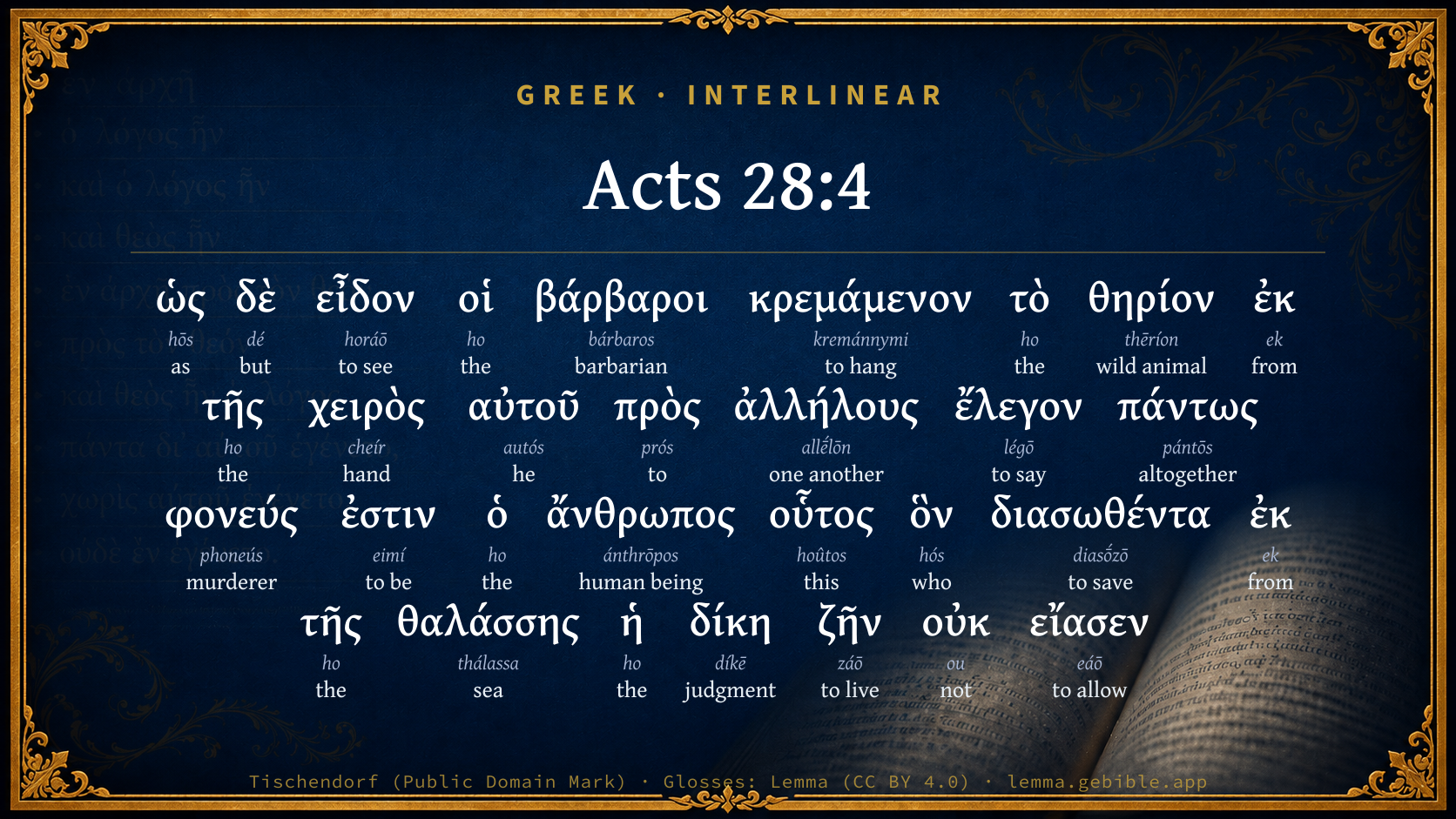
Download image
Cite this verse

Acts 28:4 (World English Bible). Public Domain. Lemma interlinear Bible study tool, https://lemma.gebible.app/v/acts/28/4.

Show BibTeX & RIS
BibTeX
RIS
English Translation
When the natives saw the creature hanging from his hand, they said one to another, "No doubt this man is a murderer, whom, though he has escaped from the sea, yet Justice has not allowed to live."
World English Bible · Public Domain
Highlights
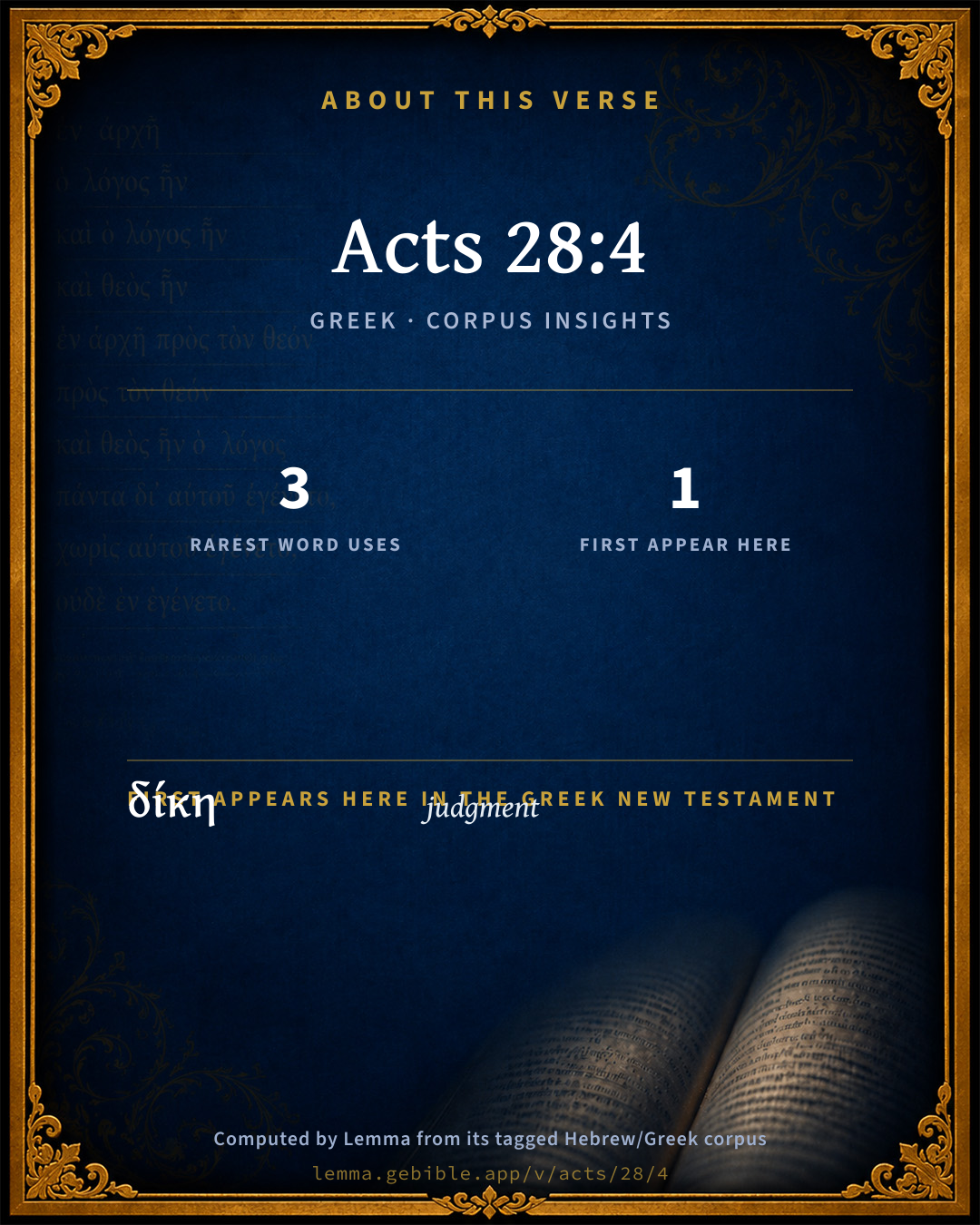
  • 1 first appearance in the Greek New Testament
Full analysis ↓
Download a study sheet

One document with this verse’s original text, its word-by-word gloss line, the meaning frame, cross-references with their text, attributed commentary, and full source and license credits — printable, and it pastes into notes with its structure intact.

This verse Autodidact and up

Study sheet (.html) Plain text (.txt)

A passage Seminary Student

Up to 50 verses in one chapter. A passage sheet keeps up to 6 commentary sources and 12 cross-references per verse, in the order this page ranks them, and says so on the sheet whenever that leaves anything out. Ask for a single verse and you get the Autodidact verse sheet above.

Everything on this page stays free to read, with no account — the sheet is a download of what is already on screen, not access to it.

Want to remove ads? Support Godless Engineer
Compare translations 3

The same verse in 3 English versions, stacked beneath the original-language interlinear above. Click any original word for its lexicon entry.

Each is an independent rendering of the whole verse — the interlinear is not word-aligned to these translations.

Highlighted words mark where these versions differ — a whole-verse word diff, not a word-by-word alignment.

  • World English Bible Public Domain
    When the natives saw the creature hanging from his hand, they said one to another, "No doubt this man is a murderer, whom, though he has escaped from the sea, yet Justice has not allowed to live."
  • King James Version Public Domain
    And when the barbarians saw the venomous beast hang on his hand, they said among themselves, No doubt this man is a murderer, whom, though he hath escaped the sea, yet vengeance suffereth not to live.
  • unfoldingWord Literal Text CC BY-SA 4.0
    And as the barbarians saw the creature hanging from his hand, they were saying to one another, “This man is certainly a murderer, whom, having been saved from the sea, Justice has not permitted to live.”

unfoldingWord Literal Text — © unfoldingWord, licensed CC BY-SA 4.0. Word-aligned USFM3 via Door43 (git.door43.org/unfoldingWord/en_ult).

Versions to compare (up to 4)

3 of 4 selected

Show all 19 translations

Every available English version of this verse, each an independent rendering of the whole verse.

  • World English Bible Public Domain
    When the natives saw the creature hanging from his hand, they said one to another, "No doubt this man is a murderer, whom, though he has escaped from the sea, yet Justice has not allowed to live."
  • Berean Standard Bible Public Domain
    When the islanders saw the creature hanging from his hand, they said to one another, “Surely this man is a murderer. Although he was saved from the sea, Justice has not allowed him to live.”
  • Majority Standard Bible Public Domain
    When the islanders saw the creature hanging from his hand, they said to one another, “Surely this man is a murderer. Although he was saved from the sea, Justice has not allowed him to live.”
  • King James Version Public Domain
    And when the barbarians saw the venomous beast hang on his hand, they said among themselves, No doubt this man is a murderer, whom, though he hath escaped the sea, yet vengeance suffereth not to live.
  • American Standard Version (1901) Public Domain
    And when the barbarians saw the `venomous' creature hanging from his hand, they said one to another, No doubt this man is a murderer, whom, though he hath escaped from the sea, yet Justice hath not suffered to live.
  • Revised Version (1885) Public Domain
    And when the barbarians saw the beast hanging from his hand, they said one to another, No doubt this man is a murderer, whom, though he hath escaped from the sea, yet Justice hath not suffered to live.
  • Geneva Bible (1599) Public Domain
    Nowe when ye Barbarians saw the worme hang on his hand, they said among themselues, This man surely is a murtherer, whom, though he hath escaped the sea, yet Vengeance hath not suffered to liue.
  • Douay-Rheims (1899) Public Domain
    And when the barbarians saw the beast hanging on his hand, they said one to another: Undoubtedly this man is a murderer, who though he hath escaped the sea, yet vengeance doth not suffer him to live.
  • Young's Literal Translation Public Domain
    And when the foreigners saw the beast hanging from his hand, they said unto one another, `Certainly this man is a murderer, whom, having been saved out of the sea, the justice did not suffer to live;'
  • Literal Standard Version CC BY-SA 4.0
    And when the foreigners saw the beast hanging from his hand, they said to one another, “Certainly this man is a murderer, whom, having been saved out of the sea, the justice did not permit to live”;
  • Unlocked Literal Bible CC BY-SA 4.0
    When the native people saw the animal hanging from his hand, they said one to another, “This man certainly is a murderer who escaped from the sea, yet justice does not permit him to live.”
  • unfoldingWord Literal Text CC BY-SA 4.0
    And as the barbarians saw the creature hanging from his hand, they were saying to one another, “This man is certainly a murderer, whom, having been saved from the sea, Justice has not permitted to live.”
  • Darby Bible Public Domain
    And when the barbarians saw the beast hanging from his hand, they said to one another, This man is certainly a murderer, whom, [though] saved out of the sea, Nemesis has not allowed to live.
  • World Messianic Bible Public Domain
    When the natives saw the creature hanging from his hand, they said to one another, “No doubt this man is a murderer, whom, though he has escaped from the sea, yet Justice has not allowed to live.”
  • Webster's Bible Public Domain
    And when the barbarians saw the animal hang on his hand, they said among themselves, No doubt this man is a murderer, whom, though he hath escaped the sea, yet vengeance suffereth not to live.
  • Free Bible Version CC BY-SA 4.0
    When the people there saw the snake hanging from his hand, they said to each other, “This man must be a murderer. Even though he escaped death from the sea, Justice won't let him live.”
  • Bible in Basic English Public Domain
    And when the people saw it hanging on his hand, they said to one another, Without doubt this man has put someone to death, and though he has got safely away from the sea, God will not let him go on living.
  • Text-Critical English NT CC BY 4.0
    When the native people saw the creature hanging from his hand, they said to one another, “This man is undoubtedly a murderer. Although he has been saved from the sea, the goddess Justice has not allowed him to live.”
  • Tyndale New Testament (1534) Public Domain
    When the men of the contre sawe the worme hange on his honde they sayde amonge the selves: this man must nedes be a mortherer. Whome (though he have escaped the see) yet vengeaunce suffreth not to lyve.

Literal Standard Version (2020), Covenant Press — licensed CC BY-SA 4.0. Text via the HelloAO Bible API (eBible.org). Unlocked Literal Bible (unfoldingWord) — licensed CC BY-SA 4.0. Text via the HelloAO Bible API (eBible.org). unfoldingWord Literal Text — © unfoldingWord, licensed CC BY-SA 4.0. Word-aligned USFM3 via Door43 (git.door43.org/unfoldingWord/en_ult). Free Bible Version, Dr. Jonathan Gallagher — licensed CC BY-SA 4.0. Text via the HelloAO Bible API (eBible.org).

Word by word

More ways to search: Search by grammar → Find every occurrence → Compare this word →

Practice this passage: Drill this verse → Learn its vocabulary →

δίκη
díkē
G1349
“judgment”
Noun, Nominative, Singular, Feminine
Part of Speech
Noun
Case
Nominative
Number
Singular
Gender
Feminine
Full Thayer's Definition

Origin: probably from G1166

TDNT: 04:58,2

1. custom, usage 2. right, just 3. a suit at law 4. a judicial hearing, judicial decision, esp. sentence of condemnation 5. execution of a sentence, punishment a. to suffer punishment 6. the goddess Justice, avenging justice
  1. ὡς hōs G5613 “as” Adverb
  2. δὲ dé G1161 “but” Conjunction
  3. εἶδον horáō G3708 “to see” Verb, Aorist, Active, Indicative, 3rd person, Plural
  4. οἱ ho G3588 “the” Article, Nominative, Plural, Masculine
  5. βάρβαροι bárbaros G915 “barbarian” Adjective, Nominative, Plural, Masculine
  6. κρεμάμενον kremánnymi G2910 “to hang” Verb, Present, Middle, Participle, Accusative, Singular, Neuter
  7. τὸ ho G3588 “the” Article, Accusative, Singular, Neuter
  8. θηρίον thēríon G2342 “wild animal” Noun, Accusative, Singular, Neuter
  9. ἐκ ek G1537 “from” Preposition
  10. τῆς ho G3588 “the” Article, Genitive, Singular, Feminine
  11. χειρὸς cheír G5495 “hand” Noun, Genitive, Singular, Feminine
  12. αὐτοῦ autós G846 “he” Personal pronoun, Genitive, Singular, Masculine
  13. πρὸς prós G4314 “to” Preposition
  14. ἀλλήλους allḗlōn G240 “one another” Reciprocal pronoun, Accusative, Plural, Masculine
  15. ἔλεγον légō G3004 “to say” Verb, Imperfect, Active, Indicative, 3rd person, Plural
  16. πάντως pántōs G3843 “altogether” Adverb
  17. φονεύς phoneús G5406 “murderer” Noun, Nominative, Singular, Masculine
  18. ἐστιν eimí G1510 “to be” Verb, Present, Active, Indicative, 3rd person, Singular
  19. ὁ ho G3588 “the” Article, Nominative, Singular, Masculine
  20. ἄνθρωπος ánthrōpos G444 “human being” Noun, Nominative, Singular, Masculine
  21. οὗτος hoûtos G3778 “this” Demonstrative pronoun, Nominative, Singular, Masculine
  22. ὃν hós G3739 “who” Relative pronoun, Accusative, Singular, Masculine
  23. διασωθέντα diasṓzō G1295 “to save” Verb, Aorist, Passive, Participle, Accusative, Singular, Masculine
  24. ἐκ ek G1537 “from” Preposition
  25. τῆς ho G3588 “the” Article, Genitive, Singular, Feminine
  26. θαλάσσης thálassa G2281 “sea” Noun, Genitive, Singular, Feminine
  27. ἡ ho G3588 “the” Article, Nominative, Singular, Feminine
  28. ζῆν záō G2198 “to live” Verb, Present, Active, Infinitive
  29. οὐκ ou G3756 “not” Particle, Negative
  30. εἴασεν eáō G1439 “to allow” Verb, Aorist, Active, Indicative, 3rd person, Singular

About this verse

These counts appear in no published source. They are computed here, from the morphology-tagged text and Lemma’s own curated glosses. What Lemma adds →

31
words
25
distinct lemmas
Acts
section

Notable vocabulary

The rarest word here is δίκη judgment G1349 — appearing just 3 times in the whole Greek New Testament.

First appearance in Scripture

This word makes its first canonical appearance in the Greek New Testament here:

  • δίκη judgment G1349

Shared distinctive vocabulary

δίκη judgment G1349 occurs in 3 verses of the Greek New Testament. Also found in:
Repetition

Words recur within this verse:

Cross-references

18

Topical passages linked to Acts 28:4 in the Treasury of Scripture Knowledge — connected by theme and wording, ordered by reader-vote popularity; previews shown in the World English Bible.

  • Luke 13:2 Jesus answered them, "Do you think that these Galileans were worse sinners than all the other Galileans, because they suffered such things?
  • Luke 13:4 Or those eighteen, on whom the tower in Siloam fell, and killed them; do you think that they were worse offenders than all the men who dwell in Jerusalem?
  • John 7:24 Don't judge according to appearance, but judge righteous judgment."
  • Acts 28:2 The natives showed us uncommon kindness; for they kindled a fire, and received us all, because of the present rain, and because of the cold.
  • Acts 28:5 However he shook off the creature into the fire, and wasn't harmed.
  • Isaiah 43:20 The animals of the field shall honor me, the jackals and the ostriches; because I give waters in the wilderness, and rivers in the desert, to give drink to my people, my chosen,
  • Matthew 23:35 that on you may come all the righteous blood shed on the earth, from the blood of righteous Abel to the blood of Zachariah son of Barachiah, whom you killed between the sanctuary and the altar.
  • John 9:1–2 As he passed by, he saw a man blind from birth.
  • Genesis 3:1 Now the serpent was more subtle than any animal of the field which Yahweh God had made. He said to the woman, "Yes, has God said, 'You shall not eat of any tree of the garden?'"
  • Genesis 4:8–11 Cain said to Abel, his brother, "Let's go into the field." It happened, when they were in the field, that Cain rose up against Abel, his brother, and killed him.
  • Genesis 9:5–6 I will surely require your blood of your lives. At the hand of every animal I will require it. At the hand of man, even at the hand of every man's brother, I will require the life of man.
  • Genesis 42:21–22 They said one to another, "We are most assuredly guilty concerning our brother, in that we saw the distress of his soul, when he begged us, and we wouldn't listen. Therefore this distress has come on us."
  • Numbers 35:31–34 Moreover you shall take no ransom for the life of a murderer who is guilty of death; but he shall surely be put to death.
  • Proverbs 28:17 A man who is tormented by life blood will be a fugitive until death; No one will support him.
  • Isaiah 26:21 For, behold, Yahweh comes forth out of his place to punish the inhabitants of the earth for their iniquity: the earth also shall disclose her blood, and shall no more cover her slain.
  • Zephaniah 2:15 This is the joyous city that lived carelessly, that said in her heart, "I am, and there is none besides me." How she has become a desolation, a place for animals to lie down in! Everyone who passes by her will hiss, and shake their fists.
  • Matthew 27:25 All the people answered, "May his blood be on us, and on our children!"
  • Revelation 21:8 But for the cowardly, unbelieving, sinners, abominable, murderers, sexually immoral, sorcerers, idolaters, and all liars, their part is in the lake that burns with fire and sulfur, which is the second death."

Cross-references courtesy of OpenBible.info (CC BY 4.0).

Commentary

Notes on Acts 28:4 from classic Christian and Jewish commentators (each source and its license shown beneath its notes). The classic Christian expositions comment on the surrounding passage and are grouped to its opening verse, so a note may address several verses; the Jewish commentaries on the Tanakh (Rashi and others) are per-verse, so they appear only where the commentator wrote on this verse.

Lemma curates 59 commentaries, every one of them public domain or Creative Commons licensed, each selected and text-cleaned for this edition rather than reprinted as found. About our sources →

Bengel's Gnomon

Johann Albrecht Bengel

Act 28:4. Ἔλεγον, they said) forming a hasty judgment. They saw his chains.—φονεὺς, a murderer) A most inhuman crime, murder, which of all crimes is most openly punished in this life.—ἡ δίκη, Vengeance) They recognise the fact, that there is some vengeance; but they account her as a goddess, and do not know who is ὁ Δίκαιος, the Just avenger. How feeble is the light of nature!—ζῆν, to live) They recognise the law of retribution in kind.—οὐκ εἴασεν, hath not suffered) They suppose Paul to be already dead.

Bengel's Gnomon of the New Testament — English translation (T&T Clark, Edinburgh, 1860) — public domain. Text from a community e-Sword module.

Meyer's Critical & Exegetical Commentary

Heinrich August Wilhelm Meyer

Act_28:4-5. Ἐκ τῆς χειρ. αὐτ.] from his hand, so that it hung fastened with its mouth in the wound. Comp. Kühner, § 622 c.

πάντως φονεύς ἐστιυ κ.τ.λ.] he is at all events a murderer, etc. From the fact that the stranger, though he had escaped from shipwreck, yet had now received this deadly bite, the people inferred that it was the work of Δίκη, who was now carrying out her sentence, and requiting like with like, killing with killing. Perhaps it had been already told to them, that Paul was a prisoner; in that case their inference was the more natural. The opinion of Elsner, to which Wolf, Kuinoel, and Lange accede, that the people might have deduced their inference from the locality of the (supposed) bite, according to the idea that punishment overtakes the member with which a crime is committed (Spanheim, ad Callim. in Cer. 64), is to be rejected for the very reason, that in fact from a bite on the hand any other crime committed by the hand might quite as well be inferred.

εἴασεν] not sinit (Vulgate, Luther, and others), but sivit; they regard the bite as so certainly fatal.

On the goddess Δίκη), the avenger of crime (Hesiod. Op. 256 ff.), Justitia, the daughter of Zeus (Hesiod. Theog. 902), and ξύνεδρος or πάρεδρος (Soph. Oed. Col. 1384; Arrian. iv. 9), see Mitscherlich, ad Hor. Od. iii. 2. 32; Ellendt, Lex. Soph. I. p. 432; Jacobs, ad Anthol. IX. p. 345. How the islanders named the goddess to whom Luke gives the Greek name Δίκη, or whether perhaps they had received the Greek Δίκη among their divinities, is not to be decided.

On the active ἀποτινάσσειν, to shake off, comp. Luk_9:5; Lam_2:7.

Meyer — Critical and Exegetical Commentary on the New Testament — English translation by Peter Christie, edited by Frederick Crombie (T&T Clark, 1880) — public domain. Text from a community e-Sword module.

Expositor's Greek Testament

ed. W. Robertson Nicoll

Act 28:4 . τὸ θηρίον : “the beast,” R.V. Although this is the meaning of the Greek word, it is to be noted that St. Luke uses it here exactly as the medical writers, who applied it to venomous serpents in particular, to the viper, ἔχιδνα (so Aristotle), and an antidote made chiefly from the flesh of vipers went by the name ἡ θηριακή (Hobart, Zahn, Knabenbauer), and those bitten by a viper were called θηριόδηκτοι . κρεμ . ἐκ : “hanging from,” R.V., it clung by its mouth to the hand of Paul, construction as in classical Greek, cf. 2Ma 6:10 . πάντως : only in Luke and Paul, expressing strong affirmation, cf. Act 21:22 , and Luk 4:23 ; cf. Tob 14:8 , Mal 3:13Mal 3:13 . φονεύς , a murderer, and therefore justice demands his life, death for death; they saw that he was a prisoner perhaps from his chains (Bengel); at all events the solders would have guarded him, as we may infer from Act 27:42 . ἡ Δίκη : “justice,” R.V., cf. Hesiod, Theog. , 902; so in Soph., Ant. , 544; Œd. Col. , 1384; for the personification cf. Wis 1:8 ; Wis 11:20 , and several instances in 4 Macc., see Grimm-Thayer, sub v. The Maltese may have heard the name from the Greeks or Romans, or they may have honoured a goddess of their own, whose name Luke here represents by ἡ Δ ., “debile lumen naturæ … nec quis sit ὁ Δίκαιος Justus Ultor norunt”, Bengel. διασωθέντα , see on Act 27:43 . οὐκ εἴασεν : “hath not suffered,” they thought of him as already dead, as if the deadly bite had already done its work; not sinit , as Vulgate, but sivit .

The Expositor's Greek Testament, edited by W. Robertson Nicoll (1897–1910) — public domain. Text from a community e-Sword module.

Geneva Bible (1599)

Geneva Bible translators

Right and reason.

Although adversity be the punishment of sin, yet seeing that God in punishing of men doth not always respect sin, they judge rashly, which either do not wait for the end, or do judge and esteem of men according to prosperity or adversity.

Geneva Bible (1599) marginal notes — public domain. Text via Bolls.life.

Jamieson, Fausset & Brown

Robert Jamieson, A. R. Fausset & David Brown

No doubt this man is a murderer--His chains, which they would see, might strengthen the impression.

whom . . . vengeance suffereth not to live--They believed in a Supreme, Resistless, Avenging Eye and Hand, however vague their notions of where it resided.

Jamieson, Fausset & Brown — Commentary Critical and Explanatory on the Whole Bible (1871) — public domain (CC PDM 1.0). Text via the HelloAO Bible API.

Adam Clarke's Commentary

Verse 4. The venomous beast] το θηριον, The venomous animal; for θηρια is a general name among the Greek writers for serpents, vipers, scorpions, wasps, and such like creatures. Though the viper fastened on Paul's hand, it does not appear that it really bit him; but the Maltese supposed that it had, because they saw it fasten on his hand.

Vengeance suffereth not to live.] These heathens had a general knowledge of retributive justice; and they thought that the stinging of the serpent was a proof that Paul was a murderer. There is a passage in Bamidbar Rabba, fol. 239, that casts some light on this place. "Although the Sanhedrin is ceased, yet are not the four deaths ceased. For he that deserves stoning either falls from his house, or a wild beast tears and devours him. He that deserves burning either falls into the fire, or a serpent bites him. He that deserves cutting of with the sword is either betrayed into the power of a heathen kingdom, or the robbers break in upon him. He that deserves strangling is either suffocated in the water, or dies of a quinsy." See Lightfoot.

As these people were heathens, it is not likely that they had any correct notion of the justice of the true God; and therefore it is most probable that they used the word δικη, not to express the quality or attribute of any being, but the goddess Dikê, or vindictive Justice, herself, who is represented as punishing the iniquities of men.

Hesiod makes a goddess of what the Maltese called Δικη, or Justice:-

Η δε τε παρθενος εϚι ΔΙΚΗ, Διος εκγεγαυια,

Κυδνη τ' αιδοιη τε θεοις, οἱ Ολυμπον εχουσιν·

Και ρ' ὁποτ' αν τις μιν βλαπτῃ σκολιως ονοταζων.

Αυτικα παρ Διΐ πατρι καθεζομενη Κρονιωνι

Γηρυετ' ανθρωπων αδικον νοον·

Hesiod. Opera, ver. 254.

JUSTICE, unspotted maid, derived from Jove,

Renown'd and reverenced by the gods above:

When mortals violate her sacred laws,

When judges hear the bribe and not the cause,

Close by her parent god, behold her stand,

And urge the punishment their sins demand.

COKE.

Adam Clarke's Commentary on the Bible (1810–1826) — public domain. Text from a community e-Sword/MySword module.

John Calvin's Commentaries

4. So soon as the barbarians saw. This judgment was common in all ages, that those who were grievously punished had grievously offended. Neither was this persuasion conceived of nothing; but it came rather from a true feeling of godliness. For God, to the end he might make the world without excuse, would have this deeply rooted in the minds of all men, that calamity and adversity, and chiefly notable destruction, were testimonies and signs of his wrath and just vengeance against sins. Therefore, so often as we call to mind any notable calamity, we do also remember that God is sore offended, seeing he punisheth so sharply. Neither did ungodliness ever get the upper hand so far, but that all men did still retain this principle, that God, to the end he may show himself to be the Judge of the world, doth notably punish the wicked. But here crept in an error almost always, because they condemned all those of wickedness whom they saw roughly handled. Though God doth always punish men’s sins with adversity, yet doth he not punish every man according to his deserts in this life; and sometimes the punishments of the godly are not so much punishments as trials of their faith and exercises of godliness.

Therefore, those men are deceived, who make this a general rule to judge every man according to his prosperity or adversity. This was the state of the controversy between Job and his friends, (Job 4:7) they did affirm that that man was a reprobate, and hated of God, whom God did punish; and he did allege, on the other side, that the godly are sometimes humbled with the cross. Wherefore, lest we be deceived in this point, we must beware of two things. The former is, that we give not rash and blind judgment of things unknown, according to the event alone, for because God doth punish the good as well as the bad; yea, it falleth out oftentimes that he spareth the reprobate, and doth sharply punish those who are his; if we will judge aright, we must begin at another thing than at punishments, to wit, that we inquire after the life and deeds. If any adulterer, if any blasphemous person, if any perjured man or murderer, if any filthy person, if any cozener, if any bloody beast be punished, God doth point out his judgment as it were with his finger. If we see no wickedness, nothing is better than to suspend our judgment concerning punishment.

The other caution is, that we wait for the end. For so soon as God beginneth to strike, we do not by and by see his drift and purpose; but the unlike end doth at length declare, that those differ far before God who seem in men’s eyes both alike in the likelihood of punishment. If any man object that it is not in vain so often repeated in the law, that all private and public miseries are the scourges of God, I grant indeed that that is true; but yet I deny that it doth keep God from sparing whom he will for a time, though they be of all men the worst, and from punishing those more sharply whose fault is mean. Nevertheless, it is not our duty to make that perpetual which falleth out oftentimes. We see now wherein the men of Melita were deceived, to wit, because having not scanned Paul’s life, they judge him to be a wicked man, only because the viper doth bite him; secondly, because they stay not the end, but give judgment rashly. Nevertheless, we must note that these are detestable monsters, who go about to pluck out of their hearts all feelings of God’s judgment, which is ingrafted in us all naturally, and which is also found in the barbarians and savage men. Whereas they think that Paul is rather guilty of murder than of any other offense, they follow this reason, because murder hath always been most detestable.

Vengeance doth not suffer. They gather that he is a wicked man, because vengeance doth persecute him though he have escaped the sea. And they feigned that the revenging goddess did sit by the seat of Jupiter, which they commonly called Δικη; grossly, I grant, as men ignorant of pure religion, and yet not without some tolerable signification, as if they had painted out God to be Judge of the world. But by these words the wrath of God is distinguished from fortune, and so the judgment of God is avouched against all blind chances. For the men of Melita take it to be a sign of the heavenly vengeance, in that though Paul be saved, yet can he not be safe.

John Calvin's Commentaries (1540-1563) — public domain. Text from the Calvin Translation Society English edition (1840s-50s) via the Christian Classics Ethereal Library (ccel.org). Calvin's coverage is partial (roughly two-thirds of the Bible); uncommented books and verses are honest gaps, never fabricated. The 19th-century editor's footnotes and remarks are omitted so the notes are faithfully Calvin's own voice.

Ellicott's Commentary for English Readers

(4) The venomous beast.—The adjective, as the italics show, is not in the Greek, and can scarcely be said to be necessary.

No doubt this man is a murderer.—They knew, we may believe, that St. Paul was a prisoner. It is hardly conceivable, indeed, that he could have come on shore bound by two chains, or even one, to his keeper, but, looking to the jealous care which the soldiers had shown in the custody of the prisoners (Act_27:42), it would be natural that they should resume their vigilance over him as soon as they were all safe on shore. And so the natives of Melita, seeing what they did, and ignorant of the prisoner’s crime, and with their rough notions of the divine government of the world, rushed to the conclusion that they were looking on an example of God’s vengeance against murder. It was in vain that such a criminal had escaped the waves; a more terrible death was waiting for him.

A Bible Commentary for English Readers, edited by Charles John Ellicott (1878–1897) — public domain. Text from a community e-Sword module.

The Cambridge Bible for Schools and Colleges

gen. ed. J. J. S. Perowne

4. saw the venomous beast] There is nothing in the Greek to represent “venomous,” though it was because the inhabitants knew that such was its character that they were so astonished at what happened.

Vengeance suffereth not to live] [R. V. “Justice hath not suffered to live”] This is an instance in which the A.V. expresses far more truly than the R. V. the sense of the Greek. The indefinite meaning of the Greek aorist is often more like what we call the English present than the perfect. “I eat” does not necessarily mean “I am eating” and covers more time than “I have eaten.” It may be present, but it can refer both to past and future time. What the people meant to say was that Justice, as her wont is, is finding out the wrong-doer.

The Cambridge Bible for Schools and Colleges (gen. ed. J. J. S. Perowne; Cambridge University Press, 1878–1918) — public domain. Text from a community e-Sword module.

John Gill's Exposition

And when the barbarians saw the venomous beast,.... The viper is called "Therion", a beast, it being of the viviparous kind; and hence comes "Theriaca", or "Venice treacle", the foundation of which composition is vipers' flesh; and it is called venomous, because it is of all serpents the most venomous: this when the country people saw

hang on his hand, having wrapped itself about it,

they said among themselves, no doubt this man is a murderer: they might see he was a prisoner by his chain, or might learn it from some of the company, and therefore took it for granted he had been guilty of some crime; and by the viper's fastening on him, they concluded it was murder he was guilty of; for the same notion might obtain among them, as among the Jews, that a murderer that could not be legally convicted, was sometimes punished this way.

"Says R. Simeon ben Shetach (l), may I never see the consolation, if I did not see one run after his friend into a desert place; and I ran after him, and I saw the sword in his hand, and the blood dropping, and he that was slain panting; and I said to him, O wicked man, who has slain this? either I or thou; but what shall I do? for thy blood is not delivered into my hand; "for the law says, by the mouth of two or three witnesses he shall surely die" (#De 17:6): may he that knows the thoughts take vengeance on that man that slew his friend; they say, they did not remove from thence, , "till a serpent came", and bit him, and he died.''

So the Jews observe, that when the execution of capital punishments was taken away from them, yet such who deserved them were punished by God in a way equivalent to them: so for instance, if a man committed a crime, for which he deserved to be burnt, either he fell into the fire, or , "a serpent bit him" (m); or if he deserved to be strangled, either he was drowned in a river, or died of a quinsy. There is a kind of an asp which the Egyptians call "Thermuthis", which they reckon sacred, and worship: this they say will not hurt good men, but destroys the wicked; and if so, says the historian, then "vengeance", or justice has honoured this creature, to be so sharp sighted as to discern the good from the bad; and they say, Isis sends it to the most wicked (n). Agreeably to which these men reason,

whom though he hath escaped the sea: has not been drowned there, when shipwrecked,

yet vengeance suffereth not to live. The Greek word "Dice" rendered "vengeance", is the name of a goddess among the Heathens, said to be the daughter of Jupiter and Themis (o). She is represented as sitting by her father Jupiter; and when anyone does injury to another, informs him of it (p). She is painted sorrowful, and with a contracted forehead, a grave countenance, and a rough aspect, to strike terror in unrighteous persons, and give confidence to righteous ones (q), agreeably to her name, which signifies "justice". This deity the barbarians supposed pursued Paul; and though she let him escape the sea, she will not suffer him to live any longer; for they looked upon the viper's fastening on him, as to be sent by her, so to be immediate death to him.

(l) T. Bab. Sanhedrin, fol. 37. 2. & Shebuot, fol. 34. 1. (m) Bemidbar Rabba, fol. 214. 2. & T. Bab. Sanhedrin, ib. & Sota, fol. 8. 2. (n) Aelian de Animal l. 10. c. 31. (o) Apollodarus de Deorurn Origon. l. 1. p. 6. Phurnutus de Natura Deorum, p. 80. (p) Hesiod Opera, &c. v. 254, 255. (q) Chrysippus apud Geilium, l. 14. c. 4.

John Gill's Exposition of the Whole Bible (1746–1763) — public domain (CC PDM 1.0). Text via the HelloAO Bible API.

Trapp's Complete Commentary

John Trapp

4 And when the barbarians saw the venomous beast hang on his hand, they said among themselves, No doubt this man is a murderer, whom, though he hath escaped the sea, yet vengeance suffereth not to live.

Ver. 4. Yet vengeance suffereth not, &c.] Nemo scelus gerit in pectore, qui non idem habet Nemesin in tergo. The fall of Blackfriars slew nearly a hundred, whereof two were priests; a third having taken water, together with many others that had escaped, purposing to go into Flanders, were drowned at London bridge shortly after, the boat being overturned.

John Trapp, A Commentary or Exposition upon All the Books of the Old and New Testament (1647–1656) — public domain. Text from a community e-Sword module.

Albert Barnes' Notes on the Bible

The venomous beast - The English word “beast” we usually apply to an animal of larger size than a viper. But the original θηρίον thērion is applicable to animals of any kind, and was especially applied by Greek writers to serpents. See Schleusner.

No doubt - The fact that the viper had fastened on him; and that, as they supposed, he must now certainly die, was the proof from which they inferred his guilt.

Is a murderer - Why they thought he was a murderer rather than guilty of some other crime is not known. It might have been:

(1) Because they inferred that he must have been guilty of some very atrocious crime, and as murder was the highest crime that man could commit, they inferred that he had been guilty of this. Or,

(2) More probably, they had an opinion that when divine vengeance overtook a man, he would be punished in a manner similar to the offence; and as murder is committed usually with the hand, and as the viper had fastened on the hand of Paul, they inferred that he had been guilty of taking life. It was supposed among the ancients that persons were often punished by divine vengeance in that part of the body which had been the instrument of the sin.

Whom, though he hath escaped the sea - They supposed that vengeance and justice would still follow the guilty; that, though he might escape one form of punishment, yet he would be exposed to another. And this, to a certain extent, is true. These barbarians reasoned from great original principles, written on the hearts of all people by nature, that there is a God of justice, and that the guilty will be punished. They reasoned incorrectly, as many do, only because that they supposed that every calamity is a judgment for some particular sin. People often draw this conclusion, and suppose that suffering is to be traced to some particular crime, and to be regarded as a direct judgment from heaven. See the notes on Joh 9:1-3. The general proposition that all sin will be punished at some time is true, but we are not qualified to affirm of particular calamities always that they are direct judgments for sin. In some cases we may. In the case of the drunkard, the gambler, and the profligate, we cannot doubt that the loss of property, health, and reputation is the direct result of specific crime. In the ordinary calamities of life, however, it requires a more profound acquaintance with the principles of divine government than we possess to affirm of each instance of suffering that it is a particular judgment for some crime.

Yet vengeance - ἡ δίκη hē dikē. “Justice” was represented by the pagan as a goddess, the daughter of Jupiter, whose office it was to take vengeance, or to inflict punishment for crimes.

Suffereth not to live - They regarded him as already a dead man. They supposed the effect of the bite of the viper would be so certainly fatal that they might speak of him as already, in effect, dead (Beza).

Albert Barnes' Notes on the Bible (1834–1885) — public domain. Text from a community e-Sword/MySword module.

Haydock's Catholic Bible Commentary

Murderer. In this instance we see how unfounded are the judgments of men. As if the misfortune itself were not sufficient to endure, the man upon whom any temporal calamity falls, must be also judged to be an object of divine vengeance. How cruel and preposterous, yet how common are such proceedings! Whence can it happen that man is so forward to think evil, so slow to suspect good in his neighbour? (Haydock) --- Not to live. The inhabitants of the island, called Barbarians, had a notion of a Deity, and also that murder was against the law of God and nature. (Witham)

George Leo Haydock (1774–1849), Haydock's Catholic Family Bible and Commentary, 1859 edition — public domain. Excludes Psalms (Douay-Rheims chapter numbering differs from Protestant) and Deuterocanonical books (Catholic canon only).

Matthew Poole's English Annotations

Venomous; so the viper is called by that appellative word, from whence also comes theriaca, or treacle, which is made out of flesh, or trochusses, of vipers. And if men can make an antidote out of poison, much more can God bring good out of evil.

This man is a murderer; it is a strange sense that men by the light of nature had of Divine vengeance, especially of God’s revenging of murder. Hence they called one of their furies Tisiphone, as one that punished and revenged murder. Yet they were to blame in this case:

1. Because they confine the punishment of wicked men wholly unto this life.

2. In that they did not expect the event; they judged before they knew what would be the end of Paul afterwards.

3. They erred, in that they measured the goodness or badness of a man’s state or cause by his prosperity or adversity.

Matthew Poole's English Annotations on the Holy Bible (1683–1685) — public domain. Text from a community e-Sword/MySword module.

Whedon's Commentary on the Bible

Daniel D. Whedon

4. Beast—Animal. The Greek word is applied to any noxious animal, quadruped, or reptile.

Vengeance—The remarkable Greek term here is Δικη, Dike, Justice, or Retribution. If it does not imply Justice to be a goddess, it certainly constitutes a strong personification. Homer is quoted by Kuinoel as saving, “Wise men of old said that Retribution is the co-assessor of Jove;” and Hesiod, “A virgin is Dike, born from Zeus.” And here Paul found a striking illustration of his own doctrine, “The Gentiles which have not the [written] law are a law unto themselves.”

Daniel D. Whedon (gen. ed.), Commentary on the Old and New Testaments (1874–1909) — public domain. Text from a community e-Sword module.

The Pulpit Commentary

Beast for venomous beast, A.V.; hanging from for hang on, A.V.; one to another for among themselves, A.V.; escaped from for escaped, A.V.; justice for vengeance, A.V.; hath not suffered for suffereth not, A.V.. The beast (toon). It is peculiar to medical writers to use qhrion as synonymous with ecidna, a viper. So also qhriodhktov, bit by a viper, qhriakh, an antidote to the bite of a viper (Dioscorides, Galen, etc.). Justice (h Dikh). In Greek mythology Dice (Justitia) was the daughter and assessor of Zeus, and the avenger of crime. In her train was Poena, of whom Horace says," Rare antecedeutem scelcstum Deseruit pede Poena claude" ("Od.," 3:2, 32). "The idea of Dice as justice personified is most perfectly developed in the dramas of Sophocles and Euripides" (article "Dice," in "Dict. of Greek and Roman Biog. and Mythol."). It does not appear whether the islanders had learned the name and office of Dice from the Greeks in Sicily, or whether they had any native divinity whose name St. Luke translates into that of Dice. The gods whose names are found in ancient Maltese inscriptions are Melkarth, another name of Hercules, the tutelar god of Tyre; Osiris, and Baal. Other Phoenician divinities are named in the Carthaginian inscriptions (see Gesenius, "Monument. Phoenic."). Had not suffered. They assume that death will certainly follow from the bite.

The superstitions of ignorance.

natives of Melita, seeing what they did, and ignorant of this prisoner"s crime, and with their rough notions of the Divine government of the world, rushed to the conclusion that they were looking on an example of God"s vengeance against murder. It was in vain that such a criminal had escaped the waves; a more terrible death was waiting for him." These men misinterpreted natural law into vengeance; yet there is a proneness in man to judge so. We expect that nature will execute the chastisement of the spiritual world. Hence all nature becomes to the imagination leagued against the transgressor. The stars in their courses fight against Sisera. The wall of Siloam falls on guilty men. The sea will not carry the criminal, nor the plank bear him; the viper stings; everything is a minister of wrath. On this conviction nations construct their trial by ordeal. The guilty man"s sword would fail in the duel, and the foot would strike and be burnt by the hot ploughshare. Borne idea of this sort lurks in all our minds. We picture to ourselves the specters of the past haunting the nightly bed of the tyrant. We take for granted there is an avenger making life miserable. In the incident of this text, and the opinions expressed, we find the thoughts of vengeance which are cherished by those who do not know the true God. Superstitions are usually akin to truth, and contain within them some measure of truth; but they are exaggerations, fashioned 50.y men"s fears, which too often wholly distort and misrepresent the truth. Estimating the superstitious fears and sentiments of these "barbarous people," we note that they were

I RIGHT IS THEIR OPINION THAT WRONGDOING NEVER ESCAPES PUNISHMENT. Their idea was that Paul was a criminal, guilty of some great crime, and justice was pursuing him; if he had escaped the doom of shipwreck, he could not get away from the avenger, who now struck at him in the viper"s bite. Explain the early notion of the blood avenger, and the classical ideas associated with the Furies. It is important that men should have a deep and unquestioning conviction that the guilty never escape; but it does not seem to be absolutely and constantly true so far as this life is concerned. Show the moral and social importance of the assurance that punishment must follow sin, and impress that God"s revelation wholly confirms the testimony of natural religion.

II THEY WERE WRONG IN THIS, THAT VENGEANCE IS A MERE THING. They thought of it as a force ever working, blindly indeed, but certainly. If baffled in one way, it set about gaining its end in another. When heathen ignorance is changed to Christian knowledge, we find:

1. That the thing which we had called vengeance is but one of the modes of the Divine working.

2. That mere calamities the things that we call accidents are not necessarily Divine vengeance (see our Lord"s teaching,. (Luk_13:1-5)

3. That God"s wrath on sin need not find its entire expression in this life, seeing that he has all the ages to work in. This our Lord figuratively expressed when he said, Fear him who can cast body and soul into hell.

4. That God"s avengings, being those of a holy Father, can never rest satisfied in the suffering of the sinful creature, but must go on to secure the creature"s redemption from the sin which issues in the suffering. Blind vengeance can rest in the destruction of the criminal. Fatherly love can never rest save in the recovery of the prodigal child. And God alone can be trusted with the avenging work. "Vengeance is mine: I will repay, saith the Lord. R.T.

The Pulpit Commentary (1880–1919), ed. H.D.M. Spence-Jones & Joseph S. Exell — public domain. Text from a community e-Sword module.

John Wesley's Explanatory Notes

And when the barbarians saw - they said - Seeing also his chains, Doubtless this man is a murderer - Such rarely go unpunished even in this life; whom vengeance hath not suffered to live - They look upon him as a dead man already. It is with pleasure that we trace among these barbarians the force of conscience, and the belief of a particular providence: which some people of more learning have stupidly thought it philosophy to despise. But they erred in imagining, that calamities must always be interpreted as judgments. Let us guard against this, lest, like them, we condemn not only the innocent, but the excellent of the earth.

John Wesley, Explanatory Notes Upon the Whole Bible (1754–1765) — public domain. Text via the GEBible commentary corpus.

McGarvey & Pendleton's Commentaries

J. W. McGarvey

See notes on verse 3

J. W. McGarvey (with Philip Y. Pendleton), Commentaries on the New Testament (The Fourfold Gospel, 1914; Acts; and the epistles) — public domain. Text from a community e-Sword/MySword module.

Cambridge Greek Testament for Schools and Colleges

4. τὸ θηρίον, the beast. There is nothing in the Greek to represent ‘venomous’ (as given in the A.V.), though it was because the inhabitants knew that such was its character that they were so astonished at what happened.

But θηρίον must have been very frequently applied to venomous creatures; for ἡ θηριακή (its derivative) is the name for an antidote against poisonous bites.

ἡ δίκη ζῇν οὐκ εἴασεν, Justice suffereth not to live, i.e. She is, as is her wont, finding out the wrongdoer.

Cambridge Greek Testament for Schools and Colleges (Cambridge University Press, 1896; 21 vols, various authors incl. Carr, Maclear, Plummer, Farrar, Lumby, Moule, M. R. James, Simcox) — public domain. Text from a community e-Sword module.

Alford’s Greek Testament

Henry Alford

4.] The natives, who were sure to know, here positively declared it to have been a venomous serpent. I make these remarks to guard against the disingenuous shifts of rationalists and semi-rationalists, who will have us believe either that the viper did not bite, or that if it did, it was not venomous.

πάντως φον. ἐστ.] ‘vincula videbant,’ Beng.

The idea of his being a murderer is not to be accounted for (as Elsner, Wolf, Kuin.) by the member which was bitten (for this would fit any crime which the hand could commit),—nor by supposing (Heinsius) the bite of a serpent to have been the Maltese punishment for murder; it is accounted for by the obviousness of the crime as belonging to the most notorious delinquents, and the aptness of the assumed punishment,—death for death.

ἡ δίκη] Justice, or Nemesis. What the Phœnician islanders called her, does not appear; but the idea is common to all religions.

Henry Alford, The Greek Testament (1849–1861) — public domain. Text from a community e-Sword module.

Vincent's Word Studies in the New Testament

Marvin R. Vincent

Justice [δικη] . Personified.

Suffereth not [ουκ ειασεν] . The aorist tense : did not suffer. His death is regarded as fixed by the divine decree.

Marvin R. Vincent, Word Studies in the New Testament (1887–1900) — public domain. Text from a community e-Sword/MySword module.

Lesson kit

Teaching starters — assembled from the data on this page, not authored interpretation. Every prompt links to the verse data it draws on. Edit before teaching.

Acts, in the Acts, opens this verse with 31 words (25 distinct Greek lemmas). Its most distinctive word is díkē (“judgment”). A historical commentator’s framing appears above. Read the whole chapter for the surrounding context.

Discussion questions

  1. The word díkē carries the sense “judgment.” How does it shape the verse?
  2. This is the first place “judgment” appears in Scripture (first appears here). What does its debut here establish?
  3. How does 2 Thessalonians 1:9, which shares the word «judgment», read alongside this verse?
  4. What does the repetition of “the” (6× in this one verse) do in this verse?
  5. These translations render this verse differently; the difference is in the English rendering, not the original. What questions does that raise?
  6. Compare how Bengel's Gnomon and Meyer's Critical & Exegetical Commentary read this verse. Where do they agree or differ?

Things to notice

  • 1 word makes its first canonical appearance in Scripture here.
  • These translations choose different wording for 27 words in this verse.
  • “the” occurs 6× in this single verse.
  • 25 distinct Greek lemmas span 31 words in this verse.

Reading settings

Reading text

Shown beneath each verse's original-language words.

Old Testament
Old Testament edition

Read the OT as the Masoretic Hebrew (MT) or the Greek Septuagint (LXX).

English shown for the Greek Septuagint (in the Hebrew ↔ Greek comparison).

Comparing translations? Open the Compare panel on any verse page to stack up to four side by side.