Revelation 13:16

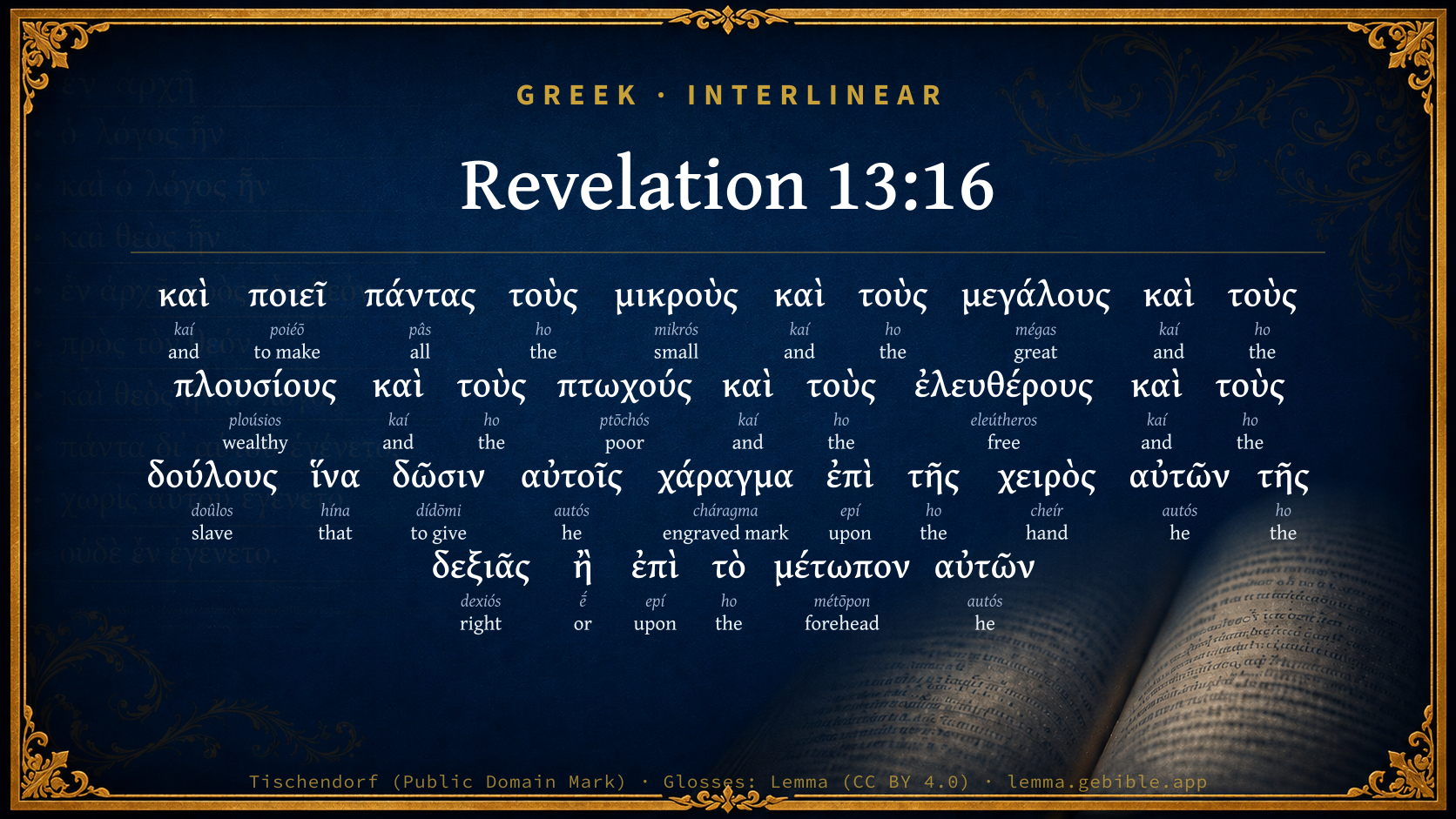
Greek (Tischendorf 8th ed.) Revelation 13:16 appears in the Greek New Testament. The text above is from the Tischendorf 8th edition. Each word links to its Strong’s number and a concise gloss. Click any word for its full Thayer’s Greek Lexicon entry.
Download image
Cite this verse

Revelation 13:16 (World English Bible). Public Domain. Lemma interlinear Bible study tool, https://lemma.gebible.app/v/revelation/13/16.

Show BibTeX & RIS
BibTeX
RIS
English Translation
He causes all, the small and the great, the rich and the poor, and the free and the slave, to be given marks on their right hands, or on their foreheads;
World English Bible · Public Domain
Download a study sheet

One document with this verse’s original text, its word-by-word gloss line, the meaning frame, cross-references with their text, attributed commentary, and full source and license credits — printable, and it pastes into notes with its structure intact.

This verse Autodidact and up

Study sheet (.html) Plain text (.txt)

A passage Seminary Student

Up to 50 verses in one chapter. A passage sheet keeps up to 6 commentary sources and 12 cross-references per verse, in the order this page ranks them, and says so on the sheet whenever that leaves anything out. Ask for a single verse and you get the Autodidact verse sheet above.

Everything on this page stays free to read, with no account — the sheet is a download of what is already on screen, not access to it.

Want to remove ads? Support Godless Engineer
Compare translations 3

The same verse in 3 English versions, stacked beneath the original-language interlinear above. Click any original word for its lexicon entry.

Each is an independent rendering of the whole verse — the interlinear is not word-aligned to these translations.

Highlighted words mark where these versions differ — a whole-verse word diff, not a word-by-word alignment.

  • World English Bible Public Domain
    He causes all, the small and the great, the rich and the poor, and the free and the slave, to be given marks on their right hands, or on their foreheads;
  • King James Version Public Domain
    And he causeth all, both small and great, rich and poor, free and bond, to receive a mark in their right hand, or in their foreheads:
  • unfoldingWord Literal Text CC BY-SA 4.0
    And it causes everyone, the small and the great and the rich and the poor and the free and the slave, that they might give to them a mark on their right hand or on their forehead,

unfoldingWord Literal Text — © unfoldingWord, licensed CC BY-SA 4.0. Word-aligned USFM3 via Door43 (git.door43.org/unfoldingWord/en_ult).

Versions to compare (up to 4)

3 of 4 selected

Show all 19 translations

Every available English version of this verse, each an independent rendering of the whole verse.

  • World English Bible Public Domain
    He causes all, the small and the great, the rich and the poor, and the free and the slave, to be given marks on their right hands, or on their foreheads;
  • Berean Standard Bible Public Domain
    And the second beast required all people small and great, rich and poor, free and slave, to receive a mark on their right hand or on their forehead,
  • Majority Standard Bible Public Domain
    And the second beast required all people, small and great, rich and poor, free and slave, to receive a mark on their right hand or on their forehead,
  • King James Version Public Domain
    And he causeth all, both small and great, rich and poor, free and bond, to receive a mark in their right hand, or in their foreheads:
  • American Standard Version (1901) Public Domain
    And he causeth all, the small and the great, and the rich and the poor, and the free and the bond, that there be given them a mark on their right hand, or upon their forehead;
  • Revised Version (1885) Public Domain
    And he causeth all, the small and the great, and the rich and the poor, and the free and the bond, that there be given them a mark on their right hand, or upon their forehead;
  • Geneva Bible (1599) Public Domain
    And he made all, both small and great, rich and poore, free and bond, to receiue a marke in their right hand or in their foreheads,
  • Douay-Rheims (1899) Public Domain
    And he shall make all, both little and great, rich and poor, freemen and bondmen, to have a character in their right hand, or on their foreheads.
  • Young's Literal Translation Public Domain
    And it maketh all, the small, and the great, and the rich, and the poor, and the freemen, and the servants, that it may give to them a mark upon their right hand or upon their foreheads,
  • Literal Standard Version CC BY-SA 4.0
    And it makes all, the small, and the great, and the rich, and the poor, and the freemen, and the servants, that it may give to them a mark on their right hand or on their foreheads,
  • Unlocked Literal Bible CC BY-SA 4.0
    It also forced everyone, unimportant and mighty, rich and poor, free and slave, to receive a mark on the right hand or on the forehead.
  • unfoldingWord Literal Text CC BY-SA 4.0
    And it causes everyone, the small and the great and the rich and the poor and the free and the slave, that they might give to them a mark on their right hand or on their forehead,
  • Darby Bible Public Domain
    And it causes all, the small and the great, and the rich and the poor, and the free and the bondmen, that they should give them a mark upon their right hand or upon their forehead;
  • World Messianic Bible Public Domain
    He causes all, the small and the great, the rich and the poor, and the free and the slave, to be given marks on their right hands or on their foreheads;
  • Webster's Bible Public Domain
    And he causeth all, both small and great, rich and poor, free and bond, to receive a mark in their right hand, or in their foreheads:
  • Free Bible Version CC BY-SA 4.0
    He made everyone, whether weak or powerful, rich or poor, free or slave, receive a mark on their right hand or on their foreheads.
  • Bible in Basic English Public Domain
    And he gives to all, small and great, the poor and those who have wealth, the free and those who are not free, a mark on their right hand or on their brows;
  • Text-Critical English NT CC BY 4.0
    The second beast required everyone, both small and great, both rich and poor, both free and slave, to receive a mark on their right hand or on their forehead,
  • Tyndale New Testament (1534) Public Domain
    And he made all bothe smale and grett ryche and poore fre and bond to receave a marke in their right hondes or in their forheddes.

Literal Standard Version (2020), Covenant Press — licensed CC BY-SA 4.0. Text via the HelloAO Bible API (eBible.org). Unlocked Literal Bible (unfoldingWord) — licensed CC BY-SA 4.0. Text via the HelloAO Bible API (eBible.org). unfoldingWord Literal Text — © unfoldingWord, licensed CC BY-SA 4.0. Word-aligned USFM3 via Door43 (git.door43.org/unfoldingWord/en_ult). Free Bible Version, Dr. Jonathan Gallagher — licensed CC BY-SA 4.0. Text via the HelloAO Bible API (eBible.org).

Word by word

More ways to search: Search by grammar → Find every occurrence → Compare this word →

Practice this passage: Drill this verse → Learn its vocabulary →

χάραγμα
cháragma
G5480
“engraved mark”
Noun, Accusative, Singular, Neuter
Part of Speech
Noun
Case
Accusative
Number
Singular
Gender
Neuter
Full Thayer's Definition

Origin: from the same as G5482

TDNT: 15:56,1

1. a stamp, an imprinted mark a. of the mark stamped on the forehead or the right hand as the badge of the followers of the Antichrist b. the mark branded upon horses 2. thing carved, sculpture, graven work a. of idolatrous images
  1. καὶ kaí G2532 “and” Conjunction
  2. ποιεῖ poiéō G4160 “to make” Verb, Present, Active, Indicative, 3rd person, Singular
  3. πάντας pâs G3956 “all” Adjective, Accusative, Plural, Masculine
  4. τοὺς ho G3588 “the” Article, Accusative, Plural, Masculine
  5. μικροὺς mikrós G3398 “small” Adjective, Accusative, Plural, Masculine
  6. καὶ kaí G2532 “and” Conjunction
  7. τοὺς ho G3588 “the” Article, Accusative, Plural, Masculine
  8. μεγάλους mégas G3173 “great” Adjective, Accusative, Plural, Masculine
  9. καὶ kaí G2532 “and” Conjunction
  10. τοὺς ho G3588 “the” Article, Accusative, Plural, Masculine
  11. πλουσίους ploúsios G4145 “wealthy” Adjective, Accusative, Plural, Masculine
  12. καὶ kaí G2532 “and” Conjunction
  13. τοὺς ho G3588 “the” Article, Accusative, Plural, Masculine
  14. πτωχούς ptōchós G4434 “poor” Adjective, Accusative, Plural, Masculine
  15. καὶ kaí G2532 “and” Conjunction
  16. τοὺς ho G3588 “the” Article, Accusative, Plural, Masculine
  17. ἐλευθέρους eleútheros G1658 “free” Adjective, Accusative, Plural, Masculine
  18. καὶ kaí G2532 “and” Conjunction
  19. τοὺς ho G3588 “the” Article, Accusative, Plural, Masculine
  20. δούλους doûlos G1401 “slave” Noun, Accusative, Plural, Masculine
  21. ἵνα hína G2443 “that” Conjunction
  22. δῶσιν dídōmi G1325 “to give” Verb, Aorist, Active, Subjunctive, 3rd person, Plural
  23. αὐτοῖς autós G846 “he” Personal pronoun, Dative, Plural, Masculine
  24. ἐπὶ epí G1909 “upon” Preposition
  25. τῆς ho G3588 “the” Article, Genitive, Singular, Feminine
  26. χειρὸς cheír G5495 “hand” Noun, Genitive, Singular, Feminine
  27. αὐτῶν autós G846 “he” Personal pronoun, Genitive, Plural, Masculine
  28. τῆς ho G3588 “the” Article, Genitive, Singular, Feminine
  29. δεξιᾶς dexiós G1188 “right” Adjective, Genitive, Singular, Feminine
  30. ἢ ḗ G2228 “or” Particle
  31. ἐπὶ epí G1909 “upon” Preposition
  32. τὸ ho G3588 “the” Article, Accusative, Singular, Neuter
  33. μέτωπον métōpon G3359 “forehead” Noun, Accusative, Singular, Neuter
  34. αὐτῶν autós G846 “he” Personal pronoun, Genitive, Plural, Masculine

About this verse

These counts appear in no published source. They are computed here, from the morphology-tagged text and Lemma’s own curated glosses. What Lemma adds →

35
words
19
distinct lemmas
Revelation
section

Notable vocabulary

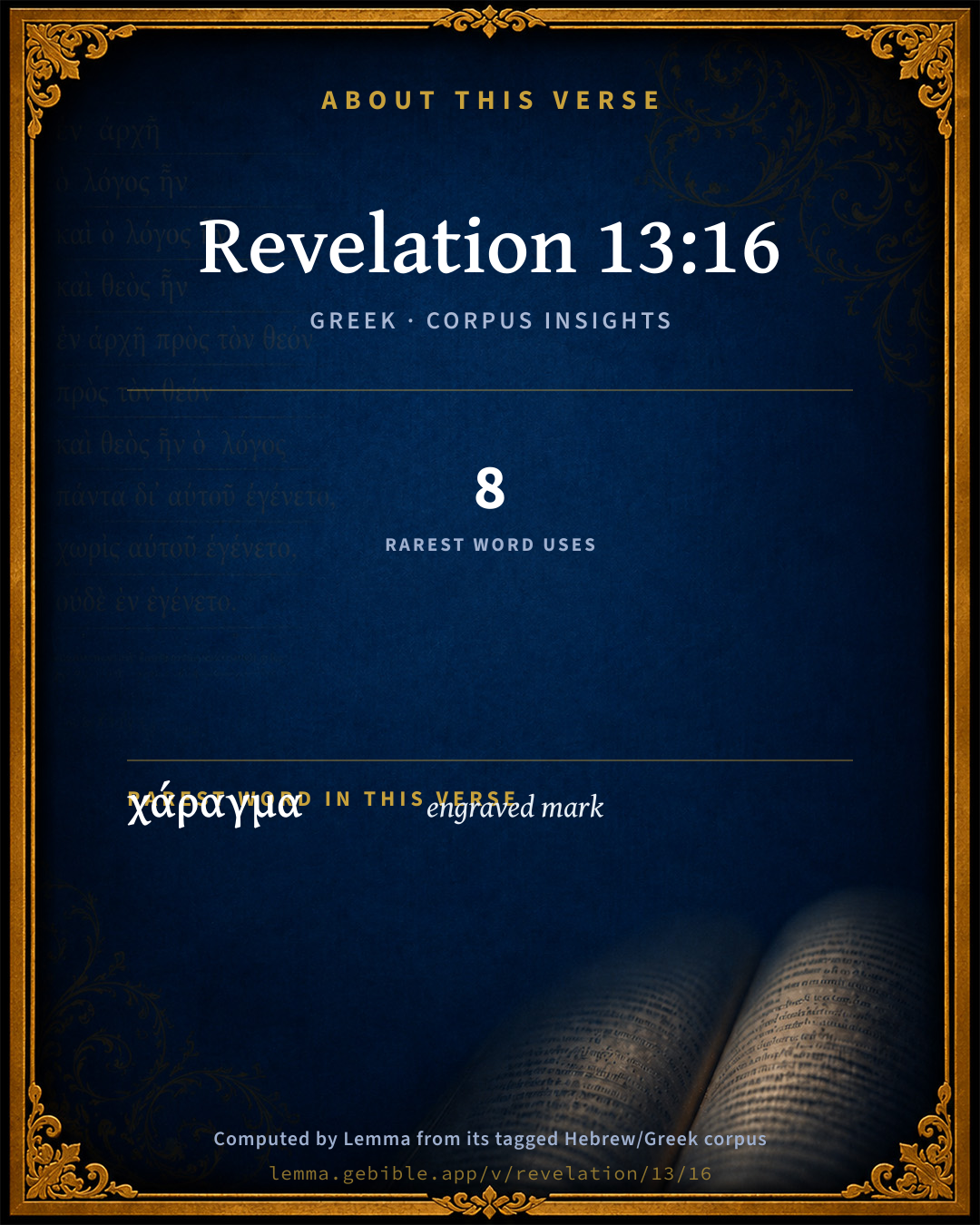
The rarest word here is χάραγμα engraved mark G5480 — appearing just 8 times in the whole Greek New Testament.

Shared distinctive vocabulary

χάραγμα engraved mark G5480 occurs in 8 verses of the Greek New Testament. Also found in:

Repetition

Words recur within this verse:

  • ἐπὶ upon G1909 ×2
  • τοὺς the G3588 ×9
  • καὶ and G2532 ×6
  • αὐτοῖς he G846 ×3

Cross-references

26

Topical passages linked to Revelation 13:16 in the Treasury of Scripture Knowledge — connected by theme and wording, ordered by reader-vote popularity; previews shown in the World English Bible.

  • Revelation 20:4 I saw thrones, and they sat on them, and judgment was given to them. I saw the souls of those who had been beheaded for the testimony of Jesus, and for the word of God, and such as didn't worship the beast nor his image, and didn't receive the mark on their forehead and on their hand. They lived, and reigned with Christ for the thousand years.
  • Revelation 19:20 The beast was taken, and with him the false prophet who worked the signs in his sight, with which he deceived those who had received the mark of the beast and those who worshiped his image. These two were thrown alive into the lake of fire that burns with sulfur.
  • Ezekiel 9:4 Yahweh said to him, Go through the midst of the city, through the midst of Jerusalem, and set a mark on the foreheads of the men that sigh and that cry over all the abominations that are done in the midst of it.
  • Deuteronomy 6:8 You shall bind them for a sign on your hand, and they shall be for symbols between your eyes.
  • Revelation 7:3 saying, "Don't harm the earth, neither the sea, nor the trees, until we have sealed the bondservants of our God on their foreheads!"
  • Revelation 14:9–11 Another angel, a third, followed them, saying with a great voice, "If anyone worships the beast and his image, and receives a mark on his forehead, or on his hand,
  • Revelation 19:18 that you may eat the flesh of kings, the flesh of captains, the flesh of mighty men, and the flesh of horses and of those who sit on them, and the flesh of all men, both free and slave, and small and great."
  • Exodus 13:9 It shall be for a sign to you on your hand, and for a memorial between your eyes, that the law of Yahweh may be in your mouth; for with a strong hand Yahweh has brought you out of Egypt.
  • Deuteronomy 11:18 Therefore shall you lay up these my words in your heart and in your soul; and you shall bind them for a sign on your hand, and they shall be for symbols between your eyes.
  • Revelation 6:15 The kings of the earth, the princes, the commanding officers, the rich, the strong, and every slave and free person, hid themselves in the caves and in the rocks of the mountains.
  • Revelation 19:5 A voice came forth from the throne, saying, "Give praise to our God, all you his servants, you who fear him, the small and the great!"
  • Job 34:19 Who doesn't respect the persons of princes, Nor regards the rich more than the poor; For they all are the work of his hands.
  • Psalms 115:13 He will bless those who fear Yahweh, Both small and great.
  • Acts 26:22 Having therefore obtained the help that is from God, I stand to this day testifying both to small and great, saying nothing but what the prophets and Moses said would happen,
  • Revelation 20:12 I saw the dead, the great and the small, standing before the throne, and they opened books. Another book was opened, which is the book of life. The dead were judged out of the things which were written in the books, according to their works.
  • 2 Chronicles 15:13 and that whoever would not seek Yahweh, the God of Israel, should be put to death, whether small or great, whether man or woman.
  • Psalms 49:2 Both low and high, Rich and poor together.
  • 1 Corinthians 12:13 For in one Spirit we were all baptized into one body, whether Jews or Greeks, whether bond or free; and were all given to drink into one Spirit.
  • Galatians 3:28 There is neither Jew nor Greek, there is neither slave nor free man, there is neither male nor female; for you are all one in Christ Jesus.
  • Galatians 6:17 From now on, let no one cause me any trouble, for I bear the marks of the Lord Jesus branded on my body.
  • Ephesians 6:8 knowing that whatever good thing each one does, he will receive the same again from the Lord, whether he is bound or free.
  • Colossians 3:11 where there can't be Greek and Jew, circumcision and uncircumcision, barbarian, Scythian, bondservant, freeman; but Christ is all, and in all.
  • Revelation 11:18 The nations were angry, and your wrath came, as did the time for the dead to be judged, and to give your bondservants the prophets, their reward, as well as to the saints, and those who fear your name, to the small and the great; and to destroy those who destroy the earth."
  • Revelation 15:2 I saw something like a sea of glass mixed with fire, and those who overcame the beast, his image, and the number of his name, standing on the sea of glass, having harps of God.
  • Zechariah 13:6 One will say to him, 'What are these wounds between your arms?' Then he will answer, 'Those with which I was wounded in the house of my friends.'
  • 2 Timothy 3:8 Even as Jannes and Jambres opposed Moses, so do these also oppose the truth; men corrupted in mind, reprobate concerning the faith.

Cross-references courtesy of OpenBible.info (CC BY 4.0).

Where the printed editions differ

1 variant

Places in this verse where the major printed Greek editions disagree on the wording in a way that affects the translation — a comparison of editions, not a manuscript-by-manuscript collation. The editions are the modern critical texts (Nestlé-Aland 28/27, SBL, Westcott-Hort, Tregelles, Tyndale House) and the traditional texts behind the KJV (the Textus Receptus and the Byzantine/Majority text). It is not a claim about which reading is original.

  1. Different wording
    μέτωπον

    “forehead”

    In NA28NA27TynSBLWHTregByz Not in TR

    μέτωπων (metōpōn) 'foreheads' occurs in traditional manuscripts (TR) instead of μέτωπον (metōpon) 'forehead' in older manuscripts (NA28+NA27+Tyn+SBL+WH+Treg+Byz)

Textual data: Translators Amalgamated Greek New Testament (STEPBible TAGNT) · CC BY 4.0.

Commentary

Notes on Revelation 13:16 from classic Christian and Jewish commentators (each source and its license shown beneath its notes). The classic Christian expositions comment on the surrounding passage and are grouped to its opening verse, so a note may address several verses; the Jewish commentaries on the Tanakh (Rashi and others) are per-verse, so they appear only where the commentator wrote on this verse.

Lemma curates 59 commentaries, every one of them public domain or Creative Commons licensed, each selected and text-cleaned for this edition rather than reprinted as found. About our sources →

Albert Barnes' Notes on the Bible

And he caused all - He claims jurisdiction, in the matters here referred to, over all classes of persons, and compels them to do his will. This is the second beast, and, according to the interpretation given above, it relates to the papal power, and to its claim of universal jurisdiction.

Both small and great - All these expressions are designed to denote universality - referring to various divisions into which the human family may be regarded as divided. One of those divisions is into “small and great”; that is, into young and old; those small in stature and those large in stature; those of humble, and those of elevated rank.

Rich and poor - Another way of dividing the human race, and denoting here, as in the former case, all - for it is a common method, in speaking of mankind, to describe them as “the rich and poor.”

Free and bond - Another method still of dividing the human race, embracing all - for all the dwellers upon the earth are either free or bond. These various forms of expression, therefore, are designed merely to denote, in an emphatic manner, universality. The idea is, that, in the matter referred to, none were exempt, either on account of their exalted rank, or on account of their humble condition; either because they were so mighty as to be beyond control, or so mean and humble as to be beneath notice. And if this refers to the papacy, every one will see the propriety of the description. The jurisdiction set up by that power has been as absolute over kings as over the feeble and the poor; over masters and their slaves; alike over those in the humblest and in the most elevated walks of life.

To receive a mark in their right hand, or in their foreheads - The word here rendered “mark” - χάραγμα charagma - occurs only in one place in the New Testament except in the Book of Revelation Act 17:29, where it is rendered “graven.” In all the other places where it is found Rev 13:16-17; Rev 14:9, Rev 14:11; Rev 15:2; Rev 16:2; Rev 19:20; Rev 20:4, it is rendered “mark,” and is applied to the same thing - the “mark of the beast.” The word properly means “something graven or sculptured”; hence:

(a)A graving, sculpture, sculptured work, as images or idols;

(b)A mark cut in or stamped - as the stamp on a coin.

Applied to people, it was used to denote some stamp or mark on the hand or elsewhere - as in the case of a servant on whose hand or arm the name of the master was impressed; or of a soldier on whom some mark was impressed denoting the company or phalanx to which he belonged. It was no uncommon thing to mark slaves or soldiers in this way; and the design was either to denote their ownership or rank, or to prevent their escaping so as not to be detected.

Most of us have seen such marks made on the hands or arms of sailors, in which, by a voluntary tattooing, their names, or the names of their vessels, were written, or the figure of an anchor, or some other device, was indelibly made by punctures in the skin, and by inserting some kind of coloring matter. The thing which it is here said was engraven on the hand or the forehead was the “name” of the beast, or the “number” of his name, Rev 13:17. That is, the “name” or the “number” was so indelibly inscribed either on the hand or the forehead, as to show that he who bare it pertained to the “beast,” and was subject to his authority - as a slave is to his master, or a soldier to his commander. Applied to the papacy, the meaning is, that there would be some mark of distinction; some indelible sign; something which would designate, with entire certainty, those persons who belonged to it, and who were subject to it. It is hardly necessary to say that, in point of fact, this has eminently characterized the papacy. All possible care has been taken to designate with accuracy those who belong to that communion, and, all over the world, it is easy to distinguish those who render allegiance to the papal power. Compare the notes on Rev 7:3.

Albert Barnes' Notes on the Bible (1834–1885) — public domain. Text from a community e-Sword/MySword module.

The Biblical Illustrator

Joseph S. Exell

Rev_13:16

He causeth all … to receive a mark.

Soul-marks

The words he causeth clearly ascribe this operation to the second beast. If it had been the first we might imagine that some outward mark or sign was meant, for that beast deals with the visible and outward. But this one stamps an image on the souls of men; this writes a name on all their inward thoughts, which afterwards expresses itself in their common daily acts. Men fancy, when they read and talk of some great tyrant-power which has established itself in their country or their age, that they are reading and talking of something which is far off from them. They can comment upon it, measure its effects, calculate the chances of its continuance or of its fall. If any complain of it as bad in its origin or immoral in its practices, wise persons will whisper, But it does not hurt you. You can buy and sell happily under the shadow of it. Your gains are not seriously lessened. You incur no great risks of loss. And all the time these wise persons are not aware that they themselves, as well as those with whom they are conversing, have received the mark of this power on their foreheads and their right hands; that the image of it is graven in their hearts; that they are showing in these very discourses of theirs that they bear the name and character of that which they are excusing. (F. D. Maurice, M. A.)

Animalism: the mark of the beast

The question that I want to ask is this, Whoever the beast is, what makes him a beast? What is the bestial element in him, whoever he be? And the answer is not far to find, Godless selfishness, that is the mark of the beast. Wherever a human nature is self-centred, God forgetting, and therefore God-opposing (for whoever forgets God defies Him), that nature has gone down below humanity, and has touched the lower level of the brutes. Men are so made as that they must either rise to the level of God, or certainly go down to the level of the brute. And wherever you get men living by their own fancies, for their own pleasure, in forgetfulness and neglect of the sweet and mystic bonds that should knit them to God, there you get the image of the beast and the number of his name. And besides that godless selfishness, we may point to simple animalism as literally the mark of the beast. He who lives not by conscience and by faith, but by fleshly inclination and sense, lowers himself to the level of the instinctive brute-life, and beneath it, because he refuses to obey faculties which they do not possess, and what is nature in them is degradation in us. Look at the unblushing sensuality which marks many respectable people nowadays. Look at the foul fleshliness of much of popular art and poetry. Look at the way in which pure animal passion, the lust of the flesh, and the lust of the eye, and the love of good things to eat and plenty to drink is swaying and destroying men and women by the thousand among us. Look at the temptations that lie along every street in Manchester for every young man after dusk. Look at the thin veneer of culture over the ugliest lust. Scratch the gentleman and you find the satyr. Is it much of an exaggeration, in view of the facts of English life to-day, to say that all the world wanders after and worships this beast? (A. Maclaren, D. D.)

The number of his name.--

The number of the name

It is indeed remarkable that the seer should speak at all of the number of the name of the beast. Why not be content with the name itself?

1. St. John may not himself have known the name. He may have been acquainted only with the character of the beast, and with the fact, too often overlooked by inquirers, that to that character its name, when made known, must correspond. No reader of St. Johns writings can have failed to notice that to him the word nam is far more than a mere appellative. It expresses the inner nature of the person to whom it is applied. No man could know the new name written upon the white stone given to him that overcometh but he that receiveth it. In other words, no one but a Christian indeed could have that Christian experience which would enable him to understand the new name. In like manner now, St. John may have felt that it was not possible for the followers of Christ to know the name of antichrist. But this need not hinder him from giving the number. The number spoke only of general character and fate; and knowledge of it did not imply, like knowledge of the name, communion of spirit with him to whom the name belonged. (W. Milligan, D. D.)

The Biblical Illustrator, edited by Joseph S. Exell (c. 1880s–1900s) — public domain. Text from a community e-Sword module.

Tyndale Open Study Notes

Tyndale Open Resources

13:16-17 small and great, rich and poor, free and slave: All humanity is required to accept the beast’s evil mark of ownership (see 14:9, 11; 19:20; 20:4), a precondition for all commerce (the right to buy or sell). The text does not explicitly tell us what the mark is or looks like. • On the right hand or on the forehead suggests the branding of slaves—the beast owns them. • the number representing his name: In both Hebrew and Greek, letters of the alphabet represent numbers, which gave names a numerical value (13:18).

Tyndale Open Study Notes — © Tyndale Open Resources, licensed CC BY-SA 4.0. Text via the HelloAO Bible API.

Meyer's Critical & Exegetical Commentary

Heinrich August Wilhelm Meyer

Rev_13:16-17. καὶ ποιεῖ πάντας

ἵνα δῶσιν αὐτοῖς χαρ.

καὶ ἵνα μή τις, κ.τ.λ. The first ἵνα, just as Rev_13:12; the second ἵνα (Rev_13:17) has a different relation to the ποιεῖ, which is to be regarded as repeated before it, in so far as here an immediate determination of the object is lacking.

John describes how the entire number of worshippers of the beast,[3379] who recognize one another by a mark which certifies that they belong to the beast, hinder the intercourse, required even in business with respect to their daily life, of saints who have not received that mark of the beast.

ΔῶΣΙΝ ΑὐΤΟῚς ΧΆΡΑΓΜΑ. Deceived by the second beast unto the worship of the first beast (Rev_13:14), the dwellers on the earth put a mark upon themselves; they receive it willingly.[3380]

ἘΠῚ Τῆς ΧΕΙΡῸς ΑὐΤῶΝ Τῆς ΔΕΞΙᾶς Ἢ ἘΠῚ ΤῸ ΜΈΤΩΠΟΝ ΑὐΤῶΝ. Züll. and Hengstenb. unjustly resist the acknowledgment[3381] that the idea contains an allusion to the heathen custom of branding slaves and soldiers, and thus of designating that they belong to the same master. It is just concerning this that the treatment refers, and not with respect to a counterpart of Deu_6:8; for the ΧΆΡΑΓΜΑ of the worshippers of the beast is to mark them as such, and to render them distinguishable as of the same nature, but in itself by no means contains an admonition of a service of the beast to which they are bound. The reminiscence of the Gentile custom is the more natural here, as the worshippers of the beast are partners in the Gentile-Roman Empire. The ΧΆΡΑΓΜΑ, however, is not the bringing together by a confession,[3382] but it is the definite external mark indicated in both its forms in Rev_13:17, which is attached either to the forehead or the right hand, and thus in places most readily presented to the eyes; for, since it is intended only for visibility, whether it be attached to the one or the other place is a matter of indifference.[3383] Inappropriately, Hengstenb. says: The forehead is the most suitable place for the confession (? Rom_10:10), and the right hand comes into consideration as the instrument for action. But just because the parallel assertion ἘΠῚ Τ. ΜΈΤΩΠΟΝ ΑΎΤ. does not allow any other reference than to the convenient visibility of the mark, the ἘΠῚ Τ. ΧΕῖΡ. ΑὐΤ. Τ. ΔΕΞ. also cannot have any deeper reference. The right hand is mentioned because this must manifest itself especially in daily use.

The nature of the signature contained by the χάραγμα is definitely expressed in Rev_13:17 : ΤῸ ὌΝΟΜΑ ΤΟῦ ΘΗΡΊΟΥ, Ἢ ΤῸΝ ἈΡΙΘΜῸΝ ΤΟῦ ὈΝΌΜΑΤΟς ΑὐΤΟῦ, i.e., either the express name by which the beast is known, and. therefore written in letters, or the number which gives the numerical value of the letters contained in the name.[3384] In every respect perversely, Coccejus says that the ΧΆΡΑΓΜΑ is the law, the ὌΝΟΜΑ the Catholic Church, and the ἈΡΙΘΜ. unwritten tradition.

[3379] The specifications τ. μικροῦς κ. τ. μεγ., κ.τ.λ., exhaust in a perceptible way the idea of the πἁντας. Cf. Rev_6:15, Rev_11:18, Rev_19:18.

[3380] Cf. Rev_14:9; Rev_14:11, Rev_16:2, Rev_19:20, Rev_20:4.

[3381] Grot., Ebrard, etc.

[3382] Against Hengstenb., who yet himself remarks that the confession has an impulse for an external sign.

[3383] Cf., on the other hand, Rev_7:3.

[3384] Cf. De Wette, etc.

Meyer — Critical and Exegetical Commentary on the New Testament — English translation by Peter Christie, edited by Frederick Crombie (T&T Clark, 1880) — public domain. Text from a community e-Sword module.

Expositor's Greek Testament

ed. W. Robertson Nicoll

Rev 13:16-17 . Detection was inevitable, for the very coins were stamped (Mat 22:19 ) with the head of the Cæsar, the gods, or Rome itself, and the prophet apparently expected that genuine Christians would refuse to sanction idolatry and condone blasphemy by handling such emblems of profanity ( cf. Ign. ad Magn. 5, δύο νομίσματα , ὃ μὲν θεοῦ , ὃ δὲ κόσμου ). Only abject, servile devotees of the cultus will stoop to that! Irenæus has a similar allusion (iv. 30. 2) to those who carried money “cum inscriptione et imagine Cæsaris”. μέτωπον . This highly figurative allusion is to the habit of marking soldiers and slaves with a conspicuous tattoo or brand ( cf. Lucian, Dea Syra ; 3Ma 2:29 , where the Alexandrian Jews are branded with the mark of Dionysius; also on Gal 6:17 ); or, better still, to the religious custom of wearing a god’s name as a talisman ( cf. Deissmann, 349 f.). The general sense of the prediction is that the faithful will be shut up to the alternative of starving or of coming forward to avow their prohibited faith, so subtly and diabolically does the cultus of the emperor pervade all social life. Another solution is to think of the χάραγμα or red stamp, which was essential to all documents of exchange (Deissmann, 240 f.); it consisted of a red seal with tho emperor’s name or effigy. Ramsay ( Seven Letters , pp. 106 f.) takes the whole description as a symbolic and rather sarcastic way of referring to a boycotting demand that every Asiatic Christian should somehow “stamp himself overtly and visibly as loyal, or be disqualified from participation in ordinary social life and trading”. Probably the passage is a figurative and unqualified expression for conspicuous loyalty to the Imperial cult. In Ep. Lugd. the devil is said to work against Christ by “excluding us from houses, baths, and markets, and also by forbidding any one of us to appear anywhere”.

The Expositor's Greek Testament, edited by W. Robertson Nicoll (1897–1910) — public domain. Text from a community e-Sword module.

Geneva Bible (1599)

Geneva Bible translators

The mark of the name of the beast.

The third place, is a most wicked and most insolent tyrrany as was said before, usurped over the persons of men in this verse: and over their goods and actions, in the next verse. For he is said, both to bring upon all persons a tyrannous servitude, that as bondslaves they might serve the beast: and also to exercise over all their goods and actions, a peddler-like abuse of indulgences and dispensations (as they term them) amongst their friends, and against others to use most violent interdictions, and to shoot out cursings, even in natural and civil, private and public contracts, wherein all good faith ought to have place.

That is, their Chrism, by which in the Sacrament (as they call it) of Confirmation, they make servile unto themselves, the persons and doings of men, signing them in their forehead and hands: and as for the sign left by Christ (of which Rev. 7:3) and the holy Sacrament of Baptism they make as void. For whom Christ hath joined unto himself by Baptism, this beast maketh challenge unto them by her greasy Chrism, which he doubteth not to prefer over Baptism, both in authority and efficacy.

Geneva Bible (1599) marginal notes — public domain. Text via Bolls.life.

Jamieson, Fausset & Brown

Robert Jamieson, A. R. Fausset & David Brown

to receive a mark--literally, "that they should give them a mark"; such a brand as masters stamp on their slaves, and monarchs on their subjects. Soldiers voluntarily punctured their arms with marks of the general under whom they served. Votaries of idols branded themselves with the idol's cipher or symbol. Thus Antiochus Epiphanes branded the Jews with the ivy leaf, the symbol of Bacchus (2 Maccabees 6:7; 3 Maccabees 2:29). Contrast God's seal and name in the foreheads of His servants, Rev 7:3; Rev 14:1; Rev 22:4; and Gal 6:17, "I bear in my body the marks of the Lord Jesus," that is, I am His soldier and servant. The mark in the right hand and forehead implies the prostration of bodily and intellectual powers to the beast's domination. "In the forehead by way of profession; in the hand with respect to work and service" [AUGUSTINE].

Jamieson, Fausset & Brown — Commentary Critical and Explanatory on the Whole Bible (1871) — public domain (CC PDM 1.0). Text via the HelloAO Bible API.

Adam Clarke's Commentary

Verse 16. And he caused all, both small and great, rich and poor, free and bond, to receive a mark] To ascertain the meaning of the mark which the two-horned beast causes all orders and degrees of men in the Latin world to receive, we need only refer to Re 14:11, where the mark imposed by the two-horned beast is called the mark of his name. The name of the beast is the Latin empire: the mark of his name must therefore be his LATIN worship: for this very reason, that it is the two-horned beast, or false prophet, who causes all descriptions of persons to receive it. Now it is well known that the continual employment of the Latin clergy is to enforce the Latin idolatry upon their flocks. The mass and offices of the Church, which are in Latin, and contain the sum and substance of their idolatrous worship, are of different kinds, and abound in impious prayers to the Virgin Mary, and the saints and angels. In a word, the LATIN worship is the universal badge of distinction of the LATIN Church, from all other Churches on the face of the earth; and is therefore the only infallible MARK by which a genuine papist can be distinguished from the rest of mankind. But the two-horned beast causes all to receive this mark:-

In their right hand, or in their foreheads] Right hand in Scripture language, when used figuratively, represents the physical power of the person of whom it is spoken; and when applied to God designates a signal manifestation of Divine power against his enemies, and in behalf of his people. See Ps 17:7; Ps 20:6; Ps 21:8; Ps 45:3; Ps 45:4, c. The reception of the mark in the right hand must therefore mean, that all so receiving it devote the whole powers of their mind and body to the propagation of the Latin worship, and to the eradication of all they denominate heresies out of their Church. But some receive the mark in their foreheads. By any thing being impressed upon the forehead, is meant the public profession of whatever is inscribed or marked upon it. See Rev 9:4; Rev 14:1; Rev 22:4, c. The mark of the beast being received on the forehead, therefore, means that all those so marked make a public profession of the Latin worship whereby it is evident to all that they form a part of the Latin Church. Many may be marked in the right hand who are also marked on their foreheads, but it does not follow that those marked on their foreheads are also marked in their right hand; that is to say, it is not every individual that complies with the Latin worship who, to the utmost of his power, endeavours to propagate his religious system. Hence the propriety of the words, "He causeth all-to receive a mark in their right hand, OR in their foreheads."

Adam Clarke's Commentary on the Bible (1810–1826) — public domain. Text from a community e-Sword/MySword module.

Ellicott's Commentary for English Readers

(16, 17) And he causeth . . .—Better, And he [i.e., probably, the second wild beast, and not the image, as in the latter clause of the last verse] makes all men, the small and the great, and the rich and the poor, and the free and the slaves, that they should give them a mark upon their right hand or upon their forehead: (and) that no one should be able to buy or to sell but he who has the mark, the name of the wild beast, or the number of his name. We have read of the sealing of the servants of God in their foreheads (Rev_7:3): we shall hear of it again (Rev_22:4); the power of evil also has its mark or stamp. As slaves received a brand or mark in their flesh, betokening to whom they belonged, so in the spiritual conflict there is on the side of good and of evil a brand or mark. St. Paul spoke of such marks in his own body that proved him a slave of Jesus Christ (Gal_6:17). In the same way the subtle false prophet, the abettor of world-power, seeks to impress a mark on all, on the penalty of complete social exclusion. It is utterly unnecessary to take this brand of evil literally, any more than we took the seal of Christ literally. That seal we understood as spiritual, in the faith and in the character; this evil brand we must interpret in like manner. It surely means the acquiescence in character and action to the principles of this tyrannical world-power: the right hand is the symbol of toil and social intercourse; the forehead is the symbol of character, as time is ever writing its awful tale upon men’s brows. There have been days when men’s faith has been read only too plainly by a hostile world, and when their simple trust in Christ caused Christians to be suspected, and when “men cast out their name as evil,” and when the mark of the beast was worn and gloried in everywhere. We might cite from the history of the past numberless such epochs. But are we sure that the days are gone? Are we sure that it is easy for simple, unaffected goodness and genuine faith to gain all it might gain? Are we sure that honesty, guilelessness, utter and strenuous truthfulness are not weighted in the race of life? The days of the future may bring intenser forms of this tyranny, as the days of the past have shown them; but the days of the present may afford us illustrations of how readily men may lose, lose much and lose terribly, rather than succumb to fashions which violate honour and dishonour Christ. But we read of more than a mark here: we read of a “name,” and the “number of a name.” What are we to understand by these?

A Bible Commentary for English Readers, edited by Charles John Ellicott (1878–1897) — public domain. Text from a community e-Sword module.

The Cambridge Bible for Schools and Colleges

gen. ed. J. J. S. Perowne

16. to receive] Lit. that they give them.

a mark] The word for “mark” is not the same as in Gal_6:17, but the image is, as there, that of the brand put upon slaves to identify them; pagan devotees sometimes received such a brand, marking them as the property of their god. In the so-called Third Book of Maccabees (which, stupid as it is, has perhaps some historical foundation) we are told that Ptolemy Philopator ordered the Jews of Alexandria to be branded with an ivy-leaf, the cognisance of Dionysus. One may compare also the sealing of the servants of God in chap. 7, and Rev_14:1.

The Cambridge Bible for Schools and Colleges (gen. ed. J. J. S. Perowne; Cambridge University Press, 1878–1918) — public domain. Text from a community e-Sword module.

John Gill's Exposition

And that no man might buy or sell,.... Either in an ecclesiastical sense, as to, be in any church office, or perform any such service, to say Mass, hear confession, give absolution, sell pardons and indulgences, &c. or in a civil sense, as to trade, and exercise merchandise, and this was forbidden by several Popish councils and synods; the Lateran council, under Pope Alexander, decreed against the Waldenses and Albigenses, that no one should presume to retain or encourage them in their houses or countries, or "trade" with them; and the synod of Tours in France forbid any reception of heretics, or protection, and that any communion should be had with them "in buying and selling", as Mr. Mede has observed; and it was ordered by a bull of Pope Martin the Fifth, that no contract should be made with such, and that they should not follow any business and merchandise:

save he that had the mark; took the oath to be true to the pope, or made a public profession of the Popish religion:

or the name of the beast; Papists, so called from the pope; thus the antichristians are called from antichrist, as the Christians from Christ:

or the number of his name; which is either the same with the number of the beast in Rev 13:18, or is something distinct it; and those who have it may be such persons who neither have the indelible character of the Romish clergy, nor are open professors of the Popish religion, but are in heart inclined to it, and privately and secretly promote it, by their doctrines and practices; and so are numbered, reckoned, esteemed, and accounted of by the Papists, and receive favours from them; or rather such who openly "furnish the drink offering" in the Mass, mixed with wine and water, "for that number", Isa 65:11.

John Gill's Exposition of the Whole Bible (1746–1763) — public domain (CC PDM 1.0). Text via the HelloAO Bible API.

Trapp's Complete Commentary

John Trapp

16 And he causeth all, both small and great, rich and poor, free and bond, to receive a mark in their right hand, or in their foreheads:

Ver. 16. All both small and great] Emperor and else. The pope having by his nephew persuaded the king of Bohemia, Maximilian (afterwards emperor), to be a good Catholic, with many promises of honours and profits, intimating the succession of the empire, which else he should hardly obtain, was answered by the king, that he thanked his Holiness, but that his soul’s health was more dear to him than all the things in the world. Which answer they said in Rome was a Lutheran form of speech, and signified an alienation from that See; and they began to discourse what would happen after the old emperor’s death. (Hist. of the Coun. Trent, p. 418.)

To receive a mark] The Popish clergy say, that in their ordination they receive an indelible character. They may choose whether they will have it in their foreheads (where it cannot be hid) or in their right hands, where they may either hide it or show it as they think good. {See Trapp on "Rev 7:3"} The mark common to all the Popish rabble is, St Peter’s keys branching out itself in every antichristian doctrine and idolatrous practice. I can never sufficiently admire (saith Mr Heyrick) the speech of blessed Luther, who though he was very earnest to have the communion administered in both kinds contrary to the doctrine and custom of Rome, yet he professeth, If the pope, as pope, commanded him to receive in both kinds, he would but receive in one kind. It is a general rule among the best, that what the pope commands, as pope, though it be good or indifferent, as to pray, read, lift up an eye, hand, to wear black or white, &c., it is a receiving of the mark of the beast, &c. (Mr Heyrick’s Serm., p. 108.)

John Trapp, A Commentary or Exposition upon All the Books of the Old and New Testament (1647–1656) — public domain. Text from a community e-Sword module.

Matthew Poole's English Annotations

No particular character is here to be understood, but only the general imposition of the Romish faith upon all sorts of persons. His mark was nothing else but either the profession of his faith and religion, or a vowed subjection to his commands, which we know is the practice of the papacy where it obtaineth in any country.

Matthew Poole's English Annotations on the Holy Bible (1683–1685) — public domain. Text from a community e-Sword/MySword module.

Whedon's Commentary on the Bible

Daniel D. Whedon

16. And he—That is, the living and supreme image.

Causeth—On this word, here and in the previous verse, we may note, 1. The entire body of Romish clergy find their own supremacy over the people to be identified with the absoluteness of the pope over themselves. And hence a common self-interest makes them a unit. An intense rivalry thence arises, to raise the pope to the highest point of supremacy. Thereby the pope becomes the primal causative spring of all persecutions to maintain the papal power. 2. But when charged with these persecutions, the papist replies that it is not the spiritual power, but the temporal magistracy, that really executes the punishment. The priest condemns, and the magistrate inflicts. The pope, therefore, does not execute; he causeth others to execute the heretic.

A mark—Slaves, soldiers, and sailors were often marked by masters and sovereigns in token of ownership. Note on Gal_6:17. Ptolemy Philopater (3Ma_2:29) enrolled the Jews of Alexandria as soldiers, and had them branded with the ivy of Bacchus with hot iron. And Philo says that some idolaters had their bodies branded with hot iron as an indelible mark which could not be obscured by time. The mark was branded, says Augustine, sometimes on forehead to denote profession, sometimes on the hand to denote activity of service.

Daniel D. Whedon (gen. ed.), Commentary on the Old and New Testaments (1874–1909) — public domain. Text from a community e-Sword module.

The Pulpit Commentary

And he causeth all, both small and great, rich and poor, free and bond, to receive a mark in their right hand, or in their foreheads; that there be given them a mark on their right hand, or upon their forehead. Dwsh , "he may give," found in the Textus Receptus, is unsupported by any uncial; dwsin , "they may give," is read in a, A, B, C, P; and most cursives have either dwsin or dwswsin . Wordsworth translates, "give to themselves," and adds, "a remarkable sentence, intimating compulsion under the semblance of choice." But it does not seem fair to press the meaning so far. The third plural is often used in a perfectly general way in the Apocalypse, (cf. Rev_12:6, and Moulton"s Winer, p. 655) and the Revised Version is probably correct in translating by the passive (vide supra). Certainly the other passages in the Apocalypse, where the mark is mentioned, seem to show that men have absolute freedom of choice. (see especially Rev_14:9 and Rev_20:4) Again the beast seeks to imitate God. (cf. Rev_3:12, "I will write upon him my new name;" Rev_22:4, "His name shall be in their foreheads;" Rev_7:3 Rev_9:4 Rev_14:1) The idea is taken kern the Mosaic customs (cf. Deu_6:8, "And thou shalt bind them for a sign upon thine hand, and they shall be as frontiers between thine eyes Some writers see also an allusion to the heathen custom of branding slaves and others who were devoted to the service of temples; and recall the fact that caragmata , or "cuttings," such as are here mentioned, were forbidden to the Jews. (Lev_19:28)

The Pulpit Commentary (1880–1919), ed. H.D.M. Spence-Jones & Joseph S. Exell — public domain. Text from a community e-Sword module.

John Wesley's Explanatory Notes

On their forehead - The most zealous of his followers will probably choose this. Others may receive it on their hand.

John Wesley, Explanatory Notes Upon the Whole Bible (1754–1765) — public domain. Text via the GEBible commentary corpus.

Scofield Reference Notes

C. I. Scofield

he causeth

Antichrist the person is to be distinguished from the "many antichrists" 1Jn 2:18 and the "spirit of antichrist" 1Jn 4:3 which characterizes all. The supreme mark of all is the denial of the Christian truth of the incarnation of the Logos, the eternal Son in Jesus as the Christ Joh 1:1; Joh 1:14.

(See Scofield "Mat 1:16").

The "many antichrists" precede and prepare the way for the Antichrist, who is "the Beast out of the earth" of Rev 13:11-17 and the "false prophet" of; Rev 16:13; Rev 19:20; Rev 20:10. He is the last ecclesiastical head, as the Beast of Rev 13:1-8 is the last civil head. For purposes of persecution he is permitted to exercise the autocratic power of the emperor- Beast.

(See Scofield "Rev 19:20").

The Scofield Reference Bible (1917 edition), notes by C. I. Scofield — public domain. Text from a community e-Sword module.

The People's New Testament

B. W. Johnson

16. He causeth all … to receive a mark. The mark of the beast is some stamp or sign, by which all its worshipers should be known. In ancient days slaves were sometimes branded, as cattle are in our own age. The brand or mark of the beast would be some indelible sign which would designate with certainty those who were subject to his authority. A mark in the hand is supposed by some to represent the practice, while a mark in the forehead indicates the profession of life. It is remarkable, however, that a mark on the forehead, the sign of the cross made with water, converts a person into a Roman Catholic, and without this mark none are regarded as heirs of salvation.

B. W. Johnson's The People's New Testament with Notes (1889–1891) — public domain. Electronic text from the Christian Classics Ethereal Library (CCEL) ThML edition.

Cambridge Greek Testament for Schools and Colleges

16. δῶσιν αὐτοῖς χάραγμα. 26 and 95 have λάβωσι τὸ χάραγμα αὐτοῦ. The Latin versions have habere. א* has αὐτῷ for αὐτοῖς.

16. καὶ ποιεῖ resumes the construction of Rev 13:14.

ἵνα δῶσιν αὐτοῖς. Is δῶσιν impersonal as λέγουσιν Rev 10:11, βλέπωσιν Rev 16:15? but for αὐτοῖς we should supply the subject from the previous accusatives.

χάραγμα. Cf. τὰ στίγματα Ἰησοῦ, Gal 6:17. The image is, as there, that of the brand put upon slaves to identify them; pagan devotees sometimes received such a brand, marking them as the property of their god. In the so-called Third Book of Maccabees (which, stupid as it is, has perhaps some historical foundation) we are told that Ptolemy Philopator ordered the Jews of Alexandria to be branded with an ivy-leaf, the cognisance of Dionysus. One may compare also the sealing of the servants of God in chap, 7, and Rev 14:1.

Cambridge Greek Testament for Schools and Colleges (Cambridge University Press, 1896; 21 vols, various authors incl. Carr, Maclear, Plummer, Farrar, Lumby, Moule, M. R. James, Simcox) — public domain. Text from a community e-Sword module.

Vincent's Word Studies in the New Testament

Marvin R. Vincent

A mark [χαραγμα] . The word occurs frequently in Revelation, and only once elsewhere (Act 17:29) on which see note. commentators find illustrations in the brand set upon slaves by their masters, or upon soldiers by their monarchs, and in the branding of slaves attached to certain temples. Herodotus describes a temple to Hercules at the Canopic mouth of the Nile, and says : "If a slave runs away from his master, and taking sanctuary at this shrine gives himself up to the God, and receives certain sacred marks upon his person, whosoever his master may be, he cannot lay hand on him" (ii., 113). In the treatise "concerning the Syrian goddess" falsely attributed to Lucian, it is said of the slaves of the temple, "all are branded, some upon the wrist and some upon the neck." Paul, in Gal 6:17, applies the word for these brands, stigmata, to the marks of Christ 's service which he bears in his body. In 3 Macc. 2 29, we read that Ptolemy Philopator required all the Jews of Alexandria to be registered among the common people; and that those who were thus registered were to be marked [χαρασεσθαι] on their persons by the ivy - leaf symbol of Dionysus (Bacchus). In Lev 19:28, the Israelites are forbidden to make cuttings in their flesh for the dead and to print marks [γραμματα στικτα] upon themselves.

Marvin R. Vincent, Word Studies in the New Testament (1887–1900) — public domain. Text from a community e-Sword/MySword module.

Lesson kit

Teaching starters — assembled from the data on this page, not authored interpretation. Every prompt links to the verse data it draws on. Edit before teaching.

Revelation, in the Revelation, opens this verse with 35 words (19 distinct Greek lemmas). Its most distinctive word is cháragma (“engraved mark”). A historical commentator’s framing appears above. Read the whole chapter for the surrounding context.

Discussion questions

  1. How does “engraved mark” (cháragma) shape what this verse is saying?
  2. Acts 17:29 shares the word «engraved mark» with this verse. How do the two illuminate each other?
  3. “upon” occurs 2× in this one verse. What is the effect of the repetition?
  4. The translations on this page render this verse differently — a whole-verse word diff, not a word-by-word alignment. What might account for the different wordings?
  5. Reading how Albert Barnes' Notes on the Bible and The Biblical Illustrator read this verse, where do the two commentators agree and where do they part?

Things to notice

Reading settings

Reading text

Shown beneath each verse's original-language words.

Old Testament
Old Testament edition

Read the OT as the Masoretic Hebrew (MT) or the Greek Septuagint (LXX).

English shown for the Greek Septuagint (in the Hebrew ↔ Greek comparison).

Comparing translations? Open the Compare panel on any verse page to stack up to four side by side.