1 Thessalonians 4:11

Greek (Tischendorf 8th ed.) 1 Thessalonians 4:11 appears in the Greek New Testament. The text above is from the Tischendorf 8th edition. Each word links to its Strong’s number and a concise gloss. Click any word for its full Thayer’s Greek Lexicon entry.
Download image
Cite this verse

1 Thessalonians 4:11 (World English Bible). Public Domain. Lemma interlinear Bible study tool, https://lemma.gebible.app/v/1-thessalonians/4/11.

Show BibTeX & RIS
BibTeX
RIS
English Translation
and that you make it your ambition to lead a quiet life, and to do your own business, and to work with your own hands, even as we charged you;
World English Bible · Public Domain
Download a study sheet

One document with this verse’s original text, its word-by-word gloss line, the meaning frame, cross-references with their text, attributed commentary, and full source and license credits — printable, and it pastes into notes with its structure intact.

This verse Autodidact and up

Study sheet (.html) Plain text (.txt)

A passage Seminary Student

Up to 50 verses in one chapter. A passage sheet keeps up to 6 commentary sources and 12 cross-references per verse, in the order this page ranks them, and says so on the sheet whenever that leaves anything out. Ask for a single verse and you get the Autodidact verse sheet above.

Everything on this page stays free to read, with no account — the sheet is a download of what is already on screen, not access to it.

Want to remove ads? Support Godless Engineer
Compare translations 3

The same verse in 3 English versions, stacked beneath the original-language interlinear above. Click any original word for its lexicon entry.

Each is an independent rendering of the whole verse — the interlinear is not word-aligned to these translations.

Highlighted words mark where these versions differ — a whole-verse word diff, not a word-by-word alignment.

  • World English Bible Public Domain
    and that you make it your ambition to lead a quiet life, and to do your own business, and to work with your own hands, even as we charged you;
  • King James Version Public Domain
    And that ye study to be quiet, and to do your own business, and to work with your own hands, as we commanded you;
  • unfoldingWord Literal Text CC BY-SA 4.0
    and to strive to be quiet and to perform your own things and to work with your own hands, just as we commanded you,

unfoldingWord Literal Text — © unfoldingWord, licensed CC BY-SA 4.0. Word-aligned USFM3 via Door43 (git.door43.org/unfoldingWord/en_ult).

Versions to compare (up to 4)

3 of 4 selected

Show all 19 translations

Every available English version of this verse, each an independent rendering of the whole verse.

  • World English Bible Public Domain
    and that you make it your ambition to lead a quiet life, and to do your own business, and to work with your own hands, even as we charged you;
  • Berean Standard Bible Public Domain
    and to aspire to live quietly, to attend to your own matters, and to work with your own hands, as we instructed you.
  • Majority Standard Bible Public Domain
    and to aspire to live quietly, to attend to your own matters, and to work with your own hands, as we instructed you.
  • King James Version Public Domain
    And that ye study to be quiet, and to do your own business, and to work with your own hands, as we commanded you;
  • American Standard Version (1901) Public Domain
    and that ye study to be quiet, and to do your own business, and to work with your hands, even as we charged you;
  • Revised Version (1885) Public Domain
    and that ye study to be quiet, and to do your own business, and to work with your hands, even as we charged you;
  • Geneva Bible (1599) Public Domain
    And that ye studie to be quiet, and to meddle with your owne busines, and to worke with your owne handes, as we commanded you,
  • Douay-Rheims (1899) Public Domain
    And that you use your endeavour to be quiet, and that you do your own business, and work with your own hands, as we commanded you: and that you walk honestly towards them that are without; and that you want nothing of any man's.
  • Young's Literal Translation Public Domain
    and to study to be quiet, and to do your own business, and to work with your own hands, as we did command you,
  • Literal Standard Version CC BY-SA 4.0
    and to study to be quiet, and to do your own business, and to work with your own hands, as we commanded you,
  • Unlocked Literal Bible CC BY-SA 4.0
    We also exhort you to aspire to live quietly, take care of your own responsibilities, and work with your hands, just as we commanded you,
  • unfoldingWord Literal Text CC BY-SA 4.0
    and to strive to be quiet and to perform your own things and to work with your own hands, just as we commanded you,
  • Darby Bible Public Domain
    and to seek earnestly to be quiet and mind your own affairs, and work with your [own] hands, even as we charged you,
  • World Messianic Bible Public Domain
    and that you make it your ambition to lead a quiet life, and to do your own business, and to work with your own hands, even as we instructed you,
  • Webster's Bible Public Domain
    And that ye study to be quiet, and to do your own business, and to work with your own hands, as we commanded you;
  • Free Bible Version CC BY-SA 4.0
    Try to live a quiet life, minding your own business, doing your own work, as we've already explained to you,
  • Bible in Basic English Public Domain
    And that you may take pride in being quiet and doing your business, working with your hands as we gave you orders;
  • Text-Critical English NT CC BY 4.0
    We urge you to aspire to lead a quiet life, to attend to your own affairs, and to work with your own hands, just as we commanded you,
  • Tyndale New Testament (1534) Public Domain
    and that ye studye to be quyet and to medle with youre awne busynes and to worke with youre awne hondes as we commaunded you:

Literal Standard Version (2020), Covenant Press — licensed CC BY-SA 4.0. Text via the HelloAO Bible API (eBible.org). Unlocked Literal Bible (unfoldingWord) — licensed CC BY-SA 4.0. Text via the HelloAO Bible API (eBible.org). unfoldingWord Literal Text — © unfoldingWord, licensed CC BY-SA 4.0. Word-aligned USFM3 via Door43 (git.door43.org/unfoldingWord/en_ult). Free Bible Version, Dr. Jonathan Gallagher — licensed CC BY-SA 4.0. Text via the HelloAO Bible API (eBible.org).

Word by word

More ways to search: Search by grammar → Find every occurrence → Compare this word →

Practice this passage: Drill this verse → Learn its vocabulary →

φιλοτιμεῖσθαι
philotiméomai
G5389
“to love honor”
Verb, Present, Middle or Passive deponent, Infinitive
Part of Speech
Verb
Tense
Present
Voice
Middle or Passive deponent
Mood
Infinitive
Full Thayer's Definition

Origin: middle voice from a compound of G5384 and G5092

TDNT: None

1. to be fond of honour a. to be actuated by love of honour b. from a love of honour to strive to bring something to pass 2. to be ambitious a. to strive earnestly, make it one's aim
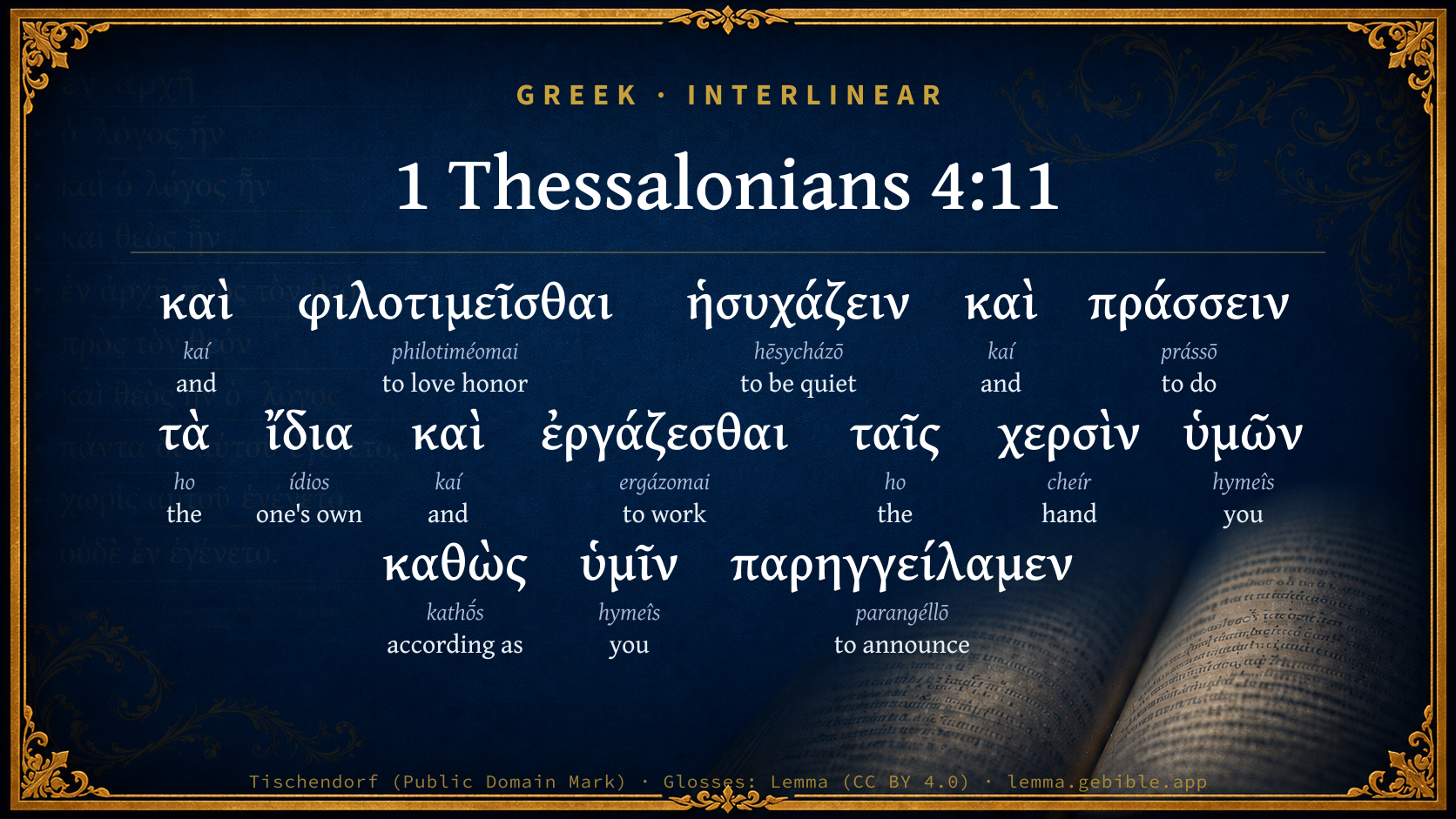
  1. καὶ kaí G2532 “and” Conjunction
  2. ἡσυχάζειν hēsycházō G2270 “to be quiet” Verb, Present, Active, Infinitive
  3. καὶ kaí G2532 “and” Conjunction
  4. πράσσειν prássō G4238 “to do” Verb, Present, Active, Infinitive
  5. τὰ ho G3588 “the” Article, Accusative, Plural, Neuter
  6. ἴδια ídios G2398 “one's own” Adjective, Accusative, Plural, Neuter
  7. καὶ kaí G2532 “and” Conjunction
  8. ἐργάζεσθαι ergázomai G2038 “to work” Verb, Present, Middle or Passive deponent, Infinitive
  9. ταῖς ho G3588 “the” Article, Dative, Plural, Feminine
  10. χερσὶν cheír G5495 “hand” Noun, Dative, Plural, Feminine
  11. ὑμῶν hymeîs G5210 “you” Personal pronoun, 2nd person, Genitive, Plural
  12. καθὼς kathṓs G2531 “according as” Adverb
  13. ὑμῖν hymeîs G5210 “you” Personal pronoun, 2nd person, Dative, Plural
  14. παρηγγείλαμεν parangéllō G3853 “to announce” Verb, Aorist, Active, Indicative, 1st person, Plural

About this verse

These counts appear in no published source. They are computed here, from the morphology-tagged text and Lemma’s own curated glosses. What Lemma adds →

15
words
11
distinct lemmas
Pauline Epistles
section

Notable vocabulary

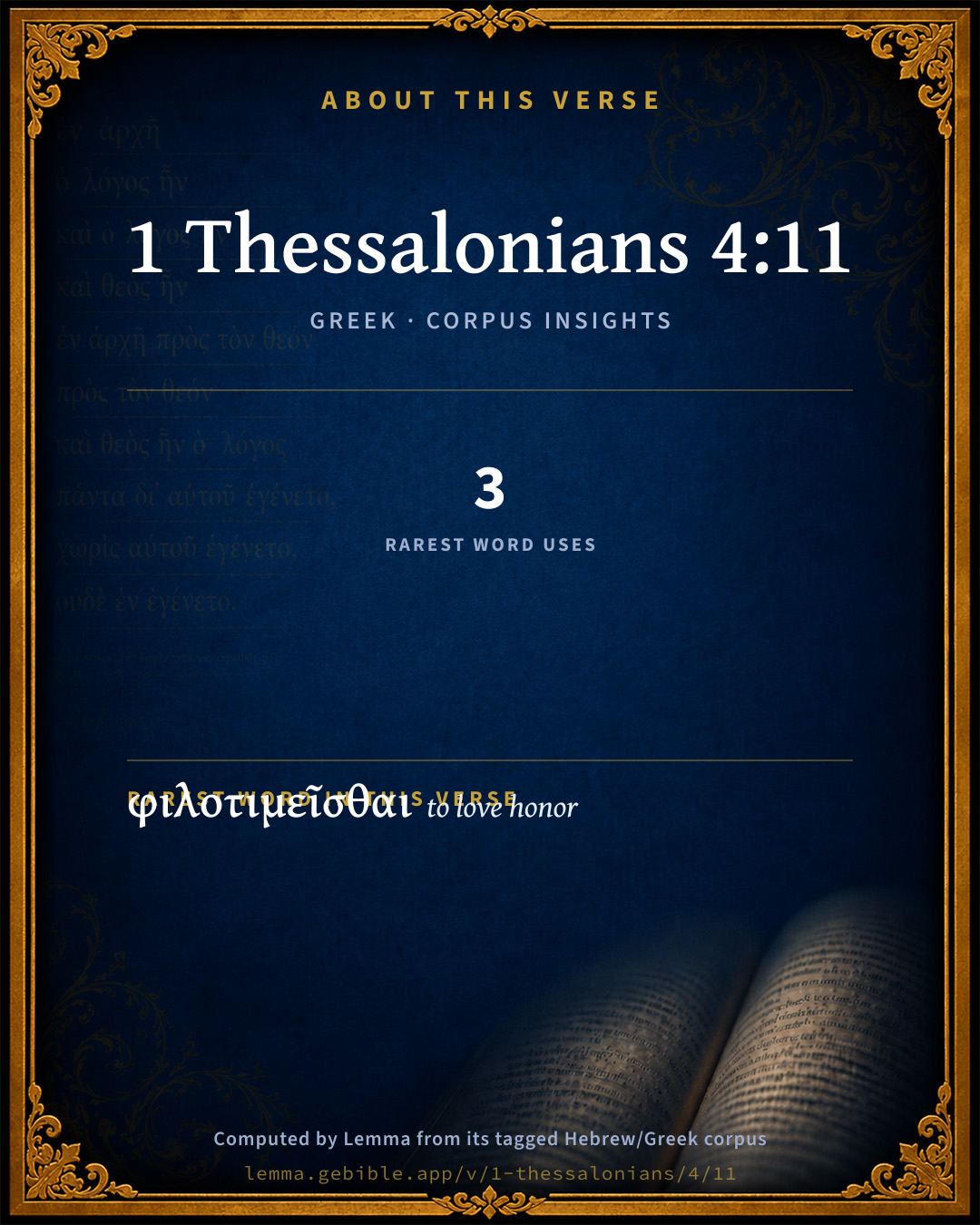
The rarest word here is φιλοτιμεῖσθαι to love honor G5389 — appearing just 3 times in the whole Greek New Testament.

Shared distinctive vocabulary

φιλοτιμεῖσθαι to love honor G5389 occurs in 3 verses of the Greek New Testament. Also found in:

Repetition

Words recur within this verse:

Cross-references

22

Topical passages linked to 1 Thessalonians 4:11 in the Treasury of Scripture Knowledge — connected by theme and wording, ordered by reader-vote popularity; previews shown in the World English Bible.

  • Ecclesiastes 4:6 Better is a handful, with quietness, than two handfuls with labor and chasing after wind.
  • Ephesians 4:28 Let him who stole steal no more; but rather let him labor, working with his hands the thing that is good, that he may have something to give to him who has need.
  • 1 Peter 3:4 but in the hidden person of the heart, in the incorruptible adornment of a gentle and quiet spirit, which is in the sight of God very precious.
  • Titus 3:14 Let our people also learn to maintain good works for necessary uses, that they may not be unfruitful.
  • Proverbs 17:1 Better is a dry morsel with quietness, Than a house full of feasting with strife.
  • Lamentations 3:26 It is good that a man should hope and quietly wait for the salvation of Yahweh.
  • 1 Timothy 2:2 for kings and all who are in high places; that we may lead a tranquil and quiet life in all godliness and reverence.
  • 1 Corinthians 4:12 We toil, working with our own hands. When people curse us, we bless. Being persecuted, we endure.
  • Romans 12:11 not lagging in diligence; fervent in spirit; serving the Lord;
  • 1 Timothy 5:13 Besides, they also learn to be idle, going about from house to house. Not only idle, but also gossips and busybodies, saying things which they ought not.
  • 2 Corinthians 5:9 Therefore also we make it our aim, whether at home or absent, to be well pleasing to him.
  • 1 Peter 4:15 For let none of you suffer as a murderer, or a thief, or an evil doer, or as a meddler in other men's matters.
  • 2 Thessalonians 3:7–12 For you know how you ought to imitate us. For we didn't behave ourselves rebelliously among you,
  • Acts 20:35 In all things I gave you an example, that so laboring you ought to help the weak, and to remember the words of the Lord Jesus, that he himself said, 'It is more blessed to give than to receive.'"
  • Titus 2:4–10 that they may train the young women to love their husbands, to love their children,
  • Mark 13:34 "It is like a man, traveling to another country, having left his house, and given authority to his servants, and to each one his work, and also commanded the doorkeeper to keep watch.
  • Luke 12:42–43 The Lord said, "Who then is the faithful and wise steward, whom his lord will set over his household, to give them their portion of food at the right times?
  • Colossians 3:22–24 Servants, obey in all things those who are your masters according to the flesh, not just when they are looking, as men-pleasers, but in singleness of heart, fearing God.
  • 1 Peter 4:10–11 According as each has received a gift, be ministering it among yourselves, as good stewards of the grace of God in its various forms.
  • Romans 15:20 yes, making it my aim to preach the Gospel, not where Christ was already named, that I might not build on another's foundation.
  • Acts 18:3 and because he practiced the same trade, he lived with them and worked, for by trade they were tent makers.
  • Romans 12:4–8 For even as we have many members in one body, and all the members don't have the same function,

Cross-references courtesy of OpenBible.info (CC BY 4.0).

Commentary

Notes on 1 Thessalonians 4:11 from classic Christian and Jewish commentators (each source and its license shown beneath its notes). The classic Christian expositions comment on the surrounding passage and are grouped to its opening verse, so a note may address several verses; the Jewish commentaries on the Tanakh (Rashi and others) are per-verse, so they appear only where the commentator wrote on this verse.

Lemma curates 59 commentaries, every one of them public domain or Creative Commons licensed, each selected and text-cleaned for this edition rather than reprinted as found. About our sources →

The Preacher's Complete Homiletical Commentary

Joseph S. Exell (gen. ed.)

CRITICAL AND EXPLANATORY NOTES

1Th_4:11. Study to be quiet.—R.V. margin, “Go: be ambitious.” “An example of St. Paul’s characteristic irony: the contrast between ambition and quiet, giving a sharper point to his exhortation, as though he said, ‘Make it your ambition to have no ambition!’ ” (Ibid.). To do your own business.—To be occupied with your own affairs.

1Th_4:12. That ye may walk honestly—The adverb here is used to match the verb—to walk with a dignified and gentlemanly bearing. St. Paul’s ideas of gentlemanliness—“working with the hands”—would not suit the youth of gentlemanly habits who wants to be adopted where he will have nothing to do. And may have need of nothing.—What a nobly independent soul! What a splendid text these verses would make for some plain words to Christians who indulge in sharp practices, or waste until they have to throw themselves on any one who will support them!

MAIN HOMILETICS OF THE PARAGRAPH.—1Th_4:11-12

A Pacific Spirit another Proof of a True Sanctification.

To pass from the subject of brotherly love to the necessity of maintaining a quiet and peaceable disposition was for the apostle a natural and suggestive transition. Love and peace are twin virtues—“Two lovely berries moulded on one stem.” Brotherly love can have no place in the heart from which peace has fled and where war and discord reign. The quiet spirit is not a weak, meaningless, cowardly condition of mind, but contains in it all the elements of patient endurance, unconquerable bravery, and inviolable moral power. It is not the quietness of the shallow lagoon, on whose surface the heaviest storm can raise but a few powerless ripples; it is rather the profound calm of the ocean, which, when roused by the tempest, is overwhelmed in its impetuous onset. Christ is likened to the lamb—gentle, harmless, pacific; but when His fury is once let loose upon the ungodly, the distracted victims will shriek for the rocks and mountains to fall on them and hide them from the face of Him that sitteth upon the throne, and from the wrath of the Lamb. A pacific spirit is another practical evidence of possessing the genuine sanctification so earnestly commended by the apostle. Observe:—

I. That a pacific spirit is to be studiously cultivated.—“And that ye study to be quiet” (1Th_4:11). The word “study” signifies to seek after an object with a holy and active ambition, as though it were the highest honour to possess it. How different this is from the restless spirit of the world! There is nothing some people dread so much as being quiet. They delight in a row; and if one does not happen as frequently as they wish, they make one for themselves. The political agitator, the avaricious money-getter, the fiery advocate of war, all seek to attain their selfish ends in the midst of tumult and confusion. Nor is the sacred circle of the Christian Church, which should ever be the abode of peace and harmony, free from the violence of the irrepressible disturber. There are some people who never will be still; you cannot hold them still. They are full of endless suggestions for other people to carry out. Their tongue is a perpetual clatter. They fly from one department of work to another, and create distraction in each. They are always on the go. No sooner have they related to one, with such evident satisfaction, the details of the latest uproar they were in, than they are off to brew another. They try one’s temper; they harry one’s nerves; they break one’s peace most cruelly. To such people it would be the severest task to obey the apostolic injunction, “That ye study to be quiet,” and yet no one in the world has more need to do so than they. A pacific spirit cannot be secured without much self-denying effort; but it is a jewel worth all the trouble and all the sacrifice (Pro_20:3; Col_3:12-15).

II. That a pacific spirit is attained by a persevering industry in personal duties.—

1. That personal duties have the first claim upon our efforts. “Do your own business” (1Th_4:11). Attend first to your personal concerns—whatever comes within the compass of your general or particular calling. The man who is inattentive to his own special duties cannot with any reason dictate as to the duties of others. To do one’s own business is the best safeguard against idleness and meddling curiosity. Solomon declared, “Every fool will be meddling.” An officious interference with the business of others creates discords. All strifes—domestic, social, ecclesiastical, and political—may be traced to meddlesomeness. The meddling man is a fool, because he gratifies his own idle curiosity at the expense of his own well-being and the happiness of others. See that the business you do is your own business, and that you let that of your neighbours alone. “Be not eavesdroppers, hearkening what is said or done in your neighbour’s house. Wide ears and long tongues dwell together. They that love to hear all that may be told them do also love to blab out all they hear” (Jewell).

2. That personal duties demand genuine hard work.—“And to work with your own hands” (1Th_4:11). The claims and enjoyments of religion do not release us from the necessity of toiling for our daily bread and providing things honest in the sight of all men. True religion rather consists in doing all the work of life with consistency, diligence, and perseverance. Manual labour is not the only form of genuine industry. The industry of some of our public men is something amazing. There is no greater foe to piety than idleness. It is the beginning of many other evils, and has been the origin of many a career that has ended with the prison and the gallows. An idle man is always something worse. His brain is the shop for the devil, where he forges the most debasing fancies and plots the most pernicious schemes. Many take more pains to go to hell than almost the holiest to go to heaven. Hièrome used to say that a man who labours disheartens even the devil himself.

3. That industry in personal duties is enforced by apostolic precept.—“As we commanded you” (1Th_4:11). The apostle frequently took occasion to enforce upon his converts the importance of diligence in one’s daily business, and set them an example in his own conduct (2Th_3:7-8). Honest labour is not beneath the dignity of any, and he who works the hardest has the greater influence in enforcing industry upon others.

III. That a pacific spirit, combined with diligence, recommends Christianity to those outside the Church.—“That ye may walk honestly towards them that are without” (1Th_4:12). Industry is no small part of honesty. A lazy man can never be an honest one, though his chastity and fidelity were as renowned as Joseph’s, if that were possible to a mere idler. A restless, trifling busybody does unspeakable damage to religion. Many, who are Christians by profession, are often more heathenish in practice, and the blindest among the aliens are swift to detect and pronounce judgment on their dishonesty. The unbelieving world, on the other hand, is impressed and attracted by the peaceful and diligent behaviour of the faithful. Human nature is powerfully influenced by appearances.

IV. That a pacific spirit, combined with diligence, ensures an honoured independence.—“And that ye may have lack of nothing” (1Th_4:12). It is more blessed to be able to give than to receive. What a mercy it is neither to know the power and misery of those temptations which arise from pinching poverty, nor yet to be necessitated to depend upon the cold-hearted, merciless charity of others. The patient, quiet persevering plodder in the way of Christian duty may not always be rewarded with affluence; but he is encouraged to expect, at least, a modest competency. And the very spirit he has striven to cultivate has enriched him with an inheritance, which few possibly attain—contentment with his lot. He whose is the silver and the gold will care for His loved and faithful servants (Psa_37:25).

Lessons.—

1. Quarrelsomeness and indolence cannot co-exist with a high degree of sanctity.

2. To secure the blessings of peace is worthy of the most industrious study.

3. The mightiest aggressions of the gospel upon the world are made quietly.

GERM NOTES ON THE VERSE

1Th_4:11. Study to be Quiet.

I. Make it our meditation day and night and fill our minds with it.

II. Put our meditation into practice.

III. We must unlearn many things before we can be taught this.—

1. Cast out self-love.

2. Covetousness.

3. Pull back our ambition.

4. Bind our malice.

5. Empty ourselves of all suspicion, surmising, and discontent.

IV. Mind our own business.—

1. Because it is becoming.

2. Brings advantage.

3. It is necessary.

4. We are commanded to do so.—Farindon.

Mind your own Business.

I. The Bible contains little encouragement for the idler.

II. The text enjoins diligence not only in business, but in one’s own business.

III. The counsel of the apostle is supported by the best wisdom of the world.—“It becomes a man,” said Herodotus, “to give heed to those things only which concern himself.”

IV. The apostle takes it for granted that ours is a worthy business.

V. Only by diligence in the care of your own souls will you be able to do really effective work for Christ.—A. F. Forrest.

The Preacher's Complete Homiletical Commentary (gen. ed. Joseph S. Exell; Funk & Wagnalls, c. 1892) — public domain (pre-1929). A full-Bible homiletical/sermon-outline anthology covering 65 of 66 books (2 John is absent from the source module). Text from a community e-Sword module.

Tyndale Open Study Notes

Tyndale Open Resources

4:11 To live a quiet life is to be respectable and not cause problems in the community. • working with your hands: Paul had previously instructed through his teaching (see 2 Thes 3:10) and personal example (2 Thes 3:7-9) that they should earn their own living.

Tyndale Open Study Notes — © Tyndale Open Resources, licensed CC BY-SA 4.0. Text via the HelloAO Bible API.

Bengel's Gnomon

Johann Albrecht Bengel

1Th 4:11. Φιλοτιμεῖσθαι ἡσυχάζειν) that you study (be ambitious) to be quiet) An Oxymoron.[15] Political ambition is ashamed to be quiet. Its opposite is περιεργάζεσθαι [to be busybodies, opposed to, with quietness—work], 2Th 3:11-12. It is therefore added here, πράσσειν τὰ ἴδια, to do your own business. There is, however, a strict propriety imparted to the word φιλοτιμεῖσθαι from 1Th 4:12, at the end.[16]—ἐργάζεσθαι, to labour) It was necessary to mention this to men who had acquired a taste for heaven. Men immersed in the world labour of their own accord. The admonition increases in force at 2Th 3:6-7.

[15] See App. The figure by which things contrary (as here ambition and quiet) are acutely and wisely joined together.

[16] i.e. “Having nothing which you need” to solicit ambitiously from others.—ED.

Bengel's Gnomon of the New Testament — English translation (T&T Clark, Edinburgh, 1860) — public domain. Text from a community e-Sword module.

Meyer's Critical & Exegetical Commentary

Heinrich August Wilhelm Meyer

1Th_4:11 is attached to the preceding in the loosest grammatical connection. It has been thought that 1Th_4:11 is only a further development of the preceding exhortation. So Olshausen, who finds in the whole section, 1Th_4:9-12, only an exhortation to love, and in such a manner that 1Th_4:9-10 refer to love to fellow-Christians, and 1Th_4:11-12 to love to man in general. To the latter in particular, inasmuch as the Thessalonians were required to give no occasion to those who were not Christians to blame anything in the professors of the gospel. But evidently the apostle, when he exhorts his readers to give no offence by their conduct to those who were not Christians, considers this not as the fulfilment of the commandment of love to man in general, but as a matter of prudence and discretion, in order in such a manner to counteract the prejudices against Christianity, and so to pave the way for its diffusion in wider circles. Comp. also Col_4:5-6. Others suppose that to the exhortation to φιλαδελφία a warning against its abuse is attached; as some in the church practised liberality, so others made use of this liberality as an occasion of leading an idle life. So already Theodoret: Οὐκ ἐναντία τοῖς προῤῥηθεῖσιν ἐπαίνοις ἡ παραίνεσις· συνέβαινε γάρ, τοὺς μὲν φιλοτίμως χορηγεῖν τοῖς δεομένοις τὴν χρείαν, τοὺς δὲ διὰ τὴν τούτων φιλοτιμίαν ἀμελεῖν τῆς ἐργασίας· εἰκότως τοίνυν κἀκείνους ἐπῄνεσε καὶ τούτοις τὰ πρόσφορα συνεβούλευσε; and after him Estius (Hac eorum liberalitate quidam pauperiores abutentes, otio et inertiae vacabant, discurrentes per domos et inhiantes mensis divitum atque in res alienas curiosi, adeo ut hoc nomine etiam apud infideles male audirent), Benson, Flatt, Schott, de Wette (wavering), and Koch. But against this view is decisive(1) That such a sharp division of the church into two different classes is not justified by the context; for, on account of the close connection of 1Th_4:11 with the preceding, those of whom περισσεύειν μᾶλλον is required are the same with those to whom the exhortation to φιλοτιμεῖσθαι ἡσυχάζειν κ.τ.λ. is addressed. It accordingly follows, that as the church as such was distinguished by active brotherly love, so also the church as such (not a mere fraction of it) did not possess the qualities mentioned in 1Th_4:11. (2) According to this view, the stress is placed only on ἐργάζεσθαι ταῖς χερσὶν ὑμῶν, whereas the demand to ἡσυχάζειν and πράσσειν τὰ ἴδια is entirely left out of consideration. And yet it apparently follows, from φιλοτιμεῖσθαι ἡσυχάζειν καὶ πράσσειν τὰ ἴδια being placed first, that the main point lies on these, whilst the idleness blamed in the readers is evidently described only as a consequence or result of the neglected ἡσυχάζειν καὶ πράσσειν τὰ ἴδια.

Accordingly, as a closer connection of ideas, than that which the form of the grammatical construction appears to indicate, is not without force demonstrable, we must, mindful of the rapid transitions which are peculiar to the Apostle Paul, especially in the practical parts of his Epistles, consider 1Th_4:11-12 as a new exhortation, internally distinct from that in 1Th_4:9-10, and which only happens to be united with it, as both refer to the moral furtherance of the Christian life.

φιλοτιμεῖσθαι ἡσυχάζειν] is to be taken together: to make it your ambition to live quietly, and the juxtaposition of the two verbs is an oxymoron, as in the usual course of things every φιλοτιμία is properly an impulse to shine by actions.[52] Calvin takes ΦΙΛΟΤΙΜΕῖΣΘΑΙ by itself, referring it back to the command to brotherly love: Postquam enim admonuit, ut crescant in caritate, sanctam aemulationem illis commendat, ut mutuo inter se amore certent, vel (?) certe praecipit, ut se ipsum unusquisque vincere contendat, atque hoc posterius magis amplector. Ergo ut perfecta sit eorum caritas, contentionem in illis requirit. So also Hemming, and already Theophylact, leave this and the usual construction a matter of choice. But the omission of ΚΑΊ before ἩΣΥΧΆΖΕΙΝ would be harsh. On ΦΙΛΟΤΙΜΕῖΣΘΑΙ, comp. Rom_15:20; 2Co_5:9; Kypke, II. p. 189. The counterpart of ἩΣΥΧΆΖΕΙΝ is ΠΕΡΙΕΡΓΆΖΕΣΘΑΙ, 2Th_3:11, and ΠΟΛΥΠΡΑΓΜΟΝΕῖΝ, Plat. Gorg. 526 C.

The disquiet or unsteadiness which prevailed in the church is not to be sought for in the political (so Zwingli: Nemo tumultuetus, nemo motum excitet; and, but undecidedly, Koppe: seditioner adversus magistratus Romanos; comp. also Schott, p. 121), but in the religious sphere. It was, as it appears, an excitement of mind which had been called forth by the new world of thought produced by Christianity; but an excitement, on the one hand, risen to such an unnatural height that worldly business was neglected, and idleness stepped into the place of a regular laborious life; and, on the other hand, manifesting itself by such a fanatical spiritual zeal that the Christians by such a line of conduct must fall into discredit with those who are not Christians. It is not improbable that the thought of the impending advent of Christ formed the centre part of this excitement. At least this, by a natural association of ideas, would give the reason why Paul after 1Th_4:11-12 suddenly interrupts the course of his admonitions, in order, exactly at this place, to attach instructions concerning the advent, whilst 1Th_5:12 ff. shows that he intended to give various other admonitions.

The exhortation of the apostle in 1Th_5:6; 1Th_5:8, to be prepared for the unexpected entrance of the advent, which might be abused in favour of such an excitement, is not decisive against the reference to an apocalyptic fanaticism (against de Wette, who for this reason supposes only pious excitement in general), because that exhortation intervenes between preceding (1Th_5:4-5) and succeeding (1Th_5:9 ff.) consolatory expressions, and, accordingly, loses all that is alarming about it; the addition of that exhortation was too naturally and necessarily required by the explanation of the circumstance itself, that Paul should have suppressed it from mere fear of a possible abuse.

πράσσειν τὰ ἴδια] same as ἹΔΙΟΠΡΑΓΕῖΝ, to be mindful of ones own concerns, without wishing to take the oversight of the concerns of our neighbour. If the above remarks are not incorrect, Paul thinks on the unauthorized zeal, by which they had used the advent as a means of terror, in order to draw before their tribunal what was a matter of individual conscience, and by which a care for the salvation of their neighbour was assumed with an objectionable curiosity, τὰ ἑαυτοῦ πράσσειν would be more correct Greek than ΤᾺ ἼΔΙΑ ΠΡΆΣΣΕΙΝ. See Lobeck, ad Phryn. p. 441 f.; Kypke, II. p. 338 f. Comp. Dio Cass. lx. 27: τὴν δὲ δὴ ἡσυχίαν ἄγων καὶ τὰ ἑαυτοῦ πράττων ἐσώζετο.

ἐργάζεσθαι] means nothing else than to work. Incorrectly, Flatt: to gain ones maintenance by work; Baumgarten-Crusius: not to be ashamed of work. From the addition ταῖς χερσὶν ὑμῶν, it follows that the Thessalonian church was mostly composed of the working class. Comp. also 1Co_1:26. Calixt, Pelt, Schott, Hofmann, and others erroneously find expressed in the words any imaginable business. Paul mentions only the business of hand labour, and to apply this to regular business of any form or kind is entirely to sever it from this meaning of the expression.

καθὼς ὑμῖν παρηγγείλαμεν] refers not only to ἘΡΓΆΖΕΣΘΑΙ, but to the whole of 1Th_4:11. It would seem from this that these disorders already prevailed in their beginnings during the apostles personal residence in Thessalonica. There is nothing objectionable in this inference, as (1) from 2Th_2:5 it appears that at the publication of the gospel in Thessalonica the advent had been the subject of very special explanations; and (2) the effect of such explanations on the minds of Gentiles anxious about salvation must have been overwhelming. Baur, p. 484, therefore is entirely mistaken when he maintains that exhortations, such as those given in 1Th_4:11-12, could not have been necessary for a church recently founded.

[52] Bengel: φιλοτιμία politica erubescit ἡσυχάζειν.

Meyer — Critical and Exegetical Commentary on the New Testament — English translation by Peter Christie, edited by Frederick Crombie (T&T Clark, 1880) — public domain. Text from a community e-Sword module.

Expositor's Greek Testament

ed. W. Robertson Nicoll

1Th 4:11 . φιλοτ . ἡσυχάζειν (oxymoron). The prospect of the second advent (1Th 4:13 f., 1Th 5:1-10 ) seems to have made some local enthusiasts feel that it was superfluous for them to go on working, if the world was to be broken up immediately. This feverish symptom occupies Paul more in the diagnosis of his second letter, but it may have been present to his mind here. For instances of this common phase in unbalanced minds compare the story of Hippolytus ( Comm. Dan. , 4:19) about a Pontic bishop in the second century who misled his people by prophesying the advent within six months, and also a recent outburst of the same superstition in Tripoli ( Westminster Gazette , Nov., 1899) where “the report that the end of the world will come on November 13” produced “an amazing state of affairs. The Israelites are sending their wives to pray in the synagogues, and most workmen have ceased work. Debtors refuse to pay their debts, so that trade is almost paralysed.” καὶ πράσσειν τὰ ἴδια . Plato uses a similar expression in his Republic , 496 D ( ἡσυχίαν ἔχων καὶ τὰ αὑτοῦ πράττων ); but of the philosopher who withdraws in despair from the lawlessness of a world which he is impotent to help (see also Thompson’s note on Gorg. , 526 c ).

The Expositor's Greek Testament, edited by W. Robertson Nicoll (1897–1910) — public domain. Text from a community e-Sword module.

Geneva Bible (1599)

Geneva Bible translators

He rebuketh idleness and slothfulness, which vices whosoever are given unto, fall into other wickedness, to the great offense of the Church.

He condemneth unquiet brains, and such as are curious in matters which appertain not unto them.

Geneva Bible (1599) marginal notes — public domain. Text via Bolls.life.

Jamieson, Fausset & Brown

Robert Jamieson, A. R. Fausset & David Brown

study to be quiet--Greek, "make it your ambition to be quiet, and to do your own business." In direct contrast to the world's ambition, which is, "to make a great stir," and "to be busybodies" (Th2 3:11-12).

work with your own hands--The Thessalonian converts were, it thus seems, chiefly of the working classes. Their expectation of the immediate coming of Christ led some enthusiasts among them to neglect their daily work and be dependent on the bounty of others. See end of Th1 4:12. The expectation was right in so far as that the Church should be always looking for Him; but they were wrong in making it a ground for neglecting their daily work. The evil, as it subsequently became worse, is more strongly reproved in Th2 3:6-12.

Jamieson, Fausset & Brown — Commentary Critical and Explanatory on the Whole Bible (1871) — public domain (CC PDM 1.0). Text via the HelloAO Bible API.

Adam Clarke's Commentary

Verse 11. That ye study to be quiet] Though in general the Church at Thessalonica was pure and exemplary, yet there seem to have been some idle, tattling people among them, who disturbed the peace of others; persons who, under the pretence of religion, gadded about from house to house; did not work, but were burdensome to others; and were continually meddling with other people's business, making parties, and procuring their bread by religious gossipping. To these the apostle gives those directions which the whole Church of God should enforce wherever such troublesome and dangerous people are found; viz: That they should study to be quiet, ησυχαζειν, to hold their peace, as their religious cant will never promote true religion; that they should do their own business, and let that of others alone; and that they should work with their own hands, and not be a burden to the Church of God, or to those well meaning but weak and inconsiderate people who entertain them, being imposed on by their apparent sanctity and glozing conversation. An idle person, though able to discourse like an angel, or pray like an apostle, cannot be a Christian; all such are hypocrites and deceivers; the true members of the Church of Christ walk, work, and labour.

Adam Clarke's Commentary on the Bible (1810–1826) — public domain. Text from a community e-Sword/MySword module.

John Calvin's Commentaries

11 Maintain Peace. I have already stated that this clause must be separated from what goes before, for this is a new sentence. Now, to be at peace, means in this passage — to act peacefully and without disturbance, as we also say in French — sans bruit, (without noise.) In short, he exhorts them to be peaceable and tranquil. This is the purport of what he adds immediately afterwards — to do your own business: for we commonly see, that those who intrude themselves with forwardness into the affairs of others, make great disturbance, and give trouble to themselves and others. This, therefore, is the best means of a tranquil life, when every one, intent upon the duties of his own calling, discharges those duties which are enjoined upon him by the Lord, and devotes himself to these things: while the husbandman employs himself in rural labors, the workman carries on his occupation, and in this way every one keeps within his own limits. So soon as men turn aside from this, everything is thrown into confusion and disorder. He does not mean, however, that every one shall mind his own business in such a way as that each one should live apart, having no care for others, but has merely in view to correct an idle levity, which makes men noisy bustlers in public, who ought to lead a quiet life in their own houses.

Labor with your hands. He recommends manual labor on two accounts — that they may have a sufficiency for maintaining life, and that they may conduct themselves honorably even before unbelievers. For nothing is more unseemly than a man that is idle and good for nothing, who profits neither himself nor others, and seems born only to eat and drink. Farther, this labor or system of working extends far, for what he says as to hands is by way of synecdoche; but there can be no doubt that he includes every useful employment of human life.

John Calvin's Commentaries (1540-1563) — public domain. Text from the Calvin Translation Society English edition (1840s-50s) via the Christian Classics Ethereal Library (ccel.org). Calvin's coverage is partial (roughly two-thirds of the Bible); uncommented books and verses are honest gaps, never fabricated. The 19th-century editor's footnotes and remarks are omitted so the notes are faithfully Calvin's own voice.

Ellicott's Commentary for English Readers

(11)And that ye study to be quiet.—The word means more than “study;” “and that ye make it your ambition to keep quiet”—their ambition having formerly been to make a stir among the Churches. It is a strong use of the rhetorical figure called oxymoron, or combining words of contrary meaning in order to give force and point to the style. The warnings in this verse are not directed against defiance of the law of brotherly love, but against a thoroughly wrong mode of showing that love: the unquietness, meddlesomeness, desultoriness with which it was accompanied are not so much instances of unkindness to the brotherhood as scandals to the heathen. Hence the conjunction at the beginning of the verse has something of an adversative force: “We beg you to be even more abundantly liberal, and (yet) at the same time to agitate for perfect calmness about it.” It is commonly supposed (but proof is impossible) that the unsettlement arose from belief in the nearness of the Advent.

Do your own business.—Not merely was each individual to do his own work, but the whole Church was to refrain from interfering ostentatiously with other Churches. In all languages, “to mind one’s own business” signifies rather the negative idea of ceasing to meddle than the positive idea of industry.

Work with your own hands.—Apparently the Thessalonians had been so busy in organising away from home that they had had no time to see to their own industry, and so (see end of next verse) were beginning to fall into difficulties. The words “with your own hands” are supposed to indicate that most of the Thessalonian Christians were of the artisan class.

A Bible Commentary for English Readers, edited by Charles John Ellicott (1878–1897) — public domain. Text from a community e-Sword module.

The Cambridge Bible for Schools and Colleges

gen. ed. J. J. S. Perowne

11. and that ye study to be quiet, and to do your own business] Lit., that you be ambitions to be quiet—an example of St Paul’s characteristic irony; the contrast between ambition and quiet giving a sharper point to his exhortation, as though he said, “Make it your ambition to have no ambition!” The love of personal distinction was an active influence and potent for mischief in Greek city life; possibly the Thessalonians were touched with it, and betrayed symptoms of the restless and emulous spirit that afterwards gave the Apostle so much trouble at Corinth. Comp. 1Ti_2:2, where he makes it an object of prayer, “that we may lead a tranquil and quiet life.” Eager and active as his own nature was, St Paul much admired this kind of life, and deemed it ordinarily the fittest for the cultivation of Christian character, and (study), he continues, to be occupied with your own affairs. This, too, was to be their aim and ambition, in contrast with the busybody, gad-about habits to which some of them were inclined (see 2Th_3:11, and note).

Those who meddle with other people’s business, commonly neglect their own; and idleness goes hand in hand with officiousness. Accordingly St Paul adds, and to work with your hands. Most of the Thessalonian Christians were probably handicraftsmen of one kind or other. Even for the few who possessed larger means the Apostle may have thought manual labour a good discipline; comp. note on ch. 1Th_2:9, and 2Th_3:7-12. He perceived the danger, especially marked in this Church, arising from the unsettling effect which great spiritual excitement is apt to have upon the pursuance of the ordinary duties of life. Hence this had been a subject of his warnings from the beginning—even as we charged you (comp. 1Th_4:2). The Apostle Paul combined in his teaching a lofty spirituality with a quick sense for practical necessities.

The Cambridge Bible for Schools and Colleges (gen. ed. J. J. S. Perowne; Cambridge University Press, 1878–1918) — public domain. Text from a community e-Sword module.

John Gill's Exposition

And that ye study to be quiet,.... To live peaceably in their own families, and to give no disturbance to other families, by talebearing, whispering, and backbiting; to behave with quietness in the neighbourhood, town, or city, they dwell in, and to seek the peace thereof; and to lead a quiet and peaceable life, in all godliness and honesty, in the commonwealth, and under the government to which they belong; and not to create and encourage factions, divisions, animosities, and contentions, in their own church, or in any of the churches of Christ; and it becomes saints to make this their study, to be very solicitous for it, to strive for it, and pursue after it: the word used signifies to be ambitious of it, as what is a man's glory and honour, to emulate and strive to outdo each other, as who shall have the honour of being the quietest person, and the most peaceable member in the community:

and to do your own business: or private business, or what is proper and peculiar to a man's self; to abide every man in his own calling wherein he is called, and attend the business of it, and not thrust himself into other families, and officiously take upon him, under a pretence of zeal, affection, and friendship, to inspect, direct, or manage the business of others: in short, he should not meddle with other people's business, but mind his own: and this is what the Jews call , "the way of the earth", or the business of life:

"there are four things, (they say (a)) in which a man should employ himself continually, with all his might, and these are they, the law, and good works, and prayer, and the business of life;''

upon which the gloss has this note by way of explanation,

"if a man is an artificer (let him attend) to his art; if a merchant to his merchandise, and if he is a soldier to war;''

and which may serve to illustrate the apostle's sense:

and to work with your own hands; the reason of this is, because there were some among them, who would not work at all; see Th2 3:11 and by this instruction it appears, that the members of this church, in common, were such as were brought up to handicraft trades and businesses, and were poor and mean; and this was the general case of the primitive churches: it pleased God to choose and call the poor of this world, to whom the Gospel was preached, and they received it; few of the rulers among the Jews believed in Christ, and not many mighty, rich, or noble among the Gentiles were called; some there were, and in this church there were some of the chief women of the city, Act 17:4, and though these and others of the better sort, as well as ministers of the Gospel among them, who laboured in the word and doctrine, were not obliged by this to perform manual work and labour, yet were not exempted from all concern in the exhortation; it being proper and necessary, that all sorts of persons be employed in one sort of business or another, and to use diligence and application in it: the apostle's view being chiefly to inveigh against sloth and idleness, and to exhort to labour and industry as the most effectual method to preserve peace and quietness, and to keep persons from being troublesome and hurtful, in families, churches, and commonwealths: the reasons enforcing this follow in this and the next verse,

as we commanded you; and the command of an apostle carries weight and authority with it, and ought to be obeyed; yea, they not only strictly enjoined a diligent application to business, but set them an example themselves, see Th1 2:9.

(a) T. Bab. Beracot, fol. 32. 2.

John Gill's Exposition of the Whole Bible (1746–1763) — public domain (CC PDM 1.0). Text via the HelloAO Bible API.

Trapp's Complete Commentary

John Trapp

11 And that ye study to be quiet, and to do your own business, and to work with your own hands, as we commanded you;

Ver. 11. Study to be quiet] Gr. Be ambitious of peace; as earnest and eager after it, as the ambitionist is after honour; who commonly rides without reins, rides over other men’s heads to compass his desire. The original is, φιλοτιμεισθαι, love the honour to be quiet, or to rest and live in silence and not to be noted or noticed, ut qui vivens moriensque fefellit, affecting rather quietness from the world than any great acquaintance with it.

And to do your own business] Not oaring in other men’s boats, not meddling in other men’s bishoprics, 1Pe 4:15. Tu fuge ceu pestem, την πολυπραγμοσυνην. Choler in the gall is useful to the body; but if it overflow, the body grows distempered. Let every man keep to his place, and affect to be no meddler, not to suffer as a busy body, Intra pelliculam tuam te contine, keep within your circle; eccentric motions cannot be right.

With your own hands] Or else with your own brains, as students, which is by far the harder labour.

John Trapp, A Commentary or Exposition upon All the Books of the Old and New Testament (1647–1656) — public domain. Text from a community e-Sword module.

Albert Barnes' Notes on the Bible

And that ye study to be quiet - Orderly, peaceful; living in the practice of the calm virtues of life. The duty to which he would exhort them was that of being subordinate to the laws; of avoiding all tumult and disorder; of calmly pursuing their regular avocations, and of keeping themselves from all the assemblages of the idle, the restless, and the dissatisfied. No Christian should be engaged in a mob; none should be identified with the popular excitements which lead to disorder and to the disregard of the laws. The word rendered “ye study” (φιλοτιμέομαι philotimeomai), means properly, “to love honor, to be ambitious;” and here means the same as when we say “to make it a point of honor to do so and so. Robinson, Lex. It is to be regarded as a sacred duty; a thing in which our honor is concerned. Every man should regard himself as disgraced who is concerned in a mob.

And to do your own business - To attend to their own concerns, without interfering with the affairs of others; see the notes on Phi 2:4; compare 2Th 3:11; 1Ti 5:13; 1Pe 4:13. The injunction here is one of the beautiful precepts of Christianity so well adapted to promote the good order and the happiness of society. It would prevent the impertinent and unauthorized prying into the affairs of others, to which many are so prone, and produce that careful attention to what properly belongs to our calling in life, which leads to thrift, order, and competence. Religion teaches no man to neglect his business. It requires no one to give up an honest calling and to be idle. It asks no one to forsake a useful occupation; unless he can exchange it for one more useful. It demands, indeed, that we shall be willing so far to suspend our ordinary labors as to observe the Sabbath; to maintain habits of devotion; to improve our minds and hearts by the study of truth, to cultivate the social affections, and to do good to others as we have an opportunity; but it makes no one idle, and it countenances idleness in no one. A man who is habitually idle can have very slender pretensions to piety. There is enough in this world for every one to do, and the Saviour set such an example of untiring industry in his vocation as to give each one occasion to doubt whether he is his true follower if he is not disposed to be employed.

And to work with your own hands, as we commanded you - This command is not referred to in the history Acts 17, but it is probable that the apostle saw that many of those residing in Thessalonica were disposed to spend their time in indolence, and hence insisted strongly on the necessity of being engaged in some useful occupation; compare Act 17:21. Idleness is one of the great evils of the pagan world in almost every country, and the parent of no small part of their vices. The effect of religion everywhere is to make people industrious; and every man, who is able, should feel himself under sacred obligation to be employed. God made man to work (compare Gen 2:15; Gen 3:19), and there is no more benevolent arrangement of his government than this. No one who has already enough for himself and family, but who can make money to do good to others, has a right to retire from business and to live in idleness (compare Act 20:34; Eph 4:27); no one has a right to live in such a relation as to be wholly dependent on others, if he can support himself; and no one has a right to compel others to labor for him, and to exact their unrequited toil, in order that he may be supported in indolence and ease. The application of this rule to all mankind would speedily put an end to slavery, and would convert multitudes, even in the church, from useless to useful people. If a man has no necessity to labor for himself and family, he should regard it as an inestimable privilege to be permitted to aid those who cannot work - the sick, the aged, the infirm. If a man has no need to add to what he has for his own temporal comfort, what a privilege it is for him to toil in promoting public improvements: in founding colleges, libraries, hospitals, and asylums; and in sending the gospel to those who are sunk in wretchedness and want! No man understands fully the blessings which God has bestowed on him, if he has hands to work and will not work.

Albert Barnes' Notes on the Bible (1834–1885) — public domain. Text from a community e-Sword/MySword module.

Haydock's Catholic Bible Commentary

And that you want nothing of any man’s.[2] This is the sense by the Greek, nor does the Latin here signify to desire, but to want them that are without; i.e. infidels out of the pale of the Church. (Witham) --- In regard of brotherly love, he advises them to remain quiet, at peace with every one, troubling nobody, nor interfering with the concerns of others, but each one minding his own work. It had been reported to the apostle that there were some at Thessalonica who made religion a pretest for idleness. It is to reprove such persons as these, that we are given to understand in this place that religion will never excuse the neglect of relative duties, either to our neighbours or to ourselves. It is the duty of all to labour, in order to prevent the evils of poverty; for involuntary poverty is a great snare, and a dangerous temptation against salvation. It exposes to ignorance, and forgetfulness of God. Happy are the poor in spirit, but miserable they who are involuntarily so: miserable, not for the wants, the humiliations, or inconveniences of their state, but for the irregularities and disorders of conduct to which they are exposed. It is therefore wise of man to pray, Give me not riches or poverty, but give me only what is sufficient, &c. (Calmet)

===============================

[BIBLIOGRAPHY]

Nullius aliquid desideretis, Greek: medenos chreian echete. i.e. nullius opus habeatis.

George Leo Haydock (1774–1849), Haydock's Catholic Family Bible and Commentary, 1859 edition — public domain. Excludes Psalms (Douay-Rheims chapter numbering differs from Protestant) and Deuterocanonical books (Catholic canon only).

Matthew Poole's English Annotations

And that ye study to be quiet: he exhorts to quietness, and yet to be diligent; and probably he might see this needful, either by what he himself had observed amongst them, or by what he had heard of them, as appears by what he writes in his Second Epistle, 2Th 3:10,11. To be quiet is to be of a peaceable temper and carriage, as the Greek word ησυχαζειν importeth both; and stands contrary to strife, contention, division, either upon a civil or religious account. And to

study to be quiet, because the thing may be difficult, especially in some circumstances of times, places, and persons. And the Greek word φιλοτιμεισθαι implies an ambitious study. Quietness we should pursue with a holy ambition, as that which is honourable to ourselves and our profession, Pro 20:3. The same word is used 2Co 5:9, where it is rendered we labour, & c. Study is properly the exercise of the mind, yet it here comprehends any kind of labour. This agrees with what the apostle elsewhere exhorteth to, Heb 12:14; see 1Pe 3:11.

And to do your own business: he next commendeth to them diligence, and that in our own business; and this he prescribeth as a good way for quietness, contentions often arising from meddling in the affairs of other men which concern us not; for which he rebukes some in this church, 2Th 3:11. But yet only to seek our own things is a great fault, and lamented by the apostle, Phi 2:21. We are to concern ourselves in the affairs of others when called to it, and not otherwise; and then we may reckon them among our own things. A Christian’s calling is either general or particular, and what falls not within the compass of one of these, is to be accounted not our own business. And our doing and suffering ought to be kept within the sphere of our calling; for to suffer otherwise, is to suffer as busybodies, which the apostle cautions against, 1Pe 4:15; as a bishop intruding himself into another’s office, to which the word there alludes.

And to work with your own hands; this condemneth idleness, and living out of a calling; we are not only to keep within our own sphere, but to stretch forth our hands to work. The same precept he gives to the Ephesians, Eph 4:28, not to steal, but to work with their hands, that they may not only eat their own bread, 2Th 3:12, but have to give to him that lacketh. Not that there is no other work but that of the hands; the ministers of the gospel are excused from that, 1Co 9:6, but not from work; there is the work of the head, and the tongue, and the foot, and the lungs, as well as of the hands; but either under one species he comprehends all, or it may be he fitteth his speech to the condition of the people to whom he writes, who generally had such occupations wherein they wrought with their hands, Thessalonica being a great place of trade. And the apostle speaks of the churches of Macedonia as a poor sort of people, 2Co 8:2, and liberal beyond their power; though some among them might be tempted to idleness by the charity of others to them, which, as some conceive, was the occasion of the apostle’s thus writing. But if men have estates, and upon that account need not work, yet no man is to be idle: men’s time, parts, or other talents are to be employed, and account thereof is to be given, Mat 25:19; and the unprofitable servant is cast into outer darkness, Mat 25:30. Some way or other every man is to work, and may work, for profit to himself and others, unless under some invincible impediment.

As we commanded you; he means, when he was with them. He might probably observe some occasion for this commandment. Industry is of good report with all; and by meddling in others’ affairs, and unquiet carriage and idleness, they might dishonour their Christian profession among the heathen, which might be the chief reason of this commandment: and the apostle doth not act herein as a civil magistrate, commanding about civil affairs for the public welfare; but as a minister of Christ, with respect to a spiritual end, as appears by what follows.

Matthew Poole's English Annotations on the Holy Bible (1683–1685) — public domain. Text from a community e-Sword/MySword module.

Whedon's Commentary on the Bible

Daniel D. Whedon

11. Study to be quiet—A slight caution against what has perhaps alloyed the purity or endangered the continuance of this love. Harmonious love cannot well endure and abound unless each one keeps his place and performs well each his respective part. Love can hardly exist among a community of idlers, and pauper parasites upon others’ bounty.

Do your own business—It would seem as if some of the Church imposed upon the liberality of others, neglecting industry, and looking in some degree to donations for a support. Lunemann objects that this supposes the Church divided into two classes of givers and takers. But it only implies that there were some known to Timothy who negligently depended too much on the liberality of their brethren, and so endangered the harmony and love of the Church. There is no allusion, either here or in 2Th_3:6-12, to any influence derived from the expectation of the immediate advent of Christ as producing this neglect of business. At the time of writing this first epistle, indeed, it does not appear that Paul understood that there was any commotion about the immediate Coming. Evidently Timothy had brought him no such information. On the contrary, the excitement therefrom arose after this epistle, and not from St. Paul’s previous preaching, but from causes detailed in the second chapter of the second epistle.

With your own hands—As Auberlen (in Lange’s Bibel-Werk) suggests, the Thessalonians were doubtless mostly handicraftsmen. And we may add the idlers, predisposed to live upon others, were, no doubt, all hand workers. Paul, therefore, here utters no rebuke on brain workers, who are as truly workers as mechanics are.

As we commanded you—And set the example. 2Th_3:8-10.

Daniel D. Whedon (gen. ed.), Commentary on the Old and New Testaments (1874–1909) — public domain. Text from a community e-Sword module.

The Pulpit Commentary

And that ye study; literally, that ye be ambitious. To be quiet; to avoid unrest, to live in peace. Worldly ambition excludes quietness and prompts to restlessness; so that the apostle"s admonition really is, "that ye be ambitious not to be ambitious." The unrest which disturbed the peace of the Thessalonian Church was not political, but religions; it arose from the excitement naturally occasioned by the entrance of the new feeling of Christianity among them. It would also appear that they were excited by the idea of Christ"s immediate advent. This had occasioned disorders, and had caused several to neglect their ordinary business and to give themselves over to an indolent inactivity, so that Christian prudence was overborne. (comp. 2Th_3:6-12) Perhaps, also, the liberality of the richer members of the Church was abused and perverted, so as to promote indolence. And to do your own business; to attend to the duties of your worldly calling, to avoid idleness. And to work with your own hands. From this it would appear that the members of the Thessalonian Church were chiefly composed of the laboring classes. As we commanded you. A precisely similar exhortation is given in the Epistle to the Ephesians: "Let him that stole steal no more: but rather let him labor, working with his hands the thing which is good". (Eph_4:28)

Quietness and faithfulness in worldly duties.

1. Quietness. A true Christian is of a quiet and retiring disposition; he shrinks from worldly bustle; he is free from worldly ambition; like the lily

2. of the valley, he loves the shade; he knows that this is not his home, and he looks for a better country, even a heavenly.

3. Faithfulness. A true Christian faithfully performs his worldly duties, because be believes them to be assigned him by the Lord; and he labors assiduously at his calling, because he recognizes it as the law of Providence that if any man do not work neither shall he cat.

Vers. 11, 12.

Inculcation of the duty of quiet and honest industry.

that ye study to be quiet, and to do your own business, and to work with your own hands, as we commanded you.

I A WARNING AGAINST THREE INCONSISTENT AND UNPROFITABLE MODES OF LIFE.

1. They were to guard against a spirit of restlessness. "That ye study to be quiet." There had, perhaps, arisen an unsettlement of mind on account of their belief in the nearness of Christ"s advent, as well as some uneasiness on account of the fate of their deceased brethren. It led to a desultoriness of life little effective for any good end. The apostle, therefore, counsels sedateness and calmness. We ought to live "a quiet and peaceable life in all godliness and honesty". (1Ti_2:2)

2. They were to guard against a meddling and pragmatical spirit. "Do your own business." Love naturally inclines us to "look not on our own things, but also on the things of others", (Php_2:4) but it must not prompt either to the neglect of our own business or to undue interference with that of others. We must not be "busybodies in other men"s matters.

3. They were to guard against idleness. "Work with your own hands." The converts probably belonged mostly to the artisan class. The belief in the nearness of the advent had unhinged their minds, and led them to neglect the duties of their secular calling. Industry is a commanded duty. "Let every man abide in the same calling wherein he was called". (1Co_7:20) The Thessalonians needed to be reminded of it, for he had occasion to speak of it in his first visit. Idleness has peculiar temptations.

II MOTIVES TO THE DISCHARGE OF THESE DUTIES. "That ye may walk honestly toward them that are without, and that ye may have need of nothing.

1. We are to have consideration to the opinion of those without. They may misjudge us, yet their judgments may be often true. We must not repel them by our inconsistencies of conduct. We must give "none occasion to the adversary to speak reproachfully". (1Ti_5:14)

1. We are to provide a supply for our own wants,

1. so as to support ourselves respectably,

2. and to enable us to supply the need of others.

Christianity is above all things a self-respecting religion, and has the promise even "of the life that now is." Mendicancy is essentially degrading. T.C.

The industrial life.

Christianity has something to say on the industrial life. It has been charged with discrediting industry. No calumny could be more false. It certainly discourages engrossing worldly cares, and bids men remember their heavenly citizenship. But it only inculcates a more faithful discharge of earthly duty by insisting on lofty views of life and the pure principles which should inspire it. Three duties in regard to the industrial life are here urged by St. Paul.

I AN AMBITION TO BE QUIET. The word study" means literally, "be ambitious." This is a remarkable collocation of ideas ambition and quiet. It is as though the apostle said, "You have been ambitious to make a noise in the world; reverse your aim: be ambitious of quiet." This striking piece of advice is urged in close connection with directions regarding the industrial life. Probably the Church at Thessalonica was largely composed of working-men. There was a danger lest the new privileges of Christianity should make some of these men foolishly anxious to make themselves conspicuous.

1. We should aim at doing much good without attracting attention to ourselves. The Christian should not clamor for recognition. He should be content that his work prospers, though he remains obscure.

2. We should be too busy with work to have much time for talk.

Busybodies are generally drones. How silent is the work of God in nature! Silently the forest grows. So let our work be done.

3. We should work peaceably. The noisy man is too often the quarrelsome man. In the ambition to sound a name abroad, bitter envy and jealousy are excited.

4. Ignorant people should not suppose that the privileges of Christian brotherhood qualify them to teach others. "Be not many teachers". (Jam_3:1)

II A DOING ONE"S OWN BUSINESS.

1. The claims of the Church are no excuse for the neglect of a mans secular business. It is wrong to become so much the slave of business as to have no time or energy for mission work, Sunday school teaching, etc. But it is also most certainly wrong to fail in our duty in the secular sphere. The Christian should be the most punctual, prompt, and energetic man of business. He should serve Christ in it. If he is responsible to others, his religion should strengthen his fidelity not to give eye-service as a manpleaser.

2. Religion does not remove a man from the station in which he is placed by Providence. It may so improve his habits of work and may bring such blessings upon him as may enable him gradually to rise in the social scale. But it may permit no such external change; it should not be expected to do so in every case. And however that may be, religion can make no sudden change in a man"s circumstances. The Christian slave was in outward circumstances a slave still. The artisan remained an artisan.

3. Christianity forbids us to be envious of the more prosperous condition of other people. It is not for us to snatch at their privileges to the neglect of our own duty. Every man has his Divine vocation It is the Christian"s duty to find his special vocation and to follow it, whether it lead him up the Beulah heights or down through the valley of humiliation. In the Church let each man find his own place and do his own work. There is a diversity of gifts. One has a gift of speech, another a gift of deft handiwork. Let neither be ambitious to usurp the place of the other.

4. Christians should be too busy with their own work to have time to judge their neighbors. We are workmen, not judges. To his own Master each man stands or falls.

III AN HONEST DILIGENCE IN MANUAL LABOR. This duty is clearly brought out in the Revised Version, which omits the word "own" before "hands," so that we read the clause, "Work with your hands." Thus we have a direct recommendation of manual labor.

1. Manual labor is necessary. There is hard, rough work of this kind that must be done. It is cowardly to shirk it. Cultivated people do not object to hard work for amusement, e.g. rowing, Alpine climbing. Why should it be shunned when it is useful?

1. Manual labor is honorable. Any work done with a good purpose is honorable. The work of the carpenter is often more honorable than that of the financier. The dirtiest work is not always done by the roughest hands.

2. The crowding of the sons of working men into the ranks of clerks is not a healthy sign if it betokens a shame of honest toil.

3. Manual labor is wholesome. The punishment of Adam is no curse. It is a blessing that man has to "eat his bread in the sweat of his face." While the early monks were busy, building, digging, weaving, monasticism presented a picture of pure Christian living. Riches brought superiority to physical industry, and corruption speedily followed. The best of Christ"s apostles were working men. W.F.A.

The Pulpit Commentary (1880–1919), ed. H.D.M. Spence-Jones & Joseph S. Exell — public domain. Text from a community e-Sword module.

John Wesley's Explanatory Notes

That ye study - Literally, that ye be ambitious: an ambition worthy a Christian. To work with your hands - Not a needless caution; for temporal concerns are often a cross to them who are newly filled with the love of God.

John Wesley, Explanatory Notes Upon the Whole Bible (1754–1765) — public domain. Text via the GEBible commentary corpus.

Burkitt's Expository Notes on the New Testament

William Burkitt

It is supposed by some, that the charity and bounty of these Thessalonians, mentioned in the foregoing verses, occasioned some persons to be idle and carry tales from house to house, seeking by such flatteries and insinuations to maintain themselves without working; the apostle therefore commands every man to work at some calling, that they neither be a burden to the church, nor give a scandal to the heathen.

Study to be quiet, that is, to be of a peaceable spirit and temper; and the original word imports an ambitious study; it ought to be our ambitious desire to live quietly and peaceably with all men; and to live so with some men will require study, and earnest endeavour:

If it be possible, live peaceably with all men, says St. Paul, Rom 12:18. Implying, that there are some men that it is impossible to live peaceably with; and whereas he adds, doing our own business, and working with our own hands; that apostolical injunction requires, that every person be well employed, and found in the way of an honest and industrious diligence, for no man is sent into the world to be idle; and as it is every man’s duty, so it is also his privilege, to have a calling: the want of which exposes to innumerable temptations, for the devil finds an idle person always ready to run of his errand.

William Burkitt's Expository Notes on the New Testament (1700–1703) — public domain. Text from a community e-Sword module.

McGarvey & Pendleton's Commentaries

J. W. McGarvey

and that ye study to be quiet [The Greeks were naturally mercurial and restless. How much they needed this advice to be quiet, or steady, will be seen in Paul's second Epistle, where he reproves them for their wild fanaticism, built upon false hopes of Christ's immediate coming], and to do your own business [without being meddlesome], and to work with your hands, even as we charged you ;

J. W. McGarvey (with Philip Y. Pendleton), Commentaries on the New Testament (The Fourfold Gospel, 1914; Acts; and the epistles) — public domain. Text from a community e-Sword/MySword module.

The People's New Testament

B. W. Johnson

11. Study to be quiet. The Greeks were naturally a restless people, often given to intermeddling in the business of other people. Work with your own hands. A Christian must not be an idler. A “loafer” cannot show forth the life of Christ. We gather, elsewhere, that some brethren at Thessalonica thought the time so short until the Lord would come that work was unnecessary.

B. W. Johnson's The People's New Testament with Notes (1889–1891) — public domain. Electronic text from the Christian Classics Ethereal Library (CCEL) ThML edition.

Cambridge Greek Testament for Schools and Colleges

11. ιδιαις is supplied by א*ADcKL, &c.—an Alexandrian emendation (? harmonistic: see 1Co 4:12; Eph 4:28), adopted by the Syrians. WH relegate the adjective to the mg in Eph 4:28, where it is attested by the same chief uncials as here, with the additional support of the versions.

11. (παρακαλοῦμεν δὲ ὑμᾶς) … καὶ φιλοτιμεῖσθαι ἡσυχάζειν καὶ πράσσειν τὰ ἴδια, and to be ambitious to keep quiet and to attend to your own business. This somewhat surprising turn to the παραγγελία was due to an element of restlessness in the Thessalonian Church, of which the 2nd Epistle, in ch. 1Th 3:6-13, will give emphatic evidence; the symptoms indicated in 1Th 4:12 ff. below may be traced to the same cause; see Introd. pp. xxxvi., xliii. f. The association of this appeal with the topic of φιλαδελφία suggests that the disorder hinted at disturbed the harmony of the Church.

Φιλοτιμεῖσθαι (ut operam detis, Vulg.; better, ut contendatis, Beza) is to act as a φιλό-τιμος, a “lover of honour,”—which signifies in common Greek a man ambitious, whether in a good or bad sense (oftener the latter), of public distinction; in later Greek the word became synonymous with ζηλωτής or πρόθυμος, denoting a man eager and restless in any pursuit; but there clings to it the connotation of some desire to shine or pursuit of eminence: see Rom 15:20, 2Co 5:9, for the only other N.T. examples. In the combination φιλοτιμ. ἡσυχάζειν there is an oxymoron, a touch of Pauline irony, as though it were said, “Make it your ambition to have no ambition; be eminent in unobtrusiveness!” The love of distinction was universal and potent for mischief in Greek city life, and the Thessalonians betray something of the uneasy, emulous spirit which gave the Apostle subsequently so much trouble at Corinth: cf. also Gal 5:26; Php 2:3. For τὰ ἵδια, “one’s own (private or home) affairs,” cf. Luk 18:28; Joh 19:27, &c. Lightfoot refers in illustration to Plato’s Repub. 496 d, describing the philosopher who escapes from the turmoil and degradation of political affairs, as ἐν ἡσυχίᾳ ἄγων καὶ τὰ αὑτοῦ πράττων; similarly Dio Cassius lx. 27.

The closing admonition, καὶ ἐργάζεσθαι ταῖς χερσὶν ὑμῶν (cf. 2Th 3:8-12; Eph 4:28), implies that some of those reproved forsook their daily work in pushing themselves into public activity and notoriety. Most of the Thessalonian Christians practised some handicraft; they belonged to the lower walks of social life (cf. 1Co 1:26 ff.). Ἡσυχάζειν … καὶ ἐργάζεσθαι κ.τ.λ. are combined in the μετὰ ἡσυχίας ἐργαζόμενοι of 2Th 3:12; cf. also 1Ti 2:2; 1Ti 2:11 f.; 1Pe 3:4. For the use of ἐργάζεσθαι, see note on 1Th 2:9. Christianity through such precepts as these, and through the example of Jesus and the Apostles, has given a new dignity to manual labour, ennobling the life of the great bulk of mankind in a manner very contrary to the sentiments of classical culture and philosophy.

To “work with your hands” had been matter of a special “charge” on the part of the missionaries—καθὼς ὑμῖν παρηγγείλαμεν—a παραγγελία supported by the example of the παραγγέλλοντες: see 2Th 3:8-12; cf. Eph 4:28 f.; Act 20:34 f.

Cambridge Greek Testament for Schools and Colleges (Cambridge University Press, 1896; 21 vols, various authors incl. Carr, Maclear, Plummer, Farrar, Lumby, Moule, M. R. James, Simcox) — public domain. Text from a community e-Sword module.

Alford’s Greek Testament

Henry Alford

11. φιλοτιμεῖσθαι ἡσυχάζειν] to make it your ambition to be quiet—have no other φιλοτιμία than that of a quiet industrious holy life. Thl. (as an alternative) and Calvin would take φιλοτιμεῖσθαι alone, and understand it “optima æmulatio, quum singuli benefaciendo se ipsos vincere conantur:” but thus the omission of any copula before ἡσυχ. would introduce great harshness into the sentence.

πράσσειν τὰ ἴδια τὰ ἴδια πράττω κ. τὰ ἴδια πράττει οἱ πολλοὶ λέγουσιν εἰκῆ, δέον, τὰ ἐμαυτοῦ πράττω, κ. τὰ σαυτοῦ πράττεις λέγειν, ὡς οἱ παλαιοί, ἢ τὰ ἴδια ἐμαυτοῦ πράττω κ. τὰ ἴδια σαυτοῦ πράττεις. Phryn. ed. Lob., p. 441: where see examples in the note.

From ἐργ. τ. χερσ. ὑμ., it appears that the members of the Thessalonian church were mostly of the class of persons thus labouring. Observe the present infinitives, indicative of continued habit.

5:11.] Instructions and exhortations concerning the time of the end: and herein

Henry Alford, The Greek Testament (1849–1861) — public domain. Text from a community e-Sword module.

International Critical Commentary

11. φιλοτιμεῖσθαι ἡσυχάζει. “Strive to be calm.” Paul recognises that the source of meddlesomeness and idleness is inward, the excitement created in the minds of some by the expectation that the day of the Lord was at hand. With Lam 3:26 he might have said: “It is good that a man should hope and quietly wait for the salvation of the Lord” (Lxx: καὶ ὑπομενεῖ καὶ ἡσυχάσει εἰς τὸ σωτήριον κυρίο). Inward tranquillity once restored, outward idleness and meddlesomeness would cease.

ἡσυχάζει, only here in Paul, is used elsewhere in Gk. Bib. to denote silence after speech (Act 11:18), rest after labour (Luk 23:56), peace after war (Jdg 3:11, etc.), and the like; also tranquillity or peace of mind, the antithesis being expressed (Job 3:26, Pro 1:32, Isa 7:4) or implied (Exo 24:14, Lam 3:26 and here); cf. II 3:12: μετὰ ἡσυχίας ἐργαζόμενο Many commentators, influenced doubtless by Plato’s Rep. VI, 496 D, where the philosopher retires from public life and pursues his studies in retirement ἡσυχίαν ἔχων καὶ τὰ αὑτοῦ πράττω (cf. Dio Cass. 60:27: τὴν ἡσυχίαν ἄγων καὶ τὰ ἑαυτοῦ πράττω), find the opposite of ἡσυχάζει implied in the opposite of πράσσειν τὰ ἴδι and interpret ἡσυχάζει objectively as leading the quiet life after busying themselves with affairs not their own, as, for example, entering into public life, discussing the Parousia in the market-place and elsewhere, and thus bringing the Christian circle into discredit with the Gentiles (Zwingli, Koppe, Schott, Dob. and others). But the Thessalonians are not philosophers but working people, and the context (περὶ τῆς φιλαδελφία) points to church rather than to public affairs.

φιλοτιμεῖσθα occurs elsewhere in Gk. Bib. only Rom 15:20, 2Co 5:9 and 4 Mac. 1:32 (A). In later Gk. it is used absolutely in the sense “love honour,” “be ambitious,” or “act with public spirit” (Mill.); and with a complementary infinitive in the sense of “strive,” “be eager,” “try” (so in papyri (Mill.); cf. Polyb. I, 83:2, where φιλοτιμεῖσθα is balanced by ποιεῖσθαι μεγάλην σπουδή). The meaning here = σπουδάζει in 2:17; see Wetstein, ad loc. and SH on Rom 15:20. On the Pauline phrase παρακαλοῦμε … ἀδελφοί cf. 5:14, Rom 15:30, Rom 15:16:17, 1Co 1:10, 1Co 1:16:15; also I 5:12, II 2:1 (where ἐρωτῶμε (v. 1) takes the place of παρακαλοῦμε). With παρακαλεῖ, Paul uses the ἵν clause (v. 1, II 3:12); or the infinitive, either alone or with εἰς το (2:11) or τὸ μη (3:2); or the imperative (5:14, 1Co 4:16).

πράσσειν τὰ ἴδια καὶ ἐργάζεσθαι κτλ. The outward expression of inward restlessness was meddlesomeness and idleness. Paul refers first not to idleness but to meddlesomeness (περιεργάζεσθα II 3:11) because in this case the disturbing element in the peace of the brotherhood was not simply that some were idle and in their want had asked support from the church, but also that, being refused, they had attempted to interfere in the management of its affairs. Furthermore, in putting second ἐργάζεσθα, the cause of meddlesomeness, he seems to intimate that καθὼς ὑμῖν παρηγγείλαμε is to be taken not with all three preceding infinitives (ἡσυχάζειν, πράσσει, and ἐργάζεσθα) but solely with the last, as indeed the clause of purpose v. 12 (especially μηδενὸς χρείαν ἔχητ) and the parallel II 3:10 (εἴ τις οὐ θέλει ἐργάζεσθαι μηδὲ ἐσθιέτ) suggest. To meet this situation, he urges first that they attend to their own affairs and not interfere with the affairs of the church; and second, repeating an injunction already given, that they work with their hands, that is, support themselves instead of begging assistance from the church (μηδενὸς χρείαν ἔχητε v. 12).

πράσσειν τὰ ἴδι is unique in the Gk. Bib. but common in the classics (see Wetstein); cf. μὴ πολυπραγμονεῖ (Plato, Rep. IV, 433 A) and ἰδιοπραγεῖ (Soph. Lex.). GF. read πράττει ἐργάζεσθαι ταῖς χερσί (1Co 4:12, Eph 4:28; cf. Sap. 15:17) denotes manual labour; but whether skilled or unskilled is not certain. Influenced by ἴδι (Weiss, 91), אAKL, et al., prefix ἰδίαι to χερσί, an unnecessary insertion in view of ὑμῶ In 1Co 4:12, Eph 4:28, where ὑμῶ fails, ἰδίαι is to be read, though B omits it in Eph 4:28.

International Critical Commentary — older volumes (1896–1929), various authors — public domain. Text from a community e-Sword module.

Vincent's Word Studies in the New Testament

Marvin R. Vincent

Study [φιλοτιμεισθαι] . P o. Make it your aim. Comp. Rom 14:20 (see note); 2Co 5:9. Often in Class. Lit. to be fond of honor : hence to strive for honor, to be ambitious.

To be quiet [ησυχαζειν] . Note the paradox, strive to be quiet. For similar instances see Rom 1:20, unseen things clearly seen : Rom 1:22, wise, be fooled (comp. Horace, Od. 1, 34, 2, insaniens sapientia) : 2Co 8:2, poverty abounded unto riches : 2Co 7:10, repentance, not to be repented of. The disturbances rebuked in the second Epistle may have begun to show themselves, so that there is a possible allusion to the idle busybodies of 2Th 3:11.

Marvin R. Vincent, Word Studies in the New Testament (1887–1900) — public domain. Text from a community e-Sword/MySword module.

Lesson kit

Teaching starters — assembled from the data on this page, not authored interpretation. Every prompt links to the verse data it draws on. Edit before teaching.

1 Thessalonians, in the Pauline Epistles, opens this verse with 15 words (11 distinct Greek lemmas). Its most distinctive word is philotiméomai (“to love honor”). A historical commentator’s framing appears above. Read the whole chapter for the surrounding context.

Discussion questions

  1. How does “to love honor” (philotiméomai) shape what this verse is saying?
  2. How does Romans 15:20, which shares the word «to love honor», read alongside this verse?
  3. What does the repetition of “and” (3× in this one verse) do in this verse?
  4. These translations render this verse differently. What is at stake in choosing one wording over another?
  5. Compare how The Preacher's Complete Homiletical Commentary and Tyndale Open Study Notes read this verse. Where do they agree or differ?

Things to notice

Reading settings

Reading text

Shown beneath each verse's original-language words.

Old Testament
Old Testament edition

Read the OT as the Masoretic Hebrew (MT) or the Greek Septuagint (LXX).

English shown for the Greek Septuagint (in the Hebrew ↔ Greek comparison).

Comparing translations? Open the Compare panel on any verse page to stack up to four side by side.