
Genesis 16:6

Hebrew (Westminster Leningrad Codex) Genesis 16:6 appears in the Hebrew Old Testament. The text above is from the Westminster Leningrad Codex. Each word links to its Strong’s number, a concise gloss, and parsing drawn from the Open Scriptures Hebrew Bible morphology. Click any word for its full Brown-Driver-Briggs (BDB) entry.
Download image
Cite this verse

Genesis 16:6 (World English Bible). Public Domain. Lemma interlinear Bible study tool, https://lemma.gebible.app/v/genesis/16/6.

Show BibTeX & RIS
BibTeX
RIS
English Translation
But Abram said to Sarai, "Behold, your maid is in your hand. Do to her whatever is good in your eyes." Sarai dealt harshly with her, and she fled from her face.
World English Bible · Public Domain
Highlights
  • 1 first appearance in the Hebrew Bible
Full analysis ↓
Download a study sheet

One document with this verse’s original text, its word-by-word gloss line, the meaning frame, cross-references with their text, attributed commentary, and full source and license credits — printable, and it pastes into notes with its structure intact.

This verse Autodidact and up

Study sheet (.html) Plain text (.txt)

A passage Seminary Student

Up to 50 verses in one chapter. A passage sheet keeps up to 6 commentary sources and 12 cross-references per verse, in the order this page ranks them, and says so on the sheet whenever that leaves anything out. Ask for a single verse and you get the Autodidact verse sheet above.

Everything on this page stays free to read, with no account — the sheet is a download of what is already on screen, not access to it.

Want to remove ads? Support Godless Engineer
Compare translations 3

The same verse in 3 English versions, stacked beneath the original-language interlinear above. Click any original word for its lexicon entry.

Each is an independent rendering of the whole verse — the interlinear is not word-aligned to these translations.

Highlighted words mark where these versions differ — a whole-verse word diff, not a word-by-word alignment.

  • World English Bible Public Domain
    But Abram said to Sarai, "Behold, your maid is in your hand. Do to her whatever is good in your eyes." Sarai dealt harshly with her, and she fled from her face.
  • King James Version Public Domain
    But Abram said unto Sarai, Behold, thy maid is in thine hand; do to her as it pleaseth thee. And when Sarai dealt hardly with her, she fled from her face.
  • unfoldingWord Literal Text CC BY-SA 4.0
    Then Abram said to Sarai, “Behold, your maidservant in your hand. Do to her what good in your eyes.” Then Sarai afflicted her, and she fled from her face.

unfoldingWord Literal Text — © unfoldingWord, licensed CC BY-SA 4.0. Word-aligned USFM3 via Door43 (git.door43.org/unfoldingWord/en_ult).

Versions to compare (up to 4)

3 of 4 selected

Show all 18 translations

Every available English version of this verse, each an independent rendering of the whole verse.

  • World English Bible Public Domain
    But Abram said to Sarai, "Behold, your maid is in your hand. Do to her whatever is good in your eyes." Sarai dealt harshly with her, and she fled from her face.
  • Berean Standard Bible Public Domain
    “Here,” said Abram, “your servant is in your hands. Do whatever you want with her.” Then Sarai treated Hagar so harshly that she fled from her.
  • Majority Standard Bible Public Domain
    “Here,” said Abram, “your servant is in your hands. Do whatever you want with her.” Then Sarai treated Hagar so harshly that she fled from her.
  • King James Version Public Domain
    But Abram said unto Sarai, Behold, thy maid is in thine hand; do to her as it pleaseth thee. And when Sarai dealt hardly with her, she fled from her face.
  • American Standard Version (1901) Public Domain
    But Abram said unto Sarai, Behold, thy maid is in thy hand; do to her that which is good in thine eyes. And Sarai dealt hardly with her, and she fled from her face.
  • Revised Version (1885) Public Domain
    But Abram said unto Sarai, Behold, thy maid is in thy hand; do to her that which is good in thine eyes. And Sarai dealt hardly with her, and she fled from her face.
  • Geneva Bible (1599) Public Domain
    Then Abram saide to Sarai, Beholde, thy maide is in thine hand: doe with her as it pleaseth thee. Then Sarai dealt roughly with her: wherefore she fled from her.
  • Douay-Rheims (1899) Public Domain
    And Abram made answer, and said to her: Behold thy handmaid is in thy own hand, use her its it pleaseth thee. And when Sarai afflicted her, she ran away.
  • Young's Literal Translation Public Domain
    And Abram saith unto Sarai, `Lo, thine handmaid `is' in thine hand, do to her that which is good in thine eyes;' and Sarai afflicted her, and she fleeth from her presence.
  • Literal Standard Version CC BY-SA 4.0
    And Abram says to Sarai, “Behold, your handmaid [is] in your hand, do to her that which is good in your eyes”; and Sarai afflicted her, and she flees from her presence.
  • Unlocked Literal Bible CC BY-SA 4.0
    But Abram said to Sarai, “See here, your servant woman is in your power, do to her what you think best.” So Sarai dealt harshly with her, and she fled from her.
  • unfoldingWord Literal Text CC BY-SA 4.0
    Then Abram said to Sarai, “Behold, your maidservant in your hand. Do to her what good in your eyes.” Then Sarai afflicted her, and she fled from her face.
  • Darby Bible Public Domain
    And Abram said to Sarai, Behold, thy maidservant is in thy hand: do to her what is good in thine eyes. And Sarai oppressed her; and she fled from her face.
  • World Messianic Bible Public Domain
    But Abram said to Sarai, “Behold, your maid is in your hand. Do to her whatever is good in your eyes.” Sarai dealt harshly with her, and she fled from her face.
  • Webster's Bible Public Domain
    But Abram said to Sarai, Behold, thy maid is in thy hand; do to her as it pleaseth thee. And when Sarai dealt hardly with her, she fled from her face.
  • Free Bible Version CC BY-SA 4.0
    “Listen, she's your slave!” Abram replied. “You can do whatever you want to her.” Sarai treated Hagar so badly that she ran away.
  • Bible in Basic English Public Domain
    And Abram said, The woman is in your power; do with her whatever seems good to you. And Sarai was cruel to her, so that she went running away from her.
  • JPS Tanakh (1917) Public Domain
    But Abram said unto Sarai: 'Behold, thy maid is in thy hand; do to her that which is good in thine eyes.' And Sarai dealt harshly with her, and she fled from her face.

Literal Standard Version (2020), Covenant Press — licensed CC BY-SA 4.0. Text via the HelloAO Bible API (eBible.org). Unlocked Literal Bible (unfoldingWord) — licensed CC BY-SA 4.0. Text via the HelloAO Bible API (eBible.org). unfoldingWord Literal Text — © unfoldingWord, licensed CC BY-SA 4.0. Word-aligned USFM3 via Door43 (git.door43.org/unfoldingWord/en_ult). Free Bible Version, Dr. Jonathan Gallagher — licensed CC BY-SA 4.0. Text via the HelloAO Bible API (eBible.org).

Word by word

More ways to search: Search by grammar → Find every occurrence → Compare this word →

Practice this passage: Drill this verse → Learn its vocabulary →

שָׂרַ֗י
Sâray
H8297
“Sarai”
Noun, Proper
Part of Speech
Noun
Type
Proper
Full BDB Definition

Origin: from H8269

TWOT: None

Sarai = "princess" - original name of Sarah the wife of Abram or Abraham
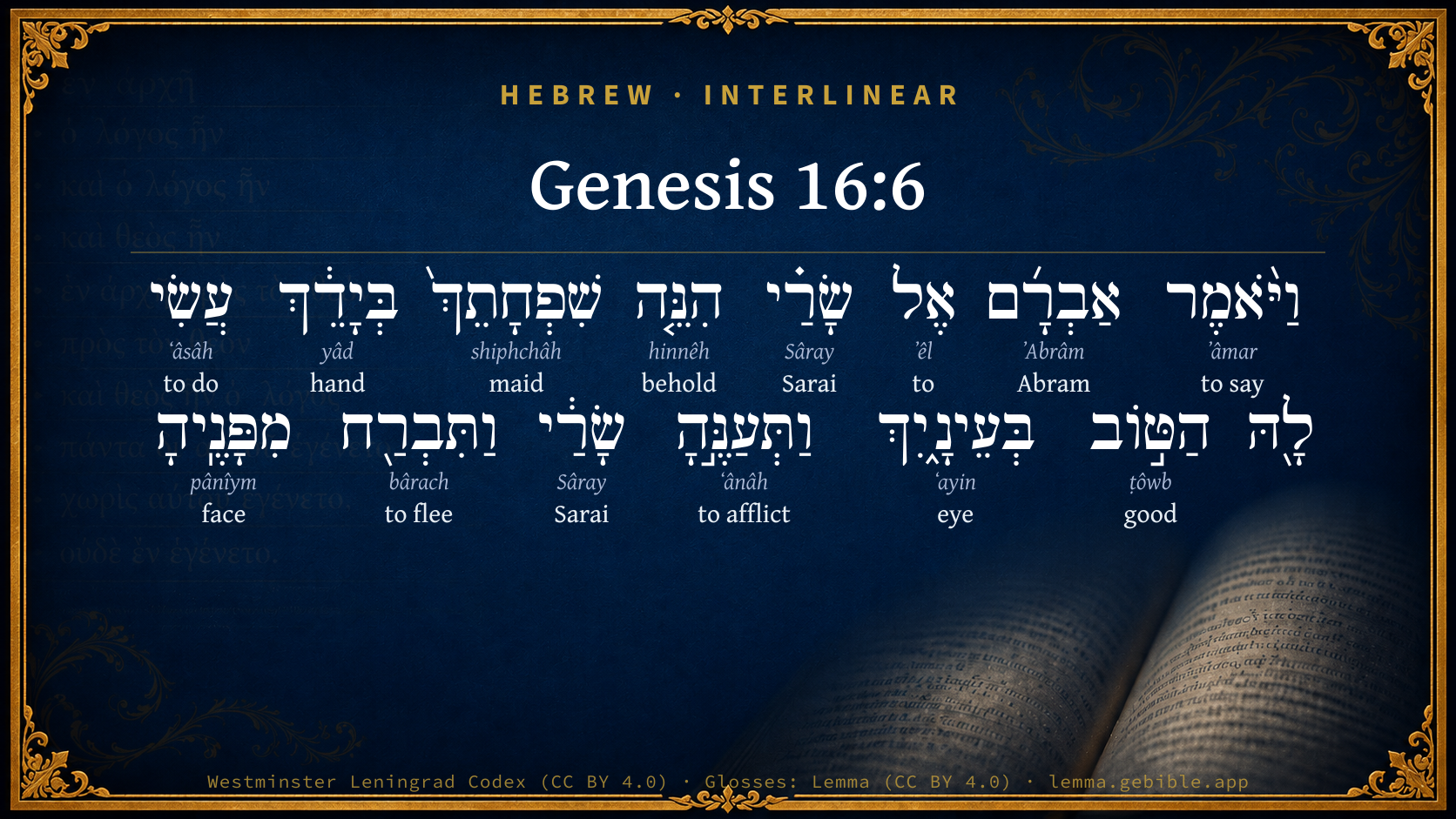
  1. וַיֹּ֨אמֶר ʼâmar H559 “and · to say” Conjunction + Verb, Qal, Sequential Imperfect, 3rd Person, Masculine, Singular
  2. אַבְרָ֜ם ʼAbrâm H87 “Abram” Noun, Proper
  3. אֶל ʼêl H413 “to” Preposition
  4. הִנֵּ֤ה hinnêh H2009 “behold” Particle, Demonstrative
  5. שִׁפְחָתֵךְ֙ shiphchâh H8198 “maid · your” Noun, Common, Feminine, Singular, Construct + Suffix, Personal, 2nd Person, Feminine, Singular
  6. בְּיָדֵ֔ךְ yâd H3027 “in/at · hand · your” Preposition + Noun, Common, Both, Singular, Construct + Suffix, Personal, 2nd Person, Feminine, Singular
  7. עֲשִׂי ʻâsâh H6213 “do” Verb, Qal, Imperative, 2nd Person, Feminine, Singular
  8. הַטּ֣וֹב ṭôwb H2896 “the · good” Particle, Definite Article + Adjective, Adjective, Masculine, Singular, Absolute
  9. בְּעֵינָ֑יִךְ ʻayin H5869 “in/at · eyes · your” Preposition + Noun, Common, Both, Dual, Construct + Suffix, Personal, 2nd Person, Feminine, Singular
  10. וַתְּעַנֶּ֣הָ ʻânâh H6031 “and · to afflict · her” Conjunction + Verb, Piel, Sequential Imperfect, 3rd Person, Feminine, Singular + Suffix, Personal, 3rd Person, Feminine, Singular
  11. שָׂרַ֔י Sâray H8297 “Sarai” Noun, Proper
  12. וַתִּבְרַ֖ח bârach H1272 “and · to flee” Conjunction + Verb, Qal, Sequential Imperfect, 3rd Person, Feminine, Singular
  13. מִפָּנֶֽיהָ pânîym H6440 “from · face(s) · her” Preposition + Noun, Common, Both, Plural, Construct + Suffix, Personal, 3rd Person, Feminine, Singular

About this verse

These counts appear in no published source. They are computed here, from the morphology-tagged text and Lemma’s own curated glosses. What Lemma adds →

15
words
13
distinct lemmas
Pentateuch
section

Notable vocabulary

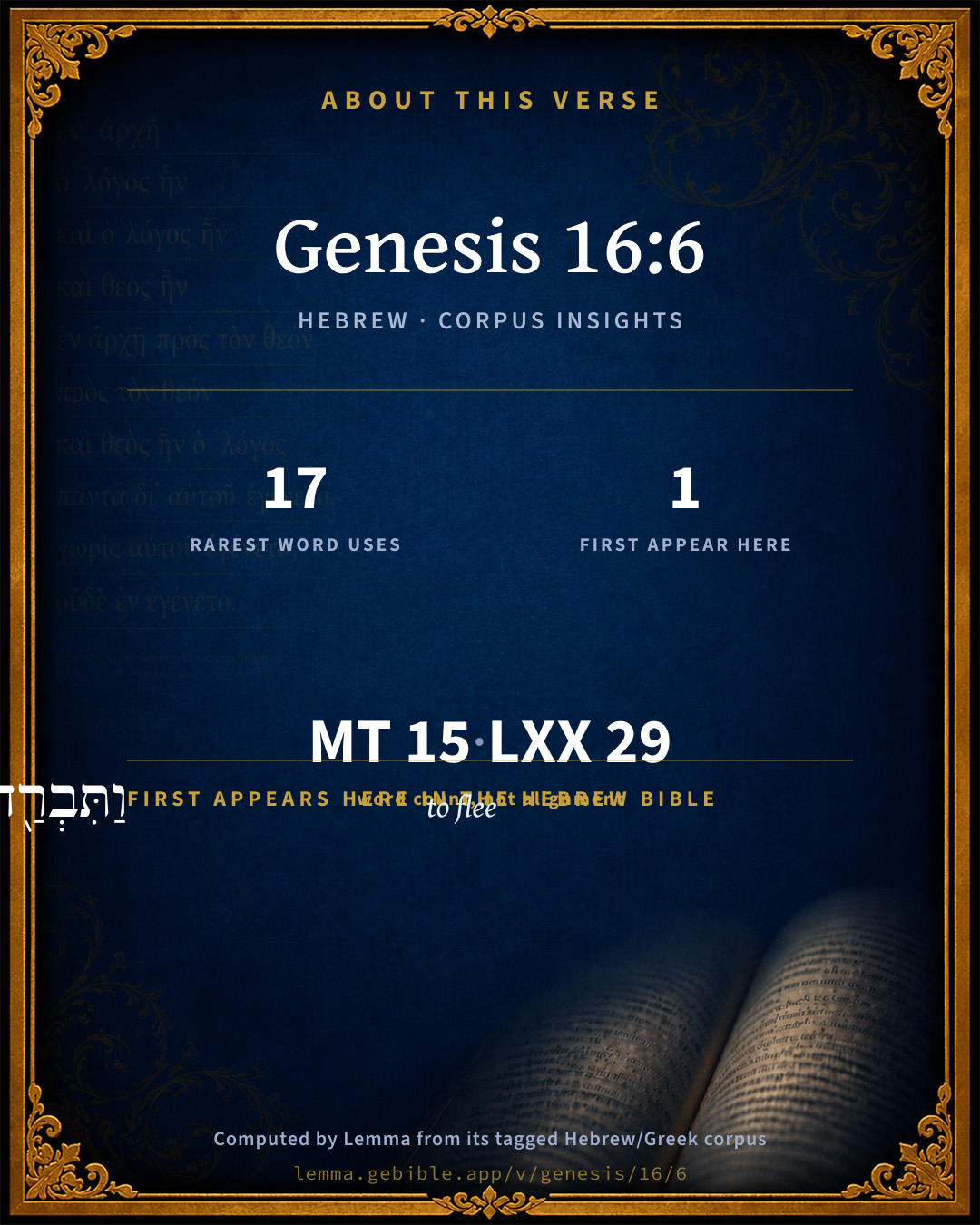
The rarest word here is שָׂרַ֗י Sarai H8297 — appearing just 17 times in the whole Hebrew Bible.

First appearance in Scripture

This word makes its first canonical appearance in the Hebrew Bible here:

  • וַתִּבְרַ֖ח to flee H1272

Shared distinctive vocabulary

שָׂרַ֗י Sarai H8297 occurs in 13 verses of the Hebrew Bible. Also found in:

Grammatical profile

  • 4 verbs
  • 7 nouns
  • 1 adjective
  • 2 prepositions
  • 1 particle

Verb forms

  • וַיֹּ֨אמֶר Qal · Sequential Imperfect
  • עֲשִׂי Qal · Imperative
  • וַתְּעַנֶּ֣הָ Piel · Sequential Imperfect
  • וַתִּבְרַ֖ח Qal · Sequential Imperfect

Repetition

A word recurs within this verse — often emphatic in Hebrew:

  • שָׂרַ֗י Sarai H8297 ×2

Hebrew & Septuagint length

In English translation the verse runs 32 words from the Hebrew and 31 from the Septuagint (LXX English) — closely comparable.

A rough comparison of the two English renderings, which tokenize alike — not a word-level alignment.

Word counts can differ between the Hebrew and the Greek without any difference in meaning — e.g. the Hebrew direct-object marker אֵת has no separate Greek word, and Greek often adds the article ὁ.

In the original languages it is 15 Hebrew tokens and 29 Greek tokens — but the two are counted differently (Hebrew bundles its prefixes and suffixes into one token; the Greek is in lemma form), so that isn’t a like-for-like length.

Cross-references

13

Topical passages linked to Genesis 16:6 in the Treasury of Scripture Knowledge — connected by theme and wording, ordered by reader-vote popularity; previews shown in the World English Bible.

  • Jeremiah 38:5 Zedekiah the king said, Behold, he is in your hand; for the king is not he who can do anything against you.
  • Genesis 13:8–9 Abram said to Lot, "Please, let there be no strife between me and you, and between my herdsmen and your herdsmen; for we are relatives.
  • Genesis 24:10 The servant took ten camels, of his master's camels, and departed, having all goodly things of his master's in his hand. He arose, and went to Mesopotamia, to the city of Nahor.
  • Exodus 2:15 Now when Pharaoh heard this thing, he sought to kill Moses. But Moses fled from the face of Pharaoh, and lived in the land of Midian, and he sat down by a well.
  • Job 2:6 Yahweh said to Satan, "Behold, he is in your hand. Only spare his life."
  • Psalms 106:41–42 He gave them into the hand of the nations. Those who hated them ruled over them.
  • Proverbs 14:29 He who is slow to anger has great understanding, But he who has a quick temper displays folly.
  • Proverbs 15:1 A gentle answer turns away wrath, But a harsh word stirs up anger.
  • Proverbs 15:17–18 Better is a dinner of herbs, where love is, Than a fattened calf with hatred.
  • Proverbs 27:8 As a bird that wanders from her nest, So is a man who wanders from his home.
  • Proverbs 29:19 A servant can't be corrected by words. Though he understands, yet he will not respond.
  • Ecclesiastes 10:4 If the spirit of the ruler rises up against you, don't leave your place; for gentleness lays great offenses to rest.
  • 1 Peter 3:7 You husbands, in like manner, live with your wives according to knowledge, giving honor to the woman, as to the weaker vessel, as being also joint heirs of the grace of life; that your prayers may not be hindered.

Cross-references courtesy of OpenBible.info (CC BY 4.0).

Hebrew and Greek witnesses Masoretic Hebrew ↔ Greek Septuagint

The same verse in the two great witnesses to the Old Testament, shown verse-for-verse.

These are two independent witnesses, not word-aligned to each other, and the Septuagint is shown in lemma (dictionary) form.

Hebrew Genesis 16:6 Masoretic · Westminster Leningrad Codex

וַיֹּ֨אמֶר אַבְרָ֜ם אֶל שָׂרַ֗י הִנֵּ֤ה שִׁפְחָתֵךְ֙ בְּיָדֵ֔ךְ עֲשִׂי לָ֖הּ הַטּ֣וֹב בְּעֵינָ֑יִךְ וַתְּעַנֶּ֣הָ שָׂרַ֔י וַתִּבְרַ֖ח מִפָּנֶֽיהָ

But Abram said to Sarai, "Behold, your maid is in your hand. Do to her whatever is good in your eyes." Sarai dealt harshly with her, and she fled from her face.

World English Bible · Public Domain

Greek LXX Genesis 16:6 Septuagint · lemma form

εἶπον δέ αβραμ πρός σαρα ἰδού ὁ παιδίσκη σύ ἐν ὁ χείρ σύ χράομαι αὐτός ὡς ἄν σύ ἀρεστός εἰμί καί κακόω αὐτός σαρα καί ἀποδιδράσκω ἀπό πρόσωπον αὐτός

And Abram said to Sara, Behold your handmaid is in your hands, use her as it may seem good to you. And Sara afflicted her, and she fled from her face.

LXX2012 (modern English Septuagint) · Public Domain

Hebrew: Westminster Leningrad Codex (CC BY 4.0). Greek: Septuagint (public domain); English from LXX2012 (modern English Septuagint) (Public Domain). How the Septuagint differs from the Hebrew →

Targum (Aramaic paraphrase)

2

The Targum is the ancient Jewish Aramaic paraphrase of the Hebrew Scriptures — an interpretive translation, not the Hebrew text itself. Onkelos (literal) and Pseudo-Jonathan (expansive) render the Torah, and Jonathan the Prophets. Coverage is partial: where no permissively-licensed English translation exists for a verse, only the Aramaic is shown. This is verse-level text, not a word-by-word alignment to the Hebrew.

  1. Targum Onkelos Torah (Genesis–Deuteronomy)
    וַאֲמַר אַבְרָם לְשָׂרַי הָא אַמְתִיךְ בִּידִךְ עִבִידִי לַהּ כִּדְתַקִין בְעֵינָיְכִי וְעֲנִיתַהּ שָׂרַי וְעָרְקַת מִקֳדָמָהַהּ

    (no public-domain English translation for this verse)

    Targum Onkelos — Aramaic: “Onkelos Genesis” (public domain); “Onkelos Exodus” (public domain); “Onkelos Leviticus” (public domain); “Onkelos Numbers” (public domain); “Onkelos Deuteronomy” (public domain). English: “Sefaria Community Translation” (CC0 1.0 (public-domain dedication)); “J.W. Etheridge. The Targums of Onkelos and Jonathan Ben Uzziel on the Pentateuch. London: Longmans, Green, 1862” (public domain). Text via Sefaria.

  2. Targum Pseudo-Jonathan Torah (Genesis–Deuteronomy)
    וַאֲמַר אַבְרָם לְשָרַי הָא אַמְתִיךְ בִּרְשׁוּתִיךְ עֲבִידִי לָהּ דְתַקִין בְּעֵיְנָיכִי וְסַגְפָתָא שָרַי וְעַרְקַת מִן קָדָמָהָא

    And Abram said to Sara, Behold, thy handmaid is under thy authority: do to her what is right in thine eyes. And Sara afflicted her, and she escaped from before her.

    Targum Pseudo-Jonathan — Aramaic: “Targum Jonathan on Genesis” (public domain); “Targum Jonathan on Exodus” (public domain); “Targum Jonathan on Leviticus” (public domain); “Targum Jonathan on Numbers” (public domain); “Targum Jonathan on Deuteronomy” (public domain). English: “The Targum of Jonathan ben Uzziel, trans. J. W. Etheridge, London, 1862” (public domain). Text via Sefaria.

Commentary

Notes on Genesis 16:6 from classic Christian and Jewish commentators (each source and its license shown beneath its notes). The classic Christian expositions comment on the surrounding passage and are grouped to its opening verse, so a note may address several verses; the Jewish commentaries on the Tanakh (Rashi and others) are per-verse, so they appear only where the commentator wrote on this verse.

Lemma curates 59 commentaries, every one of them public domain or Creative Commons licensed, each selected and text-cleaned for this edition rather than reprinted as found. About our sources →

Trapp's Complete Commentary

John Trapp

Gen 16:6 But Abram said unto Sarai, Behold, thy maid [is] in thy hand; do to her as it pleaseth thee. And when Sarai dealt hardly with her, she fled from her face.

Ver. 6. But Abram said to Sarai, Behold, &c.] Here that of Solomon is verified, "A soft answer pacifieth wrath". {Pro 15:1} Hard to soft cloth no hurt, as a bullet against a woolsack. Uxoris vitium aut tollendum, aut tollerandum , said Varro, πασα γυνη χολος εστι {a} The woman is the weaker, and hath many provocations among children and servants that the man meets not with. This must be considered, and all bitterness abandoned. The heathens, when they sacrificed at their marriage feasts, used to cast the gall of the beast sacrificed out of doors. {b} Vipera virus, ob venerationem nuptiarum, evomit , saith St Basil, et tu duritiem animi, tu feritatem, tu crudelitatem ob unionis reverentiam non deponis ? What kin art thou to him, whose name is Wormwood? {Rev 8:11}

And when Sarai dealt hardly with her.] Beat her, belike; for "a servant will not be corrected by words," {Pro 29:19} and then he must have blows, and be "buffeted". {1Pe 2:20} Not so a wife. M. Aurelius, the emperor, though a heathen, could say to the shame of many bedlams among us: Uxor admonenda persaepe, reprehendenda raro, violentis manibus tractanda nunquam.

She fled.] This was her fault. {Ecc 10:4} But our natures are refractory, and will sooner break than bend, till God subdue them.

{a} Gellius.

{b} Plutarch. Proecep. Conjug., Basil. Hexemer., hom. vii.

John Trapp, A Commentary or Exposition upon All the Books of the Old and New Testament (1647–1656) — public domain. Text from a community e-Sword module.

Joseph Benson's Commentary

Gen 16:6. Thy maid is in thy hand — Though she was his wife, he would not countenance her in any thing disrespectful to Sarai. Those who would keep up peace and love must return soft answers to hard accusations; husbands and wives particularly should endeavour not to be both angry together. And when Sarai dealt hardly with her — Making her to serve with rigour; she fled from her face — She not only avoided her wrath for the present, but totally deserted her service.

Joseph Benson's Commentary on the Old and New Testaments (1811–1818) — public domain. Text from a community e-Sword module.

Geneva Bible (1599)

Geneva Bible translators

Or, power.

Geneva Bible (1599) marginal notes — public domain. Text via Bolls.life.

Adam Clarke's Commentary

Verse 6. Sarah dealt hardly with her] תאנה teanneha, she afflicted her; the term implying stripes and hard usage, to bring down the body and humble the mind. If the slave was to blame in this business the mistress is not less liable to censure. She alone had brought her into those circumstances, in which it was natural for her to value herself beyond her mistress.

Adam Clarke's Commentary on the Bible (1810–1826) — public domain. Text from a community e-Sword/MySword module.

John Calvin's Commentaries

6. Behold, thy maid is in thy hand. The greatness of Abram’s humanity and modesty appears from his answer. He does not quarrel with his wife; and though he has the best cause, yet he does not pertinaciously defend it, but voluntarily dismisses the wife who had been given him. In short, for the sake of restoring peace, he does violence to his feelings, both as a husband, and a father. For, in leaving Hagar to the will of her enraged mistress, he does not treat her as his wife; he also, in a certain way, undervalues that object of his hope which was conceived in her womb. And it is not to be doubted that he was thus calm and placid in bearing the vehemence of his wife; because, throughout her whole life, he had found her to be obedient. Still it was a great excellence, to restrain his temper under an indignity so great. It may, however, here be asked, how it was that his care for the blessed seed had then vanished from his mind? Hagar is great with child; he hopes that the seed through which the salvation of the world was promised, is about to proceed from her. Why then does he not set Sarai aside, and turn his love and desire still more to Hagar? Truly we hence infer, that all human contrivances pass away and vanish in smoke, as soon as any grievous temptation is presented. Having taken a wife against the divine command, he thinks the matter is succeeding well, when he sees her pregnant, and pleases himself in foolish confidence; but when contention suddenly arises, he is at his wit’s end, and rejects all hope, or, at least, forgets it. The same thing must necessarily happen to us, as often as we attempt anything contrary to the word of God. Our minds will fail at the very first blast of temptation; since our only ground of stability is, to have the authority of God for what we do. In the meantime, God purifies the faith of his servant from its rust; for by mixing his own and his wife’s imagination with the word of God, he, in a sense, had stifled his faith; wherefore, to restore its brightness, that which was superfluous is cut of. God, by opposing himself in this manner to our sinful designs, recalls us from our stupidity to a sound mind. A simple promise had been given ‘I will bless thy seed.’ Sarai’s gloss supervened, namely, that she could have no seed but a supposititious one by Hagar: this mire of human imagination, with which the promise had been defiled must be purged away, that Abram might derive his knowledge from no other source, than the pure word of God.

And Sarai dealt hardly with her The word ענה (anah,) which Moses uses, signifies to afflict and to humble. I therefore explain it as being put for reducing Hagar to submission. But it was difficult for an angry woman to keep within bounds, in repressing the insolence of her maid. Wherefore, it is possible that she became immoderately enraged against her; not so much considering her own duty as revolving the means of being avenged for the offenses committed. Since Moses brings no heavier charge, I confine myself to what is certain; that Sarai made use of her proper authority in restraining the insolence of her maid. And, doubtless, from the event, we may form a judgments that Hagar was impelled to flee, not so much by the cruelty of her mistress, as by her own contumacy. Her own conscience accused her; and it is improbable that Sarai should have been so greatly incensed, except by many, and, indeed atrocious offenses. Therefore, the woman being of servile temper, and of indomitable ferocity, chose rather to flee, than to return to favor, through the humble acknowledgment of her fault.

John Calvin's Commentaries (1540-1563) — public domain. Text from the Calvin Translation Society English edition (1840s-50s) via the Christian Classics Ethereal Library (ccel.org). Calvin's coverage is partial (roughly two-thirds of the Bible); uncommented books and verses are honest gaps, never fabricated. The 19th-century editor's footnotes and remarks are omitted so the notes are faithfully Calvin's own voice.

Ellicott's Commentary for English Readers

(6) Sarai dealt hardly with her.—The verb is translated afflicted in Exo_1:11 and Isa_60:14; its more exact meaning is, Sarai humbled her, that is, reduced her to her original condition. It was quite right that as Hagar had abused her elevation, Abram should make her yield to Sarai all due respect and submission; but in making her resume her old position as a slave, Sarai was possibly dealing unkindly with her (but see on Gen_16:9). In running away Hagar not only showed the untamable love of freedom which Ishmael inherited from her, but apparently was repeating the act from which she had her name.

A Bible Commentary for English Readers, edited by Charles John Ellicott (1878–1897) — public domain. Text from a community e-Sword module.

The Cambridge Bible for Schools and Colleges

gen. ed. J. J. S. Perowne

6. in thy hand] Abram replies, with forbearance, that Hagar is under Sarai’s authority. Whether this is a formal transference of Hagar back into the power of Sarai, after she had become, as a concubine, the property of Abram, is not explained.

dealt hardly] The same word as that rendered “afflict” (Gen_15:13). Here it evidently means “persecute,” “ill-treat.”

fled] The character of Hagar is depicted as high-spirited and courageous, as well as independent. There is no evidence that her conduct was insolent.

The Cambridge Bible for Schools and Colleges (gen. ed. J. J. S. Perowne; Cambridge University Press, 1878–1918) — public domain. Text from a community e-Sword module.

John Gill's Exposition

But Abram said unto Sarai,.... In a meek, mild and gentle manner:

behold, thy maid is in thine hand; though Hagar was Abram's secondary wife he still considers her as Sarai's maid, and as subject to her, and allows her to exercise authority over her; for he still retained the same love and affection for Sarai, his first and lawful wife, and showed the same respect he ever did, and supported her in her honour and dignity:

do to her as it pleaseth thee: not giving her liberty to take away her life, nor even to use her cruelly, but to deal with her as a mistress might lawfully do with a servant, or however exercise that power which a first wife had over a second: perhaps Abram, in complaisance to Sarai, gave her too large a commission, and left it too much in her power to distress Hagar; and it might have been more correct to have heard both sides, and judged between them, and used his own authority, by reproving and correcting as he saw meet; had she been only Sarai's maid and not his wife, it would have been less exceptionable; however, for peace sake, he gave leave to Sarai to do as she would:

and when Sarai dealt hardly with her; or afflicted her (m), not only with words but with blows, as some think, and unmercifully beat her, and laid hard service upon her she was not able to go through, especially in her circumstances; though it may be she only chastised her in such a manner as a mistress may chastise her maid, since the angel seems to approve of what she did, Gen 16:9; which her proud spirit not being able to bear:

she fled from her face; which was set against her, and was full of wrath and fury: she deserted her service, quitted Abram's house though with child by him; unmindful of the various relations she stood in, which should have obliged her to have kept her place, and especially until she had made proper remonstrances of her ill usage, and could have no redress; but, unable to bear the treatment she met with, meditated a flight into her own country, Egypt, for by what follows it appears she steered her course that way; this flight of hers was agreeable to her name, for Hagar in the Arabic language signifies to "flee", hence the flight of Mahomet is called the Hegira.

(m) "eam affligeret", Tigurine version, Schmidt; "afflixit eam", Fagninus, Montanus, Junius & Tremellius, Piscator; so Ainsworth.

John Gill's Exposition of the Whole Bible (1746–1763) — public domain (CC PDM 1.0). Text via the HelloAO Bible API.

Haydock's Catholic Bible Commentary

Afflicted her, as she now resented even a moderate correction. (Haydock)

George Leo Haydock (1774–1849), Haydock's Catholic Family Bible and Commentary, 1859 edition — public domain. Excludes Psalms (Douay-Rheims chapter numbering differs from Protestant) and Deuterocanonical books (Catholic canon only).

Matthew Poole's English Annotations

Thy maid is in thine hand, i.e. subject to thy power and authority, as the phrase is taken, Gen 24:10; 39:4,6,8; Num 31:49. For though she be my concubine, yet she is thy inferior; and therefore if she exalt herself above her measure, I give thee power to exercise thy authority over her. But whether this was not one of Abram's infirmities, to give up his second wife into the hands of the first, may well be questioned. Use whatsoever power God hath given thee over her; for we must not think that Abram gave her power of life and death over her, especially now when she was with child. Therefore here, as often elsewhere, the general words must be limited from the nature of the thing, and from other texts of Scripture, which forbid cruelty even to our servants.

And when Sarai dealt hardly with her, either by imposing labours upon her above her strength, or by grievous stripes which she could not bear,

she fled from her face, contrary to God's command, Ecc 10:4, and to the laws of justice, because both her person and the fruit of her body were not her own, but Abram's right in possession.

Matthew Poole's English Annotations on the Holy Bible (1683–1685) — public domain. Text from a community e-Sword/MySword module.

Whedon's Commentary on the Bible

Daniel D. Whedon

6. Thy maid is in thy hand — By this he repudiates the implication of having wronged his wife by exalting another to her place in his affections, or in his household. Sarai’s maid is still her own. At her proposal he had treated her as a wife, and now she has her at disposal to treat her as she pleased.

Dealt hardly with her — Treated her with such oppressive rigour and humiliation that she fled from her face, resolved not to submit to such affliction. “The proud, unyielding passion of the Ishmaelite for freedom shows its characteristic feature in their ancestress.” — Lange.

Daniel D. Whedon (gen. ed.), Commentary on the Old and New Testaments (1874–1909) — public domain. Text from a community e-Sword module.

The Pulpit Commentary

But Abram said unto Sarai, Behold, thy maid is in thy hand (regarding her still as one of Sarai"s servants, though elevated to the rank of secondary wife to himself); do to her as it pleaseth thee. Literally, the good in thine eyes; in which conduct of the patriarch may be seen perhaps

(1) an evidence of his peaceful disposition in doing violence to his feelings as a husband in order to restore harmony to his disquieted household (Calvin), and

(2) a proof that he had already found out his mistake in expecting the promised seed through Hagar (Calvin); but also

(3) an indication of weakness in yielding to Sarai"s passionate invective (Willet, Bush), and

(4) an unjustifiable wrong inflicted on the future mother of his child (Candlish). And when Sarai dealt hardly with her (literally, afflicted) her by thrusting her back into the condition of a slave (Lange, Candlish); though probably by stripes or maltreatment of some sort in addition (Ainsworth, Bush)she fled from her face.

The Pulpit Commentary (1880–1919), ed. H.D.M. Spence-Jones & Joseph S. Exell — public domain. Text from a community e-Sword module.

John Wesley's Explanatory Notes

Thy maid is in thy hand - Though she was his wife, he would not countenance her in any thing disrespectful to Sarai. Those who would keep up peace and love, must return first answers to hard accusations; husbands and wives particularly should endeavour not to be both angry together. And when Sarai dealt hardly with her - Making her to serve with rigor; she fled from her face - She not only avoided her wrath for the present, but totally deserted her service.

John Wesley, Explanatory Notes Upon the Whole Bible (1754–1765) — public domain. Text via the GEBible commentary corpus.

Rashi

Rabbi Shlomo Yitzchaki (Rashi)

ותענה שרי AND SARAI AFFLICTED HER — She compelled her to work hard (Genesis Rabbah 45:6).

Rashi on the Tanakh — English translations: “The Judaica Press complete Tanach with Rashi, translated by A. J. Rosenberg” (CC BY 4.0); “Pentateuch with Rashi's commentary by M. Rosenbaum and A.M. Silbermann, 1929-1934” (public domain); “The Metsudah Tanach series, Lakewood, N.J” (CC BY 4.0); and “The Book of Joshua, Metsudah Publications, 1997” (CC BY 4.0). Text via Sefaria.

Ramban (Nachmanides)

Rabbi Moshe ben Nachman (Ramban / Nachmanides)

AND SARAI DEALT HARSHLY WITH HER, AND SHE FLED FROM BEFORE HER FACE. Our mother did transgress by this affliction, and Abraham also by his permitting her to do so. And so, G-d heard her [Hagar’s] affliction and gave her a son who would be a wild-ass of a man, to afflict the seed of Abraham and Sarah with all kinds of affliction.

Ramban (Nachmanides) on the Tanakh — English translation: “Commentary on the Torah by Ramban (Nachmanides). Translated and annotated by Charles B. Chavel. New York, Shilo Pub. House, 1971-1976” (CC BY 4.0). Text via Sefaria.

Radak

Rabbi David Kimhi (Radak)

ויאמר... שפחתך בידך, Avram meant that in spite of Hagar sleeping with him, i.e. being accorded wifely privileges from his side, she remained Sarai's slave and as such Sarai could determine how to treat her. He made it clear that his own dignity was not to be a consideration in Sarai's treatment of Hagar.

ותענה שרי, Sarai overburdened her with work, and made her perform the work in an intolerably harsh manner. It is even possible that the word ותענה includes physical as well as verbal abuse of Hagar by Sarai. The Torah testifies that Sarai did not act morally and piously toward her. From a moral point of view, although Avram had given her a free hand when he said "do to her as appears fit in your eyes," she should have treated Hagar in a manner befitting her status as a wife or legal companion of Avram. From the point of view of practicing piously, חסידות, she should have treated a subordinate with all possible consideration. The scholar Ibn Gabirol said "how beautiful is the attribute of practicing forgiveness in circumstances when this is possible!" Sarai's actions as reported were not pleasing in the eyes of the Lord. This is reflected in the words of the angel to Hagar (verse 11) כי שמע ה' אל עניך, "for the Lord has listened to the oppression you have endured." This is why the angel gave her a blessing as compensation for the harsh treatment she had suffered. Avram did not prevent Sarai from acting as she did, even though it was displeasing in his eyes, because he was concerned primarily with preserving his relations with Sarai. The reason why this whole story is preserved for all future generations in our chapter is to teach moral-ethical lessons, and to warn us not to indulge in injustice.

Radak on the Tanakh — English translations: “Sefaria Community Translation” (CC0 1.0 (public-domain dedication)); “Eliyahu Munk, HaChut Hameshulash” (CC BY 4.0); “Rabbi Mike Feuer, Jerusalem Anthology” (CC BY 4.0); and “R. David Kimhi on the first book of Psalms, Translated by R.G. Finch, London, 1919” (public domain). Text via Sefaria.

Lesson kit

Teaching starters — assembled from the data on this page, not authored interpretation. Every prompt links to the verse data it draws on. Edit before teaching.

Genesis, in the Pentateuch, opens this verse with 15 words (13 distinct Hebrew lemmas). Its most distinctive word is Sâray (“Sarai”). A historical commentator’s framing appears above. Read the whole chapter for the surrounding context.

Discussion questions

  1. The word Sâray carries the sense “Sarai.” How does it shape the verse?
  2. This is the first place “to flee” appears in Scripture (first appears here). What does its debut here establish?
  3. How does Genesis 11:29, which shares the word «Sarai», read alongside this verse?
  4. What does the repetition of “Sarai” (2× in this one verse) do in this verse?
  5. These translations render this verse differently; the difference is in the English rendering, not the original. What questions does that raise?
  6. «וַיֹּ֨אמֶר» is a Qal Sequential Imperfect verb. How does that grammatical form shape the action described?
  7. Compare how Trapp's Complete Commentary and Joseph Benson's Commentary read this verse. Where do they agree or differ?

Things to notice

Reading settings

Reading text

Shown beneath each verse's original-language words.

Old Testament
Old Testament edition

Read the OT as the Masoretic Hebrew (MT) or the Greek Septuagint (LXX).

English shown for the Greek Septuagint (in the Hebrew ↔ Greek comparison).

Comparing translations? Open the Compare panel on any verse page to stack up to four side by side.