John 10:39

Greek (Tischendorf 8th ed.) John 10:39 appears in the Greek New Testament. The text above is from the Tischendorf 8th edition. Each word links to its Strong’s number and a concise gloss. Click any word for its full Thayer’s Greek Lexicon entry.

Download image
Cite this verse

John 10:39 (World English Bible). Public Domain. Lemma interlinear Bible study tool, https://lemma.gebible.app/v/john/10/39.

Show BibTeX & RIS
BibTeX
RIS
English Translation
They sought again to seize him, and he went out of their hand.
World English Bible · Public Domain
Download a study sheet

One document with this verse’s original text, its word-by-word gloss line, the meaning frame, cross-references with their text, attributed commentary, and full source and license credits — printable, and it pastes into notes with its structure intact.

This verse Autodidact and up

Study sheet (.html) Plain text (.txt)

A passage Seminary Student

Up to 50 verses in one chapter. A passage sheet keeps up to 6 commentary sources and 12 cross-references per verse, in the order this page ranks them, and says so on the sheet whenever that leaves anything out. Ask for a single verse and you get the Autodidact verse sheet above.

Everything on this page stays free to read, with no account — the sheet is a download of what is already on screen, not access to it.

Want to remove ads? Support Godless Engineer
Compare translations 3

The same verse in 3 English versions, stacked beneath the original-language interlinear above. Click any original word for its lexicon entry.

Each is an independent rendering of the whole verse — the interlinear is not word-aligned to these translations.

Highlighted words mark where these versions differ — a whole-verse word diff, not a word-by-word alignment.

  • World English Bible Public Domain
    They sought again to seize him, and he went out of their hand.
  • King James Version Public Domain
    Therefore they sought again to take him: but he escaped out of their hand,
  • unfoldingWord Literal Text CC BY-SA 4.0
    Therefore, they were seeking to seize him again, but he went away out of their hand.

unfoldingWord Literal Text — © unfoldingWord, licensed CC BY-SA 4.0. Word-aligned USFM3 via Door43 (git.door43.org/unfoldingWord/en_ult).

Versions to compare (up to 4)

3 of 4 selected

Show all 19 translations

Every available English version of this verse, each an independent rendering of the whole verse.

  • World English Bible Public Domain
    They sought again to seize him, and he went out of their hand.
  • Berean Standard Bible Public Domain
    At this, they tried again to seize Him, but He escaped their grasp.
  • Majority Standard Bible Public Domain
    At this, they tried again to seize Him, but He escaped their grasp.
  • King James Version Public Domain
    Therefore they sought again to take him: but he escaped out of their hand,
  • American Standard Version (1901) Public Domain
    They sought again to take him: and he went forth out of their hand.
  • Revised Version (1885) Public Domain
    They sought again to take him: and he went forth out of their hand.
  • Geneva Bible (1599) Public Domain
    Againe they went about to take him: but he escaped out of their handes,
  • Douay-Rheims (1899) Public Domain
    They sought therefore to take him; and he escaped out of their hands.
  • Young's Literal Translation Public Domain
    Therefore were they seeking again to seize him, and he went forth out of their hand,
  • Literal Standard Version CC BY-SA 4.0
    Therefore they were seeking again to seize Him, and He went forth out of their hand,
  • Unlocked Literal Bible CC BY-SA 4.0
    They tried to seize him again, but he went away out of their hand.
  • unfoldingWord Literal Text CC BY-SA 4.0
    Therefore, they were seeking to seize him again, but he went away out of their hand.
  • Darby Bible Public Domain
    They sought therefore again to take him; and he went away from out of their hand
  • World Messianic Bible Public Domain
    They sought again to seize him, and he went out of their hand.
  • Webster's Bible Public Domain
    Therefore they sought again to take him; but he escaped from their hand,
  • Free Bible Version CC BY-SA 4.0
    Once again they tried to arrest him, but he escaped from them.
  • Bible in Basic English Public Domain
    Then again they made an attempt to take him; but he got away from them.
  • Text-Critical English NT CC BY 4.0
    Once again they tried to arrest him, but he eluded their grasp.
  • Tyndale New Testament (1534) Public Domain
    Agayne they went aboute to take him: but he escaped out of their hondes

Literal Standard Version (2020), Covenant Press — licensed CC BY-SA 4.0. Text via the HelloAO Bible API (eBible.org). Unlocked Literal Bible (unfoldingWord) — licensed CC BY-SA 4.0. Text via the HelloAO Bible API (eBible.org). unfoldingWord Literal Text — © unfoldingWord, licensed CC BY-SA 4.0. Word-aligned USFM3 via Door43 (git.door43.org/unfoldingWord/en_ult). Free Bible Version, Dr. Jonathan Gallagher — licensed CC BY-SA 4.0. Text via the HelloAO Bible API (eBible.org).

Word by word

More ways to search: Search by grammar → Find every occurrence → Compare this word →

Practice this passage: Drill this verse → Learn its vocabulary →

About this verse

These counts appear in no published source. They are computed here, from the morphology-tagged text and Lemma’s own curated glosses. What Lemma adds →

10
words
9
distinct lemmas
Gospels
section

Notable vocabulary

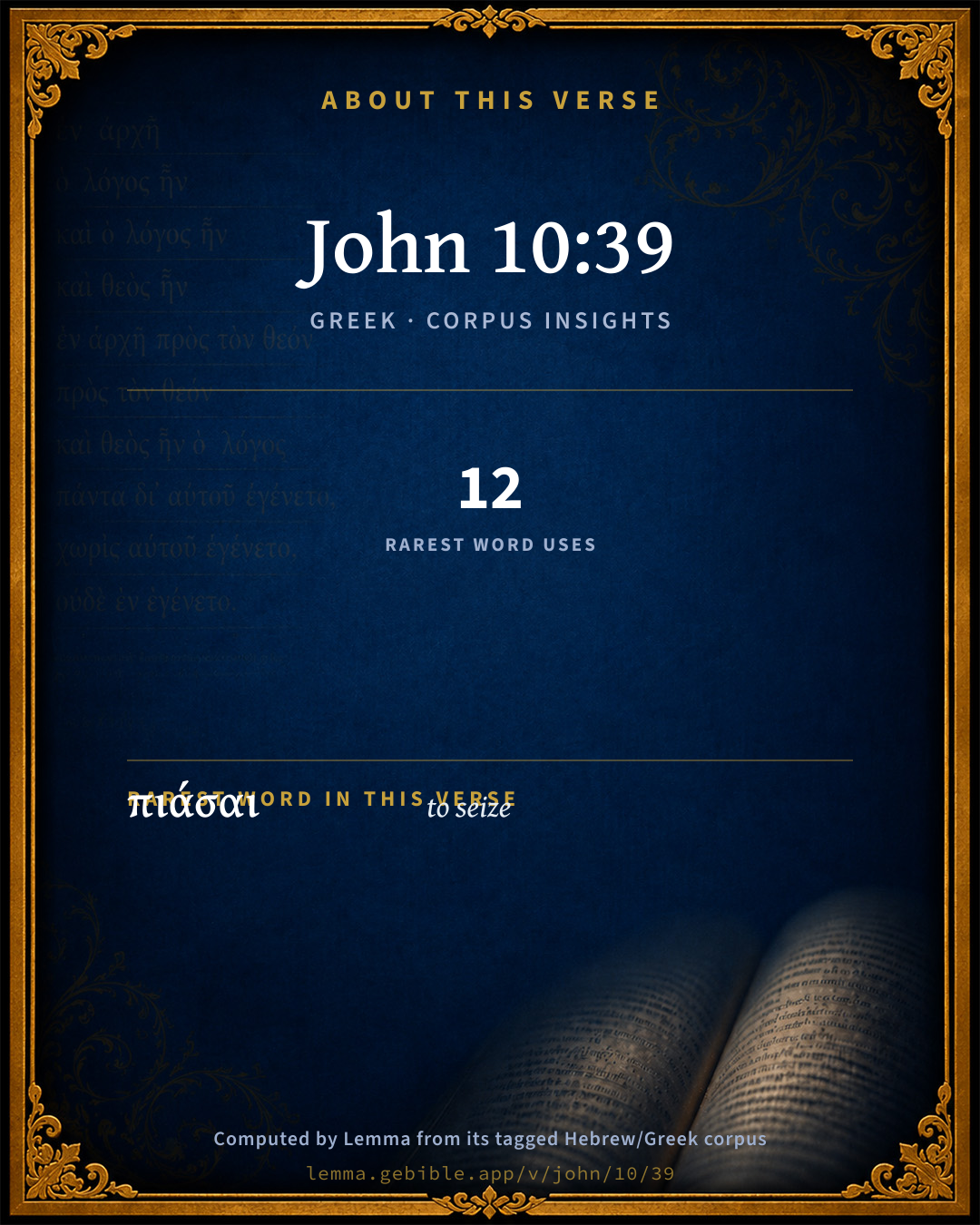
The rarest word here is πιάσαι to seize G4084 — appearing just 12 times in the whole Greek New Testament.

Shared distinctive vocabulary

πιάσαι to seize G4084 occurs in 12 verses of the Greek New Testament. Also found in:

Repetition

A word recurs within this verse:

  • αὐτὸν he G846 ×2

Cross-references

5

Topical passages linked to John 10:39 in the Treasury of Scripture Knowledge — connected by theme and wording, ordered by reader-vote popularity; previews shown in the World English Bible.

  • John 7:30 They sought therefore to take him; but no one laid a hand on him, because his hour had not yet come.
  • John 8:59 Therefore they took up stones to throw at him, but Jesus was hidden, and went out of the temple, having gone through the midst of them, and so passed by.
  • John 7:44 Some of them would have arrested him, but no one laid hands on him.
  • Luke 4:29–30 They rose up, threw him out of the city, and led him to the brow of the hill that their city was built on, that they might throw him off the cliff.
  • John 10:31 Therefore Jews took up stones again to stone him.

Cross-references courtesy of OpenBible.info (CC BY 4.0).

Commentary

Notes on John 10:39 from classic Christian and Jewish commentators (each source and its license shown beneath its notes). The classic Christian expositions comment on the surrounding passage and are grouped to its opening verse, so a note may address several verses; the Jewish commentaries on the Tanakh (Rashi and others) are per-verse, so they appear only where the commentator wrote on this verse.

Lemma curates 59 commentaries, every one of them public domain or Creative Commons licensed, each selected and text-cleaned for this edition rather than reprinted as found. About our sources →

Matthew Henry's Commentary

We have here the issue of the conference with the Jews. One would have thought it would have convinced and melted them, but their hearts were hardened. Here we are told,

I. How they attacked him by force. Therefore they sought again to take him, Joh 10:39. Therefore, 1. Because he had fully answered their charge of blasphemy, and wiped off that imputation, so that they could not for shame go on with their attempts to stone him, therefore they contrived to seize him, and prosecute him as an offender against the state. When they were constrained to drop their attempt by a popular tumult, they would try what they could do under colour of a legal process. See Rev 12:13. Or, 2. Because he persevered in the same testimony concerning himself, they persisted in their malice against him. What he had said before he did in effect say again, for the faithful witness never departs from what he has once said; and therefore, having the same provocation, they express the same resentment, and justify their attempt to stone him by another attempt to take him. Such is the temper of a persecuting spirit, and such its policy, mal facta mal factis tegere ne perpluant - to cover one set of bad deeds with another, lest the former should fall through.

II. How he avoided them by flight; not an inglorious retreat, in which there was any thing of human infirmity, but a glorious retirement, in which there was much of a divine power. He escaped out of their hands, not by the interposal of any friend that helped him, but by his own wisdom he got clear of them; he drew a veil over himself, or cast a mist before their eyes, or tied the hands of those whose hearts he did not turn. Note, No weapon formed against our Lord Jesus shall prosper, Psa 2:4. He escaped, not because he was afraid to suffer, but because his hour was not come. And he who knew how to deliver himself no doubt knows how to deliver the godly out of temptation, and to make a way for them to escape.

III. How he disposed of himself in his retirement: He went away again beyond Jordan, Joh 10:40. The bishop of our souls came not to be fixed in one see, but to go about from place to place, doing good. This great benefactor was never out of his way, for wherever he came there was work to be done. Though Jerusalem was the royal city, yet he made many a kind visit to the country, not only to his own country Galilee, but to other parts, even those that lay most remote beyond Jordan. Now observe,

1. What shelter he found there. He went into a private part of the country, and there he abode; there he found some rest and quietness, when in Jerusalem he could find none. Note, Though persecutors may drive Christ and his gospel out of their own city or country, they cannot drive him or it out of the world. Though Jerusalem was not gathered, nor would be, yet Christ was glorious, and would be. Christ's going now beyond Jordan was a figure of the taking of the kingdom of God from the Jews, and bringing it to the Gentiles. Christ and his gospel have often found better entertainment among the plain country-people than among the wise, the mighty, the noble, Co1 1:26, Co1 1:27.

2. What success he found there. He did not go thither merely for his own security, but to do good there; and he chose to go thither, where John at first baptized (Joh 1:28), because there could not but remain some impressions of John's ministry and baptism thereabouts, which would dispose them to receive Christ and his doctrine; for it was not three years since John was baptizing, and Christ was himself baptized here at Bethabara. Christ came hither now to see what fruit there was of all the pains John Baptist had taken among them, and what they retained of the things they then heard and received. The event in some measure answered expectation; for we are told,

(1.) That they flocked after him (Joh 10:41): Many resorted to him. The return of the means of grace to a place, after they have been for some time intermitted, commonly occasions a great stirring of affections. Some think Christ chose to abide at Bethabara, the house of passage, where the ferry-boats lay by which they crossed the river Jordan, that the confluence of people thither might give an opportunity of teaching many who would come to hear him when it lay in their way, but who would scarcely go a step out of the road for an opportunity of attending on his word.

(2.) That they reasoned in his favour, and sought arguments to induce them to close with him as much as those at Jerusalem sought objections against him. They said very judiciously, John did no miracle, but all things that John spoke of this man were true. Two things they considered, upon recollecting what they had seen and heard from John, and comparing it with Christ's ministry. [1.] That Christ far exceeded John Baptist's power, for John did no miracle, but Jesus does many; whence it is easy to infer that Jesus is greater than John. And, if John was so great a prophet, how great then is this Jesus! Christ is best known and acknowledged by such a comparison with others as sets him superlatively above others. Though John came in the spirit and power of Elias, yet he did not work miracles, as Elias did, lest the minds of people should be made to hesitate between him and Jesus; therefore the honour of working miracles was reserved for Jesus as a flower of his crown, that there might be a sensible demonstration, and undeniable one, that though he came after John, yet he was preferred far before him. [2.] That Christ exactly answered John Baptist's testimony. John not only did no miracle to divert people from Christ, but he said a great deal to direct them to Christ, and to turn them over as apprentices to him, and this came to their minds now: all things that John said of this man were true, that he should be the Lamb of God, should baptize with Holy Ghost and with fire. Great things John had said of him, which raised their expectations; so that though they had not zeal enough to carry them into his country to enquire after him, yet, when he came into theirs, and brought his gospel to their doors, they acknowledged him as great as John had said he would be. When we get acquainted with Christ, and come to know him experimentally, we find all things that the scripture saith of him to be true; nay, and that the reality exceeds the report, Kg1 10:6, Kg1 10:7. John Baptist was now dead and gone, and yet his hearers profited by what they had heard formerly, and, by comparing what they heard then with what they saw now, they gained a double advantage; for, First, They were confirmed in their belief that John was a prophet, who foretold such things, and spoke of the eminency to which this Jesus would arrive, though his beginning was so small. Secondly, They were prepared to believe that Jesus was the Christ, in whom they saw those things accomplished which John foretold. By this we see that the success and efficacy of the word preached are not confined to the life of the preacher, nor do they expire with his breath, but that which seemed as water spilt upon the ground may afterwards be gathered up again. See Zac 1:5, Zac 1:6.

(3.) That many believed on him there. Believing that he who wrought such miracles, and in whom John's predictions were fulfilled, was what he declared himself to be, the Son of God, they gave up themselves to him as his disciples, Joh 10:42. An emphasis is here to be laid, [1.] Upon the persons that believed on him; they were many. While those that received and embraced his doctrine at Jerusalem were but as the grape-gleanings of the vintage, those that believed on him in the country, beyond the Jordan, were a full harvest gathered in to him. [2.] Upon the place where this was; it was where John had been preaching and baptizing and had had great success; there many believed on the Lord Jesus. Where the preaching of the doctrine of repentance has had success, as desired, there the preaching of the doctrine of reconciliation and gospel grace is most likely to be prosperous. Where John has been acceptable, Jesus will not be unacceptable. The jubilee-trumpet sounds sweetest in the ears of those who in the day of atonement have afflicted their souls for sin.

Matthew Henry's Commentary on the Whole Bible (1708–1710) — public domain (CC PDM 1.0). Text via the HelloAO Bible API.

The Biblical Illustrator

Joseph S. Exell

Joh_10:39-42

Therefore they sought again to take Him

I.

MORAL INCORRIGIBILITY. What was the result of Christs appeal to His works and to their law? Of His noble life and strong logic? Were their prejudices broken down and their opposition overcome? No! here it is (Joh_10:39). Their opposition was intensified, and their determination to stone Him strengthened. There are, undoubtedly, men who have reached the stage of moral incorrigibility. Their opinions are fossilized, their habits confirmed, and their characters stereotyped. Christ taught this when He said, Give not that which is holy to dogs, etc., and when He wept over Jerusalem. Examples lie thickly around us. There are men so canine in temper, so swinish in materialism, that to argue with them would be waste of labour, and expose to insult and persecution. With these the day of grace is over, retribution has already got them into its iron grasp. Two evils befel these men to which all such characters are liable.

1. Disappointment. They made all arrangements to stone Him, and when their plans were complete they looked for Him; but He had gone. And sooner or later the incorrigible sinner will discover that all his calculations are false. He will have all his plans thwarted and his hopes blasted.

2. The loss of Christ. Christ had withdrawn. He was not afraid of them, but His time was not yet come. When the hour struck He would voluntarily fall into their hands; but meanwhile they had lost Him. The greatest calamity for a man or a community is the withdrawal of Christ, which must happen sooner or later to the incorrigible, My Spirit shall not always strive with man. When He withdraws from the soul, it is as if the sun withdrew from its orbit, and all the planets rush into black, fathomless chaos.

II. POSTHUMOUS USEFULNESS (Joh_10:40-42). The ministry of a man who had been for some time in his grave prepared the people to receive Christ.

1. It was remembered. The ministry of Jesus recalled that of John. The ministry of faithful preachers will never be forgotten by their hearers.

2. It was useful.

(1) It served to set off the superiority of Christs ministry. John did no miracle. His work was purely moral.

(2) It served to confirm the Messiahship of Christ, All things that John spake of this Man were true. Consequently, many believed, and there He abode. How long we are not told. How delightful must have been that unconstrained, free and secure intercourse! Conclusion: Faithful ministers may take courage that their ministry will operate for good when they are in their graves. (D. Thomas, D. D.)

And went away beyond Jordan.

A model ministry

I. The ministry of John was LOCAL.

1. There are special trials and temptations about a fixed and restricted sphere of service. The local minister is apt to feel that his work is monotonous and disappointing--there is little variety in it, little stimulation. He often frets like an eagle in a sack, and sighs to spread his wings.

2. let there need be no disappointment or disgust with a ministry in narrow bounds. A large, varied field of action appeals to the imagination, but faithful service in an obscure corner tells far and wide, deep and long. How often have we heard writers regret with our poet that so many brilliant flowers are born to blush unseen, and waste their sweetness on the desert air? But this is exactly what they do not do. The scientist corrects the poet, for he tells us how the date trees of the Nile, the magnolias of the Susquehanna, the rhododendrons of the Himalayas, the myrtles of Cashmere, the aromatic forests of the Spice Islands, the blooms of untraversed prairies and woods, all contribute to vitalize the common air of our daily life. So men whose life is pure and useful in one place are sweetening the air of the whole world. The Word of God is not bound. Local brother, be comforted. The tree is fixed, it cannot move however it may tug at its roots, but the fragrance is borne away on every breeze; the lamp is fixed, swaying to and fro as if vexed by the narrow bondage of its chains, but its beams shine afar into the darkness; the fountain flows in a narrow, obscure basin, and the living, sparkling waters seem to fret against the stones, but the stream at last fills distant valleys with fruit and beauty. Be faithful, and it will be found some day that the fixed star has been as useful as the wandering star.

II. The ministry of John was MODEST.

1. Did no miracle. He came in the power of Elijah, without the mantle of Elijah. People were disappointed. So now, we are disappointed in men if they do not work miracles--if they are not brilliant, surprising, extraordinary in one way or another.

2. All things that John spake of this Man were true. He was a faithful witness to Christ. The glory of John was here; he witnessed to his Master, his miracle was in his message. So with us now. When Winstanley built the first Eddystone lighthouse, he built it firmly as he thought; and then proceeded to add as many ornamentations as if the building had been designed for a summer house; it is said to have been quite a picturesque object, like a Chinese pagoda, with open galleries and fantastic projections. Now, many people would have greatly admired such a lighthouse, they dearly love a pagoda; they would have pronounced it lovely, surprising, a thing to visit on summer seas for a picnic. But, after all, the value of a lighthouse is in the light that it sends forth in the night of storm and darkness; and when Winstanleys lighthouse perished, it was felt that a pagoda was not the best form for a light beacon on the deep. Many people today are running after miracles in the religious world, miracles of preachers, miracles of ceremonies, miracles of architecture, music, and method; they are anxious to turn the Church of Christ into a pagoda; but our grand duty is not to amuse, or astonish, or delight, we are to hold forth the Word of Life that souls may be saved from shipwreck, and severe simplicity best befits the Church of Christ as it does the beacon of the seas.

III. The ministry of John was EFFECTIVE. Not immediately successful, but indirectly and ultimately so. No true work for Christ fails. It may be done silently, softly, and seem of little effect, but in the wide view and the long view it will be seen to avail much. In Southport the other day, I noticed a monument which has been erected there, in one of the public streets, to the founder of the town. The inscription sets forth that this gentleman came to the place when it was only a sandy waste; he saw the possibilities of the situation, and built the first house, which was known as his Folly. But, despite the ridicule, the place grew into the elegant town that it is today, with its many mansions, museums, galleries, gardens, temples. Such is the history of many a flourishing cause in our Church today The genesis of it was feeble indeed; it grew up an obscure mission station nursed by a local ministry, but it has grown into power, a centre of life and blessing. (W. L.Watkinson.)

A season of retirement

I. OLD SCENES REVISITED (Joh_10:40). Bethany, beyond Jordan, the scene

1. Of His baptism by the Forerunner.

2. Of His consecration by the Father through the voice of the Dove.

3. Of His showing unto Israel as the Lamb of God.

4. Of his first acquisition of adherents in Andrew, John, Peter,

James, Philip and Nathanael.

II. ACCUSTOMED LABOURS PURSUED (verse 41).

1. With disinterested zeal. Though Christ needed rest, He could Hot resist the silent invitation of the people who flocked towards Him.

2. With unwearied diligence. He neglected no opportunities of doing His Fathers work.

3. With practical beneficence. He performed miracles.

III. FRESH TESTIMONIES GAINED (verse 41).

1. That He was greater than John the Baptist. He did signs which John did not.

2. That Johns witness concerning Him had been true (chap. 5:33-35).

IV. NEW DISCIPLES SECURED (verse 42).

1. Numerous--many.

2. Intelligent--actuated by conviction.

3. True. They believed on Him as the Messiah.

Lessons

1. Grateful remembrance of past experiences.

2. Diligent employment of present opportunities.

3. Hopeful expectation of future vindication. (T. Whitelaw, D. D.)

A cheering incident at Bethabara

1. Because our Saviours reasoning was unanswerable, therefore the Jews sought again to take Him. When men cannot answer holy arguments with fair reasonings they can give hard answers with stones. He who hates the truth soon hates its advocate.

2. When our Lord found that there was nothing to be done He went away. He knew when to speak and when to refrain. Opposition in one quarter is sometimes an intimation to labour elsewhere. But though our Lord left the obstinate He never ceased to do good. Many despair under similar circumstances. But the flight of Christ from men in one place may cause the flight of souls to Him in another. Though Jesus withdrew from the stones which filled the hands of the angry Jews, He went to the place where John had said, God is able with these stones to raise up children unto Abraham.

I. IT IS VERY PLEASANT TO KNOW THE PLACE WHERE MEN BELIEVED. Not that this is essential. A man may live and yet not know where he was born, although we may be glad to know our birthplace. And so the main question is, Are you born again? Still it is a help to know the place, and some of us know it to a yard. What was there particular about this place? It was the place

1. Where Divine ordinances had been observed. Where the Lord is obeyed we may hope to see Him revealed. In keeping His commandments there is great reward, although the outward ordinance of itself cannot secure a blessing.

2. Where faithful preaching concerning Jesus had been heard.

(1) John preached the gospel of repentance, and where that is the case men will come to believe in Jesus. The plough must lead the way, and then it is good sowing.

(2) He testified that Jesus was the Lamb of God, etc. No wonder that men believed when the savour of such a ministry lingered in mens minds! What an encouragement to the faithful preacher; though dead, he will yet speak.

3. Where God had borne witness to His Son. The Holy Ghost is wont to go where He has gone before; and where the Father has borne witness to Christ once we may expect Him to do so again.

4. Where the first disciple had been won. To visit the place of their own spiritual birth would cause a renewal of their vows, and act as an encouragement to persevere in winning others. Where solid stones have been quarried, there remains more material which may yet be brought forth.

5. In what place cannot Jesus triumph? He needs no temple: nay, in its porch He finds cavillers, but yonder by the willows of the Jordan He finds a people that believe on Him. So in all times and now.

II. IT IS INSTRUCTIVE TO NOTE THE TIME WHEN MEN ARE LED TO FAITH. Some cannot, and it is not essential, yet it is blessed to those who can.

1. It was after a time of obstinate opposition. The Saviour could make nothing of the cavilling Jews; but no sooner does He cross the river than many believe on Him. Opposition is no sign of defeat. When the devil roars it is because his kingdom is being shaken.

2. It was a time of calm, unbroken quietude. Those who came were prepared to hear thoughtfully. Some persons may be converted by those who strive and cry to make their voice heard in the streets, but solemn consideration is the healthiest for gospel preaching.

3. It was a time of great desire for hearing many. You cannot catch fish where there are none; but when they come swarming up to the net we may hope to take some of them. When men are as eager to enter the house of prayer as to go to a theatre, we may hope that God means to bless them.

4. It was a time of which nothing else need be said, but that many believed. The happiest days are when many believe; this is the most honourable record for a Church.

III. IT IS CHEERING TO OBSERVE THE FACT ITSELF.

1. It was a great refreshment to the Saviours heart. There He abode. He seemed at home there. When the polished citizens rejected Him, when the wise Jews would not hear Him, the plain rustics of Peraea stood listening with delight. This was to be an oasis of comfort before the burning desert of the passion.

2. It was the fruit of Johns word. Good work never dies.

3. It was more directly the result of our Lords own presence. They first saw what He did, and compared it with what John had testified, and then drew the conclusion that all that John said was true.

4. The faith produced was

(1) Decided. They did not promise to try to believe, to think about it, etc.; they believed on Him there.

(2) Prompt. Christ had preached without result for years to some others; but to these He spoke only for a short time, and they believed on Him.

(3) Solid. They could give a reason for it.

(4) Widespread many. We should look for numerous conversions since Christ gave His life a ransom for many.

(5) What Christ lived and died for, what we preach for, what the Bible was written for, what churches are built for.

IV. IT IS MOST IMPORTANT THAT WE SHOULD HAVE A SECOND EDITION OF IT.

1. Many are here.

2. Christ is here.

3. The witness borne here is more abundant than that borne at Bethabara. (C. H.Spurgeon.)

.

Introduction

The narrative of the raising of Lazarus is unique in its completeness. The essential circumstances of the fact in regard to persons, manner, results, are given with perfect distinctness. Four scenes are to be distinguished.

1. The prelude to the miracle (Joh_11:1-16).

2. The scene at Bethany (Joh_11:17-32).

3. The miracle (Joh_11:33-44).

4. The immediate issues of the miracle (Joh_11:45-57). In studying the history several points must be kept in view.

I. The sign itself is the last of a series, which has evidently been formed Joh_20:30, etc.) with a view to the complete and harmonious exhibition of the Lords work. The seven miracles (Joh_2:1; Joh_4:46; Joh_5:1; Joh_6:5; Joh_6:15; Joh_9:1; Joh_12:1-50) form a significant whole. And in this respect it is of interest to notice that the first and last are wrought in the circle of family life, and among believers to the strengthening of faith (Joh_2:11; Joh_11:15); and both are declared to be manifestations of glory (Joh_2:11; Joh_11:4; Joh_11:40). So the natural relations of men become the occasions of the revelation of higher truth.

II. The circumstances of the miracle ought to be minutely compared with those of the corresponding miracles recorded by the Synoptists (Mar_5:22, etc., and parallels; Luk_7:11, etc.). The omission of the raising of Lazarus by the Synoptists is no more remarkable in principle than the omission of these raisings by St. John. In each case the selection of facts was determined by the purpose of the record. The miracles at Jerusalem were not included in the cycle of apostolic preaching which formed the basis of the Synoptic Gospels.

III. Numerous minute touches mark the fulness of personal knowledge, or the impression of an eyewitness: e.g., the relation of the family to Jesus (verse 5); the delay of two days (verse 6); the exact position of Bethany (verse 18); the presence of Jews (verse 19); the secret message (verse 28); the title of the Master (verse 28); the pause of Jesus (verse 30); the following of the Jews (verse 31), and their weeping (verse 33); the prostration of Mary (verse 32); the successive phases of our Lords emotion (verses 33, 35, 38); the appearance of Lazarus (verse 44).

IV. Not less remarkable than this definiteness of detail are the silence, the omissions in the narrative; e.g., as to the return of the messenger (verse 4); the message to Mary (verse 27, etc.); the welcome of the restored brother (verse 44). Note, too, the unexpected turns of expression; e.g., unto Judaea (verse 7), verses 11, etc., 37.

V. That, however, which is most impressive in the narrative, as a history, is its dramatic vividness; and this in different respects. There is a clear individuality in the persons. Thomas stands out characteristically from the apostles. Martha and Mary, alike in their convictions, are distinguished in the manner of showing them. Then, again, there is a living revelation of character in the course of the narrative. Martha reflects the influence of the Lords words. The Jews are tried and separated. And above all the Lord is seen throughout, absolutely one in His supreme freedom, perfectly human and perfectly Divine, so that it is felt that there is no want of harmony between His tears and His life-giving command.

VI. Apart from the antecedent assumption that a miracle is impossible, and that the record of a miracle must, therefore, be explained away, it is not easy to see any ground for questioning the literal exactness of the history. No explanation of the origin of the narrative, on the supposition that it is unhistorical, has even a show of plausibility. Those who deny the fact are sooner or later brought to maintain either that the scene was an imposture, or that the record is a fiction. Both of these hypotheses involve a moral miracle.

VII. No overwhelming influence is assigned to the miracle by the Evangelist. It is a sign, a revelation of Divine glory, to those who believe, or who have sympathy with the truth. But others, apparently, without questioning the reality of the fact, simply find in it a call to more energetic opposition. The work arrests attention; and then it becomes a touchstone of character. In this respect it completely answers to the functions assigned to miracles in the New Testament. (Bp. Westcott.)

The connection between the two incidents

I can conceive of no diviner introduction to the story of the raising of Lazarus than Joh_10:40-42. It prepares us to understand that what we are about to hear of is not one of those signs which Jesus rebuked His countrymen as sinful and adulterous for desiring; not one of those wonders which draw men away from the invisible to the visible--from an object of faith to an object of sight; but just the reverse of this--a witness that what John spake of Jesus was true--a witness that in Him was life, and that this life always had been, wasthere and always would be, the Life as well as the Light of men. With what care the story is related so that it shall have this impression--how all those incidents contribute to it which would have been passed over by a reporter of miracles, nay, which would have been rejected by Him as commonplace, and therefore as interfering with His object. (F. D. Maurice, M. A.)

The importance of the miracle

I have been assured that Spinoza would say to his friends: If he could have convinced himself of the resurrection of Lazarus he would have dashed to pieces his entire (Pantheistic) system, and embraced without repugnance the common faith of Christians. (Boyle.)

The miracle and the parable

There is a remarkable analogy between this great miracle and one of our Lords parables--that of Dives and Lazarus (Luk_16:20-25)--the only one that deals with the mysterious subject of the intermediate state from which the spirit of Lazarus was called to revivify his body at his resurrection. That is the only parable in which any of the persons introduced is mentioned by name. And in the parable and the miracle the name is the same. And when our Lord delivered that parable, He put into the mouth of Abraham the words--If they hear not … though one rose from the dead. He thus delivered a prophecy. Though one rose from the dead--though a Lazarus be sent unto them, they will not be persuaded. No. And the fact was, that when Lazarus was raised, they, who would not hear Moses, sought to kill Lazarus (Joh_12:10), and did kill Him who had recalled him to life. (Bp. Wordsworth.)

Lazarus and the other railings from the dead

The Bible mentions eight persons raised from death and two translated to heaven without dying.

1. Son of widow.

2. Son of Shunamite.

3. Dead man cast into Elishas grave.

4. Young man of Nain.

5. Daughter of Jairus.

6. Lazarus.

7. Tabitha.

8. Eutychus. (W. H. Van Doren, D. D.)

The omission of the narrative by the other evangelists

The raising of Lazarus is not mentioned by Matthew, Mark, and Luke. This has stumbled many persons. Yet the omission of the story is not hard to explain. Some have said that Matthew, Mark, and Luke purposely confine themselves to miracles done in Galilee. Some have said that when they wrote their Gospels Lazarus was yet alive, and the mention of his name would have endangered his safety. Some have said that it was thought better for the soul of Lazarus not to draw attention to him and surround him with an unhealthy celebrity till after he had left the world. In each and all of these reasons there is some weight. But the best and simplest explanation probably is, that each evangelist was inspired to record what God saw to be best and most suitable. No one, I suppose, imagines that the evangelists record a tenth part of our Lords miracles, or that there were not ether dead persons raised to life, of whom we know nothing at all. The dead are raised up was our Lords own message, at an early period of His ministry, to John the Baptist (Mat_11:5). If the works that Jesus did should be written everyone, says John, the world itself could not contain the books that should be written (Joh_21:25). Let it suffice us to believe that each Evangelist was inspired to record exactly those events which were most likely to be profitable for the Church in studying his Gospel. Our Lords ministry and sayings at Jerusalem were specially assigned to John. What wonder then that he was appointed to record the mighty miracle which took place within two miles of Jerusalem, and proved incontrovertibly the guilt of the Jerusalem Jews in not receiving Jesus as the Messiah. (Bp. Ryle.)

The Biblical Illustrator, edited by Joseph S. Exell (c. 1880s–1900s) — public domain. Text from a community e-Sword module.

Bengel's Gnomon

Johann Albrecht Bengel

Joh 10:39. Ἐξῆλθεν, He went forth) without any difficulty.

Bengel's Gnomon of the New Testament — English translation (T&T Clark, Edinburgh, 1860) — public domain. Text from a community e-Sword module.

Expositor's Greek Testament

ed. W. Robertson Nicoll

Joh 10:39 . Ἐζήτουν … αὐτῶν . His words so far convinced them that they dropped the stones, but they sought to arrest Him. The πάλιν refers to Joh 7:30 ; Joh 7:44 . But He escaped out of their hand, and departed again beyond Jordan to the place where John at first was baptising, i.e. , Bethany. Cf. Joh 1:28 , also Joh 4:1 . Holtzmann considers that the πρῶτον is intended to differentiate the earlier from the later ministry of the Baptist. It might rather seem to point to the beginning of the ministry of Jesus, especially as following πάλιν . καὶ ἔμεινεν ἐκεῖ , “and He remained there” until Joh 11:7 , that is, for a little more than three months.

The Expositor's Greek Testament, edited by W. Robertson Nicoll (1897–1910) — public domain. Text from a community e-Sword module.

Geneva Bible (1599)

Geneva Bible translators

Christ fleeth danger, not of mistrust, nor for fear of death, nor that he would be idle, but to gather a Church in another place.

Geneva Bible (1599) marginal notes — public domain. Text via Bolls.life.

Jamieson, Fausset & Brown

Robert Jamieson, A. R. Fausset & David Brown

Therefore they sought again to take him--true to their original understanding of His words, for they saw perfectly well that He meant to "make Himself God" throughout all this dialogue.

he escaped out of their hand--(See on Luk 4:30; Joh 8:59).

Jamieson, Fausset & Brown — Commentary Critical and Explanatory on the Whole Bible (1871) — public domain (CC PDM 1.0). Text via the HelloAO Bible API.

Adam Clarke's Commentary

Verse 39. They sought again to take him] They could not reply to his arguments but by stones. The evidence of the truth could not be resisted; and they endeavoured to destroy the person who spoke it. Truth may confound the obstinately wicked, but it does not convert them; and it is a just judgment of God, to leave those to perish in their gainsayings who obstinately continue to gainsay and disbelieve.

But he escaped] In such a way as we know not, for the evangelist has not specified the manner of it.

Adam Clarke's Commentary on the Bible (1810–1826) — public domain. Text from a community e-Sword/MySword module.

John Calvin's Commentaries

39. Therefore they sought again to seize him. This was undoubtedly that they might drive him out of the temple, and immediately stone him; for their rage was not at all abated by the words of Christ. As to what the Evangelist says, that he escaped out of their hands, this could not be accomplished in any other way than by a wonderful exertion of Divine power. This reminds us that we are not exposed to the lawless passions of wicked men, which God restrains by his bridle, whenever he thinks fit.

John Calvin's Commentaries (1540-1563) — public domain. Text from the Calvin Translation Society English edition (1840s-50s) via the Christian Classics Ethereal Library (ccel.org). Calvin's coverage is partial (roughly two-thirds of the Bible); uncommented books and verses are honest gaps, never fabricated. The 19th-century editor's footnotes and remarks are omitted so the notes are faithfully Calvin's own voice.

Ellicott's Commentary for English Readers

(39) Therefore they sought again to take him.—He has removed all ground for the charge of blasphemy, and they have abandoned the attempt to stone Him, though He here repeats the very truth which led to that attempt before (Joh_10:30-31). The word “again” refers to previous attempts to take Him (Joh_7:30; Joh_7:32; Joh_7:44).

But he escaped out of their hand.—Nothing is said of the manner, and there is no reason to suppose anything more than, while they were plotting how they might take Him, He passed out of the Temple. (Comp. Joh_8:59.)

A Bible Commentary for English Readers, edited by Charles John Ellicott (1878–1897) — public domain. Text from a community e-Sword module.

The Cambridge Bible for Schools and Colleges

gen. ed. J. J. S. Perowne

39–42. Opposite Results of the Discourse

39. Therefore they sought again] ‘Therefore’ is of rather doubtful authenticity; some important witnesses omit ‘again’ also. ‘Again’ refers us back to Joh_7:30; Joh_7:32; Joh_7:44, and shews that ‘to take Him’ means, not, take Him and stone Him (Joh_10:31), but, arrest Him for the Sanhedrin.

he escaped] Literally, went forth. There being nothing in the text to shew that His departure was miraculous, it is safest (as in Joh_8:59, where the same word is used for ‘went forth’) to suppose that there was no miracle. He withdrew through the less hostile among those who encircled Him, while the others were making up their minds how to apprehend Him. The majesty of innocence suffices to protect Him, His hour not having come.

The Cambridge Bible for Schools and Colleges (gen. ed. J. J. S. Perowne; Cambridge University Press, 1878–1918) — public domain. Text from a community e-Sword module.

John Gill's Exposition

And went away again beyond Jordan,.... Where he had been before; and whither he went; not merely for the security of his person, much less to indulge himself in ease, but to preach the Gospel, work miracles, and bring many souls to believe on him, as did: and he went

into the place where John at first baptized; that is, Bethabara, where he baptized before he was at Aenon, near Salim, Joh 1:28, and was the place where Christ himself was baptized, and where John bore such a testimony of him:

and there he abode; how long is not certain, perhaps till he went to Bethany, on account of raising Lazarus from the dead.

John Gill's Exposition of the Whole Bible (1746–1763) — public domain (CC PDM 1.0). Text via the HelloAO Bible API.

Trapp's Complete Commentary

John Trapp

39 Therefore they sought again to take him: but he escaped out of their hand,

Ver. 39. Therefore they sought again to take him] They could not answer his arguments, they turn them therefore to a course of violence, wherein they doubted not but to be too hard for him. Thus they dealt with Ridley and Latimer at Oxford; thus with other martyrs, who yet overcame them by the blood of the Lamb, yea, were more than conquerors, Rom 8:37. A fagot will make you recant, saith the Bishop to Mr Hawks, martyr. No, no, said he, a point for your fagot; you shall do no more, and your master to help you, than God permits you. In the year 1166, the synod at Oxford burned in the foreheads, and afterwards banished out of the realm, thirty Dutch doctors that taught here the right use of wedlock and the sacraments. (Alsted. Chronol.)

John Trapp, A Commentary or Exposition upon All the Books of the Old and New Testament (1647–1656) — public domain. Text from a community e-Sword module.

Albert Barnes' Notes on the Bible

Sought again to take him - They evidently understood him as still claiming equality with God, and under this impression Jesus left them. Nor can it be doubted that he intended to leave them with this impression; and if so, then he is divine.

He escaped - See Joh 8:59.

Albert Barnes' Notes on the Bible (1834–1885) — public domain. Text from a community e-Sword/MySword module.

Haydock's Catholic Bible Commentary

And he escaped out of their hands; perhaps making himself invisible, or hindering them by his divine power. (Witham)

George Leo Haydock (1774–1849), Haydock's Catholic Family Bible and Commentary, 1859 edition — public domain. Excludes Psalms (Douay-Rheims chapter numbering differs from Protestant) and Deuterocanonical books (Catholic canon only).

Matthew Poole's English Annotations

Therefore they sought again to take him; because he said, that the Father was in him, and he in the Father; by which they well enough understood, that he asserted a union with the Father. They did not again go about to stone him, as they did before; he had sufficiently stopped their mouths as to their imputation of blasphemy; but they seek to apprehend him, with a design (no doubt) to carry him before the sanhedrim, their great court, which had cognizance of those things. But as he had once and again before, so he now again escapeth out of their hands; whether by darkening the air before their eyes, or (as some would have it) making his body invisible, by his Divine power, or what other way, the Scripture tells us not, and it is great rashness to determine.

Matthew Poole's English Annotations on the Holy Bible (1683–1685) — public domain. Text from a community e-Sword/MySword module.

Whedon's Commentary on the Bible

Daniel D. Whedon

39. Sought again—They had paused to hear the Lord’s defence. His first words for a moment seemed to indicate a lowering his title from the divine to the purely human level. But as he advanced by firmly maintaining higher claims, and closed by reasserting the highest, again they commenced their onset.

Escaped—Divine loving escaping human wrath. Jesus disappeared now from Jerusalem; he reappeared at his last Passover, which was to terminate with the crucifixion.

§ 101.—JESUS GOES AGAIN TO BETHABARA AFTER THE FEAST OF DEDICATION, Joh_10:40-42.

Daniel D. Whedon (gen. ed.), Commentary on the Old and New Testaments (1874–1909) — public domain. Text from a community e-Sword module.

The Pulpit Commentary

(Therefore) they sought (again) to seize him, and he escaped out of their hands. This appeal roused their animosity, and, though they dropped their stones, they were preparing to lay violent hands on him. The palin points back to Joh_7:30, Joh_7:32, Joh_7:44. His escape was facilitated by the strange moral power he could exert to render their assaults upon him vain. They stretched out hands which dropped harmlessly at their side another confirmation of the solemn statement of ver. 18. There is no need to suppose a miracle, still less to justify the preposterous notion that the body of Jesus was, in John"s Gospel, docetic merely. (cf. Joh_8:59 Luk_4:30 Mar_11:18)

The Pulpit Commentary (1880–1919), ed. H.D.M. Spence-Jones & Joseph S. Exell — public domain. Text from a community e-Sword module.

Scofield Reference Notes

C. I. Scofield

escaped

Or, went forth out of their hand. See, Luk 4:30; Joh 8:59.

The Scofield Reference Bible (1917 edition), notes by C. I. Scofield — public domain. Text from a community e-Sword module.

Kretzmann's Popular Commentary

Paul E. Kretzmann

Jesus leaves Jerusalem:

v. 39. Therefore they sought again to take Him; but He escaped out of their hand,

v. 40. and went away again beyond Jordan into the place where John at first baptized; and there He abode.

v. 41. And many resorted unto Him and said, John did no miracle; but all things that John spake of this Man were true.

v. 42. And many believed on Him there.

The argument of Jesus at least made so much impression that the Jews dropped the stones, but they still had the intention of arresting Him; but Jesus, in the power of His divinity, went out of their hands, which sank back powerless. He had again proclaimed the Gospel to the Jews, He had again shown that He is truly the Messiah of Israel. He now went into the region of Perea where some of the early work of John the Baptist had been done, where He stayed for some time. And the effect of His preaching became evident at least in some cases. Many people, who had heard the testimony of John the Baptist concerning Jesus, had mulled over those sayings and had compared them with the evidence before their eyes in the person and works of Jesus. Though John had performed no miracles, yet they knew him to be a good and wise man and a great prophet. And now that they saw the truth of John’s prediction, they were convinced; they learned to believe in Jesus the Savior.

Summary.Jesus tells the parable of the sheepfold, showing that He is both the Door to the sheep and the Good Shepherd; He gives the Jews the evidence of His divine Sonship and escapes their murderous intentions.

Paul E. Kretzmann, Popular Commentary of the Bible (1921–1924) — public domain. Text from a community e-Sword module.

Burkitt's Expository Notes on the New Testament

William Burkitt

Observe here, 1. The violence and fury of these unbelieving Jews, against the holy and innocent Jesus! They sought again to take him.

Observe, 2. The prudential care of Christ for his own preservation; his time being not yet come, he withdraws from Jerusalem, the nest of his enemies, and goes beyond Jordan; when Christ was persecuted in one city, he fled to another; he has sanctified a state of persecution to his ministers and members, by his own being in it. ’Tis no disgrace for any of them to fly, when their Captain did it, and bids them do it, saying, When they persecute you in one city, flee unto another.

Observe, 3. The success of Christ’s ministry beyond Jordan; Many resorted to him, and believed on him. This place about Jordan was the place where John had exercised a great part of his ministry, and now, many years after John’s death, the fruit of his ministry appears: for many believed on him there: that is, about Jordan, where John had preached and baptized.

Learn hence, That the labours of faithful ministers may seem to be lost, and lie long like seed under the ground, and yet at last, by some new watering, may spring up, and the fruit appear in abundance. Here John’s ministry about Jordan hath fresh fruit upon Christ’s coming, long after John was dead.

Observe, 4. The dignity of Christ above John, John did no miracle: but Christ did all. The wisdom of God so ordered it, that through the Old Testament prophets, Elijah and Elisha, wrought many miracles for the confirmation of their divine mission, yet John the Baptist coming immediately before Christ, as his messenger and forerunner, wrought none, for these three reasons probably:

1. That so the glory of Christ in working miracles, when he came upon the state of his ministry, might be the more clear and evident.

2. That the evidence of Christ being the Messias might be the more clear by the miracles which he wrought.

3. That the minds of the people might not be divided and distracted between John and Christ, and that there might be not pretence or competition between them: Therefore John did no miracle; but all things that John spake of Christ were true.

William Burkitt's Expository Notes on the New Testament (1700–1703) — public domain. Text from a community e-Sword module.

The People's New Testament

B. W. Johnson

39. Therefore they sought again to take him. A few moments before they would have stoned him by mob violence (verse 31), but when they had cooled somewhat they sought to arrest him.

B. W. Johnson's The People's New Testament with Notes (1889–1891) — public domain. Electronic text from the Christian Classics Ethereal Library (CCEL) ThML edition.

Cambridge Greek Testament for Schools and Colleges

39–42. OPPOSITE RESULTS OF THE DISCOURSE

39. ἐζήτουν οὖν πάλιν. Both οὖν and πάλιν are of somewhat uncertain authority: the termination of ἐζήτουν might cause the omission of οὖν. Πάλιν. refers to Joh 7:30; Joh 7:32; Joh 7:44, and shews that πιάσαι (see on Joh 7:30) means ‘arrest Him’ for the Sanhedrin, not ‘take Him’ and stone Him.

ἐξῆλθεν ἐκ. Went forth out of. There being nothing in the text to shew that His departure was miraculous, it is safest (as in Joh 8:59, where also ἐξῆλθεν ἐκ occurs) to suppose that there was no miracle. He withdrew through the less hostile among those who encircled Him, while the others were making up their minds how to apprehend Him. The majesty of innocence suffices to protect Him, His hour not having come. They cannot snatch His sheep out of His hand (Joh 10:28), but He goes forth out of their hand.

Cambridge Greek Testament for Schools and Colleges (Cambridge University Press, 1896; 21 vols, various authors incl. Carr, Maclear, Plummer, Farrar, Lumby, Moule, M. R. James, Simcox) — public domain. Text from a community e-Sword module.

Alford’s Greek Testament

Henry Alford

39.] The attempt to stone Him seems to have been abandoned, but (see ch. 7:30) they tried again to take Him into custody: and, as before, He (miraculously?) withdrew Himself from them.

Henry Alford, The Greek Testament (1849–1861) — public domain. Text from a community e-Sword module.

International Critical Commentary

39. ἐζήτουν οὖν. So אALWΔ, but οὖν may have come in from 7:30 or may be an itacism; om. BΘ.

The project of stoning Him (v. 31) was abandoned, perhaps because v. 38 did not seem to express His equality with the Father so uncompromisingly as v. 30, but more probably because οἱ Ἰουδαῖοι (v. 33) found that, as before, the crowd were not in entire agreement with their policy of violence.

πάλιν. His Jewish opponents had sought His arrest more than once before (cf. 7:1, 30, 44, 8:20). א*D omit πάλιν.

For πιάζειν, see on 7:30.

καὶ ἐξῆλθεν ἐκ τῆς χειρὸς αὐτῶν. There is no suggestion of His escape being miraculous, any more than at 8:59 (q.v.).

For the redundant ἐξῆλθεν ἐκ, see on 4:30.

Jesus Retires Beyond the Jordan, and Many Believe on Him There (vv. 40-42)

International Critical Commentary — older volumes (1896–1929), various authors — public domain. Text from a community e-Sword module.

Vincent's Word Studies in the New Testament

Marvin R. Vincent

Again. Pointing back to Joh 7:30, 32, 44, where the word piasai, to seize, is found.

Escaped out of [εξηλθεν εκ] . Rev., literally, went forth out of. The phrase occurs only here.

Marvin R. Vincent, Word Studies in the New Testament (1887–1900) — public domain. Text from a community e-Sword/MySword module.

Godet's Commentaries

Frédéric Louis Godet

Ver. 39. “They sought therefore again to take him; but he went forth out of their hands.”

Perhaps this softened form in which Jesus had just repeated the affirmation of His divinity had had the effect of calming somewhat the irritation of His hearers; they abandon the purpose of immediately stoning Him. But, while they are plotting that they may arrest Him and bring Him to judgment, He succeeds in breaking the circle which they had formed around Him, and, after having rejoined His disciples, in leaving the temple with them. Nothing in the story leads to the supposition of a miracle.

It is absolutely impossible to suppose that a later writer, the inventor of the theory of the Logos, should have imagined an argument such as this passage contains. How could such a man have thought of ascribing to Jesus an argument which, superficially understood, seems to contradict everything which he had made Him affirm hitherto with relation to His divinity? This mode of discussion evidently bears the character of immediate historical reality. It testifies, at the same time, of the most lively understanding of the Old Testament. Evidently this whole discourse can be attributed only to Jesus Himself.

Frédéric Louis Godet — Commentaries on Luke, John, Romans, and 1 Corinthians — English translation (T&T Clark, Edinburgh, 1870s–1890s) — public domain. Text from a community e-Sword module.

Lesson kit

Teaching starters — assembled from the data on this page, not authored interpretation. Every prompt links to the verse data it draws on. Edit before teaching.

John, in the Gospels, opens this verse with 10 words (9 distinct Greek lemmas). Its most distinctive word is piázō (“to seize”). A historical commentator’s framing appears above. Read the whole chapter for the surrounding context.

Discussion questions

  1. How does “to seize” (piázō) shape what this verse is saying?
  2. John 7:30 shares the word «to seize» with this verse. How do the two illuminate each other?
  3. “he” occurs 2× in this one verse. What is the effect of the repetition?
  4. These translations render this verse differently. What is at stake in choosing one wording over another?
  5. Reading how Matthew Henry's Commentary and The Biblical Illustrator read this verse, where do the two commentators agree and where do they part?

Things to notice

  • These translations choose different wording for 8 words in this verse.
  • “he” occurs 2× in this single verse.
  • 9 distinct Greek lemmas span 10 words in this verse.

Reading settings

Reading text

Shown beneath each verse's original-language words.

Old Testament
Old Testament edition

Read the OT as the Masoretic Hebrew (MT) or the Greek Septuagint (LXX).

English shown for the Greek Septuagint (in the Hebrew ↔ Greek comparison).

Comparing translations? Open the Compare panel on any verse page to stack up to four side by side.