Philemon 1:19

Greek (Tischendorf 8th ed.) Philemon 1:19 appears in the Greek New Testament. The text above is from the Tischendorf 8th edition. Each word links to its Strong’s number and a concise gloss. Click any word for its full Thayer’s Greek Lexicon entry.
Download image
Cite this verse

Philemon 1:19 (World English Bible). Public Domain. Lemma interlinear Bible study tool, https://lemma.gebible.app/v/philemon/1/19.

Show BibTeX & RIS
BibTeX
RIS
English Translation
I, Paul, write this with my own hand: I will repay it (not to mention to you that you owe to me even your own self besides).
World English Bible · Public Domain
Highlights
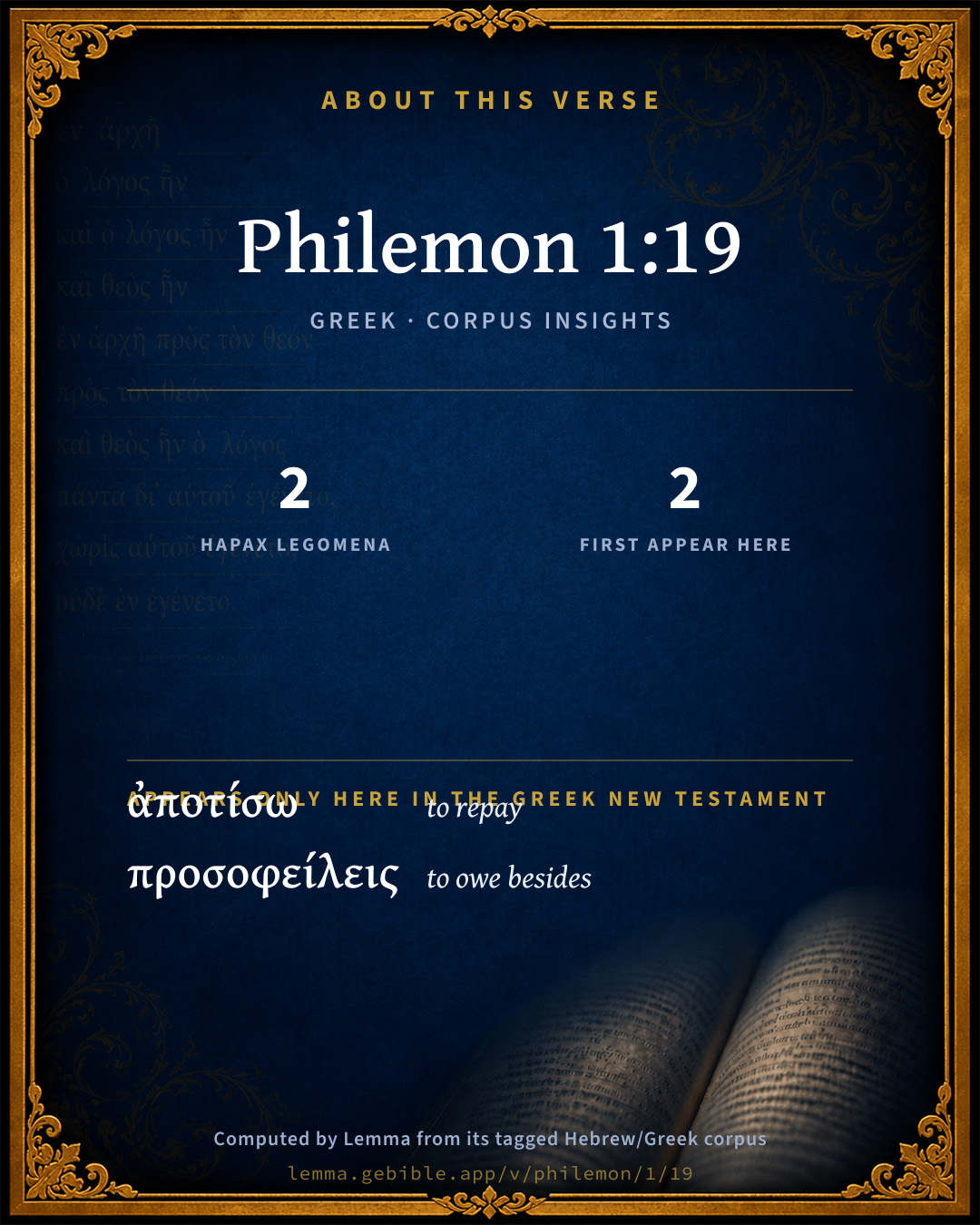
  • 2 hapax legomena — only here in the Greek New Testament
  • 2 first appearances in the Greek New Testament
Full analysis ↓
Download a study sheet

One document with this verse’s original text, its word-by-word gloss line, the meaning frame, cross-references with their text, attributed commentary, and full source and license credits — printable, and it pastes into notes with its structure intact.

This verse Autodidact and up

Study sheet (.html) Plain text (.txt)

A passage Seminary Student

Up to 50 verses in one chapter. A passage sheet keeps up to 6 commentary sources and 12 cross-references per verse, in the order this page ranks them, and says so on the sheet whenever that leaves anything out. Ask for a single verse and you get the Autodidact verse sheet above.

Everything on this page stays free to read, with no account — the sheet is a download of what is already on screen, not access to it.

Want to remove ads? Support Godless Engineer
Compare translations 3

The same verse in 3 English versions, stacked beneath the original-language interlinear above. Click any original word for its lexicon entry.

Each is an independent rendering of the whole verse — the interlinear is not word-aligned to these translations.

Highlighted words mark where these versions differ — a whole-verse word diff, not a word-by-word alignment.

  • World English Bible Public Domain
    I, Paul, write this with my own hand: I will repay it (not to mention to you that you owe to me even your own self besides).
  • King James Version Public Domain
    I Paul have written it with mine own hand, I will repay it: albeit I do not say to thee how thou owest unto me even thine own self besides.
  • unfoldingWord Literal Text CC BY-SA 4.0
    I, Paul, wrote this with my own hand. I myself will pay it back—in order not to say to you that you also owe me even your own self!

unfoldingWord Literal Text — © unfoldingWord, licensed CC BY-SA 4.0. Word-aligned USFM3 via Door43 (git.door43.org/unfoldingWord/en_ult).

Versions to compare (up to 4)

3 of 4 selected

Show all 19 translations

Every available English version of this verse, each an independent rendering of the whole verse.

  • World English Bible Public Domain
    I, Paul, write this with my own hand: I will repay it (not to mention to you that you owe to me even your own self besides).
  • Berean Standard Bible Public Domain
    I, Paul, write this with my own hand. I will repay it—not to mention that you owe me your very self.
  • Majority Standard Bible Public Domain
    I, Paul, write this with my own hand. I will repay it—not to mention that you owe me your very self.
  • King James Version Public Domain
    I Paul have written it with mine own hand, I will repay it: albeit I do not say to thee how thou owest unto me even thine own self besides.
  • American Standard Version (1901) Public Domain
    I Paul write it with mine own hand, I will repay it: that I say not unto thee that thou owest to me even thine own self besides.
  • Revised Version (1885) Public Domain
    I Paul write it with mine own hand, I will repay it: that I say not unto thee how that thou owest to me even thine own self besides.
  • Geneva Bible (1599) Public Domain
    I Paul haue written this with mine owne hande: I will recompense it, albeit I doe not say to thee, that thou owest moreouer vnto me euen thine owne selfe.
  • Douay-Rheims (1899) Public Domain
    I Paul have written it with my own hand: I will repay it: not to say to thee, that thou owest me thy own self also.
  • Young's Literal Translation Public Domain
    I, Paul did write with my hand, I -- I will repay; that I may not say that also thyself, besides, to me thou dost owe.
  • Literal Standard Version CC BY-SA 4.0
    I, Paul, wrote with my hand, I will repay; besides, that I may not say that you also owe to me yourself.
  • Unlocked Literal Bible CC BY-SA 4.0
    I, Paul, write this with my own hand. I myself will pay it back—not to mention that you owe me your own self!
  • unfoldingWord Literal Text CC BY-SA 4.0
    I, Paul, wrote this with my own hand. I myself will pay it back—in order not to say to you that you also owe me even your own self!
  • Darby Bible Public Domain
    *I* Paul have written [it] with mine own hand; *I* will repay [it]: that I say not to thee that thou owest even thine own self also to me.
  • World Messianic Bible Public Domain
    I, Paul, write this with my own hand: I will repay it (not to mention to you that you owe to me even your own self besides).
  • Webster's Bible Public Domain
    I Paul have written it with my own hand, I will repay it: although I do not say to thee that thou owest to me even thy own self besides.
  • Free Bible Version CC BY-SA 4.0
    I Paul am signing this with my own hand: I will repay you. Of course I won't mention what you owe me, including your very self!
  • Bible in Basic English Public Domain
    I, Paul, writing this myself, say, I will make payment to you: and I do not say to you that you are in debt to me even for your life.
  • Text-Critical English NT CC BY 4.0
    I, Paul, write this with my own hand: I will repay it (not to mention that yoʋ owe me yoʋr very own life).
  • Tyndale New Testament (1534) Public Domain
    I Paul have written it with myne awne hode. I will recompence it. So that I do not saye to the howe that thou owest vnto me even thyne awne silfe.

Literal Standard Version (2020), Covenant Press — licensed CC BY-SA 4.0. Text via the HelloAO Bible API (eBible.org). Unlocked Literal Bible (unfoldingWord) — licensed CC BY-SA 4.0. Text via the HelloAO Bible API (eBible.org). unfoldingWord Literal Text — © unfoldingWord, licensed CC BY-SA 4.0. Word-aligned USFM3 via Door43 (git.door43.org/unfoldingWord/en_ult). Free Bible Version, Dr. Jonathan Gallagher — licensed CC BY-SA 4.0. Text via the HelloAO Bible API (eBible.org).

Word by word

More ways to search: Search by grammar → Find every occurrence → Compare this word →

Practice this passage: Drill this verse → Learn its vocabulary →

ἀποτίσω
apotínō
G661
“to repay”
Verb, Future, Active, Indicative, 1st person, Singular
Part of Speech
Verb
Tense
Future
Voice
Active
Mood
Indicative
Person
1st person
Number
Singular
Full Thayer's Definition

Origin: from G575 and G5099

TDNT: None

1. to pay off, repay
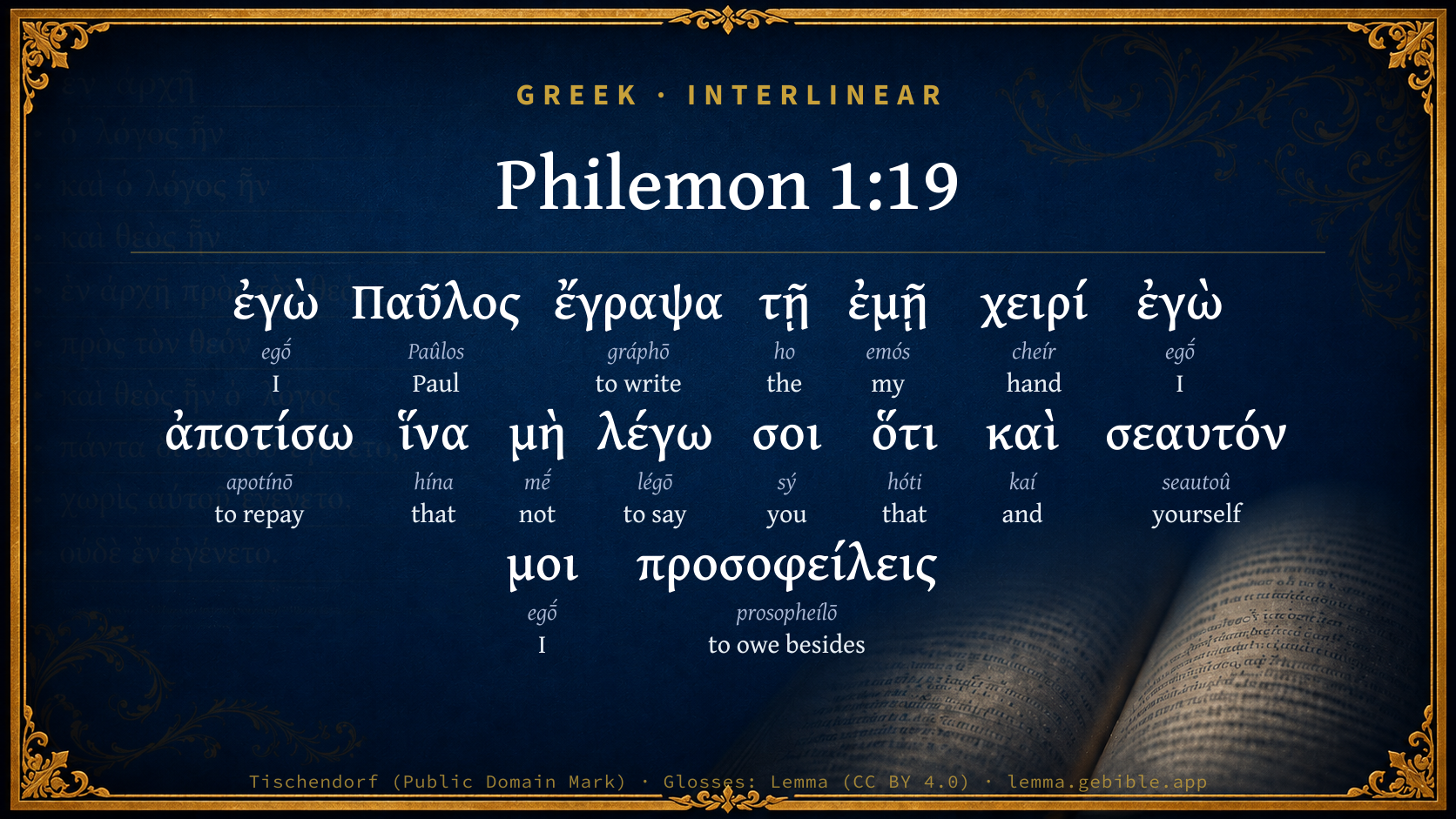
  1. ἐγὼ egṓ G1473 “I” Personal pronoun, 1st person, Nominative, Singular
  2. Παῦλος Paûlos G3972 “Paul” Noun, Nominative, Singular, Masculine
  3. ἔγραψα gráphō G1125 “to write” Verb, Aorist, Active, Indicative, 1st person, Singular
  4. τῇ ho G3588 “the” Article, Dative, Singular, Feminine
  5. ἐμῇ emós G1699 “my” Possessive pronoun, 1st person, Dative, Singular, Feminine
  6. χειρί cheír G5495 “hand” Noun, Dative, Singular, Feminine
  7. ἐγὼ egṓ G1473 “I” Personal pronoun, 1st person, Nominative, Singular
  8. ἵνα hína G2443 “that” Conjunction
  9. μὴ mḗ G3361 “not” Particle, Negative
  10. λέγω légō G3004 “to say” Verb, Present, Active, Subjunctive, 1st person, Singular
  11. σοι sý G4771 “you” Personal pronoun, 2nd person, Dative, Singular
  12. ὅτι hóti G3754 “that” Conjunction
  13. καὶ kaí G2532 “and” Conjunction
  14. σεαυτόν seautoû G4572 “yourself” Reflexive pronoun, 2nd person, Accusative, Singular, Masculine
  15. μοι egṓ G1473 “I” Personal pronoun, 1st person, Dative, Singular
  16. προσοφείλεις prosopheílō G4359 “to owe besides” Verb, Present, Active, Indicative, 2nd person, Singular

About this verse

These counts appear in no published source. They are computed here, from the morphology-tagged text and Lemma’s own curated glosses. What Lemma adds →

17
words
15
distinct lemmas
Pauline Epistles
section

Notable vocabulary

2 hapax legomena — words that appear only here in the entire Greek New Testament:

  • ἀποτίσω to repay G661
  • προσοφείλεις to owe besides G4359

First appearance in Scripture

These words make their first canonical appearance in the Greek New Testament here:

  • ἀποτίσω to repay G661
  • προσοφείλεις to owe besides G4359

Shared distinctive vocabulary

σεαυτόν yourself G4572 occurs in 42 verses of the Greek New Testament. Also found in:

Repetition

A word recurs within this verse:

Cross-references

9

Topical passages linked to Philemon 1:19 in the Treasury of Scripture Knowledge — connected by theme and wording, ordered by reader-vote popularity; previews shown in the World English Bible.

  • Galatians 6:11 See with what large letters I write to you with my own hand.
  • 1 Corinthians 16:21–22 This greeting is by me, Paul, with my own hand.
  • Galatians 5:2 Behold, I, Paul, tell you that if you receive circumcision, Christ will profit you nothing.
  • 1 Corinthians 4:15 For though you have ten thousand tutors in Christ, yet not many fathers. For in Christ Jesus, I became your father through the Gospel.
  • 1 Corinthians 9:1–2 Am I not free? Am I not an apostle? Haven't I seen Jesus Christ, our Lord? Aren't you my work in the Lord?
  • James 5:19–20 Brothers, if any among you wanders from the truth, and someone turns him back,
  • 2 Corinthians 3:2 You are our letter, written in our hearts, known and read by all men;
  • 1 Timothy 1:2 to Timothy, my true child in faith: Grace, mercy, and peace, from God our Father and Christ Jesus our Lord.
  • Titus 1:4 to Titus, my true child according to a common faith: Grace, mercy, and peace from God the Father and the Lord Jesus Christ our Savior.

Cross-references courtesy of OpenBible.info (CC BY 4.0).

Commentary

Notes on Philemon 1:19 from classic Christian and Jewish commentators (each source and its license shown beneath its notes). The classic Christian expositions comment on the surrounding passage and are grouped to its opening verse, so a note may address several verses; the Jewish commentaries on the Tanakh (Rashi and others) are per-verse, so they appear only where the commentator wrote on this verse.

Lemma curates 59 commentaries, every one of them public domain or Creative Commons licensed, each selected and text-cleaned for this edition rather than reprinted as found. About our sources →

The Biblical Illustrator

Joseph S. Exell

Phm_1:19

Written it with mine own hand--St.

Paul may have written the whole of this letter with his own hand, contrary to his usual practice. (Jerome.)

A precious relic

What a precious relic, in that case, for Philemon and his family! (Bp. Wm. Alexander.)

A signed bond

It does not follow from this sentence that the whole Epistle was written with the apostles own hand; rather it would seem that he made this engagement of repayment to be more emphatic and significant by distinguishing it from the rest of the Epistle, and by taking the pen from the hand of his secretary, and by inditing that particular clause with his own autograph, well known to Philemon. (Bp. Chris. Wordsworth.)

A Christians word should be enough

If we did live as becometh Christians, there should need no greater bond than the word of a Christian. The saying is, By the word of a king; who would not take a kings word, so royal are they in their performances? Christ has made us all kings, to God His Father; therefore we should have a singular care of any of our bare words; though the witnesses die, yet God who heard our word lives forever. But we are fallen into such an age that many mens bonds are of no validity. Samson broke the cords; and some break the seals of green wax at their pleasure; they make no account of paper or parchment bonds till they be cast into iron bonds. Some put their hands and seals to a writing, that make no conscience of the accomplishment of that which they have written. They are content to go so far with Pilate as to acknowledge their handwriting--What I have written, I have written; but they will not say, What I have written I will perform. St. Paul was of another mind; as he gave him his hand for the payment, so he gives him his heart and faithful promise to pay it. (W. Jones, D. D.)

Written covenants

We learn from hence, that civil instruments and covenants in writing, together with other assurances that may be asked and granted, are good and lawful, even amongst the best and greatest friends. I say, when debts are owing, when bargains are made, when money is lent, when lands are sold, and when there are mutual contracts between man and man, between friend and friend, between kinsman and kinsman, assurance in writing with hand and seal may be interchangeably given and received. And if we would enter into a further consideration of this truth we shall see a plain confirmation of it by sundry reasons.

1. It is a common proverb among us, fast bind, last find. That which is loosely bound is lightly lost; but a three-fold cord, well tied and twisted by word, by writing, by seal, is not easily broken. A word affirmeth, a writing confirmeth, a seal assureth, and everyone of them bindeth to confirm our promise. We see by daily experience that men are both mortal and mutable, and words prove oftentimes but wind, albeit ratified with the greatest solemnity. True it is, our word ought to be as good as a thousand obligations, but deceit is bred naturally in our hearts, so that we cannot ground upon the bare word of men to find good dealing. Otherwise, the Lord would never have given so many laws to restrain wrong and injustice, fraud, and oppression. All these, or at least a great part of them, are prevented by setting down our covenants and agreements in writing under our hands and seals.

2. It is needful to have this manner of dealing among us, to the end that equity and upright dealing might be observed among us, and that all occasions of wrangling and wresting of words and bargains might be cut off as with the sword of justice.

3. That all occasion of controversy and cousenage might be taken away. For if there were no writing to show (the memories of men being frail, and their practices being unfaithful) the world would be full of all loose dealings, and concord would be banished from among men.

4. Good assurance is to be allowed and received, to the end we may safely dispose of such things that are in our power and possession, either to our posterity or otherwise. Hence hath been in all ages, the laudable and commendable use of making wills and testaments, which the word of God approveth by delivering divers rules belonging to that profession. The law of God and of nature hath taught: that the will and testament of the dead ought not to be abrogated or altered; and that no will is of force until the testator be dead. Now we know not whether the gifts that we give, and the legacies that we bequeath, be of our own proper goods or the goods of other men, except we have beforehand a sufficient assurance of them made unto us. Seeing, therefore, where there is a fast knot, there is a sure keeping; seeing upright dealings is to be observed; seeing occasions of quarrels and contentions are to be stopped; and seeing the goods that God hath given unto us are rightly to be bestowed: it followeth that everyone is to provide for the security and quietness of his estate by all lawful means, not only by word of mouth, but by assurance in writing, that thereby he may foresee the danger that may come upon him and be wary and circumspect in all his doings, according to the saying of Christ, the Teacher and Author of true wisdom, Be ye wise as serpents and innocent as doves. For if wisdom do season all our affairs, then also our contracts that are common in this life. (W. Attersoll.)

Mans debt remitted by Christ

Of what has not man robbed God? He has assailed His government, His laws, His honour, He has stolen and prostituted His gifts, time, health, mind, influence, to the service of sin, and striven to dethrone Him in the very world which He made, and in the heart whose every pulsation is at His will. Who shall atone for the great wrong? Only a surety, and He a Divine one, who is willing to draw upon His own head the punishment, and submit to be wounded for our transgressions, and bruised for our iniquities, and to do and suffer whatever the claims and honour of Divine love required, till He could say, It is finished, and depart in peace, the Author of an eternal salvation to all that believe on His name. Graciously has God made earthly relations between man and man the representatives and explainers of higher things, and Pauls generously undertaking the debt of the guilty Onesimus sets vividly before us that Saviour whom it was his whole life to preach and his brightest hope to enjoy. (R. Nisbet, D. D.)

Thou owest unto me even thine own self besides--

Man restored to himself

Very pregnant words indeed. He that accepts the gospel of Christ is made the true possessor of himself. Before this his soul was enslaved to evil, so that, humanly speaking, it would have been better for him if he had not been born. Now his true being is restored to him, so that by Gods grace he can fulfil that purpose for which he was created and redeemed--the glorifying of God in his whole self--in his body and in his spirit, which are Gods. (M. F. Sadler, M. A.)

We owe ourselves to Christ

Does not Christ speak to us in the same language? We owe ourselves to Him, as Lazarus did, for He raises us from the death of sin to a share in His own new, undying life. As a sick man owes his life to the doctor who has cured him, as a drowning man owes his to his rescuer who dragged him from the water and breathed into his lungs till they began to work of themselves, as a child owes its life to its parents, so we owe ourselves to Christ. But He does not insist upon the debt; He gently reminds us of it, as making His commandment sweeter and easier to obey. Every heart that is really touched with gratitude will feel that the less the giver insists upon his gifts, the more do they impel to affectionate services. (A. Maclaren, D. D.)

What do you owe

Have not all of us received benefits? Have we paid our gratitude? I do not mean how much you owe to the grocer, baker, and landlord; but how much do you owe to yourself, to humanity, to God.

I. God is our Father who cares for us, and we therefore owe submission to His will when crosses and tribulation come. Tribulations borne with resignation shall mellow our nature, and be as a mould to fashion our character like unto Christ.

II. Do you not owe to yourself and to your fellow men the doing of duty? As the men who built Jerusalem, each repaired the wall before his door, so let us each do the duty that lies next us. We are not like the spectators in a theatre. We are the tragedians; we are the actors; daily life is our stage; Christ, and the angels, and our fellow men, are the spectators. Let us do our duty manfully, as Christ did. Do it because it is right; and remember that duty well done will honour us at the judgment day.

III. Pay your debt of religion to the world. When passing Westminster Abbey or St. Pauls Cathedral, if I have a quarter of an hour to spare, I always enter the sacred building and walk reverently over the graves of the good men of the past, and while looking on their partly obliterated names, I am inspired by their example to pray that my life may also be beneficial to my fellow men. What can be grander than a life which exhibits true Christian religion! Cannot you make yours such a life? Is it not a debt you owe to your neighbour? Pay the debt by embodying in your life the eternal truth which Christ has given to the world. (W. Birch.)

Reverence and love due to ministers

From hence we learn that such as have gained us to God, or preserved us in the state of salvation by the preaching of the gospel, ought to be most dear unto us, we owing unto them even ourselves, and whatsoever we have besides to do them good. The benefits bestowed upon us by the ministry of the Word can never be sufficiently esteemed, nor worthily enough prized, nor aboundantly enough be recompensed and rewarded with our love and the fruits of our love. Neither should this seem strange unto us.

1. They are most of all to be loved and highly esteemed of us that do us most good; we are most deeply indebted unto them that labour most for our benefit.

2. Again, they are unto us instead of Christ. They are His officers that He hath appointed in His Church, who, when He ascended into heaven, gave gifts unto men and ordained those that should teach His people unto the end of the world.

3. They are the ministers by whom we believe, and consequently by whom we are saved. They are our fathers in Christ, by whom we are begotten to eternal life. The uses arising from hence are of divers sorts.

(1) It directeth us to other necessary truths to be learned of us, It is noted by the apostle to be one general use of the Scripture, that it serveth and sufficeth to teach all truth needful to salvation, so the former point being received will help us to find out and conclude other truths. First we learn that, wheresoever there is a true profession, a sound feeling, a true taste of religion, or joy of salvation, there will be a reverent account and joyful entertainment of the teachers and publishers of the gospel. On the other side, a light and slender account of the ministers argueth a light account of the word of Christ, of the doctrine of salvation, and of the trueness of religion. Thus then we see how we may prove ourselves whether we be in the faith or not, even by the good estimation that we have of such as are the bringers of it. Secondly, we may gather from hence that the greatest part of the world lieth deeply and dangerously in condemnation, because such hath been the unthankfulness thereof toward the ministers and messengers of salvation, that it never respected them or gave them any reverence.

(2) As this doctrine serveth to teach, so it is profitable to reprove divers sorts of men; but I will only touch these three. First, it maketh against such as make a bad and base account of the ministers of God, and think they owe no duty to their pastors, but reckon them as their vassals and servants; suppose that they are bound to please them and follow their humours, and account their teachers beholden unto them for vouchsafing to hear them as crediting their ministry by their presence. If a man abuse an ambassador of a prince and set him at nought, it is reputed and revenged as a disgrace and dishonour done to the prince himself; so, if we shall abase and disgrace the ministers of the gospel, which are the messengers of God, we shall never escape without punishment, but bring upon ourselves swift damnation. Is not he a godless and ungracious child that mocketh and despiseth his father, after the example of cursed Shem, who tasted of Gods wrath for his contempt? Lastly, it reproveth such as refuse to give them sufficient maintenance, and do bar them of that competent and convenient portion that God hath allotted unto them in His word. For, if such as have spent their strength to bring us unto God, ought above all others to be regarded of us and have a worthy recompense of their labours; surely they deserve to be checked and controlled that deal niggardly toward them, who have kept back nothing from them, but revealed unto them the whole counsel of God. Thirdly, seeing the benefits brought unto us, both upon our bodies and souls, by the means of the ministry, can never be worthily esteemed and sufficiently expressed; it serveth to instruct us in the necessary duties of our obedience, even to testify our love to the truth by reverencing and respecting them that are the Lords messengers to bring the truth unto our doors. Lastly, seeing they by whose ministry we are gained to God and preserved in the state of salvation being gained, ought to be most dear unto us, we owing unto them our own selves; this must teach the ministers of God a necessary duty and lesson to be marked of them, to wit, to endeavour by their daily diligence and continual preaching of the gospel, to make the people indebted unto them. For how do the people come so much in their debt but that they receive heavenly doctrine by their ministry as from the mouth of God? All men are not to be handled after one manner, but one after one manner, and another after another. He were a bad and mad physician that would use all his patients to one receipt. Some have gross humours in them, and stand in need to be purged; some more strongly, others more gently, according to their condition and constitution. Others have more need to have nature restored than purged, such must have cordials and restoratives ministered unto them. So it is with such as need physic for the soul. (W. Attersoll.)

Ourselves received from and given to Christ

I venture to take these words as spoken to each Christian soul by a higher and greater voice than Pauls. I will repay it; albeit I do not say to thee how thou owest unto Me even thine own self besides.

I. Our transcendent debt. The Christian teacher may say to the soul which by his ministrations has been brought back to God and to peace in a very real sense: Thou owest thyself to me. But I pass from that altogether to the consideration of the loftier thought that is here. It is a literal fact that all of you Christian people, if you are Christians in any real sense, do owe your whole selves to Jesus Christ. Does a child owe itself to its parent? And has not Jesus Christ, if you are His, breathed into you, by supernatural and real communication, a better life and a better self, so that you have to say, I live, yet not I, but Jesus Christ liveth in me. And if that be so, is not your spiritual being, your Christian self, purely and distinctly a gift from Him? Does a man that is lying wrestling with mortal disease, and who is raised up by the skill and tenderness of his physician, owe his life to the doctor? Does a man that is drowning, and is dragged out of the river by some strong hand, owe himself to his rescuer? And is it not true that you and I were struggling with a disease which in its present form was mortal, and would very quickly end in death? Is it not true that all souls separated from God, howsoever they may secrete be living, are dead; and have not you been dragged from that living death by this dear Lord, so as that, if you have not perished, you owe yourselves to Him? Does a mad man who has been restored to self-control and sanity owe himself to the sedulous care of him that has healed him? And is it not true, paradox as it sounds, that the more a man lives to himself the less he possesses himself; and that you have been delivered, if you are Christian men and women, from the tyranny of lust and passions, and from the abject servitude to the lower parts of your nature, and to all the shabby tyrants, in time and circumstance, that rob a man of himself; and have been set free and made sane and sober, and your own masters and your own owners, by Jesus Christ? To live to self is to lose self, and when we come to ourselves we depart from ourselves; and He that has enabled us to rule our own mutinous and anarchic nature, and to put will above passions, and tastes, and flesh, and conscience above will, and Christ above conscience, has given us the gift which we never had before of an assured possession of our own selves.

II. The all-comprehending obligation based upon this. If it be true that by the sacrifice of Himself Christ has given us ourselves, what then? Why, then, the only adequate response to that gill made ours at such cost to the giver, is to give ourselves back wholly to Him who gave Himself wholly to us. Christ can only buy me at the cost of Himself. Christ only wants myself when He gives Himself. In the sweet commerce of that reciprocal love which is the foundation of all blessedness, the only equivalent for a heart is a heart. As in our daily life, and in our sweet human affections, husband and wife, and parent and children, have nothing that they can barter the one with the other except mutual interchange of self; so Jesus Christs great gift to me can only be acknowledged, adequately responded to, when I give myself to Him. And if I might for a moment dwell upon the definite particulars into which such an answer will expand itself, I might say this entire surrender of self will be manifested by the occupation of all our nature with Jesus Christ. He is meant to be the food of my mind as truth; He is meant to be the food of my heart as love; He is meant to be the Lord of my will as supreme Commander. Tastes, inclinations, faculties, hopes, memories, desires, aspirations, they are all meant as so many tendrils by which my many fingered spirit can twine itself round Him, and draw from Him nourishment and peace. Again, this entire surrender will manifest itself in the devotion of our whole being to His name and glory. Words easily spoken! words which, if they were truly transmuted into life by any of us, would revolutionise our whole nature and conduct! And further, this entire surrender of self will manifest itself in regard not only of our being and our acting, but of our having. I do not want to dwell upon this point at any length, but let me remind you, that a slave has no possessions of his own. And you and I, if we are our own owners, are so only because we are Christs slaves. Therefore we have nothing. In the old bad days the slaves cottage, his little bits of chattels, the patch of garden ground with its vegetables, and the few coins that he might have saved by selling these, they all belonged to his master because he belonged to his master. And that is true about you and me, and our balance at our bankers, and our houses and our possessions of all sorts. We say we believe that; do we administer these possessions as if we did believe it?

III. The repayment. Jesus Christ stops in no mans debt. There is an old story in one of the historical books of the Old Testament about people who, in the middle of a doubtful negotiation, were smitten by conscience and drew back from it. But one of them, with commercial shrewdness, remembered that a portion of their capital was already invested, and he says, What shall we do for the thousand talents that we have given, and are now sacrificing at the bidding of conscience? And the answer was: The Lord is able to give thee much more than these. That is true of all sacrifices for Him. He has given us abundant wages beforehand. What we give is His before it was ours. It remains His when it is called ours. We but give Him back His own. There is really nothing to repay, yet He repays in a hundred ways. He does so by giving us a keen joy in the act of surrender. It is more blessed to give than to receive. Christ bestows ourselves upon ourselves that we may have some portion of that joy. And with it come other gladnesses. There is not only the joy of surrender and the enhanced possession of all which is surrendered, but there is the larger possession of Himself which comes always as the issue of a surrender of ourselves to Him. When we thus yield He comes into our souls. (A. Maclaren, D. D.)

The Biblical Illustrator, edited by Joseph S. Exell (c. 1880s–1900s) — public domain. Text from a community e-Sword module.

Tyndale Open Study Notes

Tyndale Open Resources

1:19 Paul guarantees his promise with his signature. He typically dictated his letters to a secretary; on occasion, as here, he wrote something in his own hand. • your very soul: That is, his salvation. Philemon owed Paul much more than anything Onesimus might have owed him. Whether this means Philemon was converted directly or indirectly through Paul’s preaching is not clear (cp. Col 1:7).

Tyndale Open Study Notes — © Tyndale Open Resources, licensed CC BY-SA 4.0. Text via the HelloAO Bible API.

Bengel's Gnomon

Johann Albrecht Bengel

Phm 1:19. Ἐγὼ Παῦλος, I Paul) It was his handwriting.—ἐγὼ ἀποτίσω, I will repay) as a parent is wont to pay the debt of his son. The prisoner writes in good earnest, and with confidence that he would not want the power [of fulfilling his engagement]. But yet he promises conditionally, viz. if Philemon would exact it, Phm 1:21.—σεαυτὸν, thyself) It cannot be told how great is the obligation which is owed to those who have won souls. External property is due for spiritual benefits, but not by political obligation.—προσοφείλεις, thou even owest) This refers to owes, Phm 1:18. It is not only fitting that the pardon of Onesimus be granted to me, but thou even owest me thyself.

Bengel's Gnomon of the New Testament — English translation (T&T Clark, Edinburgh, 1860) — public domain. Text from a community e-Sword module.

Meyer's Critical & Exegetical Commentary

Heinrich August Wilhelm Meyer

Phm_1:19. Promissory note under his own hand, in which by the elsewhere so weighty ἐγὼ Παῦλος (Gal_5:2; 2Co_10:1, al.) the friendly humour of the connection is rendered the more palpable through force of contrast. Whether Paul wrote the whole Epistle with his own hand (the usual view; see already Jerome, Chrysostom, and Theodoret), or only from this point onward, cannot be determined. In the latter case the raillery comes out the more prominently.

ἵνα μὴ λέγω σοι κ.τ.λ.] Comp. 2Co_2:5, and the Latin ne dicam: est σχῆμα παρασιωπήσεως sive reticentiae, cum dicimus omittere nos velle, quod maxime dicimus, Grotius. The ἵνα denotes the design which Paul has in the ἔγραψα … ἀποτίσω; he will, so he represents the matter, by this his note of hand avoid saying to Philemonwhat he withal might in strictness have to say to himthat he was yet far more indebted to the apostle. Without sufficient reason, Wiesinger after a harsh and involved fashion attaches ἵνα, notwithstanding the intervening clause, to τοῦτο ἐμοὶ ἐλλόγα, and then takes the σοί, which according to the usual view belongs without emphasis to λέγω, as emphatic (sc. ἐλλόγα); that reckon to me, not to say: to thee. So too Hofmann, according to whose arbitrary discovery in the repetition of the ἐγώ the emphatic ἐμοί is held to continue sounding, until it finds in the emphatic σοί its antithesis, which cancels it. Why should not Paul, instead of this alleged making it sound on, have put the words ἵνα μὴ λέγω σοί, ὅτι κ.τ.λ. (because, according to Hofmann) immediately after τοῦτο ἐμοὶ ἐλλόγα, in order thereupon to conclude this passage with the weighty ἐγὼ Παῦλος κ.τ.λ.? Besides, there would be implied in that emphasizing and antithetic reference of the σοί a pungent turn so directly and incisively putting him to shame, that it would not be in keeping with the whole friendly humorous tone of this part of the letter, which does not warrant us in presupposing a displeasure on Philemons part meriting so deeply earnest a putting him to shame (Hofmann). The very shaming hint, which the passage gives, is affectionately veiled in an apparent reticence by ἵνα μὴ λέγω σοι κ.τ.λ. Chrysostom already says aptly: ἐντρεπτικῶς ἅμα καὶ χαρίεντως.

The σοί added to λέγω is in keeping with the confidential tone of the Epistle. Paul would not willingly remind his friend, of his debt.

καὶ σεαυτόν] also thine own self, διʼ ἐμοῦ γὰρ, φησὶ, τῆς σωτηρίας ἀπήλαυσας· καὶ ἐντεῦθεν δῆλον, ὡς τῆς ἀποστολικῆς ἠξιώθη διδασκαλίας ὁ Φιλήμων, Theodoret. Through his conversion he was indebted to the apostle for his own self, namely, as subject of the ξωὴ αἰώνιος. The same view is found at Luk_9:25. See on that passage.

προσοφείλεις] insuper debes, Herod. vi. 59; Dem. 650, 23; Thucyd. vii. 48. 6; Xen. Cyrop. iii. 2. 16, Oec. 20. 1; Polyb. v. 88. 4. 8, viii. 25. 4; Lucian. Sacrif. 4. The conception, namely, is: not to say to thee, that thou (namely, because I have made thee a Christian) owest to me not merely that, which I have just declared my wish to pay to thee, out also (καί) thine own self besides. With due attention to the correlation of καί and πρός, the force of the compound would not have been overlooked (Vulgate, Luther, Fliatt, and others).

Meyer — Critical and Exegetical Commentary on the New Testament — English translation by Peter Christie, edited by Frederick Crombie (T&T Clark, 1880) — public domain. Text from a community e-Sword module.

Expositor's Greek Testament

ed. W. Robertson Nicoll

Phm 1:19 . ἐγὼ Παῦλος : “The introduction of his own name gives it the character of a formal and binding signature, cf. 1Co 16:21 , Col 4:18 , 2Th 3:17 ” (Lightfoot). ἔγραψα τῇ ἐμῇ χειρί ἀποτίσω : ἔγρ . epistolary aorist, cf. 1Pe 5:12 , 1Jn 2:14 ; 1Jn 2:21 ; 1Jn 2:26 . Deissmann ( op. cit. , p. 239) calls attention to the large number of papyri which are acknowledgments of debt (Schuldhandschrift); a stereotyped phrase which these contain is, “I will repay,” usually expressed by ἀποδώσω ; in case the debtor is unable to write a representative who can do so expressly adds, “I have written this for him”. The following is an example: “… which we also will repay … besides whatever else there is ( ἄλλων ὧν ) which we owe over and above … I, Papos, write it for him, because he cannot write”. See also Deissmann’s Neue Bibelstudien , p. 67, under χειρόγραφον . It seems certain from the words ἔγραψα … ( cf. also Phm 1:21 ) that St. Paul wrote the whole of this epistle himself; this was quite exceptional, as he usually employed an amanuensis; the quasi-private character of the letter would account for this. See, further, Lightfoot’s note on Gal 6:11 . ἀποτίσω : a stronger form than the more usual ἀποδώσω . As a matter of fact St. Paul, in a large measure, had repaid whatever was due to Philemon by being the means whereby the latter received his slave back, but see Intr. § III. ἵνα μὴ λέγω σοι : a kind of mental ejaculation, as though St. Paul were speaking to himself; the σοι does not properly belong to the phrase; cf. 2Co 9:4 . καὶ σεαυτόν : the reference is to Philemon’s conversion, either directly due to St. Paul, or else indirectly through the mission into Asia Minor, which had been the means whereby Philemon had become a Christian; in either case St. Paul could claim Philemon as his spiritual child in the sense that he did in the case of Onesimus (see Phm 1:10 ). μοι προσοφείλεις : “thou owest me over and above”. See farther, on ὀφειλή , Deissmann, Neue Bibelst. , p. 48, Licht vom Osten , pp. 46, 239.

The Expositor's Greek Testament, edited by W. Robertson Nicoll (1897–1910) — public domain. Text from a community e-Sword module.

Jamieson, Fausset & Brown

Robert Jamieson, A. R. Fausset & David Brown

with mine own hand--not employing an amanuensis, as in other Epistles: a special compliment to Philemon which he ought to show his appreciation of by granting Paul's request. Contrast Col 4:18, which shows that the Epistle to the Colossian Church, accompanying this Epistle, had only its closing "salutation" written by Paul's own hand.

albeit, &c.--literally, "that I may not say . . . not to say," &c.

thou owest . . . even thine own self--not merely thy possessions. For to my instrumentality thou owest thy salvation. So the debt which "he oweth thee" being transferred upon me (I making myself responsible for it) is cancelled.

Jamieson, Fausset & Brown — Commentary Critical and Explanatory on the Whole Bible (1871) — public domain (CC PDM 1.0). Text via the HelloAO Bible API.

Adam Clarke's Commentary

Verse 19. I Paul have written it with mine own hand] It is likely that the whole of the letter was written by St. Paul himself, which was not his usual custom. See notes on 2Th 3:17. But by thus speaking he bound Philemon to do what he requested, as an act of common civility, if he could not feel a higher motive from what he had already urged.

Albeit I do not say to thee how thou owest unto me] I ask thee to do this thing to oblige me, though I will not say how much thou owest unto me; even thine own self, as having been the means of thy conversion.

Adam Clarke's Commentary on the Bible (1810–1826) — public domain. Text from a community e-Sword/MySword module.

John Calvin's Commentaries

19 Not to tell thee that thou owest to me thyself. By this expression he intended to describe how confidently he believes that he will obtain it; as if he had said, “There is nothing that thou couldest refuse to give me, even though I should demand thyself.” To the same purpose is what follows about lodging and other matters, as we shall immediately see.

There remains one question. How does Paul — who, if he had not been aided by the churches, had not the means of living sparingly and frugally — promise to pay money? Amidst such poverty and want this does certainly appear to be a ridiculous promise; but it is easy to see that, by this form of expression, Paul beseeches Philemon not to ask anything back from his slave. Though he does not speak ironically, yet, by an indirect figure, he requests him to blot out and cancel this account. The meaning, therefore, is — “I wish that thou shouldest not contend with thy slave, unless thou choosest to have me for thy debtor in his stead.” For he immediately adds that Philemon is altogether his own; and he who claims the whole man as his property, need not give himself uneasiness about paying money.

John Calvin's Commentaries (1540-1563) — public domain. Text from the Calvin Translation Society English edition (1840s-50s) via the Christian Classics Ethereal Library (ccel.org). Calvin's coverage is partial (roughly two-thirds of the Bible); uncommented books and verses are honest gaps, never fabricated. The 19th-century editor's footnotes and remarks are omitted so the notes are faithfully Calvin's own voice.

Ellicott's Commentary for English Readers

(19) I Paul have written it with mine own hand.—St. Paul actually introduces here a regular bond couched in legal form, written (as, perhaps, the whole Letter was written) with his own hand. In so doing he still continues the idea of the preceding verse; but the following words show that, though willing to stand to his bond, he knew Philemon too well to suppose that he would accept it.

It is clear from this passage that the Apostle had money which he could rightly call his own. At Ephesus, where he probably first knew Philemon, it would probably be earned in the work with Aquila and Priscilla, as at Corinth, and it is possible that some of it might still remain. In Rome now, it could hardly be from any other source than the offerings from the Church at Philippi. They were given him freely; he might fairly spend them on his own “son in the faith.”

Albeit I do not say to thee . . .—Literally, not to say to thee. Here St. Paul escapes from the business-like promise of the last verse to the freer Atmosphere of spiritual relations. He knew that this promise it was right for him to offer, but wrong for Philemon to accept. Philemon owed his own self—his new self in Christ—to the Apostle. In that was a debt which he could not repay, but would rejoice even in this smaller matter to acknowledge.

A Bible Commentary for English Readers, edited by Charles John Ellicott (1878–1897) — public domain. Text from a community e-Sword module.

The Cambridge Bible for Schools and Colleges

gen. ed. J. J. S. Perowne

19. I Paul have written it] Lit., “did write it;” an “epistolary aorist” (Col_4:8); “the tense commonly used in signatures” (Lightfoot).—Here, surely, he takes the pen (cp. Col_4:18) and writes his indebtedness in autograph, with a formal mention of his own name; then, he gives the pen back to the amanuensis.

“A signature to a deed in ancient or mediæval times would commonly take the form … “I so-and-so” (Lightfoot).

I will] The “I” is emphatic in the Greek.

albeit I do not say] Lit., and better, that I say not, not to say.

thou owest unto me … besides] As if to say, “I am restoring to you Onesimus, made new; this far more than clears any loss he cost you when he fled; thus you are indebted, even in money’s worth, to me; and besides—you owe me yourself.”

thine own self] The converted man “comes to himself” (Luk_15:17) as never before. “It is a new creation” (2Co_5:17); as it were a new self. Under God, this is due to the human bringer of the converting word; and so to him, under God, the convert feels instinctively a moral indebtedness; he owes him help and service in the new life.

The Cambridge Bible for Schools and Colleges (gen. ed. J. J. S. Perowne; Cambridge University Press, 1878–1918) — public domain. Text from a community e-Sword module.

John Gill's Exposition

I Paul have written it, with mine own hand,.... Meaning either this epistle, which being short, he used no amanuensis, but wrote it all himself, and which might be taken as an engagement to do what he promised; or else a bill, a promissory note, written with his own hand, which he sent along with Onesimus, by which he laid himself under obligation to give Philemon full satisfaction in every thing, in which he had been injured by his servant; adding,

I will repay it: this was not an ironical expression, nor a piece of vanity in the apostle; he spoke seriously, and heartily, and meant what he said; and though his circumstances were often so mean, that he was forced to work with his own hands to minister to his necessities; yet such was his interest in the churches, and such their obligation to him, on account of his personal and useful ministrations to them, that he could easily raise a sum of money among them, upon any emergent occasion; so that Philemon had a good surety and paymaster of the apostle: and this shows his great humility to be a bondsman for a servant, and to make good damages and debts brought on in a scandalous manner; as also that suretyship in some cases is lawful, though it ought to be cautiously, and for very good reasons, entered into: and this engagement of the apostle for Onesimus bears some resemblance with, and may serve to illustrate the suretyship of Christ, for his people, they, and Onesimus, being much in a like condition; as he was an unprofitable and run away servant, so they are all gone out of the way, and together become unprofitable; and Christ engaged with his Father to bring them back again, and set them before him; and by his sufferings and death has brought them nigh, which were afar off; as he had wronged his master and was indebted to him, so they have injured the law of God, affronted his justice, and incurred his displeasure; and having owed to him more than ten thousand talents, and having nothing to pay, Christ engaged to satisfy law and justice, to make reconciliation for them, and pay all their debts; all which he has accordingly done; their sins have been placed to his account, imputed to him, and charged upon him; and he has bore them, and the punishment due to them, and so has satisfied for them, and restored that which he took not away,

Albeit I do not say to thee how thou owest unto me even thine own self besides; having respect to his conversion, which he was the happy instrument of the apostle was his spiritual father, and he was his son, according to the common faith; he had been the instrument of saving his soul from death; he had been the means of that in the hand of God, which all his riches, and the riches of his friends and relations, could never have procured: the salvation of his soul, his better part, was instrumentally owing to him, and so his whole self; and therefore, what favour might he not ask of him? and what was it he could, or should deny him? this the apostle introduces in a very artificial manner, and does not insist upon it, but suggests, that should he forgive the injuries and debts, he had took upon him to make satisfaction for, it would not be an equivalent to the debt he owed to him. From hence may be observed, how greatly obliged regenerated persons are to those, who have been the means and instruments of their conversion.

John Gill's Exposition of the Whole Bible (1746–1763) — public domain (CC PDM 1.0). Text via the HelloAO Bible API.

Trapp's Complete Commentary

John Trapp

19 I Paul have written it with mine own hand, I will repay it: albeit I do not say to thee how thou owest unto me even thine own self besides.

Ver. 19. Thou owest unto me, &c.] If Cleanthes gave himself to his master Socrates; if Alexander could say that he owed more to Aristotle that taught him than to Philip that begat him; if another could say that he could never discharge his debt to God, to his parents, and to his schoolmaster; how deeply then do men stand obliged to their spiritual fathers and teachers in Christ!

I will repay it] Philemon, though rich, is suspected to be somewhat too covetous, from this expression.

" O quam difficile est opibus non tradere mores;

Et cum tot Croesos viceris, esse Numam!"

Howbeit in both the Testaments we shall scarcely read of any godly man tainted with covetousness. Luther saith of himself, that though he otherwise had his flaws and frailties, yet the infection of covetousness never laid hold on him. Heu Germann illa bestia non curat aurum, said one of his adversaries, wiser than the rest, that would have stopped his mouth with money. But Seneca was naturally covetous, which he shrouds covertly in that sentence of his in his book de Tranquillitate, Nec aegroto nec valeo, I am neither sick nor well. It had been well for him if he could have said with that dying saint, My body is weak, my soul is well. As for those Epistles pretended to be written to him by St Paul, they are bastard and counterfeit, they savour not of his apostolic gravity and majesty, which shineth even in this to Philemon, being the least of all his Epistles. In those forged Epistles far higher matters are spoken of; but, alas, how coldly, how dryly and poorly! yet here behold a poor petty matter is set forth with that pithiness and powerfulness of speech, as is admirable. (Dyke.)

John Trapp, A Commentary or Exposition upon All the Books of the Old and New Testament (1647–1656) — public domain. Text from a community e-Sword module.

Albert Barnes' Notes on the Bible

I Paul have written it with mine own hand - It has been inferred from this, that Paul wrote this entire Epistle with his own hand, though this was contrary to his usual practice; compare the Rom 16:22 note; 1Co 16:21 note; Gal 6:11 note. He undoubtedly meant to refer to this as a mark of special favor toward Philemon, and as furnishing security that he would certainly be bound for what he had promised.

I will repay it - I will be security for it. It is not probable that Paul supposed that Philemon would rigidly exact it from him, but if he did, he would feel himself bound to pay it.

Albeit I do not say to thee how thou owest unto me even thine own self besides - Paul had doubtless been the means of the conversion of Philemon, and whatever hope he cherished of eternal life, was to be traced to his instrumentality. Paul says that this was equivalent to his owing himself to him. His very life - his eternal welfare - was to be traced to his labors. What he asked now of him was a small matter compared with this, and he seems to have supposed - what was probably true - that for this consideration, Philemon would not think of exacting of him what he had voluntarily obligated himself to obey.

Albert Barnes' Notes on the Bible (1834–1885) — public domain. Text from a community e-Sword/MySword module.

Haydock's Catholic Bible Commentary

I, Paul, have written, and testified this with my own hand. Some think he wrote the whole letter, with his own hand, to make it more acceptable to Philemon. --- Not to say to thee, that thou owest me thy own self, the eternal salvation of thy soul, by thy conversion to the faith of Christ. (Witham)

George Leo Haydock (1774–1849), Haydock's Catholic Family Bible and Commentary, 1859 edition — public domain. Excludes Psalms (Douay-Rheims chapter numbering differs from Protestant) and Deuterocanonical books (Catholic canon only).

Matthew Poole's English Annotations

Thou hast it here under my hand, I take upon me to satisfy thee Onesimus’s debt; yet I could tell thee, that thou owest me more than it can be, even thy own self, God having made use of me as an instrument to convert and turn thee unto God. Such persons are great debtors to their spiritual fathers, Rom 15:27.

Matthew Poole's English Annotations on the Holy Bible (1683–1685) — public domain. Text from a community e-Sword/MySword module.

Whedon's Commentary on the Bible

Daniel D. Whedon

19. Mine own hand—It is unreasonable to suppose, as some commentators do, that Paul took up his stilus and wrote solely this sentence. He may be supposed to have written so brief an epistle with his own hand. And this emphatic mine own hand constitutes a good promissory note, that if Philemon cannot bear the pecuniary loss resulting from pardon, amnesty, and emancipation, I Paul will.

Albeit—A slight stay against Philemon’s enforcing the promissory note.

Owest… thine own self—And so art bound to what my request and thy duty inspire thee to do.

Daniel D. Whedon (gen. ed.), Commentary on the Old and New Testaments (1874–1909) — public domain. Text from a community e-Sword module.

The Pulpit Commentary

I Paul have writtenwrite it (Revised Version)with my own hand, I will repay it. Thus St. Paul took upon himself legally the repayment of the debt. "Prioribus verbis proprie cautio a bail or security continetur: his autem constituti obligatio. Hoc Latine dicitur pecuniam constituere: de quo titulus est in Digestis Anadecesyai dicunt Graeci" (Scipio Gentilis). Albeit I do not say to thee, etc.; "though I do not remind thee while so saying that thou owest even thyself to me!" Philemon owed to the apostle that debt of which the obligation outweighed every other the help by which he had been led out of spiritual darkness and brought to the knowledge of the truth. St. Paul was (as we must conclude from this allusion) the "spiritual father" of Philemon a phrase he himself uses in 1Co_4:15.

Spiritual benefits the most valuable of all;

Since St. Paul had (as it appears) won to the embracing of the faith of Christ as well Philemon himself as Onesimus his slave, he rightly reminds him, as his first and most powerful argument, that Philemon owes himself and his very life (that is, the life of his soul) to him.

I HE DOES NOT SUM UP THIS OBLIGATION. He leaves it to the conscience of Philemon to consider how much he was indebted. It was, perhaps, incommensurable with the favor he was asking. But it is clear that such an obligation must exceed every other. A man"s self is more valuable than his lands or his goods. (Job_2:4) It is therefore a lifelong obligation that men are under to those who have been to them the instruments of great spiritual benefits, and one not capable of being fully discharged. So it is said, "How beautiful upon the mountains are the feet of him that bringeth good tidings, that publisheth peace!". (Isa_52:7 Rom_10:15) St. Paul bears witness that the Galatians, whose spiritual father he was, regarded nothing as being too good or too costly to show their affection for him; (Gal_4:14, Gal_4:15) and he lays down in 1Co_9:11 that the spiritual benefits of which he had been the means were supreme in kind to any possible carnal recompense.

II SPIRITUAL BENEFITS ARE INDEED THE GIFTS OF GOD AND THE EFFECTS OF HIS GRACE; but he uses the services of men, and particularly of his ministers, in the dispensing of them. "It is better to help our friends to recover lost grace than lost money" (Thomas Aquinas). And those who receive them rightly will be suitably grateful.

III SPIRITUAL BENEFITS THE MOST VALUABLE, because the soul of man is his most precious possession. (Mar_8:36, 37) The life of the soul is impaired and at length wholly lost by sin; but is regained and strengthened by Divine grace.

1. The soul is more noble than earth or heaven; for of these the one is for its temporary habitation, the other for its eternal one.

2. It bears the image of God. It is like the piece of silver in the parable, (Luk_15:8) for which, when lost, such diligent search was made. The heavens were created with a word, but the redemption of the soul needed the incarnation of Christ, and his death upon the cross.

3. Hence its value, and the corresponding value of a service rendered to it a value so great as not to be capable of being expressed (e.g.) in money.

IV IT IS INCOMMENSURATE WITH TEMPORAL THINGS. So St. Paul does not give the sum of it. The freedom of Onesimus was a service in the spiritual sphere. It was a benefit to Onesimus himself; and, if he were employed as St. Paul proposed (Ver. 13), in the service of the Church, might be the means of good to many other souls.

V IT WAS A FITTING PLEDGE, therefore, of the gratitude of Philemon.

Vers. 19, 20. Personal obligation.

"Thine own self." This is more than all else. We can call nothing "our own" but "the self." We are not rich in what we have, but in what we are. All things, houses, estates, lands, are outside us. The self is all.

I INDEBTEDNESS OF PHILEMON. Philemon owed his spiritual conversion, all the rich inheritance in the soul, to the ministry of Paul; and he delicately enough reminds him of this in an indirect form of speech, "Albeit I do not say to thee how thou owest unto me even thine own self." It is one of those touches which show what a true gentleman St. Paul was. There is more than claim of right to counsel him, viz. the modest reminder that, if need be, he would repay any loss that Philemon might have sustained through the detention by Paul of Onesimus.

II EXPECTATION CONCERNING HIM. "Let me have joy of thee in the Lord." "Refresh me." What by? That which alone can rejoice the heart of a true father in the gospel, viz. Christ"s own Spirit in Christ"s disciples. The gospel was to be spread, not alone by eloquence or erudition, but by Christ"s own religion alive and in action in all who confessed his Name. W.M.S.

The Pulpit Commentary (1880–1919), ed. H.D.M. Spence-Jones & Joseph S. Exell — public domain. Text from a community e-Sword module.

John Wesley's Explanatory Notes

I will repay it - If thou requirest it. Not to say, that then owest me thyself - It cannot be expressed, how great our obligation is to those who have gained our souls to Christ. Beside - Receiving Onesimus.

John Wesley, Explanatory Notes Upon the Whole Bible (1754–1765) — public domain. Text via the GEBible commentary corpus.

Godbey's Commentary on the New Testament

William B. Godbey

19. “I, Paul, have written with my own hand, I will pay it.” See the wonderful faith of Paul in financial matters! Though a prisoner in bonds, and utterly disqualified to prosecute any remunerative employment, and not worth a nickel, he boldly assumes all financial responsibility in behalf of this poor fugitive slave, his son in the gospel. In all the great Pauline series he dictated to an amanuensis, except this brief letter and the epistle to the Galatians. “In order that I may not say to thee, that thou owest thyself unto me.” See what an adroit turn he makes on Philemon! “Though I go the security of Onesimus, and will pay all of his indebtedness to you, do not forget that you owe yourself to me. Satan had you by the throat, till I broke his grip and delivered you. Therefore you are indebted to me for saving your scalp. Hence, by the time you pay me all you owe me, I can well afford to pay the debts of Onesimus.”

William B. Godbey, Commentary on the New Testament (1896–1900) — public domain. Text from a community e-Sword module.

The People's New Testament

B. W. Johnson

19. I, Paul, have written it with mine own hand. If you hold this wrong against him, here is my written bond that I will repay it. Albeit. Here is a reminder that Philemon owed his salvation to Paul, a reminder which would certainly prevent him from putting in a claim against the apostle.

B. W. Johnson's The People's New Testament with Notes (1889–1891) — public domain. Electronic text from the Christian Classics Ethereal Library (CCEL) ThML edition.

Cambridge Greek Testament for Schools and Colleges

19. ἐγὼ Παῦλος. For these two words see Col 1:23, note.

It is very precarious to argue that this verse makes it probable that the whole Epistle was written by St Paul himself, for although the position of the autograph is certainly unique (cf. Col 4:18 and note), yet he would hardly have said τῇ ἐμῇ χειρί so emphatically in reference to repaying if in fact the whole epistle had been written by him. It is at least as likely that he took up the pen for a minute and wrote this verse only.

ἔγραψα. Epistolary, Phm 1:21. Cf. also ἀνέπεμψα Phm 1:12.

“The aorist is the tense commonly used in signatures; e.g. ὑπέγραψα to the conciliar decrees” (Lightfoot).

τῇ ἐμῇ χειρί, ἐλὼ. The repetition of the ἐγὼ is very fine, both in argument and in proof of love.

ἀποτίσω. Here only in the N.T. but often in LXX. For the meaning “pay back,” as doubtless here, see Exo 21:19; Exo 21:34; 2Sa 12:6; Psalms 36(37):21.

If it be asked whence St Paul would pay back the debt, the answer may lie either in his having some property of his own (cf. Ramsay on his imprisonment at Caesarea St Paul the Traveller, c. XIII.), or in the gifts of the Philippian Christians (Php 4:10-18), or in the possibility of his asking friends to help him.

ἵνα μὴ λέγω σοι ὅτι κ.τ.λ., “not to say to thee that.” The figure of speech known as paraleipsis or praeteritio, in which the speaker pretends to pass over something which in reality he mentions (see Blass Gram. § 82. 9), cf. 2Co 9:4.

A perversely ingenious interpretation takes ἐγὼ Παῦλος … ἀποτίσω as a parenthesis, and contrasts σοί with ἐμοὶ ἐλλόγα. “Put it down to me … not to say thee (as I might fairly say, i.e. to work off part of the debt to me), because” thou owest me much more. But St Paul would surely not have wrecked his sentence by putting his autograph between the two contrasted words.

καὶ σεαυτόν μοι προσοφείλεις. προσοφείλειν here only in Biblical Greek. Thou owest me already as much as Onesimus’ debt, and in addition even thyself. For through St Paul’s means (evidently) he had passed out of the state of spiritual death into full existence, and full ownership of himself.

Cambridge Greek Testament for Schools and Colleges (Cambridge University Press, 1896; 21 vols, various authors incl. Carr, Maclear, Plummer, Farrar, Lumby, Moule, M. R. James, Simcox) — public domain. Text from a community e-Sword module.

Alford’s Greek Testament

Henry Alford

19.] The inference from this is, that the whole Epistle was autographic: for it would be most unnatural to suppose the Apostle to break off his amanuensis here, and write this engagement with his own hand.

ἵνα μὴ λέγω] “est σχῆμα παρασιωπήσεως sive reticentiæ, cum dicimus nos omittere velle, quod maxime dicimus,” Grot. ἵνα μή does not exactly, as Meyer, give the purpose of St. Paul in ἔγραψα—ἀποτίσω: but rather that of an understood clause,—‘yield me this request, lest I should have to remind thee, &c.’ Ellic. paraphrases, ‘repay: yes I say this, not doubting thee, but not wishing to press on thee all the claim that I might justly urge.’ καὶ τοῦτο ἀπὸ ἀγάπης καὶ κατὰ τὸν τὴς φιλίας λόγον, καὶ τοῦ σφόδρα θαῤῥεῖν ἦν, Chrys. And this may well be the right view.

καὶ σεαυτόν] οὐ τὰ σαυτοῦ μόνον, Chr. διʼ ἐμοῦ γάρ, φησί, τῆς σωτηρίας ἀπήλαυσας· καὶ ἐντεῦθεν δῆλον, ὡς τῆς ἀποστολικῆς διδασκαλίας ἠξιώθη ὁ Φιλήμων, Thdrt.

Henry Alford, The Greek Testament (1849–1861) — public domain. Text from a community e-Sword module.

International Critical Commentary

19. ἐγὼ Παῦλος ἔγραψα τῇ ἐμῇ χειρί: ‘I, Paul, write it with my own hand.’ Paul’s promissory note. Ἔγραψα is the epistolary aorist. (Comp. 1Pe 5:12; 1Jn 2:14, 1Jn 2:21, 1Jn 2:26.) It would appear that Paul wrote these and at least the two following words with his own hand. How much more he may have written, whether the entire letter, or all the verses from 19 to the end, is purely a matter of speculation.

Lightf. says that this incidental mention of his autograph, occurring where it does, shows that he wrote the whole letter with his own hand instead of employing an amanuensis as usual. So De W. and Alf., and Ellic. and Oltr. think it not improbable. (See Lightf. and Ellic. on Gal 6:11.)

ἐγὼ ἀποτίσω: ‘I will repay it.’ Probably without any serious expectation that Philemon would demand payment; but yet not as a mere graceful pleasantry (as v. Sod., Mey., Oltr.). Oltr. imagines how Philemon must have laughed at such a promise from a man who had not a penny in the world. But why? Paul on his anticipated release from prison might have found means to pay if payment should be demanded, just as he found means to live in prison or to earn the money by his own labor as he had done more than once.

ἵνα μὴ λέγω σοι: ‘not to say to thee.’ (Comp. 2Co 9:4.) A sort of elliptical construction in which the writer delicately protests against saying something which he nevertheless does say. Similar phrases are οὐχ ὅτι (Php 4:11); οὐχ οἷον ὅτι (Rom 9:6). In many such cases the phrase becomes stereotyped, and the connection with a suppressed thought is not consciously present to the writer. The thought completely expressed would be: ‘I agree to assume the obligation in order to avoid mentioning your great personal debt to me.’

ὅτι καὶ σεαυτόν μοι προσοφείλεις: ‘that thou owest me also thine own self besides.’ You owe to me your conversion. The καὶ ‘also,’ and προς (προσοφ.) ‘in addition to’ are correlated. You are my debtor not only to the amount for which I here become responsible, but also for your own self in addition to that. Even if you remit the debt, you will still owe me yourself. Προσοφείλειν only here in N.T.

International Critical Commentary — older volumes (1896–1929), various authors — public domain. Text from a community e-Sword module.

Vincent's Word Studies in the New Testament

Marvin R. Vincent

I Paul have written, etc. Rev., write. A promissory note. The mention of his autograph here, rather than at the end of the letter, may indicate that he wrote the whole epistle with his own hand, contrary to his usual custom of employing an amanuensis.

Albeit I do not say [ινα μη λεγω] . Lit., that I may not say. Connect with I write. I thus give my note of hand that I may avoid saying that thou owest, etc. Rev., that I say not unto thee.

Thou owest [προσοφειλεις] . Lit., owest in addition. I have laid you under obligation, not only for an amount equal to that due from Onesimus, but for yourself as made a Christian through my ministry.

Marvin R. Vincent, Word Studies in the New Testament (1887–1900) — public domain. Text from a community e-Sword/MySword module.

Lightfoot's Colossians and Philemon

J. B. Lightfoot

19. ἐγὼ Παῦλος] The introduction of his own name gives it the character of a formal and binding signature: comp. 1 Cor. xvi. 21, Col. iv. 18, 2 Thess. iii. 17. A signature to a deed in ancient or mediæval times would commonly take this form ἐγὼ ὁ δεῖνα,—‘I so and so’; where we should omit the marks of the first person.

ἔγραψα] An epistolary or documentary aorist, as in ver. 21; so too ἀνέπεμψα ver. 11. See the note on ἔγραψα Gal. vi. 11. The aorist is the tense commonly used in signatures; e.g. ὑπέγραψα to the conciliar decrees.

This incidental mention of his autograph, occurring where it does, shows that he wrote the whole letter with his own hand. This procedure is quite exceptional, just as the purport of the letter is exceptional. In all other cases he appears to have employed an amanuensis, only adding a few words in his own handwriting at the close: see the note on Gal. l.c.

J. B. Lightfoot, St Paul's Epistles to the Colossians and Philemon: a revised text with introductions, notes and dissertations (London: Macmillan, 1875) — public domain. Electronic text from Project Gutenberg (ebook #50857). Covers Colossians and Philemon only (the verse-by-verse notes; introductions and dissertations are omitted); Lightfoot's companion Galatians and Philippians volumes are not included, as the available public-domain scans carry garbled Greek that cannot be faithfully reproduced.

Lesson kit

Teaching starters — assembled from the data on this page, not authored interpretation. Every prompt links to the verse data it draws on. Edit before teaching.

Philemon, in the Pauline Epistles, opens this verse with 17 words (15 distinct Greek lemmas). Its most distinctive word is apotínō (“to repay”). A historical commentator’s framing appears above. Read the whole chapter for the surrounding context.

Discussion questions

  1. How does “to repay” (apotínō) shape what this verse is saying?
  2. 2 words here appear nowhere else in the Greek New Testament. Why might the author reach for such rare wording?
  3. 2 words make their first appearance in Scripture here. What does this debut establish?
  4. How does Matthew 4:6, which shares the word «yourself», read alongside this verse?
  5. What does the repetition of “I” (3× in this one verse) do in this verse?
  6. These translations render this verse differently. What is at stake in choosing one wording over another?
  7. Compare how The Biblical Illustrator and Tyndale Open Study Notes read this verse. Where do they agree or differ?

Things to notice

  • 2 words in this verse appear nowhere else in the Greek New Testament.
  • 2 words make their first canonical appearance in Scripture here.
  • These translations choose different wording for 20 words in this verse.
  • “I” occurs 3× in this single verse.
  • 15 distinct Greek lemmas span 17 words in this verse.

Reading settings

Reading text

Shown beneath each verse's original-language words.

Old Testament
Old Testament edition

Read the OT as the Masoretic Hebrew (MT) or the Greek Septuagint (LXX).

English shown for the Greek Septuagint (in the Hebrew ↔ Greek comparison).

Comparing translations? Open the Compare panel on any verse page to stack up to four side by side.