
Acts 12:17

Greek (Tischendorf 8th ed.) Acts 12:17 appears in the Greek New Testament. The text above is from the Tischendorf 8th edition. Each word links to its Strong’s number and a concise gloss. Click any word for its full Thayer’s Greek Lexicon entry.

Download image
Cite this verse

Acts 12:17 (World English Bible). Public Domain. Lemma interlinear Bible study tool, https://lemma.gebible.app/v/acts/12/17.

Show BibTeX & RIS
BibTeX
RIS
English Translation
But he, beckoning to them with his hand to be silent, declared to them how the Lord had brought him out of the prison. He said, "Tell these things to James, and to the brothers." Then he departed, and went to another place.
World English Bible · Public Domain
Highlights
  • 1 first appearance in the Greek New Testament
Full analysis ↓
Download a study sheet

One document with this verse’s original text, its word-by-word gloss line, the meaning frame, cross-references with their text, attributed commentary, and full source and license credits — printable, and it pastes into notes with its structure intact.

This verse Autodidact and up

Study sheet (.html) Plain text (.txt)

A passage Seminary Student

Up to 50 verses in one chapter. A passage sheet keeps up to 6 commentary sources and 12 cross-references per verse, in the order this page ranks them, and says so on the sheet whenever that leaves anything out. Ask for a single verse and you get the Autodidact verse sheet above.

Everything on this page stays free to read, with no account — the sheet is a download of what is already on screen, not access to it.

Want to remove ads? Support Godless Engineer
Compare translations 3

The same verse in 3 English versions, stacked beneath the original-language interlinear above. Click any original word for its lexicon entry.

Each is an independent rendering of the whole verse — the interlinear is not word-aligned to these translations.

Highlighted words mark where these versions differ — a whole-verse word diff, not a word-by-word alignment.

  • World English Bible Public Domain
    But he, beckoning to them with his hand to be silent, declared to them how the Lord had brought him out of the prison. He said, "Tell these things to James, and to the brothers." Then he departed, and went to another place.
  • King James Version Public Domain
    But he, beckoning unto them with the hand to hold their peace, declared unto them how the Lord had brought him out of the prison. And he said, Go shew these things unto James, and to the brethren. And he departed, and went into another place.
  • unfoldingWord Literal Text CC BY-SA 4.0
    And having motioned to them with hand to be silent, he described how the Lord had led him out from the prison. And he said, “Report these things to James and the brothers.” And having gone out, he went to another place.

unfoldingWord Literal Text — © unfoldingWord, licensed CC BY-SA 4.0. Word-aligned USFM3 via Door43 (git.door43.org/unfoldingWord/en_ult).

Versions to compare (up to 4)

3 of 4 selected

Show all 19 translations

Every available English version of this verse, each an independent rendering of the whole verse.

  • World English Bible Public Domain
    But he, beckoning to them with his hand to be silent, declared to them how the Lord had brought him out of the prison. He said, "Tell these things to James, and to the brothers." Then he departed, and went to another place.
  • Berean Standard Bible Public Domain
    Peter motioned with his hand for silence, and he described how the Lord had brought him out of the prison. “Send word to James and to the brothers,” he said, and he left for another place.
  • Majority Standard Bible Public Domain
    Peter motioned with his hand for silence, and he described how the Lord had brought him out of the prison. “Send word to James and to the brothers,” he said, and he left for another place.
  • King James Version Public Domain
    But he, beckoning unto them with the hand to hold their peace, declared unto them how the Lord had brought him out of the prison. And he said, Go shew these things unto James, and to the brethren. And he departed, and went into another place.
  • American Standard Version (1901) Public Domain
    But he, beckoning unto them with the hand to hold their peace, declared unto them how the Lord had brought him forth out of the prison. And he said, Tell these things unto James, and to the brethren. And he departed, and went to another place.
  • Revised Version (1885) Public Domain
    But he, beckoning unto them with the hand to hold their peace, declared unto them how the Lord had brought him forth out of the prison. And he said, Tell these things unto James, and to the brethren. And he departed, and went to another place.
  • Geneva Bible (1599) Public Domain
    And he beckened vnto them with the hand, to hold their peace, and told them how the Lord had brought him out of the prison. And he saide, Goe shewe these things vnto Iames and to the brethren: and he departed and went into an other place.
  • Douay-Rheims (1899) Public Domain
    But he beckoning to them with his hand to hold their peace, told how the Lord had brought him out of prison, and he said: Tell these things to James, and to the brethren. And going out, he went into another place.
  • Young's Literal Translation Public Domain
    and having beckoned to them with the hand to be silent, he declared to them how the Lord brought him out of the prison, and he said, `Declare to James and to the brethren these things;' and having gone forth, he went on to another place.
  • Literal Standard Version CC BY-SA 4.0
    and having beckoned to them with the hand to be silent, he declared to them how the LORD brought him out of the prison, and he said, “Declare these things to James and to the brothers”; and having gone forth, he went on to another place.
  • Unlocked Literal Bible CC BY-SA 4.0
    Peter motioned to them with his hand to be silent, and he told them how the Lord had brought him out of prison. He said, “Report these things to James and the brothers.” Then he left and went to another place.
  • unfoldingWord Literal Text CC BY-SA 4.0
    And having motioned to them with hand to be silent, he described how the Lord had led him out from the prison. And he said, “Report these things to James and the brothers.” And having gone out, he went to another place.
  • Darby Bible Public Domain
    And having made a sign to them with his hand to be silent, he related [to them] how the Lord had brought him out of prison; and he said, Report these things to James and to the brethren. And he went out and went to another place.
  • World Messianic Bible Public Domain
    But he, beckoning to them with his hand to be silent, declared to them how the Lord had brought him out of the prison. He said, “Tell these things to Jacob and to the brothers.” Then he departed and went to another place.
  • Webster's Bible Public Domain
    But he beckoning to them with the hand to hold their peace, declared to them how the Lord had brought him out of the prison. And he said, Go, show these things to James, and to the brethren. And he departed, and went into another place.
  • Free Bible Version CC BY-SA 4.0
    Peter held up his hand for them to be quiet, and then explained to them how the Lord had led him out of the prison. “Let James and the brothers know about this,” he told them, and then left to go somewhere else.
  • Bible in Basic English Public Domain
    But he made a sign to them with his hand to be quiet, and gave them an account of how the Lord had taken him out of prison. And he said, Give the news to James and the brothers. And then he went away.
  • Text-Critical English NT CC BY 4.0
    But motioning to them with his hand to be silent, he told them how the Lord had brought him out of prison. He also said, “Tell these things to James and to the brothers.” Then he left and went to another place.
  • Tyndale New Testament (1534) Public Domain
    And he beckened vnto them with the honde to holde their peace and tolde them by what meanes the Lorde had brought him oute of the preson. And sayde: goo shew these thinges vnto Iames and to the brethren. And he departed and went into a nother place.

Literal Standard Version (2020), Covenant Press — licensed CC BY-SA 4.0. Text via the HelloAO Bible API (eBible.org). Unlocked Literal Bible (unfoldingWord) — licensed CC BY-SA 4.0. Text via the HelloAO Bible API (eBible.org). unfoldingWord Literal Text — © unfoldingWord, licensed CC BY-SA 4.0. Word-aligned USFM3 via Door43 (git.door43.org/unfoldingWord/en_ult). Free Bible Version, Dr. Jonathan Gallagher — licensed CC BY-SA 4.0. Text via the HelloAO Bible API (eBible.org).

Word by word

More ways to search: Search by grammar → Find every occurrence → Compare this word →

Practice this passage: Drill this verse → Learn its vocabulary →

κατασείσας
kataseíō
G2678
“to shake down”
Verb, Aorist, Active, Participle, Nominative, Singular, Masculine
Part of Speech
Verb
Tense
Aorist
Voice
Active
Mood
Participle
Case
Nominative
Number
Singular
Gender
Masculine
Full Thayer's Definition

Origin: from G2596 and G4579

TDNT: None

1. to shake down, throw down 2. to shake a. to make a sign, to signal with the hand to one
  1. δὲ dé G1161 “but” Conjunction
  2. αὐτοῖς autós G846 “he” Personal pronoun, Dative, Plural, Masculine
  3. τῇ ho G3588 “the” Article, Dative, Singular, Feminine
  4. χειρὶ cheír G5495 “hand” Noun, Dative, Singular, Feminine
  5. σιγᾶν sigáō G4601 “to be silent” Verb, Present, Active, Infinitive
  6. διηγήσατο diēgéomai G1334 “to recount” Verb, Aorist, Middle deponent, Indicative, 3rd person, Singular
  7. πῶς pōs G4459 “how” Adverb
  8. ὁ ho G3588 “the” Article, Nominative, Singular, Masculine
  9. κύριος kýrios G2962 “Lord” Noun, Nominative, Singular, Masculine
  10. αὐτὸν autós G846 “he” Personal pronoun, Accusative, Singular, Masculine
  11. ἐξήγαγεν exágō G1806 “to lead out” Verb, Aorist, Active, Indicative, 3rd person, Singular
  12. ἐκ ek G1537 “from” Preposition
  13. τῆς ho G3588 “the” Article, Genitive, Singular, Feminine
  14. φυλακῆς phylakḗ G5438 “guard” Noun, Genitive, Singular, Feminine
  15. εἶπέν légō G3004 “to say” Verb, Aorist, Active, Indicative, 3rd person, Singular
  16. τε té G5037 “and” Particle
  17. ἀπαγγείλατε apangéllō G518 “to report” Verb, Aorist, Active, Imperative, 2nd person, Plural
  18. Ἰακώβῳ Iákōbos G2385 “James” Noun, Dative, Singular, Masculine
  19. καὶ kaí G2532 “and” Conjunction
  20. τοῖς ho G3588 “the” Article, Dative, Plural, Masculine
  21. ἀδελφοῖς adelphós G80 “brother” Noun, Dative, Plural, Masculine
  22. ταῦτα hoûtos G3778 “this” Demonstrative pronoun, Accusative, Plural, Neuter
  23. καὶ kaí G2532 “and” Conjunction
  24. ἐξελθὼν exérchomai G1831 “to come forth” Verb, Aorist, Active, Participle, Nominative, Singular, Masculine
  25. ἐπορεύθη poreúomai G4198 “to go” Verb, Aorist, Passive deponent, Indicative, 3rd person, Singular
  26. εἰς eis G1519 “into” Preposition
  27. ἕτερον héteros G2087 “another” Adjective, Accusative, Singular, Masculine
  28. τόπον tópos G5117 “place” Noun, Accusative, Singular, Masculine

About this verse

These counts appear in no published source. They are computed here, from the morphology-tagged text and Lemma’s own curated glosses. What Lemma adds →

29
words
24
distinct lemmas
Acts
section

Notable vocabulary

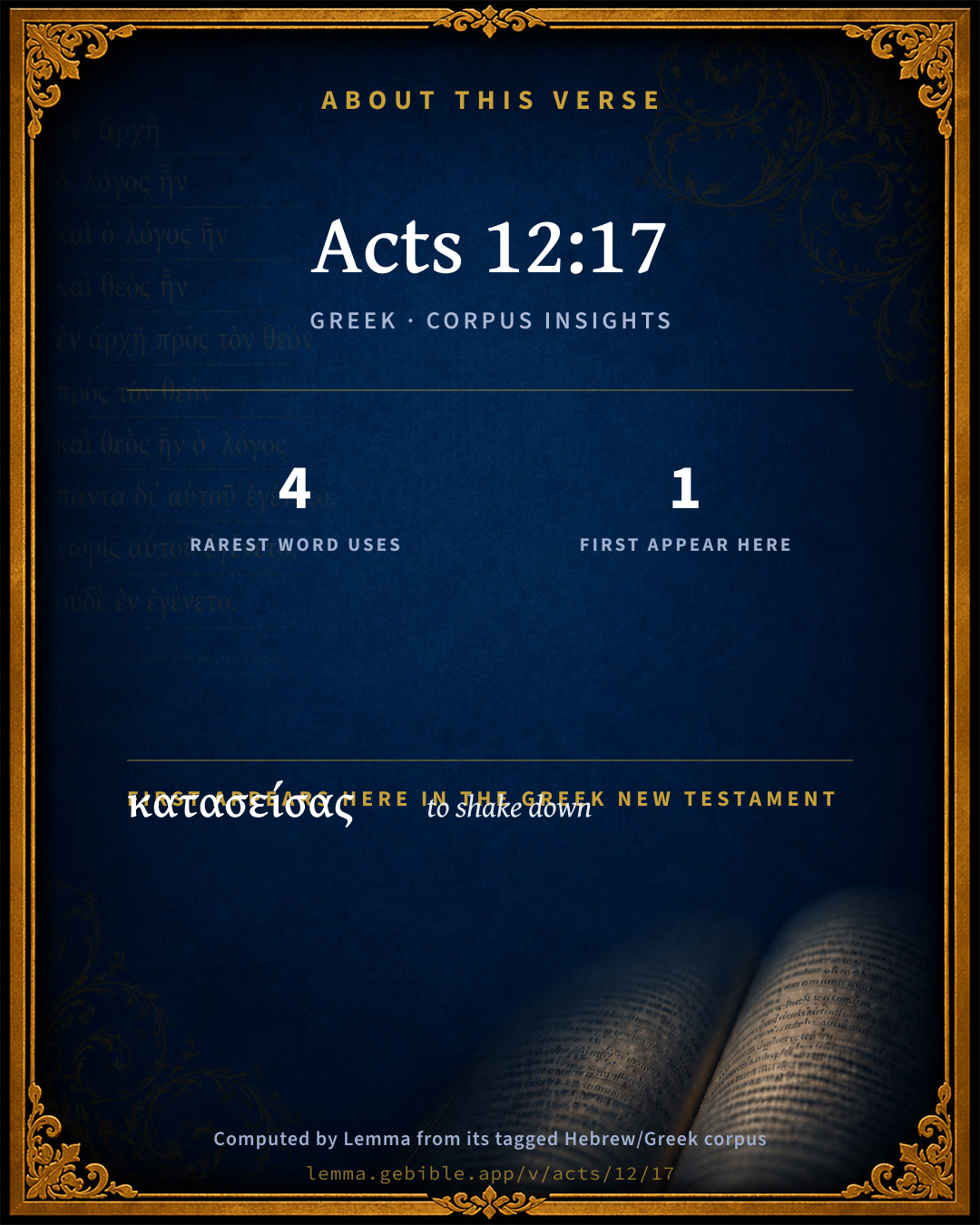
The rarest word here is κατασείσας to shake down G2678 — appearing just 4 times in the whole Greek New Testament.

First appearance in Scripture

This word makes its first canonical appearance in the Greek New Testament here:

  • κατασείσας to shake down G2678

Shared distinctive vocabulary

κατασείσας to shake down G2678 occurs in 4 verses of the Greek New Testament. Also found in:
Repetition

Words recur within this verse:

  • τῇ the G3588 ×4
  • αὐτοῖς he G846 ×2
  • καὶ and G2532 ×2

Cross-references

23

Topical passages linked to Acts 12:17 in the Treasury of Scripture Knowledge — connected by theme and wording, ordered by reader-vote popularity; previews shown in the World English Bible.

  • Acts 21:40 When he had given him permission, Paul, standing on the stairs, beckoned with his hand to the people. When there was a great silence, he spoke to them in the Hebrew language, saying,
  • Acts 13:16 Paul stood up, and beckoning with his hand said, "Men of Israel, and you who fear God, listen.
  • Acts 19:33 They brought Alexander out of the multitude, the Jews putting him forward. Alexander beckoned with his hand, and would have made a defense to the people.
  • Acts 15:13 After they were silent, James answered, "Brothers, listen to me.
  • Acts 21:18 The day following, Paul went in with us to James; and all the elders were present.
  • Galatians 1:19 But of the other apostles I saw no one, except James, the Lord's brother.
  • Galatians 2:9 and when they perceived the grace that was given to me, James and Cephas and John, they who were reputed to be pillars, gave to me and Barnabas the right hand of fellowship, that we should go to the Gentiles, and they to the circumcision.
  • Galatians 2:12 For before some people came from James, he ate with the Gentiles. But when they came, he drew back and separated himself, fearing those who were of the circumcision.
  • Matthew 10:23 But when they persecute you in this city, flee into the next, for most assuredly I tell you, you will not have gone through the cities of Israel, until the Son of Man has come.
  • John 8:59 Therefore they took up stones to throw at him, but Jesus was hidden, and went out of the temple, having gone through the midst of them, and so passed by.
  • John 11:54 Jesus therefore walked no more openly among the Jews, but departed from there into the country near the wilderness, to a city called Ephraim. He stayed there with his disciples.
  • 1 Corinthians 15:7 Then he appeared to James, then to all the apostles,
  • Psalms 66:16 Come, and hear, all you who fear God. I will declare what he has done for my soul.
  • Psalms 102:20–21 To hear the groans of the prisoner; To free those who are condemned to death;
  • Psalms 107:21–22 Let them praise Yahweh for his loving kindness, For his wonderful works to the children of men!
  • Psalms 116:14–15 I will pay my vows to Yahweh, Yes, in the presence of all his people.
  • Psalms 146:7 Who executes justice for the oppressed; Who gives food to the hungry. Yahweh frees the prisoners.
  • Luke 1:22 When he came out, he could not speak to them, and they perceived that he had seen a vision in the temple. He continued making signs to them, and remained mute.
  • John 7:1 After these things, Jesus was walking in Galilee, for he wouldn't walk in Judea, because the Jews sought to kill him.
  • John 10:40 He went away again beyond the Jordan into the place where John was baptizing at first, and there he stayed.
  • John 13:24 Simon Peter therefore beckoned to him, and said to him, "Tell us who it is of whom he speaks."
  • Acts 16:40 They went out of the prison, and entered into Lydia's house. When they had seen the brothers, they encouraged them, and departed.
  • James 1:1 James, a servant of God and of the Lord Jesus Christ, to the twelve tribes which are in the Dispersion: Greetings.

Cross-references courtesy of OpenBible.info (CC BY 4.0).

Commentary

Notes on Acts 12:17 from classic Christian and Jewish commentators (each source and its license shown beneath its notes). The classic Christian expositions comment on the surrounding passage and are grouped to its opening verse, so a note may address several verses; the Jewish commentaries on the Tanakh (Rashi and others) are per-verse, so they appear only where the commentator wrote on this verse.

Lemma curates 59 commentaries, every one of them public domain or Creative Commons licensed, each selected and text-cleaned for this edition rather than reprinted as found. About our sources →

MacLaren's Expositions of Holy Scripture

Alexander MacLaren

Acts

PETER AFTER HIS ESCAPE

Act 12:17.

When the angel ‘departed from him,’ Peter had to fall back on his own wits, and they served him well. He ‘considered the thing,’ and resolved to make for the house of Mary. He does not seem to have intended to remain there, so dangerously near Herod, but merely to have told its inmates of his deliverance, and then to have hidden himself somewhere, till the heat of the hunt after him was abated. Apparently he did not go into the house at all, but talked to the brethren, when they came trooping after Rhoda to open the gate. The signs of haste in the latter part of the story, where Peter has to think and act for himself, contrast strikingly with the majestic leisureliness of the action of the angel, who gave his successive commands to him to dress completely, as if careless of the sleeping legionaries who might wake at any moment. There was need for haste, for the night was wearing thin, and the streets of Jerusalem were no safe promenade for a condemned prisoner, escaped from his guards.

We do not deal here with the scene in Mary’s house and at the gate. We only note, in a word, the touch of nature in Rhoda’s forgetting to open ‘for gladness,’ and so leaving Peter in peril, if a detachment of his guards had already been told off to chase him. Equally true to nature, alas, is the incredulity of the praying ‘many,’ when the answer to their prayers was sent to them. They had rather believe that the poor girl was ‘mad’ or that, for all their praying, Peter was dead, and this was his ‘angel,’ than that their intense prayer had been so swiftly and completely answered. Is their behaviour not a mirror in which we may see our own?

Very like Peter, as well as very intelligible in the circumstances, is it that he ‘continued knocking,’ Well he might, and evidently his energetic fusillade of blows was heard even above the clatter of eager tongues, discussing Rhoda’s astonishing assertions. Some one, at last, seems to have kept his head sufficiently to suggest that perhaps, instead of disputing whether these were true or not, it might be well to go to the door and see. So they all went in a body, Rhoda being possibly afraid to go alone, and others afraid to stay behind, and there they saw his veritable self. But we notice that there is no sign of his being taken in and refreshed or cared for. He waved an imperative hand, to quiet the buzz of talk, spoke two or three brief words, and departed.

I. Note Peter’s account of his deliverance.

We have often had occasion to remark that the very keynote of this Book of Acts is the working of Christ from heaven, which to its writer is as real and efficient as was His work on earth. Peter here traces his deliverance to ‘the Lord.’ He does not stay to mention the angel. His thoughts went beyond the instrument to the hand which wielded it. Nor does he seem to have been at all astonished at his deliverance. His moment of bewilderment, when he did not know whether he was dreaming or awake, soon passed, and as soon as ‘the sober certainty of his waking bliss’ settled on his mind, his deliverance seemed to him perfectly natural. What else was it to be expected that ‘the Lord’ would do? Was it not just like Him? There was nothing to be astonished at, there was everything to be thankful for. That is how Christian hearts should receive the deliverances which the Lord is still working for them.

II. Note Peter’s message to the brethren.

James, the Lord’s brother, was not an Apostle. That he should have been named to receive the message indicates that already he held some conspicuous position, perhaps some office, in the Church. It may also imply that there were no Apostles in Jerusalem then. We note also that the ‘many’ who were gathered in Mary’s house can have been only a small part of the whole. We here get a little glimpse into the conditions of the life of a persecuted Church, which a sympathetic imagination can dwell on till it is luminous. Such gatherings as would attract notice had to be avoided, and what meetings were held had to be in private houses and with shut doors, through which entrance was not easy. Mary’s ‘door’ had a ‘gate’ in it, and only that smaller postern, which admitted but one at a time, was opened to visitors, and that after scrutiny. But though assemblies were restricted, communications were kept up, and by underground ways information of events important to the community spread through its members. The consciousness of brotherhood was all the stronger because of the common danger, the universal peril had not made the brethren selfish, but sympathetic. We may note, too, how great a change had come since the time when the Christians were in favour with all the people, and may reflect how fickle are the world’s smiles for Christ’s servants.

III. Note Peter’s disappearance.

All that is said of it is that he ‘went into another place.’ Probably Luke did not know where he went. It would be prudent at the time to conceal it, and the habit of concealment may have survived the need for it. But two points suggest themselves in regard to the Apostle’s flight. There may be a better use for an Apostle than to kill him, and Christ’s boldest witnesses are sometimes bound to save themselves by fleeing into another city. To hide oneself ‘till the calamity be overpast’ may be rank cowardice or commendable prudence. All depends on the circumstances of each case. Prudence is an element in courage, and courage without it is fool-hardiness. There are outward dangers from which it is Christian duty to run, and there are outward dangers which it is Christian duty to face. There are inward temptations which it is best to avoid, as there are others which have to be fought to the death. Peter was as brave and braver when he went and hid himself, than when he boasted, ‘Though all should forsake Thee, yet will not I!’ A morbid eagerness for martyrdom wrought much harm in the Church at a later time. The primitive Church was free from it.

But we must not omit to note that here Peter is dropped out of the history, and is scarcely heard of any more. We have a glimpse of him in Act 15:1 - Act 15:41, at the Council in Jerusalem, but, with that exception, this is the last mention of him in Acts. How little this Book cares for its heroes! Or rather how it has only one Hero, and one Name which it celebrates, the name of that Lord to whom Peter ascribed his deliverance, and of whom he himself declared that ‘there is none other Name under heaven, given among men, whereby we must be saved.’

END OF VOL. I.

Alexander MacLaren, Expositions of Holy Scripture (1904–1910) — public domain. Text from a community e-Sword module.

Bengel's Gnomon

Johann Albrecht Bengel

Act 12:17. Κατασείους, having made a motion to them with his hand) modestly: that a cry might not be raised. They were speaking much, through astonishment.—Ἰακώβῳ, unto James) the surviving apostle of that name.—ταῦτα, these things) that they may know, what has taken place.—ἐπορεύθη, he departed) In persecution, often one person in particular is aimed at by the persecutors; and it is allowable for him to escape, rather than the rest: ch. Act 17:14. Peter afterwards returned: ch. Act 15:7.—εἰς ἕτερον τόπον, into another place) not very distant.

Bengel's Gnomon of the New Testament — English translation (T&T Clark, Edinburgh, 1860) — public domain. Text from a community e-Sword module.

Meyer's Critical & Exegetical Commentary

Heinrich August Wilhelm Meyer

Act_12:17. Κατασείειν τῇ χειρί] to make a shaking motion with the hand generally, and in particular, as here (comp. Act_13:16, Act_19:33, Act_21:40), to indicate that there is a wish to bring forward something, for which one bespeaks the silence and attention of those present. See Polyb. i. 78. 3; Heliod. x. 7; Krebs and Wetstein in loc. The infinitive σιγᾶν, as also often with νεύειν and the like, by which a desire is made known. Comp. Joseph. Antt. xvii. 10. 2.

The three clauses of the whole verse describe vividly the haste with which Peter hurried the proceedings, in order to betake himself as soon as possible into safe concealment. Baumgarten invents as a reason: because he saw that the bond between Jerusalem and the apostles must be dissolved. As if it would have required for that purpose such haste, even in the same night! His regard to personal safety does not cast on him the appearance of cowardly anxiety; but by the opposite course he would have tempted God. How often did Paul and Jesus Himself withdraw from their enemies into concealment!

καὶ τοῖς ἀδελφ.] who were not along with them in the assembly.

εἰς ἕτερον τόπον] is wholly indefinite. Even whether a place in or out of Palestine (Ewald, p. 607) is meant, must remain undetermined. Luke, probably, did not himself know the immediate place of abode, which Peter chose after his departure. To fix without reason on Caesarea, or, on account of Gal_2:11, with Heinrichs, Kuinoel, and others, on Antioch (but see on Act_12:25), or indeed, after Eusebius, Jerome, and many Catholics,[274] on Rome (so also Thiersch, K. im apost. Zeit. p. 96 ff., comp. Ewald), is all the more arbitrary, as from the words it is not even distinctly apparent that the ἕτερος τόπος is to be placed outside of Jerusalem (although this is probable in itself); for the common explanation of ἐξελθών, relicta urbe, is entirely at variance with the context (Act_12:16), which requires the meaning, relicta domo (into which he was admitted).

The James mentioned in this passage is not the son of Alphaeus,a traditional opinion, which has for its dogmatic presupposition the perpetual virginity of Mary (see Hengstenberg on Joh_2:12; Th. Schott, d. zweite Br. Petr. und d. Br. Judä, p. 193 ff.), but the real brother of the Lord,[275] ἀδελφὸς κατὰ σάρκα τοῦ Χριστοῦ, Constit. ap. 8.35.[276] It is the same also at Act_15:13, Act_21:18. See on 1Co_9:4-5; Gal_1:19. Peter specially names him, because he was head of the church in Jerusalem. The fact that Peter does not name the apostles also, suggests the inference that none of the twelve was present in Jerusalem. The Clementines and Hegesippus make James the chief bishop of the whole church. See Ritschl, altkathol. Kirche, p. 415 ff. This amplification of the tradition as to his high position goes (in opposition to Thiersch) beyond the statements of the N. T. (Gal_2:12; 1Co_15:7; Acts 15; Act_21:18; Epistle of James).

[274] Even in the present day the reference to Rome is, on the part of the Catholics (see Gams, d. Jahr. d. Märtyrertodes der Ap. Petr. u. Paul., Regensb. 1867), very welcome, because a terminus a quo is thereby thought to be gained for the duration, lasting about twenty-five years, of the episcopal functions of Peter at Rome. Gams, indeed, places this Roman journey of Peter as early as 41, and his martyrdom in the year 65.

[275] Lange (apost. Zeitalt. I. p. 193 ff., and in Herzogs Encykl. VI. p. 407 ff.) has declared himself very decidedly on the opposite side of the question, and that primarily on the basis of the passages from Hegesippus in Eusebius ii. 23 and iv. 22; but erroneously. Credner, Einl. II. p. 574 f., has already strikingly exhibited the correct explanation of these passages, according to which Jesus and James appear certainly as brothers in the proper sense. Comp. Huther on James, Introd. p. 5 ff.; Bleek, Einl. p. 543 ff. James the Just is identical with this brother of the Lord; see, especially, Euseb. H. E. ii. 1, where the opinion of Clem. Al., that James the Just was the son of Alphaeus, is rejected by Eusebius (against Wieseler on Gal. p. 81 f.), although it was afterwards adopted by Jerome. See, generally, also Ewald, p. 221 ff. Böttger, d. Zeug. des Joseph. von Joh. d. T., etc., 1863. Plitt in the Zeitschr. f. Luth. Theol. 1864, I. p. 28 ff.; Laurent, neut. Stud. p. 184 ff.According to Mar_6:3, James was probably the eldest of the four brethren of Jesus.

[276] The Constit. ap. throughout distinguish very definitely James of Alphaeus, as one of the twelve, from the brother of the Lord, whom they characterize as ὁ ἐπίσκοπος. See ii. 55. 2, vi. 12. 1, 5, 6, vi. 14. 1, viii. 4. 1, viii. 23 f., viii. 10. 2, viii. 35, viii. 46. 7, v. 8, vii. 46. 1.

Meyer — Critical and Exegetical Commentary on the New Testament — English translation by Peter Christie, edited by Frederick Crombie (T&T Clark, 1880) — public domain. Text from a community e-Sword module.

Expositor's Greek Testament

ed. W. Robertson Nicoll

Act 12:17 . κατασείσας … σιγᾶν : only in Act 13:16 ; Act 19:33 ; Act 21:40 , prop. to shake down (as fruit from trees), thus to shake up and down (the hand), to beckon with the hand for silence, used with accusative, and later with dat [253] instrument. χειρί : so in classical Greek and Josephus, cf. Ovid, Met. , i., 206; Æneid , xii., 692, and instances in Wetstein; not in LXX as parallel to this; on the phrase, and also on σιγᾶν , as characteristic of Luke, see further Friedrich, pp. 26, 79. διηγήσατο , Act 9:27 , only in Luke and Mark (except Heb 11:32 ). Ἀπαγγείλατε : “tell,” R.V., characteristic of Luke, eleven times in his Gospel, thirteen or fourteen in Acts. Ἰακώβῳ : “the Lord’s brother,” Gal 1:19 ; Gal 2:9 , 1Co 15:7 (from Mar 6:3 it has been inferred that he was the eldest of those so called). This James may have become more prominent still since the murder of James the son of Zebedee. On his position in the Church at Jerusalem see below on Act 15:13 , and also on Act 11:30 . For arguments in favour of the identification of this James with James the son of Alphæus, see B.D., 1 2 , p. 1512; Felten, Apostelgeschichte , p. 239; and, on the other hand, Mayor, Introd. to Epistle of St. James ; Zahn, Didache 1 N. T. , i., 72; Lightfoot, Galatians , pp. 252 ff. and 364; Hort, Ecclesia , pp. 76, 77. In this mention of James, Feine points out that a knowledge as to who he was is evidently presupposed, and that therefore we have another indication that the “Jerusalem tradition” is the source of St. Luke’s information here. εἰς ἕτερον τόπον : all conjectures as to the place, whether it was Antioch, Rome, Cæsarea, are rendered more arbitrary by the fact that it is not even said that the place was outside Jerusalem (however probable this may have been); ἐξελθών need not mean that he went out of the city, but out of the house in which he had taken refuge, cf. Act 12:9 . For all that can be said in support of the view that he went to Rome, see Felten, u. s. , pp. 240 244, Knabenbauer, p. 214. Harnack, Chronol. , i., p. 243, apparently is prepared to regard the visit to Rome in the reign of Claudius, A.D. 42, as not impossible, although unprovable. But see the whole question treated from the opposite side by Zöckler, Apostelgeschichte , pp. 233, 234 (second edition). The notice is so indefinite that we cannot build anything upon it, and we can scarcely go beyond Wendt’s view that if Peter left Jerusalem at all, he may have undertaken some missionary journey, cf. 1Co 9:5 .

[253] dative case.

The Expositor's Greek Testament, edited by W. Robertson Nicoll (1897–1910) — public domain. Text from a community e-Sword module.

Geneva Bible (1599)

Geneva Bible translators

We may sometimes give place to the rage of the wicked, but yet so that our diligence which ought to be used in God’s business, be not a whit slackened.

Geneva Bible (1599) marginal notes — public domain. Text via Bolls.life.

Jamieson, Fausset & Brown

Robert Jamieson, A. R. Fausset & David Brown

But he, beckoning . . . with his hand to hold their peace--a lively touch this. In the hubbub of joyful and wondering interrogatories there might mingle reflections, thrown out by one against another, for holding out so long against the testimony of Rhoda; while the emotion of the apostle's own spirit would be too deep and solemn to take part in such demonstrations or utter a word till, with his hand, he had signified his wish for perfect silence.

Go show these things unto James and to the brethren--Whether James the son of Alpheus, one of the Twelve, usually known as "James the Less," and "James the Lord's brother" (Gal 1:19), were the same person; and if not, whether the James here referred to was the former or the latter, critics are singularly divided, and the whole question is one of the most difficult. To us, it appears that there are strong reasons for thinking that they were not the same person, and that the one here meant, and throughout the Acts, is the apostle James. (But on this more hereafter). James is singled out, because he had probably begun to take the oversight of the Church in Jerusalem, which we afterwards find him exercising (Acts 15:1-29).

And he departed, and went into another place--according to his Lord's express command (Mat 10:23). When told, on a former miraculous liberation from prison, to go and speak unto the people (Act 5:20), he did it; but in this case to present himself in public would have been to tempt God by rushing upon certain destruction.

Jamieson, Fausset & Brown — Commentary Critical and Explanatory on the Whole Bible (1871) — public domain (CC PDM 1.0). Text via the HelloAO Bible API.

Adam Clarke's Commentary

Verse 17. Declared-how the Lord had brought him out of the prison.] He still persisted in the belief that his deliverance was purely supernatural. It seems that some modern critics could have informed him of his mistake. See Ac 12:11.

Show these things unto James, and to the brethren] That is, in one word, show them to the Church, at the head of which James undoubtedly was; as we may clearly understand by the part he took in the famous council held at Jerusalem, relative to certain differences between the believing Jews and Gentiles. See Ac 15:13-21. There is still no supremacy for Peter. He who was bishop or overseer of the Church at Jerusalem was certainly at the head of the whole Church of God at this time; but James was then bishop or inspector of the Church at Jerusalem, and, consequently, was the only visible head then upon earth.

He departed - into another place.] Some popish writers say that he went to Rome, and founded a Christian Church there. Those who can believe any thing may believe this. Where he went we know not; but it is probable that he withdrew for the present into a place of privacy, till the heat of the inquiry was over relative to his escape from the prison; for he saw that Herod was intent on his death.

Adam Clarke's Commentary on the Bible (1810–1826) — public domain. Text from a community e-Sword/MySword module.

John Calvin's Commentaries

17. Tell James and the brethren: By brethren I understand not every one that was of the Church but the apostles and elders. For though it were requisite that the miracle should be made known to all, yet will Peter worthily for honor’s sake, have his fellows in office to be certified thereof. Ecclesiastical writers after Eusebius report that this James was one of the disciples; but forasmuch as Paul reckoneth him in the number of the three pillars of the Church, (Galatians 2:9,) I do not think that a disciple was advanced to that dignity, and the apostles set aside. Wherefore, I do rather conjecture, that this was James the son of Alpheus, whose holiness was such, that it caused the Jews to wonder at it. And there be two reasons for which Peter would have this joyful message brought unto the brethren; to wit, that he might rid them of that care which did vex them; secondly, that they might be encouraged with such an example of God’s goodness to be the more bold. Whereas he passeth into another place, I think it was done for this cause, because, forasmuch as the house was well known and famous, because many of the brethren resorted thither, he might lie hid elsewhere with less danger. Therefore, he sought a place which was not so much suspected of the enemy, and that he might not only save himself, but also his hostess and others.

John Calvin's Commentaries (1540-1563) — public domain. Text from the Calvin Translation Society English edition (1840s-50s) via the Christian Classics Ethereal Library (ccel.org). Calvin's coverage is partial (roughly two-thirds of the Bible); uncommented books and verses are honest gaps, never fabricated. The 19th-century editor's footnotes and remarks are omitted so the notes are faithfully Calvin's own voice.

Ellicott's Commentary for English Readers

(17) Go shew these things unto James, and to the brethren.—The James, or Jacob, thus spoken of may have been either James the son of Alphæus or James the brother of the Lord. Many writers have maintained the identity of the person described under these two names; but reasons have been given in the Notes on Mat_10:3; Mat_12:47; Mat_13:55, for believing that they were two distinct persons, and that the brother of the Lord was therefore not an Apostle. It is obvious that about this time, probably in consequence of the death of his namesake, the son of Zebedee, James the brother of the Lord comes into a fresh prominence. He is named as receiving St. Paul in Gal_1:19, and as being, with Peter and John, one of the pillars of the Church (Gal_2:9). Probably about this time (but see Introduction to the Epistle of St. James) he addressed the letter that bears his name to the Twelve Tribes that were scattered abroad. He presides at the Council of Jerusalem in Act_15:13, and acted as bishop of the Church at Jerusalem. According to the statement of Hegesippus, a Jewish Christian writer of the second century, preserved by Eusebius (Hist. ii. 23). he led the life of a Nazarite in all its rigour, was regarded by the Jews as having a priestly character, wore the linen ephod, and the golden petalon or plate, fitting on the brow of the priests, and as such was admitted to the Holy Place in the Temple. In A.D. 62 or 63 he was tempted by the priestly rulers, especially by the high-priest Ananias, to declare that the Christ was a deceiver, and on proclaiming his faith in Him was thrown from the pinnacle of the Temple, and as he lay on the ground, received a coup de grace from a fuller’s club. The way in which St. Peter here speaks of him implies that he was, in some way, the head and representative of the Christian community at Jerusalem.

He departed, and went into another place.—The act was in accordance with the precept which had been given to the Twelve in Mat_10:23. What the “other place” was we can only conjecture. Some Romish writers have hazarded the wild guess that he went to Rome, and having founded the Church there, returned to Jerusalem in time for the council in Acts 15. Others have assumed Antioch, which is, perhaps, less improbable; but there are no traces of his presence there till after the council (Gal_2:12). Some nearer city, such as Lydda or Joppa, might, however, have been sufficient as a place of refuge, and the absence of the name of the place suggests the inference that it was comparatively unimportant, and that Peter had carried on no conspicuous work there.

A Bible Commentary for English Readers, edited by Charles John Ellicott (1878–1897) — public domain. Text from a community e-Sword module.

The Cambridge Bible for Schools and Colleges

gen. ed. J. J. S. Perowne

17. the Lord had brought him out of the prison] Which had been his exclamation when he came to himself, “The Lord hath sent his angel.”

Go shew] There is only one verb in the Greek, which signifies “to bear word.” This the A.V. has attempted to render fully by the two verbs.

unto James] This is no doubt the James who is afterwards (Act_15:13) described as presiding over the council at Jerusalem concerning circumcision, and giving his sentence on that question. Thus he seems to have been at the head of the Church at Jerusalem, and to him it was natural for Peter to send the first news of his deliverance.

This James must have been either the son of Alphæus or the James who is one of the Lord’s brethren, but it is not easy to decide whether the persons called by these names were one and the same. It seems however safest not to identify the Apostle, James the son of Alphæus, with the Lord’s brother, for these brethren of Jesus did not believe in Him till a very late period of His ministerial life, long after the twelve were chosen. But the James in our narrative is probably the Lord’s brother, because St Paul gives to the James who was one of the pillars of the Church at Jerusalem (Gal_2:9) when St Paul visited that city, the express title of “the Lord’s brother” (Gal_1:19). This James, bishop of Jerusalem, was, as we learn from a tradition preserved by Eusebius (H. E. ii. 23), cast down from the pinnacle of the Temple, whither the Jews had brought him, in the expectation that he would disown Christ. When, on the contrary, he still held to his belief, he was thrown down, and not being killed by the fall, was slain by a blow from the club of a fuller.

and to the brethren] Though it was in the middle of the night when his deliverance took place, Peter sends to the various centres where, as in the house of Mary, prayer was also being offered to God for his deliverance.

went into another place] The peril of death was so imminent, if he had been seized, that he takes refuge by hiding where he cannot be found. The times are altered since the day when after his former deliverance he could dare to go and speak in the day-dawn to the people in the Temple. Then the populace were a protection to the Church, and saved them from violence of the authorities, now the Jewish people are in expectation of a second execution.

The Cambridge Bible for Schools and Colleges (gen. ed. J. J. S. Perowne; Cambridge University Press, 1878–1918) — public domain. Text from a community e-Sword module.

John Gill's Exposition

But he beckoning unto them with the hand,.... This is what the Jews call "an hint" (m), which is a beckoning, or making signs, either with the head or hand: and this was now made, to hold their peace; to be silent, and not clamorous in their expressions of joy and wonder, lest it should alarm the neighbourhood, and the consequence be bad both to him and them; as also that he might have an opportunity of relating the whole affair to them; which he did, after he had entered into the house; which though not expressed is understood, and is added in Beza's ancient copy, and in the Syriac version:

and he went in; that is, into the house: and declared unto them how the Lord had brought him out of prison: how he had sent his angel to him in prison, what a light shone about him, how his chains fell from his hands, and how the angel conducted him through the several wards, till they came to the iron gate, which opened of itself; and how when he had brought him into the public streets, he left him; he ascribes this wonderful deliverance not to the angel, but to the Lord himself:

and he said, go show these things to James; the son of Alphaeus, sometimes called the brother of our Lord; for James the son of Zebedee, the brother of John, Herod had lately killed with the sword, Act 12:2 and this other James very likely succeeded him as pastor of the church at Jerusalem, or at least had the superintendency of affairs there:

and to the brethren; the rest of the apostles, and even all the members; whom he would have acquainted with these things, which he knew would be matter of joy unto them, and a means of strengthening them in the ways of the Lord:

and he departed, and went into another place; to Rome, say the Papists, but without any foundation; if he went out of the city, and to any distant place for more safety, very likely he went to Antioch; but the words do not necessarily oblige us to conclude, that he went out of the city at that time, only that he went from Mary's house; "and went", as the Ethiopic version reads, "to another house": where another company of saints might be assembled, and where he might be more private and secure.

(m) Bartenora in Misn. Gittin, c. 5. sect. 7.

John Gill's Exposition of the Whole Bible (1746–1763) — public domain (CC PDM 1.0). Text via the HelloAO Bible API.

Trapp's Complete Commentary

John Trapp

17 But he, beckoning unto them with the hand to hold their peace, declared unto them how the Lord had brought him out of the prison. And he said, Go shew these things unto James, and to the brethren. And he departed, and went into another place.

Ver. 17. And he departed and went] Cedendum quidem interdum furori, sed ita ut nihilo negligentius fiat opus Domini, saith Beza here; who also proves that he went not now to Rome, as the Papists would have it; though Bellarmino holds it not de fide, concerning the faith, that he was ever there.

John Trapp, A Commentary or Exposition upon All the Books of the Old and New Testament (1647–1656) — public domain. Text from a community e-Sword module.

Albert Barnes' Notes on the Bible

But he, beckoning ... - To prevent the noise, and tumult, and transport which was likely to be produced. His wish was, not that there should be clamorous joy, but that they should listen in silence to what God had done. It was sufficient to awe the soul, and produce deep, grateful feeling. A noise might excite the neighboring Jews, and produce danger. Religion is calm and peaceful; and its great scenes and surprising deliverances are rather suited to awe the soul to produce calm, sober, and grateful contemplation, than the noise of rejoicing, and the shoutings of exultation. The consciousness of the presence of God, and of his mighty power, does not produce rapturous disorder and tumult, but holy, solemn, calm, grateful emotion.

Go, show these things ... - Acquaint them that their prayer is heard, and that they may rejoice also at the mercy of God.

Unto James - James, the son of Alpheus, commonly called the Less. See Act 12:2 note; Act 1:13 note; Mat 10:2 note.

And to the brethren - Particularly to the other apostles.

And went into another place - Probably a place of greater safety. Where he went is not known. The papists pretend that he went to Rome. But of this there is no evidence. He is mentioned as in Jerusalem again in Acts 15. The meaning is evidently that he went into some place of retirement until the danger was past.

Albert Barnes' Notes on the Bible (1834–1885) — public domain. Text from a community e-Sword/MySword module.

Haydock's Catholic Bible Commentary

He went into another place. Did not think fit to stay in the city of Jerusalem. St. John Chrysostom takes notice, that upon another occasion, when he was delivered by an Angel out of prison, he went boldly the next day, and preached in the temple. (chap. v. 19.) but there he was ordered by an Angel so to do; now to stay without such orders, would have been rashly to expose himself, and in a manner tempting God. (Witham) --- Peter retired to another place, that he might not rashly expose himself to future danger. It is not just to depend on supernatural assistance, when human means are adequate to the effect. (St. John Chrysostom, hom. xxvi.) --- St. Peter desires they will announce his miraculous deliverance to James, the then bishop of Jerusalem, and to the Christians, that they might see the effect of their prayers for him. St. James had, beyond a doubt, ordered general supplications to be made by all the brethren for St. Peter. (Bristow)

George Leo Haydock (1774–1849), Haydock's Catholic Family Bible and Commentary, 1859 edition — public domain. Excludes Psalms (Douay-Rheims chapter numbering differs from Protestant) and Deuterocanonical books (Catholic canon only).

Matthew Poole's English Annotations

Beckoning; it was usual by the motion of the hand both to desire silence and to crave audience.

How the Lord had brought him out; Peter gives God the glory, though an angel had been the means of his delivery.

James; this James was the son of Alpheus, Mat 10:3; Mar 3:18, and succeeded the other James, (the brother of John, of whom, Act 12:2), in governing the church at Jerusalem.

Went into another place; Peter could not but know he should be sought after, and therefore durst not abide in one place, lest he should ruin himself, and endanger his friends that should harbour him. Thus the great apostle, as David formerly, was hunted, as one hunteth a partridge in the mountains, 1Sa 26:20.

Matthew Poole's English Annotations on the Holy Bible (1683–1685) — public domain. Text from a community e-Sword/MySword module.

Whedon's Commentary on the Bible

Daniel D. Whedon

17. With the hand—Because their clamour was so great that he could not make them hear his voice to hush them.

Unto James—The apostle James is slain, Peter is banished, the entire apostolic body has probably disappeared, and the supervision of the Christian cause seems to devolve upon the Lord’s brother. (See note on Mat_10:3.)

Into another place—Commentators have been as much exercised to tell where Peter went on this occasion as Herod Agrippa doubtless was, and with quite as little success. The Romanists say that he went to Rome and there founded the popedom; had the which been true, Luke would have known it and told it. Luke simply means that Peter sought some other locality than Jerusalem for safety.

Daniel D. Whedon (gen. ed.), Commentary on the Old and New Testaments (1874–1909) — public domain. Text from a community e-Sword module.

The Pulpit Commentary

Brought him forth for brought him, A.V.; tell for go show, A.V.; to for into, A.V. Beckoning, etc.; kataseisas th ceiri. (see Act_13:16 Act_19:33 Act_21:40) It is the action of one having something to say and bespeaking silence while he says it. Unto James. This, of course, is the same James as is mentioned in Gal_1:19 as "the Lord"s brother," and who, in Gal_2:9, Gal_2:12, and Act_15:12 and Act_21:18, as well as here, appears as occupying a peculiar place in the Church at Jerusalem, viz. as all antiquity testifies, as Bishop of Jerusalem. So Hegesippus, quoted by Eusebius ("Eccl. Hist., " 2:23), "James the Lord"s brother, called by universal consent the Just, received the government of the Church together with the apostles;" and in Act_2:1 he quotes Clement of Alexandria as saying that, after the Ascension, Peter, James, and John selected James the Just, the Lord"s brother, to be the first Bishop of Jerusalem. And Eusebius gives it as the general testimony of antiquity that James the Just, the Lord"s brother, was the first who sat on the episcopal throne of Jerusalem. But who he was exactly is a point much controverted. The three hypotheses are:

1. That he was the son of Alphaeus or Clopas and Mary, sister to the blessed Virgin, and therefore our Lord"s cousin german, and called his brother by a common Hebrew idiom. According to this theory he was one of the twelve, Luk_6:15) as he appears to be in Gal_1:19, though this is not certain (see Bishop Lightfoot, in loc.)

2. That he was the son of Joseph by his first wife, and so stepbrother to the Lord, which is Eusebius"s explanation ("Eccl. Hist.," 2:1).

3. That he was in the full sense the Lord"s brother, being the son of Joseph and Mary. This is the opinion of Alford (in lee. ), fully argued in the "Proleg. to the Epistle of James," and of Meyer, Credner, and many German commentators. According to these two last hypotheses, he was not one of the twelve. "The apostolic constitutions distinguish between James the son of Alphaeus, the apostle, and James the brother of the Lord, oJ ejpiskopov" (Meyer). It may be added that Act_1:14 separates the brethren of the Lord from the apostles, who are enumerated in the preceding verses. The hypothesis which identifies James the Lord"s brother with James the son of Alphaeus or Clopas and Mary is well argued in Smith"s "Dictionary of the Bible," art. "James" (see also the able Introduction to the Epistle of James in the "Speaker"s Commentary") It seems impossible to come to a certain conclusion. The weakest point in the hypothesis which identifies James the Lord"s brother with the son of Alphaeus is that it fails to account for the distinction clearly made between the Lord"s brothers and the apostles in such passages as Joh_2:12 Joh 7:3; Act_1:13; Mat_12:46, Mat_12:49; 1Co_9:5. For the effect of these passages is scarcely neutralized by Gal_1:19. But then, on the other hand, the hypothesis that the Lord"s brethren, including James and Joses, were the children of Joseph and Mary, seems to be flatly contradicted by the mention of Mary the wife of Clopas as being "the mother of James and Jests". (Mar_15:40; Joh_19:25) He went to another place. Whether Luke was not informed what the place was, or whether there was some reason why he did not mention it, we cannot tell. The Venerable Bode ("Prolog. in Expos. in Act. Apost."), Baronius, and other authorities of the Church of Rome, say he went to Rome, and commenced his episcopate of Rome at this time Dr Lightfoot thinks it more probable that he went to Antioch (Comm. on Acts, in vol. 8. pp. 273, 289). Some guess Caesarea; but there is no clue really.

The Pulpit Commentary (1880–1919), ed. H.D.M. Spence-Jones & Joseph S. Exell — public domain. Text from a community e-Sword module.

John Wesley's Explanatory Notes

Beckoning to them - Many of whom being amazed, were talking together. And he said, Show these things to James - The brother or kinsman of our Lord, and author of the epistle which bears his name. He appears to have been a person of considerable weight and importance, probably the chief overseer of that province, and of the Church in Jerusalem in particular. He went into another place - Where he might be better concealed till the storm was over.

John Wesley, Explanatory Notes Upon the Whole Bible (1754–1765) — public domain. Text via the GEBible commentary corpus.

Kretzmann's Popular Commentary

Paul E. Kretzmann

Peter leaves Jerusalem:

v. 17. But he, beckoning unto them with the hand to hold their peace, declared unto them how the Lord had brought him out of the prison. And he said, Go show these things unto James and to the brethren. And he departed, and went into another place.

v. 18. Now as soon as it was day, there was no small stir among the soldiers what was become of Peter.

v. 19. And when Herod had sought for him and found him not, he examined the keepers, and commanded that they should be put to death. And he went down from Judea to Caesarea, and there abode.

Peter was now again completely master of himself and of the situation. He realized that any outburst of joy might not only attract attention in the neighborhood, but would also result in the loss of valuable time. So he raised his hand in a gesture commanding silence, and quickly narrated to them how the Lord had led him out of the prison by a supernatural deliverance through His angel. Then he asked them to tell, notify, James and the other brethren of the turn of events. This James was most likely not James the son of Alphaeus, but James the brother of the Lord, who was associated with Peter in Jerusalem at the time of Paul’s first visit and was very prominent among the elders of the congregation, Gal 1:19; Gal 2:9. But Peter, acting upon God’s plain suggestion, went away and journeyed to another place. His presence was no longer required in Jerusalem, but the Lord had need of him and his services elsewhere. When the morning dawned, there was great commotion and excitement among the soldiers. They had been given a prisoner to guard, very likely with instructions that they must vouch for his presence the next morning with their lives, and now the prisoner was gone; they had no idea what had become of Peter. Naturally the report had to be made to the officer in charge of the prison, who, in turn, brought it to the attention of Herod. And it may well be that the tyrant, indignant at being foiled in the very last moment, came to the prison in person to make a thorough investigation. But it availed him nothing; he did not find Peter. And so, after the peevish manner of unreasonable tyrants, he examined the guards once more and then ordered them to be put to death, very likely for gross negligence of duty or for connivance in liberating a dangerous prisoner. Just the same, Jerusalem did not seem to Herod a safe place to stay after this. Whether his conscience bothered him, or whether he dreaded the reproachful and probably triumphant glances of the Jewish leaders, does not appear. He left Judea proper and spent some time in Caesarea. The conscience of a tyrant, willfully guilty of unjustifiable crimes, will not permit him much rest. In the midst of luxury he feels ill at ease and is driven from one place to another.

Paul E. Kretzmann, Popular Commentary of the Bible (1921–1924) — public domain. Text from a community e-Sword module.

McGarvey & Pendleton's Commentaries

J. W. McGarvey

17. Apprehensive of a pursuit, Peter did not remain long with the brethren in the house of Mary. (17) " But, beckoning to them with his hand to be silent, he related to them how the Lord had led him out of the prison, and said, Tell these things to James and the brethren. And going out, he went to another place. " Whether this other place was a place of concealment in the city, or an entirely new field of labor, is not known.

The prominence given to the name of the surviving James, in this speech of Peter, shows that he already occupied a prominent position among the brethren. We will, hereafter, see that he continued to occupy this position.

J. W. McGarvey (with Philip Y. Pendleton), Commentaries on the New Testament (The Fourfold Gospel, 1914; Acts; and the epistles) — public domain. Text from a community e-Sword/MySword module.

Cambridge Greek Testament for Schools and Colleges

17. πῶς, how. See on Act 9:27 note.

ὁ κύριος αὐτὸν ἐξήγαγεν ἐκ τῆς φυλακῆς, the Lord had brought him out of the prison. Cf. his exclamation in Act 12:11.

ἀπαγγείλατε, carry word. The A.V. has endeavoured to give the full sense by ‘Go, shew,’ but this seems as though it represented two verbs instead of one.

Ἰακώβῳ, unto James. This is no doubt the James who is afterwards (Act 15:13) described as presiding over the council at Jerusalem concerning circumcision, and giving his sentence on that question. Thus he seems to have been at the head of the Church at Jerusalem, and to him it was natural for Peter to send the first news of his deliverance.

This James must have been either the son of Alphæus or else the James who is called one of the Lord’s brethren, but it is not easy to decide whether the persons called by these names were one and the same. It seems however safest not to identify the Apostle, James the son of Alphæus, with the Lord’s brother, for these brethren of Jesus did not believe in Him till a very late period of His ministerial life, long after the Twelve were chosen. But the James in St Luke’s narrative here is probably the Lord’s brother, because St Paul gives to the James who was one of the pillars of the Church at Jerusalem (Gal 2:9) when St Paul visited that city, the express title of ‘the Lord’s brother’ (Gal 1:19). This James, bishop of Jerusalem, was, as we learn from a tradition preserved by Eusebius (H. E. II. 23), cast down from the pinnacle of the Temple, whither the Jews had brought him, in the expectation that he would disown Christ. When, on the contrary, he still held to his belief, he was thrown down, and not being killed by the fall, was slain by a blow from the club of a fuller.

καὶ τοῖς ἀδελφοῖς, and to the brethren, i.e. to the rest of the Christian congregation. Though it was in the middle of the night when his deliverance took place, Peter sends to the various centres where, as in the house of Mary, prayer was also being offered to God for his deliverance.

ἐπορεύθη εἰς ἕτερον τόπον, he went into another place. The peril of death was so imminent if he had been seized that he takes refuge by hiding where he cannot be found. The times are altered since the day when, after his former deliverance, he could dare to go and speak in the day-dawn to the people in the Temple. Then the populace were a protection to the Church and saved them from violence of the authorities, now the Jewish people are in expectation of a second execution.

Cambridge Greek Testament for Schools and Colleges (Cambridge University Press, 1896; 21 vols, various authors incl. Carr, Maclear, Plummer, Farrar, Lumby, Moule, M. R. James, Simcox) — public domain. Text from a community e-Sword module.

Alford’s Greek Testament

Henry Alford

17. κατασείσας] see reff. His motive was haste: he tells briefly the particulars of his deliverance, and, while it was yet night, hastily departs.

Ἰακώβῳ] James, the brother of the Lord, whom we find presiding over the church at Jerusalem, ch. 15:13; 21:18; Gal 2:12. See Gal 1:19; Gal 2:9. He appears also to be mentioned in 1Co 15:7. I believe him to have been one of those ἀδελφοὶ τοῦ κυρίου mentioned Mat 13:55; Joh 7:5; ch. 1:14; 1Co 9:5, of whom I have in the note on the first of these passages maintained, that they were His real maternal brethren, sons of Joseph and Mary:—to have been an Apostle, as Paul and Barnabas, but not of the number of the twelve (see note on ch. 14:4):—and to have been therefore of course distinct from James the son of Alphæus, enumerated (Mat 10:3 ) among the twelve. The reasons for this belief I reserve for the Prolegomena to the Epistle of James.

εἰς ἕτερον τόπον] I see in these words a minute mark of truth in our narrative. Under the circumstances, the place of Peter’s retreat would very naturally at the time be kept secret. It probably was unknown to the person from whom the narrative came, or designedly left indefinite. And so it has remained, the narrative not following Peter’s history any longer. We find him again at Jerusalem in ch. 15. Whether he left it or not on this occasion is uncertain. It is not asserted in ἐξελθών,—which only implies that be left the house.

Henry Alford, The Greek Testament (1849–1861) — public domain. Text from a community e-Sword module.

Vincent's Word Studies in the New Testament

Marvin R. Vincent

Beckoning [κατασεισας] . Lit., having shaken downward with his hand, in order to bespeak silence and attention. It was a familiar gesture of Paul. See ch. Act 21:40; Act 26:1.

Marvin R. Vincent, Word Studies in the New Testament (1887–1900) — public domain. Text from a community e-Sword/MySword module.

Lesson kit

Teaching starters — assembled from the data on this page, not authored interpretation. Every prompt links to the verse data it draws on. Edit before teaching.

Acts, in the Acts, opens this verse with 29 words (24 distinct Greek lemmas). Its most distinctive word is kataseíō (“to shake down”). A historical commentator’s framing appears above. Read the whole chapter for the surrounding context.

Discussion questions

  1. The word kataseíō carries the sense “to shake down.” How does it shape the verse?
  2. The word “to shake down” first appears here in Scripture. What is being introduced at this debut?
  3. Acts 13:16 shares the word «to shake down» with this verse. How do the two illuminate each other?
  4. “the” occurs 4× in this one verse. What is the effect of the repetition?
  5. The translations on this page render this verse differently — a whole-verse word diff, not a word-by-word alignment. What might account for the different wordings?
  6. Reading how MacLaren's Expositions of Holy Scripture and Bengel's Gnomon read this verse, where do the two commentators agree and where do they part?

Things to notice

  • 1 word makes its first canonical appearance in Scripture here.
  • These translations choose different wording for 19 words in this verse.
  • “the” occurs 4× in this single verse.
  • 24 distinct Greek lemmas span 29 words in this verse.

Reading settings

Reading text

Shown beneath each verse's original-language words.

Old Testament
Old Testament edition

Read the OT as the Masoretic Hebrew (MT) or the Greek Septuagint (LXX).

English shown for the Greek Septuagint (in the Hebrew ↔ Greek comparison).

Comparing translations? Open the Compare panel on any verse page to stack up to four side by side.