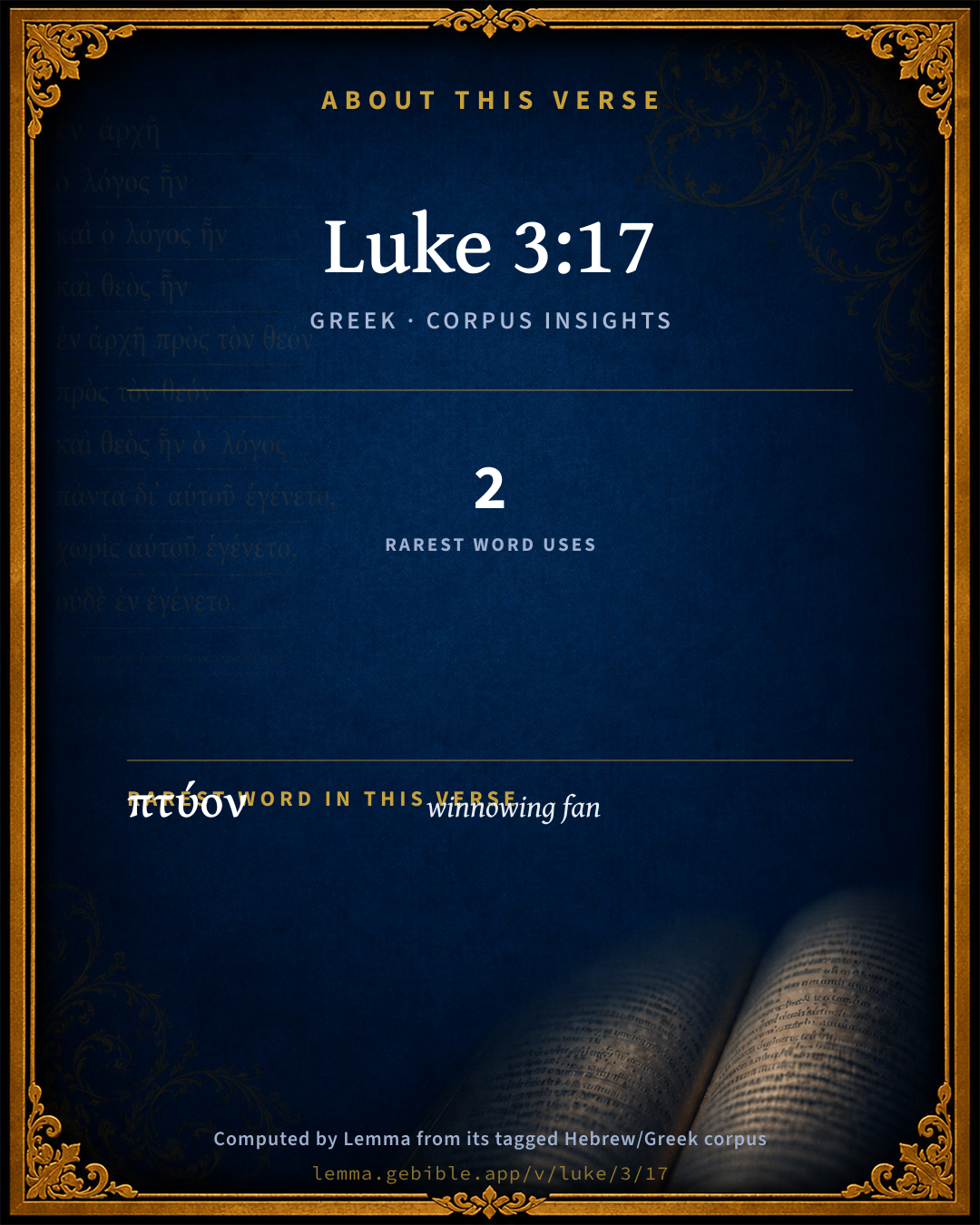
Luke 3:17

Greek (Tischendorf 8th ed.) Luke 3:17 appears in the Greek New Testament. The text above is from the Tischendorf 8th edition. Each word links to its Strong’s number and a concise gloss. Click any word for its full Thayer’s Greek Lexicon entry.
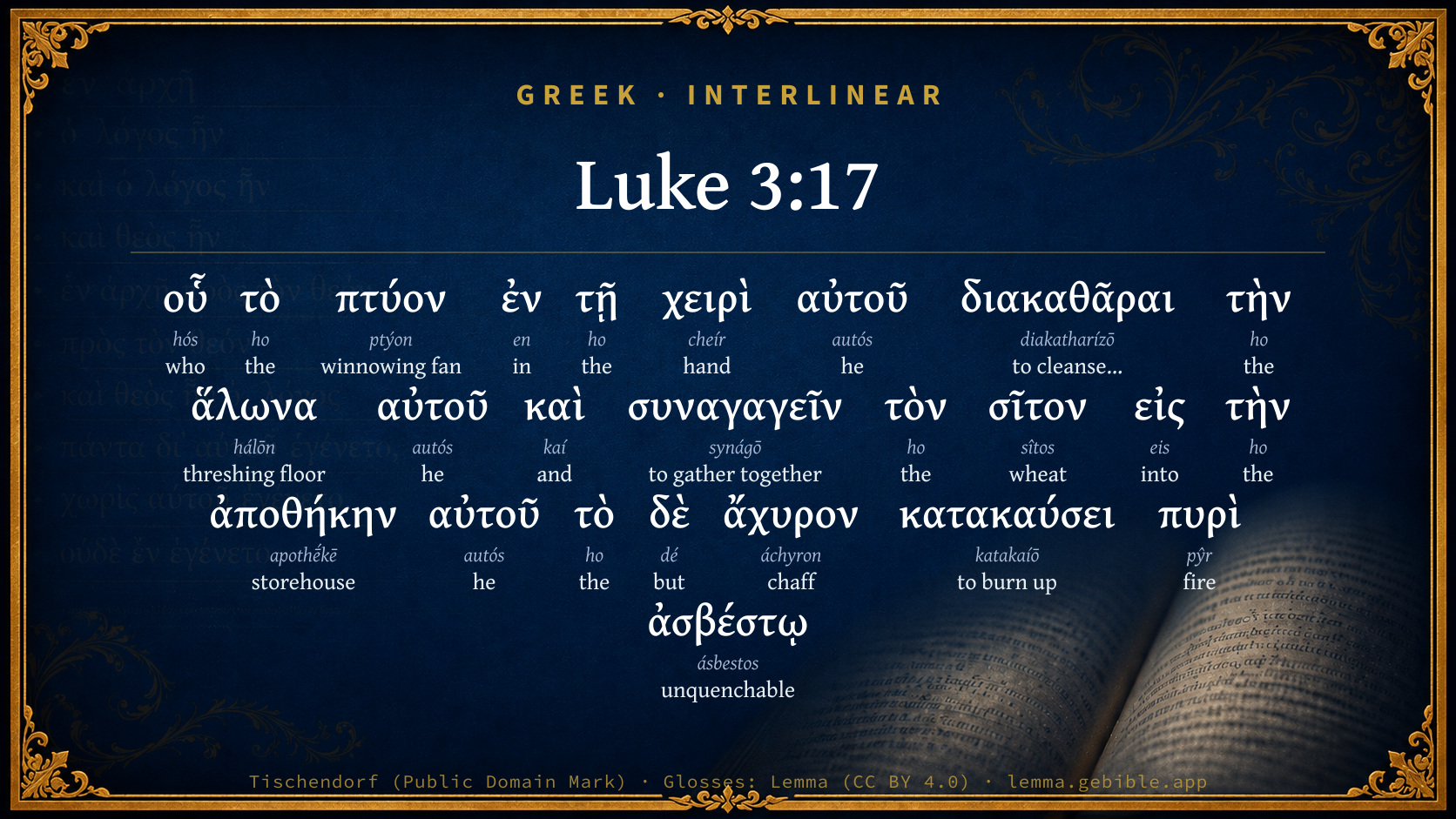
Download image
Cite this verse

Luke 3:17 (World English Bible). Public Domain. Lemma interlinear Bible study tool, https://lemma.gebible.app/v/luke/3/17.

Show BibTeX & RIS
BibTeX
RIS
English Translation
whose fan is in his hand, and he will thoroughly cleanse his threshing floor, and will gather the wheat into his barn; but he will burn up the chaff with unquenchable fire."
World English Bible · Public Domain
Download a study sheet

One document with this verse’s original text, its word-by-word gloss line, the meaning frame, cross-references with their text, attributed commentary, and full source and license credits — printable, and it pastes into notes with its structure intact.

This verse Autodidact and up

Study sheet (.html) Plain text (.txt)

A passage Seminary Student

Up to 50 verses in one chapter. A passage sheet keeps up to 6 commentary sources and 12 cross-references per verse, in the order this page ranks them, and says so on the sheet whenever that leaves anything out. Ask for a single verse and you get the Autodidact verse sheet above.

Everything on this page stays free to read, with no account — the sheet is a download of what is already on screen, not access to it.

Want to remove ads? Support Godless Engineer
Compare translations 3

The same verse in 3 English versions, stacked beneath the original-language interlinear above. Click any original word for its lexicon entry.

Each is an independent rendering of the whole verse — the interlinear is not word-aligned to these translations.

Highlighted words mark where these versions differ — a whole-verse word diff, not a word-by-word alignment.

  • World English Bible Public Domain
    whose fan is in his hand, and he will thoroughly cleanse his threshing floor, and will gather the wheat into his barn; but he will burn up the chaff with unquenchable fire."
  • King James Version Public Domain
    Whose fan is in his hand, and he will throughly purge his floor, and will gather the wheat into his garner; but the chaff he will burn with fire unquenchable.
  • unfoldingWord Literal Text CC BY-SA 4.0
    whose winnowing fork in his hand to thoroughly clear off his threshing floor and to gather the wheat into his storehouse, but he will burn up the chaff with unquenchable fire.”

unfoldingWord Literal Text — © unfoldingWord, licensed CC BY-SA 4.0. Word-aligned USFM3 via Door43 (git.door43.org/unfoldingWord/en_ult).

Versions to compare (up to 4)

3 of 4 selected

Show all 19 translations

Every available English version of this verse, each an independent rendering of the whole verse.

  • World English Bible Public Domain
    whose fan is in his hand, and he will thoroughly cleanse his threshing floor, and will gather the wheat into his barn; but he will burn up the chaff with unquenchable fire."
  • Berean Standard Bible Public Domain
    His winnowing fork is in His hand to clear His threshing floor and to gather the wheat into His barn; but He will burn up the chaff with unquenchable fire.”
  • Majority Standard Bible Public Domain
    His winnowing fork is in His hand, and He will clear His threshing floor and gather the wheat into His barn; but He will burn up the chaff with unquenchable fire.”
  • King James Version Public Domain
    Whose fan is in his hand, and he will throughly purge his floor, and will gather the wheat into his garner; but the chaff he will burn with fire unquenchable.
  • American Standard Version (1901) Public Domain
    whose fan is in his hand, thoroughly to cleanse his threshing-floor, and to gather the wheat into his garner; but the chaff he will burn up with unquenchable fire.
  • Revised Version (1885) Public Domain
    whose fan is in his hand, throughly to cleanse his threshing-floor, and to gather the wheat into his garner; but the chaff he will burn up with unquenchable fire.
  • Geneva Bible (1599) Public Domain
    Whose fanne is in his hande, and hee will make cleane his floore, and will gather the wheate into his garner, but the chaffe will hee burne vp with fire that neuer shalbe quenched.
  • Douay-Rheims (1899) Public Domain
    Whose fan is in his hand, and he will purge his floor, and will gather the wheat into his barn; but the chaff he will burn with unquenchable fire.
  • Young's Literal Translation Public Domain
    whose winnowing shovel `is' in his hand, and he will thoroughly cleanse his floor, and will gather the wheat to his storehouse, and the chaff he will burn with fire unquenchable.'
  • Literal Standard Version CC BY-SA 4.0
    whose winnowing shovel [is] in His hand, and He will thoroughly cleanse His floor, and will gather the wheat into His storehouse, and He will burn the chaff with unquenchable fire.”
  • Unlocked Literal Bible CC BY-SA 4.0
    His winnowing fork is in his hand to thoroughly clear off his threshing floor and to gather the wheat into his storehouse. But he will burn up the chaff with fire that can never be put out.”
  • unfoldingWord Literal Text CC BY-SA 4.0
    whose winnowing fork in his hand to thoroughly clear off his threshing floor and to gather the wheat into his storehouse, but he will burn up the chaff with unquenchable fire.”
  • Darby Bible Public Domain
    whose winnowing-fan is in his hand, and he will thoroughly purge his threshing-floor, and will gather the wheat into his garner, but the chaff he will burn with fire unquenchable.
  • World Messianic Bible Public Domain
    His winnowing fan is in his hand, and he will thoroughly cleanse his threshing floor, and will gather the wheat into his barn; but he will burn up the chaff with unquenchable fire.”
  • Webster's Bible Public Domain
    Whose fan is in his hand, and he will thoroughly cleanse his floor, and will gather the wheat into his granary; but the chaff he will burn with fire unquenchable.
  • Free Bible Version CC BY-SA 4.0
    His winnowing fork is in his hand and he's ready to separate the wheat from the chaff on his threshing floor. He'll gather the wheat into his barn, but he will burn up the chaff with fire that can't be extinguished.”
  • Bible in Basic English Public Domain
    In whose hand is the instrument with which he will make clean his grain; he will put the good grain in his store, but the waste will be burned in the fire which will never be put out.
  • Text-Critical English NT CC BY 4.0
    His winnowing fork is in his hand, and he will thoroughly clean out his threshing floor and gather the wheat into his barn, but the chaff he will burn up with unquenchable fire.”
  • Tyndale New Testament (1534) Public Domain
    which hath his fanne in his hond and will pourge his floore and will gader the corne into his barne: but the chaffe wyll he bourne with fyre that never shalbe quenched.

Literal Standard Version (2020), Covenant Press — licensed CC BY-SA 4.0. Text via the HelloAO Bible API (eBible.org). Unlocked Literal Bible (unfoldingWord) — licensed CC BY-SA 4.0. Text via the HelloAO Bible API (eBible.org). unfoldingWord Literal Text — © unfoldingWord, licensed CC BY-SA 4.0. Word-aligned USFM3 via Door43 (git.door43.org/unfoldingWord/en_ult). Free Bible Version, Dr. Jonathan Gallagher — licensed CC BY-SA 4.0. Text via the HelloAO Bible API (eBible.org).

Word by word

More ways to search: Search by grammar → Find every occurrence → Compare this word →

Practice this passage: Drill this verse → Learn its vocabulary →

πτύον
ptýon
G4425
“winnowing fan”
Noun, Nominative, Singular, Neuter
Part of Speech
Noun
Case
Nominative
Number
Singular
Gender
Neuter
Full Thayer's Definition

Origin: from G4429

TDNT: None

1. a winnowing shovel
  1. οὗ hós G3739 “who” Relative pronoun, Genitive, Singular, Masculine
  2. τὸ ho G3588 “the” Article, Nominative, Singular, Neuter
  3. ἐν en G1722 “in” Preposition
  4. τῇ ho G3588 “the” Article, Dative, Singular, Feminine
  5. χειρὶ cheír G5495 “hand” Noun, Dative, Singular, Feminine
  6. αὐτοῦ autós G846 “he” Personal pronoun, Genitive, Singular, Masculine
  7. διακαθᾶραι diakatharízō G1245 “to cleanse thoroughly” Verb, Aorist, Active, Infinitive
  8. τὴν ho G3588 “the” Article, Accusative, Singular, Feminine
  9. ἅλωνα hálōn G257 “threshing floor” Noun, Accusative, Singular, Feminine
  10. αὐτοῦ autós G846 “he” Personal pronoun, Genitive, Singular, Masculine
  11. καὶ kaí G2532 “and” Conjunction
  12. συναγαγεῖν synágō G4863 “to gather together” Verb, Aorist, Active, Infinitive
  13. τὸν ho G3588 “the” Article, Accusative, Singular, Masculine
  14. σῖτον sîtos G4621 “wheat” Noun, Accusative, Singular, Masculine
  15. εἰς eis G1519 “into” Preposition
  16. τὴν ho G3588 “the” Article, Accusative, Singular, Feminine
  17. ἀποθήκην apothḗkē G596 “storehouse” Noun, Accusative, Singular, Feminine
  18. αὐτοῦ autós G846 “he” Personal pronoun, Genitive, Singular, Masculine
  19. τὸ ho G3588 “the” Article, Accusative, Singular, Neuter
  20. δὲ dé G1161 “but” Conjunction
  21. ἄχυρον áchyron G892 “chaff” Noun, Accusative, Singular, Neuter
  22. κατακαύσει katakaíō G2618 “to burn up” Verb, Future, Active, Indicative, 3rd person, Singular
  23. πυρὶ pŷr G4442 “fire” Noun, Dative, Singular, Neuter
  24. ἀσβέστῳ ásbestos G762 “unquenchable” Adjective, Dative, Singular, Neuter

About this verse

These counts appear in no published source. They are computed here, from the morphology-tagged text and Lemma’s own curated glosses. What Lemma adds →

25
words
18
distinct lemmas
Gospels
section

Notable vocabulary

The rarest word here is πτύον winnowing fan G4425 — appearing just 2 times in the whole Greek New Testament.

Shared distinctive vocabulary

πτύον winnowing fan G4425 occurs in 2 verses of the Greek New Testament. Also found in:

Repetition

Words recur within this verse:

  • τὸ the G3588 ×6
  • αὐτοῦ he G846 ×3

Cross-references

8

Topical passages linked to Luke 3:17 in the Treasury of Scripture Knowledge — connected by theme and wording, ordered by reader-vote popularity; previews shown in the World English Bible.

  • Jeremiah 15:7 I have winnowed them with a fan in the gates of the land; I have bereaved [them] of children, I have destroyed my people; they didn't return from their ways.
  • Matthew 13:30 Let both grow together until the harvest, and in the harvest time I will tell the reapers, "First, gather up the darnel, and bind them in bundles to burn them; but gather the wheat into my barn."'"
  • Micah 4:12 But they don't know the thoughts of Yahweh, Neither do they understand his counsel; For he has gathered them like the sheaves to the threshing floor.
  • Psalms 1:4 The wicked are not so, But are like the chaff which the wind drives away.
  • Isaiah 30:24 the oxen likewise and the young donkeys that till the ground shall eat savory provender, which has been winnowed with the shovel and with the fork.
  • Matthew 3:12 His winnowing fork is in his hand, and he will thoroughly cleanse his threshing floor. He will gather his wheat into the barn, but the chaff he will burn up with unquenchable fire."
  • Psalms 21:9–10 You will make them as a fiery furnace in the time of your anger. Yahweh will swallow them up in his wrath. The fire shall devour them.
  • Mark 9:43–49 If your hand causes you to stumble, cut it off. It is better for you to enter into life maimed, rather than having your two hands to go into Gehenna, into the unquenchable fire,

Cross-references courtesy of OpenBible.info (CC BY 4.0).

Commentary

Notes on Luke 3:17 from classic Christian and Jewish commentators (each source and its license shown beneath its notes). The classic Christian expositions comment on the surrounding passage and are grouped to its opening verse, so a note may address several verses; the Jewish commentaries on the Tanakh (Rashi and others) are per-verse, so they appear only where the commentator wrote on this verse.

Lemma curates 59 commentaries, every one of them public domain or Creative Commons licensed, each selected and text-cleaned for this edition rather than reprinted as found. About our sources →

The Biblical Illustrator

Joseph S. Exell

Luk_3:17

Whose fan is in His hand--

Christs floor and fan

I. THE THRESHING-FLOOR MAY DE PROPERLY REGARDED AS THE CHURCH, INTO WHICH ALL PROFESSORS ARE GATHERED; or, even in a wider sense still, it may include all those who, though they have made no public profession of faith in Christ, yet secretly hold some theory of Christianity which they deem sufficient for themselves; or, even a step further, it may and does include those who respect Christ and build their own schemes of salvation. Indeed it includes every man who says, By this creed, or by this philosophy, or by this life, I will abide the issue of eternity. Thus we see how wide this threshing-floor is, and that in fact, while it is true that Christ came not to condemn the world, but to save it, the very salvation that He brings and so freely offers to all condemns and blows away the rejected as chaff.

II. THE FAN IN HIS HAND MAY SUGGEST TO US THE INSTRUMENT BY WHICH HE PURGES HIS FLOOR, SEPARATING THE CHAFF FROM THE WHEAT. Christ had no sooner come and entered upon His public ministry than He began to purge His floor.

1. His Word acts as a fan. Many of the multitudes that followed Jesus took offence at His words, as witness Joh_5:3-16. Many who approach the floor of Christ are swept away before they fairly come by His words; one cannot bear salvation by grace, another is blown away by the new birth, another by this and by that doctrine.

2. But there are others who are not blown away by the Word. When you hear them talk you wonder at their severe and unflinching orthodoxy. For such Christ has another fan. It is one that tests the character: the new birth. Many a chaffy professor of orthodoxy is blown away by this; for even if they do not recognize it themselves, others see how surely they are separated.

3. Still this is brought to another trial. Many say Oh, yes; I know even the day and the hour of my regeneration. Well! if it is so, the fruits of your new birth will be seen in a new life. Salvation means separation from sin. The demand for a holy life oftentimes proves too much for the chaffy professor who can relate a glowing experience, and he is swept from the floor and heaped up with the rest of the chaff.

4. Again, the Master comes with the fan of affliction, and tries His wheat, as He did Job. There is much meaning in the words, He that shall endure unto the end, the same shall be saved.

III. THUS IT IS THAT THIS PURGING PROCESS IS GOING ON ALL THE TIME, AND CONSTANTLY WE FIND THE CHAFF BLOWN AWAY. HOW many drop out of our churches, and go we know not where I But still much chaff remains among the wheat, and doubtless will remain until He come again, and then the floor will be thoroughly purged; the hail of that day will sweep away every refuge of lies, every hypocrites cloak will be rent off, every self-deceived one will be undeceived, and the sheep shall be separated from the goats, the chaff from the wheat. The wheat will He gather into His garner, &c. Who shall abide the day of His coming? (G. F. Pentecost, D. D.)

Judaism and Christianity

What were the characteristics of the revolution which Christianity wrought in the world?

I. IT WAS DESTRUCTIVE. It proclaimed war against the principles opposed to it. There are certain times in history when a great shock is necessary, and those are the greatest men who can see this and boldly risk the danger. There are times when it is too late to expect that the world can be saved by the instillation of good, times when the chaff is so multitudinous and so rotten that the wheat is in a double danger, the danger of being lost, the danger of being corrupted. The only thing then is to burn up the chaff at once with a fire which will not touch the wheat. Christ saw that the time had come, that the whole world of Jews and heathens was so choked up with chaff that a slow process would be ruin. He seized the moment, He accepted its dangers, and He sent forth ideas which flew along like flame, consuming, destroying, but also assimilating.

II. But if Christianity was destructive as a revolution IT was ALSO PRESERVATIVE. If Christ sent forth ideas which consumed the chaff, He sent them forth also to gather the wheat into the garner. No noble feeling, or true thought, either in Judaism, or heathenism, perished. They were taken up and woven into the new fabric, e.g., Roman law, culture, architecture--religion.

III. Its third element was A CIVILIZING POWER. Neither Greek science nor Roman culture had power to spread beyond themselves. It was of the first importance that some civilizing influence should arise which should permit of free development--which should save the world from the dilemma of being made altogether in the Roman pattern, or of remaining in barbarism. This was the work of Christianity, and it was done by its ministers, in the first place, not as apostles of culture, but as persons who spoke to the common wants of the spirit of man. The missionary spirit was the product of love to Christ. The civilization of the barbarians was the product of the missionary spirit. We also have our revolutions. That which is true about the great movements of the world is not without its personal interest to us, nor without its analogies in our life. The inner revolutions also, if it is towards God, is

(1) destructive;

(2) preservative;

(3) civilizing, or sanctifying to the whole man.

(Stopford A. Brooke, M. A.)

Christs winnowing fan

Christ did not go out of His way to choose His followers; the call itself was the fan He bore in His hand. That call imposed upon men the necessity of making a great resolution, of sacrificing a good deal. On the other hand, what did it offer? What equivalent could be expected by those who made the sacrifice? The call, which had acted as a test upon some directly by requiring from them an effort which they were not prepared to make, would winnow away others more gradually as soon as it was understood to offer no prospects which could tempt a worldly mind. In this way, without excluding any, Christ suffered the unworthy to exclude themselves. He kept them aloof by offering them nothing which they could find attractive. And all those who found Christs call attractive were such as were worthy to receive it. Such a winnowing of men as He accomplished is not unique in its kind. Every high-minded leader who gathers followers round him for any great purpose, when he calls to selfsacrifice and has no worldly rewards to offer, does something similar. And, therefore, in tracing the history of many other movements which have agitated great numbers, we are often reminded of those parables of Christ that begin, The kingdom of heaven is like The quality which carries a man through the ordeal is faith. Such then, is the new test, and it will be found the only one which could answer Christs purpose. Every other good quality which we may wish to make the test of a man implies either too little or too much. (Ecce Homo.)

The autumn-fire

A hidden fire burns perpetually upon the hearth of the world. Scientific men call it by the hard name of eremacausis, which means quiet, or slow burning. We see its effects in the fading of leaves, in the rusting of iron, and in the mantling of the rosy blush upon the cheek of youth. Every tree is a burning bush. In autumn this great conflagration becomes especially manifest. Every blade of grass in the fields and every leaf in the woodlands is cast into the great oven of nature; and the bright colours of their fading are literally the flames of their consuming. By this autumn-fire God every year purges the floor of nature. All effete substances that have served their purpose in the old form are burnt up, and only what has the promise of life and usefulness passes scathless through the ordeal. The straw and the chaff are consumed, and the wheat remains. As God thus purges His floor in nature, so He does in grace. We have a striking example of the effect of this autumn-fire in the removal of the effete things of the Levitical institution. The Mosaic dispensation had become dead ripe. Jesus came in the autumn of the world, when all things had grown ripe and old, and all growth had closed. He came to gather in the harvest of all previous dispensations. He came to cast fire upon the earth, to burn up the chaff of withered and effete institutions. His was a fiery baptism, which thoroughly purged His floor--which consumed the stubble and the withered foliage of the old growth that had served its purpose in the religious culture of a former age, and prepared them for being worked up into the new developments of the springtime of grace. The baptism of John was a process at purification; but it was only a baptism of water. Water can only remove superficial impurities; it cannot take away what is ingrained; it can cleanse surface and accidental or temporary stains, but it cannot change the nature of anything. And so the baptism of John could produce ceremonial purity, but it could not cleanse the sinful heart, or transform the erring and polluted mind. The baptism of Jesus, on the other hand, was a baptism of fire, and fire penetrates every substance submitted to its action, and changes it into its own nature. The fire of life in nature burns up all its decay and prepares it for new growth. And so in the fulness of time Jesus passed like an autumn fire over all the dead products of human attainment, thoroughly purging His floor. He caused, by the same fire of grace, to grow in spring freshness and beauty that fruit which is unto holiness, and whose end is everlasting life. But not once only in the end of the world did Jesus come to purge His floor with this sacred fire. He is coming continually, and His fire of purification is unquenchable. In each of these partial and temporary consumings He anticipates and foreshadows what He will do in the great and final judgment. In each human heart this sacred autumn fire of purification is burning as a vestal flame. To each human being the apostolic precept is uttered, Quench not the Spirit, put not out the heavenly fire. (H. Macmillan, D. D.)

Christs fan

A fan is a certain instrument which the husbandman uses to cleanse, or purge his corn from the chaff, evil seeds, and all filth whatsoever. Now John Baptist alludes to such an instrument as this.

1. By Christs fan is meant His Word, His holy gospel, especially the doctrine thereof; it is by this He cleanses and purges His floor. Now you are clean through the word I have spoken unto you.

2. The dispensation of Gods providence: for this was also a fan in Christs hand, by which He fanned away those unbelieving Jews, and so purged His floor; I mean, the time was now come that their national, legal, and external church-state must be pulled down and dissolved, the dispensation was changed, the priesthood changed, and right of Church membership changed. So that unless they receive Christ, believe in Christ, and are found gracious persons, fit wheat for Christs spiritual garner or gospel Church (which is built up of lively stones), as chaff the gospel dispensation like a fan purges them out.

3. Christ hath also another fan in His hand, viz., the fan of Church discipline. And many persons falling into sin, are purged like chaff out of His floor thereby.

(1) Sometimes some evil and corrupt persons, who get among Gods people (or into His Church) and pass awhile for wheat, i.e., for gracious persons, yet in time God suffers them to fall into one temptation or another, by which means they are fanned away. The holy Jesus by His wise providence, making a discovery of them, and their evil tempers and dispositions.

(2) Others, whom Christ would have purged out of His Church, may be suffered to such in some evil, corrupt, and dangerous principle, or errors in fundamentals, like that of Hymeneus and Alexander (1Ti_1:20); whose errors being discovered are purged out.

(3) Also many fall into notorious and scandalous sins, and are purged out by this fan. Also

(4) some who are chaff, or unsound Christians, may be suffered to take up undue offences against the Church, or Churches to whom they do belong, and by giving way to temptation, they may become unreconcilable, magnifying their own wisdom and self-conceitedness, so by a secret hand of God be discovered and purged out.

4. Jesus Christ hath also another fan in His hand to purge His floor, or cleanse His wheat from the chaff, filth, and defilement of sin, namely the Holy Spirit; and by this means He cleanses and purifies, in a gracious manner, the souls of His own people: Such were some of you; but ye are washed, but ye are sanctified, but ye are justified in the name of the Lord Jesus, and by the Spirit of our God (1Co_6:11). What filthy creatures wore those Corinthians, before the Lord Jesus by His Spirit had purged and sanctified them. Faith, of the operation of God, is a most excellent grace; it is by faith in the blood of Christ that we come to be purged from the guilt of sin; faith applying His merits and righteousness unto the soul in justification; and such is the nature thereof, that it makes holy the hearts and lives of all such persons in whom it is by the Spirit wrought or infused in sanctification; And hath put no difference between them and us, purifying their hearts by faith (Act_15:9). Yea, it cleanseth them from all filthiness of flesh and spirit, that they may perfect holiness in the fear of God (2Co_7:1). But let me tell you that the Spirit and grace of Christ, in this respect, is as a fan, and rather to cleanse the saints, by purging out the chaff of corruption, which naturally is in their hearts and lives, than to purge hypocrites and false professors out of the Church, and to that I principally refer here.

5. Moreover, Christ hath the fan of persecution, or the sufferings of the cross, and all other afflictions which He brings upon His people, which He uses to purge and purify their souls, and His Churches too. And from hence afflictions are compared to a refiners fire: He shall sit as a refiners fire, and purifier of silver. He, that is, the Messiah, i.e., our Lord Jesus Christ; this His work, viz., to purge His people, who in this place are compared to silver and gold, that is refined; as in my text they are likened unto wheat. In this He is compared to a refiner, and hath His furnace; in the other to a husbandman, and so hath His fan. Both these texts allude to the same thing, and doing the same work, namely, to sever and separate the clean from the unclean, the gold from the dross, the chaff from the wheat. (Benjamin Keach.)

The fan of separation

Scripture abounds with comparisons drawn from the various occupations of the husbandman, e.g., threshing and winnowing Isa_21:10; Jer_15:7). The visible Church may be considered as Christs floor here On this floor, or in the visible Church, there is a mixture of wheat and chaff--of really believing and holy people, with hypocrites and ungodly persons. A separation, however, will be made between them. Christ is omniscient to discriminate character; and omnipotent to put His will into execution. He distinguishes and separates characters--

(1) by the doctrines of His Word;

(2) by the dispensations of His providence;

(3) by the convictions of His Spirit.

By these means, a considerable distinction and discovery of character is made even now, and it will be completed at the Judgment. (James Foote, M. A.)

Only Christ can use the fan

How well it fits Him, and He it!Could Satans clutches snatch the fan, what work would he make! He would winnow in a tempest, yea, in a whirlwind, and blow the best away. Had man the fan in his hand, especially in distracted times, out goes for chaff all opposite to the opinions of his party. But the fan is in so good a hand it cannot be mended. Only His hand who knows hearts is proper for that employment. (Thomas Fuller.)

The design of the gospel is to separate the good from the bad

I. Tis supposed in the text, that good and evil are really different in kind, absolutely and intrinsically, essentially and in the nature of things. This appears in the similitude under which good and bad men are here represented, of wheat and chaff; which are not mere external arbitrary denominations, but things in their whole nature and kind really and essentially different. The whole foundation of religion, and of Gods governing the world at all, as a moral governor, relies entirely upon this principle--that every man is, as to his moral character, what his own behaviour and practice makes him, really and intrinsically, and by as certain and determinate a distinction; as wheat and chaff are, by their real and proper natures, different from each other.

II. A distinct declaration, that the great design of God, as in every dispensation of religion in general, so in the gospel more particularly, is to separate the evil from the good by proper trials; and that this design will be effectually accomplished by Christ--in the present life partly, and to certain degrees; in the future life perfectly, totally, and finally. By temptations, therefore, of all kinds, is the sincerity of mens virtue distinguished in the present life.

III. From hence (I say) arises one obvious and general inference, of great extent and of the highest importance-that whatever doctrine in religion has any tendency to persuade men, or make them imagine that they can be in any degree the better for their profession of the gospel of Christ, any otherwise than as their knowledge of the gospel of Christ makes them to be better and more virtuous men: that is, in the language of my text, whatever tends to persuade men that chaff may pass for wheat, while it continues to be only chaff, is a direct mockery of God, and deceit upon themselves. Little children, says the apostle, let no man deceive you: he that doeth righteousness is righteous. (S. Clarke, D. D.)

The Biblical Illustrator, edited by Joseph S. Exell (c. 1880s–1900s) — public domain. Text from a community e-Sword module.

Tyndale Open Study Notes

Tyndale Open Resources

3:17 After being harvested, the kernels of wheat would be beaten off the stalks and then tossed in the air with a winnowing fork to separate them from the chaff. The heavy grain would fall to the ground as the lighter chaff blew away. This is an image of separation for judgment. • never-ending fire: See Isa 66:24.

Tyndale Open Study Notes — © Tyndale Open Resources, licensed CC BY-SA 4.0. Text via the HelloAO Bible API.

Meyer's Critical & Exegetical Commentary

Heinrich August Wilhelm Meyer

Luk_3:17. See on Mat_3:12.

Meyer — Critical and Exegetical Commentary on the New Testament — English translation by Peter Christie, edited by Frederick Crombie (T&T Clark, 1880) — public domain. Text from a community e-Sword module.

Geneva Bible (1599)

Geneva Bible translators

The Gospel is the fan of the world.

Geneva Bible (1599) marginal notes — public domain. Text via Bolls.life.

Ellicott's Commentary for English Readers

(17) He will throughly purge . . .—The better MSS. give, throughly to purge, and to gather.

A Bible Commentary for English Readers, edited by Charles John Ellicott (1878–1897) — public domain. Text from a community e-Sword module.

The Cambridge Bible for Schools and Colleges

gen. ed. J. J. S. Perowne

17. fan] Rather, winnowing-fan. The Latin vannus, a great shovel with which corn was thrown up against the wind to separate it from the chaff.

his floor] Rather, threshing-floor. The word is the same as that from which our halo is derived, since the threshing-floors of the ancients were circular.

the chaff] The word includes straw and stubble. We find similar metaphors in Psa_1:4, “the ungodly … are like the chaff;” Mal_4:1, “all that do wickedly shall be stubble;” Jer_15:7, “I will fan them with a fan in the gates of the land.” So far as the allusion is to the separation of good from evil elements in the Church we find similar passages in Mat_13:30; 1Jn_2:19, &c. But it may refer also to the destruction of the evil elements in a mixed character, as in Luk_22:31, “Simon … Satan hath desired to have you, that he may sift you as wheat.”

into his garner] Comp. Mat_13:30, “gather the wheat into my barn.”

burn] Rather, burn up.

The Cambridge Bible for Schools and Colleges (gen. ed. J. J. S. Perowne; Cambridge University Press, 1878–1918) — public domain. Text from a community e-Sword module.

John Gill's Exposition

Whose fan is in his hand,.... See Gill on Mat 3:12

Luke 3:18

luk 3:18

luk 3:18

luk 3:18And many other thing's,.... Relating to the person and office of the Messiah, to the nature of his kingdom, the Gospel dispensation, and to faith in him; for he pointed him out to the people, and exhorted them to believe in him, and expressed much joy and pleasure on the hearing of his success and increase; and these, with others beside, in his "exhortation", or whilst he was

exhorting, or "comforting",

preached he unto the people: publishing the Gospel, the good news, and glad tidings of the Messiah's being come, and of life, righteousness, and salvation by him.

John Gill's Exposition of the Whole Bible (1746–1763) — public domain (CC PDM 1.0). Text via the HelloAO Bible API.

Trapp's Complete Commentary

John Trapp

17 Whose fan is in his hand, and he will throughly purge his floor, and will gather the wheat into his garner; but the chaff he will burn with fire unquenchable.

Ver. 17. Whose fan] viz. The preaching of the gospel.

John Trapp, A Commentary or Exposition upon All the Books of the Old and New Testament (1647–1656) — public domain. Text from a community e-Sword module.

Haydock's Catholic Bible Commentary

By the barn-floor is here prefigured the Church of Christ, in which many are called, but few are chosen. This perfect cleansing of the floor, as it is in the Greek, is performed both here when the wicked, on account of their open crimes, are excluded from the communion of the faithful by the Church; or, on account of their hidden sins, are after death by infinite justice chastised; but most especially at the end of the world, when the Son of man shall send his angels to gather from his kingdom all scandals. (Ven. Bede)

George Leo Haydock (1774–1849), Haydock's Catholic Family Bible and Commentary, 1859 edition — public domain. Excludes Psalms (Douay-Rheims chapter numbering differs from Protestant) and Deuterocanonical books (Catholic canon only).

The Pulpit Commentary

Whose fan is in his hand, and he will throughly purge his floor, and will gather the wheat into his garner. But not only, taught John, was Messiah"s work to consist in baptizing those who sought his face with the mighty baptism of the Holy Ghost and fire, there was another terrible aspect of his mission. The useless, the selfish, the oppressor, and the false-hearted, these were to be separated and then destroyed. When will this separation and subsequent destruction take place? The separation will begin in this life. The effect of the revelation of a Savior would be to intensify at once the antagonism between good and evil. Between the followers of Christ and the enemies of Christ would a sharp line of demarcation be speedily drawn even here; but the real separation would only take place on the great day when Messiah should judge the world; then would the two classes, the righteous and the unrighteous, be gathered into two bands; condemnation, sweeping, irresistible, would hurry the hapless evil-doers into destruction, while the righteous would be welcomed in his own blessed city. The imagery used is rough, but striking. It was taken, as is so much of Oriental teaching, from scenes from the everyday life of the working world around them. The theater is one of those rough Eastern threshingfloors on the top or side of a hill, so chosen for the purpose of having the benefit of the wind. The actor, a peasant employed in winnowing. "Not far from the site of ancient Corinth," writes a modern traveler in Greece, "where the peasants in many of their customs approach near to Oriental nations, I passed a heap of grain which some laborers were employed in winnowing: they used for throwing up the mingled wheat and chaff, a three-pronged wooden fork, having a handle three or four feet long. Like this, no doubt, was the fan, or winnowing-shovel, which John the Baptist represents Christ as bearing". (Dr. Hackett, quoted by Dr. Morrison, on Mat_3:12) The fan thus described would throw up against the breeze the mingled wheat and chaff; the light particles would be wafted to the side, while the grain would fall and remain on the threshing floor. With fire unquenchable. This image in itself is a terrible one; still, it must not be used in the question of eternity of punishment. The tire is here termed "unquenchable" because, when once the dry chaff was set on fire, nothing the peasants could do would arrest the swift work of the devouring flame. All that is here said of the condemned is that they will be destroyed from before the presence of the great Husbandman with a swift, certain destruction. If it points to anything, the imagery here would hint at the total annihilation of the wicked; for the flames, unquenchable while any chaff remained to be consumed, would, when the rubbish was burnt up, die quickly down, and a little heap of charred ashes would alone mark the place of its burning. But it is highly improbable that any deduction of this kind was intended to be drawn. The Baptist"s lesson is severely simple.

The Pulpit Commentary (1880–1919), ed. H.D.M. Spence-Jones & Joseph S. Exell — public domain. Text from a community e-Sword module.

unfoldingWord translationNotes

Door43 World Missions Community

His winnowing fork is in his hand

"He is holding a winnowing fork because he is ready." John speaks of the Christ coming to judge people as if he were a farmer who is ready to separate wheat grain from chaff. AT: "He is ready to judge people like a farmer who is ready" (See: Metaphor)

winnowing fork

This is a tool for tossing wheat into the air to separate the wheat grain from the chaff. The heavier grain falls back down and the unwanted chaff is blown away by the wind. It is similar to a pitchfork.

to thoroughly clear off his threshing floor

The threshing floor was the place where wheat was stacked in preparation for threshing. To "clear off" the floor is to finish threshing the grain. AT: "to finish threshing his grain"

to gather the wheat

The wheat is the acceptable harvest that is kept and stored.

will burn up the chaff

The chaff is not useful for anything, so people burn it up.

translationWords

winnow

thresh

wheat

storehouse

chaff

unfoldingWord translationNotes — © Distant Shores Media and the Door43 World Missions Community, licensed CC BY-SA 4.0. Source: git.door43.org/Door43/en_tn.

Cambridge Greek Testament for Schools and Colleges

17. τὸ πτύον. ‘Winnowing-fan.’ The Latin vannus, a great shovel with which corn was thrown up against the wind to separate it from the chaff.

ἅλωνα. ‘Threshing-floor.’ The word is the same as that from which our halo is derived, since the threshing-floors of the ancients were circular.

εἰς τὴν ἀποθήκην αὐτοῦ. Compare Mat 13:30, “gather the wheat into my barn.”

τὸ δὲ ἄχυρον. The word includes straw and stubble. We find similar metaphors in Psa 1:4, “the ungodly … are like the chaff;” Mal 4:1, “all that do wickedly shall be stubble;” Jer 15:7, “I will fan them with a fan in the gates of the land.” So far as the allusion is to the separation of good from evil elements in the Church we find similar passages in Mat 13:30; 1Jn 2:19, &c. But it may refer also to the destruction of the evil elements in a mixed character, as in Luk 22:31, “Simon … Satan hath desired to have you (ὑμᾶς), that he may sift you as wheat.”

κατακαύσει. He shall burn up.

Cambridge Greek Testament for Schools and Colleges (Cambridge University Press, 1896; 21 vols, various authors incl. Carr, Maclear, Plummer, Farrar, Lumby, Moule, M. R. James, Simcox) — public domain. Text from a community e-Sword module.

Alford’s Greek Testament

Henry Alford

17.] Mat 3:11, Mat 3:12: Mar 1:7, Mar 1:8: Joh 1:26, Joh 1:27. The four accounts are cognate, but vary in expression and arrangement: ver. 17 is verbatim (except that αὐτοῦ is after σῖτον and ἀποθήκην in Matt.) as Matthew.

Henry Alford, The Greek Testament (1849–1861) — public domain. Text from a community e-Sword module.

International Critical Commentary

17. πτύον. The “winnowing-shovel” (pala lignea; Vulg. ventilabrum), with which the threshed corn was thrown up into the wind (πτύω = “spit”).1 This is a further description of the Messiah,—He whose πτύον is ready for use. Note the impressive repetition of αὐτοῦ after τῇ χειρί, τὴν ἅλωνα, and τὴν ἀποθήκην.2

τὴν ἅλωνα. The threshing-floor itself, and not its contents. It is by removing the contents—corn to the barn, and refuse to the fire—that the floor is thoroughly cleansed. Christ’s threshing-floor is the world; or, in a more restricted sense, the Holy Land. See Mever on Mat 3:12.

ἀσβέστῳ. Comp. Mar 9:43; Lev 6:12, Lev 6:13; Isa 34:8-10, 66:24; Jer 7:20; Eze 20:47, Eze 20:48. In Homer it is a freq. epithet of γέλως, κλέος, βοή, μένος, and once of φλόξ (Il. xvi. 123). As an epithet of πῦρ it is opposed to μαλθακόν and μακρόν. See Heinichen on Eus. H. E. vi. 41, 15 and viii. 12, 1. It is therefore a fierce fire which cannot be extinguished, rather than an endless fire that will never go out, that seems to be indicated: and this is just such a fire as τὸ ἄχυρον (the refuse left after threshing and winnowing) would make. But ἄσβεστος is sometimes used of a fire that never goes out, as that of Apollo at Delphi or of Vesta at Rome (Dion. Hal. cxciv. 8). For κατακαίειν comp. Mat 13:30, Mat 13:40; also Exo 3:2, where it is distinguished from καίειν: it implies utter consumption.

International Critical Commentary — older volumes (1896–1929), various authors — public domain. Text from a community e-Sword module.

Vincent's Word Studies in the New Testament

Marvin R. Vincent

Fan - floor - purge. See on Mt 3:12.

Marvin R. Vincent, Word Studies in the New Testament (1887–1900) — public domain. Text from a community e-Sword/MySword module.

Lesson kit

Teaching starters — assembled from the data on this page, not authored interpretation. Every prompt links to the verse data it draws on. Edit before teaching.

Luke, in the Gospels, opens this verse with 25 words (18 distinct Greek lemmas). Its most distinctive word is ptýon (“winnowing fan”). A historical commentator’s framing appears above. Read the whole chapter for the surrounding context.

Discussion questions

  1. The word ptýon carries the sense “winnowing fan.” How does it shape the verse?
  2. Matthew 3:12 shares the word «winnowing fan» with this verse. How do the two illuminate each other?
  3. “the” occurs 6× in this one verse. What is the effect of the repetition?
  4. These translations render this verse differently; the difference is in the English rendering, not the original. What questions does that raise?
  5. Reading how The Biblical Illustrator and Tyndale Open Study Notes read this verse, where do the two commentators agree and where do they part?

Things to notice

Reading settings

Reading text

Shown beneath each verse's original-language words.

Old Testament
Old Testament edition

Read the OT as the Masoretic Hebrew (MT) or the Greek Septuagint (LXX).

English shown for the Greek Septuagint (in the Hebrew ↔ Greek comparison).

Comparing translations? Open the Compare panel on any verse page to stack up to four side by side.