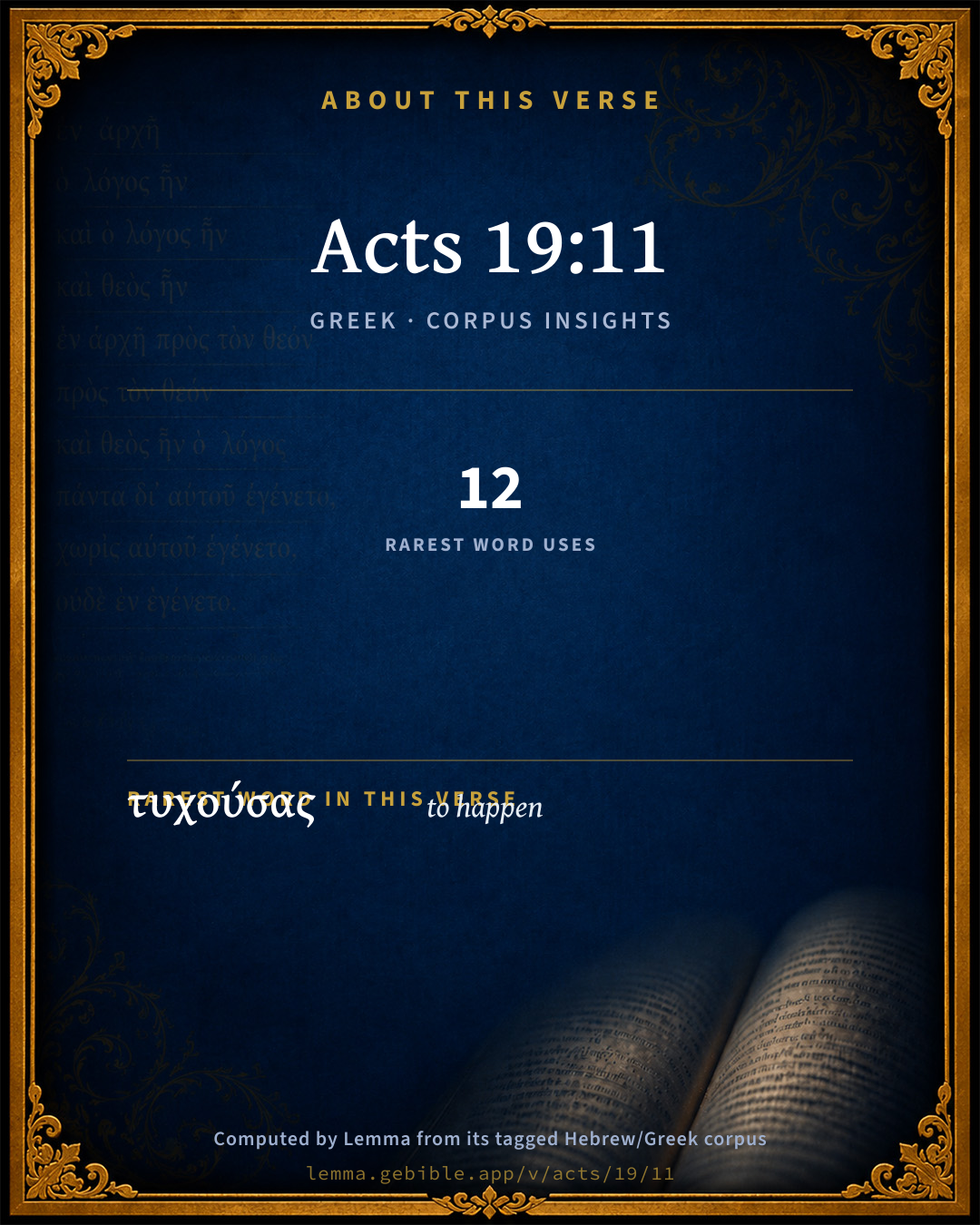
Acts 19:11

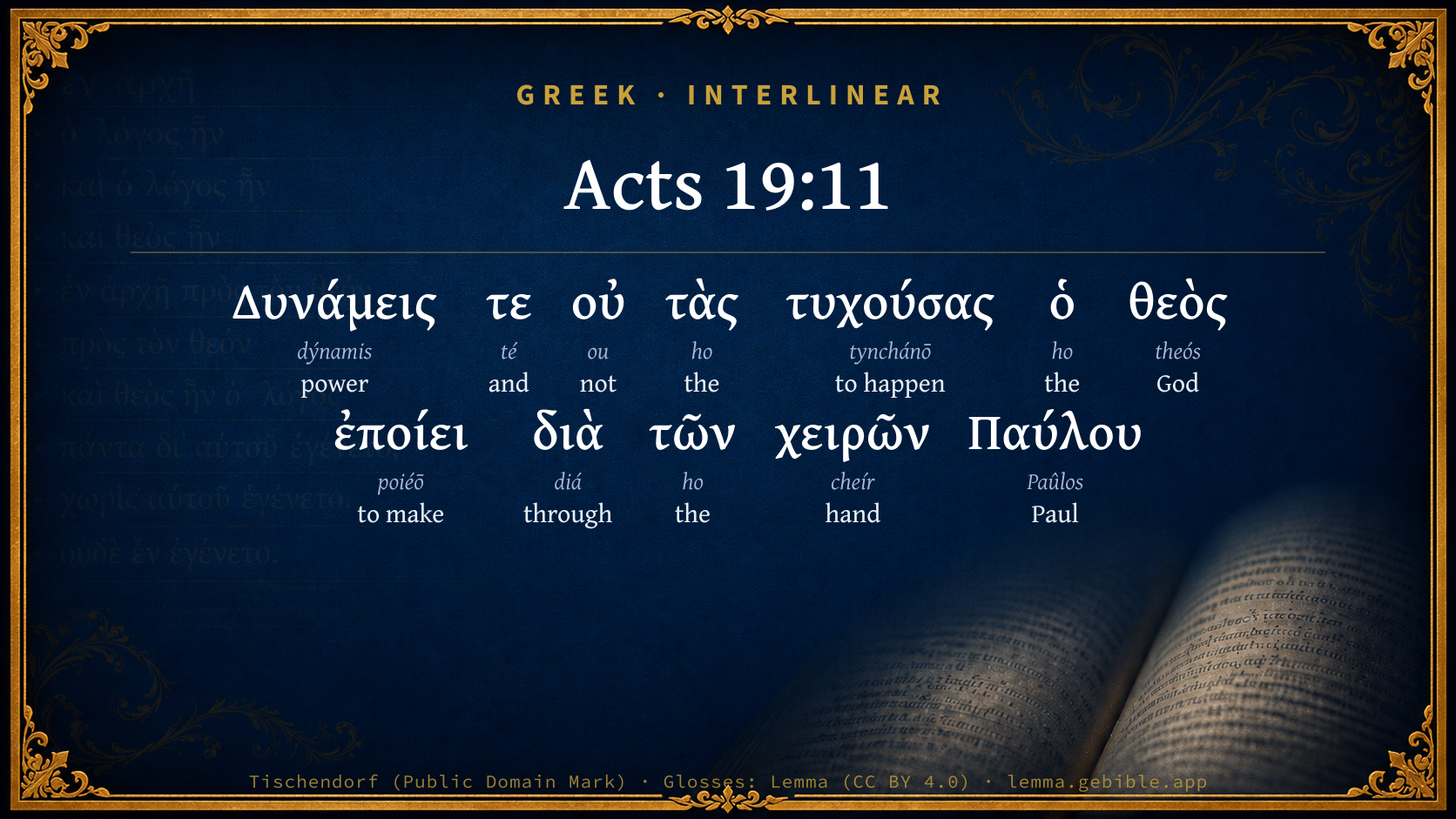
Greek (Tischendorf 8th ed.) Acts 19:11 appears in the Greek New Testament. The text above is from the Tischendorf 8th edition. Each word links to its Strong’s number and a concise gloss. Click any word for its full Thayer’s Greek Lexicon entry.
Download image
Cite this verse

Acts 19:11 (World English Bible). Public Domain. Lemma interlinear Bible study tool, https://lemma.gebible.app/v/acts/19/11.

Show BibTeX & RIS
BibTeX
RIS
English Translation
God worked special miracles by the hands of Paul,
World English Bible · Public Domain
Download a study sheet

One document with this verse’s original text, its word-by-word gloss line, the meaning frame, cross-references with their text, attributed commentary, and full source and license credits — printable, and it pastes into notes with its structure intact.

This verse Autodidact and up

Study sheet (.html) Plain text (.txt)

A passage Seminary Student

Up to 50 verses in one chapter. A passage sheet keeps up to 6 commentary sources and 12 cross-references per verse, in the order this page ranks them, and says so on the sheet whenever that leaves anything out. Ask for a single verse and you get the Autodidact verse sheet above.

Everything on this page stays free to read, with no account — the sheet is a download of what is already on screen, not access to it.

Want to remove ads? Support Godless Engineer
Compare translations 3

The same verse in 3 English versions, stacked beneath the original-language interlinear above. Click any original word for its lexicon entry.

Each is an independent rendering of the whole verse — the interlinear is not word-aligned to these translations.

Highlighted words mark where these versions differ — a whole-verse word diff, not a word-by-word alignment.

  • World English Bible Public Domain
    God worked special miracles by the hands of Paul,
  • King James Version Public Domain
    And God wrought special miracles by the hands of Paul:
  • unfoldingWord Literal Text CC BY-SA 4.0
    And God was doing not ordinary miracles by the hands of Paul,

unfoldingWord Literal Text — © unfoldingWord, licensed CC BY-SA 4.0. Word-aligned USFM3 via Door43 (git.door43.org/unfoldingWord/en_ult).

Versions to compare (up to 4)

3 of 4 selected

Show all 19 translations

Every available English version of this verse, each an independent rendering of the whole verse.

  • World English Bible Public Domain
    God worked special miracles by the hands of Paul,
  • Berean Standard Bible Public Domain
    God did extraordinary miracles through the hands of Paul,
  • Majority Standard Bible Public Domain
    God did extraordinary miracles through the hands of Paul,
  • King James Version Public Domain
    And God wrought special miracles by the hands of Paul:
  • American Standard Version (1901) Public Domain
    And God wrought special miracles by the hands of Paul:
  • Revised Version (1885) Public Domain
    And God wrought special miracles by the hands of Paul:
  • Geneva Bible (1599) Public Domain
    And God wrought no small miracles by the handes of Paul,
  • Douay-Rheims (1899) Public Domain
    And God wrought by the hand of Paul more than common miracles.
  • Young's Literal Translation Public Domain
    mighty works also -- not common -- was God working through the hands of Paul,
  • Literal Standard Version CC BY-SA 4.0
    also mighty works—not common—God was working through the hands of Paul,
  • Unlocked Literal Bible CC BY-SA 4.0
    God was doing mighty deeds by the hands of Paul,
  • unfoldingWord Literal Text CC BY-SA 4.0
    And God was doing not ordinary miracles by the hands of Paul,
  • Darby Bible Public Domain
    And God wrought no ordinary miracles by the hands of Paul,
  • World Messianic Bible Public Domain
    God worked special miracles by the hands of Paul,
  • Webster's Bible Public Domain
    And God wrought special miracles by the hands of Paul:
  • Free Bible Version CC BY-SA 4.0
    God performed unusual miracles through Paul,
  • Bible in Basic English Public Domain
    And God did special works of power by the hands of Paul:
  • Text-Critical English NT CC BY 4.0
    Now God was performing extraordinary miracles by the hands of Paul,
  • Tyndale New Testament (1534) Public Domain
    And god wrought no small miracles by the hondes of Paul:

Literal Standard Version (2020), Covenant Press — licensed CC BY-SA 4.0. Text via the HelloAO Bible API (eBible.org). Unlocked Literal Bible (unfoldingWord) — licensed CC BY-SA 4.0. Text via the HelloAO Bible API (eBible.org). unfoldingWord Literal Text — © unfoldingWord, licensed CC BY-SA 4.0. Word-aligned USFM3 via Door43 (git.door43.org/unfoldingWord/en_ult). Free Bible Version, Dr. Jonathan Gallagher — licensed CC BY-SA 4.0. Text via the HelloAO Bible API (eBible.org).

Word by word

More ways to search: Search by grammar → Find every occurrence → Compare this word →

Practice this passage: Drill this verse → Learn its vocabulary →

τυχούσας
tynchánō
G5177
“to happen”
Verb, Aorist, Active, Participle, Accusative, Plural, Feminine
Part of Speech
Verb
Tense
Aorist
Voice
Active
Mood
Participle
Case
Accusative
Number
Plural
Gender
Feminine
Full Thayer's Definition

Origin: probably for an obsolete tucho (for which the middle voice of another alternate teucho [to make ready or bring to pass] is used in certain tenses, akin to the base of G5088 through the idea of effecting

TDNT: 11:58,1

1. to hit the mark a. of one discharging a javelin or arrow 2. to reach, attain, obtain, get, become master of 3. to happen, chance, fall out a. to specify, to take a case, as for example 4. to meet one 5. of he who meets one or presents himself unsought, any chance, ordinary, common person 6. to chance to be
  1. Δυνάμεις dýnamis G1411 “power” Noun, Accusative, Plural, Feminine
  2. τε té G5037 “and” Particle
  3. οὐ ou G3756 “not” Particle, Negative
  4. τὰς ho G3588 “the” Article, Accusative, Plural, Feminine
  5. ὁ ho G3588 “the” Article, Nominative, Singular, Masculine
  6. θεὸς theós G2316 “God” Noun, Nominative, Singular, Masculine
  7. ἐποίει poiéō G4160 “to make” Verb, Imperfect, Active, Indicative, 3rd person, Singular
  8. διὰ diá G1223 “through” Preposition
  9. τῶν ho G3588 “the” Article, Genitive, Plural, Feminine
  10. χειρῶν cheír G5495 “hand” Noun, Genitive, Plural, Feminine
  11. Παύλου Paûlos G3972 “Paul” Noun, Genitive, Singular, Masculine

About this verse

These counts appear in no published source. They are computed here, from the morphology-tagged text and Lemma’s own curated glosses. What Lemma adds →

12
words
10
distinct lemmas
Acts
section

Notable vocabulary

The rarest word here is τυχούσας to happen G5177 — appearing just 12 times in the whole Greek New Testament.

Shared distinctive vocabulary

τυχούσας to happen G5177 occurs in 12 verses of the Greek New Testament. Also found in:

Repetition

A word recurs within this verse:

Cross-references

10

Topical passages linked to Acts 19:11 in the Treasury of Scripture Knowledge — connected by theme and wording, ordered by reader-vote popularity; previews shown in the World English Bible.

  • Mark 16:17–20 These signs will accompany those who believe: in my name they will cast out demons; they will speak with new languages;
  • Acts 5:12 By the hands of the apostles many signs and wonders were done among the people. They were all with one accord in Solomon's porch.
  • Romans 15:18–19 For I will not dare to speak of any things except those which Christ worked through me, for the obedience of the Gentiles, by word and deed,
  • Hebrews 2:4 God also bearing witness with them, both by signs and wonders, and by various works of power, and by gifts of the Holy Spirit, according to his own will?
  • Acts 8:13 Simon himself also believed. Being baptized, he continued with Philip. Seeing signs and great miracles occuring, he was amazed.
  • Acts 16:18 She was doing this for many days. But Paul, becoming greatly annoyed, turned and said to the spirit, "I charge you in the name of Jesus Christ to come out of her!" It came out that very hour.
  • Galatians 3:5 He therefore who supplies the Spirit to you, and works miracles among you, does he do it by the works of the law, or by hearing of faith?
  • Acts 15:12 All the multitude kept silence, and they listened to Barnabas and Paul reporting what signs and wonders God had done among the Gentiles through them.
  • John 14:12 Most assuredly I tell you, he who believes in me, the works that I do, he will do also; and greater works than these will he do; because I am going to my Father.
  • Acts 14:3 Therefore they stayed there a long time, speaking boldly in the Lord, who testified to the word of his grace, granting signs and wonders to be done by their hands.

Cross-references courtesy of OpenBible.info (CC BY 4.0).

Commentary

Notes on Acts 19:11 from classic Christian and Jewish commentators (each source and its license shown beneath its notes). The classic Christian expositions comment on the surrounding passage and are grouped to its opening verse, so a note may address several verses; the Jewish commentaries on the Tanakh (Rashi and others) are per-verse, so they appear only where the commentator wrote on this verse.

Lemma curates 59 commentaries, every one of them public domain or Creative Commons licensed, each selected and text-cleaned for this edition rather than reprinted as found. About our sources →

Joseph Benson's Commentary

Act 19:11-12. And God — To add the greater efficacy and success to this important doctrine; wrought special miracles by the hands of Paul — Who, as he abode longer at Ephesus than at any other city we read of, so he wrought more and greater miracles than in any other. So that from his body were brought unto the sick handkerchiefs, or aprons — Greek, σουδαρια η σιμικινθια, sudaria vel semicinctia. These two words, originally Latin, have been differently rendered, but the etymology of the first plainly determines it to signify pieces of linen with which they wiped the sweat from their faces, and the latter word signifies things round their waists, doubtless girdles or sashes. Aprons made no part of the ordinary dress of the Greeks; yet they might possibly be occasionally used, both by men and women, to preserve their clothes clean, while they were engaged in some particular kind of work. Dr. Macknight thinks, that these handkerchiefs and aprons belonged to the sick, from whom they were brought to touch Paul’s body, and then taken back to them, when they had the effect here mentioned. And the diseases departed from them, and the evil spirits — Which occasioned many of these diseases, though they might appear purely natural; went out of them — In this respect Paul was equal to Peter, whose shadow, as he passed by, overshadowing the sick, who were laid on couches in the streets of Jerusalem, cured them of their distempers, Act 5:15. Hence we may infer, that it was in a great measure owing to the multitude and greatness of Paul’s miracles, that so many of the inhabitants of Ephesus, and of the province of Asia, embraced the gospel.

Joseph Benson's Commentary on the Old and New Testaments (1811–1818) — public domain. Text from a community e-Sword module.

Tyndale Open Study Notes

Tyndale Open Resources

19:11-12 Paul, like other Christian evangelists (3:1-11; 4:22; 5:12-16; 6:8; 8:6-7, 13; 9:33-42), performed unusual miracles. • evil spirits were expelled: As Jesus and Peter had done (cp. 5:16; Mark 1:21-34; Luke 4:31-37).

Tyndale Open Study Notes — © Tyndale Open Resources, licensed CC BY-SA 4.0. Text via the HelloAO Bible API.

Meyer's Critical & Exegetical Commentary

Heinrich August Wilhelm Meyer

Act_19:11-12. Οὐ τὰς τυχούσ.] not the usual, i.e. distinguished, not to be compared with those of the Jewish exorcists (Act_19:13). Comp. Act_28:2. The opposite: μικραὶ καὶ αἱ τυχοῦσαι πράξεις, Polyb. i. 25. 6. On τυχών, in the sense of vulgaris, see generally, Vigerus, ed. Hermann, p. 364; and on the very frequent connection by way of litotes with οὐ, see Wetstein in loc.; Valckenaer, p. 559 f.; from Philo, Loesner, p. 219. Comp. 2Ma_3:7.

ὥστε καὶ κ.τ.λ.] so that also (among other things) towels and aprons were brought to the sick from his skin, and (thereby) the ailments were removed from them, etc.

σιμικίνθιον, not preserved elsewhere, the Latin semicinctium, is explained either as a handkerchief (Oecumenius: ἐν ταῖς χερσὶ κατέχουσι … πρὸς τὸ ἀπομάττεσθαι τὰς ὑγρότητας τοῦ προσώπου, οἷον ἱδρῶτας, πτύελον, δάκρυον κ. τὰ ὅμοια, comp. Theophylact and Suicer, Thes. II. p. 959), or usually as an apron, in favour of which is the etymology, and Martial, Epigr. xiv. 151. Very probably it was a linen apron (ἀμφότερα λινοειδῆ εἰσι, Schol. ap. Matth.), which workmen or waiters (Pignor. de serv. p. lxxv.) wore after laying aside their upper garment, and which, when they had it on, they likewise used for the purpose remarked by Oecumenius.

ἀπὸ τοῦ χρωτὸς αὐτοῦ] so that they had just been used by him and been in contact with his skin. Luke, who also here (comp. Luk_4:40 f. al.) distinguishes the ordinary sick from the possessed, represents the healing of the former and the deliverance of the latter as an effect, which was brought about by the cloths laid on them; for ὥστε down to ἐκπορ. forms together the description of a peculiar kind of those unusual miraculous δυνάμεις. Purely historical criticism, independent of arbitrary premisses laid down à priori, has nothing to assail in this view, as the healing power of the apostle, analogous to the miraculous power of Jesus, might through his will be transmitted by means of cloths requested from him to the suffering person, and received by means of the faith of the latter. The truth of the occurrence stands on the same footing with the N.T. miraculous cures in general, which took place through the will of the worker of miracles, partly with and partly without sensible transmission. By relegating the matter from the historical domain of miracles, which is yet undoubtedly to be recognised in the working of Paul (Rom_15:19; 2Co_12:12), to the sphere of legends as to relics (Baur, Zeller), with comparison of Act_5:15, or to that of the servants rooms and houses behind (Hausrath), the narrative of our passage is easily dismissed, but not got rid of, although a more special embellishment of it by the importunity of those seeking help, and by the pouring out of the sweat of the apostle as he worked (Baumgarten), of which the text indicates nothing, is to be set aside.

Meyer — Critical and Exegetical Commentary on the New Testament — English translation by Peter Christie, edited by Frederick Crombie (T&T Clark, 1880) — public domain. Text from a community e-Sword module.

Expositor's Greek Testament

ed. W. Robertson Nicoll

Act 19:11 . οὐ τὰς τυχ ., cf. Act 28:2 , the phrase is peculiar to St. Luke, “not the ordinary,” i.e. , extraordinary, with which the deeds of the Jewish exorcists could not be compared, see Klostermann, Vindiciæ Lucanæ , p. 52, for the same phrase cf. Mal 3:7Mal 3:7 , and also Deissmann, Neue Bibelstudien , p. 83; so too in classical Greek. ἐποίει : “continued to work,” or ex more , Blass.

The Expositor's Greek Testament, edited by W. Robertson Nicoll (1897–1910) — public domain. Text from a community e-Sword module.

Jamieson, Fausset & Brown

Robert Jamieson, A. R. Fausset & David Brown

God wrought special--no ordinary

miracles by the hands of Paul--implying that he had not been accustomed to work such.

Jamieson, Fausset & Brown — Commentary Critical and Explanatory on the Whole Bible (1871) — public domain (CC PDM 1.0). Text via the HelloAO Bible API.

Adam Clarke's Commentary

Verse 11. God wrought special miracles] Δυναμεις τε ου τας τυχαυσας, Miracles of no ordinary kind, i.e. extraordinary miracles.

Adam Clarke's Commentary on the Bible (1810–1826) — public domain. Text from a community e-Sword/MySword module.

John Calvin's Commentaries

11. No small miracles. He calleth miracles virtutes or powers, after the common custom of the Scripture, which were testimonies of the extraordinary power of God. And showeth that Paul’s apostleship was set forth with these ensigns, that his doctrine might have the greater authority. For it is a common speech, That wonders and signs are showed by the hand of men. So that the praise thereof is ascribed to God alone as to the author; and man is only the minister. And that he may the more amplify the miracles, he saith that handkerchiefs and partlets were brought unto the sick, which so soon as they touched they were healed. It is not unknown to what end Paul had such power given him, to wit, that he might prove himself to be a true apostle of Christ, that he might make the gospel to be believed, and might confirm his ministry. And here it is expedient to call to mind those things which we had before, touching the lawful use of miracles. And whereas God did heal the sick with Paul’s handkerchiefs, it tended to that end, that even those who had never seen the man might, notwithstanding, reverently embrace his doctrine, though he himself were absent. For which cause the Papists are more blockish, who wrest this place unto their relics; as if Paul sent his handkerchiefs that men might worship them and kiss them in honor of them; as in Papistry, they worship Francis’ shoes and mantle, Rose’s girdle, Saint Margaret’s comb, and such like trifles. Yea, rather, he did choose most simple things, lest any superstition should arise by reason of the price or pomp. For he was fully determined to keep Christ’s glory sound and undiminished.

John Calvin's Commentaries (1540-1563) — public domain. Text from the Calvin Translation Society English edition (1840s-50s) via the Christian Classics Ethereal Library (ccel.org). Calvin's coverage is partial (roughly two-thirds of the Bible); uncommented books and verses are honest gaps, never fabricated. The 19th-century editor's footnotes and remarks are omitted so the notes are faithfully Calvin's own voice.

Ellicott's Commentary for English Readers

(11) And God wrought special miracles by the hands of Paul.—The Greek phrase is negative: no common works of power—not such as one might meet with any day. (See Note on Act_28:2, where the same phrase recurs.) The noun is that which was technically used by physicians for the healing “powers” or “virtues” of this or that remedy, and is so far, though used freely by other writers, characteristic of St. Luke.

A Bible Commentary for English Readers, edited by Charles John Ellicott (1878–1897) — public domain. Text from a community e-Sword module.

The Cambridge Bible for Schools and Colleges

gen. ed. J. J. S. Perowne

11. And God wrought special miracles [Gr. powers] by the hands of Paul] The language of the historian is noteworthy. God works, Paul is the instrument. (Cp. The mighty hand of Moses, Deu_34:12.) The imperfect tense of the verb in the Greek implies that these manifestations of God’s power were continued during the Apostle’s stay. This was no mere spasmodic excitement over some powerful discourse. “By the hands” is probably only the Jewish mode of expressing “by.” See note on Act_5:12.

The Cambridge Bible for Schools and Colleges (gen. ed. J. J. S. Perowne; Cambridge University Press, 1878–1918) — public domain. Text from a community e-Sword module.

John Gill's Exposition

Then certain of the vagabond Jews,.... Who strolled about from place to place, pretending to tell fortunes, cure diseases by charms, and dispossess devils by conjuration, and therefore are called as follows,

exorcists; such there were among the Jews, as Justin Martyr observes (h), who adjured by the God of Abraham, Isaac, and Jacob: these

took upon them to call over them which had evil spirits, the name of the Lord Jesus; they imitated the Apostle Paul, and attempted to do as he did, using the same: name; hoping to get money or applause, or both, in this way; and it may be observed, that there were some who really did cast out devils in the name of Christ, who did not belong to him, Mat 7:22

Saying, we adjure you by Jesus, whom Paul preacheth; that is, to come out the bodies of those men which they had possessed: and the Jews made use of the name of Jesus for healing diseases; for it is said of one (i), that

"he swallowed something which almost choked him, and one came, and muttered to him in the name of Jesus ben Pandira, and he was well''

The Alexandrian copy, Beza's ancient one, and others, the Vulgate Latin and Syriac versions, read, "I adjure you", &c.

(h) Dialog. cum Tryphon. p. 311. (i) T. Hieros. Sabbat, fol. 14. 4. & Avoda Zara, fol. 40. 4.

John Gill's Exposition of the Whole Bible (1746–1763) — public domain (CC PDM 1.0). Text via the HelloAO Bible API.

Trapp's Complete Commentary

John Trapp

11 And God wrought special miracles by the hands of Paul:

Ver. 11. And God wrought special miracles] Virtutes non vulgares, not common power, yet ordinary in the infancy of the Church, but now not to be expected. Manna ceased when they came to Canaan; as if it would say, Ye need no miracles now you have means. So here.

John Trapp, A Commentary or Exposition upon All the Books of the Old and New Testament (1647–1656) — public domain. Text from a community e-Sword module.

Albert Barnes' Notes on the Bible

Special miracles - Miracles that were remarkable; that were not common, or that were very unusual (οὐ τὰς τυχών ou tas tuchōn). This expression is Classical Greek. Thus, Longinus says of Moses that he was no common man - οὐχ ̓ ὁ τύχων ἀνήρ ouch ho tuchōn anēr.

Albert Barnes' Notes on the Bible (1834–1885) — public domain. Text from a community e-Sword/MySword module.

Matthew Poole's English Annotations

Special miracles; not common or ordinary things, or such as might happen by chance.

By the hands of Paul; as Act 5:12; by his means and ministry.

Matthew Poole's English Annotations on the Holy Bible (1683–1685) — public domain. Text from a community e-Sword/MySword module.

The Pulpit Commentary

Vers. 11, 12. Special miracles.

Under ordinary circumstances this description of miracles wrought by God by the hands of Paul might be liable to the supposition is here that it is found. And when we look a moment beneath the surface we discover ample justification for the epithet applied to these miracles. Let us observe

I IN WHAT THE SPECIALTY OF THESE MIRACLES CONSISTS. We are taught the answer in one verse.

1. They are wrought without the laying on of the hands of Paul, without his presence, without his voice, without (so far as appears) even any knowledge on his part of the persons or the needs of the persons who received healing. These four circumstances do incontestably entitle them to the description of "special;" the nearest approach to them being miracles of the kind that were wrought when one touched "the hem of the garment" of Jesus. But Jesus did then perceive and know that "virtue was gone out of him.

2. They are wrought with intervening signs of most unusual kind; the connecting visible links being handkerchiefs and aprons that have been in some contact with the body of the apostle, and are now carried to the sick and possessed by any one presumably any one of their friends. The nearest approach to anything so special" as this may, perhaps, be considered to occur in the conduct of those who brought their sick on their couches into the streets, that haply the mere "shadow of Peter might overshadow some of them". (Act_5:15) But in these cases there was far nearer and closer connection between the miracles wrought (if such were wrought) and Peter than the connection of handkerchiefs fitfully carried by any one.

II THE OBJECTS OF THIS SPECIALTY OF MIRACLE.

1. To arrest a lively attention.

2. To suggest really far deeper thoughtfulness in all those who had thought to think.

3. To spread far and wide blessings themselves, each one of which had a hundred tongues to speak the praise of some one.

4. To attract attention to the miracle itself and the blessing wrapt in it and to the real Worker of it, rather than to suffer attention to be distracted by an apparently too close relation of the miracle to Paul personally. It is true that many in their blindness might still think and speak of all the wonderfulness of Paul, and even of the body of Paul. But yet others would be helped to see (what with time all the world would be sure to see) that it was no more due to Paul than to the handkerchief, that the miracle was wrought, but all due to God, and all to his praise and glory.

III THE MORE GENERAL AND PERMANENT LESSONS OF THIS SPECIALTY OF MIRACLE. For the "special miracle" helps to reveal only the more definitely and distinctly the meaning of any miracle.

1. It is for the attainment of a great moral end; to give sufficient and just ground, for instance, to believe, to trust, and to act the things which, without it, might be only believed and trusted by credulity, or not at all.

2. It is to attain this moral end, without overriding the exercise of men"s own reason and heart and conscience. The just suggestion, s of a miracle, forcible as they ought to prove, are still only moral helps and guides.

3. The miracle is so far forth for darker days and for the more backward stages of humanity. The foundation work for much to be built upon as time should travel on; the time fittest for the miracle is the earlier time, the more childish time of the world. Then the besetting snare of the miracle would, at all events, count for less harm, and the moral good of it would be enshrined a "possession for ever.

4. The miracle is useless if permanent. Evidently the day of miracle was drawing near its end when Peter"s shadow was waited for. But very near indeed to its end was it when even Scripture says, God wrought special miracles by the hands of Paul." If their end had not been now near, one of two things must have followed. Either they must have taken their place as grateful resources for the healing of the diseased and the dispossessing of the possessed, or, in order to keep their moral virtue and effect, they must have been becoming in long vista yet more and more "special. B.

The call for special miracles.

It should be carefully shown that Scripture miracles are never mere wonders, or displays of mere power. They are always signs, and always wrought for the sake of some immediate or prospective moral benefit. This may be affirmed, however singular the mere form of the miracle may be. The circumstances under which God sees fit to allow his servants to work miracles need careful examination and consideration. In connection with the text we find special circumstances. St. Paul had separated the disciples, and formed a distinct Christian community. For his own sake, and for the satisfaction of the people, it was important that some attestation of the Divine approval should be given. The question had to be settled Was the Christian community, thus separately constituted, as fully under the power of the Holy Ghost as the older Jewish Christian community had been? The speciality of the miracles is designed to intimate that, under these circumstances, a new and mightier baptism of God"s Spirit came upon the apostle, so that, apart from conscious efforts of his own will, healing virtue went forth from him. It is also noticed that "This great effusion of healing power, which, it is implied by the tense of the verb wrought, continued for some time, was granted as a counterpoise to the magical and theurgic practices to which the Ephesians were addicted" (vers. 13, 19). In explanation of the agency of "handkerchiefs and aprons," the following notes from Eastern travelers may be helpfully suggestive: Thomson, in "The Land and the Book," says, "The external instruments connected with working miracles had, in ancient times, transferred to them, in imagination, a portion of the sanctity and reverence due to him who used them, or to that Divine power which was transmitted through them. This applied not only to the staves, robes, and mantles of prophets while living, but to such things as their bones also, and even their very gravestones, when dead. It is now common to bind on or wrap round the sick some part of the robes of reputed saints, in the belief that healing virtue will be communicated from it." Morier says, "At a short distance, near the roadside, we saw the burial-place of a Persian saint, enclosed by very rude walls. Close to it grew a small bush, upon the branches of which were tied a variety of rags and remnants of garments. The Persians conceive that these rags, from their vicinity to the saint, acquire peculiar preservative virtues against sickness; and, substituting others, they take bits away, and, tying them about their persons, use them as talismans." How far God was pleased to fit in with the common sentiment of the age, in his gracious condescension, requires consideration; we may observe that such special manifestations of miraculous powers were strictly temporary, limited to the particular occasion for which they were required. We view these "special miracles" as the outward sign of three things.

I GOD"S APPROVAL OF ST. PAUL"S ACTION IN SEPARATING THE DISCIPLES. That action had been intensely trying to the apostle himself; and a very questionable thing to the view of the synagogue folk, and of the disciples who followed the apostle. If miraculous attestations had been withheld just at this juncture, the enemies of St. Paul would have been enabled to assert the Divine disapproval of his conduct, and St. Paul would himself have been disheartened. Compare how graciously now God often gives success to his servants when they are called to take special action; giving them converts in unusual numbers, and so silencing their adversaries.

II GOD"S ATTESTING PRESENCE WITH THE CHURCH"S LIFE AND LABOR. In those days miracles were the strong affirmation, is with us." The very point of them is that they were wrought in the power of God. The very purpose of them is to bring home to men"s hearts the conviction that what the miracle-worker says is from God, seeing that, so evidently, what he does is from God. Miracles are needed when men are dependent on outward and sensible proofs. Miracles are not needed when men are able to estimate moral and spiritual proofs. And, therefore, miracles are not needed now.

III GOD"S CONDESCENSION IN PERSUADING THE EPHESIANS BY ADAPTING HIS DEALINGS TO THEIR SENTIMENTS. They were inclined to magic, and based their belief on superstitious rites. God would not admit the truth of their "black arts," but he would consider the tone and temper of mind which characterized them, and adapt his dealings so as to meet their prejudices and persuade them. So teaching us that while we must never misrepresent or prejudice God"s truth, we must always seek so to know men that we may adapt our presentations of truth to them, and meet them on their more impressionable sides. R.T.

The Pulpit Commentary (1880–1919), ed. H.D.M. Spence-Jones & Joseph S. Exell — public domain. Text from a community e-Sword module.

John Wesley's Explanatory Notes

Special miracles - Wrought in a very uncommon manner.

John Wesley, Explanatory Notes Upon the Whole Bible (1754–1765) — public domain. Text via the GEBible commentary corpus.

Godbey's Commentary on the New Testament

William B. Godbey

11, 12. We see divine healing became an exceedingly prominent auxiliary of the spiritual work during the Pauline revival at Ephesus, so that diseases were removed and demons exorcised by the mere application of handkerchiefs and aprons, carried from the body of Paul and applied to the bodies of the persons thus possessed of diseases and demons.

William B. Godbey, Commentary on the New Testament (1896–1900) — public domain. Text from a community e-Sword module.

McGarvey & Pendleton's Commentaries

J. W. McGarvey

See notes on verse 8

J. W. McGarvey (with Philip Y. Pendleton), Commentaries on the New Testament (The Fourfold Gospel, 1914; Acts; and the epistles) — public domain. Text from a community e-Sword/MySword module.

The People's New Testament

B. W. Johnson

11, 12. God wrought special miracles. If miracles are wrought, it is always God's work, and he can work them as he wills. In this case, in order to magnify the name of his preacher, he let his power go with articles that were carried from Paul to the sick. The Lord, in his wisdom, can make use of any instrument he chooses.

B. W. Johnson's The People's New Testament with Notes (1889–1891) — public domain. Electronic text from the Christian Classics Ethereal Library (CCEL) ThML edition.

unfoldingWord translationNotes

Door43 World Missions Community

General Information:

Here the words "them" and "they" refer to those who were sick.

God was doing mighty deeds by the hands of Paul

Here "hands" stands for Paul's whole person. AT: "God was causing Paul to do miracles" or "God was doing miracles through Paul" (See: Synecdoche)

even handkerchiefs and aprons that had touched him were taken to the sick and

This can be stated in active form. AT: "when they took to sick people even handkerchiefs and aprons that had touched Paul"

even handkerchiefs and aprons that had touched him

Possible meanings are 1) these were cloth items that Paul had touched or 2) these were cloth items that Paul had worn or used.

handkerchiefs

cloths worn around the head

aprons

clothing worn on the front of the body to protect the clothes of people

the sick

This refers to sick people. AT: "sick people" or "those who were sick" (See: Nominal Adjectives)

their illnesses left them

"those who were sick became healthy"

translationWords

God

might

works

cure

demon

unfoldingWord translationNotes — © Distant Shores Media and the Door43 World Missions Community, licensed CC BY-SA 4.0. Source: git.door43.org/Door43/en_tn.

Cambridge Greek Testament for Schools and Colleges

11. δυνάμεις τε οὐ τὰς τυχούσας ὁ θεὸς ἐποίει διὰ τῶν χειρῶν Παύλου, and God wrought special (or no common) powers by the hands of Paul. The language of the historian is noteworthy. God works, Paul is the instrument. (Cp. the mighty hand of Moses, Deu 34:12.) The imperfect tense of the verb in the Greek implies that these manifestations of God’s power were continued during the Apostle’s stay. This was no mere spasmodic excitement over some powerful discourse. ‘By the hands’ is probably only the Jewish mode of expressing ‘by.’ See note on Act 5:12.

On οὐ τὰς τυχούσας = ‘not such as are usual’ cf. below chap. Act 28:2, and 2Ma 3:7, καὶ οὐ τῷ τυχόντι περιῆψαν ψόγῳ, ‘And they attached to them no ordinary blame.’

Cambridge Greek Testament for Schools and Colleges (Cambridge University Press, 1896; 21 vols, various authors incl. Carr, Maclear, Plummer, Farrar, Lumby, Moule, M. R. James, Simcox) — public domain. Text from a community e-Sword module.

Alford’s Greek Testament

Henry Alford

11. οὐ τὰς τυχ.] See reff. miracles of no ordinary kind. In what they differed from the usual displays of power by the Apostles, is presently related: viz. that even garments taken from him were endued with miraculous power.

Henry Alford, The Greek Testament (1849–1861) — public domain. Text from a community e-Sword module.

Vincent's Word Studies in the New Testament

Marvin R. Vincent

Special [ου τας τυχουσας] . A peculiar expression. Lit., not usual or common, such as one might fall in with frequently.

Marvin R. Vincent, Word Studies in the New Testament (1887–1900) — public domain. Text from a community e-Sword/MySword module.

Lesson kit

Teaching starters — assembled from the data on this page, not authored interpretation. Every prompt links to the verse data it draws on. Edit before teaching.

Acts, in the Acts, opens this verse with 12 words (10 distinct Greek lemmas). Its most distinctive word is tynchánō (“to happen”). A historical commentator’s framing appears above. Read the whole chapter for the surrounding context.

Discussion questions

  1. What does “to happen” (tynchánō) contribute to the verse as a whole?
  2. How does Luke 20:35, which shares the word «to happen», read alongside this verse?
  3. What does the repetition of “the” (3× in this one verse) do in this verse?
  4. These translations render this verse differently; the difference is in the English rendering, not the original. What questions does that raise?
  5. Compare how Joseph Benson's Commentary and Tyndale Open Study Notes read this verse. Where do they agree or differ?

Things to notice

Reading settings

Reading text

Shown beneath each verse's original-language words.

Old Testament
Old Testament edition

Read the OT as the Masoretic Hebrew (MT) or the Greek Septuagint (LXX).

English shown for the Greek Septuagint (in the Hebrew ↔ Greek comparison).

Comparing translations? Open the Compare panel on any verse page to stack up to four side by side.