Acts 12:11

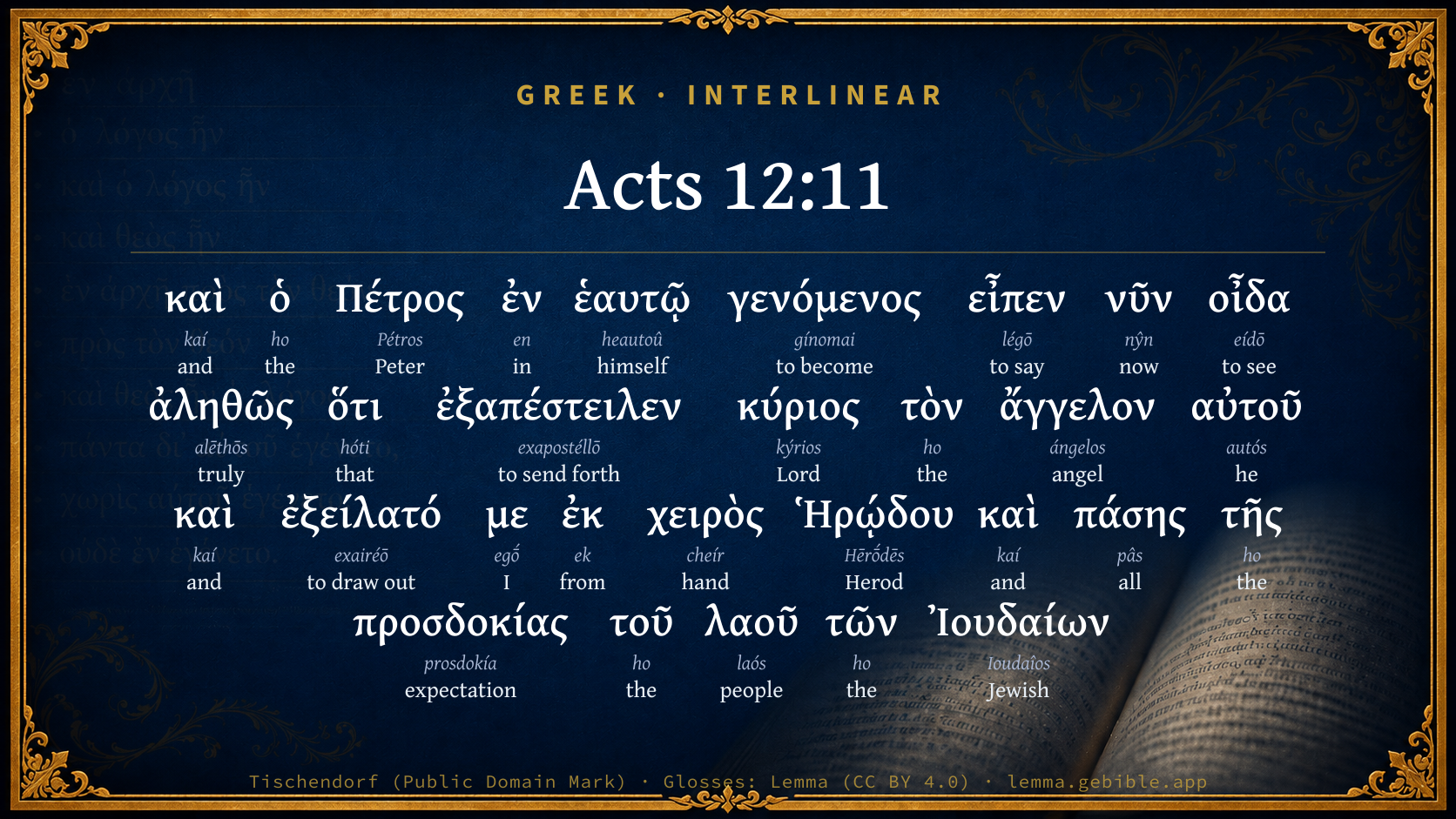
Greek (Tischendorf 8th ed.) Acts 12:11 appears in the Greek New Testament. The text above is from the Tischendorf 8th edition. Each word links to its Strong’s number and a concise gloss. Click any word for its full Thayer’s Greek Lexicon entry.
Download image
Cite this verse

Acts 12:11 (World English Bible). Public Domain. Lemma interlinear Bible study tool, https://lemma.gebible.app/v/acts/12/11.

Show BibTeX & RIS
BibTeX
RIS
English Translation
When Peter had come to himself, he said, "Now I truly know that the Lord has sent out his angel and delivered me out of the hand of Herod, and from everything the Jewish people were expecting."
World English Bible · Public Domain
Download a study sheet

One document with this verse’s original text, its word-by-word gloss line, the meaning frame, cross-references with their text, attributed commentary, and full source and license credits — printable, and it pastes into notes with its structure intact.

This verse Autodidact and up

Study sheet (.html) Plain text (.txt)

A passage Seminary Student

Up to 50 verses in one chapter. A passage sheet keeps up to 6 commentary sources and 12 cross-references per verse, in the order this page ranks them, and says so on the sheet whenever that leaves anything out. Ask for a single verse and you get the Autodidact verse sheet above.

Everything on this page stays free to read, with no account — the sheet is a download of what is already on screen, not access to it.

Want to remove ads? Support Godless Engineer
Compare translations 3

The same verse in 3 English versions, stacked beneath the original-language interlinear above. Click any original word for its lexicon entry.

Each is an independent rendering of the whole verse — the interlinear is not word-aligned to these translations.

Highlighted words mark where these versions differ — a whole-verse word diff, not a word-by-word alignment.

  • World English Bible Public Domain
    When Peter had come to himself, he said, "Now I truly know that the Lord has sent out his angel and delivered me out of the hand of Herod, and from everything the Jewish people were expecting."
  • King James Version Public Domain
    And when Peter was come to himself, he said, Now I know of a surety, that the LORD hath sent his angel, and hath delivered me out of the hand of Herod, and from all the expectation of the people of the Jews.
  • unfoldingWord Literal Text CC BY-SA 4.0
    And Peter, having come to himself, said, “Now I truly know that the Lord sent out his angel and delivered me from the hand of Herod and all the expectation of the Jewish people.”

unfoldingWord Literal Text — © unfoldingWord, licensed CC BY-SA 4.0. Word-aligned USFM3 via Door43 (git.door43.org/unfoldingWord/en_ult).

Versions to compare (up to 4)

3 of 4 selected

Show all 19 translations

Every available English version of this verse, each an independent rendering of the whole verse.

  • World English Bible Public Domain
    When Peter had come to himself, he said, "Now I truly know that the Lord has sent out his angel and delivered me out of the hand of Herod, and from everything the Jewish people were expecting."
  • Berean Standard Bible Public Domain
    Then Peter came to himself and said, “Now I know for sure that the Lord has sent His angel and rescued me from Herod’s grasp and from everything the Jewish people were anticipating.”
  • Majority Standard Bible Public Domain
    Then Peter came to himself and said, “Now I know for sure that the Lord has sent His angel and rescued me from Herod’s grasp and from everything the Jewish people were anticipating.”
  • King James Version Public Domain
    And when Peter was come to himself, he said, Now I know of a surety, that the LORD hath sent his angel, and hath delivered me out of the hand of Herod, and from all the expectation of the people of the Jews.
  • American Standard Version (1901) Public Domain
    And when Peter was come to himself, he said, Now I know of a truth, that the Lord hath sent forth his angel and delivered me out of the hand of Herod, and from all the expectation of the people of the Jews.
  • Revised Version (1885) Public Domain
    And when Peter was come to himself, he said, Now I know of a truth, that the Lord hath sent forth his angel and delivered me out of the hand of Herod, and from all the expectation of the people of the Jews.
  • Geneva Bible (1599) Public Domain
    And when Peter was come to himselfe, he said, Nowe I know for a trueth, that the Lord hath sent his Angel, and hath deliuered me out of the hand of Herod, and from all the wayting for of the people of the Iewes.
  • Douay-Rheims (1899) Public Domain
    And Peter coming to himself, said: Now I know in very deed, that the Lord hath sent his angel, and hath delivered me out of the hand of Herod, and from all the expectation of the people of the Jews.
  • Young's Literal Translation Public Domain
    And Peter having come to himself, said, `Now I have known of a truth that the Lord did sent forth His messenger, and did deliver me out of the hand of Herod, and all the expectation of the people of the Jews;'
  • Literal Standard Version CC BY-SA 4.0
    And Peter having come to himself, said, “Now I have known of a truth that the LORD sent forth His messenger, and delivered me out of the hand of Herod, and all the expectation of the people of the Jews”;
  • Unlocked Literal Bible CC BY-SA 4.0
    When Peter came to himself, he said, “Now I truly know that the Lord has sent his angel and delivered me out of the hand of Herod, and from everything the Jewish people were expecting.”
  • unfoldingWord Literal Text CC BY-SA 4.0
    And Peter, having come to himself, said, “Now I truly know that the Lord sent out his angel and delivered me from the hand of Herod and all the expectation of the Jewish people.”
  • Darby Bible Public Domain
    And Peter, being come to himself, said, Now I know certainly that [the] Lord has sent forth his angel and has taken me out of the hand of Herod and all the expectation of the people of the Jews.
  • World Messianic Bible Public Domain
    When Peter had come to himself, he said, “Now I truly know that the Lord has sent out his angel and delivered me out of the hand of Herod, and from everything the Jewish people were expecting.”
  • Webster's Bible Public Domain
    And when Peter had come to himself, he said, Now I know with certainty, that the Lord hath sent his angel, and hath delivered me out of the hand of Herod, and from all the expectation of the people of the Jews.
  • Free Bible Version CC BY-SA 4.0
    When Peter came to his senses, he said, “Now I realize this really happened! The Lord sent an angel to rescue me from Herod's power, and from everything that the Jewish people had planned.”
  • Bible in Basic English Public Domain
    And when Peter came to his senses he said, Now, truly, I am certain that the Lord has sent his angel and taken me out of the hands of Herod, against all the hopes of the Jews.
  • Text-Critical English NT CC BY 4.0
    When Peter came to his senses, he said, “Now I truly know that the Lord has sent his angel and rescued me from the hand of Herod and from everything the Jewish people were expecting to happen.”
  • Tyndale New Testament (1534) Public Domain
    And when Peter was come to him selfe he sayde: now I knowe of a surety that the Lorde hath sent his angell and hath delyvered me out of the honde of Herode and from all the waytynge for of the people of the Iewes.

Literal Standard Version (2020), Covenant Press — licensed CC BY-SA 4.0. Text via the HelloAO Bible API (eBible.org). Unlocked Literal Bible (unfoldingWord) — licensed CC BY-SA 4.0. Text via the HelloAO Bible API (eBible.org). unfoldingWord Literal Text — © unfoldingWord, licensed CC BY-SA 4.0. Word-aligned USFM3 via Door43 (git.door43.org/unfoldingWord/en_ult). Free Bible Version, Dr. Jonathan Gallagher — licensed CC BY-SA 4.0. Text via the HelloAO Bible API (eBible.org).

Word by word

More ways to search: Search by grammar → Find every occurrence → Compare this word →

Practice this passage: Drill this verse → Learn its vocabulary →

προσδοκίας
prosdokía
G4329
“expectation”
Noun, Genitive, Singular, Feminine
Part of Speech
Noun
Case
Genitive
Number
Singular
Gender
Feminine
Full Thayer's Definition

Origin: from G4328

TDNT: 18:05,9

1. expectation (whether good or evil)
  1. καὶ kaí G2532 “and” Conjunction
  2. ὁ ho G3588 “the” Article, Nominative, Singular, Masculine
  3. Πέτρος Pétros G4074 “Peter” Noun, Nominative, Singular, Masculine
  4. ἐν en G1722 “in” Preposition
  5. ἑαυτῷ heautoû G1438 “himself” Reflexive pronoun, 3rd person, Dative, Singular, Masculine
  6. γενόμενος gínomai G1096 “to become” Verb, Aorist, Middle deponent, Participle, Nominative, Singular, Masculine
  7. εἶπεν légō G3004 “to say” Verb, Aorist, Active, Indicative, 3rd person, Singular
  8. νῦν nŷn G3568 “now” Adverb
  9. οἶδα eídō G1492 “to see” Verb, Perfect, Active, Indicative, 1st person, Singular
  10. ἀληθῶς alēthōs G230 “truly” Adverb
  11. ὅτι hóti G3754 “that” Conjunction
  12. ἐξαπέστειλεν exapostéllō G1821 “to send forth” Verb, Aorist, Active, Indicative, 3rd person, Singular
  13. κύριος kýrios G2962 “Lord” Noun, Nominative, Singular, Masculine
  14. τὸν ho G3588 “the” Article, Accusative, Singular, Masculine
  15. ἄγγελον ángelos G32 “angel” Noun, Accusative, Singular, Masculine
  16. αὐτοῦ autós G846 “he” Personal pronoun, Genitive, Singular, Masculine
  17. καὶ kaí G2532 “and” Conjunction
  18. ἐξείλατό exairéō G1807 “to draw out” Verb, Aorist, Middle, Indicative, 3rd person, Singular
  19. με egṓ G1473 “I” Personal pronoun, 1st person, Accusative, Singular
  20. ἐκ ek G1537 “from” Preposition
  21. χειρὸς cheír G5495 “hand” Noun, Genitive, Singular, Feminine
  22. Ἡρῴδου Hērṓdēs G2264 “Herod” Noun, Genitive, Singular, Masculine
  23. καὶ kaí G2532 “and” Conjunction
  24. πάσης pâs G3956 “all” Adjective, Genitive, Singular, Feminine
  25. τῆς ho G3588 “the” Article, Genitive, Singular, Feminine
  26. τοῦ ho G3588 “the” Article, Genitive, Singular, Masculine
  27. λαοῦ laós G2992 “people” Noun, Genitive, Singular, Masculine
  28. τῶν ho G3588 “the” Article, Genitive, Plural, Masculine
  29. Ἰουδαίων Ioudaîos G2453 “Jewish” Adjective, Genitive, Plural, Masculine

About this verse

These counts appear in no published source. They are computed here, from the morphology-tagged text and Lemma’s own curated glosses. What Lemma adds →

30
words
24
distinct lemmas
Acts
section

Notable vocabulary

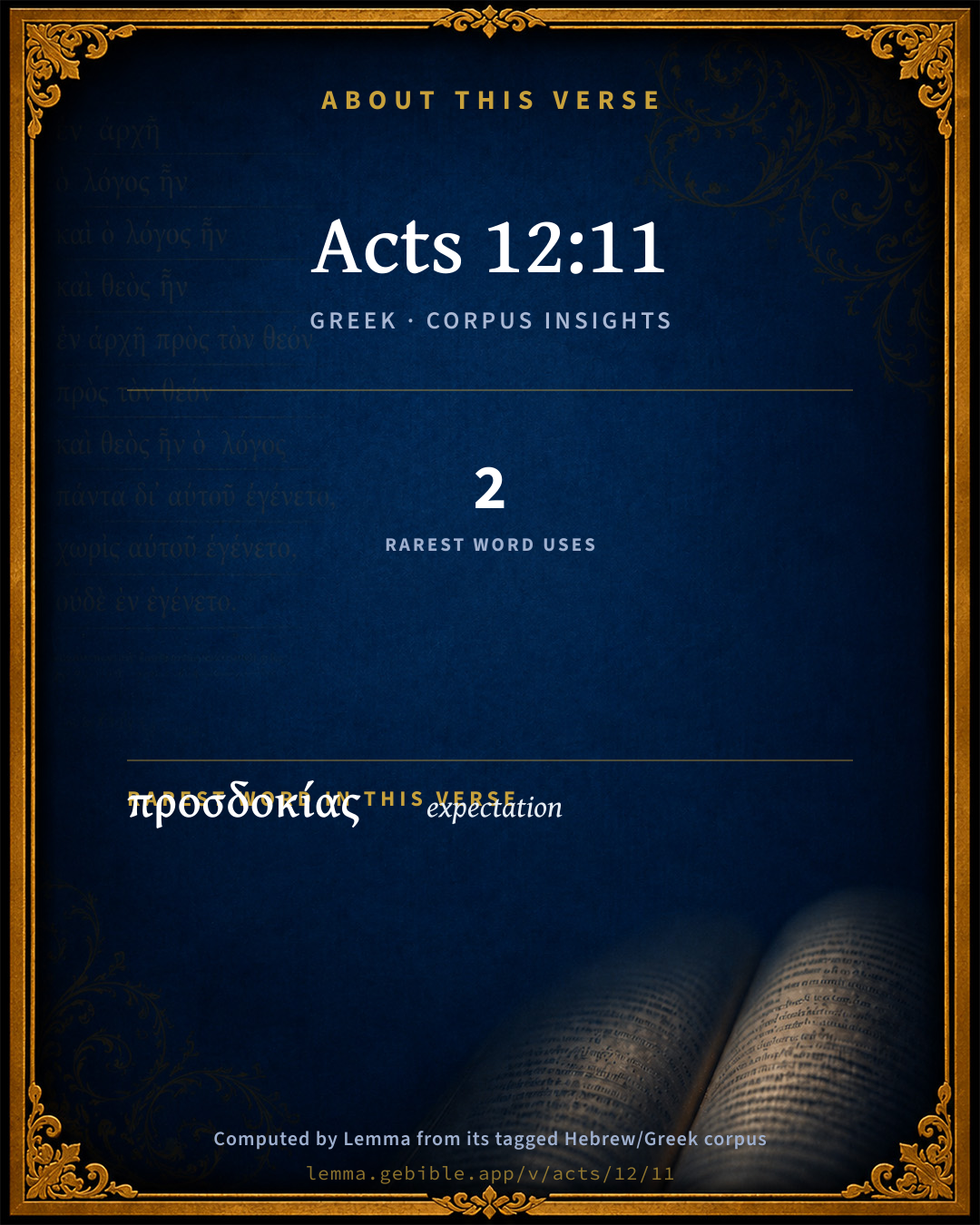
The rarest word here is προσδοκίας expectation G4329 — appearing just 2 times in the whole Greek New Testament.

Shared distinctive vocabulary

προσδοκίας expectation G4329 occurs in 2 verses of the Greek New Testament. Also found in:

Repetition

Words recur within this verse:

Cross-references

24

Topical passages linked to Acts 12:11 in the Treasury of Scripture Knowledge — connected by theme and wording, ordered by reader-vote popularity; previews shown in the World English Bible.

  • Daniel 6:22 My God has sent his angel, and has shut the lions' mouths, and they have not hurt me; because as before him innocence was found in me; and also before you, O king, have I done no hurt.
  • Daniel 3:28 Nebuchadnezzar spoke and said, Blessed be the God of Shadrach, Meshach, and Abednego, who has sent his angel, and delivered his servants who trusted in him, and have changed the king's word, and have yielded their bodies, that they might not serve nor worship any god, except their own God.
  • 2 Peter 2:9 the Lord knows how to deliver the godly out of temptation and to keep the unrighteous under punishment for the day of judgment;
  • Psalms 34:7 The angel of Yahweh encamps round about those who fear him, And delivers them.
  • Psalms 33:18 Behold, Yahweh's eye is on those who fear him, On those who hope in his loving kindness;
  • Psalms 97:10 You who love Yahweh, hate evil. He preserves the souls of his saints. He delivers them out of the hand of the wicked.
  • Acts 5:19 But an angel of the Lord opened the prison doors by night, and brought them out, and said,
  • Psalms 34:22 Yahweh redeems the soul of his servants. None of those who take refuge in him shall be condemned.
  • Psalms 41:2 Yahweh will preserve him, and keep him alive, He shall be blessed on the earth, And he will not surrender him to the will of his enemies.
  • Psalms 109:31 For he will stand at the right hand of the needy, To save him from those who judge his soul.
  • Luke 15:17 But when he came to himself he said, 'How many hired servants of my father's have bread enough to spare, and I'm dying with hunger!
  • 2 Samuel 22:1 David spoke to Yahweh the words of this song in the day that Yahweh delivered him out of the hand of all his enemies, and out of the hand of Saul:
  • Daniel 3:25 He answered, Look, I see four men loose, walking in the midst of the fire, and they have no hurt; and the aspect of the fourth is like a son of the gods.
  • Acts 12:7 And behold, an angel of the Lord stood by him, and a light shone in the cell. He struck Peter on the side, and woke him up, saying, "Stand up quickly!" His chains fell off from his hands.
  • 2 Chronicles 16:9 For the eyes of Yahweh run back and forth throughout the whole earth, to show himself strong in the behalf of them whose heart is perfect toward him. Herein you have done foolishly; for from henceforth you shall have wars.
  • Job 31:31 If the men of my tent have not said, 'Who can find one who has not been filled with his meat?'
  • Acts 23:12–30 When it was day, some of the Jews banded together, and bound themselves under a curse, saying that they would neither eat nor drink until they had killed Paul.
  • Hebrews 1:14 Aren't they all ministering spirits, sent out to do service for the sake of those who will inherit salvation?
  • Genesis 15:13 He said to Abram, "Know for sure that your seed will live as foreigners in a land that is not theirs, and will serve them. They will afflict them four hundred years.
  • Genesis 18:13 Yahweh said to Abraham, "Why did Sarah laugh, saying, 'Will I really bear a child, yet I am old?'
  • Genesis 26:9 Abimelech called Isaac, and said, "Behold, surely she is your wife. Why did you say, 'She is my sister?'" Isaac said to him, "Because I said, 'Lest I die because of her.'"
  • Acts 24:27 But when two years were fulfilled, Felix was succeeded by Porcius Festus, and desiring to gain favor with the Jews, Felix left Paul in bonds.
  • Acts 25:3–5 asking a favor against him, that he would summon him to Jerusalem; plotting to kill him on the way.
  • 2 Corinthians 1:8–10 For we don't desire to have you uninformed, brothers, concerning our affliction which happened to us in Asia, that we were weighed down exceedingly, beyond our power, so much that we despaired even of life.

Cross-references courtesy of OpenBible.info (CC BY 4.0).

Commentary

Notes on Acts 12:11 from classic Christian and Jewish commentators (each source and its license shown beneath its notes). The classic Christian expositions comment on the surrounding passage and are grouped to its opening verse, so a note may address several verses; the Jewish commentaries on the Tanakh (Rashi and others) are per-verse, so they appear only where the commentator wrote on this verse.

Lemma curates 59 commentaries, every one of them public domain or Creative Commons licensed, each selected and text-cleaned for this edition rather than reprinted as found. About our sources →

Joseph Benson's Commentary

Act 12:11-15. When Peter was come to himself — And perceived that the extraordinary things which had been shown him were not visionary representations, but real facts; and when he saw where he was; he said, Now know I of a surety, that the Lord — In whose cause I was upon the point of suffering; hath sent his angel, and delivered me — As he formerly did, Act 5:19. I know that my deliverance is real and effectual; out of the hand of Herod — Who not only intended my destruction, but thought he had taken effectual measures assuredly to accomplish it; and from all the expectation of the people of the Jews — Who, notwithstanding the many beneficial miracles I have wrought among them, were thirsting for my blood, and waiting impatiently to see me executed. And when he had considered the thing — How imminent his danger was, and how great his deliverance, and now what was best to be done; he came to the house of Mary — A friend’s house, which, it is likely, was near, and where many, even then, though it was midnight; were gathered together, praying — Doubtless, for his deliverance; God thus answering them while they were yet speaking, and bringing him, for whom they were so much concerned, to the very house in which they were assembled, praying for his release. And as Peter knocked at the door of the gate — Of an outer gate at some distance from the house, designing, it seems, to awaken them out of sleep; a damsel came to hearken — Whether any one knocked, and if so, not to open the door till she knew who was there, a friend or foe, and what his business was at that unseasonable time of the night. This damsel was probably a Christian, and even of some note in the church, as her name is mentioned, and more zealously affected toward the cause of Christ than the generality of her age. And when she knew Peter’s voice — Having probably often heard him pray, preach, and discourse; she opened not the gate for gladness — Through surprise and an ecstasy of joy. Thus, sometimes, in a transport of affection toward our friends, we do what is unkind to them; but ran in — Instantly, to the company that were assembled in the house; and told that Peter stood before the gate — As she certainly believed, though she had not had courage or presence of mind to open the gate. And they said, Thou art mad — Surely thou art out of thy senses, to imagine so incredible and impossible a thing, for Peter is undoubtedly in prison, strongly guarded. But she constantly affirmed that it was even so — Persisted in it, that she was sure she had heard his voice. Then said they, It is his angel — His guardian angel, who has assumed his form, and imitates his voice, to bring us some tidings of him. It was a common opinion among the Jews, that every man had his particular guardian angel, who frequently assumed both his shape and voice: and Philo speaks of it as also a received notion among the Jews, that the souls of good men deceased officiate as ministering spirits. But these are points on which the Scriptures are silent. And whatever the notion of the Jews was concerning them, no argument can be drawn from it, as to the truth of either of those suppositions.

Joseph Benson's Commentary on the Old and New Testaments (1811–1818) — public domain. Text from a community e-Sword module.

MacLaren's Expositions of Holy Scripture

Alexander MacLaren

Acts

‘SOBER CERTAINTY’

Act 12:11.

Where did Luke get his information of Peter’s thoughts in that hour? This verse sounds like first-hand knowledge. Not impossibly John Mark may have been his informant, for we know that both were in Rome together at a later period. In any case, it is clear that, through whatever channels this piece of minute knowledge reached Luke, it must have come originally from Peter himself. And what a touch of naturalness and evident truth it is! No wonder that the Apostle was half dazed as he came from his dungeon, through the prison corridors and out into the street. To be wakened by an angel, and to have such following experiences, would amaze most men.

I. The bewilderment of the released captive.

God’s mercies often come suddenly, and with a rush and a completeness that outrun our expectations and our power of immediate comprehension. And sometimes He sends us sorrows in such battalions and so overwhelming that we are dazed for the moment. A Psalmist touched a deep experience when he sang, ‘When the Lord turned again the captivity of Zion, we were like unto them that dream.’

The angel has to be gone before we are sure that he was really here. The tumult of emotion in an experience needs to be calmed down before we understand the experience. Reflection discovers more of heaven and of God in the great moments of our lives than was visible to us while we were living through them,

There is one region in which this is especially true-that of the religious life. There sometimes attend its beginnings in a soul a certain excitement and perturbation which disable from calm realising of the greatness of the change which has passed. And it is well when that excitement is quieted down and succeeded by meditative reflection on the treasures that have been poured into the lap, almost as in the dark. No man understands what he has received when he first receives Christ and Christ’s gifts. It occupies a lifetime to take possession of that which we possess from the first in Him, and the oldest saint is as far from full possession of the unspeakable and infinite ‘gift of God,’ as the babes in Christ are.

But, looking more generally at this characteristic of not rightly understanding the great epochs of our lives till they are past, we may note that, while in part it is inevitable and natural, there is an element of fault in it. If we lived in closer fellowship with God, we should live in an atmosphere of continual calm, and nothing, either sorrowful or joyful, would be able so to sweep us off our feet that we should be bewildered by it. Astonishment would never so fill our souls as that we could not rightly appraise events, nor should we need any time, even in the thick of the most wonderful experiences, to ‘come to’ ourselves and discern the angel.

But if it be so that our lives disclose their meanings best, when we look back on them, how much of the understanding of them, and the drawing of all its sweetness out of each event in them, is entrusted to memory! And how negligent of a great means of happiness and strength we are, if we do not often muse on ‘all the way by which God the Lord has led us these many years in the wilderness’! It is needful for Christian progress to ‘forget the things that are behind,’ and not to let them limit our expectations nor prescribe our methods, but it is quite as needful to remember our past, or rather God’s past with us, in order to confirm our grateful faith and enlarge our boundless hope.

II. The disappearance of the angel.

Why did he leave Peter standing there, half dazed and with his deliverance incomplete? He ‘led him through one street’ only, and ‘straightway departed from him.’ The Apostle delivered by miracle has now to use his brains. One distinguishing characteristic of New Testament miracles is their economy of miraculous power. Jesus raised Lazarus, for He alone could do that, but other hands must ‘loose him and let him go,’ He gave life to Jairus’s little daughter, but He bid others ‘give her something to eat’ God does nothing for us that we can do for ourselves. That economy was valuable as a preservative of the Apostles from the possible danger of expecting or relying on miracles, and as stirring them to use their own energies. Reliance on divine power should not lead us to neglect ordinary means. Alike in the natural and in the spiritual life we have to do our part, and to be sure that God will do His.

III. The symbol here of a greater deliverance.

Fancy may legitimately employ this story as setting forth for us under a lovely image the facts of Christian death, if only we acknowledge that such a use is entirely the work of fancy. But, making that acknowledgment, may we not make the use? Is not Death, too, God’s messenger to souls that love Him, ‘mighty and beauteous, though his face be hid’? Would it not be more Christian-like, and more congruous with our eternal hope, if we pictured him thus than by the hideous emblems of our cemeteries and tombs? He comes to Christ’s servants, and his touch is gentle though his fingers are icy-cold. He removes only the chains that bind us, and we ourselves are emancipated by his touch. He leads us to ‘the iron gate that leadeth into the city,’ and it opens to us ‘of its own accord.’ But he disappears as soon as our happy feet have touched the pavement of that street of the city which is ‘pure gold, as transparent as glass,’ and in the midst of which flows the river of the crystal-bright ‘water of life proceeding out of the throne of God and of the Lamb.’ Then, when we see the Face as of the sun shining in his strength, we shall come to ourselves, and ‘know of a surety that the Lord hath sent His angel and delivered’ us from all our foes and ills for evermore.

Alexander MacLaren, Expositions of Holy Scripture (1904–1910) — public domain. Text from a community e-Sword module.

Burkitt's Expository Notes on the New Testament

William Burkitt

Observe here, 1. The wise and holy course which the church took for the apostles enlargement, and that was keeping a day of prayer. A number of Christians get together, and importune heaven; the enemies plot, the church prays; they shut the prison doors, the church opens heaven’s doors, and God gives Peter in, as an answer of prayer, before they rose off from their knees.

Oh how good is it to draw nigh to God! What a prayer-hearing God is our God! How great is the power and prevalency of the conjoined prayers of good men! God’s praying people ever have been, and will be, a prevailing people. Whilst these pious souls were in the very act of calling upon God for Peter’s release, God gives in Peter released to them. God never wants means for his people’s deliverance, when he is once set on work by the prayers of his people.

Observe 2. St. Peter being delivered, meditates whilst he was walking in the streets, and going along by himself, of the greatness of his danger, and the graciousness of his deliverance: Holy and suitable thoughts, pious meditations and ejaculations, do well become us in any place, at all times and upon all occasions, but especially after signal deliverances from signal dangers. We can never enough ruminate upon them, or be sufficiently thankful for them.

Observe, 3. The wisdom and goodness of the divine providence in directing Peter in the dead of the night, to the house where the saints were praying for him. This is the more remarkable, because the angel having done his work which God sent him upon, after he had delivered Peter from his chains and imprisonment, he left him to shift for himself, and to take care of his own safety; but though an angel left him, yet the providence of God conducted him to a place where he was both safe and welcome.

Observe, 4. What an ancient opinion it was, that every good man had a guardian angel appointed him by God, to take a special care of him to his life’s end; to direct him in his way, to guard him from dangers, and to deliver him in his distresses; They say, It is his angel. For which saying there could be no reason, had there not been a current opinion among them of guardian angels.

Blessed be God, his holy angels are our keepers, our counsellors, our defenders, our loving and friendly associates: and they shall never depart from us, till they have conducted us safely to our heavenly Father’s house, where we shall be "as the angels of God in heaven."

Observe, 5. How Peter gives God, and not the angel, the glory of his deliverance, Act 12:17. "He declared how the Lord had brought him out of the prison." The angel was but the instrument, God was the principal agent, Act 12:11. "The Lord hath sent his angel, and delivered me out of the hand of Herod." All deliverances must be ascribed to him who commands deliverance for his people.

Observe, 6. The prudential care which St. Peter takes for his future preservation. "He departed and went to another place." He could not think himself safe whilst Herod was so near, no more than a lamb could be safe near the lion’s den. He knew he should be hunted for, therefore escapes for his life. And besides his own danger, he was not willing to endanger his friends, who did now entertain and harbour him: but both for his own and their preservation, he departs to another place.

Learn, That a prudential use of all lawful means for our own and others preservation, in subserviency to the divine providence, is our duty, our wisdom and interest, both as men and Christians.

William Burkitt's Expository Notes on the New Testament (1700–1703) — public domain. Text from a community e-Sword module.

Bengel's Gnomon

Johann Albrecht Bengel

Act 12:11. Εἶπε, he said) with a ready, grateful, pious, joyful mind.—οἶδα ἀληθῶς, I know of a truth) The antithesis is, he thought, Act 12:9. All things externally accorded with the internal vision.—ἐξείλετό με, hath delivered me) It was not yet the time that Peter should die: Joh 21:18.

Bengel's Gnomon of the New Testament — English translation (T&T Clark, Edinburgh, 1860) — public domain. Text from a community e-Sword module.

Expositor's Greek Testament

ed. W. Robertson Nicoll

Act 12:11 . γενόμενος ἐν ἑαυτῷ , cf. Luk 15:17 , and compare instances of similar phrases in Greek and Latin classical writers in Wetstein and Blass. Κύριος , see critical notes, if without the article Nösgen (so Weiss) takes it of God, Jehovah. ἐξαπέστειλε : a compound only found in Luke and Paul; four times in Luke’s Gospel, six or seven times in Acts, and Gal 4:4 ; Gal 4:6 ; very frequent in LXX, and used also in active voice by Polybius. ἐξείλετο ἐκ χ .: close parallels in LXX, cf. Exo 3:8 , 2Sa 22:1 , Isa 43:13 , Bar 4:18 ; Bar 4:21 , etc. ἐκ χειρὸς : Hebraism, cf. Luk 1:74 . The expression is also classical, Blass, Gram. , p. 127, for close parallel. προσδοκία : only in Luke here and in Luk 21:26 , cf. Gen 49:10 , but more allied to its sense here Psa 119:116 , Wis 17:13 , Sir 40:2 , and in 2 and 3 Macc. (see H. and R.), and Psalms of Solomon , Tit. 11; frequently in classics. Hobart claims as a medical word, especially as the verb προσδοκᾷν is also so frequent in Luke; so too Zahn, Didache 1 N. T. , p. 436; but see Plummer on Luk 21:36 . Both verb and noun are also frequent in classical use.

The Expositor's Greek Testament, edited by W. Robertson Nicoll (1897–1910) — public domain. Text from a community e-Sword module.

Jamieson, Fausset & Brown

Robert Jamieson, A. R. Fausset & David Brown

when Peter was come to himself--recovered from his bewilderment, and had time to look back upon all the steps that had followed each other in such rapid succession.

Now I know of a surety, that the Lord hath sent his angel, and hath delivered me, &c.--another evidence that Peter expected nothing but to seal his testimony with his blood on this occasion.

Jamieson, Fausset & Brown — Commentary Critical and Explanatory on the Whole Bible (1871) — public domain (CC PDM 1.0). Text via the HelloAO Bible API.

Adam Clarke's Commentary

Verse 11. When Peter was come to himself] Every thing he saw astonished him; he could scarcely credit his eyes; he was in a sort of ecstasy; and it was only when the angel left him that he was fully convinced that all was real.

Now I know - that the Lord hath sent his angel] The poor German divine is worthy of pity, who endeavoured to persuade himself and his countrymen that all this talk about the angel was mere illusion; that Peter was delivered in a way which he could not comprehend, and therefore was led to attribute to a particular providence of God what probably was done by the prefect of the prison, who favoured him! But it is the study of this writer to banish from the word of God all supernatural influence; and to reduce even the miracles of Christ to simple operations of nature, or to the workings of imagination and the prejudices of a weak and credulous people. Such men should at once cast off the mask which so thinly covers their infidelity, and honestly avow themselves to be, what they are, the enemies of revelation in general, and of the Christian religion in particular. Peter could say, Now I know of a certainty that the Lord hath sent his angel, and delivered me, c. No such thing, says Mr. E., Peter was deceived it was not the Lord, it was the prefect or some other person. Now we know that Peter spoke by the Holy Ghost; but we have no much testimony of Mr. E. nor of any of his associates.

And all the expectation of the - Jews.] It seems they had built much on the prospect of having him sacrificed, as they already had James.

Adam Clarke's Commentary on the Bible (1810–1826) — public domain. Text from a community e-Sword/MySword module.

John Calvin's Commentaries

11. Then Peter returning to himself. It is word for word, being made in himself, because, being before astonied with a strange and incredible thing, he was, as it were, without himself. But now at length, as it were after a trance, he knoweth that he is delivered from death. His words set down by Luke contain a thanksgiving; for he extolleth with himself the benefit of God which he had tried, [experienced,] and whereof he had tasted, and he doth highly commend it with himself, until he find some other witnesses. He saith that the angel was sent of God, according to the common meaning of the godly, who hold that the angels are appointed to be ministers, to be careful for, and to take charge of their safety; for unless he had been thus persuaded, he would not have spoken of the angel. And yet he doth not commend the angel as the author of the grace, but he ascribeth all the whole praise of the work to God alone, neither do the angels help us to this end, that they may derive unto themselves even the least jot of God’s glory. Whereas he saith that he was delivered out of the hand of Herod, he amplifieth the goodness and benefit of God, by the power of his enemy. To the same end tendeth that which he addeth of the Jews; for the greater the number of the enemies was, the more excellent was the grace of God toward his servant; for it is a great matter that God alone being favorable, the deadly hatred of all the whole world should come to nought.

John Calvin's Commentaries (1540-1563) — public domain. Text from the Calvin Translation Society English edition (1840s-50s) via the Christian Classics Ethereal Library (ccel.org). Calvin's coverage is partial (roughly two-thirds of the Bible); uncommented books and verses are honest gaps, never fabricated. The 19th-century editor's footnotes and remarks are omitted so the notes are faithfully Calvin's own voice.

Ellicott's Commentary for English Readers

(11) When Peter was come to himself.—Here again we find the tone of a personal reminiscence. He finds himself at night, free, in the open street. It was no dream. As before (Act_5:19), his Master had sent His angel to deliver him.

A Bible Commentary for English Readers, edited by Charles John Ellicott (1878–1897) — public domain. Text from a community e-Sword module.

The Cambridge Bible for Schools and Colleges

gen. ed. J. J. S. Perowne

11. And when Peter was come to himself] This and other subjective features of the narrative shew that the account must have been derived from St Peter himself. No one else could describe the astonishment and the after realization that all was truly enacted and no vision.

all the expectation of the people of the Jews] Whose gratification at the death of James had been great, and who now hoped to see another of the Apostles put to death.

The Cambridge Bible for Schools and Colleges (gen. ed. J. J. S. Perowne; Cambridge University Press, 1878–1918) — public domain. Text from a community e-Sword module.

John Gill's Exposition

And when Peter was come to himself.... For upon his being awaked out of sleep, what with the uncommon light, which shone around him, and with the appearance of the angel, and the chains dropping from his hands, and his surprising escape through the several wards, together with the iron gate opening of itself, he was so filled with amazement, that he was not himself; he could scarcely tell whether he was in the body or not, and whether he was in a dream or a trance, or whether he saw a vision or not; but upon the angel's leaving him he came to himself, the amazement wore off, and he found himself thoroughly awake, and perfectly in his senses, and that the deliverance was real: and then,

he said, now know I of a surety, that the Lord hath sent his angel; this was a thanksgiving to God, and an acknowledgment, that the deliverance, though it was by the ministry an angel, yet was owing to the goodness and power of God; it was God that sent his angel, and the salvation was of the Lord's doing, and it was marvellous in the eyes of Peter, and gratefully owned by him:

and hath delivered me out of the hand of Herod; who intended that morning to have brought him forth, and sacrificed him to the will of the people:

and from all the expectation of the people of the Jews; not only the inhabitants of Jerusalem, but the body of the Jewish nation, who were now at Jerusalem, on account of the passover; and who before they departed into their several cities and towns, expected to have had Peter brought forth, and put to death before them; but now both Herod and they were disappointed.

John Gill's Exposition of the Whole Bible (1746–1763) — public domain (CC PDM 1.0). Text via the HelloAO Bible API.

Trapp's Complete Commentary

John Trapp

11 And when Peter was come to himself, he said, Now I know of a surety, that the Lord hath sent his angel, and hath delivered me out of the hand of Herod, and from all the expectation of the people of the Jews.

Ver. 11. Now I know of a surety] Faith cannot he idle, or ungrateful for benefits received. If Peter have none else to tell it to, he will tell himself what God had done for him by his angel; and what great cause he had to be really and substantially thankful. So doth David, Psa 103:1-4, &c. A good man can never be alone; for, in defect of other company, he can fruitfully converse with himself, and commune with his own conscience, and thereupon lift up many a humble, joyful, and thankful heart to God.

John Trapp, A Commentary or Exposition upon All the Books of the Old and New Testament (1647–1656) — public domain. Text from a community e-Sword module.

Albert Barnes' Notes on the Bible

And when Peter was come to himself - This expression naturally means, when he had overcome bas amazement and astonishment at the unexpected deliverance, so as to be capable of reflection. He had been amazed by the whole transaction. He thought it was a vision: and in the suddenness and rapidity with which it was done, he had no time for cool reflection. The events of divine providence often overwhelm and confound us; and such are their suddenness, and rapidity, and unexpected character in their development as to prevent calm and collected reflection.

Of a surety - Certainly, surely. He considered all the circumstances; he saw that he was actually at liberty, and he was satisfied that it could have been effected only by divine interposition.

The expectation of the people - From this it appears that the people earnestly desired his death; and it was to gratify that desire that Herod had imprisoned him.

Albert Barnes' Notes on the Bible (1834–1885) — public domain. Text from a community e-Sword/MySword module.

Haydock's Catholic Bible Commentary

Peter coming to himself. Being now sensible that all was true. (Witham)

George Leo Haydock (1774–1849), Haydock's Catholic Family Bible and Commentary, 1859 edition — public domain. Excludes Psalms (Douay-Rheims chapter numbering differs from Protestant) and Deuterocanonical books (Catholic canon only).

Matthew Poole's English Annotations

When Peter was come to himself, out of that amazement which so many wonderful things had wrought in him, that he could compose himself to effect upon what he had heard and seen, he knew his deliverance was real and effectual.

Delivered me; from Herod, who had resolved to have killed him, as he had done James, Act 12:2; and from the people’s expectation, who had heard the report of Herod’s resolution, and longed for the fulfilling of it.

Matthew Poole's English Annotations on the Holy Bible (1683–1685) — public domain. Text from a community e-Sword/MySword module.

Whedon's Commentary on the Bible

Daniel D. Whedon

11. Come to himself—From the bewilderment of his sudden waking and strange surroundings. It aided his coming to himself to be in a familiar spot with no company but himself.

He said, Now I—Having no company but himself Peter talks to himself.

From all the expectation—What that expectation was the fate of James had assured him.

Daniel D. Whedon (gen. ed.), Commentary on the Old and New Testaments (1874–1909) — public domain. Text from a community e-Sword module.

The Pulpit Commentary

Truth for surety, A.V.; sent forth for sent, A.V.; delivered for hath delivered, A.V. Peter"s recognition of the Lord"s hand in sending his angel is exactly echoed in the Collect for Michaelmas Day, "Grant that as thy holy angels always do thee service in heaven, so by thy appointment they may succor and defend us on earth."

The Pulpit Commentary (1880–1919), ed. H.D.M. Spence-Jones & Joseph S. Exell — public domain. Text from a community e-Sword module.

John Wesley's Explanatory Notes

Now I know of a truth - That this is not a vision, ver. 9.

John Wesley, Explanatory Notes Upon the Whole Bible (1754–1765) — public domain. Text via the GEBible commentary corpus.

Scofield Reference Notes

C. I. Scofield

angel

(See Scofield "Heb 1:4").

The Scofield Reference Bible (1917 edition), notes by C. I. Scofield — public domain. Text from a community e-Sword module.

Kretzmann's Popular Commentary

Paul E. Kretzmann

Peter in the house of Mary:

v. 11. And when Peter was come to himself, he said, Now I know of a surety that the Lord hath sent His angel, and hath delivered me out of the hand of Herod and from all the expectation of the people of the Jews.

v. 12. And when he had considered the thing, he came to the house of Mary, the mother of John, whose surname was Mark, where many were gathered together praying.

v. 13. And as Peter knocked at the door of the gate, a damsel came to hearken, named Rhoda.

v. 14. And when she knew Peter’s voice, she opened not the gate for gladness, but ran in and told how Peter stood before the gate.

v. 15. And they said unto her, Thou art mad. But she constantly affirmed that it was even so. Then said they, It is his angel.

v. 16. But Peter continued knocking; and when they had opened the door, and saw him, they were astonished.

After the departure of the angel, whom he had till then followed in such a dazed fashion, Peter at last came to himself, he became fully awake, he shook off the lethargy of sleep and regained the proper use of his senses. And now he realized also what the Lord had done for him. Now he knew for sure that the Lord had sent His angel and had delivered him from the hand of Herod and from all the earnest expectation of the people of the Jews. In no other way could it be explained that the heavy chains had been removed from his arms, that the sleep of the soldiers at his side had been so unnaturally sound, that the sentries of the two stations had been stricken with blindness and deafness, and that he was standing here, free, safe and sound. And so Peter pictured to himself the scene of the next day, the disappointment of the people, and the annoyance of the monarch whose hand and power had proved so feeble. This side of the matter presented itself to him first. But as he became still more fully conscious of the situation, it occurred to him that the Lord was here giving him a hint. And thus came the thought of escape, of what immediate steps he should take to save himself. So he turned his steps to the house of one of the disciples, Mary, the mother of John, with the surname Mark, where many of the brethren and sisters were assembled together as a congregation, busily engaged in prayer. Note: In spite of the lateness of the hour, the night being far advanced at this time, the disciples were kept awake by their loving solicitude and Revelation rent regard for their teacher, not growing weary in praying for him and his welfare, an example which should be borne in mind at all times. Peter, having fully regained his bearings, had no difficulty, by the light of the moon now in the last quarter, in finding the house of Mary. He knocked at the wicket door of the gate leading to the vaulted entrance passage, and a maid-servant, or slave girl, by the name of Rhoda, came to answer his knock. But when, upon her challenge, she recognized the voice of Peter, she was almost beside herself with joy, forgetting even to open the gate to Peter. In fluttering eagerness she rushed back into the house and announced to the assembled disciples that Peter was standing outside. But her confident message was received with the incredulous cry: You must have lost your mind. And when she insisted with great vehemence that it was really so, that she could not be wrong in her recognition of the voice, they still would not believe, but declared that it must be his angel, Mat 18:10; Heb 1:14. They were of the opinion that Peter’s guardian angel had assumed his form and voice and was standing before the door. Meanwhile Peter continued his knocking at the door, anxious to be off the street, where there was always some danger of a late pedestrian’s recognizing him. So they finally opened the door, saw and recognized him, and were greatly astonished. Their prayers had been heard far beyond their own expectations; the miracle was too great for them to grasp. Thus the Lord’s hand is with His servants to protect them in all their work of ministry for Him. Note the kindly, intimate relations between the servant Rhoda and the other members of the household. If this story were taken as an example by masters and employees alike, there would be no servant problem in our days.

Paul E. Kretzmann, Popular Commentary of the Bible (1921–1924) — public domain. Text from a community e-Sword module.

McGarvey & Pendleton's Commentaries

J. W. McGarvey

See notes one verse 7

J. W. McGarvey (with Philip Y. Pendleton), Commentaries on the New Testament (The Fourfold Gospel, 1914; Acts; and the epistles) — public domain. Text from a community e-Sword/MySword module.

unfoldingWord translationNotes

Door43 World Missions Community

When Peter came to himself

This is an idiom. AT: "When Peter became fully awake and alert" or "When Peter became aware that what had happened was real" (See: Idiom)

delivered me out of the hand of Herod

Here "the hand of Herod" refers to "Herod's hold" or "Herod's plans." AT: "brought me from the harm Herod had planned for me" (See: Metonymy)

delivered me

"rescued me"

everything the Jewish people were expecting

Here "the people of the Jews" probably referred mainly to the Jewish leaders. AT: "all that the Jewish leaders thought would happen to me" (See: Synecdoche)

realized this

He became aware that God had rescued him.

John, also called Mark

John was also called Mark. This can be stated in active form. AT: "John, whom people also called Mark" (See: Active or Passive)

translationWords

lord

send

hand

Herod Antipas

John Mark

believe

unfoldingWord translationNotes — © Distant Shores Media and the Door43 World Missions Community, licensed CC BY-SA 4.0. Source: git.door43.org/Door43/en_tn.

Cambridge Greek Testament for Schools and Colleges

11. καὶ ὁ Πέτρος ἐν ἑαυτῷ γενόμενος, and when Peter was come to himself. This and the other subjective features of the narrative shew that the account must have been derived from St Peter himself. No one else could describe the astonishment and the after realization that all was truly enacted and no vision.

In Luk 15:17 the phrase is εἰς ἑαυτὸν γενόμενος where it is a moral and spiritual, not a physical, awakening and resipiscence that is spoken of.

καὶ πάσης τῆς προσδοκίας τοῦ λαοῦ τῶν Ἰουδαίων, and from all the expectation of the people of the Jews. Their gratification had been great at the death of James, and now they hoped to see another of the Apostles condemned and executed.

Cambridge Greek Testament for Schools and Colleges (Cambridge University Press, 1896; 21 vols, various authors incl. Carr, Maclear, Plummer, Farrar, Lumby, Moule, M. R. James, Simcox) — public domain. Text from a community e-Sword module.

Alford’s Greek Testament

Henry Alford

11.] ἐν ἑαυτῷ γ., as E. V. coming to himself: having recovered his self-consciousness. He was before in the half consciousness of one who is dreaming and knows that it is a dream: except that in his case the dream was the truth, and his supposition the unreality.

Henry Alford, The Greek Testament (1849–1861) — public domain. Text from a community e-Sword module.

Lesson kit

Teaching starters — assembled from the data on this page, not authored interpretation. Every prompt links to the verse data it draws on. Edit before teaching.

Acts, in the Acts, opens this verse with 30 words (24 distinct Greek lemmas). Its most distinctive word is prosdokía (“expectation”). A historical commentator’s framing appears above. Read the whole chapter for the surrounding context.

Discussion questions

  1. What does “expectation” (prosdokía) contribute to the verse as a whole?
  2. Luke 21:26 shares the word «expectation» with this verse. How do the two illuminate each other?
  3. “the” occurs 5× in this one verse. What is the effect of the repetition?
  4. These translations render this verse differently. What is at stake in choosing one wording over another?
  5. Reading how Joseph Benson's Commentary and MacLaren's Expositions of Holy Scripture read this verse, where do the two commentators agree and where do they part?

Things to notice

Reading settings

Reading text

Shown beneath each verse's original-language words.

Old Testament
Old Testament edition

Read the OT as the Masoretic Hebrew (MT) or the Greek Septuagint (LXX).

English shown for the Greek Septuagint (in the Hebrew ↔ Greek comparison).

Comparing translations? Open the Compare panel on any verse page to stack up to four side by side.