
Luke 1:71

Greek (Tischendorf 8th ed.) Luke 1:71 appears in the Greek New Testament. The text above is from the Tischendorf 8th edition. Each word links to its Strong’s number and a concise gloss. Click any word for its full Thayer’s Greek Lexicon entry.
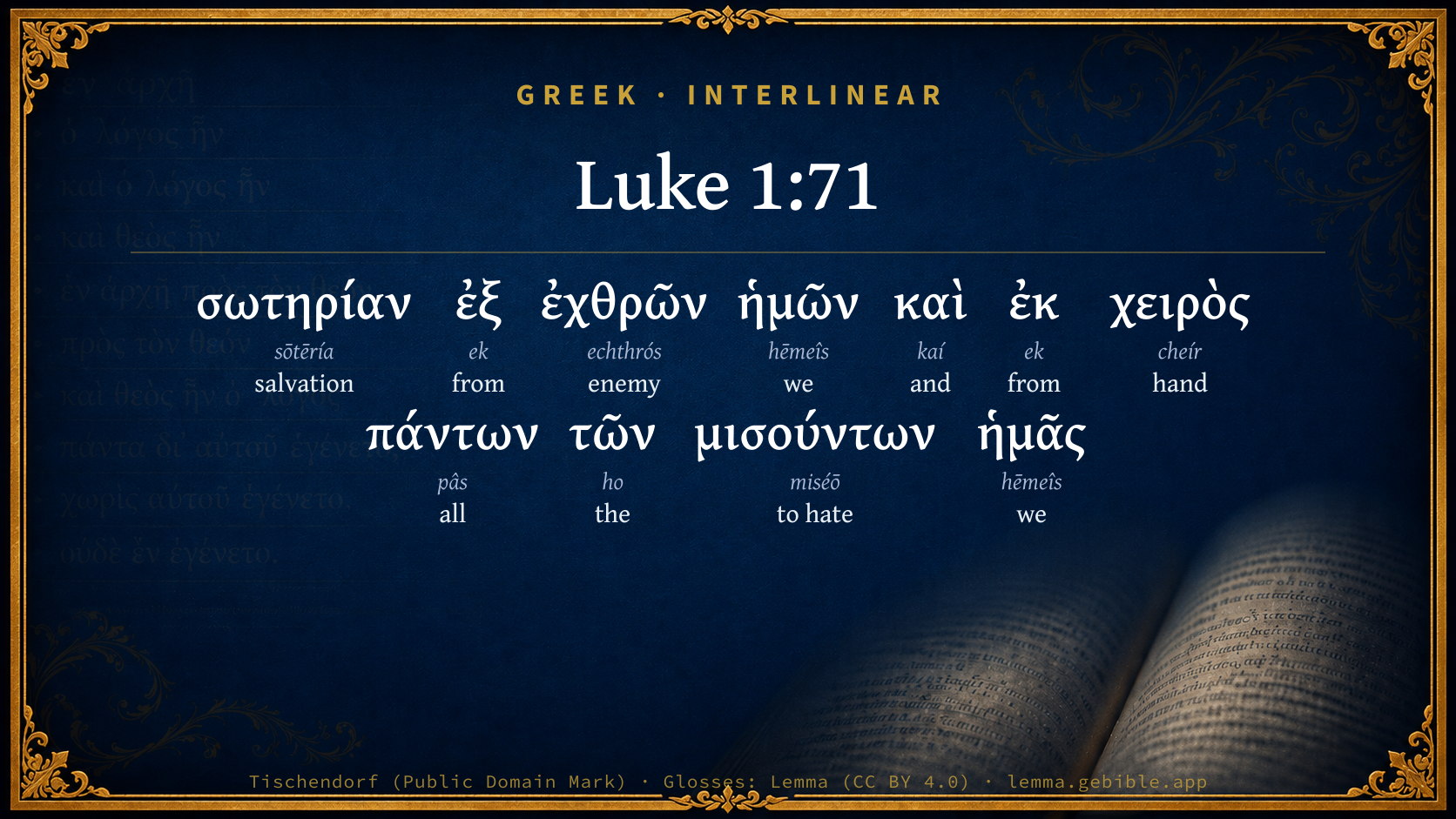
Download image
Cite this verse

Luke 1:71 (World English Bible). Public Domain. Lemma interlinear Bible study tool, https://lemma.gebible.app/v/luke/1/71.

Show BibTeX & RIS
BibTeX
RIS
English Translation
Salvation from our enemies, and from the hand of all who hate us;
World English Bible · Public Domain
Download a study sheet

One document with this verse’s original text, its word-by-word gloss line, the meaning frame, cross-references with their text, attributed commentary, and full source and license credits — printable, and it pastes into notes with its structure intact.

This verse Autodidact and up

Study sheet (.html) Plain text (.txt)

A passage Seminary Student

Up to 50 verses in one chapter. A passage sheet keeps up to 6 commentary sources and 12 cross-references per verse, in the order this page ranks them, and says so on the sheet whenever that leaves anything out. Ask for a single verse and you get the Autodidact verse sheet above.

Everything on this page stays free to read, with no account — the sheet is a download of what is already on screen, not access to it.

Want to remove ads? Support Godless Engineer
Compare translations 3

The same verse in 3 English versions, stacked beneath the original-language interlinear above. Click any original word for its lexicon entry.

Each is an independent rendering of the whole verse — the interlinear is not word-aligned to these translations.

Highlighted words mark where these versions differ — a whole-verse word diff, not a word-by-word alignment.

  • World English Bible Public Domain
    Salvation from our enemies, and from the hand of all who hate us;
  • King James Version Public Domain
    That we should be saved from our enemies, and from the hand of all that hate us;
  • unfoldingWord Literal Text CC BY-SA 4.0
    salvation from our enemies and from the hand of all the ones hating us;

unfoldingWord Literal Text — © unfoldingWord, licensed CC BY-SA 4.0. Word-aligned USFM3 via Door43 (git.door43.org/unfoldingWord/en_ult).

Versions to compare (up to 4)

3 of 4 selected

Show all 19 translations

Every available English version of this verse, each an independent rendering of the whole verse.

  • World English Bible Public Domain
    Salvation from our enemies, and from the hand of all who hate us;
  • Berean Standard Bible Public Domain
    salvation from our enemies and from the hand of all who hate us,
  • Majority Standard Bible Public Domain
    salvation from our enemies and from the hand of all who hate us,
  • King James Version Public Domain
    That we should be saved from our enemies, and from the hand of all that hate us;
  • American Standard Version (1901) Public Domain
    Salvation from our enemies, and from the hand of all that hate us;
  • Revised Version (1885) Public Domain
    Salvation from our enemies, and from the hand of all that hate us;
  • Geneva Bible (1599) Public Domain
    That he would sende vs deliuerance from our enemies, and from the hands of all that hate vs,
  • Douay-Rheims (1899) Public Domain
    Salvation from our enemies, and from the hand of all that hate us:
  • Young's Literal Translation Public Domain
    Salvation from our enemies, And out of the hand of all hating us,
  • Literal Standard Version CC BY-SA 4.0
    Salvation from our enemies, || And out of the hand of all hating us,
  • Unlocked Literal Bible CC BY-SA 4.0
    salvation from our enemies and from the hand of all who hate us.
  • unfoldingWord Literal Text CC BY-SA 4.0
    salvation from our enemies and from the hand of all the ones hating us;
  • Darby Bible Public Domain
    deliverance from our enemies and out of the hand of all who hate us;
  • World Messianic Bible Public Domain
    salvation from our enemies and from the hand of all who hate us;
  • Webster's Bible Public Domain
    That we should be saved from our enemies, and from the hand of all that hate us;
  • Free Bible Version CC BY-SA 4.0
    He promised to save us from our enemies, from those who hate us.
  • Bible in Basic English Public Domain
    Salvation from those who are against us, and from the hands of those who have hate for us;
  • Text-Critical English NT CC BY 4.0
    salvation from our enemies and from the hand of all who hate us—
  • Tyndale New Testament (1534) Public Domain
    That we shuld be saved from oure enemies and from the hondis of all that hate vs:

Literal Standard Version (2020), Covenant Press — licensed CC BY-SA 4.0. Text via the HelloAO Bible API (eBible.org). Unlocked Literal Bible (unfoldingWord) — licensed CC BY-SA 4.0. Text via the HelloAO Bible API (eBible.org). unfoldingWord Literal Text — © unfoldingWord, licensed CC BY-SA 4.0. Word-aligned USFM3 via Door43 (git.door43.org/unfoldingWord/en_ult). Free Bible Version, Dr. Jonathan Gallagher — licensed CC BY-SA 4.0. Text via the HelloAO Bible API (eBible.org).

Word by word

More ways to search: Search by grammar → Find every occurrence → Compare this word →

Practice this passage: Drill this verse → Learn its vocabulary →

ἐχθρῶν
echthrós
G2190
“enemy”
Adjective, Genitive, Plural, Masculine
Part of Speech
Adjective
Case
Genitive
Number
Plural
Gender
Masculine
Full Thayer's Definition

Origin: "from a primary echtho (to hate); hateful (passively, odious, or actively, hostile)"

TDNT: 15:31,3

1. hated, odious, hateful 2. hostile, hating, and opposing another a. used of men as at enmity with God by their sin 1. opposing (God) in the mind 2. a man that is hostile 3. a certain enemy 4. the hostile one 5. the devil who is the most bitter enemy of the divine government
  1. σωτηρίαν sōtēría G4991 “salvation” Noun, Accusative, Singular, Feminine
  2. ἐξ ek G1537 “from” Preposition
  3. ἡμῶν hēmeîs G2249 “we” Personal pronoun, 1st person, Genitive, Plural
  4. καὶ kaí G2532 “and” Conjunction
  5. ἐκ ek G1537 “from” Preposition
  6. χειρὸς cheír G5495 “hand” Noun, Genitive, Singular, Feminine
  7. πάντων pâs G3956 “all” Adjective, Genitive, Plural, Masculine
  8. τῶν ho G3588 “the” Article, Genitive, Plural, Masculine
  9. μισούντων miséō G3404 “to hate” Verb, Present, Active, Participle, Genitive, Plural, Masculine
  10. ἡμᾶς hēmeîs G2249 “we” Personal pronoun, 1st person, Accusative, Plural

About this verse

These counts appear in no published source. They are computed here, from the morphology-tagged text and Lemma’s own curated glosses. What Lemma adds →

11
words
9
distinct lemmas
Gospels
section

Shared distinctive vocabulary

ἐχθρῶν enemy G2190 occurs in 32 verses of the Greek New Testament. Also found in:
Repetition

Words recur within this verse:

Cross-references

17

Topical passages linked to Luke 1:71 in the Treasury of Scripture Knowledge — connected by theme and wording, ordered by reader-vote popularity; previews shown in the World English Bible.

  • Psalms 106:10 He saved them from the hand of him who hated them, And redeemed them from the hand of the enemy.
  • Deuteronomy 33:29 Happy are you, Israel: Who is like you, a people saved by Yahweh, The shield of your help, The sword of your excellency! Your enemies shall submit themselves to you; You shall tread on their high places.
  • Jeremiah 23:6 In his days Judah shall be saved, and Israel shall dwell safely; and this is his name by which he shall be called: Yahweh our righteousness.
  • Zephaniah 3:15–20 Yahweh has taken away your judgments. He has thrown out your enemy. The King of Israel, Yahweh, is in the midst of you. You will not be afraid of evil any more.
  • Jeremiah 32:37 Behold, I will gather them out of all the countries, where I have driven them in my anger, and in my wrath, and in great indignation; and I will bring them again to this place, and I will cause them to dwell safely:
  • Ezekiel 34:28 They shall no more be a prey to the nations, neither shall the animals of the earth devour them; but they shall dwell securely, and none shall make them afraid.
  • Isaiah 14:1–3 For Yahweh will have compassion on Jacob, and will yet choose Israel, and set them in their own land: and the foreigner shall join himself with them, and they shall cleave to the house of Jacob.
  • Isaiah 54:7–17 For a small moment have I forsaken you; but with great mercies will I gather you.
  • Jeremiah 30:9–11 but they shall serve Yahweh their God, and David their king, whom I will raise up to them.
  • Ezekiel 34:25 I will make with them a covenant of peace, and will cause evil animals to cease out of the land; and they shall dwell securely in the wilderness, and sleep in the woods.
  • Zechariah 9:9–10 Rejoice greatly, daughter of Zion! Shout, daughter of Jerusalem! Behold, your king comes to you! He is righteous, and having salvation; Lowly, and riding on a donkey, Even on a colt, the foal of a donkey.
  • Luke 1:74 To grant to us that we, being delivered out of the hand of our enemies, should serve him without fear,
  • 1 John 3:8 He who sins is of the devil, for the devil has been sinning from the beginning. To this end the Son of God was revealed, that he might destroy the works of the devil.
  • Psalms 106:47 Save us, Yahweh, our God, Gather us from among the nations, To give thanks to your holy name, To triumph in your praise!
  • Isaiah 44:24–26 Thus says Yahweh, your Redeemer, and he who formed you from the womb: I am Yahweh, who makes all things; who stretches forth the heavens alone; who spreads abroad the earth (who is with me?);
  • Ezekiel 28:26 They shall dwell securely therein; yes, they shall build houses, and plant vineyards, and shall dwell securely, when I have executed judgments on all those who do them despite round about them; and they shall know that I am Yahweh their God.
  • Ezekiel 38:8 After many days you shall be visited: in the latter years you shall come into the land that is brought back from the sword, that is gathered out of many peoples, on the mountains of Israel, which have been a continual waste; but it is brought forth out of the peoples, and they shall dwell securely, all of them.

Cross-references courtesy of OpenBible.info (CC BY 4.0).

Commentary

Notes on Luke 1:71 from classic Christian and Jewish commentators (each source and its license shown beneath its notes). The classic Christian expositions comment on the surrounding passage and are grouped to its opening verse, so a note may address several verses; the Jewish commentaries on the Tanakh (Rashi and others) are per-verse, so they appear only where the commentator wrote on this verse.

Lemma curates 59 commentaries, every one of them public domain or Creative Commons licensed, each selected and text-cleaned for this edition rather than reprinted as found. About our sources →

Joseph Benson's Commentary

Luk 1:71-75. That we should be saved from our enemies — Spiritual as well as temporal, invisible as well as visible; and from the hand of all that hate us — From Satan and his angels, and all adverse power, and especially from our sins. This certainly was the mind of the Spirit that now inspired Zacharias, as appears by the whole tenor of Scripture; but whether he fully understood his own words is impossible for us to say. It is certain the older prophets, in some cases, did not fully understand the prophecies which they themselves uttered. See 1Pe 1:10-11. To perform the mercy — Thus he speaks because our redemption and salvation have their origin in the divine mercy, that is, in his compassion for us in our fallen state, and in his free, gratuitous grace, and goodness toward us. The original expression, ποιησαι ελεος μετα τον πατερων ημον, literally signifies, to exercise, or show, mercy toward or with, our fathers. Dr. Campbell translates the verse, In kindness to our forefathers, and remembrance of his holy covenant; the tenor of which covenant was, that Abraham’s spiritual seed, being delivered from their enemies by the Messiah, should, under his government, worship and serve God acceptably through all generations. The oath which he sware to our father Abraham — By which oath he confirmed the fore-mentioned covenant, that, as the apostle observes, by two immutable things, God’s promise given in the covenant, and oath, in either of which, much more in both, it was impossible for God to lie, all that should truly embrace the covenant, by complying with the conditions of it, in repentance, faith, and new obedience, might have strong consolation in life, in death, and for ever. That he would grant unto us — For the salvation here mentioned is his free, undeserved gift; that being delivered out of the hand of our enemies — Especially our spiritual enemies, the devil, the world, and the flesh, the guilt, and power, and consequences of our sins, (the Messiah being therefore called Jesus, because he saves his people from their sins, Mat 1:21,) we might serve him — Might worship and glorify him, in and with our body and spirit, which are his; without fear — Not without a reverential fear of God, or filial fear of offending him; a watchful fear of our enemies, or a jealous fear of ourselves, lest a promise being left us of entering into his rest, we should come short of it, in which senses, blessed is the man that feareth always; but without any slavish fear of God, or that spirit of bondage from which the spirit of adoption is given to deliver true believers, Rom 8:15; Gal 4:5-7; 2Ti 1:7; and without any tormenting fear of death, or of any suffering antecedent to death, which we may be called to pass through; to deliver us from which fear Christ assumed our flesh and blood, Heb 2:14-15. In holiness — Toward God, in devotedness to his glory, conformity to his image, subjection to his authority, and obedience to his will; and righteousness — Toward our fellow-creatures, that is, in the continual exercise of truth, justice, mercy, and charity; before him — Conscious we are in his presence, and under the continual notice of his eye, setting him always before us, and aiming to please him in every temper, word, and work, in all our desires and designs, our cares, labours, and pursuits. Here, then, we have the substance of God’s great promise, that, if we embrace and live up to our privileges, as true believers in Christ, we shall be always holy, always useful, always happy; that, being delivered from Satan and sin, from every uneasy, from every unhappy and unholy disposition and affection, we shall joyfully love and serve God in our whole spirit and conduct, and that not only on sabbath days, or times of peculiar solemnity and devotion, but all the days of our life, and every hour of every day; whatsoever we do in word or deed, and doing all in the name of the Lord Jesus, and giving thanks to God, even the Father, through him. This is the great gospel salvation prepared before the face of, and free for, all people, Luk 2:30-31.

Joseph Benson's Commentary on the Old and New Testaments (1811–1818) — public domain. Text from a community e-Sword module.

Tyndale Open Study Notes

Tyndale Open Resources

1:71 saved from our enemies: The people of Israel hoped for rescue from their physical enemies, the Romans; Jesus brought salvation from sin, Satan, and death.

Tyndale Open Study Notes — © Tyndale Open Resources, licensed CC BY-SA 4.0. Text via the HelloAO Bible API.

Bengel's Gnomon

Johann Albrecht Bengel

Luk 1:71. Σωτηρίαν, salvation) Understand, I say. The idea contained in an horn of salvation [Luk 1:69], is repeated in a briefer form. [A horn of salvation—salvation, I say, from our enemies, etc.]—μισούντων, who regard us with hatred) He describes the spiritual benefits in language still in conformity with the phraseology of the Old Testament, viz. language applicable to temporal aid.

Bengel's Gnomon of the New Testament — English translation (T&T Clark, Edinburgh, 1860) — public domain. Text from a community e-Sword module.

Meyer's Critical & Exegetical Commentary

Heinrich August Wilhelm Meyer

Luk_1:71 f. Σωτηρίαν] might be attached to ἐλάλησε, Luk_1:70 (Beza, Grotius, Ewald, and others), but it is simpler to retain καθὼς κ.τ.λ. as a parenthetical clause, like Luk_1:55, so that κέρας σωτηρ., Luk_1:69, is resumed by σωτηρίαν (yet only as to the fact, without the figure) for the sake of adding the more precise definition. Such a resumption may occur with δέ (Rom_3:22) and without it (Rom_3:26). See generally, Kühner, ad Xen. Mem. i. 1. 1. Without δέ the expression is more rhetorical.

The enemies and haters are the heathen, as in Luk_1:51 ff., not the demons, sin, and the like.

ποιῆσαι] Infinitive of the aim, as at Luk_1:54. In this our deliverance God designed to show mercy to (μετά, עִם, Luk_1:58; Luk_10:37) our fathers (comp. Luk_1:55, deeply afflicted by the decline of their people), and to remember (practically, by the fulfilment of what was therein promised) His holy covenant. Euthymius Zigabenus: διαθήκην γὰρ λέγει τὴν ἐπαγγελίαν· μνήμην δὲ αὐτῆς τὴν περάτωσιν.

Meyer — Critical and Exegetical Commentary on the New Testament — English translation by Peter Christie, edited by Frederick Crombie (T&T Clark, 1880) — public domain. Text from a community e-Sword module.

Expositor's Greek Testament

ed. W. Robertson Nicoll

Luk 1:71 . σωτηρίαν , in apposition with κέρας σ ., resuming and developing the thought interrupted by Luk 1:70 , which is parenthetical. ἐχθρῶν , τῶν μισούντων : not to be anxiously distinguished; poetic synonyms.

The Expositor's Greek Testament, edited by W. Robertson Nicoll (1897–1910) — public domain. Text from a community e-Sword module.

Adam Clarke's Commentary

Verse 71. That we should be saved (literally, a salvation) from our enemies] As Zacharias spoke by the inspiration of the Holy Spirit, the salvation which he mentions here must necessarily be understood in a spiritual sense. Satan, death, and sin are the enemies from whom Jesus came to deliver us. Sin is the most dangerous of all, and is properly the only enemy we have to fear. Satan is without us, and can have no power over us, but what he gets through sin. Death is only in our flesh, and shall be finally destroyed (as it affects us) on the morning of the resurrection. Jesus redeems from sin; this is the grand, the glorious, the important victory. Let us get sin cast out, and then we need, fear neither death, nor the devil.

Adam Clarke's Commentary on the Bible (1810–1826) — public domain. Text from a community e-Sword/MySword module.

Ellicott's Commentary for English Readers

(71) That we should be saved from our enemies.—Literally, salvation from our enemies, in apposition with “the horn of salvation” of Luk_1:69. The “enemies” present to the thoughts of Zacharias may have been the Roman conquerors of Judæa; the Idumæan House of Herod may have been among “those who hate.”

A Bible Commentary for English Readers, edited by Charles John Ellicott (1878–1897) — public domain. Text from a community e-Sword module.

The Cambridge Bible for Schools and Colleges

gen. ed. J. J. S. Perowne

71. That we should be saved] Rather, Salvation—referring back to “a horn of salvation,” to which it is in apposition. The previous verse is a parenthesis.

from our enemies] No doubt in the first instance the “enemies” from which the prophets had promised deliverance were literal enemies (Deu_33:29; Isa_14:2; Isa_51:22-23, &c.), but every pious Jew would understand these words as applying also to spiritual enemies.

The Cambridge Bible for Schools and Colleges (gen. ed. J. J. S. Perowne; Cambridge University Press, 1878–1918) — public domain. Text from a community e-Sword module.

John Gill's Exposition

That we should be saved from our enemies,.... This, and the two following verses, either contain and express the sum and substance of what God spake by the prophets; or point out the end or ends of his raising up an horn of salvation, or a Saviour for his people; namely, that they should be saved by him from their enemies: from sin, which wars against the soul, and threatens the destruction of it; from Satan, the avowed and implacable adversary of mankind; from the world, the seed of the serpent, which has always bore an enmity to the seed of the woman; from the law, the killing letter; and from death, the last enemy that is to be destroyed,

and from the hand of all that hate us: which is only an illustration of the former sentence, or a repetition of it in other words; and designs the same as before.

John Gill's Exposition of the Whole Bible (1746–1763) — public domain (CC PDM 1.0). Text via the HelloAO Bible API.

Trapp's Complete Commentary

John Trapp

71 That we should be saved from our enemies, and from the hand of all that hate us;

Ver. 71. That we should be saved] Gr. Salvation from our enemies. This properly importeth the privative part of man’s happiness, but includes the positive too.

John Trapp, A Commentary or Exposition upon All the Books of the Old and New Testament (1647–1656) — public domain. Text from a community e-Sword module.

Albert Barnes' Notes on the Bible

Saved from our enemies - The enemies of “man” are his sins, his carnal propensities, his lusts, and the great adversary Satan and his angels, who continually seek to destroy him. From “these” the Messiah came to save us. Compare Gen 3:15; Mat 1:21.

The hand - The power; or to save us from them.

Albert Barnes' Notes on the Bible (1834–1885) — public domain. Text from a community e-Sword/MySword module.

Haydock's Catholic Bible Commentary

That he would save us, &c. Literally, salvation from our enemies. The construction and sense is, that God, as he had declared by his prophets, would grant us salvation, or would save us. (Witham) --- This is not to be understood of temporal, but of spiritual enemies. For the Lord Jesus, strong in battle, came to destroy all our enemies, and thus to deliver us from their snares and temptations. (Origen, hom. xvi.) --- He is that King of Glory, the Lord strong and powerful, the Lord powerful in battle. (Psalm xxiii.)

George Leo Haydock (1774–1849), Haydock's Catholic Family Bible and Commentary, 1859 edition — public domain. Excludes Psalms (Douay-Rheims chapter numbering differs from Protestant) and Deuterocanonical books (Catholic canon only).

Matthew Poole's English Annotations

This was that which God had told them by his prophets, that a mighty salvation should arise to them out of the house of David, by which they should be saved from their enemies. By which enemies the generality of the Jews understood their temporal enemies, made of flesh and blood. But Zacharias, speaking by the Spirit of prophecy, must needs have a truer notion of it, as it signifies our spiritual enemies. All this is attributed to God’s mercy and faithfulness, his mercy freely looking upon his creatures in distress and misery, his faithfulness in remembrance of his holy covenant, made to Adam, Abraham, David, &c.; but it is more particularly explained.

Matthew Poole's English Annotations on the Holy Bible (1683–1685) — public domain. Text from a community e-Sword/MySword module.

Whedon's Commentary on the Bible

Daniel D. Whedon

71. That we—The true Church of God, consisting of all faithful believers, whether of the old or new dispensation. Zacharias, as an individual, doubtless understood the words in a Jewish sense of the Jewish theocracy, or State Church alone. But the Holy Spirit knew its future application.

Should be saved from our enemies—Collectively, the Church shall be preserved in the midst of its wrathful foes, and finally obtain complete victory and triumphant security. Individually, the Christian shall have a divine protection amid both temporal and spiritual dangers, and in the triumphant age of the Church even temporal triumph. The phrase that we should be saved depends upon the phrase (Luk_1:70) as he spake. What God spoke by his holy prophets was that we should be saved, etc., by the power of the Messiah.

Daniel D. Whedon (gen. ed.), Commentary on the Old and New Testaments (1874–1909) — public domain. Text from a community e-Sword module.

The Pulpit Commentary

That we should be saved from our enemies, and from the hand of all that hate us. When Zacharias spoke these words, his mind, no doubt, was on Rome and its creatures, Herod and his party, whom Rome had set up. The deliverance of Israel, in every Hebrew heart, was the first and great work of the coming Deliverer; but the inspired words had a far broader reference than to Rome, and the enemies of Israelitic prosperity. The expression includes those spiritual evil agencies which war their ceaseless warfare against the soul of man. It was from these that the coming Deliverer would free his people. It was only after the fall of Jerusalem, and the total extinction of the national existence of the people, that, to use Dean Plumptre"s language, "what was transitory in the hymn vanished, and the words gained the brighter permanent sense which they have had for centuries in the worship of the Church of Christ."

The Pulpit Commentary (1880–1919), ed. H.D.M. Spence-Jones & Joseph S. Exell — public domain. Text from a community e-Sword module.

Scofield Reference Notes

C. I. Scofield

saved

(See Scofield "Rom 1:16")

The Scofield Reference Bible (1917 edition), notes by C. I. Scofield — public domain. Text from a community e-Sword module.

Cambridge Greek Testament for Schools and Colleges

71. σωτηρίαν. ‘salvation’—referring back to “a horn of salvation,” to which it is in apposition. The previous verse is a parenthesis.

ἐξ ἐχθρῶν ἡμῶν. No doubt in the first instance the “enemies” from which the prophets had promised deliverance were literal enemies (Deu 33:29; Isa 14:2; Isa 51:22-23, &c.), but every pious Jew would understand these words as applying also to spiritual enemies. Still, as Godet points out, the utter lack of resemblance between these anticipations, regarded in a temporal point of view, and the grim realities involved in the Fall of Jerusalem and the Rejection of Israel, are a sure mark of the authenticity of the narrative.

Cambridge Greek Testament for Schools and Colleges (Cambridge University Press, 1896; 21 vols, various authors incl. Carr, Maclear, Plummer, Farrar, Lumby, Moule, M. R. James, Simcox) — public domain. Text from a community e-Sword module.

International Critical Commentary

71. σωτηρίαν ἐξ ἐχθρῶν ἡμῶν. This is in app. with κέρας σωτηρίας and epexegetic of it. That the ἐχθρῶν ἡμῶν and τῶν μισούντων ἡμᾶς are identical is clear from Psa 18:18 and 106:10 (see table). The heathen are meant. Gentile domination prevents the progress of God’s kingdom, and the Messiah will put an end to this hindrance. Comp. Exo 18:10.

Neither σωτηρία (vv. 69, 77, 19:9; Act 4:12, etc.) nor τὸ σωτήριον (2:30, 3:6; Act 28:28) occur in Mt. or Mk. The former occurs once in (Joh 4:22). Both are common in LXX. The primary meaning is preservation from bodily harm (Gen 26:31; 2Sa 19:2), especially of the great occasions on which God had preserved Israel (Exo 14:13, Exo 14:15:2; 2Ch 20:17); and hence of the deliverance to be wrought by the Messiah (Isa 49:6, Isa 49:8), which is the meaning here. Comp. τοῦ κυρίου ἡ σωτηρία ἐπʼ οἶκον Ἰσραὴλ εἰς εὐφροσύνην αἰώνιον (Ps. Sol. 10:9; and very similarly 12:7). As the idea of the Messianic salvation became enlarged and purified, the word which so often expressed it came gradually to mean much the same as “eternal life.” See on Rom 1:16.

International Critical Commentary — older volumes (1896–1929), various authors — public domain. Text from a community e-Sword module.

Lesson kit

Teaching starters — assembled from the data on this page, not authored interpretation. Every prompt links to the verse data it draws on. Edit before teaching.

Luke, in the Gospels, opens this verse with 11 words (9 distinct Greek lemmas). Its most distinctive word is echthrós (“enemy”). A historical commentator’s framing appears above. Read the whole chapter for the surrounding context.

Discussion questions

  1. What does “enemy” (echthrós) contribute to the verse as a whole?
  2. Matthew 5:43 shares the word «enemy» with this verse. How do the two illuminate each other?
  3. “from” occurs 2× in this one verse. What is the effect of the repetition?
  4. These translations render this verse differently; the difference is in the English rendering, not the original. What questions does that raise?
  5. Reading how Joseph Benson's Commentary and Tyndale Open Study Notes read this verse, where do the two commentators agree and where do they part?

Things to notice

  • These translations choose different wording for 8 words in this verse.
  • “from” occurs 2× in this single verse.
  • 9 distinct Greek lemmas span 11 words in this verse.

Reading settings

Reading text

Shown beneath each verse's original-language words.

Old Testament
Old Testament edition

Read the OT as the Masoretic Hebrew (MT) or the Greek Septuagint (LXX).

English shown for the Greek Septuagint (in the Hebrew ↔ Greek comparison).

Comparing translations? Open the Compare panel on any verse page to stack up to four side by side.