
John 20:25

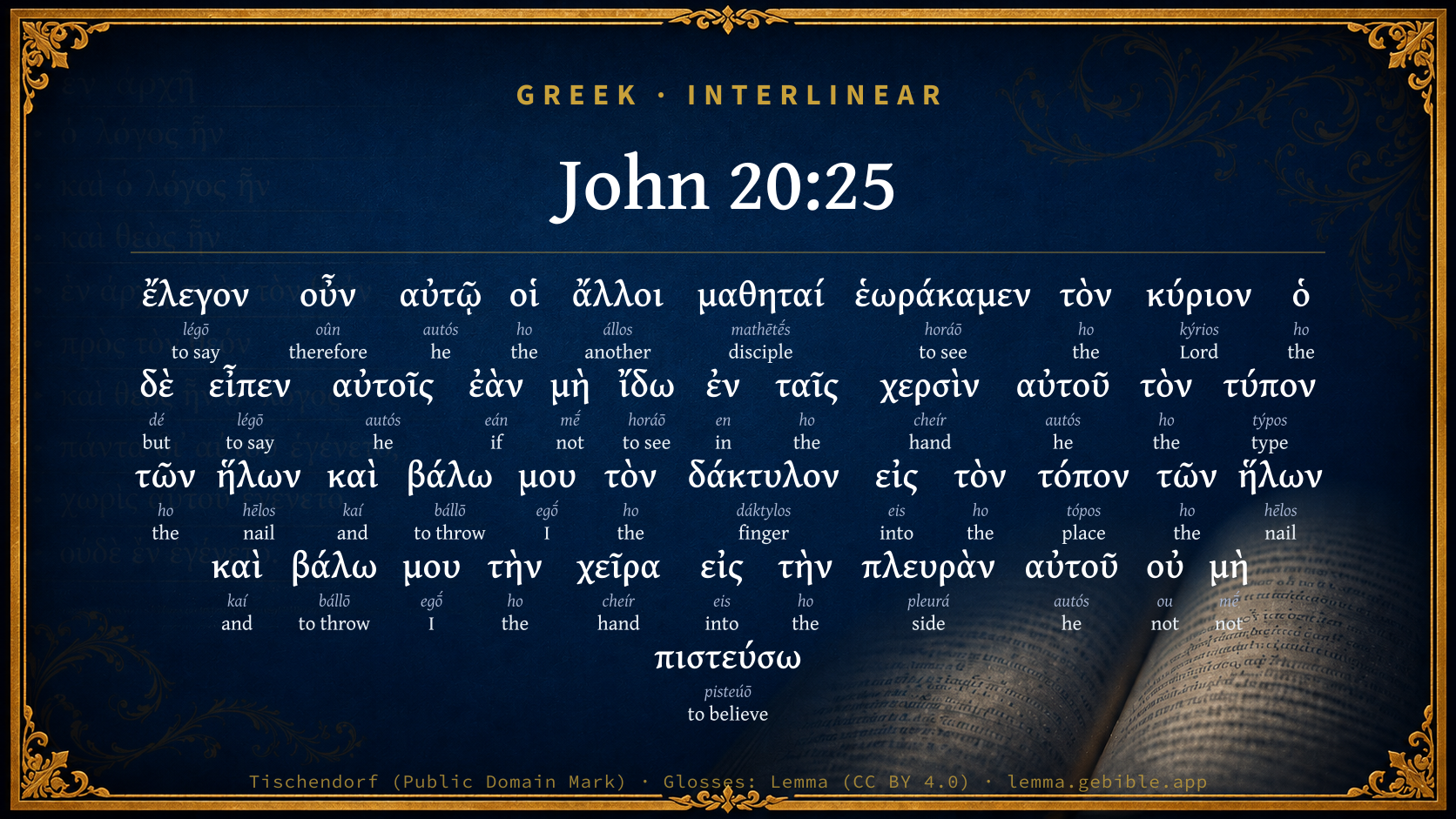
Greek (Tischendorf 8th ed.) John 20:25 appears in the Greek New Testament. The text above is from the Tischendorf 8th edition. Each word links to its Strong’s number and a concise gloss. Click any word for its full Thayer’s Greek Lexicon entry.
Download image
Cite this verse

John 20:25 (World English Bible). Public Domain. Lemma interlinear Bible study tool, https://lemma.gebible.app/v/john/20/25.

Show BibTeX & RIS
BibTeX
RIS
English Translation
The other disciples therefore said to him, "We have seen the Lord!" But he said to them, "Unless I see in his hands the print of the nails, and put my hand into his side, I will not believe."
World English Bible · Public Domain
Highlights
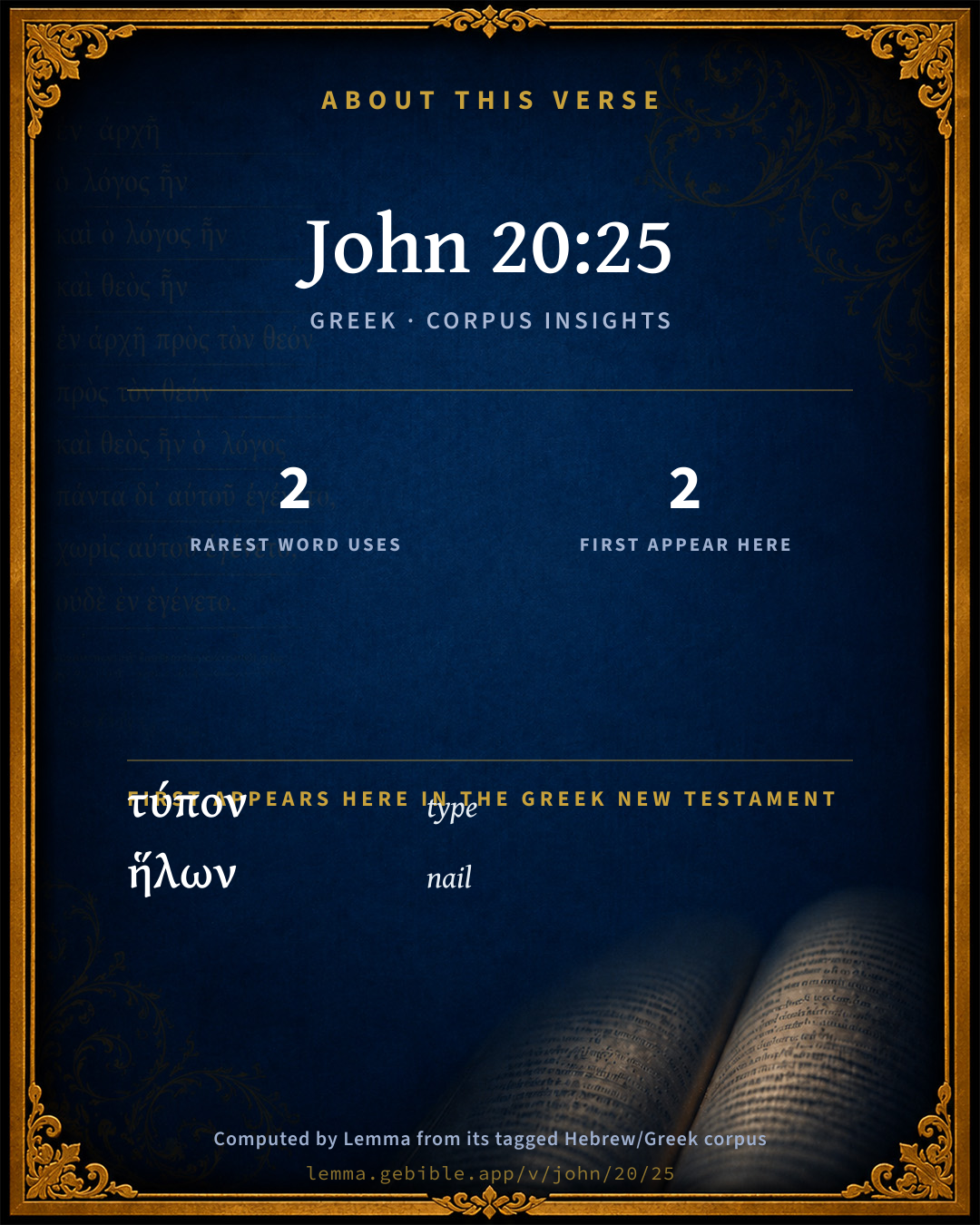
  • 2 first appearances in the Greek New Testament
Full analysis ↓
Download a study sheet

One document with this verse’s original text, its word-by-word gloss line, the meaning frame, cross-references with their text, attributed commentary, and full source and license credits — printable, and it pastes into notes with its structure intact.

This verse Autodidact and up

Study sheet (.html) Plain text (.txt)

A passage Seminary Student

Up to 50 verses in one chapter. A passage sheet keeps up to 6 commentary sources and 12 cross-references per verse, in the order this page ranks them, and says so on the sheet whenever that leaves anything out. Ask for a single verse and you get the Autodidact verse sheet above.

Everything on this page stays free to read, with no account — the sheet is a download of what is already on screen, not access to it.

Want to remove ads? Support Godless Engineer
Compare translations 3

The same verse in 3 English versions, stacked beneath the original-language interlinear above. Click any original word for its lexicon entry.

Each is an independent rendering of the whole verse — the interlinear is not word-aligned to these translations.

Highlighted words mark where these versions differ — a whole-verse word diff, not a word-by-word alignment.

  • World English Bible Public Domain
    The other disciples therefore said to him, "We have seen the Lord!" But he said to them, "Unless I see in his hands the print of the nails, and put my hand into his side, I will not believe."
  • King James Version Public Domain
    The other disciples therefore said unto him, We have seen the LORD. But he said unto them, Except I shall see in his hands the print of the nails, and put my finger into the print of the nails, and thrust my hand into his side, I will not believe.
  • unfoldingWord Literal Text CC BY-SA 4.0
    Then the other disciples said to him, “We have seen the Lord.” But he said to them, “Unless I see in his hands the mark of the nails and put my finger into the mark of the nails and put my hand into his side, I will certainly not believe.”

unfoldingWord Literal Text — © unfoldingWord, licensed CC BY-SA 4.0. Word-aligned USFM3 via Door43 (git.door43.org/unfoldingWord/en_ult).

Versions to compare (up to 4)

3 of 4 selected

Show all 19 translations

Every available English version of this verse, each an independent rendering of the whole verse.

  • World English Bible Public Domain
    The other disciples therefore said to him, "We have seen the Lord!" But he said to them, "Unless I see in his hands the print of the nails, and put my hand into his side, I will not believe."
  • Berean Standard Bible Public Domain
    So the other disciples told him, “We have seen the Lord!” But he replied, “Unless I see the nail marks in His hands, and put my finger where the nails have been, and put my hand into His side, I will never believe.”
  • Majority Standard Bible Public Domain
    So the other disciples told him, “We have seen the Lord!” But he replied, “Unless I see the nail marks in His hands, and put my finger where the nails have been, and put my hand into His side, I will never believe.”
  • King James Version Public Domain
    The other disciples therefore said unto him, We have seen the LORD. But he said unto them, Except I shall see in his hands the print of the nails, and put my finger into the print of the nails, and thrust my hand into his side, I will not believe.
  • American Standard Version (1901) Public Domain
    The other disciples therefore said unto him, We have seen the Lord. But he said unto them, Except I shall see in his hands the print of the nails, and put my hand into his side, I will not believe.
  • Revised Version (1885) Public Domain
    The other disciples therefore said unto him, We have seen the Lord. But he said unto them, Except I shall see in his hands the print of the nails, and put my finger into the print of the nails, and put my hand into his side, I will not believe.
  • Geneva Bible (1599) Public Domain
    The other disciples therefore saide vnto him, We haue seene the Lord: but he said vnto them, Except I see in his handes the print of the nailes, and put my finger into the print of the nailes, and put mine hand into his side, I will not beleeue it.
  • Douay-Rheims (1899) Public Domain
    The other disciples therefore said to him: We have seen the Lord. But he said to them: Except I shall see in his hands the print of the nails, and put my finger into the place of the nails, and put my hand into his side, I will not believe.
  • Young's Literal Translation Public Domain
    the other disciples, therefore, said to him, `We have seen the Lord;' and he said to them, `If I may not see in his hands the mark of the nails, and may put my finger to the mark of the nails, and may put my hand to his side, I will not believe.'
  • Literal Standard Version CC BY-SA 4.0
    the other disciples, therefore, said to him, “We have seen the Lord!” And he said to them, “If I may not see the mark of the nails in His hands, and may [not] put my finger into the mark of the nails, and may [not] put my hand into His side, I will not believe.”
  • Unlocked Literal Bible CC BY-SA 4.0
    The other disciples later said to him, “We have seen the Lord.” He said to them, “Unless I see in his hands the mark of the nails, and put my finger into the mark of the nails, and put my hand into his side, I will not believe.”
  • unfoldingWord Literal Text CC BY-SA 4.0
    Then the other disciples said to him, “We have seen the Lord.” But he said to them, “Unless I see in his hands the mark of the nails and put my finger into the mark of the nails and put my hand into his side, I will certainly not believe.”
  • Darby Bible Public Domain
    The other disciples therefore said to him, We have seen the Lord. But he said to them, Unless I see in his hands the mark of the nails, and put my finger into the mark of the nails, and put my hand into his side, I will not believe.
  • World Messianic Bible Public Domain
    The other disciples therefore said to him, “We have seen the Lord!” But he said to them, “Unless I see in his hands the print of the nails, put my finger into the print of the nails, and put my hand into his side, I will not believe.”
  • Webster's Bible Public Domain
    The other disciples therefore said to him, We have seen the Lord. But he said to them, Except I shall see in his hands the print of the nails, and put my finger into the print of the nails, and thrust my hand into his side, I will not believe.
  • Free Bible Version CC BY-SA 4.0
    So the other disciples told him, “We've seen the Lord.” But he replied, “I won't believe it unless I see the nail marks in his hands and put my finger in them, and put my hand in his side.”
  • Bible in Basic English Public Domain
    So the other disciples said to him, We have seen the Lord. But he said to them, If I do not see in his hands the print of the nails and put my finger into the print of the nails, and if I do not put my hand into his side, I will never have belief.
  • Text-Critical English NT CC BY 4.0
    So the other disciples said to him, “We have seen the Lord.” But he said to them, “Unless I see the nail marks in his hands and put my finger where the nails were, and put my hand into his side, I will certainly not believe.”
  • Tyndale New Testament (1534) Public Domain
    The other disciples sayd vnto him: we have sene the lorde. And he sayde vnto the: except I se in his hondes the prent of the nayles and put my fynger in the holes of the nayles and thrust my honde into his syde I will not beleve.

Literal Standard Version (2020), Covenant Press — licensed CC BY-SA 4.0. Text via the HelloAO Bible API (eBible.org). Unlocked Literal Bible (unfoldingWord) — licensed CC BY-SA 4.0. Text via the HelloAO Bible API (eBible.org). unfoldingWord Literal Text — © unfoldingWord, licensed CC BY-SA 4.0. Word-aligned USFM3 via Door43 (git.door43.org/unfoldingWord/en_ult). Free Bible Version, Dr. Jonathan Gallagher — licensed CC BY-SA 4.0. Text via the HelloAO Bible API (eBible.org).

Word by word

More ways to search: Search by grammar → Find every occurrence → Compare this word →

Practice this passage: Drill this verse → Learn its vocabulary →

ἥλων
hēlos
G2247
“nail”
Noun, Genitive, Plural, Masculine
Part of Speech
Noun
Case
Genitive
Number
Plural
Gender
Masculine
Full Thayer's Definition

Origin: of uncertain affinity

TDNT: None

1. a nail
  1. ἔλεγον légō G3004 “to say” Verb, Imperfect, Active, Indicative, 3rd person, Plural
  2. οὖν oûn G3767 “therefore” Conjunction
  3. αὐτῷ autós G846 “he” Personal pronoun, Dative, Singular, Masculine
  4. οἱ ho G3588 “the” Article, Nominative, Plural, Masculine
  5. ἄλλοι állos G243 “another” Adjective, Nominative, Plural, Masculine
  6. μαθηταί mathētḗs G3101 “disciple” Noun, Nominative, Plural, Masculine
  7. ἑωράκαμεν horáō G3708 “to see” Verb, Perfect, Active, Indicative, 1st person, Plural, Attic form
  8. τὸν ho G3588 “the” Article, Accusative, Singular, Masculine
  9. κύριον kýrios G2962 “Lord” Noun, Accusative, Singular, Masculine
  10. ὁ ho G3588 “the” Article, Nominative, Singular, Masculine
  11. δὲ dé G1161 “but” Conjunction
  12. εἶπεν légō G3004 “to say” Verb, Aorist, Active, Indicative, 3rd person, Singular
  13. αὐτοῖς autós G846 “he” Personal pronoun, Dative, Plural, Masculine
  14. ἐὰν eán G1437 “if” Conditional
  15. μὴ mḗ G3361 “not” Particle, Negative
  16. ἴδω horáō G3708 “to see” Verb, Aorist, Active, Subjunctive, 1st person, Singular
  17. ἐν en G1722 “in” Preposition
  18. ταῖς ho G3588 “the” Article, Dative, Plural, Feminine
  19. χερσὶν cheír G5495 “hand” Noun, Dative, Plural, Feminine
  20. αὐτοῦ autós G846 “he” Personal pronoun, Genitive, Singular, Masculine
  21. τὸν ho G3588 “the” Article, Accusative, Singular, Masculine
  22. τύπον týpos G5179 “type” Noun, Accusative, Singular, Masculine
  23. τῶν ho G3588 “the” Article, Genitive, Plural, Masculine
  24. καὶ kaí G2532 “and” Conjunction
  25. βάλω bállō G906 “to throw” Verb, Aorist, Active, Subjunctive, 1st person, Singular
  26. μου egṓ G1473 “I” Personal pronoun, 1st person, Genitive, Singular
  27. τὸν ho G3588 “the” Article, Accusative, Singular, Masculine
  28. δάκτυλον dáktylos G1147 “finger” Noun, Accusative, Singular, Masculine
  29. εἰς eis G1519 “into” Preposition
  30. τὸν ho G3588 “the” Article, Accusative, Singular, Masculine
  31. τόπον tópos G5117 “place” Noun, Accusative, Singular, Masculine
  32. τῶν ho G3588 “the” Article, Genitive, Plural, Masculine
  33. ἥλων hēlos G2247 “nail” Noun, Genitive, Plural, Masculine
  34. καὶ kaí G2532 “and” Conjunction
  35. βάλω bállō G906 “to throw” Verb, Aorist, Active, Subjunctive, 1st person, Singular
  36. μου egṓ G1473 “I” Personal pronoun, 1st person, Genitive, Singular
  37. τὴν ho G3588 “the” Article, Accusative, Singular, Feminine
  38. χεῖρα cheír G5495 “hand” Noun, Accusative, Singular, Feminine
  39. εἰς eis G1519 “into” Preposition
  40. τὴν ho G3588 “the” Article, Accusative, Singular, Feminine
  41. πλευρὰν pleurá G4125 “side” Noun, Accusative, Singular, Feminine
  42. αὐτοῦ autós G846 “he” Personal pronoun, Genitive, Singular, Masculine
  43. οὐ ou G3756 “not” Particle, Negative
  44. μὴ mḗ G3361 “not” Particle, Negative
  45. πιστεύσω pisteúō G4100 “to believe” Verb, Future, Active, Indicative, 1st person, Singular

About this verse

These counts appear in no published source. They are computed here, from the morphology-tagged text and Lemma’s own curated glosses. What Lemma adds →

46
words
24
distinct lemmas
Gospels
section

Notable vocabulary

The rarest word here is ἥλων nail G2247 — appearing just 2 times in the whole Greek New Testament.

First appearance in Scripture

These words make their first canonical appearance in the Greek New Testament here:
Repetition

Words recur within this verse:

  • ἔλεγον to say G3004 ×2
  • ἑωράκαμεν to see G3708 ×2
  • χερσὶν hand G5495 ×2
  • ἥλων nail G2247 ×2
  • βάλω to throw G906 ×2
  • εἰς into G1519 ×2
  • οἱ the G3588 ×11
  • αὐτῷ he G846 ×4
  • μὴ not G3361 ×2
  • καὶ and G2532 ×2
  • μου I G1473 ×2

Cross-references

20

Topical passages linked to John 20:25 in the Treasury of Scripture Knowledge — connected by theme and wording, ordered by reader-vote popularity; previews shown in the World English Bible.

  • John 6:30 They said therefore to him, "What then do you do for a sign, that we may see, and believe you? What work do you do?
  • Mark 16:11 When they heard that he was alive, and had been seen by her, they disbelieved.
  • Hebrews 3:18–4:2 To whom did he swear that they wouldn't enter into his rest, but to those who were disobedient?
  • Psalms 78:32 For all this they still sinned, And didn't believe in his wondrous works.
  • Hebrews 3:12 Beware, brothers, lest perhaps there be in any one of you an evil heart of unbelief, in falling away from the living God;
  • Job 9:16 If I had called, and he had answered me, Yet would I not believe that he listened to my voice.
  • Psalms 78:11–22 They forgot his doings, His wondrous works that he had shown them.
  • Psalms 95:8–10 Don't harden your heart, as at Meribah, As in the day of Massah in the wilderness,
  • Psalms 106:21–24 They forgot God, their Savior, Who had done great things in Egypt,
  • Matthew 16:1–4 The Pharisees and Sadducees came, and testing him, asked him to show them a sign from heaven.
  • Matthew 27:42 "He saved others, but he can't save himself. If he is the King of Israel, let him come down from the cross now, and we will believe in him.
  • Luke 24:25 He said to them, "Foolish men, and slow of heart to believe in all that the prophets have spoken!
  • Luke 24:34–41 saying, "The Lord is risen indeed, and has appeared to Simon!"
  • John 1:41 He first found his own brother, Simon, and said to him, "We have found the Messiah!" (which is, being interpreted, Christ).
  • John 20:14–20 When she had said this, she turned around and saw Jesus standing, and didn't know that it was Jesus.
  • John 21:7 That disciple therefore whom Jesus loved said to Peter, "It's the Lord!" So when Simon Peter heard that it was the Lord, he wrapped his coat around him (for he was naked), and threw himself into the sea.
  • Acts 5:30–32 The God of our fathers raised up Jesus, whom you killed, hanging him on a tree.
  • Acts 10:40–41 God raised him up the third day, and gave him to be revealed,
  • 1 Corinthians 15:5–8 and that he appeared to Cephas, then to the twelve.
  • Hebrews 10:38–39 But the righteous will live by faith. If he shrinks back, my soul has no pleasure in him."

Cross-references courtesy of OpenBible.info (CC BY 4.0).

Commentary

Notes on John 20:25 from classic Christian and Jewish commentators (each source and its license shown beneath its notes). The classic Christian expositions comment on the surrounding passage and are grouped to its opening verse, so a note may address several verses; the Jewish commentaries on the Tanakh (Rashi and others) are per-verse, so they appear only where the commentator wrote on this verse.

Lemma curates 59 commentaries, every one of them public domain or Creative Commons licensed, each selected and text-cleaned for this edition rather than reprinted as found. About our sources →

The Biblical Illustrator

Joseph S. Exell

Joh_20:25

The other disciples therefore said unto him, We have seen the Lord

A sight of the Lord--what it produces

I.

AN EVER DEEPENING SENSE OF SIN. See Isaiah (Isa_6:5); Job Job_42:5-6); Peter (Luk_5:8).

II. AN EVER ENLARGING MEASURE OF JOY. See David (Psa_4:6-7; Psa_16:11; Psa_21:6), the disciples (verse 20), the eunuch (Act_8:39), the jailer Act_16:34).

III. AN EVER ADVANCING DEGREE OF HOLINESS (2Co_3:18; 1Jn_3:2-3).

IV. AN EVER STRENGTHENING RESOLUTION TO ENDURE. Like Moses Heb_11:27); Paul (2Ti_3:11); Christ (Heb_7:2-3).

V. AN EVER GROWING DETERMINATION TO SPEAK FOR CHRIST (Act_4:20).

VI. AN EVER KINDLING DESIRE TO BE WITH CHRIST (Php_1:23). (T. Whitelaw, D. D.)

But he said unto them, except I shall see

Advice to doubters

Do not exercise your doubts. Exercise your faith. Doubt is weakness, faith is power; doubt is disease, faith is health. Let the sick part rest. Exercise the well part, and it will encroach more and more until it drives out the sickness. Take care of your faith, however small, as the famine-stricken guard the scanty seed grain, as the snowbound, lost woodsman nurses his last match. Little faith may grow to great faith and become a power. What a great matter a little fire kindleth. Do not think about your doubts. Intellectualize your faith, exercise it, use your ingenuity upon it, see what can be done with it, live up to it, what there is of it. Yonder at Niagara you see the graceful steel bridge span the chasm where the untamed whirlpool thunders below. How leapt that span from cliff to cliff? They say a tiny kite flew over the chasm and fell upon the other side. The chasm was spanned. You say by a thread. Yes, by a thread. But the thread was used to pull over a cord, and the cord to pull over a rope, and the rope a chain, and the chain a cable, and on the cable was built the bridge, upon whose strong and steadfast span the massive trains crash across. Thus may it be with the most attenuated thread of faith. What possibilities, what destinies, hang upon it! Ah! it may be lightly snapped asunder. But that thread may grow to a cord, and the cord to a rope, and the rope to a cable, and the cable to a bridge, spanning the chasm between heaven and earth. And our prayers shall ascend, and Gods blessings shall descend, like the angels ascending and descending on the ladder which Jacob saw. (R. S. Barrett.)

Doubts not to be lived in:

Is it always foggy here? inquired a lady passenger of a Cunard steamers captain, when they were groping their way across the Banks of Newfoundland. How should I know? replied the captain, gruffly; I do not live here. But there are some of Christs professed followers who do manage to live in the chilling regions of spiritual fog for a great part of their unhappy lives. (T. L. Cuyler, D. D.)

Folly of doubt:

I once heard of a poor coloured woman who earned a precarious living by dally labour, but who was a joyous, triumphant Christian. Ah, Nancy, said a gloomy Christian lady to her one day, who almost disapproved of her constant cheerfulness, and yet envied it--Ah, Nancy, it is all well enough to be happy now; but I should think the thoughts of your future would sober you. Only suppose, for instance, you should have a spell of sickness, and be unable to work; or suppose your present employers should move away, and no one else should give you anything to do; or suppose Stop! cried Nancy, I never supposes. De Lord is my Shepherd, and I know I shall not want. And, honey, she added to her gloomy friend, its all dem supposes as is makin you so misable. Youd better give dem all up, and just trust de Lord. (W. Baxendale.)

Cure for doubt:

A theological student once called on Dr. Archibald Alexander in great distress of mind, doubting whether he had been converted. The doctor said, My young brother, you know what repentance is, what faith in Christ is. You think you once repented, and once believed. Now, dont fight your doubts; go all over it again; repent now, believe in Christ now: thats the way to have a consciousness of acceptance with God. I have to do both very often. Go to your room, and give yourself to Christ this very moment, and let doubts go. If you have not been His disciple, be one now. Dont fight the devil on his own ground. Choose the ground of Christs righteousness and atonement, and then fight him. (W. Baxendale.)

Doubting cured:

A theological student once went to Dr. Hedge with his difficulties about the divinity of our Lord and Saviour. The doctor listened patiently, and then said, My dear young friend, your difficulties are of the head. If I should answer them, new ones would suggest themselves. The best way to remove them, and guard yourself from future and similar troubles, is to have Christ within you. Learn His life; learn to trust in Him more, to love Him more; become identified with Him; and your doubts as to His divinity will disappear. The young student followed his advice; his doubts fled; and, on a subsequent death-bed, he bore his testimony to the divinity of our blessed Lord. (W. Baxendale.)

Modern scepticism:

I put you on your guard against the scepticism of our time. And do you think that I am about to enlarge upon the scepticism of Rosseau, of Diderot, of Voltaire, of Bolingbroke, of Hobbes, and of Hume?--that was swept away with their ashes, and is buried. The great scepticism of our time is market-scepticism, political scepticism, and religious scepticism. Men who feel that it would be wicked to sacrifice great pecuniary interest for the sake of principle; men who think it would be a tempting of Providence to refuse profitable business speculations, to leave profitable situations, or to refuse dividends of evil; men whose consciences will not permit them, as the members of a corporation, to expose its wickedness; men who stand in the market, and feel that they have a right to do anything that wins, these men are infidels. You need not tell me that they believe in the Bible: they believe in an empty Bible--a Bible of the letter, and not a Bible of the Spirit which says to a man, Sacrifice your right hand before you do your integrity. (H. W. Beecher.)

End of a sceptic:

A reliable informant, Voltaire s own physician, writes to a friend as follows: When I compare the death of a righteous man, which is like the close of a beautiful day, with that of a Voltaire, I see the difference between bright, serene weather and a black thunderstorm. It was my lot that this man should die under my hands. Often did I tell him the truth, but, unhappily for him, I was the only person who did so. Yes, my friend, he would often say to me, you are the only one who has given me good advice. Had I but followed it, I should not have been in the horrible condition in which I now am. I have swallowed nothing but smoke; I have intoxicated myself with the incense that turned my head. You can do nothing more for me. Send me a mad doctor! Have compassion on me, I am mad! I cannot think of it without shuddering. As soon as he saw that all the means which he had employed to increase his strength had just the opposite effect death was constantly before his eyes. From this moment madness took possession of his soul. Think of the ravings of Orestes. He expired under the torment of the furies. (Professor Christlieb.)

Unbelief does not bring comfort:

David Hume, after witnessing, in the family of the venerable La Roche, those consolations which the gospel only can impart, confessed, with a sigh, that there were moments when, amidst all the pleasures of philosophical discovery and the pride of literary fame, he wished that he had never doubted. (New Handbook of Illustration.)

Folly of unbelief:

Once a sceptic in Dr. Bonars church said, Sir, I do not believe there is a God. It was 10 p.m., and no time for argument. I cast the burden on the Lord in prayer, and looked so happy that he said, Are you laughing at me? No; but I was thinking if all the grasshoppers on earth were to say there is no sun, it would not alter the matter. The Bible says, The fool hath said in his heart, there is no God. Well, that is so, he said. I then showed him that God calls every man that does not believe in Him a liar. The man went home seeming much impressed; and when I met him some months afterwards he said, I found out that I was a fool and a liar, and have come to Christ. Thus the sword of the Spirit had pierced his heart. (H. O. Mackey.)

Unbelief a non-conductor:

See these electric wires that are shooting their mysterious threads throughout our land, communicating between city and city, between man and man, however distant; dead, yet instinct with life; silent, yet vocal with hidden sound; carrying, as with a lightning-burst, the tidings of good or evil from shore to shore. Separate their terminating points by one hairs breadth from the index, or interpose some nonconducting substance, and in a moment intercourse is broken. But refasten the several points, or link them to the index with some conducting material, and instantaneously the intercourse is renewed. Joy and sorrow flow again along the line. Mens thoughts, mens feelings, mens deeds, rumours of war or assurance of peace, news of victory or defeat, the sounds of falling thrones, the shouts of frantic nations, all hurrying on after each other to convey to ten thousand throbbing hearts the evil or good which they contain. The non-conductor is unbelief. It interposes between the soul and all Divine intercourse. It may seem a thing too slight to effect so great a result, yet it does so inevitably. It shuts off the communication with the source of all glad tidings. It isolates the man, and forbids the approach of blessing. That conductor is faith. In itself it is nothing, but in its connection everything. It restores in a moment the broken communication; and this is not from any virtue in itself, but simply as the conducting link between the soul and the fountain of all blessings above. (H. Bonar, D. D.)

The Biblical Illustrator, edited by Joseph S. Exell (c. 1880s–1900s) — public domain. Text from a community e-Sword module.

Bengel's Gnomon

Johann Albrecht Bengel

Joh 20:25. Ἔλεγον, the other disciples said) He seems to have come a little while after.—ἑωράκαμεν, we have seen) Without doubt they spake to him also concerning the marks in the Lord’s hands and side.—ἐάν μὴ, unless) Professed and avowed unbelief. He demands that he should both see and touch; that he must have the evidence of the two distinct senses; [He refuses to be inferior at least to the other disciples (i.e. he requires to have at least as much evidence given him as was given to them) Joh 20:20, “He showed unto them His hands and His side.”—V. g.]; and he does not say, If I shall see, I will believe, but only, “Unless I shall see, I will not believe.” Nor does he think that he shall see, even though the others say that they have seen. Without doubt he seemed to himself to be entertaining and expressing sentiments altogether judicious: but unbelief, whilst it attributes defect in judgment to others, often itself cherishes and betrays hardness of heart, and in that hardness slowness of belief. Mar 16:14, “He upbraided them with their unbelief and hardness of heart, because they believed not them that had seen Him after He was risen;” Luk 24:25, “O fools and slow of heart to believe all that the prophets have spoken.”—ἐν ταῖς χερσὶν αὐτοῦ, in His hands) He uses the words of the disciples. Comp. Joh 20:20.

Bengel's Gnomon of the New Testament — English translation (T&T Clark, Edinburgh, 1860) — public domain. Text from a community e-Sword module.

Expositor's Greek Testament

ed. W. Robertson Nicoll

Joh 20:25 . The rest accordingly, when first they met him, possibly the same evening, said, ἑωράκαμεν τὸν Κύριον ; which he heard with incredulity, not because he could mistrust them, but because he concluded they had been the victims of some hallucination. Nothing would satisfy him but the testimony of his own senses: Ἐὰν μὴ ἴδω … πιστεύσω . The test proposed by Thomas shows that he had witnessed the crucifixion and that the death and its circumstances had deeply impressed him. To him resurrection seemed a dream. But he still associated with those who believed in it.

The Expositor's Greek Testament, edited by W. Robertson Nicoll (1897–1910) — public domain. Text from a community e-Sword module.

Jamieson, Fausset & Brown

Robert Jamieson, A. R. Fausset & David Brown

We have seen the Lord--This way of speaking of Jesus (as Joh 20:20 and Joh 21:7), so suited to His resurrection-state, was soon to become the prevailing style.

Except I see in his hands the print of the nails, and put my linger into the print of the nails, and thrust my hand into his side, I will not believe--The very form of this speech betokens the strength of the unbelief. "It is not, If I shall see I shall believe, but, Unless I shall see I will not believe; nor does he expect to see, although the others tell him they had" [BENGEL]. How Christ Himself viewed this state of mind, we know from Mar 16:14, "He upbraided them with their unbelief and hardness of heart because they believed not them which had seen Him after He was risen." But whence sprang this pertinacity of resistance in such minds? Not certainly from reluctance to believe, but as in Nathanael (see on Joh 1:46) from mere dread of mistake in so vital a matter.

Jamieson, Fausset & Brown — Commentary Critical and Explanatory on the Whole Bible (1871) — public domain (CC PDM 1.0). Text via the HelloAO Bible API.

John Calvin's Commentaries

25. Unless I see in his hands the print of the nails. This points out the source of the vice to be, that every one wishes to be wise from his own understanding, and flatters himself beyond measure. If I do not see, says he, “and if I do not touch, I will not believe.” These words have no approach to faith, but it is what may be called a sensual judgment, by which I mean, a judgment which is founded on the perception of the senses, The same thing happens to all who are so devoted to themselves that they leave no room for the word of God. It is of no consequence, whether you read the place, or the shape, or The Print of the nails; for transcribers may have exchanged τύπον (print) for τόπον, (place,) or τόπον (place) for τύπον, (print;) but the meaning is not altered on that account. Let the reader, therefore, choose which of them he shall prefer.

John Calvin's Commentaries (1540-1563) — public domain. Text from the Calvin Translation Society English edition (1840s-50s) via the Christian Classics Ethereal Library (ccel.org). Calvin's coverage is partial (roughly two-thirds of the Bible); uncommented books and verses are honest gaps, never fabricated. The 19th-century editor's footnotes and remarks are omitted so the notes are faithfully Calvin's own voice.

Ellicott's Commentary for English Readers

(25) Except I shall see in his hands the print of the nails, and put my finger into the print of the nails.—This demand for the evidence of his own senses, and refusal to admit the testimony of eyewitnesses, though these were the whole of his ten brethren in the Apostolic band, remind us of the demand made to Christ Himself, “We know not whither Thou goest, and how can we know the way?”

The reading of the second clause varies between “print of the nails” and “place of the nails.” The Greek words vary by only one letter (τύπος, “print”; τόπος, “place”), so that copyists may easily have taken one for the other. If we read “place,” it answers to the touch of the finger, as “print” does to the sight of the eye; but, on the other hand, there is in the repetition an expression of determination, almost, we may say, amounting to obstinacy, which corresponds with the position which Thomas is taking.

And thrust my hand into his side.—Comp. Joh_20:20. The feet are not mentioned, but the hands and the side would be demonstrative evidence. We cannot properly infer from this verse that the feet were not nailed.

I will not believe.—The determination is expressed in its strongest form by the double Greek negative, “I will by no means believe.”

A Bible Commentary for English Readers, edited by Charles John Ellicott (1878–1897) — public domain. Text from a community e-Sword module.

The Cambridge Bible for Schools and Colleges

gen. ed. J. J. S. Perowne

25. print … put … print … thrust] The A. V. preserves the emphatic repetition of ‘print’ but obliterates the similar repetition of ‘put.’ The verb (ballein) rendered ‘thrust’ here and in Joh_20:27 is the same as that rendered ‘put.’ Its literal meaning is ‘throw’ or ‘cast;’ but in late Greek its meaning becomes more vague and general; ‘place, lay, put.’ Comp. Joh_5:7, Joh_13:2, Joh_18:11. Here put would be better in all three places.

I will not believe] Or, I will in no wise believe; the negative is in the strongest form. Comp. Joh_4:48, Joh_6:37, &c.

The Cambridge Bible for Schools and Colleges (gen. ed. J. J. S. Perowne; Cambridge University Press, 1878–1918) — public domain. Text from a community e-Sword module.

John Gill's Exposition

The other disciples therefore said unto him,.... Some time in the same week, as they had opportunity of seeing him, with great joy, and full assurance of faith in Christ's resurrection:

we have seen the Lord; they had not only the testimony of the women, and the declaration of the angels, but they saw him with their own eyes, and beheld even the very prints of the nails in his hands and feet, and of the spear in his side, and therefore could not be mistaken and imposed upon: a spiritual sight of Christ is a blessing often enjoyed by attending the assembly of the saints to see Christ, is the desire of every gracious soul; this is the end of their meeting together for social worship; the word and ordinances have a tendency in them to lead souls to a sight of him; and it may be expected, because it is promised; and whenever it is enjoyed, it is very delightful; and a soul that meets with Christ in an ordinance, cannot but speak of it to others; and which he does with joy and pleasure, in an exulting, and even in a kind of a boasting manner; and that for the encouragement of others to attend likewise:

but he said unto them, except I shall see in his hands the print of the nails, and put my finger into the print of the nails, and thrust my hand into his side, I will not believe. That nails were used in the crucifixion of Christ, is certain from this place, though nowhere else mentioned; whereby the prophecy of him in Psa 22:16 was fulfilled; for these were not always used in this kind of death. The bodies of men were sometimes fastened to the cross with cords, and not nails (s). How many were used, whether three, as some, or four, as others, or more, as were sometimes used (t), is not certain, nor material to know. The Alexandrian copy, and some others, and the Vulgate Latin, Syriac, and Persic versions read, "the place of the nails"; that is, the place where the nails were drove. Thomas knew that Christ was fastened to the cross with nails, and that his side was pierced with a spear; which he, though not present, might have had from John, who was an eyewitness thereof; but though they had all seen him alive, he will not trust to their testimony; nay, he was determined not to believe his own eyes; unless he put his finger into, as well as saw, the print of the nails, and thrust his hand into his side, as well as beheld the wound made by the spear, he is resolved not to believe. And his sin of unbelief is the more aggravated, inasmuch as this disciple was present at the raising of Lazarus from the dead by Christ, and had heard Christ himself say, that he should rise from the dead the third day. We may learn from hence how great is the sin of unbelief; that the best of men are subject to it; and that though this was over ruled by divine providence to bring out another proof Christ's resurrection, yet this did not excuse the sin of Thomas: and it may be observed, that as Thomas would not believe without seeing the marks of the nails and spear in Christ's flesh; so many will not believe, unless they find such and such marks in themselves, which often prove very ensnaring and distressing. Just such an unbeliever as Thomas was, the Jews make Moses to be, when Israel sinned: they say,

"he did not believe that Israel had sinned, but said, , "if I do not see, I will not believe" (u).''

(s) Vid. Lipsium de Cruce, l. 2. c. 8. p. 87. (t) Ib. c. 9. p. 91. (u) Shemot Rabba, sect. 46. fol. 142. 2.

John Gill's Exposition of the Whole Bible (1746–1763) — public domain (CC PDM 1.0). Text via the HelloAO Bible API.

Trapp's Complete Commentary

John Trapp

25 The other disciples therefore said unto him, We have seen the Lord. But he said unto them, Except I shall see in his hands the print of the nails, and put my finger into the print of the nails, and thrust my hand into his side, I will not believe.

Ver. 25. I will not believe] Ah, wilful Thomas (quoth Mr Bradford, martyr); I will not, saith he: so adding to his incredulity, obstinace. But yet Christ appeared unto him, and would not lose him, &c.

John Trapp, A Commentary or Exposition upon All the Books of the Old and New Testament (1647–1656) — public domain. Text from a community e-Sword module.

Albert Barnes' Notes on the Bible

Except I shall see ... - It is not known what was the ground of the incredulity of Thomas. It is probable, however, that it was, in part, at least, the effect of deep grief, and of that despondency which fills the mind when a long-cherished hope is taken away. In such a case it requires proof of uncommon clearness and strength to overcome the despondency, and to convince us that we may obtain the object of our desires. Thomas has been much blamed by expositors, but he asked only for proof that would be satisfactory in his circumstances. The testimony of ten disciples should have been indeed sufficient, but an opportunity was thus given to the Saviour to convince the last of them of the truth of his resurrection. This incident shows, what all the conduct of the apostles proves, that they had not conspired together to impose on the world. Even they were slow to believe, and one of them refused to rely even on the testimony of ten of his brethren. How unlike this to the conduct of men who agree to impose a story on mankind! Many are like Thomas. Many now are unwilling to believe because they do not see the Lord Jesus, and with just as little reason as Thomas had. The testimony of those eleven men - including Thomas who saw him alive after he was crucified; who were willing to lay down their lives to attest that they had seen him alive; who had nothing to gain by imposture, and whose conduct was removed as far as possible from the appearance of imposture, should be regarded as ample proof of the fact that he rose from the dead.

Albert Barnes' Notes on the Bible (1834–1885) — public domain. Text from a community e-Sword/MySword module.

Haydock's Catholic Bible Commentary

I will not believe. St. Cyril thinks, that the grief and trouble St. Thomas was under, might partly excuse his want of belief: however, we may take notice with St. Gregory, the his backwardness in believing, was permitted for the good of Christians in general, that thereby they might be more convinced of Christ’s resurrection. (Witham) --- The doubts of St. Thomas are of greater advantage to the strengthening of our faith, than the ready belief of the rest of the apostles. For when he proceeded to touch, to assure his faith, our minds, laying aside every, even the least doubt, are firmly established in faith. (St. Gregory the Great)

George Leo Haydock (1774–1849), Haydock's Catholic Family Bible and Commentary, 1859 edition — public domain. Excludes Psalms (Douay-Rheims chapter numbering differs from Protestant) and Deuterocanonical books (Catholic canon only).

Matthew Poole's English Annotations

It is not said what disciples, whether any of the apostles, or some others, told Thomas of this appearing of the Lord unto them. But Thomas eminently declareth his unbelief, which argues him as yet much ignorant of the Deity of Christ, and having given too little heed to what Christ had told them of his rising again the third day.

Matthew Poole's English Annotations on the Holy Bible (1683–1685) — public domain. Text from a community e-Sword/MySword module.

Whedon's Commentary on the Bible

Daniel D. Whedon

25. Other disciples… said—No doubt they would miss the delinquent and doubting disciple, and see to it that he have their testimony of the resurrection of Jesus from the dead.

Except… I will not believe—His disbelief is a disbelief of will. His heart, indeed, is not unsusceptible of tender recollections of the past days spent with Jesus of Nazareth. He feels that there was something truly divine, something that could waken and satisfy his highest spiritual feelings. But feelings are mere feelings. He must have proof, incontestable proof, too, before he will trust the dictates of mere feeling. If these disciples have seen the Lord, that is proof enough for them, but not for me. It was not, therefore, to over-credulous witnesses that the Lord showed himself alive. The persistent scepticism of Thomas furnishes grounds for our own faith.

Daniel D. Whedon (gen. ed.), Commentary on the Old and New Testaments (1874–1909) — public domain. Text from a community e-Sword module.

The Pulpit Commentary

The other disciples therefore said unto him, We have seen the Lord. Mary, Cleopas, Peter, John, bad all tried to animate his drooping spirit. But he said unto them, Except I shall see in his hands (as I presume you have) the print of the nails, and (yet more than you have done touch as well as see) put my finger into the print of the nails, and put my hand into his side, I will by no means believe not merely in the Resurrection, which you attest, but in the grand reality I was fain to admit so recently, the supposed fact that he came from the Father, that he is the Way to the Father, that he is in the Father, that he is all he said he was. If Thomas could grasp the new life, the new and hitherto unrevealed order of being, if he could spiritually see the realization of all the mystery of love in the Resurrection, then all that he was doubting would flash forth at once from its hiding-place. Perhaps, if he had been present with the rest, he would have accepted it; but how can he "believe through their word"? The extent of his doubt is further seen in this: he did not say, "If I see the print of the nails... I will believe;" but, "Except I see... I will by no means believe." The first manifestation of our Lord seemed to correspond with the first portion of the Savior"s high-priestly prayer, viz. that he might himself be glorified; the second manifestation of the day corresponded with the prayer for the disciples; and now the third manifestation is to meet the difficulties of the third and more numerous class, who must gather all their conviction from the evidence of others. This subtle relation between parts of the Gospel shows how profound is the principle of its construction.

The Pulpit Commentary (1880–1919), ed. H.D.M. Spence-Jones & Joseph S. Exell — public domain. Text from a community e-Sword module.

The People's New Testament

B. W. Johnson

25. He said unto them, … I will not believe. At some time during the week they meet him and tell their joyful story, but he meets it with skepticism.

B. W. Johnson's The People's New Testament with Notes (1889–1891) — public domain. Electronic text from the Christian Classics Ethereal Library (CCEL) ThML edition.

Cambridge Greek Testament for Schools and Colleges

25. βάλω … βάλω. In both places, put: see on Joh 5:7. The negation is in the strongest form, οὐ μὴ πιστ., I will in no wise believe; and the condition is stated without hope: not, ‘If I see, I will believe,’ but, ‘Except I see, I will not.’ This obstinacy appears also in the repetitions in the asseveration. Τόπον for the second τύπον is an early corruption. It is asked, as in Joh 20:8, ‘Believe what?’ The answer is the same with even more certainty; that Jesus was risen.

Cambridge Greek Testament for Schools and Colleges (Cambridge University Press, 1896; 21 vols, various authors incl. Carr, Maclear, Plummer, Farrar, Lumby, Moule, M. R. James, Simcox) — public domain. Text from a community e-Sword module.

Alford’s Greek Testament

Henry Alford

25.] He probably does not name the Feet, merely because the Hands and Side would more naturally offer themselves to his examination than the Feet, to which he must stoop. He requires no more than had been granted to the rest: but he had their testimony in addition, and therefore ample ground for faith to rest on. Olshausen calls him the “Rationalist among the Apostles.” Meyer lays some stress on τόπον being used (see var. readd.) instead of τύπον in the second place: “τύπος videtur, τόπος impletur,” Grot.;—he would see the τύπος, but place his finger in the τόπος. Valeat quantum: but meantime the authority is but weak, and the mistake so obvious, that we can hardly with any safety adopt τόπον.

Henry Alford, The Greek Testament (1849–1861) — public domain. Text from a community e-Sword module.

International Critical Commentary

25. Ἐωράκαμεν τὸν κύριον. So Mary had said (v. 18). But Thomas was not satisfied. He claimed that he must test the matter by his sense of touch (a test which according to Jn. had not been offered to the other disciples, see v. 20), and not by sight only.

τὸν τύπον. AΘ have τὸν τόπον at the second occurrence of this word, a very natural mistake. The Vulgate has fixuram clauorum, followed by in locum clauorum: fixuram is the rendering of τύπον by g, but b c d e give figuram.

Thomas is represented as knowing of the lance-thrust in Jesus’ side, which suggests that he was a witness of the Crucifixion. As has been pointed out on v. 20, no mention is made of any nailing of the feet.

26 μεθʼ ἡμέρας ὀκτώ. The disciples seem to have remained in Jerusalem for the whole of Passover week, either because they had made arrangements to do so before the feast began, or (more probably) because they had some reason to believe that Jesus would manifest Himself to them again. This second manifestation was seemingly in the same room (ἔσω) where He had shown Himself to them on the evening of the Resurrection day; there is no evidence that any manifestation of the Risen Lord was granted during the week. Jn. follows his usual habit (see on 1:29) of giving dates for the incidents of his narrative.

This time Thomas was with his ten comrades (οἱ μαθηταὶ αὐτοῦ instead of οἱ μαθηταί as at v. 19; see on 2:2), the doors again being shut, perhaps because they were still afraid of the Sanhedrim. Jn. writes here ἔρχεται ὁ Ἰησοῦς, a solemn phrase which (unlike ἦλθεν ὁ Ἰησοῦς of v. 19) may be intended to express that He was expected to come. The narrative proceeds exactly as in v. 19 (where see note) καὶ ἔσρη εἰς τὸ μέσον, καὶ εἶπεν Εἰρήνη ὑμῖν, Jesus giving them the customary salutation of Peace, as before.

International Critical Commentary — older volumes (1896–1929), various authors — public domain. Text from a community e-Sword module.

Vincent's Word Studies in the New Testament

Marvin R. Vincent

Print [τυπον] . See on 1Pe 5:3.

Put - thrust [βαλω] . The same verb in both cases. Hence better, as Rev., put for thrust.

I will not [ου μη] . Double negative : in nowise.

Marvin R. Vincent, Word Studies in the New Testament (1887–1900) — public domain. Text from a community e-Sword/MySword module.

Lesson kit

Teaching starters — assembled from the data on this page, not authored interpretation. Every prompt links to the verse data it draws on. Edit before teaching.

John, in the Gospels, opens this verse with 46 words (24 distinct Greek lemmas). Its most distinctive word is hēlos (“nail”). A historical commentator’s framing appears above. Read the whole chapter for the surrounding context.

Discussion questions

  1. The word hēlos carries the sense “nail.” How does it shape the verse?
  2. 2 words here appear for the first time in Scripture. What is being introduced at this debut?
  3. John 6:30 shares this passage’s theme. How do the two illuminate each other?
  4. “to say” occurs 2× in this one verse. What is the effect of the repetition?
  5. These translations render this verse differently. What is at stake in choosing one wording over another?
  6. Reading how The Biblical Illustrator and Bengel's Gnomon read this verse, where do the two commentators agree and where do they part?

Things to notice

  • 2 words make their first canonical appearance in Scripture here.
  • These translations choose different wording for 9 words in this verse.
  • “to say” occurs 2× in this single verse.
  • 24 distinct Greek lemmas span 46 words in this verse.

Reading settings

Reading text

Shown beneath each verse's original-language words.

Old Testament
Old Testament edition

Read the OT as the Masoretic Hebrew (MT) or the Greek Septuagint (LXX).

English shown for the Greek Septuagint (in the Hebrew ↔ Greek comparison).

Comparing translations? Open the Compare panel on any verse page to stack up to four side by side.