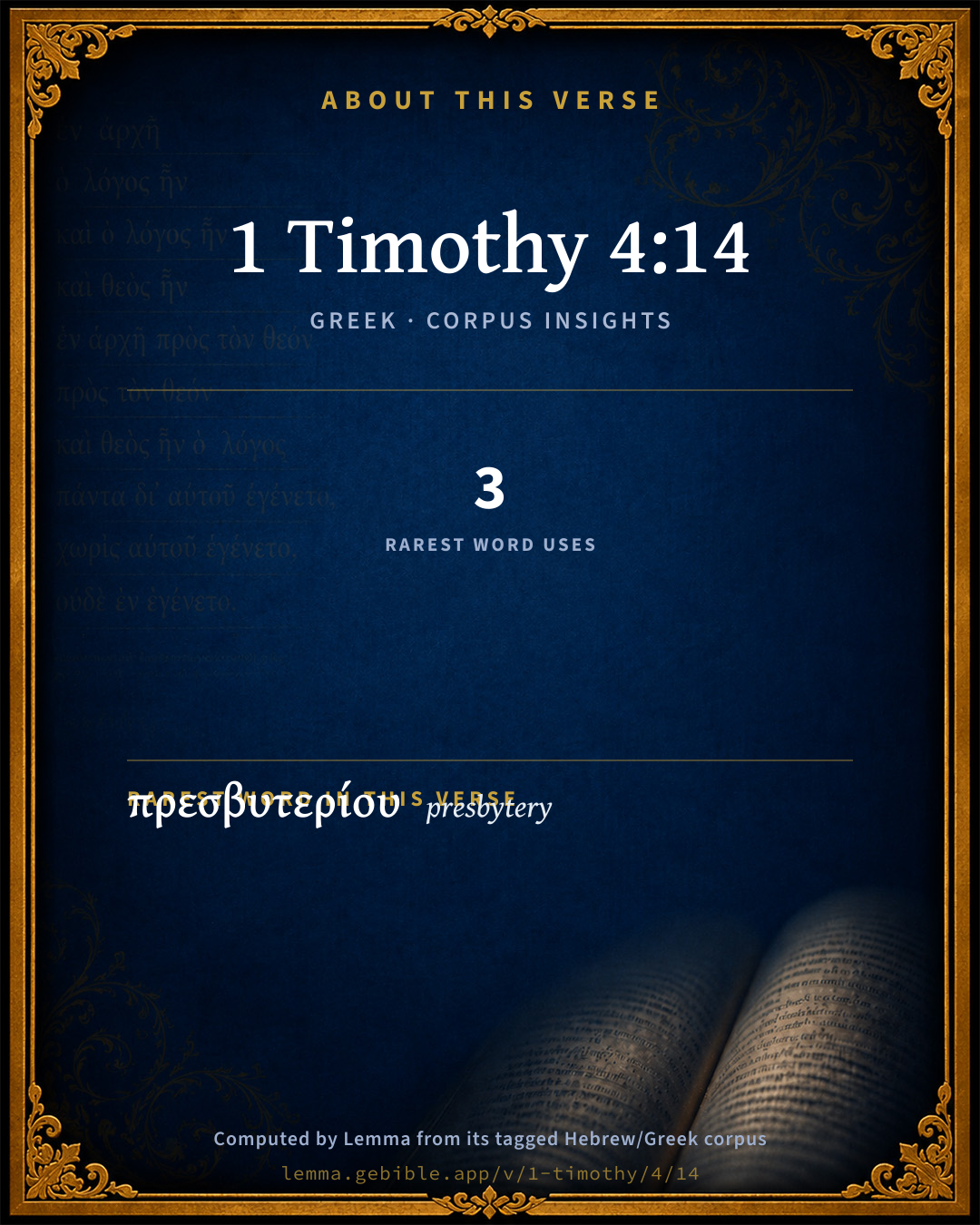
1 Timothy 4:14

Greek (Tischendorf 8th ed.) 1 Timothy 4:14 appears in the Greek New Testament. The text above is from the Tischendorf 8th edition. Each word links to its Strong’s number and a concise gloss. Click any word for its full Thayer’s Greek Lexicon entry.
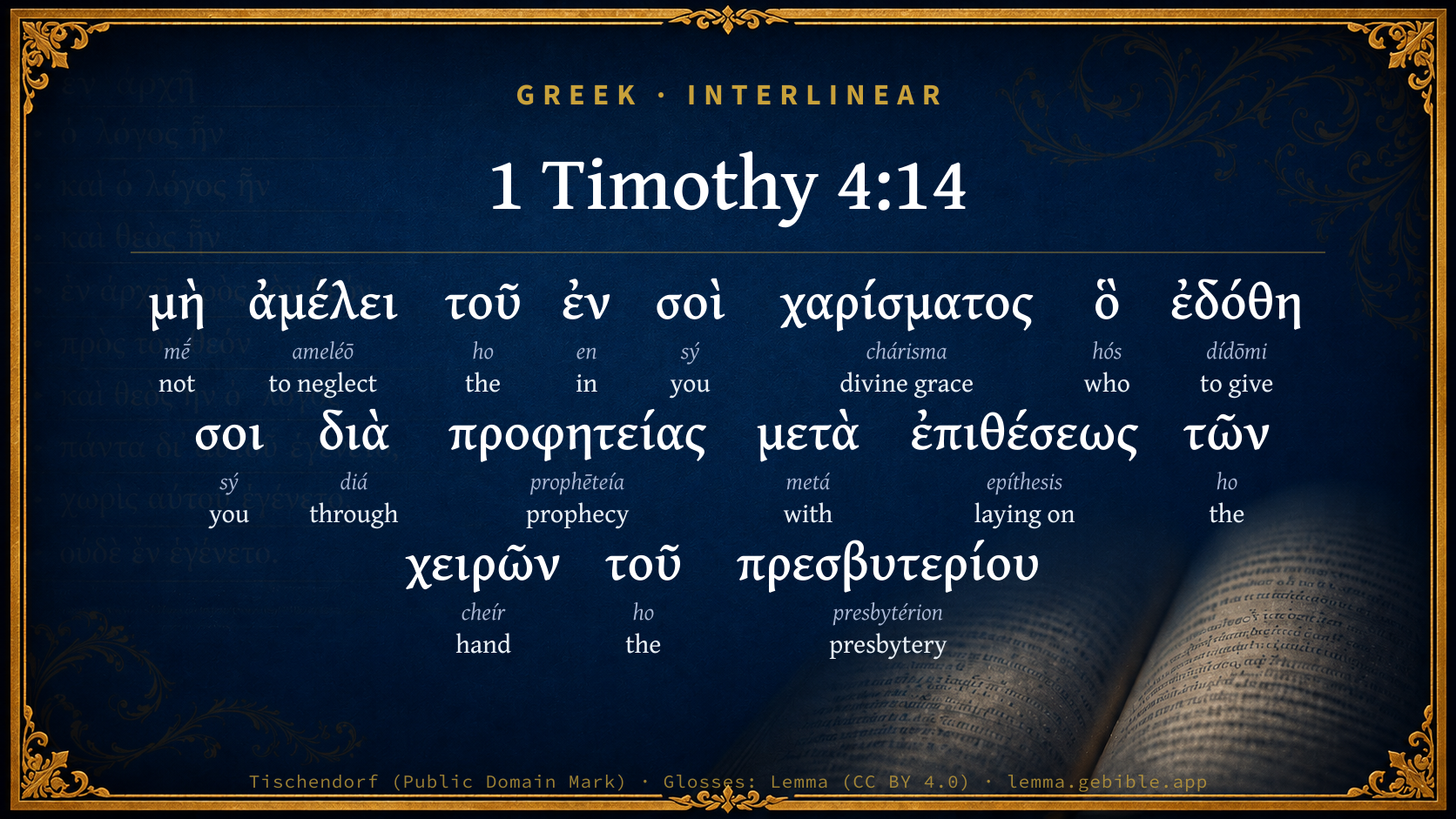
Download image
Cite this verse

1 Timothy 4:14 (World English Bible). Public Domain. Lemma interlinear Bible study tool, https://lemma.gebible.app/v/1-timothy/4/14.

Show BibTeX & RIS
BibTeX
RIS
English Translation
Don't neglect the gift that is in you, which was given to you by prophecy, with the laying on of the hands of the elders.
World English Bible · Public Domain
Download a study sheet

One document with this verse’s original text, its word-by-word gloss line, the meaning frame, cross-references with their text, attributed commentary, and full source and license credits — printable, and it pastes into notes with its structure intact.

This verse Autodidact and up

Study sheet (.html) Plain text (.txt)

A passage Seminary Student

Up to 50 verses in one chapter. A passage sheet keeps up to 6 commentary sources and 12 cross-references per verse, in the order this page ranks them, and says so on the sheet whenever that leaves anything out. Ask for a single verse and you get the Autodidact verse sheet above.

Everything on this page stays free to read, with no account — the sheet is a download of what is already on screen, not access to it.

Want to remove ads? Support Godless Engineer
Compare translations 3

The same verse in 3 English versions, stacked beneath the original-language interlinear above. Click any original word for its lexicon entry.

Each is an independent rendering of the whole verse — the interlinear is not word-aligned to these translations.

Highlighted words mark where these versions differ — a whole-verse word diff, not a word-by-word alignment.

  • World English Bible Public Domain
    Don't neglect the gift that is in you, which was given to you by prophecy, with the laying on of the hands of the elders.
  • King James Version Public Domain
    Neglect not the gift that is in thee, which was given thee by prophecy, with the laying on of the hands of the presbytery.
  • unfoldingWord Literal Text CC BY-SA 4.0
    Do not neglect the gift in you, which was given to you through prophecy, with the laying on of the hands of the council of elders.

unfoldingWord Literal Text — © unfoldingWord, licensed CC BY-SA 4.0. Word-aligned USFM3 via Door43 (git.door43.org/unfoldingWord/en_ult).

Versions to compare (up to 4)

3 of 4 selected

Show all 19 translations

Every available English version of this verse, each an independent rendering of the whole verse.

  • World English Bible Public Domain
    Don't neglect the gift that is in you, which was given to you by prophecy, with the laying on of the hands of the elders.
  • Berean Standard Bible Public Domain
    Do not neglect the gift that is in you, which was given you through the prophecy spoken over you at the laying on of the hands of the elders.
  • Majority Standard Bible Public Domain
    Do not neglect the gift that is in you, which was given you through the prophecy spoken over you at the laying on of the hands of the elders.
  • King James Version Public Domain
    Neglect not the gift that is in thee, which was given thee by prophecy, with the laying on of the hands of the presbytery.
  • American Standard Version (1901) Public Domain
    Neglect not the gift that is in thee, which was given thee by prophecy, with the laying on of the hands of the presbytery.
  • Revised Version (1885) Public Domain
    Neglect not the gift that is in thee, which was given thee by prophecy, with the laying on of the hands of the presbytery.
  • Geneva Bible (1599) Public Domain
    Despise not the gift that is in thee, which was giuen thee by prophecie with the laying on of the hands of the companie of the Eldership.
  • Douay-Rheims (1899) Public Domain
    Neglect not the grace that is in thee, which was given thee by prophesy, with imposition of the hands of the priesthood.
  • Young's Literal Translation Public Domain
    be not careless of the gift in thee, that was given thee through prophecy, with laying on of the hands of the eldership;
  • Literal Standard Version CC BY-SA 4.0
    do not be careless of the gift in you, that was given you through prophecy, with laying on of the hands of the eldership;
  • Unlocked Literal Bible CC BY-SA 4.0
    Do not neglect the gift that is in you, which was given to you through prophecy, with the laying on of the hands of the elders.
  • unfoldingWord Literal Text CC BY-SA 4.0
    Do not neglect the gift in you, which was given to you through prophecy, with the laying on of the hands of the council of elders.
  • Darby Bible Public Domain
    Be not negligent of the gift [that is] in thee, which has been given to thee through prophecy, with imposition of the hands of the elderhood.
  • World Messianic Bible Public Domain
    Don’t neglect the gift that is in you, which was given to you by prophecy with the laying on of the hands of the elders.
  • Webster's Bible Public Domain
    Neglect not the gift that is in thee, which was given thee by prophecy, with the laying on of the hands of the presbytery.
  • Free Bible Version CC BY-SA 4.0
    Don't neglect the gracious gift you have that was given to you by prophetic inspiration when the church elders laid their hands on you.
  • Bible in Basic English Public Domain
    Make use of that grace in you, which was given to you by the word of the prophets, when the rulers of the church put their hands on you.
  • Text-Critical English NT CC BY 4.0
    Do not neglect the gift that is in yoʋ, which was given to yoʋ through prophecy when the council of elders laid their hands on yoʋ.
  • Tyndale New Testament (1534) Public Domain
    Despyse not the gyfte that is in ye which was geven the thorow prophesye and with layinge on of the hondes of an elder.

Literal Standard Version (2020), Covenant Press — licensed CC BY-SA 4.0. Text via the HelloAO Bible API (eBible.org). Unlocked Literal Bible (unfoldingWord) — licensed CC BY-SA 4.0. Text via the HelloAO Bible API (eBible.org). unfoldingWord Literal Text — © unfoldingWord, licensed CC BY-SA 4.0. Word-aligned USFM3 via Door43 (git.door43.org/unfoldingWord/en_ult). Free Bible Version, Dr. Jonathan Gallagher — licensed CC BY-SA 4.0. Text via the HelloAO Bible API (eBible.org).

Word by word

More ways to search: Search by grammar → Find every occurrence → Compare this word →

Practice this passage: Drill this verse → Learn its vocabulary →

πρεσβυτερίου
presbytérion
G4244
“presbytery”
Noun, Genitive, Singular, Neuter
Part of Speech
Noun
Case
Genitive
Number
Singular
Gender
Neuter
Full Thayer's Definition

Origin: from a presumed derivative of G4245

TDNT: 16:51,9

1. body of elders, presbytery, senate, council a. of the Jewish elders b. of the elders of any body (assembly) of Christians
  1. μὴ mḗ G3361 “not” Particle, Negative
  2. ἀμέλει ameléō G272 “to neglect” Verb, Present, Active, Imperative, 2nd person, Singular
  3. τοῦ ho G3588 “the” Article, Genitive, Singular, Neuter
  4. ἐν en G1722 “in” Preposition
  5. σοὶ sý G4771 “you” Personal pronoun, 2nd person, Dative, Singular
  6. χαρίσματος chárisma G5486 “divine grace” Noun, Genitive, Singular, Neuter
  7. ὃ hós G3739 “who” Relative pronoun, Nominative, Singular, Neuter
  8. ἐδόθη dídōmi G1325 “to give” Verb, Aorist, Passive, Indicative, 3rd person, Singular
  9. σοι sý G4771 “you” Personal pronoun, 2nd person, Dative, Singular
  10. διὰ diá G1223 “through” Preposition
  11. προφητείας prophēteía G4394 “prophecy” Noun, Genitive, Singular, Feminine
  12. μετὰ metá G3326 “with” Preposition
  13. ἐπιθέσεως epíthesis G1936 “laying on” Noun, Genitive, Singular, Feminine
  14. τῶν ho G3588 “the” Article, Genitive, Plural, Feminine
  15. χειρῶν cheír G5495 “hand” Noun, Genitive, Plural, Feminine
  16. τοῦ ho G3588 “the” Article, Genitive, Singular, Neuter

About this verse

These counts appear in no published source. They are computed here, from the morphology-tagged text and Lemma’s own curated glosses. What Lemma adds →

17
words
14
distinct lemmas
Pauline Epistles
section

Notable vocabulary

The rarest word here is πρεσβυτερίου presbytery G4244 — appearing just 3 times in the whole Greek New Testament.

Shared distinctive vocabulary

πρεσβυτερίου presbytery G4244 occurs in 3 verses of the Greek New Testament. Also found in:

Repetition

Words recur within this verse:

Cross-references

12

Topical passages linked to 1 Timothy 4:14 in the Treasury of Scripture Knowledge — connected by theme and wording, ordered by reader-vote popularity; previews shown in the World English Bible.

  • 2 Timothy 1:6 For this cause, I remind you that you should stir up the gift of God which is in you through the laying on of my hands.
  • 1 Peter 4:9–11 Be hospitable one to another without grumbling.
  • 1 Timothy 1:18 This charge I commit to you, my child Timothy, according to the prophecies which led the way to you, that by them you may wage the good warfare;
  • Acts 6:6 whom they set before the apostles. When they had prayed, they laid their hands on them.
  • 1 Timothy 5:22 Lay hands hastily on no one, neither be a participant in other men's sins. Keep yourself pure.
  • 1 Thessalonians 5:19 Don't quench the Spirit.
  • Acts 13:3 Then, when they had fasted and prayed and laid their hands on them, they sent them away.
  • Matthew 25:14–30 "For it is like a man, going into another country, who called his own servants, and entrusted his goods to them.
  • Acts 8:17 Then they laid their hands on them, and they received the Holy Spirit.
  • Romans 12:6–8 Having gifts differing according to the grace that was given to us, if prophecy, let us prophesy according to the proportion of our faith;
  • Luke 19:12–26 He said therefore, "A certain nobleman went into a far country to receive for himself a kingdom, and to return.
  • Acts 19:6 When Paul had laid his hands on them, the Holy Spirit came on them, and they spoke with other languages and prophesied.

Cross-references courtesy of OpenBible.info (CC BY 4.0).

Commentary

Notes on 1 Timothy 4:14 from classic Christian and Jewish commentators (each source and its license shown beneath its notes). The classic Christian expositions comment on the surrounding passage and are grouped to its opening verse, so a note may address several verses; the Jewish commentaries on the Tanakh (Rashi and others) are per-verse, so they appear only where the commentator wrote on this verse.

Lemma curates 59 commentaries, every one of them public domain or Creative Commons licensed, each selected and text-cleaned for this edition rather than reprinted as found. About our sources →

Albert Barnes' Notes on the Bible

Neglect not the gift that is in thee - An important question arises here, to what the word “gift” refers; whether to natural endowment; to office; or to some supposed virtue which had been conferred by ordination - some transmitted influence which made him holy as a minister of religion, and which was to continue to be transmitted by the imposition of apostolic hands. The word which is here used, is rendered “gift” in every place in which it occurs in the New Testament. It is found in the following places, and with the following significations: deliverance from peril, 2Co 1:11; a gift or quality of the mind, 1Co 7:7; gifts of Christian knowledge or consolation, Rom 1:11; 1Co 1:7; redemption or salvation through Christ, Rom 5:15-16; Rom 6:23; Rom 11:29; the miraculous endowments conferred by the Holy Spirit, Rom 12:6; 1Co 12:4, 1Co 12:9,1Co 12:28, 1Co 12:30-31, and the special gift or endowment for the work of the ministry, 1Ti 4:14; 2Ti 1:6; 1Pe 4:10. The “gift” then referred to here was that by which Timothy was qualified for the work of the ministry. It relates to his office and qualifications - to “every thing” that entered into his fitness for the work. It does not refer “exclusively” to any influence that came upon him in virtue of his ordination, or to any new grace that was infused into him by that act, making him either officially or personally more holy than other people, or than he was before - or to any efficacy in the mere act of ordination - but it comprised “the whole train of circumstances” by which he had been qualified for the sacred office and recognized as a minister of religion. All this was regarded as a “gift,” a “benefit,” or a “favor” - χαρισμα charisma - and he was not to neglect or disregard the responsibilities and advantages growing out of it. In regard to the manner in which this gift or favor was bestowed, the following things are specified:

(1) It was the gift of God; 2Ti 1:6. He was to be recognized as its source; and it was not therefore conferred merely by human hands. The call to the ministry, the qualifications for the office, and the whole arrangement by which one is endowed for the work, are primarily to be traced to him as the source.

(2) It was given to Timothy in accordance with certain predictions which had existed in regard to him - the expectations of those who had observed his qualifications for such an office, and who had expressed the hope that he would one day be permitted to serve the Lord in it.

(3) It was sanctioned by the laying on of the hands of the presbytery. The call of God to the work thus recognized by the church, and the approbation of the Presbytery expressed by setting him apart to the office, should be regarded by Timothy as a part of the “gift” or “benefit” (charisma) which had been conferred on him, and which he was not to neglect.

(4) An additional circumstance which might serve to impress the mind of Timothy with the value of this endowment, and the responsibility of this office, was, that Paul himself had been concerned in his ordination; 2Ti 1:6. He who was so much more aged (Phm 1:9; compare 2Ti 4:6-7); he who had been a father to him, and who had adopted him and treated him as a son had been concerned in his ordination; and this fact imposed a higher obligation to perform aright the functions of an office which had been conferred on him in this manner. We are not to suppose, therefore, that there was any mysterious influence - any “virus” - conveyed by the act of ordination, or that that act imparted any additional degree of holiness. The endowment for the ministry; the previous anticipations and hopes of friends; and the manner in which he had been inducted into the sacred office, should all be regarded as a “benefit” or “favor” of a high order, and as a reason why the gift thus bestowed should not be neglected - and the same things now should make a man who is in the ministry deeply feel the solemn obligations resting on him to cultivate his powers in the highest degree, and to make the most of his talents.

Which was given thee by prophecy - That is, the prophetic declarations and the hopes of pious friends in regard to your future usefulness, have been among the means by which you have been introduced to the ministry, and should be a reason why you should cultivate your powers, and perform faithfully the duties of your office; see the notes on 1Ti 1:18.

With the laying on of the hands of the presbytery - it was common to lay on the hands in imparting a blessing, or in setting apart to any office; see Mat 19:15; Mar 6:5; Luk 4:40; Luk 12:13; Lev 8:14; Num 27:23; Act 28:8; Act 6:6; Act 8:17; Act 13:3. The reference here is undoubtedly to the act by which Timothy was set apart to the office of the ministry. The word rendered “presbytery” - πρεσβυτέριον presbuterion - occurs only in two other places in the New Testament - Luk 22:66, where it is rendered “elders;” and Act 22:5, where it is rendered “estate of the elders.” It properly means an “assembly of aged men; council of elders.” In Luk 22:66, and Act 22:5, it refers to the Jewish “sanhedrin;” see the notes on Mat 5:22. In the passage before us, it cannot refer to that body - for they did not ordain men to the Christian ministry - but to some association, or council, or body of elders of the Christian church. It is clear from the passage:

(1) That there was more than “one person” engaged in this service, and taking part in it when Timothy was ordained, and therefore it could not have been by a “prelate” or “bishop” alone.

(2) That the power conferred, whatever it was, was conferred by the whole body constituting the presbytery - since the apostle says that the “gift” was imparted, not in virtue of any particular power or eminence in anyone individual, but by the “laying on of the hands of the presbytery.”

(3) The statement here is just such a one as would be made now respecting a Presbyterian ordination; it is not one which would be made of an Episcopal ordination. A Presbyterian would choose “these very words” in giving an account of an ordination to the work of the ministry; an Episcopalian “would not.” The former speaks of an ordination by a “presbytery;” the latter of ordination by a “bishop.” The former can use the account of the apostle Paul here as applicable to an ordination, without explanations, comments, new versions or criticisms; the latter cannot. The passage, therefore, is full proof that, in one of the most important ordinations mentioned in the New Testament, it was performed by an association of men, and not by a prelate, and therefore, that this was the primitive mode of ordination. Indeed, there is not a single instance of ordination to an office mentioned in the New Testament which was performed by one man alone. See this passage examined at greater length in my” Enquiry into the organization and government of the apostolic church,” pp. 208-221.

Albert Barnes' Notes on the Bible (1834–1885) — public domain. Text from a community e-Sword/MySword module.

The Biblical Illustrator

Joseph S. Exell

1Ti_4:14

Neglect not the gift that is in thee.

An ordination charge

If the supernatural gifts with which Timothy was endowed were in danger of suffering injury from the neglect of the zealous, ardent, devoted evangelist, how much greater is your danger of neglecting the gift that is in you, and of suffering injury from its neglect? I have seen the desolation of a negligent ministry, if you have not. By neglect his gift seems to have decayed and died out of him. He preaches, but not as he once preached. Let me not be misunderstood. I do not say that every unsuccessful minister has neglected the gift that is in him. I am very far from saying so. Some have small ministerial gifts, little preaching power. Paul, in his younger days, made full proof of his ministry. He neglected not the gift that was in him. What gift have you? What qualification for the ministry which all true ministers have? You have the one great gift of the Holy Ghost, a renewed heart. Is this your gift? Do not neglect it. Strive to attain more of this blessed, living experience of the great truths you have to preach. I once heard a good man and a good preacher well known and greatly honoured in this town, say, in the retrospect of a long and prosperous ministry, I have nothing to boast of, for my voice has done more for my success than my intellectual power. I admired the modesty of the preacher, who, though favoured by a musical voice, had no reason to speak disparagingly of his intellectual powers. But he was wise enough to form a right estimate of the adventitious gifts of which, without being vain, he knew how to make a good use. To be vain of such things would be indeed a little, pitiable vanity. Yet, like John Angell James, Neglect not the gift that is in thee. Neglect not the gift that is in thee. The words seem to say, Cultivate your own gifts; those which are natural to you. Do not be solicitous about gifts which God has not given you. (R. Halley, D. D.)

Benefit of using personal gifts

Think, too, of the benefits to be derived in our own souls by personal service. God will never let a man be a loser by serving Him. The dense vapours that rise from earth to heaven return in pure water; so he who gives to God such as he has, shall receive from Him a good return. The spear that is used contracts no rust; the sword that is continually wielded remains untarnished; the arm in constant use becomes occasionally weary, but increasingly strong; so the child of God who labours for his master, though often wearied, gains great strength through that which he expends. The placid lake is sealed up in winters frost from shore to shore, but the running rivulet escapes its power. The bewildered traveller on the Alps, half benumbed with cold, gets fresh circulation and warmth by his exertions to restore animation to the body of another. The reason why we have so many benumbed and frozen Christians in the present day is, that there are few personally employed in the work. We long for the time when every believer like the little waterfall and the alpine traveller shall be too active to freeze. Personal service brings its own reward; watering others, we are watered ourselves; warming others, we are ourselves warmed; blessing others, we ourselves are blessed. Do you say, what can God do by one? I reply, very much! By one He brought forth His chosen people from Egypts thraldom; by one (and that a youth) Goliath was slain while the whole army of Israel trembled before him; by one the assembled Israelites were convinced that The Lord He is God, and the prophets of Baal were slain; by one sermon, and that a simple one, three thousand hearts were opened. Time would fail to tell of what God has done by such men as Wickliffe, Luther, Calvin, Huss, Whitfield, Wesley, Pounds, Harlan Page, and why not you? (G. Brown.)

The Biblical Illustrator, edited by Joseph S. Exell (c. 1880s–1900s) — public domain. Text from a community e-Sword module.

Joseph Benson's Commentary

1Ti 4:14. Neglect not — Through omitting to exercise it to the full; the gift that is in thee — The word χαρισμα, here used, commonly denotes some spiritual gift conferred on believers in the first age, whether by an immediate effusion of the Holy Spirit, or by means of the imposition of the apostle’s hands. See Rom 1:10. By this it appears, that even the miraculous gifts might be improved; and that the continuance of them with individuals depended in a great measure upon the right temper of their minds, and upon their making a proper use of their gifts. Which was given thee by prophecy — By immediate direction from God, or in consequence of predictions uttered by those who had the gift of prophecy, pointing thee out as a person fit to be invested with the office of an evangelist, and called of God to it. As it appears, from 2Ti 1:6, that the gift here referred to was given to Timothy by the laying on of the apostle’s hands, we learn from hence, that in conferring the spiritual gifts, as well as in working miracles, the apostles were not left to their own prudence, but were directed by revelations from God, communicated to themselves or others. With the laying on of the hands of the presbytery — Whose hands, with those of Paul, were laid on Timothy at the time when he was set apart solemnly by prayer to the office of the ministry, and received the spiritual gift here spoken of. Probably the apostle first conferred on Timothy the gift by the laying on of his own hands, and then set him apart to his office by prayer, the elders joining with him, and laying on their hands to show their concurrence with him in the solemn work.

Joseph Benson's Commentary on the Old and New Testaments (1811–1818) — public domain. Text from a community e-Sword module.

Tyndale Open Study Notes

Tyndale Open Resources

4:14 laid their hands on you: The gesture signified recognition, authorization, and blessing (see Acts 13:1-3; 6:6). This was probably the same event as in 2 Tim 1:6-7 (see 1 Tim 1:18; cp. Rom 12:6-8; 1 Cor 12:7-11; Eph 4:7-13). Paul’s ministry and that of his delegates was under the authority of the church.

Tyndale Open Study Notes — © Tyndale Open Resources, licensed CC BY-SA 4.0. Text via the HelloAO Bible API.

Bengel's Gnomon

Johann Albrecht Bengel

1Ti 4:14. Μὴ ἀμέλει, do not neglect) They neglect, who do not exercise the gift, and who think that they cannot fall away.—χαρίσματος, the gift) 2Ti 1:6.—διὰ προφητείας μετὰ ἐπιθέσεως τῶν χειρῶν τοῦ πρεσβυτερίου, by prophecy, with the laying on of the hands [viz. by prophecy] of the presbytery) Construe the prophecy of the presbytery. For Paul laid his hands on Timothy, 2Ti 1:6; i.e. the presbytery consisted of Paul himself (comp. 2Jn 1:1; 1Pe 5:1) and Silas, or others also. Many Latin copies have presbyteri, “of the presbyter.” The imposition of the hand is properly done by one person, and that, too, a person more dignified. But prophecy was also exercised by equals, viz. by more than one, who, while Paul was laying his hands on Timothy, were offering congratulations, and augured every good thing; perhaps even in the absence of Timothy. This is an energetic young man, they said; God will do much good by him.

Bengel's Gnomon of the New Testament — English translation (T&T Clark, Edinburgh, 1860) — public domain. Text from a community e-Sword module.

Meyer's Critical & Exegetical Commentary

Heinrich August Wilhelm Meyer

1Ti_4:14. Μὴ ἀμέλει τοῦ ἐν σοὶ χαρίσματος] Timothy is not to let the χάρισμα lie unused; he is to apply it diligently and faithfully to the purpose for which it was imparted to him. This exhortation does not imply blame, nor does that given in 2Ti_1:6.

The word χάρισμα may be applied to every gift of God bestowed on man by Gods χάρις. In the N. T. it denotes both generally the new spiritual life wrought in the believer by the Holy Spirit, and also specially every faculty imparted for special Christian work (ἱκανότης, comp. 2Co_3:5). Here, where he is speaking of Timothys official work, it can only mean the faculty given him for the office (not simply the gift of teaching, as Hofmann thinks), in regard both to the κυβέρνησις and specially to the παράκλησις and διδασκαλία (not, however, as Chrysostom explains it, the διδασκαλία itself). It is not to be taken as denoting the office itself; the ἐν σοί is against this, and nowhere in the N. T. has the word this meaning.[164]

Ὃ ἘΔΌΘΗ ΣΟΙ] not as Heinrichs says: a me, Apostolo, but, as a matter of course, by the Holy Spirit (1Co_12:4).

διὰ προφητείας μετὰ ἐπιθέσεως τῶν χειρῶν τοῦ πρεσβυτερίου] διά is here by means of, so that the ΠΡΟΦΗΤΕΊΑ is to be regarded as the means through which the ΧΆΡΙΣΜΑ was given to Timothy (by the Holy Spirit). It is arbitrary to weaken this, the proper meaning of the preposition, as Beza does when he explains it: per prophetiam i. e. ita jubente per os prophetarum spiritu sancto;[165] and as Otto also does, when he finds here the thought that the ordination was occasioned by the προφητεία. Though Hofmann in his Schriftbeweis (II. 2, pp. 278 f.) had explained it: The word of prophecy pointed out Timothy as the one to be appointed the apostles colleague, he now says: διὰ προφητείας does not mean by means of prophecy, but in consequence of prophecies. This latter explanation, however, agrees with the one which he disputes, since the expression in consequence of gives not merely the relation of time, but also the relation of cause. We must reject even the qualification of the meaning which Matthies demands: The fundamental meaning of the preposition διά, which may be shortly defined as means, may be so modified in many cases as to give the manner in which something is done, or the intermediating form under which something comes into life. We must reject this, because, as de Wette rightly remarks, there would otherwise be no indication of a relation of cause. Besides, such passages as Act_8:17-18; Act_9:17; Act_19:6, 2Ti_1:6, prove that we must keep by the proper meaning of ΔΙΆ. The ΠΡΟΦΗΤΕΊΑ is mentioned as the means, but in close connection with ἘΠΊΘΕΣΙς ΤῶΝ ΧΕΙΡῶΝ. ΠΡΟΦΗΤΕΊΑ (1Ti_1:18) is not equivalent to foretelling, but is more generally the word proceeding immediately from the Holy Spiritwhether the word of promise, or of exhortation, or of prayer. This word was spoken at the time (ΜΕΤΆ) when the presbytery laid their hands on Timothy and appointed him to his ministry. ΜΕΤᾺ ἘΠΙΘΈΣΕΩς Τ. Χ. is to be taken in close connection with ΔΙᾺ ΠΡΟΦΗΤΕΊΑς; the laying on of hands is to be regarded as part of the means; comp. 2Ti_1:6.[166] Otto wrongly says: The laying on of hands is not a coefficient of the ordination, but an act connected with the ceremony of ordination; the ΧΆΡΙΣΜΑ was imparted to Timothy along with the laying on of hands, not by means of the laying on of hands. Wherein, then, did the ceremony of ordination consist? It is curious that Hofmann, influenced by 2Ti_1:6, says regarding μετά, that it was of course the apostles business to impart the gift to Timothy by laying on of hands, but then grants that the presbytery of Timothys home-church took part in the laying on of hands, without telling us what then signified the presbyterys laying on of hands. The hands were imposed by the presbytery, but Paul does not say who uttered the προφητεία. Leo remarks: adfuerunt fortassis, quum manus imponebantur Timotheo, prophetae Christiani, qui praesagiebant faustissima quaevis, et dignum eum fore dicebant ecclesiae doctorem (similarly Wiesinger, van Oosterzee, and others). It is, however, most probable to assume that they who uttered the ΠΡΟΦΗΤΕΊΑ were the same as they who laid their hands on Timothy,[167] so that we cannot think here of prophets, in the narrower sense of the word, as present at the ordination.

The ἘΠΊΘΕΣΙς ΤῶΝ ΧΕΙΡῶΝ is well known as a symbolic action of the early Christians; it was the symbol and means not only of imparting the Holy Spirit in general (Act_8:17; Act_19:6; Heb_6:2), but also of bestowing the inward equipment for a special Christian ministry (Act_6:6; Act_13:3; comp. also Act_14:23). By the presbytery, we must understand the college of presbyters belonging to the church in which the hands were imposed. What church this was, we are not told. Ecclesiastical tradition, followed by Mack, makes it the church at Ephesus; Matthies, Leo, de Wette, Wiesinger, and others think it more probable that the ordination took place at Lystra, where Paul assumed Timothy as his companion, and that the ordination was held for this very purpose.[168] To this latter view we must object, that there is no passage in the N. T. to prove that the reception into the number of the colleagues of the apostles was made with such a solemn ceremony. It is more natural to suppose that such a reception took a freer form, and that a regular ordination was only held after a more independent position had been assigned to the colleague, a position not merely of carrying out certain instructions, but of representing the apostle in a more complete way, viz. in a particular church, such as Timothy now held. Perhaps, therefore, this ordination of Timothy had taken place when Paul on his departure for Macedonia left Timothy behind him in Ephesus as his substitute (1Ti_1:3); still it is also possible that it had been done on some earlier occasion.[169]

It is strange that in 2Ti_1:6 the laying on of hands is mentioned only as the act of the apostle. Paul might certainly be speaking there of some other occasion than here, for the consecration by laying on of hands might be imparted on different occasions to the same man. It is more probable, however, that he is speaking of the same occasion in both passages, and that Paul imposed hands along with the elders, but as the first (de Wette).

It is further to be remarked that the word πρεσβυτέριον occurs elsewhere in the N. T. only as a name for the Jewish Sanhedrim (Luk_22:66; Act_22:5), and that it is used here only of the college of the Christian presbyters of a church.

[164] Otto grants, indeed, that χάρισμα never stands exactly for office, but thinks that χάρισμα may be used, as a predicate of the idea, office, which is certainly right. Otto, however, does not wish to take χάρισμα here as the office generally speaking, but (distinguishing in the office(1) the rights of office; (2) the occupations of office) as the rights of office: A position of power working out from within. To ἐν he assigns the meaning resting upon some one; but, whatever Otto may say against it, the ἀναζωπυρεῖν (2Ti_1:6) does not accord with that idea. So long as any one holds the office, the rights of office remain to him undiminished; for these lie not in the person, but in the office, in the person only as holding the office. For such a meaning of ἐν, Otto has produced some passages from classic Greek, but none from the N. T.

[165] Beza goes still farther wrong when he continues: Potest tamen etiam sic accipi, ut idem valeat εἰς προφητείαν, i. e. ad prophetandum; vel ἐν προφητείᾳ, ita ut quod sit hoc donum exprimat apostolus.

[166] De Wette rightly: The προφ. is only named as a part of the whole act of consecration by which the χαρ. was imparted, and the preposition διά is not to be referred in strictness only to προφ., but also to the next words.

[167] Bengel is wrong: Constr. prophetiam presbyterii, nam manus imposuit Paulus Timotheo; impositio manus proprie fit per unam personam et quidem digniorem; prophetia vero fiebat etiam per aequales, per plures.

[168] So also Hofmann, in whose opinion the precedent here alluded to (which, however, he is not willing to recognise as an ordination) must have taken place in Timothys home-church.

[169] Otto, in accordance with his whole view, places Timothys ordination in the last period of Pauls three years at Ephesus. The reasons by which he seeks to establish this period as the one most exactly corresponding in Timothys life, are anything but sufficient.

Meyer — Critical and Exegetical Commentary on the New Testament — English translation by Peter Christie, edited by Frederick Crombie (T&T Clark, 1880) — public domain. Text from a community e-Sword module.

Expositor's Greek Testament

ed. W. Robertson Nicoll

1Ti 4:14 . μὴ ἀμέλει : J. H. Moulton ( Grammar , vol. i. p. 122 sqq .), distinguishes ( a ) μή with the pres. imperat, “Do not go on doing so and so,” e.g. , 1Ti 5:22-23 , from ( b ) μή with the aor. subjunctive, “Do not begin to do it” (1Ti 5:1 ; 2Ti 1:8 ). In this case, μὴ ἀμέλει is equivalent to πάντοτε μελέτα . Timothy’s χάρισμα lay in his commission to rule and in his powers as a preacher. The χάρισμα was given by God; in this particular case the formal and solemn assumption of its use was accompanied by the indication of prophecy addressed to the ear, and by the laying on of hands addressed to the eye. See Act 13:1-3 .

Winer-Moulton notes, p. 471, that the instrument , as such, is never expressed by μετά in good prose. Here, with, amid imposition of hands (conjointly with the act of imposition). μετά is here equivalent to διά in the sense given above, i.e. , of accompanying circumstances.

2Ti 1:6 is usually reconciled with this passage by saying that the body of presbyters was associated with St. Paul in the laying on of hands. But there is no reason to suppose that the same transaction is referred to in both places. Here the charismata refer to preaching and teaching; but in 2 Tim., to the administrative duties committed to Timothy, as it is reasonable to suppose, by St. Paul alone, when he appointed him his representative. Note that διά is used of St. Paul’s imposition of hands (2Ti 1:6 ), μετά of that of the presbyters, here. This suggests that it was the imposition of hands by St. Paul that was the instrument used by God in the communication of the charisma to Timothy.

πρεσβυτέριον : elsewhere in N.T. (Luk 22:66 ; Act 22:5 ) means the Jewish Sanhedrin; but Ignatius uses the term, as here, to indicate the presbyters in a local Church ( Trall . 7, 13; Philadelph . 7, etc.).

The Expositor's Greek Testament, edited by W. Robertson Nicoll (1897–1910) — public domain. Text from a community e-Sword module.

Jamieson, Fausset & Brown

Robert Jamieson, A. R. Fausset & David Brown

Neglect not the gift--by letting it lie unused. In Ti2 1:6 the gift is represented as a spark of the Spirit lying within him, and sure to smoulder by neglect, the stirring up or keeping in lively exercise of which depends on the will of him on whom it is bestowed (Mat 25:18, Mat 25:25, Mat 25:27-28). The charism or spiritual gift, is that of the Spirit which qualified him for "the work of an evangelist" (Eph 4:11; Ti2 4:5), or perhaps the gift of discerning spirits, specially needed in his function of ordaining, as overseer [BISHOP HINDS].

given thee--by God (Co1 12:4, Co1 12:6).

by prophecy--that is, by the Holy Spirit, at his general ordination, or else consecration, to the special see of Ephesus, speaking through the prophets God's will to give him the graces needed to qualify him for his work (Ti1 1:18; Act 13:1-3).

with . . . laying on of . . . hands--So in Joshua's case (Num 27:18-20; Deu 34:9). The gift was connected with the symbolical act of laying on hands. But the Greek "with" implies that the presbyter's laying on hands was the mere accompaniment of the conferring of the gift. "By" (Ti2 1:6) implies that Paul's laying on his hands was the actual instrument of its being conferred.

of the presbytery--In Ti2 1:6 the apostle mentions only his own laying on of hands. But there his aim is to remind Timothy specially of the part he himself took in imparting to him the gift. Here he mentions the fact, quite consistent with the other, that the neighboring presbyters took part in the ordination or consecration, he, however, taking the foremost part. Paul, though having the general oversight of the elders everywhere, was an elder himself (Pe1 5:1; Jo2 1:1). The Jewish council was composed of the elders of the Church (the presbytery, Luk 22:66; Act 22:5), and a presiding rabbi; so the Christian Church was composed of apostles, elders, and a president (Act 15:16). As the president of the synagogue was of the same order as his presbyters, so the bishop was of the same order as his presbyters. At the ordination of the president of the synagogue there were always three presbyters present to lay on hands, so the early Church canons required three bishops to be present at the consecration of a bishop. As the president of the synagogue, so the bishop of the Church alone could ordain, he acting as the representative, and in the name of the whole presbytery [VITRINGA]. So, in the Anglican Church, the bishop ordains, the presbyters or priests present joining with him in laying on hands.

Jamieson, Fausset & Brown — Commentary Critical and Explanatory on the Whole Bible (1871) — public domain (CC PDM 1.0). Text via the HelloAO Bible API.

Adam Clarke's Commentary

Verse 14. Neglect not the gift that is in thee] The word χαρισμα here must refer to the gifts and graces of the Divine Spirit, which Timothy received when set apart to the work of an evangelist by the imposition of St. Paul's hands, 2Ti 1:6, and by that of the presbytery or eldership; for it most evidently appears, from this verse and that above quoted, that he received this double imposition, not probably at different times, but on one and the same occasion. These very gifts and graces might be improved; and we have reason to believe, if not improved, would be withdrawn by the great Head of the Church.

Given thee by prophecy] It has already been conjectured (see the preface, and see the note on Clarke "1Ti 1:18") that there had been some remarkable prediction relative to the future destiny and usefulness of Timothy. And probably it was in consequence of this that he was set apart to the office of evangelist and bishop in the Church at Ephesus. When apostles laid their hands on men, they ordinarily received the Holy Spirit with this imposition. This may be what the apostle calls to the remembrance of Timothy, and tells him not to neglect what he had received, nor the purpose for which he had received it.

Adam Clarke's Commentary on the Bible (1810–1826) — public domain. Text from a community e-Sword/MySword module.

John Calvin's Commentaries

14 Neglect not the gift that is in thee The Apostle exhorts Timothy to employ, for the edification of the Church, that grace with which he was endued. God does not wish that talents — which he has bestowed on any one, that they may bring gain — should either be lost, or be hidden in the earth without advantage. (Matthew 25:18, 25.) To neglect a gift is carelessly to keep it unemployed through slothfulness, so that, having contracted rust it is worn away without yielding any profit. Let each of us, therefore, consider what gift he possesses, that he may diligently apply it to use.

He says that grace was given to him by prophecy. How was this? It was because, as we have already said, the Holy Spirit marked out Timothy by revelation, that he might be admitted into the rank of pastors; for he had not only been chosen by the judgment of men, in the ordinary way, but had previously been named by the Spirit.

With the laying on of the hands of the presbytery He says that it was conferred “with the laying on of hands;” by which he means, that, along with the ministry, he was also adorned with the necessary gifts. It was the custom and ordinary practice of the Apostles to ordain ministers “by the laying on of hands.” As to this ceremony, and its origin and meaning, I have formerly given a brief explanation of them, and the rest may be learned from the Institutes (Book 4: chap. 3.)

They who think that presbytery is here used as a collective noun, for “the college of presbyters or elders,” are, I think, correct in their opinion; although, after weighing the whole matter, I acknowledge that a different meaning is not inapplicable, that is, that presbytery or eldership — is the name of an office. He put the ceremony for the very act of ordination; and therefore the meaning is, that Timothy — having been called to the ministry by the voice of the prophets, and having afterwards been solemnly ordained was, at the same time, endued with the grace of the Holy Spirit for the discharge of his office. Hence we infer that it was not a useless ceremony, because God by his Spirit, accomplished that consecration which men expressed symbolically “by the laying on of hands.”

John Calvin's Commentaries (1540-1563) — public domain. Text from the Calvin Translation Society English edition (1840s-50s) via the Christian Classics Ethereal Library (ccel.org). Calvin's coverage is partial (roughly two-thirds of the Bible); uncommented books and verses are honest gaps, never fabricated. The 19th-century editor's footnotes and remarks are omitted so the notes are faithfully Calvin's own voice.

Ellicott's Commentary for English Readers

(14) Neglect not the gift that is in thee, which was given thee by prophecy.—Here the Apostle reminds his representative in the Ephesian congregation of his special gift of teaching and exhortation—that divine gift which had been conferred on Timothy at his solemn ordination long ago, when the young son of Eunice was designated for the post which John Mark had once held with the Apostle. It was in many respects a similar office, that which Timothy held about St. Paul, to that which in old days Elisha had held with Elijah; and, as in the case of the Hebrew prophet of the old dispensation, so here, the choice of St. Paul had been divinely guided. The very titles of the old covenant dispensation seem to have been revived in this instance of the divine selection of Timothy; for in 1Ti_6:11 the older Apostle addresses his representative at Ephesus with the old prophetic title when he writes: “Thou, O man of God, flee these things.” Now he solemnly calls attention to that strange, miraculous “grace” which some inspired prophet at his ordination declared was to be conferred on Timothy. The “gift” was said to be conferred, as to its certainty in the divine counsels, by such prophecy—the Holy Spirit, by the mouth of one or more of His prophets, declaring His will and intention to confer this special grace on the young companion of St. Paul.

With the laying on of the hands.—This was a symbolic action—the outward sign of an inward communication of the Holy Spirit for some spiritual office or undertaking—and was derived from the old solemn Hebrew custom. (See Num_8:10 in the case of the consecration of the Levites, and Num_27:18, Deu_34:9 in the ceremony of the dedication of Joshua.)

Of the presbytery.—The brotherhood of presbyters connected with the place where the ordination of Timothy took place is here alluded to. There appears to have been such a body of elders in each particular city or district. The presbytery in this instance would seem in all probability to have belonged to the district of Lystra, Timothy’s native city; but an old ecclesiastical tradition speaks of Ephesus as the place of this ordination.

A Bible Commentary for English Readers, edited by Charles John Ellicott (1878–1897) — public domain. Text from a community e-Sword module.

The Cambridge Bible for Schools and Colleges

gen. ed. J. J. S. Perowne

14. the gift that is in thee] The connexion here and round the parallel 1 Timothy 4 :2Ti_1:6 implies a gift for ruling and teaching, distinct from the gift conferred through ‘the laying on’ of St Paul’s hands at Ephesus, Act_19:6, the extraordinary gifts of speaking with tongues, &c., from the Holy Spirit; gifts still imparted at this time, as we learn from 1Pe_4:10, ‘according as each hath received a gift;’ and continued (with change of outward manifestation) uninterruptedly since, as the ‘grace of Confirmation or Laying on of Hands.’ The gift here is connected with ‘prophecy,’ and ‘the laying on of the hands of the presbyters,’ and follows immediately upon the public ‘ministry of the word.’ The ‘prophecy’ will naturally be the same as ‘the prophecies which went before,’ 1Ti_1:18 : and the preposition rendered ‘by’ in A.V. and R.V. should have the same force as it has in Gal_3:19, ‘the law ordained through (A.V. ‘by’) angels,’—a force seen from the synonymous phrase Act_7:53, ‘who received the law, as it was ordained by angels,’ lit. ‘unto ordinances of angels’. As angels were the ministrants and attendants of the Great Lawgiver, so the surrounding ratifying witnesses of the bestowal on Timothy of the ‘Grace of Orders’ were the ‘prophecies,’ ‘going before,’ and ‘attending,’ ‘heralds and pursuivants.’ Compare the use in 2Ti_2:2, and see note. See Introduction, p. 58.

the presbytery] The word occurs in Luk_22:66 for the body of rulers of the synagogue; and again in Act_22:5, side by side with the use of the word ‘presbyters’ in connexion with the Christian community, Act_11:30; Act_15:2; Act_21:18. In the synagogue it included the ‘chief priest’ as we see from both the passages above; so surely its earliest Christian use here, drawn from that older use still living side by side, must include St Paul himself as the chief ruler.

The Cambridge Bible for Schools and Colleges (gen. ed. J. J. S. Perowne; Cambridge University Press, 1878–1918) — public domain. Text from a community e-Sword module.

John Gill's Exposition

Meditate on these things,.... Not only on those instructions, advices, and exhortations, which the apostle had given him, throughout this chapter, which might be very useful to him, often to think of, and revolve in his mind, and seriously consider and reflect upon; but upon the Scriptures, the reading of which he had recommended to him, and the doctrines contained therein; it becomes every man not only to read, but meditate on the word of God, and much more ministers of the Gospel. The Scriptures should be read with care, and be industriously and laboriously searched into, as men dig in mines for silver or golden ore; and passages in it should be carefully compared together, the more obscure with those that are more plain and easy; and the whole is to be studied with great attention and application:

give thyself wholly to them: to the reading of the Scriptures, meditation upon them, and preaching the doctrines contained in them, clear of all secular affairs, or worldly business and employment. The apostles threw off the branch of deaconship, or ministering to the poor, that they might give themselves up wholly to the ministry of the word, and prayer; and much more should worldly business be cast off, where the circumstances of ministers and churches will admit of it; a Christian soldier, or minister of the Gospel, ought not, if possible, to be entangled with the affairs of this life; he finds enough to do without, in the discharge of his ministerial function; and though the apostles sometimes wrought with their own hands, yet it was not because they had so much leisure from the ministry, or time on their hands, or because they had not a power of forbearing working, but out of necessity, see Act 20:34, or these words may be rendered,

be thou in these things; let thine heart be in them; for if a minister's heart is not in his work, if he does not take delight in it, it will be a slavery and drudgery to him; spend all the time and strength in them, give thyself continually to them, and be always diligent and laborious in them:

that thy profiting may appear to all; that it may be manifest to all that attend the ministry of the word that there is an increase in gifts, a growing in spiritual knowledge, an improvement of the talents bestowed: or that this profiting or increase might appear in all things; in every branch of the ministry, both in exhortation or consolation, and in doctrine; or that it might be manifest among all; that is, all that hear might receive some profit, might learn, and be comforted and edified; faith might be increased, and the joy of it be furthered; and all under the ministry visibly thrive and flourish.

John Gill's Exposition of the Whole Bible (1746–1763) — public domain (CC PDM 1.0). Text via the HelloAO Bible API.

Trapp's Complete Commentary

John Trapp

14 Neglect not the gift that is in thee, which was given thee by prophecy, with the laying on of the hands of the presbytery.

Ver. 14. Neglect not the gift] God’s gifts groan under our disuse or misuse; and God hearing gives them the wings of an eagle; so that such may say as once Zedekiah did, "When went the Spirit of the Lord from me to thee?" God dries up the arm and darkens the eye of idle and idol shepherds, Zec 11:17.

With the laying on of the hands] A custom that came from the Church of the Old Testament, Gen 8:14; Lev 1:4; Lev 3:2, is laudably used to this day in the ordination of ministers, but foolishly and sinfully abused by the upstart sectarians.

John Trapp, A Commentary or Exposition upon All the Books of the Old and New Testament (1647–1656) — public domain. Text from a community e-Sword module.

Haydock's Catholic Bible Commentary

Neglect not the grace. The Greek seems to imply the gifts of the Holy Ghost, given by the sacraments,[3] by prophecy; which may signify, when the gift of preaching or of expounding prophets was bestowed upon thee. --- With the imposition of the hands of the [4] priesthood. Some expound it, when thou didst receive the order of priesthood, or wast made bishop: but the sense rather seems to be, when the hands of priests of the first order (i.e. of bishops) were laid upon thee, according to St. John Chrysostom. (Witham) --- St. Augustine sayeth that no man can doubt whether holy orders be a sacrament; and that no one may argue that he uses the term improperly, and without due precision, he joineth this sacrament in nature and name with baptism (Cont. Ep. Parmen. lib. 2. chap. xiii.) St. Ambrose on this verse understands in the words imposition of hands, all the holy action and sacred words done and spoken over him when he was made a priest; whereby, says the saint, he was designed to the work, and received authority that he durst offer sacrifice in our Lord’s stead unto God.

===============================

[BIBLIOGRAPHY]

Gratiam, Greek: charismatos.

===============================

[BIBLIOGRAPHY]

Presbyterii, Greek: tou presbuteriou. See Luke xxii. 26. and Acts xxii. 5. where Greek: presbuterion is taken for a number of Jewish priests.

====================

George Leo Haydock (1774–1849), Haydock's Catholic Family Bible and Commentary, 1859 edition — public domain. Excludes Psalms (Douay-Rheims chapter numbering differs from Protestant) and Deuterocanonical books (Catholic canon only).

Matthew Poole's English Annotations

Neglect not the gift that is in thee; neglect neither the ability which God hath given time for the discharge of the office of the ministry, nor the office to which God hath called thee; neither the improvement of them, nor the use, exercise, and discharge of them or it.

Which was given thee by prophecy; remember that they were given thee by the revelation of the Divine will, or by the extraordinary influence of the Spirit of God; and

the laying on of the hands of the presbytery was a declaration of it; God also (as usually when he calls any to any special work) calling thee to the work of the ministry then also, fitting and enabling thee for the discharge of it.

Matthew Poole's English Annotations on the Holy Bible (1683–1685) — public domain. Text from a community e-Sword/MySword module.

Whedon's Commentary on the Bible

Daniel D. Whedon

14. Neglect not—By disuse.

The gift—Namely, for the three exercises just mentioned, which gift was, as basis, natural, but divinely quickened and inspired.

Given thee by prophecy—In accordance with inspired predictions uttered concerning him personally.

With—In concurrence with. From 2Ti_1:6, it would seem that the elders or presbytery laid hands on Timothy concurrently with Paul.

Daniel D. Whedon (gen. ed.), Commentary on the Old and New Testaments (1874–1909) — public domain. Text from a community e-Sword module.

The Pulpit Commentary

The gift (carisma). The verb carizomai means to give anything freely," gratuitously, of mere good will, without any payment or return. (Luk_7:42; Act_27:24; Rom_8:32; 1Co_2:12, etc.) Hence carisma came to be especially applied to the gifts of the Holy Spirit, which are preeminently "free gifts". (see Act_8:20) It is so applied in Rom_1:11 Rom_12:6; 1Co_1:7 1Co_12:4, 1Co_12:9, 1Co_12:28, 1Co_12:30, 1Co_12:31; 1Pe_4:10. Here, then, as in the similar passage,. 2Ti_1:6, the gift" spoken of is the special grace given by the Holy Ghost to those who are separated for the office and work of a priest in the Church of God by the imposition of hands" (Ordering of Priests) This gift St. Paul bids him not neglect (mhlei). The word contains the idea of contemptuous neglect neglect as of an unimportant thing. In Mat_22:5 the persons invited to the feast made light of it, and went away to other things which they cared mere about. Inthv Heb_2:3, thlikau ajmelhsantev swthriav, and 8:9, imply a contemptuous disregard. So here Timothy is reminded that in his ordination he received a great carisma, and that he must value it duly, and use it diligently. It must not be let lie slumbering and smoldering, but must be stirred up into a flame. The lesson here and in 2Ti_1:6 seems to be that we must look back to our ordination, and to the spiritual grace given in it, as things not exhausted. The grace is there, but it must not be lightly thought of. Which was given thee by prophecy. This seems to be explained by Act_13:1-3, where Barnabas and Saul were separated for their work by the laying on of the hands apparently of the prophets and teachers, at the express command of the Holy Ghost, speaking doubtless by the mouth of one of the prophets. Timothy, it appears, was designated for his work by a like command of the Holy Ghost, speaking by one of the Church prophets, and received his commission by a like laying on of hands" by the elders of the Church. If St. Paul refers, as he appears to do, to the same occasion inou). 2Ti_1:6, then it appears that he laid his hands on Timothy, together with the presbyters, as is done by the bishop in the ordination of priests. The presbytery (tou presbuteri) The word is borrowed from the Jewish nomenclature. (see Luk_22:6; Act_22:5) In a slightly different sense for "the office of a presbyter," RAPC Sir 5:5 (Cod. Alex.).

The duty of improving the Divine gifts of exhortation and teaching.

not the gift that is in thee, which was given thee through prophecy, with laying on of the hands of the presbytery.

I THE SPIRITUAL GIFT CONFERRED ON TIMOTHY.

1. It is not mere intellectual equipment, nor the mere possession of Divine grace, but the gift, which qualified Timothy for preaching the gospel. "For the work of an evangelist." It was a gift of interpreting the Scriptures, of dispensing the mysteries of grace with edification, of bringing forth things new and old out of the good treasure of a holy heart informed with truth.

2. It was a gift conferred by means of prophecy. The Holy Spirit had, by one or more of the prophets, declared his will to confer this gift upon Timothy. The prophecy was the Divine assurance as to Timothy"s qualifications.

3. The response to this Divine act is signified by the action of the presbytery in formally designating him to his special ministerial work.

II THE DUTY OF EXERCISING AND IMPROVING THIS GIFT. "Neglect not the gift that is in thee." There were several reasons to enforce this duty.

1. The prophetic declaration accompanied by the concurrence of the whole body of presbyters would fill his mind with a sense of his high privilege and great responsibility in the possession of such a gift.

2. The exercise of a gift is the only method of preventing its complete lapse. The disuse of a limb causes it to decay. All faculties must be kept bright and vivid by constant exercise.

3. Our Lord, by the parable of the talents, teaches us the sin and danger of hiding our talent uselessly in the ground. T.C.

Spiritual negligence.

not the gift that is in thee." This is a counsel specially for Timothy as a teacher; but it applies to us all.

I THE GIFT IS A RESPONSIBILITY. We are not merely receptive beings. A lake, unless the living waters flow through it, is stagnant and dangerous. The world of youth and beauty is a world of life. The sun parts with its beams. The ocean exhales its moisture. The tree yields its fruit. The air passes through the lungs. The river makes music of progress as it passes to the sea. Here in nature there is no arresting hand, no force of self-restraint, no self-hood. God has "set in order" the courses of the rivers, and made a path for the light; and they obey his will. Man can say "No" to God"s moral ordinations not, of course, without harm and penalty; but he can, and too often he does

(1) pervert the gift, and turn it to disloyal uses; and at other times

(2) he neglects it he lays up the talent in a napkin.

He turns selfish, and mars the use of his gift by misuse and by personal ease and indulgence. The world is no better for his birth. The Church finds him a selfish epicure at the banquet of God"s grace.

II THE GIFT VARIES. It is, however, somewhere within us. There are forces of life hidden in the soul, gracious gifts of help and healing; but man neglects them. Sometimes he undervalues them with a perilous modesty, which forgets that the weakest vessel can hold some water; the simplest speech be eloquent for its Lord; the slender time be rich with opportunities. God has not made a mistake in our creation. Them are gifts of service, gifts of sympathy, gifts of prayer, which, if envy were angelic, angels might envy. Neglect not thy gift. It will be required of thee again. It needs not age to ripen it and make it ready. "Let no man despise thy youth; be thou an example of the believers, in word, in conversation, in charity, in spirit, in faith, in purity." "Be great in act as you have been in thought," says Shakespeare. This is our danger neglect. We know what it means in education, which has its now; in the dwelling, which, however well furnished, soon becomes unhealthy and unlovely through disuse and dust; in exercise, which, neglected, imperils muscle and blood and nerve. So in religion we are to be active and earnest, not resting on the couch of personal comfort, or merely enjoying, from the observatory of revelation, the vision of the heavenly shores. W.M.S.

The Pulpit Commentary (1880–1919), ed. H.D.M. Spence-Jones & Joseph S. Exell — public domain. Text from a community e-Sword module.

John Wesley's Explanatory Notes

Neglect not - They neglect it who do not exercise it to the full. The gift - Of feeding the flock, of power, and love, and sobriety. Which was given thee by prophecy - By immediate direction from God. By the laying on of my hands - 2 Tim. i, 6; while the elders joined also in the solemnity. This presbytery probably consisted of some others, together with Paul and Silas.

John Wesley, Explanatory Notes Upon the Whole Bible (1754–1765) — public domain. Text via the GEBible commentary corpus.

Fairbairn on Ezekiel, Jonah & the Pastoral Epistles

Patrick Fairbairn

Ver. 14. Neglect not the gift (the charism) that is in thee, which was given thee through (or by means of) prophecy, with laying on of the hands of the presbytery. There can be no reasonable doubt that this is the correct rendering, and that the attempts which have at various times been made to give another sense to the preposition (διὰ) than that of expressing the medium or instrumental cause, have entirely failed. Prophecy and imposition of hands by the presbytery are represented as the concurrent means through which the gift in question came to Timothy: prophecy the first and highest—hence having the preposition of the instrument coupled with it; imposition of hands by the presbytery the secondary or subordinate—hence presented as an accompaniment of the other. But what is to be understood by the gift itself, which thus came to Timothy’s possession? The word χαρίσμα, which occurs altogether fourteen times in the writings of St. Paul, but nowhere else in the New Testament, except in 1Pe 4:10, always means an endowment or gift of grace, bestowed by the Holy Spirit for some special ministration or official service. Timothy had in tender youth been destined to peculiar evangelistic work under the direction and oversight of St. Paul, and he had received from above a measure of grace proportioned to his calling and responsibilities. This qualifying grace had somehow been indicated through the spirit of prophecy as a gift destined for him, authoritatively certified to be awaiting him—therefore in a sense conferred through that; and then, acting on this divine certification or assurance, the presbytery gave him the imposition of hands,—an act which always formed “an appropriation of the gift of the Spirit in prayer through the instrumentality of others for a definite object” (Wiesinger). The prophecy, therefore, is to be viewed as the distinct enunciation of God’s will in respect to Timothy’s qualifications—his spiritual as well as natural qualifications for the evangelistic office; and the formal designation of him by the presbytery was the church’s response to the declared mind of God, and appropriate action to carry it into effect. The presbytery is to be taken in the natural and obvious sense, for the body of presbyters or elders in the particular place where Timothy was set apart to the work of the Lord. It means bishops here, says Chrysostom, since only such could ordain by imposition of hands: true in one sense, but not certainly in that meant by Chrysostom; that is, not as denoting the presence and co-operation of officers of a higher grade than presbyters. The language of the apostle, neither here nor elsewhere, furnishes any warrant for such a supposition. Bengel’s explanation is still more arbitrary; he would couple προφητείας with πρεσβυτερίον, and throw the intervening words into a parenthesis—thus: “which was given thee through the prophecy of the presbytery, with the laying on of hands.” And the hands laid on he would understand to be those of the apostle’s, on the supposed ground that imposition of hands was the act of one person, and that a person of higher dignity than he on whom the act was performed. Such, however, was not the case at Antioch, when Paul and Barnabas were by imposition of hands designated to special ministerial work (Act 13:1); nor have we any reason to think it was necessarily or even ordinarily so, except when the gift conferred had respect to the exhibition of miraculous agency. The conferring of this gift by imposition of hands belonged exclusively to an apostle. But in appointments to ministerial employ it was otherwise; and when, in another place (2Ti 1:6), the apostle speaks of this same gift having come to Timothy through the laying on of his hands, this no way prejudices the supposition of a more general concurrence in the act. The part taken by the apostle in the matter could not but be the most assuring circumstance to Timothy of an external kind, and a very special consideration prompting him to the exercise of the gift; but it did not preclude the official action of the presbytery, nor render this unimportant in its own place.

Patrick Fairbairn — An Exposition of Ezekiel (1851), Jonah (1849), and The Pastoral Epistles (1874) — public domain. Text from a community e-Sword module.

The People's New Testament

B. W. Johnson

14. Neglect not the gift. The allusion is to special spiritual gifts given to him to fit him for the duties of an evangelist. These were given, and were essential, in that first age. By prophecy. As the Spirit at Antioch said to the prophets, “Separate for me Paul and Barnabas” I suppose a revelation was given that Timothy was to be set apart, and that he would be spiritually endowed for his work. With the laying on of the hands. He was ordained in the usual way, and at the ordination the Spirit conferred upon him new gifts. It must be borne in mind that the ancient evangelists had no New Testament to guide them, and hence needed special qualifications.

B. W. Johnson's The People's New Testament with Notes (1889–1891) — public domain. Electronic text from the Christian Classics Ethereal Library (CCEL) ThML edition.

unfoldingWord translationNotes

Door43 World Missions Community

Do not neglect the gift that is in you

Paul speaks of Timothy as if he were a container that could hold God's gifts. This can be stated in positive form. AT: "Do not neglect your spiritual gift" (See: Metaphor)

Do not neglect

This can be stated in positive form. AT: "Be sure to use" (See: Active or Passive)

which was given to you through prophecy

This can be stated in active form. AT: "which you received when leaders of the church spoke God's word" (See: Active or Passive)

laying on of the hands of the elders

This was a ceremony in which the church leaders put their hands on Timothy and prayed that God would enable him to do the work he had commanded him to do.

Care for these things. Be in them

Paul speaks of God's gifts to Timothy as if he could physically be in them. AT: "Do all these things and live according to them" (See: Metaphor)

so that your progress may be evident to all people

Paul speaks of Timothy's increasing ability to serve God as if it were a physical object that others could look at. AT: "so other people will know that you are serving God better and better" (See: Metaphor)

Give careful attention to yourself and to the teaching

"Conduct yourself carefully and give attention to the teaching" or "Control your own behavior and give attention to the teaching"

Continue in these things

"Continue to do these things"

you will save yourself and those who listen to you

Possible meanings are 1) Timothy will save himself and those who hear him from God's judgment or 2) Timothy will save himself and those who hear him from the influence of false teachers.

translationWords

gift

prophet

elder

save

unfoldingWord translationNotes — © Distant Shores Media and the Door43 World Missions Community, licensed CC BY-SA 4.0. Source: git.door43.org/Door43/en_tn.

Cambridge Greek Testament for Schools and Colleges

14. μὴ ἀμέλει τοῦ ἐν σοὶ χαρίσματος, neglect not the gift that is in thee. ἀμελεῖν is not found elsewhere in St Paul, but it is a LXX. word (cp. Heb 2:3); χάρισμα, on the other hand, is characteristically Pauline, occurring 16 times in his Epistles and only once elsewhere in N.T. (1Pe 4:10). This gift is not a charm which is supposed to act of itself, without the cooperation of its possessor; it may be neglected and needs to be kindled into a flame (see 2Ti 1:6). To neglect God’s gifts, whether of nature or of grace, is a sin.

ὃ ἐδόθη σοι, i.e. by God; cp. 1Co 12:4 for such spiritual gifts.

διὰ προφητείας. πρ. is here without doubt the gen. sing., although some have taken it as acc. pl.; διά expresses the medium or vehicle through which the gift came, as μετά in the next clause marks the attestation of its bestowal.

The whole passage must be taken in close connexion with 1Ti 1:18 κατὰ τὰς προαγούσας ἐπὶ σὲ προφητείας (see the note thereon), and with 2Ti 1:6 διʼ ἣν αἰτίαν ἀναμιμνήσκω σε ἀναζωπυρεῖν τὸ χάρισμα τοῦ θεοῦ, ὅ ἐστιν ἐν σοὶ διὰ τῆς ἐπιθέσεως τῶν χειρῶν μου. The allusion of all three passages seems to be to the same event. Hort argues (Christian Ecclesia, p. 184 ff.) that this was the ‘laying of hands’ on Timothy by the presbyters (see Act 14:23) at Lystra during the early days of his discipleship. But more probably the event in question was the ordination or ‘consecration’ of Timothy by St Paul, in the presence and with the ratification of the Ephesian College of presbyters. For this office Timothy had been marked out by the προφῆται whose utterances would be regarded as giving the Divine sanction (1Ti 1:18); the spiritual χάρισμα for his new spiritual work was bestowed on him (a) διὰ προφητείας, which has reference either to the προφητείαι of 1Ti 1:18 or to the words of prayer used by a προφήτης on this solemn occasion, and (b) διὰ τῆς ἐπιθέσεως τῶν χειρῶν μου, by the imposition of St Paul’s hands (2Ti 1:6). This act was accompanied (μετά) by the imposition of the hands of the presbyters who were present; but the difference of preposition indicates clearly that their action had a different significance from that of the Apostle. The custom of our own ordinal that ‘the Bishop with the priests present’ shall lay their hands upon the ordinands is derived from this passage. Prayer and imposition of hands as the instruments of ordination have been already mentioned in the Acts, in Act 6:6 of the Appointment of the Seven, and in Act 13:1-3 of the ordination of Barnabas and Saul. The custom of χειροθεσία, as the outward sign of the transmission of a spiritual grace, was taken over from Judaism: it is said e.g. of Joshua (Deu 34:9) ἐνεπλήσθη πνεύματος συνέσεως, ἐπέθηκεν γὰρ Μωυσῆς τὰς χεῖρας αὐτοῦ ἐπ ̓ αὐτόν. Liddon points out in his note on this verse that when in Num 8:10 the Israelites are said to have ‘laid their hands’ on the Levites, the χειροθεσία merely signified their recognition of the separateness of the Levites, just as in the passage before us the χειροθεσία of the College of presbyters did no more than attest the authoritative χειροθεσία of the Apostle.

τοῦ πρεσβυτερίου. The word is used in Luk 22:66, Act 22:5 of the Sanhedrin; it is here used for the first time of the confraternity of presbyters, a sense in which it frequently appears in Ignatius.

Cambridge Greek Testament for Schools and Colleges (Cambridge University Press, 1896; 21 vols, various authors incl. Carr, Maclear, Plummer, Farrar, Lumby, Moule, M. R. James, Simcox) — public domain. Text from a community e-Sword module.

Alford’s Greek Testament

Henry Alford

14.] Do not neglect (= ἀναζωπυρεῖν, 2Ti 1:6,—do not suffer to decay and smoulder by carelessness: ‘negligunt qui non exercent, nec putant se posse excidere,’ Bengel) the spiritual gift which is in thee (see more at length in 2Ti 1:6. The spiritual gift is that of teaching and ruling the church. Thdrt. says, too narrowly (and so nearly Ellic.), χάρισυα τὴν διδασκαλίαν ἐκάλεσε: it was not teaching only, but the whole grace of God given him for the office to which he was set apart by special ordination), which was given thee (by God, 1Co 12:4, 1Co 12:6) by means of prophecy (not as Mack, ‘on account of prophecies,’ alleging the plural in ch. 1:18. That verse (see note) refers to the same fact as this—viz. that, either at the first conversion of Timotheus, or at his ordination to the ministry (and certainly the latter seems here to be pointed at), the Holy Spirit spoke, by means of a prophet or prophets, His will to invest him with χαρίσματα for the work, and thus the gift was said to be conferred, as to its certainty in the divine counsels, by such prophecy—‘ita jubente per os prophetarum Spiritu Sancto,’ Beza. All attempts to make διὰ bear other meanings (‘potest tamen sic accipi ut idem valeat quod εἰς προφητείαν, i.e. ad prophetandum; vel ἐν προφητεία ita ut quod sit hoc donum exprimat apostolus,’ Beza) are illegitimate and needless: see Act 13:1, Act 13:2, Act 13:3, which is a case precisely analogous: the gift was in Paul and Barnabas διὰ προφητείας, μετὰ ἐπιθέσεως χειρῶν. Bengel strangely joins προφητείας with πρεσβυτερίου, parenthesizing μετὰ ἐπιθ. τ. χειρῶν, alleging that ‘impositio manus proprie fit per unam personam et quidem digniorem: prophetia vero fiebat etiam per æquales,’ &c. But this certainly was not so: see below), with laying on of the hands (see on Act 6:6. Neander, Pfl. u. Leit. i. 267. There is no real difference, as De W. thinks, between this and 2Ti 1:6. There was a special reason there for putting Timotheus in mind of the fact that the Apostle’s own hands were laid on him: but that fact does not exclude this. See references on the χειροθεσία in Ellicott’s note) of the presbytery (reff.: of the body of elders who belonged to the congregation in which he was ordained. Where this was, we know not: hardly in Lystra, where he was first converted: might it not be in Ephesus itself, for this particular office?).

Henry Alford, The Greek Testament (1849–1861) — public domain. Text from a community e-Sword module.

International Critical Commentary

14. χαρίσματος] an individual capacity with external recognition. The gift of authority by the Society strengthens the individual’s power and confidence: cf. 3:13. Here the gift combines the capacity to preach himself and the authority to control others.

ἐδόθη] cf. 1Co 12:7 ff., 2Co 12:7.

διὰ προφητείας] Possibly “through” the gift of prophecy given to Timothy himself, which carried with it the lesser χάρισμα (Pelag. Ambros.); but Timothy is never elsewhere treated as a prophet, hence, almost certainly, through the utterance of some prophet or prophets; cf. 1:18.

μετʼ ἐπιθεσέως κ.τ.λ.] This may well have been combined with the laying on of the Apostle’s hands, 2Ti 1:6; but here stress is laid on the action of the presbyters, because Timothy has to exercise discipline over them (13 5:17-25). They have themselves recognized your authority.

When and where was this gift given? Either at Lystra on the first choice of Timothy as minister (so Hort, Christian Ecclesia, p. 187, and, more doubtfully, Ramsay, Expositor, 1910, p. 325), or at Ephesus when left there by St. Paul. The latter suits this context better.

To what office? The laying on of the hands of the presbyters would, if later usage is a guide, point to the presbyterate cf. The Egyptian Ch. O. (Connolly, pp. 178, 179); but it might be to an “overseership,” a presbyter being associated sometimes with the bishops in the ordination of a bishop: cf. Wordsworth, Ministry of Grace, p. 167. For the very doubtful tradition that at Alexandria presbyters alone consecrated a bishop, vid. C. H. Turner, in Cambridge Mediæval History, i. pp. 155-61.

International Critical Commentary — older volumes (1896–1929), various authors — public domain. Text from a community e-Sword module.

Vincent's Word Studies in the New Testament

Marvin R. Vincent

Neglect [αμελει] . Rare in N. T. Only Mt 22:5; Heb 2:3; Heb 8:9.

The gift that is in thee [του εν σοι χαρισματος] . Comp. 2Ti 1:6. Carisma gift is a distinctively Pauline word, being found only three times outside of Paul 's Epistles, and o LXX, o Class. See on Rom 1:11. That is in thee, comp. thv ejn soi pistewv the faith that is in thee, 2Ti 1:5. The meaning is the special inward endowment which qualified Timothy for exhortation and teaching, and which was directly imparted by the Holy Spirit. 112 By prophecy [δια προφητειας] . See on 1Ti 1:18. Profhteiav genitive, not accusative. The meaning is by the medium of prophecy. The reference is to prophetic intimation given to Paul concerning the selection of Timothy for the ministerial office. These prophecies were given by the Holy Spirit who bestowed the " gift ", so that the gift itself and the prophecy concurred in attesting the candidate for ordination.

With the laying on of the hands [μετα επιθεσεως των χειρων] . Meta implies that the prophetic intimations were in some way repeated or emphasised in connection with the ceremony of ordination. We note the association of prophecy with ordination in the setting apart of Paul and Barnabas (Act 13:9, 3); so that the case of Timothy has an analogue in that of Paul himself. 113 Epiqesiv laying on, emposition, also Act 8:18; 2Ti 1:6; Heb 6:2, in each case with of hands. "The custom," says Lange, "is as old as the race." The Biblical custom rests on the conception of the hand as the organ of mediation and transference. The priest laid his hand on the head of the bullock or goat (Lev 1:4) to show that the guilt of the people was transferred. The hand was laid on the head of a son, to indicate the transmission of the hereditary blessing (Gen 48:14); upon one appointed to a position of authority, as Joshua (Num 27:18 - 23); upon the sick or dead in token of miraculous power to heal or to restore to life (2Ki 4:34). So Christ (Mr 6:5; Luk 4:40). In the primitive Christian church the laying on of hands signified the imparting of the Holy Spirit to the newly - baptized (Act 8:17; Act 19:6; comp. Heb 6:2). Hands were laid Upon the seven (Act 6:6). But the form of consecration in ordination varied. No one mode has been universal in the church, and no authoritative written formula exists. In the Alexandrian and Abyssinian churches it was by breathing : in the Eastern church generally, by lifting up the hands in benediction : in the Armenian church, by touching the dead hand of the predecessor : in the early Celtic church, by the transmission of relics or pastoral staff : in the Latin church, by touching the head.

Of the presbytery [του πρεσβυτεριου] . The word is found in Luk 22:66, where it denotes the body of representative elders of the people in the Sanhedrim, as distinguished from the two other constituents of that body - the chief priests and scribes. Similarly Act 22:5. Here of the college or fraternity of Christian elders in the place where Timothy was ordained. The word is frequent in the Epistles of Ignatius. 114 According to this, Timothy was not ordained by a Bishop. Bishop and Presbyter are not identical. In 2Ti 1:6 we read, "by the laying on of my hands." The inconsistency is usually explained by saying that Paul was associated with the Presbyters in the laying on of hands.

Marvin R. Vincent, Word Studies in the New Testament (1887–1900) — public domain. Text from a community e-Sword/MySword module.

Lesson kit

Teaching starters — assembled from the data on this page, not authored interpretation. Every prompt links to the verse data it draws on. Edit before teaching.

1 Timothy, in the Pauline Epistles, opens this verse with 17 words (14 distinct Greek lemmas). Its most distinctive word is presbytérion (“presbytery”). A historical commentator’s framing appears above. Read the whole chapter for the surrounding context.

Discussion questions

  1. The word presbytérion carries the sense “presbytery.” How does it shape the verse?
  2. Luke 22:66 shares the word «presbytery» with this verse. How do the two illuminate each other?
  3. “the” occurs 3× in this one verse. What is the effect of the repetition?
  4. These translations render this verse differently; the difference is in the English rendering, not the original. What questions does that raise?
  5. Reading how Albert Barnes' Notes on the Bible and The Biblical Illustrator read this verse, where do the two commentators agree and where do they part?

Things to notice

Reading settings

Reading text

Shown beneath each verse's original-language words.

Old Testament
Old Testament edition

Read the OT as the Masoretic Hebrew (MT) or the Greek Septuagint (LXX).

English shown for the Greek Septuagint (in the Hebrew ↔ Greek comparison).

Comparing translations? Open the Compare panel on any verse page to stack up to four side by side.