

Ephesians 4:28
Greek (Tischendorf 8th ed.) Ephesians 4:28 appears in the Greek New Testament. The text above is from the Tischendorf 8th edition. Each word links to its Strong’s number and a concise gloss. Click any word for its full Thayer’s Greek Lexicon entry.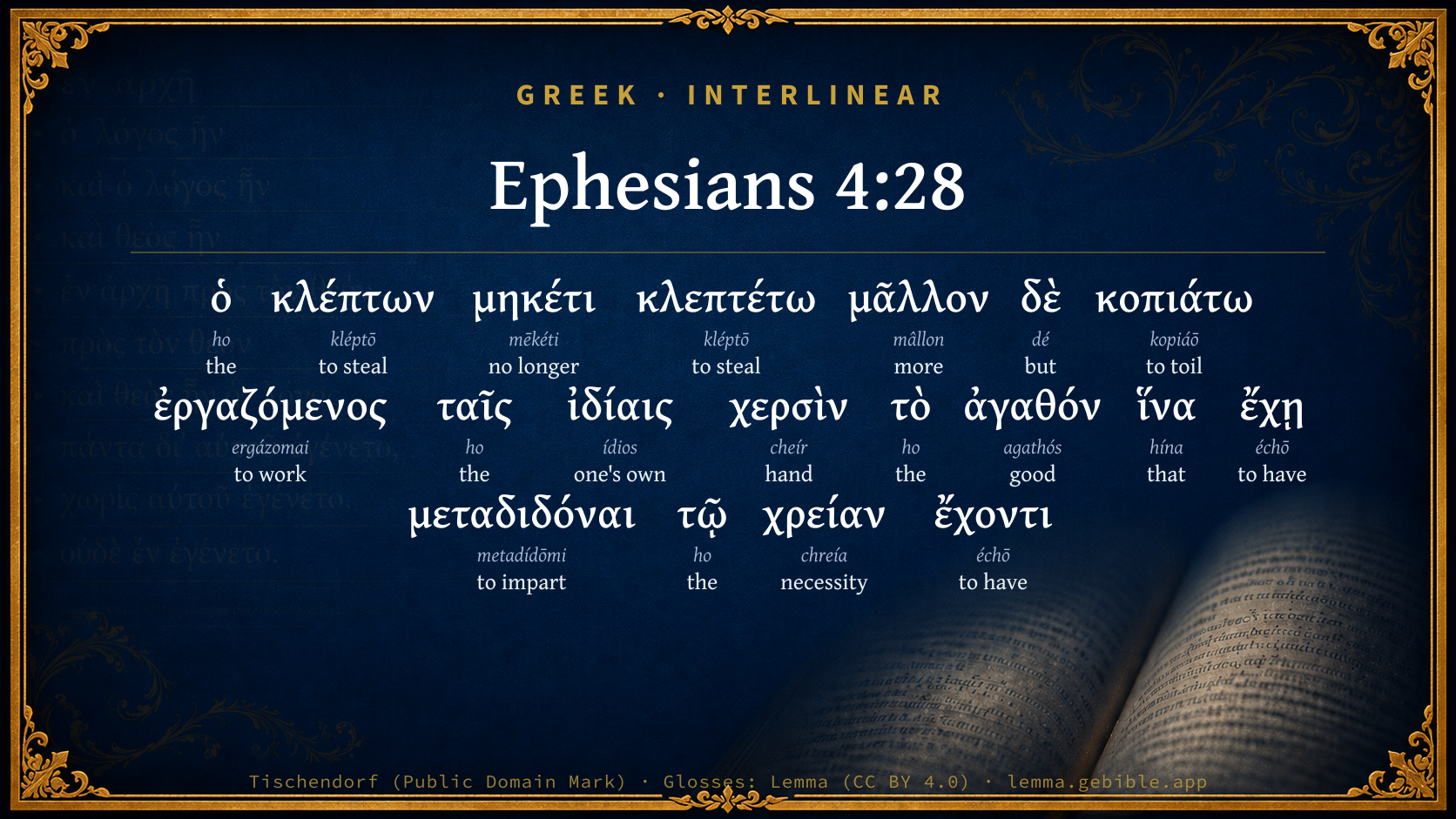
Let him who stole steal no more; but rather let him labor, working with his hands the thing that is good, that he may have something to give to him who has need.
Download a study sheet
One document with this verse’s original text, its word-by-word gloss line, the meaning frame, cross-references with their text, attributed commentary, and full source and license credits — printable, and it pastes into notes with its structure intact.
This verse Autodidact and up
A passage Seminary Student
Up to 50 verses in one chapter. A passage sheet keeps up to 6 commentary sources and 12 cross-references per verse, in the order this page ranks them, and says so on the sheet whenever that leaves anything out. Ask for a single verse and you get the Autodidact verse sheet above.
Everything on this page stays free to read, with no account — the sheet is a download of what is already on screen, not access to it.
Compare translations 3
The same verse in 3 English versions, stacked beneath the original-language interlinear above. Click any original word for its lexicon entry.
Each is an independent rendering of the whole verse — the interlinear is not word-aligned to these translations.
Highlighted words mark where these versions differ — a whole-verse word diff, not a word-by-word alignment.
-
World English Bible Public Domain
Let him who stole steal no more; but rather let him labor, working with his hands the thing that is good, that he may have something to give to him who has need.
-
King James Version Public Domain
Let him that stole steal no more: but rather let him labour, working with his hands the thing which is good, that he may have to give to him that needeth.
-
unfoldingWord Literal Text CC BY-SA 4.0
The thief must steal no longer. But rather, he must labor, working good with his hands, so that he may have something to share with the ones having need.
unfoldingWord Literal Text — © unfoldingWord, licensed CC BY-SA 4.0. Word-aligned USFM3 via Door43 (git.door43.org/unfoldingWord/en_ult).
Show all 19 translations
Every available English version of this verse, each an independent rendering of the whole verse.
-
World English Bible Public Domain
Let him who stole steal no more; but rather let him labor, working with his hands the thing that is good, that he may have something to give to him who has need.
-
Berean Standard Bible Public Domain
He who has been stealing must steal no longer, but must work, doing good with his own hands, that he may have something to share with the one in need.
-
Majority Standard Bible Public Domain
He who has been stealing must steal no longer, but must work, doing good with his hands, that he may have something to share with the one in need.
-
King James Version Public Domain
Let him that stole steal no more: but rather let him labour, working with his hands the thing which is good, that he may have to give to him that needeth.
-
American Standard Version (1901) Public Domain
Let him that stole steal no more: but rather let him labor, working with his hands the thing that is good, that he may have whereof to give to him that hath need.
-
Revised Version (1885) Public Domain
Let him that stole steal no more: but rather let him labour, working with his hands the thing that is good, that he may have whereof to give to him that hath need.
-
Geneva Bible (1599) Public Domain
Let him that stole, steale no more: but let him rather labour, and worke with his handes the thing which is good, that hee may haue to giue vnto him that needeth.
-
Douay-Rheims (1899) Public Domain
He that stole, let him now steal no more; but rather let him labour, working with his hands the thing which is good, that he may have something to give to him that suffereth need.
-
Young's Literal Translation Public Domain
whoso is stealing let him no more steal, but rather let him labour, working the thing that is good with the hands, that he may have to impart to him having need.
-
Literal Standard Version CC BY-SA 4.0
whoever is stealing let him no longer steal, but rather let him labor, working the thing that is good with the hands, that he may have to impart to him having need.
-
Unlocked Literal Bible CC BY-SA 4.0
The one who had been stealing must steal no longer. He must labor, doing useful work with his hands, so that he may have something to share with those who are in need.
-
unfoldingWord Literal Text CC BY-SA 4.0
The thief must steal no longer. But rather, he must labor, working good with his hands, so that he may have something to share with the ones having need.
-
Darby Bible Public Domain
Let the stealer steal no more, but rather let him toil, working what is honest with [his] hands, that he may have to distribute to him that has need.
-
World Messianic Bible Public Domain
Let him who stole steal no more; but rather let him labor, producing with his hands something that is good, that he may have something to give to him who has need.
-
Webster's Bible Public Domain
Let him that stole steal no more: but rather let him labor, working with his hands the thing which is good, that he may have to give to him that needeth.
-
Free Bible Version CC BY-SA 4.0
Thieves, stop your stealing, and do honest, productive work with your hands, so you'll have something to give to those who need it.
-
Bible in Basic English Public Domain
Let him who was a thief be so no longer, but let him do good work with his hands, so that he may have something to give to him who is in need.
-
Text-Critical English NT CC BY 4.0
He who steals must no longer steal; rather he must labor, doing honest work with his hands, so that he may have something to contribute to anyone in need.
-
Tyndale New Testament (1534) Public Domain
Let him that stole steale no moare but let him rather laboure with his hondes some good thinge that he maye have to geve vnto him that nedeth.
Literal Standard Version (2020), Covenant Press — licensed CC BY-SA 4.0. Text via the HelloAO Bible API (eBible.org). Unlocked Literal Bible (unfoldingWord) — licensed CC BY-SA 4.0. Text via the HelloAO Bible API (eBible.org). unfoldingWord Literal Text — © unfoldingWord, licensed CC BY-SA 4.0. Word-aligned USFM3 via Door43 (git.door43.org/unfoldingWord/en_ult). Free Bible Version, Dr. Jonathan Gallagher — licensed CC BY-SA 4.0. Text via the HelloAO Bible API (eBible.org).
Word by word
More ways to search: Search by grammar → Find every occurrence → Compare this word →
Practice this passage: Drill this verse → Learn its vocabulary →
- Appears 5× in the Greek New Testament
- First appears at Luke 3:11
- Part of Speech
- Verb
- Tense
- Present
- Voice
- Active
- Mood
- Infinitive
Full Thayer's Definition
- ὁ ho G3588 “the” Article, Nominative, Singular, Masculine
- κλέπτων kléptō G2813 “to steal” Verb, Present, Active, Participle, Nominative, Singular, Masculine
- μηκέτι mēkéti G3371 “no longer” Adverb, Negative
- κλεπτέτω kléptō G2813 “to steal” Verb, Present, Active, Imperative, 3rd person, Singular
- μᾶλλον mâllon G3123 “more” Adverb
- δὲ dé G1161 “but” Conjunction
- κοπιάτω kopiáō G2872 “to toil” Verb, Present, Active, Imperative, 3rd person, Singular
- ἐργαζόμενος ergázomai G2038 “to work” Verb, Present, Middle or Passive deponent, Participle, Nominative, Singular, Masculine
- ταῖς ho G3588 “the” Article, Dative, Plural, Feminine
- ἰδίαις ídios G2398 “one's own” Adjective, Dative, Plural, Feminine
- χερσὶν cheír G5495 “hand” Noun, Dative, Plural, Feminine
- τὸ ho G3588 “the” Article, Accusative, Singular, Neuter
- ἀγαθόν agathós G18 “good” Adjective, Accusative, Singular, Neuter
- ἵνα hína G2443 “that” Conjunction
- ἔχῃ échō G2192 “to have” Verb, Present, Active, Subjunctive, 3rd person, Singular
- μεταδιδόναι metadídōmi G3330 “to impart” Verb, Present, Active, Infinitive
- τῷ ho G3588 “the” Article, Dative, Singular, Masculine
- χρείαν chreía G5532 “necessity” Noun, Accusative, Singular, Feminine
- ἔχοντι échō G2192 “to have” Verb, Present, Active, Participle, Dative, Singular, Masculine
About this verse
These counts appear in no published source. They are computed here, from the morphology-tagged text and Lemma’s own curated glosses. What Lemma adds →
- 19
- words
- 14
- distinct lemmas
- Pauline Epistles
- section
Cross-references
28Topical passages linked to Ephesians 4:28 in the Treasury of Scripture Knowledge — connected by theme and wording, ordered by reader-vote popularity; previews shown in the World English Bible.
- 1 Timothy 6:18 that they do good, that they be rich in good works, that they be ready to distribute, willing to communicate;
- Galatians 6:10 So then, as we have opportunity, let's do what is good toward all men, and especially toward those who are of the household of the faith.
- 1 Thessalonians 4:11–12 and that you make it your ambition to lead a quiet life, and to do your own business, and to work with your own hands, even as we charged you;
- Exodus 20:15 "You shall not steal.
- 2 Thessalonians 3:11–12 For we hear of some who walk among you in rebellion, who don't work at all, but are busybodies.
- Zechariah 5:3 Then he said to me, "This is the curse that goes out over the surface of the whole land; for everyone who steals shall be cut off according to it on the one side; and everyone who swears falsely shall be cut off according to it on the other side.
- Luke 21:1–4 He looked up, and saw the rich people who were putting their gifts into the treasury.
- 2 Thessalonians 3:6–8 Now we command you, brothers, in the name of our Lord Jesus Christ, that you withdraw yourselves from every brother who walks in rebellion, and not after the tradition which they received from us.
- Hosea 4:2 There is cursing, lying, murder, stealing, and committing adultery; They break boundaries, and bloodshed causes bloodshed.
- Luke 3:10–14 The multitudes asked him, "What then must we do?"
- Jeremiah 7:9 Will you steal, murder, and commit adultery, and swear falsely, and burn incense to Baal, and walk after other gods that you have not known,
- John 12:6 Now he said this, not because he cared for the poor, but because he was a thief, and having the money box, used to steal what was put into it.
- Exodus 20:17 "You shall not covet your neighbor's house. You shall not covet your neighbor's wife, nor his man-servant, nor his maid-servant, nor his ox, nor his donkey, nor anything that is your neighbor's."
- Exodus 21:16 "Anyone who kidnaps someone and sells him, or if he is found in his hand, he shall surely be put to death.
- Proverbs 28:13 He who conceals his sins doesn't prosper, But whoever confesses and renounces them finds mercy.
- Luke 19:8 Zacchaeus stood and said to the Lord, "Behold, Lord, half of my goods I give to the poor. If I have wrongfully exacted anything of anyone, I restore four times as much."
- 1 Corinthians 6:10–11 nor thieves, nor covetous, nor drunkards, nor slanderers, nor extortioners, will inherit the Kingdom of God.
- Job 34:32 Teach me that which I don't see. If I have done iniquity, I will do it no more'?
- Proverbs 13:11 Wealth gained dishonestly dwindles away, But he who gathers by hand makes it grow.
- Proverbs 14:23 In all hard work there is profit, But the talk of the lips leads only to poverty.
- Proverbs 30:9 Lest I be full, deny you, and say, 'Who is Yahweh?' Or lest I be poor, and steal, And so dishonor the name of my God.
- Luke 3:8 Bring forth therefore fruits worthy of repentance, and don't begin to say among yourselves, 'We have Abraham for our father;' for I tell you that God is able to raise up children to Abraham from these stones!
- John 13:29 For some thought, because Judas had the money box, that Jesus said to him, "Buy what things we need for the feast," or that he should give something to the poor.
- Acts 20:34–35 You yourselves know that these hands ministered to my necessities, and to those who were with me.
- Romans 12:13 contributing to the needs of the saints; given to hospitality.
- 2 Corinthians 8:2 how that in much proof of affliction the abundance of their joy and their deep poverty abounded to the riches of their liberality.
- 2 Corinthians 8:12 For if the readiness is there, it is acceptable according to what you have, not according to what you don't have.
- 2 Corinthians 9:12–15 For this service of giving that you perform not only makes up for lack among the saints, but abounds also through many givings of thanks to God;
Cross-references courtesy of OpenBible.info (CC BY 4.0).
Lesson kit
Teaching starters — assembled from the data on this page, not authored interpretation. Every prompt links to the verse data it draws on. Edit before teaching.
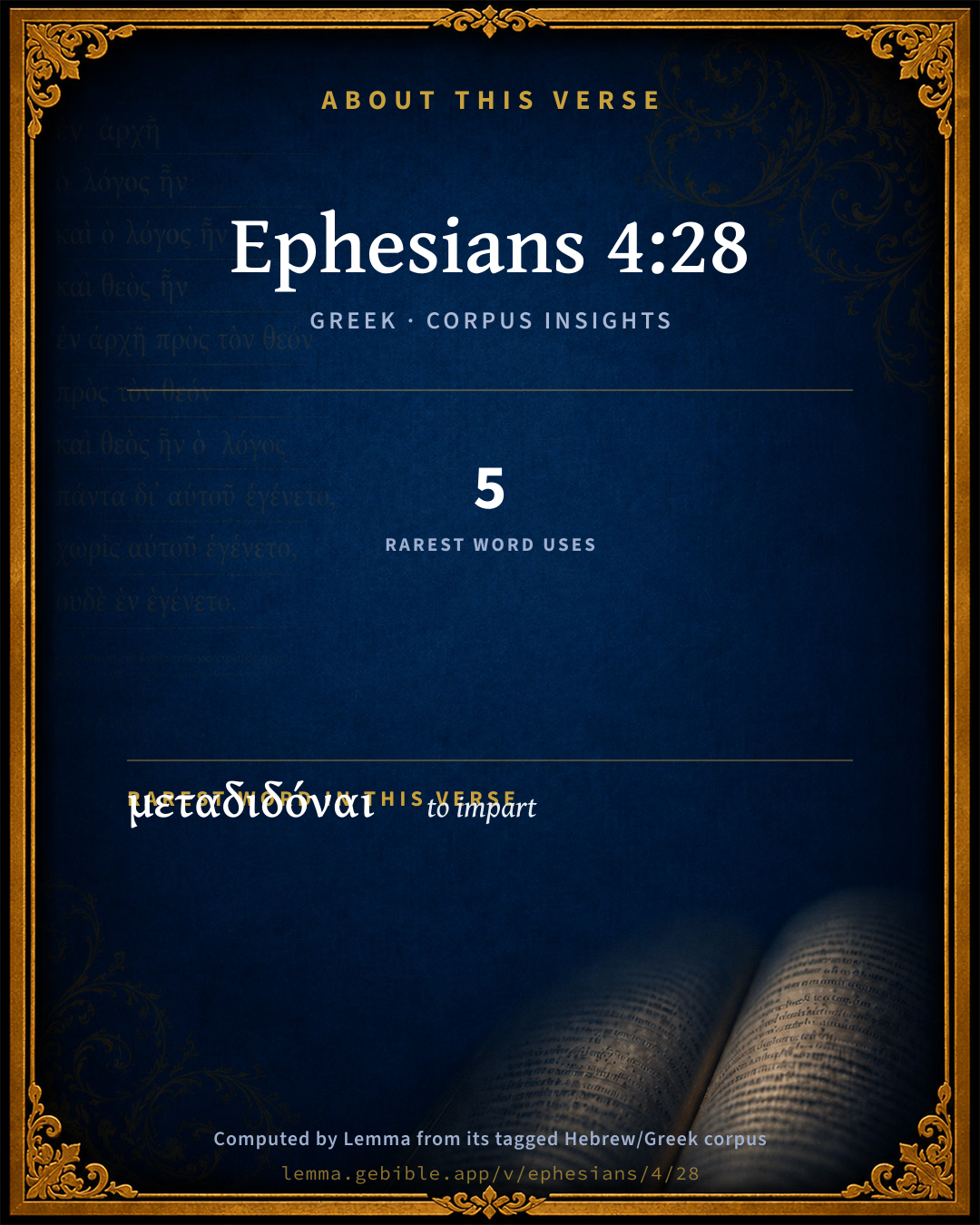
Ephesians, in the Pauline Epistles, opens this verse with 19 words (14 distinct Greek lemmas). Its most distinctive word is metadídōmi (“to impart”). A historical commentator’s framing appears above. Read the whole chapter for the surrounding context.
Discussion questions
- The word metadídōmi carries the sense “to impart.” How does it shape the verse?
- Luke 3:11 shares the word «to impart» with this verse. How do the two illuminate each other?
- “to steal” occurs 2× in this one verse. What is the effect of the repetition?
- These translations render this verse differently; the difference is in the English rendering, not the original. What questions does that raise?
- Reading how The Biblical Illustrator and Joseph Benson's Commentary read this verse, where do the two commentators agree and where do they part?
Things to notice
- These translations choose different wording for 20 words in this verse.
- “to steal” occurs 2× in this single verse.
- 14 distinct Greek lemmas span 19 words in this verse.
Commentary
Notes on Ephesians 4:28 from classic Christian and Jewish commentators (each source and its license shown beneath its notes). The classic Christian expositions comment on the surrounding passage and are grouped to its opening verse, so a note may address several verses; the Jewish commentaries on the Tanakh (Rashi and others) are per-verse, so they appear only where the commentator wrote on this verse.
Lemma curates 59 commentaries, every one of them public domain or Creative Commons licensed, each selected and text-cleaned for this edition rather than reprinted as found. About our sources →
The Biblical Illustrator
Joseph S. Exell
The Biblical Illustrator, edited by Joseph S. Exell (c. 1880s–1900s) — public domain. Text from a community e-Sword module.
Joseph Benson's Commentary
Joseph Benson's Commentary on the Old and New Testaments (1811–1818) — public domain. Text from a community e-Sword module.
Tyndale Open Study Notes
Tyndale Open Resources
Tyndale Open Study Notes — © Tyndale Open Resources, licensed CC BY-SA 4.0. Text via the HelloAO Bible API.
Bengel's Gnomon
Johann Albrecht Bengel
Bengel's Gnomon of the New Testament — English translation (T&T Clark, Edinburgh, 1860) — public domain. Text from a community e-Sword module.
Meyer's Critical & Exegetical Commentary
Heinrich August Wilhelm Meyer
Meyer — Critical and Exegetical Commentary on the New Testament — English translation by Peter Christie, edited by Frederick Crombie (T&T Clark, 1880) — public domain. Text from a community e-Sword module.
Expositor's Greek Testament
ed. W. Robertson Nicoll
The Expositor's Greek Testament, edited by W. Robertson Nicoll (1897–1910) — public domain. Text from a community e-Sword module.
Hodge's Commentary on Romans, Ephesians & First Corinthians
Charles Hodge
Charles Hodge — Commentary on Romans (1835), First Corinthians (1857), and Ephesians (1856) — public domain. Text from a community e-Sword module.
Geneva Bible (1599)
Geneva Bible translators
Geneva Bible (1599) marginal notes — public domain. Text via Bolls.life.
Jamieson, Fausset & Brown
Robert Jamieson, A. R. Fausset & David Brown
Jamieson, Fausset & Brown — Commentary Critical and Explanatory on the Whole Bible (1871) — public domain (CC PDM 1.0). Text via the HelloAO Bible API.
Adam Clarke's Commentary
Adam Clarke's Commentary on the Bible (1810–1826) — public domain. Text from a community e-Sword/MySword module.
John Calvin's Commentaries
John Calvin's Commentaries (1540-1563) — public domain. Text from the Calvin Translation Society English edition (1840s-50s) via the Christian Classics Ethereal Library (ccel.org). Calvin's coverage is partial (roughly two-thirds of the Bible); uncommented books and verses are honest gaps, never fabricated. The 19th-century editor's footnotes and remarks are omitted so the notes are faithfully Calvin's own voice.
Ellicott's Commentary for English Readers
A Bible Commentary for English Readers, edited by Charles John Ellicott (1878–1897) — public domain. Text from a community e-Sword module.
The Cambridge Bible for Schools and Colleges
gen. ed. J. J. S. Perowne
The Cambridge Bible for Schools and Colleges (gen. ed. J. J. S. Perowne; Cambridge University Press, 1878–1918) — public domain. Text from a community e-Sword module.
John Gill's Exposition
John Gill's Exposition of the Whole Bible (1746–1763) — public domain (CC PDM 1.0). Text via the HelloAO Bible API.
Trapp's Complete Commentary
John Trapp
John Trapp, A Commentary or Exposition upon All the Books of the Old and New Testament (1647–1656) — public domain. Text from a community e-Sword module.
Albert Barnes' Notes on the Bible
Albert Barnes' Notes on the Bible (1834–1885) — public domain. Text from a community e-Sword/MySword module.
Matthew Poole's English Annotations
Matthew Poole's English Annotations on the Holy Bible (1683–1685) — public domain. Text from a community e-Sword/MySword module.
Whedon's Commentary on the Bible
Daniel D. Whedon
Daniel D. Whedon (gen. ed.), Commentary on the Old and New Testaments (1874–1909) — public domain. Text from a community e-Sword module.
The Pulpit Commentary
The Pulpit Commentary (1880–1919), ed. H.D.M. Spence-Jones & Joseph S. Exell — public domain. Text from a community e-Sword module.
John Wesley's Explanatory Notes
John Wesley, Explanatory Notes Upon the Whole Bible (1754–1765) — public domain. Text via the GEBible commentary corpus.
Burkitt's Expository Notes on the New Testament
William Burkitt
William Burkitt's Expository Notes on the New Testament (1700–1703) — public domain. Text from a community e-Sword module.
The People's New Testament
B. W. Johnson
B. W. Johnson's The People's New Testament with Notes (1889–1891) — public domain. Electronic text from the Christian Classics Ethereal Library (CCEL) ThML edition.
unfoldingWord translationNotes
Door43 World Missions Community
unfoldingWord translationNotes — © Distant Shores Media and the Door43 World Missions Community, licensed CC BY-SA 4.0. Source: git.door43.org/Door43/en_tn.
Cambridge Greek Testament for Schools and Colleges
Cambridge Greek Testament for Schools and Colleges (Cambridge University Press, 1896; 21 vols, various authors incl. Carr, Maclear, Plummer, Farrar, Lumby, Moule, M. R. James, Simcox) — public domain. Text from a community e-Sword module.
Alford’s Greek Testament
Henry Alford
Henry Alford, The Greek Testament (1849–1861) — public domain. Text from a community e-Sword module.
International Critical Commentary
International Critical Commentary — older volumes (1896–1929), various authors — public domain. Text from a community e-Sword module.