
Acts 28:8

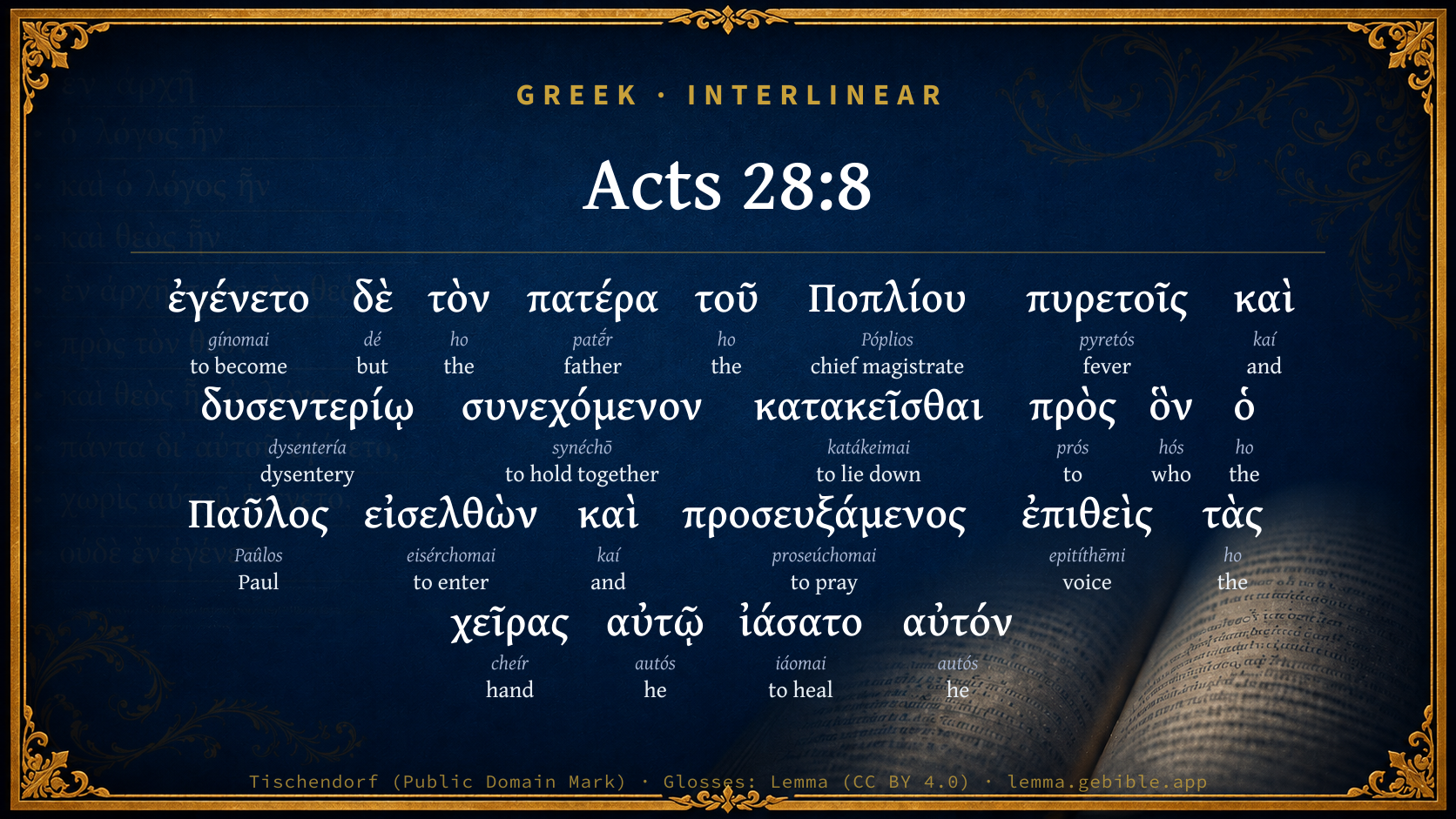
Greek (Tischendorf 8th ed.) Acts 28:8 appears in the Greek New Testament. The text above is from the Tischendorf 8th edition. Each word links to its Strong’s number and a concise gloss. Click any word for its full Thayer’s Greek Lexicon entry.
Download image
Cite this verse

Acts 28:8 (World English Bible). Public Domain. Lemma interlinear Bible study tool, https://lemma.gebible.app/v/acts/28/8.

Show BibTeX & RIS
BibTeX
RIS
English Translation
It happened that the father of Publius lay sick of fever and dysentery. Paul entered in to him, prayed, and laying his hands on him, healed him.
World English Bible · Public Domain
Highlights
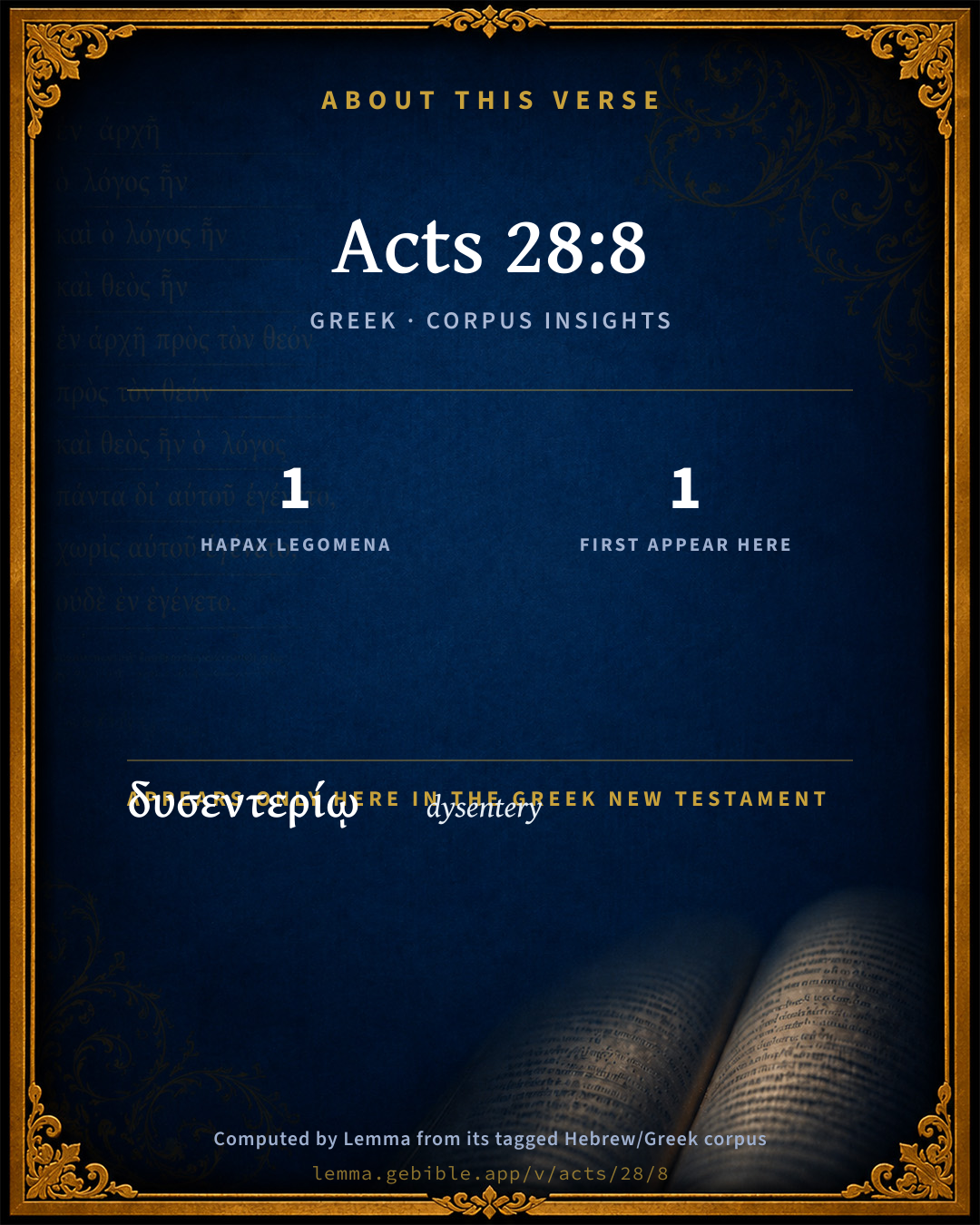
  • 1 hapax legomenon — only here in the Greek New Testament
  • 1 first appearance in the Greek New Testament
Full analysis ↓
Download a study sheet

One document with this verse’s original text, its word-by-word gloss line, the meaning frame, cross-references with their text, attributed commentary, and full source and license credits — printable, and it pastes into notes with its structure intact.

This verse Autodidact and up

Study sheet (.html) Plain text (.txt)

A passage Seminary Student

Up to 50 verses in one chapter. A passage sheet keeps up to 6 commentary sources and 12 cross-references per verse, in the order this page ranks them, and says so on the sheet whenever that leaves anything out. Ask for a single verse and you get the Autodidact verse sheet above.

Everything on this page stays free to read, with no account — the sheet is a download of what is already on screen, not access to it.

Want to remove ads? Support Godless Engineer
Compare translations 3

The same verse in 3 English versions, stacked beneath the original-language interlinear above. Click any original word for its lexicon entry.

Each is an independent rendering of the whole verse — the interlinear is not word-aligned to these translations.

Highlighted words mark where these versions differ — a whole-verse word diff, not a word-by-word alignment.

  • World English Bible Public Domain
    It happened that the father of Publius lay sick of fever and dysentery. Paul entered in to him, prayed, and laying his hands on him, healed him.
  • King James Version Public Domain
    And it came to pass, that the father of Publius lay sick of a fever and of a bloody flux: to whom Paul entered in, and prayed, and laid his hands on him, and healed him.
  • unfoldingWord Literal Text CC BY-SA 4.0
    And it happened that the father of Publius was lying sick, being afflicted with fevers and dysentery, to whom having gone in and having prayed, having placed hands on him, Paul healed him.

unfoldingWord Literal Text — © unfoldingWord, licensed CC BY-SA 4.0. Word-aligned USFM3 via Door43 (git.door43.org/unfoldingWord/en_ult).

Versions to compare (up to 4)

3 of 4 selected

Show all 19 translations

Every available English version of this verse, each an independent rendering of the whole verse.

  • World English Bible Public Domain
    It happened that the father of Publius lay sick of fever and dysentery. Paul entered in to him, prayed, and laying his hands on him, healed him.
  • Berean Standard Bible Public Domain
    The father of Publius was sick in bed, suffering from fever and dysentery. Paul went in to see him, and after praying and placing his hands on him, he healed the man.
  • Majority Standard Bible Public Domain
    The father of Publius was sick in bed, suffering from fever and dysentery. Paul went in to see him, and after praying and placing his hands on him, he healed the man.
  • King James Version Public Domain
    And it came to pass, that the father of Publius lay sick of a fever and of a bloody flux: to whom Paul entered in, and prayed, and laid his hands on him, and healed him.
  • American Standard Version (1901) Public Domain
    And it was so, that the father of Publius lay sick of fever and dysentery: unto whom Paul entered in, and prayed, and laying his hands on him healed him.
  • Revised Version (1885) Public Domain
    And it was so, that the father of Publius lay sick of fever and dysentery: unto whom Paul entered in, and prayed, and laying his hands on him healed him.
  • Geneva Bible (1599) Public Domain
    And so it was, that the father of Publius lay sicke of the feauer, and of a bloodie flixe: to whom Paul entred in, and when he prayed, he laide his hands on him, and healed him.
  • Douay-Rheims (1899) Public Domain
    And it happened that the father of Publius lay sick of a fever, and of a bloody flux. To whom Paul entered in; and when he had prayed, and laid his hands on him, he healed him.
  • Young's Literal Translation Public Domain
    and it came to pass, the father of Publius with feverish heats and dysentery pressed, was laid, unto whom Paul having entered, and having prayed, having laid `his' hands on him, healed him;
  • Literal Standard Version CC BY-SA 4.0
    and it came to pass, the father of Publius was lying, oppressed with fevers and dysentery, to whom Paul, having entered and having prayed, having laid [his] hands on him, healed him;
  • Unlocked Literal Bible CC BY-SA 4.0
    It happened that the father of Publius had been made ill with a fever and dysentery. When Paul went to him, he prayed, placed his hands on him, and healed him.
  • unfoldingWord Literal Text CC BY-SA 4.0
    And it happened that the father of Publius was lying sick, being afflicted with fevers and dysentery, to whom having gone in and having prayed, having placed hands on him, Paul healed him.
  • Darby Bible Public Domain
    And it happened that the father of Publius lay ill of fever and dysentery; to whom Paul entered in, and having prayed and laid his hands on him cured him.
  • World Messianic Bible Public Domain
    The father of Publius lay sick of fever and dysentery. Paul entered in to him, prayed, and laying his hands on him, healed him.
  • Webster's Bible Public Domain
    And it came to pass that the father of Publius lay sick with a fever, and a bloody-flux: to whom Paul entered in, and prayed, and laid his hands on him, and healed him.
  • Free Bible Version CC BY-SA 4.0
    Now Publius' father was sick, lying in bed suffering from fever and dysentery. Paul went in to see him, and prayed for him, placed his hands on him, and healed him.
  • Bible in Basic English Public Domain
    And the father of Publius was ill, with a disease of the stomach; to whom Paul went, and put his hands on him, with prayer, and made him well.
  • Text-Critical English NT CC BY 4.0
    Now it so happened that the father of Publius lay sick in bed, suffering from fevers and dysentery. So Paul went in to see him and healed him by praying and laying his hands on him.
  • Tyndale New Testament (1534) Public Domain
    And it fortuned that the father of Publius laye sicke of a fiever and of a bluddy flixe. To who Paul entred in and prayde and layde his hondes on him and healed him.

Literal Standard Version (2020), Covenant Press — licensed CC BY-SA 4.0. Text via the HelloAO Bible API (eBible.org). Unlocked Literal Bible (unfoldingWord) — licensed CC BY-SA 4.0. Text via the HelloAO Bible API (eBible.org). unfoldingWord Literal Text — © unfoldingWord, licensed CC BY-SA 4.0. Word-aligned USFM3 via Door43 (git.door43.org/unfoldingWord/en_ult). Free Bible Version, Dr. Jonathan Gallagher — licensed CC BY-SA 4.0. Text via the HelloAO Bible API (eBible.org).

Word by word

More ways to search: Search by grammar → Find every occurrence → Compare this word →

Practice this passage: Drill this verse → Learn its vocabulary →

δυσεντερίῳ
dysentería
G1420
“dysentery”
Noun, Dative, Singular, Feminine
Part of Speech
Noun
Case
Dative
Number
Singular
Gender
Feminine
Full Thayer's Definition

Origin: from G1418 and a comparative of G1787 (meaning a bowel)

TDNT: None

1. dysentery, bowel ailment
  1. ἐγένετο gínomai G1096 “to become” Verb, Aorist, Middle deponent, Indicative, 3rd person, Singular
  2. δὲ dé G1161 “but” Conjunction
  3. τὸν ho G3588 “the” Article, Accusative, Singular, Masculine
  4. πατέρα patḗr G3962 “father” Noun, Accusative, Singular, Masculine
  5. τοῦ ho G3588 “the” Article, Genitive, Singular, Masculine
  6. Ποπλίου Póplios G4196 “chief magistrate” Noun, Genitive, Singular, Masculine
  7. πυρετοῖς pyretós G4446 “fever” Noun, Dative, Plural, Masculine
  8. καὶ kaí G2532 “and” Conjunction
  9. συνεχόμενον synéchō G4912 “to hold together” Verb, Present, Passive, Participle, Accusative, Singular, Masculine
  10. κατακεῖσθαι katákeimai G2621 “to lie down” Verb, Present, Middle or Passive deponent, Infinitive
  11. πρὸς prós G4314 “to” Preposition
  12. ὃν hós G3739 “who” Relative pronoun, Accusative, Singular, Masculine
  13. ὁ ho G3588 “the” Article, Nominative, Singular, Masculine
  14. Παῦλος Paûlos G3972 “Paul” Noun, Nominative, Singular, Masculine
  15. εἰσελθὼν eisérchomai G1525 “to enter” Verb, Aorist, Active, Participle, Nominative, Singular, Masculine
  16. καὶ kaí G2532 “and” Conjunction
  17. προσευξάμενος proseúchomai G4336 “to pray” Verb, Aorist, Middle deponent, Participle, Nominative, Singular, Masculine
  18. ἐπιθεὶς epitíthēmi G2007 “voice” Verb, Aorist, Active, Participle, Nominative, Singular, Masculine
  19. τὰς ho G3588 “the” Article, Accusative, Plural, Feminine
  20. χεῖρας cheír G5495 “hand” Noun, Accusative, Plural, Feminine
  21. αὐτῷ autós G846 “he” Personal pronoun, Dative, Singular, Masculine
  22. ἰάσατο iáomai G2390 “to heal” Verb, Aorist, Middle deponent, Indicative, 3rd person, Singular
  23. αὐτόν autós G846 “he” Personal pronoun, Accusative, Singular, Masculine

About this verse

These counts appear in no published source. They are computed here, from the morphology-tagged text and Lemma’s own curated glosses. What Lemma adds →

24
words
19
distinct lemmas
Acts
section

Notable vocabulary

1 hapax legomenon — a word that appears only here in the entire Greek New Testament:

  • δυσεντερίῳ dysentery G1420

First appearance in Scripture

This word makes its first canonical appearance in the Greek New Testament here:

  • δυσεντερίῳ dysentery G1420

Shared distinctive vocabulary

Ποπλίου chief magistrate G4196 occurs in 2 verses of the Greek New Testament. Also found in:
Repetition

Words recur within this verse:

Cross-references

19

Topical passages linked to Acts 28:8 in the Treasury of Scripture Knowledge — connected by theme and wording, ordered by reader-vote popularity; previews shown in the World English Bible.

  • Acts 9:40 Peter put them all out, and kneeled down and prayed. Turning to the body, he said, "Tabitha, get up!" She opened her eyes, and when she saw Peter, she sat up.
  • Mark 6:5 He could do no mighty work there, except that he laid his hands on a few sick people, and healed them.
  • Matthew 9:18 While he told these things to them, behold, a ruler came and worshiped him, saying, "My daughter has just died, but come and lay your hand on her, and she will live."
  • James 5:14–16 Is any among you sick? Let him call for the elders of the assembly, and let them pray over him, anointing him with oil in the name of the Lord,
  • Matthew 10:8 Heal the sick, cleanse the lepers, and cast out demons. Freely you received, so freely give.
  • Mark 16:18 they will take up serpents; and if they drink any deadly thing, it will in no way hurt them; they will lay hands on the sick, and they will recover."
  • Matthew 10:1 He called to himself his twelve disciples, and gave them authority over unclean spirits, to cast them out, and to heal every disease and every sickness.
  • Luke 13:13 He laid his hands on her, and immediately she stood up straight, and glorified God.
  • Acts 19:11–12 God worked special miracles by the hands of Paul,
  • 1 Corinthians 12:9 to another faith, by the same Spirit; and to another gifts of healings, by the same Spirit;
  • 1 Corinthians 12:28 God has set some in the assembly: first apostles, second prophets, third teachers, then miracle workers, then gifts of healings, helps, governments, and various kinds of languages.
  • Luke 4:40 When the sun was setting, all those who had any sick with various diseases brought them to him; and he laid his hands on every one of them, and healed them.
  • Luke 9:1–3 He called the twelve together, and gave them power and authority over all demons, and to cure diseases.
  • Luke 10:8–9 Into whatever city you enter, and they receive you, eat the things that are set before you.
  • 1 Kings 17:20–22 He cried to Yahweh, and said, Yahweh my God, have you also brought evil on the widow with whom I sojourn, by killing her son?
  • Mark 1:30–31 Now Simon's wife's mother lay sick with a fever, and immediately they told him about her.
  • Mark 5:23 and begged him much, saying, "My little daughter is at the point of death. Please come and lay your hands on her, that she may be made healthy, and live."
  • Mark 7:32 They brought to him one who was deaf and had an impediment in his speech. They begged him to lay his hand on him.
  • Acts 9:17–18 Ananias departed, and entered into the house. Laying his hands on him, he said, "Brother Saul, the Lord, who appeared to you on the road by which you came, has sent me, that you may receive your sight, and be filled with the Holy Spirit."

Cross-references courtesy of OpenBible.info (CC BY 4.0).

Commentary

Notes on Acts 28:8 from classic Christian and Jewish commentators (each source and its license shown beneath its notes). The classic Christian expositions comment on the surrounding passage and are grouped to its opening verse, so a note may address several verses; the Jewish commentaries on the Tanakh (Rashi and others) are per-verse, so they appear only where the commentator wrote on this verse.

Lemma curates 59 commentaries, every one of them public domain or Creative Commons licensed, each selected and text-cleaned for this edition rather than reprinted as found. About our sources →

The Pulpit Commentary

It was so for it came to pass, A.V.; fever for a fever, A.V.; dysentery for of a bloody flux, A.V.; unto for to, A.V.; and laying, etc., healed for and laid, etc., and healed, A.V.. The father of Publius. The fact of the father of Publius being alive and living in Malta is a further indication that the term oJ prwtov thv nhsou is an official title. Lay sick. Sunecesqai is also the usual medical expression for being taken sick of any disease (see the numerous passages quoted by Hobart, pp. 3, 4, from Galen and Hippocrates). It is used by St. Luke, with puretw, (Luk_4:38) and in the same sense in Mat_4:24. Lay. Katakeisqai is used especially of lying in bed from sickness. (see Mar_1:30 2:4; Luk_5:25; Act_9:33) It answers to decumbo in Latin. Sick of fever and dysentery (puretoiv kaia sunecomenon). The terms here used are all professional ones. Puretov, in the plural, is of frequent occurrence in Hippocrates, Aretaeus, and Galen, but elsewhere in the New Testament always in the singular; dusenteria, only found here in the New Testament, is the regular technical word for a "dysentery," and is frequently in medical writers coupled with puretoi or puretov, as indicating different stages of the same illness. Laying his hands on him. Mar_16:18, "They shall lay hands on the sick, and they shall recover". (see also Mat_9:18 Mat_19:13, Mat_19:15; Mar_5:23 6:5 7:32 8:23, 25; Luk_4:40 Luk_13:13; Act_9:12) It is also spoken of as an accompaniment of prayer in confirmation, ordination, etc. It has been remarked as curious that the two actions of taking up serpents and healing the sick by the laying on of hands should be in such close juxtaposition both hero and in Mar_16:18. It suggests the thought whether Luke had seen the passage in St. Mark; or whether the writer of Mar_16:18 had seen Act_28:8. Or is the coincidence accidental, arising out of the facts?

Christian returns for kindness shown.

far from the scene of the shipwreck lay the town now called Alta Vecchia, the residence of Publius, the governor of the island, who was probably a legate of the Printer of Sicily. Since Julius was a person of distinction, this Roman official, who bore the title of protos (first) a local designation, the accuracy of which is supported by inscriptions offered to the centurion a genial hospitality, in which Paul and his friends were allowed to share. It happened that at that time the father of Publius was lying prostrated by feverish attacks complicated with dysentery. St. Luke was a physician, but his skill was less effectual than the agency of St. Paul, who went into the sick man"s chamber, prayed by his bedside, laid his hands on him, and healed him. The rumor of the cure spread through the little island, and caused all the sick inhabitants to come for help and tendance. We may be sure that St. Paul, though we do not hear of his founding any Church, yet lost no opportunity of making known the gospel" (Farrar). In this instance the order of St. Paul"s words have to be changed. He had received their "carnal things," and he gladly returned to them his "spiritual things." We observe

I CHRISTIANS CAN RECEIVE FROM THE WORLD BODILY AND CIRCUMSTANTIAL BLESSINGS. These are all that the world has at its command; but these Christians need. They may be illustrated under the headings:

1. Hospitalities.

2. Charities.

3. Sympathies.

4. Practical aids.

So the barbarous people could light a fire and show kindness to St. Paul, and Publius could offer to him and his friends generous hospitalities. Especially dwell on the virtue of hospitality, noticing that it was a characteristic excellence of ancient times; it is a virtue carefully cultivated in the East, and more particularly among tribes, in the present day; and that, while it is retained, it is set under very narrow limitations in modern civilized nations, where class prejudices are strong.

II CHRISTIANS CAN GIVE TO THE WORLD BOTH BODILY AND SPIRITUAL BLESSINGS, They have the common powers of brotherhood and helpfulness which belong to men as set in human relations; but they can also do for their fellows what no other class of men can do. They have a new life; that life finds its own peculiar and characteristic expression. It exerts both

(1) an unconscious and

(2) a conscious influence for good.

Illustrate that Christians can save a city, as ten righteous men would have saved Sodom. They may preserve from temporal calamity by their calmness in the hour of danger, through their faith in God; as may be seen in times of shipwreck. They may have actual power to heal, as the apostles had. They can certainly witness for the living God; commend the service of the Lord Jesus Christ; carry healing balm to sin-sick souls; comfort the weary and heavy-laden; and minister truth and sympathy and love where these are needed. They can be preserving salt; uplifted light-bearers; and upon them may hang, in full clusters, the rich ripe fruits which the world so greatly needs for its refreshing and its spiritual health. Impress that what the Christian man can be he ought to be and should strive to he. Herein is my Father glorified, that ye bear much fruit; so shall ye be my disciples. R.T.

The Pulpit Commentary (1880–1919), ed. H.D.M. Spence-Jones & Joseph S. Exell — public domain. Text from a community e-Sword module.

Tyndale Open Study Notes

Tyndale Open Resources

28:8-9 Cp. Luke 4:38-40.

Tyndale Open Study Notes — © Tyndale Open Resources, licensed CC BY-SA 4.0. Text via the HelloAO Bible API.

Bengel's Gnomon

Johann Albrecht Bengel

Act 28:8. Ἐγένετο, It came to pass) There is described a disease most serious, in respect to the age of the patient and the complication of the maladies.—πυρετοῖς, fevers) A complicated fever; or one of such a kind that he often fell into it. The Plural has this force.

Bengel's Gnomon of the New Testament — English translation (T&T Clark, Edinburgh, 1860) — public domain. Text from a community e-Sword module.

Expositor's Greek Testament

ed. W. Robertson Nicoll

Act 28:8 . πυρετοῖς : the use of the plural for a fever is peculiar to St. Luke in N.T., and quite medical, Hobart, J. Smith, Zahn ( cf. Luk 4:38-39 ); although the plural is found in Dem., Lucian in the sense of “intermittent attacks of fever,” but Hobart shows that the term was very common in Hipp., and he also quotes from Aretæus and Galen. Each of the other Evangelists uses πυρετός , but in the singular, never in the plural. The disease was common in Malta (J. Smith and C. and H.). δυσεντερίᾳ , see critical note, “dysentery,” R.V.; “Lucas medicus morbos accuratius describere solet,” Wetstein; another medical term, peculiar to St. Luke in N.T., often joined with πυρετός by Hippocrates (Hobart, Zahn). συνεχ ., cf. Luk 4:38 , συνεχομένη πυρετῷ μεγάλῳ , where St. Luke not only speaks of πυρ . μέγας , where Matthew and Mark (Mat 8:14 and Mar 1:30 ) have simply πυρετός , but also introduces the term συνεχ . where they have πυρέσσουσα ; ἔχεσθαι and συνέχ . are both used by the medical writers as in these passages, although no doubt συνέχεσθαι is sometimes found with a word like νοσήματι in classical Greek ( cf. Grotius. in loco , Hobart, Zahn, Weiss), so in Hippocrates, ὑπὸ δυσεντερίης ἐχομένῳ , and τοῖσιν ὑπὸ τῆς ἡρακλείης νόσου συνεχομένοισιν ; nine times in St. Luke, elsewhere only three times in N.T., and once in St.Mat 4:24 , in a way similar to St. Luke, but joined there not only with νόσοις , but with a word ( βασάνοις ) which the medical writers (so St. Luke) never employ of bodily disease. Ιάσατο αὐτόν , cf. Mar 16:18 , the word is more frequently used by the medical writers for “healing” than any other (Hobart), and it occurs in St. Luke’s writings fourteen times and once figuratively, in St. Matthew four times and once figuratively, once in St. Mark, three times in St. John, once figuratively, and in the rest of the N.T. three times, but in each case figuratively. In answer to the attempts to regard the miraculous element as an addition to the narrative here, as in the previous chapter, it may be sufficient to quote the remarks of Weizsäcker: “The stormy voyage and shipwreck form the central point of the narrative: to this is appended the residence at Malta. In the former, Paul reveals himself as a prophet; in the latter, as the possessor of miraculous power. We should make a vast mistake, however, if we were to infer from this that the simple travel-record had here been revised by a writer intent upon artificially glorifying the Apostle as a worker of miracles. The narrative is an indivisible whole; it is impossible to disentangle the mere history of travel from it, or to strip away the miraculous additions,” Apostolic Age , ii., p. 126, E.T.

The Expositor's Greek Testament, edited by W. Robertson Nicoll (1897–1910) — public domain. Text from a community e-Sword module.

Jamieson, Fausset & Brown

Robert Jamieson, A. R. Fausset & David Brown

the father of Publius lay sick of a fever--"fevers." The word was often thus used in the plural number, probably to express recurring attacks.

and of a bloody flux--"of dysentery." (The medical accuracy of our historian's style has been observed here.)

to whom Paul entered in, and prayed--thereby precluding the supposition that any charm resided in himself.

and laid his hands on him, and healed him--Thus, as our Lord rewarded Peter for the use of his boat (Luk 5:3-4, &c.), so Paul richly repays Publius for his hospitality. Observe the fulfilment here of two things predicted in Mar 16:18 --the "taking up serpents," and "recovering of the sick by laying hands on them."

Jamieson, Fausset & Brown — Commentary Critical and Explanatory on the Whole Bible (1871) — public domain (CC PDM 1.0). Text via the HelloAO Bible API.

Adam Clarke's Commentary

Verse 8. The father of Publius lay sick] πυρετοις και δυσεντερια; Of a fever and dysentery; perhaps a cholera morbus.

Paul - prayed] That God would exert his power; and laid his hands on him, as the means which God ordinarily used to convey the energy of the Holy Spirit, and healed him; God having conveyed the healing power by this means. In such a disorder as that mentioned here by St. Luke, where the bowels were in a state of inflammation, and a general fever aiding the dysentery in its work of death, nothing less than a miracle could have made an instantaneous cure in the patient. Such a cure was wrought, and even the heathens saw that it was the hand of God.

Adam Clarke's Commentary on the Bible (1810–1826) — public domain. Text from a community e-Sword/MySword module.

John Calvin's Commentaries

8. And had laid his hands upon him Paul declareth by prayer that he himself is not the author of the miracle, but only the minister, lest God be defrauded of his glory. He confirmeth this self-same thing by the external sign. For, as we saw before, in other places, the laying on of hands was nothing else but a solemn rite of offering and presenting. Wherefore, in that Paul doth offer the man to God with his own hands, he professed that he did humbly crave his life of him. By which example, not only those who have excellent gifts of the Spirit given them are admonished to beware, lest by extolling themselves they darken the glory of God, but also we are all taught in general that we must so thank the ministers of the grace of God that the glory remain to him alone. It is said, indeed, that Paul healed the man which had the bloody flux; but it is plainly expressed by the circumstances which are added, that it was God which bestowed this benefit, making him the minister thereof. Whereas Luke saith afterwards, that others which were sick in the isle were cured, he doth not extend it unto all; but his meaning is, that the power of God, which appeared evidently enough, was proved by many testimonies, that the apostleship of Paul might be thereby ratified. Neither need we doubt but that Paul sought as well to cure their souls as their bodies. Yet Luke doth not declare what good he did, save only that the barbarians gave him and his fellows victual and necessary things when they loosed from the haven. In the mean season, we must note, that though Paul might have withdrawn himself, and have escaped many ways, yet was the will of God to him instead of voluntary fetters, because he was often cited by the heavenly oracle to appear before the judgment-seat of Nero to bear witness of Christ. Again, he knew that if he should run away, he could no longer have preached the gospel, but should have lurked in some corner during his whole life.

John Calvin's Commentaries (1540-1563) — public domain. Text from the Calvin Translation Society English edition (1840s-50s) via the Christian Classics Ethereal Library (ccel.org). Calvin's coverage is partial (roughly two-thirds of the Bible); uncommented books and verses are honest gaps, never fabricated. The 19th-century editor's footnotes and remarks are omitted so the notes are faithfully Calvin's own voice.

Ellicott's Commentary for English Readers

(8) Lay sick of a fever and a bloody flux.—Literally, with fevers and dysentery, both words being used by St. Luke with professional precision. The plural, “fevers,” probably indicates the attacks of a recurrent fever, and its combination with dysentery would, according to Hippocrates, who also uses the plural form (Aph. vi. 3), make the case more than usually critical. The disease is said to be far from uncommon in Malta.

Prayed, and laid his hands on him.—The union of the two acts reminds us of the rule given in Jas_5:14-15; and the close sequence of the work of the healing upon the escape from the serpent’s bite, of the juxtaposition of the two promises of Mar_16:18.

A Bible Commentary for English Readers, edited by Charles John Ellicott (1878–1897) — public domain. Text from a community e-Sword module.

The Cambridge Bible for Schools and Colleges

gen. ed. J. J. S. Perowne

8. And it came to pass, that] [R.V. “and it was so, that”]. The R. V. is the better modern rendering. The expression means “It happened that, &c.,” not that after the arrival of St Paul the father fell ill, which might be taken as the meaning of the A. V.

of a fever and of a bloody flixe] [R. V. “of fever and dysentery”]. The words are technical such as a physician, as St Luke is reputed to have been, would be likely to use in describing the disease. The first, which is in the plural number, implies the fits of fever which occur at intervals in such diseases as ague.

The Cambridge Bible for Schools and Colleges (gen. ed. J. J. S. Perowne; Cambridge University Press, 1878–1918) — public domain. Text from a community e-Sword module.

John Gill's Exposition

And it came to pass that the father of Publius,.... So that Publius was not an old man, though of so much dignity and wealth: the Arabic version, contrary to all copies, and other versions, reads, "the son of Publius":

lay sick of a fever; or fevers, of different sorts, a complication of them, which sometimes is the case; unless this was an intermitting fever, and the several fits of it are intended; or rather the plural number is put for the singular, to denote the vehemence of it, and which was attended with another disorder, and might be brought on by it:

and of a bloody flux; or dysentery, a pain of the bowels, as the Syriac version renders it; or an ulceration of the bowels, as the Arabic version; which occasioned a discharge of blood, so that his case was very threatening. This disease, according to modern writers (y), is attended with a fever. The word "dysentery" here used properly signifies that kind of flux of the belly, characterized by the frequency of stools, or dejections, mixed with blood, and accompanied with gripes: the fever, ulcer, &c. which attend it, are not essential to the disease; though many both of the ancients and moderns think the ulcer is.--There are three kinds of "dysenteries"; the "first" when a laudable blood is evacuated from a mere plethora, or plenitude, without any disorder of the intestines, as in the haemorrhoidal flux; the "second" when a thin watery blood is evacuated, called the "hepatic" flux, though really arising from haemorrhoidal vessels; the "third" kind, which is that that is properly called the dysentery, is when blood is cast out, mixed with a purulent matter in the excrements: this is either "benign", i.e. without a fever, and not contagious; or "malignant", which is attended with a pestilential fever, and frequently ravages whole cities and provinces, happening most commonly in armies; in the last stage, a sort of caruncles are frequently ejected along with the purulent matter, which are difficult to be accounted for, unless from an excoriation and ulceration of the intestines: sometimes the intestines are even gangrened: this seems to have been the case of the father of Publius, which makes the following cure the more remarkable:

to whom Paul entered in; into the room where he was, no doubt with the consent and leave, if not at the request of Publius; the Ethiopic version adds, "and he entreated him to put his hand upon him"; that is, either Publius asked this favour of the apostle for his father, having heard of the affair of the viper, from whence he concluded there was something divine and extraordinary in him; or the father of Publius asked this for himself:

and prayed and laid his hands on him, and healed him; when Paul had entered the room, and found in what a bad condition the sick man was, he either kneeled down and prayed by him, or stood and prayed over him, and for him, that God would restore him to his health; and this he did, to let them know that he himself was not a god; and that the cure that would now be wrought would be from God, and not from himself, and therefore all the glory should be given to God; and he laid his hands on him, as a sign or symbol, or rite that was used in extraordinary cases, and agreeably to the direction and promise of Christ, Mar 16:18; and upon this a cure followed; both the diseases left him at once, and he was restored to health.

(y) See Chambers's Cyclopaedia in the word "Dysentery".

John Gill's Exposition of the Whole Bible (1746–1763) — public domain (CC PDM 1.0). Text via the HelloAO Bible API.

Trapp's Complete Commentary

John Trapp

8 And it came to pass, that the father of Publius lay sick of a fever and of a bloody flux: to whom Paul entered in, and prayed, and laid his hands on him, and healed him.

Ver. 8. Sick of a fever] Which hath its name both in Greek and Latin from the fire that is in it, πυρετος. Febris a fervore. The difference is not so great whether a man broil in the bed, or at a stake by frying a faggot: fear it not.

John Trapp, A Commentary or Exposition upon All the Books of the Old and New Testament (1647–1656) — public domain. Text from a community e-Sword module.

Albert Barnes' Notes on the Bible

A bloody flux - Greek: dysentery.

And laid his hands on him ... - In accordance with the promise of the Saviour, Mar 16:18. This miracle was a suitable return for the hospitality of Publius, and would serve to conciliate further the kindness of the people, and prepare the way for Paul’s usefulness.

Albert Barnes' Notes on the Bible (1834–1885) — public domain. Text from a community e-Sword/MySword module.

Matthew Poole's English Annotations

A bloody flux; a painful and dangerous disease; the torment in the bowels frequently causing a fever.

And prayed; Paul could do nothing of himself, and therefore begs of God the recovery of Publius’s father. It is God only that kills and makes alive, 1Sa 2:6.

Laid his hands on him; this imposition of hands was commonly used in miraculous cures, as Mat 9:18; Mar 6:5; and is joined with prayer, Mat 19:13, which it might be a symbol of. Thus Publius was well paid for what he did for Paul and his company. Relieving of the poor and distressed is frequently rewarded in this world, and not only in the world to come. And God now recommends the gospel and the ministry of Paul by this miracle also: for none could do such things as these, unless God were with him.

Matthew Poole's English Annotations on the Holy Bible (1683–1685) — public domain. Text from a community e-Sword/MySword module.

Whedon's Commentary on the Bible

Daniel D. Whedon

8. Fever… bloody flux—Dysentery with paroxysms of fever, diseases, as attested by modern physicians, prevailing in Malta at the present day. Passages like this and Act_12:23; Act_13:11; and Luk_22:44, are quoted as illustrating Luke’s exactness as a physician. Dr. Hackett thinks them so quoted with reason. “No other writer of the New Testament exhibits this sort of technical precision in speaking of diseases.”

Of this rude isle Paul must have retained pleasant recollections. It is permanently honoured in having its Christianity planted by his hands, and by this imperishable record of the free heart with which he and it were received.

Daniel D. Whedon (gen. ed.), Commentary on the Old and New Testaments (1874–1909) — public domain. Text from a community e-Sword module.

McGarvey & Pendleton's Commentaries

J. W. McGarvey

8-10. But no man ever loses by such hospitality, especially if it be extended to a servant of God. Publius was not without a reward for his kindness. (8) " And it came to pass that the father of Publius lay afflicted with fever and dysentery; to whom Paul went in, and having prayed, laid his hands upon him, and healed him. (9) When this was done, others also in the island who had diseases came and were healed. (10) And they honored us highly, and when we were departing, loaded us with such things as we needed. " The voyagers had lost every thing in the shipwreck, yet, through the services of Paul, they had lacked nothing during their stay on the island, and were now about to leave it with all the necessaries for the remainder of the voyage, supplied free of cost. At the beginning of the voyage Paul was one of the most unobserved of all the passengers; but he had gradually become the chief dependence of the whole company, and had acquired an ascendency over every mind. Much of this was due to his inspiration; yet native force of character and superior talent, place them where you will, will elevate their possessor to distinction and authority. Especially will this be true in times of danger and difficulty.

We can not suppose that Paul healed diseases so generally among the islanders, without mentioning the name of Jesus. On the contrary, though Luke makes no mention of it, we can not doubt that, from the palace of the governor to the remotest hamlet of the island, the name and power of Jesus were fully proclaimed during the three months of the apostle's stay.

J. W. McGarvey (with Philip Y. Pendleton), Commentaries on the New Testament (The Fourfold Gospel, 1914; Acts; and the epistles) — public domain. Text from a community e-Sword/MySword module.

Cambridge Greek Testament for Schools and Colleges

8. ἐγένετο δέ, and it was so, that, &c. The words do not mean as might be thought from A.V. ‘and it came to pass, that,’ &c., that the father of Publius fell ill after St Paul’s arrival, but that he was ill before.

πυρετοῖς καὶ δυσεντερίῳ, of fever and dysentery. The words are technical, such as a physician, as St Luke is reputed to have been, would be likely to use in describing the disease. πυρετοί, in the plural number, implies the fits of fever which occur at intervals in such diseases as ague.

Cambridge Greek Testament for Schools and Colleges (Cambridge University Press, 1896; 21 vols, various authors incl. Carr, Maclear, Plummer, Farrar, Lumby, Moule, M. R. James, Simcox) — public domain. Text from a community e-Sword module.

Alford’s Greek Testament

Henry Alford

8. πυρετοῖς] Hippocrates also uses the plural. It probably indicates the recurrence of fever fits.

δυσεντερίῳ] δυσεντερία, Ἀττικῶς· -ριον, Ἕλληνες. Mœris;—dysentery. Dr. Falconer makes this an argument against ‘Melita Africana’ being meant. “Such a place, dry and rocky, and remarkably healthy, was not likely to produce a disease which is almost peculiar to moist situations.” But Mr. Smith answers, that the changed circumstances of the island might produce this change also: and besides, that he is informed by a physician of Valetta, that the disease is by no means uncommon in Malta.

ἐπιθεὶς τ. χεῖρας αὐτῷ] It is remarkable, that so soon after the ‘taking up of serpents,’ we should read of Paul having ‘laid his hands on the sick and they recovered.’ See the two in close connexion, Mar 16:18.

Henry Alford, The Greek Testament (1849–1861) — public domain. Text from a community e-Sword module.

Vincent's Word Studies in the New Testament

Marvin R. Vincent

Sick [συνεχομενον] . Lit., taken or holden. See on taken, Luk 4:38. Fever [πυρετοις] . Lit., fevers. This peculiarly medical use of the plural is confined to Luke in the New Testament. It denotes successive and varying attacks of fever.

Bloody flux [δυσεντερια] . Only here in New Testament. Our word dysentery is nearly a transcript of it. Hippocrates often speaks of the two complaints in combination.

Healed [ιασατο] . See on Luk 6:19.

Marvin R. Vincent, Word Studies in the New Testament (1887–1900) — public domain. Text from a community e-Sword/MySword module.

Lesson kit

Teaching starters — assembled from the data on this page, not authored interpretation. Every prompt links to the verse data it draws on. Edit before teaching.

Acts, in the Acts, opens this verse with 24 words (19 distinct Greek lemmas). Its most distinctive word is dysentería (“dysentery”). A historical commentator’s framing appears above. Read the whole chapter for the surrounding context.

Discussion questions

  1. The word dysentería carries the sense “dysentery.” How does it shape the verse?
  2. 1 word here appears nowhere else in the Greek New Testament. Why might the author reach for such rare wording?
  3. This is the first place “dysentery” appears in Scripture (first appears here). What does its debut here establish?
  4. How does Acts 28:7, which shares the word «chief magistrate», read alongside this verse?
  5. What does the repetition of “the” (4× in this one verse) do in this verse?
  6. These translations render this verse differently. What is at stake in choosing one wording over another?
  7. Compare how The Pulpit Commentary and Tyndale Open Study Notes read this verse. Where do they agree or differ?

Things to notice

  • 1 word in this verse appears nowhere else in the Greek New Testament.
  • 1 word makes its first canonical appearance in Scripture here.
  • These translations choose different wording for 19 words in this verse.
  • “the” occurs 4× in this single verse.
  • 19 distinct Greek lemmas span 24 words in this verse.

Reading settings

Reading text

Shown beneath each verse's original-language words.

Old Testament
Old Testament edition

Read the OT as the Masoretic Hebrew (MT) or the Greek Septuagint (LXX).

English shown for the Greek Septuagint (in the Hebrew ↔ Greek comparison).

Comparing translations? Open the Compare panel on any verse page to stack up to four side by side.