Genesis 39:3

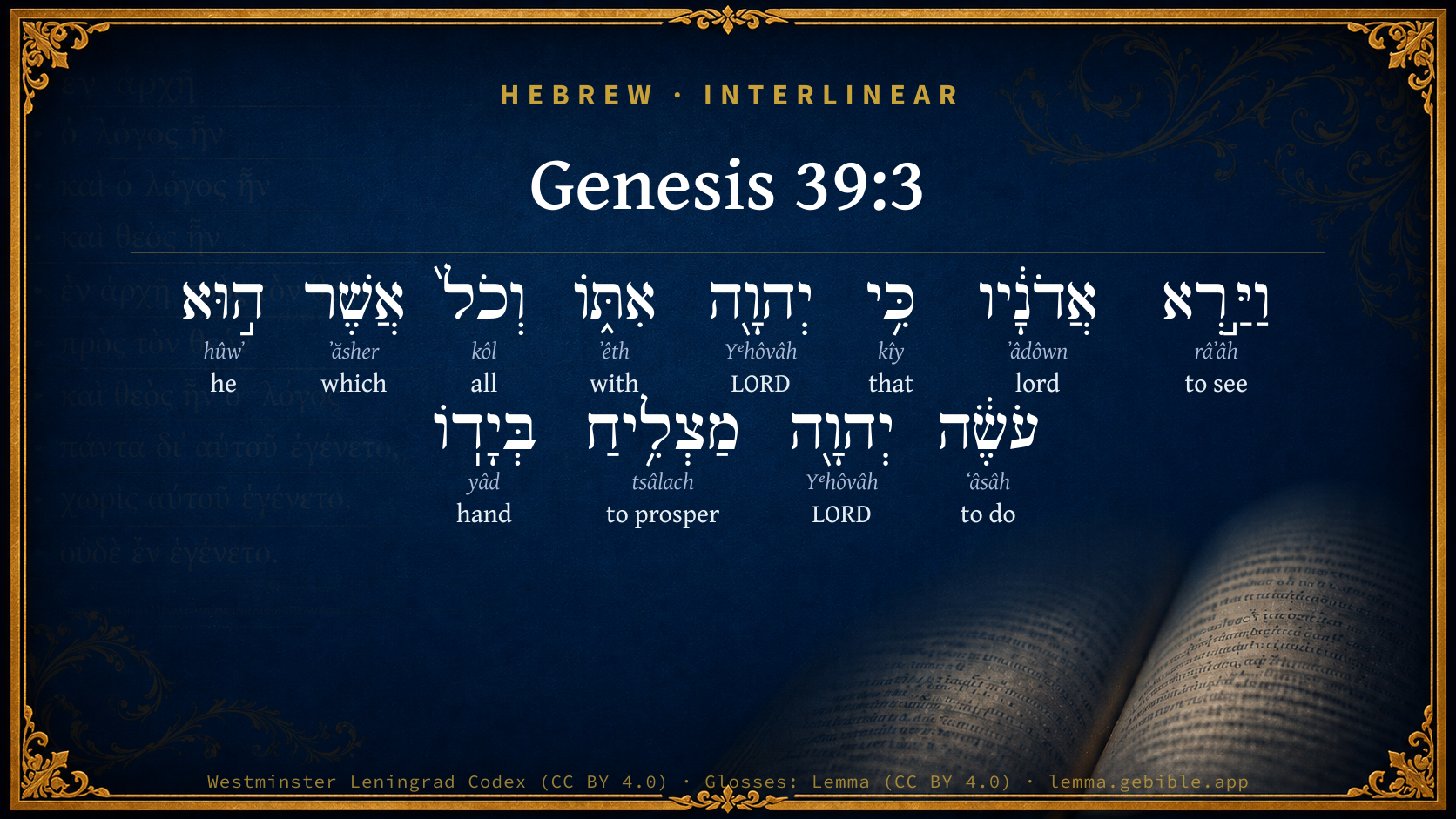
Hebrew (Westminster Leningrad Codex) Genesis 39:3 appears in the Hebrew Old Testament. The text above is from the Westminster Leningrad Codex. Each word links to its Strong’s number, a concise gloss, and parsing drawn from the Open Scriptures Hebrew Bible morphology. Click any word for its full Brown-Driver-Briggs (BDB) entry.
Download image
Cite this verse

Genesis 39:3 (World English Bible). Public Domain. Lemma interlinear Bible study tool, https://lemma.gebible.app/v/genesis/39/3.

Show BibTeX & RIS
BibTeX
RIS
English Translation
His master saw that Yahweh was with him, and that Yahweh made all that he did prosper in his hand.
World English Bible · Public Domain
Download a study sheet

One document with this verse’s original text, its word-by-word gloss line, the meaning frame, cross-references with their text, attributed commentary, and full source and license credits — printable, and it pastes into notes with its structure intact.

This verse Autodidact and up

Study sheet (.html) Plain text (.txt)

A passage Seminary Student

Up to 50 verses in one chapter. A passage sheet keeps up to 6 commentary sources and 12 cross-references per verse, in the order this page ranks them, and says so on the sheet whenever that leaves anything out. Ask for a single verse and you get the Autodidact verse sheet above.

Everything on this page stays free to read, with no account — the sheet is a download of what is already on screen, not access to it.

Want to remove ads? Support Godless Engineer
Compare translations 3

The same verse in 3 English versions, stacked beneath the original-language interlinear above. Click any original word for its lexicon entry.

Each is an independent rendering of the whole verse — the interlinear is not word-aligned to these translations.

Highlighted words mark where these versions differ — a whole-verse word diff, not a word-by-word alignment.

  • World English Bible Public Domain
    His master saw that Yahweh was with him, and that Yahweh made all that he did prosper in his hand.
  • King James Version Public Domain
    And his master saw that the LORD was with him, and that the LORD made all that he did to prosper in his hand.
  • unfoldingWord Literal Text CC BY-SA 4.0
    And his master saw that Yahweh with him and Yahweh made all that he was doing successful in his hand.

unfoldingWord Literal Text — © unfoldingWord, licensed CC BY-SA 4.0. Word-aligned USFM3 via Door43 (git.door43.org/unfoldingWord/en_ult).

Versions to compare (up to 4)

3 of 4 selected

Show all 18 translations

Every available English version of this verse, each an independent rendering of the whole verse.

  • World English Bible Public Domain
    His master saw that Yahweh was with him, and that Yahweh made all that he did prosper in his hand.
  • Berean Standard Bible Public Domain
    When his master saw that the LORD was with him and made him prosper in all he did,
  • Majority Standard Bible Public Domain
    When his master saw that the LORD was with him and made him prosper in all he did,
  • King James Version Public Domain
    And his master saw that the LORD was with him, and that the LORD made all that he did to prosper in his hand.
  • American Standard Version (1901) Public Domain
    And his master saw that Jehovah was with him, and that Jehovah made all that he did to prosper in his hand.
  • Revised Version (1885) Public Domain
    And his master saw that the LORD was with him, and that the LORD made all that he did to prosper in his hand.
  • Geneva Bible (1599) Public Domain
    And his master sawe that the Lord was with him, and that the Lord made all that hee did to prosper in his hande.
  • Douay-Rheims (1899) Public Domain
    Who knew very well that the Lord was with him, and made all that he did to prosper in his hand.
  • Young's Literal Translation Public Domain
    and his lord seeth that Jehovah is with him, and all that he is doing Jehovah is causing to prosper in his hand,
  • Literal Standard Version CC BY-SA 4.0
    and his lord sees that YHWH is with him, and all that he is doing YHWH is causing to prosper in his hand,
  • Unlocked Literal Bible CC BY-SA 4.0
    His master saw that Yahweh was with him and that Yahweh prospered everything that he did.
  • unfoldingWord Literal Text CC BY-SA 4.0
    And his master saw that Yahweh with him and Yahweh made all that he was doing successful in his hand.
  • Darby Bible Public Domain
    And his master saw that Jehovah was with him, and that Jehovah made all that he did to prosper in his hand.
  • World Messianic Bible Public Domain
    His master saw that the LORD was with him, and that the LORD made all that he did prosper in his hand.
  • Webster's Bible Public Domain
    And his master saw that the LORD was with him, and that the LORD made all that he did to prosper in his hand.
  • Free Bible Version CC BY-SA 4.0
    His master noticed that the Lord was with him and made him successful in everything he did.
  • Bible in Basic English Public Domain
    And his master saw that the Lord was with him, making everything he did go well.
  • JPS Tanakh (1917) Public Domain
    And his master saw that the LORD was with him, and that the LORD made all that he did to prosper in his hand.

Literal Standard Version (2020), Covenant Press — licensed CC BY-SA 4.0. Text via the HelloAO Bible API (eBible.org). Unlocked Literal Bible (unfoldingWord) — licensed CC BY-SA 4.0. Text via the HelloAO Bible API (eBible.org). unfoldingWord Literal Text — © unfoldingWord, licensed CC BY-SA 4.0. Word-aligned USFM3 via Door43 (git.door43.org/unfoldingWord/en_ult). Free Bible Version, Dr. Jonathan Gallagher — licensed CC BY-SA 4.0. Text via the HelloAO Bible API (eBible.org).

Word by word

More ways to search: Search by grammar → Find every occurrence → Compare this word →

Practice this passage: Drill this verse → Learn its vocabulary →

מַצְלִ֥יחַ
tsâlach
H6743
“prospering”
Verb, Hiphil, Participle Active, Masculine, Singular, Absolute
Part of Speech
Verb
Stem
Hiphil
Form
Participle Active
Gender
Masculine
Number
Singular
State
Absolute
Full BDB Definition

Origin: a primitive root

TWOT: 1916 , 1917

(Qal) to rush - to advance, prosper, make progress, succeed, be profitable - (Qal) to prosper - (Hiphil) - to make prosperous, bring to successful issue, cause to prosper - to show or experience prosperity, prosper
  1. וַיַּ֣רְא râʼâh H7200 “and · to see” Conjunction + Verb, Qal, Sequential Imperfect, 3rd Person, Masculine, Singular
  2. אֲדֹנָ֔יו ʼâdôwn H113 “lords · his” Noun, Common, Masculine, Plural, Construct + Suffix, Personal, 3rd Person, Masculine, Singular
  3. כִּ֥י kîy H3588 “that” Conjunction
  4. יְהוָ֖ה Yᵉhôvâh H3068 “LORD” Noun, Proper
  5. אִתּ֑וֹ ʼêth H854 “with · him” Preposition + Suffix, Personal, 3rd Person, Masculine, Singular
  6. וְכֹל֙ kôl H3605 “and · all” Conjunction + Noun, Common, Masculine, Singular, Absolute
  7. אֲשֶׁר ʼăsher H834 “which” Particle, Relative
  8. ה֣וּא hûwʼ H1931 “he” Pronoun, Personal, 3rd Person, Masculine, Singular
  9. עֹשֶׂ֔ה ʻâsâh H6213 “doing” Verb, Qal, Participle Active, Masculine, Singular, Absolute
  10. יְהוָ֖ה Yᵉhôvâh H3068 “LORD” Noun, Proper
  11. בְּיָדֽוֹ yâd H3027 “in/at · hand · his” Preposition + Noun, Common, Both, Singular, Construct + Suffix, Personal, 3rd Person, Masculine, Singular

About this verse

These counts appear in no published source. They are computed here, from the morphology-tagged text and Lemma’s own curated glosses. What Lemma adds →

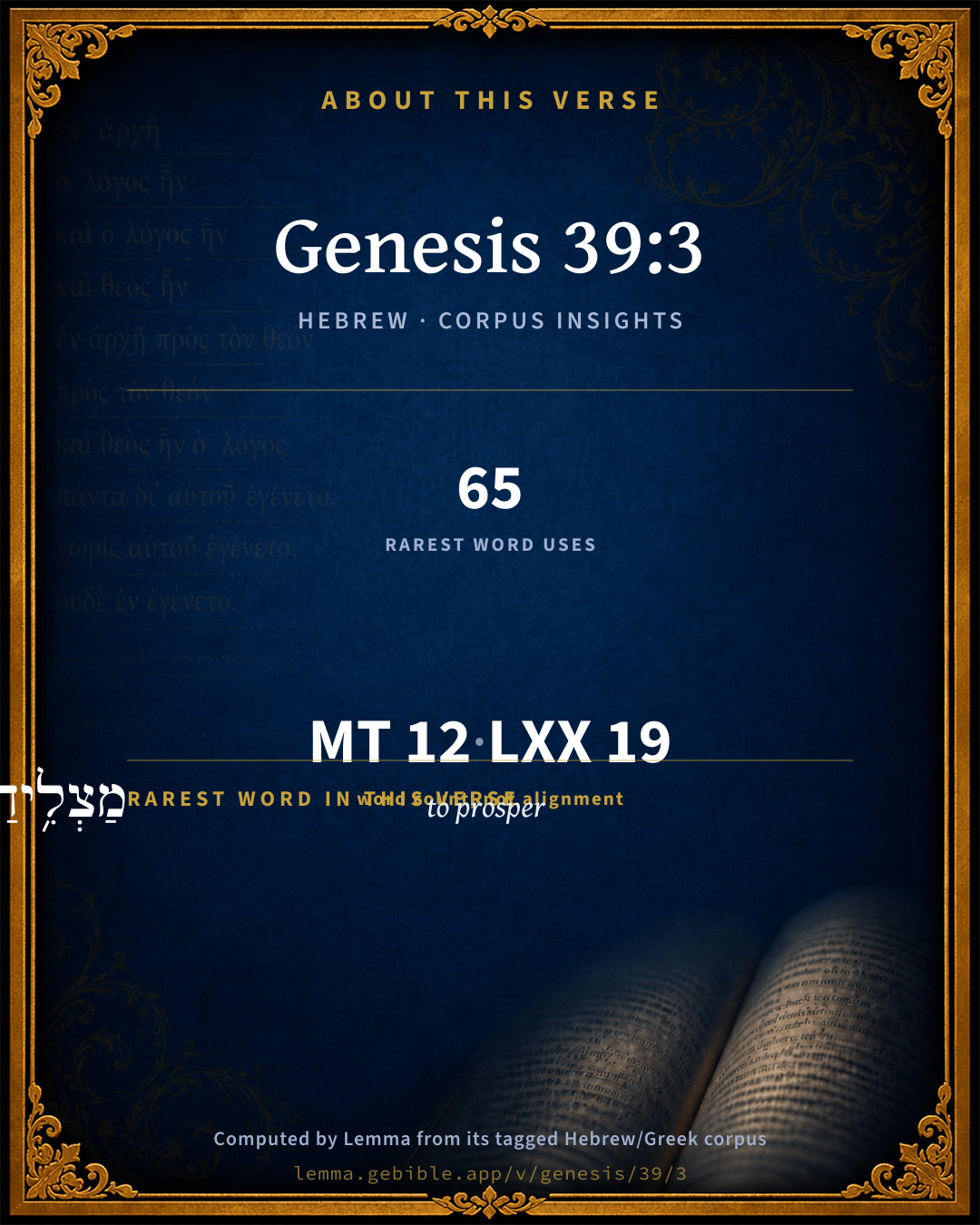
12
words
11
distinct lemmas
Pentateuch
section

Grammatical profile

  • 3 verbs
  • 5 nouns
  • 1 pronoun
  • 1 preposition
  • 1 conjunction
  • 1 particle

Verb forms

  • וַיַּ֣רְא Qal · Sequential Imperfect
  • עֹשֶׂ֔ה Qal · Participle Active
  • מַצְלִ֥יחַ Hiphil · Participle Active

Repetition

A word recurs within this verse — often emphatic in Hebrew:

  • יְהוָ֖ה LORD H3068 ×2

Hebrew & Septuagint length

In English translation the verse runs 20 words from the Hebrew and 22 from the Septuagint (LXX English) — closely comparable.

A rough comparison of the two English renderings, which tokenize alike — not a word-level alignment.

Word counts can differ between the Hebrew and the Greek without any difference in meaning — e.g. the Hebrew direct-object marker אֵת has no separate Greek word, and Greek often adds the article ὁ.

In the original languages it is 12 Hebrew tokens and 19 Greek tokens — but the two are counted differently (Hebrew bundles its prefixes and suffixes into one token; the Greek is in lemma form), so that isn’t a like-for-like length.

Cross-references

18

Topical passages linked to Genesis 39:3 in the Treasury of Scripture Knowledge — connected by theme and wording, ordered by reader-vote popularity; previews shown in the World English Bible.

  • Psalms 1:3 He will be like a tree planted by the streams of water, That brings forth its fruit in its season, Whose leaf also does not wither. Whatever he does shall prosper.
  • Genesis 30:27 Laban said to him, "If now I have found favor in your eyes, stay here, for I have divined that Yahweh has blessed me for your sake."
  • 1 Samuel 18:14 David behaved himself wisely in all his ways; and Yahweh was with him.
  • 2 Chronicles 26:5 He set himself to seek God in the days of Zechariah, who had understanding in the vision of God: and as long as he sought Yahweh, God made him to prosper.
  • Matthew 5:16 Even so, let your light shine before men; that they may see your good works, and glorify your Father who is in heaven.
  • Genesis 21:22 It happened at that time, that Abimelech and Phicol the captain of his host spoke to Abraham, saying, "God is with you in all that you do.
  • Genesis 26:28 They said, "We saw plainly that Yahweh was with you. We said, 'Let there now be an oath between us, even between us and you, and let us make a covenant with you,
  • Philippians 2:15–16 that you may become blameless and harmless, children of God without blemish in the midst of a crooked and perverse generation, among whom you are seen as lights in the world,
  • Genesis 26:24 Yahweh appeared to him the same night, and said, "I am the God of Abraham your father. Don't be afraid, for I am with you, and will bless you, and multiply your seed for my servant Abraham's sake."
  • Genesis 30:30 For it was little which you had before I came, and it has increased to a multitude. Yahweh has blessed you wherever I turned. Now when will I provide for my own house also?"
  • Genesis 39:23 The keeper of the prison didn't look after anything that was under his hand, because Yahweh was with him; and that which he did, Yahweh made it prosper.
  • Joshua 1:7–8 Only be strong and very courageous, to observe to do according to all the law, which Moses my servant commanded you: don't turn from it to the right hand or to the left, that you may have good success wherever you go.
  • 1 Samuel 18:28 Saul saw and knew that Yahweh was with David; and Michal, Saul's daughter, loved him.
  • 1 Chronicles 22:13 Then shall you prosper, if you observe to do the statutes and the ordinances which Yahweh gave Moses concerning Israel. Be strong, and of good courage. Don't be afraid, neither be dismayed.
  • Nehemiah 2:20 Then answered I them, and said to them, The God of heaven, he will prosper us; therefore we his servants will arise and build: but you have no portion, nor right, nor memorial, in Jerusalem.
  • Zechariah 8:23 Thus says Yahweh of Hosts: "In those days, ten men will take hold, out of all the languages of the nations, they will take hold of the skirt of him who is a Jew, saying, 'We will go with you, for we have heard that God is with you.'"
  • 1 Corinthians 16:2 On the first day of the week, let each one of you save, as he may prosper, that no collections be made when I come.
  • Revelation 3:9 Behold, I give of the synagogue of Satan, of those who say they are Jews, and they are not, but lie. Behold, I will make them to come and worship before your feet, and to know that I have loved you.

Cross-references courtesy of OpenBible.info (CC BY 4.0).

Hebrew and Greek witnesses Masoretic Hebrew ↔ Greek Septuagint

The same verse in the two great witnesses to the Old Testament, shown verse-for-verse.

These are two independent witnesses, not word-aligned to each other, and the Septuagint is shown in lemma (dictionary) form.

Hebrew Genesis 39:3 Masoretic · Westminster Leningrad Codex

וַיַּ֣רְא אֲדֹנָ֔יו כִּ֥י יְהוָ֖ה אִתּ֑וֹ וְכֹל֙ אֲשֶׁר ה֣וּא עֹשֶׂ֔ה יְהוָ֖ה מַצְלִ֥יחַ בְּיָדֽוֹ

His master saw that Yahweh was with him, and that Yahweh made all that he did prosper in his hand.

World English Bible · Public Domain

Greek LXX Genesis 39:3 Septuagint · lemma form

οἶδα δέ ὁ κύριος αὐτός ὅτι κύριος μετά αὐτός καί ὅσος ἄν ποιέω κύριος εὐοδόω ἐν ὁ χείρ αὐτός

And his master knew that the Lord was with him, and the Lord prospers in his hands whatever he happens to do.

LXX2012 (modern English Septuagint) · Public Domain

Hebrew: Westminster Leningrad Codex (CC BY 4.0). Greek: Septuagint (public domain); English from LXX2012 (modern English Septuagint) (Public Domain). How the Septuagint differs from the Hebrew →

Targum (Aramaic paraphrase)

2

The Targum is the ancient Jewish Aramaic paraphrase of the Hebrew Scriptures — an interpretive translation, not the Hebrew text itself. Onkelos (literal) and Pseudo-Jonathan (expansive) render the Torah, and Jonathan the Prophets. Coverage is partial: where no permissively-licensed English translation exists for a verse, only the Aramaic is shown. This is verse-level text, not a word-by-word alignment to the Hebrew.

  1. Targum Onkelos Torah (Genesis–Deuteronomy)
    וַחֲזָא רִבּוֹנֵהּ אֲרֵי מֵימְרָא דַּיְיָ בְּסַעְדֵּהּ וְכֹל דִּי הוּא עָבֵד יְיָ מַצְלַח בִּידֵהּ

    (no public-domain English translation for this verse)

    Targum Onkelos — Aramaic: “Onkelos Genesis” (public domain); “Onkelos Exodus” (public domain); “Onkelos Leviticus” (public domain); “Onkelos Numbers” (public domain); “Onkelos Deuteronomy” (public domain). English: “Sefaria Community Translation” (CC0 1.0 (public-domain dedication)); “J.W. Etheridge. The Targums of Onkelos and Jonathan Ben Uzziel on the Pentateuch. London: Longmans, Green, 1862” (public domain). Text via Sefaria.

  2. Targum Pseudo-Jonathan Torah (Genesis–Deuteronomy)
    וַחֲמָא רִבּוֹנֵיהּ אֲרוּם מֵימְרָא דַיְיָ הֲוָה בְּסַעֲדֵיהּ וְכָל דְהוּא עָבִיד יְיָ מַצְלַח בִּידֵיהּ

    And his master saw that the Word of the Lord was his Helper, and that the Lord prospered in his hand all that he did;

    Targum Pseudo-Jonathan — Aramaic: “Targum Jonathan on Genesis” (public domain); “Targum Jonathan on Exodus” (public domain); “Targum Jonathan on Leviticus” (public domain); “Targum Jonathan on Numbers” (public domain); “Targum Jonathan on Deuteronomy” (public domain). English: “The Targum of Jonathan ben Uzziel, trans. J. W. Etheridge, London, 1862” (public domain). Text via Sefaria.

Commentary

Notes on Genesis 39:3 from classic Christian and Jewish commentators (each source and its license shown beneath its notes). The classic Christian expositions comment on the surrounding passage and are grouped to its opening verse, so a note may address several verses; the Jewish commentaries on the Tanakh (Rashi and others) are per-verse, so they appear only where the commentator wrote on this verse.

Lemma curates 59 commentaries, every one of them public domain or Creative Commons licensed, each selected and text-cleaned for this edition rather than reprinted as found. About our sources →

Trapp's Complete Commentary

John Trapp

Gen 39:3 And his master saw that the LORD [was] with him, and that the LORD made all that he did to prosper in his hand.

Ver. 3. And his master saw.] Though he knew not God, yet he acknowledged that God was the giver of prosperity, and that piety pleaseth him. This ran into his senses, but wrought not kindly upon his heart.

John Trapp, A Commentary or Exposition upon All the Books of the Old and New Testament (1647–1656) — public domain. Text from a community e-Sword module.

Joseph Benson's Commentary

Gen 39:3. His master saw that the Lord was with him — Many of the heathen acknowledged a supreme God, and his overruling providence in the affairs of men, although they did not glorify him as God, but worshipped the creature with, and more than, the Creator: Potiphar, however, would doubtless learn from Joseph many things concerning the one living and true God; and proving by experience that his affairs prospered, and that Joseph ascribed this prosperity to the especial blessing of Jehovah, he might be inclined to believe that Jehovah blessed him for Joseph’s sake.

Joseph Benson's Commentary on the Old and New Testaments (1811–1818) — public domain. Text from a community e-Sword module.

Jamieson, Fausset & Brown

Robert Jamieson, A. R. Fausset & David Brown

his master saw that the Lord was with him--Though changed in condition, Joseph was not changed in spirit; though stripped of the gaudy coat that had adorned his person, he had not lost the moral graces that distinguished his character; though separated from his father on earth, he still lived in communion with his Father in heaven; though in the house of an idolater, he continued a worshipper of the true God.

Jamieson, Fausset & Brown — Commentary Critical and Explanatory on the Whole Bible (1871) — public domain (CC PDM 1.0). Text via the HelloAO Bible API.

John Calvin's Commentaries

3. And his master saw. Here that which has been lately alluded to more clearly appears, that the grace of God shone forth in Joseph, in no common or usual manner; since it became thus manifest to a man who was a heathen, and, in this respect, blind. How much more base is our ingratitude, if we do not refer all our prosperous events to God as their author; seeing that Scripture often teaches us, that nothing proceeding from men, whether counsels, or labors, or any means which they can devise, will profit them, except so far as God gives his blessing. And whereas Potiphar, on this account, conceived so much greater regard for Joseph, as to set him over his house; we hence gather, that heathens may be so affected by religion, as to be constrained to ascribe glory to God. However, his ingratitude again betrays itself, when he despises that God whose gifts he estimates so highly in the person of Joseph. He ought at least to have inquired who that God was, that he might conform himself to the worship due to him: but he deems it enough, insomuch as he thinks it will be for his private advantage, to acknowledge that Joseph was divinely directed, in order that he may use his labor with greater profit.

The lord made all that he did to prosper in his hand. This was a wonderful method of procedure, that the entire blessing by which the Lord was pleased to testify his paternal love towards Joseph, should turn to the gain of the Egyptians. For since Joseph neither sowed nor reaped for himself, he was not at all enriched by his labor. But in this way it was brought about that a proud man, who otherwise might have abused him as a vile and sordid slave, should treat him humanely and liberally. And the Lord often soothes the wicked by such favors, lest when they have suffered any injury, they should turn the fury of their indignation against the pious. We here see how abundantly the grace of God is poured out upon the faithful, since a portion of his kindness flows from them even to the reprobate. We are also taught what an advantage it is to receive the elect children of God to our hospitality, or to join ourselves to those whom the divine favor thus accompanies, that it may diffuse its fragrance to those who are near them. But since it would not greatly profit us to be saturated with those temporal benefits of God, which suffocate and ruin the reprobate; we ought to center all our wishes on this one point, that God may be propitious to us. Far better was it for Joseph that Potiphar’s wealth should be increased for his sake; than it was for Potiphar to make great gain by Joseph.

John Calvin's Commentaries (1540-1563) — public domain. Text from the Calvin Translation Society English edition (1840s-50s) via the Christian Classics Ethereal Library (ccel.org). Calvin's coverage is partial (roughly two-thirds of the Bible); uncommented books and verses are honest gaps, never fabricated. The 19th-century editor's footnotes and remarks are omitted so the notes are faithfully Calvin's own voice.

John Gill's Exposition

And his master saw that the Lord was with him,.... He knew nothing of the spiritual and gracious presence of God that was with him, he was no judge of that; but he perceived by the ingenuity of his mind, by his ready and speedy learning the Egyptian language, by his dexterity in business, and by the prudence and faithfulness with which he did everything, that he was highly favoured by the divine Being, and had great endowments bestowed upon him, and was an extraordinary person for his age:

and that the Lord made all that he did to prosper in his hand; and though Potiphar might have no knowledge of the true Jehovah, whose name he uses, yet he might have a notion of a supreme Being, and that all outward prosperity was owing to him; and knowing Joseph to be an Hebrew, as it is plain his wife did, Gen 39:14; and Jehovah to be the God of the Hebrews, he imputes all the prosperity that attended Joseph and his services unto his God.

John Gill's Exposition of the Whole Bible (1746–1763) — public domain (CC PDM 1.0). Text via the HelloAO Bible API.

Matthew Poole's English Annotations

The heathens owned a supreme God, and his overruling providence in affairs, though they did not glorify him as God, but worshipped the creature with and more than the Creator, Rom 1:25.

In his hand, i.e. under his ministry, as this phrase is used, Exo 4:13; Lev 8:36; Pro 26:6, and oft elsewhere.

Matthew Poole's English Annotations on the Holy Bible (1683–1685) — public domain. Text from a community e-Sword/MySword module.

The Pulpit Commentary

And his master saw that the Lord (Jehovah) was with him this does not imply that Potiphar was acquainted with Jehovah, but simply that he concluded Joseph to be under the Divine protectionand that the Lord (Jehovah) made all that he did to prosper in his hand.

That which led to the conviction of Potiphar concerning Joseph was the remarkable success which he saw attending all his efforts and undertakings.

The Pulpit Commentary (1880–1919), ed. H.D.M. Spence-Jones & Joseph S. Exell — public domain. Text from a community e-Sword module.

unfoldingWord translationNotes

Door43 World Missions Community

His master saw that Yahweh was with him

This means that the master saw how Yahweh was helping Joseph. AT: "His master saw that Yahweh was helping him" (See: Idiom)

that Yahweh prospered everything that he did

"Yahweh caused everything that Joseph did to prosper"

Joseph found favor in his sight

"To find favor" means to be approved by someone. The idiom "in his sight" refers to a person's opinion. Possible meanings are 1) AT: "Potiphar was pleased with Joseph" or 2) AT: "Yahweh was pleased with Joseph" (See: Idiom)

He served Potiphar

This means that he was Potiphar's personal servant.

Potiphar made Joseph manager over his house, and everything that he possessed

"Potiphar put Joseph in charge of his household and everything that belonged to Potiphar"

put under his care

When something is "put under someone's care," it means that the person is responsible for its care and safe-keeping. AT: "he had Joseph care for" (See: Metaphor)

translationWords

lord

Yahweh

favor

manager

house

unfoldingWord translationNotes — © Distant Shores Media and the Door43 World Missions Community, licensed CC BY-SA 4.0. Source: git.door43.org/Door43/en_tn.

Rashi

Rabbi Shlomo Yitzchaki (Rashi)

כי ה‘ אתו THAT THE LORD WAS WITH HIM — the name of God was a familiar word in his mouth (Midrash Tanchuma, Vayeshev 8).

Rashi on the Tanakh — English translations: “The Judaica Press complete Tanach with Rashi, translated by A. J. Rosenberg” (CC BY 4.0); “Pentateuch with Rashi's commentary by M. Rosenbaum and A.M. Silbermann, 1929-1934” (public domain); “The Metsudah Tanach series, Lakewood, N.J” (CC BY 4.0); and “The Book of Joshua, Metsudah Publications, 1997” (CC BY 4.0). Text via Sefaria.

Ramban (Nachmanides)

Rabbi Moshe ben Nachman (Ramban / Nachmanides)

THAT THE ETERNAL WAS WITH HIM. The name of G-d was a familiar word in his mouth. This is Rashi’s language. But it does not appear to be correct. Instead, And his lord saw that the Eternal was with him, means that he saw that his endeavors were always more successful than that of anyone else, so he knew that success came to him from G-d. In a similar sense is the verse, We have surely seen that the Eternal was with thee. Thus Joseph found favor in his lord’s eyes, and he appointed him as his personal attendant and overseer of his house.

Ramban (Nachmanides) on the Tanakh — English translation: “Commentary on the Torah by Ramban (Nachmanides). Translated and annotated by Charles B. Chavel. New York, Shilo Pub. House, 1971-1976” (CC BY 4.0). Text via Sefaria.

Lesson kit

Teaching starters — assembled from the data on this page, not authored interpretation. Every prompt links to the verse data it draws on. Edit before teaching.

Genesis, in the Pentateuch, opens this verse with 12 words (11 distinct Hebrew lemmas). Its most distinctive word is tsâlach (“to prosper”). A historical commentator’s framing appears above. Read the whole chapter for the surrounding context.

Discussion questions

  1. The word tsâlach carries the sense “to prosper.” How does it shape the verse?
  2. How does Psalms 1:3, which shares this passage’s theme, read alongside this verse?
  3. What does the repetition of “LORD” (2× in this one verse) do in this verse?
  4. The translations on this page render this verse differently — a whole-verse word diff, not a word-by-word alignment. What might account for the different wordings?
  5. «וַיַּ֣רְא» is a Qal Sequential Imperfect verb. How does that grammatical form shape the action described?
  6. Compare how Trapp's Complete Commentary and Joseph Benson's Commentary read this verse. Where do they agree or differ?

Things to notice

Reading settings

Reading text

Shown beneath each verse's original-language words.

Old Testament
Old Testament edition

Read the OT as the Masoretic Hebrew (MT) or the Greek Septuagint (LXX).

English shown for the Greek Septuagint (in the Hebrew ↔ Greek comparison).

Comparing translations? Open the Compare panel on any verse page to stack up to four side by side.