
Romans 10:21

Greek (Tischendorf 8th ed.) Romans 10:21 appears in the Greek New Testament. The text above is from the Tischendorf 8th edition. Each word links to its Strong’s number and a concise gloss. Click any word for its full Thayer’s Greek Lexicon entry.
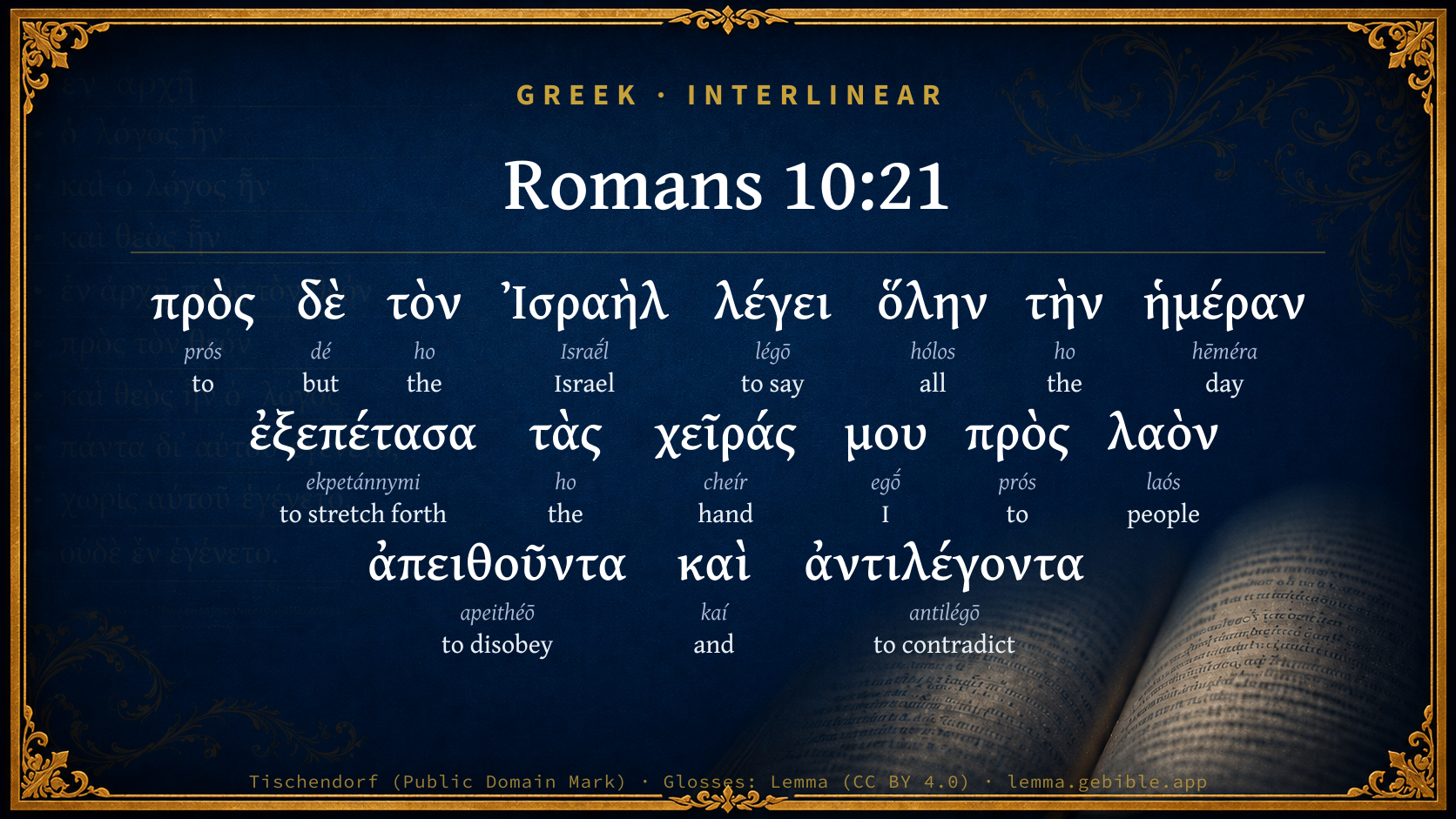
Download image
Cite this verse

Romans 10:21 (World English Bible). Public Domain. Lemma interlinear Bible study tool, https://lemma.gebible.app/v/romans/10/21.

Show BibTeX & RIS
BibTeX
RIS
English Translation
But as to Israel he says, "All day long I stretched out my hands to a disobedient and contrary people."
World English Bible · Public Domain
Highlights
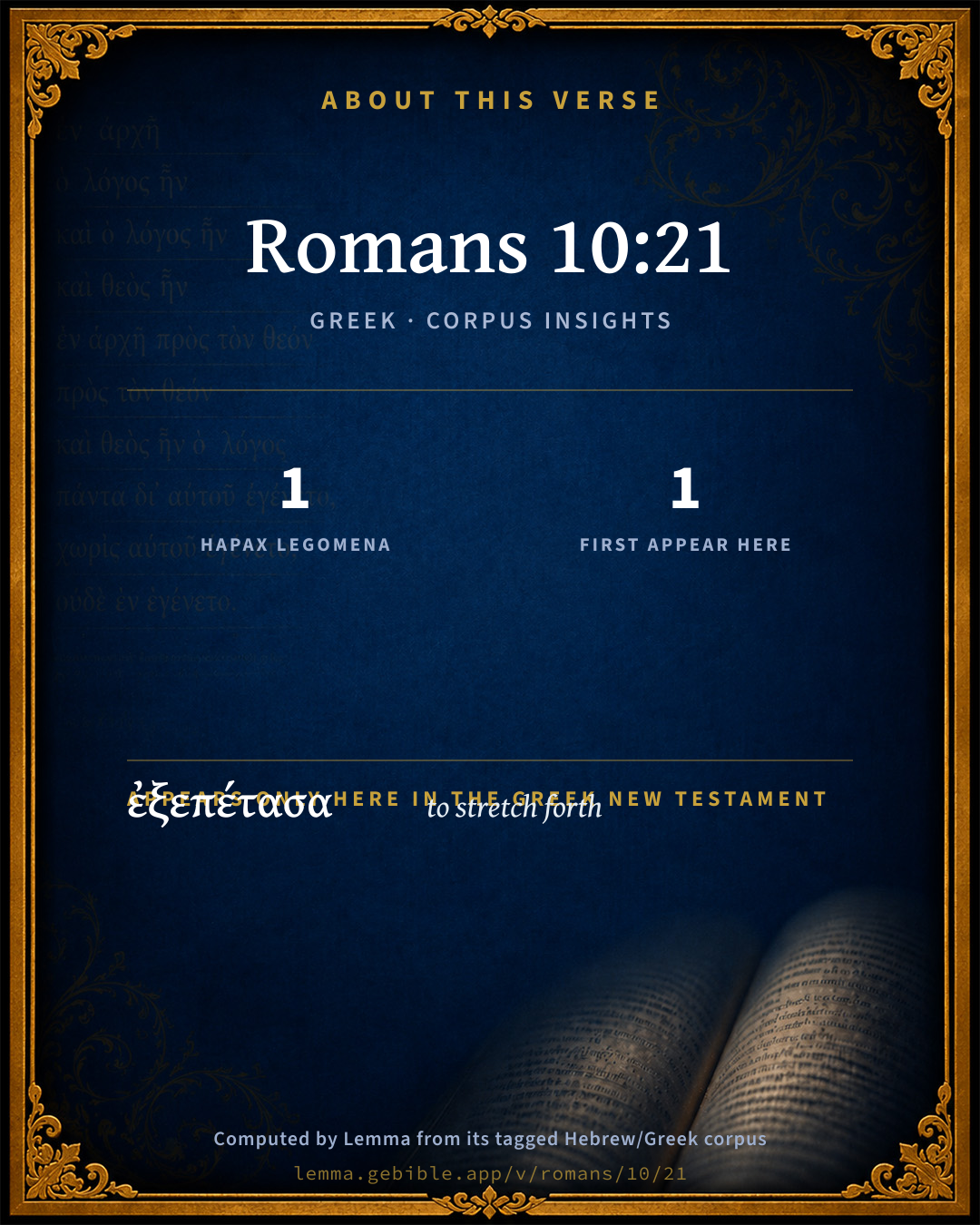
  • 1 hapax legomenon — only here in the Greek New Testament
  • 1 first appearance in the Greek New Testament
Full analysis ↓
Download a study sheet

One document with this verse’s original text, its word-by-word gloss line, the meaning frame, cross-references with their text, attributed commentary, and full source and license credits — printable, and it pastes into notes with its structure intact.

This verse Autodidact and up

Study sheet (.html) Plain text (.txt)

A passage Seminary Student

Up to 50 verses in one chapter. A passage sheet keeps up to 6 commentary sources and 12 cross-references per verse, in the order this page ranks them, and says so on the sheet whenever that leaves anything out. Ask for a single verse and you get the Autodidact verse sheet above.

Everything on this page stays free to read, with no account — the sheet is a download of what is already on screen, not access to it.

Want to remove ads? Support Godless Engineer
Compare translations 3

The same verse in 3 English versions, stacked beneath the original-language interlinear above. Click any original word for its lexicon entry.

Each is an independent rendering of the whole verse — the interlinear is not word-aligned to these translations.

Highlighted words mark where these versions differ — a whole-verse word diff, not a word-by-word alignment.

  • World English Bible Public Domain
    But as to Israel he says, "All day long I stretched out my hands to a disobedient and contrary people."
  • King James Version Public Domain
    But to Israel he saith, All day long I have stretched forth my hands unto a disobedient and gainsaying people.
  • unfoldingWord Literal Text CC BY-SA 4.0
    But to Israel he says, “The whole day I stretched out my hands to a disobedient and contradictory people.”

unfoldingWord Literal Text — © unfoldingWord, licensed CC BY-SA 4.0. Word-aligned USFM3 via Door43 (git.door43.org/unfoldingWord/en_ult).

Versions to compare (up to 4)

3 of 4 selected

Show all 19 translations

Every available English version of this verse, each an independent rendering of the whole verse.

  • World English Bible Public Domain
    But as to Israel he says, "All day long I stretched out my hands to a disobedient and contrary people."
  • Berean Standard Bible Public Domain
    But as for Israel he says: “All day long I have held out My hands to a disobedient and obstinate people.”
  • Majority Standard Bible Public Domain
    But as for Israel he says: “All day long I have held out My hands to a disobedient and obstinate people.”
  • King James Version Public Domain
    But to Israel he saith, All day long I have stretched forth my hands unto a disobedient and gainsaying people.
  • American Standard Version (1901) Public Domain
    But as to Israel he saith, All the day long did I spread out my hands unto a disobedient and gainsaying people.
  • Revised Version (1885) Public Domain
    But as to Israel he saith, All the day long did I spread out my hands unto a disobedient and gainsaying people.
  • Geneva Bible (1599) Public Domain
    And vnto Israel hee sayth, All the day long haue I stretched foorth mine hand vnto a disobedient, and gainesaying people.
  • Douay-Rheims (1899) Public Domain
    But to Israel he saith: All the day long have I spread my hands to a people that believeth not, and contradicteth me.
  • Young's Literal Translation Public Domain
    and unto Israel He saith, `All the day I did stretch out My hands unto a people unbelieving and gainsaying.'
  • Literal Standard Version CC BY-SA 4.0
    and to Israel He says, “All the day I stretched out My hands to a people unbelieving and contradicting.”
  • Unlocked Literal Bible CC BY-SA 4.0
    But to Israel he says, “All the day long I reached out my hands to a disobedient and stubborn people.”
  • unfoldingWord Literal Text CC BY-SA 4.0
    But to Israel he says, “The whole day I stretched out my hands to a disobedient and contradictory people.”
  • Darby Bible Public Domain
    But unto Israel he says, All the day long I have stretched out my hands unto a people disobeying and opposing.
  • World Messianic Bible Public Domain
    But about Israel he says, “All day long I stretched out my hands to a disobedient and contrary people.”
  • Webster's Bible Public Domain
    But to Israel he saith, All day long I have stretched forth my hands to a disobedient and gainsaying people.
  • Free Bible Version CC BY-SA 4.0
    As God says to Israel, “All day long I reached out my hands to a disobedient and stubborn people.”
  • Bible in Basic English Public Domain
    But about Israel he says; All the day my hands have been stretched out to a people whose hearts were turned away, and who put themselves against my word.
  • Text-Critical English NT CC BY 4.0
    But to Israel he says, “All day long I have held out my hands to a disobedient and contrary people.”
  • Tyndale New Testament (1534) Public Domain
    And agaynst Israel he sayth: All daye longe have I stretched forth my hondes vnto a people that beleveth not but speaketh agaynst me.

Literal Standard Version (2020), Covenant Press — licensed CC BY-SA 4.0. Text via the HelloAO Bible API (eBible.org). Unlocked Literal Bible (unfoldingWord) — licensed CC BY-SA 4.0. Text via the HelloAO Bible API (eBible.org). unfoldingWord Literal Text — © unfoldingWord, licensed CC BY-SA 4.0. Word-aligned USFM3 via Door43 (git.door43.org/unfoldingWord/en_ult). Free Bible Version, Dr. Jonathan Gallagher — licensed CC BY-SA 4.0. Text via the HelloAO Bible API (eBible.org).

Word by word

More ways to search: Search by grammar → Find every occurrence → Compare this word →

Practice this passage: Drill this verse → Learn its vocabulary →

ἐξεπέτασα
ekpetánnymi
G1600
“to stretch forth”
Verb, Aorist, Active, Indicative, 1st person, Singular
Part of Speech
Verb
Tense
Aorist
Voice
Active
Mood
Indicative
Person
1st person
Number
Singular
Full Thayer's Definition

Origin: from G1537 and a form of G4072

TDNT: None

1. to spread out, stretch forth
  1. πρὸς prós G4314 “to” Preposition
  2. δὲ dé G1161 “but” Conjunction
  3. τὸν ho G3588 “the” Article, Accusative, Singular, Masculine
  4. Ἰσραὴλ Israḗl G2474 “Israel” Noun, Proper, indeclinable
  5. λέγει légō G3004 “to say” Verb, Present, Active, Indicative, 3rd person, Singular
  6. ὅλην hólos G3650 “all” Adjective, Accusative, Singular, Feminine
  7. τὴν ho G3588 “the” Article, Accusative, Singular, Feminine
  8. ἡμέραν hēméra G2250 “day” Noun, Accusative, Singular, Feminine
  9. τὰς ho G3588 “the” Article, Accusative, Plural, Feminine
  10. χεῖράς cheír G5495 “hand” Noun, Accusative, Plural, Feminine
  11. μου egṓ G1473 “I” Personal pronoun, 1st person, Genitive, Singular
  12. πρὸς prós G4314 “to” Preposition
  13. λαὸν laós G2992 “people” Noun, Accusative, Singular, Masculine
  14. ἀπειθοῦντα apeithéō G544 “to disobey” Verb, Present, Active, Participle, Accusative, Singular, Masculine
  15. καὶ kaí G2532 “and” Conjunction
  16. ἀντιλέγοντα antilégō G483 “to contradict” Verb, Present, Active, Participle, Accusative, Singular, Masculine

About this verse

These counts appear in no published source. They are computed here, from the morphology-tagged text and Lemma’s own curated glosses. What Lemma adds →

17
words
14
distinct lemmas
Pauline Epistles
section

Notable vocabulary

1 hapax legomenon — a word that appears only here in the entire Greek New Testament:

  • ἐξεπέτασα to stretch forth G1600

First appearance in Scripture

This word makes its first canonical appearance in the Greek New Testament here:

  • ἐξεπέτασα to stretch forth G1600

Shared distinctive vocabulary

ἀντιλέγοντα to contradict G483 occurs in 11 verses of the Greek New Testament. Also found in:
Repetition

Words recur within this verse:

Cross-references

18

Topical passages linked to Romans 10:21 in the Treasury of Scripture Knowledge — connected by theme and wording, ordered by reader-vote popularity; previews shown in the World English Bible.

  • Isaiah 65:2–5 I have spread out my hands all the day to a rebellious people, who walk in a way that is not good, after their own thoughts;
  • Nehemiah 9:26 Nevertheless they were disobedient, and rebelled against you, and cast your law behind their back, and killed your prophets that testified against them to turn them again to you, and they committed awful blasphemies.
  • Proverbs 1:24 Because I have called, and you have refused; I have stretched out my hand, and no one has paid attention;
  • Jeremiah 35:15 I have sent also to you all my servants the prophets, rising up early and sending them, saying, Return you now every man from his evil way, and amend your doings, and don't go after other gods to serve them, and you shall dwell in the land which I have given to you and to your fathers: but you have not inclined your ear, nor listened to me.
  • Matthew 21:33–43 "Hear another parable. There was a man who was a master of a household, who planted a vineyard, set a hedge about it, dug a winepress in it, built a tower, leased it out to farmers, and went into another country.
  • 1 Peter 2:8 and, "A stone of stumbling, and a rock of offense." For they stumble at the word, being disobedient, whereunto also they were appointed.
  • Deuteronomy 9:13 Furthermore Yahweh spoke to me, saying, I have seen this people, and, behold, it is a stiff-necked people:
  • Deuteronomy 31:27 For I know your rebellion, and your stiff neck: behold, while I am yet alive with you this day, you have been rebellious against Yahweh; and how much more after my death?
  • Jeremiah 25:4 Yahweh has sent to you all his servants the prophets, rising up early and sending them, (but you have not listened, nor inclined your ear to hear),
  • Matthew 22:3–7 and sent out his servants to call those who were invited to the marriage feast, but they would not come.
  • Acts 7:51–52 "You stiff-necked and uncircumcised in heart and ears, you always resist the Holy Spirit! As your fathers did, so you do.
  • Acts 13:46–47 Paul and Barnabas spoke out boldly, and said, "It was necessary that God's word should be spoken to you first. Since indeed you thrust it from you, and judge yourselves unworthy of eternal life, behold, we turn to the Gentiles.
  • 1 Thessalonians 2:16 forbidding us to speak to the Gentiles that they may be saved; to fill up their sins always. But wrath has come on them to the uttermost.
  • 1 Samuel 8:7–8 Yahweh said to Samuel, Listen to the voice of the people in all that they tell you; for they have not rejected you, but they have rejected me, that I should not be king over them.
  • Jeremiah 44:4–6 However I sent to you all my servants the prophets, rising up early and sending them, saying, Oh, don't do this abominable thing that I hate.
  • Matthew 20:1–15 "For the Kingdom of Heaven is like a man who was the master of a household, who went out early in the morning to hire laborers for his vineyard.
  • Luke 24:47 and that repentance and remission of sins should be preached in his name to all the nations, beginning at Jerusalem.
  • Matthew 23:34–37 Therefore, behold, I send to you prophets, wise men, and scribes. Some of them you will kill and crucify; and some of them you will scourge in your synagogues, and persecute from city to city;

Cross-references courtesy of OpenBible.info (CC BY 4.0).

Commentary

Notes on Romans 10:21 from classic Christian and Jewish commentators (each source and its license shown beneath its notes). The classic Christian expositions comment on the surrounding passage and are grouped to its opening verse, so a note may address several verses; the Jewish commentaries on the Tanakh (Rashi and others) are per-verse, so they appear only where the commentator wrote on this verse.

Lemma curates 59 commentaries, every one of them public domain or Creative Commons licensed, each selected and text-cleaned for this edition rather than reprinted as found. About our sources →

Jamieson, Fausset & Brown

Robert Jamieson, A. R. Fausset & David Brown

But to--rather, "with regard to"

Israel he saith, All day--"All the day"

long I have stretched out my hands--"did I stretch forth"

my hands--the attitude of gracious entreaty.

unto a disobedient and gainsaying people--These words, which immediately follow the announcement just quoted of the calling of the Gentiles, were enough to forewarn the Jews both of God's purpose to eject them from their privileges, in favor of the Gentiles, and of the cause of it on their own part.

Note, (1) Mere sincerity, and even earnestness in religion--though it may be some ground of hope for a merciful recovery from error--is no excuse, and will not compensate, for the deliberate rejection of saving truth, when in the providence of God presented for acceptance (Rom 10:1-3; and see on Rom 9:7, Note 7). (2) The true cause of such rejection of saving truth, by the otherwise sincere, is the prepossession of the mind by some false notions of its own. So long as the Jews "sought to set up their own righteousness," it was in the nature of things impossible that they should "submit themselves to the righteousness of God"; the one of these two methods of acceptance being in the teeth of the other (Rom 10:3). (3) The essential terms of salvation have in every age been the same: "Whosoever will" is invited to "take of the water of life freely," Rev 22:17 (Rom 10:13). (4) How will the remembrance of the simplicity, reasonableness, and absolute freeness of God's plan of salvation overwhelm those that perish from under the sound of it (Rom 10:4-13). (5) How piercingly and perpetually should that question--"HOW SHALL THEY HEAR WITHOUT A PREACHER?"--sound in the ears of all churches, as but the apostolic echo of their Lord's parting injunction, "PREACH THE GOSPEL TO EVERY CREATURE" (Mar 16:15), and how far below the proper standard of love, zeal, and self-sacrifice must the churches as yet be, when with so plenteous a harvest the laborers are yet so few (Mat 9:37-38), and that cry from the lips of pardoned, gifted, consecrated men--"Here am I, send me" (Isa 6:8), is not heard everywhere (Rom 10:14-15)! (6) The blessing of a covenant relation to God is the irrevocable privilege of no people and no Church; it can be preserved only by fidelity, on our part, to the covenant itself (Rom 10:19). (7) God is often found by those who apparently are the farthest from Him, while He remains undiscovered by those who think themselves the nearest (Rom 10:20-21). (8) God's dealings even with reprobate sinners are full of tenderness and compassion; all the day long extending the arms of His mercy even to the disobedient and gainsaying. This will be felt and acknowledged at last by all who perish, to the glory of God's forbearance and to their own confusion (Rom 10:21).

Next: Romans Chapter 11

Jamieson, Fausset & Brown — Commentary Critical and Explanatory on the Whole Bible (1871) — public domain (CC PDM 1.0). Text via the HelloAO Bible API.

Bengel's Gnomon

Johann Albrecht Bengel

Rom 10:21. Ὅλην, whole) Isa. ibid. Rom 10:2, LXX., ἐξεπέτασα τὰς χεῖράς μου ὅλην τὴν ἡμέραν πρὸς κ.τ.λ., comp. the whole day, [all the day long] ch. Rom 8:36, see the remarkable dissertation of J. C. Pfaffius, on the continued grace of God.—ἐξεπέτασα, I extended) A metonymy [en.] of the antecedent [for the consequent]. They permit Me to extend My hands, nor do they come. Even by this one word alone the doctrine of the double will of God, viz., a mere good-will [which is towards all men], and a will of sealing [certain persons as His elect; beneplaciti et signi; εὑδοκία, Luk 2:14, good will; but σφραγὶς, sealing as the Lord’s own, 2Ti 2:19, or else the “voluntas beneplaciti” is God’s effectual good will towards the elect, Eph 1:5, εὐδοκία τοῦ θελήματος αὐτοῦ; the “voluntas signi,” His mere figurative and ostensible good will, whereby it is said in accommodation to human modes of thought “God willeth all men to be saved.” Comp. Calvin Instit. B. iii. c. 20 and c. 24, sect. 17], is shown to be absurd.—ἀπειθοῦντα, not believing) with the ‘heart.’—ἀντιλέγοντα, gainsaying) with the ‘mouth;’ comp. Rom 10:8, etc.

Bengel's Gnomon of the New Testament — English translation (T&T Clark, Edinburgh, 1860) — public domain. Text from a community e-Sword module.

Expositor's Greek Testament

ed. W. Robertson Nicoll

Rom 10:21 . πρὸς δὲ τὸν Ἰσραὴλ λέγει : That is what he says of the Gentiles, but as for Israel, he says, etc., Isa 65:2 . For πρὸς = with reference to, see Heb 1:7 f., Luk 12:41 . The arms outstretched all the day long are the symbol of that incessant pleading love which Israel through all its history has consistently despised. It is not want of knowledge, then, nor want of intelligence, but wilful and stubborn disobedience, that explains the exclusion of Israel (meanwhile) from the Kingdom of Christ and all its blessings. This is not inconsistent with Rom 10:3 , if we go to the root of the matter. For the ignorance there spoken of is one which has its root in the will, in the pride of a heart which is determined to have a righteousness of its own without coming under any obligation to God for it, and which therefore cannot assume the attitude to which the Gospel becomes credibly Divine; while the ignorance suggested as a plea for unbelief is that of men to whom the Gospel has never been presented at all. The latter ignorance might annul responsibility; the former gives its full significance to guilt.

The Expositor's Greek Testament, edited by W. Robertson Nicoll (1897–1910) — public domain. Text from a community e-Sword module.

Godet's Commentaries

Frédéric Louis Godet

Vv. 21. What leads up to this verse is the lively feeling of the contrast between the conduct of Israel and that of the Gentiles. It sums up the idea of the whole chapter: the obstinate resistance of Israel to the ways of God. The Lord is represented, Isa 65:2, under the figure of a father who, from morning to evening, stretches out his arms to his child, and experiences from him only refusal and contradiction. It is thus made clear that the apostle in no wise puts the rejection of Israel to the account of an unconditional divine decree, but that he ascribes the cause of it to Israel themselves.

The preposition πρός might signify: in relation to, as in Luk 19:9; Luk 20:19. But yet the natural meaning is to; and this meaning is quite suitable: “He saith to Israel.” For if in the prophetical discourse God spoke of Israel in the third person, in the book written for the people it is to them that he addresses this saying; comp. Rom 3:19.

All the day long: do not these words designate the whole theocratic epoch, which, in the eyes of the Lord, is like a long day of labor in behalf of His people? But what a response have they made to such fidelity! The words καὶ ἀντιλέγοντα, and gainsaying, were added to the Hebrew text by the LXX. They characterize the hair-splittings and sophisms whereby the Israelites seek to justify their persevering refusal to return to God; comp. in the Book of Malachi the refrain: “And ye say”...!

Thus Israel, blinded by the privileges bestowed on them, sought only one thing: to preserve their monopoly, and for this end to perpetuate their law (Rom 10:4). They have hardened themselves, consequently against the two essential features which constituted the Messianic dispensation, a free salvation (Rom 10:5-11) and a salvation offered to all by universal preaching (Rom 10:12-17). And to extenuate this sin, they are wholly without excuse. The messengers of salvation have followed them to the very ends of the earth to offer them grace as well as the Gentiles; neither had God failed to warn them beforehand, from the very beginning of their history, of the danger they ran of seeing themselves outstripped by the Gentiles (Rom 10:18-20). All to no purpose. They have held on in their resistance...(Rom 10:21). After this, is not the case fully ripe for trial? Do not the facts attest that it is not God who has arbitrarily excluded them, but themselves who have placed God under the necessity of pronouncing their rejection?

Yet there is a mercy which, where the sin of man abounds, yet more abounds. It has a last word to speak in this history. Its work toward the rebellious people seems closed; but it is far from being so. And chap. 11 proceeds to show us how God, in the overflowing of His grace, reserves to Himself the right to make this severe and painful dispensation issue in the most glorious result.

Frédéric Louis Godet — Commentaries on Luke, John, Romans, and 1 Corinthians — English translation (T&T Clark, Edinburgh, 1870s–1890s) — public domain. Text from a community e-Sword module.

Hodge's Commentary on Romans, Ephesians & First Corinthians

Charles Hodge

Rom_10:20, Rom_10:21

But Esaias is very bold, and saith, etc. That is, according to a very common Hebrew construction, in which one verb qualifies another adverbially, saith very plainly or openly. Plain as the passage in Deuteronomy is, it is not so clear and pointed as that now referred to Isa_65:1, Isa_65:2.

Paul follows the Septuagint version of the passage, merely transposing the clauses. The sense is accurately expressed. I am sought of them that asked not for me, I am found of them that sought me not, is the literal version of the Hebrew, as given in our translation. The apostle quotes and applies the passage in the sense in which it is to be interpreted in the ancient prophet. In the first verse of that chapter Isaiah says, that God will manifest himself to those who were not called by his name; and in the second, he gives the immediate reason of this turning unto the Gentiles, I have stretched out my hand all the day to a rebellious people. This quotation, therefore, confirms both the great doctrines taught in this chapter; the Jews were no longer the exclusive or peculiar people of God, and the blessings of the Messiahs kingdom were thrown wide open to all mankind. With regard to Israel, the language of God is peculiarly strong and tender. All day long I have stretched forth my hands. The stretching forth the hands is the gesture of invitation, and even supplication. God has extended wide his arms, and urged men frequently and long to return to his love; and it is only those who refuse, that he finally rejects.

Doctrine

1. Christianity is, from its nature, adapted to be an universal religion. There is nothing, as was the case with Judaism, which binds it to a particular location, or confines it to a particular people. All its duties may be performed, and all its blessings enjoyed, in every part of the world, and by every nation under heaven Rom_10:11-13.

2. The relation of men to God, and his to them, is not determined by any national or ecclesiastical connection. He deals with all, on the same general principles, and is ready to save all who call upon him, Rom_10:12.

3. Whosoever will, may take of the water of life. The essential conditions of salvation have in every age been the same. Even under the Old Testament dispensation, God accepted all who sincerely invoked his name, Rom_10:13.

4. The preaching of the gospel is the great means of salvation, and it is the will of God that it should be extended to all people, Rom_10:14, Rom_10:15.

5. As invocation implies faith, and faith requires knowledge, and knowledge instruction, and instruction teachers, and teachers a mission, it is evident not only that God wills that teachers should be sent to all those whom he is willing to save, when they call upon him, but that all parts of this divinely connected chain of causes and effects are necessary to the end proposed, viz., the salvation of men. It is, therefore, as incumbent on those who have the power, to send the gospel abroad, as it is on those to whom it is sent, to receive it, Rom_10:14, Rom_10:15.

6. As the rudiments of the tree are in the seed, so all the elements of the New Testament doctrines are in the Old. The Christian dispensation is the explanation, fulfillment, and development of the Jewish, Rom_10:11, Rom_10:13, Rom_10:15.

Remarks

1. Christians should breathe the spirit of an universal religion: a religion which regards all men as brethren, which looks on God, not as the God of this nation, or of that church, but as the God and Father of all, which proposes to all the same conditions of acceptance, and which opens equally to all the same boundless and unsearchable blessings, Rom_10:11-13.

2. It must be very offensive to God, who looks on all men with equal favor, (except as moral conduct makes a difference,) to observe how one class of mortals looks down upon another, on account of some merely adventitious difference of rank, color, external circumstances, or social or ecclesiastical connection, ver 12.

3. How will the remembrance of the simplicity and reasonableness of the plan of salvation, and the readiness of God to accept of all who call upon him, overwhelm those who perish from beneath the sound of the gospel! Rom_10:13.

4. It is the first and most pressing duty of the church to cause all men to hear the gospel. The solemn question implied in the language of the apostle, How can they believe without a preacher? should sound day and night in the ears of the churches, Rom_10:14, Rom_10:15.

5. How can they preach except they be sent? The failure of the whole must result from the failure of any one of the parts of the system of means. How long, alas! has the failure been in the very first step. Preachers have not been sent, and if not sent, how could men hear, believe, or call upon God? Rom_10:14, Rom_10:15.

6. If faith comes by hearing, how great is the value of a stated ministry! How obvious the duty to establish, sustain, and attend upon it! Rom_10:17.

7. The gospels want of success, or the fact that few believe our report, is only a reason for its wider extension. The more who hear, the more will be saved, even should it be but a small proportion of the whole, Rom_10:16.

8. How delightful will be the time when literally the sound of the gospel shall be as extensively diffused as the declaration which the heavens, in their circuit, make of the glory of God! Rom_10:18.

9. The blessings of a covenant relation to God are the unalienable right of no people and of no church, but can be preserved only by fidelity on the part of men to the covenant itself, Rom_10:19.

10. God is often found by those who apparently are the farthest from him, while he remains undiscovered by those who think themselves always in his presence, Rom_10:20.

11. Gods dealings, even with reprobate sinners, are full of tenderness and compassion. All the day long he extends the arms of his mercy, even to the disobedient and the gainsaying. This will be felt and acknowledged at last by all who perish, to the glory of Gods forbearance, and to their own confusion and self-condemnation, Rom_10:21.

12. Communities and individuals should beware how they slight the mercies of God, and especially how they turn a deaf ear to the invitations of the gospel. For when the blessings of a church relation have once been withdrawn from a people, they are long in being restored. Witness the Jewish and the fallen Christian churches. And when God ceases to urge on the disobedient sinner the offers of mercy, his destiny is sealed, Rom_10:21

Charles Hodge — Commentary on Romans (1835), First Corinthians (1857), and Ephesians (1856) — public domain. Text from a community e-Sword module.

Adam Clarke's Commentary

Verse 21. But to Israel he saith] In the very next verse, (Isa 65:2,) All day long have I stretched forth my hands, manifesting the utmost readiness and willingness to gather them all together under my protecting care; but I stretched forth my hands in vain, for they are a disobedient and gainsaying people. They not only disobey my command, but they gainsay and contradict my prophets. Thus the apostle proves, in answer to the objection made Ro 10:16, that the infidelity of the Jews was the effect of their own obstinacy; that the opposition which they are now making to the Gospel was foretold and deplored 700 years before; and that their opposition, far from being a proof of the insufficiency of the Gospel, proved that this was the grand means which God had provided for their salvation; and having rejected this, they could expect no other. And this gives the apostle opportunity to speak largely concerning their rejection in the following chapter.

I. IN the preceding chapter are several quotations from the law, the prophets, and the Psalms; and as the apostle seems to take them with considerable latitude of meaning, it has been thought that he only uses their words as being well calculated to express his sense, without paying any attention to their original import. This principle is too lax to be introduced in such solemn circumstances. Dr. Taylor has made some judicious and useful distinctions here. After observing that, if we allow this principle, no argument can be built on any of the apostle's quotations; and that it must have been an indifferent thing with him whether he did or did not understand the Scripture-as, on this supposition, they would serve him as well without as with the true meaning-he adds: the apostle was a strict and close quoter of the Scripture; but he did not always quote them in the same manner, or for the same purpose.

1. Sometimes his intention goes no farther than using the same strong expressions, as being equally applicable to the point in hand. So, Ro 10:6-8, he uses the words of Moses, not to prove any thing, nor as if he thought Moses spoke of the same subject, but only as intimating that the strong and lively expressions which Moses used concerning the doctrine he taught, were equally applicable to the faith of the Gospel. So, in the same manner, Ro 10:18, he quotes Ps 19:4, though it is likely (see the note in that place) that those expressions were used by the ancient Jews in application to the Messiah as the apostle applies them.

2. Sometimes the design of the quotation is only to show that the cases are parallel: or, that what happened in his times corresponded with what happened in former days. So Ro 2:24; Ro 8:36; Ro 9:27-29; Ro 11:2-5; Ro 11:8-10; Ro 15:21.

3. Sometimes the quotation is only intended to explain a doctrinal point, as Ro 1:17; Ro 4:6-8; Ro 4:18-21; Ro 9:20; Ro 9:21; Ro 10:15; Ro 15:3.

4. Sometimes the quotation is designed to prove a doctrinal point. Ro 3:4; Ro 3:10-19; Ro 4:3-17; Ro 5:12-14; Ro 9:7; Ro 9:9; Ro 9:12; Ro 9:13; Ro 9:15; Ro 9:17; Ro 10:5; Ro 10:11; Ro 10:13; Ro 12:19; Ro 12:20; Ro 13:9; Ro 14:11.

5. Sometimes it is the intention of the quotation to prove that something was predicted, or properly foretold in the prophetic writings, as Ro 9:25; Ro 9:26; Ro 9:33; Ro 10:16; Ro 10:19-21; Ro 11:26; Ro 11:27; Ro 15:9-13.

These things duly considered, it will appear that the apostle has every where shown a just regard to the true sense of the Scripture he quotes, in the view in which he quotes it.

These rules may help to vindicate the quotations in all the apostolic writings. And it is evident that we cannot form a true judgment upon any quotation, unless we take in the intention of the writer, or the view in which he quotes.

II. The apostle here makes a just and proper distinction between the righteousness or justification that is of the law, and that which is by faith in Christ. And, in his view of the former, shows it to be absolutely impossible; for if no man is to live thereby-to have spiritual and eternal life, but he who does these things; then salvation on that ground must be impossible; for,

1. The law makes no provision for the pardon of sin.

2. It affords no helps for the performance of duty.

3. It makes no allowances for imperfections in duty, or for imperfections is our nature.

4. Its commandments, necessarily, suppose a righteous soul, and a vigorous body; and it does not lower its claims to the fallen state of man.

5. It requires perfect obedience, not only in all things, but in all places and circumstances. The man who comes up to this standard, has ever been in it, and has never swerved from it, shall, by the law, live for ever. But no man, since the fall, ever did so or ever can do so: therefore, salvation by the works of the law is absolutely impossible. But,

1. The righteousness or justification, which is by faith, receives Christ as an atoning sacrifice, by which all past sin is pardoned.

2. Receives continual supplies of grace from Christ by the eternal Spirit, through which the man is enabled to love God with all his heart, soul, mind, and strength, and his neighbour as himself.

3. This grace is afforded in sufficient degrees suited to all places, times, and circumstances, so that no trial can happen too great to be borne, as the grace of Christ is ever at hand to support and to save to the uttermost. The law is the letter that killeth; the Gospel is the spirit that giveth life. Reader, let thy whole soul say with the apostle, Thanks be unto God for his unspeakable gift!

Adam Clarke's Commentary on the Bible (1810–1826) — public domain. Text from a community e-Sword/MySword module.

John Calvin's Commentaries

21. But of Israel, etc. A reason is subjoined why God passed over to the Gentiles; it was because he saw that his favor was become a mockery to the Jews. But that readers may more fully understand that the blindness of the people is pointed out in the second clause, Paul expressly reminds us that the elect people were charged with their own wickedness. Literally it is, “He says to Israel;” but Paul has imitated the Hebrew idiom; for ל, lamed, is often put for מן, men. And he says, that to Israel he stretched forth his hands, whom he continually by his word invited to himself, and ceased not to allure by every sort of kindness; for these are the two ways which he adopts to call men, as he thus proves his goodwill towards them. However, he chiefly complains of the contempt shown to his truth; which is the more abominable, as the more remarkable is the manner by which God manifests his paternal solicitude in inviting men by his word to himself.

And very emphatical is the expression, that he stretches out his hands; for by seeking our salvation through the ministers of his word, he stretches forth to us his hands no otherwise than as a father who stretches forth his arms, ready to receive his son kindly into his bosom. And he says daily, that it might not seem strange to any one if he was wearied in showing kindness to them, inasmuch as he succeeded not by his assiduity. A similar representation we have in Jeremiah 7:13; and Jeremiah 11:7, where he says that he rose up early to warn them.

Their unfaithfulness is also set forth by two most suitable words. I have thought it right to render the participle ἀπειθούντα, refractory, or rebellious, and yet the rendering of Erasmus and of the Old Translator, which I have placed in the margin, is not to be wholly disapproved. But since the Prophet accuses the people of perverseness, and then adds that they wandered through ways which were not good, I doubt not but that the Greek Translator meant to express the Hebrew word סורר, surer, by two words, calling them first disobedient or rebellious, and then gainsaying; for their contumacy showed itself in this, because the people, with untamable pride and bitterness, obstinately rejected the holy admonitions of the Prophets.

John Calvin's Commentaries (1540-1563) — public domain. Text from the Calvin Translation Society English edition (1840s-50s) via the Christian Classics Ethereal Library (ccel.org). Calvin's coverage is partial (roughly two-thirds of the Bible); uncommented books and verses are honest gaps, never fabricated. The 19th-century editor's footnotes and remarks are omitted so the notes are faithfully Calvin's own voice.

Ellicott's Commentary for English Readers

(21) To Israel.—With regard to Israel.

He saith.—Isaiah, speaking as the mouthpiece of God.

All day long.—This quotation is from the next verse to the preceding, and there is no such distinction in the persons to whom it is addressed as the Apostle here draws.

Gainsaying.—A people which refused the proffered salvation.

A Bible Commentary for English Readers, edited by Charles John Ellicott (1878–1897) — public domain. Text from a community e-Sword module.

The Cambridge Bible for Schools and Colleges

gen. ed. J. J. S. Perowne

21. to Israel] Better, with respect to Israel.

All day long, &c.] Isa_65:2; verbatim with LXX., but with slight variation of order of words.—The phrase is parallel to “rising up early and sending,” (Jer_7:13; Jer_7:25, &c.,) and wonderfully describes the Divine perseverance.

stretched forth my hands] In entreaty and welcome. Cp. Pro_1:24.

disobedient and gainsaying] An expansion of the one word “rebellious” in the Heb.—It is important to notice, side by side with strong assertions of Divine Election, these equally strong assertions of human resistance and Divine kindness.

The Cambridge Bible for Schools and Colleges (gen. ed. J. J. S. Perowne; Cambridge University Press, 1878–1918) — public domain. Text from a community e-Sword module.

John Gill's Exposition

But to Israel he saith,.... Or against Israel, or concerning Israel he saith in the same prophecy in Isa 65:2.

All day long I have stretched forth my hands, unto a disobedient and gainsaying people: very rightly does the apostle apply these words to Israel, as he does the former to the Gentiles; and just in like manner does the above mentioned Jewish writer, R. Moses the priest, interpret them. The Lord's "stretching out his hands all the day long" to them, designs the ministry of the prophets one after another to them, the preaching of John the Baptist, of Christ and his apostles among them: but they were a stiffnecked and rebellious people, uncircumcised in heart and ears; would have none of his counsel, and despised his reproof; contradicted and blasphemed the word; rejected the Messiah and his Gospel; killed the Prince of life, and persecuted his apostles; so that it was just with God to write a "Lo-ammi", Hos_1:9, upon them, and cast them off; and, to pave the way for the account of the rejection of these people in the next chapter, is all this said, and these testimonies produced.

Next: Romans Chapter 11

John Gill's Exposition of the Whole Bible (1746–1763) — public domain (CC PDM 1.0). Text via the HelloAO Bible API.

Trapp's Complete Commentary

John Trapp

21 But to Israel he saith, All day long I have stretched forth my hands unto a disobedient and gainsaying people.

Ver. 21. Stretched] A metaphor from a mother.

John Trapp, A Commentary or Exposition upon All the Books of the Old and New Testament (1647–1656) — public domain. Text from a community e-Sword module.

Albert Barnes' Notes on the Bible

But to Israel he saith - The preceding quotation established the doctrine that the Gentiles were to be called. But there was still an important part of his argument remaining - that the Jews were to be rejected. This he proceeds to establish; and he here, in the language of Isaiah Isa 65:2, says that while the Gentiles would be obedient, the character of the Jews was, that they were a disobedient and rebellious people.

All day long - Continually, without intermission; implying that their acts of rebellion were not momentary; but that this was the established character of the people.

I have stretched forth my hands - This denotes an attitude of entreaty; a willingness and earnest desire to receive them to favor; to invite and entreat; Pro 1:24.

A disobedient - In the Hebrew, rebellious, contumacious. The Greek answers substantially to that; disbelieving, not confiding or obeying.

Gain-saying - Speaking against; resisting, opposing. This is not in the Hebrew, but the substance of it was implied. The prophet Isaiah proceeds to specify in what this rebellion consisted, and to show that this was their character; Isa 65:2-7. The argument of the apostle is this; namely, the ancient character of the people was that of wickedness; God is represented as stretching out his hands in vain; they rejected him, and he was sought and found by others. It was implied, therefore, that the rebellious Jews would be rejected; and, of course, the apostle was advancing and defending no doctrine which was not found in the writings of the Jews themselves. And thus, by a different course of reasoning, he came to the same conclusion which he had arrived at in the first four chapters of the Epistle, that the Gentiles and Jews were on the same level in regard to justification before God.

In the closing part of this chapter, the great doctrine is brought forth and defended that the way of salvation is open for all the world. This, in the time of Paul, was regarded as a novel doctrine. Hence, he is at so much pains to illustrate and defend it. And hence, with so much zeal and self-denial, the apostles of the Lord Jesus went and proclaimed it to the nations. This doctrine is not the less important now. And from this discussion we may learn the following truths:

(1) The pagan world is in danger without the gospel. They are sinful, polluted, wretched. The testimony of all who visit pagan nations accords most strikingly with that of the apostles in their times. Nor is there any evidence that the great mass of pagan population has changed for the better.

(2) The provisions of the gospel are ample for them - for all. Its power has been tried on many nations; and its mild and happy influence is seen in meliorated laws, customs, habits; in purer institutions; in intelligence and order; and in the various blessings conferred by a pure religion. The same gospel is suited to produce on the wildest and most wretched population, the same comforts which are now experienced in the happiest part of our own land,

(3) The command of Jesus Christ remains still the same, to preach the gospel to every creature. That command has never been repealed or changed. The apostles met the injunction, and performed what they could. It remains for the church to act as they did, to feel as they did, and put forth their efforts as they did, in obeying one of the most plain and positive laws of Jesus Christ.

(4) If the gospel is to be proclaimed everywhere, people must be sent forth into the vast field. Every nation must have an opportunity to say, “How beautiful are the feet of him that preaches the gospel of peace.” Young men, strong and vigorous in the Christian course, must give themselves to this work, and devote their lives in an enterprise which the apostles regarded as honorable to them; and which infinite Wisdom did not regard as unworthy the toils, and tears, and self-denials of the Son of God.

(5) The church, in training young men for the ministry, in fitting her sons for these toils, is performing a noble and glorious work; a work which contemplates the triumph of the gospel among all nations. Happy will it be when the church shall feel the full pressure of this great truth, that the gospel may be preached to every son and daughter of Adam; and when every man who enters the ministry shall count it, not self-denial, but a glorious privilege to be permitted to tell dying pagan people that a Saviour bled for all sinners. And happy that day when it can be said with literal truth that their sound has gone out into all the earth; and that as far as the sun in his daily course sheds his beams, so far the Sun of righteousness sheds also his pure and lovely rays into the abodes of human beings. And we may learn, also, from this,

(6) That God will withdraw his favors from those nations that are disobedient and rebellions. Thus, he rejected the ancient Jews; and thus also he will forsake all who abuse his mercies; who become proud, luxurious, effeminate and wicked. In this respect it becomes the people of this favored land to remember the God of their fathers; and not to forget, too, that national sin provokes God to withdraw, and that a nation that forgets God must be punished.

Albert Barnes' Notes on the Bible (1834–1885) — public domain. Text from a community e-Sword/MySword module.

Haydock's Catholic Bible Commentary

After the preaching of Christ, and his apostles, after so many wonders wrought by our Saviour, he at last offers himself to the Jewish people, with stretched-out hands, and yet they cannot be induced to believe in him. They resist him as much as they can, thus verifying the prophecy of holy Simeon, that he should be set up as a sign to be contradicted. (Luke ii.) (Estius)

George Leo Haydock (1774–1849), Haydock's Catholic Family Bible and Commentary, 1859 edition — public domain. Excludes Psalms (Douay-Rheims chapter numbering differs from Protestant) and Deuterocanonical books (Catholic canon only).

Matthew Poole's English Annotations

But to Israel he saith; viz. in Isa 65:2. In the former verse there is a consolatory prophecy, foretelling the vocation of ignorant and profane Gentiles; and in this, there is a menacing prophecy, threatening the rejecting of the rebellious and stubborn Jews.

All day long; from the time of their first calling to their dissipation.

I have stretched forth my hands; as a father holds forth his arms to receive a rebellious son. Compare this with Mat 23:37.

Unto a disobedient and gainsaying people; the prophet Isaiah hath but one word, rebellious, and the apostle renders it by these two words, disobedient and gainsaying: they were disobedient in heart, and gainsaying with their tongues, contrary to those two gracious qualifications, mentioned Rom 10:9,10, belief in the heart, and the confession of the month. Compare this with Act 7:51,52; Ac 13:45; 19:9.

Matthew Poole's English Annotations on the Holy Bible (1683–1685) — public domain. Text from a community e-Sword/MySword module.

Whedon's Commentary on the Bible

Daniel D. Whedon

21. Stretched forth my hands—As a mother inviting her child. How justly terrible to the Jews were these predictions of their present character drawn from their own prophets!

Daniel D. Whedon (gen. ed.), Commentary on the Old and New Testaments (1874–1909) — public domain. Text from a community e-Sword module.

The Pulpit Commentary

But to Israel he saith, All day long I stretched out my hands unto a disobedient and gainsaying people. . (Isa_65:2) Tholuck remarks, "If from this passage we once more look back upon the tenth and ninth chapters, it is manifest how little Paul ever designed to revert to a decretun, absolutum, but meant to cast all blame upon the want of will in men, resisting the gracious will of God.

The Pulpit Commentary (1880–1919), ed. H.D.M. Spence-Jones & Joseph S. Exell — public domain. Text from a community e-Sword module.

John Wesley's Explanatory Notes

An unbelieving and gainsaying people - Just opposite to those who believed with their hearts, and made confession with their mouths.

John Wesley, Explanatory Notes Upon the Whole Bible (1754–1765) — public domain. Text via the GEBible commentary corpus.

McGarvey & Pendleton's Commentaries

J. W. McGarvey

But as to Israel he saith [ Isa_65:2 ], All the day long did I spread out of my hands unto a disobedient and gainsaying people . [Here Isaiah presents the full contrast between the Gentiles and Jews. Commentators generally regard the spread-out hands as picturing those of a parent extended toward a wayward or prodigal child; but we have no such usage in Scripture. As Plumer observes: "When Paul stretched out his hand, he beckoned to the people that he might cause silence and secure attention ( Act_21:40 ). Sometimes stretching out the hand is for rescue and deliverance ( Deu_26:8 ). Sometimes it is to offer and bestow benefits ( Isa_26:10-11 ). Sometimes it is the gesture of threatening, chastening, displaying of powers in miracles ( Deu_4:34 ). Sometimes it points the way in which we should walk or run. No gesture is more natural than this. Again, stretching out the hand is the posture of earnest address and imploring supplication." This last is evidently the sense in which it is here used. "All the day long" may refer to the entire length of the Mosaic dispensation, but it has here especial reference to the time of Christ and his apostles, and their exclusive ministry to the lost sheep of the house of Israel; for at no other time was God's supplication with Israel so marked, and at no other season was the rejection of the Lord so personal, so vehement, so bitter and cruel; all the Gospels are full of it, and the rejection of the Son was the rejection of the Father ( Joh_14:7-9 ; 2Jo_1:9 ; Joh_5:23 ; 1Jo_5:7 ). Moreover, compare the "this day" of Luk_19:42 . "Gainsaying" is added to the Hebrew by the LXX. Pool aptly says: "They were disobedient in heart and gainsaying with their tongues, contrary to those two gracious qualifications mentioned at verses 9 and 10, belief in the heart and confession of the mouth. Their gainsaying answers to "repliest" of Rom_9:20 . For examples of this sin on their part, see Mar_15:8-15 ; Act_3:13-14 ; Act_7:51-57 ; Act_13:45 ; Act_13:50 ; Act_14:2 ; Act_14:19 ; Act_17:5 ; Act_17:13 ; Act_18:12 . "Gainsaying," says Godet, "characterizes the hair-splittings and sophisms whereby the Israelites seek to justify their persevering refusal to return to God." As we glance back over the ninth and tenth chapters, they reveal clearly how Israel, zealous for religious monopoly and their exclusive rights under the law, hardened their hearts and rejected the gospel, though grace followed them to the ends of the earth with the offer of salvation. Surely it was their own wickedness, and no arbitrary, cold decree absolute, which excluded them from salvation; and it is equally certain that the Being whom Jesus called Father, and who sent our Lord as a world's Saviour, will never rest or desist until the dark picture of a lost Israel is transformed and transfigured with the glory of the heavenly light by the ultimate inbringing of all Israel, to be, with the purged Gentiles, one kingdom of God upon earth.]

J. W. McGarvey (with Philip Y. Pendleton), Commentaries on the New Testament (The Fourfold Gospel, 1914; Acts; and the epistles) — public domain. Text from a community e-Sword/MySword module.

The People's New Testament

B. W. Johnson

21. All day long, etc. Quoted from Isaiah 65:2. It presents the figure of a parent, with hands extended, appealing to a wayward child. That child was the Jewish nation. It was cast off because it would be cast off. It refused to listen to appeals. See Matt. 23:37. The apostle is far from ascribing the rejection of Israel to a divine decree, but he assigns the cause to Israel itself. Just so the Savior says in the passage (Matt. 23:37) just referred to, “How often would I have gathered, etc., … but ye would not.” The divine wish was that Israel should be saved, but Israel stubbornly refused.

B. W. Johnson's The People's New Testament with Notes (1889–1891) — public domain. Electronic text from the Christian Classics Ethereal Library (CCEL) ThML edition.

Alford’s Greek Testament

Henry Alford

21.] But of (not ‘to,’ but ‘with regard to:’ see reff. The words are not an address) Israel (evidently emphatic;—the former words having been said of the Gentiles) he saith (ibid. ver. 2), All the day (after μου in LXX) I stretched forth my hands (the attitude of gracious invitation) to a people disobedient and gainsaying (rebellious; the same word סֹרֵר occurs Deu 21:18).

Henry Alford, The Greek Testament (1849–1861) — public domain. Text from a community e-Sword module.

International Critical Commentary

21. πρὸς δὲ τὸν Ἰσραὴλ λέγει κ.τ.λ. This citation (Isa 65:2) follows almost immediately that quoted in ver. 20, and like it is taken from the LXX, with only a slight change in the order. In the original both this verse and the preceding are addressed to apostate Israel; St. Paul applies the first part to the Gentiles, the latter part definitely to Israel.

The Argument of 9:30-10:21: Human Responsibility

We have reached a new stage in our argument. The first step was the vindication of God’s faithfulness and justice: the second step has been definitely to fix guilt on man. It is clearly laid down that the Jews have been rejected through their own fault. They chose the wrong method. When the Messiah came, instead of accepting Him, they were offended. They did not allow their zeal for God to be controlled by a true spiritual knowledge. And the responsibility for this is brought home to them. All possible excuses, such as want of opportunity, insufficient knowledge, inadequate warning, are suggested, but rejected. The Jews are a disobedient people and they have been rejected for their disobedience.

Now it has been argued that such an interpretation is inconsistent with Chap. 9. That proves clearly, it is asserted, that grace comes to man, not in answer to man’s efforts, but in accordance with God’s will. How then can St. Paul go on to prove that the Jews are to blame? In order to avoid this assumed inconsistency, the whole section, or at any rate the final portion, has been interpreted differently: vv. 11-21 are taken to defend the Apostolic ministry to the Gentiles and to justify from the O. T. the calling of the Gentiles and the rejection of the Jews: vv. 14, 15 are used by St. Augustine to prove that there can be no faith without the Divine calling; by Calvin, that as there is faith among the Gentiles, there must have been a Divine call, and so the preaching to them is justified. Then the quotations in vv. 18-21 are considered to refer to the Gentiles mainly; they are merely prophecies of the facts stated in 9:30, 31 and do not imply and are not intended to imply human responsibility.

An apparent argument in favour of this interpretation is suggested by the introductory words 9:30, 31. It is maintained that two propositions are laid down there; one the calling of the Gentiles, the other the rejection of the Jews, and both these have to be justified in the paragraph that follows. But, as a matter of fact, this reference to the Gentiles is clearly introduced not as a main point to be discussed, but as a contrast to the rejection of Israel. It increases the strangeness of that fact, and with that fact the paragraph is concerned. This is brought out at once by the question asked διὰ τί; which refers, as the answer shows, entirely to the rejection of Israel. If the Apostle were not condemning the Jews there would be no reason for his sorrow (10:1) and the palliation for their conduct which he suggests (10:2); and when we come to examine the structure of the latter part we find that all the leading sentences are concerned not with the defence of any ‘calling,’ but with fixing the guilt of those rejected: for example ἀλλʼ οὐ πάντες ὑπήκουσαν (v. 16), ἀλλὰ λέγω, μὴ οὐκ ἤκουσαν; (v. 18), μὴ Ἰσραὴλ οὐκ ἔγνω; (v. 19). As there is nowhere any reference to Gentiles rejecting the message, the reference must be to the Jews; and the object of the section must be to show the reason why (although Gentiles have been accepted) the Jews have been rejected. The answer is given in the concluding quotation, which sums up the whole argument. It is because the Jews have been a disobedient and gainsaying people. Chrysostom, who brings out the whole point of this section admirably, sums up its conclusion as follows: ‘Then to prevent them saying, But why was He not made manifest to us also? he sets down what is more than this, that I not only was made manifest, but I even continued with My hands stretched out, inviting them, and displaying all the concern of an affectionate father, and a fond mother that is set on her child. See how he has brought us a most lucid answer to all the difficulties before raised, by showing that it was from their own temper that ruin had befallen them, and that they are wholly undeserving of pardon.’

We must accept the interpretation then which sees in this chapter a proof of the guilt of the Jews. St. Paul is in fact looking at the question from a point of view different from that which he adopted in Chap. 9. There he assumes Divine Sovereignty, and assuming it shows that God’s dealings with the Jews are justified. Now he assumes human responsibility, and shows that assuming it the Jews are guilty. Two great steps are passed in the Divine Theodicy. We need not anticipate the argument, but must allow it to work itself out. The conclusion may suggest a point of view from which these two apparently inconsistent attitudes can be reconciled.

St. Paul’s Use of the Old Testament

In Chaps. 9-11 St. Paul, as carrying on a long and sustained argument, which, if not directed against Jewish opponents, discusses a question full of interest to Jews from a Jewish point of view, makes continued use of the O. T., and gives an opportunity for investigating his methods of quotation and interpretation.

The text of his quotations is primarily that of the LXX. According to Kautzsch (De Veteris Testamenti locis a Paulo Apostolo allegatis), out of eighty-four passages in which St. Paul cites the O. T. about seventy are taken directly from the LXX or do not vary from it appreciably, twelve vary considerably, but still show signs of affinity, and two only, both from the book of Job (Rom 11:35 = Job 41:3 (11); 1Co 3:19 = Job 5:13) are definitely independent and derived either from the Hebrew text or some quite distinct version. Of those derived from the LXX a certain number, such for example as Rom 10:15, show in some points a resemblance to the Hebrew text as against the LXX. We have probably not sufficient evidence to say whether this arises from a reminiscence of the Hebrew text (conscious or unconscious), or from an Aramaic Targum, or from the use of an earlier from of a LXX text. It may be noticed that St. Paul’s quotations sometimes agree with late MSS. of the LXX as against the great uncials (cf. 3:4, 15 ff.). As to the further question whether he cites from memory or by reference, it may be safely said that the majority of the quotations are from memory; for many of them are somewhat inexact, and those which are correct are for the most part short and from well-known books. There is a very marked distinction between these and the long literary quotations of the Epistle to the Hebrews.

In his formulae of quotation St. Paul adopts all the various forms which seem to have been in use in the Rabbinical schools, and are found in Rabbinical writings. Even his less usual expressions may be paralleled from them (cf. 11:2). Another point of resemblance may be found in the series of passages which he strings together from different books (cf. 3:10) after the manner of a Rabbinical discourse. St. Paul was in fact educated as a Rabbi in Rabbinical schools and consequently his method of using the O. T. is such as might have been learnt in these schools.

But how far is his interpretation Rabbinical? It is not quite easy to answer this question directly. It is perhaps better to point out first of all some characteristics which it possesses.

In the first place it is quite clearly not ‘historical’ in the modern sense of the word. The passages are quoted without regard to their context or to the circumstances under which they were written. The most striking instances of this are those cases in which the words of the O. T. are used in an exactly opposite sense to that which they originally possessed. For instance in 9:25, 26 words used in the O. T. of the ten tribes are used of the Gentiles, in 10:6-8 words used of the Law are applied to the Gospel as against the Law. On the other hand Rabbinical interpretations in the sense in which they have become proverbial are very rare. St. Paul almost invariably takes the literal and direct meaning of the words (although without regard to their context), he does not allegorize or play upon their meaning, or find hidden and mysterious principles. There are some obvious exceptions, such as Gal 4:22 ff., but for the most part St. Paul’s interpretation is not allegorical, nor in this sense of the term Rabbinical.

Speaking broadly, St. Paul’s use of the O. T. may be described as literal, and we may distinguish three classes of texts. There are firstly those, and they are the largest number, in which the texts are used in a sense corresponding to their O. T. meaning. All texts quoted in favour of moral principles, or spiritual ideas, or the methods of Divine government may be grouped under this head. The argument in 9:20, 21 is correctly deduced from O. T. principles; the quotation in 9:17 is not quite so exactly correct, but the principle evolved is thoroughly in accordance with O. T. ideas. So again the method of Divine Election is deduced correctly from the instances quoted in 9:6-13. Controversially these arguments were quite sound; actually they represent the principles and ideas of the O. T.

A second class of passages consists of those in which, without definitely citing the O. T., the Apostle uses its language in order to express adequately and impressively the ideas he has to convey. A typical instance is that in 10:18, where the words of the Psalm are used in quite a different sense from that which they have in the original, and without any definite formula of citation. So in 10:6-8 (see the note) the O. T. language is used rather than a text from it cited. The same is true in a number of other passages where, as the text of Westcott and Hort exhibits clearly, ideas borrowed from the O. T. are expressed in language which is borrowed, but without any definite sign of quotation. That this is the natural and normal use of a religious book must clearly be recognized. ‘For [the writers of the N. T. the Scripture], was the one thesaurus of truth. They had almost no other books. The words of the O. T. had become a part of their mental furniture, and they used them to a certain extent with the freedom with which they used their own ideas’ (Toy, Quotations, &c. p. xx). It is a use which is constantly being made of the Bible at the present day, and when we attempt to analyze the exact force it is intended to convey, it is neither easy nor desirable to be precise. Between the purely rhetorical use on the one side and the logical proof on the other there are infinite gradations of ideas, and it is never quite possible to say how far in any definite passage the use is purely rhetorical and how far it is intended to suggest a definite argument.

But there is a third class of instances in which the words are used in a sense which the original context will not bear, and yet the object is to give a logical proof. This happens mainly in a certain class of passages; in those in which the Law is used to condemn the Law, in those in which passages not Messianic are used with a Messianic bearing, and in those (a class connected with the last) in which passages are applied to the calling of the Gentiles which do not refer to that event in the original. Here controversially the method is justified. Some of the passages used Messianically by the Christians had probably been so used by the Rabbis before them. In all cases the methods they adopted were those of their contemporaries, however incorrect they may have been. But what of the method in relation to our own times? Are we justified in using it? The answer to that must be sought in a comparison of their teaching with that of the Rabbis. We have said that controversially it was justified. The method was the same as, and as good as, that of their own time; but it was no better. As far as method goes the Rabbis were equally justified in their conclusions. There is in fact no standard of right and wrong, when once it is permitted to take words in a sense which their original context will not bear. Anything can be proved from anything.

Where then does the superiority of the N. T. writers lie? In their correct interpretation of the spirit of the O. T. ‘As expounders of religion, they belong to the whole world and to all time; as logicians, they belong to the first century. The essence of their writing is the Divine spirit of love and righteousness that filled their souls, the outer shell is the intellectual form in which the spirit found expression in words. Their comprehension of the deeper spirit of the O. T. thought is one thing: the logical method by which they sought formally to extend it is quite another’ (Toy, Quotations, &c. p. xxi). This is just one of those points in which we must trace the superiority of the N. T. writers to its root and take from them that, and not their faulty exegesis.

An illustration may be drawn from Church History. The Church inherited equally from the Jewish schools, the Greek Philosophers, and the N. T. writers an unhistorical method of interpretation; and in the Arian controversy (to take an example) it constantly makes use of this method. We are learning to realize more and more how much of our modern theology is based on the writings of St. Athanasius; but that does not impose upon us the necessity of adopting his exegesis. If the methods that he applies to the O. T. are to be admitted it is almost as easy to deduce Arianism from it. Athanasius did not triumph because of those exegetical methods, but because he rightly interpreted (and men felt that he had rightly interpreted) the spirit of the N. T. His creed, his religious insight, to a certain extent his philosophy, we accept: but not his exegetical methods.

So with the O. T. St. Paul triumphed, and the Christian Church triumphed, over Judaism, because they both rightly interpreted the spirit of the O. T. We must accept that interpretation, although we shall find that we arrive at it on other grounds. This may be illustrated in two main points.

It is the paradox of ch. 10 that it condemns the Law out of the Law; that it convicts the Jews by applying to them passages, which in the original accuse them of breaking the Law, in order to condemn them for keeping it. But the paradox is only apparent. Running through the O. T., in the books of the Law as well as in those of the Prophets, is the prophetic spirit, always bringing out the spiritual truths and lessons concealed in or guarded by the Law in opposition to the formal adherence to its precepts. This spirit the Gospel inherits. ‘The Gospel itself is a reawakening of the spirit of prophecy. There are many points in which the teaching of St. Paul bears a striking resemblance to that of the old Prophets. It is not by chance that so many quotations from them occur in his writings. Separated from Joel, Amos, Hosea, Micah, and Isaiah by an interval of about 800 years, he felt a kind of sympathy with them; they expressed his inmost feelings; like them he was at war with the evil of the world around. When they spoke of forgiveness of sins, of non-imputation of sins, of a sudden turning to God, what did this mean but righteousness by faith? When they said, “I will have mercy and not sacrifice,” here also was imaged the great truth, that salvation was not of the Law … Like the elder Prophets, he came not “to build up a temple made with hands,” but to teach a moral truth: like them he went forth alone, and not in connexion with the church at Jerusalem: like them he was looking for and hastening to the day of the Lord’ (Jowett). This represents the truth, as the historical study of the O. T. will prove; or rather one side of the truth. The Gospel is not merely the reawakening of the spirit of prophecy; it is also the fulfilment of the spiritual teaching of Law. It was necessary for a later writer—the author of the Epistle to the Hebrews—when controversy was less bitter to bring this out more fully. Christ not only revived all the teaching of the Prophets, righteousness, mercy, peace; He also exhibited by His death the teaching of the Law, the heinousness of sin, the duty of sacrifice, the spiritual union of God and man.

The same lines of argument will justify the Messianic use of the O. T. If we study it historically the reality of the Messianic interpretation remains just as clear as it was to St. Paul. Allegorical and incorrect exegesis could never create an idea. They only illustrate one which has been suggested in other ways. The Messianic interpretation, and with it the further idea of the universality of the Messianic kingdom, arose because they are contained in the O. T. Any incorrectness of exegesis that there may be lies not in the ideas themselves but in finding them in passages which have probably a different meaning. We are not bound, and it would be wrong to bind ourselves, by the incorrect exegesis of particular passages; but the reality and truth of the Messianic idea and the universal character of the Messianic kingdom, as prophesied in the O. T. and fulfilled in the N. T., remain one of the most real and impressive facts in religious history. Historical criticism does not disprove this; it only places it on a stronger foundation and enables us to trace the origin and growth of the idea more accurately (cf. Sanday, Bampton Lectures, pp. 404, 405).

The value of St. Paul’s exegesis therefore lies not in his true interpretation of individual passages, but in his insight into the spiritual meaning of the O. T.; we need not use his methods, but the books of the Bible will have little value for us if we are not able to see in them the spiritual teaching which he saw. In the cause of truth, as a guide to right religious ideas, as a fatal enemy to many a false and erroneous and harmful doctrine, historical criticism and interpretation are of immense value; but if they be divorced from a spiritual insight, such as can be learnt only by the spiritual teaching of the N. T., which interprets the O. T. from the stand-point of its highest and truest fulfilment, they will become as barren and unproductive as the strangest conceits of the Rabbis or the most unreal fancies of the Schoolmen.

[See, besides other works: Jowett, Contrasts of Prophecy, in his edition of the Romans; Toy, Quotations in the New Testament, New York, 1884; Kautzsch, De Veteris Testamenti locis a Paule Apostolo allegatis, Lipsiae, 1869; Clemen (Dr. August), Ueber den Gebrauch des Alten Testaments im Neuen Testamente, und speciell in den Reden Jesu (Einladungsschrift, &c., Leipzig, 1891); Turpie (David Mc Calman), The Old Testament in the New, London, 1868.]

Tert. Tertullian.

Lft. Lightfoot.

Beng. Bengel.

אԠCod. Sinaiticus

Tisch. Tischendorf.

A Cod. Alexandrinus

B Cod. Vaticanus

D Cod. Claromontanus

E Cod. Sangermanensis

P Cod. Porphyrianus

Vulg. Vulgate.

Boh. Bohairic.

Arm. Armenian.

Gif. Gifford.

Fri. Fritzsche (C. F. A.).

Lid. Liddon.

Orig. Origen.

&c. always qualify the word which precedes, not that which follows:

Chrys. Chrysostom.

Va. Vaughan.

Aug. Augustine.

De W. De Wette.

Mey. Meyer.

Orig.-lat. Latin Version of Origen

אԠCod. Sinaiticus, corrector c

F Cod. Augiensis

G Cod. Boernerianus

K Cod. Mosquensis

L Cod. Angelicus

Syrr. Syriac.

d Latin version of D

e Latin version of E

† The Bohairic Version is quoted incorrectly in support of this reading. The eam read there does not imply a variant, but was demanded by the idiom of the language.

RV. Revised Version.

Lips. Lipsius.

Ign. Ignatius.

WH. Westcott and Hort.

Clem.-Alex. Clement of Alexandria.

Go. Godet.

Oltr. Oltramare.

Ath. Athanasius.

edd. editores.

Theodrt. Theodoret.

T. R. Textus Receptus.

C Cod. Ephraemi Rescriptus

pauc. pauci.

Aegyptt. Egyptian.

Sah. Sahidic.

Aeth. Ethiopic.

Pesh. Peshitto.

Harcl. Harclean.

Goth. Gothic.

al. alii, alibi.

Eus. Eusebius.

Ambrstr. Ambrosiaster.

pler. plerique.

International Critical Commentary — older volumes (1896–1929), various authors — public domain. Text from a community e-Sword module.

Vincent's Word Studies in the New Testament

Marvin R. Vincent

Disobedient - gainsaying [απειθουντα - αντιλεγοντα] . See on Joh 3:36; Jude 1:11. Disobedience is the manifestation of the refractoriness expressed in gainsaying. Some explain gainsaying as contradicting. Compare Luk 13:34, 35.

Marvin R. Vincent, Word Studies in the New Testament (1887–1900) — public domain. Text from a community e-Sword/MySword module.

Lesson kit

Teaching starters — assembled from the data on this page, not authored interpretation. Every prompt links to the verse data it draws on. Edit before teaching.

Romans, in the Pauline Epistles, opens this verse with 17 words (14 distinct Greek lemmas). Its most distinctive word is ekpetánnymi (“to stretch forth”). A historical commentator’s framing appears above. Read the whole chapter for the surrounding context.

Discussion questions

  1. The word ekpetánnymi carries the sense “to stretch forth.” How does it shape the verse?
  2. This verse holds 1 word here found nowhere else in the Greek New Testament. What might the rare word draw attention to?
  3. The word “to stretch forth” first appears here in Scripture. What is being introduced at this debut?
  4. Luke 2:34 shares the word «to contradict» with this verse. How do the two illuminate each other?
  5. “the” occurs 3× in this one verse. What is the effect of the repetition?
  6. These translations render this verse differently; the difference is in the English rendering, not the original. What questions does that raise?
  7. Reading how Jamieson, Fausset & Brown and Bengel's Gnomon read this verse, where do the two commentators agree and where do they part?

Things to notice

  • 1 word in this verse appears nowhere else in the Greek New Testament.
  • 1 word makes its first canonical appearance in Scripture here.
  • These translations choose different wording for 10 words in this verse.
  • “the” occurs 3× in this single verse.
  • 14 distinct Greek lemmas span 17 words in this verse.

Reading settings

Reading text

Shown beneath each verse's original-language words.

Old Testament
Old Testament edition

Read the OT as the Masoretic Hebrew (MT) or the Greek Septuagint (LXX).

English shown for the Greek Septuagint (in the Hebrew ↔ Greek comparison).

Comparing translations? Open the Compare panel on any verse page to stack up to four side by side.