
Revelation 17:4

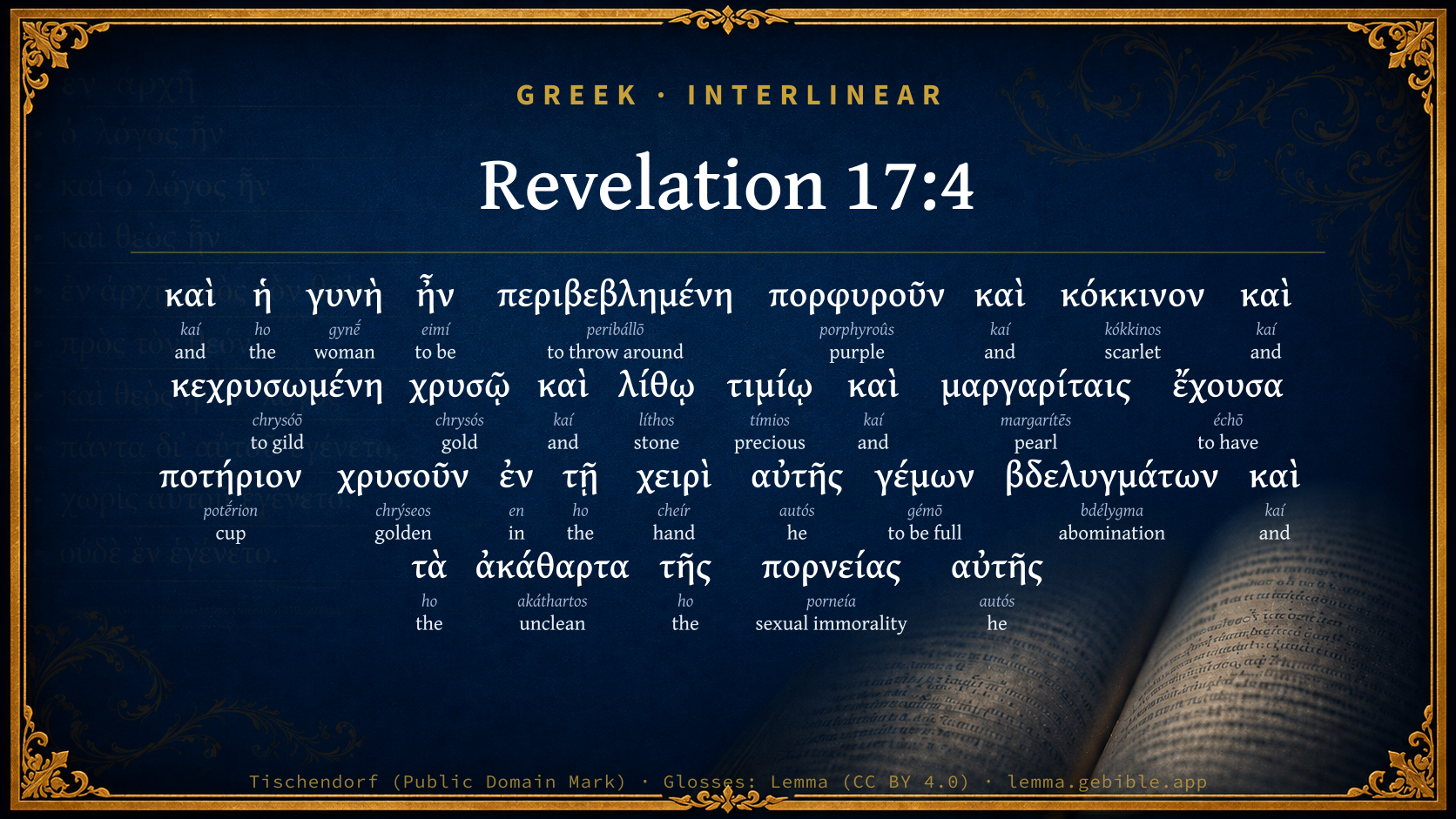
Greek (Tischendorf 8th ed.) Revelation 17:4 appears in the Greek New Testament. The text above is from the Tischendorf 8th edition. Each word links to its Strong’s number and a concise gloss. Click any word for its full Thayer’s Greek Lexicon entry.
Download image
Cite this verse

Revelation 17:4 (World English Bible). Public Domain. Lemma interlinear Bible study tool, https://lemma.gebible.app/v/revelation/17/4.

Show BibTeX & RIS
BibTeX
RIS
English Translation
The woman was dressed in purple and scarlet, and decked with gold and precious stones and pearls, having in her hand a golden cup full of abominations and the impurities of the sexual immorality of the earth.
World English Bible · Public Domain
Highlights
  • 1 first appearance in the Greek New Testament
Full analysis ↓
Download a study sheet

One document with this verse’s original text, its word-by-word gloss line, the meaning frame, cross-references with their text, attributed commentary, and full source and license credits — printable, and it pastes into notes with its structure intact.

This verse Autodidact and up

Study sheet (.html) Plain text (.txt)

A passage Seminary Student

Up to 50 verses in one chapter. A passage sheet keeps up to 6 commentary sources and 12 cross-references per verse, in the order this page ranks them, and says so on the sheet whenever that leaves anything out. Ask for a single verse and you get the Autodidact verse sheet above.

Everything on this page stays free to read, with no account — the sheet is a download of what is already on screen, not access to it.

Want to remove ads? Support Godless Engineer
Compare translations 3

The same verse in 3 English versions, stacked beneath the original-language interlinear above. Click any original word for its lexicon entry.

Each is an independent rendering of the whole verse — the interlinear is not word-aligned to these translations.

Highlighted words mark where these versions differ — a whole-verse word diff, not a word-by-word alignment.

  • World English Bible Public Domain
    The woman was dressed in purple and scarlet, and decked with gold and precious stones and pearls, having in her hand a golden cup full of abominations and the impurities of the sexual immorality of the earth.
  • King James Version Public Domain
    And the woman was arrayed in purple and scarlet colour, and decked with gold and precious stones and pearls, having a golden cup in her hand full of abominations and filthiness of her fornication:
  • unfoldingWord Literal Text CC BY-SA 4.0
    And the woman was clothed in purple and scarlet and adorned with gold and precious stone and pearls, holding in her hand a golden cup being full of abominations and the impurities of her sexual immorality,

unfoldingWord Literal Text — © unfoldingWord, licensed CC BY-SA 4.0. Word-aligned USFM3 via Door43 (git.door43.org/unfoldingWord/en_ult).

Versions to compare (up to 4)

3 of 4 selected

Show all 19 translations

Every available English version of this verse, each an independent rendering of the whole verse.

  • World English Bible Public Domain
    The woman was dressed in purple and scarlet, and decked with gold and precious stones and pearls, having in her hand a golden cup full of abominations and the impurities of the sexual immorality of the earth.
  • Berean Standard Bible Public Domain
    The woman was dressed in purple and scarlet, and adorned with gold and precious stones and pearls. She held in her hand a golden cup full of abominations and the impurities of her sexual immorality.
  • Majority Standard Bible Public Domain
    The woman was dressed in purple and scarlet, and adorned with gold and precious stones and pearls. She held in her hand a golden cup full of abominations and the impurities of her sexual immorality.
  • King James Version Public Domain
    And the woman was arrayed in purple and scarlet colour, and decked with gold and precious stones and pearls, having a golden cup in her hand full of abominations and filthiness of her fornication:
  • American Standard Version (1901) Public Domain
    And the woman was arrayed in purple and scarlet, and decked with gold and precious stone and pearls, having in her hand a golden cup full of abominations, even the unclean things of her fornication,
  • Revised Version (1885) Public Domain
    And the woman was arrayed in purple and scarlet, and decked with gold and precious stone and pearls, having in her hand a golden cup full of abominations, even the unclean things of her fornication,
  • Geneva Bible (1599) Public Domain
    And the woman was arayed in purple and skarlet, and gilded with golde, and precious stones, and pearles, and had a cup of gold in her hand, full of abominations, and filthines of her fornication.
  • Douay-Rheims (1899) Public Domain
    And the woman was clothed round about with purple and scarlet, and gilt with gold, and precious stones and pearls, having a golden cup in her hand, full of the abomination and filthiness of her fornication.
  • Young's Literal Translation Public Domain
    and the woman was arrayed with purple and scarlet-colour, and gilded with gold, and precious stone, and pearls, having a golden cup in her hand full of abominations and uncleanness of her whoredom,
  • Literal Standard Version CC BY-SA 4.0
    and the woman was clothed with purple and scarlet-color, and gilded with gold, and precious stone, and pearls, having a golden cup in her hand full of abominations and uncleanness of her whoredom,
  • Unlocked Literal Bible CC BY-SA 4.0
    The woman was dressed in purple and scarlet and was adorned with gold, precious stones, and pearls. She was holding in her hand a golden cup full of detestable things and the impurities of her sexual immorality.
  • unfoldingWord Literal Text CC BY-SA 4.0
    And the woman was clothed in purple and scarlet and adorned with gold and precious stone and pearls, holding in her hand a golden cup being full of abominations and the impurities of her sexual immorality,
  • Darby Bible Public Domain
    And the woman was clothed in purple and scarlet, and had ornaments of gold and precious stones and pearls, having a golden cup in her hand full of abominations and the unclean things of her fornication;
  • World Messianic Bible Public Domain
    The woman was dressed in purple and scarlet, and decked with gold and precious stones and pearls, having in her hand a golden cup full of abominations and the impurities of the sexual immorality of the earth.
  • Webster's Bible Public Domain
    And the woman was arrayed in purple and scarlet-color, and decked with gold and precious stones and pearls, having a golden cup in her hand full of abominations and filthiness of her lewdness:
  • Free Bible Version CC BY-SA 4.0
    The woman was clothed in purple and scarlet, and wore jewelry made of gold and gems and pearls. She held in her hand a golden cup full of obscene things and her disgusting immorality.
  • Bible in Basic English Public Domain
    And the woman was clothed in purple and bright red, with ornaments of gold and stones of great price and jewels; and in her hand was a gold cup full of evil things and her unclean desires;
  • Text-Critical English NT CC BY 4.0
    The woman was clothed in purple and scarlet, and adorned with gold, precious stones, and pearls. She held in her hand a golden cup full of abominations and the filth of the fornication of the earth.
  • Tyndale New Testament (1534) Public Domain
    And the woman was arayed in purple and rose color and decked with golde precious stone and pearles and had a cup of golde in her honde full of abominacions and fylthynes of her fornycacion.

Literal Standard Version (2020), Covenant Press — licensed CC BY-SA 4.0. Text via the HelloAO Bible API (eBible.org). Unlocked Literal Bible (unfoldingWord) — licensed CC BY-SA 4.0. Text via the HelloAO Bible API (eBible.org). unfoldingWord Literal Text — © unfoldingWord, licensed CC BY-SA 4.0. Word-aligned USFM3 via Door43 (git.door43.org/unfoldingWord/en_ult). Free Bible Version, Dr. Jonathan Gallagher — licensed CC BY-SA 4.0. Text via the HelloAO Bible API (eBible.org).

Word by word

More ways to search: Search by grammar → Find every occurrence → Compare this word →

Practice this passage: Drill this verse → Learn its vocabulary →

κεχρυσωμένη
chrysóō
G5558
“to gild”
Verb, Perfect, Passive, Participle, Nominative, Singular, Feminine
Part of Speech
Verb
Tense
Perfect
Voice
Passive
Mood
Participle
Case
Nominative
Number
Singular
Gender
Feminine
Full Thayer's Definition

Origin: from G5557

TDNT: None

1. to adorn with gold, to gild a. of a woman ornamented with gold so profusely that she seems to be gilded
  1. καὶ kaí G2532 “and” Conjunction
  2. ἡ ho G3588 “the” Article, Nominative, Singular, Feminine
  3. γυνὴ gynḗ G1135 “woman” Noun, Nominative, Singular, Feminine
  4. ἦν eimí G1510 “to be” Verb, Imperfect, Active, Indicative, 3rd person, Singular
  5. περιβεβλημένη peribállō G4016 “to throw around” Verb, Perfect, Passive, Participle, Nominative, Singular, Feminine
  6. πορφυροῦν porphyroûs G4210 “purple” Adjective, Accusative, Singular, Neuter
  7. καὶ kaí G2532 “and” Conjunction
  8. κόκκινον kókkinos G2847 “scarlet” Adjective, Accusative, Singular, Neuter
  9. καὶ kaí G2532 “and” Conjunction
  10. χρυσῷ chrysós G5557 “gold” Noun, Dative, Singular, Masculine
  11. καὶ kaí G2532 “and” Conjunction
  12. λίθῳ líthos G3037 “stone” Noun, Dative, Singular, Masculine
  13. τιμίῳ tímios G5093 “precious” Adjective, Dative, Singular, Masculine
  14. καὶ kaí G2532 “and” Conjunction
  15. μαργαρίταις margarítēs G3135 “pearl” Noun, Dative, Plural, Masculine
  16. ἔχουσα échō G2192 “to have” Verb, Present, Active, Participle, Nominative, Singular, Feminine
  17. ποτήριον potḗrion G4221 “cup” Noun, Accusative, Singular, Neuter
  18. χρυσοῦν chrýseos G5552 “golden” Adjective, Accusative, Singular, Neuter
  19. ἐν en G1722 “in” Preposition
  20. τῇ ho G3588 “the” Article, Dative, Singular, Feminine
  21. χειρὶ cheír G5495 “hand” Noun, Dative, Singular, Feminine
  22. αὐτῆς autós G846 “he” Personal pronoun, Genitive, Singular, Feminine
  23. γέμων gémō G1073 “to be full” Verb, Present, Active, Participle, Nominative, Singular, Masculine
  24. βδελυγμάτων bdélygma G946 “abomination” Noun, Genitive, Plural, Neuter
  25. καὶ kaí G2532 “and” Conjunction
  26. τὰ ho G3588 “the” Article, Accusative, Plural, Neuter
  27. ἀκάθαρτα akáthartos G169 “unclean” Adjective, Accusative, Plural, Neuter
  28. τῆς ho G3588 “the” Article, Genitive, Singular, Feminine
  29. πορνείας porneía G4202 “sexual immorality” Noun, Genitive, Singular, Feminine
  30. αὐτῆς autós G846 “he” Personal pronoun, Genitive, Singular, Feminine

About this verse

These counts appear in no published source. They are computed here, from the morphology-tagged text and Lemma’s own curated glosses. What Lemma adds →

31
words
22
distinct lemmas
Revelation
section

Notable vocabulary

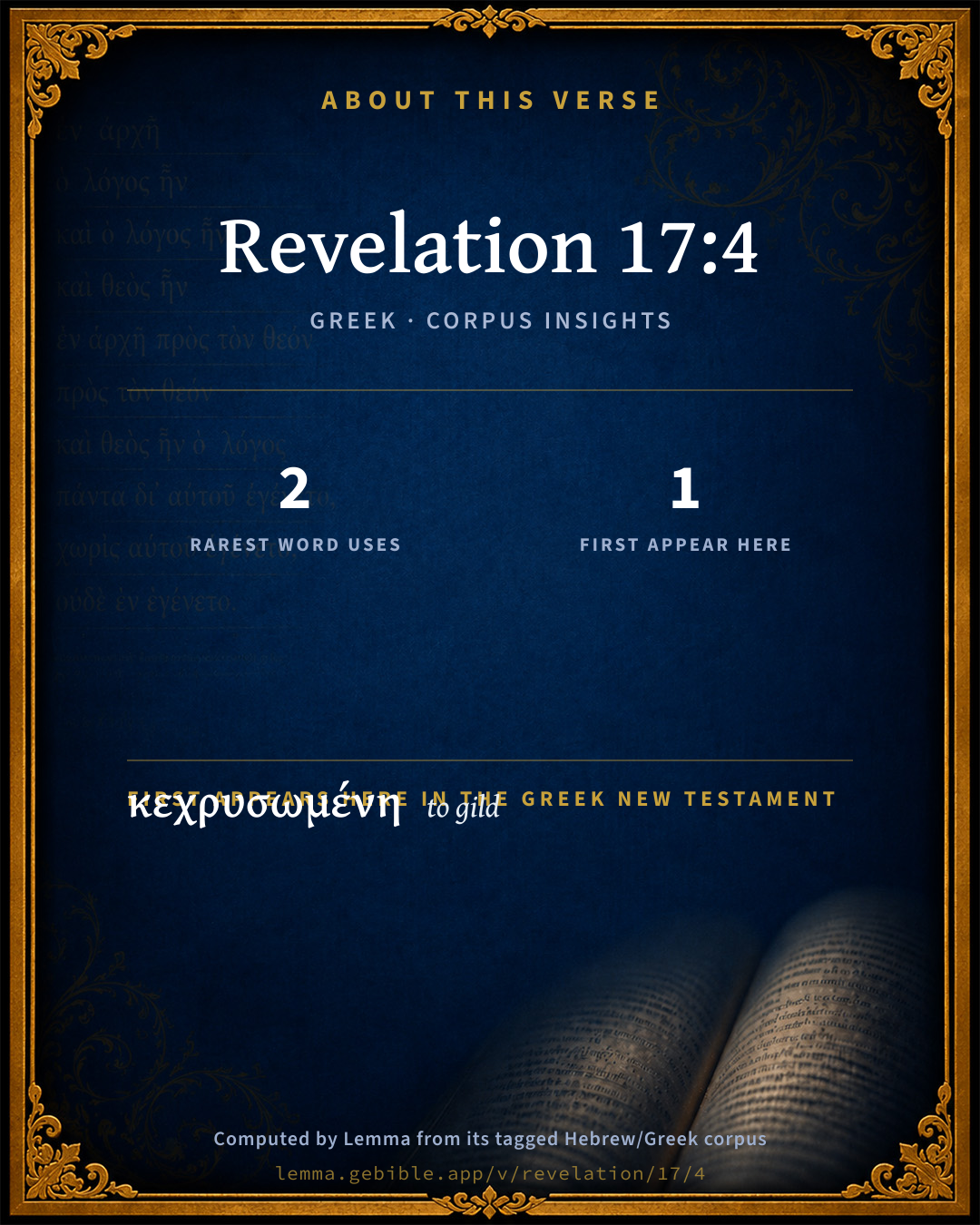
The rarest word here is κεχρυσωμένη to gild G5558 — appearing just 2 times in the whole Greek New Testament.

First appearance in Scripture

This word makes its first canonical appearance in the Greek New Testament here:

  • κεχρυσωμένη to gild G5558

Shared distinctive vocabulary

κεχρυσωμένη to gild G5558 occurs in 2 verses of the Greek New Testament. Also found in:
Repetition

Words recur within this verse:

Cross-references

16

Topical passages linked to Revelation 17:4 in the Treasury of Scripture Knowledge — connected by theme and wording, ordered by reader-vote popularity; previews shown in the World English Bible.

  • Jeremiah 51:7 Babylon has been a golden cup in Yahweh's hand, who made all the earth drunken: the nations have drunk of her wine; therefore the nations are mad.
  • Revelation 18:16 saying, 'Woe, woe, the great city, she who was dressed in fine linen, purple, and scarlet, and decked with gold and precious stones and pearls!
  • Revelation 19:2 for true and righteous are his judgments. For he has judged the great prostitute, who corrupted the earth with her sexual immorality, and he has avenged the blood of his servants at her hand."
  • Revelation 18:12 merchandise of gold, silver, precious stones, pearls, fine linen, purple, silk, scarlet, all expensive wood, every vessel of ivory, every vessel made of most precious wood, and of brass, and iron, and marble;
  • Lamentations 1:9 Her filthiness was in her skirts; she didn't remember her latter end; Therefore is she come down wonderfully; she has no comforter: See, Yahweh, my affliction; for the enemy has magnified himself.
  • 2 Thessalonians 2:3–10 Let no one deceive you in any way. For it will not be, unless the departure comes first, and the man of sin is revealed, the son of destruction,
  • Ezekiel 24:13 In your filthiness is lewdness: because I have cleansed you and you weren't cleansed, you shall not be cleansed from your filthiness any more, until I have caused my wrath toward you to rest.
  • Daniel 11:38 But in his place shall he honor the god of fortresses; and a god whom his fathers didn't know shall he honor with gold, and silver, and with precious stones, and pleasant things.
  • Revelation 14:8 Another, a second angel, followed, saying, "Babylon the great has fallen, which has made all the nations to drink of the wine of the wrath of her sexual immorality."
  • Revelation 18:6–7 Return to her just as she returned, and repay her double as she did, and according to her works. In the cup which she mixed, mix to her double.
  • 1 Kings 14:24 and there were also sodomites in the land: they did according to all the abominations of the nations which Yahweh drove out before the children of Israel.
  • Ezekiel 24:11 Then set it empty on the coals of it, that it may be hot, and the brass of it may burn, and that the filthiness of it may be molten in it, that the rust of it may be consumed.
  • Ezra 9:11 which you have commanded by your servants the prophets, saying, The land, to which you go to possess it, is an unclean land through the uncleanness of the peoples of the lands, through their abominations, which have filled it from one end to another with their filthiness:
  • Hosea 9:10 I found Israel like grapes in the wilderness. I saw your fathers as the first ripe in the fig tree at its first season; But they came to Baal Peor, and consecrated themselves to the shameful thing, And became abominable like that which they loved.
  • 2 Kings 21:2 He did that which was evil in the sight of Yahweh, after the abominations of the nations whom Yahweh cast out before the children of Israel.
  • Ezekiel 20:30 Therefore tell the house of Israel, Thus says the Lord Yahweh: Do you pollute yourselves after the manner of your fathers? and play you the prostitute after their abominations?

Cross-references courtesy of OpenBible.info (CC BY 4.0).

Commentary

Notes on Revelation 17:4 from classic Christian and Jewish commentators (each source and its license shown beneath its notes). The classic Christian expositions comment on the surrounding passage and are grouped to its opening verse, so a note may address several verses; the Jewish commentaries on the Tanakh (Rashi and others) are per-verse, so they appear only where the commentator wrote on this verse.

Lemma curates 59 commentaries, every one of them public domain or Creative Commons licensed, each selected and text-cleaned for this edition rather than reprinted as found. About our sources →

Joseph Benson's Commentary

Rev 17:4-5. And the woman was arrayed — With the utmost pomp and magnificence; in purple and scarlet — Which were the colours of the imperial habit, — the purple in times of peace, and the scarlet in times of war: and the scarlet is the colour of the popes and cardinals, as it used to be that of the Roman emperors and senators. Nay, the mules and horses which carry the popes and cardinals are covered with scarlet cloth, so that they may properly be said to ride upon a scarlet-coloured beast. The woman is also decked with gold, and precious stones, and pearls — And who can sufficiently describe the pride, and grandeur, and magnificence of the Church of Rome in her vestments and ornaments of all kinds? One remarkable instance of this we have in Paul II., whose mitre was set with diamonds, sapphires, emeralds, chrysolites, jaspers, and all kinds of precious stones: and another conspicuous instance is in the lady of Loretto; the riches of whose holy image, and house, and treasury are far beyond the reach of description. There silver can hardly find an admission, and gold itself looks but poorly among such an incredible number of precious stones. Moreover, the woman, like other harlots, who give filters and love-potions to inflame their lovers, hath a golden cup in her hand, like the ancient Babylon, Jer 51:7, full of abominations and filthiness of her fornication — Signifying the specious and alluring arts wherewith she bewitches and incites men to idolatry, which is an abomination, and spiritual fornication, and to many other abominable doctrines as well as practices. And upon her forehead a name written — Whereas the saints have the name of God and the Lamb on their foreheads. The allusion here seems to be to the practice of some notorious prostitutes, who had their names written in a label upon their foreheads, as we may collect from ancient authors; (see Seneca, Book 1. contr. 2; Juvenal, Sat. 6. lin. 122;) MYSTERY, BABYLON THE GREAT — This name mystery can imply no less than that she dealeth in mysteries; her religion is a mystery, — a mystery of iniquity; and she herself is mystically Babylon the Great. Benedict XIII., in his proclamation of the jubilee, A.D. 1725, explains this sufficiently. His words are, “To this holy city, famous for the memory of so many holy martyrs, run with religious alacrity! Hasten to the place which the Lord hath chosen. Ascend to this new Jerusalem, whence the law of the Lord, and the light of evangelical truth, hath flowed forth into all nations, from the very first beginning of the church: the city most rightfully called The Palace; placed for the pride of all ages; the city of the Lord; the Sion of the Holy One of Israel. This catholic and apostolical Roman Church is the head of the world, the mother of all believers, the faithful interpreter of God, and mistress of all churches.” But God varies the style: he terms her the mother of harlots — The parent, ring-leader, patroness, and nourisher of many daughters, that closely copy after her; and abominations — Of every kind, spiritual and fleshly; of the earth — In all lands. In this respect she is indeed catholic, or universal.

The Papists would fain persuade us that pagan Rome is here intended: but, as Bishop Newton justly observes, “The title of mystery is in no respect proper to her more than any other city, and neither is there any mystery in substituting one heathen, idolatrous, and persecuting city for another; but it is indeed a mystery that a city, called Christian, professing and boasting herself to be the city of God, should prove another Babylon in idolatry and cruelty to the people of God. She glories in the name of Roman Catholic, and well therefore may she be called, Babylon the Great. She affects the style and title of our holy mother the church, but she is in truth the mother of fornications and abominations. Neither can this character, with any propriety, be applied to ancient Rome, for she was rather a learner of foreign superstitions than the mistress of idolatry to other nations; as appears in various instances, and particularly from that solemn form of adjuration which the Romans used when they laid siege to a city, calling forth the tutelary deities of the place, and promising them temples, and sacrifices, and other solemnities at Rome. It may be concluded, therefore, that this part of the prophecy is sufficiently fulfilled, though there should be reason to question the truth of what is asserted by some writers, that the word MYSTERY was formerly written in letters of gold upon the forepart of the pope’s mitre. Scaliger affirms it upon the authority of the duke de Montmorency: Francis le Moyne and Brocardus confirm it, appealing to ocular inspection: and when King James objected this, Lessius could not deny it. If the thing be true, it is a wonderful coincidence of the event with the letter of prophecy. It is, however, much more certain, and none of that communion can deny it, that the ancient mitres were usually adorned with inscriptions.

Joseph Benson's Commentary on the Old and New Testaments (1811–1818) — public domain. Text from a community e-Sword module.

Expositor's Greek Testament

ed. W. Robertson Nicoll

Rev 17:4 . κεχρυς . goes by an awkward zeugma with λίθῳ (collective) καὶ μαργαρίταις ; “with ornaments of gold and precious stones and pearls” (like Ezekiel’s doomed prince of Tyre). The harlot in Test. Jud 1:13Jud 1:13 :5 was also decked ἐν χρυσίῳ καὶ μαργαρίταις and poured out wine for her victims. Rome is pronounced luxurious, licentious and loathsome. Here, as in the contemporary 4 Esd. 3:2, 29, it is felt to be a mystery that prosperity and permanence should belong to a state flaunting its impiety and oppression, not merely enjoying but propagating vice.

The Expositor's Greek Testament, edited by W. Robertson Nicoll (1897–1910) — public domain. Text from a community e-Sword module.

Geneva Bible (1599)

Geneva Bible translators

That harlot, the spiritual Babylon, which is Rome. She is described by her attire, profession and deeds.

In profession, the nourisher of all, in this verse, and teaching her mysteries unto all, verse 5, setting forth all things most magnificently: but indeed most pernicious besotting miserable men with her cup, and bringing upon them a deadly giddiness.

In attire most glorious, triumphant, most rich, and most gorgeous.

Geneva Bible (1599) marginal notes — public domain. Text via Bolls.life.

Jamieson, Fausset & Brown

Robert Jamieson, A. R. Fausset & David Brown

The color scarlet, it is remarkable, is that reserved for popes and cardinals. Paul II made it penal for anyone but cardinals to wear hats of scarlet; compare Roman Ceremonial [3.5.5]. This book was compiled several centuries ago by MARCELLUS, a Romish archbishop, and dedicated to Leo X. In it are enumerated five different articles of dress of scarlet color. A vest is mentioned studded with pearls. The Pope's miter is of gold and precious stones. These are the very characteristics outwardly which Revelation thrice assigns to the harlot or Babylon. So Joachim an abbot from Calabria, about A.D. 1200, when asked by Richard of England, who had summoned him to Palestine, concerning Antichrist, replied that "he was born long ago at Rome, and is now exalting himself above all that is called God." ROGER HOVEDEN [Annals, 1.2], and elsewhere, wrote, "The harlot arrayed in gold is the Church of Rome." Whenever and wherever (not in Rome alone) the Church, instead of being "clothed (as at first, Rev 12:1) with the sun" of heaven, is arrayed in earthly meretricious gauds, compromising the truth of God through fear, or flattery, of the world's power, science, or wealth, she becomes the harlot seated on the beast, and doomed in righteous retribution to be judged by the beast (Rev 17:16). Soon, like Rome, and like the Jews of Christ's and the apostles' time leagued with the heathen Rome, she will then become the persecutor of the saints (Rev 17:6). Instead of drinking her Lord's "cup" of suffering, she has "a cup full of abominations and filthinesses." Rome, in her medals, represents herself holding a cup with the self-condemning inscription, "Sedet super universum." Meanwhile the world power gives up its hostility and accepts Christianity externally; the beast gives up its God-opposed character, the woman gives up her divine one. They meet halfway by mutual concessions; Christianity becomes worldly, the world becomes Christianized. The gainer is the world; the loser is the Church. The beast for a time receives a deadly wound (Rev 13:3), but is not really transfigured; he will return worse than ever (Rev 17:11-14). The Lord alone by His coming can make the kingdoms of this world become the kingdoms of our Lord and His Christ. The "purple" is the badge of empire; even as in mockery it was put on our Lord.

decked--literally, "gilded."

stones--Greek, "stone."

filthiness--A, B, and ANDREAS read, "the filthy (impure) things."

Jamieson, Fausset & Brown — Commentary Critical and Explanatory on the Whole Bible (1871) — public domain (CC PDM 1.0). Text via the HelloAO Bible API.

Adam Clarke's Commentary

Verse 4. And the woman was arrayed in purple and scarlet colour, and decked with gold, and precious stones, and pearls, having a golden cup in her hand full of abominations and filthiness of her fornication] This strikingly represents the most pompous and costly manner in which the Latin Church has held forth to the nations the rites and ceremonies of its idolatrous and corrupt worship.

Adam Clarke's Commentary on the Bible (1810–1826) — public domain. Text from a community e-Sword/MySword module.

Ellicott's Commentary for English Readers

(4) And the woman was arrayed . . .—Better, arrayed (or, clad) in purple (the colour of the robe which was in mockery put on our Lord—Joh_19:2) and scarlet, gilded (not “decked”) with gold, &c. Her appearance is one of imperial splendour. (Comp. the description of Tyre in Eze_28:13.)

Having a golden cup in her hand . . .—Translate, Having a golden cup in her hand teeming with abominations and with the unclean things of the fornication of the earth. Jeremiah (Jer_51:7) called Babylon a “golden cup in the hand of the Lord.” The cup had made all the earth drunken; the cup of intoxication, splendid and attractive, was full of an evil power, which robbed men’s senses and degraded them. The great city of the world ever holds out such a glittering cup, which

“Most do taste through fond intemperate desire.

Soon as the potion works, their human countenance,

Th’ express resemblance of the gods, is changed

Into some brutish form. . . . . . .

—Comus, 68-77.

A Bible Commentary for English Readers, edited by Charles John Ellicott (1878–1897) — public domain. Text from a community e-Sword module.

The Cambridge Bible for Schools and Colleges

gen. ed. J. J. S. Perowne

4. arrayed in purple and scarlet colour] Protestant interpreters have been fond of applying this description to the robes of Roman bishops and cardinals: and perhaps not altogether unjustly. See Introduction, pp. 57, 58.

decked with gold] Lit. gilded with gold: perhaps illustrated by the contemporary picture of the historical imperial harlot, Messalina.

precious stone] Lit. stone, used, of course, collectively. See on Rev_15:6.

a golden cup] See Jer_51:7 already quoted. We can hardly say that the cup serves her to drink the blood of saints and martyrs (Rev_17:6), but it is meant to suggest that she is drunken and invites to drunkenness, as well as to uncleanness.

The Cambridge Bible for Schools and Colleges (gen. ed. J. J. S. Perowne; Cambridge University Press, 1878–1918) — public domain. Text from a community e-Sword module.

John Gill's Exposition

And the woman was arrayed in purple and scarlet colour,.... Which may be expressive of her grandeur, authority, and power, sitting as a queen, and sovereign in the empire, ruling over kingdoms and nations in it; and also of her bloody disposition to the saints, with whose blood she is afterwards said to be drunk;

and decked with gold and precious stones, and pearls; which may denote her hypocrisy, she being gilded with these things, as the word signifies, when she was inwardly rotten, corrupt, and filthy; and may point out the things by which persons have been enticed into the communion of the church of Rome, and to comply with her idolatrous worship and practices; and may also respect the prodigious riches, which have, by various methods, been brought into the pope's coffers; these, with other things, are reckoned among the merchandise of Babylon, Rev 18:12 and particularly this may have reference to the adorning of their temples, or churches, and the decking of their images, with those things; which gaudy pompous shows strike the minds of carnal men, amuse them, and engage their attention. So Philo (k) the Jew describes an whore as arrayed in purple, and adorned with gold and precious stones; see Pro 7:10.

Having a golden cup in her hand full of abominations and filthiness of her fornication; in allusion to Babylon, Jer 51:7 and also to harlots, who give philters or love potions to men, to excite lust, and draw their affections to them; and this being a golden cup may design the external lustre and splendour of the worship of the church of Rome, by which many have been drawn into a compliance with it, which is attended with many abominable, filthy, and idolatrous practices: and perhaps some regard may be had to the golden chalice, in which, it is pretended, is the very blood of Christ, which the priests take as such, and worship and adore, and is no other than an abominable and filthy piece of idolatry; and such are the persons that partake of it; like the Pharisees of old, they make clean the outside of the cup and platter; glister, and make a great show of devotion, but within are full of extortion and excess.

(k) De Mercede Meretricis non recip. p. 861.

John Gill's Exposition of the Whole Bible (1746–1763) — public domain (CC PDM 1.0). Text via the HelloAO Bible API.

Trapp's Complete Commentary

John Trapp

4 And the woman was arrayed in purple and scarlet colour, and decked with gold and precious stones and pearls, having a golden cup in her hand full of abominations and filthiness of her fornication:

Ver. 4. In purple and scarlet] Clothing for kings and nobles, over whom this whore domineers much more than the concubines did over the kings of Persia.

And decked with gold] Gr. κεχρυσωμενη, gilded with gold, to note her hypocrisy and outsideness, gold without, copper within. The pope styles himself the servant of God’s servants, but yet stamps in his coin, "The nation and country that will not serve thee shall be rooted out." At the absolution of King John of England, 8000 marks of silver were presently delivered to Pandoffus the pope’s envoy, who trampled it under his feet as condemning that base matter, but yet received it and sent it away to Rome. (Daniel’s Hist.)

And precious stones and pearls] Besides the rich stones that are in the pope’s triple crown of inestimable price and value, he carries in his pantofle {a} (which he holds out to be kissed) the picture of the cross, set in pearls and precious stones, Ut plenis faucibus crucem Christi derideat, saith Hiedfeld. Pope Sixtus quintus five was wont to give to Tiresa, his harlot, pantofles covered with pearls. He spent two hundred and threescore thousand crowns upon a conduit, which he built for his pleasure; and yet he brought in fifty hundred thousand crowns into the new treasury built by himself in the castle of St Angelo. At the coronation of Pope Leo X, a million crowns are said to have been spent in one day. Pope Paul II was wont to sleep all day, and spend whole nights in weighing monies and beholding jewels and precious pictures, uno eo die 1,000,000 aureorum expendit. (Jac. Rev 261.)

A golden cup full of abominations] Gold, if it be right, they say discovers and expels poison. Put poison into a cup of gold, and it will hiss and send up certain circles like rainbows. Hereby is signified (saith an author) that God threateneth judgment and fire to those that pour poison into divine doctrine, as the pope doth with his mad mixtures. He that argued from the letters of Papa, P. Poculum, A. Aureum, P. Plenum, A. Abominationum, argued no less wittily than that other, who of Roma made Radix omnium malorum, the base of all evils.

{a} A slipper; formerly applied very variously, app., at one time or another, to every sort of in-door slippers or loose shoes; esp. to the high-heeled cork-soled chopins; also to out-door overshoes or goloshes; and to all manner of Oriental and non-European slippers, sandals, and the like. (In Scottish use from 15th c.; in common Eng. use from c 1570 to c 1650-60; after that chiefly an alien or historical word.) ŒD

John Trapp, A Commentary or Exposition upon All the Books of the Old and New Testament (1647–1656) — public domain. Text from a community e-Sword module.

Albert Barnes' Notes on the Bible

And the woman was arrayed in purple and scarlet colour - On the nature of the scarlet color, see the notes on Rev 17:3. The purple color - πορφύρα porphura - was obtained from a species of shellfish found on the coasts of the Mediterranean, which yielded a reddish-purple dye, much prized by the ancients. Robes dyed in that color were commonly worn by persons of rank and wealth, Mar 15:17, Mar 15:20; Luk 16:19. The purple color contains more blue than the crimson, though the limits are not very accurately defined, and the words are sometimes interchanged. Thus the mock robe put on the Saviour is called in Mar 15:17, Mar 15:20, πορφύραν porphuran - “purple,” and in Mat 27:28, κοκκίνην kokkinēn - “crimson.” On the applicability of this to the papacy, see the notes on Rev 17:3.

And decked with gold - After the manner of an harlot, with rich jewelry.

And precious stones - Sparkling diamonds, etc.

And pearls - Also a much-valued female ornament. Compare the notes on Mat 7:6; Mat 13:46.

Having a golden cup in her hand - As if to entice lovers. See the notes on Rev 14:8.

Full of abominations - Of abominable things; of things suited to excite abhorrence and disgust; things unlawful and forbidden. The word, in the Scriptures, is commonly used to denote the impurities and abominations of idolatry. See the notes on Dan 9:27. The meaning here is, that it seemed to be a cup filled with wine, but it was in fact a cup full of all abominable drugs, leading to all kinds of corruption. How much in accordance this is with the fascinations of the papacy, it is not necessary now to say, after the ample illustrations of the same thing already furnished in these notes.

And filthiness of her fornication - The image here is that of papal Rome, represented as an abandoned woman in gorgeous attire, alluring by her arts the nations of the earth, and seducing them into all kinds of pollution and abomination. It is a most remarkable fact that the papacy, as if designing to furnish a fulfillment of this prophecy, has chosen to represent itself almost precisely in this manner - as a female extending an alluring cup to passers by - as will be seen by the engraving on this page. Far as the design of striking this medal may have been from confirming this portion of the Book of Revelation, yet no one can fail to see that if this had been the design, no more happy illustration could have been adopted. Apostate churches, and guilty nations, often furnish the very proofs necessary to confirm the truth of the Scriptures.

Albert Barnes' Notes on the Bible (1834–1885) — public domain. Text from a community e-Sword/MySword module.

Haydock's Catholic Bible Commentary

Cup....full of the abomination, &c. These are common scriptural expressions for the abominations of idolatry, with which ancient Rome had notoriously polluted herself. For not content with worshipping her own heathenish gods, she adopted those of all the countries and nations she had subdued. In Rome itself there were no less than 420 heathenish temples, so that one of their most famous poets, Ovid, (lib. i. Trist.) says: Sed quæ de septem totum circumspicit orbem,

mortibus Imperii, Roma, Deumque locus.

George Leo Haydock (1774–1849), Haydock's Catholic Family Bible and Commentary, 1859 edition — public domain. Excludes Psalms (Douay-Rheims chapter numbering differs from Protestant) and Deuterocanonical books (Catholic canon only).

Matthew Poole's English Annotations

And the woman was arrayed in a purple and scarlet colour; purple was the colour of kings and princes: this woman, Rev 18:7, said she was queen.

Scarlet also was a rich and noble colour, anciently most used in a time of war. How much it is in use with the pope and his cardinals, is sufficiently known.

And decked with gold and precious stones and pearls; this shows the worldly riches of the papacy.

Having a golden cup in her hand full of abominations and filthiness of her fornication; alluring and tempting persons to idolatry, as whores use to do with their philters, or enchanted cups, allure and provoke men to sensual satisfactions.

Matthew Poole's English Annotations on the Holy Bible (1683–1685) — public domain. Text from a community e-Sword/MySword module.

Whedon's Commentary on the Bible

Daniel D. Whedon

4. Decked with gold and precious stones and pearls—The pomp and glare, and lavish richness of the Romish equipage and worship, are notorious to all the world. The Italian historian Platina, quoted by Newton, says of Paul II: “In his pontifical vestments he outwent all his predecessors, especially in his regno or mitre, upon which he had laid out a great deal of money in purchasing, at vast rates, diamonds, sapphires, emeralds, chrysolites, jaspers, unions, and all manner of precious stones, wherewith adorned, like another Aaron, he would appear abroad somewhat more august than a man, delighting to be seen and admired by every one.”

A golden cup in her hand—And so it was said of ancient Babylon, Jer_51:7 : “The nations have drunken of her wine, therefore the nations are mad.”

Full of… filthiness… fornication—Not wine alone is in her cup, but drugs and philters, and stimulants to fornication.

Daniel D. Whedon (gen. ed.), Commentary on the Old and New Testaments (1874–1909) — public domain. Text from a community e-Sword module.

The Pulpit Commentary

And the woman was arrayed in purple and scarlet colour. These words, taken in connection with those that follow, seem to signify the worldly magnificence which may be the portion of the faithless Christian. Some writers see an allusion to the purple robe of Christ. (On the meaning of "scarlet," see on ver. 3) And decked with gold and precious stones and pearls; gilded with, etc. Similar descriptions are given in Eze_16:13 and Eze_28:13. Compare the description in Rev_21:11. This account is sufficiently characteristic of the world"s attractions to need no comment. Having a golden cup in her hand full of abominations and filthiness of her fornication; full of abominations, even the unclean things of, etc. (Revised Version), the Authorized Version reading being placed in the margin. Another reference to Jer_51:7. (cf. also Rev_14:10) Abominations are all things that are displeasing to God. (On "fornication," see on Rev_14:8 and Rev_17:1, Rev_17:2; it signifies unfaithfulness towards God)

The Pulpit Commentary (1880–1919), ed. H.D.M. Spence-Jones & Joseph S. Exell — public domain. Text from a community e-Sword module.

John Wesley's Explanatory Notes

And the woman was arrayed - With the utmost pomp and magnificence. In purple and scarlet - These were the colours of the imperial habit: the purple, in times of peace; and the scarlet, in times of war. Having in her hand a golden cup - Like the ancient Babylon, Jer. li, 7. Full of abominations - The most abominable doctrines as well as practices.

John Wesley, Explanatory Notes Upon the Whole Bible (1754–1765) — public domain. Text via the GEBible commentary corpus.

The People's New Testament

B. W. Johnson

4–5. And the woman was arrayed in purple and scarlet color. The color of royalty. Decked with gold, etc. Her jewels and gold indicate enormous wealth. Having a golden cup in her hand. A golden censer in the hands of an angel represents by its incense the prayers of those who belong to the true church. This symbol of the false church has a cup full of abominations instead. See Jeremiah 51:7.

B. W. Johnson's The People's New Testament with Notes (1889–1891) — public domain. Electronic text from the Christian Classics Ethereal Library (CCEL) ThML edition.

Cambridge Greek Testament for Schools and Colleges

4. τῆς πορν. αὐτῆς. B2 reads τῆς πορν. τῆς γῆς; Cyp[590] Primas[591] fornicationis totius terrae; א τῆς πορνίας αὐτῆς καὶ τῆς γῆς.

[590] St Cyprian as quoted by Haussleiter.

[591] Primasius, edited by Haussleiter.

4. περιβεβλημένη πορφυροῦν καὶ κόκκινον. Protestant interpreters have been fond of applying this description to the robes of Roman bishops and cardinals: and perhaps not altogether unjustly. See Introduction, p. lxxii.

κεχρυσωμένη χρυσῷ. Lit. “gilded with gold,” and, but for the words which follow, the literal sense might be right; the imperial harlot Messalina did the like, Juv. VI. 123. If not, it is a question whether we are to suppose a zeugma or translate κεχρυσωμένη “bejewelled.”

λίθῳ τιμίῳ. See on Rev 15:6; of course λίθῳ is used collectively.

ποτήριον χρυσοῦν. See Jer 51:7 already quoted. We can hardly say that the cup serves her to drink the blood of saints and martyrs (Rev 17:6), but it is meant to suggest that she is drunken, and invites to drunkenness, as well as to uncleanness.

γέμον βδελυγμάτων. It is the cup of idolatry and the βδελύγματα are idols.

καὶ τὰ ἀκάθαρτα τῆς πορνείας αὐτῆς. The pollutions of her whoredom are the same as the abominations of her idols: neither the revisers nor the editors of the Variorum Bible consider Düsterdieck’s suggestion, since adopted by Weiss, that the accusative may depend upon ἔχουσα as easily as on γέμον, worth notice, and probably it is condemned by the Latin translators, who all make the connexion the same as in A. V[619], though they get rid of the irregular construction.

[619] Authorised Version.

Cambridge Greek Testament for Schools and Colleges (Cambridge University Press, 1896; 21 vols, various authors incl. Carr, Maclear, Plummer, Farrar, Lumby, Moule, M. R. James, Simcox) — public domain. Text from a community e-Sword module.

Vincent's Word Studies in the New Testament

Marvin R. Vincent

Purple [πορφυρουν] . See on Luk 16:19.

Decked [κεχρυσωμενη] . Lit., gilded.

Precious stones [λιθω τιμιω] Lit., precious stone.

Golden cup. Compare Jer 51:7.

Abominations [βδελυγματων] . See on Mt 24:15.

Marvin R. Vincent, Word Studies in the New Testament (1887–1900) — public domain. Text from a community e-Sword/MySword module.

Lesson kit

Teaching starters — assembled from the data on this page, not authored interpretation. Every prompt links to the verse data it draws on. Edit before teaching.

Revelation, in the Revelation, opens this verse with 31 words (22 distinct Greek lemmas). Its most distinctive word is chrysóō (“to gild”). A historical commentator’s framing appears above. Read the whole chapter for the surrounding context.

Discussion questions

  1. The word chrysóō carries the sense “to gild.” How does it shape the verse?
  2. This is the first place “to gild” appears in Scripture (first appears here). What does its debut here establish?
  3. How does Revelation 18:16, which shares the word «to gild», read alongside this verse?
  4. What does the repetition of “and” (6× in this one verse) do in this verse?
  5. These translations render this verse differently. What is at stake in choosing one wording over another?
  6. Compare how Joseph Benson's Commentary and Expositor's Greek Testament read this verse. Where do they agree or differ?

Things to notice

  • 1 word makes its first canonical appearance in Scripture here.
  • These translations choose different wording for 17 words in this verse.
  • “and” occurs 6× in this single verse.
  • 22 distinct Greek lemmas span 31 words in this verse.

Reading settings

Reading text

Shown beneath each verse's original-language words.

Old Testament
Old Testament edition

Read the OT as the Masoretic Hebrew (MT) or the Greek Septuagint (LXX).

English shown for the Greek Septuagint (in the Hebrew ↔ Greek comparison).

Comparing translations? Open the Compare panel on any verse page to stack up to four side by side.