
Mark 1:27

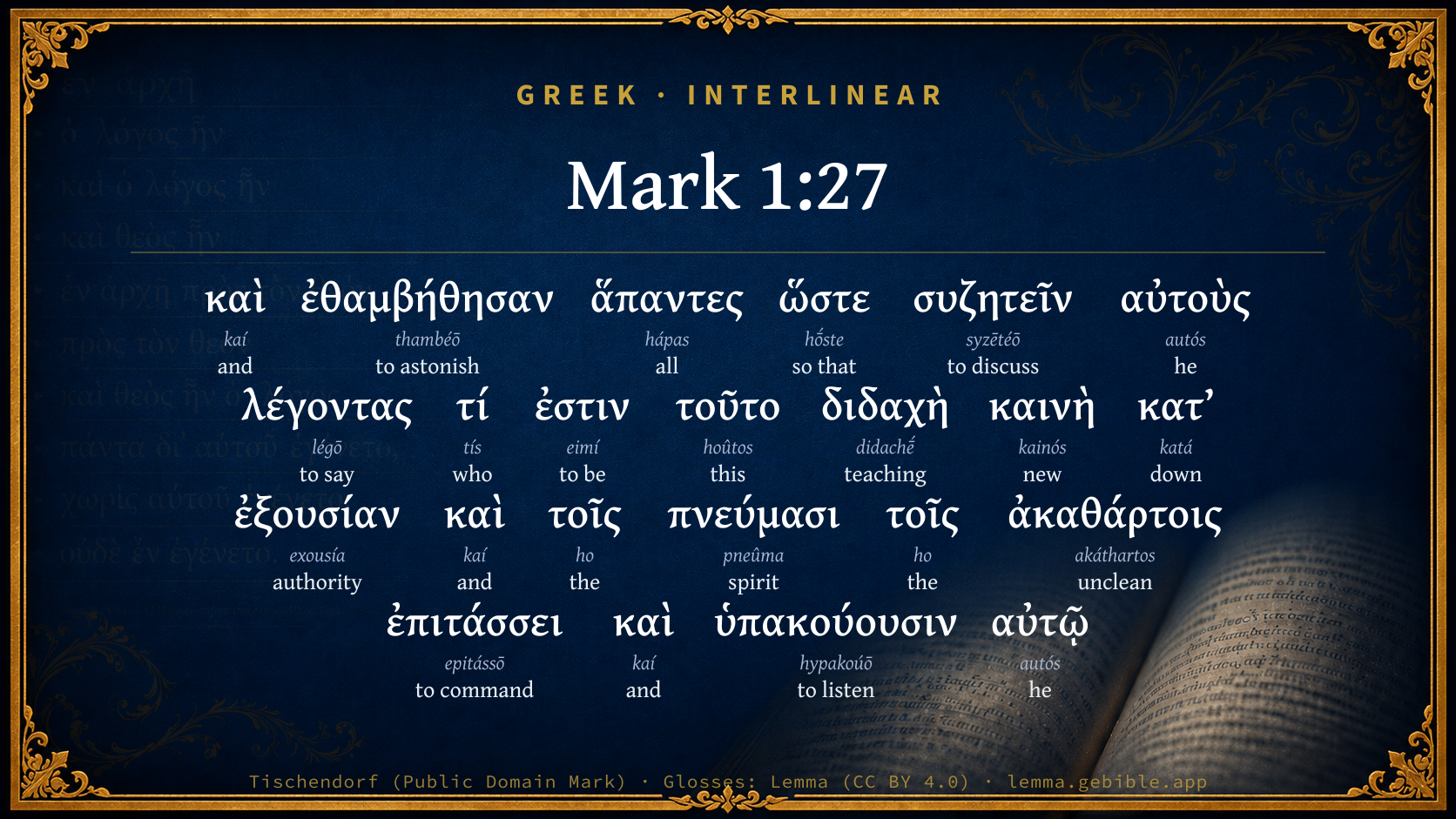
Greek (Tischendorf 8th ed.) Mark 1:27 appears in the Greek New Testament. The text above is from the Tischendorf 8th edition. Each word links to its Strong’s number and a concise gloss. Click any word for its full Thayer’s Greek Lexicon entry.
Download image
Cite this verse

Mark 1:27 (World English Bible). Public Domain. Lemma interlinear Bible study tool, https://lemma.gebible.app/v/mark/1/27.

Show BibTeX & RIS
BibTeX
RIS
English Translation
They were all amazed, so that they questioned among themselves, saying, "What is this? A new teaching? For with authority he commands even the unclean spirits, and they obey him!"
World English Bible · Public Domain
Highlights
  • 3 first appearances in the Greek New Testament
Full analysis ↓
Download a study sheet

One document with this verse’s original text, its word-by-word gloss line, the meaning frame, cross-references with their text, attributed commentary, and full source and license credits — printable, and it pastes into notes with its structure intact.

This verse Autodidact and up

Study sheet (.html) Plain text (.txt)

A passage Seminary Student

Up to 50 verses in one chapter. A passage sheet keeps up to 6 commentary sources and 12 cross-references per verse, in the order this page ranks them, and says so on the sheet whenever that leaves anything out. Ask for a single verse and you get the Autodidact verse sheet above.

Everything on this page stays free to read, with no account — the sheet is a download of what is already on screen, not access to it.

Want to remove ads? Support Godless Engineer
Compare translations 3

The same verse in 3 English versions, stacked beneath the original-language interlinear above. Click any original word for its lexicon entry.

Each is an independent rendering of the whole verse — the interlinear is not word-aligned to these translations.

Highlighted words mark where these versions differ — a whole-verse word diff, not a word-by-word alignment.

  • World English Bible Public Domain
    They were all amazed, so that they questioned among themselves, saying, "What is this? A new teaching? For with authority he commands even the unclean spirits, and they obey him!"
  • King James Version Public Domain
    And they were all amazed, insomuch that they questioned among themselves, saying, What thing is this? what new doctrine is this? for with authority commandeth he even the unclean spirits, and they do obey him.
  • unfoldingWord Literal Text CC BY-SA 4.0
    And they all were amazed, so that they discussed among themselves, saying, “What is this? A new teaching according to authority! And he commands the unclean spirits, and they obey him!”

unfoldingWord Literal Text — © unfoldingWord, licensed CC BY-SA 4.0. Word-aligned USFM3 via Door43 (git.door43.org/unfoldingWord/en_ult).

Versions to compare (up to 4)

3 of 4 selected

Show all 19 translations

Every available English version of this verse, each an independent rendering of the whole verse.

  • World English Bible Public Domain
    They were all amazed, so that they questioned among themselves, saying, "What is this? A new teaching? For with authority he commands even the unclean spirits, and they obey him!"
  • Berean Standard Bible Public Domain
    All the people were amazed and began to ask one another, “What is this? A new teaching with authority! He commands even the unclean spirits, and they obey Him!”
  • Majority Standard Bible Public Domain
    All the people were amazed and began to ask one another, “What is this? What new teaching is this that with authority He commands even the unclean spirits, and they obey Him?”
  • King James Version Public Domain
    And they were all amazed, insomuch that they questioned among themselves, saying, What thing is this? what new doctrine is this? for with authority commandeth he even the unclean spirits, and they do obey him.
  • American Standard Version (1901) Public Domain
    And they were all amazed, insomuch that they questioned among themselves, saying, What is this? a new teaching! with authority he commandeth even the unclean spirits, and they obey him.
  • Revised Version (1885) Public Domain
    And they were all amazed, insomuch that they questioned among themselves, saying, What is this? a new teaching! with authority he commandeth even the unclean spirits, and they obey him.
  • Geneva Bible (1599) Public Domain
    And they were all amased, so that they demaunded one of another, saying, What thing is this? what newe doctrine is this? for he commandeth euen the foule spirites with authoritie, and they obey him.
  • Douay-Rheims (1899) Public Domain
    And they were all amazed, insomuch that they questioned among themselves, saying: What thing is this? what is this new doctrine? for with power he commandeth even the unclean spirits, and they obey him.
  • Young's Literal Translation Public Domain
    and they were all amazed, so as to reason among themselves, saying, `What is this? what new teaching `is' this? that with authority also the unclean spirits he commandeth, and they obey him!'
  • Literal Standard Version CC BY-SA 4.0
    and they were all amazed, so as to reason among themselves, saying, “What is this? What new teaching [is] this? That with authority He also commands the unclean spirits, and they obey Him!”
  • Unlocked Literal Bible CC BY-SA 4.0
    All the people were amazed, so they asked each other, “What is this? A new teaching with authority? He even commands the unclean spirits and they obey him!”
  • unfoldingWord Literal Text CC BY-SA 4.0
    And they all were amazed, so that they discussed among themselves, saying, “What is this? A new teaching according to authority! And he commands the unclean spirits, and they obey him!”
  • Darby Bible Public Domain
    And all were amazed, so that they questioned together among themselves, saying, What is this? what new doctrine is this? for with authority he commands even the unclean spirits, and they obey him.
  • World Messianic Bible Public Domain
    They were all amazed, so that they questioned among themselves, saying, “What is this? A new teaching? For with authority he commands even the unclean spirits, and they obey him!”
  • Webster's Bible Public Domain
    And they were all amazed, so that they questioned among themselves, saying, What thing is this? what new doctrine is this? for with authority he commandeth even the unclean spirits, and they obey him.
  • Free Bible Version CC BY-SA 4.0
    Everyone was amazed at what happened. “What is this?” they asked each other. “What is this new teaching that has such authority? Even evil spirits do what he tells them!”
  • Bible in Basic English Public Domain
    And they were all greatly surprised, so that they put questions to one another, saying, What is this? a new teaching! with authority he gives orders even to the unclean spirits, and they do what he says.
  • Text-Critical English NT CC BY 4.0
    All the people were amazed so that they questioned among themselves, saying, “What is this? What new teaching is this that with authority he commands even the unclean spirits, and they obey him?”
  • Tyndale New Testament (1534) Public Domain
    And they were all amased in so moche that they demaunded one of another amonge them selves saying: what thinge is this? what newe doctryne is this? For he commaundeth the foule spirites with power and they obeye him.

Literal Standard Version (2020), Covenant Press — licensed CC BY-SA 4.0. Text via the HelloAO Bible API (eBible.org). Unlocked Literal Bible (unfoldingWord) — licensed CC BY-SA 4.0. Text via the HelloAO Bible API (eBible.org). unfoldingWord Literal Text — © unfoldingWord, licensed CC BY-SA 4.0. Word-aligned USFM3 via Door43 (git.door43.org/unfoldingWord/en_ult). Free Bible Version, Dr. Jonathan Gallagher — licensed CC BY-SA 4.0. Text via the HelloAO Bible API (eBible.org).

Word by word

More ways to search: Search by grammar → Find every occurrence → Compare this word →

Practice this passage: Drill this verse → Learn its vocabulary →

ἐθαμβήθησαν
thambéō
G2284
“to astonish”
Verb, Aorist, Passive, Indicative, 3rd person, Plural
Part of Speech
Verb
Tense
Aorist
Voice
Passive
Mood
Indicative
Person
3rd person
Number
Plural
Full Thayer's Definition

Origin: from G2285

TDNT: 03:04,3

1. to be astonished 2. to astonish, terrify a. to be amazed b. to be frightened
  1. καὶ kaí G2532 “and” Conjunction
  2. ἅπαντες hápas G537 “all” Adjective, Nominative, Plural, Masculine
  3. ὥστε hṓste G5620 “so that” Conjunction
  4. συζητεῖν syzētéō G4802 “to discuss” Verb, Present, Active, Infinitive
  5. αὐτοὺς autós G846 “he” Personal pronoun, Accusative, Plural, Masculine
  6. λέγοντας légō G3004 “to say” Verb, Present, Active, Participle, Accusative, Plural, Masculine
  7. τί tís G5101 “who” Interrogative pronoun, Nominative, Singular, Neuter
  8. ἐστιν eimí G1510 “to be” Verb, Present, Active, Indicative, 3rd person, Singular
  9. τοῦτο hoûtos G3778 “this” Demonstrative pronoun, Nominative, Singular, Neuter
  10. διδαχὴ didachḗ G1322 “teaching” Noun, Nominative, Singular, Feminine
  11. καινὴ kainós G2537 “new” Adjective, Nominative, Singular, Feminine
  12. κατ’ katá G2596 “down” Preposition
  13. ἐξουσίαν exousía G1849 “authority” Noun, Accusative, Singular, Feminine
  14. καὶ kaí G2532 “and” Conjunction
  15. τοῖς ho G3588 “the” Article, Dative, Plural, Neuter
  16. πνεύμασι pneûma G4151 “spirit” Noun, Dative, Plural, Neuter
  17. τοῖς ho G3588 “the” Article, Dative, Plural, Neuter
  18. ἀκαθάρτοις akáthartos G169 “unclean” Adjective, Dative, Plural, Neuter
  19. ἐπιτάσσει epitássō G2004 “to command” Verb, Present, Active, Indicative, 3rd person, Singular
  20. καὶ kaí G2532 “and” Conjunction
  21. ὑπακούουσιν hypakoúō G5219 “to listen” Verb, Present, Active, Indicative, 3rd person, Plural
  22. αὐτῷ autós G846 “he” Personal pronoun, Dative, Singular, Masculine

About this verse

These counts appear in no published source. They are computed here, from the morphology-tagged text and Lemma’s own curated glosses. What Lemma adds →

23
words
19
distinct lemmas
Gospels
section

Notable vocabulary

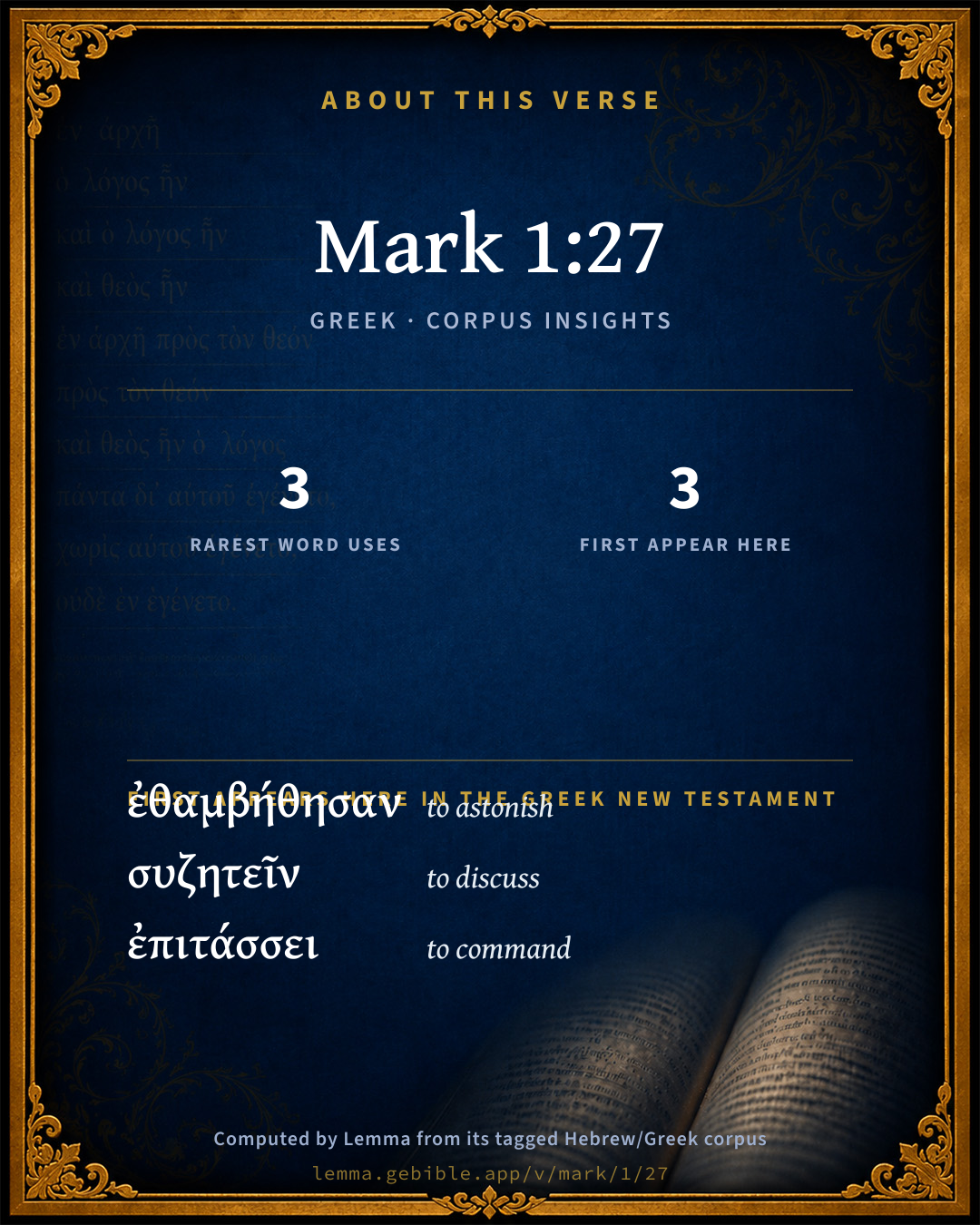
The rarest word here is ἐθαμβήθησαν to astonish G2284 — appearing just 3 times in the whole Greek New Testament.

First appearance in Scripture

These words make their first canonical appearance in the Greek New Testament here:

  • ἐθαμβήθησαν to astonish G2284
  • συζητεῖν to discuss G4802
  • ἐπιτάσσει to command G2004

Shared distinctive vocabulary

ἐθαμβήθησαν to astonish G2284 occurs in 3 verses of the Greek New Testament. Also found in:
Repetition

Words recur within this verse:

  • καὶ and G2532 ×3
  • αὐτοὺς he G846 ×2
  • τοῖς the G3588 ×2

Cross-references

9

Topical passages linked to Mark 1:27 in the Treasury of Scripture Knowledge — connected by theme and wording, ordered by reader-vote popularity; previews shown in the World English Bible.

  • Matthew 15:31 so that the multitude wondered when they saw the mute speaking, injured whole, lame walking, and blind seeing--and they glorified the God of Israel.
  • Mark 7:37 They were astonished beyond measure, saying, "He has done all things well. He makes even the deaf hear, and the mute speak!"
  • Luke 9:1 He called the twelve together, and gave them power and authority over all demons, and to cure diseases.
  • Matthew 9:33 When the demon was cast out, the mute man spoke. The multitudes marveled, saying, "Nothing like this has ever been seen in Israel!"
  • Luke 4:36 Amazement came on all, and they spoke together, one with another, saying, "What is this word? For with authority and power he commands the unclean spirits, and they come out!"
  • Matthew 12:22–23 Then one possessed by a demon, blind and mute, was brought to him and he healed him, so that the blind and mute man both spoke and saw.
  • Mark 10:24 The disciples were amazed at his words. But Jesus answered again, "Children, how hard is it for those who trust in riches to enter into the Kingdom of God!
  • Mark 10:32 They were on the way, going up to Jerusalem; and Jesus was going in front of them, and they were amazed; and those who followed were afraid. He again took the twelve, and began to tell them the things that were going to happen to him.
  • Luke 10:17–20 The seventy returned with joy, saying, "Lord, even the demons are subject to us in your name!"

Cross-references courtesy of OpenBible.info (CC BY 4.0).

Commentary

Notes on Mark 1:27 from classic Christian and Jewish commentators (each source and its license shown beneath its notes). The classic Christian expositions comment on the surrounding passage and are grouped to its opening verse, so a note may address several verses; the Jewish commentaries on the Tanakh (Rashi and others) are per-verse, so they appear only where the commentator wrote on this verse.

Lemma curates 59 commentaries, every one of them public domain or Creative Commons licensed, each selected and text-cleaned for this edition rather than reprinted as found. About our sources →

Tyndale Open Study Notes

Tyndale Open Resources

1:27-28 The amazement caused by this exorcism quickly led to the spread of the news about Jesus. • What sort of new teaching is this? Jesus’ healings and exorcisms were understood holistically as being part of his teaching (1:21-22, 27; cp. 1:38-39; 3:14-15; 6:2, 5, 12-13, 30).

Tyndale Open Study Notes — © Tyndale Open Resources, licensed CC BY-SA 4.0. Text via the HelloAO Bible API.

Bengel's Gnomon

Johann Albrecht Bengel

Mar 1:27. Διδαχὴ, doctrine) with which these miracles were connected and accompanied.—καὶ, even).

Bengel's Gnomon of the New Testament — English translation (T&T Clark, Edinburgh, 1860) — public domain. Text from a community e-Sword module.

Meyer's Critical & Exegetical Commentary

Heinrich August Wilhelm Meyer

Mar_1:27. Πρὸς ἐαυτούς] is equivalent to πρὸς ἀλλήλους (Luk_4:36). The reason why the reflexive is used, is the conception of the contradistinction to others (they discussed among one another, not with Jesus and His disciples). See Kühner, ad Xen. Mem. ii. 6. 20. Fritzsche explains: apud animum suum. But συζητεῖν stands opposed to this, designating as it does action in common, Mar_9:10, Mar_12:28; Luk_20:23; Luk_24:15, al.; so also in the classics.

τί ἐστι τοῦτο;] a natural demand in astonishment at what had happened for more precise information as to the circumstances of the case.

In what follows we must read: διδαχὴ καινὴ κατʼ ἐξουσίαν· καὶ τοῖς πνεύμασι τοῖς ἀκαθάρτοις … αὐτῷ! See the critical remarks. They give vent by way of exclamation to what has thrown them into such astonishment and is so incomprehensible to them, and do so in the unperiodic mode of expression that is appropriate to excited feeling: a doctrine new in power! and He commands the unclean spirits, etc.! They marvel at these two marked points, as they have just perceived them in Jesus. Lachmann attaches κατʼ ἐξουσίαν to καὶ τοῖς πνεύμασι κ.τ.λ. But this is manifestly opposed to the connection, according to which κατʼ ἐξουσίαν looks back to the foregoing ἦν γὰρ διδάσκων αὐτοὺς ὡς ἐξουσίαν ἔχων. This applies also in opposition to Ewald, who reads διδαχῇ καινῇ: with new teaching He powerfully commands even the devils. A confused identification of the teaching with the impression of the miraculous action is here groundlessly discovered by Baur,[57] and used as a proof of dependence on Luk_4:36. Even with the Recepta ὅτι the two elements of the exclamation would be very definitely correlative to the two elements of the ministry of Jesus in the synagogue respectively.

κατʼ ἐξουσίαν] defines the reference of καινή: new in respect to power, which has never yet occurred thus with the impress of higher authorization.

[57] Who holds that Mark has not been able to enter into Lukes mode of view, but has kept to the διδαχή of Jesus in the sense of Matthew, without himself rightly understanding in what relation the καινὴ διδαχή stood to the ἐπιτάσσειν κ.τ.λ. Baur, Markusevang. p. 11; comp. theol. Jahrb. 1853, p. 69 f. See, on the other hand, Hilgenfeld, Evang. p. 128.

Meyer — Critical and Exegetical Commentary on the New Testament — English translation by Peter Christie, edited by Frederick Crombie (T&T Clark, 1880) — public domain. Text from a community e-Sword module.

Expositor's Greek Testament

ed. W. Robertson Nicoll

Mar 1:27 . ἐθαμβήθησαν : another strong word peculiar to Mark = they were astonished, i.e. , at the sudden and complete recovery. They saw at a glance that the attack had not run its usual course. ὥστε with the infinitive here expressing result. συζητεῖν , to seek together; in N. T. tropical = to inquire of one another, to discuss. The word occurs several times in Mark. τί ἐστι τοῦτο ; The question refers to the whole appearance of Jesus in the synagogue that day. One surprise following close on another provoked wondering inquiry as to the whole phenomenon. The words following state the twofold ground of their astonishment: (1) διδαχὴ καινή κατʼ ἐξουσίαν , a style of teaching new as to authoritativeness (entirely different from the familiar type of the scribes); (2) καὶ τοῖς πνεύμασι τοῖς ἀκαθάρτοις ἑπιτάσσει , etc., also He commandeth the unclean spirits so that they obey Him. Both equally unlooked for: the former a moral miracle, the latter a physical; both revealing an imperial spirit exercising sway over the minds and bodies of men.

The Expositor's Greek Testament, edited by W. Robertson Nicoll (1897–1910) — public domain. Text from a community e-Sword module.

Geneva Bible (1599)

Geneva Bible translators

As men amazed.

By his own authority, or as a Lord.

Geneva Bible (1599) marginal notes — public domain. Text via Bolls.life.

Jamieson, Fausset & Brown

Robert Jamieson, A. R. Fausset & David Brown

What thing is this? what new doctrine--teaching

is this?--The audience, rightly apprehending that the miracle was wrought to illustrate the teaching and display the character and glory of the Teacher, begin by asking what novel kind of teaching this could be, which was so marvellously attested.

Jamieson, Fausset & Brown — Commentary Critical and Explanatory on the Whole Bible (1871) — public domain (CC PDM 1.0). Text via the HelloAO Bible API.

Adam Clarke's Commentary

Verse 27. What thing is this?] Words of surprise and astonishment.

And what new doctrine] I have added the particle and, from the Syriac, as it helps the better to distinguish the members of the sentence; but there is a vast diversity in the MSS. on this verse. See Griesbach.

For with authority] They had never heard such a gracious doctrine, and never saw any teaching supported by miracles before. How much must this person be superior to men! - they are brought into subjection by unclean spirits; this person subjects unclean spirits to himself.

Adam Clarke's Commentary on the Bible (1810–1826) — public domain. Text from a community e-Sword/MySword module.

Ellicott's Commentary for English Readers

(27) What new doctrine is this?—A various-reading gives a different structure, “What thing is this? A new doctrine with power. He commandeth even the unclean spirits . . .” “Doctrine” is, as elsewhere, the teaching taken as a whole, including manner as well as substance.

A Bible Commentary for English Readers, edited by Charles John Ellicott (1878–1897) — public domain. Text from a community e-Sword module.

John Gill's Exposition

And they were all amazed,.... The people that were in the synagogue, who were met together for divine worship, were astonished, not only at his doctrine, as before, but at this miracle and power of his in casting out devils:

insomuch that they questioned among themselves, saying, what thing is this? They spake among themselves, as Luke says, Luk 4:36; they inquired of one another; they conferred together, talked over the point, and disputed among themselves, concerning both the doctrine and power of Christ, what, and how wonderful they were:

what new doctrine is this? This they said, not as fixing a brand of novelty upon it, as the Athenians did on Paul's doctrine, Act 17:19, but as admiring it; being what was rare and unusual, and which they had never heard of from their Rabbins and Scribes, and which was confirmed by miracles;

for with authority commandeth he even the unclean spirits, and they do obey him: they not only observed the authority with which he delivered his doctrine, but the authority with which he cast out devils, by a word speaking; he not only commanded them to come out, but they immediately came out; their exorcists took authority upon them to command, but could not oblige the devils to obey; but these men took notice, that such was the authority of Christ in commanding, that the unclean spirits were obliged to obey, and did.

John Gill's Exposition of the Whole Bible (1746–1763) — public domain (CC PDM 1.0). Text via the HelloAO Bible API.

Trapp's Complete Commentary

John Trapp

27 And they were all amazed, insomuch that they questioned among themselves, saying, What thing is this? what new doctrine is this? for with authority commandeth he even the unclean spirits, and they do obey him.

Ver. 27. For with authority] As he taught, so he wrought with authority, εξουσια. The same word is used Mar 1:22.

John Trapp, A Commentary or Exposition upon All the Books of the Old and New Testament (1647–1656) — public domain. Text from a community e-Sword module.

Haydock's Catholic Bible Commentary

It is observed by St. Justin, (Apol. i. 54.) that the discourses of Jesus were short and concise. St. John Chrysostom (in hom. xlviii. in Matt.) says, that Christ here accommodated his preaching to his hearers, and to his subject. The ancients differ as to the length of time employed by Christ in the ministry of the word. It is most probable that he spent about three years in announcing to the world his heavenly doctrines. In the first year of his preaching, he seems not to have met with any great opposition; and on this account it may have been called, by the prophet Isaias, the acceptable year. (Sandinus) --- What is this new doctrine? In the Greek, This new manner of instructing. See below, xiv. 2, and xii. 38.

George Leo Haydock (1774–1849), Haydock's Catholic Family Bible and Commentary, 1859 edition — public domain. Excludes Psalms (Douay-Rheims chapter numbering differs from Protestant) and Deuterocanonical books (Catholic canon only).

Matthew Poole's English Annotations

The Jews had exorcists amongst them, who sometimes cast out devils by some forms of invocation they had; but Christ commanded them out; he neither did it by any kind of entreaty from any compact with the devil, nor yet by any invocation of God, but by an authoritative command. This was new to the Jews, and especially confirming a new doctrine that he had published. But still we read of no believing, no agnation of him as God, or the Son of God, or the Messias and Saviour of the world; only the generality are amazed they could not obtain of themselves to believe this new doctrine, nor yet so far command their passions, but they must be startled and amazed at it.

Matthew Poole's English Annotations on the Holy Bible (1683–1685) — public domain. Text from a community e-Sword/MySword module.

Whedon's Commentary on the Bible

Daniel D. Whedon

27. What new doctrine — A new set of facts was coming to light; a new power was being disclosed. Men’s ideas must open to the new views and new doctrines as soon as a being has appeared on earth superior to and in antagonism with the powers of darkness. Indeed, it is important to remark that, striking as was the testimony rendered to the heavenly mission of Jesus, from the fact that his miracles were in opposition to the ills of men, to their diseases, their sorrows, and deaths, including the whole ruin that sin produces, there was needed this miracle of casting out devils from their dominion over men, to place the opposition between him and the powers of hell in the clearest view. He is the friend of man; an opponent of sin, death, and hell. Hence it seems, in fact, that it was this very miracle of casting out devils that his enemies subsequently felt themselves most called upon to explain by perverting.

Daniel D. Whedon (gen. ed.), Commentary on the Old and New Testaments (1874–1909) — public domain. Text from a community e-Sword module.

The Pulpit Commentary

What thing is this? what new doctrine is this? The now generally approved text gives a different rendering, namely, What is this? a new teaching! (Ti esti touto di). If this is the true reading and there is excellent authority for it it would mean that the bystanders inferred that this new and unexampled power indicated the accompanying gift of a "new teaching," a new revelation. Nay, more, it indicated that he who wrought these miracles must be the promised Messiah, the true God; for he alone by his power could rule the evil spirits.

The Pulpit Commentary (1880–1919), ed. H.D.M. Spence-Jones & Joseph S. Exell — public domain. Text from a community e-Sword module.

The People's New Testament

B. W. Johnson

27. They were all amazed. Those in the synagogue.

B. W. Johnson's The People's New Testament with Notes (1889–1891) — public domain. Electronic text from the Christian Classics Ethereal Library (CCEL) ThML edition.

unfoldingWord translationNotes

Door43 World Missions Community

they asked each other, "What is this? A new teaching with authority? ... and they obey him!"

The people used the two questions to show how amazed they were. The questions can be expressed as exclamations. AT: "they said to each other, 'This is amazing! He gives a new teaching, and he speaks with authority! ... and they obey him!'" (See: Rhetorical Question)

He even commands

The word "He" refers to Jesus.

translationWords

amazed

authority

demon

obey

Galilee

unfoldingWord translationNotes — © Distant Shores Media and the Door43 World Missions Community, licensed CC BY-SA 4.0. Source: git.door43.org/Door43/en_tn.

Cambridge Greek Testament for Schools and Colleges

27. Τί ἐστιν τοῦτο; διδαχὴ καινή ([159][160][161] 33). These abrupt sentences have been smoothed in different ways in [162] and [163] and other texts.

[159] Codex Sinaiticus. 4th cent. Discovered by Tischendorf in 1859 at the Monastery of St Katharine on Mount Sinai. Now at St Petersburg. The whole Gospel, ending at Mar 16:8. Photographic facsimile, 1911.

[160] Codex Vaticanus. 4th cent., but perhaps a little later than א. In the Vatican Library almost since its foundation by Pope Nicolas V., and one of its greatest treasures. The whole Gospel, ending at Mar 16:8. Photographic facsimile, 1889.

[161] Codex Regius. 8th cent. An important witness. At Paris. Contains Mar 1:1 to Mar 10:15; Mar 10:30 to Mar 15:1; Mar 15:20 to Mar 16:20, but the shorter ending is inserted between Mar 16:8 and Mar 16:9, showing that the scribe preferred it to the longer one.

[162] Codex Alexandrinus. 5th cent. Brought by Cyril Lucar, Patriarch of Constantinople, from Alexandria, and afterwards presented by him to King Charles I. in 1628. In the British Museum. The whole Gospel. Photographic facsimile, 1879.

[163] Codex Ephraemi. 5th cent. A palimpsest: the original writing has been partially rubbed out, and the works of Ephraem the Syrian have been written over it; but a great deal of the original writing has been recovered; of Mark we have Mar 1:17 to Mar 6:31, Mar 8:5 to Mar 12:29, Mar 13:19 to Mar 16:20. In the National Library at Paris.

27. ἐθαμβήθησαν ἅπαντες. Lk. has ἐγένετο θάμβος ἐπὶ πάντας. In N.T. Mk alone uses θαμβέομαι, and Lk. alone uses θάμβος. But Lk., far more often than all other N.T. writers put together, uses the strong form ἅπας. Just as Christ’s rebuke to the demon reveals the two things which provoked the rebuke (see on Mar 1:25), so the people’s utterance reveals the two things which excited their astonishment, His authoritative teaching and His casting out the unclean spirit with a word. Cf. Mat 7:28.

συνζητεῖν. Freq. in Mk, elsewhere twice in Lk. and twice in Acts. It is usually followed by πρός.

Τί ἐστιν τοῦτο; See crit. note. The text of [193][194][195] 33 and other cursives gives the utterances of the congregation in abrupt short sentences and is probably original. But the punctuation is doubtful: διδαχὴ καινή may be interrogative, and κατʼ ἐξουσίαν may be taken either with what precedes or with what follows. Διδαχὴ καινή is probably the answer to τί ἐστιν τοῦτο; and Lk. is in favour of taking κατʼ ἐξ. with what follows. It is barely possible to take κατʼ ἐξ. (with ἐστιν understood) as a separate sentence. The recently discovered MS. acquired by Mr C. L. Freer has “What is this new, this authoritative teaching, and that He commandeth even the unclean spirits and they obey Him?” See Appendix.

[193] Codex Sinaiticus. 4th cent. Discovered by Tischendorf in 1859 at the Monastery of St Katharine on Mount Sinai. Now at St Petersburg. The whole Gospel, ending at Mar 16:8. Photographic facsimile, 1911.

[194] Codex Vaticanus. 4th cent., but perhaps a little later than א. In the Vatican Library almost since its foundation by Pope Nicolas V., and one of its greatest treasures. The whole Gospel, ending at Mar 16:8. Photographic facsimile, 1889.

[195] Codex Regius. 8th cent. An important witness. At Paris. Contains Mar 1:1 to Mar 10:15; Mar 10:30 to Mar 15:1; Mar 15:20 to Mar 16:20, but the shorter ending is inserted between Mar 16:8 and Mar 16:9, showing that the scribe preferred it to the longer one.

καινή. “New” in reference to quality, “fresh,” not worn out or obsolete; whereas νέος is “new” in reference to time, “young,” not aged. But, excepting in Mar 2:22 and parallels, καινός cannot be translated “fresh”: “fresh covenant,” “fresh heaven,” “fresh Jerusalem” are intolerable.

καὶ τοῖς πνεύμασι τ. ἀκ. Even the spirits, the unclean ones. The repetition of the art. makes the adj. a separate idea. They had often heard of exorcisms; they had not so often heard that the demons at once obeyed. Cf. the Testaments (Benj. Mar 1:2), καὶ τὰ ἀκάθαρτα πνεύματα φεύξονται ἀφʼ ὑμῶν. Cf. καὶ ὁ ἄνεμος (Mar 4:41), καὶ τὰ δαιμόνια (Luk 10:17). Christ’s miracles, like His teaching, were not an art which He had acquired, but ἐξουσία with which He was endowed.

Cambridge Greek Testament for Schools and Colleges (Cambridge University Press, 1896; 21 vols, various authors incl. Carr, Maclear, Plummer, Farrar, Lumby, Moule, M. R. James, Simcox) — public domain. Text from a community e-Sword module.

Alford’s Greek Testament

Henry Alford

27.] πρὸς ἑαυτούς is not, each man within himself, but amounts to πρὸς ἀλλήλους, see reff. Meyer well remarks, that the reason of the reflexive pronoun being used, is probably to be found in the narrative representing what was said among themselves, not to Jesus and his disciples.

We may either take καινή with κατʼ ἐξουσίαν, ‘new in respect of power,’ as Meyer: or regard καινή and κατʼ ἐξουσίαν as two separate predicates of διδαχή. The latter view is preferable as more borne out by the adverbial use of κατά with nouns signifying power in the reff. Render then a teaching new and powerful.

Henry Alford, The Greek Testament (1849–1861) — public domain. Text from a community e-Sword module.

International Critical Commentary

27. ὥστε συζητεῖν αὐτούς—so that they discussed.

αὐτούς, instead of πρὸς αὐτούς (ἑαυτούς) Tisch. WH. א B and mss. of Lat. Vet.

συζητεῖν—to discuss, or question.2 Τί ἐστι τοῦτο; διδαχὴ καινὴ κατʼ ἐξουσίαν· καὶ τοῖς πνεύμασι, etc.—What is this? A new teaching according to authority. And he commands, etc.

διδαχὴ καινὴ κατʼ ἐξουσίαν is the reading of Tisch. Treg. WH. RV. א BL 33, 102.

The critical texts which adopt the above reading, with the exception of Tisch., punctuate differently. They connect κατʼ ἐξουσίαν with what follows, so that it reads, a new teaching; with authority he commands even the unclean spirits. But according to v. 22, this new element of authority resides in the teaching itself, so that κατʼ ἐξουσίαν belongs more naturally with διδαχὴ καινὴ. This new, authoritative teaching makes the first ground of their astonishment. And in addition to this, not a part of it, is their astonishment at the submission of the spirits to his command.

International Critical Commentary — older volumes (1896–1929), various authors — public domain. Text from a community e-Sword module.

Vincent's Word Studies in the New Testament

Marvin R. Vincent

They questioned among themselves (συνζητεῖν πρὸς ἑαυτοὺς)

Stronger than Luke, who has they spake together. Tynd., They demanded one of another among themselves.

Marvin R. Vincent, Word Studies in the New Testament (1887–1900) — public domain. Text from a community e-Sword/MySword module.

Lesson kit

Teaching starters — assembled from the data on this page, not authored interpretation. Every prompt links to the verse data it draws on. Edit before teaching.

Mark, in the Gospels, opens this verse with 23 words (19 distinct Greek lemmas). Its most distinctive word is thambéō (“to astonish”). A historical commentator’s framing appears above. Read the whole chapter for the surrounding context.

Discussion questions

  1. The word thambéō carries the sense “to astonish.” How does it shape the verse?
  2. 3 words make their first appearance in Scripture here. What does this debut establish?
  3. How does Mark 10:24, which shares the word «to astonish», read alongside this verse?
  4. What does the repetition of “and” (3× in this one verse) do in this verse?
  5. These translations render this verse differently; the difference is in the English rendering, not the original. What questions does that raise?
  6. Compare how Tyndale Open Study Notes and Bengel's Gnomon read this verse. Where do they agree or differ?

Things to notice

  • 3 words make their first canonical appearance in Scripture here.
  • These translations choose different wording for 11 words in this verse.
  • “and” occurs 3× in this single verse.
  • 19 distinct Greek lemmas span 23 words in this verse.

Reading settings

Reading text

Shown beneath each verse's original-language words.

Old Testament
Old Testament edition

Read the OT as the Masoretic Hebrew (MT) or the Greek Septuagint (LXX).

English shown for the Greek Septuagint (in the Hebrew ↔ Greek comparison).

Comparing translations? Open the Compare panel on any verse page to stack up to four side by side.