Matthew 27:37

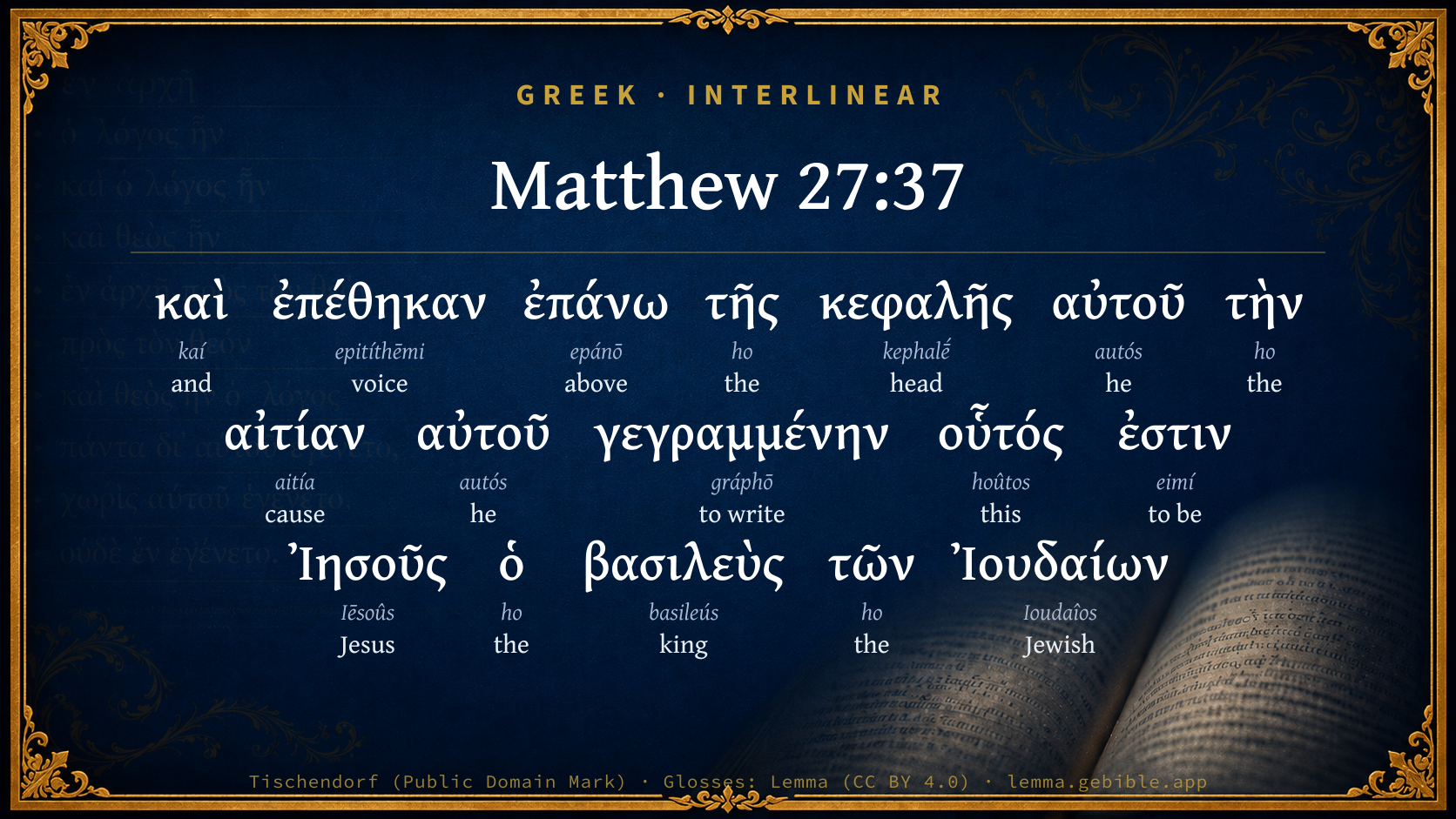
Greek (Tischendorf 8th ed.) Matthew 27:37 appears in the Greek New Testament. The text above is from the Tischendorf 8th edition. Each word links to its Strong’s number and a concise gloss. Click any word for its full Thayer’s Greek Lexicon entry.
Download image
Cite this verse

Matthew 27:37 (World English Bible). Public Domain. Lemma interlinear Bible study tool, https://lemma.gebible.app/v/matthew/27/37.

Show BibTeX & RIS
BibTeX
RIS
English Translation
They set up over his head the accusation against him written, "THIS IS JESUS, THE KING OF THE JEWS."
World English Bible · Public Domain
Download a study sheet

One document with this verse’s original text, its word-by-word gloss line, the meaning frame, cross-references with their text, attributed commentary, and full source and license credits — printable, and it pastes into notes with its structure intact.

This verse Autodidact and up

Study sheet (.html) Plain text (.txt)

A passage Seminary Student

Up to 50 verses in one chapter. A passage sheet keeps up to 6 commentary sources and 12 cross-references per verse, in the order this page ranks them, and says so on the sheet whenever that leaves anything out. Ask for a single verse and you get the Autodidact verse sheet above.

Everything on this page stays free to read, with no account — the sheet is a download of what is already on screen, not access to it.

Want to remove ads? Support Godless Engineer
Compare translations 3

The same verse in 3 English versions, stacked beneath the original-language interlinear above. Click any original word for its lexicon entry.

Each is an independent rendering of the whole verse — the interlinear is not word-aligned to these translations.

Highlighted words mark where these versions differ — a whole-verse word diff, not a word-by-word alignment.

  • World English Bible Public Domain
    They set up over his head the accusation against him written, "THIS IS JESUS, THE KING OF THE JEWS."
  • King James Version Public Domain
    And set up over his head his accusation written, THIS IS JESUS THE KING OF THE JEWS.
  • unfoldingWord Literal Text CC BY-SA 4.0
    And they put above his head his charge, having been written, “This is Jesus, the King of the Jews.”

unfoldingWord Literal Text — © unfoldingWord, licensed CC BY-SA 4.0. Word-aligned USFM3 via Door43 (git.door43.org/unfoldingWord/en_ult).

Versions to compare (up to 4)

3 of 4 selected

Show all 19 translations

Every available English version of this verse, each an independent rendering of the whole verse.

  • World English Bible Public Domain
    They set up over his head the accusation against him written, "THIS IS JESUS, THE KING OF THE JEWS."
  • Berean Standard Bible Public Domain
    Above His head they posted the written charge against Him: THIS IS JESUS, THE KING OF THE JEWS.
  • Majority Standard Bible Public Domain
    Above His head they posted the written charge against Him: THIS IS JESUS, THE KING OF THE JEWS.
  • King James Version Public Domain
    And set up over his head his accusation written, THIS IS JESUS THE KING OF THE JEWS.
  • American Standard Version (1901) Public Domain
    And they set up over his head his accusation written, THIS IS JESUS THE KING OF THE JEWS.
  • Revised Version (1885) Public Domain
    And they set up over his head his accusation written, THIS IS JESUS THE KING OF THE JEWS.
  • Geneva Bible (1599) Public Domain
    They set vp also ouer his head his cause written, THIS IS IESVS THE KING OF THE IEVVES.
  • Douay-Rheims (1899) Public Domain
    And they put over his head his cause written: THIS IS JESUS THE KING OF THE JEWS.
  • Young's Literal Translation Public Domain
    and they put up over his head, his accusation written, `This is Jesus, the king of the Jews.'
  • Literal Standard Version CC BY-SA 4.0
    and they put up over His head, His accusation written: “THIS IS JESUS, THE KING OF THE JEWS.”
  • Unlocked Literal Bible CC BY-SA 4.0
    Above his head they put the charge against him, which read “This is Jesus, the king of the Jews.”
  • unfoldingWord Literal Text CC BY-SA 4.0
    And they put above his head his charge, having been written, “This is Jesus, the King of the Jews.”
  • Darby Bible Public Domain
    And they set up over his head his accusation written: This is Jesus, the King of the Jews.
  • World Messianic Bible Public Domain
    They set up over his head the accusation against him written, “THIS IS YESHUA, THE KING OF THE JEWS.”
  • Webster's Bible Public Domain
    And set up over his head his accusation written, THIS IS JESUS THE KING OF THE JEWS.
  • Free Bible Version CC BY-SA 4.0
    They placed a sign over his head with the charge against him. It read, “This is Jesus, the King of the Jews.”
  • Bible in Basic English Public Domain
    And they put up over his head the statement of his crime in writing, THIS IS JESUS THE KING OF THE JEWS.
  • Text-Critical English NT CC BY 4.0
    Over his head they placed the written charge against him, which read, “This is Jesus, the King of the Jews.”
  • Tyndale New Testament (1534) Public Domain
    And they set vp over his heed the cause of his deeth written. This is Iesus the kynge of the Iewes.

Literal Standard Version (2020), Covenant Press — licensed CC BY-SA 4.0. Text via the HelloAO Bible API (eBible.org). Unlocked Literal Bible (unfoldingWord) — licensed CC BY-SA 4.0. Text via the HelloAO Bible API (eBible.org). unfoldingWord Literal Text — © unfoldingWord, licensed CC BY-SA 4.0. Word-aligned USFM3 via Door43 (git.door43.org/unfoldingWord/en_ult). Free Bible Version, Dr. Jonathan Gallagher — licensed CC BY-SA 4.0. Text via the HelloAO Bible API (eBible.org).

Word by word

More ways to search: Search by grammar → Find every occurrence → Compare this word →

Practice this passage: Drill this verse → Learn its vocabulary →

ἐπάνω
epánō
G1883
“above”
Adverb
Part of Speech
Adverb
Full Thayer's Definition

Origin: from G1909 and G507

TDNT: None

1. above a. of place b. of number: more than
  1. καὶ kaí G2532 “and” Conjunction
  2. ἐπέθηκαν epitíthēmi G2007 “voice” Verb, Aorist, Active, Indicative, 3rd person, Plural
  3. τῆς ho G3588 “the” Article, Genitive, Singular, Feminine
  4. κεφαλῆς kephalḗ G2776 “head” Noun, Genitive, Singular, Feminine
  5. αὐτοῦ autós G846 “he” Personal pronoun, Genitive, Singular, Masculine
  6. τὴν ho G3588 “the” Article, Accusative, Singular, Feminine
  7. αἰτίαν aitía G156 “cause” Noun, Accusative, Singular, Feminine
  8. αὐτοῦ autós G846 “he” Personal pronoun, Genitive, Singular, Masculine
  9. γεγραμμένην gráphō G1125 “to write” Verb, Perfect, Passive, Participle, Accusative, Singular, Feminine
  10. οὗτός hoûtos G3778 “this” Demonstrative pronoun, Nominative, Singular, Masculine
  11. ἐστιν eimí G1510 “to be” Verb, Present, Active, Indicative, 3rd person, Singular
  12. Ἰησοῦς Iēsoûs G2424 “Jesus” Noun, Nominative, Singular, Masculine
  13. ὁ ho G3588 “the” Article, Nominative, Singular, Masculine
  14. βασιλεὺς basileús G935 “king” Noun, Nominative, Singular, Masculine
  15. τῶν ho G3588 “the” Article, Genitive, Plural, Masculine
  16. Ἰουδαίων Ioudaîos G2453 “Jewish” Adjective, Genitive, Plural, Masculine

About this verse

These counts appear in no published source. They are computed here, from the morphology-tagged text and Lemma’s own curated glosses. What Lemma adds →

17
words
13
distinct lemmas
Gospels
section

Notable vocabulary

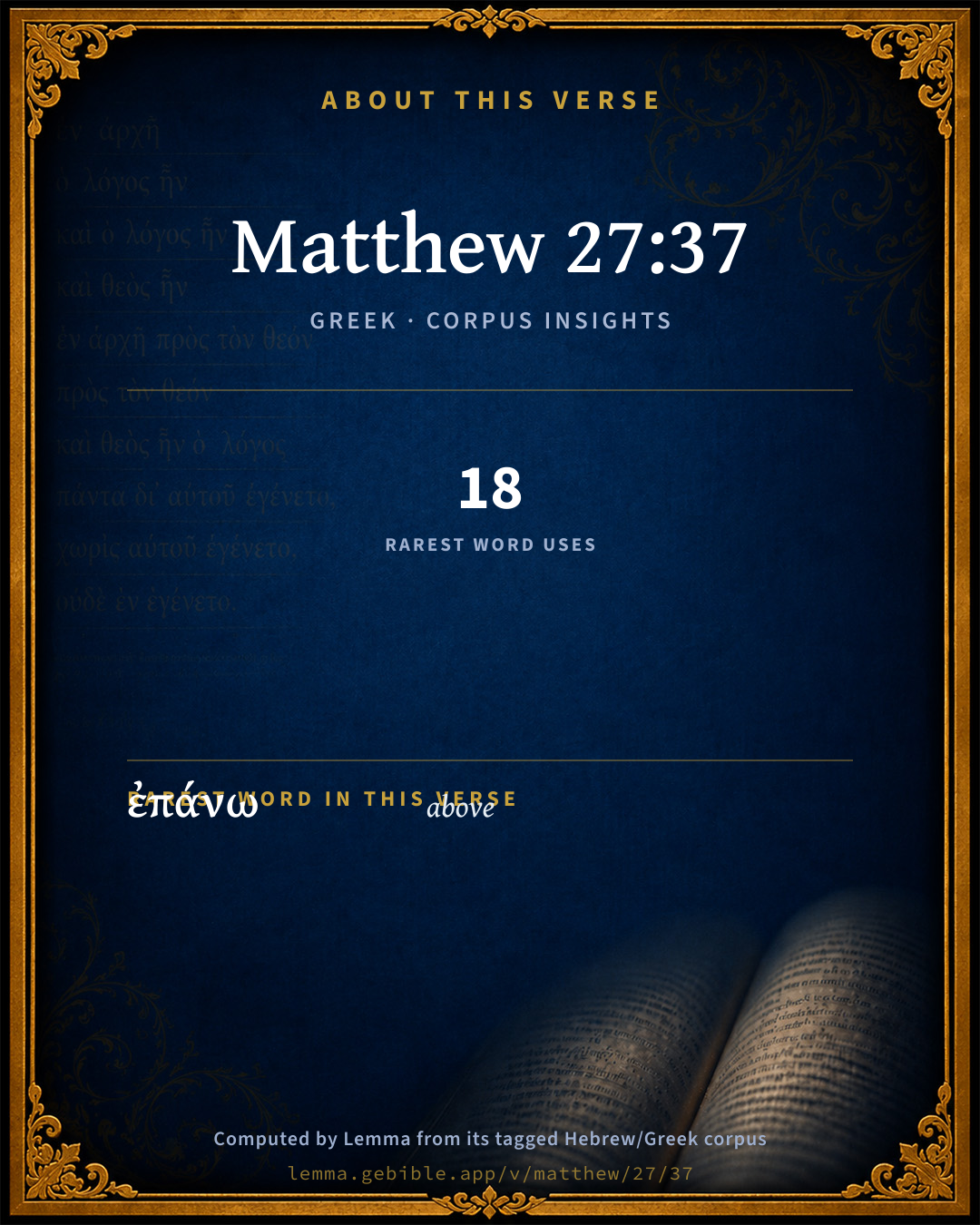
The rarest word here is ἐπάνω above G1883 — appearing just 18 times in the whole Greek New Testament.

Shared distinctive vocabulary

ἐπάνω above G1883 occurs in 18 verses of the Greek New Testament. Also found in:

Repetition

Words recur within this verse:

  • τῆς the G3588 ×4
  • αὐτοῦ he G846 ×2

Cross-references

3

Topical passages linked to Matthew 27:37 in the Treasury of Scripture Knowledge — connected by theme and wording, ordered by reader-vote popularity; previews shown in the World English Bible.

  • Mark 15:26 The superscription of his accusation was written over him, "THE KING OF THE JEWS."
  • Luke 23:38 An inscription was also written over him in letters of Greek, Latin, and Hebrew: "THIS IS THE KING OF THE JEWS."
  • John 19:19–22 Pilate wrote a title also, and put it on the cross. There was written, "JESUS OF NAZARETH, THE KING OF THE JEWS."

Cross-references courtesy of OpenBible.info (CC BY 4.0).

Commentary

Notes on Matthew 27:37 from classic Christian and Jewish commentators (each source and its license shown beneath its notes). The classic Christian expositions comment on the surrounding passage and are grouped to its opening verse, so a note may address several verses; the Jewish commentaries on the Tanakh (Rashi and others) are per-verse, so they appear only where the commentator wrote on this verse.

Lemma curates 59 commentaries, every one of them public domain or Creative Commons licensed, each selected and text-cleaned for this edition rather than reprinted as found. About our sources →

Joseph Benson's Commentary

Mat 27:37-38. And set over his head his accusation — That is, a superscription, containing the substance of his pretended crime, written in capital letters, and in these remarkable words, THIS IS JESUS, (John adds, OF NAZARETH,) THE KING OF THE JEWS. The two other evangelists do not express the title so fully. See the note on Joh 19:19, &c. Bishop Pearson, (On the Creed, p. 205,) and Dr. Lardner, (Credibil., vol. 1. p. 347,) have abundantly proved it to be usual, in cases of any extraordinary punishment, to put an inscription over the head of the sufferer, indicative of the crime for which he suffered. Then were there two thieves crucified with him — “They placed Jesus in the middle, by way of mock honour, because he had called himself a king, and was now crowned with thorns; or, if the priests had any hand in this, they might design hereby to impress the spectators more strongly with the thought of his being an impostor, and to make them look on him as the chief malefactor. Thus, however, as Mark observes, the Scripture, namely, Isa 53:12, was fulfilled, which saith, And he was numbered with the transgressors. For, in giving the history of our Lord’s sufferings, the evangelists endeavour all along to make their readers sensible that all the circumstances of them had been foreseen and foretold by the prophets. Their design in which was, to prevent the offence which might otherwise have been taken at Christ’s sufferings.

Joseph Benson's Commentary on the Old and New Testaments (1811–1818) — public domain. Text from a community e-Sword module.

Tyndale Open Study Notes

Tyndale Open Resources

27:37 The official charge was fastened to the cross above the criminal’s head; Jesus was crucified for political sedition.

Tyndale Open Study Notes — © Tyndale Open Resources, licensed CC BY-SA 4.0. Text via the HelloAO Bible API.

Bengel's Gnomon

Johann Albrecht Bengel

Mat 27:37. Ἐστιν, is) Yes; He truly is so! The inscription, perhaps, remained longer on the cross than the body of Jesus.[1196]

[1196] δυο λῃσταὶ, two robbers) Matthew and Mark mention their crucifixion at a later point of time than the other two Evangelists; from which we may infer that the crucifixion of Jesus was regarded by Pilate and his subordinates as the principal and most important case.—Harm., p. 567.

Bengel's Gnomon of the New Testament — English translation (T&T Clark, Edinburgh, 1860) — public domain. Text from a community e-Sword module.

Meyer's Critical & Exegetical Commentary

Heinrich August Wilhelm Meyer

Mat_27:37 Whether it was customary to have a tablet (σανίς) put over the cross containing a statement of the crime (τὴν αἰτίαν αὐτοῦ) for which the offender was being executed, we have no means of knowing. According to Dio Cass. liv. 8, it might be seen hanging round the neck of the criminal even when he was passing through the city to the place of execution. Comp. also Sueton. Domit. 10; Calig. 32; Euseb. v. 1. 19.

ἐπέθηκαν] It was undoubtedly affixed to the part of the cross that projected above the horizontal beam. But it is inadmissible, in deference to the hypothesis that the title (Joh_19:19) was affixed to the cross before it was set up, either to transpose the verses in the text (Mat_27:33-34; Mat_27:37-38; Mat_27:35-36; Mat_27:39, so Wassenbergh in Valckenaer, Schol. II. p. 31), or to take ἐπέθηκαν (Kuinoel) in the sense of the pluperfect, or to assume some inaccuracy in the narrative, by supposing, for example, that the various details are not given in chronological order, and that the mention of the watch being set is introduced too soon, from a desire to include at once all that was done (de Wette, Bleek) by the soldiers (who, however, are understood to have nailed up the title as well!). According to Matthews statement, it would appear that when the soldiers had finished the work of crucifixion, and had cast lots for the clothes, and had mounted guard over the body, they proceed, by way of supplementing what had been already done, to affix the title to the top of the cross. The terms of the inscription are given with diplomatic precision in Joh_19:20, though others, including Keim, prefer the shortest version, being that found in Mark.

Meyer — Critical and Exegetical Commentary on the New Testament — English translation by Peter Christie, edited by Frederick Crombie (T&T Clark, 1880) — public domain. Text from a community e-Sword module.

Expositor's Greek Testament

ed. W. Robertson Nicoll

Mat 27:37 : this fact is mentioned out of its proper place. t is probable that the placard with the accusation was fixed up before the cross was erected. As it stands in Mt.’s narrative, it looks like an after-thought of the soldiers as they sat keeping watch, their final jest at the expense of their victim and the nation to which He belonged. What the custom was as to this is not known. Of the various versions of the inscription Mk.’s is the shortest: THE KING OF THE JEWS; to this Mt. prefixes: This is Jesus.

The Expositor's Greek Testament, edited by W. Robertson Nicoll (1897–1910) — public domain. Text from a community e-Sword module.

Geneva Bible (1599)

Geneva Bible translators

He is pronounced the true Messiah, even of them of whom he is rejected.

Geneva Bible (1599) marginal notes — public domain. Text via Bolls.life.

Adam Clarke's Commentary

Verse 37. His accusation] It was a common custom to affix a label to the cross, giving a statement of the crime for which the person suffered. This is still the case in China, when a person is crucified. Sometimes a person was employed to carry this before the criminal, while going to the place of punishment.

It is with much propriety that Matthew calls this αιτια, accusation; for it was false that ever Christ pretended to be KING OF THE JEWS, in the sense the inscription held forth: he was accused of this, but there was no proof of the accusation; however it was affixed to the cross. From Joh 19:21, we find that the Jews wished this to be a little altered: Write, said they, that HE said, l am king of the Jews; thus endeavouring, by the addition of a vile lie, to countenance their own conduct in putting him to death. But this Pilate refused to do. Both Luke, Lu 23:38, and John, Joh 19:20, say that this accusation was written in Greek, Latin, and Hebrew. In those three languages, we may conceive the label to stand thus, according to the account given by St. John; the Hebrew being the mixed dialect then spoken.

In Hehrew - εβραιστι:

ישוע נצריא מלכא דיהודיא

In Greek - ελληνιστα:

ΙΗΣΟΥΣ Ο ΝΑΖΩΡΑΙΟΣ Ο ΒΑΣΙΛΕΥΕ ΤΩΝ ΙΟΥΔΑΙΩΝ

In Latin - ρωμαιστι:

IESUS NAZARENUS REX IUDAEORUM

It is only necessary to observe, that all the letters, both of the Greek and Roman alphabets, were those now called square or uncial, similar to these above.

Adam Clarke's Commentary on the Bible (1810–1826) — public domain. Text from a community e-Sword/MySword module.

Ellicott's Commentary for English Readers

(37) THIS IS JESUS THE KING OF THE JEWS.—This was what was technically known as the titulus—the bill, or placard, showing who the condemned person was, and why he was punished. Each Gospel gives it in a slightly different form—Mark (Mar_15:26), “The King of the Jews;” Luke (Luk_23:38), “This is the King of the Jews;” John (Joh_19:19), “Jesus of Nazareth, the King of the Jews.” The variations are, perhaps, in part, explicable on the assumption of corresponding differences in the Hebrew, Greek, and Latin forms of the inscription, which reproduced themselves in the reports upon which the Gospel narratives were based. But in part also they may reasonably be ascribed to the natural variations sure to arise even among eye-witnesses, and à fortiori among those who were not eye witnesses, as to the circumstantial details of events which they record in common. On grounds of ordinary likelihood St. John’s record, as that of the only disciple whom we know to have been present at the crucifixion (Joh_19:25), may claim to be the most accurate.

There was, apparently, a kind of rough tenderness towards the Man whom he had condemned in the form which Pilate had ordered. He would at least recognise His claims to be in some sense a King. The priests obviously felt it to imply such a recognition, a declaration, as it were, to them and to the people that One who had a right to be their King, who was the only kind of King they were ever likely to have, had died the death of a malefactor, and therefore they clamoured for a change, which Pilate refused to make (Joh_19:20).

A Bible Commentary for English Readers, edited by Charles John Ellicott (1878–1897) — public domain. Text from a community e-Sword module.

The Cambridge Bible for Schools and Colleges

gen. ed. J. J. S. Perowne

37. and set up over his head his accusation written] It was the Roman custom to place on the cross over the criminal’s head, a titulus, or placard, stating the crime for which he suffered. St John records Pilate’s refusal to alter the inscription, and mentions that the title was written in Hebrew and Greek and Latin.

King of the Jews. See ch. Mat_2:2.

The inscription is given with slight variations by the four Evangelists. “The King of the Jews” (Mar_15:26). “This is the King of the Jews” (Luk_23:38). “Jesus of Nazareth, the King of the Jews” (Joh_19:19). This variation points to the independence of the different Gospels, and also indicates that a real though not a verbal accuracy should be looked for in the records of the Evangelists.

The Cambridge Bible for Schools and Colleges (gen. ed. J. J. S. Perowne; Cambridge University Press, 1878–1918) — public domain. Text from a community e-Sword module.

John Gill's Exposition

Then were there two thieves crucified with him,.... Which seems contrary to one of their canons, which runs thus; .

, "they do not judge two in one day" (y), unless they were both in the same crime, and died the same death: but here were three persons, Jesus, and these two malefactors, condemned and executed in one, and the same day: these two thieves were led out with Jesus, to be put to death with him, according to Luk 23:32, and were crucified with him upon the same spot of ground; their death was the same, but not their crime:

one the right hand, and another on the left; and Jesus in the midst, as John relates, Joh 19:18, and hereby was fulfilled, as Mark observes, Mar 15:28, a prophecy in Isa 53:12. If this was so ordered by Pilate, it might be done in order to cover the sin, and take off the reproach of putting an innocent person to death, suggesting hereby he was one of them; though this seems rather to be done by the Jews, the soldiers agreeing to it, for the greater reproach of Jesus; intimating, that he was the worst of these malefactors, and a ringleader of such sort of persons: and whereas they had observed, he took it ill at their hands that they should come to apprehend him with swords and staves, as if he was a thief and a robber; to vex and distress him the more, they crucify him between two such persons: but the grand reason why it was so ordered, was, that though Christ was no transgressor, he was accounted one, and stood in the room and stead of sinners, and was numbered with them, and as such was treated by divine justice, and accordingly died for them,

(y) T. Bab. Sanhedrin, fol. 35. 1. & 46. 1. Bemidbar Rabba, sect. 8. fol. 190. 1.

John Gill's Exposition of the Whole Bible (1746–1763) — public domain (CC PDM 1.0). Text via the HelloAO Bible API.

Trapp's Complete Commentary

John Trapp

37 And set up over his head his accusation written, THIS IS JESUS THE KING OF THE JEWS.

Ver. 37. This is Jesus, the King of the Jews] Pilate (by a special providence of God), intending nothing less, gives Christ a testimonial, and would not alter it, though solicited thereto. He did it to be revenged on the Jews for their senseless importunity to have him condemn an innocent, and also, to put Christ to an open shame, as a crucified King. Like as that atheist Lucian blasphemously calls our Saviour the crucified deceiver, Ανεσκολοπισμενον σοφιστην, the modern Jews contemptuously call him (in reference to his cross), "The Woof and the Warp." {a} And, at the sack of Constantinople, the image of the crucifix was set up by the insolent Turks, and shot at with their arrows; and afterwards in great derision carried about the camp, as it had been in procession, those dead dogs railing and spitting at it, and calling it "The god of the Christians." Ten thousand martyrs were crucified on the Mount of Ararat under Adrian the emperor, crowned with thorns, and thrust into the sides with sharp darts, in contempt of Christ.

{a} Iudaei perpetuo obganniunt nihil esse stolidius Christianis, quod salutem ex homine crucifixo sibi polliceantur. Bucholcer.

John Trapp, A Commentary or Exposition upon All the Books of the Old and New Testament (1647–1656) — public domain. Text from a community e-Sword module.

Albert Barnes' Notes on the Bible

And set up over his head - John says Joh 19:19 that Pilate wrote the title and put it upon the cross. Probably Pilate wrote it or caused it to be written, and directed the soldiers to set it up. A man is often said to do what he directs others to do. It was customary to set up over the heads of persons crucified the crime for which they suffered, and the name of the sufferer The accusation on which Jesus had been condemned by Pilate was his claiming to be the King of the Jews.

This is Jesus, the King of the Jews - The evangelists differ in the account of this title. Mark Mar 15:26 says it was, “The King of the Jews.” Luke Luk 23:38, “This is the King of the Jews.” John Joh 19:19, “Jesus of Nazareth, the King of the Jews.” But the difficulty may be easily removed. John says that the title was written in Hebrew, Greek, and Latin. It is not at all improbable that the inscription “varied” in these languages. One evangelist may have translated it from the Hebrew, another from the Greek, a third from the Latin, and a fourth may have translated one of the inscriptions a little differently from another. Besides, the evangelists all agree in the main point of the inscription, namely, that he was the King of the Jews.

Albert Barnes' Notes on the Bible (1834–1885) — public domain. Text from a community e-Sword/MySword module.

Haydock's Catholic Bible Commentary

This is Jesus, the King of the Jews. St. Mark has only, this is the King of the Jews; as also St. Luke. St. John, Jesus, of Nazareth, King of the Jews, which might be the whole inscription. It was the custom of the Romans to put such inscriptions with the cause of their being crucified. St. Luke and St. John tell us, it was written in Hebrew, Greek, and Latin. The Jews begged of Pilate that it might be changed, or only put; He said, I am the King of the Jews: but Pilate made them this short answer: what I have written, I have written. (Witham) --- This title was nailed over the head of our expiring Redeemer, by divine Providence; that the Jews might still be convinced, that with all their opposition, they must acknowledge him for their King, whom they had condemned to so cruel a death; and that so far from lessening his empire and regal power, they rather increased it. (St. Remigius)

George Leo Haydock (1774–1849), Haydock's Catholic Family Bible and Commentary, 1859 edition — public domain. Excludes Psalms (Douay-Rheims chapter numbering differs from Protestant) and Deuterocanonical books (Catholic canon only).

Whedon's Commentary on the Bible

Daniel D. Whedon

37. Accusation — The indictment or charge upon which he was executed. It was written with black letters upon a white ground. The purport of a criminal charge was often proclaimed also by the public crier, and may have been done in this case.

Daniel D. Whedon (gen. ed.), Commentary on the Old and New Testaments (1874–1909) — public domain. Text from a community e-Sword module.

The Pulpit Commentary

Set up over his head his accusation written. This was the titulus. A wooden tablet smeared with gypsum, had on it, written in black letters, the charge on which the prisoner was condemned. This, which had been hung round the criminal"s neck or carried before him on the way to execution, was now affixed to the upper portion of the cross over his head. THIS IS JESUS THE KING OF THE JEWS. The title had been prepared by Pilate, (Joh_19:19, Joh_19:22) and was conceived in terms studiously offensive to the Jews, with whom he was deeply indignant. It was written in three languages, so that all of whatever nationality might read it in Hebrew and in Latin and in Greek (for the order, see Westcott on Joh_19:20); i.e. the national Aramaic, familiar to all Jews; the official Latin, understood by the soldiers and Romans; the current Greek, the dialect of Hellenistic Jews, and largely used by all classes. "These three languages gathered up the results of the religious, the social, the intellectual preparation for Christ, and in each witness was given to his office" (Westcott). The title is given by the four evangelists with some verbal variations, which are owing in part to the actual differences existing in the three versions of the inscription. They run thus: is Jesus the King of the Jews" (Matthew); "The King of the Jews" (Mark); "This is the King of the Jews" (Luke); "Jesus of Nazareth the King of the Jews" (John). Of these titles, those given by Mark and Luke probably represent the Latin; that of Matthew, the Greek; while that of John was intended for the national population, who alone would understand the veiled sneer contained in the addition, "of Nazareth." The legend of the finding of the cross and its inscription is given by Butler, "Lives of the Saints," on "The Invention of the Holy Cross." A supposed fragment of the title is preserved at Rome, in the Church of the Holy Cross, and declared by a papal bull to be authentic. In this case infallibility has rather overstepped its limits.

Christ as King of the Jews.

It is not difficult to understand Pilate. He is a commonplace, and in no sense a complex character. His act in putting this inscription above Christ"s head reveals the mean-souled man who, because he cannot have his way, will have his revenge in a paltry, petty way. Not an outrageously wicked man, the key to his character lies in his love of distinction, power, and self-indulgence. A man of weak, and, with his temptations, of corrupt character, he was anxious to conciliate the Jews, so he surrendered Jesus; but he would force his stubborn way in the trumpery matter of the superscription. To all expostulations he replied, "What I have written I have written.

I TO CALL CHRIST "KING OF THE JEWS" MAY PRODUCE A FALSE IMPRESSION.

1. Old prophecies had indeed suggested the kingship of Messiah, but the kingship anticipated was a theocracy rather than an earthly rule.

2. Disciples had taken up the idea that Christ was to be an earthly King. There was a materializing tendency in that age, because material deliverance from Roman bondage seemed to be the one thing needful.

3. Christ never claimed such a title, and never acted as if he claimed it. There is a royal tone in Christ"s words and works. He spoke of himself in relation to the "kingdom of heaven;" but never of himself as "King of the Jews.

4. Christ emphatically declared, even to Pilate, that in such senses as men attached to the words, he was not "King of the Jews." "My kingdom is not of this world." Christ is not an earthly king, and never will be. He is King of truth, King of souls, King of righteousness.

II TO CALL CHRIST "KING OF THE JEWS" MAY EXPRESS THE TRUTH CONCERNING HIM. He is King of the Jews, but not of those who are only nationally such. He is King of all who are the true children of Abraham, because they have the faith of Abraham. Christ may be called a "King" if we understand by that term:

1. King of truth seekers; of all truth seekers everywhere.

2. King of the spiritually minded; of those who cannot be satisfied with the seen and temporal, but must breathe the atmosphere of the unseen and eternal.

3. Christ, as we see him on the cross, is Champion-King.

4. Christ, as now in the spiritual realm, is King of his Church. "On his vesture and thigh his name is written, King of kings, and Lord of lords. R.T.

The Pulpit Commentary (1880–1919), ed. H.D.M. Spence-Jones & Joseph S. Exell — public domain. Text from a community e-Sword module.

Scofield Reference Notes

C. I. Scofield

This is

Cf Mar 15:26; Luk 23:38; Joh 19:19 These accounts supplement, but do not contradict one another. No one of the Evangelists quotes the entire inscription. All have "The King of the Jews." Luke adds to this the further words, "This is"; Matthew quotes the name, "Jesus"; whilst John gives the additional words "of Nazareth." The narratives combined give the entire inscription: "This is Matthew, Luke Jesus Matthew,John of Nazareth John the King of the Jews" all.

The Scofield Reference Bible (1917 edition), notes by C. I. Scofield — public domain. Text from a community e-Sword module.

Burkitt's Expository Notes on the New Testament

William Burkitt

It was the manner of the Romans, when they crucified any man, to publish the cause of his death in capital letters, placed over the head of the person. Now see how the wisdom and providence of God powerfully over-ruled the heart and pen of Pilate to draw his title, which was truly honourable; and fix it to his cross: Pilate is Christ’s herald, and proclaims him, King of the Jews.

Learn hence, That the regal dignity of Christ was proclaimed by an enemy, and that in a time of his greatest sufferings and reproaches. Pilate did Christ a special honour, and an eminent piece of service. He did that for Christ which none of his own disciples durst do; but he did it not designedly for his glory, but from the special over-ruling power of divine Providence: but the highest services performed to Christ undesignedly, shall never be accepted or rewarded by God.

William Burkitt's Expository Notes on the New Testament (1700–1703) — public domain. Text from a community e-Sword module.

The People's New Testament

B. W. Johnson

37. This is Jesus the King of the Jews. It was the Roman custom to place on the cross over the criminal's head, a titulus, or placard, stating the crime for which he suffered. Luke (23:38) says that the title was written in Greek, Latin, and Hebrew, the chief languages then spoken, and all spectators would be able to read it.

B. W. Johnson's The People's New Testament with Notes (1889–1891) — public domain. Electronic text from the Christian Classics Ethereal Library (CCEL) ThML edition.

Cambridge Greek Testament for Schools and Colleges

37. τὴν αἰτίαν κ.τ.λ. It was the Roman custom to place on the cross over the criminal’s head, a titulus, or placard, stating the crime for which he suffered. St John records Pilate’s refusal to alter the inscription, and mentions that the title was written in Hebrew and Greek and Latin.

ὁ βασιλεὺς τῶν Ἰουδαίων. See note ch. Mat 2:2.

The inscription is given with slight variations by the four Evangelists. ὁ βασιλεὺς τῶν Ἰουδαίων (Mar 15:26). ὁ βασιλεὺς τῶν Ἰουδαίων οὗτος (Luk 23:38). Ἰησοῦς ὁ Ναζωραῖος ὁ βασιλεὺς τῶν Ιουδαίων (Joh 19:19). This variation points to the independence of the different Gospels, and also indicates that a real though not a verbal accuracy should be looked for in the records of the Evangelists.

Cambridge Greek Testament for Schools and Colleges (Cambridge University Press, 1896; 21 vols, various authors incl. Carr, Maclear, Plummer, Farrar, Lumby, Moule, M. R. James, Simcox) — public domain. Text from a community e-Sword module.

Alford’s Greek Testament

Henry Alford

37.] ἐπέθ. is not to be taken as a plusq. perf.—Matthew finishes relating what the soldiers did, and then goes back to the course of the narrative. ‘The soldiers’ need not even be the nominative case to ἐπέθ. The ‘title’ appears to have been written by Pilate (see John, ver. 19) and sent to be affixed on the cross. It is not known whether the affixing of this title was customary. In Dio Cassius (cited by Meyer, but incorrectly), we read of such a title being hung round the neck of a criminal on his way to execution. So also Suet. Domit. 10,—“canibus objecit, cum hoc titulo, ‘Impie locutus parmularius:’ ” and Caligula 32,—“præcedente titulo, qui caussam pœnæ indicaret.”

On the difference in the four Gospels as to the words of the inscription itself it is hardly worth while to comment, except to remark, that the advocates for the verbal and literal exactness of each Gospel may here find an undoubted example of the absurdity of their view, which may serve to guide them in less plain and obvious cases. (See this further noticed in the Prolegg. ch. i. § vi. 18.) A title was written, containing certain words; not four titles, all different, but one, differing probably from all of these four, but certainly from three of them. Let us bear this in mind when the narratives of words spoken, or events, differ in a similar manner. Respecting the title, see further on John, vv. 20-22.

Henry Alford, The Greek Testament (1849–1861) — public domain. Text from a community e-Sword module.

International Critical Commentary

(M) 37. And they placed above His head His accusation written, This is Jesus the King of the Jews.] Mk. has: “And the inscription of His accusation was written, The King of the Jews.”—οὗτος] Lk. also adds this.

International Critical Commentary — older volumes (1896–1929), various authors — public domain. Text from a community e-Sword module.

Vincent's Word Studies in the New Testament

Marvin R. Vincent

Accusation [αιτιαν] . Lit., cause, and so rendered by Wyc. Tynd., cause of his death. The word accusation is compounded with the Latin causa, a cause. It is the cause of his condemnation and suffering.

Marvin R. Vincent, Word Studies in the New Testament (1887–1900) — public domain. Text from a community e-Sword/MySword module.

Lesson kit

Teaching starters — assembled from the data on this page, not authored interpretation. Every prompt links to the verse data it draws on. Edit before teaching.

Matthew, in the Gospels, opens this verse with 17 words (13 distinct Greek lemmas). Its most distinctive word is epánō (“above”). A historical commentator’s framing appears above. Read the whole chapter for the surrounding context.

Discussion questions

  1. What does “above” (epánō) contribute to the verse as a whole?
  2. How does Matthew 2:9, which shares the word «above», read alongside this verse?
  3. What does the repetition of “the” (4× in this one verse) do in this verse?
  4. The translations on this page render this verse differently — a whole-verse word diff, not a word-by-word alignment. What might account for the different wordings?
  5. Compare how Joseph Benson's Commentary and Tyndale Open Study Notes read this verse. Where do they agree or differ?

Things to notice

Reading settings

Reading text

Shown beneath each verse's original-language words.

Old Testament
Old Testament edition

Read the OT as the Masoretic Hebrew (MT) or the Greek Septuagint (LXX).

English shown for the Greek Septuagint (in the Hebrew ↔ Greek comparison).

Comparing translations? Open the Compare panel on any verse page to stack up to four side by side.