Matthew 27:41

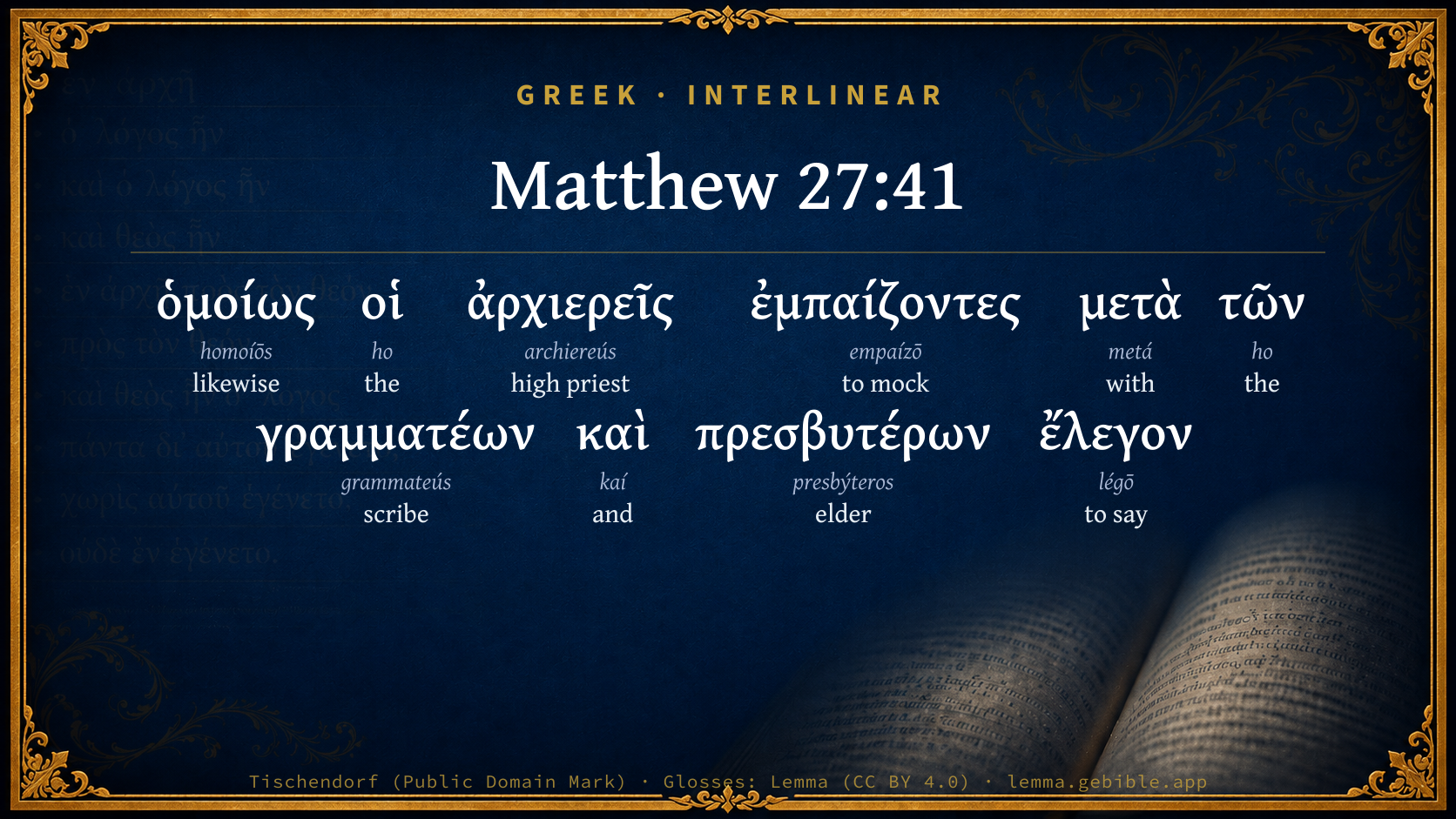
Greek (Tischendorf 8th ed.) Matthew 27:41 appears in the Greek New Testament. The text above is from the Tischendorf 8th edition. Each word links to its Strong’s number and a concise gloss. Click any word for its full Thayer’s Greek Lexicon entry.
Download image
Cite this verse

Matthew 27:41 (World English Bible). Public Domain. Lemma interlinear Bible study tool, https://lemma.gebible.app/v/matthew/27/41.

Show BibTeX & RIS
BibTeX
RIS
English Translation
Likewise the chief priests also mocking, with the scribes, the Pharisees, and the elders, said,
World English Bible · Public Domain
Download a study sheet

One document with this verse’s original text, its word-by-word gloss line, the meaning frame, cross-references with their text, attributed commentary, and full source and license credits — printable, and it pastes into notes with its structure intact.

This verse Autodidact and up

Study sheet (.html) Plain text (.txt)

A passage Seminary Student

Up to 50 verses in one chapter. A passage sheet keeps up to 6 commentary sources and 12 cross-references per verse, in the order this page ranks them, and says so on the sheet whenever that leaves anything out. Ask for a single verse and you get the Autodidact verse sheet above.

Everything on this page stays free to read, with no account — the sheet is a download of what is already on screen, not access to it.

Want to remove ads? Support Godless Engineer
Compare translations 3

The same verse in 3 English versions, stacked beneath the original-language interlinear above. Click any original word for its lexicon entry.

Each is an independent rendering of the whole verse — the interlinear is not word-aligned to these translations.

Highlighted words mark where these versions differ — a whole-verse word diff, not a word-by-word alignment.

  • World English Bible Public Domain
    Likewise the chief priests also mocking, with the scribes, the Pharisees, and the elders, said,
  • King James Version Public Domain
    Likewise also the chief priests mocking him, with the scribes and elders, said,
  • unfoldingWord Literal Text CC BY-SA 4.0
    Likewise also the chief priests, mocking with the scribes and elders, were saying,

unfoldingWord Literal Text — © unfoldingWord, licensed CC BY-SA 4.0. Word-aligned USFM3 via Door43 (git.door43.org/unfoldingWord/en_ult).

Versions to compare (up to 4)

3 of 4 selected

Show all 19 translations

Every available English version of this verse, each an independent rendering of the whole verse.

  • World English Bible Public Domain
    Likewise the chief priests also mocking, with the scribes, the Pharisees, and the elders, said,
  • Berean Standard Bible Public Domain
    In the same way, the chief priests, scribes, and elders mocked Him, saying,
  • Majority Standard Bible Public Domain
    In the same way, the chief priests, scribes, elders, and Pharisees mocked Him, saying,
  • King James Version Public Domain
    Likewise also the chief priests mocking him, with the scribes and elders, said,
  • American Standard Version (1901) Public Domain
    In like manner also the chief priests mocking `him', with the scribes and elders, said,
  • Revised Version (1885) Public Domain
    In like manner also the chief priests mocking him, with the scribes and elders, said,
  • Geneva Bible (1599) Public Domain
    Likewise also the hie Priests mocking him, with the Scribes, and Elders, and Pharises, said,
  • Douay-Rheims (1899) Public Domain
    In like manner also the chief priests, with the scribes and ancients, mocking, said:
  • Young's Literal Translation Public Domain
    And in like manner also the chief priests mocking, with the scribes and elders, said,
  • Literal Standard Version CC BY-SA 4.0
    And in like manner also the chief priests mocking, with the scribes and elders, said,
  • Unlocked Literal Bible CC BY-SA 4.0
    In the same way the chief priests were mocking him, along with the scribes and elders, and said,
  • unfoldingWord Literal Text CC BY-SA 4.0
    Likewise also the chief priests, mocking with the scribes and elders, were saying,
  • Darby Bible Public Domain
    [And] in like manner the chief priests also, mocking, with the scribes and elders, said,
  • World Messianic Bible Public Domain
    Likewise the chief priests also mocking with the scribes, the Pharisees, and the elders, said,
  • Webster's Bible Public Domain
    Likewise also the chief priests mocking him, with the scribes and elders, said,
  • Free Bible Version CC BY-SA 4.0
    The chief priests mocked him in the same way, along with the religious teachers and elders.
  • Bible in Basic English Public Domain
    In the same way, the chief priests, making sport of him, with the scribes and those in authority, said,
  • Text-Critical English NT CC BY 4.0
    In the same way the chief priests also, along with the scribes, elders, and Pharisees, were mocking him, saying,
  • Tyndale New Testament (1534) Public Domain
    Lykwyse also the hye prestes mockinge him with the scribes and elders sayde:

Literal Standard Version (2020), Covenant Press — licensed CC BY-SA 4.0. Text via the HelloAO Bible API (eBible.org). Unlocked Literal Bible (unfoldingWord) — licensed CC BY-SA 4.0. Text via the HelloAO Bible API (eBible.org). unfoldingWord Literal Text — © unfoldingWord, licensed CC BY-SA 4.0. Word-aligned USFM3 via Door43 (git.door43.org/unfoldingWord/en_ult). Free Bible Version, Dr. Jonathan Gallagher — licensed CC BY-SA 4.0. Text via the HelloAO Bible API (eBible.org).

Word by word

More ways to search: Search by grammar → Find every occurrence → Compare this word →

Practice this passage: Drill this verse → Learn its vocabulary →

About this verse

These counts appear in no published source. They are computed here, from the morphology-tagged text and Lemma’s own curated glosses. What Lemma adds →

10
words
9
distinct lemmas
Gospels
section

Notable vocabulary

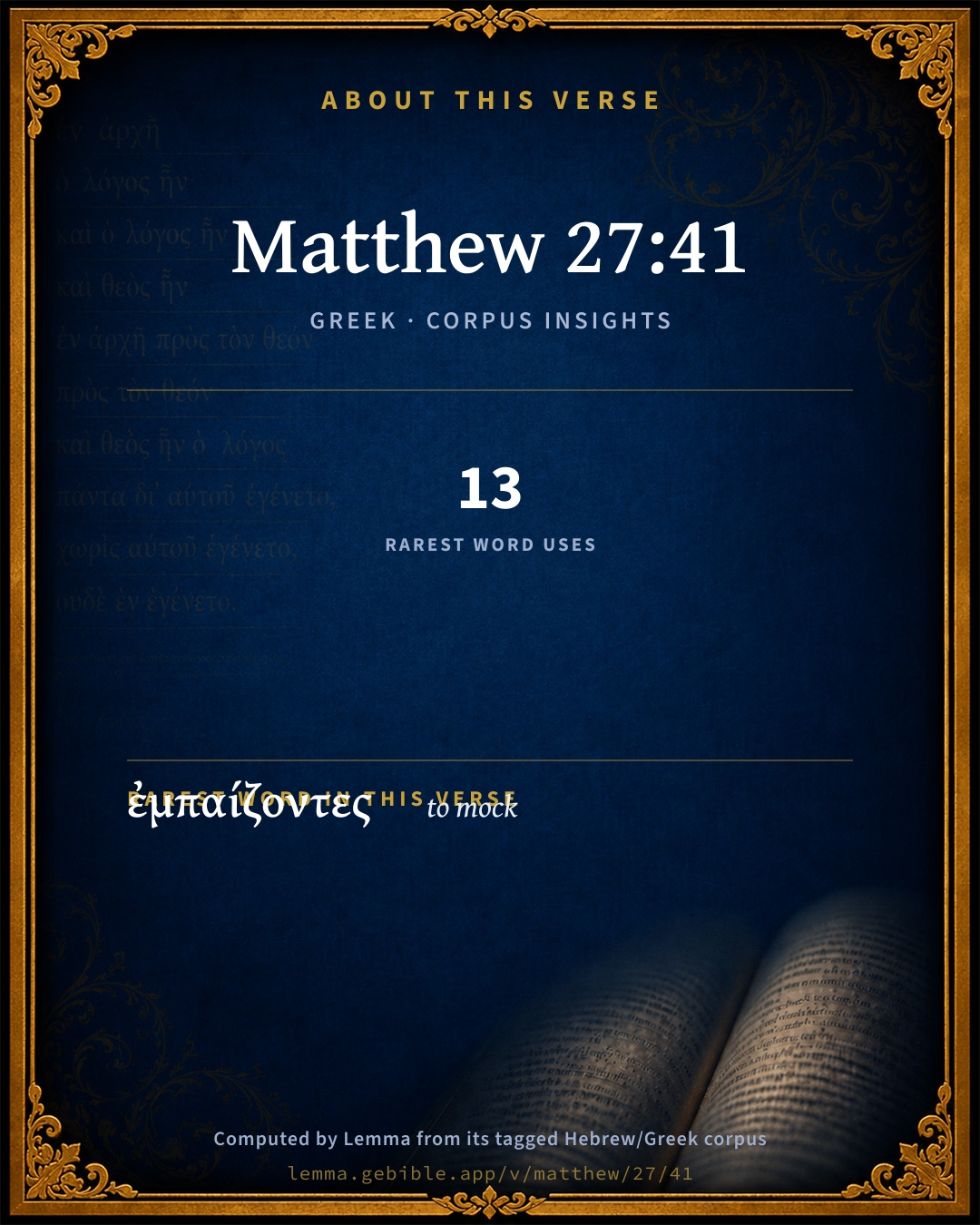
The rarest word here is ἐμπαίζοντες to mock G1702 — appearing just 13 times in the whole Greek New Testament.

Shared distinctive vocabulary

ἐμπαίζοντες to mock G1702 occurs in 13 verses of the Greek New Testament. Also found in:

Repetition

A word recurs within this verse:

Cross-references

10

Topical passages linked to Matthew 27:41 in the Treasury of Scripture Knowledge — connected by theme and wording, ordered by reader-vote popularity; previews shown in the World English Bible.

  • Psalms 35:26 Let them be disappointed and confounded together who rejoice at my calamity. Let them be clothed with shame and dishonor who magnify themselves against me.
  • Job 13:9 Is it good that he should search you out? Or as one deceives a man, will you deceive him?
  • Psalms 22:12–13 Many bulls have surrounded me. Strong bulls of Bashan have encircled me.
  • Isaiah 28:22 Now therefore don't you be scoffers, lest your bonds be made strong; for a decree of destruction have I heard from the Lord, Yahweh of Hosts, on the whole earth.
  • Isaiah 49:7 Thus says Yahweh, the Redeemer of Israel, [and] his Holy One, to him whom man despises, to him whom the nation abhors, to a servant of rulers: Kings shall see and arise; princes, and they shall worship; because of Yahweh who is faithful, [even] the Holy One of Israel, who has chosen you.
  • Zechariah 11:8 I cut off the three shepherds in one month; for my soul was weary of them, and their soul also loathed me.
  • Mark 15:31–32 Likewise, also the chief priests mocking among themselves with the scribes said, "He saved others. He can't save himself.
  • Luke 18:32 For he will be delivered up to the Gentiles, will be mocked, treated shamefully, and spit on.
  • Luke 22:52 Jesus said to the chief priests, captains of the temple, and elders, who had come against him, "Have you come out as against a robber, with swords and clubs?
  • Luke 23:35 The people stood watching. The rulers with them also scoffed at him, saying, "He saved others. Let him save himself, if this is the Christ of God, his chosen one!"

Cross-references courtesy of OpenBible.info (CC BY 4.0).

Where the printed editions differ

1 variant

Places in this verse where the major printed Greek editions disagree on the wording in a way that affects the translation — a comparison of editions, not a manuscript-by-manuscript collation. The editions are the modern critical texts (Nestlé-Aland 28/27, SBL, Westcott-Hort, Tregelles, Tyndale House) and the traditional texts behind the KJV (the Textus Receptus and the Byzantine/Majority text). It is not a claim about which reading is original.

  1. Extra text
    καὶ Φαρισαίων

    “and Pharisees”

    In Byz Not in NA28NA27TynSBLWHTregTR

    καὶ Φαρισαίων (kai Pharisaiōn) 'and Pharisees' is only in a few manuscripts (Byz)

Textual data: Translators Amalgamated Greek New Testament (STEPBible TAGNT) · CC BY 4.0.

Commentary

Notes on Matthew 27:41 from classic Christian and Jewish commentators (each source and its license shown beneath its notes). The classic Christian expositions comment on the surrounding passage and are grouped to its opening verse, so a note may address several verses; the Jewish commentaries on the Tanakh (Rashi and others) are per-verse, so they appear only where the commentator wrote on this verse.

Lemma curates 59 commentaries, every one of them public domain or Creative Commons licensed, each selected and text-cleaned for this edition rather than reprinted as found. About our sources →

MacLaren's Expositions of Holy Scripture

Alexander MacLaren

Matthew

THE CRUCIFIXION

TAUNTS TURNING TO TESTIMONIES

Mat 27:41 - Mat 27:43.

It is an old saying that the corruption of the best is the worst. What is more merciful and pitiful than true religion? What is more merciless and malicious than hatred which calls itself ‘religious’? These priests, like many a persecutor for religion since, came to feast their eyes on the long-drawn-out agonies of their Victim, and their rank tongues blossomed into foul speech. Characteristically enough, though they shared in the mockeries of the mob, they kept themselves separate. The crowd pressed near enough to the cross to speak their gibes to Jesus; the dignified movers of the ignorant crowd stood superciliously apart, and talked scoffingly about Him. Whilst the populace yelled, ‘Thou that destroyest the Temple and buildest it in three days, come down,’ the chief priests, with the scribes, looked at each other with a smile, and said, ‘He saved others; Himself He cannot save.’ Now, these brutal taunts have lessons for us. They witness to the popular impression of Christ, and what His claims were. He asserted Himself to be a worker of miracles, the Messiah-King of Israel, the Son of God, therefore He died. And they witness to the misconception which ruled in the minds of these priests as to the relation of His claims to the Cross. They thought that it had finally burst the bubble, and disposed once for all of these absurd and blasphemous pretensions. Was it credible that a man who possessed miraculous power should not, in this supreme moment, use it to deliver Himself? Did not ‘Physician, heal Thyself,’ come in properly there? Would any of the most besotted followers of this pretender retain a rag of belief in His Messiahship if He was crucified? Could it be possible that, if there was a God at all, He should leave a man that really trusted in Him, not to say who was really His Son, to die thus? A cracked mirror gives a distorted image. The facts were seen, but their relation was twisted. If we will take the guidance of these gibes, and see what is the real explanation to the anomaly that they suggest, then we shall find that the taunts turn to Him for a testimony, and that ‘out of the mouths of mockers there is ‘perfected praise.’ The stones flung at the Master turn to roses strewed in His path.

I. So, then, first the Cross shows us the Saviour who could not save Himself.

The priests did not believe in Christ’s miracles, and they thought that this final token of his impotence, as they took it to be, was clear proof that the miracles were either tricks or mistakes. They saw the two things, they fatally misunderstood the relation between them. Let us put the two things together.

Here, on the one hand, is a Man who has exercised absolute authority in all the realms of the universe, who has spoken to dead matter, and it has obeyed; who by His word has calmed the storm, and hushed the winds by His word, has multiplied bread, has transmuted pale water into ruddy wine; who has moved omnipotent amongst the disturbed minds and diseased bodies of men, who has cast His sovereign word into the depth and darkness of the grave, and brought out the dead, stumbling and entangled in the grave-clothes. All these are facts on the one side. And on the other there is this-that there, passive, and, to superficial eyes, impotent, He hangs the helpless Victim of Roman soldiers and of Jewish priests. The short and easy vulgar way to solve the apparent contradiction was to deny the reality of the one of its members; to say ‘Miracles? Absurd! He never worked one, or He would have been working one now.’

But let their error lead us into truth, and let us grasp the relation of the two apparently contradictory facts. ‘He saved others,’ that is certain. He did not ‘save Himself,’ that is as certain. Was the explanation ‘cannot’? The priests by ‘cannot’ meant physical impossibility, defect of power, and they were wrong. But there is a profound sense in which the word ‘cannot’ is absolutely true. For this is in all time, and in all human relations, the law of service-sacrifice; and no man can truly help humanity, or an individual, unless he is prepared to surrender himself in the service. The lamp burns away in giving light. The fire consumes in warming the hearth, and no brotherly sympathy or help has ever yet been rendered, or ever will be, except at the price of self-surrender. Now, some people think that this is the whole explanation of our Lord’s history, both in His life and in His death. I do not believe that it is the whole explanation, but I do believe it carries us some way towards the central sanctuary, where the explanation lies. And yet it is not complete or adequate, because, to parallel Christ’s work with the work of any of the rest of us to our brethren, however beautiful, disinterested, self-oblivious, and self-consuming it may be, seems to me-I say it with deference, though I must here remember considerations of brevity and be merely assertive-entirely to ignore the unique special characteristic of the work of Jesus Christ-viz., that it was the atonement for the sins of the world. He could not bear away our sins, unless the burden of them was laid on His own back, and He carried our griefs, our sorrows, our diseases, and our transgressions. ‘He saved others, Himself He cannot save.’ But the impossibility was purely the result of His own willing and obedient love; or, if I put it in more epigrammatic form, the priests’ ‘cannot’ was partially true, but if they had said ‘would not’ they would have hit the mark, and come to full truth. The reason for His death becomes clear, and each of the contrasted facts is enhanced, when we set side by side the opulence and ease of His manifold miracles and the apparent impotence and resourcelessness of the passive Victim on the cross.

That ‘cannot’ did not come from defect of power, but from plenitude of love, and it was a ‘will not’ in its deepest depths. For you will find scattered throughout Scripture, especially these Gospels, indications from our Lord’s own lips, and by His own acts, that, in the truest and fullest sense, His sufferings were voluntary. ‘No man taketh it from me’-He says about His life-’I have power to lay it down, and I have power to take it again.’ And once He did choose to flash out for a moment the always present power, that we might learn that when it did not appear, it was not because he could not, but because he would not. When the soldiers came to lay their hands upon Him, He presented Himself before them, saving them all the trouble of search, and when He asked a question, and received the answer that it was He of whom they were in search, there came one sudden apocalypse of His majesty, and they fell to the ground, and lay there prone before Him. They could have had no power at all against Him, except He had willed to surrender Himself to them. Again, though it is hypercritical perhaps to attach importance to what may only be natural idiomatic forms of speech, yet in this connection it is not to be overlooked that the language of all the Evangelists, in describing the supreme moment of Christ’s death, is congruous with the idea that He died neither from the exhaustion of crucifixion, nor from the thrust of the soldier’s spear, but because He would. For they all have expressions equivalent to that of one of them, ‘He gave up His spirit.’ Be that as it may, the ‘cannot’ was a ‘will not’; and it was neither nails that fastened Him to the tree, nor violence that slew Him, but He was fixed there by His own steadfast will, and He died because He would. So if we rightly understand the ‘cannot’ we may take up with thankfulness the taunt which, as I say, is tuned to a testimony, and reiterate adoringly, ‘He saved others, Himself He cannot save.’

II. The Cross shows us the King on His throne.

To the priests it appeared ludicrous to suppose that a King of Israel should, by Israel, be nailed upon the cross. ‘Let Him come down, and we will believe Him.’ They saw the two facts, they misconceived their relation. There was a relation between them, and it is not difficult for us to apprehend it.

The Cross is Christ’s throne. There are two ways in which the tragedy of His crucifixion is looked at in the Gospels, one that prevails in the three first, another that prevails in the fourth. These two seem superficially to be opposite; they are complementary. It depends upon your station whether a point in the sky is your zenith or your nadir. Here it is your zenith; at the antipodes it is the nadir. In the first three gospels the aspect of humiliation, degradation, inanition, suffering, is prominent in the references to the Crucifixion. In the fourth gospel the aspect of glory and triumph is uppermost. ‘Even so must the Son of Man be lifted up’; ‘I, if I be lifted up, will draw all men unto Me’; ‘Now the hour is come that the Son of Man should be glorified.’ And it is His glory, for on that Cross Jesus Christ manifests, in transcendent and superlative form, at once power and love that are boundless and divine. The Cross is the foundation of His kingdom. In his great passage in Philippians the Apostle brings together, in the closest causal connection, His obedience unto death, the death of the Cross, and His exaltation and reception of ‘the name that is above every name, that at the name of Jesus every knee should bow.’ The title over the Cross was meant for a gibe. It was a prophecy. By the Cross He becomes the ‘King,’ and not only the ‘King of the Jews.’ The sceptre that was put in His hand, though it was meant for a sneer, was a forecast of a truth, for He rules, not with a rod of iron, but with the reed of gentleness; and the crown of thorns, that was pressed down on His wounded and bleeding head, foretold for our faith the great truth that suffering is the foundation of dominion, and that men will bow as to their King and Lord before Him who died for them, with a prostration of spirit, a loyalty of allegiance, and an alertness of service, which none other, monarch or superior, may even dream of attaining. The Cross establishes, not destroys, Christ’s dominion over men.

Yes; and that Cross wins their faith as nothing else can. The blind priests said, ‘Let Him come down, and we will believe Him.’ Precisely because He did not come down, do sad and sorrowful and sinful hearts turn to Him from the ends of the earth, and from the distances of the ages pour the treasures of their trust and their love at His feet. Did you ever think how strange it is, except with one explanation, that the gibes of the priests did not turn out to be true? Why is it that Christ’s shameful death did not burst the bubble, as they thought it had done? Why is it that in His case-and I was going to say, and it would have been no exaggeration, in His case only-the death of the leader did not result in the dispersion of the led? Why is it that His fate and future were the opposite of that of multitudes of other pseudo-Messiahs, of whom it is true that when they were slain their followers came to nought? Why? There is only one explanation, I think, and that is that the death was not the end, but that He rose again from the dead. My brother, you will either have to accept the Resurrection, with all that comes from it, or else you will have to join the ranks of the priests, and consider that Christ’s death blew to atoms Christ’s pretensions. If we know anything about Him, we know that He asserted miraculous power, Messiahship, and a filial relation to God. These things are facts. Did He rise or did He not? If He did not, He was an enthusiast. If He did, He is the King to whom our hearts can cleave, and to whom our loyalty is due.

III. Now, lastly, the Cross shows us the Son, beloved of the Father.

The priests thought that it was altogether incredible that His devotion should have been genuine, or His claim to be the Son of God should have any reality, since the Cross, to their vulgar eyes, disproved them both. Like all coarse-minded people, they estimated character by condition, but they who do that make no end of mistakes. They had forgotten their own Prophecies, which might have told them that ‘the Servant of the Lord in whom’ His ‘heart delighted,’ was a suffering Servant. But whilst they recognised the facts, here again, as in the other two cases, they misconceived the relation. We have the means of rectifying the distorted image.

We ought to know, and to be sure, that the Cross of Christ was the very token that this was God’s ‘beloved Son in whom He was well pleased.’ If we dare venture on the comparison of parts of that which is all homogeneous and perfect, we might say that in the moment of His death Jesus Christ was more than ever the object of the Father’s delight.

Why? It is not my purpose now to enlarge upon all the reasons which might be suggested. Let me put them together in a sentence or two. In that Cross Jesus Christ revealed God as God’s heart had always yearned to be revealed, infinite in love, pitifulness, forbearance, and pardoning mercy. There was the highest manifestation of the glory of God. ‘What?’ you say, ‘a poor weak Man, hanging on a cross, and dying in the dark-is that the very shining apex of all that humanity can know of divinity?’ Yes, for it is the pure manifestation that God is Love. Therefore the whole sunshine of the Father’s presence rested on the dying Saviour. It was the hour when God most delighted in Him, if I may venture the comparison, for the other reasons that then He carried filial obedience to its utmost perfection, that then His trust in God was deepest, even at the hour when His spirit was darkened by the cloud that the world’s sin, which He was carrying, had spread thunderous between Him and the sunshine of the Father’s face. For in that mysterious voice, which we can never understand in its depths, there were blended trust and desolation, each in its highest degree: ‘My God! my God! Why hast Thou forsaken Me?’ And the Cross was the complete carrying out of God’s dearest purpose for the world, that He might be ‘just, and the justifier of him that believeth in Jesus.’ Therefore, then-I was going to say as never before-was Christ His Son, in whom He delighted.

Brethren, let us, led by the errors of these scoffers, grasp the truths that they pervert. Let us see that weak Man hanging helpless on the cross, whose ‘cannot’ is the impotence of omnipotence, imposed by His own loving will to save a world by the sacrifice of Himself. Let us crown Him our King, and let our deepest trust and our gladdest obedience be rendered to Him because He did not come down from, but ‘endured, the cross.’ Let us behold with wonder, awe, and endless love the Father not withholding His only Son, but ‘delivering Him up to the death for us all,’ and from the empty grave and the occupied Throne let us learn how the Father by both proclaims to all the world concerning Him hanging dying on the cross: ‘This is My beloved Son, in whom I am well pleased.’

Alexander MacLaren, Expositions of Holy Scripture (1904–1910) — public domain. Text from a community e-Sword module.

Bengel's Gnomon

Johann Albrecht Bengel

Mat 27:41. Ὁμοίως, κ.τ.λ., in like manner, etc.) Now the chief men imitate the populace: a great confusion! but they surpass them in bitterness.[1198]

[1198] Such persons scarcely at any other time betray in public what is the secret feeling which they cherish inwardly.—V. g.

Bengel's Gnomon of the New Testament — English translation (T&T Clark, Edinburgh, 1860) — public domain. Text from a community e-Sword module.

Expositor's Greek Testament

ed. W. Robertson Nicoll

Mat 27:41 . ὁμοίως , etc.: one might have expected the dignitaries, priests, scribes, elders, to have left that low-minded work to the mob. But they condescend to their level, yet with a difference. They speak about the Sufferer, not to Him, and in a tone of affected seriousness and fairness.

The Expositor's Greek Testament, edited by W. Robertson Nicoll (1897–1910) — public domain. Text from a community e-Sword module.

Adam Clarke's Commentary

Verse 41. Chief priests - scribes and elders] To these, several ancient MSS. and versions add, και Φαρισαιων, and Pharisees. But though the authority for this reading is respectable, yet it does not appear that the Pharisees joined in with the others in the condemnation of our Lord. Probably his discourses and parables, related in some of the preceding chapters, which were spoken directly to them, had so far convinced them that they would at least have no hand in putting him to death. All the infamy of this seems to fall upon the PRIESTS, scribes, and elders.

Adam Clarke's Commentary on the Bible (1810–1826) — public domain. Text from a community e-Sword/MySword module.

Ellicott's Commentary for English Readers

(41) The chief priests mocking him, with the scribes and elders.—It would seem as if all, or nearly all, the members of the Sanhedrin—those, at least, who had taken part in the condemnation—had come to feast their eyes with the sight of their Victim’s sufferings.

A Bible Commentary for English Readers, edited by Charles John Ellicott (1878–1897) — public domain. Text from a community e-Sword module.

The Cambridge Bible for Schools and Colleges

gen. ed. J. J. S. Perowne

41. chief priests … scribes and elders] members of the Sanhedrin, the “rulers” of Luk_23:35.

The Cambridge Bible for Schools and Colleges (gen. ed. J. J. S. Perowne; Cambridge University Press, 1878–1918) — public domain. Text from a community e-Sword module.

John Gill's Exposition

He saved others, himself he cannot save,.... This was not so much a concession of theirs, that he had done many saving works, as healing the sick, cleansing lepers, causing the blind to see, and the lame to walk, and raising the dead; but rather a suggestion, that these were only pretensions and illusions; that either they were not really done, or done by the help of the devil; since now he himself was in the utmost extremity, he could not save himself: but of this they might have been convinced by his striking many of them to the ground, that came to apprehend him in the garden, and of which these men were eyewitnesses; and he, as man, could easily have obtained of his Father more than twelve legions of angels that would have rescued him out of their hands: but so it must not be; he came not to save himself, but others, and to save them spiritually and eternally by dying himself,

If he be the king of Israel; that is, the Messiah, who was promised and expected as a king, as Zion's king, or king of Israel; see Joh 1:49, hence in Mar 15:32 it is Christ the king of Israel,

Let him now come down from the cross, and we will believe him. The Persic version reads, "that the people may see, and believe in him"; and the Syriac and Arabic versions, "that we may see, and believe in him", as in Mar 15:32. But, alas! they had seen greater things already than this, and yet had not believed. He could easily have caused the nails to have given way, and unloosed himself, and come down, who had done such mighty works among them; and if he had, there is no reason to conclude they would have believed him to be the Son of God, and the true Messiah; for though after this, he did a much greater work, raised himself from the dead, of which they had the fullest evidence, yet they remained unbelieving.

John Gill's Exposition of the Whole Bible (1746–1763) — public domain (CC PDM 1.0). Text via the HelloAO Bible API.

Trapp's Complete Commentary

John Trapp

41 Likewise also the chief priests mocking him, with the scribes and elders, said,

Ver. 41. Likewise also the chief priests] Sick of an επιχαιρεκακια, the devil’s disease, they petulantly insult over our dying Saviour with their satanical sarcasms; which he answereth with silence, and by a brave composedness sets himself above the flight of the injurious claw. Facile est in me dicere, cum non sim responsurus, saith one. It is as impossible to avoid, as necessary to contemn the lash of lewd tongues, bitter terms, and scurrilous invectives. Those ears that were wont to hear nothing but angelic hymns are here filled with them, and he replies not. Princes use not to chide when ambassadors offer them indecencies, but deny them audience.

John Trapp, A Commentary or Exposition upon All the Books of the Old and New Testament (1647–1656) — public domain. Text from a community e-Sword module.

Whedon's Commentary on the Bible

Daniel D. Whedon

41. Chief priests… scribes and elders — They are all there, and they all have their mock.

Daniel D. Whedon (gen. ed.), Commentary on the Old and New Testaments (1874–1909) — public domain. Text from a community e-Sword module.

The Pulpit Commentary

Likewise also. All classes that composed the Sanhedrin were present at the execution, and took part in the reviling; but, unlike the soldiers (Luk_23:36) and the mob, they did not address him personally, either from supreme contempt, or because they stood aloof from the herd, and spake among themselves. Some few authorities of no great weight, after "elders" add "and Pharisees;" but the words are an interpolation, though they are without doubt true in fact. That these leaders should presume thus to revile One whom they knew to be innocent is unspeakably iniquitous.

The Pulpit Commentary (1880–1919), ed. H.D.M. Spence-Jones & Joseph S. Exell — public domain. Text from a community e-Sword module.

The People's New Testament

B. W. Johnson

41, 42. He saved others. This may be ironical, but if Christ had saved himself he could not have saved others. If he be the King of Israel. The language is that of taunt, and refers to the inscription upon the cross.

B. W. Johnson's The People's New Testament with Notes (1889–1891) — public domain. Electronic text from the Christian Classics Ethereal Library (CCEL) ThML edition.

unfoldingWord translationNotes

Door43 World Missions Community

He saved others, but he cannot save himself

Possible meanings are 1) the Jewish leaders do not believe that Jesus saved others or that he can save himself, or 2) they believe he did save others but are laughing at him because now he cannot save himself. (See: Irony)

He is the King of Israel

The leaders are mocking Jesus. They call him "King of Israel," but they do not really believe he is king. AT: "He says that he is the King of Israel" (See: Irony)

translationWords

chief priests

scribe

elder

king

Israel

believe

unfoldingWord translationNotes — © Distant Shores Media and the Door43 World Missions Community, licensed CC BY-SA 4.0. Source: git.door43.org/Door43/en_tn.

Cambridge Greek Testament for Schools and Colleges

41. οἱ ἀρχιερεῖς κ.τ.λ. Members of the Sanhedrin, the ‘rulers’ of Luk 23:35.

Cambridge Greek Testament for Schools and Colleges (Cambridge University Press, 1896; 21 vols, various authors incl. Carr, Maclear, Plummer, Farrar, Lumby, Moule, M. R. James, Simcox) — public domain. Text from a community e-Sword module.

International Critical Commentary

(M) 41. Likewise also the chief priests mocking with the scribes and elders, said.] Mk. has: “Likewise also the chief priests mocking to one another with the scribes, said.” For the insertion of καὶ πρεσβυτέρων, cf. vv. 12, 20.

International Critical Commentary — older volumes (1896–1929), various authors — public domain. Text from a community e-Sword module.

Lesson kit

Teaching starters — assembled from the data on this page, not authored interpretation. Every prompt links to the verse data it draws on. Edit before teaching.

Matthew, in the Gospels, opens this verse with 10 words (9 distinct Greek lemmas). Its most distinctive word is empaízō (“to mock”). A historical commentator’s framing appears above. Read the whole chapter for the surrounding context.

Discussion questions

  1. The word empaízō carries the sense “to mock.” How does it shape the verse?
  2. Matthew 2:16 shares the word «to mock» with this verse. How do the two illuminate each other?
  3. “the” occurs 2× in this one verse. What is the effect of the repetition?
  4. The translations on this page render this verse differently — a whole-verse word diff, not a word-by-word alignment. What might account for the different wordings?
  5. Reading how MacLaren's Expositions of Holy Scripture and Bengel's Gnomon read this verse, where do the two commentators agree and where do they part?

Things to notice

  • These translations choose different wording for 4 words in this verse.
  • “the” occurs 2× in this single verse.
  • 9 distinct Greek lemmas span 10 words in this verse.

Reading settings

Reading text

Shown beneath each verse's original-language words.

Old Testament
Old Testament edition

Read the OT as the Masoretic Hebrew (MT) or the Greek Septuagint (LXX).

English shown for the Greek Septuagint (in the Hebrew ↔ Greek comparison).

Comparing translations? Open the Compare panel on any verse page to stack up to four side by side.