
Mark 1:13

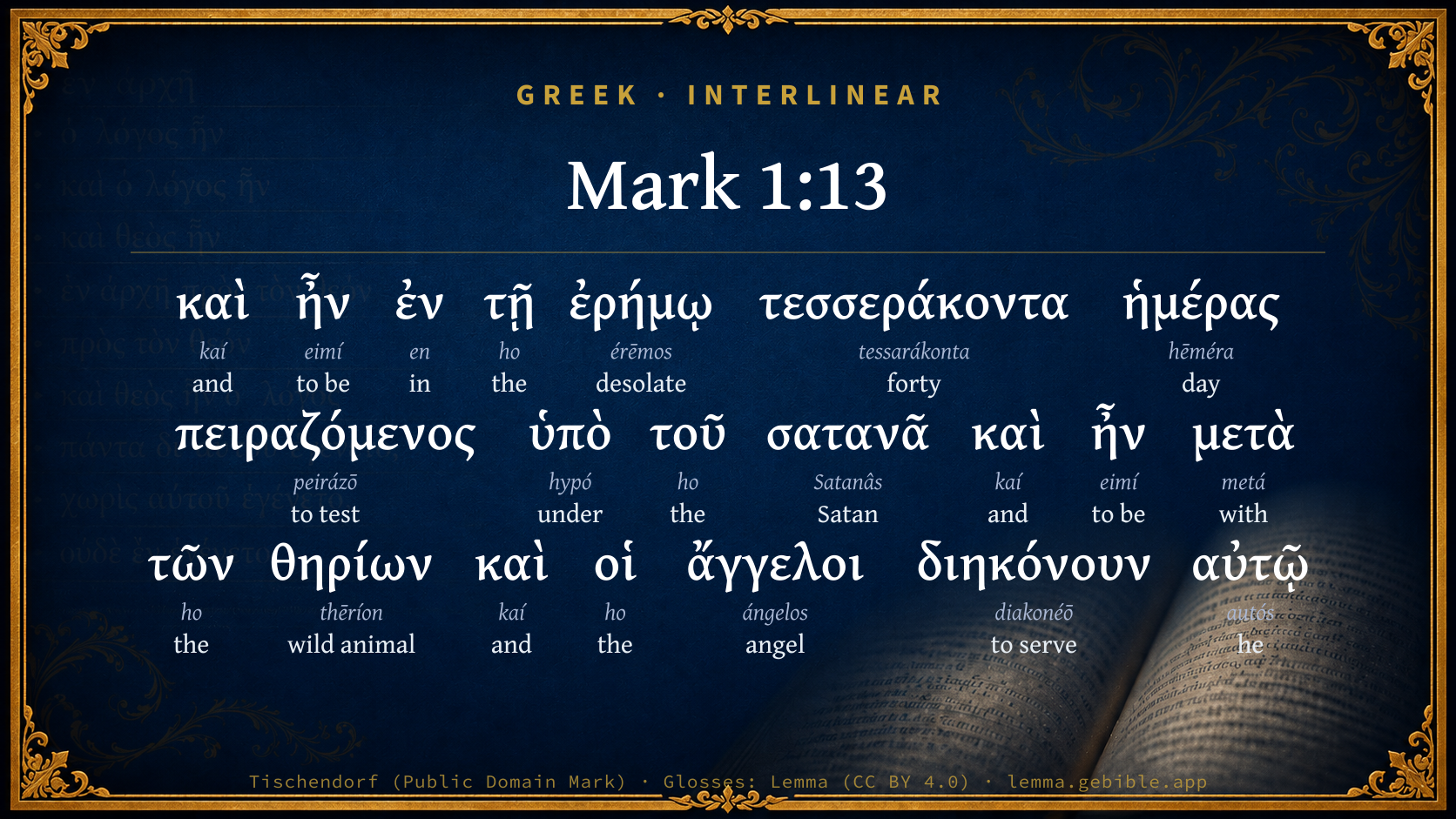
Greek (Tischendorf 8th ed.) Mark 1:13 appears in the Greek New Testament. The text above is from the Tischendorf 8th edition. Each word links to its Strong’s number and a concise gloss. Click any word for its full Thayer’s Greek Lexicon entry.
Download image
Cite this verse

Mark 1:13 (World English Bible). Public Domain. Lemma interlinear Bible study tool, https://lemma.gebible.app/v/mark/1/13.

Show BibTeX & RIS
BibTeX
RIS
English Translation
He was there in the wilderness forty days tempted by Satan. He was with the wild animals; and the angels were ministering to him.
World English Bible · Public Domain
Highlights
  • 1 first appearance in the Greek New Testament
Full analysis ↓
Download a study sheet

One document with this verse’s original text, its word-by-word gloss line, the meaning frame, cross-references with their text, attributed commentary, and full source and license credits — printable, and it pastes into notes with its structure intact.

This verse Autodidact and up

Study sheet (.html) Plain text (.txt)

A passage Seminary Student

Up to 50 verses in one chapter. A passage sheet keeps up to 6 commentary sources and 12 cross-references per verse, in the order this page ranks them, and says so on the sheet whenever that leaves anything out. Ask for a single verse and you get the Autodidact verse sheet above.

Everything on this page stays free to read, with no account — the sheet is a download of what is already on screen, not access to it.

Want to remove ads? Support Godless Engineer
Compare translations 3

The same verse in 3 English versions, stacked beneath the original-language interlinear above. Click any original word for its lexicon entry.

Each is an independent rendering of the whole verse — the interlinear is not word-aligned to these translations.

Highlighted words mark where these versions differ — a whole-verse word diff, not a word-by-word alignment.

  • World English Bible Public Domain
    He was there in the wilderness forty days tempted by Satan. He was with the wild animals; and the angels were ministering to him.
  • King James Version Public Domain
    And he was there in the wilderness forty days, tempted of Satan; and was with the wild beasts; and the angels ministered unto him.
  • unfoldingWord Literal Text CC BY-SA 4.0
    And he was in the wilderness 40 days, being tempted by Satan. And he was with the wild animals, and the angels were serving him.

unfoldingWord Literal Text — © unfoldingWord, licensed CC BY-SA 4.0. Word-aligned USFM3 via Door43 (git.door43.org/unfoldingWord/en_ult).

Versions to compare (up to 4)

3 of 4 selected

Show all 19 translations

Every available English version of this verse, each an independent rendering of the whole verse.

  • World English Bible Public Domain
    He was there in the wilderness forty days tempted by Satan. He was with the wild animals; and the angels were ministering to him.
  • Berean Standard Bible Public Domain
    and He was there for forty days, being tempted by Satan. He was with the wild animals, and the angels ministered to Him.
  • Majority Standard Bible Public Domain
    and He was there in the wilderness for forty days, being tempted by Satan. He was with the wild animals, and the angels ministered to Him.
  • King James Version Public Domain
    And he was there in the wilderness forty days, tempted of Satan; and was with the wild beasts; and the angels ministered unto him.
  • American Standard Version (1901) Public Domain
    And he was in the wilderness forty days tempted of Satan; And he was with the wild beasts; And the angels ministered unto him.
  • Revised Version (1885) Public Domain
    And he was in the wilderness forty days tempted of Satan; and he was with the wild beasts; and the angels ministered unto him.
  • Geneva Bible (1599) Public Domain
    And he was there in the wildernesse fourtie daies, and was tempted of Satan: hee was also with the wilde beastes, and the Angels ministred vnto him.
  • Douay-Rheims (1899) Public Domain
    And he was in the desert forty days and forty nights, and was tempted by Satan; and he was with beasts, and the angels ministered to him.
  • Young's Literal Translation Public Domain
    and he was there in the wilderness forty days, being tempted by the Adversary, and he was with the beasts, and the messengers were ministering to him.
  • Literal Standard Version CC BY-SA 4.0
    and He was there in the wilderness forty days, being tempted by Satan, and He was with the beasts, and the messengers were ministering to Him.
  • Unlocked Literal Bible CC BY-SA 4.0
    He was in the wilderness forty days, being tempted by Satan. He was with the wild animals, and the angels served him.
  • unfoldingWord Literal Text CC BY-SA 4.0
    And he was in the wilderness 40 days, being tempted by Satan. And he was with the wild animals, and the angels were serving him.
  • Darby Bible Public Domain
    And he was in the wilderness forty days tempted by Satan, and was with the wild beasts; and the angels ministered to him.
  • World Messianic Bible Public Domain
    He was there in the wilderness forty days, tempted by Satan. He was with the wild animals; and the angels were serving him.
  • Webster's Bible Public Domain
    And he was there in the wilderness forty days tempted by Satan: and was with the wild beasts, and the angels ministered to him.
  • Free Bible Version CC BY-SA 4.0
    where he was tempted by Satan for forty days. He was with the wild animals, and angels took care of him.
  • Bible in Basic English Public Domain
    And he was in the waste land for forty days, being tested by Satan; and he was with the beasts; and the angels took care of him.
  • Text-Critical English NT CC BY 4.0
    and he was there in the wilderness for forty days, being tempted by Satan. He was with the wild beasts, and the angels ministered to him.
  • Tyndale New Testament (1534) Public Domain
    and he was there in the wildernes xl dayes and was tempted of Satan and was with wilde beestes. And the aungels ministred vnto him.

Literal Standard Version (2020), Covenant Press — licensed CC BY-SA 4.0. Text via the HelloAO Bible API (eBible.org). Unlocked Literal Bible (unfoldingWord) — licensed CC BY-SA 4.0. Text via the HelloAO Bible API (eBible.org). unfoldingWord Literal Text — © unfoldingWord, licensed CC BY-SA 4.0. Word-aligned USFM3 via Door43 (git.door43.org/unfoldingWord/en_ult). Free Bible Version, Dr. Jonathan Gallagher — licensed CC BY-SA 4.0. Text via the HelloAO Bible API (eBible.org).

Word by word

More ways to search: Search by grammar → Find every occurrence → Compare this word →

Practice this passage: Drill this verse → Learn its vocabulary →

τεσσεράκοντα
tessarákonta
G5062
“forty”
Adjective, Numeral (indeclinable)
Part of Speech
Adjective · Numeral (indeclinable)
Full Thayer's Definition

Origin: the decade of G5064

TDNT: 10:15,1

1. forty
  1. καὶ kaí G2532 “and” Conjunction
  2. ἦν eimí G1510 “to be” Verb, Imperfect, Active, Indicative, 3rd person, Singular
  3. ἐν en G1722 “in” Preposition
  4. τῇ ho G3588 “the” Article, Dative, Singular, Feminine
  5. ἐρήμῳ érēmos G2048 “desolate” Adjective, Dative, Singular, Feminine
  6. ἡμέρας hēméra G2250 “day” Noun, Accusative, Plural, Feminine
  7. πειραζόμενος peirázō G3985 “to test” Verb, Present, Passive, Participle, Nominative, Singular, Masculine
  8. ὑπὸ hypó G5259 “under” Preposition
  9. τοῦ ho G3588 “the” Article, Genitive, Singular, Masculine
  10. σατανᾶ Satanâs G4567 “Satan” Noun, Genitive, Singular, Masculine
  11. καὶ kaí G2532 “and” Conjunction
  12. ἦν eimí G1510 “to be” Verb, Imperfect, Active, Indicative, 3rd person, Singular
  13. μετὰ metá G3326 “with” Preposition
  14. τῶν ho G3588 “the” Article, Genitive, Plural, Neuter
  15. θηρίων thēríon G2342 “wild animal” Noun, Genitive, Plural, Neuter
  16. καὶ kaí G2532 “and” Conjunction
  17. οἱ ho G3588 “the” Article, Nominative, Plural, Masculine
  18. ἄγγελοι ángelos G32 “angel” Noun, Nominative, Plural, Masculine
  19. διηκόνουν diakonéō G1247 “to serve” Verb, Imperfect, Active, Indicative, 3rd person, Plural
  20. αὐτῷ autós G846 “he” Personal pronoun, Dative, Singular, Masculine

About this verse

These counts appear in no published source. They are computed here, from the morphology-tagged text and Lemma’s own curated glosses. What Lemma adds →

21
words
15
distinct lemmas
Gospels
section

Notable vocabulary

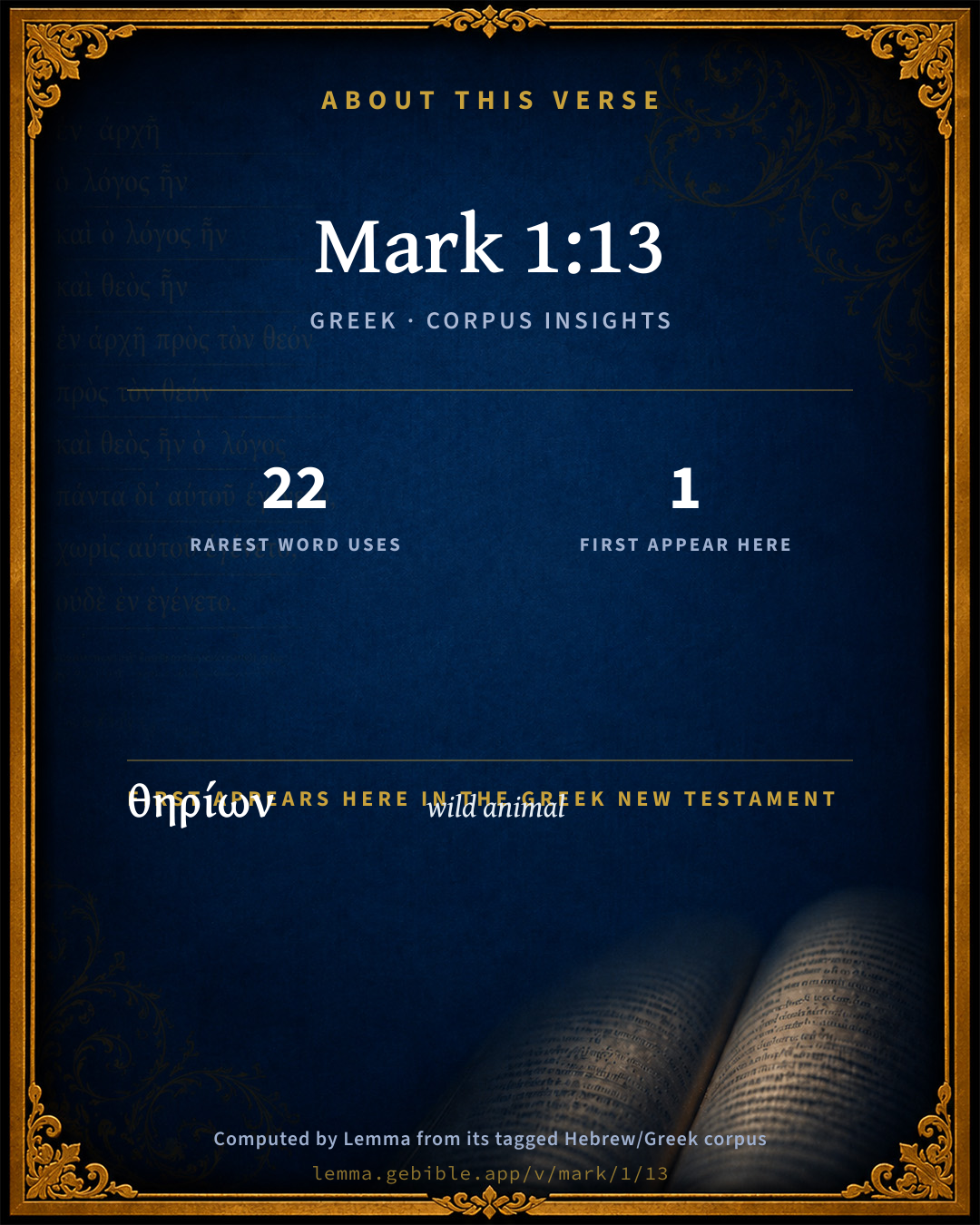
The rarest word here is τεσσεράκοντα forty G5062 — appearing just 22 times in the whole Greek New Testament.

First appearance in Scripture

This word makes its first canonical appearance in the Greek New Testament here:

  • θηρίων wild animal G2342

Shared distinctive vocabulary

τεσσεράκοντα forty G5062 occurs in 21 verses of the Greek New Testament. Also found in:
Repetition

Words recur within this verse:

Cross-references

11

Topical passages linked to Mark 1:13 in the Treasury of Scripture Knowledge — connected by theme and wording, ordered by reader-vote popularity; previews shown in the World English Bible.

  • Hebrews 2:17–18 Therefore he was obligated in all things to be made like his brothers, that he might become a merciful and faithful high priest in things pertaining to God, to make atonement for the sins of the people.
  • Hebrews 4:15 For we don't have a high priest who can't be touched with the feeling of our infirmities, but one who has been in all points tempted like we are, yet without sin.
  • Exodus 34:28 He was there with Yahweh forty days and forty nights; he neither ate bread, nor drank water. He wrote on the tablets the words of the covenant, the ten commandments.
  • Matthew 26:53 Or do you think that I couldn't ask my Father, and he would even now send me more than twelve legions of angels?
  • Deuteronomy 9:11 It came to pass at the end of forty days and forty nights, that Yahweh gave me the two tables of stone, even the tables of the covenant.
  • Deuteronomy 9:18 I fell down before Yahweh, as at the first, forty days and forty nights; I did neither eat bread nor drink water; because of all your sin which you sinned, in doing that which was evil in the sight of Yahweh, to provoke him to anger.
  • Deuteronomy 9:25 So I fell down before Yahweh the forty days and forty nights that I fell down, because Yahweh had said he would destroy you.
  • 1 Kings 19:5–8 He lay down and slept under a juniper tree; and, behold, an angel touched him, and said to him, Arise and eat.
  • Matthew 4:10–11 Then Jesus said to him, "Get behind me, Satan! For it is written, 'You shall worship the Lord your God, and him only shall you serve.'"
  • Exodus 24:18 Moses entered into the midst of the cloud, and went up on the mountain; and Moses was on the mountain forty days and forty nights.
  • 1 Timothy 3:16 Without controversy, the mystery of godliness is great: God was revealed in the flesh, Justified in the spirit, Seen by angels, Preached among the nations, Believed on in the world, And received up in glory.

Cross-references courtesy of OpenBible.info (CC BY 4.0).

Commentary

Notes on Mark 1:13 from classic Christian and Jewish commentators (each source and its license shown beneath its notes). The classic Christian expositions comment on the surrounding passage and are grouped to its opening verse, so a note may address several verses; the Jewish commentaries on the Tanakh (Rashi and others) are per-verse, so they appear only where the commentator wrote on this verse.

Lemma curates 59 commentaries, every one of them public domain or Creative Commons licensed, each selected and text-cleaned for this edition rather than reprinted as found. About our sources →

Bengel's Gnomon

Johann Albrecht Bengel

Mar 1:13. Μετὰ τῶν θηρίων, with the wild beasts) An important fact; comp. Gen 1:26. This was a state more trying than the mere solitude of the desert. [Here the Saviour was removed apart from angels and men; and yet, however, not liable to the attacks of wild beasts. He even now, in the very height of His humiliation (self-emptying), exercised over the beasts the dominion which Adam had so soon suffered himself to lose; how much more so, when exalted! Psa 8:8.—V. g.] Mark not only exhibits in a more compendious compass the history described by Matthew, but also, as it were in the manner of a supplement, some particulars of considerable value, which had not been previously recorded by Matthew, but which were calculated to afford profitable instruction to believers, who by this time had become proficients in the truth.[8]

[8] Michaelis, in the Enleitung, etc., T. ii., p. 1154, etc., has tried to prove, by induction of particulars, that those things which Mark has either omitted or supplied, most especially accord with the tradition of the ancients, which represented Mark’s aim in writing to have been with a view to the conversion and edification of the Romans.—E. B.

Bengel's Gnomon of the New Testament — English translation (T&T Clark, Edinburgh, 1860) — public domain. Text from a community e-Sword module.

Expositor's Greek Testament

ed. W. Robertson Nicoll

Mar 1:13 . πειραζόμενος , being tempted, presumably the whole time; doubtless the real truth. Two powers at work all through, the Spirit of God and the spirit of evil. ἦν μετὰ τ . θηρ .: not merely pictorial or intended to hint danger; meant rather to indicate the uninhabited nature of the place; no supplies obtainable there, hunger therefore a part of the experience. οἱ ἄγγελοι : angels as opposed, not to devils (Schanz), but to human beings, of whom there were none. διηκόνουν , ministered; in what way not said, but implying exhaustion. These few touches of Mk. suggest a vivid picture of a spiritual crisis: intense preoccupation, instinctive retreat into congenial grim solitudes, temptation, struggle, fierce and protracted, issuing in weakness, calling for preternatural aid.

The Expositor's Greek Testament, edited by W. Robertson Nicoll (1897–1910) — public domain. Text from a community e-Sword module.

Adam Clarke's Commentary

Verse 13. With the wild beasts] This is a curious circumstance, which is mentioned by none of the other evangelists; and seems to intimate that he was in the most remote, unfrequented, and savage part of the desert; which, together with the diabolic influence, tended to render the whole scene the more horrid. Perhaps this very circumstance is mentioned, as emblematical of that savage and brutal cruelty with which he was persecuted to death by the Jews and Gentiles, instigated thereto by the malice of Satan.

Adam Clarke's Commentary on the Bible (1810–1826) — public domain. Text from a community e-Sword/MySword module.

Ellicott's Commentary for English Readers

(13) And he was there in the wilderness.—See Notes on Mat_4:2-11. St. Mark compresses the history by omitting the several forms of the Temptation. Peculiar to him are (1) the use of “Satan” instead of “the devil;” (2) the statement that Jesus was “with the wild beasts.” In our Lord’s time these might include the panther, the bear, the wolf, the hyena, possibly the lion. The implied thought is partly that their presence added to the terrors of the Temptation, partly that in His being protected from them there was the fulfilment of the promise in the very Psalm which furnished the Tempter with his chief weapon, that the true child of God should trample under foot “the lion and the adder,” the “young lion and the dragon” (Psa_91:13).

A Bible Commentary for English Readers, edited by Charles John Ellicott (1878–1897) — public domain. Text from a community e-Sword module.

The Cambridge Bible for Schools and Colleges

gen. ed. J. J. S. Perowne

13. tempted of Satan] In Mat_4:1 and Luk_4:2, He is said to have been tempted by the Devil, i. e. the “Slanderer,” who slanders God to man (Gen_3:1-5) and man to God (Job_1:9-11; Rev_12:10). St Mark, who never uses this word, says He was tempted by Satan, i e. “the Enemy” of God and man alike. He seems to have been permitted to tempt our Lord during the whole of the forty days, but at the end of that period to have assailed Him with increased intensity through every avenue that could allure, as afterwards in Gethsemane through every channel that could terrify and appal (Luk_4:13).

the wild beasts] St Mark relates the Temptation very briefly, but he alone adds the graphic touch to the picture that the Saviour was “with the wild beasts,” unhurt by them, as Adam was in Paradise. Comp. Daniel in the den of lions.

the angels] St Matthew records the ministry of Angels at the close as to a Heavenly Prince (Mat_4:11). St Mark records a ministry of the same celestial Visitants apparently throughout the trial.

The Cambridge Bible for Schools and Colleges (gen. ed. J. J. S. Perowne; Cambridge University Press, 1878–1918) — public domain. Text from a community e-Sword module.

John Gill's Exposition

And he was there in the wilderness forty days,.... The Vulgate Latin, Arabic, and Ethiopic versions add, "and forty nights": for so long was he there,

tempted of Satan: the several temptations of Satan, and how they were overcome by Christ, are particularly related by the Evangelist Matthew, Mat 4:3, which are here omitted; and what is not mentioned there, is here recorded:

and was with the wild beasts: which shows, that he was now in an uncultivated and uninhabited part of the desert by men, and where only the most fierce and most savage of creatures dwelt; and yet was as secure and unhurt by them, being the Lord of them, as Adam in Eden's garden, or Daniel in the lions' den. This circumstance is only related by the Evangelist Mark, and is what adds to the uncomfortable situation Christ was in, when tempted by Satan; and his being not hurt by them, may declare, partly his innocence, as man, being as pure and holy as the first man was in his state of integrity, when all creatures were brought before him, to give them names; and partly the power of God, who shut up the mouths of these creatures, that they did him no hurt; and also may signify, the awe they stood in of him, who, as God, is Lord of all. These creatures were more gentle to Christ, and used him better than the wicked Jews, among whom he dwelt, who are compared to lions, dogs, and "bulls" of Bashan, Psa 22:12.

And the angels ministered unto him; after the temptations were over, and Satan had left him, preparing for him, and bringing to him proper food, after so long a fast; and waiting upon him, and serving him as their great Lord and master; See Gill on Mat 4:11.

John Gill's Exposition of the Whole Bible (1746–1763) — public domain (CC PDM 1.0). Text via the HelloAO Bible API.

Trapp's Complete Commentary

John Trapp

13 And he was there in the wilderness forty days, tempted of Satan; and was with the wild beasts; and the angels ministered unto him.

Ver. 13. And was with the wild beasts] Unhurt by them, as Adam was in the state of integrity. These fell creatures saw in Christ the perfect image of God; and therefore reverenced him as their Lord, as they did Adam before his fall, see Job 5:21-22.

John Trapp, A Commentary or Exposition upon All the Books of the Old and New Testament (1647–1656) — public domain. Text from a community e-Sword module.

Haydock's Catholic Bible Commentary

The Greek does not express the forty nights, but we find it in St. Matthew iv. 2.

George Leo Haydock (1774–1849), Haydock's Catholic Family Bible and Commentary, 1859 edition — public domain. Excludes Psalms (Douay-Rheims chapter numbering differs from Protestant) and Deuterocanonical books (Catholic canon only).

Whedon's Commentary on the Bible

Daniel D. Whedon

13. Forty days tempted — This by no means affirms that the temptation lasted during the whole forty days, any more than the ministry of angels mentioned in the last clause. Satan… wild beasts… the angels — Three very different sorts of company. Diabolical and brutal natures were present to witness or subdue the divine; but, on the other hand the divine and angelic combined with the human were too mighty for them.

Daniel D. Whedon (gen. ed.), Commentary on the Old and New Testaments (1874–1909) — public domain. Text from a community e-Sword module.

The Pulpit Commentary

Forty days tempted of Satan. St. Mark gathers up the whole temptation into this one sentence; and the passage would seem to imply that the three temptations recorded by St. Matthew and St. Luke were not the only trials through which our Lord passed during those forty days, although they were no doubt the prominent and the most powerful assaults upon our Redeemer. And he was with the wild beasts (meta twn yhriwn). This shows the extreme solitude of the place. It shows also the innocence of our Lord, that there, in that wild and desolate district, amongst lions, and wolves, and leopards, and serpents, he neither feared them nor was injured by them. He dwelt amongst them as Adam lived with them in his state of innocence in Paradise. These wild beasts recognized and revered their Creater and their Lord. And the angels ministered unto him. This, as we learn from St. Matthew, (Mat_4:11) was after his temptation and victory. Some have thought that Jesus became known to the devil as the Son of God, by the reverence and adoration of the angels. Thus Jesus showed in his own person, when alone he had striven with Satan and, had overcome him, that heavenly comfort and the ministry of angels are provided by God for those who overcome temptation.

The Pulpit Commentary (1880–1919), ed. H.D.M. Spence-Jones & Joseph S. Exell — public domain. Text from a community e-Sword module.

John Wesley's Explanatory Notes

And he was there forty days, tempted by Satan - Invisibly. After this followed the temptation by him in a visible shape, related by St. Matthew. And he was with the wild beasts - Though they had no power to hurt him. St. Mark not only gives us a compendium of St. Matthew's Gospel, but likewise several valuable particulars, which the other evangelists have omitted.

John Wesley, Explanatory Notes Upon the Whole Bible (1754–1765) — public domain. Text via the GEBible commentary corpus.

Cambridge Greek Testament for Schools and Colleges

13. τεσσεράκοντα ἡμέρας. Vulg. adds et quadraginta noctibus from Mat 4:2. Mt. mentions the nights to show that the fasting was continuous; but Mk does not mention fasting. Mk and Lk. indicate that temptations continued throughout the forty days; cf. Exo 34:28 of Moses, and 1Ki 19:8 of Elijah. Mt. might lead us to suppose that they did not begin till acute hunger was felt.

πειραζόμενος. In N.T. the verb is often used of the attacks of the evil one, a use not found in LXX., in which God’s trying man, or man’s trying God, is the usual meaning. Often in N.T. “try” or “test” would be a better rendering than “tempt.” Here, as in Mar 1:5; Mar 1:39, we have a leading idea expressed by a participle.

ὑπὸ τοῦ σατανᾶ. Mt. and Lk. say ὑπὸ τοῦ διαβόλου, a word more widely used in N.T. than Σατανᾶς, but not found in Mk. “Satan” (= “Adversary”) is found in all four Gospels, Acts, Pauline Epp. and Revelation. Cf. Job 1:6; Job 2:1; 1Ch 21:1; Zec 3:1. Here the Adversary of God and man begins his conflict with ὁ ἰσχυρότερος αὐτοῦ (Luk 11:22) about the method of overcoming the world. Mk thinks it unnecessary to state which was victor.

ἦν μετὰ τῶν θηρίων. Short as Mk’s narrative is, he here gives a particular which is not in Mt. or Lk. The wild beasts indicate the solitariness of the place, διὰ τὴν ἄγαν ἐρημίαν τοῦ τόπου (Euthym.), rather than a special terror. One who knew Himself to be the Messiah would not be afraid of being killed by wild animals. That the beasts are meant to suggest a Paradise for the Second Adam is an idea alien from the context. They intimate the absence of human beings (Isa 13:21), and hence the need of Angels. Still less need we suppose that here there is confusion between two similar Hebrew words, one of which means “wild beasts” and the other “fast,” so that “wild beasts” here becomes “hungered” in Mt. and Lk. Least of all that there is here any borrowing from Buddha’s fasting or the temptation of Zarathustra. “Such ideas can only occur to those who will not try first of all to find in the story its own explanation” (Clemen). See p. 92.

διηκόνουν. Cf. Mar 1:31, Mar 15:41. The imperf. seems to imply that the Angelic ministrations, like the Satanic assaults, continued throughout Mt. places both at the end. Bede’s antithesis is hardly right: inter bestias commoratur ut homo, sed ministerio utitur angelico ut Deus. It was as man that He needed the support of Angels (Luk 22:43). There is a striking parallel in the Testaments (Naph. viii. 4): “And the devil shall fly from you, [And the wild beasts shall fear you,] And the Lord shall love you, [And the Angels shall cleave to you].” But the words in brackets are not found in all texts. Christian interpolations are freq. in the Testaments.

Cambridge Greek Testament for Schools and Colleges (Cambridge University Press, 1896; 21 vols, various authors incl. Carr, Maclear, Plummer, Farrar, Lumby, Moule, M. R. James, Simcox) — public domain. Text from a community e-Sword module.

Alford’s Greek Testament

Henry Alford

13.] Temptation of Jesus. Mat 4:1-11.Luk 4:1-13Luk 4:1-13.

12,

13.] ἐκβάλλω = ἀνάγω Matt., = ἄγω Luke. It is a more forcible word than either of these to express the mighty and cogent impulse of the Spirit.

σατανᾶ = διαβ. Matt., Luke: see note, Mat 4:1.

It seems to have been permitted to the evil one to tempt our Lord during the whole of the 40 days, and of this we have here, as in Luke, an implied assertion. The additional intensity of temptation at the end of that period, is expressed in Matt. by the tempter coming to Him—becoming visible and audible. Perhaps the being with the beasts may point to one form of temptation, viz. that of terror, which was practised on Him:—but of the inward trials who may speak?

οἱ ἄγγ., as τῶν θηρ. generic.

There is nothing here to contradict the fast spoken of in Matt. and Luke, as De W. maintains. Our Evangelist perhaps implies it in the last words of ver. 13. It is remarkable that those Commentators who are fondest of maintaining that Mark constructed his narrative out of those of Matt. and Luke (De W., Meyer) are also most keen in pointing out what they call irreconcileable differences between him and them. No apportionment of these details to the various successive parts of the temptation is given by our Evangelist. They are simply stated to have happened, compendiously.

14,

Henry Alford, The Greek Testament (1849–1861) — public domain. Text from a community e-Sword module.

International Critical Commentary

13. Καὶ ἦν ἐν τῇ ἐρήμῳ τεσσεράκοντα ἡμέρας—And he was in the wilderness forty days. This period is given by both Mk. and Lk. as that of the temptation, though Mt. and Lk. both give us the three special temptations following the forty days. Mt. makes these the only temptations. πειραζόμενος—tempted. Used here of an actual solicitation to evil.

The proper meaning of πειράζειν is to try, in the sense both of attempt and test. It is through the latter meaning that it comes to be applied to the test of character, whether by trial, or by solicitation to evil.

Σατανᾶ—Satan.1 The name is Hebrew, but the personage does not figure much in O.T. narrative or discourse (1Ch 21:1, Zec 3:1, Zec 3:2, Job 1:6-9, Job 1:2:1sqq.). In the N.T., he is represented, in accordance with current Jewish ideas, as the ruler of a kingdom of evil, having subjects and emissaries in the shape of demons, corresponding to the angels who act as God’s messengers. His special function is to tempt men to evil. μετὰ τῶν θηρίων—with the wild beasts. The desert of Judæa is in parts wild and untamed, and abounds in beasts of the same description, such as the leopard, the bear, the wild boar, and the jackal. This descriptive touch, in which, just as with a word, the wildness and solitariness of the scene are brought before us, and equally, the omission of details of the temptation, are characteristics of Mk. The omission accords with the plan of his Gospel, but, also, with a certain objective quality belonging to it. See Introduction. διηκόνουν—were ministering.2 This ministry, like the temptations, is represented in Mt. as taking place after the forty days. In our account, it is evidently an offset to the presence of the wild beasts. The visible things figuring in the scene were these beasts, but there were invisible presences as well, and these were ministering to him. Mk. does not tell us what the ministrations were. (Nor Mt.)

The historicity of the account of the temptation is attacked with some plausibility. There are certain things about it on which a just historical criticism throws some doubt. There is a concreteness about the appearance of Satan, and of the angels, an air of visibility even, an impression of actual transportation through the air, and the introduction of a typical number (forty),1 which can, however, easily be eliminated without touching the essential history. The account which has been preserved is evidently the pictorial and concrete story of what really took place within the soul of Jesus. But the temptations themselves, just because they represent the actual temptations of his later life, are a portrait, and not an imaginative picture. Holtzmann, in his Note on the passage, gives an admirable statement of the way in which the story corresponds to the real temptations of Jesus’ life. But his argument that some one made up this story from those falls to the ground. It implies that some one understood that life better than any contemporary did understand it.

BEGINNING OF JESUS’ MINISTRY

International Critical Commentary — older volumes (1896–1929), various authors — public domain. Text from a community e-Sword module.

Vincent's Word Studies in the New Testament

Marvin R. Vincent

With the wild beasts

Peculiar to Mark. The region just alluded to abounds in boars, jackals, wolves, foxes, leopards, hyenas, etc.

Marvin R. Vincent, Word Studies in the New Testament (1887–1900) — public domain. Text from a community e-Sword/MySword module.

Lesson kit

Teaching starters — assembled from the data on this page, not authored interpretation. Every prompt links to the verse data it draws on. Edit before teaching.

Mark, in the Gospels, opens this verse with 21 words (15 distinct Greek lemmas). Its most distinctive word is tessarákonta (“forty”). A historical commentator’s framing appears above. Read the whole chapter for the surrounding context.

Discussion questions

  1. How does “forty” (tessarákonta) shape what this verse is saying?
  2. The word “wild animal” first appears here in Scripture. What is being introduced at this debut?
  3. Matthew 4:2 shares the word «forty» with this verse. How do the two illuminate each other?
  4. “to be” occurs 2× in this one verse. What is the effect of the repetition?
  5. The translations on this page render this verse differently — a whole-verse word diff, not a word-by-word alignment. What might account for the different wordings?
  6. Reading how Bengel's Gnomon and Expositor's Greek Testament read this verse, where do the two commentators agree and where do they part?

Things to notice

  • 1 word makes its first canonical appearance in Scripture here.
  • These translations choose different wording for 9 words in this verse.
  • “to be” occurs 2× in this single verse.
  • 15 distinct Greek lemmas span 21 words in this verse.

Reading settings

Reading text

Shown beneath each verse's original-language words.

Old Testament
Old Testament edition

Read the OT as the Masoretic Hebrew (MT) or the Greek Septuagint (LXX).

English shown for the Greek Septuagint (in the Hebrew ↔ Greek comparison).

Comparing translations? Open the Compare panel on any verse page to stack up to four side by side.