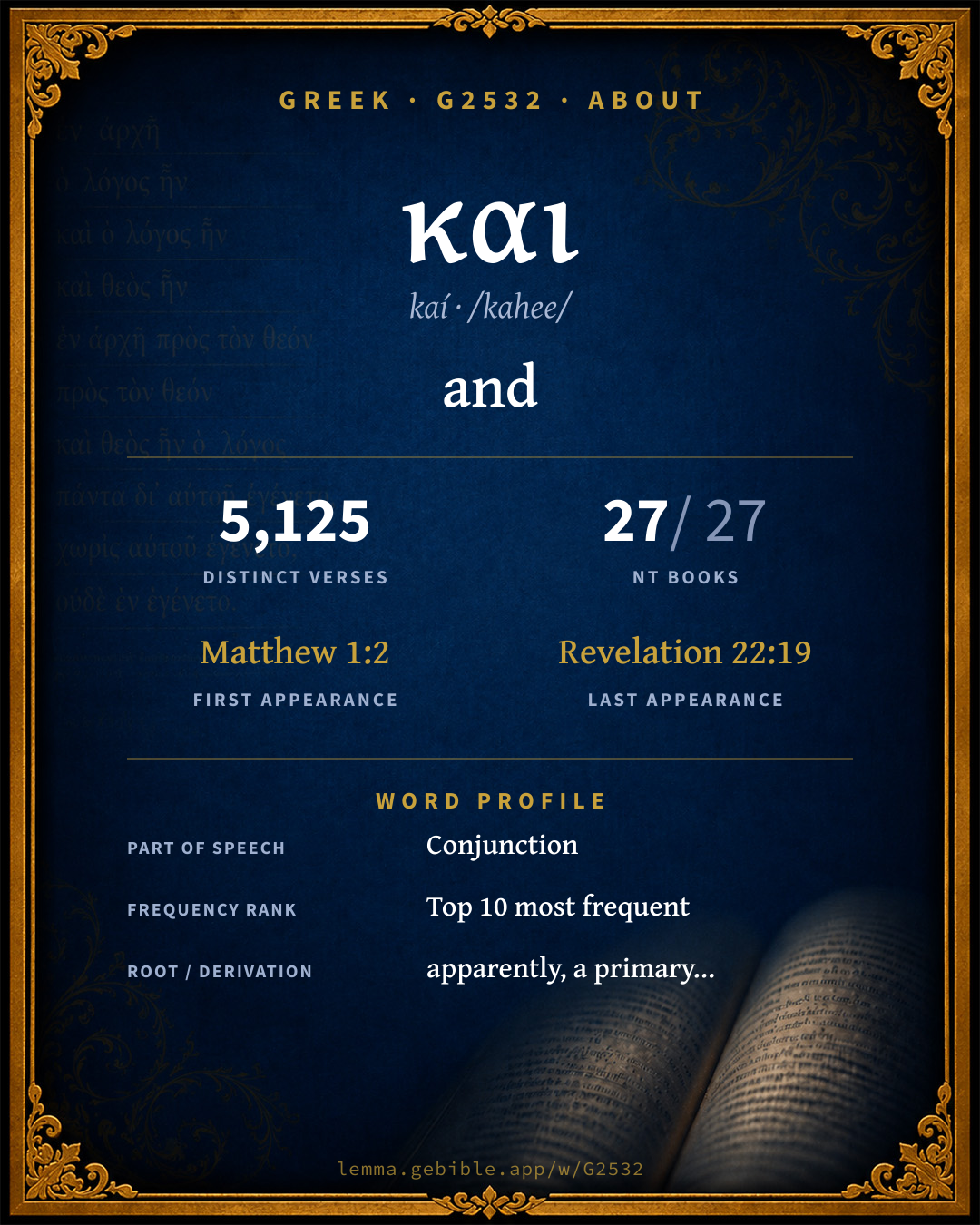
καί
and
Full lexicon entry — Thayer's Greek Lexicon
From Thayer's Greek Lexicon
Where this word appears
Grammar key — what these labels mean
Part of speech
- Conjunction
- A joining word linking words or clauses.
Page 5 of 26 — showing verses 801–1,000 of 5,125 distinct verses where G2532 appears, across 27 books. Click any verse to open its interlinear word-by-word view. Verse text shown in the World English Bible for context — . Each verse’s Greek form is shown with its reference; the English is not keyword-highlighted, since the data carries no word-level English alignment. Use “Compare translations” on any verse to read it across multiple English versions. This concordance covers the Greek New Testament; Septuagint (Greek Old Testament) occurrences of this word are not indexed here.
Mark 556 verses
- Mark 3:34 καὶ καὶ conj conj Looking around at those who sat around him, he said, "Behold, my mother and my brothers!
- Mark 3:35 καὶ καὶ conj conj For whoever does the will of God, the same is my brother, and my sister, and mother."
- Mark 4:1 Καὶ καὶ καὶ conj conj conj Again he began to teach by the seaside. A great multitude was gathered to him, so that he entered into a boat in the sea, and sat down. All the multitude were on the land by the sea.
- Mark 4:2 καὶ καὶ conj conj He taught them many things in parables, and told them in his teaching,
- Mark 4:4 καὶ καὶ καὶ conj conj conj and it happened, as he sowed, some seed fell by the road, and the birds came and devoured it.
- Mark 4:5 καὶ καὶ conj conj Others fell on the rocky ground, where it had little soil, and immediately it sprang up, because it had no depth of soil.
- Mark 4:6 καὶ καὶ conj conj When the sun had risen, it was scorched; and because it had no root, it withered away.
- Mark 4:7 καὶ καὶ καὶ καὶ conj conj conj conj Others fell among the thorns, and the thorns grew up, and choked it, and it yielded no fruit.
- Mark 4:8 καὶ καὶ καὶ καὶ καὶ καὶ conj conj conj conj conj conj Others fell into the good ground, and yielded fruit, growing up and increasing. Some brought forth thirty times, some sixty times, and some one hundred times as much."
- Mark 4:9 καὶ conj He said, "Whoever has ears to hear, let him hear."
- Mark 4:10 Καὶ conj When he was alone, those who were around him with the twelve asked him about the parables.
- Mark 4:11 καὶ conj He said to them, "To you is given the mystery of the Kingdom of God, but to those who are outside, all things are done in parables,
- Mark 4:12 καὶ καὶ καὶ καὶ conj conj conj conj that 'seeing they may see, and not perceive; and hearing they may hear, and not understand; lest perhaps they should turn again, and their sins should be forgiven them.'"
- Mark 4:13 καὶ καὶ conj conj He said to them, "Don't you understand this parable? How will you understand all of the parables?
- Mark 4:15 καὶ καὶ conj conj These are the ones by the road, where the word is sown; and when they have heard, immediately Satan comes, and takes away the word which has been sown in them.
- Mark 4:16 καὶ conj These in like manner are those who are sown on the rocky places, who, when they have heard the word, immediately receive it with joy.
- Mark 4:17 καὶ conj They have no root in themselves, but are short-lived. When oppression or persecution arises because of the word, immediately they stumble.
- Mark 4:18 καὶ conj Others are those who are sown among the thorns. These are those who have heard the word,
- Mark 4:19 καὶ καὶ καὶ καὶ conj conj conj conj and the cares of this age, and the deceitfulness of riches, and the lusts of other things entering in choke the word, and it becomes unfruitful.
- Mark 4:20 καὶ καὶ καὶ καὶ καὶ conj conj conj conj conj These are those which were sown on the good ground: such as hear the word, and accept it, and bear fruit, some thirty times, some sixty times, and some one hundred times."
- Mark 4:21 Καὶ conj He said to them, "Is the lamp brought to be put under a basket or under a bed? Isn't it put on a lampstand?
- Mark 4:24 Καὶ καὶ conj conj He said to them, "Take heed what you hear. With whatever measure you measure, it will be measured to you, and more will be given to you who hear.
- Mark 4:25 καὶ καὶ conj conj For whoever has, to him will more be given, and he who doesn't have, from him will be taken away even that which he has."
- Mark 4:26 Καὶ conj He said, "The Kingdom of God is as if a man should cast seed on the earth,
- Mark 4:27 καὶ καὶ καὶ καὶ καὶ conj conj conj conj conj and should sleep and rise night and day, and the seed should spring up and grow, he doesn't know how.
- Mark 4:30 Καὶ conj He said, "How will we liken the Kingdom of God? Or with what parable will we illustrate it?
- Mark 4:32 καὶ καὶ καὶ conj conj conj yet when it is sown, grows up, and becomes greater than all the herbs, and puts out great branches, so that the birds of the sky can lodge under its shadow."
- Mark 4:33 Καὶ conj With many such parables he spoke the word to them, as they were able to hear it.
- Mark 4:35 Καὶ conj On that day, when evening had come, he said to them, "Let's go over to the other side."
- Mark 4:36 καὶ καὶ conj conj Leaving the multitude, they took him with them, even as he was, in the boat. Other small boats were also with him.
- Mark 4:37 καὶ καὶ conj conj There arose a great wind storm, and the waves beat into the boat, so much that the boat was already filled.
- Mark 4:38 καὶ καὶ καὶ conj conj conj He himself was in the stern, asleep on the cushion, and they woke him up, and told him, "Teacher, don't you care that we are dying?"
- Mark 4:39 καὶ καὶ καὶ καὶ conj conj conj conj He awoke, and rebuked the wind, and said to the sea, "Peace! Be still!" The wind ceased, and there was a great calm.
- Mark 4:40 καὶ conj He said to them, "Why are you so afraid? How is it that you have no faith?"
- Mark 4:41 καὶ καὶ καὶ καὶ conj conj conj conj They were greatly afraid, and said to one another, "Who then is this, that even the wind and the sea obey him?"
- Mark 5:1 Καὶ conj They came to the other side of the sea, into the country of the Gadarenes.
- Mark 5:2 καὶ conj When he had come out of the boat, immediately there met him out of the tombs a man with an unclean spirit,
- Mark 5:3 καὶ conj who had his dwelling in the tombs. Nobody could bind him any more, not even with chains,
- Mark 5:4 καὶ καὶ καὶ καὶ conj conj conj conj because he had been often bound with fetters and chains, and the chains had been torn apart by him, and the fetters broken in pieces. Nobody had the strength to tame him.
- Mark 5:5 καὶ καὶ καὶ καὶ conj conj conj conj Always, night and day, in the tombs and in the mountains, he was crying out, and cutting himself with stones.
- Mark 5:6 καὶ καὶ conj conj When he saw Jesus from afar, he ran and bowed down to him,
- Mark 5:7 καὶ καὶ conj conj and crying out with a loud voice, he said, "What have I to do with you, Jesus, you Son of the Most High God? I adjure you by God, don't torment me."
- Mark 5:9 καὶ καὶ conj conj He asked him, "What is your name?" He said to him, "My name is Legion, for we are many."
- Mark 5:10 καὶ conj He begged him much that he would not send them away out of the country.
- Mark 5:12 καὶ conj All the demons begged him, saying, "Send us into the pigs, that we may enter into them."
- Mark 5:13 καὶ καὶ καὶ καὶ conj conj conj conj At once Jesus gave them permission. The unclean spirits came out and entered into the pigs. The herd of about two thousand rushed down the steep bank into the sea, and they were drowned in the sea.
- Mark 5:14 καὶ καὶ καὶ καὶ conj conj conj conj Those who fed them fled, and told it in the city and in the country. The people came to see what it was that had happened.
- Mark 5:15 καὶ καὶ καὶ καὶ conj conj conj conj They came to Jesus, and saw him who had been possessed by demons sitting, clothed, and in his right mind, even him who had the legion; and they were afraid.
- Mark 5:16 καὶ καὶ conj conj Those who saw it declared to them how it happened to him who was possessed by demons, and about the pigs.
- Mark 5:17 καὶ conj They began to beg him to depart from their region.
- Mark 5:18 καὶ conj As he was entering into the boat, he who had been possessed by demons begged him that he might be with him.
- Mark 5:19 καὶ καὶ καὶ conj conj conj He didn't allow him, but said to him, "Go to your house, to your friends, and tell them what great things the Lord has done for you, and how he had mercy on you."
- Mark 5:20 καὶ καὶ καὶ conj conj conj He went his way, and began to proclaim in Decapolis how Jesus had done great things for him, and everyone marveled.
- Mark 5:21 Καὶ καὶ conj conj When Jesus had crossed back over in the boat to the other side, a great multitude was gathered to him; and he was by the sea.
- Mark 5:22 καὶ καὶ conj conj Behold, one of the rulers of the synagogue, Jairus by name, came; and seeing him, he fell at his feet,
- Mark 5:23 καὶ καὶ conj conj and begged him much, saying, "My little daughter is at the point of death. Please come and lay your hands on her, that she may be made healthy, and live."
- Mark 5:24 καὶ καὶ καὶ conj conj conj He went with him, and a great multitude followed him, and they pressed upon him on all sides.
- Mark 5:25 καὶ conj A certain woman, who had an issue of blood for twelve years,
- Mark 5:26 καὶ καὶ καὶ conj conj conj and had suffered many things by many physicians, and had spent all that she had, and was no better, but rather grew worse,
- Mark 5:29 καὶ καὶ conj conj Immediately the flow of her blood was dried up, and she felt in her body that she was healed of her affliction.
- Mark 5:30 καὶ conj Immediately Jesus, perceiving in himself that the power had gone out from him, turned around in the crowd, and asked, "Who touched my clothes?"
- Mark 5:31 καὶ καὶ conj conj His disciples said to him, "You see the multitude pressing against you, and you say, 'Who touched me?'"
- Mark 5:32 καὶ conj He looked around to see her who had done this thing.
- Mark 5:33 καὶ καὶ καὶ conj conj conj But the woman, fearing and trembling, knowing what had been done to her, came and fell down before him, and told him all the truth.
- Mark 5:34 καὶ conj He said to her, "Daughter, your faith has made you well. Go in peace, and be cured of your disease."
- Mark 5:37 καὶ καὶ καὶ conj conj conj He allowed no one to follow him, except Peter, James, and John the brother of James.
- Mark 5:38 καὶ καὶ καὶ καὶ conj conj conj conj He came to the synagogue ruler's house, and he saw an uproar, weeping, and great wailing.
- Mark 5:39 καὶ καὶ conj conj When he had entered in, he said to them, "Why do you make an uproar and weep? The child is not dead, but is asleep."
- Mark 5:40 καὶ καὶ καὶ καὶ conj conj conj conj They ridiculed him. But he, having put them all out, took the father of the child and her mother and those who were with him, and went in where the child was lying.
- Mark 5:41 καὶ conj Taking the child by the hand, he said to her, "Talitha cumi;" which means, being interpreted, "Girl, I tell you, get up."
- Mark 5:42 καὶ καὶ καὶ conj conj conj Immediately the girl rose up, and walked, for she was twelve years old. They were amazed with great amazement.
- Mark 5:43 καὶ καὶ conj conj He strictly ordered them that no one should know this, and commanded that something should be given to her to eat.
- Mark 6:1 Καὶ καὶ καὶ conj conj conj He went out from there. He came into his own country, and his disciples followed him.
- Mark 6:2 καὶ καὶ καὶ καὶ conj conj conj conj When the Sabbath had come, he began to teach in the synagogue, and many hearing him were astonished, saying, "Where did this man get these things?" and, "What is the wisdom that is given to this man, that such mighty works come about by his hands?
- Mark 6:3 καὶ καὶ καὶ καὶ καὶ καὶ conj conj conj conj conj conj Isn't this the carpenter, the son of Mary, and brother of James, Joses, Judas, and Simon? Aren't his sisters here with us?" They were offended at him.
- Mark 6:4 καὶ καὶ καὶ conj conj conj Jesus said to them, "A prophet is not without honor, except in his own country, and among his own relatives, and in his own house."
- Mark 6:5 καὶ conj He could do no mighty work there, except that he laid his hands on a few sick people, and healed them.
- Mark 6:6 καὶ Καὶ conj conj He marveled because of their unbelief. He went around the villages teaching.
- Mark 6:7 Καὶ καὶ καὶ conj conj conj He called to himself the twelve, and began to send them out two by two; and he gave them authority over the unclean spirits.
- Mark 6:8 καὶ conj He charged them that they should take nothing for their journey, except a staff only: no bread, no wallet, no money in their purse,
- Mark 6:9 καὶ conj but to wear sandals, and not put on two tunics.
- Mark 6:10 καὶ conj He said to them, "Wherever you enter into a house, stay there until you depart from there.
- Mark 6:11 καὶ conj Whoever will not receive you nor hear you, as you depart from there, shake off the dust that is under your feet for a testimony against them. Assuredly, I tell you, it will be more tolerable for Sodom and Gomorrah in the day of judgment than for that city!"
- Mark 6:12 καὶ conj They went out and preached that people should repent.
- Mark 6:13 καὶ καὶ καὶ conj conj conj They cast out many demons, and anointed many with oil who were sick, and healed them.
- Mark 6:14 Καὶ καὶ καὶ conj conj conj King Herod heard this, for his name had become known, and he said, "John the Baptizer has risen from the dead, and therefore these powers are at work in him."
- Mark 6:17 καὶ conj For Herod himself had sent out and arrested John, and bound him in prison for the sake of Herodias, his brother Philip's wife, for he had married her.
- Mark 6:19 καὶ καὶ conj conj Herodias set herself against him, and desired to kill him, but she couldn't,
- Mark 6:20 καὶ καὶ καὶ καὶ conj conj conj conj for Herod feared John, knowing that he was a righteous and holy man, and kept him safe. When he heard him, he did many things, and he heard him gladly.
- Mark 6:21 καὶ καὶ καὶ conj conj conj Then a convenient day came, that Herod on his birthday made a supper for his nobles, the high officers, and the chief men of Galilee.
- Mark 6:22 καὶ καὶ καὶ καὶ conj conj conj conj When the daughter of Herodias herself came in and danced, she pleased Herod and those sitting with him. The king said to the young lady, "Ask me whatever you want, and I will give it to you."
- Mark 6:23 καὶ conj He swore to her, "Whatever you shall ask of me, I will give you, up to half of my kingdom."
- Mark 6:24 καὶ conj She went out, and said to her mother, "What shall I ask?" She said, "The head of John the Baptizer."
- Mark 6:25 καὶ conj She came in immediately with haste to the king, and asked, "I want you to give me right now the head of John the Baptizer on a platter."
- Mark 6:26 καὶ καὶ conj conj The king was exceedingly sorry, but for the sake of his oaths, and of his dinner guests, he didn't wish to refuse her.
- Mark 6:27 καὶ conj Immediately the king sent out a soldier of his guard, and commanded to bring John's head, and he went and beheaded him in the prison,
- Mark 6:28 καὶ καὶ καὶ καὶ conj conj conj conj and brought his head on a platter, and gave it to the young lady; and the young lady gave it to her mother.
- Mark 6:29 καὶ καὶ καὶ conj conj conj When his disciples heard this, they came and took up his corpse, and laid it in a tomb.
- Mark 6:30 Καὶ καὶ καὶ conj conj conj The apostles gathered themselves together to Jesus, and they told him all things, whatever they had done, and whatever they had taught.
- Mark 6:31 καὶ καὶ καὶ καὶ conj conj conj conj He said to them, "You come apart into a deserted place, and rest awhile." For there were many coming and going, and they had no leisure so much as to eat.
- Mark 6:32 καὶ conj They went away in the boat to a desert place by themselves.
- Mark 6:33 καὶ καὶ καὶ καὶ conj conj conj conj They saw them going, and many recognized him and ran there on foot from all the cities. They arrived before them and came together to him.
- Mark 6:34 Καὶ καὶ καὶ conj conj conj Jesus came out, saw a great multitude, and he had compassion on them, because they were like sheep without a shepherd, and he began to teach them many things.
- Mark 6:35 καὶ καὶ conj conj When it was late in the day, his disciples came to him, and said, "This place is deserted, and it is late in the day.
- Mark 6:36 καὶ conj Send them away, that they may go into the surrounding country and villages, and buy themselves bread, for they have nothing to eat."
- Mark 6:37 καὶ καὶ conj conj But he answered them, "You give them something to eat." They asked him, "Shall we go and buy two hundred denarii worth of bread, and give them something to eat?"
- Mark 6:38 καὶ καὶ conj conj He said to them, "How many loaves do you have? Go see." When they knew, they said, "Five, and two fish."
- Mark 6:39 καὶ conj He commanded them that everyone should sit down in groups on the green grass.
- Mark 6:40 καὶ καὶ conj conj They sat down in ranks, by hundreds and by fifties.
- Mark 6:41 καὶ καὶ καὶ καὶ καὶ conj conj conj conj conj He took the five loaves and the two fish, and looking up to heaven, he blessed and broke the loaves, and he gave to his disciples to set before them, and he divided the two fish among them all.
- Mark 6:42 καὶ καὶ conj conj They all ate, and were filled.
- Mark 6:43 καὶ καὶ conj conj They took up twelve baskets full of broken pieces and also of the fish.
- Mark 6:44 καὶ conj Those who ate the loaves were five thousand men.
- Mark 6:45 Καὶ καὶ conj conj Immediately he made his disciples get into the boat, and to go ahead to the other side, to Bethsaida, while he himself sent the multitude away.
- Mark 6:46 καὶ conj After he had taken leave of them, he went up the mountain to pray.
- Mark 6:47 καὶ καὶ conj conj When evening had come, the boat was in the midst of the sea, and he was alone on the land.
- Mark 6:48 καὶ καὶ conj conj Seeing them distressed in rowing, for the wind was contrary to them, about the fourth watch of the night he came to them, walking on the sea, and he would have passed by them,
- Mark 6:49 καὶ conj but they, when they saw him walking on the sea, supposed that it was a ghost, and cried out;
- Mark 6:50 καὶ καὶ conj conj for they all saw him, and were troubled. But he immediately spoke with them, and said to them, "Cheer up! It is I! Don't be afraid."
- Mark 6:51 καὶ καὶ καὶ conj conj conj He got into the boat with them; and the wind ceased, and they were very amazed among themselves, and marveled;
- Mark 6:53 Καὶ καὶ conj conj When they had crossed over, they came to land at Gennesaret, and moored to the shore.
- Mark 6:54 καὶ conj When they had come out of the boat, immediately the people recognized him,
- Mark 6:55 καὶ conj and ran around that whole region, and began to bring those who were sick, on their mats, to where they heard he was.
- Mark 6:56 καὶ καὶ καὶ conj conj conj Wherever he entered, into villages, or into cities, or into the country, they laid the sick in the marketplaces, and begged him that they might touch just the fringe of his garment; and as many as touched him were made well.
- Mark 7:1 Καὶ καί conj conj Then the Pharisees, and some of the scribes gathered together to him, having come from Jerusalem.
- Mark 7:2 καὶ conj Now when they saw some of his disciples eating bread with defiled, that is, unwashed, hands, they found fault.
- Mark 7:3 καὶ conj (For the Pharisees, and all the Jews, don't eat unless they wash their hands and forearms, holding to the tradition of the elders.
- Mark 7:4 καὶ καὶ καὶ καὶ conj conj conj conj They don't eat when they come from the marketplace, unless they bathe themselves, and there are many other things, which they have received to hold to: washings of cups, pitchers, bronze vessels, and couches.)
- Mark 7:5 καὶ καὶ conj conj The Pharisees and the scribes asked him, "Why don't your disciples walk according to the tradition of the elders, but eat their bread with unwashed hands?"
- Mark 7:9 καὶ conj He said to them, "Full well do you reject the commandment of God, that you may keep your tradition.
- Mark 7:10 καὶ καί conj conj For Moses said, 'Honor your father and your mother;' and, 'He who speaks evil of father or mother, let him be put to death.'
- Mark 7:13 καὶ conj making void the word of God by your tradition, which you have handed down. You do many things like this."
- Mark 7:14 καὶ καὶ conj conj He called all the multitude to himself, and said to them, "Hear me, all of you, and understand.
- Mark 7:17 Καὶ conj When he had entered into a house away from the multitude, his disciples asked him about the parable.
- Mark 7:18 καὶ καὶ conj conj He said to them, "Are you thus without understanding also? Don't you perceive that whatever goes into the man from outside can't defile him,
- Mark 7:19 καὶ conj because it doesn't go into his heart, but into his stomach, then into the latrine, thus making all foods clean?"
- Mark 7:23 καὶ conj All these evil things come from within, and defile the man."
- Mark 7:24 καὶ καὶ conj conj From there he arose, and went away into the borders of Tyre and Sidon. He entered into a house, and didn't want anyone to know it, but he couldn't escape notice.
- Mark 7:26 καὶ conj Now the woman was a Greek, a Syrophoenician by race. She begged him that he would cast the demon out of her daughter.
- Mark 7:27 καὶ καὶ conj conj But Jesus said to her, "Let the children be filled first, for it is not appropriate to take the children's bread and throw it to the dogs."
- Mark 7:28 καὶ καὶ conj conj But she answered him, "Yes, Lord. Yet even the dogs under the table eat the children's crumbs."
- Mark 7:29 καὶ conj He said to her, "For this saying, go your way. The demon has gone out of your daughter."
- Mark 7:30 καὶ καὶ conj conj She went away to her house, and found the child having been laid on the bed, with the demon gone out.
- Mark 7:31 Καὶ conj Again he departed from the borders of Tyre and Sidon, and came to the sea of Galilee, through the midst of the region of Decapolis.
- Mark 7:32 καὶ καὶ καὶ conj conj conj They brought to him one who was deaf and had an impediment in his speech. They begged him to lay his hand on him.
- Mark 7:33 καὶ καὶ conj conj He took him aside from the multitude, privately, and put his fingers into his ears, and he spat, and touched his tongue.
- Mark 7:34 καὶ καὶ conj conj Looking up to heaven, he sighed, and said to him, "Ephphatha!" that is, "Be opened!"
- Mark 7:35 καὶ καὶ καὶ conj conj conj Immediately his ears were opened, and the impediment of his tongue was released, and he spoke clearly.
- Mark 7:36 καὶ conj He commanded them that they should tell no one, but the more he commanded them, so much the more widely they proclaimed it.
- Mark 7:37 καὶ καὶ καὶ conj conj conj They were astonished beyond measure, saying, "He has done all things well. He makes even the deaf hear, and the mute speak!"
- Mark 8:1 καὶ conj In those days, when there was a very great multitude, and they had nothing to eat, Jesus called his disciples to himself, and said to them,
- Mark 8:2 καὶ conj "I have compassion on the multitude, because they have stayed with me now three days, and have nothing to eat.
- Mark 8:3 καὶ καί conj conj If I send them away fasting to their home, they will faint on the way, for some of them have come a long way."
- Mark 8:4 καὶ conj His disciples answered him, "From where could one satisfy these people with bread here in a deserted place?"
- Mark 8:5 καὶ conj He asked them, "How many loaves do you have?" They said, "Seven."
- Mark 8:6 καὶ καὶ καὶ καὶ conj conj conj conj He commanded the multitude to sit down on the ground, and he took the seven loaves. Having given thanks, he broke them, and gave them to his disciples to serve, and they served the multitude.
- Mark 8:7 καὶ καὶ conj conj They had a few small fish. Having blessed them, he said to serve these also.
- Mark 8:8 καὶ καὶ καὶ conj conj conj They ate, and were filled. They took up seven baskets of broken pieces that were left over.
- Mark 8:9 καὶ conj Those who had eaten were about four thousand. Then he sent them away.
- Mark 8:10 Καὶ conj Immediately he entered into the boat with his disciples, and came into the region of Dalmanutha.
- Mark 8:11 καὶ καὶ conj conj The Pharisees came out and began to question him, seeking from him a sign from heaven, and testing him.
- Mark 8:12 καὶ conj He sighed deeply in his spirit, and said, "Why does this generation seek a sign? Most assuredly I tell you, no sign will be given to this generation."
- Mark 8:13 καὶ conj He left them, and again entering into the boat, departed to the other side.
- Mark 8:14 Καὶ καὶ conj conj They forgot to take bread; and they didn't have more than one loaf in the boat with them.
- Mark 8:15 καὶ καὶ conj conj He charged them, saying, "Take heed: beware of the yeast of the Pharisees and the yeast of Herod."
- Mark 8:16 καὶ conj They reasoned with one another, saying, "It's because we have no bread."
- Mark 8:17 καὶ conj Jesus, perceiving it, said to them, "Why do you reason that it's because you have no bread? Don't you perceive yet, neither understand? Is your heart still hardened?
- Mark 8:18 καὶ καὶ conj conj Having eyes, don't you see? Having ears, don't you hear? Don't you remember?
- Mark 8:19 καὶ conj When I broke the five loaves among the five thousand, how many baskets full of broken pieces did you take up?" They told him, "Twelve."
- Mark 8:20 καὶ καὶ conj conj "When the seven loaves fed the four thousand, how many baskets full of broken pieces did you take up?" They told him, "Seven."
- Mark 8:21 καὶ conj He asked them, "Don't you understand, yet?"
- Mark 8:22 Καὶ καὶ καὶ conj conj conj He came to Bethsaida. They brought a blind man to him, and begged him to touch him.
- Mark 8:23 καὶ καὶ conj conj He took hold of the blind man by the hand, and brought him out of the village. When he had spit on his eyes, and laid his hands on him, he asked him if he saw anything.
- Mark 8:24 καὶ conj He looked up, and said, "I see men; for I see them like trees walking."
- Mark 8:25 καὶ καὶ καὶ conj conj conj Then again he laid his hands on his eyes. He looked intently, and was restored, and saw everyone clearly.
- Mark 8:26 καὶ conj He sent him away to his house, saying, "Don't enter into the village, nor tell anyone in the village."
- Mark 8:27 Καὶ καὶ καὶ conj conj conj Jesus went out, with his disciples, into the villages of Caesarea Philippi. On the way he asked his disciples, "Who do men say that I am?"
- Mark 8:28 καὶ conj They told him, "John the Baptizer, and others say Elijah, but others: one of the prophets."
- Mark 8:29 καὶ conj He said to them, "But who do you say that I am?" Peter answered, "You are the Christ."
- Mark 8:30 καὶ conj He charged them that they should tell no one about him.
- Mark 8:31 Καὶ καὶ καὶ καὶ καὶ καὶ conj conj conj conj conj conj He began to teach them that the Son of Man must suffer many things, and be rejected by the elders, the chief priests, and the scribes, and be killed, and after three days rise again.
- Mark 8:32 καὶ καὶ conj conj He spoke to them openly. Peter took him, and began to rebuke him.
- Mark 8:33 καὶ καὶ conj conj But he, turning around, and seeing his disciples, rebuked Peter, and said, "Get behind me, Satan! For you have in mind not the things of God, but the things of men."
- Mark 8:34 Καὶ καὶ καὶ conj conj conj He called the multitude to himself with his disciples, and said to them, "Whoever wants to come after me, let him deny himself, and take up his cross, and follow me.
- Mark 8:35 καὶ conj For whoever wants to save his life will lose it; and whoever will lose his life for my sake and the Gospel's will save it.
- Mark 8:36 καὶ conj For what does it profit a man, to gain the whole world, and forfeit his life?
- Mark 8:38 καὶ καὶ καὶ conj conj conj For whoever will be ashamed of me and of my words in this adulterous and sinful generation, the Son of Man also will be ashamed of him, when he comes in the glory of his Father with the holy angels."
- Mark 9:1 καὶ conj He said to them, "Most assuredly I tell you, there are some standing here who will in no way taste death until they see the Kingdom of God come with power."
- Mark 9:2 Καὶ καὶ καὶ καὶ καὶ conj conj conj conj conj After six days Jesus took with him Peter, James, and John, and brought them up onto a high mountain privately by themselves, and he was changed into another form in front of them.
- Mark 9:3 καὶ conj His clothing became glistening, exceedingly white, like snow, such as no launderer on earth can whiten them.
- Mark 9:4 καὶ καὶ conj conj Elijah and Moses appeared to them, and they were talking with Jesus.
- Mark 9:5 καὶ καὶ καὶ καὶ conj conj conj conj Peter answered Jesus, "Rabbi, it is good for us to be here. Let's make three tents: one for you, one for Moses, and one for Elijah."
- Mark 9:7 καὶ καὶ conj conj A cloud came, overshadowing them, and a voice came out of the cloud, "This is my beloved Son. Listen to him."
- Mark 9:8 καὶ conj Suddenly looking around, they saw no one with them any more, except Jesus only.
- Mark 9:9 Καὶ conj As they were coming down from the mountain, he charged them that they should tell no one what things they had seen, until after the Son of Man had risen from the dead.
- Mark 9:10 καὶ conj They kept this saying to themselves, questioning what the "rising from the dead" meant.
- Mark 9:11 καὶ καὶ conj conj They asked him, saying, "Why do the scribes say that Elijah must come first?"
- Mark 9:12 καὶ καὶ conj conj He said to them, "Elijah indeed comes first, and restores all things. How is it written about the Son of Man, that he should suffer many things and be despised?
- Mark 9:13 καὶ καὶ conj conj But I tell you that Elijah has come, and they have also done to him whatever they wanted to, even as it is written about him."
- Mark 9:14 Καὶ καὶ conj conj Coming to the disciples, he saw a great multitude around them, and scribes questioning them.
About this entry
At a glance — auto-summarized from this page’s data, not written by a person. Every figure links to its source below. This summary describes the numbers; it doesn’t interpret them.
At its core, και (kaí) means “and.” Scripture first uses it in Matthew 1:2. With 5,125 verses in 27 books, it is one of the most common word in the Greek New Testament. Sharing its root, it stands alongside καγω, καιγε and καιπερ. Each statement above links to its evidence; the full detail follows below.
Gloss history
Strong's 1890 vs modern scholarship

About this word
Strong's G2532 catalogs a Greek word from the Greek New Testament.
These counts are not copied from any lexicon or concordance. They are computed here, from the morphology-tagged Greek New Testament. What Lemma adds →
- 5,125
- distinct verses
- The word appears in 5,125 distinct verses.
- 27 / 27
- NT books
- The word appears in 27 of 27 New Testament books.
- #2
- by frequency
- Top 10 most frequent Greek words (rank 2 of 5,347 Greek words by occurrence).
View all 5,125 occurrences in the concordance →
By section of the New Testament
By traditional corpus
Conventional, traditional groupings — biblical authorship is debated, so this is a traditional corpus grouping, not an authorship claim. Some books belong to more than one corpus (Luke is in both the Gospels and the Lukan corpus, and so on), so these shares overlap and need not total 100%. Each figure is a share of the word’s 5,125 distinct verses.
- Gospels 2,619 verses · 51%
- Lukan (Luke–Acts) 1,489 verses · 29%
- Pauline corpus 1,026 verses · 20%
- Johannine 995 verses · 19%
- Revelation 370 verses · 7%
- General (Catholic) Epistles 277 verses · 5%
- Hebrews 173 verses · 3%
How translations render this word
Counts come from each version’s own published word-to-Strong’s tagging or interlinear alignment — an approximate guide to how each version renders this word, not a word-level alignment the data otherwise carries. Because each total is that version’s own tagged count, the per-version totals vary from one another and need not match the appearance or distinct-verse counts above. These counts may also differ from a printed concordance because Lemma counts each distinctly tagged rendering and does not collapse phrase taggings into a single head-word total. This is a fixed set of word-tagged versions (KJV, ASV, BSB, ULT) and does not change with the reading translation you choose elsewhere. Each version’s license is shown beside its name below (and on Sources).
- King James Version: And 8,097×, Also 500×, Even 101×
- American Standard Version: And 7,750×, Also 433×, Even 110×
- Berean Standard Bible: And 5,240×, Then 278×, Also 156×
- unfoldingWord Literal Text: And 7,949×, Also 596×, But 132×
King James Version Public Domain
Renders G2532 across 9,091 tagged occurrences — most commonly:
Plus other, less common renderings. Plus 72 renderings that appear only once — usually multi-word phrases or single function words the recovered tagging swept in, not distinct renderings. Not rendered by a distinct English word in 156 further occurrences.
American Standard Version Public Domain
Renders G2532 across 8,928 tagged occurrences — most commonly:
Plus other, less common renderings. Plus 227 renderings that appear only once — usually multi-word phrases or single function words the recovered tagging swept in, not distinct renderings. Not rendered by a distinct English word in 83 further occurrences.
Berean Standard Bible Public Domain
Renders G2532 across 6,415 tagged occurrences — most commonly:
Plus other, less common renderings. Plus 44 renderings that appear only once — usually multi-word phrases or single function words the recovered tagging swept in, not distinct renderings. Not rendered by a distinct English word in 2,467 further occurrences.
unfoldingWord Literal Text CC BY-SA 4.0
Renders G2532 across 9,016 tagged occurrences — most commonly:
Plus other, less common renderings. Plus 20 renderings that appear only once — usually multi-word phrases or single function words the recovered tagging swept in, not distinct renderings. Not rendered by a distinct English word in 3 further occurrences.
Senses in Thayer's
The 1 sense Thayer's distinguishes for this word, in lexicon order (not ranked by frequency or importance). The full entry — with sub-senses — is in the Lexicon Entry tab.
- and, also, even, indeed, but Frequency count based on 1894 Scrivener Greek New Testament.
Word origin
Origin: apparently, a primary particle, having a copulative and sometimes also a cumulative force
Apparently a primary particle having a copulative and sometimes also a cumulative force; and also even so then too etc.; often used in connection (or composition) with other particles or small words : - and also both but even for if indeed likewise moreover or so that then therefore when yea yet.
— Strong’s Exhaustive Concordance (1890), public domain.
Forms in the corpus
The 5 distinct written forms G2532 takes in the Greek New Testament, most frequent first — each parse links to that case’s occurrences in the concordance.
| Form | Parsing | Example | Uses |
|---|---|---|---|
| καὶ kaì | Conjunction | Matthew 1:2 | 8,661 |
| Καὶ Kaì | Conjunction | Matthew 4:21 | 274 |
| καί kaí | Conjunction | Matthew 15:4 | 29 |
| Καί Kaí | Conjunction | Luke 19:39 | 4 |
| και kai | Conjunction | John 7:53 | 1 |
Same root — word family
Other Thayer's entries built from the same root as G2532, grouped by Strong’s listed origin. These share a root / origin per the lexicon — not necessarily a shared meaning. Each links to that word’s own entry.
Derived from this word
- καγω kagṓ G2504 and I
- καιγε kaíge G2534 and indeed
- καιπερ kaíper G2539 although
- καιτοι kaítoi G2543 and yet
- κακει kakeî G2546 and there
- κακειθεν kakeîthen G2547 of place
- κακεινος kakeînos G2548 and he
- καν kán G2579 and if
Compare all same-root words → Showing 4 of 9 — not the complete family. They share a root, not necessarily a meaning.
Septuagint usage
The same Greek word και appears 47,643 times in the Greek Old Testament (Septuagint), across 18,587 verses in 38 books.
- 47,643
- LXX occurrences
- Tagged occurrences of this Greek word in the Septuagint.
- 18,587
- verses
- Distinct Septuagint verses containing this word.
- 38 / 39
- OT books
- The word appears in 38 of the 39 Old Testament books.
Sample Septuagint occurrences
- Genesis 1:1 καί
- Exodus 1:3 καί
- Leviticus 1:1 καί
- Numbers 1:1 καί
- Deuteronomy 1:1 καί
- Joshua 1:1 καί
- Judges 1:1 καί
- Ruth 1:1 καί
- 1 Samuel 1:1 καί
- 2 Samuel 1:1 καί
- 1 Kings 1:1 καί
- 2 Kings 1:1 καί
Septuagint occurrences (same lexeme)
Every verse where the same Strong’s number (G2532) appears in the Greek Septuagint — showing the first 50 of 18,587. Verse text shown in the World English Bible for context; the Greek form is the matched word — the English is not keyword-highlighted.
- Genesis 1:1 καί In the beginning God created the heavens and the earth.
- Genesis 1:2 καί Now the earth was formless and empty. Darkness was on the surface of the deep. God's Spirit was hovering over the surface of the waters.
- Genesis 1:3 καί God said, "Let there be light," and there was light.
- Genesis 1:4 καί God saw the light, and saw that it was good. God divided the light from the darkness.
- Genesis 1:5 καί God called the light Day, and the darkness he called Night. There was evening and there was morning, one day.
- Genesis 1:6 καί God said, "Let there be an expanse in the midst of the waters, and let it divide the waters from the waters."
- Genesis 1:7 καί God made the expanse, and divided the waters which were under the expanse from the waters which were above the expanse, and it was so.
- Genesis 1:8 καί God called the expanse sky. There was evening and there was morning, a second day.
- Genesis 1:9 καί God said, "Let the waters under the sky be gathered together to one place, and let the dry land appear," and it was so.
- Genesis 1:10 καί God called the dry land Earth, and the gathering together of the waters he called Seas. God saw that it was good.
- Genesis 1:11 καί God said, "Let the earth put forth grass, herbs yielding seed, and fruit trees bearing fruit after their kind, with its seed in it, on the earth," and it was so.
- Genesis 1:12 καί The earth brought forth grass, herbs yielding seed after their kind, and trees bearing fruit, with its seed in it, after their kind: and God saw that it was good.
- Genesis 1:13 καί There was evening and there was morning, a third day.
- Genesis 1:14 καί God said, "Let there be lights in the expanse of sky to divide the day from the night; and let them be for signs, and for seasons, and for days and years;
- Genesis 1:15 καί and let them be for lights in the expanse of sky to give light on the earth," and it was so.
- Genesis 1:16 καί God made the two great lights: the greater light to rule the day, and the lesser light to rule the night. He also made the stars.
- Genesis 1:17 καί God set them in the expanse of sky to give light to the earth,
- Genesis 1:18 καί and to rule over the day and over the night, and to divide the light from the darkness. God saw that it was good.
- Genesis 1:19 καί There was evening and there was morning, a fourth day.
- Genesis 1:20 καί God said, "Let the waters swarm with swarms of living creatures, and let birds fly above the earth in the open expanse of sky."
- Genesis 1:21 καί God created the large sea creatures, and every living creature that moves, with which the waters swarmed, after their kind, and every winged bird after its kind. God saw that it was good.
- Genesis 1:22 καί God blessed them, saying, "Be fruitful, and multiply, and fill the waters in the seas, and let birds multiply on the earth."
- Genesis 1:23 καί There was evening and there was morning, a fifth day.
- Genesis 1:24 καί God said, "Let the earth bring forth living creatures after their kind, cattle, creeping things, and animals of the earth after their kind," and it was so.
- Genesis 1:25 καί God made the animals of the earth after their kind, and the cattle after their kind, and everything that creeps on the ground after its kind. God saw that it was good.
- Genesis 1:26 καί God said, "Let us make man in our image, after our likeness: and let them have dominion over the fish of the sea, and over the birds of the sky, and over the cattle, and over all the earth, and over every creeping thing that creeps on the earth."
- Genesis 1:27 καί God created man in his own image. In God's image he created him; male and female he created them.
- Genesis 1:28 καί God blessed them. God said to them, "Be fruitful, multiply, fill the earth, and subdue it. Have dominion over the fish of the sea, over the birds of the sky, and over every living thing that moves on the earth."
- Genesis 1:29 καί God said, "Behold, I have given you every herb yielding seed, which is on the surface of all the earth, and every tree, which bears fruit yielding seed. It will be your food.
- Genesis 1:30 καί To every animal of the earth, and to every bird of the sky, and to everything that creeps on the earth, in which there is life, I have given every green herb for food." And it was so.
- Genesis 1:31 καί God saw everything that he had made, and, behold, it was very good. There was evening and there was morning, the sixth day.
- Genesis 2:1 καί The heavens and the earth were finished, and all the host of them.
- Genesis 2:2 καί On the seventh day God finished his work which he had made; and he rested on the seventh day from all his work which he had made.
- Genesis 2:3 καί God blessed the seventh day, and made it holy, because he rested in it from all his work which he had created and made.
- Genesis 2:4 καί This is the history of the generations of the heavens and of the earth when they were created, in the day that Yahweh God made earth and the heavens.
- Genesis 2:5 καί No plant of the field was yet in the earth, and no herb of the field had yet sprung up; for Yahweh God had not caused it to rain on the earth. There was not a man to till the ground,
- Genesis 2:6 καί but a mist went up from the earth, and watered the whole surface of the ground.
- Genesis 2:7 καί Yahweh God formed man from the dust of the ground, and breathed into his nostrils the breath of life; and man became a living soul.
- Genesis 2:8 καί Yahweh God planted a garden eastward, in Eden, and there he put the man whom he had formed.
- Genesis 2:9 καί Out of the ground Yahweh God made every tree to grow that is pleasant to the sight, and good for food; the tree of life also in the midst of the garden, and the tree of the knowledge of good and evil.
- Genesis 2:12 καί and the gold of that land is good. There is aromatic resin and the onyx stone.
- Genesis 2:13 καί The name of the second river is Gihon: the same river that flows through the whole land of Cush.
- Genesis 2:14 καί The name of the third river is Hiddekel: this is the one which flows in front of Assyria. The fourth river is the Euphrates.
- Genesis 2:15 καί Yahweh God took the man, and put him into the garden of Eden to dress it and to keep it.
- Genesis 2:16 καί Yahweh God commanded the man, saying, "Of every tree of the garden you may freely eat:
- Genesis 2:17 καί but of the tree of the knowledge of good and evil, you shall not eat of it: for in the day that you eat of it you will surely die."
- Genesis 2:18 καί Yahweh God said, "It is not good that the man should be alone; I will make him a helper suitable for him."
- Genesis 2:19 καί Out of the ground Yahweh God formed every animal of the field, and every bird of the sky, and brought them to the man to see what he would call them. Whatever the man called every living creature, that was its name.
- Genesis 2:20 καί The man gave names to all cattle, and to the birds of the sky, and to every animal of the field; but for man there was not found a helper suitable for him.
- Genesis 2:21 καί Yahweh God caused a deep sleep to fall on the man, and he slept; and he took one of his ribs, and closed up the flesh in its place.
These are occurrences of the same Greek lexeme (G2532) in the Septuagint — not a translation of any one Hebrew word. The store carries no word-level Hebrew↔Greek alignment, so no Hebrew original is asserted here. Counts come from the recovered LXX Strong's tagging — high-frequency vocabulary is well covered, while rare or late forms may be untagged — so they reflect tagged occurrences and may slightly undercount.