Mark 1:29

Greek (Tischendorf 8th ed.) Mark 1:29 appears in the Greek New Testament. The text above is from the Tischendorf 8th edition. Each word links to its Strong’s number and a concise gloss. Click any word for its full Thayer’s Greek Lexicon entry.
Download image
Cite this verse

Mark 1:29 (World English Bible). Public Domain. Lemma interlinear Bible study tool, https://lemma.gebible.app/v/mark/1/29.

Show BibTeX & RIS
BibTeX
RIS
English Translation
Immediately, when they had come out of the synagogue, they came into the house of Simon and Andrew, with James and John.
World English Bible · Public Domain
Download a study sheet

One document with this verse’s original text, its word-by-word gloss line, the meaning frame, cross-references with their text, attributed commentary, and full source and license credits — printable, and it pastes into notes with its structure intact.

This verse Autodidact and up

Study sheet (.html) Plain text (.txt)

A passage Seminary Student

Up to 50 verses in one chapter. A passage sheet keeps up to 6 commentary sources and 12 cross-references per verse, in the order this page ranks them, and says so on the sheet whenever that leaves anything out. Ask for a single verse and you get the Autodidact verse sheet above.

Everything on this page stays free to read, with no account — the sheet is a download of what is already on screen, not access to it.

Want to remove ads? Support Godless Engineer
Compare translations 3

The same verse in 3 English versions, stacked beneath the original-language interlinear above. Click any original word for its lexicon entry.

Each is an independent rendering of the whole verse — the interlinear is not word-aligned to these translations.

Highlighted words mark where these versions differ — a whole-verse word diff, not a word-by-word alignment.

  • World English Bible Public Domain
    Immediately, when they had come out of the synagogue, they came into the house of Simon and Andrew, with James and John.
  • King James Version Public Domain
    And forthwith, when they were come out of the synagogue, they entered into the house of Simon and Andrew, with James and John.
  • unfoldingWord Literal Text CC BY-SA 4.0
    And immediately, having come out from the synagogue, they came into the house of Simon and Andrew, along with James and John.

unfoldingWord Literal Text — © unfoldingWord, licensed CC BY-SA 4.0. Word-aligned USFM3 via Door43 (git.door43.org/unfoldingWord/en_ult).

Versions to compare (up to 4)

3 of 4 selected

Show all 19 translations

Every available English version of this verse, each an independent rendering of the whole verse.

  • World English Bible Public Domain
    Immediately, when they had come out of the synagogue, they came into the house of Simon and Andrew, with James and John.
  • Berean Standard Bible Public Domain
    As soon as Jesus and His companions had left the synagogue, they went with James and John to the home of Simon and Andrew.
  • Majority Standard Bible Public Domain
    As soon as Jesus and His companions had left the synagogue, they went with James and John to the home of Simon and Andrew.
  • King James Version Public Domain
    And forthwith, when they were come out of the synagogue, they entered into the house of Simon and Andrew, with James and John.
  • American Standard Version (1901) Public Domain
    And straightway, when they were come out of the synagogue, they came into the house of Simon and Andrew, with James and John.
  • Revised Version (1885) Public Domain
    And straightway, when they were come out of the synagogue, they came into the house of Simon and Andrew, with James and John.
  • Geneva Bible (1599) Public Domain
    And assoone as they were come out of the Synagogue, they entred into the house of Symon and Andrew, with Iames and Iohn.
  • Douay-Rheims (1899) Public Domain
    And immediately going out of the synagogue they came into the house of Simon and Andrew, with James and John.
  • Young's Literal Translation Public Domain
    And immediately, having come forth out of the synagogue, they went to the house of Simon and Andrew, with James and John,
  • Literal Standard Version CC BY-SA 4.0
    And immediately, having come forth out of the synagogue, they went into the house of Simon and Andrew, with James and John,
  • Unlocked Literal Bible CC BY-SA 4.0
    After coming out of the synagogue, they came into the house of Simon and Andrew, along with James and John.
  • unfoldingWord Literal Text CC BY-SA 4.0
    And immediately, having come out from the synagogue, they came into the house of Simon and Andrew, along with James and John.
  • Darby Bible Public Domain
    And straightway going out of the synagogue, they came with James and John into the house of Simon and Andrew.
  • World Messianic Bible Public Domain
    Immediately, when they had come out of the synagogue, they came into the house of Simon and Andrew, with Jacob and Yochanan.
  • Webster's Bible Public Domain
    And forthwith, when they had come out of the synagogue, they entered into the house of Simon and Andrew, with James and John.
  • Free Bible Version CC BY-SA 4.0
    Then they left the synagogue and went to the home of Simon and Andrew, along with James and John.
  • Bible in Basic English Public Domain
    And when they came out of the Synagogue, they went into the house of Simon and Andrew, with James and John.
  • Text-Critical English NT CC BY 4.0
    After leaving the synagogue, they immediately went to the house of Simon and Andrew, with James and John.
  • Tyndale New Testament (1534) Public Domain
    And forth with assone as they were come out of the synagoge they entred into the housse of Symon and Andrew with Iames and Ihon.

Literal Standard Version (2020), Covenant Press — licensed CC BY-SA 4.0. Text via the HelloAO Bible API (eBible.org). Unlocked Literal Bible (unfoldingWord) — licensed CC BY-SA 4.0. Text via the HelloAO Bible API (eBible.org). unfoldingWord Literal Text — © unfoldingWord, licensed CC BY-SA 4.0. Word-aligned USFM3 via Door43 (git.door43.org/unfoldingWord/en_ult). Free Bible Version, Dr. Jonathan Gallagher — licensed CC BY-SA 4.0. Text via the HelloAO Bible API (eBible.org).

Word by word

More ways to search: Search by grammar → Find every occurrence → Compare this word →

Practice this passage: Drill this verse → Learn its vocabulary →

Ἀνδρέου
Andréas
G406
“Andrew”
Noun, Genitive, Singular, Masculine
Part of Speech
Noun
Case
Genitive
Number
Singular
Gender
Masculine
Full Thayer's Definition

Origin: from G435

TDNT: None

Andrew = "manly" 1. A native of Bethsaida in Galilee, brother of Simon Peter, a disciple of John the Baptist, and afterwards an apostle of Christ. He is said to have been crucified at Patrae in Archaia.
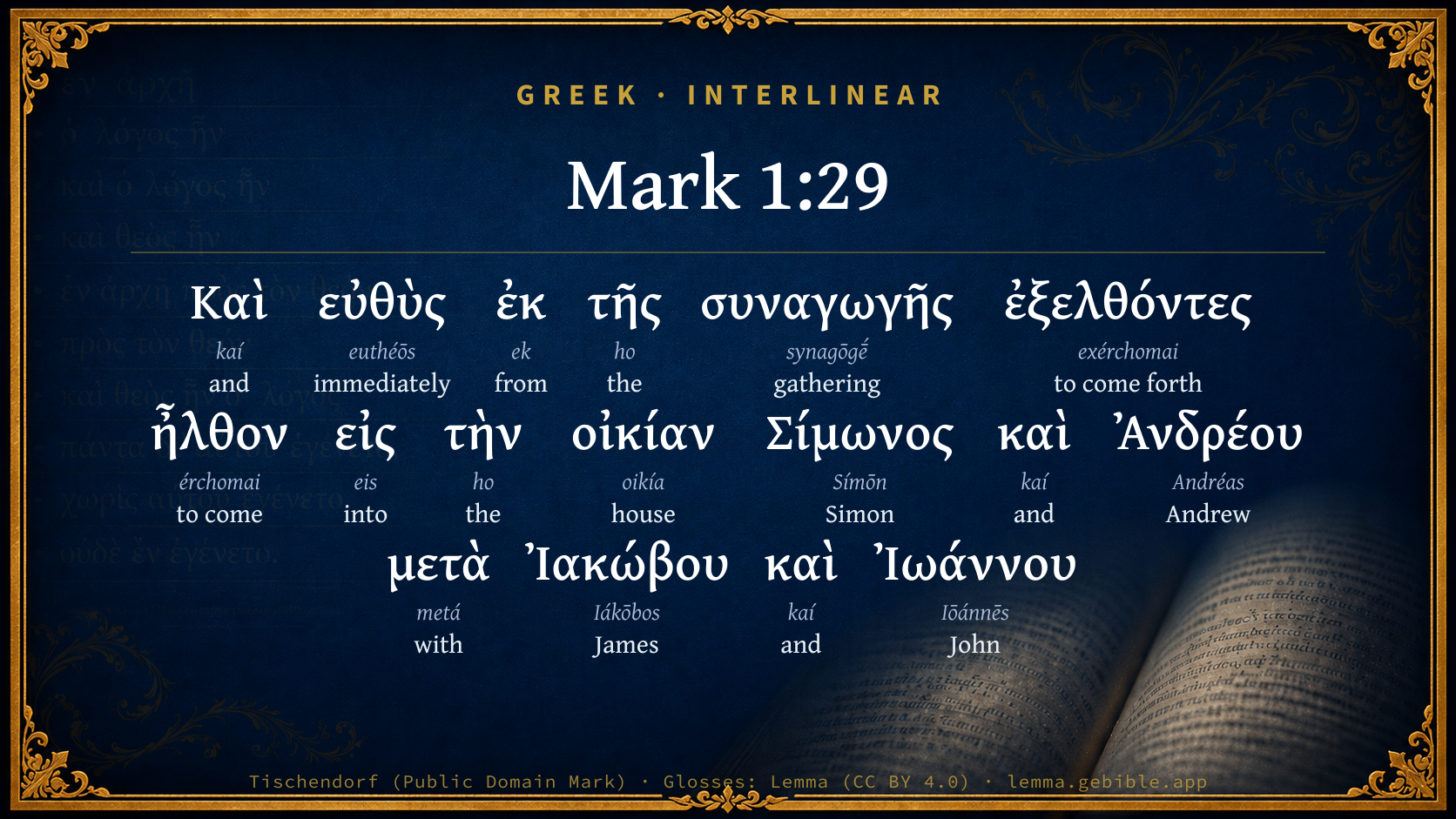
  1. Καὶ kaí G2532 “and” Conjunction
  2. εὐθὺς euthéōs G2112 “immediately” Adverb
  3. ἐκ ek G1537 “from” Preposition
  4. τῆς ho G3588 “the” Article, Genitive, Singular, Feminine
  5. συναγωγῆς synagōgḗ G4864 “gathering” Noun, Genitive, Singular, Feminine
  6. ἐξελθόντες exérchomai G1831 “to come forth” Verb, Aorist, Active, Participle, Nominative, Plural, Masculine
  7. ἦλθον érchomai G2064 “to come” Verb, Aorist, Active, Indicative, 3rd person, Plural
  8. εἰς eis G1519 “into” Preposition
  9. τὴν ho G3588 “the” Article, Accusative, Singular, Feminine
  10. οἰκίαν oikía G3614 “house” Noun, Accusative, Singular, Feminine
  11. Σίμωνος Símōn G4613 “Simon” Noun, Genitive, Singular, Masculine
  12. καὶ kaí G2532 “and” Conjunction
  13. μετὰ metá G3326 “with” Preposition
  14. Ἰακώβου Iákōbos G2385 “James” Noun, Genitive, Singular, Masculine
  15. καὶ kaí G2532 “and” Conjunction
  16. Ἰωάννου Iōánnēs G2491 “John” Noun, Genitive, Singular, Masculine

About this verse

These counts appear in no published source. They are computed here, from the morphology-tagged text and Lemma’s own curated glosses. What Lemma adds →

17
words
14
distinct lemmas
Gospels
section

Notable vocabulary

The rarest word here is Ἀνδρέου Andrew G406 — appearing just 13 times in the whole Greek New Testament.

Shared distinctive vocabulary

Ἀνδρέου Andrew G406 occurs in 12 verses of the Greek New Testament. Also found in:

Repetition

Words recur within this verse:

Cross-references

5

Topical passages linked to Mark 1:29 in the Treasury of Scripture Knowledge — connected by theme and wording, ordered by reader-vote popularity; previews shown in the World English Bible.

  • Matthew 8:14–15 When Jesus came into Peter's house, he saw his wife's mother lying sick with a fever.
  • Luke 4:38–39 He rose up from the synagogue, and entered into Simon's house. Simon's mother-in-law was afflicted with a great fever, and they begged him for her.
  • Mark 1:21 They went into Capernaum, and immediately on the Sabbath day he entered into the synagogue and taught.
  • Luke 9:58 Jesus said to him, "The foxes have holes, and the birds of the sky have nests, but the Son of Man has no place to lay his head."
  • Mark 1:23 Immediately there was in their synagogue a man with an unclean spirit, and he cried out,

Cross-references courtesy of OpenBible.info (CC BY 4.0).

Where the printed editions differ

1 variant

Places in this verse where the major printed Greek editions disagree on the wording in a way that affects the translation — a comparison of editions, not a manuscript-by-manuscript collation. The editions are the modern critical texts (Nestlé-Aland 28/27, SBL, Westcott-Hort, Tregelles, Tyndale House) and the traditional texts behind the KJV (the Textus Receptus and the Byzantine/Majority text). It is not a claim about which reading is original.

  1. Different wording
    ἐξελθόντες ἦλθον

    “they going out they came”

    In NA28NA27TynSBLWHTRByz Not in Treg

    ἐξελθὼν (exelthōn) 'he going out' occurs in a few manuscripts (Treg) instead of ἐξελθόντες (exelthontes) 'they going out' in older manuscripts (NA28+NA27+Tyn+SBL+WH+TR+Byz)

Textual data: Translators Amalgamated Greek New Testament (STEPBible TAGNT) · CC BY 4.0.

Commentary

Notes on Mark 1:29 from classic Christian and Jewish commentators (each source and its license shown beneath its notes). The classic Christian expositions comment on the surrounding passage and are grouped to its opening verse, so a note may address several verses; the Jewish commentaries on the Tanakh (Rashi and others) are per-verse, so they appear only where the commentator wrote on this verse.

Lemma curates 59 commentaries, every one of them public domain or Creative Commons licensed, each selected and text-cleaned for this edition rather than reprinted as found. About our sources →

The Biblical Illustrator

Joseph S. Exell

Mar_1:29-31

But Simons wifes mother lay sick of a fever.

Simons wife

The Lord chose as the first of His apostles a married man, and after his election to follow the Lord he did not separate from his wife, but the Lord honours the family by sometimes dwelling in their house. St. Paul implies (1Co_9:5) that at times, at least, she accompanied St. Peter in his journeys. It appears from a very touching account given by Clement of Alexandria, that they were living together when she was called to martyrdom. They say, accordingly, that Peter, on seeing his wife led to death, rejoiced on account of her call and conveyance home, and called very encouragingly and comfortingly, addressing her by name, Remember thou the Lord. Such was the marriage of the blessed, and their perfect disposition towards those dearest to them. (M. F. Sadler.)

Miracles are instructive emblems of Scriptural truth

Spiritual truth, to be clearly discerned, often needs to be embodied in the more significant language of action. Christs miracles are like mirrors-bringing within easy view objects hard to see or quite out of sight. The famous picture of Aurora by Guido adorns the ceiling of one of the palaces of Rome. The discomfort attending the effort to look up, for the length of time required to study its beauty, is so great, that one could not adequately estimate its merit if there were no other way of viewing it. But a mirror, set up in the room so as to reflect the picture, permits the beholder to view it at his leisure with perfect ease. So the great miracle of the renewing of the soul is above our inspection, but in the mirror miracles of Jesus we have reflections, helping us to the better understanding of that spiritual work. Thus we may gain more good from them, than was imparted to those for whose special benefit they were originally wrought. (A. H. Currier.)

The Great Physicians skill

We have-

I. A scene of domestic trouble.

1. Trouble is widespread and manifold.

2. Earthly kinships are sources both of joy and grief.

3. Domestic trouble should not detain us from Gods house.

II. An application for belief-Anon they tell Him of her.

1. It was intercessory prayer.

2. We admire the simplicity of their request.

3. Nor should we overlook their promptness of suit.

III. Gracious interposition.

1. Here is a nearer approach, Though Christ has come near to us He can come nearer yet.

2. Jesus Christ does not refrain from personal contact.

3. Christs gracious touch elevates prostrate humanity-He lifted her up.

IV. Grateful recompense-She ministered unto them.

1. The recipient of Christs grace exhibits gratitude in a practical form.

2. Unconsciously she performed good service for others.

3. Jesus Christ stoops to accept service from all.

V. Christs healing virtue brings to light societys manifold sores.

1. The life of men is also their light. Jesus revealed to men, and to society, their needs. Probably no one knew that there was a demoniac in the synagogue, until Jesus began to teach. Men hide their deeper needs even from themselves, until the Healer comes.

2. Mens minds naturally reason from the special to the general.

3. We must observe how tolerant Christ is of human prejudices and traditional habits. The inhabitants of Capernaum would not bring their sick until the sun had set, i.e., until the Sabbath had closed. Towards human ignorance He is inexpressibly pitiful.

4. The rewards of faithful service are larger service yet. Jesus had blessed a man, a family; now He is required to bless a city. So shall it be in heaven. Fidelity shall be honoured by more responsible service-Be thou ruler over ten cities.

VI. The manifold needs of man disclose the hidden glory of Christ.

VII. Christ is the hope of humanity, but the terror of demons. The whole city was gathered to Him at the door. Men are more conscious of bodily evils, than of soul malady. But the goodness that attracts men, repels demons. (D. Davies, M. A.)

Jesus as Healer

Note-

I. The variety of the cases of healing. Fever. Divers diseases, demoniacal possession. Leprosy. Christ had no specialty; His resources were varied; He can touch all classes of human need.

II. How healing was effected by personal contact-Took her by the hand. Put forth His hand and touched him.

III. How rapidly the patients were healed-immediately. Ordinarily healing travels slowly; here as if by lightning. So in matters spiritual.

IV. How manifest was the reality of the healing. Peters mother-in-law ministered. Work of Christ in man always seen in its effects. Saul (Gal_1:23). (H. Thorne.)

A domestic drama

I. What the friends of the sick woman rid.

1. They told Jesus of her. Worth while to be sick to be brought to Him.

2. Anon they told Him of her, i.e., at once.

3. They told Him of her. Often what is everybodys business is nobodys.

4. They told Him of her. Prayer is telling Jesus.

II. What Jesus did.

1. He came: at once, but not always at once, for good reasons.

2. He took her by the hand. Without ceremony: familiarly.

3. He lifted her up. Gospel always raises.

4. He healed her immediately. Pardon instantly ours when we grasp Christs hand.

III. What the restored woman did. Ministered. We are saved to work: by precept and example. (J. S. Swan.)

The religious uses of time

I. Social service (Mar_1:31).

II. Public ministry (Mar_1:32-34).

III. Private devotion (Mar_1:35). (J. Parker, D. D.)

Christs public and private ministry

Jesus had a public ministry in the synagogue; a private ministry in the domestic circle.

I. The individual case as well as that of the multitudes should receive attention.

II. Bodily diseases as well as spiritual ailments are within the sphere of our solicitude.

III. We are to put ourselves in personal contact with the suffering. We can do little by proxy.

IV. We should never leave a house without leaving a blessing behind.

V. Our visits, like the masters, should not be mere visits of courtesy. (J. Parker, D. D.)

Simons wifes mother

If Peter was the first Pope, he set them an example in this respect which all the popes and all the clergy would have been wise to follow. Nature never injures grace. It is not desirable to be without parents in our youth, or without wife or husband in our mature life. The love of another heart is not only a quiet resting place, but a great aid to goodness; and he who loves well wife or child wilt love God better for doing so. (R. Glover.)

Simons wifes mother

I. Let us ascertain what it teaches concerning this noted apostle, Simon Peter. Marriage is honourable in all, Let every man have his own wife, and let every woman have her own husband.

II. What do we know of this woman who was cured? But there is something to be said concerning the wife herself, and this is of special importance. There is reason to believe that she remained a most faithful companion and fellow worker with Peter, whom Paul always calls Cephas, down to the end of her life. For in one of Pauls epistles an allusion is made to her: he says, Have we not power to lead about a sister, a wife, as well as other apostles, and as the brethren of the Lord, and Cephas? This was written more than twenty years after Christs resurrection, when Peter was an old man. As a comment upon the verse, Clement of Alexandria adds: Peter and Philip had children, and both took about their Wives, in order that they might act as their assistants in ministering to women at their own homes; by their means the doctrine of the Lord penetrated without scandal into the privacy of the womens apartments.

III. What do we know about the other members of this apostles family? There is a beautiful little legend, altogether uninspired, which is found in the history of sacred and legendary art; there is nothing to prevent its being true, and it is certainly worth telling. The story relates that Peter had a lovely daughter, born in lawful wedlock, who accompanied him in his journey from the East. At Rome she fell sick of a grievous infirmity which deprived her of the use of her limbs. One of Simons disciples sitting at meat with him said: Master, how is it that thou, who healest the infirmities of others, dost not heal thy daughter Petronilla? It is good for her to remain sick, replied her father, perhaps thinking of the profitable discipline which the pain might bring to her. But that they all might see the power that was in the word of God, he commanded her to get up and serve them at table-which she did. Then afterwards, praying fervently, the maiden was permanently healed.

IV. It is refreshing to turn from the mere poetry of a legend to the serene majesty of history. And now there is a lesson in almost every particular.

1. Was this woman sick of a great fever? Then we see how Christ is the only help, but always the sure help, in desperate cases. He is able to save bodies and souls to the uttermost.

2. Did the disciples go and tell Jesus of her? Then we may note the advantage of faith in the Divine and sovereign Saviour. None but Jesus can do helpless sinners good.

3. Are we told that those home friends besought the Lord in her behalf? Then we learn how necessary is fervent prayer. For all these things will I be inquired of by the house of Israel.

4. Did our Saviour touch this womans hand, and touch it only, for her cure? Then observe how delicate is the ministration of Divine grace in the gospel, and let us be gentle with souls.

5. Was it the interposition of other people which availed to bring this sick creature to health? Then how fine is the office of human means and instruments with God. There is really a glorious share in the work of saving souls which He permits.

6. Do we notice that this woman was also lifted up by Jesus? The miracle is a parable; God never lays a commandment on any soul which He does not aid that soul in performing for Him.

7. Did the cured woman rise at once to begin her grateful service? It is by that we know her healing was perfectly done. The good Lord never leaves body or soul half-delivered from ill.

8. Was Simons wifes mother satisfied to minister to Jesus Christ right off and right there? Then think how much valuable time some impatient people waste in trying to find a field of work for Christ, when most likely the best task lies nearest at hand. This woman entered the ministry just as truly as Simon Peter did: he preached, and she served; that was ministry.

9. Were these wonderful privileges misused and perverted by Capernaum? Then let all the world know and remember that it is preeminently a dangerous thing to do, this disregard of the merciful manifestations of the Divine presence among men. (C. S. Robinson, D. D.)

Peters mother-in-law cured

I. The sufferer.

II. Her complaint.

III. Her cure.

1. That there was no parade.

2. There was no delay.

3. There was no ground for doubting its reality. (Expository Outlines.)

The best house visitation

I. How grace came to Peters house.

II. What it did in Peters house.

III. How it flowed forth from Peters house. (C. H. Spurgeon.)

Wherever Christ comes, He comes to do good, and will be sure to pay richly for His entertainment. (M. Henry.)

Domestic affliction healed by Christ

I. The scene of this domestic affliction.

1. The home of a disciple.

2. The house visited by Christ.

II. The healing of this domestic affliction.

1. It was done tenderly.

2. It was done immediately.

3. It was done easily.

4. It was done effectually.

III. The healing was followed by ministration.

1. It was prompted by the glad impulse of her new strength.

2. It was obligated by a remembrance of her Benefactor.

3. It was required by her relatives.

4. It was not avoided by unreal excuses.

Lessons:

1. Cultivate in your homes the feeling of discipleship toward Christ.

2. Seek Christ as a constant Visitor to your home.

3. Tell Christ of all your domestic sorrows.

4. Let His healing touch be immediately followed by your active ministration. (Joseph S. Exell, M. A.)

Mutual benefits

The afflicted should receive sympathy and succour, and return kindness and help. (J. H. Godwin.)

Instant healing from Christ

By His touch He restored her immediately to health and strength. This no human physician could have done. After a fever a long convalescence ensues before health returns. But in the case of Christs miracles, it was with diseases as with the sea. After a storm there is a swell, before the sea sinks into a calm. But Christ reduced the fury of the sea by a word to perfect calm, as He did the rage of the fever to perfect health. She arose and was ministering to Him, thus proving the cure and her own love to its Author. (Bishop Chris. Wordsworth.)

The ministry of women

Became a servant to them. Her work was common womens work which had simply to do with the physical wants of Christ and His disciples. There are a few women who are called by God to work publicly for Him: but for the most part the ministry of women lies in another direction. We are not to be so much like Miriam and Deborah as like Ruth and Hannah. If we cannot preach we can work for the poor as Dorcas did; we may lend our rooms for Bible readings and prayer meetings, as did Mary the mother of Mark; and like the elect lady we may bring up our children to work in the truth. We can minister to the disciples who are in our house; to ignorant servants; to the sick, and old, and lonely; to those who have few friends and whom other workers overlook. Whatever we are we may do something for Christ. Some can speak for Him, more can sing for Him, and more still can smile for Him. Willing hands will not remain long idle if wedded to thoughtful hearts and observant eyes. (Marianne Farningham.)

The Biblical Illustrator, edited by Joseph S. Exell (c. 1880s–1900s) — public domain. Text from a community e-Sword module.

Joseph Benson's Commentary

Mar 1:29-34. They entered into the house of Simon — That is, of Peter. See the notes on Mat 8:14-17. And all the city was gathered together at the door — Namely, of the house in which Jesus was; some coming as humble petitioners for themselves or their friends, others as spectators of the surprising miracles which he wrought, and some probably to hear and be instructed by his discourses. O what a fair prospect was here! Who could then have imagined that all these blossoms would die away without fruit? And he healed many — Luke says, Luk 4:40, He laid his hands on every one of them and healed them. The sight of so many of the humankind in distress, moved him; and he took pity on them, and cured them all. And he suffered not the devils to speak, because they knew him — Luke, knew that he was the Christ — That is, according to the hypothesis of those who consider the Scriptural demoniacs as being only diseased persons, he suffered not the diseases to speak, because they knew him! The fact seems to have been this, the demons, in addressing Jesus, honoured him with the title of the Messiah. This, his enemies said, they never would have done, had he not been in compact with them. Therefore, our Lord would not have their testimony, because it was a real and intended defamation of him; and because he foresaw that it would be made a bad use of by men of evil minds.

Joseph Benson's Commentary on the Old and New Testaments (1811–1818) — public domain. Text from a community e-Sword module.

Whedon's Commentary on the Bible

Daniel D. Whedon

§ 28. — HEALING OF PETER’S WIFE’S MOTHER, vv. AND MANY OTHERS, Mar_1:29-39.

(29-33. See notes on Mat_8:14; Mat_8:17. 34-39. See notes on Mat_4:23-25.)

Daniel D. Whedon (gen. ed.), Commentary on the Old and New Testaments (1874–1909) — public domain. Text from a community e-Sword module.

Lange's Commentary on the Holy Scriptures

3. Healing among the Disciples; Healings and casting out of Demons in Capernaum; the first Return of Christ after He had thus dealt with the susceptible in that city. Mar_1:29-35

(Parallels: Mat_8:14-17; Luk_4:38-41)

29And forthwith, when they were come out of the synagogue, they entered into thehouse of Simon and Andrew, with James and John. 30But Simon’s wife’s mother laysick of a fever; and anon they tell him of her. 31And he came and took her by the hand, and lifted her up; and immediately the fever left her, and she ministered untothem. 32And at even, when the sun did set, they brought unto him all that were dis-eased, and them that were possessed with devils. 33And all the city was gathered together at the door. 34And he healed many that were sick of divers diseases, and castout many devils; and suffered not the devils to speak, because they knew him.13 35And in the morning, rising up a great while before day, he went out, and departed into a solitary place, and there prayed.

EXEGETICAL AND CRITICAL

See on Mat_8:14-17

Mar_1:29. They entered into.—Jesus, Peter, and Andrew are meant; the two latter as the ordinary occupants of the house, which Peter or both possessed in Capernaum (see on Matthew). In addition came James and John. Thus the Lord was with the collective four disciples who had been called.

Mar_1:30. And anon they tell him of her.—Here also we have εὐθέως thrice in rapid succession. Immediately into the house, immediately to the matter in hand, immediately healed. Matthew transfers this miracle to a later period (see on Matthew). Starke for the sake of harmony: “It may have been that the mother-in-law of Peter twice had the fever, and that Christ healed her twice.” (!)

Mar_1:32. At even, when the sun did set.—The full close of the Sabbath. “Judœos religio tenebat, quominus ante exitum. Sabbati œgrotos suos afferrent.” Wetstein.

Mar_1:34. Sick of divers diseases, and cast out many devils.—The physically sick and the demoniacs clearly distinguished (Mar_1:34; Mat_8:16); just as they are in relation to the opposite charisms which were given with respect to them, 1Co_12:9-10.—And He healed many.—Not as opposed to all who were brought to Him, but to describe the abundance and variety of the healings which took place so late in the evening.

Mar_1:35. Into a solitary place.—To a secret place in the wilderness. It is to be noted that Jesus, according to Mark, thrice in quick succession, withdrew into the wilderness, Mar_1:12; Mar_1:35; Mar_1:45. Here we can understand only a solitude near Capernaum. That He thus took up His abode time after time in the wilderness, declared his supremacy over the demons of the wilderness. He made the desert place a temple of God by His prayers.

DOCTRINAL AND ETHICAL

1. The succession of events marks the development of Christ’s work: 1. The synagogue at home. 2. The house of Peter, as the hearth of the new community of disciples at its outset. 3. The whole town of Capernaum. 4. The entire land of Galilee.—The progression of the influence of our Lord’s preaching: 1. His fame goes out through all Galilee. 2. The whole town of Capernaum presses for help at His door, yea, into His doors. 3. All seek Him after He had withdrawn. 4. Even in the wilderness they come to Him from all parts.

2. In order that they may punctiliously guard their own rest on the Sabbath, the people of Capernaum wait till evening with their sufferers, and rob the Lord of His rest in the night.

HOMILETICAL AND PRACTICAL

Jesus the Saviour of the new as of the old community (Peter’s house, the synagogue).—And they told Him of her: with faith waxes intercession.—Peter, as householder, a type of the ecclesiastic at home: 1. He is not hindered from his calling by domestic trouble (he also went into the synagogue); but, 2. he took his domestic trouble with him into his calling (he prayed the Lord for the sick).—The people at Capernaum seeking help; or, Christ the true Physician: 1. As the revealer of human misery; 2. as the marvellous deliverer from it.—An evening and a morning in the life of Jesus; or, His holy day’s work: 1. Closed in the blessing of toil; 2. renewed in devotion.—The rapid diffusion of Christ’s work and influence: 1. Through the believing house; 2. through the susceptible town; 3. through the amazed land.—New seclusion for new conflicts.—Private prayer the source of Christ’s victories.—The Lord’s early hours.—His morning devotion.—The significance of morning in the kingdom of God: 1. A festal time in the life of Jesus; 2. an image of His whole life; 3. a blessed time in the life of Christians; 4. figure of their regeneration and their eternity.—How Christ sanctifies all times and all places.

Starke:—Quesnel:—The dwelling of a poor fisherman pleases Christ more than a great palace.—Osiander:—God is oftener in little huts than in rich palaces.—Christianity and household life agree well together.—Marriage unfits no man for the ministry.—Compassionate love suffers not the wretched long to wait, but thinks at once of help.—Quesnel:—The love of Jesus is never weary.—There are always wretched ones in this vale of tears, who stand in need of the help of the Most High.—Christ the most approved Physician.—It does not become the man spiritually possessed of the devil to reveal Christ.—Early hours must be thought much of.—For prayer even sleep must be abridged.

Gerlach:—The gracious love of Christ amidst the household necessities of the poor and neglected.—Lisco:—Jesus connects together prayer and work, solitude and public life, in order to do good.—Euth. Zig.:—We must shun the praise of men, and thank God in silent secrecy.

Footnotes:

[13]Mar_1:34.—Some Codd. add, “that He was Christ.”

Lange's Commentary on the Holy Scriptures (Critical, Doctrinal, and Homiletical), ed. John Peter Lange, English translation edited by Philip Schaff (1864–1880) — public domain. Text from a community e-Sword module.

McGarvey & Pendleton's Commentaries

J. W. McGarvey

J. W. McGarvey's The Fourfold Gospel [XXXII. Healing Peter's Mother-in-Law].

XXXII. HEALING PETER'S MOTHER-IN-LAW AND MANY OTHERS. (At Capernaum.) aMATT. VIII. 14-17; bMARK I. 29-34; cLUKE IV. 38-41.

c38 And he arose out of the synagogue [where he had just healed the demoniac], b29 And straightway, when they were come out of the synagogue, they came centered binto the house of Simon and Andrew, with James and John. [Peter and Andrew had dwelt at Bethsaida ( Joh_1:44). They may have removed to Capernaum, or Bethsaida, being near by, may be here counted as a part, or suburb, of Capernaum. Its name does not contradict this view, for it means "house of fishing" or "fishery."] 30 Now Simon's wife's mother lay sick of { cwas holden with a great fever. [The Papists, who claim that Peter was the first pope, must confess that he was married at this time, and continued to be so for years afterwards ( 1Co_9:5). Celibacy is unauthorized by Scripture ( Heb_13:4). God says it is not good ( Gen_2:18). Luke speaks as a physician; for Galen, the father of medicine, divided fevers into little and great.] a14 And when Jesus was come into Peter's house, he saw his wife's mother lying sick of a fever. band straightway they tell him of her: cand they besought him for her. [Their interest in her shows the spirit of love and kindness which pervaded the home.] b31 and he came c39 And he stood over her, and rebuked the fever [Though it was an inanimate force, it was still subject to rebuke, as were the winds and waves of Galilee-- Mat_8:26]; a15 And he touched her hand, band took her by the hand, and raised her up [thus showing the miracle came from him, and that he felt a tender interest in the sufferer]; cand it bthe fever cleft her: and immediately she rose up aarose, band she ministered unto them. ahim. [Her complete recovery emphasized the miracle. Such fevers invariably leave the patient weak, [170] and the period of convalescence is long and trying, and often full of danger. She showed her gratitude by her ministry.] b32 And at even, awhen even was come, cwhen the sun was setting, bdid set, call they that had any sick with divers diseases, brought them unto him; bthey brought unto him all that were sick, and them amany bthat were possessed with demons. [Their delay till sundown was unquestionably caused by the traditional law of the Sabbath which forbade men to carry any burden on that day ( Joh_5:10). The Sabbath closed at sundown ( Lev_23:32). The distinction is drawn between the sick and the demon-possessed. Lightfoot gives two reasons why demoniacal possession was so common at that time, viz.: 1, the intense wickedness of the nation; 2, the addiction of the nation to magic, whereby the people invited evil spirits to be familiar with them.] cand he laid his hands on every one of them, aand he cast out the spirits with a word, and healed all cthem athat were sick: 17 that it might be fulfilled which was spoken through Isaiah the prophet [ Isa_53:4], saying, Himself took our infirmities, and bare our diseases. [Isaiah's vision is progressive; he sees, first, a man of sorrows; second, a man sorrowful because he bore the sickness and sorrows of others; third, a man who also bore sin, and healed the souls of others by so doing. Such was the order of Christ's life. His early years were spent in poverty and obscurity; his days of ministry in bearing, by sympathy and compassion, the sicknesses and sorrows of others ( Joh_11:35, Mar_14:34); and in the hour of his crucifixion, he became the world's sin-bearer-- Joh_1:29, 1Pe_2:24.] b33 And all the city was gathered together at the door. 34 And he healed many that were sick of divers diseases, and cast out many demons; c41 And demons also came out from many, crying out, and saying, Thou art the Son of God. And rebuking them, he suffered them bthe demons cnot to speak, bbecause they knew him. cthat he was Christ. [Those who are disposed to frequent spiritual seances and to seek information from mediums should remember that the Son of God permitted his disciples to receive no information from such sources. He forbade demons to speak in the presence of his own, even on the most important of all topics.] [171]

[FFG 169-170]

J. W. McGarvey (with Philip Y. Pendleton), Commentaries on the New Testament (The Fourfold Gospel, 1914; Acts; and the epistles) — public domain. Text from a community e-Sword/MySword module.

The Expositor's Bible

CHAPTER 1:29-34 (Mar_1:29-34)

A GROUP OF MIRACLES

"And straightway, when they were come out of the synagogue, they came into the house of Simon and Andrew, with James and John. Now Simon's wife's mother lay sick of a fever; and straightway they tell Him of her: and He came and took her by the hand, and raised her up; and the fever left her, and she ministered unto them. And at even, when the sun did set, they brought unto Him all that were sick, and them that were possessed with devils. And all the city was gathered together at the door. And He healed many that were sick with divers diseases, and cast out many devils; and He suffered not the devils to speak, because they knew Him." Mar_1:29-34 (R.V.)

ST. Matthew tells us that on leaving the synagogue they entered into Peter's house. St. Mark, with his peculiar sources of information, is aware that Andrew shared the house with hisbrother.

Especial interest attaches to the mention of the mother-in-law of Peter, as proving that Jesus chose a married man to be an apostle, the very apostle from whom the celibate ministry of Rome professes to have received the keys. The evidence does not stand alone. When St. Paul's apostolic authority was impugned, he insisted that he had the same right to bring with him in his travels a believing wife, which Peter exercised. And Clement of Alexandria tells us that Peter's wife acted as his coadjutor, ministering to women in their own homes, by which means the gospel of Christ penetrated without scandal the privacy of women's apartments. Thus the notion of a Zenana mission is by no means modern.

The mother of such a wife is afflicted by fever of a kind which still haunts that district. "And they tell Him of her." Doubtless there was solicitude and hope in their voices, even if desire did not take the shape of formal prayer. We are just emerging from that early period when belief in His power to heal might still be united with some doubt whether free application might be made to Him. His disciples might still be as unwise as those modern theologians who are so busy studying the miracles as a sign that they forget to think of them as works of love. Any such hesitation was now to be dispelled forever.

It is possible that such is the meaning of the expression, and if so, it has a useful lesson. Sometimes there are temporal gifts which we scarce know whether we should pray for, so complex are our feelings, so entangled our interests with those of others, so obscure and dubious the springs which move our desire. Is it presumptuous to ask? Yet can it be right to keep anything back, in our communion with our Father?

Now there is a curious similarity between the expression "they tell Jesus of her" and that phrase which is only applied to prayer when St. Paul bids us pray for all that is in our hearts. "In nothing be anxious, but in everything by prayer and supplication with thanksgiving let your requests be made known unto God." So shall the great benediction be fulfilled: "The peace of God which passeth all understanding, shall guard your hearts and your thoughts" (Php_4:6-7). All that is unholy shall be purified, all that is unwise subdued, all that is expedient granted.

If this be indeed the force of St. Mark's phrase, Jesus felt their modest reticence to be a strong appeal, for St. Luke says "they besought Him," while St. Matthew merely writes that He saw her lying. The "Interpreter of St. Peter" is most likely to have caught the exact shade of anxiety and appeal by which her friends drew His attention, and which was indeed a prayer.

The gentle courtesy of our Lord's healings cannot be too much studied by those who would know His mind and love Him. Never does He fling a careless blessing as coarse benefactors fling their alms; we shall hereafter see how far He was from leaving fallen bread to be snatched as by a dog, even by one who would have welcomed a boon thus contemptuously given to her; and in the hour of His arrest, when He would heal the ear of a persecutor, His courtesy appeals to those who had laid hold on Him, "Suffer ye thus far." Thus He went to this woman and took her by the hand and raised her up, laying a cool touch upon her fevered palm, bestowing His strength upon her weakness, healing her as He would fain heal humanity. For at His touch the disease was banished; with His impulse her strength returned.

We do not read that she felt bound thereupon to become an obtrusive public witness to His powers: that was not her function; but in her quiet home she failed not to minister unto Him who had restored her powers. Would that all whose physical powers Jesus renews from sickness, might devote their energies to Him. Would that all for whom He has calmed the fever of earthly passion, might arise and be energetic in His cause.

Think of the wonder, the gladness and gratitude of their humble feast. But if we felt aright the sickness of our souls, and the grace which heals them, equal gratitude would fill our lives as He sups with us and we with Him

Tidings of the two miracles have quickly gone abroad, and as the sun sets, and the restraint of the sabbath is removed, all the city gathers all the sick around His door.

Now here is a curious example of the peril of pressing too eagerly our inferences from the expressions of an evangelist. St. Mark tells us that they brought "all their sick and them that were possessed with devils. And He healed" (not all, but) "many that were sick, and cast out many devils." How easily we might distinguish between the "all" who came, and the "many" who were healed. Want of faith would explain the difference, and spiritual analogies would explain the difference, and spiritual analogies would be found for those who remained unhealed at the feet of the good Physician. These lessons might be very edifying, but they would be out of place, for St. Matthew tells us that He healed them all.

But who can fail to contrast this universal movement, the urgent quest of bodily health, and the willingness of friends and neighbors to convey their sick to Jesus, with our indifference to the health of the soul, and our neglect to lead others to the Savior. Disease being the cold shadow of sin, its removal was a kind of sacrament, an outward and visible sign that the Healer of souls was nigh. But the chillness of the shadow afflicts us more than the pollution of the substance, and few professing Christians lament a hot temper as sincerely as a fever.

As Jesus drove out the demons, He suffered them not to speak because they knew Him. We cannot believe that His rejection of their impure testimony was prudential only, whatever possibility there may have been of that charge of complicity which was afterwards actually brought. Any help which might have come to Him from the lips of hell was shocking and revolting to our Lord. And this is a lesson for all religious and political partisans who stop short of doing evil themselves, but reject no advantage which the evil deeds of others may bestow. Not so cold and negative is the morality of Jesus. He regards as contamination whatever help fraud, suppressions of truth, injustice, by whomsoever wrought, can yield. He rejects them by an instinct of abhorrence, and not only because shame and dishonor have always befallen the purest cause which stooped to unholy alliances.

Jesus that day showed Himself powerful alike in the congregation, in the home, and in the streets, and over evil spirits and physical disease alike.

William Robertson Nicoll, ed., The Expositor's Bible (London: Hodder & Stoughton, 1887–1910) — public domain. 65 of 66 books (1 Corinthians is not separately keyed, as that volume carries no machine-parseable verse references); section-level commentary keyed to the opening verse. Introductory and overview sections not keyed to a specific passage are excluded.

Tyndale Open Study Notes

Tyndale Open Resources

1:29-30 Simon (Peter) was married (see 1 Cor 9:5).

Tyndale Open Study Notes — © Tyndale Open Resources, licensed CC BY-SA 4.0. Text via the HelloAO Bible API.

Bengel's Gnomon

Johann Albrecht Bengel

Mar 1:29. Εὐθέως, forthwith) Jesus avoided the din of a crowd.—ἦλθον, they came) Jesus, and Simon, and Andrew.—μετὰ, with) Already, after having left one home, James and John had several homes [viz., those of their fellow-disciples].

Bengel's Gnomon of the New Testament — English translation (T&T Clark, Edinburgh, 1860) — public domain. Text from a community e-Sword module.

Meyer's Critical & Exegetical Commentary

Heinrich August Wilhelm Meyer

Mar_1:29 ff. See on Mat_8:14 f.

ἐξελθόντες] Jesus, Peter and Andrew. James and John are thereupon specially named as accompanying.

The short narrative is condensed, animated, graphic,[58] not subjected to elaboration, against which view the mention of Andrew, whom Matthew and Luke omit as a secondary person, cannot well be urged. Comp. Weiss, p. 654.

[58] In this point of view the sickness is denoted by the words κατέκειτο πυρέσσ. as severe enough not to allow the event to be treated as a simple soothing of the over-excited nervous system (Schenkel). Mere psychological soothings of this kind would simply stand in utter disproportion to the sensation produced by Jesus as a worker of miracles.

Mar_1:29-39. In connection and narrative, Luk_4:38-44 is parallel. But compare also Mat_8:14-17, which proceeds by way of abridgment.

Meyer — Critical and Exegetical Commentary on the New Testament — English translation by Peter Christie, edited by Frederick Crombie (T&T Clark, 1880) — public domain. Text from a community e-Sword module.

Expositor's Greek Testament

ed. W. Robertson Nicoll

Mar 1:29-31 . Cure of Peter’s mother-in-law (Mat 8:14-15 ; Luk 4:38-39 ). ἐξελθόντες ἦλθον : even if the reading of [2] (participle and verb singular) be the true one, as it probably is just because the more difficult, the implied fact is that Jesus left the synagogue accompanied by His disciples, probably all four, Simon and Andrew as well as James and John. Jesus came from the synagogue to the house of Simon and Andrew, with them , and with James and John.

[2] Codex Vaticanus (sæc. iv.), published in photographic facsimile in 1889 under the care of the Abbate Cozza-Luzi.

The Expositor's Greek Testament, edited by W. Robertson Nicoll (1897–1910) — public domain. Text from a community e-Sword module.

Geneva Bible (1599)

Geneva Bible translators

By healing of divers diseases, he showeth that he hath brought true life into the world.

Geneva Bible (1599) marginal notes — public domain. Text via Bolls.life.

Matthew Henry's Commentary

In these verses, we have,

I. A particular account of one miracle that Christ wrought, in the cure of Peter's wife's mother, who was ill of a fever. This passage we had before, in Matthew. Observe,

1. When Christ had done that which spread his fame throughout all parts, he did not then sit still, as some think that they may lie in bed when their name is up. No, he continued to do good, for that was it he aimed at, and not his own honour. Nay, those who are in reputation, had need be busy and careful to keep it up.

2. When he came out of the synagogue, where he had taught and healed with a divine authority, yet he conversed familiarly with the poor fishermen that attended him, and did not think it below him. Let the same mind, the same lowly mind, be in us, that was in him.

3. He went into Peter's house, probably invited thither to such entertainment as a poor fisherman could give him, and he accepted of it. The apostles left all for Christ; so far as that what they had should not hinder them from him, yet not so, but that they might use it for him.

4. He cured his mother-in-law, who was sick. Wherever Christ comes, he comes to do good, and will be sure to pay richly for his entertainment. Observe, How complete the cure was; when the fever left her, it did not, as usual, leave her weak, but the same hand that healed her, strengthened her, so that she was able to minister to them; the cure is in order to that, to fit for action, that we may minister to Christ, and to those that are his for his sake.

II. A general account of many cures he wrought - diseases healed, devils expelled. It was on the evening of the sabbath, when the sun did set, or was set; perhaps many scrupled bringing their sick to him, till the sabbath was over, but their weakness therein was no prejudice to them in applying to Christ. Though he proved it lawful to heal on the sabbath days, yet, if any stumbled at it, they were welcome at another time. Now observe,

1. How numerous the patients were; All the city was gathered at the door, as beggars for a dole. That one cure in the synagogue occasioned this crowding after him. Others speeding well with Christ should quicken us in our enquiries after him. Now the Sun of righteousness rises with healing under his wings; to him shall the gathering of the people be. Observe, How Christ was flocked after in a private house, as well as in the synagogue; wherever he is, there let his servants, his patients, be. And in the evening of the sabbath, when the public worship is over, we must continue our attendance upon Jesus Christ; he healed, as Paul preached, publicly, and from house to house.

2. How powerful the Physician was; he healed all that were brought to him, though ever so many. Nor was it some one particular disease, that Christ set up for the cure of, but he healed those that were sick of divers diseases, for his word was a panpharmacon - a salve for every sore. And that miracle particularly which he wrought in the synagogue, he repeated in the house at night; for he cast out many devils, and suffered not the devils to speak, for he made them know who he was, and that silenced them. Or, He suffered them not to say that they knew him (so it may be read); he would not permit any more of them to say, as they did (Mar 1:24), I know thee, who thou art.

III. His retirement to his private devotion (Mar 1:35); He prayed, prayed alone; to set us an example of secret prayer. Though as God he was prayed to, as man he prayed. Though he was glorifying God, and doing good, in his public work, yet he found time to be alone with his Father; and thus it became him to fulfil all righteousness. Now observe,

1. The time when Christ prayed. (1.) It was in the morning, the morning after the sabbath day. Note, When a sabbath day is over and past, we must not think that we may intermit our devotion till the next sabbath: no, though we go not to the synagogue, we must go to the throne of grace, every day in the week; and the morning after the sabbath particularly, that we may preserve the good impressions of the day. This morning was the morning of the first day of the week, which afterward he sanctified, and made remarkable, by another sort of rising early. (2.) It was early, a great while before day. When others were asleep in their beds, he was praying, as a genuine Son of David, who seeks God early, and directs his prayer in the morning; nay, and at midnight will rise to give thanks. It has been said, The morning is a friend to the Muses - Aurora Musis amica; and it is no less so to the Graces. When our spirits are most fresh and lively, then we should take time for devout exercises. He that is the first and best, ought to have the first and best.

2. The place where he prayed; He departed into a solitary place, either out of town, or some remote garden or out-building. Though he was in no danger of distraction, or of temptation to vain-glory, yet he retired, to set us an example to his own rule, When thou prayest enter into thy closet. Secret prayer must be made secretly. Those that have the most business in public, and of the best kind, must sometimes be alone with God; must retire into solitude, there to converse with God, and keep up communion with him.

IV. His return to his public work. The disciples thought they were up early, but found their Master was up before them, and they enquired which way he went, followed him to his solitary place, and there found him at prayer, Mar 1:36, Mar 1:37. They told him that he was much wanted, that there were a great many patients waiting for him; All men seek for thee. They were proud that their Master was become so popular already, and would have him appear in public, yet more in that place, because it was their own city; and we are apt to be partial to the places we know and are interested in. "No," saith Christ, "Capernaum must not have the monopoly of the Messiah's preaching and miracles. Let us go into the next towns, the villages that lie about here, that I may preach there also, and work miracles there, for therefore came I forth, not to be constantly resident in one place, but to go about doing good." Even the inhabitants of the villages in Israel shall rehearse the righteous acts of the Lord, Jdg 5:11. Observe, Christ had still an eye to the end wherefore he came forth, and closely pursued that; nor will he be drawn by importunity, or the persuasions of his friends, to decline from that; for (Mar 1:39) he preached in their synagogues throughout all Galilee, and, to illustrate and confirm his doctrine, he cast out devils. Note, Christ's doctrine is Satan's destruction.

Matthew Henry's Commentary on the Whole Bible (1708–1710) — public domain (CC PDM 1.0). Text via the HelloAO Bible API.

Jamieson, Fausset & Brown

Robert Jamieson, A. R. Fausset & David Brown

And forthwith, when they were come out of the synagogue--so also in Luk 4:38.

they entered into the house of Simon and Andrew, with James and John--The mention of these four--which is peculiar to Mark--is the first of those traces of Peter's hand in this Gospel, of which we shall find many more. The house being his, and the illness and cure so nearly affecting himself, it is interesting to observe this minute specification of the number and names of the witnesses; interesting also--as the first occasion on which the sacred triumvirate of Peter and James and John are selected from among the rest, to be a threefold cord of testimony to certain events in their Lord's life (see on Mar 5:37) --Andrew being present on this occasion, as the occurrence took place in his own house.

Jamieson, Fausset & Brown — Commentary Critical and Explanatory on the Whole Bible (1871) — public domain (CC PDM 1.0). Text via the HelloAO Bible API.

Adam Clarke's Commentary

Verse 29. See this account of the healing of Peter's mother-in-law explained at large, Mt 8:14-17.

Adam Clarke's Commentary on the Bible (1810–1826) — public domain. Text from a community e-Sword/MySword module.

Ellicott's Commentary for English Readers

(29) And forthwith.—Again we have St. Mark’s characteristic word, as in the “immediately” of Mar_1:28, and in the “anon” of Mar_1:30. (See Notes on Mat_8:14-15.)

A Bible Commentary for English Readers, edited by Charles John Ellicott (1878–1897) — public domain. Text from a community e-Sword module.

The Cambridge Bible for Schools and Colleges

gen. ed. J. J. S. Perowne

29–34. The Cure of Peter’s Wife’s Mother and Others

29. they] i. e. the Lord and the four disciples, whom He had already called. It was a Sabbath day, and He probably went to the Apostle’s house to eat bread. Comp. Luk_14:1.

The Cambridge Bible for Schools and Colleges (gen. ed. J. J. S. Perowne; Cambridge University Press, 1878–1918) — public domain. Text from a community e-Sword module.

John Gill's Exposition

And forthwith, when they were come out of the synagogue,.... Christ having wrought this miracle, and finished his sermon, and the whole synagogue service being over, when it was usual for every one to repair to their own houses, or their friends, for refreshment; he, and they that were with him, departed from it, and directly, being not far from it,

they entered into the house of Simon and Andrew; who being brethren, dwelt together in a house at Capernaum, where it seems they were now inhabitants, though their native place was Bethsaida, Joh 1:44,

with James and John; whom they took along with them, being fellow disciples of Christ.

John Gill's Exposition of the Whole Bible (1746–1763) — public domain (CC PDM 1.0). Text via the HelloAO Bible API.

Trapp's Complete Commentary

John Trapp

29 And forthwith, when they were come out of the synagogue, they entered into the house of Simon and Andrew, with James and John.

Ver. 29. They entered into the house] Happy house in such a guest. If Elisabeth held it so great a matter, that the mother of her Lord should come unto her, Luk 1:43, what may Peter think, since the Lord himself comes to give him a visit!

John Trapp, A Commentary or Exposition upon All the Books of the Old and New Testament (1647–1656) — public domain. Text from a community e-Sword module.

Albert Barnes' Notes on the Bible

See the notes at Mat 8:14-15.

Albert Barnes' Notes on the Bible (1834–1885) — public domain. Text from a community e-Sword/MySword module.

Matthew Poole's English Annotations

See Poole on "Mat 8:14-15", where we met with this history. Our Saviour sometimes showed his power in diseases not accounted incurable. The miracle appeared,

1. In the cure of her without the use of any means.

2. In the instantaneousness of the act; she did not recover gradually, but in a moment, and to such a degree as she could minister unto them, suppose at dinner or supper, &c.

Matthew Poole's English Annotations on the Holy Bible (1683–1685) — public domain. Text from a community e-Sword/MySword module.

The Pulpit Commentary

They came; a better reading is, he came (hlyen). St. Matthew and St. Luke speak of this house as the house of Simon Peter only; but St. Mark, writing probably under St. Peter"s direction, includes Andrew as a joint owner with Simon Peter.

Vers. 29-31. Christ"s domestic ministry.

Wherever Jesus went and amongst whomsoever, he took with him a heart sensitive to the appeal of human need, suffering, and sin; he took with him a hand open to give, stretched out to help and deliver. In city and country, among Jews and foreigners, with high and low, in the society of men, women, and children, he was always the same the Helper, the Comforter, the Healer, the Friend of man. For the brief but pictorial and tender narrative in these verses we are doubtless indebted to the memory of the grateful Peter, himself a witness of the miracle, and one who profited by it in his own family and household.

I The DISCIPLES SOON REAP THE REWARD OF THEIR OBEDIENCE AND SELF-SACRIFICE. How readily had they responded to the Master"s call, "Follow me"! How readily had they left their boats and fishing-nets, their daily occupations and their gains! So they had come into close relations with Jesus; so he became a guest in Simon"s house. This led to the miracle here recorded, in which the Lord more than recompensed them for any loss they might have incurred. Christ often calls upon us for some self-denial and sacrifice; but he never does other than reward a hundredfold, even in this time, those who obey.

II PETER LEARNS A LESSON OF HIS MASTER"S POWER AND WILLINGNESS TO SAVE. We know enough of Simon to understand that his nature was very receptive of impressions, very responsive to sympathy. What a lesson for him was this which the Saviour vouchsafed to teach him so early in his discipleship of the compassion and grace of his Lord! And what a preparation for the apostolate, yet so far in the future! First impressions are often the strongest. And we know that of all the twelve Peter was, in the course of the Lord"s ministry, the first to confess his Divine dignity and Messiahship. Surely this was the maturity of the seed now sown at Capernaum.

III CHRIST PROVES HIS SYMPATHY WITH HOME SUFFERINGS, AND BLESSES HOME LIFE. His ministry was indeed chiefly fulfilled in public; yet in the homes of Simon, of Levi, of Lazarus, he proved his interest in the domestic life of his friends. He entered into family feeling, and consecrated family life. It was sometimes said to him, "He whom thou lovest is sick." It was an appeal to which he was never indifferent. Christ is ever mindful of our family cares and anxieties, sorrows and joys. Let him "abide with us," and he will lighten our dwellings when they are clouded with trouble and with grief. When, like Simon"s household, we "tell him" of the need and sorrow of those we love, his help is near.

IV CHRIST EXERCISES HIS DIVINE POWER TO BANISH DISEASE. The action of our Lord in performing this miracle deserves attention. He does not stand at a distance and utter words of exorcism, banishing the fever with an authoritative rebuke. Quite the reverse, he takes the sufferer by the hand and raises her up. An illustration of our Saviour"s personal ministry, of the way in which he has ever come into contact with individual cases of need, of his tender and yet authoritative manner. It is not the religion of Christ, it is Christ himself who saves. And he ever saves by stretching forth the hand of help, and raising, elevating, the suppliant and penitent from the prostration and helplessness of sin. As the fever left this suffering woman, so all spiritual malady is banished at the bidding of a mighty, gracious Saviour.

V AFFECTIONATE GRATITUDE PROMPTS TO PERSONAL SERVICE AND MINISTRATION. If our Lord made this house his home in Capernaum, Peter"s mother-in-law must have had many opportunities of showing her thankfulness and love. Like many other devoted women, she took pleasure in showing how highly she honored and how gratefully she loved her Lord. It is a law of moral life that those who are aided, healed, and pardoned shall love him to whom they owe so much; and shall show their love by grateful ministrations. They may not have the opportunity of ministering to Christ in the body; but the principle he propounds is this, "Inasmuch as ye did it unto one of the least of these my brethren, ye did it unto me.

PRACTICAL LESSONS.

1. Let us, like Simon, welcome Christ into our houses, our homes.

2. Let us, like this household, tell the Saviour of those members of the family who have special need of him.

3. Let us place all confidence in Christ"s power and willingness to bless.

4. Let us, healed and pardoned by Christ"s grace, take every opportunity of showing our gratitude, by engaging in his service; and, by ministering to his people, let us minister to him.

The home and the synagogue.

This passage, which gives an account of a sabbath spent in Capernaum, shows us the manner in which many unmentioned sabbaths were spent by our Lord and his disciples. Whithersoever Jesus went we should follow him, translating into modem habits the principles which underlay his actions. Consider

I THE SYNAGOGUE WHICH JESUS ENTERED. Its worship, unlike that of the temple, was not specially ordained by the Mosaic code. It was the outcome of earlier and more habitual devotions, to which the tents of the patriarchs had not been strangers. Side by side with the ornate, national ritual that enshrined the spiritual truths which, as the Epistle to the Hebrews tells us, were fulfilled in the work of Jesus Christ, this more homely worship continued. Its form sometimes varied, yet it constantly ministered to the religious instruction of the people, and expressed their devotional feeling. In such services our Lord from his childhood took part, and his apostles used them for the propagation of Christian truth amongst their fellow-countrymen. As the synagogue represented the abiding religious worship of the people, we will consider what it was to our Lord and his disciples.

1. It was a place of worship. It is noteworthy that, so far as we know, Jesus Christ never neglected the ordinary worship in which the people united. If any might have found an excuse for doing so, it certainly was he. Self-sufficient in the fullness of his Divine life, he required no help from such extraneous means. With his spiritual insight he could see the formalism and unreality of many about him, and knew the terrible extent to which false teaching misrepresented the character and the ways of God. But he did not turn from the synagogue with contempt, nor did he make the place a scene of theological strife. He himself, the Sinless One, was present there amongst a sinful people, and he devoutly joined with them in prayer and praise. The remembrance of this should serve as a rebuke to those who, in our day, neglect the sanctuary. Their spirituality may be such that they can meditate profitably in their home or in the fields; their intelligence may be so great that no human teacher can help them; yet they do not surely compare with him who was the wisest Teacher and lived the loftiest life the world has ever known, and yet went into the synagogue every sabbath day, "as his custom was.

2. It was a place for teac hin g. During the service of the synagogue an opportunity was given to any worshipper present to speak a few words on the interpretation of the Scriptures. (Act_13:15) Of this liberty the apostles often availed themselves. In this they followed their Lord. It is stated in ver. 21 that Jesus "taught" on this sabbath, and we do not wonder that the people "were astonished at his teaching." He showed the spiritual significance of the events in Old Testament history, which were too often merely subjects of national boasting. He drew his illustrations, not from rabbinical books, but from the lake and the fields, from the housewife"s employments and the merchant"s trading. And as he spoke the weary found rest, the eager seekers had a revelation of God, the anxious lost their burdens, and a hush came over the assembly as if the peace of heaven was brooding there.

3. It was a place of comfort. Help and deliverance came even to the poor demoniac, whose obscene ravings and hideous shrieks disturbed the worship and, interrupted the teaching that day. He found that the synagogue was "the house of God and the gate of heaven" to his enslaved spirit. So has many a man, possessed by sin, had deliverance wrought for him where Jesus is. The disciples also knew that comfort was to be found in worship. Hence Simon Peter was there, although he had illness at home such as would detain many a Christian from public worship. What to some would be an excuse was to him a call to the house of God, as the place of rest for anxious hearts. There songs of praise may lift us up as on angels" wings, and Christian teaching may prove as the Bread of life to our hungering hearts.

II THE HOME WHICH JESUS BLESSED house of Simon and Andrew." These two brethren appear to have removed from Bethsaida, possibly because of marriage connection with the place or for their convenience as fishermen.

1. It was a h ome with ordinary associations. There was nothing special or distinctive about it or about others which our Lord frequented, and in which he did some of his mightiest deeds and spoke some of his most weighty words. His presence gave sanctity to domestic associations from the time of his first miracle (Joh_2:2) to the hour when he made himself known in the home of Emmaus. (Luk_24:29) We are not to sever ourselves from them even Peter did not (ver. 30; 1Co_9:5) but should rather seek to recognize and welcome Jesus amidst them. It is a happy thing when there is family peace and love such as seem to have prevailed in this home. A "wife"s mother" would occupy a difficult and delicate position, but such had been her wisdom and gentleness, her sympathy and constancy, that she had now the love of all, and therefore, directly Jesus entered the home, her illness and need of help prompted the urgent and united prayer he so gladly answered.

2. It was a home in lowly life. A fisherman"s house not the stately palace of a Herod. In contrast with our Lord"s humility and graciousness, how paltry seems the ambition of those who would make any sacrifice to get a stately establishment or to push their way into higher social circles! A palace often hides from the world aching hearts and wasted lives, while a cottage may be the home where love and peace are constant, because Jesus is in the midst.

3. It was a home significant of higher fellowship. The Christian Church sprang rather from the homes of the people than from the temple at Jerusalem. If it had originated in the temple, sacramentalism would have found more justification than it does in the New Testament. But the temple was not frequented by the great Teacher to the extent we might have expected. His Church met in the homes of Capernaum and Bethany. The relations between his disciples were to be those of brothers and sisters, bound together, not by law, but by love. Let us, then, try to make the Church a home, and thence the voice of our gracious Master will speak with effectual power to a weary world, saying, "Come unto me, all ye that labour and are heavy laden, and I will give you rest. A.R.

Vers. 29-34. The progress of health.

I It IS IDENTICAL WITH THE PROGRESS OF CHRISTIANITY. For Christianity is the embodiment of the wisdom of the physician, the power of the Creator, the compassion of the God. These wonders are really revelations of law. Were the will of God the only factor in the case, we could hardly imagine how suffering could be. But there is our will also. The truth, so far as we may conjecture, seems to be that in the nature of things evil cannot be as a rule overcome without the co-operation of the individual free-will. On the other hand, without the operation of the living love of God, any removal of ill seems inconceivable.

II CHRISTIANITY WILL NOT ADMIT ANY QUESTIONABLE AID IN THIS WORK. NO recognition of evil powers, of compliments or testimonials from them. Christian work is vitiated when it courts bad alliances. Better to go on single-handed than in fellowship with those whose aims are not ours. One voice out of time spoils the chorus. One detected interest paralyzes the nerve of benevolent enterprise. Suffer not the demon of policy to speak in our councils. J.

Vers. 29-34. Parallel passages: Mat_8:14-17 Luk_4:38-41. The cure of Peter"s wife"s mother and others.

I FEVER OF A VIRULENT TYPE. That St. Peter was a married man appears not only from this mention of his mother-in-law, but also from the reference of St. Paul, (1Co_9:5) "Have we not power to lead about a sister, a wife, as well as other apostles, and as the brethren of the Lord, and Cephas?" But, near and dear as Peter was to She Saviour, he was not exempted from the common lot; his home was visited with sickness. Nor was it a mere slight indisposition. Fever of almost any type is a painful, wasting, and distressing malady. The present attack was one of no little severity, for St. Luke, a physician by profession, and so capable of accurate diagnosis, calls it a great or violent fever (puretw megalw). "Anon they tell him of her." The persons who did so may have been Peter and Andrew, who had come to reside at Capernaum, and who, as St. Mark with his usual particularity here informs us, were joint-occupants of one house after they had removed from Bethsaida ("place of fishing"), their native place. Or it may have been the domestics; or rather, perhaps, the subject is left indeterminate. In any case, it was the right thing to do. At any time of sickness, and whatever be the nature of the disease, we should first go to God, then to the physician; first have recourse to prayer, then to the use of means. Similar in spirit is the injunction, "Is any sick among you? let him call for the elders of the Church; and let them pray over him, anointing him with oil in the name of the Lord.

II THE MOVE OF CURE. The cure was another manifestation of Divine power, as well as of human sympathy, on the part of our Lord. There are several graphic touches of a very interesting kind, especially in the description of the cure, by St. Mark. Our Lord approached the sufferer (proselywn); St. Luke interjects the additional detail that he stood over her (epistanw); he raised her up (hgeiren); he took hold of her by the hand ( krathsav thv ceiro). We cannot fail to be struck with the tenderness and compassion and sympathy of our blessed Lord with the poor sufferer. A word from him would have been quite as effectual. He did indeed rebuke the disease but he did not stop there. Had he done so, there would have been apparently less of human interest, less of tender sensibility, and altogether less of that affectionate fellow-feeling that so touches the heart of suffering humanity.

III THE EFFECTUAL NATURE OF THE CURE. It was immediate. He had no sooner taken her by the hand than the fever left her. The cure was miraculous; not that the disease was incurable, or past the power of ordinary physicians, but from the manner of the cure a touch of the hand, and its immediacy: "Immediately the fever left her." Still more, she was relieved of, or rather saved from, the prostration, often extreme, in consequence of fever. Her convalescence was instantaneous. No weary weeks of waiting for returning strength, no administering of restoratives to the exhausted frame, no slow or gradually perceptible increase of physical energy; at once, immediately, she arose and engaged in her usual routine of household duties.

IV THE DUTY OF DEVOTING OUR RENEWED HEALTH AND RESTORED STRENGTH TO GOD"S SERVICE. She ministered unto them; that is, to Christ and his disciples. This is the great end and the sanctified use of affliction. When the visitation is removed, we are to employ ourselves with renewed zeal in the Divine service. We are to make some suitable return for the mercy experienced, and show our gratitude for the benefit bestowed. "Bless the Lord, O my soul, and forget not all his benefits: who forgiveth all thine iniquities; who healeth all thy diseases; who redeemeth thy life from destruction; who crowneth thee with loving-kindness and tender mercies. J.J.G.

The Pulpit Commentary (1880–1919), ed. H.D.M. Spence-Jones & Joseph S. Exell — public domain. Text from a community e-Sword module.

John Wesley's Explanatory Notes

Matt. viii, 14; Luke iv, 38.

John Wesley, Explanatory Notes Upon the Whole Bible (1754–1765) — public domain. Text via the GEBible commentary corpus.

Kretzmann's Popular Commentary

Paul E. Kretzmann

The healing of Peter’s mother-in-law:

v. 29. And forthwith, when they were come out of the synagogue, they entered into the house of Simon and Andrew, with James and John.

v. 30. But Simon’s wife’s mother lay sick of a fever, and anon they tell Him of her.

v. 31. And He came and took her by the hand, and lifted her up; and immediately the fever left her, and she ministered unto them.

Mark tells this story with greater attention to detail than Matthew, undoubtedly because Peter had taken note of all the things which concerned him closely. By the word "forthwith" the evangelist calls attention to the miracle. The two brothers, Simon and Andrew, as the text here expressly states, had a house in Capernaum. And to this Christ and His four disciples wended their way. Hardly had they entered the house, when they, the members of the household, especially Simon and Andrew, told him about the severe sickness of Peter’s mother-in-law, who was ill with a bad fever, which is apt to sap the strength very rapidly. Jesus, in turn, lost no time in performing His work of sympathy. Going to her couch, He lifted or raised her up by taking hold of her hand. At the same time, He rebuked the fever, Luk 4:39, and it left her at once. And her full strength was restored to her in a moment, for she was able to arise and serve them all, but especially Him, to whom she owed her recovery. Fevers and grievous diseases of all kinds are an uncanny power, their very mysteriousness often renders them baffling and fearful. But Christ is stronger than all powers of destruction.

Paul E. Kretzmann, Popular Commentary of the Bible (1921–1924) — public domain. Text from a community e-Sword module.

unfoldingWord translationNotes

Door43 World Missions Community

Connecting Statement:

After healing the demon-possessed man, Jesus healed Simon's mother-in-law and many other people.

Now Simon's mother-in-law was lying sick with a fever

The word "Now" introduces Simon's mother-in-law to the story and gives background information about her. (See: Introduction of New and Old Participants and Background Information)

raised her up

"caused her to stand" or "made her able to get out of bed"

the fever left her

It can be shown clearly who healed her. AT: "Jesus healed her of the fever" (See: Assumed Knowledge and Implicit Information)

she started serving them

It is implied that food was served. AT: "she provided them with food and drinks" (See: Assumed Knowledge and Implicit Information)

translationWords

synagogue

Peter

Andrew

James (son of Zebedee)

John (the apostle)

Jesus

unfoldingWord translationNotes — © Distant Shores Media and the Door43 World Missions Community, licensed CC BY-SA 4.0. Source: git.door43.org/Door43/en_tn.

Cambridge Greek Testament for Schools and Colleges

29–31. HEALING OF SIMON’S WIFE’S MOTHER

Mat 8:14-15. Luk 4:38-39

29. For ἐξελθὼν ἦλθεν ([164][165] good cursives, f g Arm. Aeth.) many witnesses have ἐξελθόντες ἦλθον.

[164] Codex Vaticanus. 4th cent., but perhaps a little later than א. In the Vatican Library almost since its foundation by Pope Nicolas V., and one of its greatest treasures. The whole Gospel, ending at Mar 16:8. Photographic facsimile, 1889.

[165] Codex Bezae. 6th cent. Has a Latin translation (d) side by side with the Greek text, and the two do not quite always agree. Presented by Beza to the University Library of Cambridge in 1581. Remarkable for its frequent divergences from other texts. Contains Mark, except Mar 16:15-20, which has been added by a later hand. Photographic facsimile, 1899.

29. εὐθὺς … ἐξελθών. See on Mar 1:10. The coincidence with ἐξῆλθεν … εὐθύς (Mar 1:28) is accidental. No parallel is intended between the report going forth at once and His at once going forth. As soon as the synagogue service was over, Christ went to the home of the first pair of disciples accompanied by the second pair; and this house now becomes His headquarters (Mar 2:1, Mar 3:20, Mar 7:24, Mar 9:33, Mar 10:10). Those who adopt the reading ἐξελθόντες ἧλθον ([205][206][207] etc.) think that here we can trace the words of Peter, ἐξελθόντες ἤλθομεν. The change to the plur. was probably made in order to include the disciples who accompanied Him to Peter’s house. Mt. omits “with James and John.” Syr-Sin. has “And He came out of the synagogue, and they came to the house of Simon Cepha and of Andrew; and James and John were with Him.”

[205] Codex Sinaiticus. 4th cent. Discovered by Tischendorf in 1859 at the Monastery of St Katharine on Mount Sinai. Now at St Petersburg. The whole Gospel, ending at Mar 16:8. Photographic facsimile, 1911.

[206] Codex Alexandrinus. 5th cent. Brought by Cyril Lucar, Patriarch of Constantinople, from Alexandria, and afterwards presented by him to King Charles I. in 1628. In the British Museum. The whole Gospel. Photographic facsimile, 1879.

[207] Codex Ephraemi. 5th cent. A palimpsest: the original writing has been partially rubbed out, and the works of Ephraem the Syrian have been written over it; but a great deal of the original writing has been recovered; of Mark we have Mar 1:17 to Mar 6:31, Mar 8:5 to Mar 12:29, Mar 13:19 to Mar 16:20. In the National Library at Paris.

Cambridge Greek Testament for Schools and Colleges (Cambridge University Press, 1896; 21 vols, various authors incl. Carr, Maclear, Plummer, Farrar, Lumby, Moule, M. R. James, Simcox) — public domain. Text from a community e-Sword module.

Alford’s Greek Testament

Henry Alford

29-34.] Healing of Simon’s mother-in-law. Mat 8:14-17. Luk 4:38-41. The three accounts, perhaps from a common source (but see notes on Luke), are all identical in substance, but very diverse in detail and words.

Henry Alford, The Greek Testament (1849–1861) — public domain. Text from a community e-Sword module.

International Critical Commentary

29-34. Healing of Peter’s wife’s mother, followed by a popular uprising, bringing all the sick of the city to him, at the close of the legal Sabbath.

This story is a continuation of the account of this first Sabbath in Capernaum. The miracle in the synagogue is followed by the healing at Peter’s house, and at evening, the whole population, who have been restrained only by their fear of breaking the Sabbath, gather at the house, bringing all their sick to him.

29. Καὶ εὐθὺς—And immediately. The characteristic use of this word continues in this paragraph. See v. 30. It is omitted in the parallel accounts. The whole series, taken together, shows how straight events marched from his first appearance in Capernaum to the climax of v. 32, 33. These two, v. 29 and 30, show more particularly the immediateness with which the miracle at Peter’s house succeeded that in the synagogue. One miracle follows another, until finally the whole city bring their sick to him. ἐξελθόντες ἦλθον—having gone out, they came.

ἐξελθόντες ἦλθον Tisch. WH. txt. RV. txt. א ACL ΓΔΠ Vulg. Memph. Pesh. Harcl. txt. ἐξελθὼν ἦλθεν, having gone out, he came, Treg. WH. marg. RV.marg. BD 1, 22, 69, 124, 131, 209, 346, Lat. Vet. 2 mss. of Vulg. Harcl. marg.

ἦλθον—they came. The subj. remains the same as in v. 21, viz. Jesus and his disciples, whose call to follow him is given in v. 16-20. But, since Simon and Andrew are mentioned, the writer adds James and John specifically, in order to avoid the possible inference that only Simon and Andrew are meant. The touch of the eyewitness, Peter, is seen here.

Holtzmann, by coupling this with Jesus’ instruction to his disciples (6:10), that they should stay in any house that they entered, infers that Peter’s house became Jesus’ residence. But that injunction does not apply here, as it belongs to Jesus’ instructions about their conduct when they entered a town for only a short stay during a missionary journey.

International Critical Commentary — older volumes (1896–1929), various authors — public domain. Text from a community e-Sword module.

Lesson kit

Teaching starters — assembled from the data on this page, not authored interpretation. Every prompt links to the verse data it draws on. Edit before teaching.

Mark, in the Gospels, opens this verse with 17 words (14 distinct Greek lemmas). Its most distinctive word is Andréas (“Andrew”). A historical commentator’s framing appears above. Read the whole chapter for the surrounding context.

Discussion questions

  1. What does “Andrew” (Andréas) contribute to the verse as a whole?
  2. How does Matthew 4:18, which shares the word «Andrew», read alongside this verse?
  3. What does the repetition of “and” (3× in this one verse) do in this verse?
  4. These translations render this verse differently. What is at stake in choosing one wording over another?
  5. Compare how The Biblical Illustrator and Joseph Benson's Commentary read this verse. Where do they agree or differ?

Things to notice

Reading settings

Reading text

Shown beneath each verse's original-language words.

Old Testament
Old Testament edition

Read the OT as the Masoretic Hebrew (MT) or the Greek Septuagint (LXX).

English shown for the Greek Septuagint (in the Hebrew ↔ Greek comparison).

Comparing translations? Open the Compare panel on any verse page to stack up to four side by side.