Mark 1:30

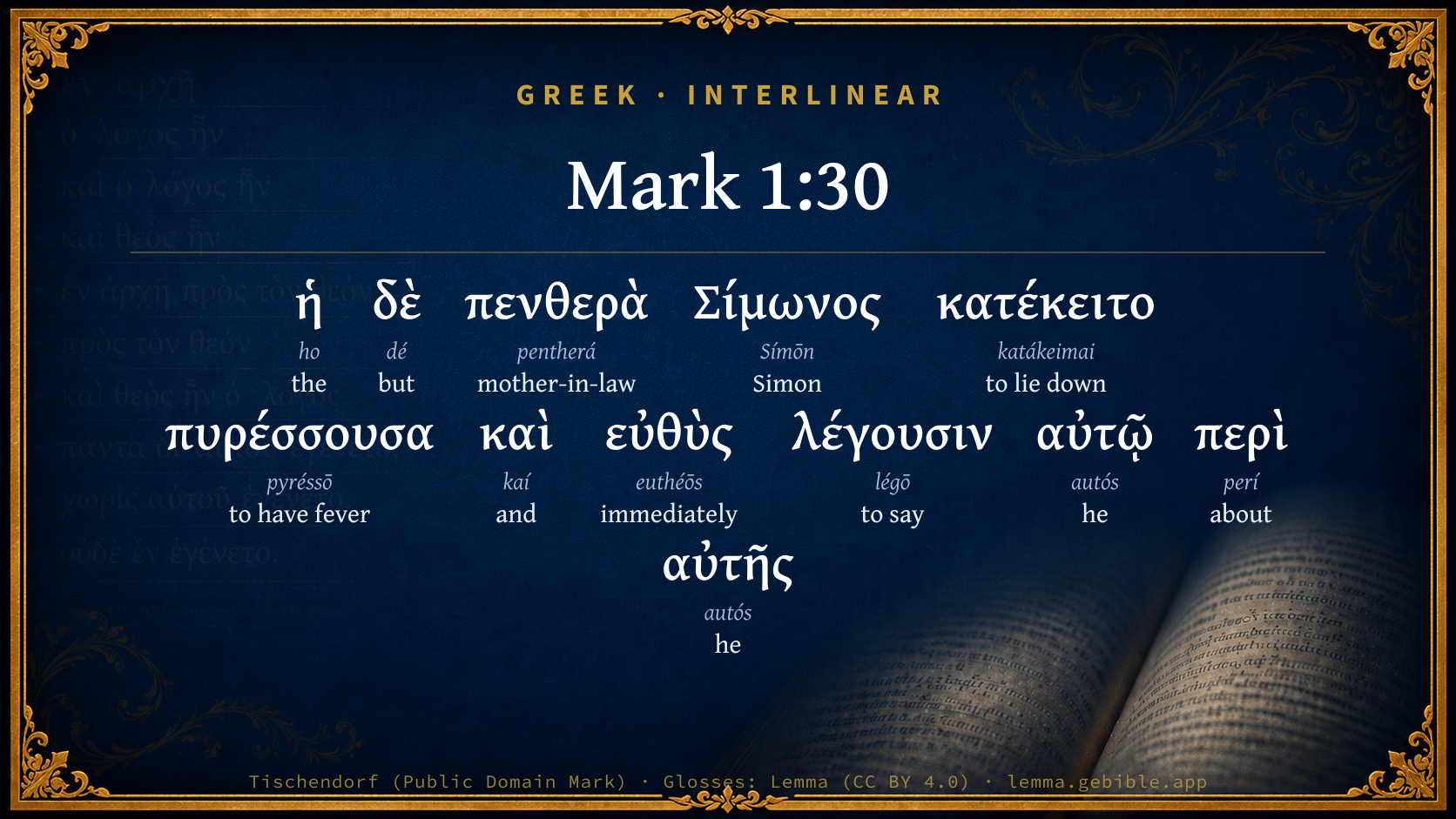
Greek (Tischendorf 8th ed.) Mark 1:30 appears in the Greek New Testament. The text above is from the Tischendorf 8th edition. Each word links to its Strong’s number and a concise gloss. Click any word for its full Thayer’s Greek Lexicon entry.
Download image
Cite this verse

Mark 1:30 (World English Bible). Public Domain. Lemma interlinear Bible study tool, https://lemma.gebible.app/v/mark/1/30.

Show BibTeX & RIS
BibTeX
RIS
English Translation
Now Simon's wife's mother lay sick with a fever, and immediately they told him about her.
World English Bible · Public Domain
Highlights
  • 1 first appearance in the Greek New Testament
Full analysis ↓
Download a study sheet

One document with this verse’s original text, its word-by-word gloss line, the meaning frame, cross-references with their text, attributed commentary, and full source and license credits — printable, and it pastes into notes with its structure intact.

This verse Autodidact and up

Study sheet (.html) Plain text (.txt)

A passage Seminary Student

Up to 50 verses in one chapter. A passage sheet keeps up to 6 commentary sources and 12 cross-references per verse, in the order this page ranks them, and says so on the sheet whenever that leaves anything out. Ask for a single verse and you get the Autodidact verse sheet above.

Everything on this page stays free to read, with no account — the sheet is a download of what is already on screen, not access to it.

Want to remove ads? Support Godless Engineer
Compare translations 3

The same verse in 3 English versions, stacked beneath the original-language interlinear above. Click any original word for its lexicon entry.

Each is an independent rendering of the whole verse — the interlinear is not word-aligned to these translations.

Highlighted words mark where these versions differ — a whole-verse word diff, not a word-by-word alignment.

  • World English Bible Public Domain
    Now Simon's wife's mother lay sick with a fever, and immediately they told him about her.
  • King James Version Public Domain
    But Simon's wife's mother lay sick of a fever, and anon they tell him of her.
  • unfoldingWord Literal Text CC BY-SA 4.0
    Now the mother-in-law of Simon was lying down, being sick with a fever, and immediately they speak to him concerning her.

unfoldingWord Literal Text — © unfoldingWord, licensed CC BY-SA 4.0. Word-aligned USFM3 via Door43 (git.door43.org/unfoldingWord/en_ult).

Versions to compare (up to 4)

3 of 4 selected

Show all 19 translations

Every available English version of this verse, each an independent rendering of the whole verse.

  • World English Bible Public Domain
    Now Simon's wife's mother lay sick with a fever, and immediately they told him about her.
  • Berean Standard Bible Public Domain
    Simon’s mother-in-law was sick in bed with a fever, and they promptly told Jesus about her.
  • Majority Standard Bible Public Domain
    Simon’s mother-in-law was sick in bed with a fever, and they promptly told Jesus about her.
  • King James Version Public Domain
    But Simon's wife's mother lay sick of a fever, and anon they tell him of her.
  • American Standard Version (1901) Public Domain
    Now Simon's wife's mother lay sick of a fever; and straightway they tell him of her:
  • Revised Version (1885) Public Domain
    Now Simon’s wife’s mother lay sick of a fever; and straightway they tell him of her:
  • Geneva Bible (1599) Public Domain
    And Symons wiues mother lay sicke of a feuer, and anon they told him of her.
  • Douay-Rheims (1899) Public Domain
    And Simon's wife's mother lay in a fit of a fever: and forthwith they tell him of her.
  • Young's Literal Translation Public Domain
    and the mother-in-law of Simon was lying fevered, and immediately they tell him about her,
  • Literal Standard Version CC BY-SA 4.0
    and the mother-in-law of Simon was lying fevered, and immediately they tell Him about her,
  • Unlocked Literal Bible CC BY-SA 4.0
    Now Simon's mother-in-law was lying sick with a fever, and they told Jesus about her.
  • unfoldingWord Literal Text CC BY-SA 4.0
    Now the mother-in-law of Simon was lying down, being sick with a fever, and immediately they speak to him concerning her.
  • Darby Bible Public Domain
    And the mother-in-law of Simon lay in a fever. And straightway they speak to him about her.
  • World Messianic Bible Public Domain
    Now Simon’s wife’s mother lay sick with a fever, and immediately they told him about her.
  • Webster's Bible Public Domain
    But the mother of Simon's wife lay sick with a fever; and forthwith they tell him of her.
  • Free Bible Version CC BY-SA 4.0
    Simon's mother-in-law was sick in bed with a fever, so they told Jesus about her.
  • Bible in Basic English Public Domain
    Now Simon's wife's mother was ill, with a burning heat; and they gave him word of her:
  • Text-Critical English NT CC BY 4.0
    Now Simon's mother-in-law lay sick with a fever, and they immediately told Jesus about her.
  • Tyndale New Testament (1534) Public Domain
    And Symons mother in lawe lay sicke of a fever. And anone they tolde him of her.

Literal Standard Version (2020), Covenant Press — licensed CC BY-SA 4.0. Text via the HelloAO Bible API (eBible.org). Unlocked Literal Bible (unfoldingWord) — licensed CC BY-SA 4.0. Text via the HelloAO Bible API (eBible.org). unfoldingWord Literal Text — © unfoldingWord, licensed CC BY-SA 4.0. Word-aligned USFM3 via Door43 (git.door43.org/unfoldingWord/en_ult). Free Bible Version, Dr. Jonathan Gallagher — licensed CC BY-SA 4.0. Text via the HelloAO Bible API (eBible.org).

Word by word

More ways to search: Search by grammar → Find every occurrence → Compare this word →

Practice this passage: Drill this verse → Learn its vocabulary →

About this verse

These counts appear in no published source. They are computed here, from the morphology-tagged text and Lemma’s own curated glosses. What Lemma adds →

12
words
11
distinct lemmas
Gospels
section

Notable vocabulary

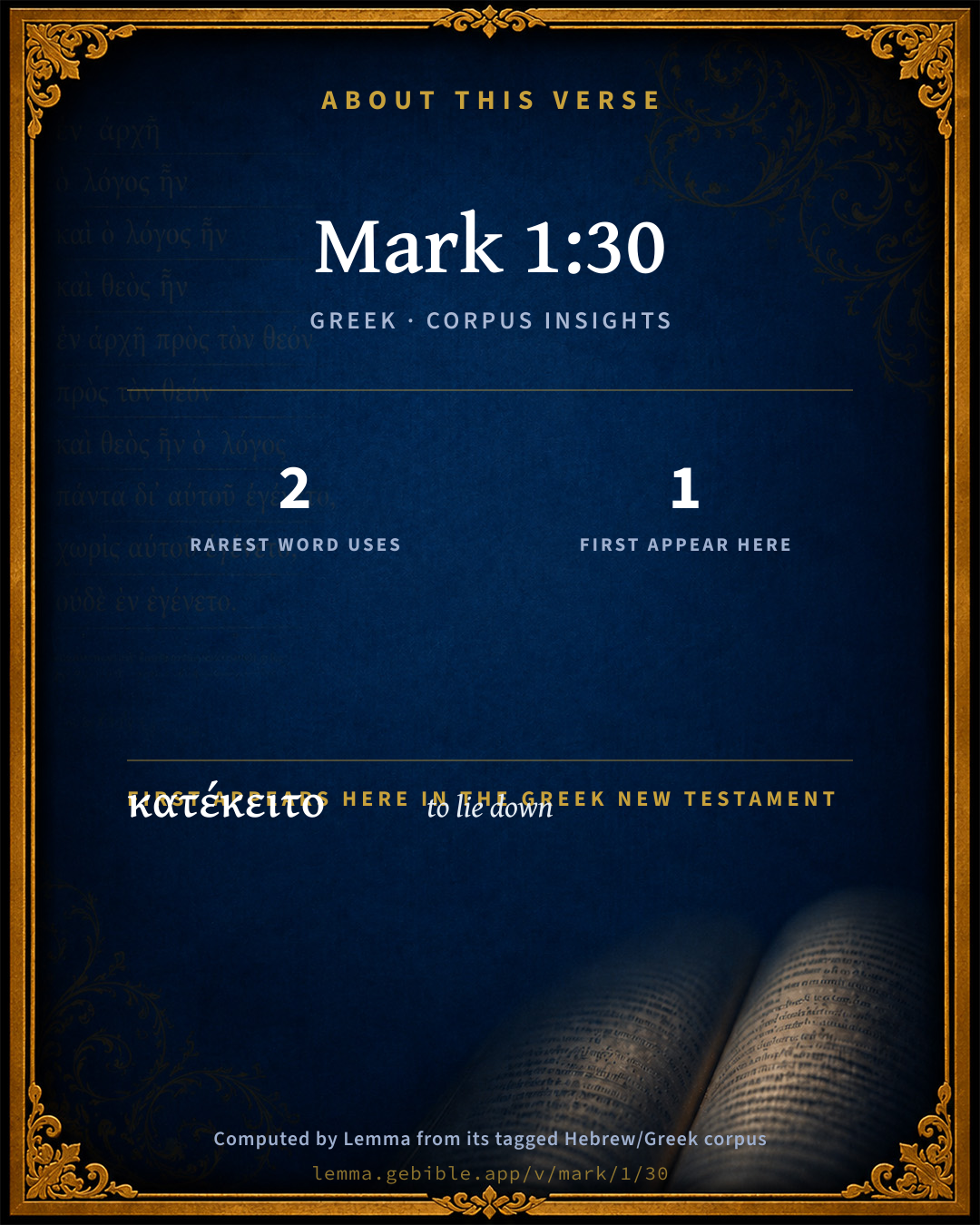
The rarest word here is πυρέσσουσα to have fever G4445 — appearing just 2 times in the whole Greek New Testament.

First appearance in Scripture

This word makes its first canonical appearance in the Greek New Testament here:

  • κατέκειτο to lie down G2621

Shared distinctive vocabulary

πυρέσσουσα to have fever G4445 occurs in 2 verses of the Greek New Testament. Also found in:

Repetition

A word recurs within this verse:

  • αὐτῷ he G846 ×2

Cross-references

4

Topical passages linked to Mark 1:30 in the Treasury of Scripture Knowledge — connected by theme and wording, ordered by reader-vote popularity; previews shown in the World English Bible.

  • 1 Corinthians 9:5 Have we no right to take along a wife who is a believer, even as the rest of the apostles, and the brothers of the Lord, and Cephas?
  • Mark 5:23 and begged him much, saying, "My little daughter is at the point of death. Please come and lay your hands on her, that she may be made healthy, and live."
  • John 11:3 The sisters therefore sent to him, saying, "Lord, behold, he for whom you have great affection is sick."
  • James 5:14–15 Is any among you sick? Let him call for the elders of the assembly, and let them pray over him, anointing him with oil in the name of the Lord,

Cross-references courtesy of OpenBible.info (CC BY 4.0).

Commentary

Notes on Mark 1:30 from classic Christian and Jewish commentators (each source and its license shown beneath its notes). The classic Christian expositions comment on the surrounding passage and are grouped to its opening verse, so a note may address several verses; the Jewish commentaries on the Tanakh (Rashi and others) are per-verse, so they appear only where the commentator wrote on this verse.

Lemma curates 59 commentaries, every one of them public domain or Creative Commons licensed, each selected and text-cleaned for this edition rather than reprinted as found. About our sources →

MacLaren's Expositions of Holy Scripture

Alexander MacLaren

Mark

MIGHTY IN WORD AND DEED

HEALING AND SERVICE

Mar 1:30 - Mar 1:31

This miracle is told us by three of the four Evangelists, and the comparison of their brief narratives is very interesting and instructive. We all know, I suppose, that the common tradition is that Mark was, in some sense, Peter’s mouthpiece in this Gospel. The truthfulness of that ancient statement is borne out by little morsels of evidence that crop up here and there throughout the Gospel. There is one of them in this context. The other two Evangelists tell us that our Lord, with His four attendant disciples, ‘entered into the house of Simon’; Mark knows that Simon’s brother Andrew shared the house with him. Who was likely to have told him such an insignificant thing as that? We seem to hear the Apostle himself recounting the whole story to his amanuensis.

Then, further, Mark’s narrative is distinguished from that of the other two Evangelists in very minute and yet interesting points, which will come out as we go along. So I think we may fairly say that we have here Peter himself telling us the story of his mother-in-law’s cure. Now, one thing that strikes one is that this is a very small miracle. It is by no means-if we can apply the words ‘great’ and ‘small’ to these miraculous events-one of the more striking and significant. Another point to note is that it was done evidently without the slightest intention of vindicating Christ’s mission, or of preaching any truth whatever, and so it starts up into a new beauty as being simply and solely a manifestation of His love. I think, when some people are so busy in denying, and others in proving, the miraculous element in Scripture, and others in drawing doctrinal or symbolical lessons out of it, that there is great need to emphasise this, that the first thing about all Christ’s miracles, and most conspicuously about this one, is that they were the welling out of His loving heart which responded to the sight of human sorrow-I was going to say instinctively; but I will find a better word, and say divinely. The deed that had no purpose whatsoever except to lighten the burden upon a disciple’s heart, and to heal the passing physical trouble of one poor old woman, is great, just because it is small; and full of teaching because, to the superficial eye, it teaches nothing.

The first thing in the story is, as it seems to me-

I. The disciple’s intercession.

I wonder if Peter knew that his wife’s mother was ill, when he said to Jesus Christ, after that exciting morning in the synagogue, ‘Come home, and rest in our house’? Probably not. One can scarcely imagine hospitality proffered under such circumstances, or with a knowledge of them. And if we look a little more closely into the preceding narrative we shall see that it is at least possible that Peter and his brother had been away from home for some time; so that the old woman might easily have fallen ill during their temporary absence. But be that as it may, they expect to find rest and food, and they find a sick woman.

There must have been at least two rooms in the humble house, because they ‘come to Jesus Christ and tell Him of her.’ Now if we turn to the other Evangelists, we shall find that Matthew says nothing about any message being communicated to Jesus, but brings Him at once, as It were, to the side of the sick-bed. That is evidently an incomplete account. And then we find in Luke’s Gospel that, instead of the simple ‘tell Him of her’ of Mark, he intensifies the telling into ‘they besought Him for her.’ Now, I think that Mark’s is plainly the more precise story, because he lets us see that Jesus Christ did not commit such a breach of courtesy, due to the humblest home, as to go to the woman’s bedside without being summoned, and he also lets us see that the ‘beseeching’ was a simple intimation to Him. They did not ask; they tell Him; being, perhaps, restrained from definite petitioning partly by reverence, and partly, no doubt, by hesitation in these early days of their discipleship-for this incident occurred at the very beginning, when all the subsequent manifestations of His character were yet waiting to be flashed upon them-as to whether it might be in accordance with their new Teacher’s very little known disposition and mind to help. They knew that He could, because He had just healed a demoniac in the synagogue, but one can understand how, at the beginning of their discipleship, there was a little faltering of confidence as to whether they should go so far as to ask Him to do such a thing. So they ‘tell Him of her,’ and do you not think that the tone of petition vibrated in the intimation, and that there looked out of the eyes of the impulsive, warm-hearted Peter, an unspoken prayer? So Luke was perfectly right in his interpretation of the incident, though not precise in his statement of the external fact, when, instead of saying ‘they tell Him of her,’ he translated that telling into what it meant, and put it, ‘they besought Him for her.’

Ah! dear brethren, there are a great many things in our lives which, though we ought to know Jesus Christ better than the first disciples at first did, scarcely seem to us fit to be turned into subjects of petition, partly because we have wrong notions as to the sphere and limits of prayer, and partly because they seem to be such transitory things that it is a shame to trouble Him about such insignificant matters. Well, go and tell Him, at any rate. I do not think that Christians ought to have anything in their heads or hearts that they do not take to Jesus Christ, and it is an uncommonly good test-and one very easily applied-of our hopes, fears, purposes, thoughts, deeds, and desires-’Should I like to go and make a clean breast of it to the Master?’

‘They tell Him of her,’ and that meant petition, and Jesus Christ can interpret an unspoken petition, and an unexpressed desire appeals to His sympathetic heart. Although the words be but ‘O Lord! I am troubled, perplexed; and I do not know what to do,’ He translates them into ‘Calm Thou me; enlighten Thou me; guide Thou me’; and be sure of this, that as in the story before us, so in our lives, He will answer the unspoken petition in so far as may be best for us.

The next thing to note in this incident is-

II. The Healers method.

There, again, the three stories diverge, and yet are all one. Matthew says, ‘He touched her’; Luke says, ‘He stood’-or rather, as the Greek means, ‘He bent over her-and rebuked the fever.’ Perhaps Peter was close to the pallet, and saw and remembered that there were not a standing over and rebuking the fever only, but that there was the going out of His tender sympathy to the sufferer, and that if there were stern words as of indignation and authority addressed to the disease as if to an unlawful intruder, there were also compassion and tenderness for the victim. For Mark tells that it was not a touch only, but that ‘He took her by the hand and lifted her up,’ and the grasp banished sickness and brought strength.

Now the most precious of the lessons that we can gather from the variety of Christ’s methods of healing is this: that all methods which He used were in themselves equally powerless, and that the curative virtue was in neither the word nor the touch, nor the spittle, nor the clay, nor the bathing in the pool of Siloam, but was purely and simply in the outgoing of His will. The reasons for the wonderful variety of ways in which He communicated His healing power are to be sought partly in the respective moral, and spiritual, and intellectual condition of the people to be healed, and partly in wider reasons and considerations. Why did He stoop and touch the woman, and take her by the hand and gently lift her up? Because His heart went out to her, because He felt the emotion and sympathy which makes the whole world kin, and because His heart was a heart of love, and bade Him come into close contact with the poor fever-ridden woman. Unless we regard that hand-clasp as being such an instinctive attitude and action of Christ’s sympathetic love, we lose the deepest significance of it. And then, when we have given full weight to that, the simplest and yet the most blessed of all the thoughts that cluster round the deed, we can venture further to say that in that small matter we see mirrored, as a wide sweep of country in a tiny mirror, or the sun in a bowl of water, the great truth: ‘He took not hold of angels, but He took hold of the seed of Abraham, wherefore it behoved Him to be made in all things like unto His brethren.’ The touch upon the fevered hand of that old woman in Capernaum was as a condensation into one act of the very principle of the Incarnation and of the whole power which Christ exercises upon a fevered and sick world. For it is by His touch, by His lifting hand, by His sympathetic grasp, and by our real contact with Him, that all our sicknesses are banished, and health and strength come to our souls.

So let us learn a lesson for our own guidance. We can do no man any real good unless we make ourselves one with him, and benefits that we bestow will hurt rather than help, if they are flung down upon men as from a height, or as people cast a bone to a dog. The heart must go with them; and identification with the sufferer is a condition of succour. If we would take lepers and blind beggars and poor old women by the hand-I mean, of course, by giving them our sympathy along with our help-we should see larger results from, and be more Christ-like in, our deeds of beneficence.

The last point is-

III. The healed sufferer’s service.

‘She arose’-yes, of course she did, when Christ grasped her. How could she help it? ‘And she ministered to them,’-how could she help that either, if she had any thankfulness in her heart? What a lovely, glad, awe-stricken meal that would be, to which they all sat down in Simon’s house, on that Sabbath night, as the sun was setting! It was a humble household. There were no servants in it. The convalescent old woman had to do all the ministering herself, and that she was able to do it was, of course, as everybody remarks on reading the narrative, the sign of the completeness of the cure. But it was a great deal more than that. How could she sit still and not minister to Him who had done so much for her? And if you and I, dear friends, have any living apprehension of Christ’s healing power, and understand and respond at all to ‘that for which we have been laid hold of’ by Him, our thankfulness will take the same shape, and we, too, shall become His servants. Up yonder, amidst the blaze of the glory, He is still capable of being ministered to by us. The woman who did so on earth had no monopoly of this sacred office, but it continues still. And every housewife, as she goes about her duties, and every domestic servant, as she moves round her mistress’s dinner-table, and all of us, in our secular avocations, as people call them, may indeed serve Christ, if only we have regard to Him in the doing of them. There is also a yet higher sense in which that ministration, incumbent upon all the healed, and spontaneous on their part if they have truly been recipients of the healing grace, is still possible for us. ‘When saw we Thee. . . in need. . . and served Thee?’ ‘Inasmuch as ye did it unto one of the least of these My brethren, ye did it unto Me.’

Alexander MacLaren, Expositions of Holy Scripture (1904–1910) — public domain. Text from a community e-Sword module.

Expositor's Greek Testament

ed. W. Robertson Nicoll

Mar 1:30 . πυρέσσουσα (same word in Matthew), fevered, or feverish, doubtless a common occurrence in the damp, marshy flats by the lake. λέγουσι αὐτῷ π . α ., forthwith they tell Him about her, not necessarily as expecting Him to heal her, but to account for her absence, or as one naturally tells a friend of family troubles.

The Expositor's Greek Testament, edited by W. Robertson Nicoll (1897–1910) — public domain. Text from a community e-Sword module.

Cambridge Greek Testament for Schools and Colleges

30. πενθερά. It is certain that πενθερά means “mother-in-law” (Luk 12:53; Rth 1:14; Rth 2:11; Rth 2:18-19; Rth 2:23; Mic 7:6); “step-mother” is μητρυιά; and it is clear from 1Co 9:5 that Peter was married. Clem. Alex. (Strom. iii. 6) says that Peter had children and that his wife helped the Apostle in ministering to women; and here her mother ministers to Christ and His disciples. See also Strom. vii. 11, quoted by Eusebius, H. E. iii. 30. Jonas or John (Joh 21:15), the father of Simon and Andrew, was probably dead.

Note the accurate changes of tense in Mar 1:30-31, imperf. of what continued, hist. pres. or aor. of what was done once for all; also the two participles, as in Mar 1:14-15.

κατέκειτο. Was in bed; Joh 5:3; Joh 5:6; Act 9:33; Act 28:8; cf. Wis 17:7. She was keeping her bed, being in a fever.

εὐθὺς λέγουσιν. As soon as He enters the house Peter and Andrew tell Him of their sick relation, for after what they had seen in the synagogue they were confident that He could and would heal her. To suppose that they were merely explaining her non-appearance is inadequate. Mt. omits this. Euthymius notes how often ὁ Χριστὸς τῇ ἑτέρων πἱστει χαρίζεται τὴν ἑτέρων ἴασιν, and continues ὑποδεξώμεθα καὶ ἡμεῖς τὸν Χριστόν, ἵνα τῶν ἐν ἡμῖν παθῶν τὴν πύρωσιν ἀποσβέσῃ.

Cambridge Greek Testament for Schools and Colleges (Cambridge University Press, 1896; 21 vols, various authors incl. Carr, Maclear, Plummer, Farrar, Lumby, Moule, M. R. James, Simcox) — public domain. Text from a community e-Sword module.

Jamieson, Fausset & Brown

Robert Jamieson, A. R. Fausset & David Brown

But Simon's wife's mother lay sick of a fever--Luke, as was natural in "the beloved physician" (Col 4:14), describes it professionally; calling it a "great fever," and thus distinguishing it from that lighter kind which the Greek physicians were wont to call "small fevers," as GALEN, quoted by WETSTEIN, tells us.

and anon--immediately.

they tell him of her--naturally hoping that His compassion and power towards one of His own disciples would not be less signally displayed than towards the demonized stranger in the synagogue.

Jamieson, Fausset & Brown — Commentary Critical and Explanatory on the Whole Bible (1871) — public domain (CC PDM 1.0). Text via the HelloAO Bible API.

The Cambridge Bible for Schools and Colleges

gen. ed. J. J. S. Perowne

30. Simon’s wife’s mother] For St Paul’s allusion to him as a married man see 1Co_9:5.

sick of a fever] a “great” or “violent fever” according to the physician St Luke. Intermittent fever and dysentery, the latter often fatal, are ordinary Arabian diseases.

The Cambridge Bible for Schools and Colleges (gen. ed. J. J. S. Perowne; Cambridge University Press, 1878–1918) — public domain. Text from a community e-Sword module.

John Gill's Exposition

But Simon's wife's mother lay sick of a fever,.... "A great fever", Luke says, Luk 4:38; a very violent one, which threatened with death, and must be very dangerous to an old person; See Gill on Mat 8:14,

And anon they tell him or her; for it seems, that not as soon as he came into the house, but some time after, when he had sat awhile, and rested himself after his fatigue in preaching; they acquainted him with her case, and beseeched him to look upon her, and restore her: this was done, either by Simon and Andrew, or by some others of their friends that were in the house; who having either seen, or heard of his dispossessing the unclean spirit, might rightly conclude he had power to remove a fever.

John Gill's Exposition of the Whole Bible (1746–1763) — public domain (CC PDM 1.0). Text via the HelloAO Bible API.

Trapp's Complete Commentary

John Trapp

30 But Simon’s wife’s mother lay sick of a fever, and anon they tell him of her.

Ver. 30. Sick of a fever] πυρετος, which the Greeks denominate of the heat that is in it; the Germans of the cold. {See Trapp on "Mat 8:14"}

John Trapp, A Commentary or Exposition upon All the Books of the Old and New Testament (1647–1656) — public domain. Text from a community e-Sword module.

Haydock's Catholic Bible Commentary

It appears from St. Mark and St. Luke, that the cure of Peter’s mother-in-law and the other sick, here mentioned, happened after the preceding narrative, and probably on the same day. But St. Matthew does not observe this order; for having related that Jesus, after the sermon on the mount, entered Capharnaum, and healed the centurion’s servant, he hence takes occasion to mention this and the other miracles, which he had omitted, and which Jesus had wrought at his first coming to Capharnaum. (Rutter)

George Leo Haydock (1774–1849), Haydock's Catholic Family Bible and Commentary, 1859 edition — public domain. Excludes Psalms (Douay-Rheims chapter numbering differs from Protestant) and Deuterocanonical books (Catholic canon only).

The Pulpit Commentary

Vers. 30, 31. Lay sick of a fever (katekeito puressousa). St. Luke (Luk_4:38) uses a stronger expression, "was holden with a great fever" (sunecomenh puretw megalw). There were marshes in that district; hence the prevalence of fevers of a malignant character. There is no mention of the wife of Peter by name in the New Testament. We may infer, from the fact that his wish"s mother lived with him, that he was the head of the family. St. Paul (1Co_9:5) intimates that he was a married man, and that his wife accompanied him on his missionary tours. According to the testimony of Clement of Alexandria, and of Eusebius (3:30), she suffered martyrdom, and was led away to death in the sight of her husband, whose last words to her were, "Remember thou the Lord." St. Mark here tells us that Jesus came and took Simon"s wife"s mother by the hand, and raised her up. St. Luke (Luk_4:39) says that "he stood over her and rebuked the fever." Immediately the fever left her. The word "immediately" (euyewv), familiar as it is to St. Mark, is here omitted by the best authorities. But the omission is of no importance; for the fact that "the fever left her," and that she was at once strong enough to "minister to them," proves that it was not like an ordinary recovery from fever, which is wont to be slow and tedious.

The Pulpit Commentary (1880–1919), ed. H.D.M. Spence-Jones & Joseph S. Exell — public domain. Text from a community e-Sword module.

International Critical Commentary

30. κατέκειτο πυρέσσουσα—was lying prostrate with a fever. The language is descriptive, the prep. in κατέκειτο denoting the prostration of disease, and the part. the fire of fever. The imperf. denotes that this was her state at the time.

International Critical Commentary — older volumes (1896–1929), various authors — public domain. Text from a community e-Sword module.

Vincent's Word Studies in the New Testament

Marvin R. Vincent

Lay sick of a fever (κατέκειτο πυρέσσουσα)

Κατά, prostrate. Mark adds, they tell him of her. Luke, they besought him for her. Mark, he came to her. Luke, he stood over her. Mark only, he took her by the hand and raised her up.

Marvin R. Vincent, Word Studies in the New Testament (1887–1900) — public domain. Text from a community e-Sword/MySword module.

Lesson kit

Teaching starters — assembled from the data on this page, not authored interpretation. Every prompt links to the verse data it draws on. Edit before teaching.

Mark, in the Gospels, opens this verse with 12 words (11 distinct Greek lemmas). Its most distinctive word is pyréssō (“to have fever”). A historical commentator’s framing appears above. Read the whole chapter for the surrounding context.

Discussion questions

  1. The word pyréssō carries the sense “to have fever.” How does it shape the verse?
  2. This is the first place “to lie down” appears in Scripture (first appears here). What does its debut here establish?
  3. How does Matthew 8:14, which shares the word «to have fever», read alongside this verse?
  4. What does the repetition of “he” (2× in this one verse) do in this verse?
  5. These translations render this verse differently; the difference is in the English rendering, not the original. What questions does that raise?
  6. Compare how MacLaren's Expositions of Holy Scripture and Expositor's Greek Testament read this verse. Where do they agree or differ?

Things to notice

  • 1 word makes its first canonical appearance in Scripture here.
  • These translations choose different wording for 17 words in this verse.
  • “he” occurs 2× in this single verse.
  • 11 distinct Greek lemmas span 12 words in this verse.

Reading settings

Reading text

Shown beneath each verse's original-language words.

Old Testament
Old Testament edition

Read the OT as the Masoretic Hebrew (MT) or the Greek Septuagint (LXX).

English shown for the Greek Septuagint (in the Hebrew ↔ Greek comparison).

Comparing translations? Open the Compare panel on any verse page to stack up to four side by side.