
Mark 1:39

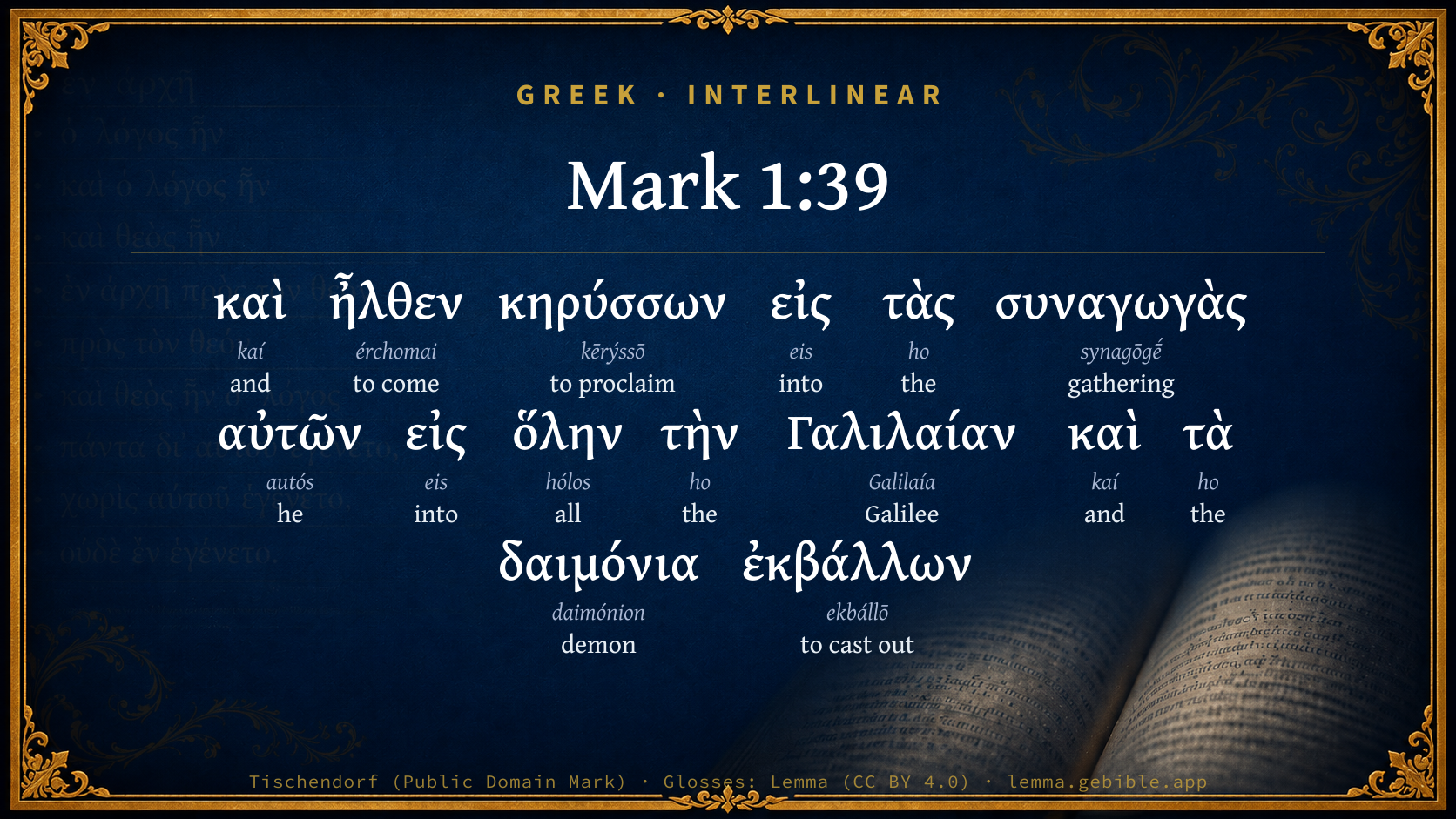
Greek (Tischendorf 8th ed.) Mark 1:39 appears in the Greek New Testament. The text above is from the Tischendorf 8th edition. Each word links to its Strong’s number and a concise gloss. Click any word for its full Thayer’s Greek Lexicon entry.
Download image
Cite this verse

Mark 1:39 (World English Bible). Public Domain. Lemma interlinear Bible study tool, https://lemma.gebible.app/v/mark/1/39.

Show BibTeX & RIS
BibTeX
RIS
English Translation
He went into their synagogues throughout all Galilee, preaching and casting out demons.
World English Bible · Public Domain
Download a study sheet

One document with this verse’s original text, its word-by-word gloss line, the meaning frame, cross-references with their text, attributed commentary, and full source and license credits — printable, and it pastes into notes with its structure intact.

This verse Autodidact and up

Study sheet (.html) Plain text (.txt)

A passage Seminary Student

Up to 50 verses in one chapter. A passage sheet keeps up to 6 commentary sources and 12 cross-references per verse, in the order this page ranks them, and says so on the sheet whenever that leaves anything out. Ask for a single verse and you get the Autodidact verse sheet above.

Everything on this page stays free to read, with no account — the sheet is a download of what is already on screen, not access to it.

Want to remove ads? Support Godless Engineer
Compare translations 3

The same verse in 3 English versions, stacked beneath the original-language interlinear above. Click any original word for its lexicon entry.

Each is an independent rendering of the whole verse — the interlinear is not word-aligned to these translations.

Highlighted words mark where these versions differ — a whole-verse word diff, not a word-by-word alignment.

  • World English Bible Public Domain
    He went into their synagogues throughout all Galilee, preaching and casting out demons.
  • King James Version Public Domain
    And he preached in their synagogues throughout all Galilee, and cast out devils.
  • unfoldingWord Literal Text CC BY-SA 4.0
    And he went in all Galilee, preaching in their synagogues and casting out the demons.

unfoldingWord Literal Text — © unfoldingWord, licensed CC BY-SA 4.0. Word-aligned USFM3 via Door43 (git.door43.org/unfoldingWord/en_ult).

Versions to compare (up to 4)

3 of 4 selected

Show all 19 translations

Every available English version of this verse, each an independent rendering of the whole verse.

  • World English Bible Public Domain
    He went into their synagogues throughout all Galilee, preaching and casting out demons.
  • Berean Standard Bible Public Domain
    So He went throughout Galilee, preaching in their synagogues and driving out demons.
  • Majority Standard Bible Public Domain
    So He went throughout Galilee, preaching in their synagogues and driving out demons.
  • King James Version Public Domain
    And he preached in their synagogues throughout all Galilee, and cast out devils.
  • American Standard Version (1901) Public Domain
    And he went into their synagogues throughout all Galilee, preaching and casting out demons.
  • Revised Version (1885) Public Domain
    And he went into their synagogues throughout all Galilee, preaching and casting out devils.
  • Geneva Bible (1599) Public Domain
    And hee preached in their Synagogues, throughout all Galile, and cast the deuils out.
  • Douay-Rheims (1899) Public Domain
    And he was preaching in their synagogues, and in all Galilee, and casting out devils.
  • Young's Literal Translation Public Domain
    And he was preaching in their synagogues, in all Galilee, and is casting out the demons,
  • Literal Standard Version CC BY-SA 4.0
    And He was preaching in their synagogues, in all Galilee, and is casting out the demons,
  • Unlocked Literal Bible CC BY-SA 4.0
    He went throughout all of Galilee, preaching in their synagogues and casting out demons.
  • unfoldingWord Literal Text CC BY-SA 4.0
    And he went in all Galilee, preaching in their synagogues and casting out the demons.
  • Darby Bible Public Domain
    And he was preaching in their synagogues in the whole of Galilee, and casting out demons.
  • World Messianic Bible Public Domain
    He went into their synagogues throughout all Galilee, proclaiming and casting out demons.
  • Webster's Bible Public Domain
    And he preached in their synagogues throughout all Galilee, and cast out demons.
  • Free Bible Version CC BY-SA 4.0
    So he went all over Galilee, speaking in the synagogues and expelling demons.
  • Bible in Basic English Public Domain
    And he went into their Synagogues in every part of Galilee, preaching and driving out evil spirits.
  • Text-Critical English NT CC BY 4.0
    So he was preaching in their synagogues in all of Galilee and casting out demons.
  • Tyndale New Testament (1534) Public Domain
    And he preached in their synagoges throughout all Galile and cast the devyls out.

Literal Standard Version (2020), Covenant Press — licensed CC BY-SA 4.0. Text via the HelloAO Bible API (eBible.org). Unlocked Literal Bible (unfoldingWord) — licensed CC BY-SA 4.0. Text via the HelloAO Bible API (eBible.org). unfoldingWord Literal Text — © unfoldingWord, licensed CC BY-SA 4.0. Word-aligned USFM3 via Door43 (git.door43.org/unfoldingWord/en_ult). Free Bible Version, Dr. Jonathan Gallagher — licensed CC BY-SA 4.0. Text via the HelloAO Bible API (eBible.org).

Word by word

More ways to search: Search by grammar → Find every occurrence → Compare this word →

Practice this passage: Drill this verse → Learn its vocabulary →

συναγωγὰς
synagōgḗ
G4864
“gathering”
Noun, Accusative, Plural, Feminine
Part of Speech
Noun
Case
Accusative
Number
Plural
Gender
Feminine
Full Thayer's Definition

Origin: from (the reduplicated form of) G4863

TDNT: 20:18,1

1. a bringing together, gathering (as of fruits), a contracting 2. in the NT, an assembling together of men, an assembly of men 3. a synagogue a. an assembly of Jews formally gathered together to offer prayers and listen to the reading and expositions of the scriptures; assemblies of that sort were held every sabbath and feast day, afterwards also on the second and fifth days of every week; name transferred to an assembly of Christians formally gathered together for religious purposes b. the buildings where those solemn Jewish assemblies are held. Synagogues seem to date their origin from the Babylonian exile. In the times of Jesus and the apostles every town, not only in Palestine, but also among the Gentiles if it contained a considerable number of Jewish inhabitants, had at least one synagogue, the larger towns several or even many. These were also used for trials and inflicting punishment.
  1. καὶ kaí G2532 “and” Conjunction
  2. ἦλθεν érchomai G2064 “to come” Verb, Aorist, Active, Indicative, 3rd person, Singular
  3. κηρύσσων kērýssō G2784 “to proclaim” Verb, Present, Active, Participle, Nominative, Singular, Masculine
  4. εἰς eis G1519 “into” Preposition
  5. τὰς ho G3588 “the” Article, Accusative, Plural, Feminine
  6. αὐτῶν autós G846 “he” Personal pronoun, Genitive, Plural, Masculine
  7. εἰς eis G1519 “into” Preposition
  8. ὅλην hólos G3650 “all” Adjective, Accusative, Singular, Feminine
  9. τὴν ho G3588 “the” Article, Accusative, Singular, Feminine
  10. Γαλιλαίαν Galilaía G1056 “Galilee” Noun, Accusative, Singular, Feminine
  11. καὶ kaí G2532 “and” Conjunction
  12. τὰ ho G3588 “the” Article, Accusative, Plural, Neuter
  13. δαιμόνια daimónion G1140 “demon” Noun, Accusative, Plural, Neuter
  14. ἐκβάλλων ekbállō G1544 “to cast out” Verb, Present, Active, Participle, Nominative, Singular, Masculine

About this verse

These counts appear in no published source. They are computed here, from the morphology-tagged text and Lemma’s own curated glosses. What Lemma adds →

15
words
11
distinct lemmas
Gospels
section

Shared distinctive vocabulary

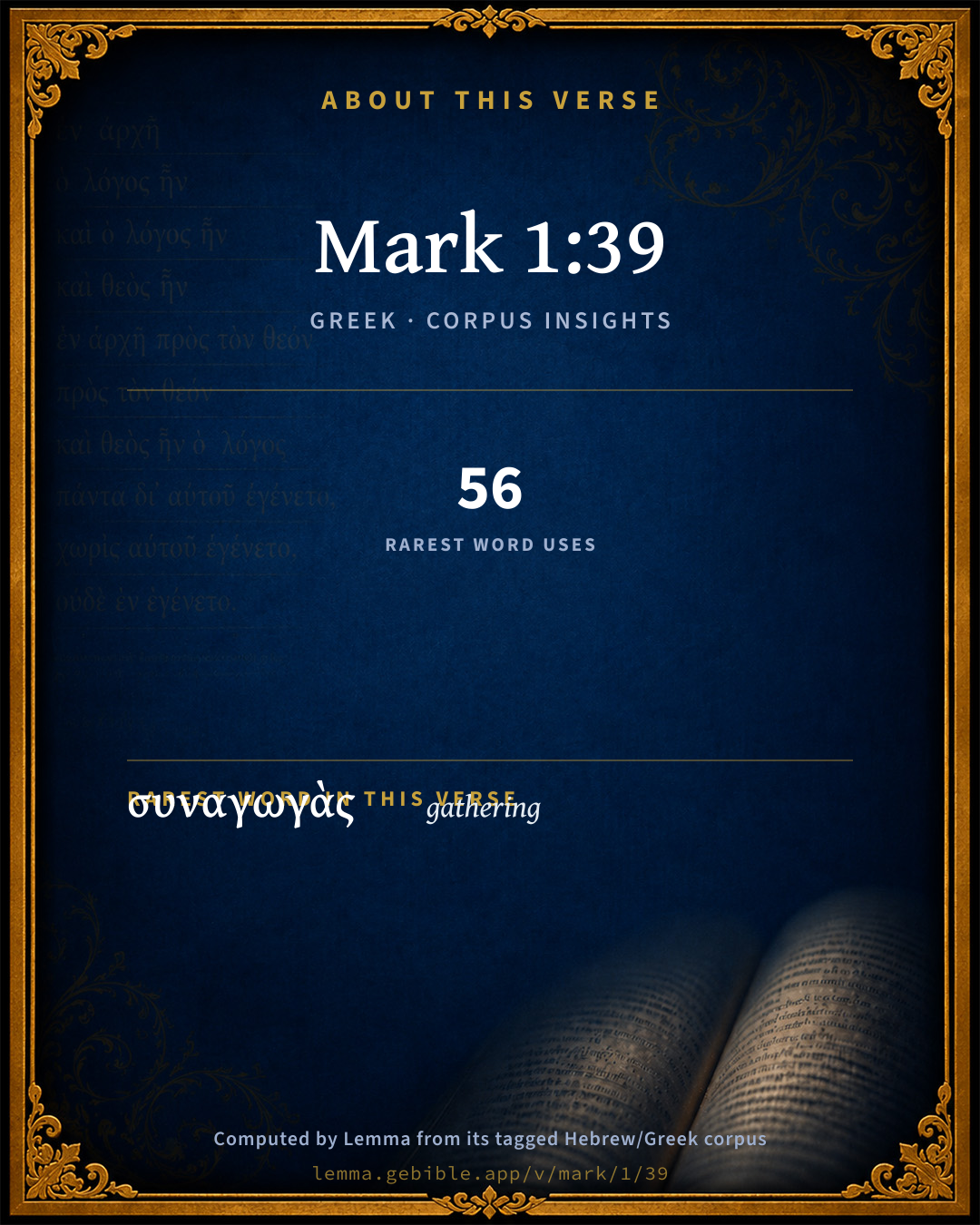
συναγωγὰς gathering G4864 occurs in 56 verses of the Greek New Testament. Also found in:
Repetition

Words recur within this verse:

Cross-references

5

Topical passages linked to Mark 1:39 in the Treasury of Scripture Knowledge — connected by theme and wording, ordered by reader-vote popularity; previews shown in the World English Bible.

  • Matthew 4:23 Jesus went about in all Galilee, teaching in their synagogues, preaching the Gospel of the Kingdom, and healing every disease and every sickness among the people.
  • Mark 1:21 They went into Capernaum, and immediately on the Sabbath day he entered into the synagogue and taught.
  • Mark 7:30 She went away to her house, and found the child having been laid on the bed, with the demon gone out.
  • Luke 4:41 Demons also came out from many, crying out, and saying, "You are the Christ, the Son of God!" Rebuking them, he didn't allow them to speak, because they knew that he was the Christ.
  • Luke 4:43–44 But he said to them, "I must preach the good news of the Kingdom of God to the other cities also. For this reason I have been sent."

Cross-references courtesy of OpenBible.info (CC BY 4.0).

Commentary

Notes on Mark 1:39 from classic Christian and Jewish commentators (each source and its license shown beneath its notes). The classic Christian expositions comment on the surrounding passage and are grouped to its opening verse, so a note may address several verses; the Jewish commentaries on the Tanakh (Rashi and others) are per-verse, so they appear only where the commentator wrote on this verse.

Lemma curates 59 commentaries, every one of them public domain or Creative Commons licensed, each selected and text-cleaned for this edition rather than reprinted as found. About our sources →

Bengel's Gnomon

Johann Albrecht Bengel

Mar 1:39. Κηρύσσων—ἐκβάλλων, preaching—casting out) Two kinds of benefits.

Bengel's Gnomon of the New Testament — English translation (T&T Clark, Edinburgh, 1860) — public domain. Text from a community e-Sword module.

Meyer's Critical & Exegetical Commentary

Heinrich August Wilhelm Meyer

Mar_1:39. Κηρύσσων εἰς τὰς συναγωγ. αὐτῶν κ.τ.λ.] There is the conception of direction in εἰς: announcing (the Gospel) into their synagogues. He is conceived of as coming before the assembly in the synagogue and speaking to them. Comp. the well-known modes of expression: ἐς τὸν δῆμον εἰπεῖν, Thuc. v. 45, εἰς τὴν στρατίαν εἰπεῖν, Xen. Anab. v. 6. 37; Joh_8:26, ταῦτα λέγω εἰς τὸν κόσμον. Comp. Mar_14:10; Rom_16:26. The following εἰς ὅλην τὴν Γαλιλαίαν specifies the geographical field, into which the κηρύσσειν εἰς τὰς συναγωγ. αὐτ. extended. Comp. Mar_13:10; Luk_24:47. We may add that this tour is not invented by Mark as a happier substitute for the Gadarene journey of Matthew 8, as Hilgenfeld assumes it to be, which is a vagary in the interest of antagonism to the independence of Mark. Holtzmann appropriately observes that Mar_1:35-39 is one of the most telling passages in favour of Marks originality.

Meyer — Critical and Exegetical Commentary on the New Testament — English translation by Peter Christie, edited by Frederick Crombie (T&T Clark, 1880) — public domain. Text from a community e-Sword module.

Expositor's Greek Testament

ed. W. Robertson Nicoll

Mar 1:39 . ἦλθεν ( vide critical notes). εἰς τ . συν . may be connected with ἦλθεν , and the sentence will run thus: He came, preaching, to their synagogues, all over Galilee; also casting out devils, the healing ministry being referred to as subordinate to the teaching. If we connect εἰς τὰς συν with κηρύσσων the word “synagogues” will refer to the assemblies rather than to the places = preaching to their synagogues, as we might say “preaching to their churches” or “congregations”. For similar expressions cf. Mar 13:10 , Mar 14:9 , Joh 8:26 . This short verse contains the record of an extensive preaching tour, of which not a single discourse has been preserved. Doubtless some of the parables were spoken on these occasions. Note the synagogue , not the market place , was the scene of Christ’s addresses; His work religious, not political (Schanz).

The Expositor's Greek Testament, edited by W. Robertson Nicoll (1897–1910) — public domain. Text from a community e-Sword module.

Adam Clarke's Commentary

Verse 39. And he preached] He continued preaching - ην κηρυσσων: this is the proper meaning of the words: he never slackened his pace-he continued proclaiming the glad tidings of salvation to all - there was no time to be lost - immortal souls were perishing for lack of knowledge; and the grand adversary was prowling about, seeking whom he might devour. This zealous, affectionate, and persevering diligence of Christ should be copied by all his servants in the ministry; it is not less necessary now than it was then. Thousands, thousands of Christians, so called, are perishing for lack of knowledge. O God, send forth more and more faithful labourers into thy vineyard!

Adam Clarke's Commentary on the Bible (1810–1826) — public domain. Text from a community e-Sword/MySword module.

Ellicott's Commentary for English Readers

(39) And he preached.—See Note on Mat_4:23.

A Bible Commentary for English Readers, edited by Charles John Ellicott (1878–1897) — public domain. Text from a community e-Sword module.

John Gill's Exposition

And he preached in their synagogues,.... Which were in the next towns, in the village cities, and

throughout all Galilee: taking every town and city in his circuit, he continued preaching the Gospel of the kingdom in one place and another, until he had gone over the whole country:

and cast out devils; as out of the souls, so out of the bodies of men, whereby he confirmed the doctrine he preached.

John Gill's Exposition of the Whole Bible (1746–1763) — public domain (CC PDM 1.0). Text via the HelloAO Bible API.

Trapp's Complete Commentary

John Trapp

39 And he preached in their synagogues throughout all Galilee, and cast out devils.

Ver. 39. In their synagogues] Which were as chapels of ease, or petty parish churches, belonging to the temple, as the cathedral. In these it was lawful to pray, preach, and dispute, but not to sacrifice, Act 15:21.

John Trapp, A Commentary or Exposition upon All the Books of the Old and New Testament (1647–1656) — public domain. Text from a community e-Sword module.

Albert Barnes' Notes on the Bible

And he preached in their synagogues - See Mat 4:23.

All Galilee - See Mat 1:22.

And cast out devils - See Mat 4:24.

Albert Barnes' Notes on the Bible (1834–1885) — public domain. Text from a community e-Sword/MySword module.

Whedon's Commentary on the Bible

Daniel D. Whedon

39. He preached in their synagogues — From which it appears that their synagogues were scattered through the villages of Galilee, as churches are among us.

Daniel D. Whedon (gen. ed.), Commentary on the Old and New Testaments (1874–1909) — public domain. Text from a community e-Sword module.

Scofield Reference Notes

C. I. Scofield

devils demons.

(See Scofield "Mat 7:22")

The Scofield Reference Bible (1917 edition), notes by C. I. Scofield — public domain. Text from a community e-Sword module.

Kretzmann's Popular Commentary

Paul E. Kretzmann

The Healing of a Leper

The beginning of the Galilean journey:

v. 39. And He preached in their synagogues throughout all Galilee, and cast out devils.

v. 40. And there came a leper to Him, beseeching Him, and kneeling down to Him, and saying unto Him, If thou wilt, Thou canst make me clean.

v. 41. And Jesus, moved with compassion, put forth His hand, and touched him, and saith unto him, I will; be thou clean.

v. 42. And as soon as He had spoken, immediately the leprosy departed from him, and he was cleansed.

Mark relates the events of the Galilean journey very briefly. Jesus went, He carried out His intention at once, perhaps without returning to Capernaum; the anxiety to perform His work urged Him on. Throughout. Galilee, not only in the towns of the hill country of Upper Galilee, but also in the less mountainous districts of Lower Galilee, He went His way. The outstanding feature of the journey was the preaching in the synagogues, which could be done all the more easily, since services were held not only on the Sabbath, but on Mondays and Thursdays as well. He came preaching, He continued proclaiming the glad tidings of salvation to all, without respite, without ceasing. "This zealous, affectionate, and persevering diligence of Christ should be copied by all His servants in the ministry: it is not less necessary now than it was then. " wherever people were assembled for services, He was willing and anxious to bring them the message of salvation. It was also on this trip that a leper came to Him. Whether this leper is the same one of whom Matthew speaks, chapter 8:2, is immaterial. Note the urgency of his behavior: He comes, he begs and pleads, he bows down on his knees before Jesus, and he puts his desire in words. His prayer is a model: If Thou wilt, Thou canst make me clean. Here is humility and submission; he leaves all in the hands of Jesus; the Master must know best what is expedient and what is wholesome. Here is also the trust of faith; the man knows, he has the firm conviction that Christ has the power to heal him. To know that Christ is the great Healer for all weaknesses and maladies of body and soul, to put one’s trust in Him absolutely for help, but, in the case of bodily infirmities, to leave the time, the means, and the method in His hands, that is the essence of confidence in the Lord. The prayer and the entire bearing of the man impressed Jesus very deeply. Having compassion, He extended His hand, He touched him and said: I will; become clean. That almighty word wrought the miracle, it drove away the sickness that was such a severe burden upon the poor man. See Heb 2:17; Heb 4:15; Act 4:30. There was no interval of doubt and uncertainty, the healing was complete at once.

Paul E. Kretzmann, Popular Commentary of the Bible (1921–1924) — public domain. Text from a community e-Sword module.

The People's New Testament

B. W. Johnson

39. Throughout all Galilee. This was the first missionary circuit of Galilee. Galilee was then densely peopled. Josephus says it contained 240 towns and villages.

B. W. Johnson's The People's New Testament with Notes (1889–1891) — public domain. Electronic text from the Christian Classics Ethereal Library (CCEL) ThML edition.

Cambridge Greek Testament for Schools and Colleges

39. ἦλθεν ([178][179][180] rather than ἦν ([181][182][183][184][185]); cf. Luk 4:44.

[178] Codex Sinaiticus. 4th cent. Discovered by Tischendorf in 1859 at the Monastery of St Katharine on Mount Sinai. Now at St Petersburg. The whole Gospel, ending at Mar 16:8. Photographic facsimile, 1911.

[179] Codex Vaticanus. 4th cent., but perhaps a little later than א. In the Vatican Library almost since its foundation by Pope Nicolas V., and one of its greatest treasures. The whole Gospel, ending at Mar 16:8. Photographic facsimile, 1889.

[180] Codex Regius. 8th cent. An important witness. At Paris. Contains Mar 1:1 to Mar 10:15; Mar 10:30 to Mar 15:1; Mar 15:20 to Mar 16:20, but the shorter ending is inserted between Mar 16:8 and Mar 16:9, showing that the scribe preferred it to the longer one.

[181] Codex Alexandrinus. 5th cent. Brought by Cyril Lucar, Patriarch of Constantinople, from Alexandria, and afterwards presented by him to King Charles I. in 1628. In the British Museum. The whole Gospel. Photographic facsimile, 1879.

[182] Codex Ephraemi. 5th cent. A palimpsest: the original writing has been partially rubbed out, and the works of Ephraem the Syrian have been written over it; but a great deal of the original writing has been recovered; of Mark we have Mar 1:17 to Mar 6:31, Mar 8:5 to Mar 12:29, Mar 13:19 to Mar 16:20. In the National Library at Paris.

[183] Codex Bezae. 6th cent. Has a Latin translation (d) side by side with the Greek text, and the two do not quite always agree. Presented by Beza to the University Library of Cambridge in 1581. Remarkable for its frequent divergences from other texts. Contains Mark, except Mar 16:15-20, which has been added by a later hand. Photographic facsimile, 1899.

[184] Codex Oxoniensis. 9th cent. Contains Mark, except Mar 3:35 to Mar 6:20.

[185] Codex Sangallensis. 9th or 10th cent. Contains the Gospels nearly complete, with an interlinear Latin translation. The text of Mark is specially good, agreeing often with CL. At St Gall.

39. εἰς τὰς συναγωγάς. The εἰς may give the direction of the preaching or may be influenced by ἦλθεν (Mar 4:15, Mar 14:9; Joh 8:26). Cf. ἐς τὸν δῆμον ταῦτα λέγωσιν (Thuc. Mar 1:45). But in late Greek εἰς and ἐν have become less distinct. The verse illustrates Mk’s lack of literary skill. While εἰς τὰς συν. belongs to κηρύσσων, εἰς ὅλην τ. [215]. must belong to ἦλθεν. Mt. puts the construction straight. Note the combination of participles (Mar 1:15).

[215] Codex Oxoniensis. 9th cent. Contains Mark, except Mar 3:35 to Mar 6:20.

τὰ δαιμόνια ἐκβάλλων. With Mk this is the representative miracle; Mar 3:15, Mar 6:7.

Cambridge Greek Testament for Schools and Colleges (Cambridge University Press, 1896; 21 vols, various authors incl. Carr, Maclear, Plummer, Farrar, Lumby, Moule, M. R. James, Simcox) — public domain. Text from a community e-Sword module.

Alford’s Greek Testament

Henry Alford

39.] See on Mat 4:23: also on Luk 4:44.

κηρ. εἰς] not for ἐν, but as ἐς τὸν δῆμον λέγειν, Thuc. v. 45, and similar expressions: see reff.

Henry Alford, The Greek Testament (1849–1861) — public domain. Text from a community e-Sword module.

International Critical Commentary

39. Καὶ ἦλθεν κηρύσσων εἰς τὰς συναγωγὰς αὐτῶν εἰς ὅλην τὴν Γαλιλαίαν—And he came, preaching to their synagogues, into all Galilee, and casting out demons.

ἦλθεν εἰς, instead of ἧν ἐν, Tisch. Treg. WH. RV. א BL Memph. The construction with this reading is not without difficulty, especially the use of εἰς with κηρύσσων, to denote those to whom the proclamation is made. And probably, this original form of the text was changed to avoid this roughness. But, while the Lexicons consider it necessary to explain this use of εἰς, they admit it. This leaves the second εἰς with ὅλην τὴν Γαλιλαίαν to depend on ἦλθεν.

καὶ τὰ δαιμόνια ἐκβάλλων—and casting out the demons. Before, vv. 32-34, this miracle is separated from the rest. Here it is mentioned by itself without the rest in such a way as to represent them. Although it is the only miracle mentioned, it was evidently not the only one performed. It is selected as the great and representative miracle. And it is not improbable that it was, so to speak, our Lord’s favorite miracle, because here the physical and spiritual parts of his work coincided.1

International Critical Commentary — older volumes (1896–1929), various authors — public domain. Text from a community e-Sword module.

Lesson kit

Teaching starters — assembled from the data on this page, not authored interpretation. Every prompt links to the verse data it draws on. Edit before teaching.

Mark, in the Gospels, opens this verse with 15 words (11 distinct Greek lemmas). Its most distinctive word is synagōgḗ (“gathering”). A historical commentator’s framing appears above. Read the whole chapter for the surrounding context.

Discussion questions

  1. What does “gathering” (synagōgḗ) contribute to the verse as a whole?
  2. Matthew 4:23 shares the word «gathering» with this verse. How do the two illuminate each other?
  3. “into” occurs 2× in this one verse. What is the effect of the repetition?
  4. These translations render this verse differently; the difference is in the English rendering, not the original. What questions does that raise?
  5. Reading how Bengel's Gnomon and Meyer's Critical & Exegetical Commentary read this verse, where do the two commentators agree and where do they part?

Things to notice

  • These translations choose different wording for 9 words in this verse.
  • “into” occurs 2× in this single verse.
  • 11 distinct Greek lemmas span 15 words in this verse.

Reading settings

Reading text

Shown beneath each verse's original-language words.

Old Testament
Old Testament edition

Read the OT as the Masoretic Hebrew (MT) or the Greek Septuagint (LXX).

English shown for the Greek Septuagint (in the Hebrew ↔ Greek comparison).

Comparing translations? Open the Compare panel on any verse page to stack up to four side by side.