
Matthew 27:56

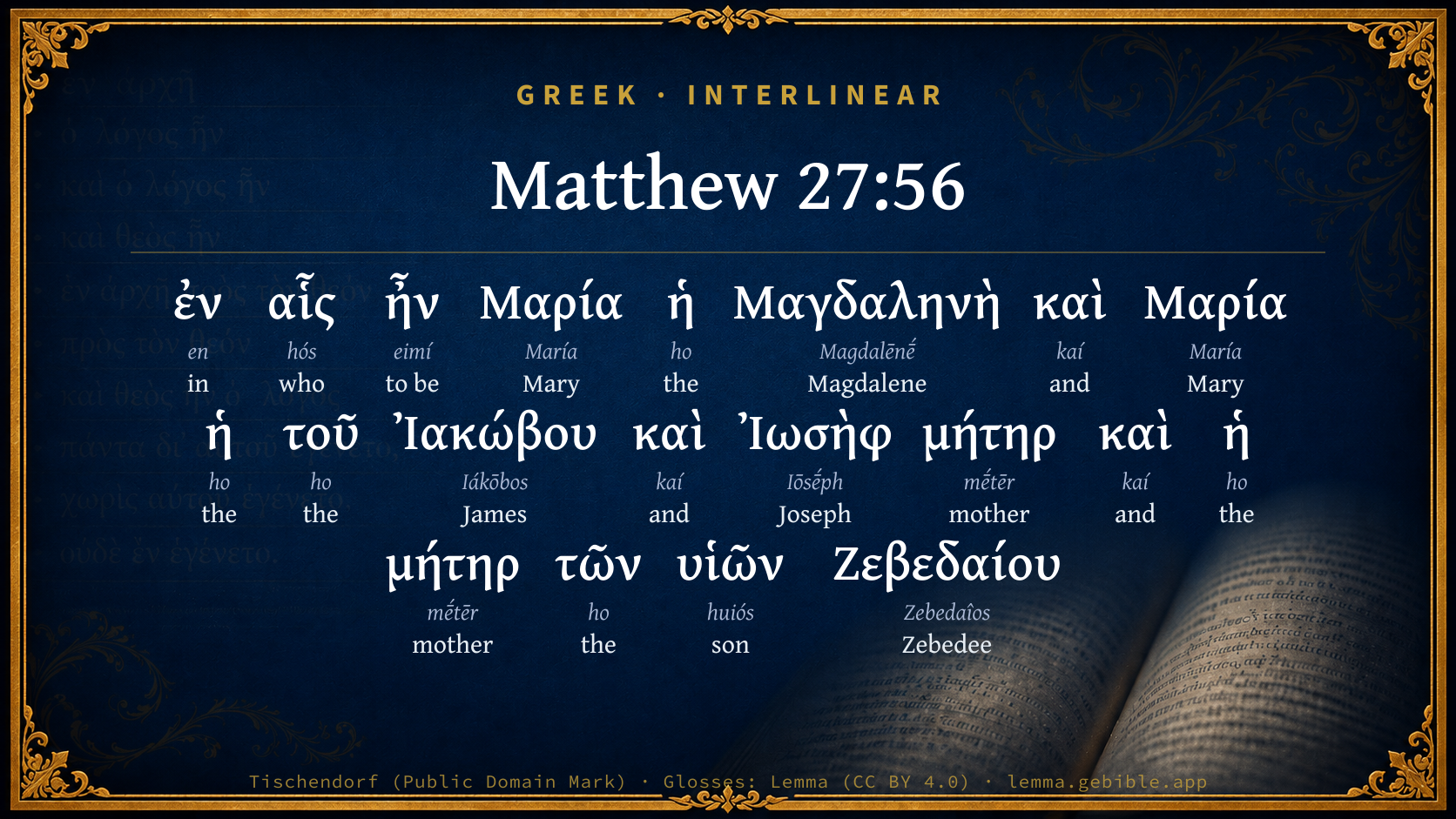
Greek (Tischendorf 8th ed.) Matthew 27:56 appears in the Greek New Testament. The text above is from the Tischendorf 8th edition. Each word links to its Strong’s number and a concise gloss. Click any word for its full Thayer’s Greek Lexicon entry.
Download image
Cite this verse

Matthew 27:56 (World English Bible). Public Domain. Lemma interlinear Bible study tool, https://lemma.gebible.app/v/matthew/27/56.

Show BibTeX & RIS
BibTeX
RIS
English Translation
Among them were Mary Magdalene, Mary the mother of James and Joses, and the mother of the sons of Zebedee.
World English Bible · Public Domain
Highlights
  • 1 first appearance in the Greek New Testament
Full analysis ↓
Download a study sheet

One document with this verse’s original text, its word-by-word gloss line, the meaning frame, cross-references with their text, attributed commentary, and full source and license credits — printable, and it pastes into notes with its structure intact.

This verse Autodidact and up

Study sheet (.html) Plain text (.txt)

A passage Seminary Student

Up to 50 verses in one chapter. A passage sheet keeps up to 6 commentary sources and 12 cross-references per verse, in the order this page ranks them, and says so on the sheet whenever that leaves anything out. Ask for a single verse and you get the Autodidact verse sheet above.

Everything on this page stays free to read, with no account — the sheet is a download of what is already on screen, not access to it.

Want to remove ads? Support Godless Engineer
Compare translations 3

The same verse in 3 English versions, stacked beneath the original-language interlinear above. Click any original word for its lexicon entry.

Each is an independent rendering of the whole verse — the interlinear is not word-aligned to these translations.

Highlighted words mark where these versions differ — a whole-verse word diff, not a word-by-word alignment.

  • World English Bible Public Domain
    Among them were Mary Magdalene, Mary the mother of James and Joses, and the mother of the sons of Zebedee.
  • King James Version Public Domain
    Among which was Mary Magdalene, and Mary the mother of James and Joses, and the mother of Zebedees children.
  • unfoldingWord Literal Text CC BY-SA 4.0
    Among them were Mary Magdalene, and Mary the mother of James and Joseph, and the mother of the sons of Zebedee.

unfoldingWord Literal Text — © unfoldingWord, licensed CC BY-SA 4.0. Word-aligned USFM3 via Door43 (git.door43.org/unfoldingWord/en_ult).

Versions to compare (up to 4)

3 of 4 selected

Show all 19 translations

Every available English version of this verse, each an independent rendering of the whole verse.

  • World English Bible Public Domain
    Among them were Mary Magdalene, Mary the mother of James and Joses, and the mother of the sons of Zebedee.
  • Berean Standard Bible Public Domain
    Among them were Mary Magdalene, Mary the mother of James and Joseph, and the mother of Zebedee’s sons.
  • Majority Standard Bible Public Domain
    Among them were Mary Magdalene, Mary the mother of James and Joses, and the mother of Zebedee’s sons.
  • King James Version Public Domain
    Among which was Mary Magdalene, and Mary the mother of James and Joses, and the mother of Zebedees children.
  • American Standard Version (1901) Public Domain
    among whom was Mary Magdalene, and Mary the mother of James and Joses, and the mother of the sons of Zebedee.
  • Revised Version (1885) Public Domain
    among whom was Mary Magdalene, and Mary the mother of James and Joses, and the mother of the sons of Zebedee.
  • Geneva Bible (1599) Public Domain
    Among whom was Marie Magdalene, and Marie the mother of Iames, and Ioses, and the mother of Zebedeus sonnes.
  • Douay-Rheims (1899) Public Domain
    Among whom was Mary Magdalen, and Mary the mother of James and Joseph, and the mother of the sons of Zebedee.
  • Young's Literal Translation Public Domain
    among whom was Mary the Magdalene, and Mary the mother of James and of Joses, and the mother of the sons of Zebedee.
  • Literal Standard Version CC BY-SA 4.0
    among whom was Mary the Magdalene, and Mary the mother of James and of Joses, and the mother of the sons of Zebedee.
  • Unlocked Literal Bible CC BY-SA 4.0
    Among them were Mary Magdalene, Mary the mother of James and Joseph, and the mother of the sons of Zebedee.
  • unfoldingWord Literal Text CC BY-SA 4.0
    Among them were Mary Magdalene, and Mary the mother of James and Joseph, and the mother of the sons of Zebedee.
  • Darby Bible Public Domain
    among whom was Mary of Magdala, and Mary the mother of James and Joses, and the mother of the sons of Zebedee.
  • World Messianic Bible Public Domain
    Among them were Miriam Magdalene, Miriam the mother of Jacob and Yosi, and the mother of the sons of Zebedee.
  • Webster's Bible Public Domain
    Among whom was Mary Magdalene, and Mary the mother of James and Joses, and the mother of Zebedee's children.
  • Free Bible Version CC BY-SA 4.0
    These included Mary Magdalene, Mary the mother of James and Joseph, and the mother of the sons of Zebedee.
  • Bible in Basic English Public Domain
    Among whom was Mary Magdalene, and Mary, the mother of James and Joses, and the mother of the sons of Zebedee.
  • Text-Critical English NT CC BY 4.0
    among whom were Mary Magdalene, Mary the mother of James and Joses, and the mother of the sons of Zebedee.
  • Tyndale New Testament (1534) Public Domain
    Amonge which was Mary Magdalen and Mary the mother of Iames and Ioses and the mother of zebedes chyldren.

Literal Standard Version (2020), Covenant Press — licensed CC BY-SA 4.0. Text via the HelloAO Bible API (eBible.org). Unlocked Literal Bible (unfoldingWord) — licensed CC BY-SA 4.0. Text via the HelloAO Bible API (eBible.org). unfoldingWord Literal Text — © unfoldingWord, licensed CC BY-SA 4.0. Word-aligned USFM3 via Door43 (git.door43.org/unfoldingWord/en_ult). Free Bible Version, Dr. Jonathan Gallagher — licensed CC BY-SA 4.0. Text via the HelloAO Bible API (eBible.org).

Word by word

More ways to search: Search by grammar → Find every occurrence → Compare this word →

Practice this passage: Drill this verse → Learn its vocabulary →

Μαγδαληνὴ
Magdalēnḗ
G3094
“Magdalene”
Noun, Nominative, Singular, Feminine
Part of Speech
Noun
Case
Nominative
Number
Singular
Gender
Feminine
Full Thayer's Definition

Origin: from a derivative of G3093

TDNT: None

Magdalene = "a tower" 1. a name given to Mary Magdalene, identifying her as from Magdala
  1. ἐν en G1722 “in” Preposition
  2. αἷς hós G3739 “who” Relative pronoun, Dative, Plural, Feminine
  3. ἦν eimí G1510 “to be” Verb, Imperfect, Active, Indicative, 3rd person, Singular
  4. Μαρία María G3137 “Mary” Noun, Nominative, Singular, Feminine
  5. ἡ ho G3588 “the” Article, Nominative, Singular, Feminine
  6. καὶ kaí G2532 “and” Conjunction
  7. Μαρία María G3137 “Mary” Noun, Nominative, Singular, Feminine
  8. ἡ ho G3588 “the” Article, Nominative, Singular, Feminine
  9. τοῦ ho G3588 “the” Article, Genitive, Singular, Masculine
  10. Ἰακώβου Iákōbos G2385 “James” Noun, Genitive, Singular, Masculine
  11. καὶ kaí G2532 “and” Conjunction
  12. Ἰωσὴφ Iōsḗph G2501 “Joseph” Noun, Proper, indeclinable
  13. μήτηρ mḗtēr G3384 “mother” Noun, Nominative, Singular, Feminine
  14. καὶ kaí G2532 “and” Conjunction
  15. ἡ ho G3588 “the” Article, Nominative, Singular, Feminine
  16. μήτηρ mḗtēr G3384 “mother” Noun, Nominative, Singular, Feminine
  17. τῶν ho G3588 “the” Article, Genitive, Plural, Masculine
  18. υἱῶν huiós G5207 “son” Noun, Genitive, Plural, Masculine
  19. Ζεβεδαίου Zebedaîos G2199 “Zebedee” Noun, Genitive, Singular, Masculine

About this verse

These counts appear in no published source. They are computed here, from the morphology-tagged text and Lemma’s own curated glosses. What Lemma adds →

20
words
12
distinct lemmas
Gospels
section

Notable vocabulary

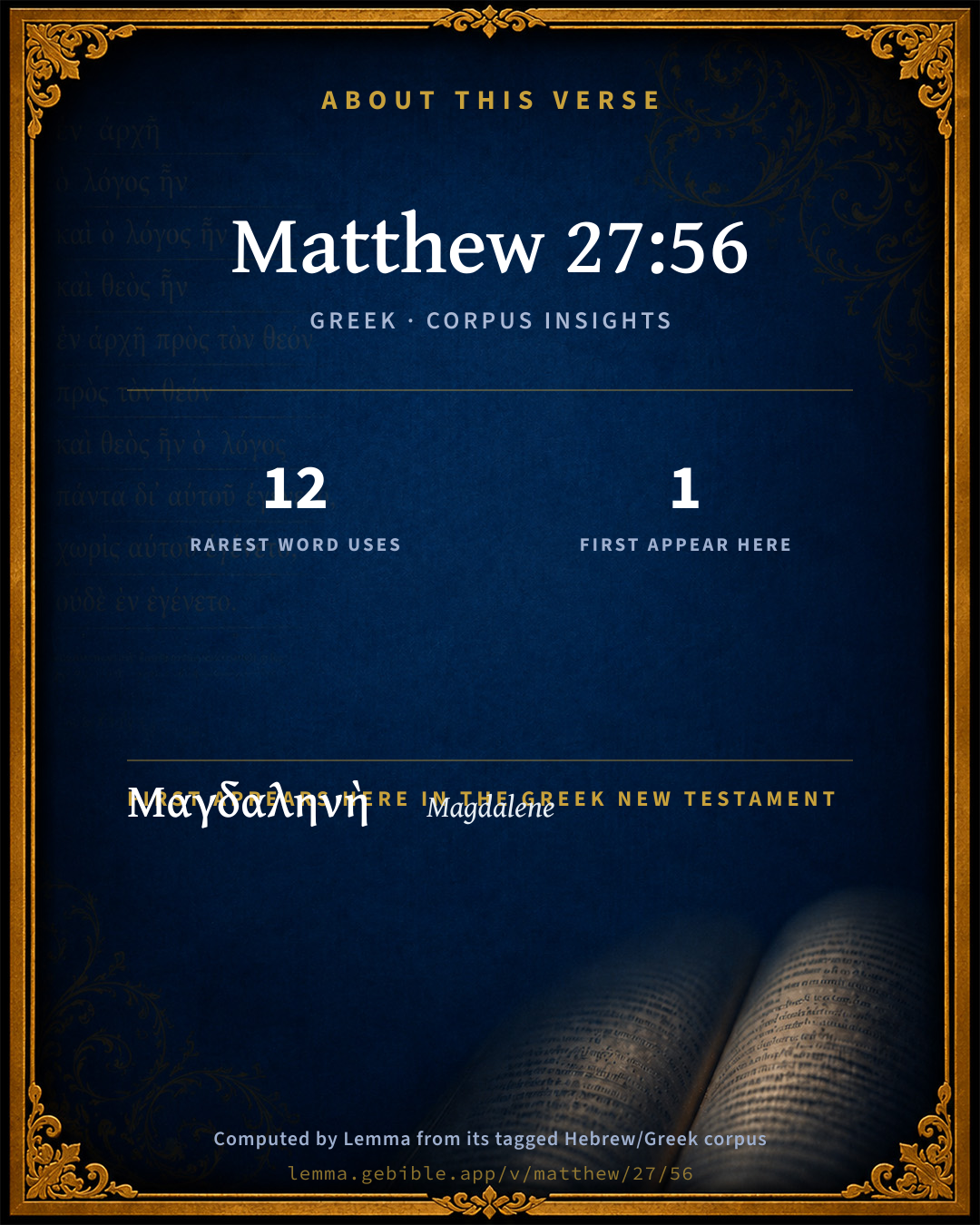
The rarest word here is Μαγδαληνὴ Magdalene G3094 — appearing just 12 times in the whole Greek New Testament.

First appearance in Scripture

This word makes its first canonical appearance in the Greek New Testament here:

  • Μαγδαληνὴ Magdalene G3094

Shared distinctive vocabulary

Μαγδαληνὴ Magdalene G3094 occurs in 12 verses of the Greek New Testament. Also found in:
Repetition

Words recur within this verse:

Cross-references

11

Topical passages linked to Matthew 27:56 in the Treasury of Scripture Knowledge — connected by theme and wording, ordered by reader-vote popularity; previews shown in the World English Bible.

  • John 19:25 But there were standing by the cross of Jesus his mother, and his mother's sister, Mary the wife of Clopas, and Mary Magdalene.
  • Matthew 28:1 Now after the Sabbath, as it began to dawn on the first day of the week, Mary Magdalene and the other Mary came to see the tomb.
  • Mark 15:47–16:1 Mary Magdalene and Mary, the mother of Joses, saw where he was laid.
  • Mark 16:9 Now when he had risen early on the first day of the week, he appeared first to Mary Magdalene, from whom he had cast out seven demons.
  • Matthew 13:55 Isn't this the carpenter's son? Isn't his mother called Mary, and his brothers, James, Joses, Simon, and Judas?
  • Matthew 27:61 Mary Magdalene was there, and the other Mary, sitting opposite the tomb.
  • Luke 24:10 Now they were Mary Magdalene, Joanna, and Mary the mother of James. The other women with them told these things to the apostles.
  • John 20:1 Now on the first day of the week, Mary Magdalene went early, while it was still dark, to the tomb, and saw the stone taken away from the tomb.
  • John 20:18 Mary Magdalene came and told the disciples that she had seen the Lord, and that he had said these things to her.
  • Matthew 20:20–21 Then the mother of the sons of Zebedee came to him with her sons, kneeling and asking a certain thing of him.
  • Mark 15:40–41 There were also women watching from afar, among whom were both Mary Magdalene, and Mary the mother of James the less and of Joses, and Salome;

Cross-references courtesy of OpenBible.info (CC BY 4.0).

Commentary

Notes on Matthew 27:56 from classic Christian and Jewish commentators (each source and its license shown beneath its notes). The classic Christian expositions comment on the surrounding passage and are grouped to its opening verse, so a note may address several verses; the Jewish commentaries on the Tanakh (Rashi and others) are per-verse, so they appear only where the commentator wrote on this verse.

Lemma curates 59 commentaries, every one of them public domain or Creative Commons licensed, each selected and text-cleaned for this edition rather than reprinted as found. About our sources →

Bengel's Gnomon

Johann Albrecht Bengel

Mat 27:56. Ἡ τοῦ Ἰακωβου καὶ Ἰωσῆ μήτηρ, the mother of James and Joses) When St Matthew wrote, the sons were better known than their mother; wherefore she was denominated from them.

Bengel's Gnomon of the New Testament — English translation (T&T Clark, Edinburgh, 1860) — public domain. Text from a community e-Sword module.

Expositor's Greek Testament

ed. W. Robertson Nicoll

Mat 27:56 . ἐν αἷς : three out of the many named, with a reference to the sequel, or as the best known. Mary of Magdala (first mention in Mt.), Mary, the mother of a well-known pair of brothers, and the mother of the sons of Zebedee (Salome in Mk.).

The Expositor's Greek Testament, edited by W. Robertson Nicoll (1897–1910) — public domain. Text from a community e-Sword module.

Jamieson, Fausset & Brown

Robert Jamieson, A. R. Fausset & David Brown

Among which was Mary Magdalene--(See on Luk 8:2).

and Mary the mother of James and Joses--the wife of Cleophas, or rather Clopas, and sister of the Virgin (Joh 19:25). See on Mat 13:55-56.

and the mother of Zebedee's children--that is, Salome: compare Mar 15:40. All this about the women is mentioned for the sake of what is afterwards to be related of their purchasing spices to anoint their Lord's body.

The Taking Down from the Cross and the Burial (Mat 27:57-60).

For the exposition of this portion, see on Joh 19:38-42.

The Women Mark the Sacred Spot that They Might Recognize It on Coming Thither to Anoint the Body (Mat 27:61).

Jamieson, Fausset & Brown — Commentary Critical and Explanatory on the Whole Bible (1871) — public domain (CC PDM 1.0). Text via the HelloAO Bible API.

Adam Clarke's Commentary

Verse 56. Mary Magdalene] She probably had her name from Magdala, a village or district in Lower Galilee. See Mt 15:39. Some think she was called Magdalene from מגדלא magdala, which signifies a plaiter of hair. See Lightfoot.

Mary the mother of James] She was mother of him called James the lesser, or junior, who was son of Alpheus or Cleopas - see Mt 10:3; Mr 15:40; Joh 19:25; and she was sister to the holy virgin. Thus it appears that there were four remarkable Marys mentioned in the Gospels.

1. MARY the Virgin, wife of JOSEPH.

2. MARY SALOME, her sister, wife of Cleopas, Joh 19:25.

3. MARY MAGDALENE, or MARY of Magdala; and,

4. MARY, the sister of Martha and Lazarus, Joh 11:1.

Though Baronius asserts, and Lightfoot is of the same opinion, that Mary Magdalene, and Mary, the sister of Martha and Lazarus, was one and the same person. It is difficult to ascertain and distinguish these women where their names occur in the Gospels, so many being called by the name of Mary.

Joses] Several MSS. and versions read Joseph.

Adam Clarke's Commentary on the Bible (1810–1826) — public domain. Text from a community e-Sword/MySword module.

Ellicott's Commentary for English Readers

(56) Mary Magdalene.—This is the first mention of the name in St. Matthew. The most natural explanation of it is that she came from the town of Magdala, or Magadan (the reading of the chief MSS.), not far from Tiberias, on the western side of the Sea of Galilee. The two prominent facts in her history prior to her connection with the Resurrection are, (1) that our Lord had cast “seven devils out of her” (Mar_16:9, Luk_8:2)—i.e., had freed her from some specially aggravated form of demoniacal possession—and that she followed Him and ministered to Him of her substance. The question whether she was identical (1) with Mary the sister of Lazarus, or (2) with the “woman which was a sinner” of Luk_7:37, will be better discussed in the Notes on the latter passage. It may be enough to intimate here my conviction that there is not the shadow of any evidence for either identification.

Mary the mother of James and Joses.—In St. Mark (Mar_15:40) she is described as the mother of “James the Less” (or, better, the Little) “and Joses,” the epithet distinguishing the former from James the son of Zebedee, and possibly also from James the son of Alphæus. She may, however, have been identical with the wife of Clopas (possibly another form of Alphæus) mentioned in Joh_19:25 as standing near the cross with the mother of the Lord, and, according to a natural construction of the words, described as her sister. In this case, the word “Little” would attach to the son of that sister. Whether the two names, which occur also in the list of the “brethren of the Lord” (Mar_6:3), indicate that she was the mother of those brethren, is a point which we have no evidence to settle. The presumption seems to me against it, as on this supposition the “brethren” would be identical with the three sons of Alphæus in the list of the Twelve, a view which we have seen reason to reject (see Note on Mat_12:46).

The mother of Zebedee’s children.—St. Mark (Mar_15:40) gives her name as Salome, and she, and not the wife of Clopas, may, on a perfectly tenable construction of Joh_19:25, have been identical with the sister of our Lord’s mother there mentioned. St. Luke notes the fact that with the women were those whom he describes as “all His acquaintance,” i.e., friends and disciples of, or at that time in, Jerusalem (Luk_23:49).

A Bible Commentary for English Readers, edited by Charles John Ellicott (1878–1897) — public domain. Text from a community e-Sword module.

The Cambridge Bible for Schools and Colleges

gen. ed. J. J. S. Perowne

56. St Mark (Mar_15:40) specifies the group as “Mary Magdalene, and Mary the mother of James the less (rather, the little) and of Joses, and Salome.”

Mary Magdalene] Mentioned here for the first time by St Matthew. She was probably named from Magdala (Mejdel), on the Lake of Gennesaret; see map, p. 49. She had been a victim of demoniacal possession, but was cured by Jesus (Luk_8:2), and then joined the company of faithful women who followed Him with the Twelve. Mary Magdalene is not named by St John among those who at an earlier period “stood by the cross of Jesus,” but even then we may believe she was watching far off, and early in the morning she was present at the sepulchre.

The great Italian painters have identified Mary Magdalene either with the “woman that was a sinner” who anointed Jesus in the house of Simon the Pharisee (Luk_7:36-50), or with Mary the sister of Lazarus. But neither identification can be sustained on critical grounds.

Mary the mother of James and Joses] Perhaps the same Mary who was the wife of Cleophas, Clopas, or Alphæus (different forms of one name), mentioned Joh_19:25. If so, according to one interpretation of the passage in John, the sister of the Blessed Virgin.

the mother of Zebedee’s children] Salome. See ch. Mat_20:20.

The Cambridge Bible for Schools and Colleges (gen. ed. J. J. S. Perowne; Cambridge University Press, 1878–1918) — public domain. Text from a community e-Sword module.

John Gill's Exposition

When the even was come,.... The second evening, when it was just at sunset; at which time the Jewish sabbath began, and when the bodies of those that were crucified, must be taken down; and if not dead, their bones must be broken, and they dispatched, in order to be interred in the common burying place of malefactors:

there came a rich man Arimathea: not from thence now, for he lived at Jerusalem; but this was the place of his nativity, or former abode, and from whence he originally came; and is the same with Ramathaim Zophim, and Ramah, and was the birthplace of Samuel the prophet, Sa1 1:1, and is by the Septuagint called Armathaim, in Sa1 1:1. His character, as a rich man, is particularly mentioned, not merely to show that such men may be, and sometimes are, instances of the grace of God; much less in a way of boasting, that such a man was attached to Jesus; but rather to point out the reason, how he came to have such easy access to Pilate, and to succeed in his business with him; as well as to observe the accomplishment of a prophecy, in Isa 53:9,

named Joseph; the same name with one of the patriarchs, the sons of Jacob; between whom there was a resemblance, not only as good men, but in their observance of funeral rites and obsequies; the one in those of his father, the other in those of his dear Lord and Master. Some think (k) he is the same with Joseph ben Gorion, the brother of Nicodemus ben Gorion, often spoken of as a priest, and one of the richest of them in Jerusalem:

who also himself was Jesus' disciple; though he was only a secret one, as Nicodemus was: he had not as yet, or till now publicly professed him, for fear of the Jews, who had made a law, that whoever did, should be cast out of the synagogue; see Joh 19:38.

(k) Alting. Shilo, p. 309.

John Gill's Exposition of the Whole Bible (1746–1763) — public domain (CC PDM 1.0). Text via the HelloAO Bible API.

Trapp's Complete Commentary

John Trapp

56 Among which was Mary Magdalene, and Mary the mother of James and Joses, and the mother of Zebedee’s children.

Ver. 56. Among which was Mary Magdalen] Love is strong as death; good blood will never belie itself. Mary also the mother of Jesus was there, sitting with the sword through her heart, that old Simeon had fortold to her. See Joh 19:26-27. {See Trapp on "Joh 19:26"} {See Trapp on "Joh 19:27"}

John Trapp, A Commentary or Exposition upon All the Books of the Old and New Testament (1647–1656) — public domain. Text from a community e-Sword module.

Albert Barnes' Notes on the Bible

Mary Magdalene - Mary of Magdala. She had a special cause of attachment to the Saviour, having been relieved by him of a most dreadful calamity and restored to her right mind, after being possessed by seven devils. See the notes at Luk 8:2.

And the mother of Zebedee’s children - That is, of James and John, Mat 10:2. Her name was Salome, Mar 15:40.

Albert Barnes' Notes on the Bible (1834–1885) — public domain. Text from a community e-Sword/MySword module.

Whedon's Commentary on the Bible

Daniel D. Whedon

56. Mary Magdalene — Mary of the town of Magdala, so called to distinguish her from the other Marys. See note on Mat_5:39. The Lord had delivered her from the dominion of several evil spirits, which may have possessed her more as a sad misfortune than from any guilt. The reputation for impurity of life which has been imputed to her is without any proof, and the habit of connecting her name with ideas of unchastity should be disused. Mary the mother of James and Joses — She was the sister of the virgin mother, and wife of Cleophas. James and Joses were therefore cousins of our Lord. This James was sometimes called James the Less. The mother of Zebedee’s children — This was Salome of Bethsaida. See note on Mat_20:20.

The crucifixion was now closed. The beloved Jesus is a corpse, still in the hands of his enemies, and upon the cross. But, by the Jewish law, no dead body must lie unburied after sundown. The three crucified are therefore taken down; and of the two thieves the legs are broken, to secure their certain death. But as the Saviour is found apparently dead they break not his body, but a soldier pierces his side. These facts — the actuality of his death — John testifies as seen by his own eyes.

Daniel D. Whedon (gen. ed.), Commentary on the Old and New Testaments (1874–1909) — public domain. Text from a community e-Sword module.

The Pulpit Commentary

The historian mentions the most prominent of these pious women. Mary Magdalene (h Magdalhnh , the Magdalene). She was a native of Magdala, (Mat_15:39, where see note) a small village on the shore of Gennesaret. Some have identified her with the sister of Lazarus, chiefly because, taking her to be the "sinner" mentioned in Luk_7:37, she is related to have behaved in a somewhat similar way to our Lord as her namesake. But this is clearly a mistake. Of the two events, the locality, the scene, the occasion, the circumstances, are different. Of this Mary of Magdala we really know nothing, except that out of her Jesus had cast seven devils. (Mar_16:9 Luk_8:2) That these were demons of impurity, or that she was the sinful woman who anointed our Lord, there is nothing whatever to prove; though the notion connected with the name Magdalene is so rooted in men"s minds and language that it is impossible to eradicate it, however erroneous it may be shown to be. She had probably been one who was melancholy mad, and subject to fits; Christ had seen the spiritual cause of this malady, and removed it by freeing her from demoniacal possession. What wonder is it that she followed him from Galilee, tending him lovingly and anxiously until the end? Mary the mother of James and Joses. Some manuscripts read Joseph; but the Received Text is correct. These two persons are mentioned among our Lord"s "brethren" in Mat_13:55. The former is called "James the Less", (Mar_15:40) and is the apostle of that name. Mary is usually supposed to be the wife of Cleophas, (Joh_19:25) and the sister of the mother of our Lord; so that these two disciples would be Christ"s first cousins. The matter is shrouded in difficulty, and cannot be decided with absolute certainty. From the present passage, at any rate, one fact is shown, that they were not Christ"s uterine brothers a truth which needed no mention, were not the dishonouring heresy of Helvidius still rife among us. The mother of Zebedee"s children. Salome. (Mat_20:20 Mar_15:40) The rejection of her ambitious petition had not lessened her love and devotion to Christ.

The Pulpit Commentary (1880–1919), ed. H.D.M. Spence-Jones & Joseph S. Exell — public domain. Text from a community e-Sword module.

John Wesley's Explanatory Notes

James - The less: he was so called, to distinguish him from the other James, the brother of John; probably because he was less in stature.

John Wesley, Explanatory Notes Upon the Whole Bible (1754–1765) — public domain. Text via the GEBible commentary corpus.

Scofield Reference Notes

C. I. Scofield

James

Son of Alphaeus. (See Scofield "Mat 4:21").

The Scofield Reference Bible (1917 edition), notes by C. I. Scofield — public domain. Text from a community e-Sword module.

Cambridge Greek Testament for Schools and Colleges

56. Ἰωσὴφ for Ἰωσῆ: the first is supported by א*DL, Versions and Origen, and the second by ABC, many other uncials and Fathers.

56. St Mark (Mar 15:40) specifies the group as ‘Mary Magdalene, and Mary the mother of James the less (rather, the little) and of Joses, and Salome.’

Μαρία ἡ Μαγδαληνή. Mentioned here for the first time by St Matthew. She was probably named from Magdala (Mejdel) on the Lake of Gennesaret; see map. She had been a victim of demoniacal possession, but was cured by Jesus (Luk 8:2), and then joined the company of faithful women who followed Him with the Twelve. Mary Magdalene is named by St John as standing by the cross of Jesus, together with ‘his mother, and his mother’s sister, Mary the wife of Cleophas’ (Mat 19:25). With these she watched the entombment of the Lord, and, after the Sabbath rest, early in the morning she was present at the sepulchre with sweet spices to anoint Him.

The great Italian painters have identified Mary Magdalene either with the ‘woman that was a sinner’ who anointed Jesus in the house of Simon the Pharisee (Luk 7:36-50), or with Mary the sister of Lazarus. But neither identification can be sustained on critical grounds.

Μαρία κ.τ.λ. Perhaps the same Mary who was the wife of Cleophas, Clopas, or Alphæus (different forms of one name), mentioned Joh 19:25. If so, according to one interpretation of the passage in John, the sister of the Blessed Virgin.

ἡ μήτηρ κ.τ.λ. Salome. See ch. Mat 20:20.

The record of the names of these women and the special note of their presence seems intended to be an express testimony to their high courage and devotion, which kept them on the scene of danger when the disciples had fled. The deed of them contrasts with the words of Peter and of all the Apostles (ch. Mat 26:35).

Cambridge Greek Testament for Schools and Colleges (Cambridge University Press, 1896; 21 vols, various authors incl. Carr, Maclear, Plummer, Farrar, Lumby, Moule, M. R. James, Simcox) — public domain. Text from a community e-Sword module.

Alford’s Greek Testament

Henry Alford

56.] ἠκολ., the historic aorist in a relative clause, see Act 1:2: Joh 11:30 al. fr.: and Winer, § 40. 5, end: where the true account of the idiom is given; viz. that in such clauses, the Greek merely states the event as a past one, where we commonly use the pluperfect.

ἡ Μαγδ., from Magdala: see note on ch. 15:39. She is not to be confounded with Mary who anointed our Lord, Joh 12:1, nor with the woman who did the same, Luk 7:36: see Luk 8:2.

Μαρ. ἡ τ. Ἰακ.] The wife of Alphæus or Clopas, Joh 19:25: see note on ch. 13:55.

Ἰακ.] Mark adds τοῦ μικροῦ, to distinguish him from the brother of our Lord (probably not from the son of Zebedee, see Prolegg. to Epistle of James, § i. 8).

μήτ. τ. υἱ. Ζ. = Σαλώμη Mark. Both omit Mary the mother of Jesus:—but we must remember, that if we are to take the group as described at this moment, she was not present, having been, as I believe (see note on John, ver. 27), led away by the beloved Apostle immediately on the speaking of the words, ‘Behold thy mother.’ And if this view be objected to, yet she could not be named here, nor in Mark, except separately from these three—for she could not well have been one of the διακονοῦσαι αὐτῷ.

There must have been also another group, of His disciples, within sight;—e.g. Thomas, who said, ‘Except I see in his hands the print of the nails,’ &c., and generally those to whom He afterwards shewed his hands and feet as a proof of his identity.

Henry Alford, The Greek Testament (1849–1861) — public domain. Text from a community e-Sword module.

International Critical Commentary

(M) 56. Amongst whom were Mary of Magdala, and Mary the mother of James and Joseph, and the mother of the sons of Zebedee.] Mk. has: “Amongst whom were Mary of Magdala, and Mary the mother of James the little and of Joses, and Salome.” The Sinaitic Syriac renders in both Gospels, “Mary the daughter of James”; and so Wellhausen. Mt. apparently identified Salome as the wife of Zebedee.

56. ἡ τοῦ Ἰακώβου καὶ Ἰωσὴφ μήτηρ] S1 has: “daughter of James and mother of Joseph”; and so in Mar 15:40 “daughter of James the little, the mother of Joseph,” and Mar 15:47 “the daughter of James.” In the latter place Ἰωσῆτος or Ἰωσήφ is the reading of most MSS. D ff2 n q and S1 have “of james.” It seems clear, however, that in Mar 15:40, Mk. intended to describe Mary as“the mother of James and Joseph.” In v. 47 he writes the ambiguous ὴ Ἱωσῆτος, which to a Semitic translator would naturally suggest “daughter of Joses.” Yet Mk. himself can hardly have intended to suggest a different Mary from her of v. 40, and his slovenly ἡ Ἰωσῆτος must be taken to mean “mother of Joses.” S1, translating daughter in accordance with Semitic usage, has seen the difficulty of describing this Mary in v. 40 as “mother” and in v. 47 as “daughter” of Joses, and has therefore assimilated to v. 40 by substituting “James” for “Joseph” to v. 47. D and the Latin versions have apparently been influenced by the Syriac in this substitution, or may have made the change independently to assimilate to v. 40.

International Critical Commentary — older volumes (1896–1929), various authors — public domain. Text from a community e-Sword module.

Vincent's Word Studies in the New Testament

Marvin R. Vincent

Magdalene [η μαγδαληνη] . Neither Mary of Bethany (Mt 26:6 - 13) nor the woman who had been a sinner (Luk 7:37 - 48). The word denotes merely her town : She of Magdala.

Marvin R. Vincent, Word Studies in the New Testament (1887–1900) — public domain. Text from a community e-Sword/MySword module.

Lesson kit

Teaching starters — assembled from the data on this page, not authored interpretation. Every prompt links to the verse data it draws on. Edit before teaching.

Matthew, in the Gospels, opens this verse with 20 words (12 distinct Greek lemmas). Its most distinctive word is Magdalēnḗ (“Magdalene”). A historical commentator’s framing appears above. Read the whole chapter for the surrounding context.

Discussion questions

  1. What does “Magdalene” (Magdalēnḗ) contribute to the verse as a whole?
  2. The word “Magdalene” first appears here in Scripture. What is being introduced at this debut?
  3. Matthew 27:61 shares the word «Magdalene» with this verse. How do the two illuminate each other?
  4. “Mary” occurs 2× in this one verse. What is the effect of the repetition?
  5. These translations render this verse differently. What is at stake in choosing one wording over another?
  6. Reading how Bengel's Gnomon and Expositor's Greek Testament read this verse, where do the two commentators agree and where do they part?

Things to notice

  • 1 word makes its first canonical appearance in Scripture here.
  • These translations choose different wording for 7 words in this verse.
  • “Mary” occurs 2× in this single verse.
  • 12 distinct Greek lemmas span 20 words in this verse.

Reading settings

Reading text

Shown beneath each verse's original-language words.

Old Testament
Old Testament edition

Read the OT as the Masoretic Hebrew (MT) or the Greek Septuagint (LXX).

English shown for the Greek Septuagint (in the Hebrew ↔ Greek comparison).

Comparing translations? Open the Compare panel on any verse page to stack up to four side by side.