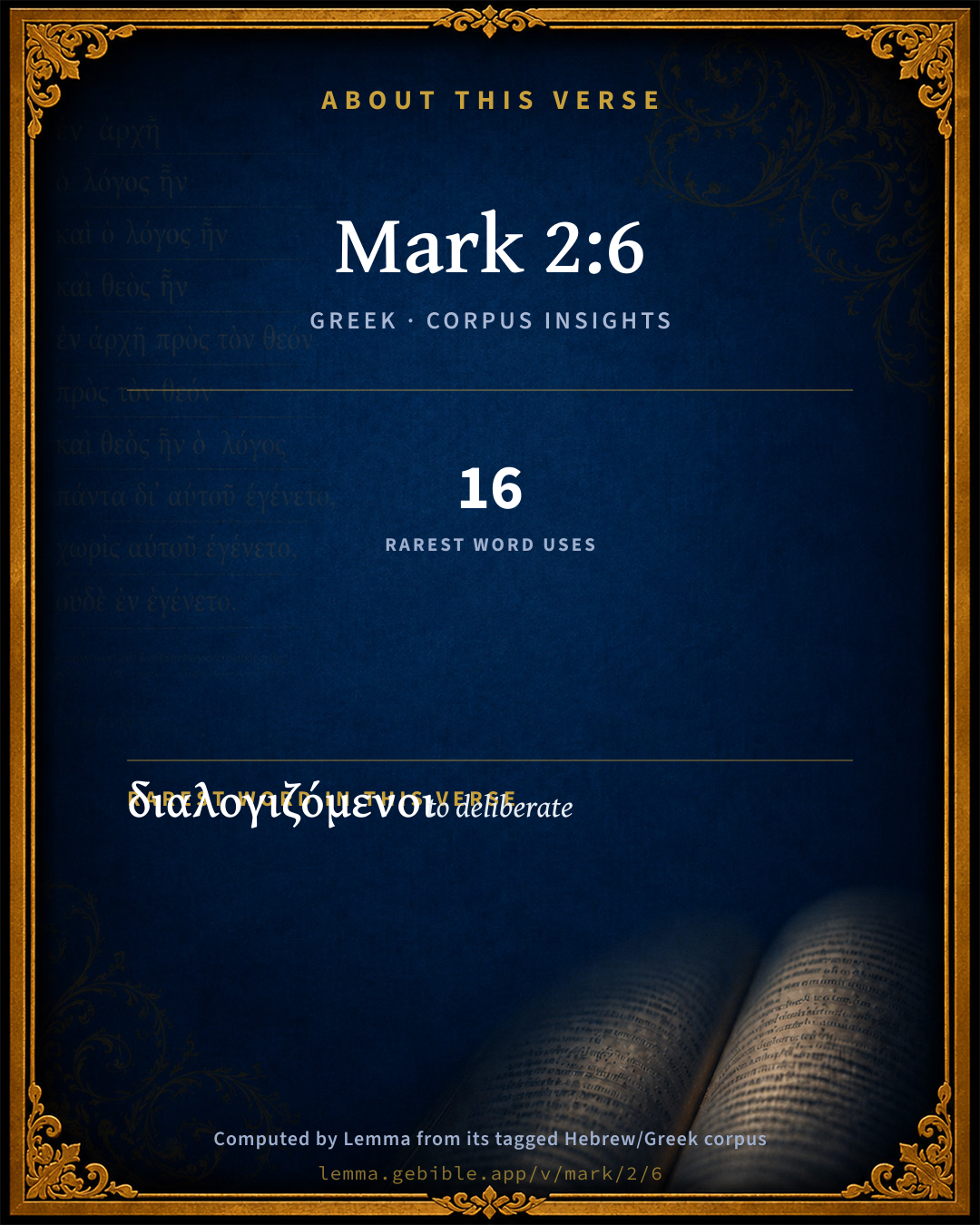
Mark 2:6

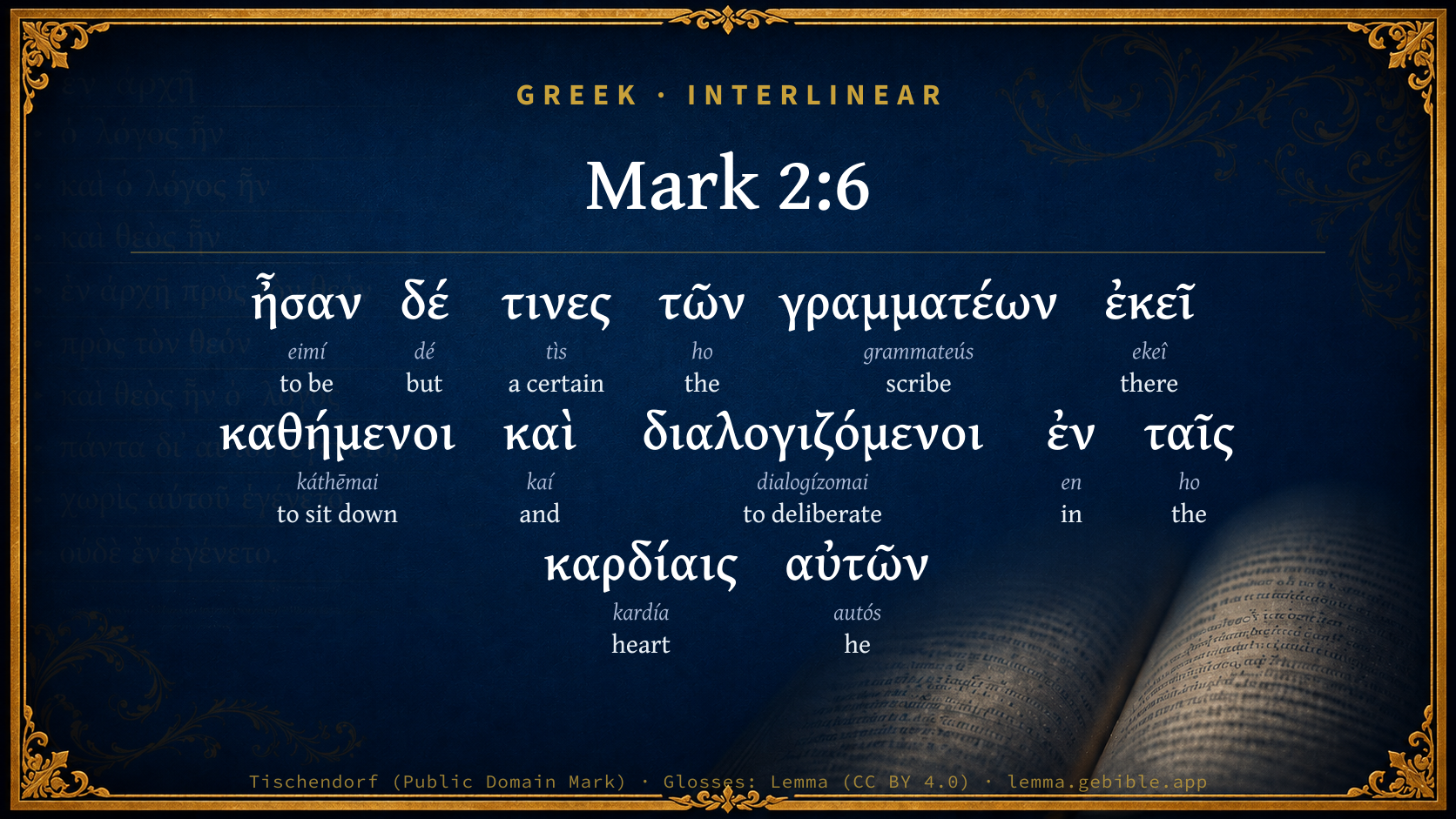
Greek (Tischendorf 8th ed.) Mark 2:6 appears in the Greek New Testament. The text above is from the Tischendorf 8th edition. Each word links to its Strong’s number and a concise gloss. Click any word for its full Thayer’s Greek Lexicon entry.
Download image
Cite this verse

Mark 2:6 (World English Bible). Public Domain. Lemma interlinear Bible study tool, https://lemma.gebible.app/v/mark/2/6.

Show BibTeX & RIS
BibTeX
RIS
English Translation
But there were some of the scribes sitting there, and reasoning in their hearts,
World English Bible · Public Domain
Download a study sheet

One document with this verse’s original text, its word-by-word gloss line, the meaning frame, cross-references with their text, attributed commentary, and full source and license credits — printable, and it pastes into notes with its structure intact.

This verse Autodidact and up

Study sheet (.html) Plain text (.txt)

A passage Seminary Student

Up to 50 verses in one chapter. A passage sheet keeps up to 6 commentary sources and 12 cross-references per verse, in the order this page ranks them, and says so on the sheet whenever that leaves anything out. Ask for a single verse and you get the Autodidact verse sheet above.

Everything on this page stays free to read, with no account — the sheet is a download of what is already on screen, not access to it.

Want to remove ads? Support Godless Engineer
Compare translations 3

The same verse in 3 English versions, stacked beneath the original-language interlinear above. Click any original word for its lexicon entry.

Each is an independent rendering of the whole verse — the interlinear is not word-aligned to these translations.

Highlighted words mark where these versions differ — a whole-verse word diff, not a word-by-word alignment.

  • World English Bible Public Domain
    But there were some of the scribes sitting there, and reasoning in their hearts,
  • King James Version Public Domain
    But there was certain of the scribes sitting there, and reasoning in their hearts,
  • unfoldingWord Literal Text CC BY-SA 4.0
    But some of the scribes were sitting there and debating in their hearts,

unfoldingWord Literal Text — © unfoldingWord, licensed CC BY-SA 4.0. Word-aligned USFM3 via Door43 (git.door43.org/unfoldingWord/en_ult).

Versions to compare (up to 4)

3 of 4 selected

Show all 19 translations

Every available English version of this verse, each an independent rendering of the whole verse.

  • World English Bible Public Domain
    But there were some of the scribes sitting there, and reasoning in their hearts,
  • Berean Standard Bible Public Domain
    But some of the scribes were sitting there and thinking in their hearts,
  • Majority Standard Bible Public Domain
    But some of the scribes were sitting there and thinking in their hearts,
  • King James Version Public Domain
    But there was certain of the scribes sitting there, and reasoning in their hearts,
  • American Standard Version (1901) Public Domain
    But there were certain of the scribes sitting there, and reasoning in their hearts,
  • Revised Version (1885) Public Domain
    But there were certain of the scribes sitting there, and reasoning in their hearts,
  • Geneva Bible (1599) Public Domain
    And there were certaine of the Scribes sitting there, and reasoning in their hearts,
  • Douay-Rheims (1899) Public Domain
    And there were some of the scribes sitting there, and thinking in their hearts:
  • Young's Literal Translation Public Domain
    And there were certain of the scribes there sitting, and reasoning in their hearts,
  • Literal Standard Version CC BY-SA 4.0
    And there were certain of the scribes sitting there, and reasoning in their hearts,
  • Unlocked Literal Bible CC BY-SA 4.0
    Now some of the scribes were sitting there, and they reasoned in their hearts,
  • unfoldingWord Literal Text CC BY-SA 4.0
    But some of the scribes were sitting there and debating in their hearts,
  • Darby Bible Public Domain
    But certain of the scribes were there sitting, and reasoning in their hearts,
  • World Messianic Bible Public Domain
    But there were some of the scribes sitting there and reasoning in their hearts,
  • Webster's Bible Public Domain
    But there were certain of the scribes sitting there, and reasoning in their hearts,
  • Free Bible Version CC BY-SA 4.0
    Some of the religious teachers sitting there thought to themselves,
  • Bible in Basic English Public Domain
    But there were certain of the scribes seated there, and reasoning in their hearts,
  • Text-Critical English NT CC BY 4.0
    Now some of the scribes were sitting there and questioning in their hearts:
  • Tyndale New Testament (1534) Public Domain
    And ther were certayne of the scribes sittinge there and reasoninge in their hertes:

Literal Standard Version (2020), Covenant Press — licensed CC BY-SA 4.0. Text via the HelloAO Bible API (eBible.org). Unlocked Literal Bible (unfoldingWord) — licensed CC BY-SA 4.0. Text via the HelloAO Bible API (eBible.org). unfoldingWord Literal Text — © unfoldingWord, licensed CC BY-SA 4.0. Word-aligned USFM3 via Door43 (git.door43.org/unfoldingWord/en_ult). Free Bible Version, Dr. Jonathan Gallagher — licensed CC BY-SA 4.0. Text via the HelloAO Bible API (eBible.org).

Word by word

More ways to search: Search by grammar → Find every occurrence → Compare this word →

Practice this passage: Drill this verse → Learn its vocabulary →

διαλογιζόμενοι
dialogízomai
G1260
“to deliberate”
Verb, Present, Middle or Passive deponent, Participle, Nominative, Plural, Masculine
Part of Speech
Verb
Tense
Present
Voice
Middle or Passive deponent
Mood
Participle
Case
Nominative
Number
Plural
Gender
Masculine
Full Thayer's Definition

Origin: from G1223 and G3049

TDNT: 03:35,2

1. to bring together different reasons, to reckon up the reasons, to reason, revolve in one's mind, deliberate
  1. ἦσαν eimí G1510 “to be” Verb, Imperfect, Active, Indicative, 3rd person, Plural
  2. δέ dé G1161 “but” Conjunction
  3. τινες tìs G5100 “a certain” Indefinite pronoun, Nominative, Plural, Masculine
  4. τῶν ho G3588 “the” Article, Genitive, Plural, Masculine
  5. γραμματέων grammateús G1122 “scribe” Noun, Genitive, Plural, Masculine
  6. ἐκεῖ ekeî G1563 “there” Adverb
  7. καθήμενοι káthēmai G2521 “to sit down” Verb, Present, Middle or Passive deponent, Participle, Nominative, Plural, Masculine
  8. καὶ kaí G2532 “and” Conjunction
  9. ἐν en G1722 “in” Preposition
  10. ταῖς ho G3588 “the” Article, Dative, Plural, Feminine
  11. καρδίαις kardía G2588 “heart” Noun, Dative, Plural, Feminine
  12. αὐτῶν autós G846 “he” Personal pronoun, Genitive, Plural, Masculine

About this verse

These counts appear in no published source. They are computed here, from the morphology-tagged text and Lemma’s own curated glosses. What Lemma adds →

13
words
12
distinct lemmas
Gospels
section

Notable vocabulary

The rarest word here is διαλογιζόμενοι to deliberate G1260 — appearing just 16 times in the whole Greek New Testament.

Shared distinctive vocabulary

διαλογιζόμενοι to deliberate G1260 occurs in 15 verses of the Greek New Testament. Also found in:

Repetition

A word recurs within this verse:

Cross-references

4

Topical passages linked to Mark 2:6 in the Treasury of Scripture Knowledge — connected by theme and wording, ordered by reader-vote popularity; previews shown in the World English Bible.

  • Luke 5:21–22 The scribes and the Pharisees began to reason, saying, "Who is this that speaks blasphemies? Who can forgive sins, but God alone?"
  • Mark 8:17 Jesus, perceiving it, said to them, "Why do you reason that it's because you have no bread? Don't you perceive yet, neither understand? Is your heart still hardened?
  • Matthew 16:7–8 They reasoned among themselves, saying, "We brought no bread."
  • 2 Corinthians 10:5 throwing down imaginations and every high thing that is exalted against the knowledge of God, and bringing every thought into captivity to the obedience of Christ;

Cross-references courtesy of OpenBible.info (CC BY 4.0).

Commentary

Notes on Mark 2:6 from classic Christian and Jewish commentators (each source and its license shown beneath its notes). The classic Christian expositions comment on the surrounding passage and are grouped to its opening verse, so a note may address several verses; the Jewish commentaries on the Tanakh (Rashi and others) are per-verse, so they appear only where the commentator wrote on this verse.

Lemma curates 59 commentaries, every one of them public domain or Creative Commons licensed, each selected and text-cleaned for this edition rather than reprinted as found. About our sources →

The Biblical Illustrator

Joseph S. Exell

Mar_2:6

But there were certain of the scribes sitting there, and reasoning in their hearts.

Reasons in reserve

All true religion is located in the heart. Where the human heart goes the human life will go. The New Testament is a revelation addressed to the heart. Our Lord Jesus Christ was set for the fall and rising again of many in Israel, and for a sign to be spoken against, that the thoughts of many hearts may he revealed. This story is remarkable for the exhibition it makes:

(1) Of enterprise in bringing a helpless soul to the Saviour: how many ingenuities-there are for reaching men when only the friends around them are in earnest;

(2) of the intimate connection existing between sin and suffering: our Lords action in bestowing pardon with the cure was strictly logical;

(3) of the great advantage it is to any man to have Christians for companions to become friends in his need: this palsied creature was healed because of the faith other people had;

(4) of the force of mean motives in driving men to reject Christ: these scribes were moved by arguments which they cherished, but concealed from sight. Upon this last point it seems worth while to dwell for a little while just by itself. Let us group the illustrations of the narrative around two simple propositions in turn.

I. The worst opposition which Christians have to meet in offering the gospel to men is found in the mental reservations of its rejectors, and the sullen silence of their hearts.

1. To begin with, there are unspoken objections which influence, if they do not control, ones intellectual views. Men insist that there are discrepancies in the records of the Old and New Testaments which vitiate their truth, and, if generally known, would mock their claim to exact inspiration. Other men make great parade in private over difficulties in doctrine, and challenge attention to the fact that theologians differ in relation to almost all the cardinal points of what is called the evangelical system. Still others cavil at the inconsistencies of Church members, and rail out against them for hypocrisy, if only they can manage to secure a safe and credulous audience that dares not contradict them. Hints and innuendoes are the usual signs of this disturbed and unwholesome state of mind. Where do the young men of the present day obtain so much sceptical information? It is thrust in upon them by the public press. Doubts drop down like loose feathers wherever croaking ravens are wont to fly. But why is it that these reasons are so often held in reserve? Why does the man preserve his sullen demeanour without a word?

(1) Because he is not exactly certain he can state them: it is not everybody who can say clearly what he does not believe;

(2) because he feels a misgiving that they may not stand when someone a little more scholarly gets hold of them;

(3) and because he suspects that if he goes so far in his small infidelity, he really would have to go farther or give it up.

2. There are unconscious prejudices which arouse ones temper. Some persons conceive a violent spite at what they assert is a continuous rebuke whenever Christian life is praised or commended. This is not a new thing in history. Classic annals tell us that an unlettered countryman gave his vote against Aristides at the ostracism because, as he frankly said, he was tired of hearing him called The Just. Other persons cherish implacable memories of indiscreet zeal practised upon them by those who supposed they were dutifully obeying the command, Go, speak to that young man. They recite the grievance of revival extravagances, which they deemed offensive and never to be forgotten. They rehearse the biographies of preachers who bullied the patient congregations, and then ran into immorality and deplorable scandal. They plead rashness as an excuse for reserve.

3. There are unacknowledged sins which sway ones career. Come back to the story here in Marks narrative. Hear the comments of these scribes accusing Jesus of blasphemy! Violent clamours for moral and theological perfectness are raised by many whose sole aim is to divert attention from some secret indulgences of their own. These people reason in their hearts. Sometimes in modern life a very showy conflict with Satan is kept up before the public in order to conceal the fact of ones friendship with him. It reminds us of plays in which the actors personate the devil fencing with some good antagonist behind the footlights, a knight, perhaps, the pink of virtue, battling fiercely with the demon clad in robe of fire. No one engaged for his soul could appear more bravely in earnest. But we are struck with a certain kind of wariness, which they both show in their hitting. Sparks fly from the weapons, but blood does not seem to be drawn. And if afterwards we were to go behind the scenes, there we should find those high-tempered combatants in a most surprising state of reconciliation; honourable knight and fiery devil seated in a friendly way at the table.

4. There results an unsubdued will sullenly closing ones lips. Many men live a double life; they mean to be courteous, but on religious matters they cultivate a cool, proud reserve. It often surprises us to find our Christian endeavours so ineffective with apparently kind, open, intelligent people. What is the real reason? Because the heart is what governs, and logic is not addressed to the heart. Arguments are made and meant for the intellect, and lose weight in the tenuous atmosphere of the feelings. It shows no difference whether we drop down feathers or dollars through the vacuum of an air pump.

II. Thus we reach our second proposition: all these reasons in reserve avail nothing to men the moment the contest is seen to be, as it always is, a contest with god and not man.

1. Look at the facts here; first, see verse 8. Jesus understood those scribes

(1) divinely-He perceived in His spirit. He understood them

(2) thoroughly-He saw what was within themselves. He understood them

(3) at once; note that old word immediately. God knows all our surmises and suspicions.

Jesus peremptorily challenged those scribes in their logic.

(1) He announced His discovery. They were amazed; literally, thunderstruck.

(2) He accepted their condition. They looked on while He healed the man by miracle.

(3) He defeated them utterly. We read that they all glorified God.

2. Now let us draw a few final inferences from the whole story. This scene is repeated every day in the full sight of a patient God. Human nature is always the same along the ages.

(1) There cannot possibly be any reasoning in ones heart which our omniscient Judge is not able instantly to perceive and to answer. Once a French soldier fell asleep on his post, and was brought up for trial by court martial. The first witness called was the Emperor Napoleon. I was visiting the sentinels outposts, he said; I saw this soldier myself.

(2) True prudence consists in outspoken candour. Come, let us reason together. Sometimes objections vanish with the statement; for they seem so insignificant when expressed. Mere articulation of difficulties often clears them of confusion.

(3) Sullen reserve surely runs to swift ruin. The difference between an ignorant prejudice and a wilful conceit is shown in this: ignorance stands with its back to the sun, and so if it advances moves on in the line of its own shadow only a step deeper; but churlish conceit walks straight away into a forest of doubts, till its own shadow is darkened with other shadows gloomier still. Hence, a confessed ignorance is altogether more hopeful for good because all it has to do is to turn to the light. Sullen obstinacy has to retrace its path, and so journey clear back to where it started. It was considerations of this sort which forced the bright remark that an ingenuous intellect is often better than an ingenious one.

(4) Reasons in reserve have really nothing to do with actual life or eternal prospects. (C. S. Robinson, D. D.)

I. An important aspect of human power. Secrecy and mental reservations.

II. A startling instance of Divine insight. Our silence is as loud as thunder to God! Our heart talk is overheard!

III. A splendid manifestation of Christs fearlessness Be need not have answered more than was spoken.

IV. A solemn example of the confusion which will fall upon all Christs objectors. Enquiry: What is your unspoken objection? Doctrinal? Disciplinary? Philosophical? Ethical? Grammatical? (J. Parker, D. D.)

Human reasonings about Divine forgiveness

I. That human reasonings are busy with the fact of the Divine forgiveness. Why doth this man thus speak blasphemies? Who can forgive sins, but God only?

1. Some men question the ability of Christ to forgive sin.

2. Some men seek to understand the process by which sin is forgiven. They wish to understand the mental philosophy of forgiveness, and because they cannot they deride it as a delusion. Is it to be expected that men shall be able to trace the Divine action in its method of forgiveness upon the human soul? Can men infallibly submit the subtle influences of heaven to their rude and vulgar tests, as they would the thoughts and mental actions of men? No! Who, by searching, can find out God? And certainly in His forgiving influence upon the human soul He is an unsearchable mystery.

3. Some men repudiate the evidences of the Divine forgiveness. They ask, how do we know that a man is forgiven; and what is the difference between him and any unforgiven individual? The evidence of it is in the hatred of sin, and in the purity of life which it inspires. And this witness is true. The world should receive it as such.

II. That Christ refutes the mental reasonings of men in reference to the fiat of Divine forgiveness. The reasonings of these men were refuted:

1. By the test of consciousness. The palsied man knew that his sins were forgiven in response to the Divine voice.

2. By the miracle of healing. Forgiveness heals the life.

Lessons:

1. Not to cavil at the method of the Divine forgiveness.

2. To receive it with adoring gratitude.

3. To attest it by a holy life.

The Biblical Illustrator, edited by Joseph S. Exell (c. 1880s–1900s) — public domain. Text from a community e-Sword module.

Tyndale Open Study Notes

Tyndale Open Resources

2:6-7 Only God can forgive sins, yet Jesus had authority to do so (2:10).

Tyndale Open Study Notes — © Tyndale Open Resources, licensed CC BY-SA 4.0. Text via the HelloAO Bible API.

Expositor's Greek Testament

ed. W. Robertson Nicoll

Mar 2:6-12 . Thus far of the sick man, how he got to Jesus, and the sympathetic reception he met with. Now the scribes begin to play their part. They find their opportunity in the sympathetic word of Jesus: thy sins be forgiven thee; a word most suitable to the case, and which might have been spoken by any man. τινες τ . γρ .: Lk. makes of this simple fact a great affair: an assembly of Pharisees and lawyers from all quarters Galilee, Judaea, Jerusalem, hardly suitable to the initial stage of conflict. ἐκεῖ καθήμενοι : sitting there. If the posture is to be pressed they must have been early on the spot, so as to get near to Jesus and hear and see Him distinctly. ἐν ταῖς καρδίαις α .: they looked like men shocked and disapproving. The popularity of Jesus prevented free utterance of their thought. But any one could see they were displeased and why. It was that speech about forgiveness.

The Expositor's Greek Testament, edited by W. Robertson Nicoll (1897–1910) — public domain. Text from a community e-Sword module.

Geneva Bible (1599)

Geneva Bible translators

In their minds disputing upon that matter, on both sides.

Geneva Bible (1599) marginal notes — public domain. Text via Bolls.life.

Jamieson, Fausset & Brown

Robert Jamieson, A. R. Fausset & David Brown

But there were certain of the scribes--"and the Pharisees" (Luk 5:21)

sitting there--those Jewish ecclesiastics who, as Luke told us (Luk 5:17), "were come out of every village of Galilee, and Judea, and Jerusalem," to make their observations upon this wonderful Person, in anything but a teachable spirit, though as yet their venomous and murderous feeling had not showed itself.

and reasoning in their hearts.

Jamieson, Fausset & Brown — Commentary Critical and Explanatory on the Whole Bible (1871) — public domain (CC PDM 1.0). Text via the HelloAO Bible API.

Ellicott's Commentary for English Readers

(6) Certain of the scribes.—These are described by St. Luke (Luk_5:17) as “having come from every village of Galilee, and Judæa, and Jerusalem.”

A Bible Commentary for English Readers, edited by Charles John Ellicott (1878–1897) — public domain. Text from a community e-Sword module.

The Cambridge Bible for Schools and Colleges

gen. ed. J. J. S. Perowne

6. certain of the scribes] During our Lord’s absence from Capernaum it would seem there had arrived not only from Galilee, but even from Judæa and Jerusalem (Luk_5:17), Pharisees and lawyers, who were insidiously watching all that He did. Emissaries from the hostile party at Jerusalem, where the Lord’s death had already been decreed (Joh_5:18), they proceeded to carry out a settled plan of collecting charges against Him and thwarting His work of mercy.

The Cambridge Bible for Schools and Colleges (gen. ed. J. J. S. Perowne; Cambridge University Press, 1878–1918) — public domain. Text from a community e-Sword module.

John Gill's Exposition

Why doth this man thus speak blasphemies?.... They took Christ to be a mere man, and reasoned with themselves, that he must be a blasphemer, in assuming that to himself, which was peculiar to God: they seem astonished at his words, and wonder at his arrogance, and to be filled with indignation and resentment at him; saying,

who can forgive sins but God only? this was a generally received maxim with them, and a very just one. The Chaldee paraphrase of Job 14:4, runs thus;

"who can give a pure man out of a man that is defiled with sins, but God, who alone is he, , "that can pardon him?"''

They even deny that Metatron, so they call the angel in Exo 23:20, of whom they say, that his name is as the name of his master, has a power of forgiving sins; for which reason the Israelites rejected him as a messenger (i). They were right in saying, that none but God could forgive sin, against whom it is committed; but wrong in charging Christ with blasphemy on this account; because he is truly God, as well as man, as his omniscience and omnipotence hereafter manifested, did abundantly show. That no mere creature can forgive sin, is certain: good men may, and ought to forgive one another, and even their very enemies; but then they can only forgive sin as an injury done to themselves, not as committed against God. The ministers of the Gospel may be said to remit sins ministerially, or declaratively, by preaching the doctrine of pardon, declaring, that such as believe in Christ shall receive the remission of sins; but for any man to assume such a power to himself, as to grant pardons and indulgences, to absolve from sins, is anti-christian, as the pope of Rome does; in which he takes that to himself, which is peculiar to God; so that he, as God, sitteth in the temple of God, showing himself that he is God, Th2 2:4. Nor can any man procure the forgiveness of his sins by any thing he has, or can do; not by his riches, which will not profit in a day of wrath, they being not a sufficient ransom price for a man's self, or any of his brethren and friends; nor by his repentance, for though this, and remission of sins, go together in grace and experience, yet repentance is not the cause of remission of sins, but rather the effect of remission applied; nor by his faith, for faith does not procure, but receives this blessing: and much less by good works, for then the forgiveness of sins would not be according to the riches of grace; and a man would be saved by his works, since a principal part of salvation lies in the pardon of sin; and besides the blood of Christ would be shed in vain. That God only can forgive sin, is evident, because it is against him, and him only, that men sin: sin is a transgression of his law, a contrariety to his nature, and a contradiction of his will, an affront to his justice and holiness, a contempt of him, who is the lawgiver, that is able to save and to destroy; it is of the nature of a debt, which he only can loose from. Moreover, if there were any besides himself that could forgive sin, he would have one equal with him, and like unto him; whereas, "who is a God like unto thee, that pardoneth iniquity?" Mic 7:18. This is a prerogative peculiar to him, which he challenges to himself: "I even I am he that blotteth out thy transgressions", Isa 43:25, but then this is common to all the three divine persons in the Godhead, Father, Son, and Spirit. The Father, he has prepared this grace in his own heart; for the moving cause of it, is his sovereign grace and mercy; he has promised and secured it in the covenant of his grace; he set forth, and sent forth his Son to obtain it, by the shedding of his blood, that so his justice might he satisfied; and it is for Christ's sake he forgives all trespasses. The Son of God is concerned in it: as man, his blood was, shed for it; and that being the blood, not of a mere man, but of him that is God, as well as man, it was effectual to that purpose; it is in his name that it is preached, and he is exalted as a Saviour to give it; and as the advocate of his people he calls for it, and requires it; and as he is truly and properly God, he has equal power to bestow it, and apply it as his Father. The holy Spirit, as he makes men sensible of their need of it, he shows it to them, and their interest in it; he sprinkles the blood of Christ upon their consciences, and declares them pardoned through it; he bears witness of the truth of it to them, and seals it up unto them; so that it is wholly of God.

(i) T. Bab. Sanhedrin, fol. 38. 2. & Gloss. in ib.

John Gill's Exposition of the Whole Bible (1746–1763) — public domain (CC PDM 1.0). Text via the HelloAO Bible API.

Trapp's Complete Commentary

John Trapp

6 But there were certain of the scribes sitting there, and reasoning in their hearts,

Ver. 6. But there were certain of the scribes] Little do preachers know when they preach, what hearers sit before them. Araneo fel est, quod api mel. Some of our hearers carry fel in aure, as it is said of some creatures, they carry their gall in their ears.

John Trapp, A Commentary or Exposition upon All the Books of the Old and New Testament (1647–1656) — public domain. Text from a community e-Sword module.

The Pulpit Commentary

Vers. 6, 7. The words, Why doth this man thus speak blasphemies? in accordance with the altered reading (blasfhmei for blasfhmiav), should stand thus: Why doth this man thus speak? he blasphemeth. It is evident that the scribes, who were secretly amongst themselves finding fault with our Lord"s words, understood that, by the use of these words, our Lord was assuming to himself a Divine attribute. And if he had been a mere man; if he had not really been, as he assumed to be, Divine, the only begotten Son of the Father, then no doubt they would have been right in supposing that he blasphemed. But their error was that they could not perceive in him the glory of the only begotten Son. The light was shining in the darkness, and the darkness apprehended it not.

The Pulpit Commentary (1880–1919), ed. H.D.M. Spence-Jones & Joseph S. Exell — public domain. Text from a community e-Sword module.

John Wesley's Explanatory Notes

But certain of the scribes - See whence the first offense cometh! As yet not one of the plain unlettered people were offended. They all rejoiced in the light, till these men of learning came, to put darkness for light, and light for darkness. Woe to all such blind guides! Good had it been for these if they had never been born. O God, let me never offend one of thy simple ones! Sooner let my tongue cleave to the roof of my mouth!

John Wesley, Explanatory Notes Upon the Whole Bible (1754–1765) — public domain. Text via the GEBible commentary corpus.

Kretzmann's Popular Commentary

Paul E. Kretzmann

Christ’s defense against the scribes:

v. 6. But there were certain of the scribes sitting there, and reasoning in their hearts,

v. 7. Why doth this man thus speak blasphemies? Who can forgive sins but God only!’

v. 8. And immediately when Jesus perceived in His spirit that they so reasoned within themselves, He said unto them, Why reason ye these things in your hearts!’

v.. Whether is it easier to say to the sick of the palsy, Thy sins be forgiven thee, or to say, Arise, and take up thy bed, and walk!’

v. 10. But that ye may know that the Son of Man hath power on earth to forgive sins, (He saith to the sick of the palsy,)

v. 11. I say unto thee, Arise, and take up thy bed, and go thy way into thine house.

v. 12. And immediately he arose, took up the bed, and went forth before them all, insomuch that they were all amazed, and glorified God, saying, We never saw it on this fashion.

The leaders of the Jews had watched developments in Galilee with apprehension for some time. The simple assurance of this new teacher did not meet with their approval, especially since He had not asked for their sanction. And so they had men watching Jesus all the time. In this case there was a large delegation of scribes present, Luk 5:17. As soon as they heard the word out of the mouth of Jesus concerning forgiveness, their pharisaic suspicions were aroused, and their pharisaic condemnation followed. For fear of the multitude they dared not voice their sentiments, but in their heart they passed judgment unhesitatingly, condemning Jesus for a blasphemer. Their argument sounds reasonable: Who can forgive sins but God only? Every sin is, in the last analysis, a transgression of God’s holy commandment and therefore against Him. From God, therefore, we ask forgiveness of our sins, Psa 25:18; Psa 32:5. But two points should be noted: Christ, as the Son of God, as His equal in all divine attributes, can and may forgive sins in His own power; and the announcement of forgiveness implies the redemption, and may now be made by any man. Though the objection was not spoken, yet Jesus, who searches mind and heart, Psa 139:2, knew their thoughts perfectly which they had concerning Him. And He replies to the challenge. He puts a question to them which is intended to show them the foolishness of their position: Which is the easier of the two, to heal the spiritual or the bodily infirmity? Mat 9:4-5, to say: Thy sins be forgiven thee, or to say: Arise, and take up thy bed, and walk off? The scribes, according to their position, now should have said: The forgiving of sins is the easier, for that cannot be controlled, since its action was strictly in the spiritual plane. But Jesus does not wait for their answer. He wants to give them a practical, indubitable proof and demonstration of the power which He possesses in His position as Son of Man, in His office as the divine-human Messiah. He forgave the sins of the paralytic in His own power, by His own right and might. And He now, by a simple command, restored the sick man to perfect health and full strength, enabling him not only to get up from his couch with some unsteadiness, but to take up his couch before them all and to depart. It was such a wonderful manifestation that all those present, with the exception of the scribes, were astonished almost to stupefaction, and gave praise to God in the words: In this way we never saw it yet. This miracle and all it implied and presupposed was something new to them. It argued for a power greater than any that they had ever come into contact with.

There is much comfort in these words to this day. The Son of God became man, and by His life, Passion, and death earned perfect forgiveness for the sins of all men. The debt is not simply canceled, but is paid through the merits of Christ. For that reason God no longer has a remembrance of our sins. And therefore the Son of Man may distribute the great treasure, which He has earned, among the children of men. What is more, God has, through Christ, given to men the power on earth to forgive sins. Christ has given to all His disciples, to the entire Christian Church on earth, the peculiar power to forgive the sins of the penitent sinners unto them. Thus we know where and how we may find forgiveness of sins. "Not in heaven, as the Pharisees here suppose. Guard against that and say: God has placed forgiveness of sins into Holy Baptism, into the Lord’s Supper, and into the Word; yea, He has given it into the mouth of every Christian; if he consoles thee and promises thee God’s grace through the merit of Christ Jesus, thou shalt receive and believe it, in no other way but as though Christ with His own mouth had given thee the promise, as here to the paralytic."

Paul E. Kretzmann, Popular Commentary of the Bible (1921–1924) — public domain. Text from a community e-Sword module.

Cambridge Greek Testament for Schools and Colleges

6. τινες τῶν γραμματέων. See on Mar 1:22. The first appearance of the Scribes in Mk, but Mt. (Mar 2:4) has them in connexion with the Magi.

καθήμενοι. Lk. preserves this graphic detail and adds that they had come “out of every village of Galilee and Judaea and from Jerusalem.” That is popular hyperbole, but it shows that Christ’s teaching had already excited the misgivings of the hierarchy (Joh 4:1), as the Baptist’s teaching had done (Joh 1:19; Joh 1:24). Their sitting may have been accidental (Mar 3:34), but it may have been a mark of distinction such as they loved (Mar 12:39). In so crowded a room most would have to stand. On the combination of participles see on Mar 1:15.

ἐν ταῖς καρδίαις. It is remarkable that this Hebraistic expression is in Mk, while Mt., as also in Mat 16:7-8, Mat 21:25, has ἐν ἑαυτοῖς. In Mar 2:8 all three have ἐν τ. καρδίαις: in Mar 11:23 Mk alone has it. The heart is regarded as the seat of thought (Mar 7:21) as well as of emotion. The Scribes had not yet got so far as to express their hostile criticisms openly in Christ’s hearing.

Cambridge Greek Testament for Schools and Colleges (Cambridge University Press, 1896; 21 vols, various authors incl. Carr, Maclear, Plummer, Farrar, Lumby, Moule, M. R. James, Simcox) — public domain. Text from a community e-Sword module.

International Critical Commentary

6. τῶν γραμματέων—of the Scribes.1 This is the first encounter of Jesus with the formalists and dogmatists of his time. So also in Mt. and Lk. And the matter in controversy, the extraordinary claims of Jesus, was sure to become an issue between them. The opposition to Jesus is easily explained. διαλογιζόμενοι ἐν ταῖς καρδίαις—debating in their hearts. καρδία, in the N.T., does not denote, like our word heart, the seat of the affections, but the inner man generally, and more specifically, the mind. This corresponds to the Homeric use, the common Greek use being like ours.

International Critical Commentary — older volumes (1896–1929), various authors — public domain. Text from a community e-Sword module.

Vincent's Word Studies in the New Testament

Marvin R. Vincent

Reasoning [διαλογιζομενοι] . The word dialogue is derived from this, and the meaning literally is, that they held a dialogue with themselves.

Marvin R. Vincent, Word Studies in the New Testament (1887–1900) — public domain. Text from a community e-Sword/MySword module.

Lesson kit

Teaching starters — assembled from the data on this page, not authored interpretation. Every prompt links to the verse data it draws on. Edit before teaching.

Mark, in the Gospels, opens this verse with 13 words (12 distinct Greek lemmas). Its most distinctive word is dialogízomai (“to deliberate”). A historical commentator’s framing appears above. Read the whole chapter for the surrounding context.

Discussion questions

  1. What does “to deliberate” (dialogízomai) contribute to the verse as a whole?
  2. How does Matthew 16:7, which shares the word «to deliberate», read alongside this verse?
  3. What does the repetition of “the” (2× in this one verse) do in this verse?
  4. These translations render this verse differently. What is at stake in choosing one wording over another?
  5. Compare how The Biblical Illustrator and Tyndale Open Study Notes read this verse. Where do they agree or differ?

Things to notice

Reading settings

Reading text

Shown beneath each verse's original-language words.

Old Testament
Old Testament edition

Read the OT as the Masoretic Hebrew (MT) or the Greek Septuagint (LXX).

English shown for the Greek Septuagint (in the Hebrew ↔ Greek comparison).

Comparing translations? Open the Compare panel on any verse page to stack up to four side by side.