Matthew 26:7

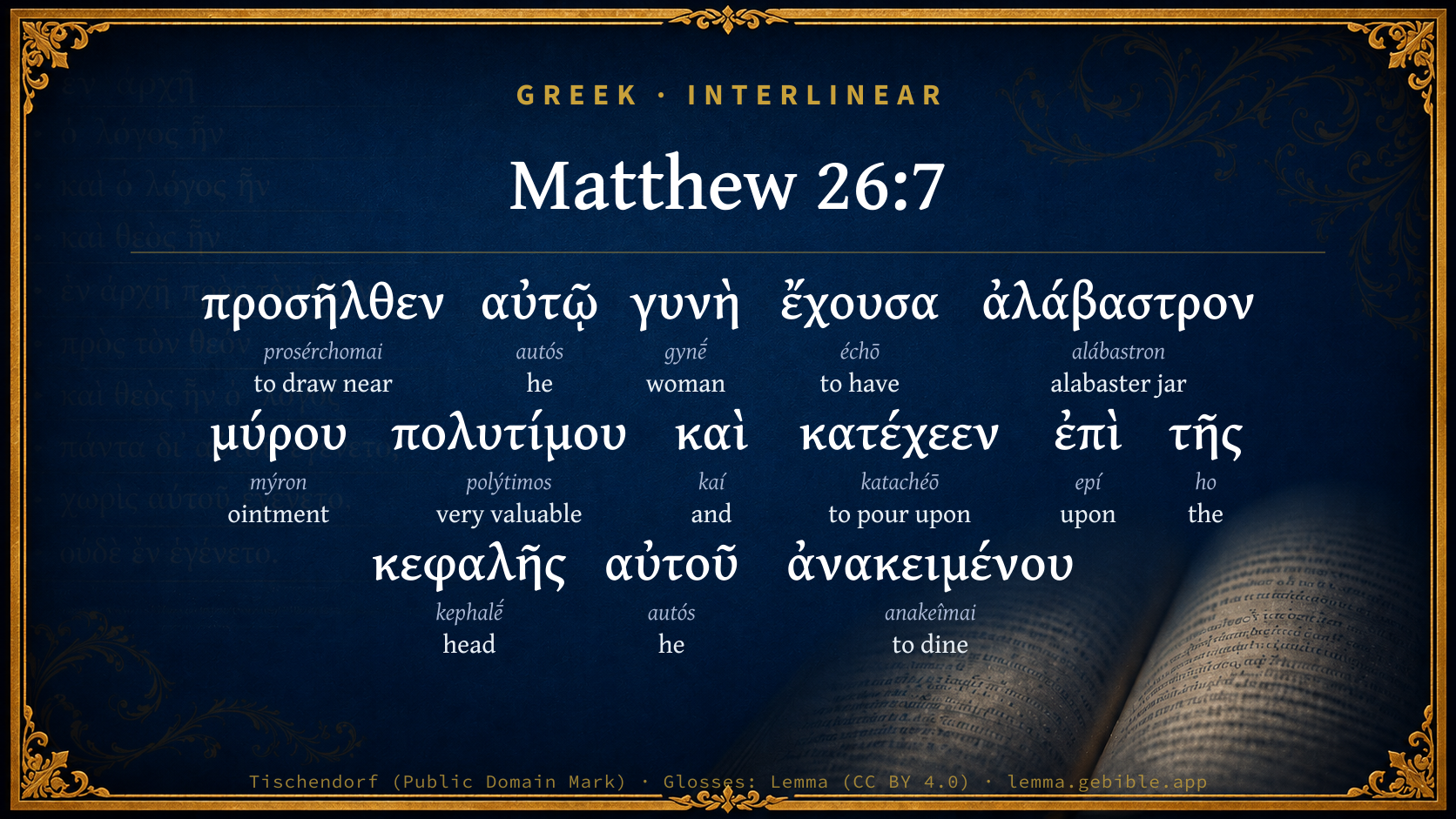
Greek (Tischendorf 8th ed.) Matthew 26:7 appears in the Greek New Testament. The text above is from the Tischendorf 8th edition. Each word links to its Strong’s number and a concise gloss. Click any word for its full Thayer’s Greek Lexicon entry.
Download image
Cite this verse

Matthew 26:7 (World English Bible). Public Domain. Lemma interlinear Bible study tool, https://lemma.gebible.app/v/matthew/26/7.

Show BibTeX & RIS
BibTeX
RIS
English Translation
a woman came to him having an alabaster jar of very expensive ointment, and she poured it on his head as he sat at the table.
World English Bible · Public Domain
Highlights
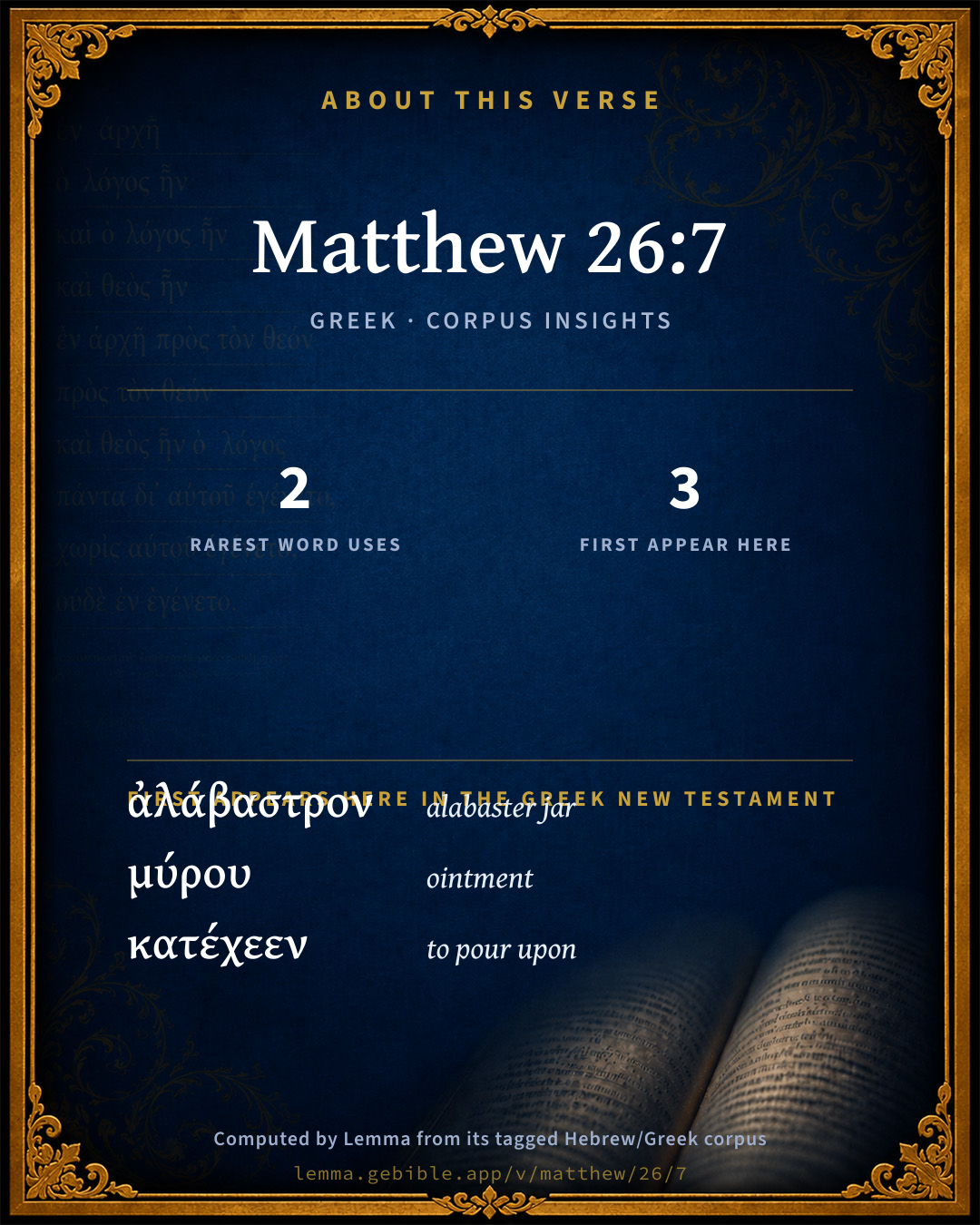
  • 3 first appearances in the Greek New Testament
Full analysis ↓
Download a study sheet

One document with this verse’s original text, its word-by-word gloss line, the meaning frame, cross-references with their text, attributed commentary, and full source and license credits — printable, and it pastes into notes with its structure intact.

This verse Autodidact and up

Study sheet (.html) Plain text (.txt)

A passage Seminary Student

Up to 50 verses in one chapter. A passage sheet keeps up to 6 commentary sources and 12 cross-references per verse, in the order this page ranks them, and says so on the sheet whenever that leaves anything out. Ask for a single verse and you get the Autodidact verse sheet above.

Everything on this page stays free to read, with no account — the sheet is a download of what is already on screen, not access to it.

Want to remove ads? Support Godless Engineer
Compare translations 3

The same verse in 3 English versions, stacked beneath the original-language interlinear above. Click any original word for its lexicon entry.

Each is an independent rendering of the whole verse — the interlinear is not word-aligned to these translations.

Highlighted words mark where these versions differ — a whole-verse word diff, not a word-by-word alignment.

  • World English Bible Public Domain
    a woman came to him having an alabaster jar of very expensive ointment, and she poured it on his head as he sat at the table.
  • King James Version Public Domain
    There came unto him a woman having an alabaster box of very precious ointment, and poured it on his head, as he sat at meat.
  • unfoldingWord Literal Text CC BY-SA 4.0
    a woman approached him having an alabaster jar of very expensive perfumed oil, and she poured upon his head, reclining to eat.

unfoldingWord Literal Text — © unfoldingWord, licensed CC BY-SA 4.0. Word-aligned USFM3 via Door43 (git.door43.org/unfoldingWord/en_ult).

Versions to compare (up to 4)

3 of 4 selected

Show all 19 translations

Every available English version of this verse, each an independent rendering of the whole verse.

  • World English Bible Public Domain
    a woman came to him having an alabaster jar of very expensive ointment, and she poured it on his head as he sat at the table.
  • Berean Standard Bible Public Domain
    a woman came to Him with an alabaster jar of expensive perfume, which she poured on His head as He reclined at the table.
  • Majority Standard Bible Public Domain
    a woman came to Him with an alabaster jar of expensive perfume, which she poured on His head as He reclined at the table.
  • King James Version Public Domain
    There came unto him a woman having an alabaster box of very precious ointment, and poured it on his head, as he sat at meat.
  • American Standard Version (1901) Public Domain
    there came unto him a woman having an alabaster cruse of exceeding precious ointment, and she poured it upon his head, as he sat at meat.
  • Revised Version (1885) Public Domain
    there came unto him a woman having an alabaster cruse of exceeding precious ointment, and she poured it upon his head, as he sat at meat.
  • Geneva Bible (1599) Public Domain
    There came vnto him a woman, which had a boxe of very costly oyntment, and powred it on his head, as he sate at the table.
  • Douay-Rheims (1899) Public Domain
    There came to him a woman having an alabaster box of precious ointment, and poured it on his head as he was at table.
  • Young's Literal Translation Public Domain
    there came to him a woman having an alabaster box of ointment, very precious, and she poured on his head as he is reclining (at meat).
  • Literal Standard Version CC BY-SA 4.0
    there came to Him a woman having an alabaster box of ointment, very precious, and she poured on His head as He is reclining.
  • Unlocked Literal Bible CC BY-SA 4.0
    as he was reclining at table, a woman came to him having an alabaster jar of very expensive ointment, and she poured it upon his head.
  • unfoldingWord Literal Text CC BY-SA 4.0
    a woman approached him having an alabaster jar of very expensive perfumed oil, and she poured upon his head, reclining to eat.
  • Darby Bible Public Domain
    a woman, having an alabaster flask of very precious ointment, came to him and poured it out upon his head as he lay at table.
  • World Messianic Bible Public Domain
    a woman came to him having an alabaster jar of very expensive ointment, and she poured it on his head as he sat at the table.
  • Webster's Bible Public Domain
    There came to him a woman having an alabaster-box of very precious ointment, and poured it on his head as he sat at table.
  • Free Bible Version CC BY-SA 4.0
    a woman came over to him carrying an alabaster jar of very expensive perfume. She poured it on Jesus' head while he was sitting eating.
  • Bible in Basic English Public Domain
    There came to him a woman having a bottle of perfume of great price, and she put the perfume on his head when he was seated at table.
  • Text-Critical English NT CC BY 4.0
    a woman came to him with an alabaster jar of very expensive ointment, and she poured it on his head as he reclined at the table.
  • Tyndale New Testament (1534) Public Domain
    ther came vnto him a woman which had an alablaster boxe of precious oyntment and powred it on his heed as he sate at the bourde.

Literal Standard Version (2020), Covenant Press — licensed CC BY-SA 4.0. Text via the HelloAO Bible API (eBible.org). Unlocked Literal Bible (unfoldingWord) — licensed CC BY-SA 4.0. Text via the HelloAO Bible API (eBible.org). unfoldingWord Literal Text — © unfoldingWord, licensed CC BY-SA 4.0. Word-aligned USFM3 via Door43 (git.door43.org/unfoldingWord/en_ult). Free Bible Version, Dr. Jonathan Gallagher — licensed CC BY-SA 4.0. Text via the HelloAO Bible API (eBible.org).

Word by word

More ways to search: Search by grammar → Find every occurrence → Compare this word →

Practice this passage: Drill this verse → Learn its vocabulary →

κατέχεεν
katachéō
G2708
“to pour upon”
Verb, Aorist, Active, Indicative, 3rd person, Singular
Part of Speech
Verb
Tense
Aorist
Voice
Active
Mood
Indicative
Person
3rd person
Number
Singular
Full Thayer's Definition

Origin: from G2596 and cheo (to pour)

TDNT: None

1. to pour down upon 2. pour over, pour upon
  1. προσῆλθεν prosérchomai G4334 “to draw near” Verb, Aorist, Active, Indicative, 3rd person, Singular
  2. αὐτῷ autós G846 “he” Personal pronoun, Dative, Singular, Masculine
  3. γυνὴ gynḗ G1135 “woman” Noun, Nominative, Singular, Feminine
  4. ἔχουσα échō G2192 “to have” Verb, Present, Active, Participle, Nominative, Singular, Feminine
  5. ἀλάβαστρον alábastron G211 “alabaster jar” Noun, Accusative, Singular, Neuter
  6. μύρου mýron G3464 “ointment” Noun, Genitive, Singular, Neuter
  7. πολυτίμου polýtimos G4186 “very valuable” Adjective, Genitive, Singular, Feminine
  8. καὶ kaí G2532 “and” Conjunction
  9. ἐπὶ epí G1909 “upon” Preposition
  10. τῆς ho G3588 “the” Article, Genitive, Singular, Feminine
  11. κεφαλῆς kephalḗ G2776 “head” Noun, Genitive, Singular, Feminine
  12. αὐτοῦ autós G846 “he” Personal pronoun, Genitive, Singular, Masculine
  13. ἀνακειμένου anakeîmai G345 “to dine” Verb, Present, Middle or Passive deponent, Participle, Genitive, Singular, Masculine

About this verse

These counts appear in no published source. They are computed here, from the morphology-tagged text and Lemma’s own curated glosses. What Lemma adds →

14
words
13
distinct lemmas
Gospels
section

Notable vocabulary

The rarest word here is κατέχεεν to pour upon G2708 — appearing just 2 times in the whole Greek New Testament.

First appearance in Scripture

These words make their first canonical appearance in the Greek New Testament here:

  • ἀλάβαστρον alabaster jar G211
  • μύρου ointment G3464
  • κατέχεεν to pour upon G2708

Shared distinctive vocabulary

κατέχεεν to pour upon G2708 occurs in 2 verses of the Greek New Testament. Also found in:

Repetition

A word recurs within this verse:

  • αὐτῷ he G846 ×2

Cross-references

9

Topical passages linked to Matthew 26:7 in the Treasury of Scripture Knowledge — connected by theme and wording, ordered by reader-vote popularity; previews shown in the World English Bible.

  • John 12:2–3 So they made him a supper there. Martha served, but Lazarus was one of those who sat at the table with him.
  • Luke 7:46 You didn't anoint my head with oil, but she has anointed my feet with ointment.
  • Luke 7:37–38 Behold, a woman in the city who was a sinner, when she knew that he was reclining in the Pharisee's house, she brought an alabaster jar of ointment.
  • Ecclesiastes 9:8 Let your garments be always white, and don't let your head lack oil.
  • Psalms 133:2 It is like the precious oil on the head, That ran down on the beard, Even Aaron's beard; That came down on the edge of his robes;
  • Song of Solomon 1:3 Your oils have a pleasing fragrance. Your name is oil poured forth, Therefore the virgins love you.
  • Isaiah 57:9 You went to the king with oil, and did increase your perfumes, and did send your ambassadors far off, and did debase yourself even to Sheol.
  • Exodus 30:23–33 "Also take fine spices: of liquid myrrh, five hundred shekels; and of fragrant cinnamon half as much, even two hundred and fifty; and of fragrant cane, two hundred and fifty;
  • Ecclesiastes 10:1 Dead flies cause the oil of the perfumer to send forth an evil odor; so does a little folly outweigh wisdom and honor.

Cross-references courtesy of OpenBible.info (CC BY 4.0).

Commentary

Notes on Matthew 26:7 from classic Christian and Jewish commentators (each source and its license shown beneath its notes). The classic Christian expositions comment on the surrounding passage and are grouped to its opening verse, so a note may address several verses; the Jewish commentaries on the Tanakh (Rashi and others) are per-verse, so they appear only where the commentator wrote on this verse.

Lemma curates 59 commentaries, every one of them public domain or Creative Commons licensed, each selected and text-cleaned for this edition rather than reprinted as found. About our sources →

Tyndale Open Study Notes

Tyndale Open Resources

26:7 The jar of expensive perfume was a burial ointment (see Mark 16:1; Luke 23:56–24:1; John 12:1-7; 19:38-42) made of nard, which was harvested in India. The value of this jar of perfume was nearly a year’s wages (John 12:5).

Tyndale Open Study Notes — © Tyndale Open Resources, licensed CC BY-SA 4.0. Text via the HelloAO Bible API.

Bengel's Gnomon

Johann Albrecht Bengel

Mat 26:7. Ἀλάβαστρον, alabaster) Rather of thin stone than glass, otherwise it could not have been (see Mar 14:3) broken without inflicting wounds.—ἔχουσα, having) She had one alabaster-box, and did not know how to employ it better.—ἀνακειμένου, as He reclined) at table.[1112]—Others were anointed after death; it behoved Christ rather to be anointed whilst living: after His death it was needless.

[1112] E. V. As He sat at meat.—(I. B.)

Καὶ κατέχεεν, and poured it down) The mode of anointing in such a case is more readily understood, when it is taken into consideration that the ancients rather lay reclined at table than sat at it. They had couches furnished with cushions, and they lay in such a posture as that their feet rested backwards.—V. g.

Bengel's Gnomon of the New Testament — English translation (T&T Clark, Edinburgh, 1860) — public domain. Text from a community e-Sword module.

Meyer's Critical & Exegetical Commentary

Heinrich August Wilhelm Meyer

Mat_26:7. Γυνή] According to John, it was Mary.

ἀλάβαστρον] Among classical writers the neuter of this word does not occur except in the plural; in the singular ἀλάβαστρος is masculine, as also in 2Ki_21:13, and feminine. Unguenta optime servantur in alabastris, Plin. N. H. iii. 3; Herod, iii. 20; Theocr. Id. xv. 114; Anth. Pal. ix. 153. 3; Jacobs, ad Anthol. XI. p. 92.

ἐπὶ τ. κ. αὐτοῦ] A divergence from Johns account, not to be reconciled in the arbitrary manner in which Calvin and Ebrard have attempted, as though the oil had been so unsparingly poured on that it ran down and was used for the feet as well (comp. Morison). Matthew narrates an anointing of the head; John, of the feet. The practice of anointing the heads of guests by way of showing them respect is well known (comp. Plat. Rep. p. 398 A, and Stallbaum thereon). Seeing, however, that the anointing of the feet was unusual (in opposition to Ebrard), and betokened a special and extraordinary amount of respect (as is, in fact, apparent from Luk_7:46), our passage would have been all the less likely to omit it (Lange), had it really formed part of the tradition.

ἀνακειμένου] while He was reclining at table, a circumstance qualifying the αὐτοῦ.

Meyer — Critical and Exegetical Commentary on the New Testament — English translation by Peter Christie, edited by Frederick Crombie (T&T Clark, 1880) — public domain. Text from a community e-Sword module.

Expositor's Greek Testament

ed. W. Robertson Nicoll

Mat 26:7 . ἀλάβαστρον , an “alabaster” (vase), the term, originally denoting the material, being transferred to the vessel made of it, like our word “glass” (Speaker’s Com. ), in common use for preserving ointments (Pliny, N.H., iii., 3). An alabaster of nard ( μύρου ) was a present for a king. Among five precious articles sent by Cambyses to the King of Ethiopia was included a μύρου ἀλάβ . (Herod., iii., 20). On this ointment and its source vide Tristram, Natural History of the Bible , p. 484 (quoted in notes on Mk.). βαρυτίμου (here only in N. T.), of great price; this noted to explain the sequel. κεφαλῆς : she broke the vase and poured the contents on the head of Jesus, feet in John; both possible; must be combined, say the Harmonists.

The Expositor's Greek Testament, edited by W. Robertson Nicoll (1897–1910) — public domain. Text from a community e-Sword module.

Geneva Bible (1599)

Geneva Bible translators

These boxes were of alabaster, which in old time men made hollow to put in ointments: for some write, that alabaster keepeth ointment without corruption, Pliny, book 13, chapter 1.

For these things were done before Christ came to Jerusalem: and yet some think that the Evangelists recite two histories.

Geneva Bible (1599) marginal notes — public domain. Text via Bolls.life.

Adam Clarke's Commentary

Verse 7. There came unto him a woman] There is much contention among commentators about the transaction mentioned here, and in Joh 12:3; some supposing them to be different, others to be the same. Bishop Newcome's view of the subject I have placed at the end of the chapter.

Some think that the woman mentioned here was Mary, the sister of Lazarus; others Mary Magdalene; but against the former opinion it is argued that it is not likely, had this been Mary the sister of Lazarus, that Matthew and Mark would have suppressed her name. Besides, say they, we should not confound the repast which is mentioned here, with that mentioned by John, Joh 12:3. This one was made only two days before the passover, and that one six days before: the one was made at the house of Simon the leper, the other at the house of Lazarus, Joh 12:1-2. At this, the woman poured the oil on the head of Christ; at the other, Mary anointed Christ's feet with it. See Clarke on Mr 14:3, and See Clarke on Mt 26:75

Adam Clarke's Commentary on the Bible (1810–1826) — public domain. Text from a community e-Sword/MySword module.

Ellicott's Commentary for English Readers

(7) There came unto him a woman.—We learn from St. John (Joh_12:3) that this was Mary the sister of Lazarus. It is hardly conceivable (unless we conjecture that she came in veiled, and that St. John alone knew her) that the writers of the first two Gospels, or those from whom they derived their knowledge, could have been ignorant who she was, and we can only see in their suppression of the name an example of the singular reticence which sealed their lips as to every member of the family at Bethany. A prevalent tradition or conjecture in the Western Church has identified the sister of Lazarus with the woman that was a sinner, of Luke 7, and, on this assumption what we now read was a repetition of an offering of love that had been made before. Of this, however, there is not the shadow of proof (see Notes on Luk_7:37-38). It may well have been, on the other hand, that the household of Bethany had heard of that act, and that this suggested the way in which love and gratitude now manifested themselves.

An alabaster box of very precious ointment.—The box was probably a vase of the material described as alabaster (according to one etymology, however, that word described originally the shape of the vase, as made without handles, and was subsequently extended to the material of which such vases were commonly made), with the lid cemented down, so as not to admit of extraction like a cork or stopper. St. John (Joh_12:3) describes the quantity as a pound (litra=about twelve ounces); and both St. John and St. Mark add that it was “of spikenard.” The word so rendered, however (pistikè), is found only in those two passages (Mar_14:3, Joh_12:3), and it is open to question whether it bears this meaning, or means “pure, genuine, unadulterated.” The “nard” so described is identified by botanists with the Nardostachys jatamansi, the sumbul of India, but was probably applied by Greeks and Romans to other perfumes. The value of the ointment is roughly estimated afterwards at three hundred denarii (Joh_12:5). Such preparations, like genuine âtar of roses in the modern East, consisting, as they did mainly, in the essential oils of carefully cultivated flowers, often fetched an almost fabulous price. The fact that Mary had such an unguent by her indicates that the household of Bethany belonged to the comparatively wealthy class, and so agrees with the general impression left by the record of John 11. It is a probable conjecture that a like costly unguent had been used in embalming the body of the brother who had so recently been raised from the dead, and that this gave a special point to our Lord’s comment on the act. St. Mark adds that she broke or crushed the vessel in order to pour out the ointment; St. John, that she anointed His feet, and wiped them with her hair.

A Bible Commentary for English Readers, edited by Charles John Ellicott (1878–1897) — public domain. Text from a community e-Sword module.

The Cambridge Bible for Schools and Colleges

gen. ed. J. J. S. Perowne

7. a woman having an alabaster box of very precious ointment] “Then took Mary a pound of ointment, very costly” (John). “Ointment of spikenard, very precious” (Mark). The “alabaster box” was “a flask of fragrant oil;” the special kind of ointment named by the Evangelists—nard or spikenard—was extracted from the blossoms of the Indian and Arabian nard-grass (Becker’s Gallus).

These alabastra or unguent-flasks were usually made of the Oriental or onyx alabaster, with long narrow necks, which let the oil escape drop by drop, and could easily be broken (Mar_14:3). But the shape and material varied. Herodotus (iii. 20) mentions an “alabastron of fragrant oil”—the precise expression in the text—sent among other royal gifts of gold and purple by Cambyses to the king of Æthiopia.

The costliness of Mary’s offering may be judged from this. The other Evangelists name three hundred pence or denarii as the price; (St Mark says, “more than three hundred pence”). Now a denarius was a day’s wages for a labourer (see ch. Mat_20:2); equivalent, therefore, to two shillings at least of English money; hence, relatively to English ideas, Mary’s offering would amount to £30. It was probably the whole of her wealth.

The Cambridge Bible for Schools and Colleges (gen. ed. J. J. S. Perowne; Cambridge University Press, 1878–1918) — public domain. Text from a community e-Sword module.

John Gill's Exposition

There came unto him a woman,.... By some thought to be the same that is spoken of in Luk 7:37, and by most, to be Mary, the sister of Lazarus, Joh 12:3, which may be true; for it is possible that one and the same woman, might perform a like action at different times; for to neither of the above, at the same time, will the following agree: not to the former, for though that was done in the house of one Simon, yet not Simon the leper, but Simon the Pharisee; who though he had a particular respect for Christ, which few of that sect had, yet appeared to be then of a Pharisaical spirit; that was done in Galilee, this near Jerusalem in Bethany; the woman there anointed the feet of Christ, but this woman poured the ointment on his head; nor did any such conversation as here follow upon it, between Christ and his disciples; but what discourse was had on that occasion, was between Simon and Christ. Not to the latter, for that does not appear to be done in Simon's house, but rather in the house of Lazarus; no mention is made of the alabaster box, nor was the ointment poured on his head, but on his feet; besides, that was done six days before the passover, whereas this was but two; moreover, Judas only objected to that, but the disciples in general had indignation at this; and though the objections to it, and Christ's defence of it, are much in the same language, in one place as in the other, yet it was no unusual thing with Christ, to make use of the same words on a like incident, or when the same objections were made. The fact here recorded, is the same as in Mar 14:3, where it stands in the same order as here, and seems to have been done at the supper, of which mention is made, Joh 13:2, when Satan entered into Judas, and put it into his heart to betray his master, the account of which follows this here:

having an alabaster box of very precious ointment; Mark calls it, "ointment of spikenard", Mar 14:3, which was very odorous, and of a very fragrant smell; see Sol 1:12. Some there render it, "pure nard"; unadulterated, unmixed, sincere and genuine; others, "liquid nard", which was drinkable, and easy to be poured out; and some "Pistic" nard, so called, either from "Pista", the name of a place in India, from whence it was brought, as some think; or as Dr. Lightfoot, from "Pistaca", which is the maste of a tree (c), and of which, among other things, Pliny says (d), the ointment of nard was made. The Persic version in both places read it, "ointment of Gallia"; and the just now mentioned writer (e), speaks of "nardum Gallicum", "Gallic nard", which is what may be meant by that interpreter; but be it what ointment it will; it was ointment, very precious: very costly, and of a very great price; for the disciples observe, it might have been sold for more than three hundred pence: and for the better preserving of such ointments incorrupt, they used to be put into vessels made of "alabaster" (f); though some think not the matter, but the form of these vessels is referred to; and observe, that vessels of gold, silver, and glass, for this use, being made in the form of "alabasters", were called by that name; and that this might be made of the latter, since Mark says, that she brake the box; not into pieces, for then she could not be said to pour it out; but either the top, or side of it: though some critics observe, that the word signifies no more, than that she shook it, that the thicker parts of the ointment might liquify, and be the more easily poured out. The Arabic version has omitted that clause, and the Syriac, Persic, and Ethiopic, read it, "she opened it"; that is, as the Persic adds, "the top of the vessel": she took off the covering of the box, or took out the stopple,

and poured it on his head, as he sat at meat: which was usually done at festivals, or at any considerable entertainments, as at weddings, &c.

"Says Rab, they "pour ointment on the heads of the doctors"; (the gloss is, the women put ointment on the heads of the scholars;) says R. Papa to Abai, does the doctor speak of the ointment of the bridechamber? He replies, thou orphan, did not thy mother cause for thee, that "they poured out ointment on the heads of the doctors", at thy wedding? for lo! one of the Rabbins got a wife for his son, in the house of R. Bar Ula; and they say, that R. Bar Ula got a wife for his son in the house of one of the Rabbins, , "and poured ointment on the head of the doctors" (g):''

to this custom are the allusions in Psa 23:5. The pouring of this ointment on the head of Christ was emblematical of his being anointed with the oil of gladness above his fellows; of his having the holy Spirit, and his gifts and graces without measure; which, like the ointment poured on Aaron's head, that ran down to his beard, and the skirts of his garments, descends to all the members of his mystical body: and was a symbol of the Gospel, which is like ointment poured forth; and of the sweet savour of the knowledge of Christ, which was to be diffused, throughout all the world, by the preaching of it; and was done by this woman in the faith of him, as the true Messiah, the Lord's anointed, as the prophet, priest, and king of his church.

(c) T. Bab. Gittin, fol. 69. 1. Gloss. in ib. (d) Hist. Nat. l. 13. c. 1. (e) Ib. c. 2. & l. 12. c. 12. (f) Plin. Nat. Hist. l. 13. 2. & 36. 8. (g) T. Bab. Cetubot, fol. 17. 2.

John Gill's Exposition of the Whole Bible (1746–1763) — public domain (CC PDM 1.0). Text via the HelloAO Bible API.

Trapp's Complete Commentary

John Trapp

7 There came unto him a woman having an alabaster box of very precious ointment, and poured it on his head, as he sat at meat.

Ver. 7. An alabaster box of very precious, &c.] Pliny telleth us that they were wont to keep the most costly ointments in boxes of alabaster. And Herodotus reckoneth μυρου αλαβαστρον, an alabaster box of ointment, among the precious things that Cambyses the Persian sent for a present to the king of Ethiopia. Mary thought nothing too costly for Christ. {See Trapp on "Joh 12:3"}

John Trapp, A Commentary or Exposition upon All the Books of the Old and New Testament (1647–1656) — public domain. Text from a community e-Sword module.

Haydock's Catholic Bible Commentary

A woman. This was Mary, the sister of Lazarus. (St. John xii. 3.) (Bible de Vence) --- It is not the use, but the abuse of things, which is blameworthy. That man is not to be blamed, who does not exceed the rules followed by good, honourable, and conscientious men, with whom he associates. What, therefore, in some is often reprehensible, in another is highly commendable. A good reputation is a sweet perfume, which a man merits for his worthy deeds; and whilst he follows the footsteps of Christ, he may justly be said to anoint our Redeemer’s feet with a most precious ointment. (St. Augustine)

George Leo Haydock (1774–1849), Haydock's Catholic Family Bible and Commentary, 1859 edition — public domain. Excludes Psalms (Douay-Rheims chapter numbering differs from Protestant) and Deuterocanonical books (Catholic canon only).

Whedon's Commentary on the Bible

Daniel D. Whedon

7. Came… a woman — John informs us that she was Mary the sister of Lazarus. The other evangelists are less explicit, as they say but little about the family of Lazarus. It seems as if Mary was not at the feast, but entered unexpectedly.

Alabaster box — Alabaster is a sort of white marble of much beauty and polish. It was a costly article, and was supposed to possess a special virtue for preserving ointment. Of this, ointment-boxes were first made. Afterward they retained the same name, even when the material was different, as glass or metal. The box was rather a vial with a long neck, and hence Mark says she poured the ointment, or rather oil, by breaking, namely, the neck of the vial; John says she anointed, additionally, his feet. This she could easily do, for it must be remembered that our Saviour did not sit in a modern chair, but reclined on a couch at meat.

Ointment — This was the nardine unguent, made from the spikenard; and was of costly value, being customarily used for a perfuming application to give softness and agreeable odour to the skin.

Daniel D. Whedon (gen. ed.), Commentary on the Old and New Testaments (1874–1909) — public domain. Text from a community e-Sword module.

The Pulpit Commentary

A woman. St. John identifies her as Mary the sister of Lazarus and Martha. Why the synoptists omit her name is not known; it is equally uncertain why St. John makes no mention of Simon. None of the synoptists notice Lazarus, though St. Luke names Martha and Mary. (Luk_10:38, Luk_10:39) It may have been at the time a matter of prudence or delicacy not to draw attention to them by name. But there is no discrepancy. One narrative supplements the other, and it is best to be thankful for what we have, and not to be over curious concerning points not explained. An alabaster box (alabastron). A cruse or flask made of alabaster, which is a white calcareous spar resembling marble, but setter and more easily worked. These cruses were generally round shaped, with a long narrow neck, the orifice of which was sealed. It may be the breaking of this seal to which St. Mark refers in his account, (Mar_14:3) when he says that "she brake the box." Very precious ointment (murou). St. Mark calls it "pistic nard," rendered in our version "spikenard." The word in our text seems to be used for any salve or ointment which contained myrrh as one of its ingredients. Nard is found in Syria, the Himalayas, and other parts of India. From its root a strong scented unguent was made, which, being imported from a long distance, was very costly. Poured it on his head. It is to be noted that in the original there is no "it" after "poured;" so there is nothing to imply that the whole was poured upon his head. This helps to reconcile this account with that of the fourth evangelist (Morison). St. John tells that she anointed his feet, which was unusual; she first anointed his head, and then his feet, wiping the latter with her long flowing hair. Anointing the head was not an uncommon way of honouring distinguished guests; but Mary had another thought in her mind which the Lord discerned (ver. 12). As he sat at meat; as he reclined at table. The Jews had adopted the Roman mode of eating. (comp. Mat_22:10, where the word rendered "guests" is "the recumbent St. Matthew does not mention that a special supper was arranged for him, (Joh_12:1) as if to do him honour.

The Pulpit Commentary (1880–1919), ed. H.D.M. Spence-Jones & Joseph S. Exell — public domain. Text from a community e-Sword module.

Scofield Reference Notes

C. I. Scofield

head

No contradiction of Joh 12:3 is implied. The ordinary anointing of hospitality and honour was of the feet Luk 7:38 and head Luk 7:46 But Mary of Bethany, who alone of our Lord’s disciples had comprehended His thrice repeated announcement of His coming death and resurrection, invested the anointing with the deeper meaning of the preparation of His body for burying. Mary of Bethany was not among the women who went to the sepulchre with intent to embalm the body of Jesus.

woman i.e. Mary of Bethany.

The Scofield Reference Bible (1917 edition), notes by C. I. Scofield — public domain. Text from a community e-Sword module.

The People's New Testament

B. W. Johnson

7. There came a woman. Mary, the sister of Lazarus. See John 12:3. An alabaster box. A vase. Of precious ointment. Of spikenard, very costly and precious. It was worth 300 pence, or denarii, equivalent, when we consider the change in money values, to $300 now. Poured it on his head. She broke the vase and emptied it. See Mark.

B. W. Johnson's The People's New Testament with Notes (1889–1891) — public domain. Electronic text from the Christian Classics Ethereal Library (CCEL) ThML edition.

Cambridge Greek Testament for Schools and Colleges

7. πολυτίμου for βαρυτίμου, which has the support of B, but the evidence for πολυτ. is very strong.

7. ἀλάβαστρον κ.τ.λ. ἀλάβαστρον μύρου νάρδου πιστικῆς πολυτελοῦς (Mark). λίτραν μύρου νάρδου πιστικῆς πολυτίμου (John). The ‘alabaster box’ was ‘a flask of fragrant oil;’ the special kind of ointment named by the Evangelists—nard or spikenard—was extracted from the blossoms of the Indian and Arabian nard-grass (Becker’s Gallus).

These alabastra or unguent-flasks were usually made of the Oriental or onyx alabaster, with long narrow necks, which let the oil escape drop by drop, and could easily be broken (Mar 14:3). But the shape and material varied. Herodotus (III. 20) mentions a μύρου ἀλάβαστρον—the precise expression in the text—sent among other royal gifts of gold and purple by Cambyses to the king of Æthiopia.

The costliness of Mary’s offering may be judged from this. The other Evangelists name three hundred pence or denarii as the price (St Mark says, ‘more than three hundred pence’). Now a denarius was a day’s wages for a labourer (see ch. Mat 20:2); equivalent, therefore, to two shillings at least of English money; hence, relatively to English ideas, Mary’s offering would amount to £30. It was probably the whole of her wealth.

Cambridge Greek Testament for Schools and Colleges (Cambridge University Press, 1896; 21 vols, various authors incl. Carr, Maclear, Plummer, Farrar, Lumby, Moule, M. R. James, Simcox) — public domain. Text from a community e-Sword module.

Alford’s Greek Testament

Henry Alford

7. ἀλάβαστρον] ἄγγος μύρου μὴ ἔχον λαβάς, λίθινος, ἢ λίθινος μυροθήκη. Suidas. See Herod. iii. 20. It was the usual cruse or pot for ointment, with a long narrow neck, and sealed at the top. It was thought (Plin. xiii. 3) that the ointment kept best in these cruses. On the nature of the ointment, see note on νάρδου πιστικῆς, Mar 14:3.

τὴν κεφ. αὐτ.] His feet, according to Joh 12:3. See Luk 7:38, and note there.

ἀνακειμένου is not to be taken with αὐτοῦ, but is a separate gen. absol. by itself; on His head while He was reclining at table. See on this construction, Kühner, Gr. Gr. ii. p. 368, where many examples are given.

Henry Alford, The Greek Testament (1849–1861) — public domain. Text from a community e-Sword module.

International Critical Commentary

(M) 7. There came to Him a woman having an alabaster vase of precious ointment.] Mk. has: “There came a woman having an alabaster vase of ointment, costly spikenard.” And poured it over His head as He sat at meat.] Mk. has: “She brake the alabaster vase, and poured it on His head.”—προσῆλθεν for Mk.’s ἦλθεν. For the word as characteristic of Mt., see on 4:3. Mt. omits the explanatory νάρδου πιστικῆς; cf. Introduction, p. xxv.—βαρυτίμοὒ for Mk.’s πολυτελοῦς. For βαπύτιμος in this sense, cf. Strabo, 798. Mt. omits the breaking of the vase.—κατέχεεν ἐπὶ τῆς κεφαλῆς] Mk. has the common post-Homeric construction, with the simple gen.—ἀνακειμένου] for Mk.’s κατακειμένου; cf. a similar change to 9:10. Mar_4 times has κατακεῖσθαι; Mt. avoids it in each case. For “alabaster,” see Hastings, DCG. i. p. 41.

7. βαρυτίμου] B al S1.—πολυτίμου] א A D al.

International Critical Commentary — older volumes (1896–1929), various authors — public domain. Text from a community e-Sword module.

Vincent's Word Studies in the New Testament

Marvin R. Vincent

An alabaster box [αλαβαστρον] . Rev., cruse; flask in margin. Lit., an alabaster, just as we call a drinking - vessel made of glass a glass. Luther renders glass. It was a kind of cruet, having a cylindrical form at the top. Pliny compares these vessels to a closed rosebud, and says that ointments are best preserved in them.

Marvin R. Vincent, Word Studies in the New Testament (1887–1900) — public domain. Text from a community e-Sword/MySword module.

Lesson kit

Teaching starters — assembled from the data on this page, not authored interpretation. Every prompt links to the verse data it draws on. Edit before teaching.

Matthew, in the Gospels, opens this verse with 14 words (13 distinct Greek lemmas). Its most distinctive word is katachéō (“to pour upon”). A historical commentator’s framing appears above. Read the whole chapter for the surrounding context.

Discussion questions

  1. The word katachéō carries the sense “to pour upon.” How does it shape the verse?
  2. 3 words make their first appearance in Scripture here. What does this debut establish?
  3. How does Mark 14:3, which shares the word «to pour upon», read alongside this verse?
  4. What does the repetition of “he” (2× in this one verse) do in this verse?
  5. The translations on this page render this verse differently — a whole-verse word diff, not a word-by-word alignment. What might account for the different wordings?
  6. Compare how Tyndale Open Study Notes and Bengel's Gnomon read this verse. Where do they agree or differ?

Things to notice

  • 3 words make their first canonical appearance in Scripture here.
  • These translations choose different wording for 16 words in this verse.
  • “he” occurs 2× in this single verse.
  • 13 distinct Greek lemmas span 14 words in this verse.

Reading settings

Reading text

Shown beneath each verse's original-language words.

Old Testament
Old Testament edition

Read the OT as the Masoretic Hebrew (MT) or the Greek Septuagint (LXX).

English shown for the Greek Septuagint (in the Hebrew ↔ Greek comparison).

Comparing translations? Open the Compare panel on any verse page to stack up to four side by side.