Mark 3:19

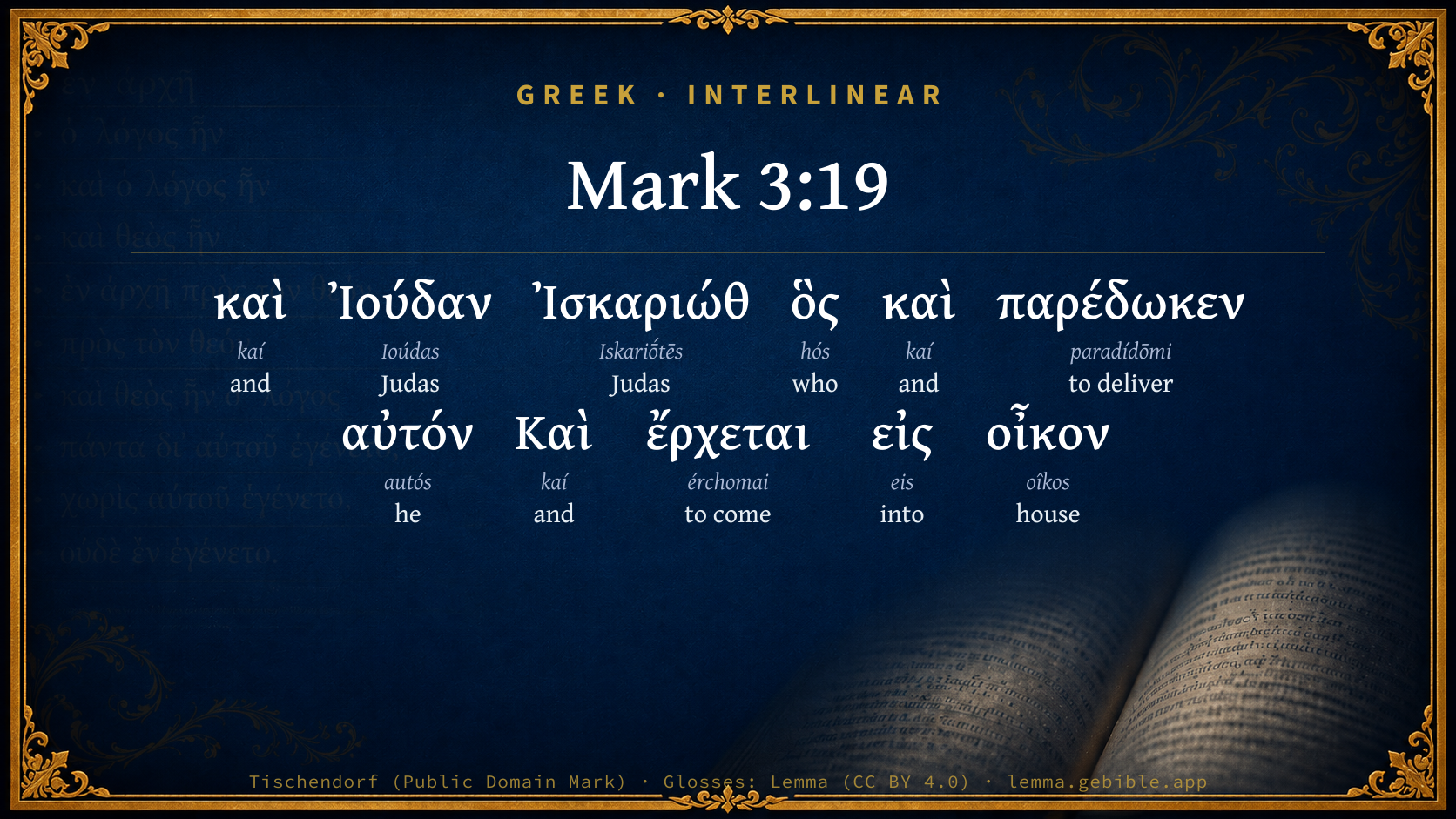
Greek (Tischendorf 8th ed.) Mark 3:19 appears in the Greek New Testament. The text above is from the Tischendorf 8th edition. Each word links to its Strong’s number and a concise gloss. Click any word for its full Thayer’s Greek Lexicon entry.
Download image
Cite this verse

Mark 3:19 (World English Bible). Public Domain. Lemma interlinear Bible study tool, https://lemma.gebible.app/v/mark/3/19.

Show BibTeX & RIS
BibTeX
RIS
English Translation
and Judas Iscariot, who also betrayed him. He came into a house.
World English Bible · Public Domain
Download a study sheet

One document with this verse’s original text, its word-by-word gloss line, the meaning frame, cross-references with their text, attributed commentary, and full source and license credits — printable, and it pastes into notes with its structure intact.

This verse Autodidact and up

Study sheet (.html) Plain text (.txt)

A passage Seminary Student

Up to 50 verses in one chapter. A passage sheet keeps up to 6 commentary sources and 12 cross-references per verse, in the order this page ranks them, and says so on the sheet whenever that leaves anything out. Ask for a single verse and you get the Autodidact verse sheet above.

Everything on this page stays free to read, with no account — the sheet is a download of what is already on screen, not access to it.

Want to remove ads? Support Godless Engineer
Compare translations 3

The same verse in 3 English versions, stacked beneath the original-language interlinear above. Click any original word for its lexicon entry.

Each is an independent rendering of the whole verse — the interlinear is not word-aligned to these translations.

Highlighted words mark where these versions differ — a whole-verse word diff, not a word-by-word alignment.

  • World English Bible Public Domain
    and Judas Iscariot, who also betrayed him. He came into a house.
  • King James Version Public Domain
    And Judas Iscariot, which also betrayed him: and they went into an house.
  • unfoldingWord Literal Text CC BY-SA 4.0
    and Judas Iscariot, who also handed him over.

unfoldingWord Literal Text — © unfoldingWord, licensed CC BY-SA 4.0. Word-aligned USFM3 via Door43 (git.door43.org/unfoldingWord/en_ult).

Versions to compare (up to 4)

3 of 4 selected

Show all 19 translations

Every available English version of this verse, each an independent rendering of the whole verse.

  • World English Bible Public Domain
    and Judas Iscariot, who also betrayed him. He came into a house.
  • Berean Standard Bible Public Domain
    and Judas Iscariot, who betrayed Jesus.
  • Majority Standard Bible Public Domain
    and Judas Iscariot, who betrayed Jesus.
  • King James Version Public Domain
    And Judas Iscariot, which also betrayed him: and they went into an house.
  • American Standard Version (1901) Public Domain
    and Judas Iscariot, who also betrayed him. And he cometh into a house.
  • Revised Version (1885) Public Domain
    and Judas Iscariot, which also betrayed him. And he cometh into a house.
  • Geneva Bible (1599) Public Domain
    And Iudas Iscariot, who also betraied him, and they came home.
  • Douay-Rheims (1899) Public Domain
    And Judas Iscariot, who also betrayed him.
  • Young's Literal Translation Public Domain
    and Judas Iscariot, who did also deliver him up; and they come into a house.
  • Literal Standard Version CC BY-SA 4.0
    and Judas Iscariot, who also delivered Him up; and they come into a house.
  • Unlocked Literal Bible CC BY-SA 4.0
    and Judas Iscariot, who would betray him.
  • unfoldingWord Literal Text CC BY-SA 4.0
    and Judas Iscariot, who also handed him over.
  • Darby Bible Public Domain
    and Judas Iscariote, who also delivered him up. And they come to [the] house.
  • World Messianic Bible Public Domain
    and Judah Iscariot, who also betrayed him. Then he came into a house.
  • Webster's Bible Public Domain
    And Judas Iscariot, who also betrayed him: and they went into a house.
  • Free Bible Version CC BY-SA 4.0
    and Judas Iscariot (who betrayed him).
  • Bible in Basic English Public Domain
    And Judas Iscariot, who was false to him.
  • Text-Critical English NT CC BY 4.0
    and Judas Iscariot, who betrayed him. Jesus and Beelzebul Then they entered a house,
  • Tyndale New Testament (1534) Public Domain
    and Iudas Iscarioth which same also betrayed him. And they came vnto housse

Literal Standard Version (2020), Covenant Press — licensed CC BY-SA 4.0. Text via the HelloAO Bible API (eBible.org). Unlocked Literal Bible (unfoldingWord) — licensed CC BY-SA 4.0. Text via the HelloAO Bible API (eBible.org). unfoldingWord Literal Text — © unfoldingWord, licensed CC BY-SA 4.0. Word-aligned USFM3 via Door43 (git.door43.org/unfoldingWord/en_ult). Free Bible Version, Dr. Jonathan Gallagher — licensed CC BY-SA 4.0. Text via the HelloAO Bible API (eBible.org).

Word by word

More ways to search: Search by grammar → Find every occurrence → Compare this word →

Practice this passage: Drill this verse → Learn its vocabulary →

About this verse

These counts appear in no published source. They are computed here, from the morphology-tagged text and Lemma’s own curated glosses. What Lemma adds →

11
words
9
distinct lemmas
Gospels
section

Notable vocabulary

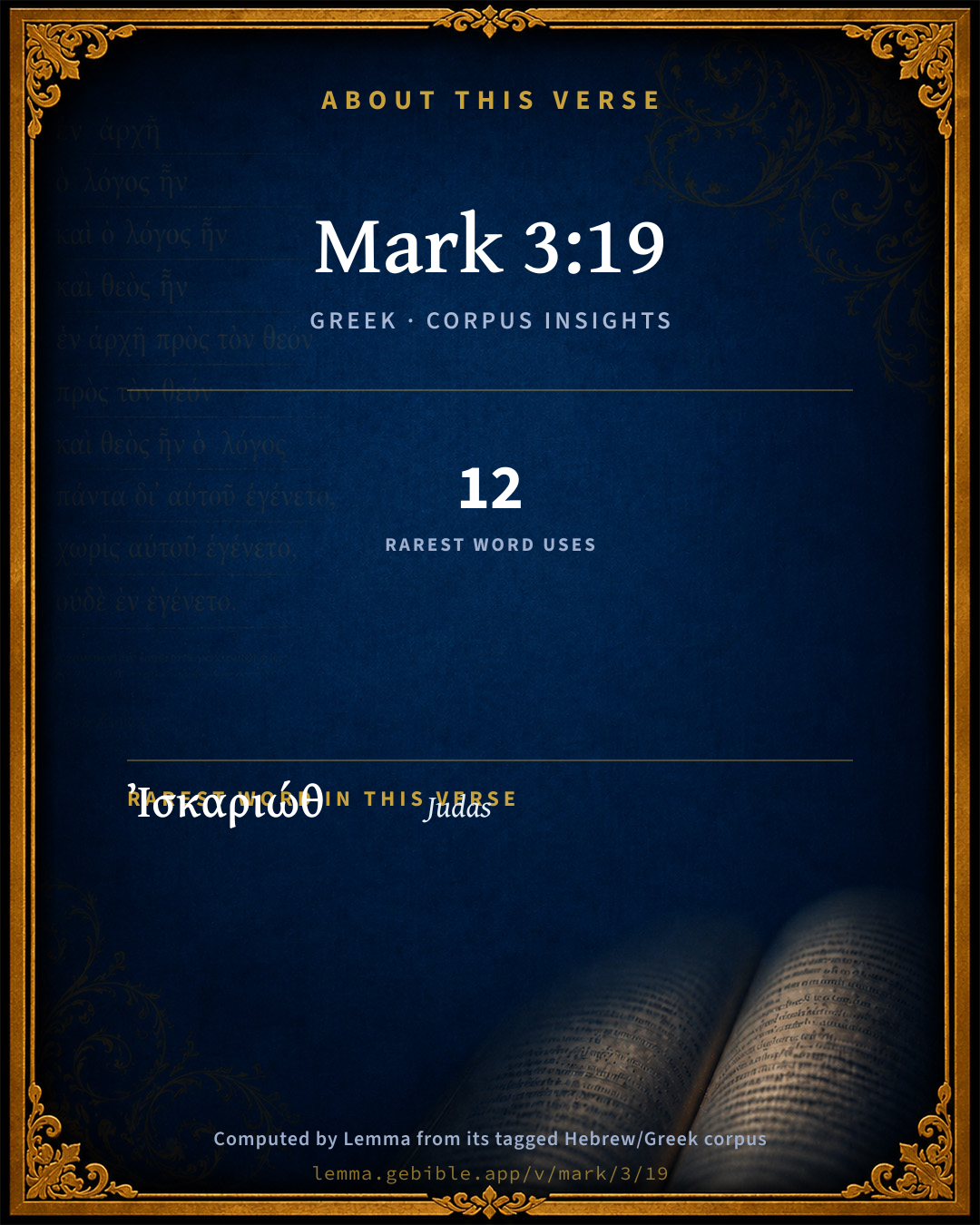
The rarest word here is Ἰσκαριώθ Judas G2469 — appearing just 12 times in the whole Greek New Testament.

Shared distinctive vocabulary

Ἰσκαριώθ Judas G2469 occurs in 12 verses of the Greek New Testament. Also found in:

Repetition

A word recurs within this verse:

Cross-references

9

Topical passages linked to Mark 3:19 in the Treasury of Scripture Knowledge — connected by theme and wording, ordered by reader-vote popularity; previews shown in the World English Bible.

  • Matthew 26:14–16 Then one of the twelve, who was called Judas Iscariot, went to the chief priests,
  • Matthew 26:47 While he was still speaking, behold, Judas, one of the twelve, came, and with him a great multitude with swords and clubs, from the chief priest and elders of the people.
  • Matthew 27:3–5 Then Judas, who betrayed him, when he saw that Jesus was condemned, felt remorse, and brought back the thirty pieces of silver to the chief priests and elders,
  • John 6:64 But there are some of you who don't believe." For Jesus knew from the beginning who they were who didn't believe, and who it was who would betray him.
  • John 6:71 Now he spoke of Judas, the son of Simon Iscariot, for it was he who would betray him, being one of the twelve.
  • John 12:4–6 Then Judas Iscariot, Simon's son, one of his disciples, who would betray him, said,
  • John 13:2 After supper, the devil having already put into the heart of Judas Iscariot, Simon's son, to betray him,
  • John 13:26–30 Jesus therefore answered, "It is he to whom I will give this piece of bread when I have dipped it." So when he had dipped the piece of bread, he gave it to Judas, the son of Simon Iscariot.
  • Acts 1:16–25 "Brothers, it was necessary that this Scripture should be fulfilled, which the Holy Spirit spoke before by the mouth of David concerning Judas, who was guide to those who took Jesus.

Cross-references courtesy of OpenBible.info (CC BY 4.0).

Commentary

Notes on Mark 3:19 from classic Christian and Jewish commentators (each source and its license shown beneath its notes). The classic Christian expositions comment on the surrounding passage and are grouped to its opening verse, so a note may address several verses; the Jewish commentaries on the Tanakh (Rashi and others) are per-verse, so they appear only where the commentator wrote on this verse.

Lemma curates 59 commentaries, every one of them public domain or Creative Commons licensed, each selected and text-cleaned for this edition rather than reprinted as found. About our sources →

Joseph Benson's Commentary

Mar 3:19-21. And they went into a house — It appears, from the manner in which Mark here connects this with the names of the apostles, that it happened very quickly after their being chosen. The other evangelists, indeed, inform us of some previous events which happened in the meantime, but they might be despatched in a few hours. And the multitude cometh together — Assembled again about the doors and windows of the house, and pressed so eagerly upon him; that they — Christ and his disciples, or the members of the family — could not so much as eat bread — Or take any sustenance, though it was the proper hour for it. And when his friends heard of it — Greek, οι παρ’ αυτου; “a common phrase,” says Dr. Campbell, “for denoting sui, (so the Vulgate,) his friends, propinqui, cognati, his kinsmen or relations. I prefer,” says he, “the word kinsmen, as the circumstances of the story evince that it is not his disciples who are meant.” This interpretation of the expression the doctor defends very ably by a critical examination of the original text, and an elaborate exposition of the verse; but which is too long to be inserted here. They went — Or, went forth, namely, from their own homes; to lay hold on him — Namely, says Grotius, “that they might take him away from that house, in which he was pressed, to another place:” for they said, Οτι εξεστη, that he faints, or, may faint; so Grotius, Dr. Whitby, and some others, understand the word, thinking it “absurd to say, that Christ did, either in his gestures or in his actions, show any symptoms of transportation or excess of mind; nor could his kindred, they think, have any reason to conceive thus of him, who had never given the least symptoms of any such excess, though those of them who believed not in him, might have such unworthy thoughts of him.” Dr. Hammond, however, justly observes that the word here used “doth, in all places of the New Testament but this and 2Co 5:13, signify being amazed, or astonished, or in some sudden perturbation of mind, depriving a person of the exercise of his faculties. And in the place just referred to, it is opposed to σωφρονειν, sobriety, or temper. And thus in the Old Testament it is variously used for excess, vehemency, or commotion of mind. Psa 31:22, we read, I said in my haste, &c., where the Greek is, εν τη εκστασει μου, in the excess, or vehemence of my mind.

Accordingly, here he supposes the word may be most fitly taken for a commotions, excess, vehemence, or transportation of mind, acting or speaking in zeal, (above what is ordinarily called temper and sobriety;) or in such a manner as they were wont to act or speak who were moved by some extraordinary influence, as the prophets, and other inspired persons, according to that of Chrysostom, Τουτο μαντεως ιδιον το εξεστηκεναι, It belongs to prophets to be thus transported, which sense of the word is suited to the place, for in this chapter Christ begins to show himself in the full lustre of his office; he cures on the sabbath day, which the Pharisees conceived to be unlawful; looks about him with anger, or some incitation of mind; is followed by great multitudes; heals the diseased, and is flocked to for that purpose; is called openly the Son of God by the demoniacs; makes twelve disciples, and commissions them to preach and to do cures. Upon this the Pharisees and Herodians take counsel against him, and those of their faction say, He acts by Beelzebub, and is possessed by him, that is, that he was actuated by some principal evil spirit, and did all his miracles thereby; and so was not to be followed, but abhorred by men. And they who uttered not these high blasphemies against him, yet thought and said, οτι εξεστη, that he was in an excess, or transportation of mind, and this, it seems, was the conceit of his own kindred. They had a special prejudice against him, chap. Mar 6:4; and did not believe on him, Joh 7:5; and accordingly, hearing a report of his doing these extraordinary things, they came out, κρατησαι, to lay hold on, or get him into their hands, and take him home with them, for they said he was guilty of some excesses.” The above interpretation supposes the sense of the expression to be nearly the same with that which is given by our translators, He is beside himself, which has the sanction of the Vulgate, in furorem versus est, and which, as has been noticed, is fully justified by Dr. Campbell, who concludes his defence of it in the following words: “I cannot help observing, on the whole, that in the way the verse is here rendered, no signification is assigned to the words which it is not universally allowed they frequently bear; no force is put upon the construction, but every thing interpreted in the manner which would most readily occur to a reader of common understanding, who, without any preconceived opinion, entered on the study. On the contrary, there is none of the other interpretations which does not, as has been shown, offer some violence to the words or to the syntax; in consequence of which, the sense extracted is far from being that which would most readily present itself to an unprejudiced reader. It hardly admits a doubt, that the only thing which has hindered the universal concurrence of translators in the common version, is the unfavourable light it puts our Lord’s relations in. But that their disposition was, at least, not always favourable to his claims, we have the best authority for asserting.”

Joseph Benson's Commentary on the Old and New Testaments (1811–1818) — public domain. Text from a community e-Sword module.

Whedon's Commentary on the Bible

Daniel D. Whedon

§ 42. — HEALING A DEMONIAC; SCRIBES AND PHARISEES BLASPHEME, Mar_3:19-30.

(See notes on Mat_9:33; Mat_12:32-37.)

19. And they went into a house — This clause properly belongs to the next verse, and opens the next paragraph. It is to this house that “the multitude cometh together.”

Daniel D. Whedon (gen. ed.), Commentary on the Old and New Testaments (1874–1909) — public domain. Text from a community e-Sword module.

The Expositor's Bible

CHAPTER 3:19 (Mar_3:19)

THE APOSTLE JUDAS

"And Judas Iscariot, which also betrayed Him." Mar_3:19 (R.V.)

THE evidential value of what has been written about the apostles will, to some minds, seem to be overborne by the difficulties which start up at the name of Judas. And yet the fact that Jesus chose him -- that awful fact which has offended many -- is in harmony with all that we see around us, with the prodigious powers bestowed upon Napoleon and Voltaire, bestowed in full knowledge of the dark results, yet given because the issues of human freewill never cancel the trusts imposed on human responsibility. Therefore the issues of the freewill of Judas did not cancel the trust imposed upon his responsibility; and Jesus acted not on His foreknowledge of the future, but on the mighty possibilities, for good as for evil, which heaved in the bosom of the fated man as he stood upon the mountain sward.

In the story of Judas, the principles which rule the world are made visible. From Adam to this day men have been trusted who failed and fell, and out of their very downfall, but not be precipitating it, the plans of God have evolved themselves.

It is not possible to make such a study of the character of Judas as of some others of the Twelve. A traitor is naturally taciturn. No word of his draws our attention to the fact that he had gained possession of the bag, even though one who had sat at the receipt of custom might more naturally have become the treasurer. We do not hear his voice above the rest, until St. John explains the source of the general discontent, which remonstrated against the waste of ointment. He is silent even at the feast, in despite of the words which revealed his guilty secret, until a slow and tardy question is wrung from him, not "Is it I, Lord?" but "Rabbi, is it I?" His influence is like that of a subtle poison, not discerned until its effects betray it.

But many words of Jesus acquire new force and energy when we observe that, whatever their drift beside, they were plainly calculated to influence and warn Iscariot. Such are the repeated and urgent warnings against covetousness, from the first parable, spoken so shortly after his vocation, which reckons the deceitfulness of riches and the lust of other things among the tares that choke the seed, down to the declaration that they who trust in riches shall hardly enter the kingdom. Such are the denunciations against hypocrisy, spoken openly, as in the Sermon on the Mount, or to His own apart, as when He warned them of the leaven of the Pharisees which is hypocrisy, that secret vice which was eating out the soul of one among them. Such were the opportunities given to retread without utter dishonor, as when He said, "Do ye also will to go away? . . . Did I not choose you the Twelve, and one of you is a devil?" (Joh_6:67; Joh_6:70). And such also were the awful warnings given of the solemn responsibilities of special privileges. The exalted city which is brought down to hell, the salt which is trodden under foot, the men whose sin remained because they can claim to see, and still more plainly, the first that shall be last, and the man for whom it were good that he had not been born. In many besides the last of these, Judas must have felt himself sternly because faithfully dealt with. And the exasperation which always results from rejected warnings, the sense of a presence utterly repugnant to his nature, may have largely contributed to his final and disastrous collapse.

In the life of Judas there was a mysterious impersonation of all the tendencies of godless Judaism, and his dreadful personality seems to express the whole movement of the nation which rejected Christ. We see this in the powerful attraction felt toward Messiah before His aims were understood, in the deadly estrangement and hostility which were kindled by the gentle and self-effacing ways of Jesus, in the treachery of Judas in the garden and the unscrupulous wiliness of the priests accusing Christ before the governor, in the fierce intensity of rage which turned his hands against himself and which destroyed the nation under Titus. Nay the very sordidness which made a bargain for thirty pieces of silver has ever since been a part of the popular conception of the race. We are apt to think of a gross love of money as inconsistent with intense passion, but in Shylock, the compatriot of Judas, Shakespeare combines the two.

Contemplating this blighted and sinister career, the lesson is burnt in upon the conscience, that since Judas by transgression fell, no place in the Church of Christ can render any man secure. And since, falling, he was openly exposed, none may flatter himself that the cause of Christ is bound up with his reputation, that the mischief must needs be averted which his downfall would entail, that Providence must needs avert from him the natural penalties of evil-doing. Though one was as the signet upon the Lord's hand, yet was he plucked thence. There is no security for any soul anywhere except where love and trust repose, upon the bosom of Christ.

Now if this be true, and if sin and scandal may conceivable penetrate even the inmost circle of the chosen, how great an error is it to break, because of these offenses, the unity of the Church, and institute some new communion, purer far than the Churches of Corinth and Galatia, which were not abandoned but reformed, and more impenetrable to corruption than the little group of those who ate and drank with Jesus.

William Robertson Nicoll, ed., The Expositor's Bible (London: Hodder & Stoughton, 1887–1910) — public domain. 65 of 66 books (1 Corinthians is not separately keyed, as that volume carries no machine-parseable verse references); section-level commentary keyed to the opening verse. Introductory and overview sections not keyed to a specific passage are excluded.

Tyndale Open Study Notes

Tyndale Open Resources

3:19 Identifying Judas as Iscariot suggests that Mark wanted to avoid confusing him with another Judas (Luke 6:16; Acts 1:13). Iscariot probably comes from ’ish (“man of”) qeriyoth (“Kerioth,” a town in Judea). • who later betrayed him: See Mark 14:10-11, 43-46.

Tyndale Open Study Notes — © Tyndale Open Resources, licensed CC BY-SA 4.0. Text via the HelloAO Bible API.

Expositor's Greek Testament

ed. W. Robertson Nicoll

Mar 3:19 . And Judas Iscariot, who also betrayed Him.

The Expositor's Greek Testament, edited by W. Robertson Nicoll (1897–1910) — public domain. Text from a community e-Sword module.

Geneva Bible (1599)

Geneva Bible translators

The disciples whom Christ had taken to be of his train and to live with him, come home to his house, to be with him always after.

Geneva Bible (1599) marginal notes — public domain. Text via Bolls.life.

Adam Clarke's Commentary

Verse 19. Into a house.] As Christ was now returned to Capernaum, this was probably the house of Peter, mentioned Mr 2:1.

Adam Clarke's Commentary on the Bible (1810–1826) — public domain. Text from a community e-Sword/MySword module.

Ellicott's Commentary for English Readers

(19) And they went into an house.—It would be better to put a full stop after “betrayed Him,” and to make this the beginning of a new sentence.

A Bible Commentary for English Readers, edited by Charles John Ellicott (1878–1897) — public domain. Text from a community e-Sword module.

The Cambridge Bible for Schools and Colleges

gen. ed. J. J. S. Perowne

19. xii. Judas Iscariot] sometimes called the son of Simon (Joh_6:71; Joh_13:2; Joh_13:26), more generally Iscariot, i. e. probably “a native of Kerioth” a little village in the tribe of Judah (Jos_15:25; Jer_48:24). For the probable motives that led him to become the traitor, see note on Mar_14:10.

and they went into an house] The incident here related took place after the delivery of the Sermon on the Mount, and the Saviour’s second ministerial journey, an interval of a few months (?).

The Cambridge Bible for Schools and Colleges (gen. ed. J. J. S. Perowne; Cambridge University Press, 1878–1918) — public domain. Text from a community e-Sword module.

John Gill's Exposition

And the multitude coming together again,.... Either the multitude that were about the door of this house; insomuch that there was no room about, nor any coming near it, Mar 2:2, or the multitude that came from different parts, and had thronged about him at the sea side, before he went up into the mountain: these understanding that he was come down from thence, and was returned to Capernaum, and was at Simon's house, flocked thither, in great numbers, to see his person, hear his doctrines, and observe his miracles;

so that they could not so much as eat bread; the press was so great, and their importunities so urgent, either to hear him preach, or have their sick healed, that Christ, and his disciples, had neither room nor opportunity to eat some food for the refreshment of nature; though it was very necessary, and high time they had, especially Christ, who had been up all night, which he had spent in prayer; and had been very busy that morning in calling and appointing his apostles, and instructing them what they should do.

John Gill's Exposition of the Whole Bible (1746–1763) — public domain (CC PDM 1.0). Text via the HelloAO Bible API.

Trapp's Complete Commentary

John Trapp

19 And Judas Iscariot, which also betrayed him: and they went into an house.

Ver. 19. And they went into the house] But could not rest in the house; for a demoniac was brought home to him, and the multitude met to hear; and Christ gratified them, with the neglect of himself, Mat 12:22. Now to all his he saith, as Abimelech did to his soldiers, "What ye have seen me do, make haste and do as I have done," Jdg 9:48.

John Trapp, A Commentary or Exposition upon All the Books of the Old and New Testament (1647–1656) — public domain. Text from a community e-Sword module.

McGarvey & Pendleton's Commentaries

J. W. McGarvey

J. W. McGarvey's The Fourfold Gospel [XLVIII. Blasphemous Accusations].

XLVIII. BLASPHEMOUS ACCUSATIONS OF THE JEWS. (Galilee.) aMATT. XII. 22-37; bMARK III. 19-30; cLUKE XI. 14-23.

b19 And he cometh into a house. [Whose house is not stated.] 20 And the multitude cometh together again [as on a previous occasion-- Mar_2:1], so that they could not so much as eat bread. [They could not sit down to a regular meal. A wonderful picture of the intense importunity of people and the corresponding eagerness of Jesus, who was as willing to do as they were to have done.] 21 And when his friends heard it, they went out to lay hold on him: for they said, He is beside himself. [These friends were his brothers and his mother, as appears from Mar_3:31, Mar_3:32. They probably came from Nazareth. To understand their feelings, we must bear in mind their want of [298] faith. See Joh_7:3-9. They regarded Jesus as carried away by his religious enthusiasm ( Act_26:24, 2Co_5:13), and thought that he acted with reckless regard for his personal safety. They foresaw the conflict with the military authorities and the religious leaders into which the present course of Jesus was leading, and were satisfied that the case called for their interference. Despite her knowledge as to Jesus, Mary sympathized with her sons in this movement, and feared for the safety of Jesus.] a22 Then was brought unto him one possessed with a demon, blind and dumb: c14 And he was casting out a demon that was dumb. aand he healed him, insomuch that cit came to pass, when the demon was gone out, athe dumb man spake and saw. [The man was brought because he could not come alone. While Luke does not mention the blindness, the similarity of the narratives makes it most likely that he is describing the same circumstances as Matthew and Mark, so we have combined the three accounts.] 23 And all the multitudes cmarvelled. awere amazed, and said, Can this be the son of David? [It was a time for amazement, for Jesus had performed a triple if not a quadruple miracle, restoring liberty, hearing and sight, and granting the power of speech. It wakened the hope that Jesus might be the Messiah, the son of David, but their hope is expressed in the most cautious manner, not only being stated as a question, but as a question which expects a negative answer. The question, however, was well calculated to arouse the envious opposition of the Pharisees.] c15 But some of them said [that is, some of the multitude. Who these "some" were is revealed by Matthew and Mark, thus:], a24 But when the Pharisees heard it, they b22 and the scribes that came down from Jerusalem said, aThis man doth not cast out demons, but by Beelzebub the prince of the demons. bHe hath Beelzebub, and, By the prince of the demons casteth he out the demons. [Beelzebub is a corruption of Baalzebub, the god of the fly. There was a tendency among the heathen to name [299] their gods after the pests which they were supposed to avert. Thus Zeus was called Apomuios (Averter of flies), and Apollo Ipuktonos (Slayer of vermin). How Beelzebub became identified with Satan in the Jewish mind is not known. In opposing the influence of Jesus and corrupting the public mind, these Pharisees showed a cunning worthy of the cultivated atmosphere, the seat of learning whence they came. Being unable to deny that a miracle was wrought (for Celsus in the second century is the first recorded person who had the temerity to do such a thing), they sought to so explain it as to reverse its potency, making it an evidence of diabolical rather than divine power. Their explanation was cleverly plausible, for there were at least two powers by which demons might be cast out, as both were invisible, it might appear impossible to decide whether it was done in this instance by the power of God or of Satan. It was an explanation very difficult to disprove, and Jesus himself considered it worthy of the very thorough reply which follows.] c16 And others, trying him, sought of him a sign from heaven. [These probably felt that the criticisms of the Pharisees were unjust, and wished that Jesus might put them to silence by showing some great sign, such as the pillar of cloud which sanctioned the guidance of Moses, or the descending fire which vindicated Elijah.] b23 And he called them unto him [thus singling out his accusers], a25 And c17 But aknowing their thoughts he said unto them, bin parables [We shall find that Jesus later replied to those who sought a sign. He here answers his accusers in a fourfold argument. First argument:], How can Satan cast out Satan? aEvery kingdom divided against itself is brought to desolation; and every city or house [family] divided against itself shall not stand: b24 And if a kingdom be divided against itself, that kingdom cannot stand. cA house divided against a house falleth. b25 And if a house be divided against itself, that house will not be able to stand. a26 And if Satan cast out Satan, he is divided against himself; c18 And if Satan also is [300] divided against himself, ahow then shall his kingdom stand? b26 And if Satan hath risen up against himself, and is divided, he cannot stand, but hath an end. cbecause ye say that I cast out demons by Beelzebub. [The explanation given by the Pharisees represented Satan as divided against himself; robbing himself of his greatest achievement; namely, his triumph over the souls and bodies of men. Jesus argues, not that Satan could not do this, but that he would not, and that therefore the explanation which supposes him to do it is absurd. We should note that Jesus here definitely recognizes two important truths: 1. That the powers of evil are organized into a kingdom with a head ( Mat_13:29, Mat_25:41, Mar_4:15, Luk_22:31). 2. That division tends to destruction. His argument therefore, "constitutes an incidental but strong argument against sectarianism. See 1Co_1:13" (Abbott). Second argument:] 19 And if I by Beelzebub cast out demons, by whom do your sons cast them out? Therefore shall they be your judges. [The sons of the Pharisees were not their children, but their disciples ( 2Ki_2:3, Act_19:13, Act_19:14). Josephus mentions these exorcists (Ant. viii. 2, 5, and Wars vii. 6, 3), and there is abundant mention of them in later rabbinical books. Our Lord's reference to them was merely for the purpose of presenting an argumentum ad hominem, and in no way implies that they exercised any real power over the demons; nor could they have done so in any marked degree, else the similar work of Christ would not have created such an astonishment. The argument therefore is this, I have already shown you that it is against reason that Satan cast out Satan; I now show you that it is against experience. The only instances of dispossession which you can cite are those of your own disciples. Do they act by the power of Satan? They therefore shall be your judges as to whether you have spoken rightly in saying that Satan casts out Satan. Third argument:] 20 But if I with the finger { aby the Spirit of God cast out demons, then is the kingdom of God come upon you. [The finger of God signifies the power of God [301] ( Exo_8:19, Exo_31:18, Psa_8:3). [Jesus exercised this power in unison with the Spirit of God. Jesus here draws a conclusion from the two arguments presented. Since he does not cast out by Satan, he must cast out by the power of God, and therefore his actions demonstrated the potential arrival of the kingdom of God. The occasional accidental deliverance of exorcists might be evidence of the flow and ebb of a spiritual battle, but the steady, daily conquests of Christ over the powers of evil presented to the people the triumphant progress of an invading kingdom. It is an argument against the idea that there was a collusion between Christ and Satan. Fourth argument:] c21 When the strong man fully armed guardeth his own court, his goods are in peace: 22 but when a stronger than he shall come upon him, and overcome him, he taketh from him his whole armor wherein he trusted, and divided his spoils. b27 But no one can a29 Or how can one enter into the house of the strong man, and spoil his goods, except he first bind the strong man? and then will he spoil his house. [Satan is the strong man, his house the body of the demoniac, and his goods the evil spirit within the man. Jesus had entered his house, and robbed him of his goods; and this proved that, instead of being in league with Satan, he had overpowered Satan. Thus Jesus put to shame the Pharisees, and caused the divinity of his miracle to stand out in clearer light than ever. The power of Jesus to dispossess the demon was one of his most convincing credentials, and its meaning now stood forth in its true light.] 30 He that is not with me is against me; and he that gathereth not with me scattereth abroad. [Jesus here addresses the bystanders. In the spiritual conflict between Jesus and Satan, neutrality is impossible. There are only two kingdoms, and every soul is either in one or the other, for there is no third. Hence one who fought Satan in the name of Christ was for Christ ( Luk_9:50). In the figure of gathering and scattering, the people are compared to a flock of sheep which Jesus would gather into the fold, but which Satan and all who aid him (such as the Pharisees) would [302] scatter and destroy.] b28 Verily a31 Therefore I say unto you, Every sins and blasphemy ball their sins shall be forgiven unto the sons of men, and their blasphemies wherewith soever they shall blaspheme [Jesus here explains to the Pharisees the awful meaning of their enmity. Blasphemy is any kind of injurious speech. It is the worst form of sin, as we see by this passage. This does not declare that every man shall be forgiven all his sins, but that all kinds of sin committed by various men shall be forgiven. The forgiveness is universal as to the sin, not as to the men]: abut the blasphemy against the Spirit shall not be forgiven. 32 And whosoever shall speak a word against the Son of man, it shall be forgiven him; but whosoever shall speak bblaspheme against the Holy Spirit hath never forgiveness, but is guilty of an eternal sin: ait shall not be forgiven him, neither in this world, nor in that which is to come. b30 because they said, He hath an unclean spirit. [Blasphemy against the Son may be a temporary sin, for the one who commits it may be subsequently convinced of his error by the testimony of the Holy Spirit and become a believer ( 1Ti_1:13). But blasphemy against the Holy Spirit is in its nature an eternal sin, for if one rejects the evidence given by the Holy Spirit and ascribes it to Satan, he rejects the only evidence upon which faith can be based; and without faith there is no forgiveness. The difference in the two sins is therefore in no way due to any difference in the Son and Spirit as to their degrees of sanctity or holiness. The punishment is naturally eternal because the sin is perpetual. The mention of the two worlds is, "just an extended way of saying 'never'" (Morison). Some assert that the Jews would not know what Jesus meant by the Holy Spirit, but the point is not so well taken. See Exo_31:3, Num_11:26, 1Sa_10:10, 1Sa_19:20; Psa_139:7, Psa_143:10, Isa_48:16, Eze_11:24. We see by Mark's statement that blasphemy against the Spirit consisted in saying that Jesus had an unclean spirit, that his works were due to Satanic influence, and hence wrought to [303] accomplish Satanic ends. We can not call God Satan, nor the Holy Spirit a demon, until our state of sin has passed beyond all hope of reform. One can not confound the two kingdoms of good and evil unless he does so maliciously and willfully.] a33 Either make the tree good, and its fruit good, or make the tree corrupt, and its fruit corrupt: for the tree is known by its fruit. [The meaning and connection are: "Be honest for once; represent the tree as good, and its fruit as good, or the tree as evil, and its fruit as evil; either say that I am evil, and that my works are evil, or, if you admit that my works are good, admit that I am good also and not in league with Beelzebub"--Carr.] 34 Ye offspring of vipers, how can ye, being evil, speak good things? for out of the abundance of the heart the mouth speaketh. [Realizing the hopelessness of this attempt to get an honest judgment out of dishonest hearts, Jesus plainly informs them as to the condition of their hearts. Their very souls were full of poison like vipers. Their sin lay not in their words, but in a condition of heart which made such words possible. The heart being as it was, the words could not be otherwise. "What is in the well will be in the bucket"--Trapp.] 35 The good man out of his good treasure bringeth forth good things: and an evil man out of the evil treasure bringeth forth evil things. [We have here a summary of the contrast given in the Mat_12:33, Mat_12:34. The good heart of Jesus brought forth its goodness, as the evil hearts of the Pharisees brought forth their evil.] 36 And I say unto you, That every idle word that men shall speak, they shall give account thereof in the day of judgment. 37 For by thy words thou shalt be justified, and by thy words thou shalt be condemned. [It may have seemed to some that Jesus denounced too severely a saying which the Pharisees had hastily and lightly uttered. But it is the word inconsiderately spoken which betrays the true state of the heart. The hypocrite can talk like an angel if he be put on notice that his words are heard. Jesus here makes words the basis of the judgment of God. Elsewhere [304] we find it is works ( Rom_2:6, 2Co_5:10), and again we find it is faith ( Rom_3:28). There is no confusion here. The judgment in its finality must be based upon our character. Our faith forms our character, and our words and works are indices by which we may determine what manner of character it is.]

[FFG 298-305]

J. W. McGarvey (with Philip Y. Pendleton), Commentaries on the New Testament (The Fourfold Gospel, 1914; Acts; and the epistles) — public domain. Text from a community e-Sword/MySword module.

The People's New Testament

B. W. Johnson

19. They went into a house. On the return to Capernaum.

B. W. Johnson's The People's New Testament with Notes (1889–1891) — public domain. Electronic text from the Christian Classics Ethereal Library (CCEL) ThML edition.

Cambridge Greek Testament for Schools and Colleges

19. Ἰσκαριώθ ([532][533][534][535][536] 33) rather than Ἰσκαριώτην ([537][538][539][540]). ἔρχεται ([541][542][543][544]) rather than ἔρχονται ([545]3[546][547][548][549][550]).

[532] Codex Sinaiticus. 4th cent. Discovered by Tischendorf in 1859 at the Monastery of St Katharine on Mount Sinai. Now at St Petersburg. The whole Gospel, ending at Mar 16:8. Photographic facsimile, 1911.

[533] Codex Vaticanus. 4th cent., but perhaps a little later than א. In the Vatican Library almost since its foundation by Pope Nicolas V., and one of its greatest treasures. The whole Gospel, ending at Mar 16:8. Photographic facsimile, 1889.

[534] Codex Ephraemi. 5th cent. A palimpsest: the original writing has been partially rubbed out, and the works of Ephraem the Syrian have been written over it; but a great deal of the original writing has been recovered; of Mark we have Mar 1:17 to Mar 6:31, Mar 8:5 to Mar 12:29, Mar 13:19 to Mar 16:20. In the National Library at Paris.

[535] Codex Regius. 8th cent. An important witness. At Paris. Contains Mar 1:1 to Mar 10:15; Mar 10:30 to Mar 15:1; Mar 15:20 to Mar 16:20, but the shorter ending is inserted between Mar 16:8 and Mar 16:9, showing that the scribe preferred it to the longer one.

[536] Codex Sangallensis. 9th or 10th cent. Contains the Gospels nearly complete, with an interlinear Latin translation. The text of Mark is specially good, agreeing often with CL. At St Gall.

[537] Codex Alexandrinus. 5th cent. Brought by Cyril Lucar, Patriarch of Constantinople, from Alexandria, and afterwards presented by him to King Charles I. in 1628. In the British Museum. The whole Gospel. Photographic facsimile, 1879.

[538] Codex Oxoniensis. 9th cent. Contains Mark, except Mar 3:35 to Mar 6:20.

[539] Codex Petropolitanus. 9th cent. Gospels almost complete. Mar 16:18-20 is in a later hand.

[540] Codex Beratinus. 6th cent. Contains Mar 1:1 to Mar 14:62.

[541] Codex Sinaiticus. 4th cent. Discovered by Tischendorf in 1859 at the Monastery of St Katharine on Mount Sinai. Now at St Petersburg. The whole Gospel, ending at Mar 16:8. Photographic facsimile, 1911.

[542] An asterisk denotes that the word is not found elsewhere in N.T., and such words are included in the index, even if there is no note on them in the commentary.

[543] Codex Vaticanus. 4th cent., but perhaps a little later than א. In the Vatican Library almost since its foundation by Pope Nicolas V., and one of its greatest treasures. The whole Gospel, ending at Mar 16:8. Photographic facsimile, 1889.

[544] Codex Oxoniensis. 9th cent. Contains Mark, except Mar 3:35 to Mar 6:20.

[545] Codex Sinaiticus. 4th cent. Discovered by Tischendorf in 1859 at the Monastery of St Katharine on Mount Sinai. Now at St Petersburg. The whole Gospel, ending at Mar 16:8. Photographic facsimile, 1911.

[546] Codex Ephraemi. 5th cent. A palimpsest: the original writing has been partially rubbed out, and the works of Ephraem the Syrian have been written over it; but a great deal of the original writing has been recovered; of Mark we have Mar 1:17 to Mar 6:31, Mar 8:5 to Mar 12:29, Mar 13:19 to Mar 16:20. In the National Library at Paris.

[547] Codex Regius. 8th cent. An important witness. At Paris. Contains Mar 1:1 to Mar 10:15; Mar 10:30 to Mar 15:1; Mar 15:20 to Mar 16:20, but the shorter ending is inserted between Mar 16:8 and Mar 16:9, showing that the scribe preferred it to the longer one.

[548] Codex Sangallensis. 9th or 10th cent. Contains the Gospels nearly complete, with an interlinear Latin translation. The text of Mark is specially good, agreeing often with CL. At St Gall.

[549] Codex Petropolitanus. 9th cent. Gospels almost complete. Mar 16:18-20 is in a later hand.

[550] Codex Beratinus. 6th cent. Contains Mar 1:1 to Mar 14:62.

19. Ἰσκαριώθ. See crit. note. Mt. and Jn write Ἰσκαριώτης: Lk. has both forms. The epithet probably means “man of Kerioth,” but the site of Kerioth is uncertain. Both he and his father Simon have this epithet (Joh 6:71; Joh 18:26), which is in favour of its having a local meaning. He seems to have been the only Apostle who was not a Galilean, and this may have caused estrangement from the first. It is not necessary to do more than mention the suggestion that “Iscariot” comes from “Ashharti” = “Ashhurite” = N. Arabian; or that it is a thinly disguised form of sikkarti (Isa 19:4) and means “surrender,” so that Judas is a personification of the Jewish people.

ὃς καὶ παρέδωκεν αὐτόν. The force of the καὶ is “who was identical with the one who betrayed Him.” Each Evangelist gives the appalling fact in a different way; Mt. ὁ καὶ παραδοὺς αὐτόν, Lk. ὃς ἐγένετο προδότης, i.e. “who became a traitor,” or “who turned traitor,” not “which was the traitor” (R.V.). Nowhere in Scripture is Judas called “the traitor.” After Peter, John, and James, Judas Iscariot is mentioned in Scripture more often than any of the remaining eight Apostles. Of most of them we know nothing, except as members of the Twelve, and of none of them do we know much. Traditions as to their subsequent labours are for the most part unworthy of trust. With the first Christians it was the Gospel rather than those who preached it that was of supreme importance. And it was so with the Apostles themselves; “whether it were I or they” did not matter, if only their hearers believed.

Mk places a considerable interval between the appointment of the Twelve and the sending them out as missionaries (Mar 6:7). Mt. with much less probability has no interval. The theory that at this point there is a gap in Mk, owing to the loss of a portion of the original document, is not one that repays investigation. To insert here a long discourse, mediating between the Sermon in Mt. and the Sermon in Lk., is pure conjecture. Along with this, other things which are in Mt. or Lk. but not in our Mk may be added. There is no end to such guesswork. Spitta, Lücken im Markusevangelium, pp. 126–138.

19 b–30. BY WHOSE POWER ARE DEMONS CAST OUT?

Mat 12:22-32. Luk 11:14-23; Luk 11:10

Καὶ ἔρχεται εἰς οἶκον. And He cometh into a house. This is to remind us that the shore (Mar 3:7) and the mountain (Mar 3:13) are left, and to prepare us for the incident with His Mother and brethren (Mar 3:31-35), which took place when He was in a house. The division of the verses is unfortunate. These words belong to Mar 3:20. A.V. puts only a colon after “betrayed Him,” and continues “and they went into a house.” See crit. note. Between the descent from τὸ ὄρος (Mar 3:13) and this incident, Lk. (Luk 6:17 f.) inserts the Sermon “on a level place,” which Mk seems not to have known. If he was acquainted with Q, the acquaintance must have been slight.

Cambridge Greek Testament for Schools and Colleges (Cambridge University Press, 1896; 21 vols, various authors incl. Carr, Maclear, Plummer, Farrar, Lumby, Moule, M. R. James, Simcox) — public domain. Text from a community e-Sword module.

International Critical Commentary

19. Ἰσκαριώτην—Heb., אִישׁ קְרִיּוֹת, Man of Kerioth. Judas is designated thus as an inhabitant of Kerioth, a village of Judæa. παρέδωκεν—delivered up. The word for betrayal is προέδωκεν.

There can be no doubt what significance Mk. means to give to the appointment of the twelve. It is preceded and followed in his account by the gathering of the importunate crowds about our Lord. And the connection points plainly to the conclusion that Jesus appoints them to be his helpers in the work thus growing on his hands. This is indicated in the purpose, that he may send them forth to preach, and to heal; that is, to share in the work which has been described before as done by him.1 But we do not find that much of this active work was done by them during Jesus’ lifetime. The purpose which was more fully carried out was that of permanent association with himself, expressed in the words, that they may be with him. Instead of the fluctuating attendance on his person of the ordinary disciples, he desired for these twelve such constant association that they could afterwards be his witnesses, and carry forward his work. Mat 9:35-4 gives the same general reason, but the immediate occasion is a missionary tour made by Jesus through Galilee, in which he is impressed by the greatness of the spiritual harvest, and the small number of laborers. Luk 6:17-19 places the concourse of people after the appointment of the twelve. The inclusion of Judas in the number of the apostles is a certain indication that he was at the time a genuine disciple. In his case, as in that of all the apostles, there was a failure to understand our Lord’s purely spiritual programme, but the personal equation, the faith in Christ himself, overcame this doubt at first. Later, the doubt predominated in the case of Judas, and even in the rest of the apostles it led to the temporary desertion of the ten, and to the denial of Peter.

CHARGE OF DIABOLISM

International Critical Commentary — older volumes (1896–1929), various authors — public domain. Text from a community e-Sword module.

Vincent's Word Studies in the New Testament

Marvin R. Vincent

Judas Iscariot. See on Mt 10:4.

Marvin R. Vincent, Word Studies in the New Testament (1887–1900) — public domain. Text from a community e-Sword/MySword module.

Lesson kit

Teaching starters — assembled from the data on this page, not authored interpretation. Every prompt links to the verse data it draws on. Edit before teaching.

Mark, in the Gospels, opens this verse with 11 words (9 distinct Greek lemmas). Its most distinctive word is Iskariṓtēs (“Judas”). A historical commentator’s framing appears above. Read the whole chapter for the surrounding context.

Discussion questions

  1. What does “Judas” (Iskariṓtēs) contribute to the verse as a whole?
  2. Matthew 10:4 shares the word «Judas» with this verse. How do the two illuminate each other?
  3. “and” occurs 3× in this one verse. What is the effect of the repetition?
  4. The translations on this page render this verse differently — a whole-verse word diff, not a word-by-word alignment. What might account for the different wordings?
  5. Reading how Joseph Benson's Commentary and Whedon's Commentary on the Bible read this verse, where do the two commentators agree and where do they part?

Things to notice

  • These translations choose different wording for 9 words in this verse.
  • “and” occurs 3× in this single verse.
  • 9 distinct Greek lemmas span 11 words in this verse.

Reading settings

Reading text

Shown beneath each verse's original-language words.

Old Testament
Old Testament edition

Read the OT as the Masoretic Hebrew (MT) or the Greek Septuagint (LXX).

English shown for the Greek Septuagint (in the Hebrew ↔ Greek comparison).

Comparing translations? Open the Compare panel on any verse page to stack up to four side by side.