
Mark 1:5

Greek (Tischendorf 8th ed.) Mark 1:5 appears in the Greek New Testament. The text above is from the Tischendorf 8th edition. Each word links to its Strong’s number and a concise gloss. Click any word for its full Thayer’s Greek Lexicon entry.

Download image
Cite this verse

Mark 1:5 (World English Bible). Public Domain. Lemma interlinear Bible study tool, https://lemma.gebible.app/v/mark/1/5.

Show BibTeX & RIS
BibTeX
RIS
English Translation
All the country of Judea and all those of Jerusalem went out to him. They were baptized by him in the Jordan river, confessing their sins.
World English Bible · Public Domain
Highlights
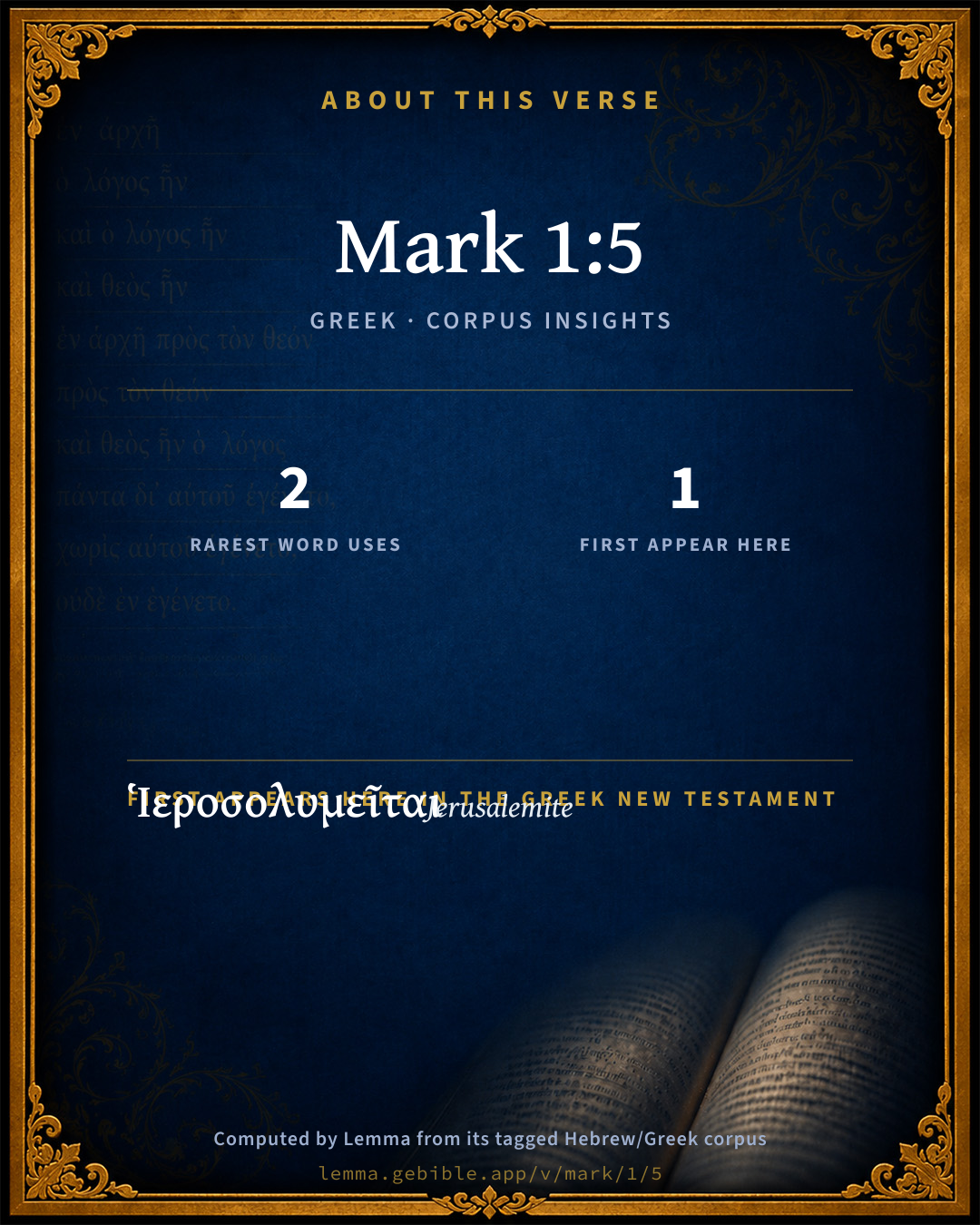
  • 1 first appearance in the Greek New Testament
Full analysis ↓
Download a study sheet

One document with this verse’s original text, its word-by-word gloss line, the meaning frame, cross-references with their text, attributed commentary, and full source and license credits — printable, and it pastes into notes with its structure intact.

This verse Autodidact and up

Study sheet (.html) Plain text (.txt)

A passage Seminary Student

Up to 50 verses in one chapter. A passage sheet keeps up to 6 commentary sources and 12 cross-references per verse, in the order this page ranks them, and says so on the sheet whenever that leaves anything out. Ask for a single verse and you get the Autodidact verse sheet above.

Everything on this page stays free to read, with no account — the sheet is a download of what is already on screen, not access to it.

Want to remove ads? Support Godless Engineer
Compare translations 3

The same verse in 3 English versions, stacked beneath the original-language interlinear above. Click any original word for its lexicon entry.

Each is an independent rendering of the whole verse — the interlinear is not word-aligned to these translations.

Highlighted words mark where these versions differ — a whole-verse word diff, not a word-by-word alignment.

  • World English Bible Public Domain
    All the country of Judea and all those of Jerusalem went out to him. They were baptized by him in the Jordan river, confessing their sins.
  • King James Version Public Domain
    And there went out unto him all the land of Judaea, and they of Jerusalem, and were all baptized of him in the river of Jordan, confessing their sins.
  • unfoldingWord Literal Text CC BY-SA 4.0
    And all the Judea region and all the Jerusalemites were going out to him and were being baptized by him in the Jordan River, confessing their sins.

unfoldingWord Literal Text — © unfoldingWord, licensed CC BY-SA 4.0. Word-aligned USFM3 via Door43 (git.door43.org/unfoldingWord/en_ult).

Versions to compare (up to 4)

3 of 4 selected

Show all 19 translations

Every available English version of this verse, each an independent rendering of the whole verse.

  • World English Bible Public Domain
    All the country of Judea and all those of Jerusalem went out to him. They were baptized by him in the Jordan river, confessing their sins.
  • Berean Standard Bible Public Domain
    People went out to him from all of Jerusalem and the countryside of Judea. Confessing their sins, they were baptized by him in the Jordan River.
  • Majority Standard Bible Public Domain
    People went out to him from all of Jerusalem and the countryside of Judea. Confessing their sins, they were all baptized by him in the Jordan River.
  • King James Version Public Domain
    And there went out unto him all the land of Judaea, and they of Jerusalem, and were all baptized of him in the river of Jordan, confessing their sins.
  • American Standard Version (1901) Public Domain
    And there went out unto him all the country of Judaea, and all they of Jerusalem; And they were baptized of him in the river Jordan, confessing their sins.
  • Revised Version (1885) Public Domain
    And there went out unto him all the country of Judaea, and all they of Jerusalem; and they were baptized of him in the river Jordan, confessing their sins.
  • Geneva Bible (1599) Public Domain
    And al ye countrey of Iudea, and they of Hierusalem went out vnto him, and were all baptized of him in the riuer Iordan, confessing their sinnes.
  • Douay-Rheims (1899) Public Domain
    And there went out to him all the country of Judea, and all they of Jerusalem, and were baptized by him in the river of Jordan, confessing their sins.
  • Young's Literal Translation Public Domain
    and there were going forth to him all the region of Judea, and they of Jerusalem, and they were all baptized by him in the river Jordan, confessing their sins.
  • Literal Standard Version CC BY-SA 4.0
    and there were going forth to him all the region of Judea, and they of Jerusalem, and they were all immersed by him in the river Jordan, confessing their sins.
  • Unlocked Literal Bible CC BY-SA 4.0
    The whole country of Judea and all the people of Jerusalem went out to him. They were baptized by him in the Jordan River, confessing their sins.
  • unfoldingWord Literal Text CC BY-SA 4.0
    And all the Judea region and all the Jerusalemites were going out to him and were being baptized by him in the Jordan River, confessing their sins.
  • Darby Bible Public Domain
    And there went out to him all the district of Judaea, and all they of Jerusalem, and were baptised by him in the river Jordan, confessing their sins.
  • World Messianic Bible Public Domain
    All the country of Judea and all those of Jerusalem went out to him. They were immersed by him in the Jordan river, confessing their sins.
  • Webster's Bible Public Domain
    And there went out to him all the land of Judea, and they of Jerusalem, and were all baptized by him in the river Jordan, confessing their sins.
  • Free Bible Version CC BY-SA 4.0
    Everybody from the country of Judea and from Jerusalem went to him. They admitted their sins publicly and were baptized in the Jordan River.
  • Bible in Basic English Public Domain
    And there went out to him all the people of Judaea, and all those of Jerusalem, and they were given baptism by him in the river Jordan, saying that they were sinners.
  • Text-Critical English NT CC BY 4.0
    The whole Judean countryside was going out to him, and so were the people of Jerusalem. They were all being baptized by him in the Jordan River, confessing their sins.
  • Tyndale New Testament (1534) Public Domain
    And all the londe of Iurie and they of Ierusalem went out vnto him and were all baptised of him in the ryver Iordan confessynge their synnes.

Literal Standard Version (2020), Covenant Press — licensed CC BY-SA 4.0. Text via the HelloAO Bible API (eBible.org). Unlocked Literal Bible (unfoldingWord) — licensed CC BY-SA 4.0. Text via the HelloAO Bible API (eBible.org). unfoldingWord Literal Text — © unfoldingWord, licensed CC BY-SA 4.0. Word-aligned USFM3 via Door43 (git.door43.org/unfoldingWord/en_ult). Free Bible Version, Dr. Jonathan Gallagher — licensed CC BY-SA 4.0. Text via the HelloAO Bible API (eBible.org).

Word by word

More ways to search: Search by grammar → Find every occurrence → Compare this word →

Practice this passage: Drill this verse → Learn its vocabulary →

Ἱεροσολυμεῖται
Hierosolymítēs
G2415
“Jerusalemite”
Noun, Nominative, Plural, Masculine
Part of Speech
Noun
Case
Nominative
Number
Plural
Gender
Masculine
Full Thayer's Definition

Origin: from G2414

TDNT: 11:52,1

1. a citizen or inhabitant of Jerusalem
  1. καὶ kaí G2532 “and” Conjunction
  2. ἐξεπορεύετο ekporeúomai G1607 “to go forth” Verb, Imperfect, Middle or Passive deponent, Indicative, 3rd person, Singular
  3. πρὸς prós G4314 “to” Preposition
  4. αὐτὸν autós G846 “he” Personal pronoun, Accusative, Singular, Masculine
  5. πᾶσα pâs G3956 “all” Adjective, Nominative, Singular, Feminine
  6. ἡ ho G3588 “the” Article, Nominative, Singular, Feminine
  7. Ἰουδαία Ioudaía G2449 “Judea” Noun, Nominative, Singular, Feminine
  8. χώρα chṓra G5561 “region” Noun, Nominative, Singular, Feminine
  9. καὶ kaí G2532 “and” Conjunction
  10. οἱ ho G3588 “the” Article, Nominative, Plural, Masculine
  11. πάντες pâs G3956 “all” Adjective, Nominative, Plural, Masculine
  12. καὶ kaí G2532 “and” Conjunction
  13. ἐβαπτίζοντο baptízō G907 “to baptize” Verb, Imperfect, Passive, Indicative, 3rd person, Plural
  14. ὑπ’ hypó G5259 “under” Preposition
  15. αὐτοῦ autós G846 “he” Personal pronoun, Genitive, Singular, Masculine
  16. ἐν en G1722 “in” Preposition
  17. τῷ ho G3588 “the” Article, Dative, Singular, Masculine
  18. Ἰορδάνῃ Iordánēs G2446 “Jordan” Noun, Dative, Singular, Masculine
  19. ποταμῷ potamós G4215 “river” Noun, Dative, Singular, Masculine
  20. ἐξομολογούμενοι exomologéō G1843 “to confess” Verb, Present, Middle, Participle, Nominative, Plural, Masculine
  21. τὰς ho G3588 “the” Article, Accusative, Plural, Feminine
  22. ἁμαρτίας hamartía G266 “sin” Noun, Accusative, Plural, Feminine
  23. αὐτῶν autós G846 “he” Personal pronoun, Genitive, Plural, Masculine

About this verse

These counts appear in no published source. They are computed here, from the morphology-tagged text and Lemma’s own curated glosses. What Lemma adds →

24
words
16
distinct lemmas
Gospels
section

Notable vocabulary

The rarest word here is Ἱεροσολυμεῖται Jerusalemite G2415 — appearing just 2 times in the whole Greek New Testament.

First appearance in Scripture

This word makes its first canonical appearance in the Greek New Testament here:

  • Ἱεροσολυμεῖται Jerusalemite G2415

Shared distinctive vocabulary

Ἱεροσολυμεῖται Jerusalemite G2415 occurs in 2 verses of the Greek New Testament. Also found in:
Repetition

Words recur within this verse:

Cross-references

11

Topical passages linked to Mark 1:5 in the Treasury of Scripture Knowledge — connected by theme and wording, ordered by reader-vote popularity; previews shown in the World English Bible.

  • Leviticus 26:40–42 "'If they confess their iniquity, and the iniquity of their fathers, in their trespass which they trespassed against me, and also that, because they walked contrary to me,
  • Acts 19:18 Many also of those who had believed came, confessing, and declaring their deeds.
  • Matthew 3:5–6 Then people from Jerusalem, all of Judea, and all the region around the Jordan went out to him.
  • Acts 2:38 Peter said to them, "Repent, and be baptized, everyone of you, in the name of Jesus Christ for the forgiveness of sins, and you will receive the gift of the Holy Spirit.
  • Joshua 7:19 Joshua said to Achan, My son, please give glory to Yahweh, the God of Israel, and make confession to him; and tell me now what you have done; don't hide it from me.
  • Psalms 32:5 I acknowledged my sin to you. I didn't hide my iniquity. I said, I will confess my transgressions to Yahweh, And you forgave the iniquity of my sin. Selah.
  • Proverbs 28:13 He who conceals his sins doesn't prosper, But whoever confesses and renounces them finds mercy.
  • Matthew 4:25 Great multitudes from Galilee, Decapolis, Jerusalem, Judea and from beyond the Jordan followed him.
  • John 1:28 These things were done in Bethany beyond the Jordan, where John was baptizing.
  • John 3:23 John also was baptizing in Enon near Salim, because there was much water there. They came, and were baptized.
  • 1 John 1:8–10 If we say that we have no sin, we deceive ourselves, and the truth is not in us.

Cross-references courtesy of OpenBible.info (CC BY 4.0).

Commentary

Notes on Mark 1:5 from classic Christian and Jewish commentators (each source and its license shown beneath its notes). The classic Christian expositions comment on the surrounding passage and are grouped to its opening verse, so a note may address several verses; the Jewish commentaries on the Tanakh (Rashi and others) are per-verse, so they appear only where the commentator wrote on this verse.

Lemma curates 59 commentaries, every one of them public domain or Creative Commons licensed, each selected and text-cleaned for this edition rather than reprinted as found. About our sources →

The Biblical Illustrator

Joseph S. Exell

Mar_1:5

And there went out to him all the land of Judaea.

The Baptists audience

It was a mixed multitude of almost every class. The other Evangelists help us to realize its heterogeneous character. There were Pharisees, whose scrupulous routine of external observance had woven around them a web of self-satisfied pride; and Sadducees, whose reaction from superstition had landed them in a cold and heartless infidelity. Among these there would be followers of Shammai, cleaving to tradition and rigidly orthodox; sympathisers also with his opponent Hillel, just emerging from that slavery to the letter which had taken the very life out of their religion. There were soldiers, too, who, through the lawless rapacity of their generals, had learned to think only of loot and plunder; and the bated publicans, with their overreaching and fraudulent exactions, the byword for all that was lowest and most contemptible-all were there, and for all he had the same message, Repent. The Rabbis have a wonderful comment on the import of that message. If, they say, Israel would repent, they would be redeemed. (H. M. Luckock, D. D.)

What induced them to flock to him thus

1. The excellency of his person.

2. The novelty of his doctrine.

3. The zeal and earnestness of his preaching.

4. The strangeness of the place where he preached.

5. The austerity and strictness of his life. (G. Petter.)

The crowd going out to the lonely man

Notice, the man of the crowd goes to the man of the desert. The publican, the soldier, even the Pharisee. Strange attraction this, yet recurrent. He who knows most of himself, he who has learned himself in solitude, will know most of others. It has ever been thus. The world has gone to the cloister, not the cloister to the world; the city finds solace in the desert, never the desert in the city. A few years ago, all Paris flocked to the Cure d Ars an obscure provincial priest, without much learning or preaching power either, but they found in him the fresh springs of comfort, the word of prophecy, the call to repentance, which in every souls solitude is the cry most certain to pierce. (H. R. Haweis, M. A.)

Secret of John Baptists influence

In one word, it was reality. In an age of hollowness and hypocrisy never equalled before or since, such a characteristic was bound to startle men and arrest their attention. The Baptist, if anyone, practised what he preached. His protest against sin was embodied by his example. Take a single illustration from his habit and dress. He came to denounce luxury and soft clothing and sumptuous fare, and he was a living example of the austerity which he called for. (H. M. Luckock, D. D.)

Confessing sin

Steps towards conversion.

1. To seek an enlightened guide.

2. To open our heart to him, by acquainting him with our manner of life.

3. To receive directions concerning repentance from him.

4. To baptize ourselves, as it were, by his advice, in tears and works of mortification.

It is an instinct and a duty which is, so to speak, natural, for a man to confess his sins, and to humble himself for them, when once he is touched with a true contrition; but to do this is not at all natural to human pride. Repentance is a pool, or rather a river, which carries our impurities far from us, so as never to be resumed again. Lord, Thou art the only one who can put us into it! (Quesnel.)

The necessity of confession of sins

There is a two- fold confession of sins necessary in the practice of repentance.

I. To God.

1. It must come from a feeling heart, touched with sense of sin and grieved for it: not verbal, or from the teeth outward.

2. It must come from a hatred and loathing of the sins confessed, not from fear of punishment merely. Saul. Pharaoh.

3. From hope of mercy, else we witness against ourselves. Judas.

4. Free and voluntary, not forced from us. God requires a freewill offering, else it is not pleasing to Him.

5. It must not be only in general terms, but there must be a laying open of our particular known sins, so far as we can remember them.

II. To men. Not always necessary, but in some cases only.

1. When by our sins we have offended and scandalized men-either the Church in general, or some particular persons.

2. When any sin lies heavy on our conscience, so that we cannot find ease or comfort. In this case, it is necessary to open our hearts, and to acknowledge that sin which troubles us, to some faithful pastor, or other Christian brother, who may minister spiritual advice and comfort to us. (G. Petter.)

John the Baptist

I. The preacher. Fearless, honest, earnest; and these characteristics are sure to attract public notice and confidence. The secret of his power over men seems to have been that he was fully convinced that he was sent on a Divine mission, and was so engrossed in fulfilling it, that he cared little for anything else. What John the Baptist was was quite as effective preaching as anything he said.

II. But if the preacher was notable, his preaching was equally so. The mans words caught the colour of his character. They were positive, straightforward, unmistakable, he aimed directly at the great need of his generation. It was not a pleasing style of address. When the Church preaches the simple gospel, men stop to listen and prepare themselves to welcome Christ. The majority of men are not influenced by mere doctrinal speculation, any more than a sham fight can determine the fortunes of a nation. (Sermons by the Monday Club.)

The inspiration of work for God

When he is conscious that he is sent of God as a messenger of glad tidings to the poor and needy, how relatively unimportant all other business appears! When he realizes that all the wealth and blessings of the kingdom of God are to be his forever, how trifling are the few temporary burdens he is called to bear! how petty the sacrifices he is asked to make! It is said that when Pliny saw from a distance the eruption of Vesuvius, he forsook his occupation and launched his boat and rowed toward the flaming mountain, forgetting the labour and the peril in the fascination of the sight; and when one sees, even from afar, the light of the city of God, there is such longing to get nearer the brightness, that approach, at any cost, seems cheap. You remember the old legend, which has been so beautifully done into verse by one of our poets, of the monk who was charmed from his cell door by the singing of a bird, and, though the sweetness of the song was such that it seemed to him that he only walked an hour, yet on his return he found that a hundred years had passed. When we are in such spiritual condition that we hear heavenly voices calling us, no way of duty seems long or hard. The most exhausting service is a delight. What the Church wants is to know, like John the Baptist, that its responsibility is its privilege, and then it will have zeal enough for its opportunity. What the individual Christian wants is to realize the grandeur of his position and the greatness of his mission, and he will need no other urgency to faithfulness. (Sermons by the Monday Club.)

Efficiency more than refinement in work for God

Napoleon was once told by certain professionals that his impetuous methods were uncivil and contrary to all military traditions. His reply to his critics was: Gentlemen, battles are not to be won by compliance with the rules of etiquette, by postponing action until the enemy is drawn up in line, and his officers, having put on their gloves, stand hat in hand, saying, We are ready. Will you please to fire first?-and to win the battle is what I am after. There is danger that the Church may lay so much stress on what it calls the amenities and proprieties, that it may fail to win the battle-the one thing which God has put it into the world to do. (Sermons by the Monday Club.)

The Biblical Illustrator, edited by Joseph S. Exell (c. 1880s–1900s) — public domain. Text from a community e-Sword module.

Joseph Benson's Commentary

Mar 1:5-8. There went out to him all Judea, &c. — So disposed were the people to receive his baptism. See note on Mat 3:5. The latchet of whose shoes, &c. — That is, whose servant I am not worthy to be, or to perform for him the meanest offices. He shall baptize you with the Holy Ghost — The promise of which is made to you and your children, Act 2:39; where see the note, and on Mat 3:11.

Joseph Benson's Commentary on the Old and New Testaments (1811–1818) — public domain. Text from a community e-Sword module.

Godbey's Commentary on the New Testament

William B. Godbey

JOHN’S INFLUENCE

Mat 5:6, & Mar 1:5. “Then there went out unto him Jerusalem, and all Judea, and all the regions round about Jordan, and were baptized of him in Jordan, confessing their sins.” Six millions of people are included in these countries. O the wonderful power and magnetism of John’s preaching! He actually emptied the cities and populated the desert with thronging millions. From dewy morn till dusky eve, the rich on camels, the middle classes on donkeys, and the poor trudging on foot, literally crowd the way, off into the desert wild and drear, carrying their food and bedding, that they may spend a fortnight in the grandest camp-meeting that the world has seen in four thousand years. Water is very scarce in the “wilderness [desert] of Judea.” Traveling through it four times, I saw none but the Brook Cherith. I have heard of it, however, in other localities of that desert. Doubtless the scarcity of water to supply the multitudes and the animals they rode, as well as for baptismal demands, induced John to go away to the Jordan, only a dozen miles from this desert. The Jordan rises in great Mt. Hermon, ten thousand feet high, capped with a world of snows, all through the long summer incessantly melting, and keeping the river abundantly supplied with plenty of water for all purposes. Behold John, standing on the beautiful, spreading plain of the Jordan, surrounded by an audience of fifty thousand people, listening spellbound to his thunder peals, while the lightning of conviction is flashing from the skies, electrifying all hearts, with the gushing tears of a soul-crushing repentance. Moses was a great baptist, baptizing all the people at the tabernacle door upon the ratification of the Sinaitic Covenant. (Heb 9:10-12.) Judaism, with its vast and operose ritual, the Messianic hemisphere, offering millions of slain victims, typifying the atonement of Christ, while the spiritual was equally operose, emblematizing the work of the Holy Ghost by the innumerable watery ablutions for the purification from all sorts of ceremonial uncleanness. Hence the Johannic dispensation must be characterized by ceremonial purifications. At the present time, the Oriental religions gather by thousands upon the very spot where John baptized the Savior, the priest dipping the cross three times in the name of the Three Persons of the Trinity, they all simultaneously plunge themselves under the rolling wave of the holy Jordan three times; not doing this for baptism as the initiatory rite into the Church-this they have already received — but as a holy ablution to sanctify them, as they all believe the baptism of the Savior sanctified the Jordan. As John had neither the time nor the physical ability to handle his converts, they either plunged themselves under the rolling tide, or John, after the manner of the Jewish priest (and he was one), dipping the hyssop in the water, sprinkled the multitudes, somewhat as a Catholic priest nowadays sprinkles his audiences. The Jordan has plenty of water, and there is plenty in all parts of the earth. Be sure you satisfy your conscience as to this duty.

William B. Godbey, Commentary on the New Testament (1896–1900) — public domain. Text from a community e-Sword module.

Tyndale Open Study Notes

Tyndale Open Resources

1:5 All of Judea: John the Baptist created a lot of interest. It was generally believed that there had been no prophet for over 400 years, so prophets were associated with Israel’s past and with the future reign of the Messiah. John preached repentance like the ancient prophets, and he dressed like the great prophet Elijah (1:6), who was predicted to return in the last days (Mal 4:5).

Tyndale Open Study Notes — © Tyndale Open Resources, licensed CC BY-SA 4.0. Text via the HelloAO Bible API.

Bengel's Gnomon

Johann Albrecht Bengel

Mar 1:5. Ἰουδαία χώρα, the land of Judea) So, τὴν Ἰουδαίαν γῆν, Joh 3:22.[6]—οἱ Ἱεροσολυμῖται, they of Jerusalem) At other times, capital cities are not readily wont to follow a new institution [a new mode of life preached for the first time].

[6] Two Substantives coming together in apposition, so that one acts as an Adjective.—ED.

Bengel's Gnomon of the New Testament — English translation (T&T Clark, Edinburgh, 1860) — public domain. Text from a community e-Sword module.

Meyer's Critical & Exegetical Commentary

Heinrich August Wilhelm Meyer

Mar_1:5-8. See on Mat_3:4-5; Mat_3:11; Luk_3:7 ff. Matthew enters more into detail on John the Baptist; Mark has several particulars in a form more original.

πᾶσα ἡ Ἰουδ. κ.τ.λ.] Ἰουδ. is an adjective (see on Joh_3:22), and χώρα is in contrast to the metropolis (see on Joh_11:54 f.), the whole Judaean region, and the people of Jerusalem collectively. In πᾶσα and πάντες there is a popular hyperbole.

Mar_1:6. Instead of ἐσθίων, we must write, with Tischendorf, ἔσθων.[50]

Mar_1:7. ἔρχεται] present: ut Christum intelligas jam fuisse in via, Beza.

κύψας] belongs to the graphic character of Mark, whose delineation is here certainly more original than that of Matthew.

ἘΝ ΠΝΕΎΜ. ἉΓΊῼ] The fire, which Matthew (and Luke also) has in the connection of his more comprehensive narrative, is not yet mentioned here, and thus there is wanting a characteristic point, which, nevertheless, appears not to be original. Comp. Joh_1:33 (in opposition to Ewald, Köstlin, Holtzmann, and others). It would not have been abrupt (Holtzmann) even in Mark.

[50] See on this poetical form, which occurs also in the LXX. and Apocrypha, Duncan, Lex., ed. Rost, p. 457; Winer, p. 79 [E. T. 105]; Buttmann, neut. Gr. p. 51 [E. T. 58]. Also at Mar_12:40, Luk_7:33 f., Luk_10:7, Luk_22:30, this form is to be read.

Meyer — Critical and Exegetical Commentary on the New Testament — English translation by Peter Christie, edited by Frederick Crombie (T&T Clark, 1880) — public domain. Text from a community e-Sword module.

Expositor's Greek Testament

ed. W. Robertson Nicoll

Mar 1:5-8 . Mar 1:5 describes the widespread character of the movement much as in Mt., only that Judaea comes before Jerusalem, and the district of the Jordan is not mentioned.

The Expositor's Greek Testament, edited by W. Robertson Nicoll (1897–1910) — public domain. Text from a community e-Sword module.

Adam Clarke's Commentary

Verse 5. All the land] See on Mt 3:4-6.

Confessing their sins.] It was an invariable custom among the Jews to admit no proselyte to baptism, till he had, in the most solemn manner, declared that he forever had renounced all idolatrous worship, all heathenish superstitions, and promised an entire and unreserved submission to the law of Moses. This was necessary for a proselyte adult - a child dedicated to God by baptism must be brought up in this faith.

Adam Clarke's Commentary on the Bible (1810–1826) — public domain. Text from a community e-Sword/MySword module.

Ellicott's Commentary for English Readers

(5) There went out unto him. . . .—See Note on Mat_3:5. Note St. Mark’s use of the term “in the river of Jordan,” as writing for those who were not familiar with the topography of Palestine.

A Bible Commentary for English Readers, edited by Charles John Ellicott (1878–1897) — public domain. Text from a community e-Sword module.

The Cambridge Bible for Schools and Colleges

gen. ed. J. J. S. Perowne

5. all the land] This strong expression is peculiar to St Mark. But it is illustrated by the other Gospels. The crowds that flocked to his baptism included representatives of every class, Pharisees and Sadducees (Mat_3:7), tax-gatherers (Luk_3:12), soldiers (Luk_3:14), rich and poor (Luk_3:10).

of Jordan] Of here is redundant and appositional. We use it after “town,” “city,” “valley.” For its use after river, comp. “the river of Cydnus,” Shak. A. and C. II. 2. 192. The word “river” does not occur in the best MSS. of Mat_3:6. It is used by St Mark, who writes for those who were unacquainted with the geography of Palestine.

The Cambridge Bible for Schools and Colleges (gen. ed. J. J. S. Perowne; Cambridge University Press, 1878–1918) — public domain. Text from a community e-Sword module.

John Gill's Exposition

And there went out unto him all the land of Judea,.... The people of the land, a great number of them:

and they of Jerusalem; the inhabitants of Jerusalem, hearing of this new preacher, the new doctrine that he taught, and the new ordinance that he administered:

and were all baptized of him in the river Jordan, confessing their sins; that is, as many of them as were brought to a sight and sense of their sins, and made a confession of them, these he baptized, or immersed, in the river Jordan; for certain it is, that there were many of the Pharisees and Sadducees who came, whom he rejected; See Gill on Mat 3:5, Mat 3:6, Mat 3:7.

John Gill's Exposition of the Whole Bible (1746–1763) — public domain (CC PDM 1.0). Text via the HelloAO Bible API.

Trapp's Complete Commentary

John Trapp

5 And there went out unto him all the land of Judaea, and they of Jerusalem, and were all baptized of him in the river of Jordan, confessing their sins.

Ver. 5. All the land of Judea] That is, a great sort of them; but John quickly grew stale to them, Joh 5:35. Principium fervet, medium leper, exitus alger. Weak Christians easily fall off, as leaves in autumn, or untimely figs, Rev 6:13.

John Trapp, A Commentary or Exposition upon All the Books of the Old and New Testament (1647–1656) — public domain. Text from a community e-Sword module.

Scofield Reference Notes

C. I. Scofield

sins

(See Scofield "Rom 3:23")

The Scofield Reference Bible (1917 edition), notes by C. I. Scofield — public domain. Text from a community e-Sword module.

Kretzmann's Popular Commentary

Paul E. Kretzmann

The effect of John’s preaching:

v. 5. And there went out unto him all the land of Judea and they of Jerusalem, and were all baptized of him in the river of Jordan, confessing their sins.

A man with a message such as John’s, supplemented by the oddity of his dress and habits, was bound to attract attention anywhere, even where his message was not welcome in its real significance. The inhabitants of the Judean hills heard of the hermit first, and came out of curiosity. But the fame of the wilderness preacher traveled fast, and soon the haughty people of the capital, probably with a deprecatory air, set out over the hills to see this strange man with the stranger message. And the effect of his preaching was truly remarkable. Great masses of people, men and women, crowded to his preaching and to his baptism. It was the custom, at the baptism of proselytes, not to administer the rite until the candidate had affirmed most solemnly that he would renounce all idolatrous worship, all heathenish superstitions, and had promised full and undivided allegiance to the Law of Moses. Here the individual confession of sins preceded baptism. As John himself was sincere, he tolerated no sham and deceit, no mere lip-service. He applied the words of the prophet. Those that were bowed down by the full realization of their sinfulness he cheered by the reference to the free grace of God, to those that were proud and conceited he emphasized the necessity of humility, upon those that were inclined to be deceitful he urged simplicity and purity of heart.

Paul E. Kretzmann, Popular Commentary of the Bible (1921–1924) — public domain. Text from a community e-Sword module.

Burkitt's Expository Notes on the New Testament

William Burkitt

Here we have an account of the success of St. John’s ministry; 1. In the general concourse and resort of the people to it, All Judea and Jerusalem; that is, a great many of all degrees and ranks, of all ages and sexes. John was famed for a prophet, and a prophet was now a great rarity. Malachi was the last prophet before John, and he lived about five hundred years before John. Now the excellency of his person, the earnestness of his preaching, the acceptableness of his doctrine, that the Messias was come, and the austerity of his life and conversation, all these caused the people to flock unto him.

Learn hence, That it is a great encouragement to the ministers of Christ when people show themselves ready and forward to repair unto the places where the word and sacraments are dispensed to them: All Judea and Jerusalem attended upon John’s ministry.

The second fruit of John’s ministry was, that the people were ready to receive at his hand the sacrament of baptism: They were all baptised of him in Jordan.

Learn hence, That the ministers of Christ ought not only to preach the word, but also to dispense the sacraments to their people, even to all that do desire them, and are fit to be partakers of them.

A third fruit of John’s ministry was, his hearers’ profession of repentance is requisite in all that are baptized, so a free and voluntary, and ingenuous and impartial, confession of sin, is a good evidence and testimony of the truth and sincerity of our repentance.

William Burkitt's Expository Notes on the New Testament (1700–1703) — public domain. Text from a community e-Sword module.

The People's New Testament

B. W. Johnson

5. There went out to him. See notes on Matt. 3:5, 6.

B. W. Johnson's The People's New Testament with Notes (1889–1891) — public domain. Electronic text from the Christian Classics Ethereal Library (CCEL) ThML edition.

Cambridge Greek Testament for Schools and Colleges

5. ἐξεπορεύετο … ἐβαπτίζοντο. Both actions went on continually. The latter verb is passive (Mar 1:9, Mar 8:3), not middle (Act 22:16; 1Co 10:2).

πᾶσα … πάντες. Popular hyperbole, which misleads no one, cf. Mar 1:37. But it is difficult for us to estimate the enthusiasm caused by the hope that, after centuries of silence, Jehovah was again speaking to His people through a Prophet. Most of the people regarded John as a Prophet, most of the hierarchy did not; but the hierarchy did not dare to avow their denial openly (Mar 11:27-33). Mark at the time of John’s preaching was quite old enough to remember the excitement, and he was living in Jerusalem. He may here be giving his own recollections.

ἡ Ἰουδαία χώρα. Elsewhere Mk says simply ἡ Ἰουδαία (Mar 3:7, Mar 10:1, Mar 13:14). Judaea proper is meant, not the whole of Palestine.

Ἰεροσολυμεῖται. Smooth breathing; the aspirate has come from a mistaken connexion with ἱερός. So also in Ἰεροσόλυμα. See on Mar 10:32.

ἐβαπτίζοντο. Were one after another baptized.

ἐξομολογούμενοι. Confessing right out, in full and openly. Not classical, and rare in late Grk, except in LXX. and N.T. See on Joh 1:9. The meaning may be “thereby confessing their sins”; their asking for baptism was ipso facto a confession of sin. More probably it means that they there and then made an acknowledgment in words. Cf. Act 19:18; Jas 5:16. In LXX. it commonly means “giving praise”; cf. Luk 10:21; Rom 14:11; Rom 15:9. The two meanings are connected, Jos 7:19, Δὸς δόξαν τῷ κυρίῳ καὶ δὸς τὴν ἐξομολόγησιν, when Joshua urges Achan to confess his guilt. See also LXX. of Dan 9:20. Here, as in Mar 1:13; Mar 1:39, Mar 2:23, Mar 3:1, we have an important fact expressed by a participle attached to the finite verb.

Cambridge Greek Testament for Schools and Colleges (Cambridge University Press, 1896; 21 vols, various authors incl. Carr, Maclear, Plummer, Farrar, Lumby, Moule, M. R. James, Simcox) — public domain. Text from a community e-Sword module.

International Critical Commentary

5. πάντες should be removed from its position after ἐβαπτίζοντο, so as to follow Ἱεροσολυμίται, and the verse reads, … and all the inhabitants of Jerusalem, and were baptized. …

Ἱεροσολυμίται πάντες καὶ ἐβαπτίζοντο Tisch. Treg. WH. RV. א BDL Δ 28, 33, 102, Latt. Memph. etc.

πᾶσα … πάντες—all. These words are to be taken rhetorically. We know that John’s severity must have turned many away (Mat 3:7-10, Luk 3:7-14). And the leaders of the people did not believe in him (Mar 11:27-33). But the λαός, the people, all recognized John as a prophet (Mar 11:32). This general outpouring was to be expected from the nature of John’s proclamation, since a prophetic call to national repentance would be hailed as a call to national deliverance. ἐξομολογούμενοι—confessing.2 This confession of sins gave reality to the baptism, making it a baptism of repentance.

International Critical Commentary — older volumes (1896–1929), various authors — public domain. Text from a community e-Sword module.

Vincent's Word Studies in the New Testament

Marvin R. Vincent

There went out (ἐξεπορεύετο)

The imperfect tense signifies, there kept going out.

The river

Peculiar to Mark.

Confessing

See on Mat 3:6.

Marvin R. Vincent, Word Studies in the New Testament (1887–1900) — public domain. Text from a community e-Sword/MySword module.

Lesson kit

Teaching starters — assembled from the data on this page, not authored interpretation. Every prompt links to the verse data it draws on. Edit before teaching.

Mark, in the Gospels, opens this verse with 24 words (16 distinct Greek lemmas). Its most distinctive word is Hierosolymítēs (“Jerusalemite”). A historical commentator’s framing appears above. Read the whole chapter for the surrounding context.

Discussion questions

  1. What does “Jerusalemite” (Hierosolymítēs) contribute to the verse as a whole?
  2. This is the first place “Jerusalemite” appears in Scripture (first appears here). What does its debut here establish?
  3. How does John 7:25, which shares the word «Jerusalemite», read alongside this verse?
  4. What does the repetition of “all” (2× in this one verse) do in this verse?
  5. These translations render this verse differently; the difference is in the English rendering, not the original. What questions does that raise?
  6. Compare how The Biblical Illustrator and Joseph Benson's Commentary read this verse. Where do they agree or differ?

Things to notice

  • 1 word makes its first canonical appearance in Scripture here.
  • These translations choose different wording for 11 words in this verse.
  • “all” occurs 2× in this single verse.
  • 16 distinct Greek lemmas span 24 words in this verse.

Reading settings

Reading text

Shown beneath each verse's original-language words.

Old Testament
Old Testament edition

Read the OT as the Masoretic Hebrew (MT) or the Greek Septuagint (LXX).

English shown for the Greek Septuagint (in the Hebrew ↔ Greek comparison).

Comparing translations? Open the Compare panel on any verse page to stack up to four side by side.