
Mark 3:18

Greek (Tischendorf 8th ed.) Mark 3:18 appears in the Greek New Testament. The text above is from the Tischendorf 8th edition. Each word links to its Strong’s number and a concise gloss. Click any word for its full Thayer’s Greek Lexicon entry.
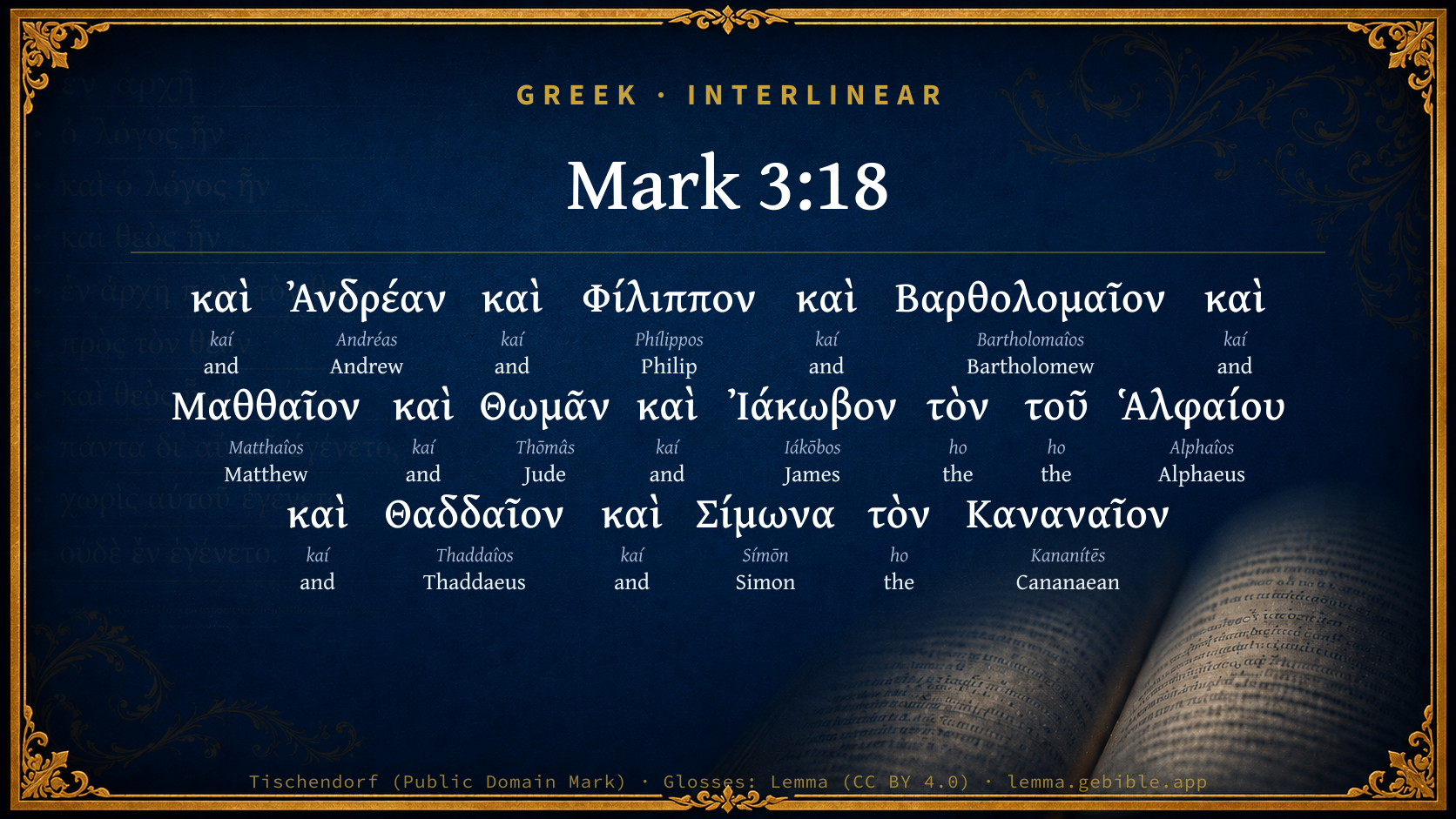
Download image
Cite this verse

Mark 3:18 (World English Bible). Public Domain. Lemma interlinear Bible study tool, https://lemma.gebible.app/v/mark/3/18.

Show BibTeX & RIS
BibTeX
RIS
English Translation
Andrew; Philip; Bartholomew; Matthew; Thomas; James, the son of Alphaeus; Thaddaeus; Simon the Zealot;
World English Bible · Public Domain
Highlights
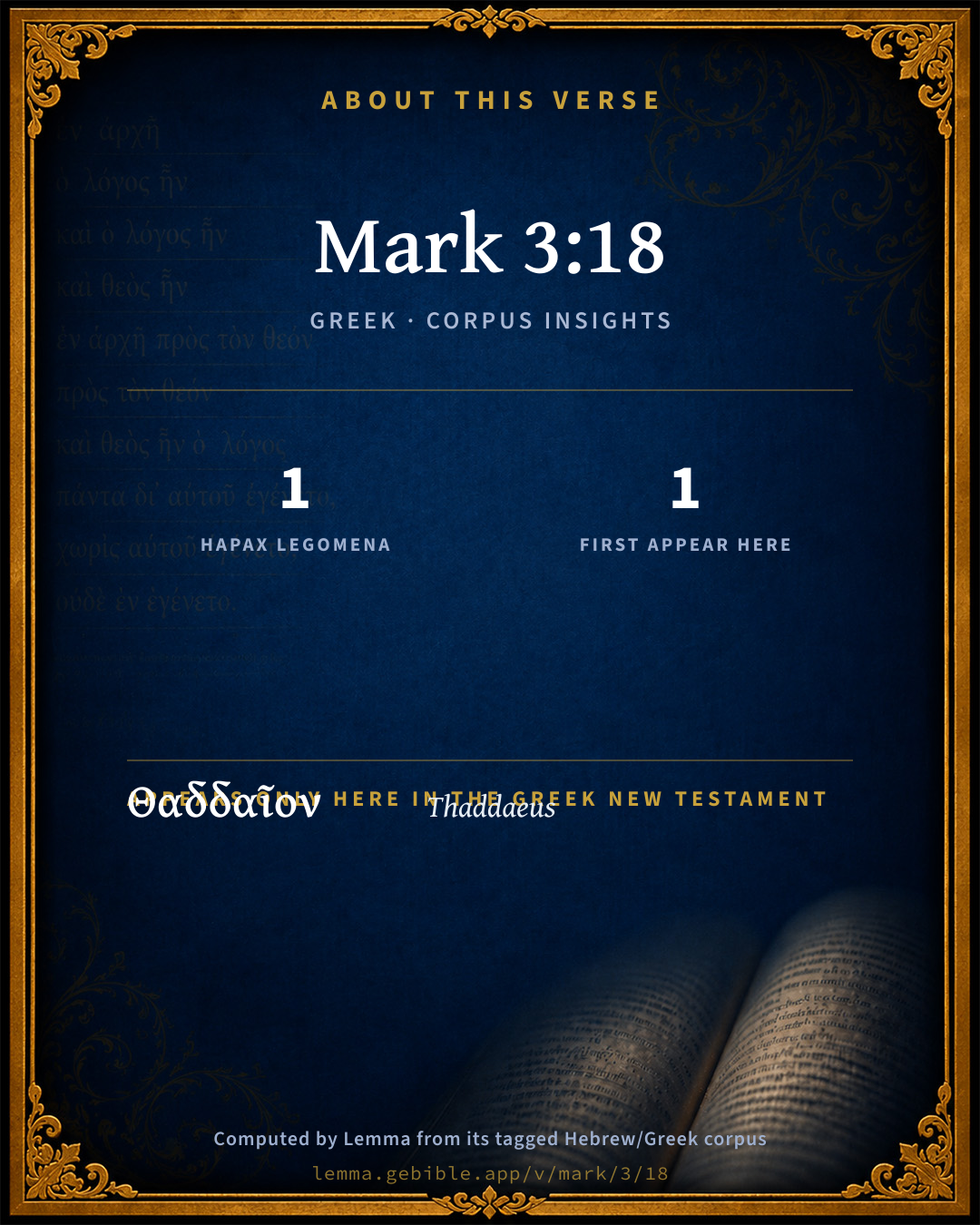
  • 1 hapax legomenon — only here in the Greek New Testament
  • 1 first appearance in the Greek New Testament
Full analysis ↓
Download a study sheet

One document with this verse’s original text, its word-by-word gloss line, the meaning frame, cross-references with their text, attributed commentary, and full source and license credits — printable, and it pastes into notes with its structure intact.

This verse Autodidact and up

Study sheet (.html) Plain text (.txt)

A passage Seminary Student

Up to 50 verses in one chapter. A passage sheet keeps up to 6 commentary sources and 12 cross-references per verse, in the order this page ranks them, and says so on the sheet whenever that leaves anything out. Ask for a single verse and you get the Autodidact verse sheet above.

Everything on this page stays free to read, with no account — the sheet is a download of what is already on screen, not access to it.

Want to remove ads? Support Godless Engineer
Compare translations 3

The same verse in 3 English versions, stacked beneath the original-language interlinear above. Click any original word for its lexicon entry.

Each is an independent rendering of the whole verse — the interlinear is not word-aligned to these translations.

Highlighted words mark where these versions differ — a whole-verse word diff, not a word-by-word alignment.

  • World English Bible Public Domain
    Andrew; Philip; Bartholomew; Matthew; Thomas; James, the son of Alphaeus; Thaddaeus; Simon the Zealot;
  • King James Version Public Domain
    And Andrew, and Philip, and Bartholomew, and Matthew, and Thomas, and James the son of Alphaeus, and Thaddaeus, and Simon the Canaanite,
  • unfoldingWord Literal Text CC BY-SA 4.0
    and Andrew and Philip and Bartholomew and Matthew and Thomas and James the of Alphaeus and Thaddaeus and Simon the Cananaios

unfoldingWord Literal Text — © unfoldingWord, licensed CC BY-SA 4.0. Word-aligned USFM3 via Door43 (git.door43.org/unfoldingWord/en_ult).

Versions to compare (up to 4)

3 of 4 selected

Show all 19 translations

Every available English version of this verse, each an independent rendering of the whole verse.

  • World English Bible Public Domain
    Andrew; Philip; Bartholomew; Matthew; Thomas; James, the son of Alphaeus; Thaddaeus; Simon the Zealot;
  • Berean Standard Bible Public Domain
    Andrew, Philip, Bartholomew, Matthew, Thomas, James son of Alphaeus, Thaddaeus, Simon the Zealot,
  • Majority Standard Bible Public Domain
    Andrew, Philip, Bartholomew, Matthew, Thomas, James son of Alphaeus, Thaddaeus, Simon the Zealot,
  • King James Version Public Domain
    And Andrew, and Philip, and Bartholomew, and Matthew, and Thomas, and James the son of Alphaeus, and Thaddaeus, and Simon the Canaanite,
  • American Standard Version (1901) Public Domain
    and Andrew, and Philip, and Bartholomew, and Matthew, and Thomas, and James the `son' of Alphaeus, and Thaddaeus, and Simon the Cananaean,
  • Revised Version (1885) Public Domain
    and Andrew, and Philip, and Bartholomew, and Matthew, and Thomas, and James the son of Alphaeus, and Thaddaeus, and Simon the Cananaean,
  • Geneva Bible (1599) Public Domain
    And Andrew, and Philippe, and Bartlemew, and Matthewe, and Thomas, and Iames, the sonne of Alpheus, and Thaddeus, and Simon the Cananite,
  • Douay-Rheims (1899) Public Domain
    And Andrew and Philip, and Bartholomew and Matthew, and Thomas and James of Alpheus, and Thaddeus, and Simon the Cananean:
  • Young's Literal Translation Public Domain
    and Andrew, and Philip, and Bartholomew, and Matthew, and Thomas, and James of Alpheus, and Thaddeus, and Simon the Cananite,
  • Literal Standard Version CC BY-SA 4.0
    and Andrew, and Philip, and Bartholomew, and Matthew, and Thomas, and James of Alpheus, and Thaddeus, and Simon the Zealot,
  • Unlocked Literal Bible CC BY-SA 4.0
    and Andrew, Philip, Bartholomew, Matthew, Thomas, James son of Alphaeus, Thaddaeus, Simon the Zealot,
  • unfoldingWord Literal Text CC BY-SA 4.0
    and Andrew and Philip and Bartholomew and Matthew and Thomas and James the of Alphaeus and Thaddaeus and Simon the Cananaios
  • Darby Bible Public Domain
    and Andrew, and Philip, and Bartholomew, and Matthew, and Thomas, and James the [son] of Alphaeus, and Thaddaeus, and Simon the Cananaean,
  • World Messianic Bible Public Domain
    Andrew; Philip; Bartholomew; Matthew; Thomas; Jacob, the son of Halfai; Taddai; Simon the Zealot;
  • Webster's Bible Public Domain
    And Andrew, and Philip, and Bartholomew, and Matthew, and Thomas, and James the son of Alpheus, and Thaddeus, and Simon the Canaanite,
  • Free Bible Version CC BY-SA 4.0
    Andrew, Philip, Bartholomew, Matthew, Thomas, James the son of Alphaeus, Thaddaeus, Simon the Revolutionary,
  • Bible in Basic English Public Domain
    And Andrew, and Philip, and Bartholomew, and Matthew, and Thomas, and James, the son of Alphaeus, and Thaddaeus, and Simon the Zealot;
  • Text-Critical English NT CC BY 4.0
    Andrew, Philip, Bartholomew, Matthew, Thomas, James the son of Alphaeus, Thaddaeus, Simon the Cananite,
  • Tyndale New Testament (1534) Public Domain
    And Andrew and Philip and Bartlemew and Mathew and Thomas and Iames the sonne of Alphey and Taddeus and Symon of Cane,

Literal Standard Version (2020), Covenant Press — licensed CC BY-SA 4.0. Text via the HelloAO Bible API (eBible.org). Unlocked Literal Bible (unfoldingWord) — licensed CC BY-SA 4.0. Text via the HelloAO Bible API (eBible.org). unfoldingWord Literal Text — © unfoldingWord, licensed CC BY-SA 4.0. Word-aligned USFM3 via Door43 (git.door43.org/unfoldingWord/en_ult). Free Bible Version, Dr. Jonathan Gallagher — licensed CC BY-SA 4.0. Text via the HelloAO Bible API (eBible.org).

Word by word

More ways to search: Search by grammar → Find every occurrence → Compare this word →

Practice this passage: Drill this verse → Learn its vocabulary →

Θαδδαῖον
Thaddaîos
G2280
“Thaddaeus”
Noun, Accusative, Singular, Masculine
Part of Speech
Noun
Case
Accusative
Number
Singular
Gender
Masculine
Full Thayer's Definition

Origin: of uncertain origin

TDNT: None

Thaddaeus = "large hearted, courageous" 1. one of the twelve apostles. From a comparison with the catalogue of apostles in Lk 6:16 , and Acts 1:13 , is seems that Judas, Lebbaeus and Thaddaeus were the same person, and the writer of the book of Jude.
  1. καὶ kaí G2532 “and” Conjunction
  2. Ἀνδρέαν Andréas G406 “Andrew” Noun, Accusative, Singular, Masculine
  3. καὶ kaí G2532 “and” Conjunction
  4. Φίλιππον Phílippos G5376 “Philip” Noun, Accusative, Singular, Masculine
  5. καὶ kaí G2532 “and” Conjunction
  6. Βαρθολομαῖον Bartholomaîos G918 “Bartholomew” Noun, Accusative, Singular, Masculine
  7. καὶ kaí G2532 “and” Conjunction
  8. Μαθθαῖον Matthaîos G3156 “Matthew” Noun, Accusative, Singular, Masculine
  9. καὶ kaí G2532 “and” Conjunction
  10. Θωμᾶν Thōmâs G2381 “Jude” Noun, Accusative, Singular, Masculine
  11. καὶ kaí G2532 “and” Conjunction
  12. Ἰάκωβον Iákōbos G2385 “James” Noun, Accusative, Singular, Masculine
  13. τὸν ho G3588 “the” Article, Accusative, Singular, Masculine
  14. τοῦ ho G3588 “the” Article, Genitive, Singular, Masculine
  15. Ἁλφαίου Alphaîos G256 “Alphaeus” Noun, Genitive, Singular, Masculine
  16. καὶ kaí G2532 “and” Conjunction
  17. καὶ kaí G2532 “and” Conjunction
  18. Σίμωνα Símōn G4613 “Simon” Noun, Accusative, Singular, Masculine
  19. τὸν ho G3588 “the” Article, Accusative, Singular, Masculine
  20. Καναναῖον Kananítēs G2581 “Cananaean” Noun, Accusative, Singular, Masculine

About this verse

These counts appear in no published source. They are computed here, from the morphology-tagged text and Lemma’s own curated glosses. What Lemma adds →

21
words
12
distinct lemmas
Gospels
section

Notable vocabulary

1 hapax legomenon — a word that appears only here in the entire Greek New Testament:

  • Θαδδαῖον Thaddaeus G2280

First appearance in Scripture

This word makes its first canonical appearance in the Greek New Testament here:

  • Θαδδαῖον Thaddaeus G2280

Shared distinctive vocabulary

Καναναῖον Cananaean G2581 occurs in 2 verses of the Greek New Testament. Also found in:
Repetition

Words recur within this verse:

Cross-references

25

Topical passages linked to Mark 3:18 in the Treasury of Scripture Knowledge — connected by theme and wording, ordered by reader-vote popularity; previews shown in the World English Bible.

  • Acts 1:13 When they had come in, they went up into the upper room, where they were staying; that is Peter, John, James, Andrew, Philip, Thomas, Bartholomew, Matthew, James the son of Alphaeus, Simon the Zealot, and Judas the son of James.
  • Mark 2:14 As he passed by, he saw Levi, the son of Alphaeus, sitting at the tax office, and he said to him, "Follow me." And he arose and followed him.
  • Matthew 9:9 As Jesus passed by from there, he saw a man called Matthew sitting at the tax collection office. He said to him, "Follow me." He got up and followed him.
  • James 1:1 James, a servant of God and of the Lord Jesus Christ, to the twelve tribes which are in the Dispersion: Greetings.
  • Matthew 10:3–4 Philip; Bartholomew; Thomas; Matthew the tax collector; James the son of Alphaeus; and Lebbaeus, whose surname was Thaddaeus;
  • Matthew 13:55 Isn't this the carpenter's son? Isn't his mother called Mary, and his brothers, James, Joses, Simon, and Judas?
  • Mark 6:3 Isn't this the carpenter, the son of Mary, and brother of James, Joses, Judas, and Simon? Aren't his sisters here with us?" They were offended at him.
  • Luke 5:27–29 After these things he went out, and saw a tax collector named Levi sitting at the tax office, and said to him, "Follow me!"
  • Luke 6:14–16 Simon, whom he also named Peter; Andrew, his brother; James; John; Philip; Bartholomew;
  • John 1:40 One of the two who heard John, and followed him, was Andrew, Simon Peter's brother.
  • John 1:43–45 On the next day, he was determined to go out into Galilee, and he found Philip. Jesus said to him, "Follow me."
  • John 6:5–8 Jesus therefore lifting up his eyes, and seeing that a great multitude was coming to him, said to Philip, "Where are we to buy bread, that these may eat?"
  • John 11:16 Thomas therefore, who is called Didymus, said to his fellow disciples, "Let's go also, that we may die with him."
  • John 12:21–22 These, therefore, came to Philip, who was from Bethsaida of Galilee, and asked him, saying, "Sir, we want to see Jesus."
  • John 14:8–9 Philip said to him, "Lord, show us the Father, and that will be enough for us."
  • John 14:22 Judas (not Iscariot) said to him, "Lord, what has happened that you are about to reveal yourself to us, and not to the world?"
  • John 20:24–29 But Thomas, one of the twelve, called Didymus, wasn't with them when Jesus came.
  • John 21:2 Simon Peter, Thomas called Didymus, Nathanael of Cana in Galilee, and the sons of Zebedee, and two others of his disciples were together.
  • Acts 15:13 After they were silent, James answered, "Brothers, listen to me.
  • Acts 21:18 The day following, Paul went in with us to James; and all the elders were present.
  • 1 Corinthians 9:5 Have we no right to take along a wife who is a believer, even as the rest of the apostles, and the brothers of the Lord, and Cephas?
  • 1 Corinthians 15:7 Then he appeared to James, then to all the apostles,
  • Galatians 1:19 But of the other apostles I saw no one, except James, the Lord's brother.
  • Galatians 2:9 and when they perceived the grace that was given to me, James and Cephas and John, they who were reputed to be pillars, gave to me and Barnabas the right hand of fellowship, that we should go to the Gentiles, and they to the circumcision.
  • Jude 1:1 Jude, a servant of Jesus Christ, and brother of James, to those who are called, sanctified by God the Father, and kept for Jesus Christ:

Cross-references courtesy of OpenBible.info (CC BY 4.0).

Commentary

Notes on Mark 3:18 from classic Christian and Jewish commentators (each source and its license shown beneath its notes). The classic Christian expositions comment on the surrounding passage and are grouped to its opening verse, so a note may address several verses; the Jewish commentaries on the Tanakh (Rashi and others) are per-verse, so they appear only where the commentator wrote on this verse.

Lemma curates 59 commentaries, every one of them public domain or Creative Commons licensed, each selected and text-cleaned for this edition rather than reprinted as found. About our sources →

Tyndale Open Study Notes

Tyndale Open Resources

3:18 Philip is fifth on all four lists of the twelve disciples (Matt 10:1-4; Luke 6:12-16; Acts 1:13); James the son of Alphaeus (not the son of Zebedee and brother of John) is always ninth. Bartholomew might be Nathanael (John 1:43-51), and Matthew is probably Levi, the tax collector (Mark 2:14; Matt 9:9). Although Thomas is referred to as “the twin” (John 11:16; 20:24; 21:2), nothing else is said in the New Testament about this. Thaddaeus (Matt 10:3) is missing from Luke’s list; he might be Judas, the son of James (Luke 6:16; Acts 1:13). That a government official (Matthew) and an anti-government activist (Simon . . . the zealot) were among the twelve apostles testifies to Jesus’ ability to change people’s hearts and overcome natural antagonism.

Tyndale Open Study Notes — © Tyndale Open Resources, licensed CC BY-SA 4.0. Text via the HelloAO Bible API.

Expositor's Greek Testament

ed. W. Robertson Nicoll

Mar 3:18 . Ματθαῖον . One wonders why Mk. did not here say: Levi, to whom He gave the name Matthew. Or did this disciple get his new name independently of Jesus? This list of names shows the importance of the act of selecting the Twelve. He gives the names, says Victor Ant., that you may not err as to the designations, lest any one should call himself an apostle ( ἵνα μὴ ὁ τυχὼν εἴπῃ ἀπόστολος γεγονέναι ).

Mar 3:19-21 . The friends of Jesus think Him out of His senses ; peculiar to Mk. One of his realisms which Mt. and Lk. pass over in silence.

Mar 3:19 b. καὶ ἔρχεται εἶς οἶκον , and He cometh home (“nach Haus,” Weizs.) to house-life as distinct from hill-life ( εἰς τὸ ὄρος , Mar 3:13 ). The formal manner in which this is stated suggests a sojourn on the hill of appreciable length, say, for some days. How occupied there? Probably in giving a course of instruction to the disciple-circle; say, that reproduced in the “Sermon on the Mount” = the “Teaching on the Hill,” vide introductory notes on Mat 5 .

The Expositor's Greek Testament, edited by W. Robertson Nicoll (1897–1910) — public domain. Text from a community e-Sword module.

Geneva Bible (1599)

Geneva Bible translators

Whom Luke also calleth Judas: and for difference’s sake, the other Judas is called Iscariot.

Geneva Bible (1599) marginal notes — public domain. Text via Bolls.life.

Ellicott's Commentary for English Readers

(18) Simon the Canaanite.—Better, Cananite, or, following many MSS., Cananœan, i.e., the Aramaic equivalent of Zelotes. (See Note on Mat_10:2-4)

A Bible Commentary for English Readers, edited by Charles John Ellicott (1878–1897) — public domain. Text from a community e-Sword module.

The Cambridge Bible for Schools and Colleges

gen. ed. J. J. S. Perowne

18. iv. Andrew] a brother of St Peter (Mat_4:18), and like him a native of Bethsaida, and a former disciple of the Baptist (Joh_1:40). By his means his brother Simon was brought to Jesus (Joh_1:41). In the lists of the Apostles given by St Matthew and St Luke he appears second; but in St Mark and Act_1:13, fourth. We have three notices of him in the Gospels, (i) On the occasion of the feeding of the Five Thousand it is he who points out the little lad with the five barley loaves and the two fishes; (ii) when certain Greeks desired to see Jesus, it was he in conjunction with Philip who introduced them to the Lord (Joh_12:22); (iii) together with Peter, James, and John he inquired privately of our Lord respecting His future coming (Mar_13:3).

(b) Group ii

v. Philip] He also was a native of Bethsaida and one of the earliest disciples (Joh_1:43). To him first of the whole circle of the Apostles were spoken the solemn words “Follow Me.” It was to him the question was put “to prove him,” “Whence shall we buy bread, that these may eat?” (Joh_6:5-9); together with his friend and fellow townsman, St Andrew, he brought the inquiring Greeks to the Saviour (Joh_12:20-22); it was he who asked “Lord, shew us the Father, and it sufficeth us” (Joh_14:8).

vi. Bartholomew] i. e. Bar-Tolmai, the “Son of Tolmai,” and probably identical with Nathanael = “gift of God” For (i) St John twice mentions Nathanael, never Bartholomew (Joh_1:45; Joh_21:2); (ii) the other Evangelists all speak of Bartholomew, never of Nathanael; (iii) Philip first brought Nathanael to Jesus, and Bartholomew is mentioned by each of the Synoptic Evangelists immediately after Philip; (iv) St John couples Philip with Nathanael precisely in the same way that Simon is coupled with his brother Andrew. Respecting him, at least under the name Nathanael, we learn from the Gospels little more than (a) his birth-place, Cana of Galilee (Joh_21:2); (b) his simple, guileless character (Joh_1:47); and (c) that he was one of the seven, to whom our Lord shewed Himself by the lake of Gennesaret after His resurrection (Joh_21:2).

vii. Matthew] or Levi, whose call has just been described. See above, on Mar_2:14.

viii. Thomas] or Didymus= a twin (Joh_11:16; Joh_21:2), whose character was marked by a deep attachment to his Master and a readiness even to die with Him (Joh_11:16), but at the same time by a tendency to misgiving and despondency, which made him ever ready to take the darker view of things, and to distrust other evidence than that of sight (Joh_14:5; Joh_20:25).

(c) Group iii

ix. James] or “James the Less” (see note below, Mar_15:40), the son of Alphæus, so called to distinguish him from James, the son of Zebedee, mentioned above. He is probably a distinct person from James the Lord’s brother (Gal_1:19), and author of the Epistle, which bears his name.

x. Thaddæus] i. e. Judas, a brother, or possibly a son of James, bishop of Jerusalem (Act_1:13). He was surnamed Thaddæus and Lebbæus (Mat_10:3), which some interpret as = “cordatus or animosus” = “a man of energy and courage.” He is the author of the Epistle which bears his name. Once only in the Gospels do we find any act or saying of his recorded, viz., in Joh_14:22, “Lord, how is it that thou wilt manifest thyself unto us, and not unto the world?”

xi. Simon] the Cananite, or Cananœan (Mat_10:4), in Greek Zelotes (Luk_6:15; Act_1:13). The spelling of the English Version here is misleading. The word does not signify a native of Canaan, or of Cana, but comes from a Chaldee or Syriac word Kanean or Kaneniah, by which the Jewish sect or faction of “the Zealots” was designated. To this sect Simon had probably belonged before his call.

The Cambridge Bible for Schools and Colleges (gen. ed. J. J. S. Perowne; Cambridge University Press, 1878–1918) — public domain. Text from a community e-Sword module.

John Gill's Exposition

And Judas Iscariot,.... So called to distinguish him from the other Judas; and is mentioned last for the following reason:

which also betrayed him; and which action of his will ever render his name infamous among men. This man, with the rest, our Lord chose to be an apostle of his, though he knew he would betray him; in order to fulfil the purposes of God, the prophecies of the Old Testament, and bring on the work of man's redemption he came into the world to perform.

And they went into an house at Capernaum; the house of Simon and Andrew, where Jesus used to be when there: they went home with him from the mountain; and from that time became his domestics, and were looked upon by him as his family, and were admitted to the greatest nearness and intimacy with him.

John Gill's Exposition of the Whole Bible (1746–1763) — public domain (CC PDM 1.0). Text via the HelloAO Bible API.

Trapp's Complete Commentary

John Trapp

18 And Andrew, and Philip, and Bartholomew, and Matthew, and Thomas, and James the son of Alphaeus, and Thaddaeus, and Simon the Canaanite,

Ver. 18. And Bartholomew] {See Trapp on "Mat 10:3"}

John Trapp, A Commentary or Exposition upon All the Books of the Old and New Testament (1647–1656) — public domain. Text from a community e-Sword module.

The Pulpit Commentary

Vers. 18, 19. Andrew is next mentioned after these eminent apostles, as the first called. The word is from the Greek, and means "manly." Bartholomew, that is, Bar-tolmai, the son of Tolmay. This is a patronymic, and not a proper name. It has been with good reason supposed that he is identical with Nathanael, of whom we first read in Joh_1:46, as having been found by Philip and brought to Christ. In the three synoptic Gospels we find Philip and Bartholomew enumerated together in the lists of the apostles; and certainly the mode in which Nathanael is mentioned in Joh_21:2 would seem to show that he was an apostle. His birthplace, too, Cana of Galilee, would point to the same conclusion. If this be so, then the name Nathanael, the "gift of God," would bear the same relation to Bartholomew that Simon does to Bar-jona. Matthew. In St Matthew"s own list of the apostles (Mat_10:3) the epithet "the publican" is added to his name, and he places himself after Thomas. This marks the humility of the apostle, that he does not scruple to place on record what he was before he was called. The word Matthew, a contraction of Mattathias, means the "gift of Jehovah," according to Gesenius, which in Greek would be "Theodore." Thomas. Eusebius says that his real name was Judas. It is possible that Thomas may have been a surname. The word is Hebrew meaning a twin, and it is so rendered in Greek in Joh_11:16. James the son of Alphaeus, or Clopas (not Cleophas): called" the Less," either because he was junior in age, or rather in his call, to James the Great, the brother of John. This James, the son of Alphaeus, is called the brother of our Lord. St. Jerome says that his father Alphaeus, or Clopas, married Mary, a sister of the blessed Virgin Mary, which would make him the cousin of our Lord. This view is confirmed by Bishop Pearson (Art. 3:on the Creed). He was the writer of the Epistle which bears his name, and he became Bishop of Jerusalem. Thaddaeus, called also Lebbaeus and Judas; whence St. Jerome describes him as "trionimus," i.e. having three names. Judas would be his proper name. Lebbaeus and Thaddaeus have a kind of etymological affinity, the root of Lebbaeus being "heart," and of Thaddaeus, "breast." These names are probably recorded to distinguish him from Judas the traitor. Simon the Canaanite. The word in the Greek, according to the best authorities, is, both here and in St. Matthew, (Mat_10:4) Kananaiov , from a Chaldean or Syriac word, Kanean, or Kanenieh. The Greek equivalent is Zhlwthv , which we find preserved in St. Luke. (Luk_6:15) It is possible, however, that Simon may have been born in Cana of Galilee. St. Jerome says that he was called a Cananaean or Zealot, by a double reference to the place of his birth and to his zeal. Judas Iscariot. Iscariot. The most probable derivation is from the Hebrew lsh-Kerioth, "a man of Kerioth," a city of the tribe of Judah. St. John (Joh_6:7) describes him as the son of Simon. If it be asked why our Lord should have chosen Judas Iscariot, the answer is that he chose him, although he knew that he would betray him, because it was his will that he should be betrayed by one that had been "his own familiar friend," and that had "eaten bread with him." Bengel says well here that "there is an election of grace from which men may fall." How far our Lord knew from the first the results of his choice of Judas belongs to the profound, unfathomable mystery of the union of the Godhead and the manhood in his sacred Person. We may notice generally, with regard to this choice by our Lord of his apostles, the germ of the principle of sending them forth by two and two. Here are Peter and Andrew, James and John, Philip and Bartholomew, and so on. Then, again, our Lord chose three pairs of brothers, Peter and Andrew, James and John, James the Less and Jude, that he might teach us how powerful an influence is brotherly love. We may also observe that Christ, in selecting his apostles, chose some of his kinsmen according to the flesh. When he took upon him our flesh, he recognized those who were near to him by nature, and he would unite them yet mere closely by grace to his Divine nature. Three of the apostles took the lead, namely, Peter and James and John, who were admitted to be witnesses of his transfiguration, of one of his greatest miracles, and of his passion.

The Pulpit Commentary (1880–1919), ed. H.D.M. Spence-Jones & Joseph S. Exell — public domain. Text from a community e-Sword module.

Cambridge Greek Testament for Schools and Colleges

18. Καναναῖον ([522][523][524][525][526][527] 33) rather than Κανανίτην ([528][529][530][531]).

[522] Codex Sinaiticus. 4th cent. Discovered by Tischendorf in 1859 at the Monastery of St Katharine on Mount Sinai. Now at St Petersburg. The whole Gospel, ending at Mar 16:8. Photographic facsimile, 1911.

[523] Codex Vaticanus. 4th cent., but perhaps a little later than א. In the Vatican Library almost since its foundation by Pope Nicolas V., and one of its greatest treasures. The whole Gospel, ending at Mar 16:8. Photographic facsimile, 1889.

[524] Codex Ephraemi. 5th cent. A palimpsest: the original writing has been partially rubbed out, and the works of Ephraem the Syrian have been written over it; but a great deal of the original writing has been recovered; of Mark we have Mar 1:17 to Mar 6:31, Mar 8:5 to Mar 12:29, Mar 13:19 to Mar 16:20. In the National Library at Paris.

[525] Codex Bezae. 6th cent. Has a Latin translation (d) side by side with the Greek text, and the two do not quite always agree. Presented by Beza to the University Library of Cambridge in 1581. Remarkable for its frequent divergences from other texts. Contains Mark, except Mar 16:15-20, which has been added by a later hand. Photographic facsimile, 1899.

[526] Codex Regius. 8th cent. An important witness. At Paris. Contains Mar 1:1 to Mar 10:15; Mar 10:30 to Mar 15:1; Mar 15:20 to Mar 16:20, but the shorter ending is inserted between Mar 16:8 and Mar 16:9, showing that the scribe preferred it to the longer one.

[527] Codex Sangallensis. 9th or 10th cent. Contains the Gospels nearly complete, with an interlinear Latin translation. The text of Mark is specially good, agreeing often with CL. At St Gall.

[528] Codex Alexandrinus. 5th cent. Brought by Cyril Lucar, Patriarch of Constantinople, from Alexandria, and afterwards presented by him to King Charles I. in 1628. In the British Museum. The whole Gospel. Photographic facsimile, 1879.

[529] Codex Oxoniensis. 9th cent. Contains Mark, except Mar 3:35 to Mar 6:20.

[530] Codex Petropolitanus. 9th cent. Gospels almost complete. Mar 16:18-20 is in a later hand.

[531] Codex Beratinus. 6th cent. Contains Mar 1:1 to Mar 14:62.

18. Ἀνδρέαν. Cf. Mar 1:16; Mar 1:29; he is mentioned again Mar 13:3. Almost all that we know of him comes from Jn (Mar 1:41; Mar 1:44, Mar 6:8, Mar 12:22).

Φίλιππον. All that we know of him comes from Jn (Mar 1:44-45, Mar 6:5-7, Mar 12:21-22, Mar 14:8-9). Both Andrew and Philip are purely Greek names, and there seems to have been some connexion between the two Apostles. Both came from Bethsaida. In Act 1:13 their names are placed together, as here. Philip is mentioned 12 times, and Andrew 9 times, outside the four lists.

Βαρθολομαῖον. “Son of Talmai,” or (as some think) “of Ptolemäus.” This patronymic is in all the lists, and the Synoptists place him next to Philip. If he is the same as Nathanael, Philip brought him to Christ (Joh 1:46). All the companions who are named in Joh 21:2 are Apostles. Jn never mentions Bartholomew, and Mk, Mt., and Lk. never mention Nathanael. Nevertheless, this ancient identification cannot be assumed as certain.

Μαθθαῖον καὶ Θωμᾶν. In all three Gospels these two names come together, but Mt. puts Thomas before Matthew and adds ὁ τελώνης to the latter, an addition found in no other list. This points to the influence of Matthew on the First Gospel, and to his wish to make it clear that Matthew the Apostle and Levi the toll-collector are the same person. See on Mar 2:14. All that we know of Thomas is told us by Jn (Joh 11:16, Joh 14:5, Joh 20:24-29, Joh 21:2). Δίδυμος is a translation, and Θωμᾶς is a transliteration, of the Hebrew for “twin.” Tradition says that his original name was Judas, and in that case it would be almost necessary to give him another name, as there were two other Apostles named Judas.

Ἰάκωβον τὸν τοῦ Ἀλφαίου. The father’s name is added to distinguish him from the son of Zebedee. This Alphaeus is not the father of Levi (Mar 2:14), nor is this James the brother of the Lord (Mar 6:3; Mat 13:55; Gal 1:19), who was the first overseer of the Church of Jerusalem (Act 12:17; Act 15:13; Gal 2:9; Gal 2:12). The brethren of the Lord at this time did not believe on Him (Joh 7:5). But James of Alphaeus may be identical with James the Little (Mar 15:40; Mat 27:56; Joh 19:25), for Alphaeus may perhaps = Clopas.

Θαδδαῖον. This is the only name about which there is material difference in the lists. Mk and Mt. have “Thaddaeus,” with “Lebbaeus” as an alternative reading, while Lk. and Acts have “Judas the son of James.” Here and in Mt. the reading θαδδαιον may safely be adopted, Λεββαίον ([606] Lat-Vet.) being perhaps due to a wish to identify him with Levi.

[606] Codex Bezae. 6th cent. Has a Latin translation (d) side by side with the Greek text, and the two do not quite always agree. Presented by Beza to the University Library of Cambridge in 1581. Remarkable for its frequent divergences from other texts. Contains Mark, except Mar 16:15-20, which has been added by a later hand. Photographic facsimile, 1899.

Καναναῖον. See crit. note. “Canaanite” would be Χαναναῖος, and “man of Cana” would be Καναῖος. Καναναῖος is the Greek form of the Aramaic Kanan, which = ζηλωτής, as Lk. renders it. Lightfoot, On Revision2, pp. 154 f. We need not suppose that this Simon ever belonged to the fanatical extremists from whom sprang the Sicarii. Like St Paul, he may have been περισσοτέρως ζηλωτὴς τῶν πατρικῶν παραδόσεων (Gal 1:14), and may have been equally zealous respecting Christ’s teaching, after his call. Onias, who was head of the orthodox party, is said to be “zealous of the laws” (2Ma 4:2).

Cambridge Greek Testament for Schools and Colleges (Cambridge University Press, 1896; 21 vols, various authors incl. Carr, Maclear, Plummer, Farrar, Lumby, Moule, M. R. James, Simcox) — public domain. Text from a community e-Sword module.

International Critical Commentary

18. Φίλιππον—Philip heads the second group in all the Gospels, as Peter the first. The name is a Greek name. We hear nothing more about him in the Synoptics, though he is mentioned several times in the fourth Gospel.

Βαρθολομαῖον—This name does not occur in the Gospels outside of these lists, and elsewhere only in Act 1:13. And in the passage in Acts, Bartholomew’s name is associated, as it is here, with those of Philip and Thomas. In the fourth Gospel, on the other hand, we find that Nathanael is associated with Philip and Thomas, as Bartholomew is in the Synoptics and the Acts. In J. 1:46-50, Nathanael is the one whom Philip introduces to Jesus, while in J. 21:2, Nathanael’s name is associated with Thomas. This, together with the fact that so important a personage as Nathanael appears to be in J. is not mentioned in the list of the twelve, has led to the quite reasonable supposition that the two are to be identified. In that case, Bartholomew, which means Son of Tolmai, would be a patronymic, and Nathanael would be the real name.

Μαθθαῖον—On the identification of this disciple with Levi the publican, see on 2:14. He is not mentioned after this, except in Act 1:13. Θωμᾶν—This disciple, who is a mere name in the Synoptics and the Acts, becomes a personage in the fourth Gospel. J. 11:16, 14:5, 20:24-28. This group of four is the same in all three Synoptics, but in Mt., Thomas precedes Matthew.

Ἰάκωβον τὸν τοῦ Ἀλφαίου—This James is probably the same as Ἰάκωβος ὁ μικρός, James the little, the son of Mary and Clopas. See 15:40, 16:1, J. 19:25. The supposition, however, that in this passage from J., Μαρία ἡ τοῦ Κλωπᾶ is in apposition with ἡ μήτηρ αὐτοῦ, and that thus the brothers of our Lord were his cousins and included in the list of apostles, is decisively negatived, first, by its giving us two sisters having the same name, Mary; secondly, by the fact, that in Luk 2:7, Jesus is called the firstborn son of Mary, implying that there were other sons; thirdly, by Act 1:14, in which the brothers of our Lord are distinguished from the apostles; and finally, by J. 7:5 which states distinctly, that at the Feast of Tabernacles, six months before the death of Jesus, his brothers did not believe in him.

Θαδδαῖον—This must be the same as Lebbæus, Mat 10:3 (AV. Tisch.), and Jude the son of James, Luk 6:16.

τὸν Καναναῖον—the Zealot.

Καναναῖον, instead of Κανανίτην, Tisch. Treg. WH. RV. א BCDL Δ 33, Latt. Memph. (Pesh.) etc.

If this name meant an inhabitant of Cana, it would be Καναῖον. Probably, it comes from the Heb. קַנָּא, Chald. קַנְאָן, with the termination αιος which denotes a party (Φαρισαῖος, Σαδδουκαῖος), and is the same as Ζηλώτης zealot, the name given to him in Luk 6:15. This was the name of a party of fanatic nationalists among the Jews, leaders of the national revolt against the foreign yoke.

International Critical Commentary — older volumes (1896–1929), various authors — public domain. Text from a community e-Sword module.

Vincent's Word Studies in the New Testament

Marvin R. Vincent

Andrew [ανδρεαν] . A name of Greek origin though ill use among the Jews, from ajnhr, man, and signifying manly. He was one of the two who came earliest to Christ (Mt 4:18, 20; compare Joh 1:40, 41); and hence is always styled by the Greek fathers prwtoklhtov, first called.

Philip [φιλιππον] . Another Greek name, meaning fond of horses. In ecclesiastical legend he is said to have been a chariot - driver.

Bartholomew. A Hebrew name - Bar Tolmai, son of Tolmai. Almost certainly identical with Nathanael. Philip and Nathanael are associated by John, as are Philip and Bartholomew in the parallel passages of the synoptics. Bartholomew is not mentioned in John's list of the twelve (xi. 2), but Nathanael is; while the synoptists do not mention Nathanael in their lists, but do mention Bartholomew. Probably he had two names.

Matthew. See on the superscription of Matthew's Gospel. Thomas. A Hebrew name, meaning twin, and translated by the Greek Didymus (Joh 11:16).

Thaddaeus or Lebbaeus, as in Mt 10:3. He is the Judas of Joh 14:22. Luther calls him der formme Judas (the good Judas). The two surnames, Lebbaeus and Thaddaeus, mean the same thing - beloved child.

Simon the Canaanite. Properly, Cananaean. See on Mt 10:4 : "No name is more striking in the list than that of Simon the Zealot, for to none of the twelve could the contrast be so vivid between their former and their new position. What revolution of thought and heart could be greater than that which had thus changed into a follower of Jesus one of the fierce war - party of the day, which looked on the presence of Rome in the Holy Land as treason against the majesty of Jehovah, a party who were fanatical in their Jewish strictures and exclusiveness?" (Geikie, " Life and Words of Christ ").

Marvin R. Vincent, Word Studies in the New Testament (1887–1900) — public domain. Text from a community e-Sword/MySword module.

Lesson kit

Teaching starters — assembled from the data on this page, not authored interpretation. Every prompt links to the verse data it draws on. Edit before teaching.

Mark, in the Gospels, opens this verse with 21 words (12 distinct Greek lemmas). Its most distinctive word is Thaddaîos (“Thaddaeus”). A historical commentator’s framing appears above. Read the whole chapter for the surrounding context.

Discussion questions

  1. What does “Thaddaeus” (Thaddaîos) contribute to the verse as a whole?
  2. 1 word here appears nowhere else in the Greek New Testament. Why might the author reach for such rare wording?
  3. This is the first place “Thaddaeus” appears in Scripture (first appears here). What does its debut here establish?
  4. How does Matthew 10:4, which shares the word «Cananaean», read alongside this verse?
  5. What does the repetition of “and” (8× in this one verse) do in this verse?
  6. These translations render this verse differently. What is at stake in choosing one wording over another?
  7. Compare how Tyndale Open Study Notes and Expositor's Greek Testament read this verse. Where do they agree or differ?

Things to notice

  • 1 word in this verse appears nowhere else in the Greek New Testament.
  • 1 word makes its first canonical appearance in Scripture here.
  • These translations choose different wording for 4 words in this verse.
  • “and” occurs 8× in this single verse.
  • 12 distinct Greek lemmas span 21 words in this verse.

Reading settings

Reading text

Shown beneath each verse's original-language words.

Old Testament
Old Testament edition

Read the OT as the Masoretic Hebrew (MT) or the Greek Septuagint (LXX).

English shown for the Greek Septuagint (in the Hebrew ↔ Greek comparison).

Comparing translations? Open the Compare panel on any verse page to stack up to four side by side.