
Matthew 27:5

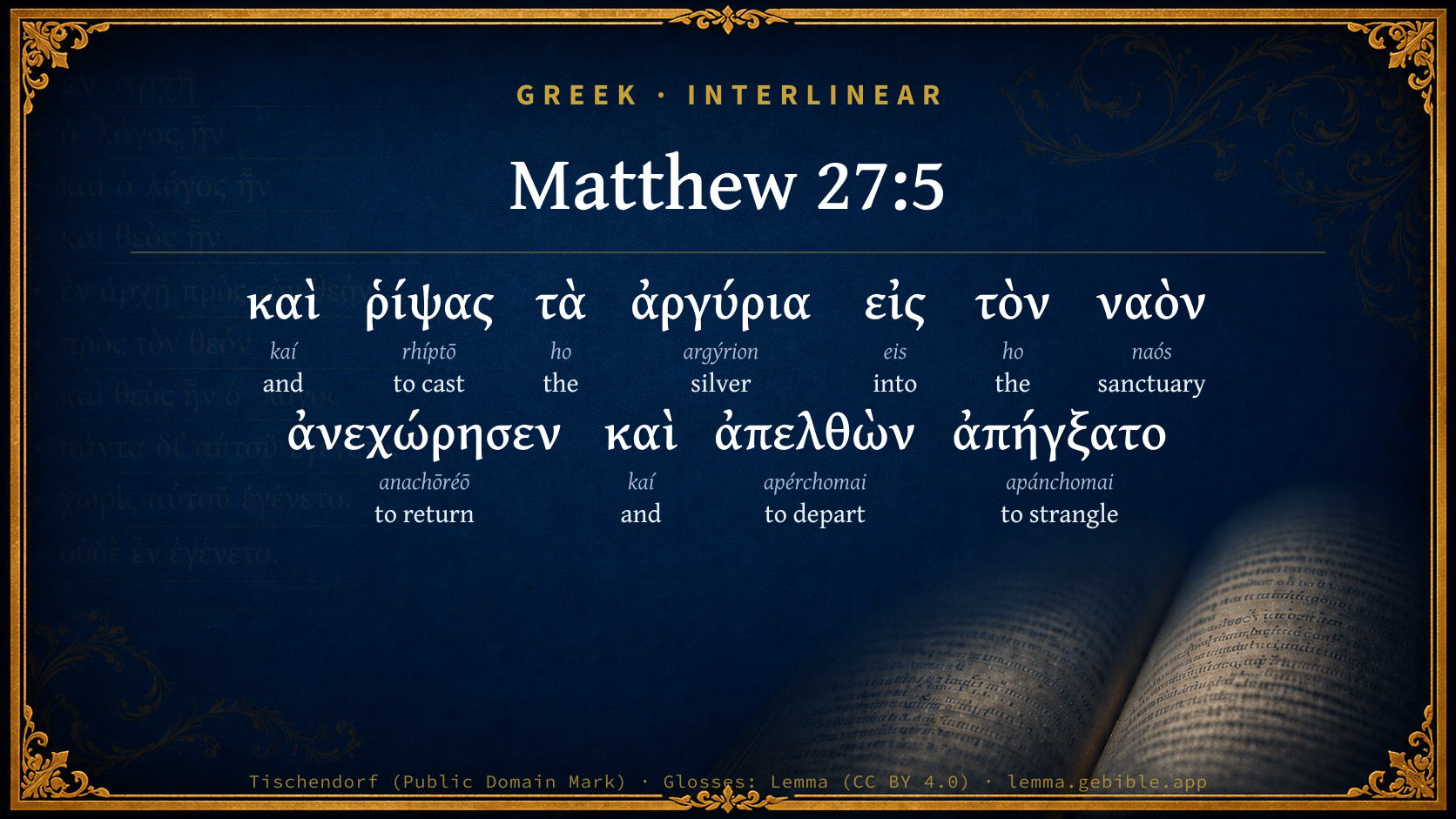
Greek (Tischendorf 8th ed.) Matthew 27:5 appears in the Greek New Testament. The text above is from the Tischendorf 8th edition. Each word links to its Strong’s number and a concise gloss. Click any word for its full Thayer’s Greek Lexicon entry.
Download image
Cite this verse

Matthew 27:5 (World English Bible). Public Domain. Lemma interlinear Bible study tool, https://lemma.gebible.app/v/matthew/27/5.

Show BibTeX & RIS
BibTeX
RIS
English Translation
He threw down the pieces of silver in the sanctuary, and departed. He went away and hanged himself.
World English Bible · Public Domain
Highlights
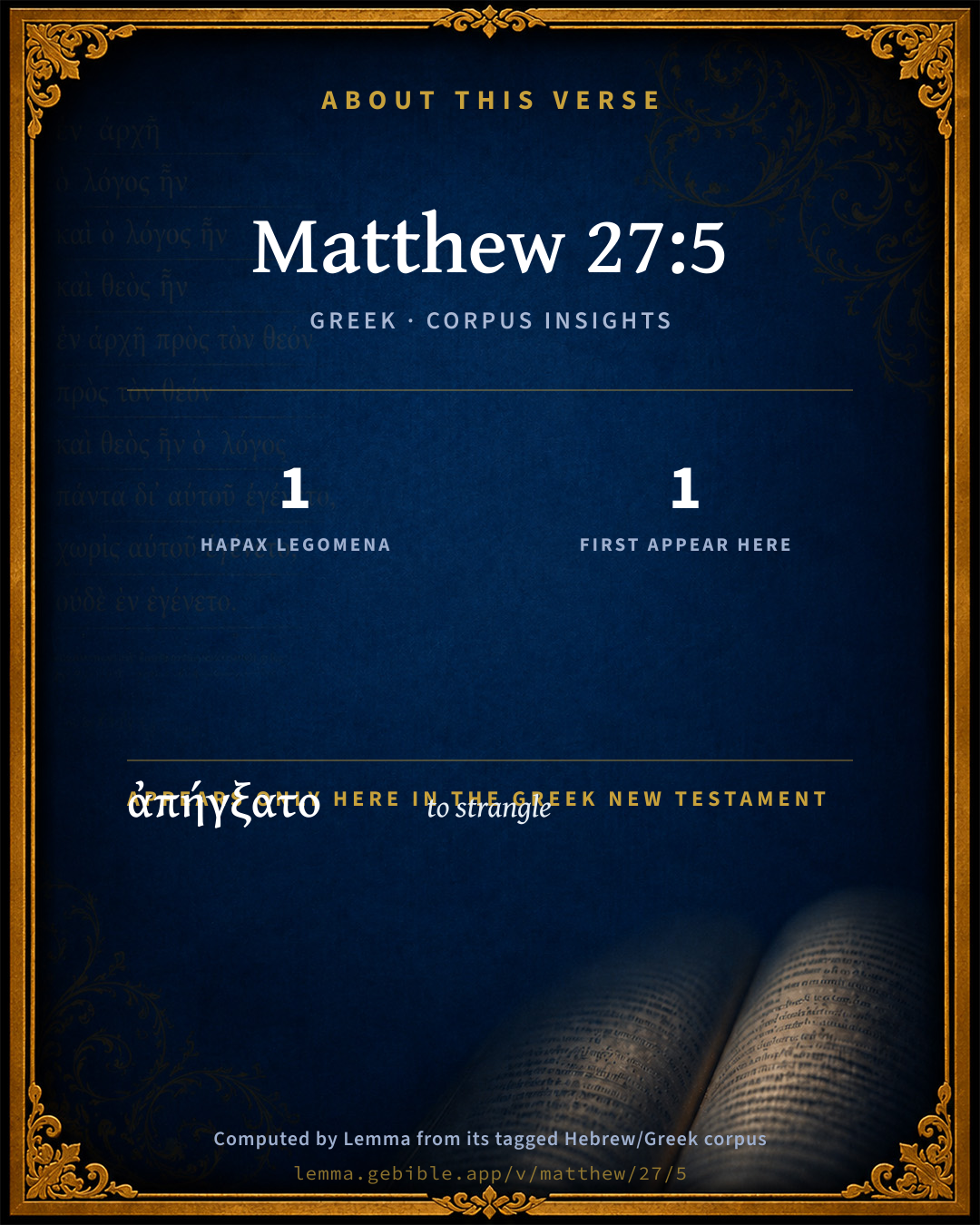
  • 1 hapax legomenon — only here in the Greek New Testament
  • 1 first appearance in the Greek New Testament
Full analysis ↓
Download a study sheet

One document with this verse’s original text, its word-by-word gloss line, the meaning frame, cross-references with their text, attributed commentary, and full source and license credits — printable, and it pastes into notes with its structure intact.

This verse Autodidact and up

Study sheet (.html) Plain text (.txt)

A passage Seminary Student

Up to 50 verses in one chapter. A passage sheet keeps up to 6 commentary sources and 12 cross-references per verse, in the order this page ranks them, and says so on the sheet whenever that leaves anything out. Ask for a single verse and you get the Autodidact verse sheet above.

Everything on this page stays free to read, with no account — the sheet is a download of what is already on screen, not access to it.

Want to remove ads? Support Godless Engineer
Compare translations 3

The same verse in 3 English versions, stacked beneath the original-language interlinear above. Click any original word for its lexicon entry.

Each is an independent rendering of the whole verse — the interlinear is not word-aligned to these translations.

Highlighted words mark where these versions differ — a whole-verse word diff, not a word-by-word alignment.

  • World English Bible Public Domain
    He threw down the pieces of silver in the sanctuary, and departed. He went away and hanged himself.
  • King James Version Public Domain
    And he cast down the pieces of silver in the temple, and departed, and went and hanged himself.
  • unfoldingWord Literal Text CC BY-SA 4.0
    And having thrown the pieces of silver into the temple, he withdrew. And having gone out, he hanged himself.

unfoldingWord Literal Text — © unfoldingWord, licensed CC BY-SA 4.0. Word-aligned USFM3 via Door43 (git.door43.org/unfoldingWord/en_ult).

Versions to compare (up to 4)

3 of 4 selected

Show all 19 translations

Every available English version of this verse, each an independent rendering of the whole verse.

  • World English Bible Public Domain
    He threw down the pieces of silver in the sanctuary, and departed. He went away and hanged himself.
  • Berean Standard Bible Public Domain
    So Judas threw the silver into the temple and left. Then he went away and hanged himself.
  • Majority Standard Bible Public Domain
    So Judas threw the silver into the temple and left. Then he went away and hanged himself.
  • King James Version Public Domain
    And he cast down the pieces of silver in the temple, and departed, and went and hanged himself.
  • American Standard Version (1901) Public Domain
    And he cast down the pieces of silver into the sanctuary, and departed; and he went away and hanged himself.
  • Revised Version (1885) Public Domain
    And he cast down the pieces of silver into the sanctuary, and departed; and he went away and hanged himself.
  • Geneva Bible (1599) Public Domain
    And when hee had cast downe the siluer pieces in the Temple, hee departed, and went, and hanged himselfe.
  • Douay-Rheims (1899) Public Domain
    And casting down the pieces of silver in the temple, he departed: and went and hanged himself with an halter.
  • Young's Literal Translation Public Domain
    and having cast down the silverlings in the sanctuary, he departed, and having gone away, he did strangle himself.
  • Literal Standard Version CC BY-SA 4.0
    And having cast down the pieces of silver in the temple, he departed, and having gone away, he strangled himself.
  • Unlocked Literal Bible CC BY-SA 4.0
    Then he threw down the pieces of silver in the temple, and departed, and went out and hanged himself.
  • unfoldingWord Literal Text CC BY-SA 4.0
    And having thrown the pieces of silver into the temple, he withdrew. And having gone out, he hanged himself.
  • Darby Bible Public Domain
    And having cast down the pieces of silver in the temple, he left the place, and went away and hanged himself.
  • World Messianic Bible Public Domain
    He threw down the pieces of silver in the sanctuary and departed. Then he went away and hanged himself.
  • Webster's Bible Public Domain
    And he cast down the pieces of silver in the temple, and departed, and went and hanged himself.
  • Free Bible Version CC BY-SA 4.0
    Judas threw the silver coins into the sanctuary and left. He went away and hanged himself.
  • Bible in Basic English Public Domain
    And he put down the silver in the Temple and went out, and put himself to death by hanging.
  • Text-Critical English NT CC BY 4.0
    So he threw the pieces of silver into the temple and departed. Then he went away and hanged himself.
  • Tyndale New Testament (1534) Public Domain
    And he cast doune the sylver plattes in the temple and departed and went and hounge him sylfe.

Literal Standard Version (2020), Covenant Press — licensed CC BY-SA 4.0. Text via the HelloAO Bible API (eBible.org). Unlocked Literal Bible (unfoldingWord) — licensed CC BY-SA 4.0. Text via the HelloAO Bible API (eBible.org). unfoldingWord Literal Text — © unfoldingWord, licensed CC BY-SA 4.0. Word-aligned USFM3 via Door43 (git.door43.org/unfoldingWord/en_ult). Free Bible Version, Dr. Jonathan Gallagher — licensed CC BY-SA 4.0. Text via the HelloAO Bible API (eBible.org).

Word by word

More ways to search: Search by grammar → Find every occurrence → Compare this word →

Practice this passage: Drill this verse → Learn its vocabulary →

About this verse

These counts appear in no published source. They are computed here, from the morphology-tagged text and Lemma’s own curated glosses. What Lemma adds →

11
words
9
distinct lemmas
Gospels
section

Notable vocabulary

1 hapax legomenon — a word that appears only here in the entire Greek New Testament:

  • ἀπήγξατο to strangle G519

First appearance in Scripture

This word makes its first canonical appearance in the Greek New Testament here:

  • ἀπήγξατο to strangle G519

Shared distinctive vocabulary

ῥίψας to cast G4496 occurs in 7 verses of the Greek New Testament. Also found in:
Repetition

Words recur within this verse:

Cross-references

10

Topical passages linked to Matthew 27:5 in the Treasury of Scripture Knowledge — connected by theme and wording, ordered by reader-vote popularity; previews shown in the World English Bible.

  • Acts 1:18–19 Now this man obtained a field with the reward for his wickedness, and falling headlong, his body burst open, and all his intestines gushed out.
  • 2 Samuel 17:23 When Ahithophel saw that his counsel was not followed, he saddled his donkey, and arose, and got him home, to his city, and set his house in order, and hanged himself; and he died, and was buried in the tomb of his father.
  • 1 Samuel 31:4–5 Then said Saul to his armor bearer, Draw your sword, and thrust me through therewith, lest these uncircumcised come and thrust me through, and abuse me. But his armor bearer would not; for he was sore afraid. Therefore Saul took his sword, and fell on it.
  • 1 Kings 16:18 It happened, when Zimri saw that the city was taken, that he went into the castle of the king's house, and burnt the king's house over him with fire, and died,
  • Job 2:9 Then his wife said to him, "Do you still maintain your integrity? Renounce God, and die."
  • Job 7:15 So that my soul chooses strangling, Death rather than my bones.
  • Psalms 55:23 But you, God, will bring them down into the pit of destruction. Bloodthirsty and deceitful men shall not live out half their days, But I will trust in you.
  • Luke 1:9 according to the custom of the priest's office, his lot was to enter into the temple of the Lord and burn incense.
  • Luke 1:21 The people were waiting for Zacharias, and they marveled that he delayed in the temple.
  • Judges 9:54 Then he called hastily to the young man his armor bearer, and said to him, Draw your sword, and kill me, that men not say of me, A woman killed him. His young man thrust him through, and he died.

Cross-references courtesy of OpenBible.info (CC BY 4.0).

Commentary

Notes on Matthew 27:5 from classic Christian and Jewish commentators (each source and its license shown beneath its notes). The classic Christian expositions comment on the surrounding passage and are grouped to its opening verse, so a note may address several verses; the Jewish commentaries on the Tanakh (Rashi and others) are per-verse, so they appear only where the commentator wrote on this verse.

Lemma curates 59 commentaries, every one of them public domain or Creative Commons licensed, each selected and text-cleaned for this edition rather than reprinted as found. About our sources →

Tyndale Open Study Notes

Tyndale Open Resources

27:5 hanged himself: Judas’s suicide resulted from a guilt-stricken, unrepentant conscience. His death satisfied Old Testament law regarding the punishment of a false witness (see Deut 19:16-21).

Tyndale Open Study Notes — © Tyndale Open Resources, licensed CC BY-SA 4.0. Text via the HelloAO Bible API.

Bengel's Gnomon

Johann Albrecht Bengel

Mat 27:5. Ῥίψας, casting down) in the disquietude of his mind.[1174]—ἘΝ Τῷ ΝΑῷ, in the Temple) Judas was therefore in the Temple, with the chief priests and elders; and, in order to soothe his troubled conscience any how, attempted to give his money to the Sacred Treasury. The part of the Temple where this took place is unknown. The word ναὸς, which, strictly speaking, signifies a shrine, is employed here in a wider signification, for ἱερὸν, temple.—ἀπήγξατο, strangled himself with a noose) which is usually done by hanging. The same expression is used by the LXX. in 2Sa 17:23, concerning Ahitophel, whom some, however, suppose to have died of the quinsey as well as Iscariot. Raphelius has diligently established the interpretation of hanging from Polybius, etc.; see also Gnomon on Act 1:18.

[1174] “That very thing which had previously proved a bait to the sinner, subsequently causes him the deepest sorrow.”—B. G. V.

Bengel's Gnomon of the New Testament — English translation (T&T Clark, Edinburgh, 1860) — public domain. Text from a community e-Sword module.

Meyer's Critical & Exegetical Commentary

Heinrich August Wilhelm Meyer

Mat_27:5 Ἐν τῷ ναῷ] is to be taken neither in the sense of near the temple (Kypke), nor as referring to the room, Gasith, in which the Sanhedrim held its sittings (Grotius), nor as equivalent to ἐν τῷ ἱερῷ (Fritzsche, Olshausen, Bleek); but, in accordance with the regular use of ναός (see on Mat_4:5) and the only possible meaning of ἐν, we must interpret thus: he flung down the money in the temple proper, i.e. in the holy place where the priests were to be found. Judas in his despair had ventured within that place which none but priests were permitted to enter.

ἀπήγξατο] he strangled himself. Hom. Od. xix. 230; Herod. vii. 232; Xen. Cyrop. iii. 1. 14; Hier. vii. 13; Aesch. Suppl. 400; Ael. V. H. v. 3. There is no reason why the statement in Act_1:18 should compel us to take ἀπάγχομαι as denoting, in a figurative sense, an awakening of the conscience (Grotius, Perizonius, Hammond, Heinsius), for although ἄγχειν is sometimes so used by classical authors (Dem. 406, 5; and see the expositors, ad Thom. Mag. p. 8), such a meaning would be inadmissible here, where we have no qualifying term, and where the style is that of a plain historical narrative (comp. 2Sa_17:23; Tob_3:10). With a view to reconcile what is here said with Act_1:18, it is usual to assume that the traitor first hanged himself, and then fell down headlong, Matthew being supposed to furnish the first, and Luke the second half of the statement (Kuinoel, Fritzsche, Olshausen, Kaeuffer, Paulus, Ebrard, Baumgarten

Crusius). But such a way of parcelling out this statement, besides being arbitrary in itself, is quite inadmissible, all the more so that it is by no means clear from Act_1:18 that suicide had been committed. Now as suicide was regarded by the Jews with the utmost abhorrence, it would for that very reason have occupied a prominent place in the narrative instead of being passed over in silence. It has been attempted to account for the absence of any express mention of suicide, by supposing that the historian assumed his readers to be familiar with the fact. But if one thing forbids such an explanation more than another, it is the highly rhetorical character of the passage in the Acts just referred to, which, rhetorical though it be, records, for example, the circumstance of the purchase of the field with all the historical fidelity of Matthew himself, the only difference being that Lukes mode of representing the matter is almost poetical in its character (in opposition to Strauss, Zeller, de Wette, Ewald, Bleek, Pressensé, Paret, Keim, all of whom concur with Paulus in assuming, in opposition to Matthew, that Judas bought the field himself). Comp. on Act_1:18. In Mat_27:5 and Act_1:18, we have two different accounts of the fate of the betrayer, from which nothing further is to be gathered by way of historical fact than that he came to a violent end. In the course of subsequent tradition, however, this violent death came to be represented sometimes as suicide by means of hanging (Matthew, Ignatius, ad Philipp. interpol. 4), at a later stage again as a fall resulting in the bursting of the bowels, or at a later period still as the consequence of his having been crushed by a carriage when the body was in a fearfully swollen condition (Papias as quoted by Oecumenius, ad Act. l.c., and by Apollinaris in Rouths reliquiae sacr. p. 9, 23 ff.; also in Cramers Catena, p. 231; Overbeck in Hilgenfelds Zeitschr. 1867, p. 39 ff.; Anger, Synops. p. 233). There is no other way of accounting for so many diverse traditions regarding this matter, but by supposing that nothing was known as to how the death actually took place. Be this as it may, we cannot entertain the view that Judas sunk into obscurity, and so disappeared from history, but that meanwhile the Christian legends regarding him were elaborated out of certain predictions and typical characters (Strauss, Keim, Scholten) found in Scripture (in such passages as Psa_109:8; Psa_69:25); such a view being inadmissible, because it takes no account of what is common to all the New Testament accounts, the fact, namely, that Judas died a violent death, and that very soon after the betrayal; and further, because the supposed predictions (Psalms 69, 109, 20) and typical characters (such as Ahithophel, 2Sa_15:30 ff; 2Sa_17:23; Antiochus, 2Ma_9:5 ff.) did not help to create such stories regarding the traitors death, but it would be nearer the truth to say that they were subsequently taken advantage of by critics to account for the stories after they had originated.

Meyer — Critical and Exegetical Commentary on the New Testament — English translation by Peter Christie, edited by Frederick Crombie (T&T Clark, 1880) — public domain. Text from a community e-Sword module.

Expositor's Greek Testament

ed. W. Robertson Nicoll

Mat 27:5 . εἰς τὸν ναόν : not in that part of the temple where the Sanhedrim met (Grotius), or in the temple at large, in a place accessible to laymen (Fritzsche, Bleek), or near the temple (Kypke), but in the holy place itself (Meyer, Weiss, Schanz, Carr, Morison); the act of a desperate man determined they should get the money, and perhaps hoping it might be a kind of atonement for his sin. ἀπήγξατο , strangled himself; usually reconciled with Act 1:18 by the supposition that the rope broke. The suggestion of Grotius that the verb points to death from grief (“non laqueo sed moestitiâ”) has met with little favour.

The Expositor's Greek Testament, edited by W. Robertson Nicoll (1897–1910) — public domain. Text from a community e-Sword module.

Geneva Bible (1599)

Geneva Bible translators

Out of men’s sights.

Geneva Bible (1599) marginal notes — public domain. Text via Bolls.life.

Jamieson, Fausset & Brown

Robert Jamieson, A. R. Fausset & David Brown

And he cast down the pieces of silver--The sarcastic, diabolical reply which he had got, in place of the sympathy which perhaps he expected, would deepen his remorse into an agony.

in the temple--the temple proper, commonly called "the sanctuary," or "the holy place," into which only the priests might enter. How is this to be explained? Perhaps he flung the money in after them. But thus were fulfilled the words of the prophet--"I cast them to the potter in the house of the Lord" (Zac 11:13).

and departed, and went and hanged himself--For the details, see on Act 1:18.

Jamieson, Fausset & Brown — Commentary Critical and Explanatory on the Whole Bible (1871) — public domain (CC PDM 1.0). Text via the HelloAO Bible API.

Adam Clarke's Commentary

Verse 5. In the temple] ναος signifies, properly, the temple itself, into which none but the priests were permitted to enter; therefore εν τω ναω must signify, near the temple, by the temple door, where the boxes stood to receive the free-will offerings of the people, for the support and repairs of the sacred edifice. See this amply proved by Kypke.

Hanged himself] Or was strangled - απηγξατο. Some eminent critics believe that he was only suffocated by excessive grief, and thus they think the account here given will agree with that in Ac 1:18. Mr. Wakefield supports this meaning of the word with great learning and ingenuity. I have my doubts - the old method of reconciling the two accounts appears to me quite plausible - he went and strangled himself, and the rope breaking, he fell down, and by the violence of the fall his body was bursted, and his bowels gushed out. I have thought proper, on a matter of such difficulty, to use the word strangled, as possessing a middle meaning between choking or suffocation by excessive grief, and hanging, as an act of suicide. See Clarke on Mt 10:4. Dr. Lightfoot is of opinion that the devil caught him up into the air, strangled him, and threw him down on the ground with violence, so that his body was burst, and his guts shed out! This was an ancient tradition.

Adam Clarke's Commentary on the Bible (1810–1826) — public domain. Text from a community e-Sword/MySword module.

Ellicott's Commentary for English Readers

(5) He cast down the pieces of silver in the temple.—The Greek word for “Temple” is that which specially denotes (as in Mat_23:16; Mat_26:61; Joh_2:19), not the whole building, but the “sanctuary,” which only the priests could enter. They had stood, it would seem, talking with Judas before the veil or curtain which screened it from the outer court, and he hurled or flung it into the Holy Place.

Hanged himself.—The word is the same as that used of Ahithophel, in the Greek version of 2Sa_17:23, and is a perfectly accurate rendering. Some difficulties present themselves on comparing this brief record with Act_1:18, which will be best examined in the Notes on that passage. Briefly, it may be said here that the horrors there recorded may have been caused by the self-murderer’s want of skill, or the trembling agony that could not tie the noose firm enough.

A Bible Commentary for English Readers, edited by Charles John Ellicott (1878–1897) — public domain. Text from a community e-Sword module.

The Cambridge Bible for Schools and Colleges

gen. ed. J. J. S. Perowne

5. in the temple] Properly, “in the holy place,” which only the priests could enter.

went and hanged himself] A different account of the end of Judas is given Act_1:18; either by St Peter, or by St Luke in a parenthetical insertion. It is there stated (1) that Judas, not the Priests, bought the field: (2) that “falling headlong he burst asunder in the midst, and all his bowels gushed out;” (3) that the field was called Aceldama for that reason, not for the reason stated in this passage. The two accounts are not actually inconsistent, but the key to their concordance is lost. No entirely satisfactory solution of the discrepancy has been given.

The Cambridge Bible for Schools and Colleges (gen. ed. J. J. S. Perowne; Cambridge University Press, 1878–1918) — public domain. Text from a community e-Sword module.

John Gill's Exposition

And he cast down the pieces of silver in the temple,.... Upon the ground, in that part of the temple where they were sitting; in their council chamber, , "the paved chamber", where the sanhedrim used to meet (m): for it seems they would not take the money of him; and he was determined not to carry it back with him, and therefore threw it down before them, left it,

and departed; from the sanhedrim: and went; out of the temple; not to God, nor to the throne of his grace, nor to his master, to ask pardon of him, but to some secret solitary place, to cherish his grief and black despair,

and hanged himself. The kind and manner of his death, as recorded by Luke in Act 1:18 is, that "falling headlong, he burst asunder the midst, and all his bowels gushed out"; which account may be reconciled with this, by supposing the rope, with which he hanged himself, to break, when falling; it may be, from a very high place, upon a stone, or stump of a tree; when his belly burst, and his guts came out: or it may be rendered, as it is in the Arabic and Ethiopic versions, "he was strangled"; and that either by the devil, as Dr. Lightfoot thinks; who, having been in him for the space of two or three days, caught him up into the air, and threw him down headlong; and dashing him on the ground, he burst in the midst, and his bowels gushed out, and the devil made his exit that way: or by a disease called the squinancy, or quinsy, a suffocation brought upon him by excessive grief, deep melancholy, and utter despair; when being choked by it, he fell flat upon his face, and the rim of his belly burst, and his entrails came out. This disease the Jews call "Iscara"; and if it was what he was subject to from his infancy, his parents might call him Iscariot from hence; and might be designed in providence to be what should bring him to his wretched end: and what is said of this suffocating disorder, seems to agree very well with the death of Judas. They say (n), that

"it is a disease that begins in the bowels, and ends in the throat:''

they call death by it, , "an evil death" (o); and say (p), that

"there are nine hundred and three kinds of deaths in the world, but that , "the hardest of them all is Iscara"; which the Gloss calls "strangulament", and says, is in the midst of the body:''

they also reckon it, , "a violent death" (q); and say (r), that the spies which brought a bad report of the good land, died of it. Moreover, they affirm (s), that

"whoever tastes anything before he separates (i.e. lights up the lamp on the eve of the sabbath, to distinguish the night from the day), shall die by "Iscara", or suffocation.''

Upon which the Gloss says, this is

"measure for measure: he that satisfies his throat, or appetite, shall be choked: as it is said (t) he that is condemned to be strangled, either he shall be drowned in a river, or he shall die of a quinsy, this is "Iscara".''

(m) T. Bab. Sanhedrin, fol. 88. 2. (n) Gloss. in T. Bab. Sabbat, fol 33. 1. (o) T. Bab. Yebamot, fol. 62. 9. (p) Beracot, fol. 3. 1. (q) Gloss. in T. Bab. Taanith, fol. 19. 2. (r) T. Bab. Sota, fol. 35. 1. (s) T. Bab. Pesachim, fol. 105. 1. (t) T. Bab. Cetubot, fol. 30. 2.

John Gill's Exposition of the Whole Bible (1746–1763) — public domain (CC PDM 1.0). Text via the HelloAO Bible API.

Trapp's Complete Commentary

John Trapp

5 And he cast down the pieces of silver in the temple, and departed, and went and hanged himself.

Ver. 5. And he cast down the pieces of silver] That wage of wickedness burnt in his purse, in his conscience; neither could it secure him in the day of wrath. See Zep 1:18; Eze 7:19; Oba 1:4 Jas 4:1-2. Omnia fui, et nihil mihi profitit, I had everything and it profited my nothing, said Severus the emperor, when he lay dying. Most of the emperors got nothing by their advancement to the empire, whereof they were so ambitious, but this, Ut citius interficerentur, that they were slain the sooner. All, or most of them, till Constantine, died unnatural deaths. Achan’s wedge of gold served but to cleave asunder his soul from his body; and the Babylonish garment but for a shroud.

And went and hanged himself] If you confess yourself to a priest, and not to God, said that martyr, you shall have the reward that Judas had. For he confessed himself to a priest, and yet went and hanged himself by-and-by. So did Porter, townclerk of London in Henry VIII’s time, who had before sworn a great oath, that if the king’s highness would set forth the Scripture in English, and let it be read of the people by his authority, rather than he would so long live, he would cut his own throat. But he brake promise: for shortly after he hanged himself. And about the same time, Foxford, chancellor to the bishop of London, a cruel persecutor and butcher of the saints, died suddenly in his chair, his belly being burst, and his guts falling out before him; as likewise Judas’ did, Cum quodam singulari crepitus fragore, as the word ελακησε imports, Act 1:18. Selneccerus makes mention of a covetous bishop of Misna in Germany, who had the devil for his death’s man. And Dr Morton, late bishop of Durham, reports a story of his own knowledge, of one Sir Booth, a Bachelor of Arts in St John’s College in Cambridge, who, being popishly affected, took the consecrated bread at the time of the communion; and forbearing to eat it, conveyed and kept it closely for a time, and afterwards threw it over the college wall. But a short time after, not enduring the torment of his guilty conscience, he threw himself headlong over the battlements of the chapel, and some few hours after ended his life. "The spirit of a man may sustain his infirmity:" some shift or other a man may make to suffer whatsoever other calamities, "but a wounded spirit who can bear?" Pro 18:14: there is no fighting with a mighty fire, no bearing up sail against a storm. Job, when once wet to the skin, curseth the day of his birth, and thinketh it better to be strangled or hanged than longer to endure it, Job 7:15. And yet God was but in jest, as it were, with Job, in comparison of Judas.

John Trapp, A Commentary or Exposition upon All the Books of the Old and New Testament (1647–1656) — public domain. Text from a community e-Sword module.

Albert Barnes' Notes on the Bible

And he cast down ... - This was an evidence of his remorse of conscience for his crime. His ill-gotten gain now did him no good. It would not produce relief to his agonized mind. He “attempted,” therefore, to obtain relief by throwing back the price of treason; but he attempted it in vain. The consciousness of guilt was fastened to his soul; and Judas found, as all will find, that to cast away or abandon ill-gotten wealth will not alleviate a guilty conscience.

In the temple - It is not quite certain what part of the temple is here meant. Some have thought that it was the place where the Sanhedrin were accustomed to sit; others, the treasury; others, the part where the priests offered sacrifice. It is probable that Judas cared little or thought little to what particular part of the temple he went. In his deep remorse he hurried to the temple, and probably cast the money down in the most convenient spot, and fled to some place where he might take his life.

And went and hanged himself - The word used in the original, here, has given rise to much discussion, whether it means that he was suffocated or strangled by his great grief, or whether he took his life by suspending himself. It is acknowledged on all hands, however, that the latter is its most usual meaning, and it is certainly the most obvious meaning. Peter says, in giving an account of the death of Jesus Act 1:18, that Judas, “falling headlong, burst asunder in the midst, and all his bowels gushed out.” There has been supposed to be some difficulty in reconciling these two accounts, but there is really no necessary difference. Both accounts are true. Matthew records the mode in which Judas attempted his death by hanging. Peter speaks of the result. Judas probably passed out of the temple in great haste and perturbation of mind. He sought a place where he might perpetrate this crime.

He would not, probably, be very careful about the fitness or the means he used. In his anguish, his haste, his desire to die, he seized upon a rope and suspended himself; and it is not at all remarkable, or indeed unusual, that the rope might prove too weak and break. Falling headlong - that is, on his face - he burst asunder, and in awful horrors died - a double death, with double pains and double horrors - the reward of his aggravated guilt. The explanation here suggested will be rendered more probable if it be supposed that he hung himself near some precipitous valley. “Interpreters have suggested,” says Professor Hackett (Illustrations of Scripture, pp. 275, 276), “that Judas may have hung himself on a tree near a precipice over the valley of Hinnom, and that, the limb or rope breaking, he fell to the bottom, and was dashed to pieces by the fall. For myself, I felt, as I stood in this valley and looked up to the rocky terraces which hang over it, that the proposed explanation was a perfectly natural one. I was more than ever satisfied with it. I measured the precipitous, almost perpendicular walls in different places, and found the height to be, variously, 40, 36, 33, 30, and 25 feet. Trees still grow quite near the edge of these rocks, and, no doubt, in former times were still more numerous in the same place. A rocky pavement exists, also, at the bottom of the ledges, and hence on that account, too, a person who should fall from above would be liable to be crushed and mangled as well as killed. The traitor may have struck, in his fall, upon some pointed rock, which entered the body and caused ‘his bowels to gush out.’”

Albert Barnes' Notes on the Bible (1834–1885) — public domain. Text from a community e-Sword/MySword module.

Haydock's Catholic Bible Commentary

Hanged himself,[1] and did not die of the quinsy, (a tumid inflammation in the throat) as some of late expound it. It is true the Greek word may sometimes signify a suffocation with grief; but it signifies also to be strangled with a rope, as Erasmus translated it. So it is in the ancient Syriac version; and the same Greek word is made use of in 2 Kings xvii, as to Achitophel’s death. (Witham) --- to his first repentance succeeded fell despair, which the devil pursued to his eternal destruction. If the unhappy man had sought true repentance, and observed due moderation in it, (by avoiding both extremes, presumption and despair) he might have heard a forgiving Master speaking to him these consoling words: I will not the death of a sinner, but rather that he may be converted and still live. (Origen)

===============================

[BIBLIOGRAPHY]

Laqueo se suspendit, Greek: apegxato. See Mr. Leigh, Crit. Sacra, Greek: apagchomai, strangular, suffocor.

George Leo Haydock (1774–1849), Haydock's Catholic Family Bible and Commentary, 1859 edition — public domain. Excludes Psalms (Douay-Rheims chapter numbering differs from Protestant) and Deuterocanonical books (Catholic canon only).

Whedon's Commentary on the Bible

Daniel D. Whedon

5. Hanged himself — There is no discrepancy between this account and the narrative given in Act_1:18. Judas hung himself near one of the precipices with which the environs of Jerusalem abound, and the rope breaking, perhaps intentionally on his part, he was precipitated down and dashed to pieces. On this point Prof. Hackett says: “I measured the precipitous, almost perpendicular walls in different places, and found the height to be, variously, forty, thirty-six, thirty-three, thirty, and twenty-five feet. Olive trees still grow quite near the edge of these rocks, and, no doubt, in former times they were still more numerous in the same place. A rocky pavement exists also at the bottom of the precipices; and hence, on that account, a person who should fall from above would be liable to be crushed and mangled as well as killed. The traitor may have struck in his fall upon some pointed rock and caused ‘his bowels to gush out.’“

Daniel D. Whedon (gen. ed.), Commentary on the Old and New Testaments (1874–1909) — public domain. Text from a community e-Sword module.

The Pulpit Commentary

He cast down the pieces of silver in the temple (en ta naw , in the sanctuary, or, as good manuscripts read, eiv ton , into the sanctuary). The priests were in the priests" court (which would be included in the term naov), separated by a stone partition from the court of the Gentiles. Into the latter area Judas had pressed; and, hurrying to the wall of division, he flung the cursed shekels with all his force into the inner place, as if to rescind the iniquitous contract and to cast away its pollution. He departed. He rushed away from the temple and the city into solitude, down into and across the valley of Hinnom, up the steep sides of the overhanging mountain anywhere to escape human eyes, and, if it might be, to flee from himself. Vain endeavour! The memory of his useless crime haunts him; he has no hope in earth or heaven; life under this burden is no longer supportable. Went and hanged himself (aphgxato , he strangled himself; laqueo se suspendit, Vulgate). He mounted some precipitous rock, and unwinding the girdle (for it was unnecessary to find and take a rope with him) which he wore, and in which he had doubtless carried the pieces of silver, fastened it round his neck, and securing it to some tree or projecting stone, flung himself from the height. The horrible result is told by St. Peter in his first address to the disciples, (Act_1:4-8) "Falling headlong, he burst asunder in the midst, and all his bowels gushed out." This may have resulted from the breaking of the girdle. A fragment of Papias gives another explanation, recounting that he was crushed and disembowelled by a passing waggon. Thus Judas, the only man concerning whom the terrible expression is used, went "to his own place". (Act_1:25) he is the Ahithophel of the New Testament. (2Sa_17:23 Psa_41:9 Psa_55:12-14)

The Pulpit Commentary (1880–1919), ed. H.D.M. Spence-Jones & Joseph S. Exell — public domain. Text from a community e-Sword module.

John Wesley's Explanatory Notes

In that part of the temple where the sanhedrim met.

John Wesley, Explanatory Notes Upon the Whole Bible (1754–1765) — public domain. Text via the GEBible commentary corpus.

The People's New Testament

B. W. Johnson

5. Cast down the pieces of silver in the temple. Where he had this interview with the Sanhedrim. Went and hanged himself. So have done, since, thousands of criminals when the blackness of their crime had revealed itself to them. How often a man after the committal of a murder shoots himself!

B. W. Johnson's The People's New Testament with Notes (1889–1891) — public domain. Electronic text from the Christian Classics Ethereal Library (CCEL) ThML edition.

Cambridge Greek Testament for Schools and Colleges

5. εἰς τὸν ναὸν for ἐν τῷ ναῷ (אBL). In favour of ἐν τ. ν. AC and many uncials. The variation and evenly-balanced evidence is another proof of the close relationship between εἰς and ἐν. If εἰς τ. ν. be the true reading a very early copyist finds ἐν τ. ν. to be more intelligible or more natural.

5. εἰς τὸν ναόν. ‘Into the holy place, which only the priests could enter.

ἀπελθὼν ἀπήγξατο. A different account of the end of Judas is given Act 1:18, either by St Peter, or by St Luke in a parenthetical insertion. It is there stated (1) that Judas, not the Priests, bought the field; (2) that ‘falling headlong he burst asunder in the midst, and all his bowels gushed out;’ (3) that the field was called Aceldama for that reason, not for the reason stated in this passage. The two accounts are not actually inconsistent, but the key to their concordance is lost. No entirely satisfactory solution of the discrepancy has been given.

Cambridge Greek Testament for Schools and Colleges (Cambridge University Press, 1896; 21 vols, various authors incl. Carr, Maclear, Plummer, Farrar, Lumby, Moule, M. R. James, Simcox) — public domain. Text from a community e-Sword module.

Alford’s Greek Testament

Henry Alford

5. ἐν τῷ ναῷ] in the holy place, where the priests only might enter. We must conceive him as speaking to them without, and throwing the money into the ναός.

ἀπήγξατο] hanged, or strangled himself. On the account given Act 1:18, see note there. Another account of the end of Judas was current, which I have cited there.

Henry Alford, The Greek Testament (1849–1861) — public domain. Text from a community e-Sword module.

International Critical Commentary

(P) 5. And he cast the silver into the temple, and went away and hanged himself.]—ῤίψας] as in 15:30.—εἰς τὸν ναόν] ναός in 23:16, 21, 35, 26:61 is used of the shrine. Judas could hardly literally cast the money into this shrine, into which none but priests entered. He may have cast it down in the court of the priests.—ἀνεχώρησε] see on 2:12.—καὶ ἀπελθὼν ἀπήγξατο] cf. 2 S 17:23 καὶ ἀπῆλθεν—καὶ ἀπήγξατο.

5. εἰς τὸν ναόν] א B L; ἐν τῷ ναῷ, A C al.

International Critical Commentary — older volumes (1896–1929), various authors — public domain. Text from a community e-Sword module.

Vincent's Word Studies in the New Testament

Marvin R. Vincent

In the temple. But the best reading is eijv ton naon, into the sanctuary. He cast the pieces over the barrier of the enclosure which surrounded the sanctuary, or temple proper, and within which only the priests were allowed, and therefore into the sanctuary.

Marvin R. Vincent, Word Studies in the New Testament (1887–1900) — public domain. Text from a community e-Sword/MySword module.

Lesson kit

Teaching starters — assembled from the data on this page, not authored interpretation. Every prompt links to the verse data it draws on. Edit before teaching.

Matthew, in the Gospels, opens this verse with 11 words (9 distinct Greek lemmas). Its most distinctive word is apánchomai (“to strangle”). A historical commentator’s framing appears above. Read the whole chapter for the surrounding context.

Discussion questions

  1. The word apánchomai carries the sense “to strangle.” How does it shape the verse?
  2. This verse holds 1 word here found nowhere else in the Greek New Testament. What might the rare word draw attention to?
  3. The word “to strangle” first appears here in Scripture. What is being introduced at this debut?
  4. Matthew 9:36 shares the word «to cast» with this verse. How do the two illuminate each other?
  5. “and” occurs 2× in this one verse. What is the effect of the repetition?
  6. These translations render this verse differently; the difference is in the English rendering, not the original. What questions does that raise?
  7. Reading how Tyndale Open Study Notes and Bengel's Gnomon read this verse, where do the two commentators agree and where do they part?

Things to notice

  • 1 word in this verse appears nowhere else in the Greek New Testament.
  • 1 word makes its first canonical appearance in Scripture here.
  • These translations choose different wording for 14 words in this verse.
  • “and” occurs 2× in this single verse.
  • 9 distinct Greek lemmas span 11 words in this verse.

Reading settings

Reading text

Shown beneath each verse's original-language words.

Old Testament
Old Testament edition

Read the OT as the Masoretic Hebrew (MT) or the Greek Septuagint (LXX).

English shown for the Greek Septuagint (in the Hebrew ↔ Greek comparison).

Comparing translations? Open the Compare panel on any verse page to stack up to four side by side.