Matthew 27:28

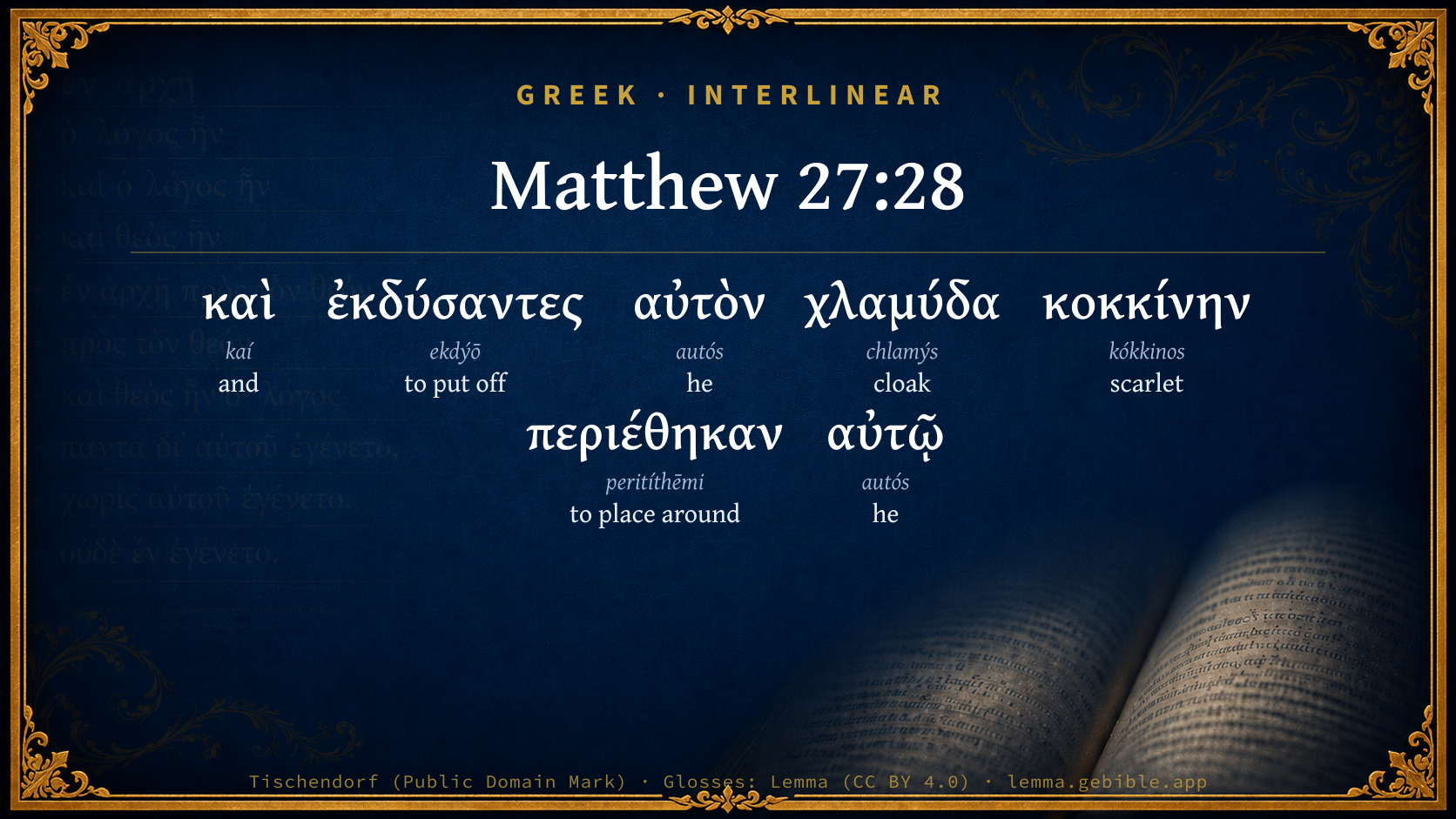
Greek (Tischendorf 8th ed.) Matthew 27:28 appears in the Greek New Testament. The text above is from the Tischendorf 8th edition. Each word links to its Strong’s number and a concise gloss. Click any word for its full Thayer’s Greek Lexicon entry.
Download image
Cite this verse

Matthew 27:28 (World English Bible). Public Domain. Lemma interlinear Bible study tool, https://lemma.gebible.app/v/matthew/27/28.

Show BibTeX & RIS
BibTeX
RIS
English Translation
They stripped him, and put a scarlet robe on him.
World English Bible · Public Domain
Highlights
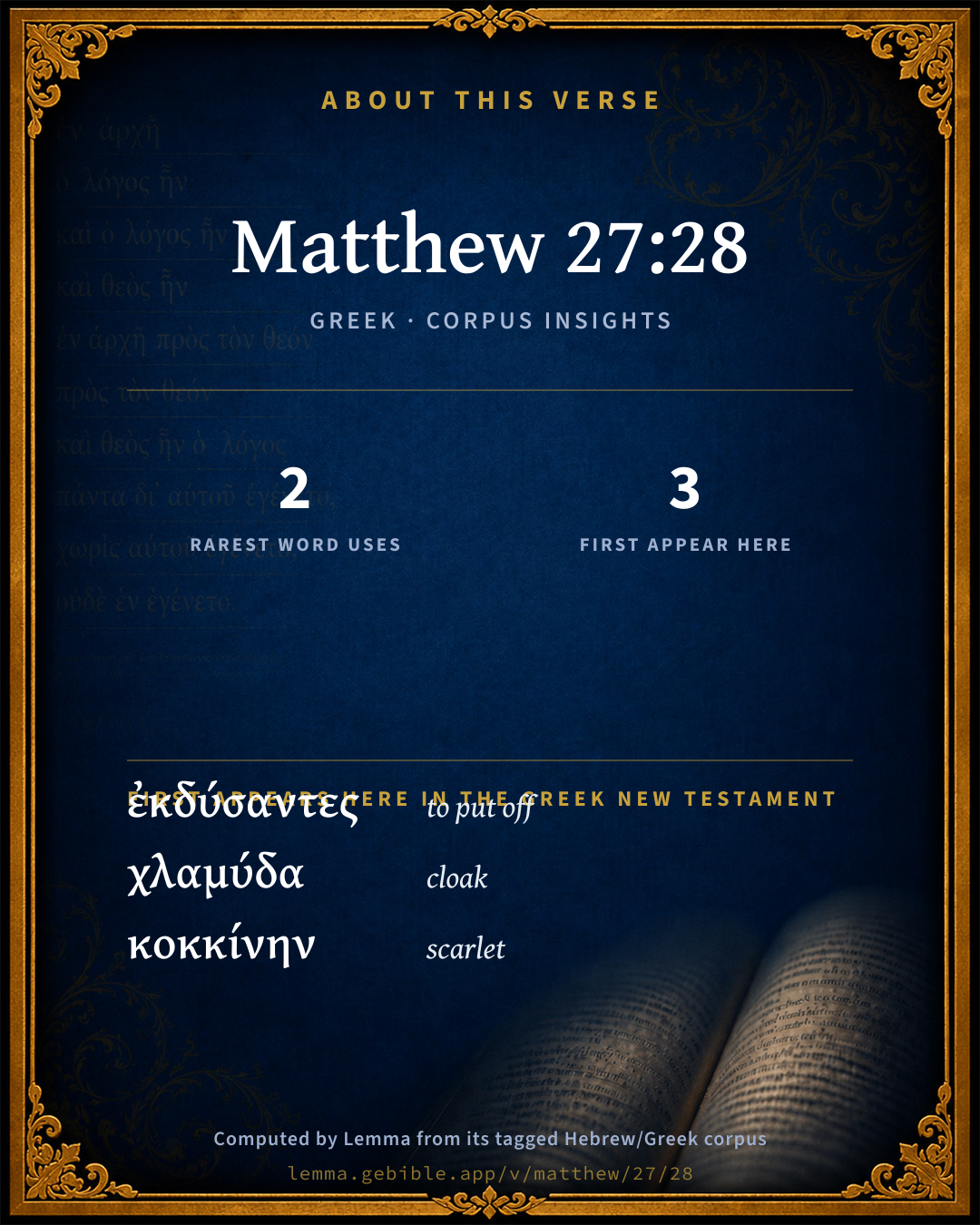
  • 3 first appearances in the Greek New Testament
Full analysis ↓
Download a study sheet

One document with this verse’s original text, its word-by-word gloss line, the meaning frame, cross-references with their text, attributed commentary, and full source and license credits — printable, and it pastes into notes with its structure intact.

This verse Autodidact and up

Study sheet (.html) Plain text (.txt)

A passage Seminary Student

Up to 50 verses in one chapter. A passage sheet keeps up to 6 commentary sources and 12 cross-references per verse, in the order this page ranks them, and says so on the sheet whenever that leaves anything out. Ask for a single verse and you get the Autodidact verse sheet above.

Everything on this page stays free to read, with no account — the sheet is a download of what is already on screen, not access to it.

Want to remove ads? Support Godless Engineer
Compare translations 3

The same verse in 3 English versions, stacked beneath the original-language interlinear above. Click any original word for its lexicon entry.

Each is an independent rendering of the whole verse — the interlinear is not word-aligned to these translations.

Highlighted words mark where these versions differ — a whole-verse word diff, not a word-by-word alignment.

  • World English Bible Public Domain
    They stripped him, and put a scarlet robe on him.
  • King James Version Public Domain
    And they stripped him, and put on him a scarlet robe.
  • unfoldingWord Literal Text CC BY-SA 4.0
    And having stripped him, they placed a scarlet cloak on him.

unfoldingWord Literal Text — © unfoldingWord, licensed CC BY-SA 4.0. Word-aligned USFM3 via Door43 (git.door43.org/unfoldingWord/en_ult).

Versions to compare (up to 4)

3 of 4 selected

Show all 19 translations

Every available English version of this verse, each an independent rendering of the whole verse.

  • World English Bible Public Domain
    They stripped him, and put a scarlet robe on him.
  • Berean Standard Bible Public Domain
    They stripped Him and put a scarlet robe on Him.
  • Majority Standard Bible Public Domain
    They stripped Him and put a scarlet robe on Him.
  • King James Version Public Domain
    And they stripped him, and put on him a scarlet robe.
  • American Standard Version (1901) Public Domain
    And they stripped him, and put on him a scarlet robe.
  • Revised Version (1885) Public Domain
    And they stripped him, and put on him a scarlet robe.
  • Geneva Bible (1599) Public Domain
    And they stripped him, and put about him a skarlet robe,
  • Douay-Rheims (1899) Public Domain
    And stripping him, they put a scarlet cloak about him.
  • Young's Literal Translation Public Domain
    and having unclothed him, they put around him a crimson cloak,
  • Literal Standard Version CC BY-SA 4.0
    and having unclothed Him, they put a crimson cloak around Him,
  • Unlocked Literal Bible CC BY-SA 4.0
    They stripped him and put a scarlet robe on him.
  • unfoldingWord Literal Text CC BY-SA 4.0
    And having stripped him, they placed a scarlet cloak on him.
  • Darby Bible Public Domain
    and having taken off his garment, put on him a scarlet cloak;
  • World Messianic Bible Public Domain
    They stripped him and put a scarlet robe on him.
  • Webster's Bible Public Domain
    And they stripped him, and put on him a scarlet robe.
  • Free Bible Version CC BY-SA 4.0
    They stripped him and put a scarlet cloak on him.
  • Bible in Basic English Public Domain
    And they took off his clothing, and put on him a red robe.
  • Text-Critical English NT CC BY 4.0
    They stripped him and put a scarlet robe on him,
  • Tyndale New Testament (1534) Public Domain
    And they stripped him and put on him a purpyll roobe

Literal Standard Version (2020), Covenant Press — licensed CC BY-SA 4.0. Text via the HelloAO Bible API (eBible.org). Unlocked Literal Bible (unfoldingWord) — licensed CC BY-SA 4.0. Text via the HelloAO Bible API (eBible.org). unfoldingWord Literal Text — © unfoldingWord, licensed CC BY-SA 4.0. Word-aligned USFM3 via Door43 (git.door43.org/unfoldingWord/en_ult). Free Bible Version, Dr. Jonathan Gallagher — licensed CC BY-SA 4.0. Text via the HelloAO Bible API (eBible.org).

Word by word

More ways to search: Search by grammar → Find every occurrence → Compare this word →

Practice this passage: Drill this verse → Learn its vocabulary →

About this verse

These counts appear in no published source. They are computed here, from the morphology-tagged text and Lemma’s own curated glosses. What Lemma adds →

7
words
6
distinct lemmas
Gospels
section

Notable vocabulary

The rarest word here is χλαμύδα cloak G5511 — appearing just 2 times in the whole Greek New Testament.

First appearance in Scripture

These words make their first canonical appearance in the Greek New Testament here:

  • ἐκδύσαντες to put off G1562
  • χλαμύδα cloak G5511
  • κοκκίνην scarlet G2847

Shared distinctive vocabulary

χλαμύδα cloak G5511 occurs in 2 verses of the Greek New Testament. Also found in:

Repetition

A word recurs within this verse:

  • αὐτὸν he G846 ×2

Cross-references

3

Topical passages linked to Matthew 27:28 in the Treasury of Scripture Knowledge — connected by theme and wording, ordered by reader-vote popularity; previews shown in the World English Bible.

  • Mark 15:17 They clothed him with purple, and weaving a crown of thorns, they put it on him.
  • Luke 23:11 Herod with his soldiers humiliated him and mocked him. Dressing him in luxurious clothing, they sent him back to Pilate.
  • John 19:2–5 The soldiers twisted thorns into a crown, and put it on his head, and dressed him in a purple garment.

Cross-references courtesy of OpenBible.info (CC BY 4.0).

Commentary

Notes on Matthew 27:28 from classic Christian and Jewish commentators (each source and its license shown beneath its notes). The classic Christian expositions comment on the surrounding passage and are grouped to its opening verse, so a note may address several verses; the Jewish commentaries on the Tanakh (Rashi and others) are per-verse, so they appear only where the commentator wrote on this verse.

Lemma curates 59 commentaries, every one of them public domain or Creative Commons licensed, each selected and text-cleaned for this edition rather than reprinted as found. About our sources →

Tyndale Open Study Notes

Tyndale Open Resources

27:28-29 The scarlet robe was probably the cloak of a soldier meant to emulate royal garb solely for the purpose of ridiculing Jesus. • Weaving thorn branches into a crown was a mockery of Jesus as king.

Tyndale Open Study Notes — © Tyndale Open Resources, licensed CC BY-SA 4.0. Text via the HelloAO Bible API.

Bengel's Gnomon

Johann Albrecht Bengel

Mat 27:28. Χλαμύδα κοκκίνην, a crimson robe) They make sport of His kingdom, as the Jews had done of His prophetical dignity; ch. Mat 26:68. It is called πορφύραν, purple, in Mar 15:17, and ἱμάτιον πορφυροῦν, a purple garment, in Joh 19:2. Sometimes these words are used promiscuously; sometimes they differ, as in Rev 17:4. The one colour also used formerly to be superinduced upon the other.

Bengel's Gnomon of the New Testament — English translation (T&T Clark, Edinburgh, 1860) — public domain. Text from a community e-Sword module.

Meyer's Critical & Exegetical Commentary

Heinrich August Wilhelm Meyer

Mat_27:28 Ἐνδύσαντες (see the critical remarks) is to be explained by the fact that previous to the scourging all His clothes had been pulled off (Act_16:22; Dionys. Hal. ix. 596). They accordingly put on His under garments again, and instead of the upper robes (τὰ ἱμάτια, Mat_27:31) they arrayed Him in a red sagum, the ordinary military cloak (Plut. Sert. 14; Philop. 9, 11), for the purpose, however, of ridiculing His pretensions to the dignity of king; for kings and emperors likewise wore the χλαμύς, the only difference being that in their case the garment was longer and of a finer texture. Plut. Demetr. 41 f.; Mor. p. 186 C, al. On this military cloak, which was first used by the Macedonians, see Hermann, Privatalterth. § xxi. 20; Friedlieb, p. 118. According to the other evangelists, the cloak made use of on this occasion was of a purple colour; but Matthew would intend scarlet (Heb_9:19; Rev_17:3; Num_4:8; Plut. Fab. xv.) to be taken as at least conveying the idea of purple.

Meyer — Critical and Exegetical Commentary on the New Testament — English translation by Peter Christie, edited by Frederick Crombie (T&T Clark, 1880) — public domain. Text from a community e-Sword module.

Expositor's Greek Testament

ed. W. Robertson Nicoll

Mat 27:28 . ἐκδύσαντες (or ἐνδ .) α .: taking off (or putting on) His clothes. If we adopt the former reading, the implied situation will be this: Jesus first stripped for scourging, then reclothed; then stripped again at the commencement of the mocking process. If the latter, this: Jesus after scourging led naked to the praetorium, there clothed, all but His upper garment, instead of which they put on χλαμύδα κ . (Meyer). χλαμ . κοκκίνην , a scarlet cloak, probably a soldier’s sagum . Carr renders a soldier’s scarf , and suggests that it may have been a worn-out scarf of Pilate’s (Herod’s, Elsner). The ridicule would be more lifelike if it was really a fine article that might be, or had been, worn by a potentate. πλέξαντες στ . ἐξ ἀ ., weaving out of thorns a crown; not, say Meyer and Weiss, hard and sharp, so as to cause great pain, but young, flexible, easily plaited, the aim being to ridicule not to inflict torture. Possibly, but the soldiers would not make a point of avoiding giving pain. They would take what came first to band. κάλαμον , a reed; apparently under the gov. of ἐπέθηκαν , but really the object of ἔθηκαν , understood. γονυπετήσαντες : after the investiture comes the homage, by lowly gesture and worshipful salutation: χαῖρε βασιλεῦ τ . Ἰ . Hail, King of the Jews. A mockery of the nation in intention quite as much as of the particular victim. Loesner ( Observ. ad N. T. ) adduces from Philo. ( in Flaccum , 6) a historic parallel, in which the youth of Alexandria treat similarly a half-witted person, Karabas, the real design being to insult Herod Agrippa. Schanz and Holtzmann also refer to this incident.

The Expositor's Greek Testament, edited by W. Robertson Nicoll (1897–1910) — public domain. Text from a community e-Sword module.

Geneva Bible (1599)

Geneva Bible translators

Christ suffereth that reproach which was due to our sins; notwithstanding in the meantime by the secret providence of God, he is entitled King by them which did him that reproach.

They cast a cloak about him, and wrapped it about him, for it lacked sleeves.

John and Mark make mention of a purple robe, which is also a very pleasant red. But these profane and malapert saucy soldiers clad Jesus in this array, to mock him withall, who was indeed a true King.

Geneva Bible (1599) marginal notes — public domain. Text via Bolls.life.

Adam Clarke's Commentary

Verse 28. Stripped him] Took off his mantle, or upper garment.

A scarlet robe] Or, according to Mark and John, a purple robe, such as emperors and kings wore.

Adam Clarke's Commentary on the Bible (1810–1826) — public domain. Text from a community e-Sword/MySword module.

Ellicott's Commentary for English Readers

(28) A scarlet robe.—Here again we have a technical word, the chlamys or paludamentum, used for the military cloak worn by emperors in their character as generals, and by other officers of high rank (Pliny, xxii. 2, 3). St. Mark and St. John call it purple (Mar_15:17; Joh_19:2); but the “purple “of the ancients was “crimson,” and the same colour might easily be called by either name. It was probably some cast-off cloak of Pilate’s own, or, possibly, that in which Herod had before arrayed Him (Luk_23:11). Philo records a like mockery as practised upon an idiot at Alexandria, who was there made to represent Herod Agrippa II. (in Flacc. p. 980). It was but too common a practice to subject condemned prisoners before execution to this kind of outrage. Here the point of the mockery lay, of course, in the fact that their Victim had been condemned as claiming the title of a King. They had probably seen or heard of the insults of like kind offered by Herod and his soldiers (Luk_23:21), and now reproduced them with aggravated cruelty.

A Bible Commentary for English Readers, edited by Charles John Ellicott (1878–1897) — public domain. Text from a community e-Sword module.

The Cambridge Bible for Schools and Colleges

gen. ed. J. J. S. Perowne

28. a scarlet robe] A soldier’s scarf, Lat. chlamys: it was generally worn by superior officers, but its use was not confined to them. This may have been a worn-out scarf belonging to Pilate; it is different from “the gorgeous robe” (Luk_23:11), which Herod’s soldiers put on Jesus. Scarlet was the proper colour for the military chlamys. (See Dict. of Ant.) St Mark has the less definite “purple;” St John “a purple robe.” Purple, however, is used by Latin writers to denote any bright colour.

The Cambridge Bible for Schools and Colleges (gen. ed. J. J. S. Perowne; Cambridge University Press, 1878–1918) — public domain. Text from a community e-Sword module.

John Gill's Exposition

And when they had platted a crown of thorns,.... What sort of thorn this crown was made of, whether of the bramble, or of the white thorn, is not very material (b): the word used in the Syriac version, is rendered by interpreters, "white thorns", and which were common in Judea: these, be they what they will, they made into the form of a crown, and

they put it upon his head; both to reproach him as a king, and to torture him as a man: however, it had its significance, and was an emblem of men, comparable to thorns; either of wicked men, and of his being encompassed with them at this time; or of good men, chosen out from among them, redeemed by him, and accounted as a royal diadem with him (c): or it might represent the sins of his people, which, like thorns, pierced him, and like a crown of them surrounded him every side; or else the many troubles he was exercised with, and through which he did, as his members do, enter the kingdom: and especially, his being made a curse for us, thorns and briers being the curse which was inflicted on the earth, for the sin of man: in this Christ was the antitype of the ram, caught by his horns among the thickets, which "Abraham" sacrificed in the room of his son. This may teach us many useful lessons: we may see what a curse sin brought upon man, and upon the earth for man's sake; and even upon the Messiah, in the stead of men: we may observe the difference between us and Christ: we are a crown of glory, and a royal diadem in his hand; we are crowned with loving kindness and tender mercies, and have a crown of righteousness, life, and glory, laid up for us, and he was crowned with thorns; as also the difference between Christ in his state of humiliation wearing such a crown, and his state of exaltation, in which he is crowned with glory and honour. The Jews acknowledge this circumstance of the sufferings of Jesus, though they ascribe it to the elders of Jerusalem; who, they say (d),

"took thorns and made a crown of them, and put it upon his head.''

Which are the very words of the evangelist:

and a reed in his right hand, or "cane"; and Munster's Hebrew Gospel uses the word, "a cane", such as men walk with; and this may be confirmed from the barbarous use they afterwards made of it, by smiting him on the head with it: a "reed" indeed may fitly express the weakness of his kingdom in the eye of the world: but any cane or common staff, or stick, put into his hands in the room of a sceptre, would also signify the meanness of his kingdom, which was not of this world, and came not with observation: they meant to reproach him with it, but they will find one time or another, that he, has another sceptre, even a sceptre of righteousness, a staff of strength, a rod of iron, with which he will rule and break in pieces, all the wicked of the earth. However, we may learn from hence, Christ does not disdain to hold a reed in his hand: nor will he break the bruised reed, or discourage, or crush the weakest believer.

And they bowed the knee before him, and mocked him, saying, Hail, king of the Jews: being thus clad in a scarlet, or purple robe, or both; and having a crown of thorns on his head, and a reed instead of a sceptre in his hand, they carry on the mockery still further, and bend the knee to him, as to a prince just come to his throne, and salute as such; and in a mock way, wish him long life and prosperity: thus deriding him in his kingly office, as all such do, who call him Lord, Lord, but disregard his commands.

(b) Vid. Bartholin. de Spinea Corona, sect. 1. 2. (c) Vid. Paschal. de Coronis, l. 10. c. 12. p. 701, 702. (d) Toldos Jesu, p. 17.

John Gill's Exposition of the Whole Bible (1746–1763) — public domain (CC PDM 1.0). Text via the HelloAO Bible API.

Trapp's Complete Commentary

John Trapp

28 And they stripped him, and put on him a scarlet robe.

Ver. 28. And they stripped him] That we might be clothed with the rich and royal raiment of his righteousness, that fleece of the Lamb of God, who taketh away, &c.

And put on him a scarlet robe] O’erworn and threadbare, no doubt; so to set him forth as a theatrical king, in contempt of him; but the kingdom of Christ came not by observation. He is an obscure king, as Melchisedec was, but yet a king, as he told Pilate; and this was that good confession witnessed by him, and celebrated by St Paul, 1Ti 6:13.

John Trapp, A Commentary or Exposition upon All the Books of the Old and New Testament (1647–1656) — public domain. Text from a community e-Sword module.

Haydock's Catholic Bible Commentary

A scarlet cloak. St. Mark and St. John call it purple. But these colours are frequently taken promiscuously by writers. Scarlet is a lighter, and crimson a deeper red colour. (Bible de Vence)

George Leo Haydock (1774–1849), Haydock's Catholic Family Bible and Commentary, 1859 edition — public domain. Excludes Psalms (Douay-Rheims chapter numbering differs from Protestant) and Deuterocanonical books (Catholic canon only).

Whedon's Commentary on the Bible

Daniel D. Whedon

28. A scarlet robe — A kind of round cloak, which was confined on the right shoulder by a clasp, so as to cover the left side of the body, worn by military officers and called paludamentum. Those of the emperors were purple. This cloak or robe, called by Matthew scarlet, is by Mark called purple. The two colours blend into each other, and the words are interchangeable. The scarlet dye, however, was made from a shrub; the purple from a shell-fish.

Daniel D. Whedon (gen. ed.), Commentary on the Old and New Testaments (1874–1909) — public domain. Text from a community e-Sword module.

The Pulpit Commentary

They stripped him (ekdusantev). Some manuscripts read endusantev , "when they had clothed him;" but this seems to have been derived from St. Mark, and to be here somewhat tautological. They had heard of his claim to be a King, so they determined to deride him with the mockery of royal honours. They tore his garments from his mangled form, thus opening afresh his half-dried wounds. Put on him a scarlet robe (clamuda kokkinhn). This was probably the short military woolen cloak worn by officers, in colour either scarlet or purple, and fastened by a buckle on the right shoulder. Some think it was a cast-off garment from the wardrobe of King Herod, which they found and appropriated to this purpose. Whatever it was, its bright hue was suitable for this mockery of regal splendour.

The Pulpit Commentary (1880–1919), ed. H.D.M. Spence-Jones & Joseph S. Exell — public domain. Text from a community e-Sword module.

John Wesley's Explanatory Notes

They put on him a scarlet robe - Such as kings and generals wore; probably an old tattered one.

John Wesley, Explanatory Notes Upon the Whole Bible (1754–1765) — public domain. Text via the GEBible commentary corpus.

The People's New Testament

B. W. Johnson

28. They stripped him. His clothing, stripped off at the scourging, had been replaced, but was now removed to wrap him in a mock royal mantle. Scarlet or purple were the royal colors.

B. W. Johnson's The People's New Testament with Notes (1889–1891) — public domain. Electronic text from the Christian Classics Ethereal Library (CCEL) ThML edition.

Cambridge Greek Testament for Schools and Colleges

28. χλαμύδα κοκκίνην. A soldier’s scarf, Lat. chlamys: it was generally worn by superior officers, but its use was not confined to them. This may have been a worn-out scarf belonging to Pilate; it is different from ἐσθῆτα λαμπράν, (Luk 23:11), which Herod’s soldiers put on Jesus. Scarlet was the proper colour for the military chlamys; cp. ‘coccum imperatoriis dicatum paludamentis.’ Plin. H. N. xxii. 10. (See Dict. of Ant.) St Mark has the less definite πορφύραν; St John ἱμάτιον πορφυροῦν. Purpureus, however, is used by Latin writers to denote any bright colour.

Cambridge Greek Testament for Schools and Colleges (Cambridge University Press, 1896; 21 vols, various authors incl. Carr, Maclear, Plummer, Farrar, Lumby, Moule, M. R. James, Simcox) — public domain. Text from a community e-Sword module.

Alford’s Greek Testament

Henry Alford

28.] Possibly the mantle in which he had been sent back from Herod—see note on Luke, ver. 11: or perhaps one of the ordinary soldiers’ cloaks.

Henry Alford, The Greek Testament (1849–1861) — public domain. Text from a community e-Sword module.

International Critical Commentary

(M) 28. And they stripped Him, and put round Him a scarlet cloke.] Mk. has: “And they put on Him a purple robe, and put round Him.” The “scourging” of v. 26 has already implied stripping. In Mk. the καὶ περιτιθέασιν has as object the crown of thorns. Mt. seems to have supposed that both verbs referred to the robe. περιτίθημι may be used of either object. For στἐφανον, cf. Eur. Med. 984, and for χλαμύδα, Sapph. 68. We should expect Mt. to omit one verb; cf. Introduction, p. xxiv.1 But instead he converts ἐνδιδύσκειν into ἐκδύειν unobservant of the fact that the action implied in this verb was unnecessary. He avoids as usual Mk.’s hist. presents. —χλαμύδα κοκκίνην] The chlamys was generally a military garment, but was worn also by kings. Mk. has πορφύρα.

International Critical Commentary — older volumes (1896–1929), various authors — public domain. Text from a community e-Sword module.

Vincent's Word Studies in the New Testament

Marvin R. Vincent

Robe [χλαμυδα] . The short military cloak which kings and emperors as well as soldiers wore.

Marvin R. Vincent, Word Studies in the New Testament (1887–1900) — public domain. Text from a community e-Sword/MySword module.

Lesson kit

Teaching starters — assembled from the data on this page, not authored interpretation. Every prompt links to the verse data it draws on. Edit before teaching.

Matthew, in the Gospels, opens this verse with 7 words (6 distinct Greek lemmas). Its most distinctive word is chlamýs (“cloak”). A historical commentator’s framing appears above. Read the whole chapter for the surrounding context.

Discussion questions

  1. What does “cloak” (chlamýs) contribute to the verse as a whole?
  2. 3 words make their first appearance in Scripture here. What does this debut establish?
  3. How does Matthew 27:31, which shares the word «cloak», read alongside this verse?
  4. What does the repetition of “he” (2× in this one verse) do in this verse?
  5. The translations on this page render this verse differently — a whole-verse word diff, not a word-by-word alignment. What might account for the different wordings?
  6. Compare how Tyndale Open Study Notes and Bengel's Gnomon read this verse. Where do they agree or differ?

Things to notice

  • 3 words make their first canonical appearance in Scripture here.
  • These translations choose different wording for 5 words in this verse.
  • “he” occurs 2× in this single verse.
  • 6 distinct Greek lemmas span 7 words in this verse.

Reading settings

Reading text

Shown beneath each verse's original-language words.

Old Testament
Old Testament edition

Read the OT as the Masoretic Hebrew (MT) or the Greek Septuagint (LXX).

English shown for the Greek Septuagint (in the Hebrew ↔ Greek comparison).

Comparing translations? Open the Compare panel on any verse page to stack up to four side by side.