Matthew 27:38

Greek (Tischendorf 8th ed.) Matthew 27:38 appears in the Greek New Testament. The text above is from the Tischendorf 8th edition. Each word links to its Strong’s number and a concise gloss. Click any word for its full Thayer’s Greek Lexicon entry.
Download image
Cite this verse

Matthew 27:38 (World English Bible). Public Domain. Lemma interlinear Bible study tool, https://lemma.gebible.app/v/matthew/27/38.

Show BibTeX & RIS
BibTeX
RIS
English Translation
Then there were two robbers crucified with him, one on his right hand and one on the left.
World English Bible · Public Domain
Download a study sheet

One document with this verse’s original text, its word-by-word gloss line, the meaning frame, cross-references with their text, attributed commentary, and full source and license credits — printable, and it pastes into notes with its structure intact.

This verse Autodidact and up

Study sheet (.html) Plain text (.txt)

A passage Seminary Student

Up to 50 verses in one chapter. A passage sheet keeps up to 6 commentary sources and 12 cross-references per verse, in the order this page ranks them, and says so on the sheet whenever that leaves anything out. Ask for a single verse and you get the Autodidact verse sheet above.

Everything on this page stays free to read, with no account — the sheet is a download of what is already on screen, not access to it.

Want to remove ads? Support Godless Engineer
Compare translations 3

The same verse in 3 English versions, stacked beneath the original-language interlinear above. Click any original word for its lexicon entry.

Each is an independent rendering of the whole verse — the interlinear is not word-aligned to these translations.

Highlighted words mark where these versions differ — a whole-verse word diff, not a word-by-word alignment.

  • World English Bible Public Domain
    Then there were two robbers crucified with him, one on his right hand and one on the left.
  • King James Version Public Domain
    Then were there two thieves crucified with him, one on the right hand, and another on the left.
  • unfoldingWord Literal Text CC BY-SA 4.0
    Then two robbers are being crucified with him, one at his right and one at his left.

unfoldingWord Literal Text — © unfoldingWord, licensed CC BY-SA 4.0. Word-aligned USFM3 via Door43 (git.door43.org/unfoldingWord/en_ult).

Versions to compare (up to 4)

3 of 4 selected

Show all 19 translations

Every available English version of this verse, each an independent rendering of the whole verse.

  • World English Bible Public Domain
    Then there were two robbers crucified with him, one on his right hand and one on the left.
  • Berean Standard Bible Public Domain
    Two robbers were crucified with Him, one on His right hand and the other on His left.
  • Majority Standard Bible Public Domain
    Two robbers were crucified with Him, one on His right and the other on His left.
  • King James Version Public Domain
    Then were there two thieves crucified with him, one on the right hand, and another on the left.
  • American Standard Version (1901) Public Domain
    Then are there crucified with him two robbers, one on the right hand and one on the left.
  • Revised Version (1885) Public Domain
    Then are there crucified with him two robbers, one on the right hand, and one on the left.
  • Geneva Bible (1599) Public Domain
    And there were two theeues crucified with him, one on the right hand, and another on the left.
  • Douay-Rheims (1899) Public Domain
    Then were crucified with him two thieves: one on the right hand, and one on the left.
  • Young's Literal Translation Public Domain
    Then crucified with him are two robbers, one on the right hand, and one on the left,
  • Literal Standard Version CC BY-SA 4.0
    Then two robbers are crucified with Him, one on the right hand and one on the left,
  • Unlocked Literal Bible CC BY-SA 4.0
    Two robbers were crucified with him, one on the right of him and one on the left.
  • unfoldingWord Literal Text CC BY-SA 4.0
    Then two robbers are being crucified with him, one at his right and one at his left.
  • Darby Bible Public Domain
    Then are crucified with him two robbers, one on the right hand and one on the left.
  • World Messianic Bible Public Domain
    Then there were two robbers crucified with him, one on his right hand and one on the left.
  • Webster's Bible Public Domain
    Then were there two thieves crucified with him: one on the right hand, and another on the left.
  • Free Bible Version CC BY-SA 4.0
    They crucified two rebels with him, one on the right, and one on the left.
  • Bible in Basic English Public Domain
    Then two thieves were put on crosses with him, one on the right and one on the left.
  • Text-Critical English NT CC BY 4.0
    Then two robbers were crucified with him, one on his right and one on his left.
  • Tyndale New Testament (1534) Public Domain
    And ther were two theves crucified with him one on the right honde and another on the lyfte.

Literal Standard Version (2020), Covenant Press — licensed CC BY-SA 4.0. Text via the HelloAO Bible API (eBible.org). Unlocked Literal Bible (unfoldingWord) — licensed CC BY-SA 4.0. Text via the HelloAO Bible API (eBible.org). unfoldingWord Literal Text — © unfoldingWord, licensed CC BY-SA 4.0. Word-aligned USFM3 via Door43 (git.door43.org/unfoldingWord/en_ult). Free Bible Version, Dr. Jonathan Gallagher — licensed CC BY-SA 4.0. Text via the HelloAO Bible API (eBible.org).

Word by word

More ways to search: Search by grammar → Find every occurrence → Compare this word →

Practice this passage: Drill this verse → Learn its vocabulary →

εὐωνύμων
euṓnymos
G2176
“left”
Adjective, Genitive, Plural, Masculine
Part of Speech
Adjective
Case
Genitive
Number
Plural
Gender
Masculine
Full Thayer's Definition

Origin: from G2095 and G3686

TDNT: None

1. of good name and of good omen a. in the latter sense used in taking auguries; but those omens were euphemistically called "euonumos" which in fact were regarded as unlucky, i.e. which came from the left, sinister omens, (for which a good name was desired) 2. left, on the left hand
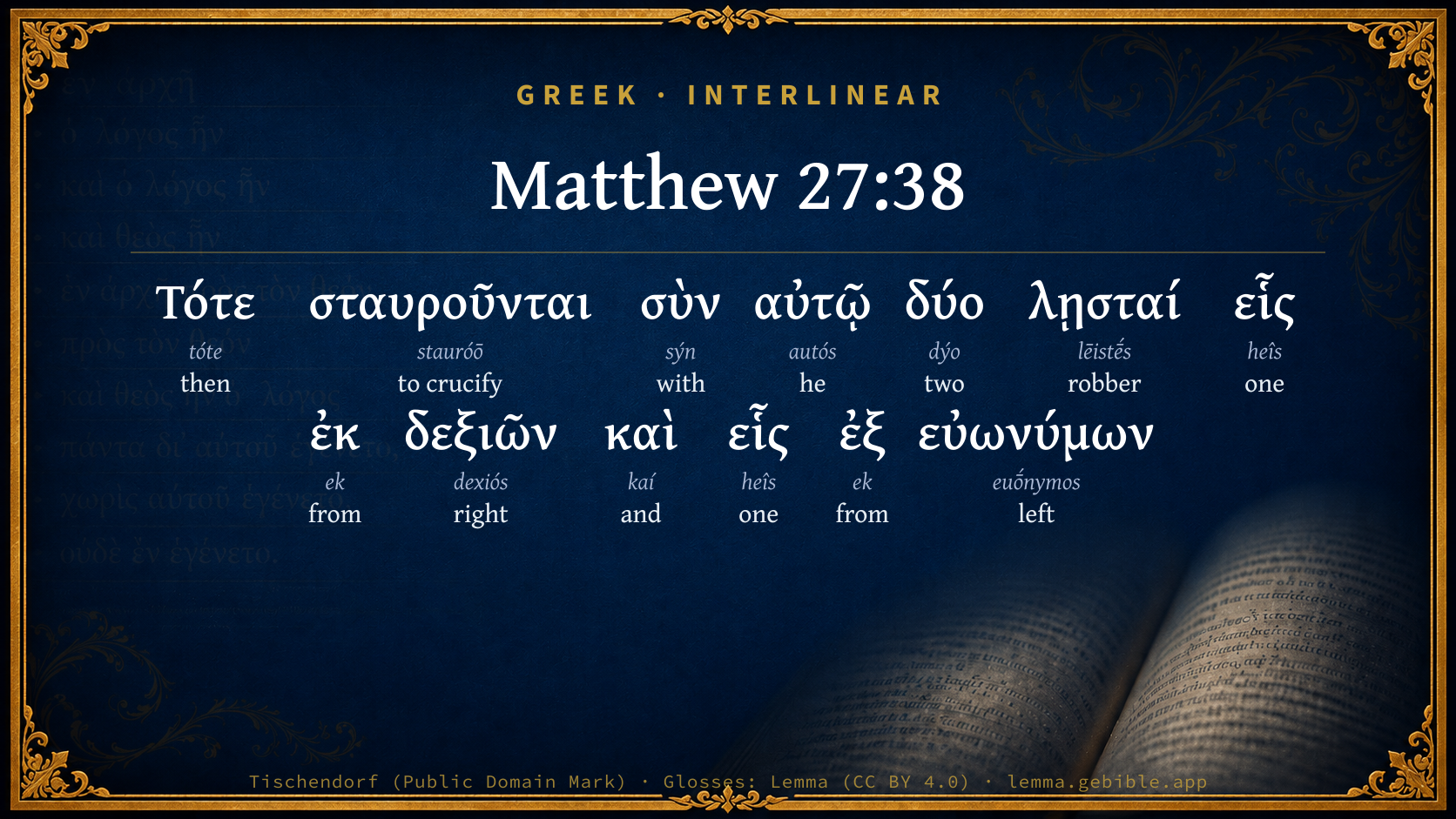
  1. Τότε tóte G5119 “then” Adverb
  2. σταυροῦνται stauróō G4717 “to crucify” Verb, Present, Passive, Indicative, 3rd person, Plural
  3. σὺν sýn G4862 “with” Preposition
  4. αὐτῷ autós G846 “he” Personal pronoun, Dative, Singular, Masculine
  5. δύο dýo G1417 “two” Adjective, Numeral (indeclinable)
  6. λῃσταί lēistḗs G3027 “robber” Noun, Nominative, Plural, Masculine
  7. εἷς heîs G1520 “one” Adjective, Nominative, Singular, Masculine
  8. ἐκ ek G1537 “from” Preposition
  9. δεξιῶν dexiós G1188 “right” Adjective, Genitive, Plural, Masculine
  10. καὶ kaí G2532 “and” Conjunction
  11. εἷς heîs G1520 “one” Adjective, Nominative, Singular, Masculine
  12. ἐξ ek G1537 “from” Preposition

About this verse

These counts appear in no published source. They are computed here, from the morphology-tagged text and Lemma’s own curated glosses. What Lemma adds →

13
words
11
distinct lemmas
Gospels
section

Notable vocabulary

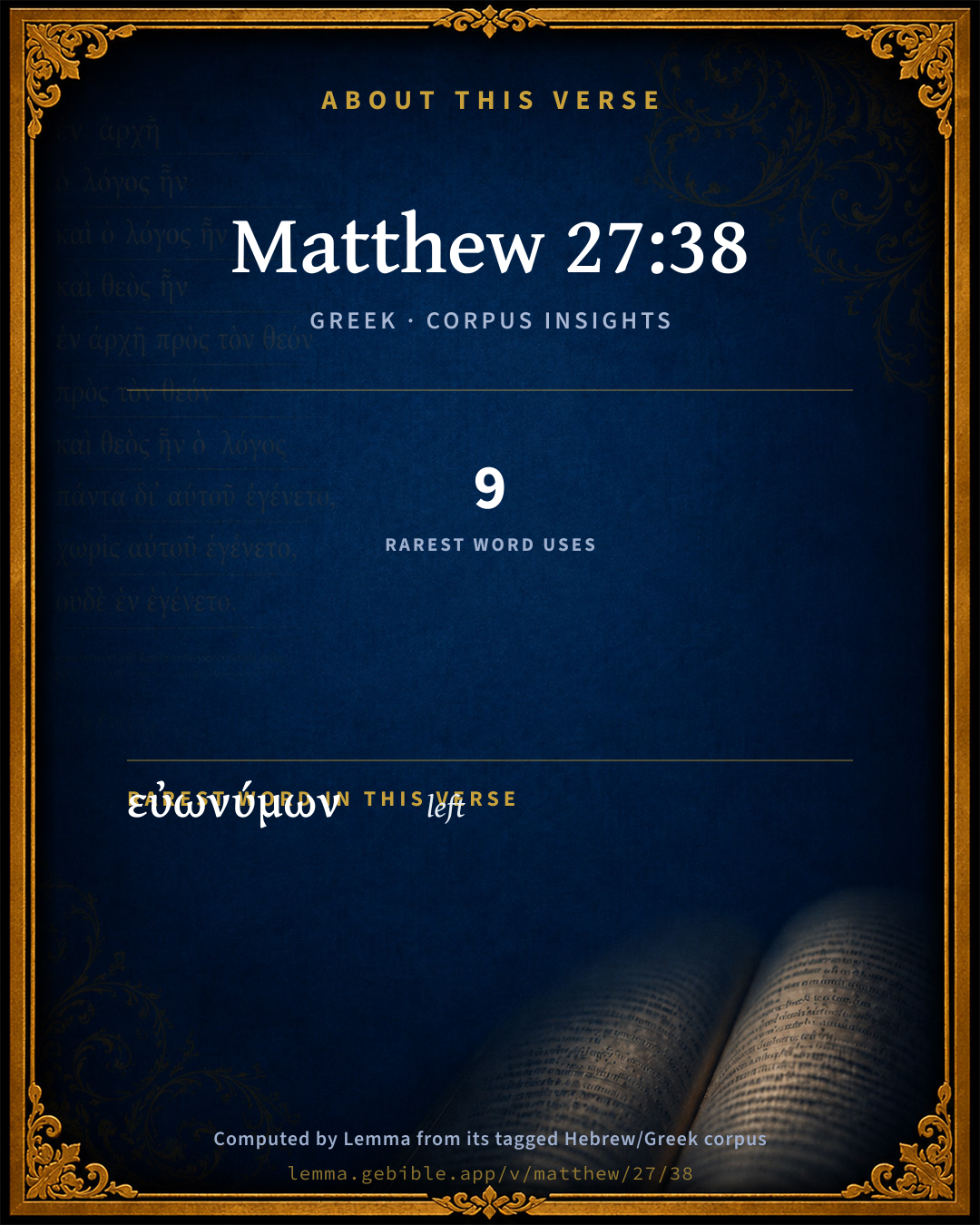
The rarest word here is εὐωνύμων left G2176 — appearing just 9 times in the whole Greek New Testament.

Shared distinctive vocabulary

εὐωνύμων left G2176 occurs in 9 verses of the Greek New Testament. Also found in:

Repetition

Words recur within this verse:

Cross-references

8

Topical passages linked to Matthew 27:38 in the Treasury of Scripture Knowledge — connected by theme and wording, ordered by reader-vote popularity; previews shown in the World English Bible.

  • John 19:18 where they crucified him, and with him two others, on either side one, and Jesus in the middle.
  • Luke 23:39–43 One of the criminals who was hanged insulted him, saying, "If you are the Christ, save yourself and us!"
  • John 19:31–35 Therefore the Jews, because it was the Preparation Day, so that the bodies wouldn't remain on the cross on the Sabbath (for that Sabbath was a special one), asked of Pilate that their legs might be broken, and that they might be taken away.
  • Isaiah 53:12 Therefore will I divide him a portion with the great, and he shall divide the spoil with the strong; because he poured out his soul to death, and was numbered with the transgressors: yet he bore the sin of many, and made intercession for the transgressors.
  • Matthew 27:44 The robbers also who were crucified with him cast on him the same reproach.
  • Mark 15:27 With him they crucified two robbers; one on his right hand, and one on his left.
  • Luke 22:37 For I tell you that this which is written must still be fulfilled in me: 'He was counted with the lawless.' For that which concerns me has an end."
  • Luke 23:32–33 There were also others, two criminals, led with him to be put to death.

Cross-references courtesy of OpenBible.info (CC BY 4.0).

Commentary

Notes on Matthew 27:38 from classic Christian and Jewish commentators (each source and its license shown beneath its notes). The classic Christian expositions comment on the surrounding passage and are grouped to its opening verse, so a note may address several verses; the Jewish commentaries on the Tanakh (Rashi and others) are per-verse, so they appear only where the commentator wrote on this verse.

Lemma curates 59 commentaries, every one of them public domain or Creative Commons licensed, each selected and text-cleaned for this edition rather than reprinted as found. About our sources →

The Biblical Illustrator

Joseph S. Exell

Mat_27:38

Two thieves crucified with Him.

Jesus between two robbers

I. The moral condition of these men before crucifixion-Robbers. They are also called malefactors. At the earlier stage of the proceedings these two men were equally depraved.

II. The moral condition of these men after they were affixed to the cross. In the case of one-

1. There was a beholding of the crucified Jesus.

2. There was a perception of his own sinfulness and of the purity of Christ.

3. There is a prayer for a participation in all that Christ has to offer.

4. His acceptance promised by Jesus. The other sinner mocks our Lord. The men the same at first, but now how changed the condition of one.

III. The position these two robbers occupied in respect to Christ.

1. Christ is placed on the central cross. He was first suspended on the cross by the cruel malignity of men.

2. That Christs sufferings were for all men. He was crucified between two, not on one side.

3. These robbers were the representative men of the world.

4. You may perish with Christ close beside you. (G. Venables.)

The three crosses

I. There may be the same outward circumstances where there is the greatest inward diversity.

II. We have no choice as to the fact of suffering: our choice refers only to its nature. Each has his own cross: Christ was not without one. The wicked have their woes.

1. The sufferings of the good are consoled.

2. The sufferings of the good are limited-For a season.

III. The means used for Christs disgrace promote His glory. Satan was wounded by his own weapon: and the robber designed to insult our Lord was saved. Thus temptation is turned to good ends. (T. R. Stevenson.)

Christ dying amid thieves

There then are the two stories (of the thieves and of Jesus). See how far apart they begin. One in the innocence of perfect holiness; the other in the blackest wickedness. And then see how they meet at last. As when a black and turbid stream goes hurrying towards a caverns gloom, into which it is destined to plunge itself oat of sight, and just before it reaches its dark doom, a pure fresh river that was born among the snows in the sunlight on the mountains top, and has sung its way down through flowers, drops its quiet, transparent waters down into the tumultuous current, and shares its plunge, so the pure holiness of Christ fell into the stream of human wickedness, and shared its fate. (Phillips Brooks.)

The penitent thief

The different effects the judgments of God have upon the minds of men. The wisdom of God in setting the examples of His justice and mercy so near together, and has taught us to fear without despair, and to hope without presumption. What would the dying sinner give to have his Saviour so near him in his last moments.

I. Let us see the circumstances which distinguish it from that of the dying Christian.

1. In all this there may be nothing resembling a death-bed repentance. The dying thief seems to have heard and known much about the character of Christ: he had elsewhere learnt His dignity and was persuaded of the truth of His mission. And what is this to them who have no desire to lie down Christians upon their death-beds, though they would willingly go off penitents.

2. Suppose this great work were begun and finished on the cross, yet it cannot be drawn into example by Christian sinners; because the conversion of a Jew or a heathen is one thing, and the repentance of a Christian another.

3. The profligate life of this unconverted sinner was not attended with such aggravated circumstances as the sins of Christians are. He sinned against the light of nature and reason only. The greater his weakness was, the fitter object for mercy was he. Not the same excuses for Christians.

II. But there are other circumstances fit to be observed which render a death-bed repentance very insecure and dangerous, though we should allow it all the hopes which have been raised from the case before us.

1. He that sins in hopes of repentance at last, may sin so far as to grow hardened and obdurate, and imcapable of repentance when the time cosines. Nor is it in your own power to sin to what degree you please; habits grow insensibly. There is more reason to fear that sin indulged will get the better of you, than you of it.

2. Could you preserve your resolutions of repentance, yet still it is not in your own power to secure an opportunity to execute them. The thief on the cross died by the hand of justice, knew how long he had to live; he had no pretence to defer his repentance.

3. His death not being the effect of disease, but of the judges sentence, he brought with him to the cross, which you may call his death-bed, a sound body and mind. He had his senses perfectly, his reason fresh, and was capable of faith and acts of devotion. How different is the case of the languishing sinner. How can one know His Saviour who cannot know even his own luther at such a time. (T. Sherlock, D. D.)

The Biblical Illustrator, edited by Joseph S. Exell (c. 1880s–1900s) — public domain. Text from a community e-Sword module.

Tyndale Open Study Notes

Tyndale Open Resources

27:38 Crucifying Jesus between two convicted revolutionaries added further humiliation and guilt by association.

Tyndale Open Study Notes — © Tyndale Open Resources, licensed CC BY-SA 4.0. Text via the HelloAO Bible API.

Meyer's Critical & Exegetical Commentary

Heinrich August Wilhelm Meyer

Mat_27:38 Τότε] then, after the crucifixion of Jesus was thus disposed of.

σταυροῦνται] spoken with reference to another band of soldiers which takes the place of καθήμενοι ἐτήρουν αὐτὸν ἐκεῖ, Mat_27:36. The whole statement is merely of a cursory and summary nature.

Meyer — Critical and Exegetical Commentary on the New Testament — English translation by Peter Christie, edited by Frederick Crombie (T&T Clark, 1880) — public domain. Text from a community e-Sword module.

Expositor's Greek Testament

ed. W. Robertson Nicoll

Mat 27:38 : τότε introduces the fact mentioned as an accompaniment of the crucifixion of Jesus, ithout indicating its precise place in the course of events. σταυροῦνται , the historical present with lively effect; and passive, probably to imply that this act was performed by other soldiers. This very slight notice grows into a considerable incident in the hands of Luke.

The Expositor's Greek Testament, edited by W. Robertson Nicoll (1897–1910) — public domain. Text from a community e-Sword module.

Geneva Bible (1599)

Geneva Bible translators

Christ began then to judge the world, when after his judgment he hung betwixt two thieves.

Geneva Bible (1599) marginal notes — public domain. Text via Bolls.life.

Adam Clarke's Commentary

Verse 38. Two thieves] λησται, robbers, or cutthroats: men who had committed robbery and murder; for it does not appear that persons were crucified for robbery only. Thus was our Lord numbered (his name enrolled, placed as it were in the death warrant) with transgressors, according to the prophetic declaration, Isa 53:12; and the Jews placed him between these two, perhaps to intimate that he was the worst felon of the three.

Adam Clarke's Commentary on the Bible (1810–1826) — public domain. Text from a community e-Sword/MySword module.

Ellicott's Commentary for English Readers

(38) Then were there two thieves crucified with him.—Better, robbers, the word being the same as that used of Barabbas (Joh_18:40). It would seem, as there is no record of their trial, as if they were already under sentence of death; and it is probable enough that they were members of the same band, and had been sharers in the same insurrection. The legends of the Apocryphal Gospel of Nicodemns (i. 10), give their names as Dysmas and Gysmas, and these names appear still in the Calvaries and Stations of Roman Catholic countries.

A Bible Commentary for English Readers, edited by Charles John Ellicott (1878–1897) — public domain. Text from a community e-Sword module.

The Cambridge Bible for Schools and Colleges

gen. ed. J. J. S. Perowne

38. two thieves] Rather, robbers; in all probability partners in the crime of Barabbas. The mountain robbers, or banditti, were always ready to take part in such desperate risings against the Roman power. In the eyes of the Jews they would be patriots.

Josephus tells of one leader of robbers who burnt the palaces in Jericho (B. J. ii. 6), and of another who for twenty years had wasted the country with fire and sword.

The Cambridge Bible for Schools and Colleges (gen. ed. J. J. S. Perowne; Cambridge University Press, 1878–1918) — public domain. Text from a community e-Sword module.

John Gill's Exposition

And they that passed by,.... In the road to or from Jerusalem; for, it seems, the crosses were placed by the wayside; or they who passed by the cross, the populace that came from Jerusalem, on purpose to see the sight,

reviled him, or "blasphemed him": they spoke all manner of evil of him, they could think of, to which he answered not a word; and which may teach us patience under the revilings of men: this was foretold of him, Psa 89:51, "they have reproached the footsteps of thine anointed", or "Messiah"; and which Jarchi explains by "the ends of the king Messiah"; his last times, towards the close of his days; and cites that passage in the Misna (z),

"in the heels, or, as Buxtorf renders it, in the end of the days of the Messiah impudence shall be multiplied,

as it now was exceedingly:

wagging their heads; in derision of him, and as exulting in his misery; see Isa 37:22. This also was prophesied of him in

Psa 22:7.

(z) Sota, c. 9. sect. 15.

John Gill's Exposition of the Whole Bible (1746–1763) — public domain (CC PDM 1.0). Text via the HelloAO Bible API.

Trapp's Complete Commentary

John Trapp

38 Then were there two thieves crucified with him, one on the right hand, and another on the left.

Ver. 38. Then were there two thieves] So he "was reckoned among the transgressors," Isa 53:12; a sinner, not by imputation only, for "he bare the sin of many" (ib.), but by reputation also, and therefore crucified in the midst (as the worst of the three, "chief of sinners," Quasi maleficiorum rex esset), that we might have place in the midst of heavenly angels, in those walks of paradise, Zec 3:7. The one of those two thieves went railing to hell (his crucifixion being but a typical hell to him, a trap door to eternal torment), the other went repenting forthright to heaven, living long in a little time, and by prayer making his cross a Jacob’s ladder, whereby angels descended to fetch up his soul. It is remarkable, and to our purpose suitable, that Rabus reporteth, that when Leonard Caesar suffered martyrdom at Rappa, a little town in Bavaria, a certain priest, that had by the law for some villanous act deserved death, being led forth with him towards the place of execution, cried out often, Ego ne quidem dignus sum, qui tibi in hac paena associer, iusto iniustus, I am not worthy to suffer with thee, the just with the unjust. At the death of George Eagles, martyr, in Queen Mary’s days, two thieves going to be executed with him, he exhorted them to embrace the truth, and to persevere therein. Whereupon one of them scoffingly said, Why should we doubt about going to heaven, seeing this holy man shall go before us, as our captain in the way? we shall certainly flee straight there, as soon as he hath made us the entry. But the other thief reproved him for it, and gave good heed to George Eagles’ exhortation, earnestly bewailing his own wickedness, and crying unto Christ for mercy. This penitent thief exhorted the people upon the ladder, to beware of sin by his example: and so commending his soul to Christ, ended his life quietly, and in a godly manner. The mocker when he came upon the ladder would have said something, but could not; his tongue did so fumble and falter in his head, that he could not repeat the Lord’s prayer, but became a singular instance of God’s just judgment upon so profane a person.

John Trapp, A Commentary or Exposition upon All the Books of the Old and New Testament (1647–1656) — public domain. Text from a community e-Sword module.

Albert Barnes' Notes on the Bible

Two thieves crucified ... - Rather two “robbers.” Pilate did not reside in Jerusalem. When he came there on the great feasts, or at other times, it was, in part, to hold courts for the trial of criminals. These robbers had been probably condemned at that time; and to show greater contempt for Jesus, he was crucified between men of that abandoned character, and on a cross that should have been occupied by their companion and leader, Barabbas.

Albert Barnes' Notes on the Bible (1834–1885) — public domain. Text from a community e-Sword/MySword module.

Haydock's Catholic Bible Commentary

Two robbers, or thieves, and Jesus in the midst; as if he had been the greatest malefactor of the three. (Witham)

George Leo Haydock (1774–1849), Haydock's Catholic Family Bible and Commentary, 1859 edition — public domain. Excludes Psalms (Douay-Rheims chapter numbering differs from Protestant) and Deuterocanonical books (Catholic canon only).

Matthew Poole's English Annotations

Mark relates this part of the history with no material circumstance differing from Matthew, Mat 15:29-32. Luke saith, Luk 23:39-43, And one of the malefactors which were hanged railed on him, saying, If thou be Christ, save thyself and us. But the other answering rebuked him, saying, Dost not thou fear God, seeing thou art in the same condemnation? and we indeed justly; for we receive the due reward of our deeds: but this man hath done nothing amiss. And he said unto Jesus, Lord, remember me when thou comest into thy kingdom. And Jesus said unto him, Verily I say unto thee, To day shalt thou be with me in paradise.

John saith, Joh 19:25-30. Now there stood by the cross of Jesus his mother, and his mother’s sister, Mary the wife of Cleophas, and Mary Magdalene. When Jesus therefore saw his mother, and the disciple standing by, whom he loved, he saith unto his mother, Woman, behold thy son! Then saith he to the disciple, Behold thy mother! And from that hour that disciple took her unto his own home. After this, Jesus knowing that all things were now accomplished, that the Scripture might be fulfilled saith, I thirst. Now there was set a vessel full of vinegar: and they filled a spunge with vinegar, and put it upon hyssop, and put it to his mouth. When Jesus therefore had received the vinegar, he said, It is finished. Matthew and Mark relate more particularly what abuses our Saviour suffered while he hung dying upon the cross:

1. From passengers.

2. From the chief priests, scribes, and elders.

Nothing is more inhuman than to mock such as are in the most extreme and utmost misery, and it is what we seldom hear from the worst of men; but for the chief priests and elders, the magistrates and rulers of the Jews, to be guilty of such a barbarous behaviour, is amazing. That not the ordinary priests only, but the chief priests, that is, either such as had been in the office of high priest, or else some of the most ancient and grave men of the priests; that, not the hot headed young men amongst the Jews, but the elders of Israel, should be so rude, as not only to behave themselves indecently to a man in the most extreme misery, whom they ought to have pitied, and for whom they ought at this time to have been praying, but also forgetting all reverence to God, to say,

He trusted in God, let him deliver him now, if he will have him; jeering all faith and trusting in God, and as it were defying God’s power, and saying with Nebuchadnezzar, Dan 3:15, Who is that God that shall deliver you out of my hands? This is justly surprising, and lets us see to what a height of wickedness the Jews were come, and confirms us in this, that if those who serve the Lord in public places, especially in holy things, be not the best of men, they are the worst. Having more knowledge of the will of God than others, if they have once mastered their consciences, they become the vilest of men, and the most prodigious patterns of atheism and all wickedness. It lets us also see to what a degree malice and covetousness will debauch souls, and teach us to fear sinning against our light and convictions. All this was foretold by the prophet David, Psa 22:8, and so must be. But the necessity of the event by no means excused the sinfulness of the act, nor made God the author of these men’s sins. Matthew saith,

The thieves also, which were crucified with him, cast the same in his teeth.

Luke saith, only one of them did so. Some think that at the first they both reviled him, but the heart of one of them was changed while he hung upon the cross; but it is no unusual thing in Scripture to use the plural number for the singular; and the number may be understood not so much to refer to the persons as their qualities, they were both thieves, though but one of them reviled our Saviour. Or what hinders, but that they both might desire Christ to put forth his power to deliver them, though one of them further reviled him, by words which the evangelists have not set down. Luke tells us, that one of these thieves rebuked his fellow, and cleared Christ’s innocency. Thus God had that honour from a thief which was denied him by the chief priests and elders. He can of stones raise up children to Abraham. He begs of Christ to remember him when he came into his kingdom; discovering an eminent faith in Christ, he is rewarded, by Christ telling him, Today thou shalt be with me in paradise: a plain text to prove that souls neither sleep nor die with the body, but immediately pass into their eternal mansions. John addeth, that there stood by the cross of Jesus his mother, and her sister, Mary the wife of Cleophas, and Mary Magdalene, and mentions our Saviour’s recommending his mother to the care of his beloved disciple, and tells us of John’s care of her; the other three evangelists mention their being there, but standing afar off; which might both be true, they being nearer the cross at first, then removing themselves further from it. John further mentions their giving our Saviour (upon his saying, I thirst) vinegar to drink. It is very probable this was but a kindness they did usually show to malefactors, dying that kind of death, when they were so long a time dying; but the evangelist tells us that in our Saviour’s case there was a scripture to be fulfilled, Psa 69:21, In my thirst they gave me vinegar to drink: whether David there spake in the person of Christ, or what was at that time primarily fulfilled in David, was at that time fulfilled in Christ as his antitype, is not much material for us to know; that the text related to Christ, and was fulfilled in him, we are assured by the evangelist. This giving of Christ to drink was distinct from that we meet with before, as may appear by the many different circumstances. That he refused; this he received, and said, It is finished: my passion is finished, or upon the finishing.

Matthew Poole's English Annotations on the Holy Bible (1683–1685) — public domain. Text from a community e-Sword/MySword module.

Whedon's Commentary on the Bible

Daniel D. Whedon

38. Two thieves — A fuller account in regard to the thieves is given by Luke.

Daniel D. Whedon (gen. ed.), Commentary on the Old and New Testaments (1874–1909) — public domain. Text from a community e-Sword module.

The Pulpit Commentary

Then. St. Matthew does not give the exact sequence of events, generally grouping them together for ethical and other kindred reasons. Probably these two malefactors were crucified immediately after cur Lord. Thieves; lhstai : robbers, brigands. (Mat_21:13) Thus was Christ "numbered with the transgressors". (Isa_53:12) St. Luke alone relates the acceptance of the penitent thief. If he was the one set on the right hand, possibly the careful mention of the position of the two robbers, which is found in the ether evangelists, may have a silent reference to this episode. We know from Josephus ("Ant.," 16:10, 8; 20:8, 10; "Belt. Jud:," 2:12, 2, etc.) that Palestine was infested with banditti, who were rigorously pursued by the Romans, and were commonly crucified when captured. Doubtless these two criminals had been taken red-handed in some act of robbery and murder, and it was an exquisite malice that treated Jesus as their comrade and accomplice, and placed him in the position of their leader. But Augustine sees a spiritual signification in this scene: "The very cross was the tribunal of Christ; for the Judge was placed in the middle; one thief, who believed, was set free; the other, who reviled, was condemned; which signified what he was already about to do with the quick and dead; being about to set some on his right hand, but ethers on his left."

The Pulpit Commentary (1880–1919), ed. H.D.M. Spence-Jones & Joseph S. Exell — public domain. Text from a community e-Sword module.

John Wesley's Explanatory Notes

Mark xv, 27; Luke xxiii, 32.

John Wesley, Explanatory Notes Upon the Whole Bible (1754–1765) — public domain. Text via the GEBible commentary corpus.

Kretzmann's Popular Commentary

Paul E. Kretzmann

The taunts of the people:

v. 38. Then were there two thieves crucified with Him, one on the right hand and another on the left.

v. 39. And they that passed by Revelation led Him, wagging their heads

v. 40. and saying, Thou that destroyest the Temple, and buildest it in three days, save Thyself.

If Thou be the Son of God, come down from the cross.

v. 41. Likewise also the chief priests mocking Him, with the scribes and elders, said,

v. 42. He saved others; Himself He cannot save. If He be the King of Israel, let Him now come down from the cross, and we will believe Him.

v. 43. He trusted in God; let Him deliver Him now, if He will have Him, for He said, I am the Son of God.

v. 44. The thieves also which were crucified with Him cast the same in His teeth.

Christ was numbered with the criminals, with the transgressors. Isa 53:12. On either side of Him were suspended men that had committed crimes worthy of death. And here the sinless Son of God, by His obedience to the will of the Father for the redemption of the world, was guilty with them, yea, a thousand, a millionfold more guilty than they. The pains of the cross were intensified by the taunting remarks of the people that thronged out from the city to see the spectacle, most of them still in a bloodthirsty mood, some brought by morbid curiosity, some few in a feeling of sincere affection and sympathy. The large majority improved the occasion after the manner of similar mobs the world over: They shook their heads, not merely in disapproval or in malignant joy, Psa 22:7; Job 16:4; Psa 109:25; Isa 37:22, but as over one whose sound intelligence one is inclined to doubt; they quoted His prophecy concerning the temple of His body, in its garbled form, a prophecy which was even then being fulfilled before their eyes, and urged Him to save Himself and to step down from the cross. To this blasphemy of the members of the mob was added the mockery of the leaders of the Jewish Church, who on this occasion so far forgot their dignity and fear of pollution as to come out and enjoy their supposed triumph, the tortures of Him whom they foolishly considered their victim. They concede that He saved others, they blasphemously conclude that He cannot save Himself. Let Him prove His claim of being the Messiah by stepping down from the cross, whereupon they would gladly believe on Him. They were totally blind in not understanding that such an attempt, if undertaken by Jesus, would utterly frustrate the entire work of redemption. It was necessary for Him to suffer to the end, if full atonement should be made. Even the criminals, the murderers on the other crosses, joined in the maledictions heaped upon Christ, until one of them was led to repentance by the influence of the Lord’s patience, Luk 23:40-43.

Paul E. Kretzmann, Popular Commentary of the Bible (1921–1924) — public domain. Text from a community e-Sword module.

Burkitt's Expository Notes on the New Testament

William Burkitt

Here we have several aggravations of our Lord’s sufferings upon the cross. 1. From the company he suffered with, two thieves. It had been disparagement enough to our blessed Saviour to have been sorted with the best of men; but to be numbered with the scum of mankind, is such an indignity as confounds our thoughts. This was intended by the Jews to dishonour him the more, and to persuade the world that he was the greatest of offenders; but God over-ruled this, that the scripture might be fulfilled, He was numbered with the transgressors.

2. Another aggravation of our Lord’s sufferings on the cross, was the scorn and mocking derision which he met with in his dying moments from the common people, from the chief priests, and from the thieves that suffered with him. The common people, both in words and actions, expressed scorn and detestation against him. They reviled him wagging their heads.

The chief priests, though men of age and gravity, not only barbously mock him, in his extremest misery, whom humanity obliged them to pity; but they scoff astheistically and profanely, jeering at his faith and affiance in God; tauntingly saying, He trusted in God that he would deliver him; let him deliver him now if he will have him.

Where observe, That persecutors are generally atheists, though they make a profession of religion. The chief priests and elders here, though learned and knowing men, yet they blaspheme God, mock at his power, and deride his providence, which was as bad as to deny his being.

Hence we gather, That those who administer to God in holy things by way of office, if they be not the best, they are the worst of men. No such bitter enemies to the power of godiness, as the ministers of religion who were never acquainted with the efficacy and power of it in their own hearts and lives. Nothing on this side hell is worse than a wicked priest, a minister of God devoted to the service of the devil.

A third aggravation of our Lord’s sufferings on the cross, was, that the thieves that suffered with him reviled him with the rest; that is, one of them, as St. Luke has it, or perhaps both of them, might do it at first. Which, if so, increases the wonder of the penitent thief’s conversion.

From the thief’s impenitency we learn, That neither shame nor pain will change the mind of a resolute sinner; but even then when he is in the very suburbs of hell, will he blaspheme.

William Burkitt's Expository Notes on the New Testament (1700–1703) — public domain. Text from a community e-Sword module.

The People's New Testament

B. W. Johnson

38. Then were there two robbers crucified with him. In all probability, partners in the crime of Barabbas. The mountain robbers, or banditti, were always ready to take part in such desperate risings against the Roman power.

B. W. Johnson's The People's New Testament with Notes (1889–1891) — public domain. Electronic text from the Christian Classics Ethereal Library (CCEL) ThML edition.

unfoldingWord translationNotes

Door43 World Missions Community

Two robbers were crucified with him

This can be stated in active form. AT: "The soldiers crucified two robbers with Jesus" (See: Active or Passive)

shaking their heads

They did this to make fun of Jesus. (See: Symbolic Action)

If you are the Son of God, come down from the cross

They did not believe that Jesus is the Son of God, so they wanted him to prove it if it was true. AT: "If you are the Son of God, prove it by coming down from the cross" (See: Assumed Knowledge and Implicit Information)

the Son of God

This is an important title for the Christ that describes his relationship to God. (See: Translating Son and Father)

translationWords

temple

save

Son of God

cross

unfoldingWord translationNotes — © Distant Shores Media and the Door43 World Missions Community, licensed CC BY-SA 4.0. Source: git.door43.org/Door43/en_tn.

Cambridge Greek Testament for Schools and Colleges

38. δύο λῃσταί, ‘Two robbers’; in all probability partners in the crime of Barabbas. The mountain robbers, or banditti, were always ready to take part in such desperate risings against the Roman power. In the eyes of the Jews they would be patriots.

Josephus tells of one leader of robbers who burnt the palaces in Jericho (B. J. II. 6), and of another who for twenty years had wasted the country with fire and sword.

Note the absence of αὐτοῦ after δεξιῶν and εὐωνύμων. See notes, ch. Mat 25:31 (1).

Cambridge Greek Testament for Schools and Colleges (Cambridge University Press, 1896; 21 vols, various authors incl. Carr, Maclear, Plummer, Farrar, Lumby, Moule, M. R. James, Simcox) — public domain. Text from a community e-Sword module.

Alford’s Greek Testament

Henry Alford

38.] τότε, after the crucifixion of Jesus was accomplished. These thieves were led out with Jesus, and crucified, perhaps by the same soldiers, or perhaps as Meyer says, inferring this from the καθήμενοι ἐτήρουν αὐτὸν ἐκεῖ, ver. 36, by another band.

Henry Alford, The Greek Testament (1849–1861) — public domain. Text from a community e-Sword module.

International Critical Commentary

(M) 38. Then are crucified with Him two robbers, one at the right hand, and one at the left.] Mk. has: “And they crucify with Him two robbers, one at (His) right hand, and one at His left.”—σταυροῦνται] hist. pres., contrary to Mt.’s custom. Passive for active, see Introduction, p. xxiii.

International Critical Commentary — older volumes (1896–1929), various authors — public domain. Text from a community e-Sword module.

Vincent's Word Studies in the New Testament

Marvin R. Vincent

Thieves [λησται] . Rev., robbers. See on Mt 26:55.

Marvin R. Vincent, Word Studies in the New Testament (1887–1900) — public domain. Text from a community e-Sword/MySword module.

Lesson kit

Teaching starters — assembled from the data on this page, not authored interpretation. Every prompt links to the verse data it draws on. Edit before teaching.

Matthew, in the Gospels, opens this verse with 13 words (11 distinct Greek lemmas). Its most distinctive word is euṓnymos (“left”). A historical commentator’s framing appears above. Read the whole chapter for the surrounding context.

Discussion questions

  1. What does “left” (euṓnymos) contribute to the verse as a whole?
  2. Matthew 20:21 shares the word «left» with this verse. How do the two illuminate each other?
  3. “one” occurs 2× in this one verse. What is the effect of the repetition?
  4. The translations on this page render this verse differently — a whole-verse word diff, not a word-by-word alignment. What might account for the different wordings?
  5. Reading how The Biblical Illustrator and Tyndale Open Study Notes read this verse, where do the two commentators agree and where do they part?

Things to notice

Reading settings

Reading text

Shown beneath each verse's original-language words.

Old Testament
Old Testament edition

Read the OT as the Masoretic Hebrew (MT) or the Greek Septuagint (LXX).

English shown for the Greek Septuagint (in the Hebrew ↔ Greek comparison).

Comparing translations? Open the Compare panel on any verse page to stack up to four side by side.