Mark 1:28

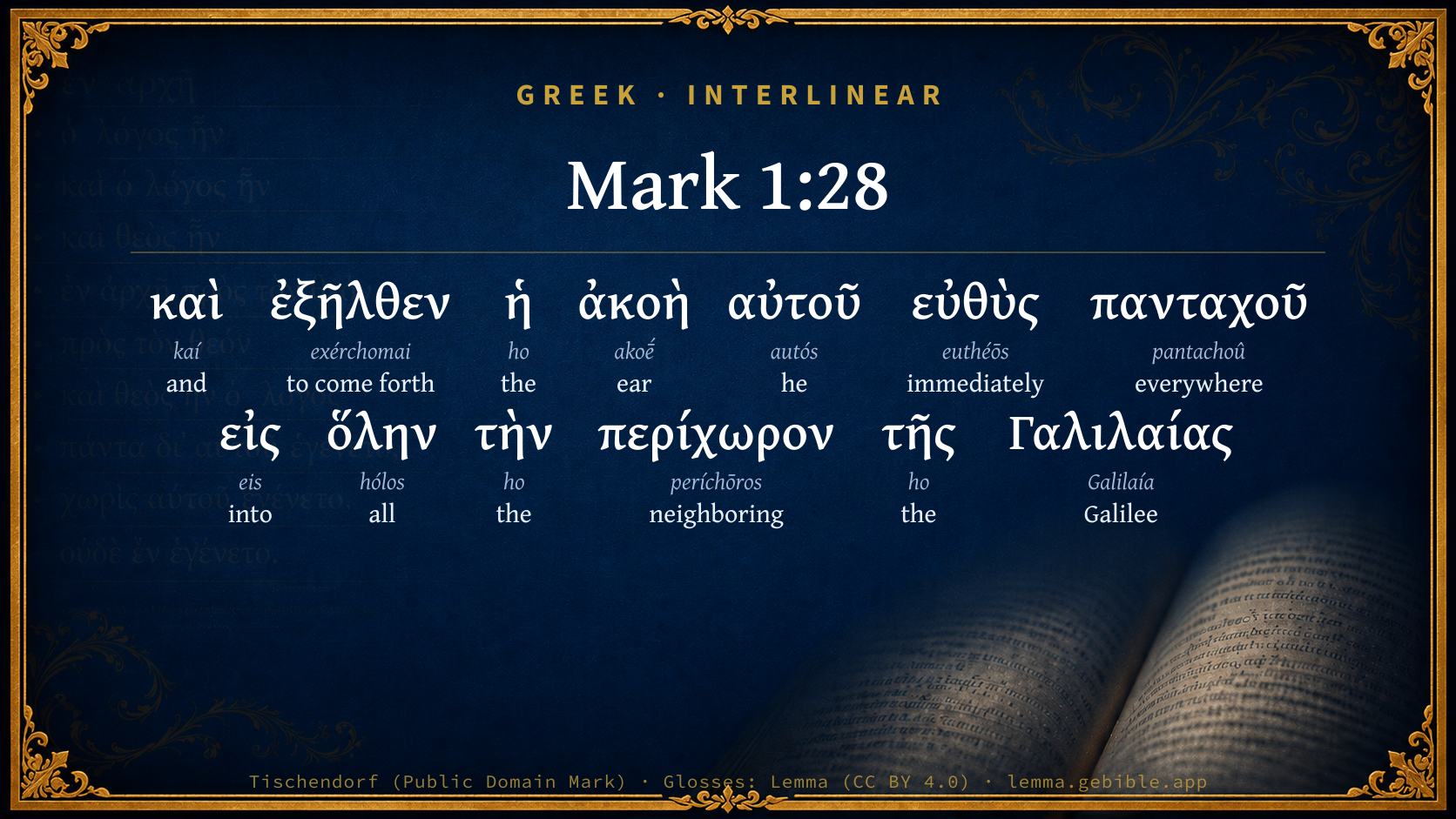
Greek (Tischendorf 8th ed.) Mark 1:28 appears in the Greek New Testament. The text above is from the Tischendorf 8th edition. Each word links to its Strong’s number and a concise gloss. Click any word for its full Thayer’s Greek Lexicon entry.
Download image
Cite this verse

Mark 1:28 (World English Bible). Public Domain. Lemma interlinear Bible study tool, https://lemma.gebible.app/v/mark/1/28.

Show BibTeX & RIS
BibTeX
RIS
English Translation
The report of him went out immediately everywhere into all the region of Galilee and its surrounding area.
World English Bible · Public Domain
Highlights
  • 1 first appearance in the Greek New Testament
Full analysis ↓
Download a study sheet

One document with this verse’s original text, its word-by-word gloss line, the meaning frame, cross-references with their text, attributed commentary, and full source and license credits — printable, and it pastes into notes with its structure intact.

This verse Autodidact and up

Study sheet (.html) Plain text (.txt)

A passage Seminary Student

Up to 50 verses in one chapter. A passage sheet keeps up to 6 commentary sources and 12 cross-references per verse, in the order this page ranks them, and says so on the sheet whenever that leaves anything out. Ask for a single verse and you get the Autodidact verse sheet above.

Everything on this page stays free to read, with no account — the sheet is a download of what is already on screen, not access to it.

Want to remove ads? Support Godless Engineer
Compare translations 3

The same verse in 3 English versions, stacked beneath the original-language interlinear above. Click any original word for its lexicon entry.

Each is an independent rendering of the whole verse — the interlinear is not word-aligned to these translations.

Highlighted words mark where these versions differ — a whole-verse word diff, not a word-by-word alignment.

  • World English Bible Public Domain
    The report of him went out immediately everywhere into all the region of Galilee and its surrounding area.
  • King James Version Public Domain
    And immediately his fame spread abroad throughout all the region round about Galilee.
  • unfoldingWord Literal Text CC BY-SA 4.0
    And the hearing of him immediately went out everywhere into the whole surrounding region of Galilee.

unfoldingWord Literal Text — © unfoldingWord, licensed CC BY-SA 4.0. Word-aligned USFM3 via Door43 (git.door43.org/unfoldingWord/en_ult).

Versions to compare (up to 4)

3 of 4 selected

Show all 19 translations

Every available English version of this verse, each an independent rendering of the whole verse.

  • World English Bible Public Domain
    The report of him went out immediately everywhere into all the region of Galilee and its surrounding area.
  • Berean Standard Bible Public Domain
    And the news about Jesus spread quickly through the whole region of Galilee.
  • Majority Standard Bible Public Domain
    And the news about Jesus spread quickly through the whole region of Galilee.
  • King James Version Public Domain
    And immediately his fame spread abroad throughout all the region round about Galilee.
  • American Standard Version (1901) Public Domain
    And the report of him went out straightway everywhere into all the region of Galilee round about.
  • Revised Version (1885) Public Domain
    And the report of him went out straightway everywhere into all the region of Galilee round about.
  • Geneva Bible (1599) Public Domain
    And immediatly his fame spred abroade throughout all the region bordering on Galile.
  • Douay-Rheims (1899) Public Domain
    And the fame of him was spread forthwith into all the country of Galilee.
  • Young's Literal Translation Public Domain
    And the fame of him went forth immediately to all the region, round about, of Galilee.
  • Literal Standard Version CC BY-SA 4.0
    And the fame of Him went forth immediately to all the region of Galilee.
  • Unlocked Literal Bible CC BY-SA 4.0
    The news about him went out everywhere into the whole region of Galilee.
  • unfoldingWord Literal Text CC BY-SA 4.0
    And the hearing of him immediately went out everywhere into the whole surrounding region of Galilee.
  • Darby Bible Public Domain
    And his fame went out straightway into the whole region of Galilee around.
  • World Messianic Bible Public Domain
    The report of him went out immediately everywhere into all the region of Galilee and its surrounding area.
  • Webster's Bible Public Domain
    And immediately his fame spread abroad throughout all the region around Galilee.
  • Free Bible Version CC BY-SA 4.0
    News about him spread quickly throughout the whole region of Galilee.
  • Bible in Basic English Public Domain
    And news of him went out quickly everywhere into all parts of Galilee round about.
  • Text-Critical English NT CC BY 4.0
    And the news about him immediately spread throughout all the surrounding region of Galilee.
  • Tyndale New Testament (1534) Public Domain
    And immediatly his fame spreed abroade throughoute all the region borderinge on Galile.

Literal Standard Version (2020), Covenant Press — licensed CC BY-SA 4.0. Text via the HelloAO Bible API (eBible.org). Unlocked Literal Bible (unfoldingWord) — licensed CC BY-SA 4.0. Text via the HelloAO Bible API (eBible.org). unfoldingWord Literal Text — © unfoldingWord, licensed CC BY-SA 4.0. Word-aligned USFM3 via Door43 (git.door43.org/unfoldingWord/en_ult). Free Bible Version, Dr. Jonathan Gallagher — licensed CC BY-SA 4.0. Text via the HelloAO Bible API (eBible.org).

Word by word

More ways to search: Search by grammar → Find every occurrence → Compare this word →

Practice this passage: Drill this verse → Learn its vocabulary →

About this verse

These counts appear in no published source. They are computed here, from the morphology-tagged text and Lemma’s own curated glosses. What Lemma adds →

13
words
11
distinct lemmas
Gospels
section

Notable vocabulary

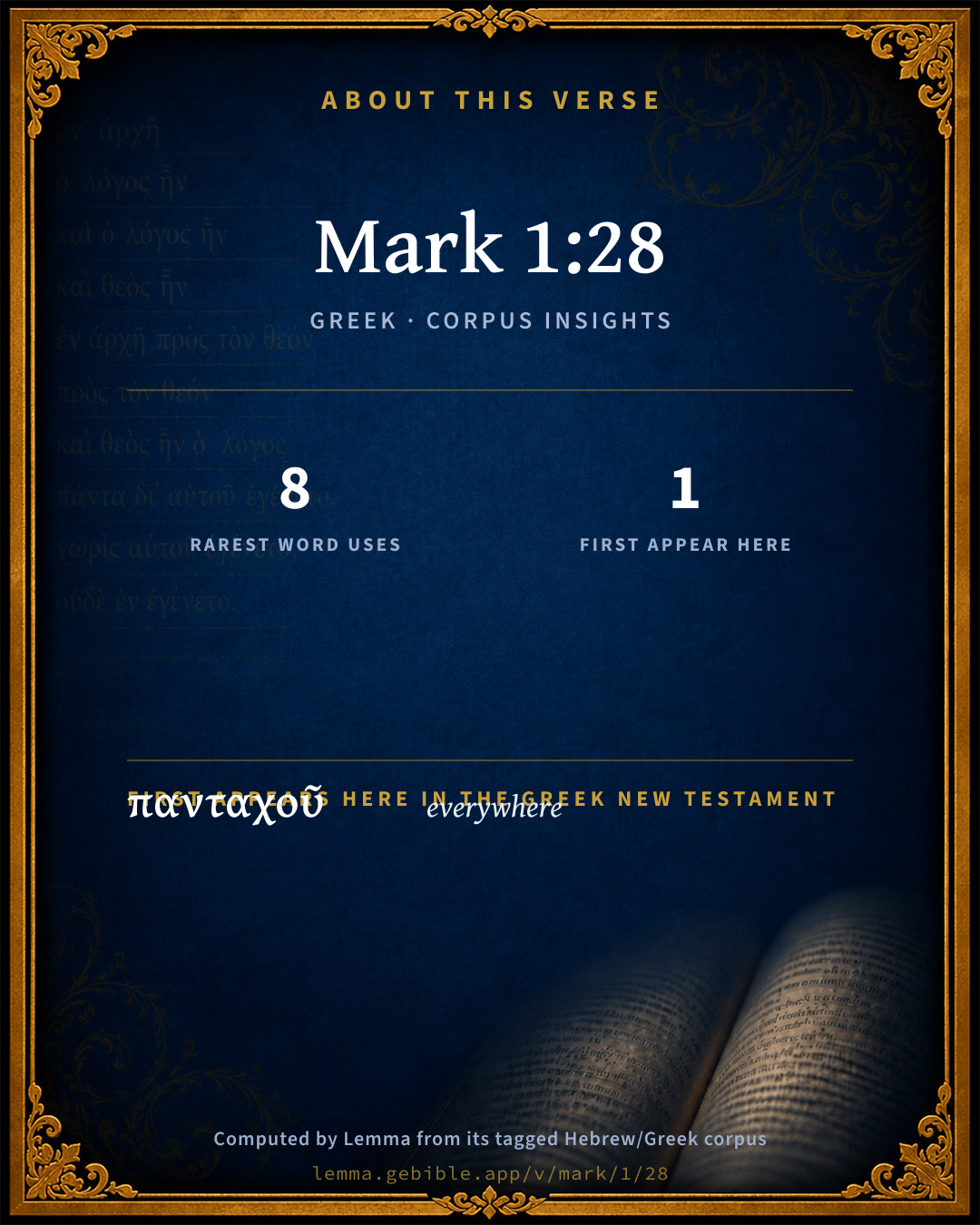
The rarest word here is πανταχοῦ everywhere G3837 — appearing just 8 times in the whole Greek New Testament.

First appearance in Scripture

This word makes its first canonical appearance in the Greek New Testament here:

  • πανταχοῦ everywhere G3837

Shared distinctive vocabulary

πανταχοῦ everywhere G3837 occurs in 8 verses of the Greek New Testament. Also found in:

Repetition

A word recurs within this verse:

Cross-references

6

Topical passages linked to Mark 1:28 in the Treasury of Scripture Knowledge — connected by theme and wording, ordered by reader-vote popularity; previews shown in the World English Bible.

  • Matthew 9:31 But they went out and spread abroad his fame in all that land.
  • Luke 4:37 News about him went out into every place of the surrounding region.
  • Micah 5:4 He shall stand, and shall shepherd in the strength of Yahweh, In the majesty of the name of Yahweh his God: And they will live, for then he will be great to the ends of the earth.
  • Matthew 4:24 The report about him went out into all Syria. They brought to him all who were sick, afflicted with various diseases and torments, possessed with demons, epileptics, and paralytics; and he healed them.
  • Mark 1:45 But he went out, and began to proclaim it much, and to spread about the matter, so that Jesus could no more openly enter into a city, but was outside in desert places: and they came to him from everywhere.
  • Luke 4:17 The book of the prophet Isaiah was handed to him. He opened the book, and found the place where it was written,

Cross-references courtesy of OpenBible.info (CC BY 4.0).

Where the printed editions differ

1 variant

Places in this verse where the major printed Greek editions disagree on the wording in a way that affects the translation — a comparison of editions, not a manuscript-by-manuscript collation. The editions are the modern critical texts (Nestlé-Aland 28/27, SBL, Westcott-Hort, Tregelles, Tyndale House) and the traditional texts behind the KJV (the Textus Receptus and the Byzantine/Majority text). It is not a claim about which reading is original.

  1. Extra text
    πανταχοῦ

    “everywhere”

    In NA28NA27TynSBLWHTreg Not in TRByz

    πανταχοῦ (pantachou) 'everywhere' is only in older manuscripts (NA28+NA27+Tyn+SBL+WH+Treg)

Textual data: Translators Amalgamated Greek New Testament (STEPBible TAGNT) · CC BY 4.0.

Commentary

Notes on Mark 1:28 from classic Christian and Jewish commentators (each source and its license shown beneath its notes). The classic Christian expositions comment on the surrounding passage and are grouped to its opening verse, so a note may address several verses; the Jewish commentaries on the Tanakh (Rashi and others) are per-verse, so they appear only where the commentator wrote on this verse.

Lemma curates 59 commentaries, every one of them public domain or Creative Commons licensed, each selected and text-cleaned for this edition rather than reprinted as found. About our sources →

Meyer's Critical & Exegetical Commentary

Heinrich August Wilhelm Meyer

Mar_1:28. Εἰς ὅλην τ. περίχ. τ. Γαλιλ.] not merely therefore into Galilee itself, but also into the whole region that surrounds Galilee. Comp. Luk_3:3; Luk_8:37. This wide diffusion, the expression of which is still further strengthened by πανταχοῦ (see the critical remarks), is not at variance with the εὐθύς (Köstlin finds in the word a mistaken fashion of exaggeration), which is to be estimated in accordance with the lively popular mode of expression. Criticism becomes confused by the stress laid on such points.

πανταχοῦ] with the verb of motion, as is often the case among the Greeks: every-whither. Comp. on ἀλλαχοῦ, Mar_1:38.

It is to be observed, we may add, that this first miracle, which Mark and Luke relate, is not designated by them as the first. Hence there is no inconsistency with Joh_2:11 (in opposition to Strauss).

Meyer — Critical and Exegetical Commentary on the New Testament — English translation by Peter Christie, edited by Frederick Crombie (T&T Clark, 1880) — public domain. Text from a community e-Sword module.

Expositor's Greek Testament

ed. W. Robertson Nicoll

Mar 1:28 . ἡ ἀκοὴ , the report, as in Mat 14:1 ; Mat 24:6 . εὐθὺς , expressive of the lightning speed with which rumour travels = πανταχοῦ = πανταχοῖ , in every direction. εἰς ὅλην τ . π . τ . Γαλ ., a vague phrase suggestive of a wide range of circulation, even beyond the boundaries of Galilee. But that can hardly be meant. Recent interpreters take it as meaning that the fame spread into the Galilean environment of Capernaum , along the lake north and south, and back into the hill country.

Similarity at certain points in this incident to the story of the Gadarene demoniac, especially in the deprecatory speech (Mar 1:24 , Mat 8:29 ), has suggested the hypothesis of borrowing on one side or other. Keim thinks this not a real history but an acted programme, like the change of water into wine in Joh 2 and like the preaching programme in Luk 4 ( L. J. , ii. 165, 203), a mere duplicate of the Gadara story. Weiss thinks the words spoken by the demoniac (Mar 1:34 ) are borrowed from that story, and that Mark reproduces the features with which Peter was wont to describe such cases. The lifelike reflections of the spectators (Mar 1:27 ) powerfully witness for the reality of the occurrence.

The Expositor's Greek Testament, edited by W. Robertson Nicoll (1897–1910) — public domain. Text from a community e-Sword module.

Geneva Bible (1599)

Geneva Bible translators

Not only into Galilee, but also into the countries bordering upon it.

Geneva Bible (1599) marginal notes — public domain. Text via Bolls.life.

Jamieson, Fausset & Brown

Robert Jamieson, A. R. Fausset & David Brown

And immediately his fame spread abroad throughout all the region round about Galilee--rather, "the whole region of Galilee"; though some, as MEYER and ELLICOTT, explain it of the country surrounding Galilee.

Jamieson, Fausset & Brown — Commentary Critical and Explanatory on the Whole Bible (1871) — public domain (CC PDM 1.0). Text via the HelloAO Bible API.

Adam Clarke's Commentary

Verse 28. And immediately his fame spread abroad] The miracle which he had performed was -

1. great;

2. evidenced much benevolence in the worker of it; and

3. was very public, being wrought in the synagogue.

The many who saw it published it wherever they went; and thus the fame of Christ, as an incomparable teacher, and unparalleled worker of miracles, became soon spread abroad through the land.

The word, ευθεως, immediately, occurs more frequently in this evangelist than in any other writer of the new covenant: it is very often superfluous, and may often be omitted in the translation, without any prejudice to the sense of the passage in which it is found. It seems to be used by St. Mark, as our ancient writers used forsooth, and such like words.

Adam Clarke's Commentary on the Bible (1810–1826) — public domain. Text from a community e-Sword/MySword module.

John Gill's Exposition

And immediately his fame spread abroad,.... Not only in the city of Capernaum, where these things were done, and where his fame was first spread, but also

throughout all the region round about Galilee: and not only throughout Galilee, but throughout all the country that was bordering upon it, and adjacent to it; see Mat 4:23. The Persic version reads, "through all the provinces".

John Gill's Exposition of the Whole Bible (1746–1763) — public domain (CC PDM 1.0). Text via the HelloAO Bible API.

Trapp's Complete Commentary

John Trapp

28 And immediately his fame spread abroad throughout all the region round about Galilee.

Ver. 28. His fame spread] Those that do worthily in Ephratah shall be famous in Bethlehem, Rth 4:11. Cicero worthily preferreth Cato before Socrates, quoniam huius dicta, illius facta laudantur. because in saying these things, he is praised in doing those things. But our Lord Christ was mighty both "in deed and word," Luk 24:19.

John Trapp, A Commentary or Exposition upon All the Books of the Old and New Testament (1647–1656) — public domain. Text from a community e-Sword module.

Matthew Poole's English Annotations

The fame of his miracles, rather than of his doctrine; by this means many were brought to him to be cured, many were brought also to hear him, some of whom believed, others were hardened.

Matthew Poole's English Annotations on the Holy Bible (1683–1685) — public domain. Text from a community e-Sword/MySword module.

Whedon's Commentary on the Bible

Daniel D. Whedon

28. Spread… throughout… Galilee — The phrase, region round about Galilee, would be more correctly rendered, the surrounding region of Galilee. Our Lord did not leave Galilee, but took a circuit in it. It went abroad that a beneficent being had appeared, at whose touch and voice disease and damage and leprosy and demons disappeared.

The followers of the Saviour were even for centuries called by the Pagans Galileans. The philosopher Epictetus, who lived after the time of the Emperor Nero, asked if a philosopher can become indifferent to suffering, like the Galileans, meaning thereby the Christians. And the Emperor Julian, surnamed the Apostate, in the third century, who was cut off in the midst of his efforts to destroy Christianity, cried with his dying voice, addressing Christ, “Thou hast conquered, O Galilean!”

Daniel D. Whedon (gen. ed.), Commentary on the Old and New Testaments (1874–1909) — public domain. Text from a community e-Sword module.

The Pulpit Commentary

All the region round about Galilee; more literally, all the region of Galilee, round about; and the best readings add "everywhere" (pantacou eiv olhn thcwron thv Galilaiav). This is, of course, said by anticipation.

"The region... round about.

I THE POSITION OF THE CHURCH.

1. Centre of the worlds life.

(1) This by virtue of what she is, the principles of righteousness which she inculcates and practises. These "doctrines of the cross" are keys to the chambers of power and authority. They are the true solution of the mysteries of human life. Questions of biography or of history, of individual lives or of eras, can only be understood from their underlying and determining spiritual principles the relations of man to the Divine. Because of this connection of righteousness with the laws of the universe, Christian faith and virtue are the conditions of true possession and influence, whether in the region of the material or that of the spiritual. The beatitudes illustrate this truth. Only to the central principle does the world yield up its wealth. Herein, too, lies the reason of the Church"s responsibility and stewardship. She holds what she has, not for herself alone, but for others. Her power is a moral one, as being guardian of the best interests of man.

(2) This by virtue of her relation to Christ, He is the Centre of humanity, and in him all things are created and sustained. It is, however, only through doctrines and belief that vital connection with him is maintained. Being, so to speak, "in Christ," she is his representative in proportion to her faithfulness and vitality. It is as constituted of individual members, each believing in Christ and living in him, that this character belongs to her, and not from any mystic corporate prerogative. What is true, therefore, of the Church, is so because, in the first instance, it is true of individual believers. Christ himself is the great attractive force of the Church; "I, if I be lifted up, will draw all men unto me.

(3) This by virtue of her present circumstances. Although not of the world, she is in it, sent into it, and kept there. The great reason of her institution is that she may influence evangelize her neighborhood. For a season in the midst of the world, as Christ was in its midst, she is to radiate forth light and life upon mankind. The minister, "of the whole city center," is typical of the spiritual temple in the midst of world-life.

1. A moving center. Wherever our Saviour went he carried on his work in "the region round about," and "they came to him from every quarter" (ver. 45). In the same manner must it be with his followers. Like him, they must go about continually doing good. Christian work is not exclusively associated with a special place or building, a sacred day or an official service; it is inseparable from the individual personality of the believer, and must constantly proceed wherever he is.

2. A multiplying center. The powers of the individual believer increase and multiply. His command of new truths, and attainment of fresh spiritual life, add to his facilities and capacities for usefulness. And every person added to the faith is a new evangelist, with a sphere and fitness of his own. It is the glory of Christianity thus to propagate itself. The "Society of Jesus" was described as "a sword, with the handle at Rome and the point everywhere." The ideal this represents is only realized in the spiritual society of Jesus the Church saved through his blood, and in all her members, loyal and loving, carrying out the great commission, "Go ye into all the world, and preach the gospel to the whole creation". (Mar_16:15)

II THE FIELD OF THE CHURCH.

1. Always at hand. The sphere of the Christian is described from himself as a center. He can never escape it or be destitute of it. He ought to be always ready and furnished for his work, however peer or ignorant he may be; for "our sufficiency is of God." "Of whom are ye in Christ Jesus, who of God is made unto us wisdom, and righteousness, and sanctification, and redemption." Even the one talent is given for use and service. Men often lose themselves in vague dreams and extensive ideas. For this reason it may be, as Bishop Butler suggests, that we are first told to "love our neighbor a duty which develops into many graces. It is a bad sign when the immediate neighborhood, the family, the servants, the friends, etc., of a professing Christian, are neglected.

2. Practically infinite. It is undefined save at its center. Each region is a center to others. The pressure of spiritual responsibility is as constant and necessary to the Christian"s soul as that of the atmosphere in relation to his body. The ever-increasing and widening vistas of possible usefulness are occasions of inspiration and ennoblement to the earnest worker.

3. Constantly varied. N ew subjects of Christian solicitude present themselves, new adaptations of spiritual truth and agency. The adaptability, capacity, and sympathy of the Christian ought to be continually developing. And when "the region round about" has received its due labour and attention and prayer, there is ever some "region beyond" whither the hastening feet of the Saviour have already made a way. M.

The Pulpit Commentary (1880–1919), ed. H.D.M. Spence-Jones & Joseph S. Exell — public domain. Text from a community e-Sword module.

Burkitt's Expository Notes on the New Testament

William Burkitt

The second miracle which our Saviour wrought in this chapter, to confirm the truth and authority of his doctrine was his raising up of Peter’s wife’s mother from her bed of sickness.

Where note, 1. that St. Peter, now a disciple, and afterwards an apostle, was a married person. Neither the prophets of the Old Testament, nor the ministers of the New, did abhor the marriage-bed, nor think themselves too pure for an institution of their Maker. The church of Rome, by denying the lawfulness of priests’ marriage, makes herself wiser than God, who says, Marriage is honourable amongst all men. Heb 13:4.

Observe, 2. Peter, though a good man, and his wife’s mother probably a gracious woman, yet is his family visited with sickness; strength of grace, and dearness of respect even from Christ himself, cannot prevail against diseases. God’s own children are visited with bodily sickness as well as others.

Observe, 3. The charitable care of St. Peter, and the other disciples, forthwith to acquaint Christ with the condition of this sick person, Anon they tell him of her. The care of our fellow-christians, especially when of the number of our near and dear relations, in a time of sickness, is not to be deferred or delayed. Outward help for their bodies, and the spiritual help of our prayers for their souls, are both straightway to be afforded them.

Observe, 4. Christ’s divine power manifested in this miraculous cure: He no sooner took her by the hand but the fever left her. The miracle was not in curing an incurable distemper, but in curing an ordinary distemper after a miraculous manner; namely,

1. By a touch of the hand.

2. The recovery was instantaneous and sudden: Immediately the fever left her.

3. The visible effects of her recovery instantly appeared: She arose and ministered unto Christ and his disciples.

That she could arise, argued her cure miraculous; that she did arise, and did minister to Christ, argued her thankfulness.

Learn thence, That after Christ hath graciously healed any of us, it ought to be our first work and care to administer unto Christ; that is, to employ our recovered health in the service of Christ, and to improve our renewed strength to the honour and glory of Christ.

William Burkitt's Expository Notes on the New Testament (1700–1703) — public domain. Text from a community e-Sword module.

The People's New Testament

B. W. Johnson

28–34. His fame spread abroad. For notes on the increasing fame of Christ see Matt. 4:25; for notes on the healing of Peter's wife's mother, see Matt. 8:14.

B. W. Johnson's The People's New Testament with Notes (1889–1891) — public domain. Electronic text from the Christian Classics Ethereal Library (CCEL) ThML edition.

Cambridge Greek Testament for Schools and Colleges

28. ἀκοή. Here again (see on Mar 1:25) we have a word with three meanings, of which the second and third spring directly from the first: (1) “hearing,” as “by hearing ye shall hear,” Isa 6:9; then, seeing that “hearing” may mean either the sense of hearing or hearsay, we have (2) “the ear,” Mar 7:35, and (3) “rumour” or “report,” as here. Cf. Jer 6:24.

εὐθὺς [πανταχοῦ]. From that moment in all directions. Some important witnesses ([196][197] 33, Lat-Vet.) omit εὐθύς, and still more ([198][199][200][201][202][203][204], Latt. Syrr.) omit πανταχοῦ, but perhaps both may be retained (R.V.). Syr-Sin. omits both and adds “and many followed Him.”

[196] Codex Sinaiticus. 4th cent. Discovered by Tischendorf in 1859 at the Monastery of St Katharine on Mount Sinai. Now at St Petersburg. The whole Gospel, ending at Mar 16:8. Photographic facsimile, 1911.

[197] An asterisk denotes that the word is not found elsewhere in N.T., and such words are included in the index, even if there is no note on them in the commentary.

[198] Codex Sinaiticus. 4th cent. Discovered by Tischendorf in 1859 at the Monastery of St Katharine on Mount Sinai. Now at St Petersburg. The whole Gospel, ending at Mar 16:8. Photographic facsimile, 1911.

[199] An asterisk denotes that the word is not found elsewhere in N.T., and such words are included in the index, even if there is no note on them in the commentary.

[200] Codex Alexandrinus. 5th cent. Brought by Cyril Lucar, Patriarch of Constantinople, from Alexandria, and afterwards presented by him to King Charles I. in 1628. In the British Museum. The whole Gospel. Photographic facsimile, 1879.

[201] Codex Bezae. 6th cent. Has a Latin translation (d) side by side with the Greek text, and the two do not quite always agree. Presented by Beza to the University Library of Cambridge in 1581. Remarkable for its frequent divergences from other texts. Contains Mark, except Mar 16:15-20, which has been added by a later hand. Photographic facsimile, 1899.

[202] Codex Oxoniensis. 9th cent. Contains Mark, except Mar 3:35 to Mar 6:20.

[203] Codex Sangallensis. 9th or 10th cent. Contains the Gospels nearly complete, with an interlinear Latin translation. The text of Mark is specially good, agreeing often with CL. At St Gall.

[204] Codex Petropolitanus. 9th cent. Gospels almost complete. Mar 16:18-20 is in a later hand.

ὅλην τὴν περίχωρον τῆς Γαλιλαίας. Either A.V. or R.V. may be right; all the region round about Galilee, i.e. the whole of Syria (Mat 4:24), or all the region of Galilee round about, i.e. the whole of Galilee (Luk 4:37). In the latter case, τῆς Γαλ. merely explains τ. περίχωρον.

This curing of a demoniac is the first miracle recorded by Mk, who may have regarded it as symbolical of the Messiah’s work—His victory over the forces of evil.

Cambridge Greek Testament for Schools and Colleges (Cambridge University Press, 1896; 21 vols, various authors incl. Carr, Maclear, Plummer, Farrar, Lumby, Moule, M. R. James, Simcox) — public domain. Text from a community e-Sword module.

Alford’s Greek Testament

Henry Alford

28.] This miracle, which St. Mark and St. Luke relate first of all, is not stated by them to have been the first. Cf. Joh 2:11.

Henry Alford, The Greek Testament (1849–1861) — public domain. Text from a community e-Sword module.

International Critical Commentary

28. εὐθὺς, immediately. This is the third instance of this word in this short paragraph. Lk., in spite of his general verbal resemblance to Mk., omits it in every case. Here it shows the immediateness of the fame which followed such exhibitions of authority. πανταχοῦ εἰς ὅλην τὴν περίχωρον—everywhere, into all the neighborhood.3

Insert πανταχοῦ Tisch. (Treg.) WH. RV. א BCL 69, Lat. Vet. (some mss.), Memph.

τῆς Γαλιλαίας is partitive gen., denoting the part of Galilee that lay about Capernaum.

Lk. is parallel to Mk. here (4:31-37), and the minute verbal resemblance again shows obvious interdependence. The secondary character of Lk.’s account appears unmistakably in the report of the popular discussion that followed the miracle.

A POPULAR UPRISING

International Critical Commentary — older volumes (1896–1929), various authors — public domain. Text from a community e-Sword module.

Lesson kit

Teaching starters — assembled from the data on this page, not authored interpretation. Every prompt links to the verse data it draws on. Edit before teaching.

Mark, in the Gospels, opens this verse with 13 words (11 distinct Greek lemmas). Its most distinctive word is pantachoû (“everywhere”). A historical commentator’s framing appears above. Read the whole chapter for the surrounding context.

Discussion questions

  1. How does “everywhere” (pantachoû) shape what this verse is saying?
  2. The word “everywhere” first appears here in Scripture. What is being introduced at this debut?
  3. Mark 16:20 shares the word «everywhere» with this verse. How do the two illuminate each other?
  4. “the” occurs 3× in this one verse. What is the effect of the repetition?
  5. These translations render this verse differently. What is at stake in choosing one wording over another?
  6. Reading how Meyer's Critical & Exegetical Commentary and Expositor's Greek Testament read this verse, where do the two commentators agree and where do they part?

Things to notice

  • 1 word makes its first canonical appearance in Scripture here.
  • These translations choose different wording for 17 words in this verse.
  • “the” occurs 3× in this single verse.
  • 11 distinct Greek lemmas span 13 words in this verse.

Reading settings

Reading text

Shown beneath each verse's original-language words.

Old Testament
Old Testament edition

Read the OT as the Masoretic Hebrew (MT) or the Greek Septuagint (LXX).

English shown for the Greek Septuagint (in the Hebrew ↔ Greek comparison).

Comparing translations? Open the Compare panel on any verse page to stack up to four side by side.