Mark 1:36

Greek (Tischendorf 8th ed.) Mark 1:36 appears in the Greek New Testament. The text above is from the Tischendorf 8th edition. Each word links to its Strong’s number and a concise gloss. Click any word for its full Thayer’s Greek Lexicon entry.

Download image
Cite this verse

Mark 1:36 (World English Bible). Public Domain. Lemma interlinear Bible study tool, https://lemma.gebible.app/v/mark/1/36.

Show BibTeX & RIS
BibTeX
RIS
English Translation
Simon and those who were with him followed after him;
World English Bible · Public Domain
Highlights
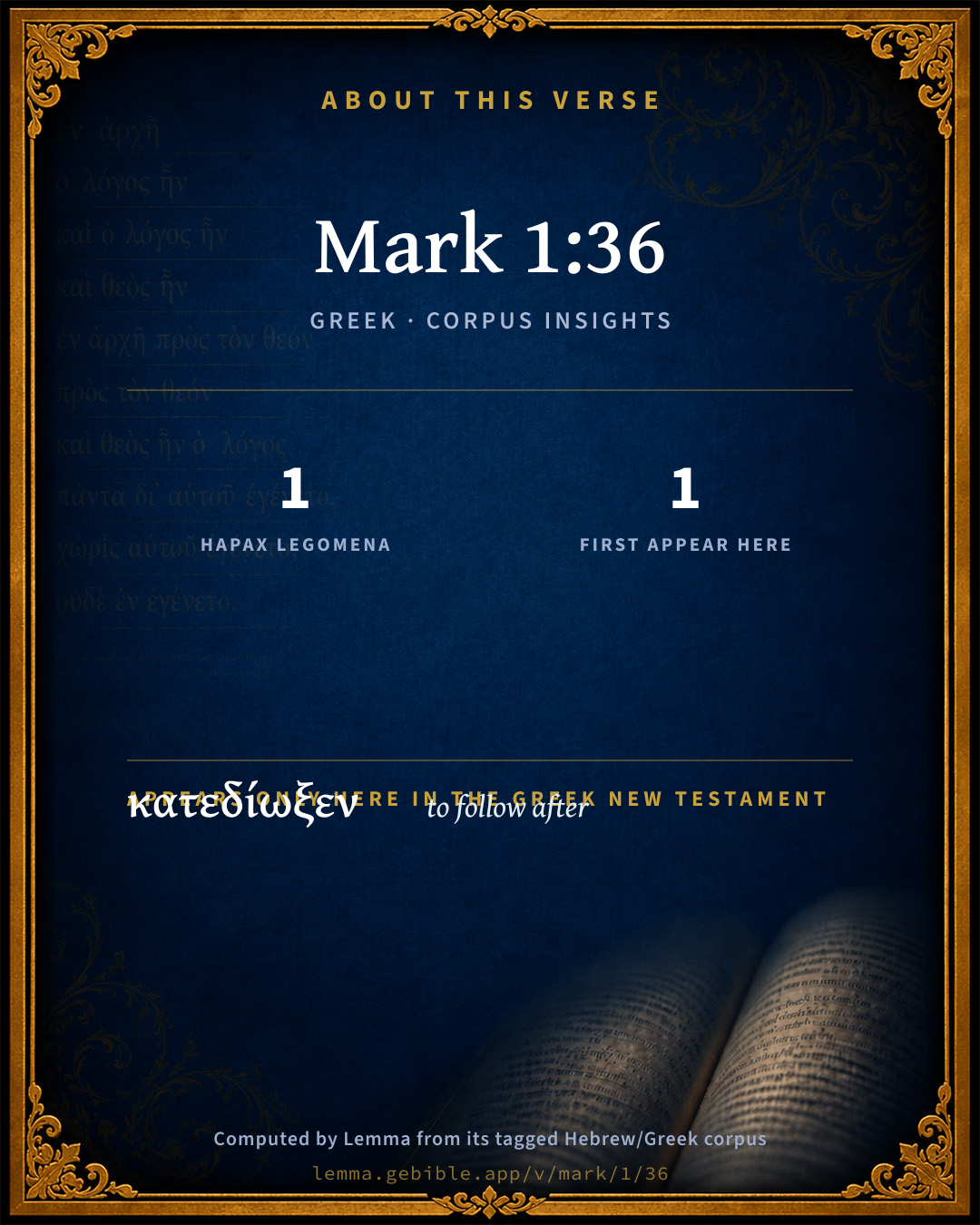
  • 1 hapax legomenon — only here in the Greek New Testament
  • 1 first appearance in the Greek New Testament
Full analysis ↓
Download a study sheet

One document with this verse’s original text, its word-by-word gloss line, the meaning frame, cross-references with their text, attributed commentary, and full source and license credits — printable, and it pastes into notes with its structure intact.

This verse Autodidact and up

Study sheet (.html) Plain text (.txt)

A passage Seminary Student

Up to 50 verses in one chapter. A passage sheet keeps up to 6 commentary sources and 12 cross-references per verse, in the order this page ranks them, and says so on the sheet whenever that leaves anything out. Ask for a single verse and you get the Autodidact verse sheet above.

Everything on this page stays free to read, with no account — the sheet is a download of what is already on screen, not access to it.

Want to remove ads? Support Godless Engineer
Compare translations 3

The same verse in 3 English versions, stacked beneath the original-language interlinear above. Click any original word for its lexicon entry.

Each is an independent rendering of the whole verse — the interlinear is not word-aligned to these translations.

Highlighted words mark where these versions differ — a whole-verse word diff, not a word-by-word alignment.

  • World English Bible Public Domain
    Simon and those who were with him followed after him;
  • King James Version Public Domain
    And Simon and they that were with him followed after him.
  • unfoldingWord Literal Text CC BY-SA 4.0
    And Simon and the ones with him pursued him

unfoldingWord Literal Text — © unfoldingWord, licensed CC BY-SA 4.0. Word-aligned USFM3 via Door43 (git.door43.org/unfoldingWord/en_ult).

Versions to compare (up to 4)

3 of 4 selected

Show all 19 translations

Every available English version of this verse, each an independent rendering of the whole verse.

  • World English Bible Public Domain
    Simon and those who were with him followed after him;
  • Berean Standard Bible Public Domain
    Simon and his companions went to look for Him,
  • Majority Standard Bible Public Domain
    Simon and his companions went to look for Him,
  • King James Version Public Domain
    And Simon and they that were with him followed after him.
  • American Standard Version (1901) Public Domain
    And Simon and they that were with him followed after him;
  • Revised Version (1885) Public Domain
    And Simon and they that were with him followed after him;
  • Geneva Bible (1599) Public Domain
    And Simon, and they that were with him, followed carefully after him.
  • Douay-Rheims (1899) Public Domain
    And Simon, and they that were with him, followed after him.
  • Young's Literal Translation Public Domain
    and Simon and those with him went in quest of him,
  • Literal Standard Version CC BY-SA 4.0
    and Simon and those with him went in quest of Him,
  • Unlocked Literal Bible CC BY-SA 4.0
    Simon and those who were with him searched for him.
  • unfoldingWord Literal Text CC BY-SA 4.0
    And Simon and the ones with him pursued him
  • Darby Bible Public Domain
    And Simon and those with him went after him:
  • World Messianic Bible Public Domain
    Simon and those who were with him searched for him.
  • Webster's Bible Public Domain
    And Simon, and they that were with him, followed after him.
  • Free Bible Version CC BY-SA 4.0
    Simon and the others went to search for him.
  • Bible in Basic English Public Domain
    And Simon and those who were with him came after him.
  • Text-Critical English NT CC BY 4.0
    Simon and his companions searched diligently for him,
  • Tyndale New Testament (1534) Public Domain
    And Simon and they that were with him folowed after him.

Literal Standard Version (2020), Covenant Press — licensed CC BY-SA 4.0. Text via the HelloAO Bible API (eBible.org). Unlocked Literal Bible (unfoldingWord) — licensed CC BY-SA 4.0. Text via the HelloAO Bible API (eBible.org). unfoldingWord Literal Text — © unfoldingWord, licensed CC BY-SA 4.0. Word-aligned USFM3 via Door43 (git.door43.org/unfoldingWord/en_ult). Free Bible Version, Dr. Jonathan Gallagher — licensed CC BY-SA 4.0. Text via the HelloAO Bible API (eBible.org).

Word by word

More ways to search: Search by grammar → Find every occurrence → Compare this word →

Practice this passage: Drill this verse → Learn its vocabulary →

About this verse

These counts appear in no published source. They are computed here, from the morphology-tagged text and Lemma’s own curated glosses. What Lemma adds →

8
words
6
distinct lemmas
Gospels
section

Notable vocabulary

1 hapax legomenon — a word that appears only here in the entire Greek New Testament:

  • κατεδίωξεν to follow after G2614

First appearance in Scripture

This word makes its first canonical appearance in the Greek New Testament here:

  • κατεδίωξεν to follow after G2614

Repetition

Words recur within this verse:

  • καὶ and G2532 ×2
  • αὐτὸν he G846 ×2

Commentary

Notes on Mark 1:36 from classic Christian and Jewish commentators (each source and its license shown beneath its notes). The classic Christian expositions comment on the surrounding passage and are grouped to its opening verse, so a note may address several verses; the Jewish commentaries on the Tanakh (Rashi and others) are per-verse, so they appear only where the commentator wrote on this verse.

Lemma curates 59 commentaries, every one of them public domain or Creative Commons licensed, each selected and text-cleaned for this edition rather than reprinted as found. About our sources →

The Biblical Illustrator

Joseph S. Exell

Mar_1:36-39

And when they had found Him.

The desire of humanity for Christ

While rejoicing in Divine solitude, the loneliness in which He left the suffering, toiling people was indescribably painful to them. A man born blind does not realize his deprivation, but if there is given him a brief vision of daylight how unutterable his sense of loss when it fades away again. So these people felt themselves deprived of the fresh interest and hopes with which they had been inspired when they lost the society and communion of Jesus. But the question was asked by all lips: Where is He? And most true is it today-be mans opinions what they may-there is no more universal experience of human kind, whether gentle or simple, scientific or ignorant, barbarian or bond or free, than the hunger for that fulness of life which is in Christ Jesus. (J. A. Picton, M. A.)

An unconscious prophecy

What the disciples said in their wondering delight, shall one day be literally true-all men will be in search of the Saviour of the world. In the first instance the Saviour sought all men, and in the second all men will seek the Saviour. We love Him because He first loved us. (J. Parker, D. D.)

Christ the centre of union for all men

All men seek for Thee. Yes, they are tired of their sectarian wranglings; they are wearied out with their ineffectual metaphysical analysis; they are sick of the poor results yielded up by material research; they have lost confidence in their own self-will; they prize no longer their self-conceit; they long to be brothers in the embrace of one common Father, and none can bring them together but Christ. All men seek for thee. Even so, come, Lord Jesus. (J. A. Picton, M. A.)

The reason for Christs apparently unreasonable departures

He had spoken to the people because He desired them to know; and again, He will retire from them, and have His heart set on their well-being as he retires. When you and I have heard the sermon, what remains for us to do? Is it to hear more, or to think about what we have heard? You can learn by hearing, but you can be confused by hearing too much; one sermon may obliterate the effect of the other. So Christ left the people to whom He had been so acceptable, that in the quietude of their homes they might think of that which they had both heard and seen. (J. Cymore Davies.)

Christian evangelization

I. That this Christian evangelization was preceded by private devotion.

II. That this Christian evangelization was accompanied by an earnest preaching of the truth.

III. That this Christian evangelization made use of the already existing agencies of the Church.

IV. That this Christian evangelization was just in its conception of work, in that it east the devil out of men. Lessons:

1. That evangelistic work requires and is worthy of the best talent that can be obtained.

2. That evangelistic work is ennobling to those who engage in it, as well as to those who are contemplated by it.

3. That evangelistic work has done much to cast the devil out of the masses of our large towns. (J. S. Exell, M. A.)

Christ, a home missionary

From these words I commend to your notice-

I. The resemblance between your own labours, and the personal ministry of your Lord and Saviour, as performed in the field of home missions.

1. In the scene of your labours. The title of missionary denotes one sent forth, and especially belongs to one whose errand is to propagate religion. Christ was sent from God-The great Apostle of our profession (Heb_3:1). To bring the glad message to our earth from the far heavens, He emptied Himself of glory, etc. It was to an alien race that he ministered. His personal ministry was far more limited and national in its character than was His message. Whatever His intent, in narrowing the field of His toils as a preacher, the fact is evident that to the land of Canaan, or the bounds of His native country, His ministerial labours were confined, and Jesus Christ, while upon earth, was a Home Missionary. Now a work which occupied the greatest of preachers can never be unimportant, etc.

2. In the commission under which He acted, the message He bore, the manner in which He published it, and the mode in which His labours were sustained.

II. The consequent duty of the Church to continue and abound in the like good work. Whether we look to the advantages which our nation presents for such labour, or to its peculiar necessities; to our duty as Christians, or our interests as men loving their country; to the general obligations of the Church, or our own personal and special privileges and responsibilities-on every hand are teeming incitements to energy and liberality, to perseverance and courageous devotedness. (W. R. Williamson, D. D.)

The Biblical Illustrator, edited by Joseph S. Exell (c. 1880s–1900s) — public domain. Text from a community e-Sword module.

Lange's Commentary on the Holy Scriptures

THIRD SECTION

Mar_1:36-45

________

1. The Preaching and Healing of Jesus. Mar_1:36-39

(Parallel: Luk_4:44)

36And Simon, and they that were with him, followed after him. 37And when they ha found him, they said unto him, All men seek for thee. 38And he said unto them, Let usgo14 into the next towns, that I may preach there also: for therefore came I forth. 39And he preached in their15 synagogues throughout all Galilee, and cast out devils.

EXEGETICAL AND CRITICAL

Mar_1:36. And Simon, and they that were with him.—Simon placed first, not on account of any superiority, but as the head of the house and the guide.

Mar_1:38. Into the next towns.—The κωμοπόλεις only here in the New Testament. The primary object is to record the travelling through the Galilean hill-country, and its villages and towns.—For therefore came I forth.—The question is, whether the meaning be, “I am come from the Father to preach generally” (Bengel); or, “I have left the house (or Capernaum) in order to preach in the neighboring villages” (Meyer). We think that Christ lays stress upon preaching as His great vocation, in opposition to the pressure of individual applicants for help in Capernaum. The former of the two interpretations seems to be the better.

Mar_1:39. In their synagogues (into).—The Accusative, twice occurring, makes it emphatic that he filled the synagogues and all Judea with a might of preaching that formed a contrast to the synagogue style.

DOCTRINAL AND ETHICAL

1. Jesus prepared himself in the desert for His second great expedition. The spiritual awakening and conquest of the land of Galilee was now in question.

2. Here also Mark (like Luke) gives special emphasis to the casting out of devils, and to the command of silence, by which Jesus hindered the devils from uttering His name.

3. It is observed also that Jesus places preaching expressly above miraculous healings; this is seen in the use of the participle, δαιμόνια ἐκβάλλων. But the preaching has its root in the secret devotion: His public work sprang from His solitary prayer.

HOMILETICAL AND PRACTICAL

How the Lord equipped himself anew for new labors.—Christ goes with His first four disciples into the land of Galilee: the small beginning of the universamission.—How the Lord’s preaching approves itself as the power of divine life: 1. As the spiritual word of His working; 2. as delivering power for the suffering; 3. as judicial power of victory over the demons.—Christ confronting the increasing pressure of the people: 1. How He restrains it (withdrawal into the wilderness); 2. how He regulates it (preaching on the individual miracles); 3. how He surrenders Himself to it (responding to every demand of help).—Christ does not shut up His activity within the walls of Capernaum, nor within the limits of any one people or any one confession.—The way of Christ among the surrounding villages: 1. Already to as many as possible; 2. one day to all.

Starke:—We must have village preachers.—The Gospel of Jesus must sound out in all places.—Where Christ’s kingdom is to be established, the devils must be abolished. So also in thee.—Schleiermacher:—The preaching of the kingdom of God was Christ’s vocation: 1. Concerning Himself, as He who was come to save men; 2. concerning the true righteousness which avails before God; 3. concerning the worship of God in spirit and truth.—Within these limits it was His vocation to spread that kingdom as far as He could.—Gossner:—To this end am I come (He says) to save men.—Christ did not scorn the little towns and villages.

Lange's Commentary on the Holy Scriptures (Critical, Doctrinal, and Homiletical), ed. John Peter Lange, English translation edited by Philip Schaff (1864–1880) — public domain. Text from a community e-Sword module.

Bengel's Gnomon

Johann Albrecht Bengel

Mar 1:36. Ὁ Σίμων καὶ οἱ μετʼ αὐτοῦ, Simon and they that were with him) Already Simon is eminent among them. So Luk 8:45; Luk 9:32. It is not said, for instance, “Thomas and they that were with him.” [Comp. note [13] on Mar 1:16].

[13] This is preferred in the margin of both Editions of Bengel, to the omission of the reading τοῦ Σίμωνος, and is therefore marked with the sign ε; with which also the Germ. Vers, agrees on this passage.—E. B.

ABLa have Σίμωνος (and A prefixes τοῦ). Dbc Vulg. and Rec. Text read αὐτοῦ. Only later Uncial MSS. and later Syr. Version read αὐτοῦ τοῦ Σίμωνος.—ED.

Bengel's Gnomon of the New Testament — English translation (T&T Clark, Edinburgh, 1860) — public domain. Text from a community e-Sword module.

Expositor's Greek Testament

ed. W. Robertson Nicoll

Mar 1:36 . κατεδίωξεν : followed Him up; almost pursued Him as a fugitive; verb singular, though more than one followed, Peter , the chief of them, being thought of mainly. A strong term like ἐκβάλλει , Mar 1:12 , all allowance made for weakened force in Hellenistic usage.

The Expositor's Greek Testament, edited by W. Robertson Nicoll (1897–1910) — public domain. Text from a community e-Sword module.

Jamieson, Fausset & Brown

Robert Jamieson, A. R. Fausset & David Brown

And Simon and they that were with him followed after him--rather, "pressed after Him." Luke (Luk 4:42) says, "The multitudes sought after Him"; but this would be a party from the town. Mark, having his information from Peter himself, speaks only of what related directly to him. "They that were with him" would probably be Andrew his brother, James and John, with a few other choice brethren.

Jamieson, Fausset & Brown — Commentary Critical and Explanatory on the Whole Bible (1871) — public domain (CC PDM 1.0). Text via the HelloAO Bible API.

Adam Clarke's Commentary

Verse 36. And Simon - followed after him.] κατεδιωξαν, followed him eagerly. They had now begun to taste the good word of God, and thought they could never hear too much of it. Many possess this spirit when first converted to God. O! what a pity that they should ever lose it! The soul that relishes God's word is ever growing in grace by it.

Adam Clarke's Commentary on the Bible (1810–1826) — public domain. Text from a community e-Sword/MySword module.

Ellicott's Commentary for English Readers

(36) Simon and they that were with him.—This part of the narrative is given by St. Luke also, but not by St. Matthew. The definite statement who they were that followed after Him is, however, peculiar to St. Mark; while St. Luke alone gives their motive: “they stayed Him that He should not depart from them.” They would fain have kept Him at Capernaum, that He might teach them and heal their sick. This is to some extent, perhaps, implied in the words “All men seek for Thee.”

A Bible Commentary for English Readers, edited by Charles John Ellicott (1878–1897) — public domain. Text from a community e-Sword module.

The Cambridge Bible for Schools and Colleges

gen. ed. J. J. S. Perowne

36. Simon] already with his earnest impulsiveness beginning to take the lead. Comp. Luk_8:45; Luk_9:32.

followed after Him] The word in the original is very expressive and only occurs here. It denotes (i) to follow hard upon, (ii) to pursue closely, to track out. “Simon and his friends almost hunted for Him.” It generally implies a hostile intent. It occurs in a good sense in the LXX. rendering of Psa_23:6, “Thy mercy shall follow me.”

The Cambridge Bible for Schools and Colleges (gen. ed. J. J. S. Perowne; Cambridge University Press, 1878–1918) — public domain. Text from a community e-Sword module.

John Gill's Exposition

And Simon, and they that were with him,.... Peter, and his brother Andrew, together with James and John,

followed after him; some time after he was gone; for he privately withdrew from them, so that they might not be aware when he went, nor apprized of his departure, for some considerable time; which when they were, they set out, in diligent search, and eager pursuit after him, until they found him.

John Gill's Exposition of the Whole Bible (1746–1763) — public domain (CC PDM 1.0). Text via the HelloAO Bible API.

Trapp's Complete Commentary

John Trapp

36 And Simon and they that were with him followed after him.

Ver. 36. Followed after him] Gr. "Followed hard after him," as David’s soul did after God, Psa 63:8, and as God’s grace did after David, Psa 23:6.

John Trapp, A Commentary or Exposition upon All the Books of the Old and New Testament (1647–1656) — public domain. Text from a community e-Sword module.

Matthew Poole's English Annotations

Peter probably pitieth the multitude, because many amongst them needed Christ’s presence, for their bodily infirmities. Our Saviour knew their hearts better than Peter; and that which made them so much seek for him, was either in some a curiosity to see miracles wrought, or at best but a desire of some bodily benefit from him. Whereas his working of miracles was but a secondary work, subservient to his work in preaching, and done to confirm his doctrine, and to advantage them as to their faith in him as the Messias. As therefore he refused to gratify the curiosity of the Pharisees in giving them a sign, so here our Saviour takes no notice of the multitude seeking for him, but saith to his disciples, Let us go into the next towns, that I may preach there also; for therefore came I forth. Paul saith that God sent him not to baptize, but to preach, 1Co 1:17. Our Saviour saith not, Let us go into the next towns, that I may work miracles, but that I may preach there also; he doth not say he came forth to work miracles, but to preach: how it comes to pass that some are possessed of so slight an opinion of preaching as to think that it is needless, which our Saviour and St. Paul counted to be their principal work, where, in the mean time, they pretend to derive from Christ, I cannot tell. I am sure preaching was the greatest part of Christ’s work; how it comes to be the least part of ministers’ work since, or how any of them think it sufficient to discharge that work by journeymen, which he thought it not beneath him to do himself, may deserve their examination which make it so. We do not say that preaching is a greater work than prayer, or that it is not ministers’ duty to pray; nor yet that it is greater than administering the sacrament: but this we say, we read of Christ’s preaching often in the synagogues, on the mountain, in a ship; of his public praying we read not, though of his private and secret prayer often. We read expressly that he baptized none. We must have leave to think that our greatest work which our Lord and his apostles were most employed in, and do think others will be of our minds as soon as they shall understand, that if the end of preaching be not turning men from one opinion to another, but from the love and practice of sin to God, there is as much need of it as ever; and that the turning of men from one opinion to another, without a change of heart, as to the love of sin, is but a turning of men from one quarter of the devil’s kingdom to another.

Matthew Poole's English Annotations on the Holy Bible (1683–1685) — public domain. Text from a community e-Sword/MySword module.

The Pulpit Commentary

And Simon and they that were with him followed after him katediwxan the word implies an "earnest pursuing." They that were with him would doubtless include Andrew and James and John, and probably others whose enthusiasm had been kindled by Simon Peter. St. Luke, in the parallel passage. (Luk_4:42) tells us that "the multitudes sought after him, and came unto him, and would have stayed him, that he should not go from them."

The Pulpit Commentary (1880–1919), ed. H.D.M. Spence-Jones & Joseph S. Exell — public domain. Text from a community e-Sword module.

Burkitt's Expository Notes on the New Testament

William Burkitt

Observe here two things: First, the great end of Christ in his incarnation and coming into the world, namely, as a Prophet sent from God to reveal his will, and to publish the doctrine of the gospel. Therefore came I forth; that is, to preach and plant the gospel.

Secondly, It being Christ’s design not only to plant but to propagate the gospel, he would not confine his ministry to any particular places, no, not to the great city of Capernaum, but resolves to preach the word in the smallest towns and villages. Leaving his ministers herein an instructive example, to be as willing to preach the gospel in the smallest villages, as in the largest cities, if God calls them thereunto.

Let the place be never so obscure and mean, and the congregation never so small and little, if God sends us thither, the greatest of us must not think it beneath us to go and instruct a handful of people.

William Burkitt's Expository Notes on the New Testament (1700–1703) — public domain. Text from a community e-Sword module.

The People's New Testament

B. W. Johnson

36. Simon. Peter and the other disciples.

B. W. Johnson's The People's New Testament with Notes (1889–1891) — public domain. Electronic text from the Christian Classics Ethereal Library (CCEL) ThML edition.

Cambridge Greek Testament for Schools and Colleges

36. κατεδίωξαν. “Pursued Him closely,” “followed Him down.” Freq. in LXX., but here only in N.T. The verb generally implies interference with the person pursued, and sometimes implies persecution. But cf. Psa 23:6. Considering the simple character of Mk’s Greek, he uses compound words more often than we should expect. It is instructive to take a page here and there and count. In N.T., διώκω is freq. Peter at once begins to lead.

οἱ μετʼ αὐτοῦ. Andrew, James, and John. In Lk. this is blurred into οἱ ὄχλοι. The earliest tradition says that the disciples pleaded the desires of the multitudes: Lk. says the people came and urged their own wishes.

Cambridge Greek Testament for Schools and Colleges (Cambridge University Press, 1896; 21 vols, various authors incl. Carr, Maclear, Plummer, Farrar, Lumby, Moule, M. R. James, Simcox) — public domain. Text from a community e-Sword module.

Alford’s Greek Testament

Henry Alford

36. οἱ μετʼ αὐτ.] Andrew, John, and James, ibid.

Henry Alford, The Greek Testament (1849–1861) — public domain. Text from a community e-Sword module.

International Critical Commentary

36. κατεδίωξεν αὐτόν—pursued him closely. See Liddell and Scott, Gr. Lex. The EV., followed after, is inadequate. κατά, as in our expression, to hunt down, gives the idea of hard, persistent search. The word occurs only here in the N.T. καὶ οἱ μετʼ αὐτοῦ —and those with him. Andrew, James, and John are meant. See v. 29.

International Critical Commentary — older volumes (1896–1929), various authors — public domain. Text from a community e-Sword module.

Vincent's Word Studies in the New Testament

Marvin R. Vincent

Followed after (κατεδίωξαν)

The word found only in Mark. Simon and his companions, as well as the people of the city, seem to have been afraid lest he should have permanently left them. Hence the compound verb indicates that they followed him eagerly; pursued him as if he were fleeing from them. Simon, true to his nature, was foremost in the pursuit: Simon, and they that were with him.

Marvin R. Vincent, Word Studies in the New Testament (1887–1900) — public domain. Text from a community e-Sword/MySword module.

Lesson kit

Teaching starters — assembled from the data on this page, not authored interpretation. Every prompt links to the verse data it draws on. Edit before teaching.

Mark, in the Gospels, opens this verse with 8 words (6 distinct Greek lemmas). Its most distinctive word is katadiṓkō (“to follow after”). A historical commentator’s framing appears above. Read the whole chapter for the surrounding context.

Discussion questions

  1. How does “to follow after” (katadiṓkō) shape what this verse is saying?
  2. 1 word here appears nowhere else in the Greek New Testament. Why might the author reach for such rare wording?
  3. This is the first place “to follow after” appears in Scripture (first appears here). What does its debut here establish?
  4. What does the repetition of “and” (2× in this one verse) do in this verse?
  5. These translations render this verse differently. What is at stake in choosing one wording over another?
  6. Compare how The Biblical Illustrator and Lange's Commentary on the Holy Scriptures read this verse. Where do they agree or differ?

Things to notice

  • 1 word in this verse appears nowhere else in the Greek New Testament.
  • 1 word makes its first canonical appearance in Scripture here.
  • These translations choose different wording for 5 words in this verse.
  • “and” occurs 2× in this single verse.
  • 6 distinct Greek lemmas span 8 words in this verse.

Reading settings

Reading text

Shown beneath each verse's original-language words.

Old Testament
Old Testament edition

Read the OT as the Masoretic Hebrew (MT) or the Greek Septuagint (LXX).

English shown for the Greek Septuagint (in the Hebrew ↔ Greek comparison).

Comparing translations? Open the Compare panel on any verse page to stack up to four side by side.