
Mark 3:17

Greek (Tischendorf 8th ed.) Mark 3:17 appears in the Greek New Testament. The text above is from the Tischendorf 8th edition. Each word links to its Strong’s number and a concise gloss. Click any word for its full Thayer’s Greek Lexicon entry.
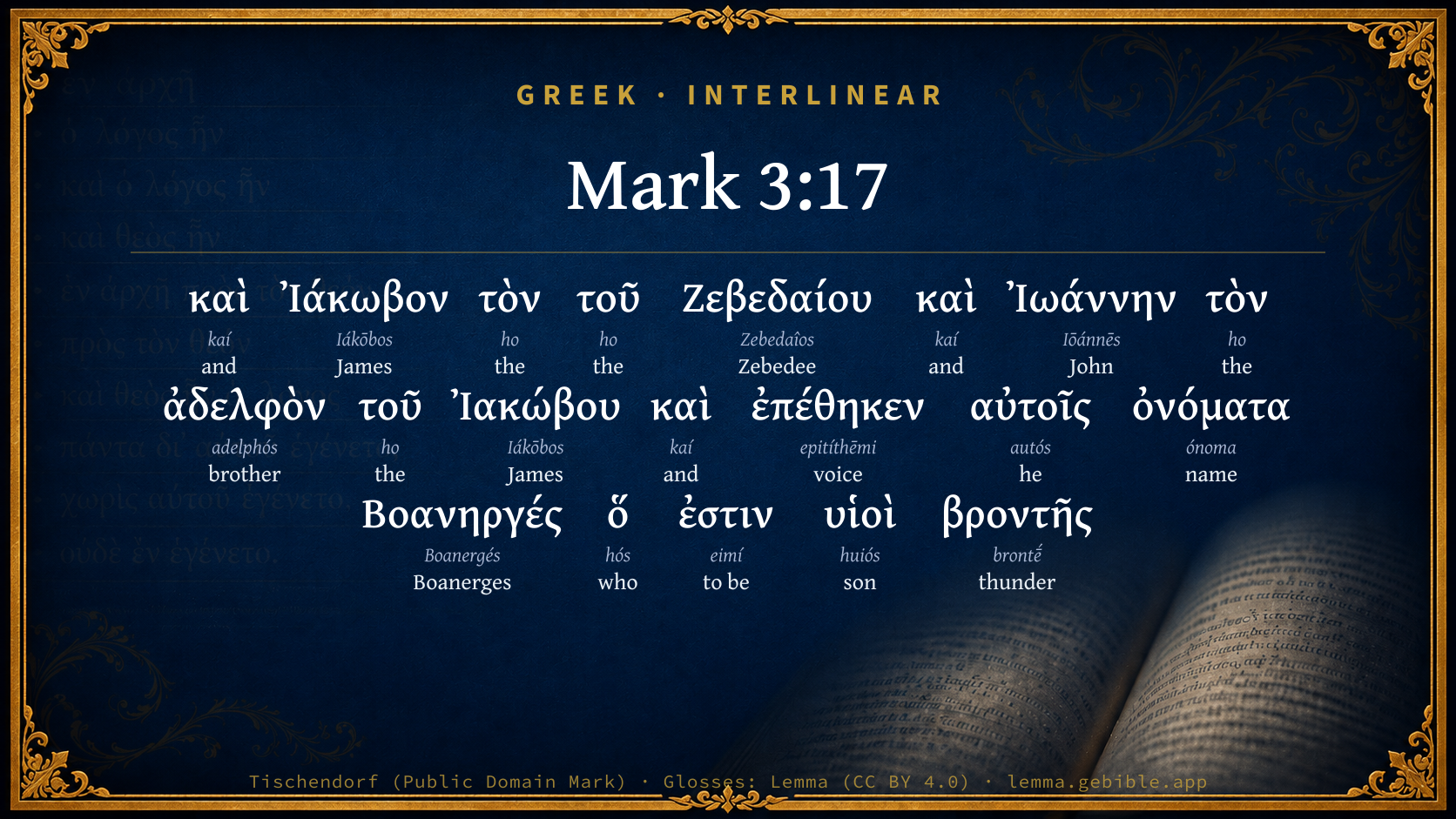
Download image
Cite this verse

Mark 3:17 (World English Bible). Public Domain. Lemma interlinear Bible study tool, https://lemma.gebible.app/v/mark/3/17.

Show BibTeX & RIS
BibTeX
RIS
English Translation
James the son of Zebedee; John, the brother of James, and he surnamed them Boanerges, which means, Sons of Thunder;
World English Bible · Public Domain
Highlights
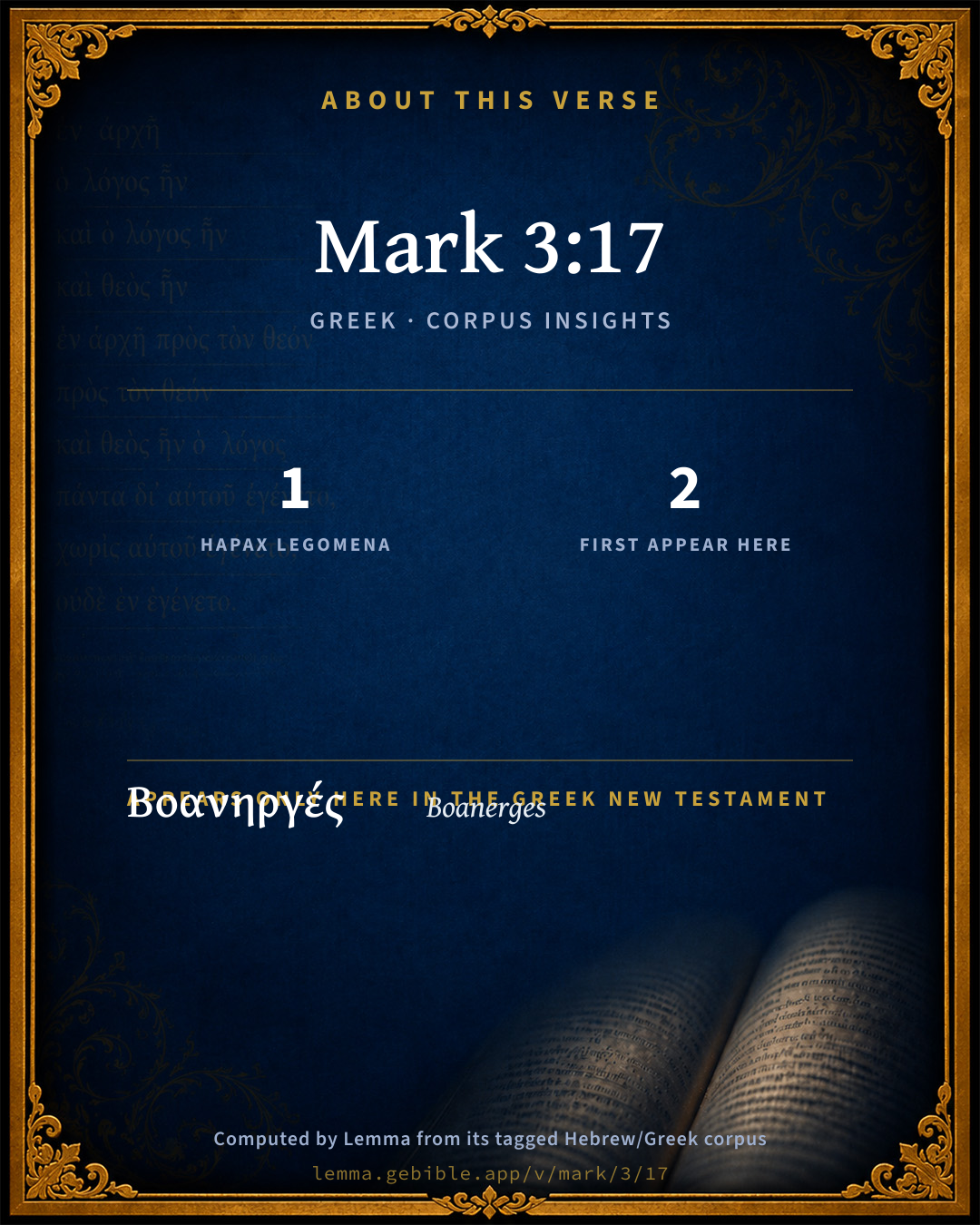
  • 1 hapax legomenon — only here in the Greek New Testament
  • 2 first appearances in the Greek New Testament
Full analysis ↓
Download a study sheet

One document with this verse’s original text, its word-by-word gloss line, the meaning frame, cross-references with their text, attributed commentary, and full source and license credits — printable, and it pastes into notes with its structure intact.

This verse Autodidact and up

Study sheet (.html) Plain text (.txt)

A passage Seminary Student

Up to 50 verses in one chapter. A passage sheet keeps up to 6 commentary sources and 12 cross-references per verse, in the order this page ranks them, and says so on the sheet whenever that leaves anything out. Ask for a single verse and you get the Autodidact verse sheet above.

Everything on this page stays free to read, with no account — the sheet is a download of what is already on screen, not access to it.

Want to remove ads? Support Godless Engineer
Compare translations 3

The same verse in 3 English versions, stacked beneath the original-language interlinear above. Click any original word for its lexicon entry.

Each is an independent rendering of the whole verse — the interlinear is not word-aligned to these translations.

Highlighted words mark where these versions differ — a whole-verse word diff, not a word-by-word alignment.

  • World English Bible Public Domain
    James the son of Zebedee; John, the brother of James, and he surnamed them Boanerges, which means, Sons of Thunder;
  • King James Version Public Domain
    And James the son of Zebedee, and John the brother of James; and he surnamed them Boanerges, which is, The sons of thunder:
  • unfoldingWord Literal Text CC BY-SA 4.0
    and James the of Zebedee, and John the brother of James, and he gave names to them, Boanerges, that is, Sons of Thunder;

unfoldingWord Literal Text — © unfoldingWord, licensed CC BY-SA 4.0. Word-aligned USFM3 via Door43 (git.door43.org/unfoldingWord/en_ult).

Versions to compare (up to 4)

3 of 4 selected

Show all 19 translations

Every available English version of this verse, each an independent rendering of the whole verse.

  • World English Bible Public Domain
    James the son of Zebedee; John, the brother of James, and he surnamed them Boanerges, which means, Sons of Thunder;
  • Berean Standard Bible Public Domain
    James son of Zebedee and his brother John (whom He named Boanerges, meaning “Sons of Thunder”),
  • Majority Standard Bible Public Domain
    James son of Zebedee and his brother John (whom He named Boanerges, meaning “Sons of Thunder”),
  • King James Version Public Domain
    And James the son of Zebedee, and John the brother of James; and he surnamed them Boanerges, which is, The sons of thunder:
  • American Standard Version (1901) Public Domain
    and James the `son' of Zebedee, and John the brother of James; and them he surnamed Boanerges, which is, Sons of thunder:
  • Revised Version (1885) Public Domain
    and James the son of Zebedee, and John the brother of James; and them he surnamed Boanerges, which is, Sons of thunder:
  • Geneva Bible (1599) Public Domain
    Then Iames the sonne of Zebedeus, and Iohn Iames brother (and surnamed them Boanerges, which is, the sonnes of thunder,)
  • Douay-Rheims (1899) Public Domain
    And James the son of Zebedee, and John the brother of James; and he named them Boanerges, which is, The sons of thunder:
  • Young's Literal Translation Public Domain
    and James of Zebedee, and John the brother of James, and he put on them names -- Boanerges, that is, `Sons of thunder;'
  • Literal Standard Version CC BY-SA 4.0
    and James of Zebedee, and John the brother of James, and He put on them names—Boanerges, that is, “Sons of thunder”;
  • Unlocked Literal Bible CC BY-SA 4.0
    James son of Zebedee, and John the brother of James, to whom he gave the name Boanerges, that is, sons of thunder;
  • unfoldingWord Literal Text CC BY-SA 4.0
    and James the of Zebedee, and John the brother of James, and he gave names to them, Boanerges, that is, Sons of Thunder;
  • Darby Bible Public Domain
    and James the [son] of Zebedee, and John the brother of James, and he gave them the surname of Boanerges, that is, Sons of thunder;
  • World Messianic Bible Public Domain
    Jacob the son of Zebedee; and Yochanan, the brother of Jacob, (whom he called Benei-Regesh, which means, Sons of Thunder);
  • Webster's Bible Public Domain
    And James the son of Zebedee, and John the brother of James, (and he surnamed them Boanerges, which is, Sons of thunder,)
  • Free Bible Version CC BY-SA 4.0
    James the son of Zebedee and his brother John (who he called Boanerges, meaning “sons of thunder”),
  • Bible in Basic English Public Domain
    And to James, the son of Zebedee, and John, the brother of James, he gave the second name of Boanerges, which is, Sons of thunder:
  • Text-Critical English NT CC BY 4.0
    James the son of Zebedee and John the brother of James (whom he gave the name Boanerges, which means, Sons of Thunder);
  • Tyndale New Testament (1534) Public Domain
    And he called Iames the sonne of zebede and Iohn Iames brother and gave them Bonarges to name which is to saye the sonnes of thounder.

Literal Standard Version (2020), Covenant Press — licensed CC BY-SA 4.0. Text via the HelloAO Bible API (eBible.org). Unlocked Literal Bible (unfoldingWord) — licensed CC BY-SA 4.0. Text via the HelloAO Bible API (eBible.org). unfoldingWord Literal Text — © unfoldingWord, licensed CC BY-SA 4.0. Word-aligned USFM3 via Door43 (git.door43.org/unfoldingWord/en_ult). Free Bible Version, Dr. Jonathan Gallagher — licensed CC BY-SA 4.0. Text via the HelloAO Bible API (eBible.org).

Word by word

More ways to search: Search by grammar → Find every occurrence → Compare this word →

Practice this passage: Drill this verse → Learn its vocabulary →

Βοανηργές
Boanergés
G993
“Boanerges”
Noun, Proper, indeclinable
Part of Speech
Noun · Proper, indeclinable
Full Thayer's Definition

Origin: of Aramaic origin H1123 and G7266

TDNT: None

Boanerges = "sons of thunder" 1. a nickname given to James and John, the sons of Zebedee, by the Lord. The name seems to denote fiery and destructive zeal that may be likened to a thunder storm.
  1. καὶ kaí G2532 “and” Conjunction
  2. Ἰάκωβον Iákōbos G2385 “James” Noun, Accusative, Singular, Masculine
  3. τὸν ho G3588 “the” Article, Accusative, Singular, Masculine
  4. τοῦ ho G3588 “the” Article, Genitive, Singular, Masculine
  5. Ζεβεδαίου Zebedaîos G2199 “Zebedee” Noun, Genitive, Singular, Masculine
  6. καὶ kaí G2532 “and” Conjunction
  7. Ἰωάννην Iōánnēs G2491 “John” Noun, Accusative, Singular, Masculine
  8. τὸν ho G3588 “the” Article, Accusative, Singular, Masculine
  9. ἀδελφὸν adelphós G80 “brother” Noun, Accusative, Singular, Masculine
  10. τοῦ ho G3588 “the” Article, Genitive, Singular, Masculine
  11. Ἰακώβου Iákōbos G2385 “James” Noun, Genitive, Singular, Masculine
  12. καὶ kaí G2532 “and” Conjunction
  13. ἐπέθηκεν epitíthēmi G2007 “voice” Verb, Aorist, Active, Indicative, 3rd person, Singular
  14. αὐτοῖς autós G846 “he” Personal pronoun, Dative, Plural, Masculine
  15. ὀνόματα ónoma G3686 “name” Noun, Accusative, Plural, Neuter
  16. ὅ hós G3739 “who” Relative pronoun, Nominative, Singular, Neuter
  17. ἐστιν eimí G1510 “to be” Verb, Present, Active, Indicative, 3rd person, Singular
  18. υἱοὶ huiós G5207 “son” Noun, Nominative, Plural, Masculine
  19. βροντῆς brontḗ G1027 “thunder” Noun, Genitive, Singular, Feminine

About this verse

These counts appear in no published source. They are computed here, from the morphology-tagged text and Lemma’s own curated glosses. What Lemma adds →

20
words
14
distinct lemmas
Gospels
section

Notable vocabulary

1 hapax legomenon — a word that appears only here in the entire Greek New Testament:

  • Βοανηργές Boanerges G993

First appearance in Scripture

These words make their first canonical appearance in the Greek New Testament here:

  • Βοανηργές Boanerges G993
  • βροντῆς thunder G1027

Shared distinctive vocabulary

Ζεβεδαίου Zebedee G2199 occurs in 11 verses of the Greek New Testament. Also found in:
Repetition

Words recur within this verse:

  • Ἰάκωβον James G2385 ×2
  • τὸν the G3588 ×4
  • καὶ and G2532 ×3

Cross-references

12

Topical passages linked to Mark 3:17 in the Treasury of Scripture Knowledge — connected by theme and wording, ordered by reader-vote popularity; previews shown in the World English Bible.

  • Jeremiah 23:29 Isn't my word like fire? says Yahweh; and like a hammer that breaks the rock in pieces?
  • Mark 5:37 He allowed no one to follow him, except Peter, James, and John the brother of James.
  • Mark 14:33 He took with him Peter, James, and John, and began to be greatly troubled and distressed.
  • Hebrews 4:12 For the word of God is living, and active, and sharper than any two-edged sword, and piercing even to the dividing of soul and spirit, of both joints and marrow, and is able to discern the thoughts and intentions of the heart.
  • Isaiah 58:1 Cry aloud, don't spare, lift up your voice like a trumpet, and declare to my people their disobedience, and to the house of Jacob their sins.
  • Mark 1:19–20 Going on a little further from there, he saw James the son of Zebedee, and John, his brother, who were also in the boat mending the nets.
  • Mark 9:2 After six days Jesus took with him Peter, James, and John, and brought them up onto a high mountain privately by themselves, and he was changed into another form in front of them.
  • Mark 10:35 James and John, the sons of Zebedee, came near to him, saying, "Teacher, we want you to do for us whatever we will ask."
  • John 21:2 Simon Peter, Thomas called Didymus, Nathanael of Cana in Galilee, and the sons of Zebedee, and two others of his disciples were together.
  • John 21:20–25 Then Peter, turning around, saw a disciple following. This was the disciple whom Jesus sincerely loved, the one who had also leaned on Jesus' breast at the supper and asked, "Lord, who is going to betray You?"
  • Acts 12:1 Now about that time, Herod the king stretched out his hands to oppress some of the assembly.
  • Revelation 10:11 They told me, "You must prophesy again over many peoples, nations, languages, and kings."

Cross-references courtesy of OpenBible.info (CC BY 4.0).

Commentary

Notes on Mark 3:17 from classic Christian and Jewish commentators (each source and its license shown beneath its notes). The classic Christian expositions comment on the surrounding passage and are grouped to its opening verse, so a note may address several verses; the Jewish commentaries on the Tanakh (Rashi and others) are per-verse, so they appear only where the commentator wrote on this verse.

Lemma curates 59 commentaries, every one of them public domain or Creative Commons licensed, each selected and text-cleaned for this edition rather than reprinted as found. About our sources →

The Biblical Illustrator

Joseph S. Exell

Mar_3:17

And He surnamed them Boanerges, which is, The sons of thunder.

The soils of thunder

In what sense this name was applicable to the character or teaching of these two brethren is not certain, particularly in the case of St. John, the apostle of gentleness and love. Perhaps, however, if we had heard him preach, we should have discerned in a moment the fitness of the name. If he wrote as he wrote in his epistle, there would be much to vindicate the title, for he wrote such terrible words as, who is a liar, but he that denieth that Jesus is the Christ? He that committeth sin is of the devil. Whosoever hateth his brother is a murderer, and ye know that no murderer hath eternal life abiding in him. And respecting a certain troubler of the Church he writes, If I come, I will remember his deeds which he doeth. We must remember, too, that this epistle was written in his old age, when years had toned down his decisiveness and vehemence. Respecting the preaching of the other brother we know nothing except this, that when Herod would gratify the Jewish hatred of the gospel, he singled out James as his first victim, which he would hardly have done unless this apostle also had been foremost in aggressive energy of speech. (M. F. Sadler.)

Gentleness and energy of Christianity

I. We will consider some things in Christianity that are adapted to give gentleness to the character.

1. The view which it gives a person of himself. This, you know, is anything but flattering. Christian humility certainly tends to promote gentleness.

2. I mention next the view Christianity gives of God and of eternity. Not only is a person who has felt the powers of the world to come apt to feel that the paltry interests of time are not worth contending for, but habitual contemplation of eternal realities, and of Him who inhabiteth eternity, will so awe and elevate the spirit, that it will have the utmost disrelish for contention. Would it not be strange if two persons should quarrel while gazing together at the cataract of Niagara, listening to its solemn roar, and feeling its solemn tremor? Is it possible to retain anger when you stand at a window, watching the coming up of a storm; or at the foot of cliffs, that lift themselves ruggedly up to the sky; or on the shore of the ocean, stretching away beyond the utmost reach of vision, endlessly rolling in its waves, and ceaselessly lifting up its voice! Christianity, studied, believed, embraced, experienced, causes the soul to dwell habitually in the presence of sublimer objects than these, and under the influence of nobler contemplations.

3. The character of Christ, as it is delineated in the Scriptures, and as the Christian contemplates it, is calculated to promote gentleness. He is exhibited as the Lamb of God,-not only a spotless victim, fit for the sacrifice, but dumb and unresisting when led to slaughter.

II. Some things in Christianity that are adapted to give energy to the character.

1. Look at the objects of effort which if presents-all that is involved in ones own eternal salvation, and all that tends to the well-being of mankind and the glory of God.

2. Look at the motives to effort which Christianity supplies.

3. Consider the examples which Christianity exhibits. I hope you see that the energy which Christianity inspires does not mar the gentleness which is so beautiful an ornament of character; and that the gentleness which Christianity cultivates does not soften and enervate the soul. The two elements do most harmoniously blend, balancing and tempering, not at all hindering each other. In all our efforts at self-culture, let us seek for the attainment of both these elements in scriptural proportions and in scriptural combination. (H. A. Nelson, D. D.)

Thunder in preaching

If we thunder in our preaching we must lighten in our lives. (Anon.)

Zeal blended with discretion

Barnabas and Boanerges, the sons of consolation and of thunder make a good mixture. The good Samaritan pours in wine to search the wounds and oil to supple them. Discretion must hold zeal by the heel. These two must be as the lions that supported Solomons throne. He that hath them may be a Moses for his meekness and a Phinehas for his fervour. (Trapp.)

Be true to a good name

Names were given that they might be stirred up to verify the meaning and signification of them. Wherefore let every Obadiah strive to be a servant of God; each Nathanael to be a gift of God; Onesimus, to be profitable; every Roger, quiet and peaceable; Robert, famous for counsel; and William, a help and defence to many … that they may be incited to imitate the virtues of those worthy persons who formerly have been owners and bearers of them. Let all Abrahams be faithful; Isaacs, quiet; Jacobs, painful (painstaking); Josephs, chaste; every Louis, pious; Edward, confessor of the new faith; William, conqueror over his own corruptions. Let them also carefully avoid those sins for which the bearers of the names stand branded to posterity. Let every Jonah beware of frowardness; Thomas, of distrustfulness; Martha, of worldliness; Mary, of wantonness; etc., etc.

The Biblical Illustrator, edited by Joseph S. Exell (c. 1880s–1900s) — public domain. Text from a community e-Sword module.

Joseph Benson's Commentary

Mar 3:17. James and John he surnamed Boanerges — “This word,” says Dr. Hammond, “is the corruption of the Hebrew בני רעשּׁ, benei ragnash, sons of earthquake, tempest, or any other commotion, such as is here styled, βροντη, thunder. And the meaning of this title may seem to be, that those two sons of Zebedee were to be special, eminent ministers of the gospel, which is called, Heb 12:26, φονη την γην γαλευουσα, a voice shaking the earth, taken from Hag 2:7, which is directly the periphrasis of רעשּׁ, which is here rendered thunder, in the notion wherein φονη, voice, and βροντη, thunder, are promiscuously used for the same thing.” If the learned reader will consult Dr. Lightfoot and Grotius, he will receive further information concerning the derivation of the word Boanerges. Whitby thinks, “Christ gave James and John this name from a foresight of the heat and zeal of their temper, of which they quickly gave an instance in their desire to call down fire from heaven to consume the Samaritans. Hence we find, in the Acts, Peter and John are the chief speakers and actors in the defence and propagation of the gospel; and the zeal of James and Peter seems to be the reason why the one was slain by Herod, and the other imprisoned in order to the like execution.” Doubtless our Lord, in giving them this name, had respect to three things: the warmth and impetuosity of their spirits, their fervent manner of preaching, and the power of their word.

Joseph Benson's Commentary on the Old and New Testaments (1811–1818) — public domain. Text from a community e-Sword module.

Tyndale Open Study Notes

Tyndale Open Resources

3:17 but Jesus nicknamed them “Sons of Thunder”: This nickname probably speaks of their character (cp. Luke 9:53-54).

Tyndale Open Study Notes — © Tyndale Open Resources, licensed CC BY-SA 4.0. Text via the HelloAO Bible API.

Bengel's Gnomon

Johann Albrecht Bengel

Mar 3:17. Ἰάκωβον, James) He calls to Him.—ὀνόματα, names) The plural intimates that this name applied even to each of the two separately [Vers. Germ. maintains, on the contrary, that it was only conjointly they seem to have been honoured with this surname. This is the only passage in which the surname of James and John is mentioned, whereas that of Peter occurs frequently].—βοανεργὲς, Boanerges) “Without doubt Christ by this name alludes (בני ריגשא) to the two Scribes, who, in the Sanhedrim, were wont to sit, one on the right hand, the other on the left of the high priest, of whom the former used to collect the votes of acquittal, the latter those of condemnation, and Christ applies this judicial custom of the Sanhedrim to His spiritual kingdom;” Mellant, Sac., p. 36, 37. The etymology of the surname is somewhat differently traced out by Hiller; Onom., p. 117, 699.—ὑιοὶ βροντῆς, sons of thunder) A magnificent appellation. Thunder in Scripture is something both terrible and Joyous. So also the Gospel strikes terror into the world, and brings joy and gain to the godly. John in his mildness has, notwithstanding the hidden force of thunder, especially in his testimony as to the Godhead of Jesus Christ; comp. Joh 12:29; Joh 12:28; and in the Revelation he has written out the account of very many thunders; and he himself heard utterances of thunders, which he was forbidden to write out; Rev 10:3-4. Hiller, in the passage quoted from him, says, “The thunder-bolt (lightning) is the son of thunder, inasmuch as it accompanies the crashing sound which proceeds from the rent clouds.”

Bengel's Gnomon of the New Testament — English translation (T&T Clark, Edinburgh, 1860) — public domain. Text from a community e-Sword module.

Expositor's Greek Testament

ed. W. Robertson Nicoll

Mar 3:17 . Βοανεργές = בְּנֵי רֶגֶש as pronounced by Galileans; in Syrian = sons of thunder ; of tumult , in Hebrew. Fact mentioned by Mk. only. Why the name was given not known. It does not seem to have stuck to the two disciples, therefore neglected by the other evangelists. It may have been an innocent pleasantry in a society of free, unrestrained fellowship, hitting off some peculiarity of the brothers. Mk. gives us here a momentary glimpse into the inner life of the Jesus-circle Peter, whose new name did live, doubtless the voucher. The traditional interpretation makes the epithet a tribute to the eloquence of the two disciples ( διὰ τὸ μέγα καὶ διαπρύσιον ἠχῆσαι τῇ οἰκουμένῃ τῆς θεολογίας τὰ δόγματα . Victor Ant.).

The Expositor's Greek Testament, edited by W. Robertson Nicoll (1897–1910) — public domain. Text from a community e-Sword module.

Adam Clarke's Commentary

Verse 17. Sons of thunder] A Hebraism for thunderers; probably so named because of their zeal and power in preaching the Gospel.

The term Boanerges is neither Hebrew nor Syriac. Calmet and others think that there is reason to believe that the Greek transcribers have not copied it exactly. בני רעם beney raam, which the ancient Greeks would pronounce Beneregem, and which means sons of thunder, was probably the appellative used by our Lord: or בני רעש beni reges, sons of tempest, which comes nearest to the Boanerges of the evangelist. St. Jerome, on Dan. 1:, gives בני רעם (which he writes Benereem, softening the sound of the ע ain) as the more likely reading, and Luther, supposing our Lord spoke in Hebrew, gives the proper Hebrew term above mentioned, which he writes Bnehargem. Some think that the reason why our Lord gave this appellative to the sons of Zebedee was, their desire to bring fire down from heaven, i.e. a storm of thunder and lightning, to overturn and consume a certain Samaritan village, the inhabitants of which would not receive their Master. See the account in Lu 9:53-54. It was a very usual thing among the Jews to give surnames, which signified some particular quality or excellence, to their rabbins. See several instances in Schoettgen.

Adam Clarke's Commentary on the Bible (1810–1826) — public domain. Text from a community e-Sword/MySword module.

Ellicott's Commentary for English Readers

(17) Boanerges.—The word is an Aramaic compound (B’nè-regesh = sons of thunder). We may see in the name thus given a witness to the fiery zeal of the sons of Zebedee, seen, e.g., in their wish to call down fire from heaven on the Samaritans (Luk_9:54), and John’s desire to stop the work of one who cast out devils (Luk_9:49), or the prayer of the two brothers that they might sit on their Lord’s right hand and on His left in His kingdom (Mat_20:21). It was, we may well believe, that burning zeal that made James the proto-martyr of the Apostolic company (Act_12:2). We can scarcely fail to trace in the multiplied “thunderings and voices” of the Apocalypse (Rev_4:5; Rev_6:1; Rev_8:5), and in the tradition of John’s indignant shrinking from contact with the heretic Cerinthus. that which was in harmony with the spiritual being of the Seer, and with the name which his Lord had thus given him.

A Bible Commentary for English Readers, edited by Charles John Ellicott (1878–1897) — public domain. Text from a community e-Sword module.

The Cambridge Bible for Schools and Colleges

gen. ed. J. J. S. Perowne

17. ii. James the son of Zebedee and Salome (Mat_27:56; Mar_15:40), a native of Bethsaida, commonly known as James “the Great,” the first of the Apostolic body to suffer martyrdom, and the only one of the Twelve whose death is actually recorded in the New Testament.

iii. John] the brother of James, who never in his Gospel calls himself by this name, but sometimes “the disciple whom Jesus loved” (Joh_13:23; Joh_19:26), sometimes “the other disciple” (Joh_18:15; Joh_20:2-3). To him our Lord committed the care of His earthly mother. These brothers were surnamed by our Lord, according to St Mark, Boanerges, i. e. “sons of thunder,” in allusion we may believe to the fiery intrepid zeal which marked their character. Of this feature we have traces in Luk_9:54; Mar_9:38; Mar_10:37.

The Cambridge Bible for Schools and Colleges (gen. ed. J. J. S. Perowne; Cambridge University Press, 1878–1918) — public domain. Text from a community e-Sword module.

John Gill's Exposition

And Andrew,.... The brother of Peter;

and Philip, who was of Bethsaida;

and Bartholomew, whom Dr. Lightfoot thinks is the same with Nathaniel: the name may be the same with , "Bar Talmion", with the Jews (y); See Gill on Mat 10:3. See Gill on Joh 1:41.

and Matthew, the publican, who was called Levi;

and Thomas, who was called Didymus, from his being a twin;

and James, the son of Alphaeus, to distinguish him from the other James, the son of Zebedee, and who is sometimes called "the less";

and Thaddaeus, whose name was also Lebbaeus, and likewise Jude, the author of the Epistle that bears that name;

and Simon the Canaanite, or Zelotes; of these men, and their several names; see Gill on Mat 10:2. See Gill on Mat 10:3. See Gill on Mat 10:4.

(y) Vajikra Rabba, sect. 6. fol. 151. 1.

John Gill's Exposition of the Whole Bible (1746–1763) — public domain (CC PDM 1.0). Text via the HelloAO Bible API.

Trapp's Complete Commentary

John Trapp

17 And James the son of Zebedee, and John the brother of James; and he surnamed them Boanerges, which is, The sons of thunder:

Ver. 17. Boanerges] Syr. Benai regeschi, filii fragoris. Nazianzen saith they were so called, δια το μεγαλοφωνον, for the volume of their voice. Farellus was famous for his loud speaking, when the envious monks rang the bells to drown his voice as he was preaching at Metis, ille contra ad ravim usque vocem intendit, nec vinci se a strepitu ullo passus est. (Melch. Adam.) But there may be a great deal of force in a low language. Basil was said to thunder in his preaching, lighten in his life. Jerome was called Fulmen Ecclesiasticum, thunder of the chucrh, Athanasius Magnes et Adamas, A loadstone for his sweetness, and an adamant for his stoutness. The apostles had fiery tongues, but yet cloven. Barnabas and Boanerges "the son of consolation and of thunder," make a good mixture. The good Samaritan pours in wine to search the sores and oil to supple them. Discretion must hold zeal by the heel, as Jacob did his brother; these two must be as the two lions that supported Solomon’s throne. He that hath them, may be a Moses for his meekness and a Phineas for his fervour. It was a good caution that Oecolampadius gave Farellus, Evangelizatum, non maledictum missus, et laudo zelum, modo non desideretur mansuetudo. Thou art sent, not to rail, but to reveal holy trust in meekness of wisdom.

John Trapp, A Commentary or Exposition upon All the Books of the Old and New Testament (1647–1656) — public domain. Text from a community e-Sword module.

Haydock's Catholic Bible Commentary

And he called James, &c. The words, he called, are no addition, as they only express the literal sense: they are included in what is said, ver. 13, that he called to him whom he would. --- Boanerges, the sons of thunder, or thunderers, is only to express their great zeal. (Witham) --- He gave also the two sons of Zebedee the name of Boanerges, (Greek: Boanerges) from the Syriac, Benairegesch; or the Hebrew, Bene, sons, regesch, thunder, noise or tumult. In conformity to their name, we find these two apostles asking Jesus, (Luke ix. 54.) wilt thou that we command fire to come down from heaven, to consume them? They spread the fame of the gospel through the whole world. So great was the zeal of St. James, that he incurred the resentment of king Agrippa, and was the first of the apostles to seal the doctrines of Jesus Christ with his blood. St. John also fulfilled the import of his name, as appears form his gospel, epistles, apocalypse, and the sufferings he underwent at Rome for the faith. Sts. Peter, James, and John, were the only apostles to whom our Saviour gave particular names, a mark, perhaps, of his special affection for them. (Tirinus)

George Leo Haydock (1774–1849), Haydock's Catholic Family Bible and Commentary, 1859 edition — public domain. Excludes Psalms (Douay-Rheims chapter numbering differs from Protestant) and Deuterocanonical books (Catholic canon only).

Scofield Reference Notes

C. I. Scofield

James

(See Scofield "Mat 4:21")

The Scofield Reference Bible (1917 edition), notes by C. I. Scofield — public domain. Text from a community e-Sword module.

The People's New Testament

B. W. Johnson

17. Boanerges. Why this title was bestowed on James and John we are not told. Possibly from their power as preachers.

B. W. Johnson's The People's New Testament with Notes (1889–1891) — public domain. Electronic text from the Christian Classics Ethereal Library (CCEL) ThML edition.

unfoldingWord translationNotes

Door43 World Missions Community

to whom he gave

The phrase "to whom" refers to both James son of Zebedee and his brother John.

the name Boanerges, that is, sons of thunder

Jesus called them this because they were like thunder. AT: "the name Boanerges, which means men who are like thunder" or "the name Boanerges, which means thunder men" (See: How to Translate Names)

Thaddaeus

This is the name of a man. (See: How to Translate Names)

who would betray him

"who would betray Jesus" The word "who" refers to Judas Iscariot.

translationWords

James (son of Zebedee)

John (the apostle)

Andrew

Philip, the apostle

Bartholomew

Matthew

Thomas

James (son of Alphaeus)

Simon the Zealot

Judas Iscariot

unfoldingWord translationNotes — © Distant Shores Media and the Door43 World Missions Community, licensed CC BY-SA 4.0. Source: git.door43.org/Door43/en_tn.

Cambridge Greek Testament for Schools and Colleges

17. ὄνομα ([512][513] Syr-Pesh.) may be right; but ὀνόματα ([514][515][516][517][518][519][520][521], Latt. Syr-Hark. Arm. Memph. Goth. Aeth.) would be corrected to ὅνομα, as only one name follows.

[512] Codex Vaticanus. 4th cent., but perhaps a little later than א. In the Vatican Library almost since its foundation by Pope Nicolas V., and one of its greatest treasures. The whole Gospel, ending at Mar 16:8. Photographic facsimile, 1889.

[513] Codex Bezae. 6th cent. Has a Latin translation (d) side by side with the Greek text, and the two do not quite always agree. Presented by Beza to the University Library of Cambridge in 1581. Remarkable for its frequent divergences from other texts. Contains Mark, except Mar 16:15-20, which has been added by a later hand. Photographic facsimile, 1899.

[514] Codex Sinaiticus. 4th cent. Discovered by Tischendorf in 1859 at the Monastery of St Katharine on Mount Sinai. Now at St Petersburg. The whole Gospel, ending at Mar 16:8. Photographic facsimile, 1911.

[515] Codex Alexandrinus. 5th cent. Brought by Cyril Lucar, Patriarch of Constantinople, from Alexandria, and afterwards presented by him to King Charles I. in 1628. In the British Museum. The whole Gospel. Photographic facsimile, 1879.

[516] Codex Ephraemi. 5th cent. A palimpsest: the original writing has been partially rubbed out, and the works of Ephraem the Syrian have been written over it; but a great deal of the original writing has been recovered; of Mark we have Mar 1:17 to Mar 6:31, Mar 8:5 to Mar 12:29, Mar 13:19 to Mar 16:20. In the National Library at Paris.

[517] Codex Regius. 8th cent. An important witness. At Paris. Contains Mar 1:1 to Mar 10:15; Mar 10:30 to Mar 15:1; Mar 15:20 to Mar 16:20, but the shorter ending is inserted between Mar 16:8 and Mar 16:9, showing that the scribe preferred it to the longer one.

[518] Codex Oxoniensis. 9th cent. Contains Mark, except Mar 3:35 to Mar 6:20.

[519] Codex Sangallensis. 9th or 10th cent. Contains the Gospels nearly complete, with an interlinear Latin translation. The text of Mark is specially good, agreeing often with CL. At St Gall.

[520] Codex Petropolitanus. 9th cent. Gospels almost complete. Mar 16:18-20 is in a later hand.

[521] Codex Beratinus. 6th cent. Contains Mar 1:1 to Mar 14:62.

17. Βοανηργές. Such is the spelling in [591][592][593][594][595][596][597] 33; [598] has Βοανεργής, while [599][600][601][602][603][604][605] have Βοανεργές. The name and its interpretation are well-known difficulties. (1) How are the two vowels ο α to be got from the Hebrew? (2) What Hebrew or Aramaic root resembling ργς means “thunder”? (3) If ὀνόματα is the right reading (see crit. note), why is only one name given? Syr-Sin. has “He called them Beni-Ragshi,” and gives no explanation of the name. It is possible that in the oral tradition sounds became confused, and perhaps two names were fused into one; but no satisfactory solution has been found. Whence did Luther get Bnehargem, which is as strange as his asabthani in Mar 15:34? Justin quotes the words Βοανεργές, ὅ ἐστιν υἱοὶ βροντῆς as occurring in the “Memoirs of Peter,” which is good reason for believing that by the Ἀπομνημονεύματα Πέτρου he means Mk (Try. 106). He also speaks of Christ as being regarded as a carpenter (Try. 88), and in Mk alone (Mar 6:3) is He so called. The fiery temper of the brothers appears Mar 9:38 and Luk 9:54, and this may have caused James to have been soon put to death (Act 12:2). Like Stephen, he may have infuriated those in authority by strong language. If in the first instance it was only John who was called “a son of thunder,” the Fathers who point to the heavenly resonance of the Johannine writings may be near the truth. Jerome and Pseudo-Jerome apply the name to Peter as well as to James and John, and the latter interprets it of their hearing the voice from heaven at the Transfiguration. It is remarkable how often Mk’s translations of Aramaic cause difficulty. In Mar 5:41 σοὶ λέγω is superfluous, and in Mar 15:34 there is more than one puzzle. Outside the four lists, John is mentioned 50 times in N.T. and James 21 times. Some think Boanerges may = ‘the twins.’

[591] Codex Sinaiticus. 4th cent. Discovered by Tischendorf in 1859 at the Monastery of St Katharine on Mount Sinai. Now at St Petersburg. The whole Gospel, ending at Mar 16:8. Photographic facsimile, 1911.

[592] Codex Alexandrinus. 5th cent. Brought by Cyril Lucar, Patriarch of Constantinople, from Alexandria, and afterwards presented by him to King Charles I. in 1628. In the British Museum. The whole Gospel. Photographic facsimile, 1879.

[593] Codex Vaticanus. 4th cent., but perhaps a little later than א. In the Vatican Library almost since its foundation by Pope Nicolas V., and one of its greatest treasures. The whole Gospel, ending at Mar 16:8. Photographic facsimile, 1889.

[594] Codex Ephraemi. 5th cent. A palimpsest: the original writing has been partially rubbed out, and the works of Ephraem the Syrian have been written over it; but a great deal of the original writing has been recovered; of Mark we have Mar 1:17 to Mar 6:31, Mar 8:5 to Mar 12:29, Mar 13:19 to Mar 16:20. In the National Library at Paris.

[595] Codex Cyprius. 9th cent. One of the seven uncials which have the Gospels complete, the others being אBMSUΩ. At Paris.

[596] Codex Regius. 8th cent. An important witness. At Paris. Contains Mar 1:1 to Mar 10:15; Mar 10:30 to Mar 15:1; Mar 15:20 to Mar 16:20, but the shorter ending is inserted between Mar 16:8 and Mar 16:9, showing that the scribe preferred it to the longer one.

[597] Codex Campianus. 9th cent. At Paris. Gospels complete.

[598] Codex Bezae. 6th cent. Has a Latin translation (d) side by side with the Greek text, and the two do not quite always agree. Presented by Beza to the University Library of Cambridge in 1581. Remarkable for its frequent divergences from other texts. Contains Mark, except Mar 16:15-20, which has been added by a later hand. Photographic facsimile, 1899.

[599] Codex Basiliensis. 8th cent. At Basle.

[600] Codex Boreelianus. Once in the possession of John Boreel. 9th cent. At Utrecht. Contains Mk 1–41; Mar 2:8-23; Mar 3:5 to Mar 11:6; Mar 11:27 to Mar 14:54; Mar 15:6-39; Mar 16:19-20.

[601] Codex Seidelianus I. 9th or 10th cent. Contains Mar 1:13 to Mar 14:18; Mar 14:25 to Mar 16:20.

[602] Codex Seidelianus II. 9th or 10th cent. Contains Mar 1:1-31; Mar 2:4 to Mar 15:43; Mar 16:14-20.

[603] Codex Nanianus. 9th or 10th cent. Gospels complete.

[604] Codex Mosquensis. 9th cent.

[605] Codex Oxoniensis. 9th cent. Contains Mark, except Mar 3:35 to Mar 6:20.

Cambridge Greek Testament for Schools and Colleges (Cambridge University Press, 1896; 21 vols, various authors incl. Carr, Maclear, Plummer, Farrar, Lumby, Moule, M. R. James, Simcox) — public domain. Text from a community e-Sword module.

Alford’s Greek Testament

Henry Alford

17.] Βοανηργές = בְּנֵי רֶגֶשׁ,—Sheva being expressed by οα in Aramaic (Meyer, from Lightf.),—perhaps on account of their vehement and zealous disposition, of which we see marks Luk 9:54: Mar 9:38; Mar 10:37: see also 2Jn 1:10; but this is uncertain.

ὀνόματα, since both bore the name, and the Hebrew word is plural.

There is an interesting notice of the catalogues of the Apostles, and the questions arising out of them, in the Lectures of Bleek on the three Gospels, published since his death by Holzmann, Leipzig, 1862.

Henry Alford, The Greek Testament (1849–1861) — public domain. Text from a community e-Sword module.

International Critical Commentary

17. καὶ Ἰάκωβον—This resumes the structure of v. 14, as if v. 16 read Σίμωνα ᾧ ἐπέθηκε.

Βοανεργές. This is a modified form of the Heb. בְנֵי רֶגֶשׁ. רֶגֶשׁ properly means tumult or uproar, of any kind, and thunder, as a secondary meaning, is not improbable, though we have no example of it in Hebrew literature. The name probably describes a fiery, vehement temperament, rather than a thunderous eloquence, or a sonorous speech. The little that is told us about the disciples makes it impossible to follow out these hints about their character and temperament. These four, Peter, James and John, and Andrew, always stand first in these lists of the twelve, and among them, Peter is always first. Mt. calls him πρῶτος. But Mt. and Lk. put Andrew into the second place, evidently to associate him with his brother. Mk.’s order is the order of their rank, Peter, James, and John being the three disciples chosen by Jesus to attend him on special occasions, e.g. the Transfiguration, the raising of the daughter of Jairus, and the scene in the garden of Gethsemane.

International Critical Commentary — older volumes (1896–1929), various authors — public domain. Text from a community e-Sword module.

Vincent's Word Studies in the New Testament

Marvin R. Vincent

Although Mark mentions that the apostles were sent out in pairs (vi. 7), he does not classify them here in pairs. But he alone throws Peter and James and John, the three who shared the Lord 's particular intimacy, into one group. Matthew and Luke both introduce Andrew between Peter and James.

He surnamed them Boanerges [επεθηκεν αυτοις ονομα βοανηργες] . Lit., he put upon them the name. Some uncertainty attaches to both the origin and the application of the name. Most of the best texts read ojnomata, names, instead of name. This would indicate that each of the two was surnamed a "son of thunder." Some, however, have claimed that it was a dual name given to them as a pair, as the name Dioscuri was given to Castor and Pollux. The reason of its bestowal we do not know. It seems to have been intended as a title of honor, though not perpetuated like the surname Peter, this being the only instance of its occurrence; possibly because the inconvenience of a common surname, which would not have sufficiently designated which of them was intended, may have hindered it from ever growing into an appellation. It is justified by the impetuosity and zeal which characterized both the brothers, which prompted them to suggest the calling of fire from heaven to consume the inhospitable Samaritan village (Luk 9:54); which marked James as the victim of an early martyrdom (Act 12:2); and which sounds in the thunders of John's Revelation. The Greek Church calls John Brontofwnov, the thunder - voiced. The phrase, sons of, is a familiar Hebrew idiom, ill which the distinguishing characteristic of the individual or thing named is regarded as his parent. Thus sparks are sons of fire (Job 5:7); threshed corn is son of the floor (Isa 21:10). Compare son of perdition (Joh 17:12); sons of disobedience (Eph 2:2; Eph 5:6).

Marvin R. Vincent, Word Studies in the New Testament (1887–1900) — public domain. Text from a community e-Sword/MySword module.

Lesson kit

Teaching starters — assembled from the data on this page, not authored interpretation. Every prompt links to the verse data it draws on. Edit before teaching.

Mark, in the Gospels, opens this verse with 20 words (14 distinct Greek lemmas). Its most distinctive word is Boanergés (“Boanerges”). A historical commentator’s framing appears above. Read the whole chapter for the surrounding context.

Discussion questions

  1. What does “Boanerges” (Boanergés) contribute to the verse as a whole?
  2. This verse holds 1 word here found nowhere else in the Greek New Testament. What might the rare word draw attention to?
  3. 2 words here appear for the first time in Scripture. What is being introduced at this debut?
  4. Matthew 4:21 shares the word «Zebedee» with this verse. How do the two illuminate each other?
  5. “James” occurs 2× in this one verse. What is the effect of the repetition?
  6. These translations render this verse differently. What is at stake in choosing one wording over another?
  7. Reading how The Biblical Illustrator and Joseph Benson's Commentary read this verse, where do the two commentators agree and where do they part?

Things to notice

  • 1 word in this verse appears nowhere else in the Greek New Testament.
  • 2 words make their first canonical appearance in Scripture here.
  • These translations choose different wording for 6 words in this verse.
  • “James” occurs 2× in this single verse.
  • 14 distinct Greek lemmas span 20 words in this verse.

Reading settings

Reading text

Shown beneath each verse's original-language words.

Old Testament
Old Testament edition

Read the OT as the Masoretic Hebrew (MT) or the Greek Septuagint (LXX).

English shown for the Greek Septuagint (in the Hebrew ↔ Greek comparison).

Comparing translations? Open the Compare panel on any verse page to stack up to four side by side.