Mark 2:28

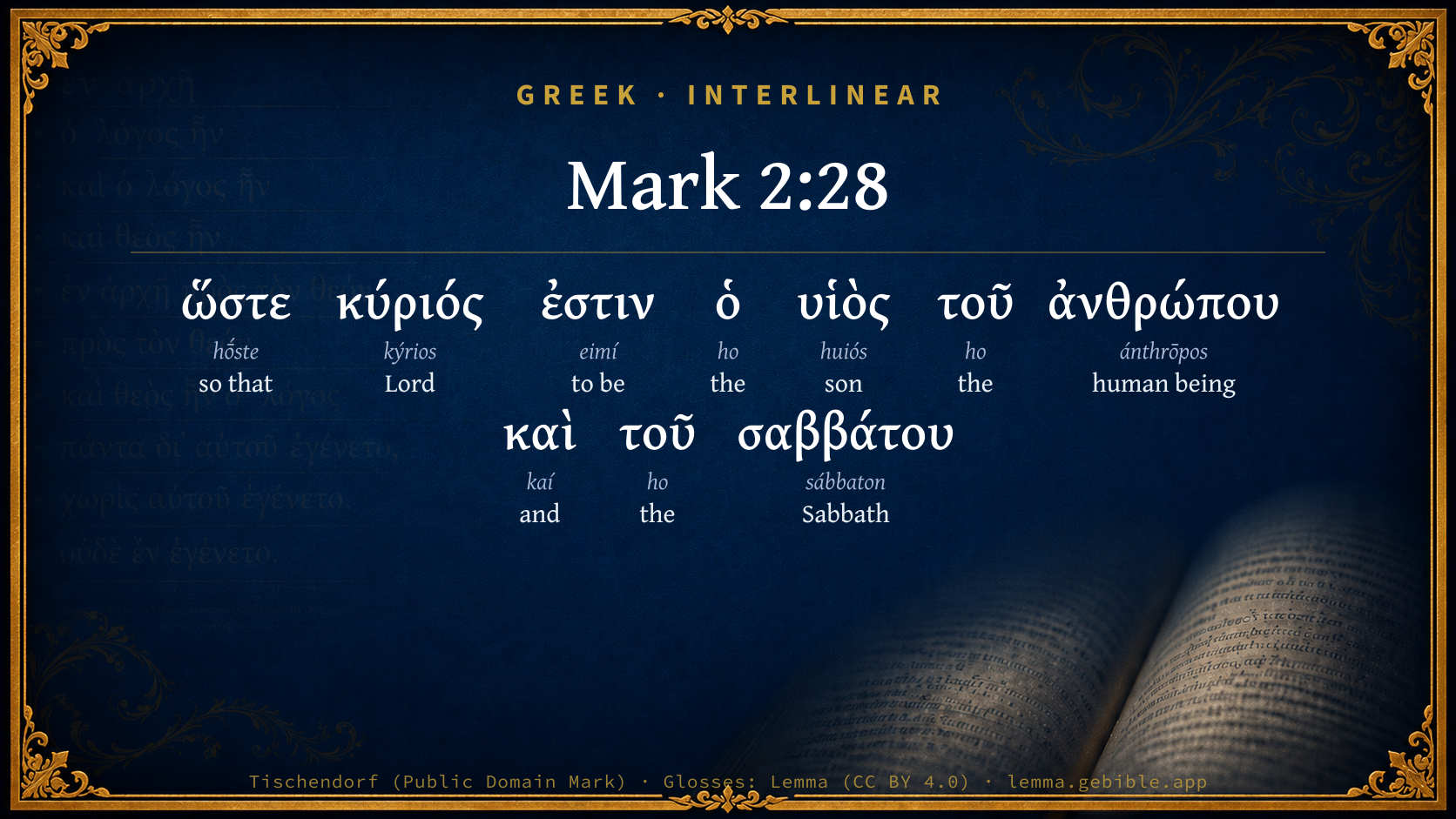
Greek (Tischendorf 8th ed.) Mark 2:28 appears in the Greek New Testament. The text above is from the Tischendorf 8th edition. Each word links to its Strong’s number and a concise gloss. Click any word for its full Thayer’s Greek Lexicon entry.
Download image
Cite this verse

Mark 2:28 (World English Bible). Public Domain. Lemma interlinear Bible study tool, https://lemma.gebible.app/v/mark/2/28.

Show BibTeX & RIS
BibTeX
RIS
English Translation
Therefore the Son of Man is lord even of the Sabbath."
World English Bible · Public Domain
Download a study sheet

One document with this verse’s original text, its word-by-word gloss line, the meaning frame, cross-references with their text, attributed commentary, and full source and license credits — printable, and it pastes into notes with its structure intact.

This verse Autodidact and up

Study sheet (.html) Plain text (.txt)

A passage Seminary Student

Up to 50 verses in one chapter. A passage sheet keeps up to 6 commentary sources and 12 cross-references per verse, in the order this page ranks them, and says so on the sheet whenever that leaves anything out. Ask for a single verse and you get the Autodidact verse sheet above.

Everything on this page stays free to read, with no account — the sheet is a download of what is already on screen, not access to it.

Want to remove ads? Support Godless Engineer
Compare translations 3

The same verse in 3 English versions, stacked beneath the original-language interlinear above. Click any original word for its lexicon entry.

Each is an independent rendering of the whole verse — the interlinear is not word-aligned to these translations.

Highlighted words mark where these versions differ — a whole-verse word diff, not a word-by-word alignment.

  • World English Bible Public Domain
    Therefore the Son of Man is lord even of the Sabbath."
  • King James Version Public Domain
    Therefore the Son of man is Lord also of the sabbath.
  • unfoldingWord Literal Text CC BY-SA 4.0
    Therefore, the Son of Man is Lord, even of the Sabbath.”

unfoldingWord Literal Text — © unfoldingWord, licensed CC BY-SA 4.0. Word-aligned USFM3 via Door43 (git.door43.org/unfoldingWord/en_ult).

Versions to compare (up to 4)

3 of 4 selected

Show all 19 translations

Every available English version of this verse, each an independent rendering of the whole verse.

  • World English Bible Public Domain
    Therefore the Son of Man is lord even of the Sabbath."
  • Berean Standard Bible Public Domain
    Therefore, the Son of Man is Lord even of the Sabbath.”
  • Majority Standard Bible Public Domain
    Therefore, the Son of Man is Lord even of the Sabbath.”
  • King James Version Public Domain
    Therefore the Son of man is Lord also of the sabbath.
  • American Standard Version (1901) Public Domain
    so that the Son of man is lord even of the sabbath.
  • Revised Version (1885) Public Domain
    so that the Son of man is lord even of the sabbath.
  • Geneva Bible (1599) Public Domain
    Wherefore the Sonne of man is Lord, euen of the Sabbath.
  • Douay-Rheims (1899) Public Domain
    Therefore the Son of man is Lord of the sabbath also.
  • Young's Literal Translation Public Domain
    so that the son of man is lord also of the sabbath.'
  • Literal Standard Version CC BY-SA 4.0
    so that the Son of Man is also Lord of the Sabbath.”
  • Unlocked Literal Bible CC BY-SA 4.0
    Therefore, the Son of Man is Lord, even of the Sabbath.”
  • unfoldingWord Literal Text CC BY-SA 4.0
    Therefore, the Son of Man is Lord, even of the Sabbath.”
  • Darby Bible Public Domain
    so that the Son of man is lord of the sabbath also.
  • World Messianic Bible Public Domain
    Therefore the Son of Man is lord even of the Sabbath.”
  • Webster's Bible Public Domain
    Therefore the Son of man is Lord also of the sabbath.
  • Free Bible Version CC BY-SA 4.0
    “So the Son of man is Lord even of the Sabbath.”
  • Bible in Basic English Public Domain
    So that the Son of man is lord even of the Sabbath.
  • Text-Critical English NT CC BY 4.0
    So the Son of Man is Lord even of the Sabbath.”
  • Tyndale New Testament (1534) Public Domain
    Wherfore the sonne of man is Lorde even of the Saboth daye.

Literal Standard Version (2020), Covenant Press — licensed CC BY-SA 4.0. Text via the HelloAO Bible API (eBible.org). Unlocked Literal Bible (unfoldingWord) — licensed CC BY-SA 4.0. Text via the HelloAO Bible API (eBible.org). unfoldingWord Literal Text — © unfoldingWord, licensed CC BY-SA 4.0. Word-aligned USFM3 via Door43 (git.door43.org/unfoldingWord/en_ult). Free Bible Version, Dr. Jonathan Gallagher — licensed CC BY-SA 4.0. Text via the HelloAO Bible API (eBible.org).

Word by word

More ways to search: Search by grammar → Find every occurrence → Compare this word →

Practice this passage: Drill this verse → Learn its vocabulary →

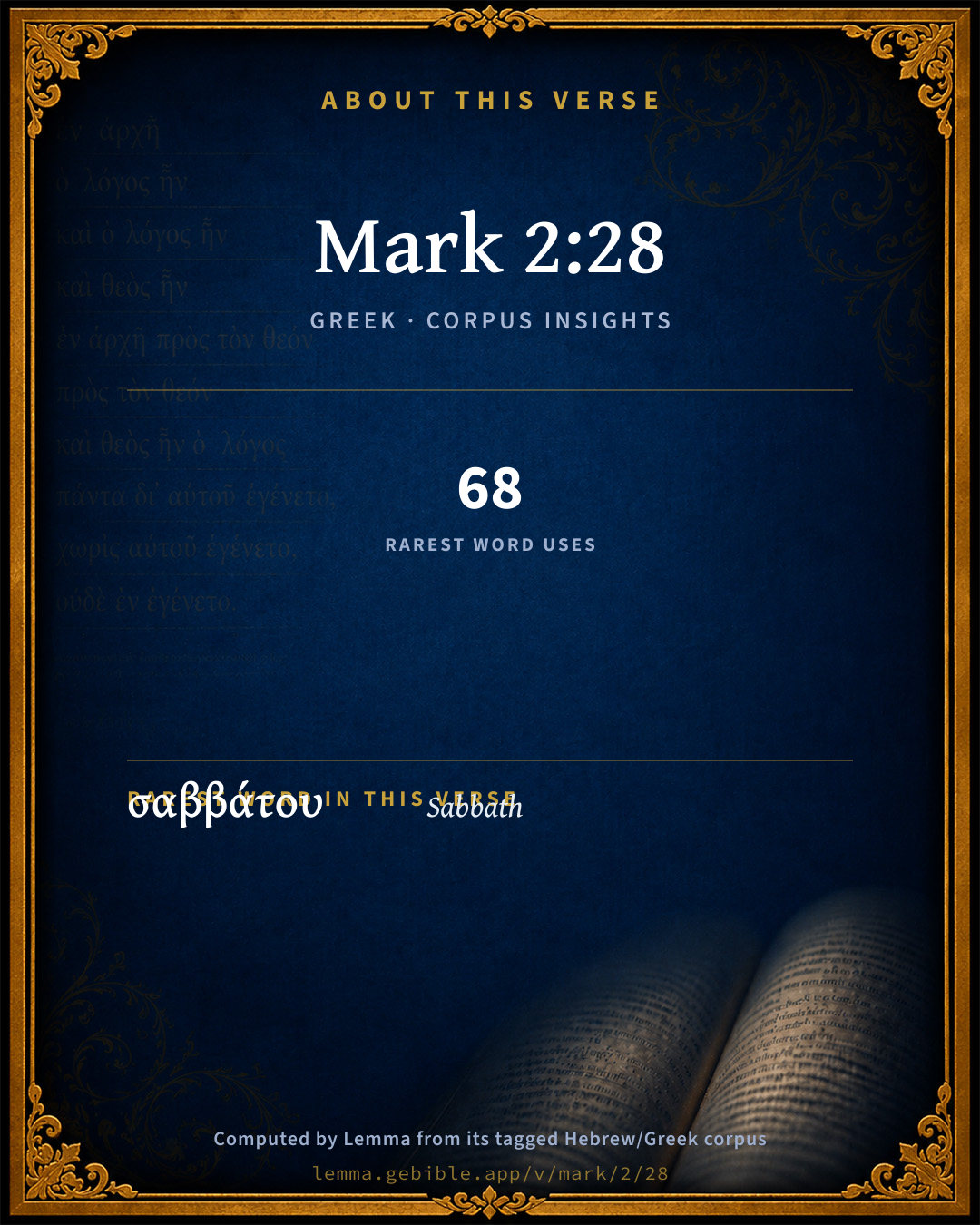
About this verse

These counts appear in no published source. They are computed here, from the morphology-tagged text and Lemma’s own curated glosses. What Lemma adds →

10
words
8
distinct lemmas
Gospels
section

Repetition

A word recurs within this verse:

Cross-references

11

Topical passages linked to Mark 2:28 in the Treasury of Scripture Knowledge — connected by theme and wording, ordered by reader-vote popularity; previews shown in the World English Bible.

  • Matthew 12:8 For the Son of Man is Lord of the Sabbath."
  • Revelation 1:10 I was in the Spirit on the Lord's day, and I heard behind me a loud voice, like a trumpet
  • Luke 6:5 He said to them, "The Son of Man is lord of the Sabbath."
  • John 5:17 But Jesus answered them, "My Father is still working, so I am working, too."
  • John 9:14 It was a Sabbath when Jesus made the mud and opened his eyes.
  • Ephesians 1:22 He put all things in subjection under his feet, and gave him to be head over all things for the assembly,
  • Mark 3:4 He said to them, "Is it lawful on the Sabbath day to do good, or to do harm? To save a life, or to kill?" But they were silent.
  • Luke 13:15–16 Therefore the Lord answered him, "You hypocrites! Doesn't each one of you free his ox or his donkey from the stall on the Sabbath, and lead him away to water?
  • John 5:9–11 Immediately, the man was made well, and took up his mat and walked. Now it was the Sabbath on that day.
  • John 9:5–11 While I am in the world, I am the light of the world."
  • John 9:16 Some therefore of the Pharisees said, "This man is not from God, because he doesn't keep the Sabbath." Others said, "How can a man who is a sinner do such signs?" There was division among them.

Cross-references courtesy of OpenBible.info (CC BY 4.0).

Commentary

Notes on Mark 2:28 from classic Christian and Jewish commentators (each source and its license shown beneath its notes). The classic Christian expositions comment on the surrounding passage and are grouped to its opening verse, so a note may address several verses; the Jewish commentaries on the Tanakh (Rashi and others) are per-verse, so they appear only where the commentator wrote on this verse.

Lemma curates 59 commentaries, every one of them public domain or Creative Commons licensed, each selected and text-cleaned for this edition rather than reprinted as found. About our sources →

Bengel's Gnomon

Johann Albrecht Bengel

Mar 2:28. Ὥστε, therefore) The more obvious sense of this remarkable enigmatical aphorism is, Whatever right as regards the Sabbath any man hath, I also have. The more august sense, though one kept hidden [recondite] then, as suited to the relations in which that time stood to the whole divine scheme, is this, The end of the institution of the Sabbath is the salvation [welfare] of man as to his soul and body. The Son of Man is bound to ensure this salvation; and, in order to bring about this end, He the same has also authority over all things, and expressly over the Sabbath, inasmuch as it was made for man; and with a view to [in accordance with] obtaining this end, He regulates aright the whole use of the Sabbath.

Bengel's Gnomon of the New Testament — English translation (T&T Clark, Edinburgh, 1860) — public domain. Text from a community e-Sword module.

Expositor's Greek Testament

ed. W. Robertson Nicoll

Mar 2:28 . ὥστε : wherefore, so then, introducing a thesis of co-ordinate importance, while an inference from the previous statement. ὁ υἱὸς τ . α .: the Son of Man, as representing the human interest, as opposed to the falsely conceived divine interest championed by the Pharisees. καὶ τ . σ ., even of the Sabbath, so inviolable in your eyes. Lord, not to abolish but to interpret and keep in its own place, and give it a new name. No disparagement of Sabbath meant.

The Expositor's Greek Testament, edited by W. Robertson Nicoll (1897–1910) — public domain. Text from a community e-Sword module.

Geneva Bible (1599)

Geneva Bible translators

Hath the Sabbath day in his power, and may rule as him listeth.

Geneva Bible (1599) marginal notes — public domain. Text via Bolls.life.

Adam Clarke's Commentary

Verse 28. The Son of man is Lord] See on Mt 12:7-8. Some have understood this as applying to men in general, and not to Christ. The Son of man, any man is Lord of the Sabbath; i.e. it was made for him, for his ease, comfort, and use, and to these purposes he is to apply it. But this is a very harsh, and at the same time a very lax, mode of interpretation; for it seems to say that a man may make what use he pleases of the Sabbath; and, were this true, the moral obligation of the Sabbath would soon be annihilated.

GOD ordained the Sabbath not only to be a type of that rest which remains for the people of God, but to be also a mean of promoting the welfare of men in general.

The ordinances of religion should be regulated according to their end, which is the honour of God, and the salvation of men. It is the property of the true religion to contain nothing in it but what is beneficial to man. Hereby God plainly shows that it is neither out of indigence or interest that he requires men to worship and obey him; but only out of goodness, and to make them happy. God prohibited work on the Sabbath day, lest servants should be oppressed by their masters, that the labouring beasts might have necessary rest, and that men might have a proper opportunity to attend upon his ordinances, and get their souls saved. To the Sabbath, under God, we owe much of what is requisite and necessary as well for the body as the soul.

Adam Clarke's Commentary on the Bible (1810–1826) — public domain. Text from a community e-Sword/MySword module.

Trapp's Complete Commentary

John Trapp

28 Therefore the Son of man is Lord also of the sabbath.

Ver. 28. Therefore the Son of man] This Lordship taking beginning in Christ, seems to be, from him, derived to all that are in Christ. As Psa 8:4-5 cf. Heb 2:6-7. Whatever David speaks of man, is applied to Christ, and so is proper to the saints, by virtue of their union with Christ.

Is Lord also of the sabbath] And can dispense with it. The schoolmen say that God can dispense with the materiality of any precept in the decalogue, the three first excepted.

John Trapp, A Commentary or Exposition upon All the Books of the Old and New Testament (1647–1656) — public domain. Text from a community e-Sword module.

Haydock's Catholic Bible Commentary

The maker of the law may abrogate or dispense with it when and where, for just cause, it seemeth good to him: thus the Church can dispense with, change, or abrogate, for just reasons, the disciplines of the Church founded upon Church authority. This we prove also from the action of David, (ver. 26, above) which the Scripture notices without blaming it, because the observance of the law, prescribed for the utility of man, must yield to the necessities of man.

====================

George Leo Haydock (1774–1849), Haydock's Catholic Family Bible and Commentary, 1859 edition — public domain. Excludes Psalms (Douay-Rheims chapter numbering differs from Protestant) and Deuterocanonical books (Catholic canon only).

The Pulpit Commentary

Therefore the Son of man is Lord also of the sabbath. "The sabbath was made for man." It is the inferior institution, man being the higher, for whose sake the sabbath was appointed. But the Son of man is Lord of all men, and of all things that pertain to man"s salvation; therefore he must of necessity be Lord even of the sabbath; so that when he sees fit he can relax or dispense with its obligations. It is true that for us Christians the first day of the week, the Lord"s day, has taken the place of the ancient Jewish sabbath; but the principle here laid down by our Lord is applicable to the "first" day no less than to the "seventh;" and it teaches us that our own moral and religious advancement and that of our brethren is the object which we should all aim at in the manner of our observance of the Christian Sunday; while we strive to "stand fast in the liberty wherewith Christ has made us free."

The Pulpit Commentary (1880–1919), ed. H.D.M. Spence-Jones & Joseph S. Exell — public domain. Text from a community e-Sword module.

John Wesley's Explanatory Notes

Moreover the Son of man is Lord even of the Sabbath - Being the supreme Lawgiver, he hath power to dispense with his own laws; and with this in particular.

John Wesley, Explanatory Notes Upon the Whole Bible (1754–1765) — public domain. Text via the GEBible commentary corpus.

The People's New Testament

B. W. Johnson

28. The Son of man is Lord also of the sabbath. This affirms the Divine nature of Jesus. None but the Divine is Lord of a divine institution. Since Christ is Lord of the Sabbath day, he has the right to modify it, to adapt it to the new dispensation, and to change the time of its observance from the last day of the week to the first, so as to make it the memorial of the beginning of the New Creation, instead of commemorating the rest from the first creation.

B. W. Johnson's The People's New Testament with Notes (1889–1891) — public domain. Electronic text from the Christian Classics Ethereal Library (CCEL) ThML edition.

Cambridge Greek Testament for Schools and Colleges

28. ὥστε. Here, as in Mar 10:8, c. indic. If Mar 2:27 is omitted, the argument is incomplete. Mt. has γάρ, making the saying a premise rather than a conclusion. Lk. has neither. In all three, κύριος comes first with emphasis. The Sabbath has been given to mankind for their benefit; therefore the Representative of mankind may decide how the gift can best be used for their benefit, and it must not be used in such a way as to turn a blessing into a curse. Thus Christ not only takes the responsibility for His disciples’ action but claims it. St Paul argues in a similar way about our liberty in things indifferent; we must not use it in such a way as to lose it, by becoming slaves to a habit (1Co 6:12). See Hort, Jud. Chris. p. 33. Some Fathers seem to have thought that, because the Jews made the Sabbath a burden, it was given them as a burden, to punish them for their carnal way of life.

καὶ τοῦ σαββάτου. Either “also” (A.V.) or “even” (R.V.) may be right. If “also,” it means “in addition to other things of which He has control.” Cf. Mar 7:18.

Cambridge Greek Testament for Schools and Colleges (Cambridge University Press, 1896; 21 vols, various authors incl. Carr, Maclear, Plummer, Farrar, Lumby, Moule, M. R. James, Simcox) — public domain. Text from a community e-Sword module.

Alford’s Greek Testament

Henry Alford

28. καί] as well as of His other domains or elements of lordship and power.

Henry Alford, The Greek Testament (1849–1861) — public domain. Text from a community e-Sword module.

International Critical Commentary

28. κύριος—the noun is emphatic from its position. καὶ τοῦ σαββάτου—also of the Sabbath, as well as of other things belonging to the life of man. This lordship, as we have seen, is true of everything else except moral law. Of that he would be administrator and interpreter, but not Lord. He would be ruler under the supreme law, but without the power to modify or set aside, as in the case of that which is made for man.

Weiss, Life of Jesus, contends that Jesus did not here, nor in fact anywhere, assume an attitude of independence towards the Jewish Law, but only towards the current traditional interpretation of it. But surely, the statement that the Sabbath was made for man, not man for the Sabbath, puts the Sabbath law in a separate class, and subordinates it to the moral law. Whereas, the O.T. throughout, not only makes the Sabbath a matter of moral obligation, but of the highest moral obligation. Judaism is a system of rules, Christianity of principles. And so far forth as the Sabbath is a rule, that is, so far as it is Jewish, Jesus does abrogate it in these words. Weiss confuses matters by neglecting this distinction.

This early statement of Jesus’ lordship, and its use of the term Son of Man as his official title, is a good specimen of the way in which he tacitly assumed his Messianic character under this title, while the doubt in which the whole nation stood of his claim shows that he was not understood to make it formally.

THE PERIOD OF CONFLICT CONTINUED

The third chapter continues the account of the Period of Conflict. It contains matter, however, which belongs to the period, but not to the conflict. It shows us Jesus attended by larger crowds than ever, drawn by the report of his deeds from the whole country, as far south as Jerusalem, and as far north as Tyre and Sidon. The growth of hostility against him is thus shown to be accompanied by an access of popularity with the people. The combination of these two features seems to his family to make the situation so dangerous, and his own action so unwise, that they think him distraught and seek to restrain him. In the midst of this is introduced the account of the appointment of the apostles, evidently in the connection, as assistants to him in his increasing work. The occasions of conflict are, first, the healing of a man with a palsied arm on the Sabbath, causing a renewal of the Sabbath controversy, and secondly, the charge of the Scribes that he casts out demons through Beelzebul, and that he himself is possessed by that prince of the demons. He himself brings on the controversy about the Sabbath by his question whether the Sabbath is a day for good or evil deeds, for killing or healing. And the charge of collusion with the devil he meets with the question whether Satan casts out Satan.

Tisch. Tischendorf.

Treg. Tregelles.

WH. Westcott and Hort.

RV. Revised Version.

אԠCodex Sinaiticus.

B Codex Vaticanus.

D Codex Ephraemi.

L Codex Regius.

28 Codex Regius.

33 Codex Regius.

Lat. Vet. Vetus Latina.

Memph. Memphitic.

1 See Win. 47, I. 64, 5.

2 The prep. with the anarthrous noun constitutes a phrase.

Vulg. Vulgate.

Pesh. Peshito.

1 χωρεῖν is transitive and has τὰ πρὸς τὴν θύραν for its subject. On the repetition of the negative, see Win. 55, 9, b. On the construction of ὥστε with μή and the inf.—always so in N.T.—see Win. 55, 2, d.

AV. Authorised Version.

2 For other instances of this use of ὁ λόγος to denote in a general way the subject of Christian teaching, see 4:14-33, Luk 1:2.

3 This word belongs to Biblical Greek. The Greeks said παραλελυμένος.

4 See Win. 55, 5, g, β.

marg. Revided Version marg.

Harcl. Harclean.

5 This is the only case of the use of this verb in the N.T.

6 χαλῶσι commonly means to slacken, or relax, and to let down, when this involves slackening. κράβαττον is a late Greek word copied from the Latin grabatus. The Greeks said σκίμπους.

1 See on 1:22.

2 In J. 20:23, Jesus extends this power to his disciples.

1 εὐκοπωτερον is a late word, and is used in the N.T. only in this phrase, εὐκοπώτερόν ἐστι. The Greek word for which of two is πότερον. τί means strictly what, not which.

E Codex Basiliensis.

F Codex Borelli.

G Codex Wolfi A.

H Codex Wolfi B.

K Codex Cyprius.

Δ̠Codex Sangallensis

2 For passages, see Thay.-Grm. Lex. For a discussion of the date of the allegories in which the Messianic portion of the book occurs, see Schürer, N.Zg. II. III. 32. 2. Schürer, on the whole, favors the pre-Christian date.

3 Son alone is used by Jesus in Mat 11:27, Mat 21:37, Mat 28:19, referring to the Divine Sonship in the theocratic sense.

1 ἐγείρω is transitive, and the active is used here in the sense of the passive or middle. On the meaning of the verb, see on 1:31 footnote. In the passive or middle, in the sense peculiar to the N.T., the meaning is to rise from a reclining position.

C Codex Bezae.

13 Codex Regius.

1 In Greek, ἐξίστημι means to displace or alter, and sometimes by itself, but generally with φρενῶν, or τοῦ φρονεῖν, to put one beside himself, to derange. In the N.T., it is used always in the sense of amaze, or be amazed, except 3:21, 2Co 5:13, where the stronger meaning, to be distraught, reappears.

2 δοξάζειν means properly to think, to have an opinion. To praise, or glorify, is the only N.T. use.

3 εἴδαμεν is sec. aor., with the vowel of the first aor.

4 See note on Mk.’s use of πάλιν, v. 1

5 Note the difference from the aor. ἐξῆλθε which denotes the momentary past act.

Thay.-Grm. Thayer’s Grimm.

1 The repetition of the somewhat peculiar ἐπὶ τὸ τελώνιον in Mt. and Lk. is a strong sign of the interdependence of the Synoptics.

2 γίνεται κατακεῖσθαι, it comes to pass, that, is a periphrase not unknown to the Greek, but its frequent recurrence in the Synoptics is probably due to Hebrew usage.

69 Codex Leicestrensis.

102 Codex Bibliothecae Mediceae.

1 The word ἁμαρτωλοί is rare in Greek writers.

2 The double compound συνανέκειντο is found, outside of Biblical Greek, only in Byzantine and ecclesiastical writers. ἀνακεῖμαι itself belongs to later Greek, the earlier writers using κεῖμαι and κατακεῖμαι. See Thay.-Grm. Lex.

3 The insertion of καὶ before ἰδόντες in v. 16 makes it necessary to connect ἠκολούθουν with ἔλεγον, instead of with ἦσαν.

1 ὅτι is here the indirect interrogative, taking the place of the direct, a usage unknown to earlier Greek, but occurring a few times in the Sept. and N.T.

A Codex Alexandrinus.

1 ἦν with the part is a stronger form of expressing the idea of the impf. than the tense. It is characteristic of Mk., and belongs to the picturesqueness of his style.

1 νυμφών is a Biblical word.

S Codex Vaticanus.

1 .Codex Basiliensis

1 So Weiss.

2 So Morison.

Γ̠Codex Tischendorfianus

International Critical Commentary — older volumes (1896–1929), various authors — public domain. Text from a community e-Sword module.

Lesson kit

Teaching starters — assembled from the data on this page, not authored interpretation. Every prompt links to the verse data it draws on. Edit before teaching.

Mark, in the Gospels, opens this verse with 10 words (8 distinct Greek lemmas). Its most distinctive word is sábbaton (“Sabbath”). A historical commentator’s framing appears above. Read the whole chapter for the surrounding context.

Discussion questions

  1. What does “Sabbath” (sábbaton) contribute to the verse as a whole?
  2. How does Matthew 12:8, which shares this passage’s theme, read alongside this verse?
  3. What does the repetition of “the” (3× in this one verse) do in this verse?
  4. These translations render this verse differently; the difference is in the English rendering, not the original. What questions does that raise?
  5. Compare how Bengel's Gnomon and Expositor's Greek Testament read this verse. Where do they agree or differ?

Things to notice

  • These translations choose different wording for 2 words in this verse.
  • “the” occurs 3× in this single verse.
  • 8 distinct Greek lemmas span 10 words in this verse.

Reading settings

Reading text

Shown beneath each verse's original-language words.

Old Testament
Old Testament edition

Read the OT as the Masoretic Hebrew (MT) or the Greek Septuagint (LXX).

English shown for the Greek Septuagint (in the Hebrew ↔ Greek comparison).

Comparing translations? Open the Compare panel on any verse page to stack up to four side by side.