Matthew 27:2

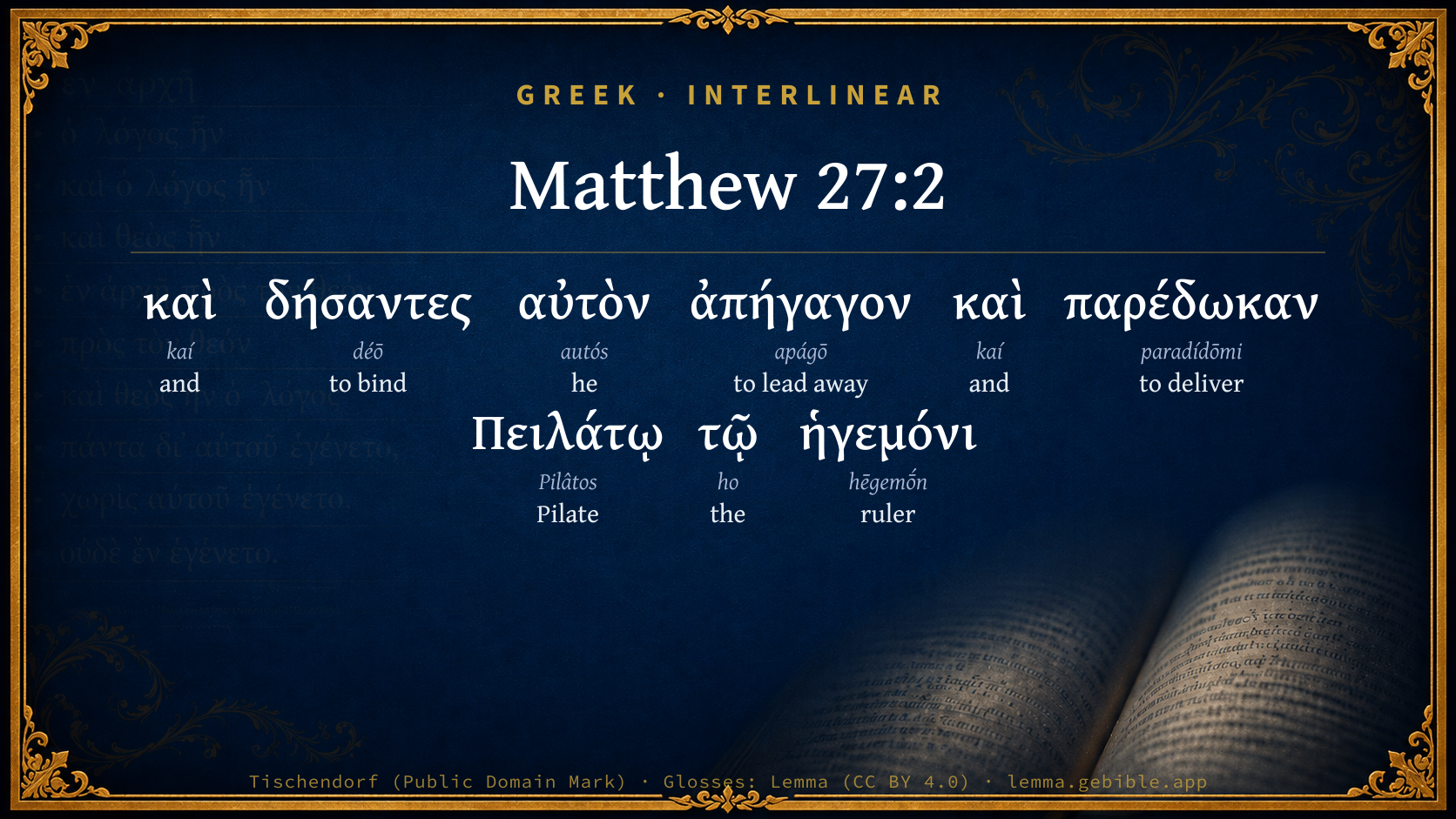
Greek (Tischendorf 8th ed.) Matthew 27:2 appears in the Greek New Testament. The text above is from the Tischendorf 8th edition. Each word links to its Strong’s number and a concise gloss. Click any word for its full Thayer’s Greek Lexicon entry.
Download image
Cite this verse

Matthew 27:2 (World English Bible). Public Domain. Lemma interlinear Bible study tool, https://lemma.gebible.app/v/matthew/27/2.

Show BibTeX & RIS
BibTeX
RIS
English Translation
and they bound him, and led him away, and delivered him up to Pontius Pilate, the governor.
World English Bible · Public Domain
Highlights
  • 1 first appearance in the Greek New Testament
Full analysis ↓
Download a study sheet

One document with this verse’s original text, its word-by-word gloss line, the meaning frame, cross-references with their text, attributed commentary, and full source and license credits — printable, and it pastes into notes with its structure intact.

This verse Autodidact and up

Study sheet (.html) Plain text (.txt)

A passage Seminary Student

Up to 50 verses in one chapter. A passage sheet keeps up to 6 commentary sources and 12 cross-references per verse, in the order this page ranks them, and says so on the sheet whenever that leaves anything out. Ask for a single verse and you get the Autodidact verse sheet above.

Everything on this page stays free to read, with no account — the sheet is a download of what is already on screen, not access to it.

Want to remove ads? Support Godless Engineer
Compare translations 3

The same verse in 3 English versions, stacked beneath the original-language interlinear above. Click any original word for its lexicon entry.

Each is an independent rendering of the whole verse — the interlinear is not word-aligned to these translations.

Highlighted words mark where these versions differ — a whole-verse word diff, not a word-by-word alignment.

  • World English Bible Public Domain
    and they bound him, and led him away, and delivered him up to Pontius Pilate, the governor.
  • King James Version Public Domain
    And when they had bound him, they led him away, and delivered him to Pontius Pilate the governor.
  • unfoldingWord Literal Text CC BY-SA 4.0
    And having bound him, they led away and handed over to Pilate the governor.

unfoldingWord Literal Text — © unfoldingWord, licensed CC BY-SA 4.0. Word-aligned USFM3 via Door43 (git.door43.org/unfoldingWord/en_ult).

Versions to compare (up to 4)

3 of 4 selected

Show all 19 translations

Every available English version of this verse, each an independent rendering of the whole verse.

  • World English Bible Public Domain
    and they bound him, and led him away, and delivered him up to Pontius Pilate, the governor.
  • Berean Standard Bible Public Domain
    They bound Him, led Him away, and handed Him over to Pilate the governor.
  • Majority Standard Bible Public Domain
    They bound Him, led Him away, and handed Him over to Pontius Pilate the governor.
  • King James Version Public Domain
    And when they had bound him, they led him away, and delivered him to Pontius Pilate the governor.
  • American Standard Version (1901) Public Domain
    and they bound him, and led him away, and delivered him up to Pilate the governor.
  • Revised Version (1885) Public Domain
    and they bound him, and led him away, and delivered him up to Pilate the governor.
  • Geneva Bible (1599) Public Domain
    And led him away bounde, and deliuered him vnto Pontius Pilate the gouernour.
  • Douay-Rheims (1899) Public Domain
    And they brought him bound, and delivered him to Pontius Pilate the governor.
  • Young's Literal Translation Public Domain
    and having bound him, they did lead away, and delivered him up to Pontius Pilate, the governor.
  • Literal Standard Version CC BY-SA 4.0
    and having bound Him, they led [Him] away, and delivered Him up to Pontius Pilate, the governor.
  • Unlocked Literal Bible CC BY-SA 4.0
    They bound him, led him away, and delivered him to Pilate the governor.
  • unfoldingWord Literal Text CC BY-SA 4.0
    And having bound him, they led away and handed over to Pilate the governor.
  • Darby Bible Public Domain
    And having bound him they led him away, and delivered him up to Pontius Pilate, the governor.
  • World Messianic Bible Public Domain
    They bound him, led him away, and delivered him up to Pontius Pilate, the governor.
  • Webster's Bible Public Domain
    And when they had bound him, they led him away, and delivered him to Pontius Pilate the governor.
  • Free Bible Version CC BY-SA 4.0
    They bound him, led him away, and handed him over to Pilate, the governor.
  • Bible in Basic English Public Domain
    And they put cords on him and took him away, and gave him up to Pilate, the ruler.
  • Text-Critical English NT CC BY 4.0
    They bound him, led him away, and handed him over to Pontius Pilate, the governor.
  • Tyndale New Testament (1534) Public Domain
    and brought him bounde and delivered him vnto Poncius Pilate the debite.

Literal Standard Version (2020), Covenant Press — licensed CC BY-SA 4.0. Text via the HelloAO Bible API (eBible.org). Unlocked Literal Bible (unfoldingWord) — licensed CC BY-SA 4.0. Text via the HelloAO Bible API (eBible.org). unfoldingWord Literal Text — © unfoldingWord, licensed CC BY-SA 4.0. Word-aligned USFM3 via Door43 (git.door43.org/unfoldingWord/en_ult). Free Bible Version, Dr. Jonathan Gallagher — licensed CC BY-SA 4.0. Text via the HelloAO Bible API (eBible.org).

Word by word

More ways to search: Search by grammar → Find every occurrence → Compare this word →

Practice this passage: Drill this verse → Learn its vocabulary →

About this verse

These counts appear in no published source. They are computed here, from the morphology-tagged text and Lemma’s own curated glosses. What Lemma adds →

9
words
8
distinct lemmas
Gospels
section

Notable vocabulary

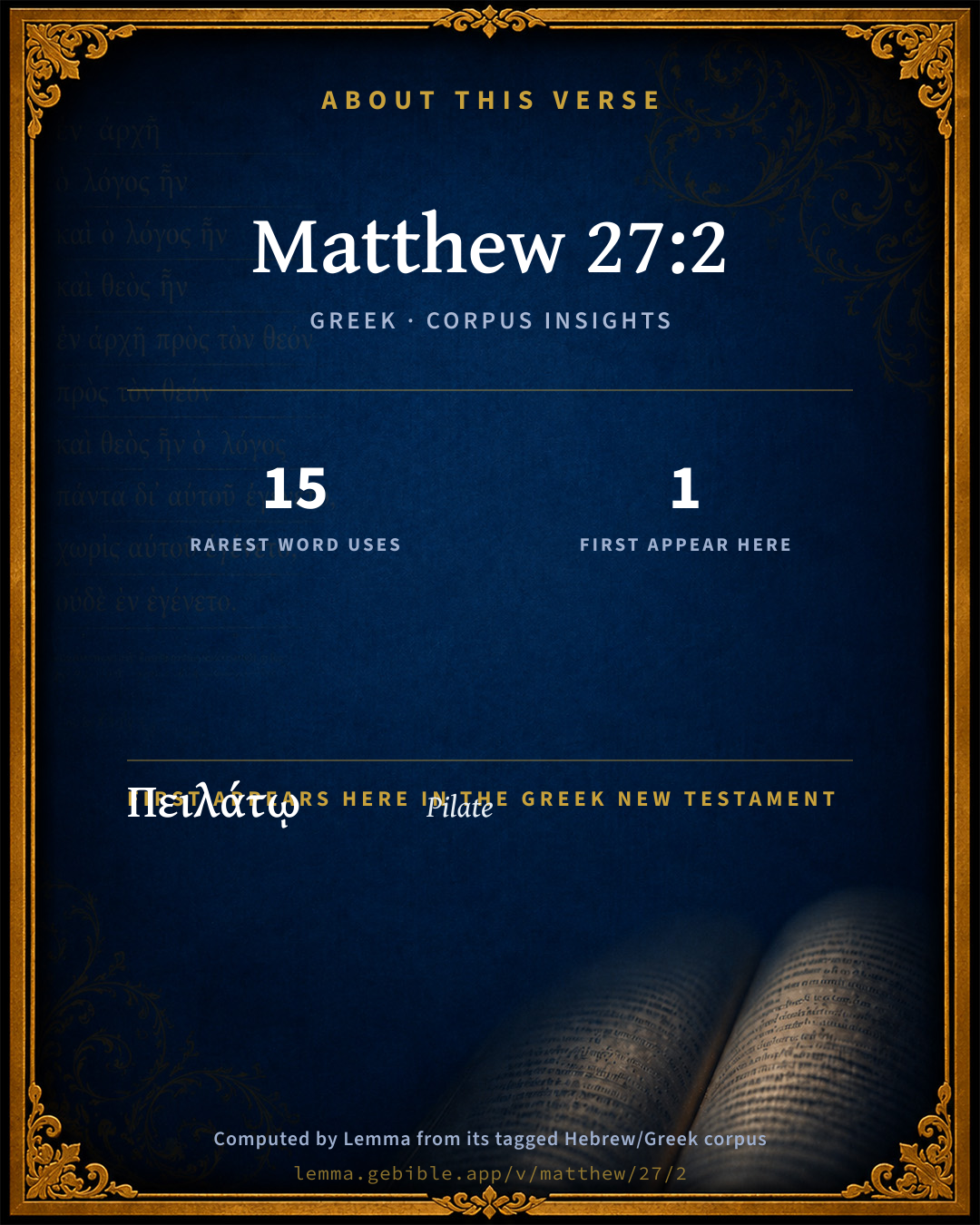
The rarest word here is ἀπήγαγον to lead away G520 — appearing just 15 times in the whole Greek New Testament.

First appearance in Scripture

This word makes its first canonical appearance in the Greek New Testament here:

  • Πειλάτῳ Pilate G4091

Shared distinctive vocabulary

ἀπήγαγον to lead away G520 occurs in 15 verses of the Greek New Testament. Also found in:

Repetition

A word recurs within this verse:

Cross-references

20

Topical passages linked to Matthew 27:2 in the Treasury of Scripture Knowledge — connected by theme and wording, ordered by reader-vote popularity; previews shown in the World English Bible.

  • Matthew 20:19 and will hand him over to the Gentiles to mock, to scourge, and to crucify; and the third day he will be raised up."
  • Acts 3:13 The God of Abraham, Isaac, and Jacob, the God of our fathers, has glorified his Servant Jesus, whom you delivered up, and denied in the presence of Pilate, when he had determined to release him.
  • Luke 13:1 Now there were some present at the same time who told him about the Galileans, whose blood Pilate had mixed with their sacrifices.
  • 1 Timothy 6:13 I charge you before God, who gives life to all things, and before Christ Jesus, who before Pontius Pilate testified the good confession,
  • Genesis 22:9 They came to the place which God had told him of. Abraham built the altar there, and laid the wood in order, bound Isaac his son, and laid him on the altar, on the wood.
  • Luke 3:1 Now in the fifteenth year of the reign of Tiberius Caesar, Pontius Pilate being governor of Judea, and Herod being tetrarch of Galilee, and his brother Philip tetrarch of the region of Ituraea and Trachonitis, and Lysanias tetrarch of Abilene,
  • Luke 18:32–33 For he will be delivered up to the Gentiles, will be mocked, treated shamefully, and spit on.
  • Luke 20:20 They watched him, and sent out spies, who pretended to be righteous, that they might trap him in something he said, so as to deliver him up to the power and authority of the governor.
  • John 18:12 So the detachment, the commanding officer, and the officers of the Jews, seized Jesus and bound him,
  • John 18:24 Annas sent him bound to Caiaphas, the high priest.
  • Acts 4:27 For truly, in this city against your holy servant, Jesus, whom you anointed, both Herod and Pontius Pilate, with the Gentiles and the people of Israel, were gathered together
  • Acts 9:2 and asked for letters from him to the synagogues of Damascus, that if he found any who were of the Way, whether men or women, he might bring them bound to Jerusalem.
  • Acts 12:6 The same night when Herod was about to bring him out, Peter was sleeping between two soldiers, bound with two chains. Guards in front of the door kept the prison.
  • Acts 21:33 Then the commanding officer came near, arrested him, commanded him to be bound with two chains, and inquired who he was and what he had done.
  • Acts 22:25 When they had tied him up with thongs, Paul asked the centurion who stood by, "Is it lawful for you to scourge a man who is a Roman, and not found guilty?"
  • Acts 22:29 Immediately those who were about to examine him departed from him, and the commanding officer also was afraid when he realized that he was a Roman, because he had bound him.
  • Acts 24:27 But when two years were fulfilled, Felix was succeeded by Porcius Festus, and desiring to gain favor with the Jews, Felix left Paul in bonds.
  • Acts 28:20 For this cause therefore I asked to see you and to speak with you. For because of the hope of Israel I am bound with this chain."
  • 2 Timothy 2:9 in which I suffer hardship to the point of chains as a criminal. But God's word isn't chained.
  • Hebrews 13:3 Remember those who are in bonds, as bound with them; and those who are ill-treated, since you are also in the body.

Cross-references courtesy of OpenBible.info (CC BY 4.0).

Where the printed editions differ

1 variant

Places in this verse where the major printed Greek editions disagree on the wording in a way that affects the translation — a comparison of editions, not a manuscript-by-manuscript collation. The editions are the modern critical texts (Nestlé-Aland 28/27, SBL, Westcott-Hort, Tregelles, Tyndale House) and the traditional texts behind the KJV (the Textus Receptus and the Byzantine/Majority text). It is not a claim about which reading is original.

  1. Extra text
    αὐτὸν Ποντίῳ

    “Him to Pontius”

    In TRByz Not in NA28NA27TynSBLWHTreg

    αὐτὸν Ποντίῳ (auton Pontiō) 'Him to Pontius' is only in traditional manuscripts (TR+Byz)

Textual data: Translators Amalgamated Greek New Testament (STEPBible TAGNT) · CC BY 4.0.

Commentary

Notes on Matthew 27:2 from classic Christian and Jewish commentators (each source and its license shown beneath its notes). The classic Christian expositions comment on the surrounding passage and are grouped to its opening verse, so a note may address several verses; the Jewish commentaries on the Tanakh (Rashi and others) are per-verse, so they appear only where the commentator wrote on this verse.

Lemma curates 59 commentaries, every one of them public domain or Creative Commons licensed, each selected and text-cleaned for this edition rather than reprinted as found. About our sources →

Tyndale Open Study Notes

Tyndale Open Resources

27:2 Tiberius Caesar appointed Pilate to be the governor (or prefect) of Judea. Pilate ruled primarily from Caesarea, not Jerusalem, from AD 26 to AD 36. Though he had sovereign power in Judea, Pilate was ultimately responsible to the legate of Syria, the central authority in the eastern portion of the Roman Empire. Josephus records several instances where Pilate’s disregard for the sanctity of Jewish customs led to revolt.

Tyndale Open Study Notes — © Tyndale Open Resources, licensed CC BY-SA 4.0. Text via the HelloAO Bible API.

Bengel's Gnomon

Johann Albrecht Bengel

Mat 27:2. Ἀπήγαγον καὶ παρέδωκαν Αὐτὸν, they led Him away and delivered Him) cf. Mat 27:9, and Gnomon on the latter part.—τῷ ἡγεμόνι, to the Procurator).

Bengel's Gnomon of the New Testament — English translation (T&T Clark, Edinburgh, 1860) — public domain. Text from a community e-Sword module.

Meyer's Critical & Exegetical Commentary

Heinrich August Wilhelm Meyer

Mat_27:2 Δήσαντες] The shackles which had been put upon. Jesus at the time of His arrest (Mat_26:50, comp. with Joh_18:12), and which He still wore when He was led away from Annas to Caiaphas (Joh_18:24), would seem, from what is here stated, to have been either wholly or partially removed during the trial. With the view of His being securely conducted to the residence of the procurator, they take the precaution to put their prisoner in chains again. It is not expressly affirmed, either by Matthew or Mark, that the ἀπήγαγον was the work of the members of the Sanhedrim in pleno (as generally supposed, Weiss and Keim also sharing in the opinion); and, indeed, it is scarcely probable that they would have so far incurred the risk of a popular tumult (comp. Mat_26:5). The statement in Luk_23:1 is unquestionably the product of a later tradition. As for Matthew and Mark, they seem to assume that merely a deputation accompanied the prisoner, though doubtless it would be large enough to be in keeping with the importance of the occasion. Comp. also on Mat_27:3.

παρέδωκαν αὐτὸν Ποντίῳ, κ.τ.λ.] For after Judaea became a Roman province (from the time that King Archelaus was dethroned, 759 U.C.), the Sanhedrim had lost the jus gladii. Comp. on Joh_18:31. On Pontius Pilate, the fifth procurator of Judaea, who was successor to Valerius Gratus, and who, after holding office for ten years (from A.D. 26 onwards), was summoned to Rome at the instance of Vitellius, then governor of Syria, to answer to certain charges made against him, and then (according to Euseb. ii. 7) banished to Vienne, where he is said to have committed suicide, see Ewald, Gesch. Chr. p. 87 ff.; Leyrer in Herzogs Encykl. XI. p. 663 ff.; Gerlach, d. Röm. Statthalter in Syr. u. Jud. p. 53 ff.; Hausrath, Zeitgesch. I. p. 312 ff. For certain Christian legends regarding His death, consult Tischendorfs Evang. Apocr. p. 426 ff. Caesarea was the place where the procurators usually resided (Act_23:23 f., Mat_24:27, Mat_25:1); but, as it was the Passover season, Pilate was in Jerusalem (to be ready, in fact, to quell any disturbance that might arise, comp. on Mat_26:5), where he lived in the praetorium (see on Mat_27:27).

τῷ ἡγεμόνι] principi. The more precise designation would have been τῷ ἐπιτρόπῳ, procuratori. Comp. Joseph. Antt. xviii. 3. 1 : Πιλάτος δὲ ὁ τῆς Ἰουδαίας ἡγεμών. On the comprehensive sense in which ἡγεμών is frequently used, see Krebs, Obss. p. 61 ff.

Meyer — Critical and Exegetical Commentary on the New Testament — English translation by Peter Christie, edited by Frederick Crombie (T&T Clark, 1880) — public domain. Text from a community e-Sword module.

Expositor's Greek Testament

ed. W. Robertson Nicoll

Mat 27:2 . δήσαντες : no mention of binding before in Mt.’s narrative. If Jesus was bound at His apprehension the fetters must have been taken off during the trial. ἀπήγαγον , etc., they led Him away and delivered Him to Pontius Pilate. No mention at this point what they had resolved to say to Pilate. That comes out in Pilate’s questioning. Pilate was a very undesirable judge to come to with such a cause a poor representative of Roman authority; as described by Philo. and Josephus, as destitute of fear of God or respect for justice, as the unjust judge of the parable; but, like him, accessible on the side of self-interest, as, no doubt, the Sanhedrists knew very well. τῷ ἡγεμόνι , the governor; a general title for one exercising supreme authority as representing the emperor. The more specific title was ἐπίτροπος , procurator. The ordinary residence of procurators was Caesarea, on the sea coast, but it was their custom to be in Jerusalem at passover time, with a detachment of soldiers, to watch over the public peace.

The Expositor's Greek Testament, edited by W. Robertson Nicoll (1897–1910) — public domain. Text from a community e-Sword module.

Adam Clarke's Commentary

Verse 2. They - delivered him to Pontius Pilate] The Sanhedrin had the power of life and death in their own hands in every thing that concerned religion; but as they had not evidence to put Christ to death because of false doctrine, they wished to give countenance to their conduct by bringing in the civil power, and therefore they delivered him up to Pilate as one who aspired to regal dignities, and whom he must put to death, if he professed to be Caesar's friend. Pontius Pilate governed Judea ten years under the Emperor Tiberius; but, having exercised great cruelties against the Samaritans, they complained of him to the emperor, in consequence of which he was deposed, and sent in exile to Vienna, in Dauphiny, where he killed himself two years after.

Adam Clarke's Commentary on the Bible (1810–1826) — public domain. Text from a community e-Sword/MySword module.

Ellicott's Commentary for English Readers

(2) Pontius Pilate.—It may be well to bring together the chief known facts as to the previous history of the Governor, or more accurately, the Procurator, of Judæa, whose name is conspicuous as occupying a solitary prominence in the creeds of Christendom. He must have belonged, by birth or adoption, to the gens of the Pontii, one of whom, C. Pontius Telesinus, had been the leader of the Samnites in their second and third wars against Rome B.C. 321-292. The cognomen Pilatus means “armed with the pilum or javelin,” and may have had its origin in some early military achievement. As applied, however, to Mount Pilatus in Switzerland, it has been conjectured that it is a contracted form of Pileatus, from pilea a cap, and is applied to the mountain as having for the most part, a cloud-capped summit. When Judæa became formally subject to the empire, on the deposition of Archelaus, a procurator, or collector of revenue, invested with judicial power, was appointed to govern it, subject to the Governor of Syria (Luk_2:2), and resided commonly at Cæsarea. Pontius Pilate, of whose previous career we know nothing, was appointed, A.D. 25-26, as the sixth holder of that office. His administration had already, prior to our Lord’s trial, been marked by a series of outrages on Jewish feelings. (1) He had removed the head-quarters of his army from Cæsarea to Jerusalem, and the troops brought their standards with the image of the emperor into the Holy City. The people were excited into frenzy, and rushed in crowds to Cæsarea to implore him to spare them this outrage on their religion. After five days of obstinacy and a partial attempt to suppress the tumult, Pilate at last yielded (Jos. Ant. xvii. 3, §§ 1, 2; Wars, ii. 9, §§ 2-4). (2) He had hung up in his palace at Jerusalem gilt shields inscribed with the names of heathen deities, and would not remove them till an express order came from Tiberius (Philo, Leg. ad Caium, c. 38). (3) He had taken money from the Corban, or treasury of the Temple, for the construction of an aqueduct. This led to another tumult, which was suppressed by the slaughter not of the rioters only, but also of casual spectators (Jos. Wars, ii. 9, § 4). (4) Lastly, on some unknown occasion, he had slain some Galileans while they were in the very act of sacrificing (Luk_13:1), and this had probably caused the ill-feeling between him and the tetrarch Antipas mentioned in Luk_23:12. It is well to bear in mind these antecedents of the man, as notes of character, as we follow him through the series of vacillations which we now have to trace.

A Bible Commentary for English Readers, edited by Charles John Ellicott (1878–1897) — public domain. Text from a community e-Sword module.

The Cambridge Bible for Schools and Colleges

gen. ed. J. J. S. Perowne

2. The Delivery to Pontius Pilate

St Mar_15:1; St Luk_23:1; St Joh_18:28; “then led they Jesus from Caiaphas unto the hall of Judgment (or Prætorium), and it was early.”

2. Pontius Pilate the governor] Pontius Pilate was the governor, or more accurately, the Procurator of Judæa, which after the banishment of Archelaus (see ch. Mat_2:22) had been placed under the direct government of Rome, and attached as a dependency to Syria. Pilate filled this office during the last ten years of the reign of Tiberius, to whom as Procurator in an imperial province he was directly responsible. In the year a. d. 35 or 36, he was sent to Rome on a charge of cruelty to the Samaritans. The death of Tiberius probably deferred his trial, and according to Eusebius, “wearied with his misfortunes,” he put himself to death. In character Pilate appears to have been impolitic, cruel and weak. On three signal occasions he had trampled on the religious feelings of the Jews, and repressed their resistance with merciless severity. A further instance of cruelty, combined with profanation, is alluded to, St Luk_13:1 : “the Galilæans, whose blood Pilate had mingled with their sacrifices.” The name Pontius connects Pilate with the gens of the Pontii, to which the great Samnite General, C. Pontius Telesinus, belonged. (Read history of second and third Samnite wars, b. c. 327–290.) The cognomen Pilatus probably signifies “armed with a pilum” (javelin). Tacitus mentions Pontius Pilate in a well-known passage (Ann. xv. 44), Auctor nominis ejus Christus Tiberio imperitante per procuratorem Pontium Pilatum supplicio affectus erat. “Christus, from whom the Christians are called, suffered death in the reign of Tiberius, under the procurator, P. Pilate.” Many traditions have gathered round the name of Pontius Pilate. According to one, he was banished to Vienne in the south of France; according to another, he ended a restless life by plunging into a deep and gloomy lake on Mount Pilatus, near Lucerne. The shallow pool, often dry in the summer months, sufficiently disproves this story. The usual residence of the Roman Procurator in Judæa was Cæsarea Stratonis (see map).

The wish of the Sanhedrin in delivering Jesus to Pilate was to have their sentence confirmed without enquiry, see ch. Mat_26:66.

The Cambridge Bible for Schools and Colleges (gen. ed. J. J. S. Perowne; Cambridge University Press, 1878–1918) — public domain. Text from a community e-Sword module.

John Gill's Exposition

And when they had bound him,.... The captain, and officers, bound him when they first took him, and brought him to Annas, and Annas sent him bound to Caiaphas, Joh 18:12. Perhaps he might be unloosed whilst he was examining before the high priest, under a show of freedom to speak for himself; or they might bind him faster now, partly greater security, as he passed through the streets, and partly for his greater reproach; as also, that he might be at once taken to be a malefactor by the Roman judge;

they led him away: the chief priests and elders of the people led him, at least by their servants, and they themselves attending in person, that they might awe the people from attempting a rescue of him, as they passed along; and that they might influence the Roman governor speedily to put him to death; and lest he should be prevailed upon to release him, through his own commiseration, the innocence of Jesus, and the entreaty of his friends.

And delivered him to Pontius Pilate the governor; and so fulfilled what Christ had predicted, Mat 20:19. This they did, either because the power of judging in cases of life and death was taken away from them; or if it was not, they chose that the infamy of his death should be removed from them, and be laid upon a Gentile magistrate; and chiefly because they were desirous he should die the death of the cross. The Syriac, Arabic, and Persic versions leave out the first name Pontius, and only call him Pilate: the Ethiopic version calls him Pilate Pontinaeus; and Theophylact suggests, that he was so called because he was of Pontus. Philo the Jew (h) makes mention of him:

"Pilate, says he, was , "procurator of Judea"; who not so much in honour of Tiberius, as to grieve the people, put the golden shields within the holy city in the palace of Herod.''

And so Tacitus (i) calls him the procurator of Tiberius, and Josephus also (k). It is said (l) of him, that falling into many calamities, he slew himself with his own hand, in the times of Caligula, and whilst Publicola and Nerva were consuls; which was a righteous judgment of God upon him for condemning Christ, contrary to his own conscience.

(h) De Legat. ad Caium, p. 1033, 1034. (i) Hist. l. 15. (k) De Bello Jud. l. 2. e. 9. sect. 2. (l) M. Aurel-Cassiodor. Chronicon in Caligula, Joseph. Antiq. l. 18. c. 11. Euseb. Eccl. Hist. l. 2. c. 7.

John Gill's Exposition of the Whole Bible (1746–1763) — public domain (CC PDM 1.0). Text via the HelloAO Bible API.

Trapp's Complete Commentary

John Trapp

2 And when they had bound him, they led him away, and delivered him to Pontius Pilate the governor.

Ver. 2. And when they had bound him] Bound he had been before this (to loose the cords of our iniquities): but likely they had loosed him again, to try if by fair means they could make him belie himself. So those martyrs were tempted, Heb 11:37. (επρισθησαν, επειρασθησαν.) And this was Julian’s way of persecuting the primitive Christians, as Nazianzen testifieth: persecutioni suae miscuit persuasionem; ideoque fuit superioribus nocentior, et perniciosior. So Bonner, after he had allowed William Hunter, martyr, a halfpenny a day in bread and drink in prison, persuaded with him, saying, If thou wilt recant, I will make thee a freeman in the city, and give thee forty pounds in good money, to set up thine occupation also; or I will make thee steward of mine house, and set thee in office. So, to reduce Dr Taylor, martyr, they promised him not only his pardon, but a bishopric.

John Trapp, A Commentary or Exposition upon All the Books of the Old and New Testament (1647–1656) — public domain. Text from a community e-Sword module.

Albert Barnes' Notes on the Bible

And when they had bound him - He was “bound” when they took him in the garden, Joh 18:12. Probably when he was tried before the Sanhedrin in the palace of Caiaphas, he had been loosed from his bonds, being there surrounded by multitudes, and supposed to be safe. As they were about to lead him to another part of the city now, they again bound him. The binding consisted, probably, in nothing more than tying his hands.

Pontius Pilate, the governor - The governor appointed by the Romans over Judea. The governor commonly resided at Caesarea; but he came up to Jerusalem usually at the great feasts, when great numbers of the Jews were assembled, to administer justice, and to suppress tumults if any should arise. The “title” which Pilate received was that of “governor or procurator.” The duties of the office were, chiefly, to collect the revenues due to the Roman emperor, and in certain cases to administer justice. Pilate was appointed governor of Judea by Tiberius, then Emperor of Rome. John says Joh 18:28 that they led Jesus from Caiaphas to the hall of judgment - that is, to the part of the “praetorium,” or governor’s palace, where justice was administered. The Jews did not, however, enter in themselves, lest they should be defiled, but that they might eat the Passover. In Num 19:22 it is said that whosoever touched an unclean thing should be unclean. For this reason they would not enter into the house of a pagan, lest they should contract some defilement that would render them unfit to keep the Passover.

Albert Barnes' Notes on the Bible (1834–1885) — public domain. Text from a community e-Sword/MySword module.

Haydock's Catholic Bible Commentary

In the council Jesus was free; but now all the council rising up, as appears from St. Luke, and binding him, (Greek: detantes auton) as one certainly guilty of death, they conduct him to Pilate. All attend to repress by their authority the people, to engage Pilate to pronounce sooner the sentence, when he saw that he was condemned by the unanimous voice of the Sanhedrim, and to hinder any one from rising in his defence. There were the more anxious, 1. because about three years before, the power of life and death had been taken from them; 2. because they wished to throw the odium of the crime on another person; and lastly, because both Jew and Gentile were equally to benefit of Christ’s death, so both Jew and Gentile were to concur in inflicting it; and as all were to have salvation offered them through his blood, so none were to be freed from the guilt of shedding it. (Haydock)

George Leo Haydock (1774–1849), Haydock's Catholic Family Bible and Commentary, 1859 edition — public domain. Excludes Psalms (Douay-Rheims chapter numbering differs from Protestant) and Deuterocanonical books (Catholic canon only).

Whedon's Commentary on the Bible

Daniel D. Whedon

2. And when they had bound him — Doubtless while the keepers of our Lord had been waiting for the morning they had relaxed the severity of his bonds. They now rebind him, and lead him forth. The entire Sanhedrim present seem to have gone in a body with their prisoner to the palace of Pilate. Pontius Pilate the governor — Pilate was at this time procurator of Judea, an office rather of a pecuniary nature, yet, in the irregularities of the times, extended over every department of government. He was the sixth governor of Palestine after the cessation of the royalty. He was noted for his severity, cruelty, and despotic will. On one occasion, contrary to the practice of the Roman governors, who respected as far as possible the religious peculiarities of subject provinces, he introduced the Roman standards into the city with the images of the emperor upon them, esteemed idolatrous by the Jews. When the Jews remonstrated he threatened to massacre them. Upon this they threw themselves unanimously on the ground, protesting that they would rather die than consent to the profanation; upon which the Roman governor relented. On another occasion, when the Jews seditiously opposed his expending the sacred money upon the city water-works, he sent a body of soldiers with concealed arms to fall upon them unawares, who committed a much greater massacre than he intended. Saint Luke refers to a massacre by him, committed at a passover, when he mingled the blood of certain Galileans with the sacrifices they were performing. A similar cruelty in the massacre of certain Samaritans, after they had submitted, proved the ruin of Pilate. The Samaritan senate sent a complaint of his cruelty to Vitellius, president of Syria, by whom Pilate was ordered to Rome, to answer to the charge before the emperor Tiberius. Before he arrived Tiberius died; but Pilate was banished by his successor Caligula to Vienne in Gaul, where, in mortification for his disgrace, he committed suicide.

In his conduct at the trial of our Saviour, Pilate appears like a true Roman politician. He is on the side of justice, in regard to which his perceptions are acute and his procedures exact and just, so far as no passion or self-interest of his own interfered. He is versatile and inventive of expedients to rescue Jesus from an unjust death, until the Jews make him feel that such a course endangers his standing as Cesar’s friend. He examines Jesus, and pronounces him innocent; he expostulates with the Jews; he endeavours to release him instead of Barabbas; he sends him to Herod; he presents him as an object of sympathy, to move the Jews to pity; he proposes to chastise and set him free, and finally, he washes his hands in token of irresponsibility of Jesus’s death. It was only to save himself from the danger of what he finally suffered, an arraignment before Cesar for maladministration, that he yielded the point. But to save his own life or interests, the life of a single man or of any number of men would have been readily sacrificed.

Daniel D. Whedon (gen. ed.), Commentary on the Old and New Testaments (1874–1909) — public domain. Text from a community e-Sword module.

The Pulpit Commentary

When they had bound him. With his hands tied by a rope behind his back. This was the treatment inflicted on condemned malefactors. During the actual official proceedings it was customary to release the accused person from bonds; hence this new binding was necessary. What passed in the council before this indignity was inflicted is, perhaps, told by St. Luke: the Sanhedrists satisfied themselves that they had a case against Jesus sufficient for their purpose, and they proceeded in a body to lay it before the governor. Pontius Pilate the governor (tw hgemoni). Some good manuscripts omit "Pontius," as in Mark and Luke; but there seems to be no doubt that he bore this nomen gentilicium (see e.g. Tacitus, "Ann.," 15:44), which connected him with the Samnite gens of the Pontii. He was the sixth Roman Procurator of Judaea, and his title in Greek was epitropov rather than hgemwn , which was a more general term for a commander or chief possessing more extensive powers. He held the office under the Prefect of Syria for ten years, at the end of which time he was removed for cruelty and extortion, and banished to Vienne, in Gaul, where he put an end to his own life. The turbulence and national animosity of the Jews had rendered it necessary to invest the procurator with the power of life and death, which he used in the most unscrupulous manner, so that he was universally hated and feared. The quarters of the Roman governor were called the Praetorium, and to this Christ was led. Pilate usually resided at Caesarea, but came to Jerusalem at the great festival, to be ready to quell any fanatical outbreak that might occur. So nowadays the Turks keep a body of troops in the same city to preserve the peace between Christian worshippers at Easter(!). Whether Pilate occupied the barracks at the fortress Antonia, or the magnificent palace of Herod, situated at the northwest angle of the upper city, is uncertain; but as we know that the Roman procurators did reside in Herod"s palace, and as on this occasion Pilate was accompanied by his wife (ver. 19), it is most probable that he took up his abode in the latter, and that Jesus was brought before him there. Herod had a house of his own on the east of Zion, opposite the castle, which he seems to have occupied more often than his father"s palace, thus leaving the latter at the pleasure of the Roman governors. Assuming this to be the case, Dr. Edersheim writes, "From the slope of the eastern angle, opposite the temple mount, where the palace of Caiaphas stood, up the narrow streets of the upper city, the melancholy procession wound to the portals of the grand palace of Herod. It is recorded that they who brought him would not themselves enter the portals of the palace, "that they might not be defiled, but might eat the Passover ("Life and Times of Jesus," 2:505).

The Pulpit Commentary (1880–1919), ed. H.D.M. Spence-Jones & Joseph S. Exell — public domain. Text from a community e-Sword module.

John Wesley's Explanatory Notes

Having bound him - They had bound him when he was first apprehended. But they did it now afresh, to secure him from any danger of an escape, as he passed through the streets of Jerusalem.

John Wesley, Explanatory Notes Upon the Whole Bible (1754–1765) — public domain. Text via the GEBible commentary corpus.

The People's New Testament

B. W. Johnson

2. Delivered him to Pontius Pilate the governor. The first mention of the Roman procurator by that name. He was both military and civil commander, usually dwelt at Cæsarea, but came up to Jerusalem at the passover feasts to preserve order. The Sanhedrim could not put Jesus to death, as the Roman rulers demanded that all cases of capital punishment be referred to them.

B. W. Johnson's The People's New Testament with Notes (1889–1891) — public domain. Electronic text from the Christian Classics Ethereal Library (CCEL) ThML edition.

Cambridge Greek Testament for Schools and Colleges

2. אBL, several Versions and Fathers omit Ποντίῳ before Πιλάτῳ. The majority of MSS. give both names. Josephus generally has Πιλᾶτος only.

2. THE DELIVERY TO PONTIUS PILATE

St Mar 15:1; St Luk 23:1; St Joh 18:28; ‘then led they Jesus from Caiaphas unto the hall of Judgment (or Prætorium), and it was early.’

2. Πιλάτῳ. Pontius Pilatus was the governor, or more accurately, the Procurator of Judæa, which after the banishment of Archelaus (see ch. Mat 2:22) had been placed under the direct government of Rome, and attached as a dependency to Syria. Pilate filled this office during the last ten years of the reign of Tiberius, to whom as Procurator in an imperial province he was directly responsible. In the year A.D. 35 or 36, he was sent to Rome on a charge of cruelty to the Samaritans. The death of Tiberius probably deferred his trial, and according to Eusebius, ‘wearied with his misfortunes,’ he put himself to death. In character Pilate appears to have been impolitic, cruel and weak. On three signal occasions he had trampled on the religious feelings of the Jews, and repressed their resistance with merciless severity. A further instance of cruelty, combined with profanation, is alluded to, St Luk 13:1: ‘the Galilæans, whose blood Pilate had mingled with their sacrifices.’ The name Pontius connects Pilate with the gens of the Pontii, to which the great Samnite General, C. Pontius Telesinus, belonged. The cognomen Pilatus probably signifies ‘armed with a pilum’ (javelin). Tacitus mentions Pontius Pilate in a well-known passage (Ann. XV. 44), ‘Auctor nominis ejus Christus Tiberio imperitante per procuratorem Pontium Pilatum supplicio affectus erat.’ ‘Christus, from whom the Christians are called, suffered death in the reign of Tiberius, under the procurator P. Pilate.’ Many traditions have gathered round the name of Pontius Pilate. According to one, he was banished to Vienne in the south of France; according to another, he ended a restless life by plunging into a deep and gloomy lake on Mount Pilatus, near Lucerne. The shallow pool, often dry in the summer months, sufficiently disproves this story. The usual residence of the Roman Procurator in Judæa was Cæsarea Stratonis (see map).

The wish of the Sanhedrin in delivering Jesus to Pilate was to have their sentence confirmed without enquiry, see ch. Mat 26:66.

τῷ ἡγεμόνι. Pilate’s special title as dependent governor of an imperial province was ἐπίτροπος (procurator), or ‘high steward.’ In the plural ἡγεμόνες is used as a general term. Cp. ἐπὶ ἡγεμόνας, ch. Mat 10:18, and 1Pe 2:14. In the singular ἡγεμὼν is applied in the N.T. to the Procurators of Judæa, as here and elsewhere to Pilate, in Act 23:24 and elsewhere to Felix. In Luk 3:1, ἡγεμονία means the imperium of Cæsar, ἡγεμονεύειν is used of the Proprætor Quirinus, Luk 2:2. In the Acts St Luke distinguishes with great historical accuracy the various titles of the provincial governors. See note, ch. Mat 10:18.

Cambridge Greek Testament for Schools and Colleges (Cambridge University Press, 1896; 21 vols, various authors incl. Carr, Maclear, Plummer, Farrar, Lumby, Moule, M. R. James, Simcox) — public domain. Text from a community e-Sword module.

Alford’s Greek Testament

Henry Alford

2.] Jesus is led away to Pilate. Mar 15:1.Luk 22:66Luk 22:66 (who probably combines with this morning meeting of the Sanhedrim some things that took place at their earlier assembly), 23:1. Joh 18:28. The object of this taking counsel, was ὥστε θ. αὐ.—to condemn Him formally to death, and devise the best means for the accomplishment of the sentence.

2. Ποντ. Πιλ. τ. ἡγ.] See note on Luk 3:1;—and on the reason of their taking Him to Pilate, on Joh 18:31. Pilate ordinarily resided at Cæsarea, but during the feast, in Jerusalem.

Henry Alford, The Greek Testament (1849–1861) — public domain. Text from a community e-Sword module.

International Critical Commentary

(M) 2. And bound Him, and led Him away, and delivered Him to Pilate the governor.] Mk. has: “Bound Jesus, and carried Him away, and delivered Him to Pilate.”—ἀπήγαγον] cf. 26:57 for Mk.’s ἀπήνεγκαν. Lk. has ἤγαγον.—τῷ ἡγεμόνι] Mt. uses this word of Pilate 7 times, Mar_10, Luk_1 (20:20). Mt. adds also the clause, κατὰ τοῦ Ἰησοῦ ὥστε θανατῶσαι αὐτόν: cf. 26:59 ὥστε: with the infinitive here expresses purpose; cf. Moulton, p. 207.

International Critical Commentary — older volumes (1896–1929), various authors — public domain. Text from a community e-Sword module.

Lesson kit

Teaching starters — assembled from the data on this page, not authored interpretation. Every prompt links to the verse data it draws on. Edit before teaching.

Matthew, in the Gospels, opens this verse with 9 words (8 distinct Greek lemmas). Its most distinctive word is apágō (“to lead away”). A historical commentator’s framing appears above. Read the whole chapter for the surrounding context.

Discussion questions

  1. The word apágō carries the sense “to lead away.” How does it shape the verse?
  2. This is the first place “Pilate” appears in Scripture (first appears here). What does its debut here establish?
  3. How does Matthew 7:13, which shares the word «to lead away», read alongside this verse?
  4. What does the repetition of “and” (2× in this one verse) do in this verse?
  5. The translations on this page render this verse differently — a whole-verse word diff, not a word-by-word alignment. What might account for the different wordings?
  6. Compare how Tyndale Open Study Notes and Bengel's Gnomon read this verse. Where do they agree or differ?

Things to notice

  • 1 word makes its first canonical appearance in Scripture here.
  • These translations choose different wording for 8 words in this verse.
  • “and” occurs 2× in this single verse.
  • 8 distinct Greek lemmas span 9 words in this verse.

Reading settings

Reading text

Shown beneath each verse's original-language words.

Old Testament
Old Testament edition

Read the OT as the Masoretic Hebrew (MT) or the Greek Septuagint (LXX).

English shown for the Greek Septuagint (in the Hebrew ↔ Greek comparison).

Comparing translations? Open the Compare panel on any verse page to stack up to four side by side.