
Mark 1:15

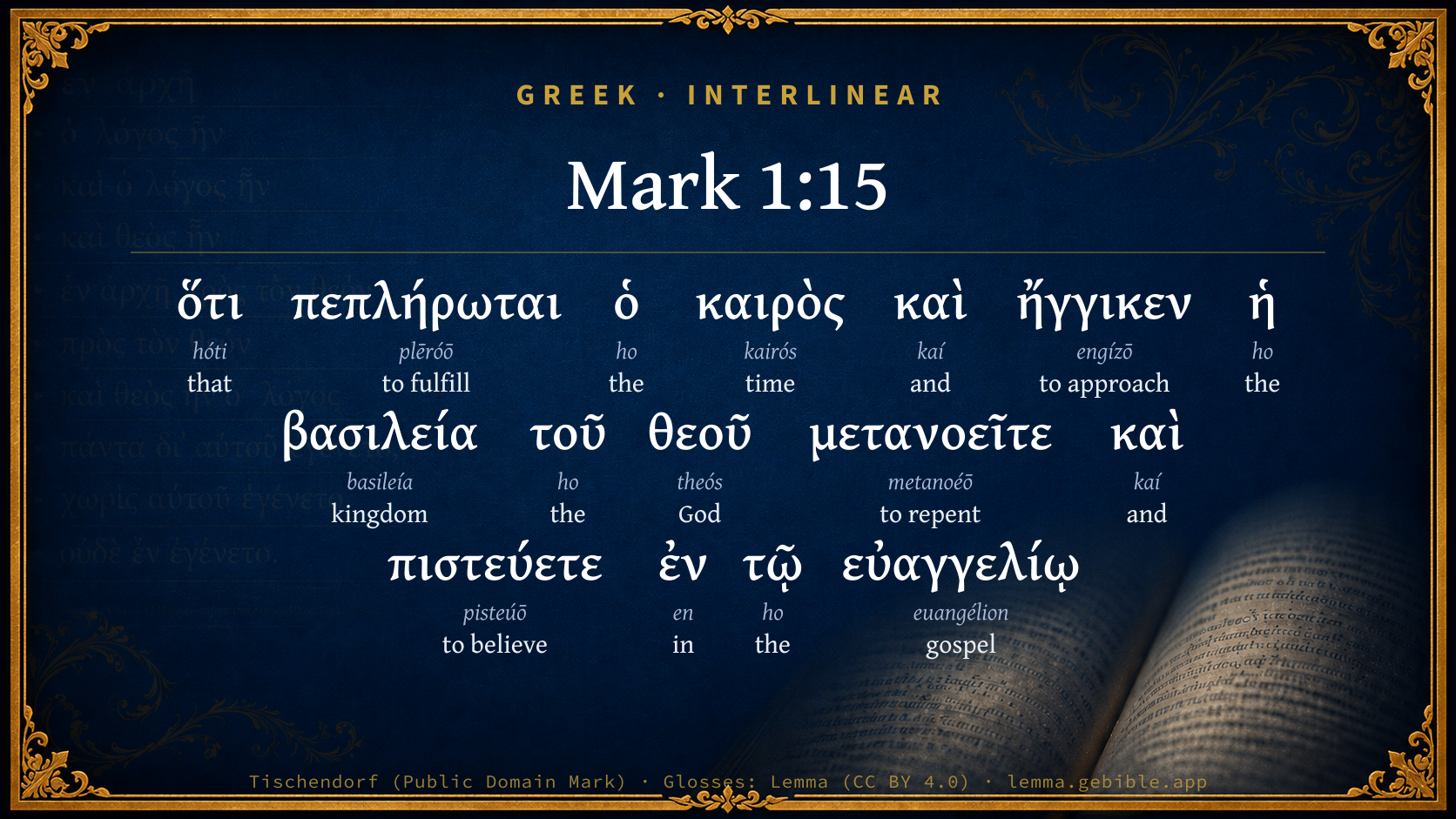
Greek (Tischendorf 8th ed.) Mark 1:15 appears in the Greek New Testament. The text above is from the Tischendorf 8th edition. Each word links to its Strong’s number and a concise gloss. Click any word for its full Thayer’s Greek Lexicon entry.
Download image
Cite this verse

Mark 1:15 (World English Bible). Public Domain. Lemma interlinear Bible study tool, https://lemma.gebible.app/v/mark/1/15.

Show BibTeX & RIS
BibTeX
RIS
English Translation
and saying, "The time is fulfilled, and the Kingdom of God is at hand! Repent, and believe in the Gospel."
World English Bible · Public Domain
Download a study sheet

One document with this verse’s original text, its word-by-word gloss line, the meaning frame, cross-references with their text, attributed commentary, and full source and license credits — printable, and it pastes into notes with its structure intact.

This verse Autodidact and up

Study sheet (.html) Plain text (.txt)

A passage Seminary Student

Up to 50 verses in one chapter. A passage sheet keeps up to 6 commentary sources and 12 cross-references per verse, in the order this page ranks them, and says so on the sheet whenever that leaves anything out. Ask for a single verse and you get the Autodidact verse sheet above.

Everything on this page stays free to read, with no account — the sheet is a download of what is already on screen, not access to it.

Want to remove ads? Support Godless Engineer
Compare translations 3

The same verse in 3 English versions, stacked beneath the original-language interlinear above. Click any original word for its lexicon entry.

Each is an independent rendering of the whole verse — the interlinear is not word-aligned to these translations.

Highlighted words mark where these versions differ — a whole-verse word diff, not a word-by-word alignment.

  • World English Bible Public Domain
    and saying, "The time is fulfilled, and the Kingdom of God is at hand! Repent, and believe in the Gospel."
  • King James Version Public Domain
    And saying, The time is fulfilled, and the kingdom of God is at hand: repent ye, and believe the gospel.
  • unfoldingWord Literal Text CC BY-SA 4.0
    and saying, “The time has been fulfilled, and the kingdom of God has come near. Repent and believe in the gospel.”

unfoldingWord Literal Text — © unfoldingWord, licensed CC BY-SA 4.0. Word-aligned USFM3 via Door43 (git.door43.org/unfoldingWord/en_ult).

Versions to compare (up to 4)

3 of 4 selected

Show all 19 translations

Every available English version of this verse, each an independent rendering of the whole verse.

  • World English Bible Public Domain
    and saying, "The time is fulfilled, and the Kingdom of God is at hand! Repent, and believe in the Gospel."
  • Berean Standard Bible Public Domain
    “The time is fulfilled,” He said, “and the kingdom of God is near. Repent and believe in the gospel!”
  • Majority Standard Bible Public Domain
    “The time is fulfilled,” He said, “and the kingdom of God is near. Repent and believe in the gospel!”
  • King James Version Public Domain
    And saying, The time is fulfilled, and the kingdom of God is at hand: repent ye, and believe the gospel.
  • American Standard Version (1901) Public Domain
    and saying, The time is fulfilled, and the kingdom of God is at hand: repent ye, and believe in the gospel.
  • Revised Version (1885) Public Domain
    and saying, The time is fulfilled, and the kingdom of God is at hand: repent ye, and believe in the gospel.
  • Geneva Bible (1599) Public Domain
    And saying, The time is fulfilled, and the kingdome of God is at hand: repent and beleeue the Gospel.
  • Douay-Rheims (1899) Public Domain
    And saying: The time is accomplished, and the kingdom of God is at hand: repent, and believe the gospel.
  • Young's Literal Translation Public Domain
    and saying -- `Fulfilled hath been the time, and the reign of God hath come nigh, reform ye, and believe in the good news.'
  • Literal Standard Version CC BY-SA 4.0
    and saying, “The time has been fulfilled, and the Kingdom of God has come near, convert and believe in the good news.”
  • Unlocked Literal Bible CC BY-SA 4.0
    He said, “The time is fulfilled, and the kingdom of God is near. Repent and believe in the gospel.”
  • unfoldingWord Literal Text CC BY-SA 4.0
    and saying, “The time has been fulfilled, and the kingdom of God has come near. Repent and believe in the gospel.”
  • Darby Bible Public Domain
    and saying, The time is fulfilled and the kingdom of God has drawn nigh; repent and believe in the glad tidings.
  • World Messianic Bible Public Domain
    and saying, “The time is fulfilled, and God’s Kingdom is at hand! Repent, and believe in the Good News.”
  • Webster's Bible Public Domain
    And saying, The time is fulfilled, and the kingdom of God is at hand: repent ye, and believe the gospel.
  • Free Bible Version CC BY-SA 4.0
    “The time predicted has come,” he said. “God's kingdom has arrived! Repent and believe in the good news.”
  • Bible in Basic English Public Domain
    And saying, The time has come, and the kingdom of God is near: let your hearts be turned from sin and have faith in the good news.
  • Text-Critical English NT CC BY 4.0
    and saying, “The time is fulfilled, and the kingdom of God has drawn near. Repent and believe in the gospel.”
  • Tyndale New Testament (1534) Public Domain
    and sayinge: the tyme is come and the kyngdome of God is at honde repent and beleve the gospell.

Literal Standard Version (2020), Covenant Press — licensed CC BY-SA 4.0. Text via the HelloAO Bible API (eBible.org). Unlocked Literal Bible (unfoldingWord) — licensed CC BY-SA 4.0. Text via the HelloAO Bible API (eBible.org). unfoldingWord Literal Text — © unfoldingWord, licensed CC BY-SA 4.0. Word-aligned USFM3 via Door43 (git.door43.org/unfoldingWord/en_ult). Free Bible Version, Dr. Jonathan Gallagher — licensed CC BY-SA 4.0. Text via the HelloAO Bible API (eBible.org).

Word by word

More ways to search: Search by grammar → Find every occurrence → Compare this word →

Practice this passage: Drill this verse → Learn its vocabulary →

μετανοεῖτε
metanoéō
G3340
“to repent”
Verb, Present, Active, Imperative, 2nd person, Plural
Part of Speech
Verb
Tense
Present
Voice
Active
Mood
Imperative
Person
2nd person
Number
Plural
Full Thayer's Definition

Origin: from G3326 and G3539

TDNT: 20:15,6

1. to change one's mind, i.e. to repent 2. to change one's mind for better, heartily to amend with abhorrence of one's past sins
  1. ὅτι hóti G3754 “that” Conjunction
  2. πεπλήρωται plēróō G4137 “to fulfill” Verb, Perfect, Passive, Indicative, 3rd person, Singular
  3. ὁ ho G3588 “the” Article, Nominative, Singular, Masculine
  4. καιρὸς kairós G2540 “time” Noun, Nominative, Singular, Masculine
  5. καὶ kaí G2532 “and” Conjunction
  6. ἤγγικεν engízō G1448 “to approach” Verb, Perfect, Active, Indicative, 3rd person, Singular
  7. ἡ ho G3588 “the” Article, Nominative, Singular, Feminine
  8. βασιλεία basileía G932 “kingdom” Noun, Nominative, Singular, Feminine
  9. τοῦ ho G3588 “the” Article, Genitive, Singular, Masculine
  10. θεοῦ theós G2316 “God” Noun, Genitive, Singular, Masculine
  11. καὶ kaí G2532 “and” Conjunction
  12. πιστεύετε pisteúō G4100 “to believe” Verb, Present, Active, Imperative, 2nd person, Plural
  13. ἐν en G1722 “in” Preposition
  14. τῷ ho G3588 “the” Article, Dative, Singular, Neuter
  15. εὐαγγελίῳ euangélion G2098 “gospel” Noun, Dative, Singular, Neuter

About this verse

These counts appear in no published source. They are computed here, from the morphology-tagged text and Lemma’s own curated glosses. What Lemma adds →

16
words
12
distinct lemmas
Gospels
section

Shared distinctive vocabulary

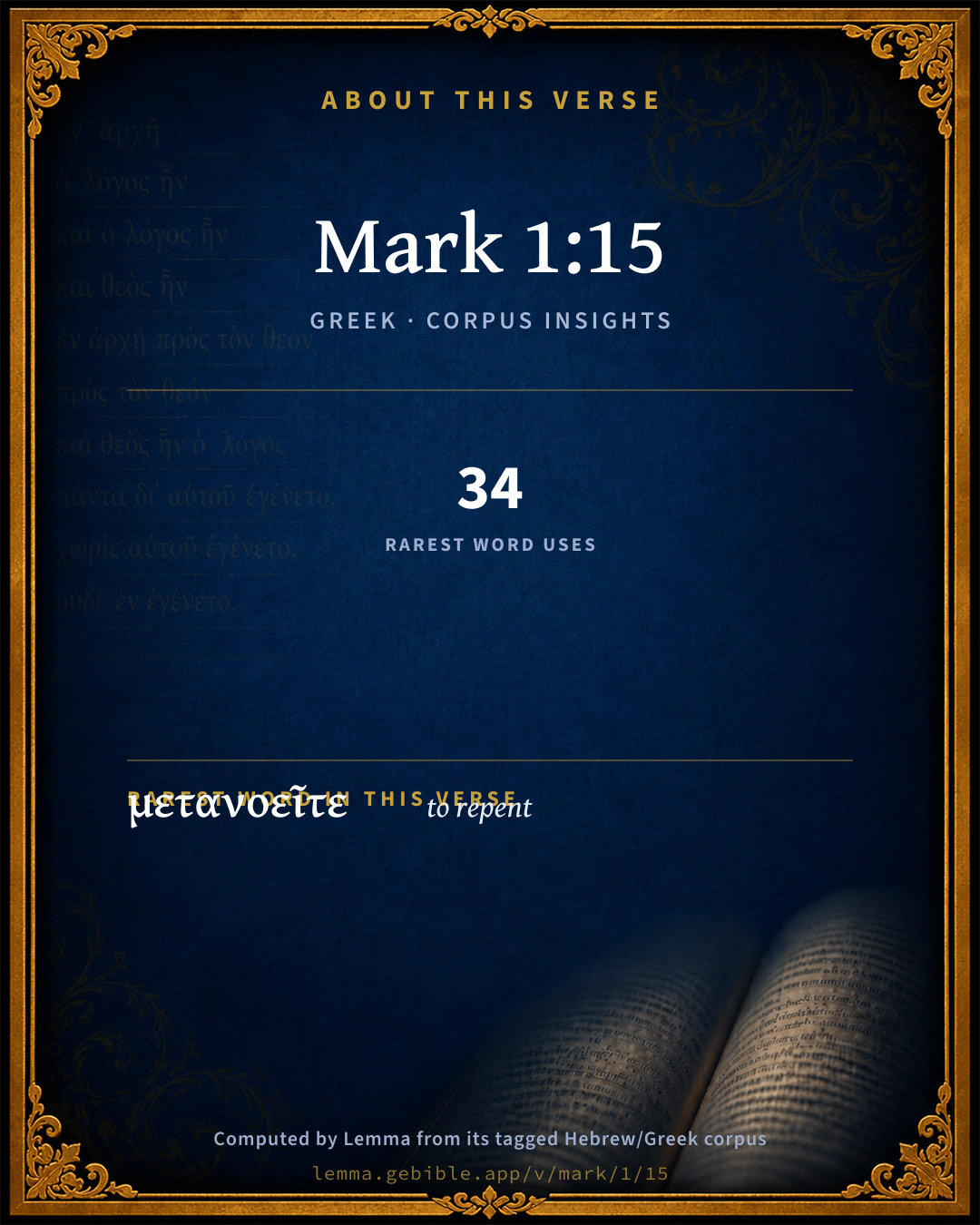
μετανοεῖτε to repent G3340 occurs in 32 verses of the Greek New Testament. Also found in:
Repetition

Words recur within this verse:

Cross-references

15

Topical passages linked to Mark 1:15 in the Treasury of Scripture Knowledge — connected by theme and wording, ordered by reader-vote popularity; previews shown in the World English Bible.

  • Matthew 3:2 "Repent, for the Kingdom of Heaven is at hand!"
  • Matthew 4:17 From that time, Jesus began to preach, and to say, "Repent! For the Kingdom of Heaven is at hand."
  • Acts 2:36–38 "Let all the house of Israel therefore know assuredly that God has made him both Lord and Christ, this Jesus whom you crucified."
  • Acts 20:21 testifying both to Jews and to Greeks repentance toward God, and faith toward our Lord Jesus.
  • Ephesians 1:10 to an administration of the fullness of the times, to sum up all things in Christ, the things in the heavens, and the things on the earth, in him;
  • Matthew 10:7 As you go, preach, saying, 'The Kingdom of Heaven is at hand!'
  • Galatians 4:4 But when the fullness of the time came, God sent out his Son, born to a woman, born under the law,
  • Daniel 2:44 In the days of those kings shall the God of heaven set up a kingdom which shall never be destroyed, nor shall the sovereignty of it be left to another people; but it shall break in pieces and consume all these kingdoms, and it shall stand forever.
  • Luke 10:9 Heal the sick who are therein, and tell them, 'The Kingdom of God has come near to you.'
  • Luke 24:47 and that repentance and remission of sins should be preached in his name to all the nations, beginning at Jerusalem.
  • Luke 10:11 'Even the dust from your city that clings to us, we wipe off against you. Nevertheless know this, that the Kingdom of God has come near to you.'
  • Daniel 9:25 Know therefore and discern, that from the going forth of the commandment to restore and to build Jerusalem to the Anointed One, the prince, shall be seven weeks, and sixty-two weeks: it shall be built again, with street and moat, even in troubled times.
  • Matthew 21:31–32 Which of the two did the will of his father?" They said to him, "The first." Jesus said to them, "Most assuredly I tell you that the tax collectors and the prostitutes are entering into the Kingdom of God before you.
  • 2 Timothy 2:25–26 in gentleness correcting those who oppose him: perhaps God may give them repentance leading to a full knowledge of the truth,
  • Romans 16:26

Cross-references courtesy of OpenBible.info (CC BY 4.0).

Commentary

Notes on Mark 1:15 from classic Christian and Jewish commentators (each source and its license shown beneath its notes). The classic Christian expositions comment on the surrounding passage and are grouped to its opening verse, so a note may address several verses; the Jewish commentaries on the Tanakh (Rashi and others) are per-verse, so they appear only where the commentator wrote on this verse.

Lemma curates 59 commentaries, every one of them public domain or Creative Commons licensed, each selected and text-cleaned for this edition rather than reprinted as found. About our sources →

The Biblical Illustrator

Joseph S. Exell

Mar_1:15

And saying, The time is fulfilled.

Repentance and faith

I. The import of the exhortation.

1. By the repentance to which we are exhorted we are not to understand merely an external reformation. To the. Pharisees such an exhortation would have been inappropriate and useless. Their outward conduct was exemplary. Nor can we suppose that the repentance to which we are exhorted is a mere sense of sorrow and regret on account of the afflictive and penal consequences to which our transgressions may expose us, either in the present life or in that which is to come. True repentance is towards God-for the remission of sins-unto salvation. Putting all these explanatory terms together, we are led to the conclusion that repentance consists in a sorrowful conviction of our having grieved and provoked God, and in an earnest desire and endeavour to be reconciled to Him, and to secure by the remission of our sins the salvation of our souls. These convictions and desires must be substantially the same in character in all true penitents, but are not in all cases equal in degree. Sometimes the heart is rather melted than broken.

2. But by the faith to which we are exhorted we are not to understand merely a general belief in God as the Almighty Creator, and the gracious Governor of all things. It is not merely a faith in the Divine mission and authority of Christ, and in the truth of that system of doctrine which He taught. The exhortation is Believe the gospel-that which is peculiar to the gospel. Those whom our Lord addressed believed in God as the Creator, in the truth of the Old Testament Scriptures; making it a boast that they were Moses disciples. It must therefore have been something more particularly pertaining to the gospel which they were now exhorted to believe, namely, the doctrine of salvation by Him as their Redeemer-the testimony that God was in Christ reconciling the world unto Himself, etc. We must do more than yield assent with the understanding to this great doctrine; as it is with a broken and contrite heart that man repents, so with the heart man believeth unto righteousness. It is, in other words, to feel what we believe, or to exercise a sure trust and confidence in that which we acknowledge to be true.

3. We have already noticed the close and intimate sequence with which the exhortation to faith in the gospel follows the exhortation to repentance; and we may now further remark upon that head, that the one is thus inculcated in connection with the other-

1. Because for all true penitents there is a gospel, or a message of good news. Had it been otherwise repentance would have been a dreadful thing. Are you guilty? Here is a fountain opened for sin. In a word, are you entirely lost? Here is a Saviour able to save even to the uttermost, etc.

2. This faith is inculcated in connection with repentance, because it is in the act of cordially believing what the gospel says, that we receive the blessings which the gospel offers.

II. The arguments or motives by which the exhortation is supported.

1. The exhortation to repentance may be regarded as being urged by the assurance that the time is fulfilled. To all who bare not repented the time is fulfilled-the time, place, and subject we are considering are all favourable. May it not be said of you that the time of your own solemn promise and engagement is fulfilled. The time of Gods special influence and grace is now fulfilled. In the case of some of you it may probably be said, the time is fulfilled, as you are very near the period when lime is to be exchanged for eternity. Your days are fulfilled, for your end is come.

2. Upon the supposition that you are already penitent, you are encouraged to faith in the gospel by the assurance that the kingdom of God is at hand. This kingdom is at hand as all things needful for its establishment have been abundantly provided. Indeed, if truly penitent, you are already in a state of preparation for being made by faith the subjects of His kingdom. If you are truly penitent, the kingdom of God is at hand, for God is this moment waiting to set up that kingdom in your hearts. Let repentance and faith ever be connected. There are persons who, in a certain sense, believe the gospel without having ever truly repented; they have a speculative faith in the gospel. On the other hand are persons resting in repentance, and on the mere ground of their repentance are looking to be admitted into heaven. Let one follow the other in the order in which Christ has placed them. (J. Crowther.)

Remark-

I. The insufficiency of repentance by itself to procure the forgiveness of sin.

II. The suitableness of faith to the being associated with repentance as a condition.

III. The thorough harmony of doth conditions with the blessed fact that eternal life is the free gift of God through our Lord Jesus Christ. (H. Melvill, B. D.)

Repentance

Many persons who appear to repent are like sailors who throw their goods overboard in a storm, and wish for them again in a calm. (Mead.)

A saints tears are better than a sinners triumphs. (Secker.)

The tears of penitents are the wine of angels. (Bernard.)

Repentance begins in the humiliation of the heart, and ends in the reformation of the life. (Mason.)

There is no going to the fair haven of glory without sailing through the narrow strait of repentance. (Dyer.)

Preaching repentance

In 1680, Mr. Philip Henry preached on the doctrine of faith and repentance from several texts of scripture. He used to say that he had been told concerning the famous Mr. Dod, that some called him in scorn Faith and Repentance, because he insisted so much upon these two in all his preaching. But, says he, if this be to be vile, I will be yet more vile, for faith and repentance are all in all in Christianity. Concerning repentance he has sometimes said, If I were to die in the pulpit, I would desire to die preaching repentance, as if I were to die out of the pulpit I would desire to die practising repentance.

Repentance a reversal of conduct

A locomotive is rushing at express speed along the main line of a railway, when suddenly, by a pointsmans mistake, it is switched off into a sideline. Instantly the brakes are applied, and the moving mass is brought to a standstill. Then the engineer lays his hand upon a lever, the motion of the engine is reversed, and the train moves back to the main line, and continues on its course. In human life, such an abandoning of the main line is transgression; such a reversal is repentance. The kingdom of God is like a walled city with a single gate, to which outsiders can only approach by one path. That gate is faith; that path is repentance. An old tower in one of the southern counties of Scotland goes by the name of The Tower of Repentance. A herd boy was one day lying in a field near it, reading his New Testament, when an irreligious gentleman of the neighbourhood stopped and asked him what book he was reading. On being informed, he said with a sneer, Perhaps, then, you can tell me the way to heaven? Oh, yes, replied the boy, you must go up through that tower. This quaint way of expressing the truth, sent the inquirer off in a more thoughtful mood than when he came. If a man is running from the kingdom of God, it is obvious that he must just turn round and run for it, if he wishes to reach it. Just as soon as it is possible for a man to reach the top of a hill by running downhill, will it be possible for the sinner to enter Gods kingdom without repentance. (Sunday School Times.)

Repentance and faith

From these words we learn what it is to preach the gospel.

I. We are to prove that Jesus of Nazareth is He that should come-He of whom all the prophets did write-the very Christ, the Saviour of the world. The time is fulfilled and the kingdom of God is at hand.

II. We are to teach men how to receive, and how to act, under these good tidings-Repent ye, etc.

1. Repentance: Its importance and necessity. Its nature.

2. Our Lord preached not only repentance, but also faith. So the apostles. In every saved soul these two must and do meet together. Not that God deals alike with every saved soul. Believe the gospel,-come to Jesus, that you may have a free pardon, etc. (R. Dixon, D. D.)

Repentance not immediately followed by faith

I have known instances where for years there have been right views of the evil of sin, and of the nature of holiness, and a desire after holiness-and what is this but repentance? imperfect it may be, but still repentance at least in its beginnings: imperfect, it went not far enough, inasmuch as it was without faith. I knew a man a public character, who wrote to me, in youth, many an instructive letter, a man of no common intellect, who, when only a boy, on reading Martin Luthers book on the Epistle to the Galatians, absolutely rolled in agony on the floor, under a sense of sin and the wrath of God; and though his home influence and his occupation in after life were opposed to his spiritual progress, he never lost his reverence for the Bible and his desire to be religious. It is a fact that it was his habit to read the Bible with a commentary of a night, after he had left his occupation, which was eminently worldly; and he used to say, it was his greatest comfort in life. I have, as a boy, listened to his reverential reading of the Bible and that commentary to his family. But the error of seeking salvation by the works of the law prevented his enjoyment of peace, or sense of pardon. It was not till the later years of his life, when the providence of God had removed him from his ensnaring and worldly occupation, that he attained to what the Scripture calls faith-salvation by grace through the faith of Christ-a simple, childlike trust in Christ, as made sin for him, that he might be made the righteousness of God in Christ. For several years of his later time, Archbishop Leightons works, especially his commentary on St. Peters first epistle, one of the noblest works which ever came from uninspired man, was his daily companion, from which he seemed never weary of making large extracts: and he owned that he now apprehended faith as he had never done before. Like many others, in his zeal for good works he had thought that such sweeping statements about faith alone being needful for salvation were contrary to good works. Whereas he lived to see and know and feel that faith in Christ works by love, and is the fruitful source of all good and holy works. He found that the Twelfth Article of our Church is the truth of God. Albeit that good works, which are the fruits of faith, and follow after justification, cannot put away our sins, and endure the severity of Gods judgment; yet are they pleasing to God in Christ, and do spring out necessarily of a true and lively faith; insomuch that by them a lively faith may be as evidently known as a tree discerned by the fruit. I have no doubt that in the case of my departed friend, as in many others, the Holy Spirit was slowly bringing about His purpose of mercy, through the workings of repentance; and when he had been brought to see that there was no good in him, and that all his strivings after holiness were altogether vain, then came the gift of faith, and he believed to the saving of his soul. As another example of the long separation between faith and repentance, in some souls, I cannot withhold from you the case of one of our greatest literary characters, Dr. Samuel Johnson. His writings have been my companion from my youth up; I early conceived a great admiration of him, not only for his large intellectual powers, but because he stood forth in an immoral age as a friend of revealed religion, and an earnest teacher of morals. I am fully aware of the defects of his character,-they were many and great; but these imperfections were balanced by some great and noble qualities, accompanied by an intellect of the highest order, which to use his own words, at the close of his Rambler, he vigorously employed, to give ardour to virtue and confidence to truth. Let me briefly sketch his souls religious history. As a young man at Oxford he took up Laws Serious Call to the Unconverted, expecting to find it a dull book, and perhaps to laugh at it. But he found Law an overmatch for him, This, he says, was the first occasion of my thinking in earnest about religion, after I became capable of rational inquiry. Nor did he conceal his convictions. He attended church with much regularity; he was indignant when, for political reasons, there was some hesitation about giving the Highlanders of Scotland the Scriptures in Gaelic; he would allow no profane swearing in his presence, and he sternly rebuked anyone who ventured to utter in his presence impure or profane language. To a young clergyman he gave this admirable advice, that all means must be tried by which souls may be saved; and in one of his writings he declares, that, compared with the conversion of sinners, propriety and elegance in preaching are less than nothing. Yet, with all this honest earnestness, his religion gave him no peace. His views of the gospel were very defective, and partook very largely of that legal spirit so natural to man. He rested, as he himself says, his hope of salvation on his own obedience by which to obtain the application of the Saviours mediation to himself, and then; o repentance to make up for the defects of obedience. I cannot be sure, he said, that I have fulfilled the conditions in which salvation is granted; I am afraid I may be one of those who should be condemned. He never could be sure that he had done enough. And yet no one can read his meditations and prayers and not be convinced that he had a deep sense of sin and an earnest desire for holiness, accompanied with great self-abasement before God: but all in vain; there was no peace; there was repentance, but no faith. He had yet to learn that being justified by faith, we have peace with God. And he was taught this blessed truth by the Holy Spirit in his last illness. All his life long he had looked upon death with the greatest terror; but though late, relief was granted to him. At evening time it was light. It appears that a clergyman was the main instrument in bringing his mind to a quiet trust. In answer to the anxious question, written to him by the dying moralist, What shall I do to be saved, the clergyman wrote, I say to you, in the language of the Baptist, Behold the Lamb of God which taketh away the sins of the world. That passage had been often read by him, and made but a slight impression; but now pressed home by the gracious Spirit, it went straight to his heart. He interrupted the friend who was reading the letter. Does he say so? Read it again! Comfort came and peace. His biographer tells us, for some time before his death all his fears were calmed and absorbed by the prevalence of his faith and his trust in the merits and propitiation of Jesus Christ. Now all those years of darkness, fear, and disquiet, would have been saved had he known and received the free grace of God in Christ-in other words, if he had not only repented, but also believed the gospel. (R. Dixon, D. D.)

The call to repentance and faith

I. A motive to genuine repentance, and cordial faith in the gospel, may be drawn from the consideration of that appalling misery which awaits the impenitent and unbelieving.

II. A motive may be gathered from the riches of Gods goodness, especially as dispensed through the merits and intercession of Christ.

III. A motive may be gathered from the promise of the Holy Spirit, and from the countless instances which prove that promise to have been actually fulfilled down to this day. (J. Thornton.)

Christ preaching repentance

I. Christ preached the nature of repentance.

II. Christ preached the necessity of repentance.

1. The universal necessity may be shown from the character of God, as the Ruler of the world.

2. It may be shown from the state of man.

3. From the fact that an impenitent sinner is unfit for heaven.

III. Christ preached the duty of repentance. He pressed it home upon every mans conscience. He enforced it by rewards and punishments (Mat_11:20; Mat_2:2; Mat_12:41). He encouraged men to it. (J. Carter.)

Gist of the Saviours teaching

The whole gospel is practically reduced to repentance. Christ joins it to the hope of heaven, as being the only means of arriving there. Here are four points in His teaching.

1. That His Father does everything according to the order of His adorable designs, in the time prefixed in His eternal predestination, and in the manner described in the Scriptures, prefigured in the shadows of the law, foretold by the prophets, and included in the promises, the time whereof is now fulfilled at His coming.

2. That sin has reigned under the law, but that God is to reign under grace and by it, and that the time of this kingdom of grace and mercy is at hand.

3. That the kingdom of God, and His reign by grace, begins with repentance for past sins.

4. That it is established by submission to the yoke of faith, and of the precepts of the gospel, and by the hope and love of eternal enjoyments which it reveals and promises. (Quesnel.)

Nature and evidence of repentance

I. Repentance is a change of mind concerning

(1) God;

(2) the law;

(3) sin;

(4) self;

(5) Christ;

(6) holiness.

II. Repentance is manifested by its effects:

(1) Contrition;

(2) confession;

(3) self-abhorrence;

(4) self- abandonment. (W. W. Whythe.)

Tokens of repentance

The signs of true repentance are-

(1) Carefulness not to fall into our former sins again;

(2) holy indignation against ourselves for our sins past;

(3) a greater hatred of all sin, than we ever had a love for it;

(4) constant striving against secret sins;

(5) thorough obedience rendered cheerfully to all Gods commands. (G. Petter.)

Jesus in Galilee

I. The preaching of Jesus was spiritual. His theme was the kingdom of God. Galilee was full of rabbis who taught for doctrines the commandments of men. Jesus held the minds of men to spiritual themes. His coming was the setting up on earth of the kingdom of God. The countrymen of Jesus looked for that kingdom as one of worldly magnificence. Nothing could deter Him from unfolding its spiritual nature.

II. Jesus preached with authority. He commanded men to repent (verse 16.) He came to be King as well as Saviour.

III. Jesus required not only acceptance of His doctrines but of Himself also - Come ye after Me.

IV. Jesus proffers large reward to His followers-I will make you fishers of men.

V. Jesus words and acts were a revelation of His Divine power. Rebuking the evil spirit, He bade him hold his peace and come out of him. That word was irresistible. Lessons:

1. The way to spread the gospel is to tell what Jesus does.

2. If one agency fails to bring men to Christ, let others be employed.

3. Opportunities for greatest duties are found in the discharge of ordinary ones. Jesus was in the synagogue on the Sabbath, and while there occasion was afforded for healing a demoniac.

4. A broad estimate should he had of the kingdom of Christ. How vast was Christs view of the kingdom He came to set up. Beings of both worlds were interested in it. (Sermons by Monday Club.)

Jesus in Galilee

I. The entrance to the kingdom. For a sinful man the only way into a kingdom of righteousness, is through repentance and renewal.

II. The ministry of the kingdom. Discipleship means ministry.

III. The demonstration of the kingdom. The gospel of the kingdom is good news for the whole man; mind, heart, will, soul and body. At last the gospel of the heavenly kingdom, in its full realization, shall be only a renewal of the gospel of the kingdom that was spoken in Galilee. And there shall be no more death, neither sorrow, nor crying. (Sermons by Monday Club.)

Repent and believe.

Adams likens Faith to a great queen in her progress, having repentance as her messenger going before her, and works as the attendants following in her train. (J. G. Pilkington.)

The look of repentance backward and forward

Like Janus Bifrons, the Roman god looking two ways, a true repentance net only bemoans the past but takes heed to the future. Repentance, like the lights of a ship at her bow and her stern, not only looks to the track she has made, but to the path before her. A godly sorrow moves the Christian to weep over the failure of the past, but his eyes are not so blurred with tears but that he can look watchfully into the future, and, profiting by the experience of former failures, make straight paths for his feet. (J. G. Pilkington.)

Repentance lifelong

Sir, said a young man to Philip Henry, how long should a man go on repenting? How long, Mr. Henry, do you mean to go on repenting yourself? Sir, was the reply, I hope to carry my repentance to the very gates of heaven. Every day I find I am a sinner, and every day I need to repent. I mean to carry my repentance, by Gods help, up to the very gates of heaven. May this be your divinity, and mine! May repentance towards God, and faith towards our Lord Jesus Christ, be Jachin and Boaz-the two great pillars before the temple of our religion, the cornerstones in our system of Christianity. (Bishop Ryle.)

Repentance and faith inseparable

Here is the sum and substance of Christs whole teaching-the Alpha and Omega of His entire ministry; and coming from the lips of such an one and at such a time (just after His baptism), we should give the most earnest heed to it.

I. The gospel which Christ preached was, very plainly, a command. He didnt condescend to reason about it. Why is this?

1. To ensure its being attended to. Many would never venture to believe at all if it were not made penal to refuse to do so.

2. That men may be without excuse if they neglect it.

II. This command is two fold. It explains itself: repent and believe.

1. Repentance. Abhorrence of ones past life, because of the love of Christ which has pardoned it. Avoidance of present sin, because not ones own, but bought with a price. Resolution to live henceforth like Jesus. This is the only repentance we have to preach and to practise: not law and terrors, not despair, not driving men to self-murder-this is the sorrow of the world, which worketh death: godly sorrow is a sorrow unto salvation through Christ.

2. Faith. That is, trust in Christ. This goes hand-in-hand with repentance. Neither will be of any use without the other. Trust Christ to save you, and lament that you need to be saved, and mourn because this need of yours has put the Saviour to open shame, frightful sufferings, and a terrible death.

III. This command is a most reasonable one. God only asks of you that which your heart, if it were in a right state, would rejoice to give. You cant expect to be saved while you are in your sins, any more than you can expect to have a healthy body while there is poison in your veins. And then, as to faith, God surely has a right to demand of the creature he has made, that he shall believe what He tells him:

IV. This is a command which demands immediate obedience. The danger is real; the necessity is urgent. Today is the time God graciously gives you; tomorrow He may claim as His own. (C. H. Spurgeon.)

Low in repentance, high in faith

An old saint, on his sick bed, once used this remarkable expression: Lord, sink me low as hell in repentance, but-and here is the beauty of it-lift me high as heaven in faith. The repentance that sinks a man low as hell is of no use except there is the faith also that lifts him as high as heaven, and the two are perfectly consistent the one with the other. Oh, how blessed it is to know where these two lines meet-the stripping of repentance, and the clothing of faith! (C. H. Spurgeon.)

Repentance dear to the Christian

Rowland Hill, when he was near death, said he had one regret, and that was that a dear friend who had lived with him for sixty years, would have to leave him at the gate of heaven. That dear friend, said he, is repentance; repentance has been with me all my life, and I think I shall drop a tear as I go through the gates, to think that I can repent no more.

Repentance bears sweet fruit

The sweetness of the apple makes up for the bitterness of the root, the hope of gain makes pleasant the perils of the sea, the expectation of health mitigates the nauseousness of medicine. He who desires the kernel, breaks the nut so he who desires the joy of a holy conscience, swallows down the bitterness of penance. (Scholiast in Jerome.)

Repentance and faith twin duties

Faith and repentance keep up a Christians life, as the natural heat and radical moisture do the natural life. Faith is like the innate heat; repentance like the natural moisture. And, as the philosopher saith, if the innate heat devour too much the radical moisture, or, on the contrary, there breed presently diseases; so, if believing make a man repent less, or repenting make a man believe less, this turneth to a distemper. Lord, cast me down (said a holy man upon his death bed) as low as hell in repentance; and lift me up by faith into the highest heavens, in confidence of Thy salvation. (John Trapp.)

Repentance a daily duty

He that repents every day for the sins of every day, when he comes to die will have the sins of only one day to repent of. Short reckonings make long friends. (M. Henry.)

The time fulfilled

The same thought as St. Pauls fulness of time. (Gal_4:4; Eph_1:10). The kingdom of God and of heaven. These two formulae are used with a slight difference of meaning.

I. The kingdom of heaven stands opposed to the kingdoms of earth: the great world empires that lived and ruled by the strength of their armies and that were, in means and ends, in principles and practices, bad. These had grown out of the cruel ambitions, jealousies, and hatreds of men and States; had created war, bloodshed, famine, pestilence, the oppression which crushed the weak, and the tyranny which exalted the strong. But the kingdom from above was the descent of a spiritual power, calm and ubiquitous as the sun to light: plastic, penetrative, pervasive, silently changing from ill to good, from chaos order, both man and the world.

II. The kingdom of God has its opposite in the kingdom of evil or satan, the great empire of darkness and anarchy, creative of misery and death to man. It belonged to God, came from Him, existed to promote His ends, to vanquish sin, and to restore on earth an obedience that would make it happy and harmonious as heaven. (Principal A. M. Fairbairn.)

The Biblical Illustrator, edited by Joseph S. Exell (c. 1880s–1900s) — public domain. Text from a community e-Sword module.

Tyndale Open Study Notes

Tyndale Open Resources

1:15 Jesus’ preaching is summarized by his announcement that the Kingdom of God had come, and that people needed to repent and believe the Good News about the Messiah (1:1). • The Kingdom of God is not tied to a territory; it dynamically began in Jesus’ person and extended to his followers. • In response to the arrival of God’s Kingdom, people are called to repent (to turn from sin and yield to God) and to have faith in God’s Good News. In Jesus’ time, the Good News was the arrival of God’s reign through the Messiah. For Mark’s later audience, it was the news of Jesus’ death, resurrection, ascension, and promised return (15:1–16:8). All people, Jews and Gentiles alike, need God’s forgiveness through repentance and faith in Jesus.

Tyndale Open Study Notes — © Tyndale Open Resources, licensed CC BY-SA 4.0. Text via the HelloAO Bible API.

Bengel's Gnomon

Johann Albrecht Bengel

Mar 1:15. Πεπλήρωται ὁ καιρὸς, the proper time is fulfilled) the time, of which Daniel wrote, viz., that of His kingdom coming: the time which ye have been expecting. Those who acknowledged that the time was fulfilled, had, as the next step to take, either to embrace the true Messiah as set forth here, or else false Messiahs: comp. Luk 21:8. It was not John, but our Lord Himself, who openly declared the fulfilment of the time.—μετανοεῖτε καὶ πιστεύετε, repent and believe) then you will be partakers in the Gospel.

Bengel's Gnomon of the New Testament — English translation (T&T Clark, Edinburgh, 1860) — public domain. Text from a community e-Sword module.

Expositor's Greek Testament

ed. W. Robertson Nicoll

Mar 1:15 . ἡ βασιλεία τ . θ .: this defines more precisely the gospel Jesus preaches. It is the gospel of the Kingdom of God. But even this is vague. The kingdom may be differently conceived: as an awful thing or as a beneficent thing. The summons following throws light on its nature. μετανοεῖτε καὶ πιστεύετε : “repent” echoes John’s preaching, and savours of awe, but “ believe ” is a new word, and presumably the watchword of the new ministry. And the name for the message to be believed settles the nature of the kingdom. Its coming is good news ( ἐν τῷ εὐαγγελίῳ ). For πιστεύειν ἐν , vide Gal 3:26 , Eph 1:13 .

The Expositor's Greek Testament, edited by W. Robertson Nicoll (1897–1910) — public domain. Text from a community e-Sword module.

Adam Clarke's Commentary

Verse 15. The time is fulfilled] That is, the time appointed for sending the Messiah; and particularly the time specified by Daniel, Da 9:24-27. Here are four points worthy of deep attention, in the preaching of the Son of God.

1. Every thing that is done is according to a plan laid by the Divine wisdom, and never performed till the time appointed was filled up.

2. That the kingdom and reign of sin are to be destroyed, and the kingdom of grace and heaven established in their place.

3. That the kingdom of God, and his reign by grace, begins with repentance for past sins.

4. That this reign of grace is at hand; and that nothing but an obstinate perseverance in sin and impenitence can keep any soul out of it; and that now is the accepted time to enter in.

Adam Clarke's Commentary on the Bible (1810–1826) — public domain. Text from a community e-Sword/MySword module.

Ellicott's Commentary for English Readers

(15) The time is fulfilled.—The words are not found in the parallel passages of the other Gospels, and are interesting as embodying the same thought as St. Paul’s “in the fulness of time” (Gal_4:4; Eph_1:10). So, too, St. Mark adds “believe the gospel” to the simple “repent” of St. Matthew, and gives “the kingdom of God” instead of “the kingdom of heaven.”

A Bible Commentary for English Readers, edited by Charles John Ellicott (1878–1897) — public domain. Text from a community e-Sword module.

The Cambridge Bible for Schools and Colleges

gen. ed. J. J. S. Perowne

15. The time, i. e. the great fore-ordained and predicted time of the Messiah.

the kingdom of God] or as it is called in St Matthew the Kingdom of the Heavens (comp. Dan_2:44; Dan_7:13-14; Dan_7:27), denotes here the Kingdom of grace, the visible Church, of which our Lord described (a) in the parable of “the Mustard Seed” (Mat_13:31-32), its slight and despised beginning; (b) in that of “the Hidden Leaven” and the “Seed growing secretly,” its hidden and mysterious working (Mat_13:33; Mar_4:26-29); (c) and again in the first two Parables its final and assured triumph in spite of the obstacles set forth in the Parable of “the Tares” (Mat_13:24-30).

believe] Rather believe in, repose your faith on, the Gospel.

The Cambridge Bible for Schools and Colleges (gen. ed. J. J. S. Perowne; Cambridge University Press, 1878–1918) — public domain. Text from a community e-Sword module.

John Gill's Exposition

And saying, the time is fulfilled,.... Either that which was fixed for the end of the law and prophets, the legal and Mosaic dispensation, and the Jewish church state; or the fulness of time for the Messiah's appearance in the world; which was agreed upon between the Father and the Son, was predicted in various prophecies, and the people of the Jews were in a general expectation of:

and the kingdom of God is at hand: the same with the kingdom of heaven, in Mat 3:2, see the notes: See Gill on Mat 3:2, Mat 4:17.

repent ye, and believe the Gospel. He called them to repent, not only of their former sins and vicious course of life, but of their bad principles and tenets, concerning a temporal kingdom of the Messiah; concerning merit and free will, justification by the works of the law, and salvation by their obedience to the ceremonies of it, and the traditions of the elders: these he exhorts them to change their sentiments about, and to relinquish them, and give into the Gospel scheme; which proclaims liberty from the law, peace, pardon, and righteousness by Christ, and salvation and eternal life by the free grace of God.

John Gill's Exposition of the Whole Bible (1746–1763) — public domain (CC PDM 1.0). Text via the HelloAO Bible API.

Trapp's Complete Commentary

John Trapp

15 And saying, The time is fulfilled, and the kingdom of God is at hand: repent ye, and believe the gospel.

Ver. 15. And saying, The time is fulfilled] These were four of our Saviour’s sermon heads. The prophets of old were wont to set down some short notes of their larger discourses to the people, and to fasten them to the doors of the temple till the people had read them. {a} And then they were taken down by the priests, and laid up for the use of posterity.

Repent ye and believe, &c.] Repentance, then, is a gospel duty, and (as some argue from this text) before faith; the proper purchase of Christ’s blood, Act 5:31. Indeed, faith and repentance keep up a Christian’s life (saith a learned man), as the natural heat and radical moisture do the natural life. Faith is like the innate heat; repentance like the natural moisture. And, as the philosopher saith, if the innate heat devour too much the radical moisture, or on the contrary, there breed presently diseases; so, if believing make a man repent less, or repenting make a man believe less, this turneth to a distemper. Lord, cast me down (said a holy man upon his deathbed) as low as hell in repentance; and lift me up by faith into the highest heavens, in confidence of thy salvation.

{a} Calvin in Esaiam.

John Trapp, A Commentary or Exposition upon All the Books of the Old and New Testament (1647–1656) — public domain. Text from a community e-Sword module.

Albert Barnes' Notes on the Bible

The time is fulfilled - That is, the time for the appearance of the Messiah, the time so long foretold, has come. “The kingdom of God is at hand.” See the notes at Mat 3:2.

Repent ye - Exercise sorrow for sins, and turn from them.

And believe the gospel - Literally, trust in the gospel, or believe the good tidings - to wit, respecting salvation. See the notes at Mat 4:17.

Albert Barnes' Notes on the Bible (1834–1885) — public domain. Text from a community e-Sword/MySword module.

Haydock's Catholic Bible Commentary

As if he were to say: To this day the Mosaic law has been in full force, but henceforth the evangelical law shall be preached; which law is not undeservedly compared to the kingdom of God. (Theophylactus) --- Repent, therefore, says our Saviour, and believe the gospel; for if you believe not, you shall not understand; repent, therefore, and believe. What advantage is it to believe with good works? the merit of good works will not bring us to faith, but faith is the beginning of good works. (St. Jerome)

George Leo Haydock (1774–1849), Haydock's Catholic Family Bible and Commentary, 1859 edition — public domain. Excludes Psalms (Douay-Rheims chapter numbering differs from Protestant) and Deuterocanonical books (Catholic canon only).

The Pulpit Commentary

The time is fulfilled; that is, the time for the coming of Messiah and of his kingdom. The kingdom which had been shut for so many ages was now to be reopened by the preaching and the death of Christ. The time is very accurately indicated. St. Matthew tells us (Mat_4:12) that "when Jesus had heard that John was cast into prison, he departed into Galilee;" and then presently afterwards he adds, "From that time Jesus began to preach and to say, Repent, for the kingdom of God is at hand." The time and place are also accurately specified by St. Peter, (Act_10:36, Act_10:37) where he tells Cornelius that "the word of peace, preached by Jesus Christ, was published throughout all Judaea, and began from Galilee, after the baptism which John preached." It was necessary that these circumstances should be carefully detailed, because they were among the proofs of the Messiahship of Jesus. Elias must come first; and he had come in the person of the Baptist, although the prophecy probably awaits its full accomplishment in the actual reappearance of the great prophet of Israel before the second coming of our Lord. Repent ye, and believe the gospel. These words may be regarded as a summary of the method of salvation. Repentance and faith are the conditions of admission into the Christian covenant. Repentance has a special reference to God the Father, and faith, to Jesus Christ the eternal Son. It is in the gospel that Christ is revealed to us as a Saviour; and therefore we find Jesus Christ, as the object of our faith, distinguished from the Father as the object of our repentance. Repentance of itself is not sufficient it makes no satisfaction for the Law which we have broken; and hence, over and above repentance, there is required from us faith in the Gospel, wherein Christ is revealed to us as a propitiation for sin, and as the only way of reconciliation with the Father. Without faith repentance becomes despair, and without repentance faith becomes only presumption. Join the two together, and the faithful soul is borne onwards, like a well-balanced vessel, to the haven where it would be.

The Pulpit Commentary (1880–1919), ed. H.D.M. Spence-Jones & Joseph S. Exell — public domain. Text from a community e-Sword module.

John Wesley's Explanatory Notes

The time is fulfilled - The time of my kingdom, foretold by Daniel, expected by you, is fully come.

John Wesley, Explanatory Notes Upon the Whole Bible (1754–1765) — public domain. Text via the GEBible commentary corpus.

Cambridge Greek Testament for Schools and Colleges

15. καὶ λέγων. Mk often accumulates participles; Mar 1:31; Mar 1:41, Mar 2:6, Mar 3:5; Mar 3:31, Mar 4:8, Mar 5:25-27; Mar 5:30; Mar 5:33, Mar 6:2, Mar 8:11, Mar 10:17, Mar 12:28, Mar 13:34, Mar 14:23; Mar 14:67, Mar 15:21; Mar 15:36; Mar 15:43.

ὅτι. When ὅτι introduces, in the oratio recta, the words spoken, it is omitted in translation, being equivalent to inverted commas; Mar 1:37; Mar 1:40, Mar 2:12, Mar 3:11; Mar 3:21-22, etc. But we need not suppose that Christ used these very words. He was not constructing set phrases to be impressed on the memory by repetition; but in these sentences the Evangelist sums up the substance of the Messiah’s preaching.

Πεπλήρωται ὁ καιρός. “The time has been completed and is complete”; a Jewish idea, freq. in O.T. As usual ὁ καιρός means “the appointed time, right season, opportune moment,” not necessarily a short time; ὁ καιρὸς ὁ ἀφορισθεὶς παρὰ θεοῦ τῇ πολιτείᾳ τῆς Παλαιᾶς Διαθήκης (Euthym.).

ἤγγικεν. “Has come near” and therefore is at hand (A.V., R.V.). Cf. Mar 14:42. Christ appears as a Revivalist of religion.

ἡ βασιλεία τοῦ θεοῦ. Mk has this expression 14 times, Lk. 32 times. Mt. nearly always omits or paraphrases Mk’s expression, or substitutes ἡ βασ. τῶν οὐρανῶν, which he has 32 times. This Kingdom or Reign is the rule of God in men’s hearts and in society. It exists already, but many have not even begun to try to attain to it, and no one gains it in its fulness. God’s rule will be complete in eternity (1Co 15:24-28). See the full discussion of the phrase, esp. in its eschatological sense, in Dalman, The Words of Jesus, pp. 91–143; D.C.G. art. “Kingdom of God.”

πιστεύετε ἐν τῷ εὐαγγελίῳ. Πιστ. εἰς is freq. in N.T., and πιστ. ἐπί occurs several times in Acts and Romans and elsewhere; but neither is found in LXX. Πιστ. ἐν occurs Eph 1:13, and perhaps nowhere else in N.T., for Joh 3:15 is doubtful, and it is rare in LXX. All three expressions are stronger than πιστ. with the simple dat. (Mar 11:31)—the difference between reposing trust in and merely believing what is stated. J. H. Moulton, Gr. p. 67. Mk elsewhere attributes the use of the word εὐαγγέλιον to Christ (Mar 8:35, Mar 10:29, Mar 13:10, Mar 14:9); but he nowhere represents Him as speaking of “My Gospel.” It would be natural to give Christ’s meaning in the language which was current when Mk wrote. Dalman, Words of Jesus, pp. 102, 106. Syr-Sin. has “believe His Gospel.”

Cambridge Greek Testament for Schools and Colleges (Cambridge University Press, 1896; 21 vols, various authors incl. Carr, Maclear, Plummer, Farrar, Lumby, Moule, M. R. James, Simcox) — public domain. Text from a community e-Sword module.

Alford’s Greek Testament

Henry Alford

15.] Jesus begins His ministry. Mat 4:12-17. Luk 4:14, Luk 4:15.

15. πεπλ. ὁ καιρ.] See Gal 4:4. “The end of the old covenant is at hand; … the Son is born, grown up, anointed (in his baptism), tempted, gone forth, the testimony of his witness is given, and now He witnesses Himself; now begins that last speaking of God, by His Son (Heb 1:1), which henceforth shall be proclaimed in all the world till the end comes.” Stier, R. J. i. 57.

καὶ πιστ.] These words are in Mark only. They furnish us an interesting characteristic of the difference between the preaching of John, which was that of repentance—and of our Lord, which was repentance and faith. It is not in Himself as the Saviour that this faith is yet preached: this He did not proclaim till much later in his ministry: but in the fulfilment of the time and approach of the kingdom of God.

ἐν is not instrumental (as Fritzsche), ‘by means of the Gospel:’ but in the Gospel, which, in its completion, sets forth Jesus Christ as the object of faith. “The object of the faith is conceived as that on which the faith lays hold.” Meyer.

Henry Alford, The Greek Testament (1849–1861) — public domain. Text from a community e-Sword module.

International Critical Commentary

15. The words, καὶ λέγων, and saying, at the beginning of this verse, are to be omitted.

Omit καὶ λέγων Tisch. WH. (καὶ λέγων) א one ms. of Lat. Vet., Orig. The insertion of καὶ λέγων is caused probably by the interpolation of τῆς βασιλείας in the preceding verse. The two go together.

πεπλήρωται ὁ καιρός—the time has been filled up, or completed. Fulfilled, EV. is etymologically correct, but misleading, on account of its technical use to denote the accomplishment of expectation, promise, or prophecy. What is denoted here is the filling up of the time appointed for the coming of the Kingdom. This idea of an appointment of times, as well as of events, is thoroughly Jewish, referring all things to God. But to Jesus, who read the signs of the times (Mat 16:3), the language signified not only a theology, but a philosophy of events. The time revealed itself to him as ripe for the event.

ἤγγικεν ἡ βασιλεία τοῦ Θεοῦ—The kingdom of God has come near. This message assumes evidently the existence of the idea of a kingdom of God among the Jews as a familiar thought. The announcement is, that this expected kingdom is at hand. Jesus does not announce a new fact, nor does he enter here upon any exposition of the nature of the kingdom, such as belonged to his later teaching, but simply announces the expected kingdom. He does not enter into the question of the difference between his spiritual kingdom, and the earthly kingdom of Jewish expectation. It is enough for his present purpose to announce it as a kingdom of God, and so to prepare the way for his call to repentance.

This announcement has to be located first, in the life and teaching of Jesus; secondly, in its relation to John’s message; and thirdly, in current Jewish thought. In Jesus’ own thought it is central; the kingdom of God is the subject of his teaching, and his object is to revolutionize the current idea; but that necessary change comes later. And moreover, in its connection with his later activity, it constitutes the announcement that the object of that was the establishment of the kingdom of God, and not merely the instruction of the people as to its nature. He was in his earthly work prophet, but also king. In its relation to John’s message, this announcement of Jesus was the continuation and development of that, repeating his call to repentance, but substituting for his announcement of the coming One, that of the coming Kingdom. This is in accordance with Jesus’ impersonal manner of treating his work. In its relation to current Jewish thought, this announcement fulfilled national expectations. This is evident from the reception given to Jesus by the nation, and from the uncanonical Jewish literature. This literature shows that the idea of Jewish deliverance and greatness, started in the prophetic books of the O.T., had not been allowed to lapse, but had gradually taken shape in the idea of a universal kingdom ruled by God himself, with the Messiah as his earthly vice-gerent, having Palestine as its centre and Jerusalem as its capital, and including in itself the righteous dead, who had been raised to share its glories. And the attitude of the people during the life of Jesus shows that this had become at this time a subject of fervid popular hope and expectation.

μετανοεῖτε—repent. This is a continuation of John’s message. Καὶ πιστεύετε ἐν τῷ εὐαγγελίῳ—and believe in the good news, is, however, a distinct addition to that message. The εὐαγγέλιον, good news, is that the expected kingdom is at hand. Our word gospel, with its acquired meaning, is again singularly out of place here, as it inevitably obscures this obvious reference to the εὐαγγέλιον τοῦ Θεοῦ just mentioned. πιστεύετε, believe, is another word that has to be evacuated of its theological sense. It is purely and simply belief of the message brought by Jesus, that the kingdom of God is at hand. If a crisis is coming, and men are to be prepared for it, the first requisite is, that they believe in its coming.1

International Critical Commentary — older volumes (1896–1929), various authors — public domain. Text from a community e-Sword module.

Vincent's Word Studies in the New Testament

Marvin R. Vincent

The time (ὁ καιρὸς)

That is, the period completed by the setting up of Messiah's kingdom. Compare the fulness of the time, Gal 4:4.

Repent

See on Mat 3:2; and Mat 21:29. Mark adds, and believe in the Gospel.

Marvin R. Vincent, Word Studies in the New Testament (1887–1900) — public domain. Text from a community e-Sword/MySword module.

Lesson kit

Teaching starters — assembled from the data on this page, not authored interpretation. Every prompt links to the verse data it draws on. Edit before teaching.

Mark, in the Gospels, opens this verse with 16 words (12 distinct Greek lemmas). Its most distinctive word is metanoéō (“to repent”). A historical commentator’s framing appears above. Read the whole chapter for the surrounding context.

Discussion questions

  1. What does “to repent” (metanoéō) contribute to the verse as a whole?
  2. Matthew 3:2 shares the word «to repent» with this verse. How do the two illuminate each other?
  3. “the” occurs 4× in this one verse. What is the effect of the repetition?
  4. These translations render this verse differently. What is at stake in choosing one wording over another?
  5. Reading how The Biblical Illustrator and Tyndale Open Study Notes read this verse, where do the two commentators agree and where do they part?

Things to notice

Reading settings

Reading text

Shown beneath each verse's original-language words.

Old Testament
Old Testament edition

Read the OT as the Masoretic Hebrew (MT) or the Greek Septuagint (LXX).

English shown for the Greek Septuagint (in the Hebrew ↔ Greek comparison).

Comparing translations? Open the Compare panel on any verse page to stack up to four side by side.