Matthew 28:12

Greek (Tischendorf 8th ed.) Matthew 28:12 appears in the Greek New Testament. The text above is from the Tischendorf 8th edition. Each word links to its Strong’s number and a concise gloss. Click any word for its full Thayer’s Greek Lexicon entry.
Download image
Cite this verse

Matthew 28:12 (World English Bible). Public Domain. Lemma interlinear Bible study tool, https://lemma.gebible.app/v/matthew/28/12.

Show BibTeX & RIS
BibTeX
RIS
English Translation
When they were assembled with the elders, and had taken counsel, they gave a large amount of silver to the soldiers,
World English Bible · Public Domain
Download a study sheet

One document with this verse’s original text, its word-by-word gloss line, the meaning frame, cross-references with their text, attributed commentary, and full source and license credits — printable, and it pastes into notes with its structure intact.

This verse Autodidact and up

Study sheet (.html) Plain text (.txt)

A passage Seminary Student

Up to 50 verses in one chapter. A passage sheet keeps up to 6 commentary sources and 12 cross-references per verse, in the order this page ranks them, and says so on the sheet whenever that leaves anything out. Ask for a single verse and you get the Autodidact verse sheet above.

Everything on this page stays free to read, with no account — the sheet is a download of what is already on screen, not access to it.

Want to remove ads? Support Godless Engineer
Compare translations 3

The same verse in 3 English versions, stacked beneath the original-language interlinear above. Click any original word for its lexicon entry.

Each is an independent rendering of the whole verse — the interlinear is not word-aligned to these translations.

Highlighted words mark where these versions differ — a whole-verse word diff, not a word-by-word alignment.

  • World English Bible Public Domain
    When they were assembled with the elders, and had taken counsel, they gave a large amount of silver to the soldiers,
  • King James Version Public Domain
    And when they were assembled with the elders, and had taken counsel, they gave large money unto the soldiers,
  • unfoldingWord Literal Text CC BY-SA 4.0
    And having been gathered together with the elders, and having taken counsel, they gave many pieces of silver to the soldiers,

unfoldingWord Literal Text — © unfoldingWord, licensed CC BY-SA 4.0. Word-aligned USFM3 via Door43 (git.door43.org/unfoldingWord/en_ult).

Versions to compare (up to 4)

3 of 4 selected

Show all 19 translations

Every available English version of this verse, each an independent rendering of the whole verse.

  • World English Bible Public Domain
    When they were assembled with the elders, and had taken counsel, they gave a large amount of silver to the soldiers,
  • Berean Standard Bible Public Domain
    And after the chief priests had met with the elders and formed a plan, they gave the soldiers a large sum of money
  • Majority Standard Bible Public Domain
    And after the chief priests had met with the elders and formed a plan, they gave the soldiers a large sum of money
  • King James Version Public Domain
    And when they were assembled with the elders, and had taken counsel, they gave large money unto the soldiers,
  • American Standard Version (1901) Public Domain
    And when they were assembled with the elders, and had taken counsel, they gave much money unto the soldiers,
  • Revised Version (1885) Public Domain
    And when they were assembled with the elders, and had taken counsel, they gave large money unto the soldiers,
  • Geneva Bible (1599) Public Domain
    And they gathered them together with the Elders, and tooke counsell, and gaue large money vnto the souldiers,
  • Douay-Rheims (1899) Public Domain
    And they being assembled together with the ancients, taking counsel, gave a great sum of money to the soldiers,
  • Young's Literal Translation Public Domain
    and having been gathered together with the elders, counsel also having taken, they gave much money to the soldiers,
  • Literal Standard Version CC BY-SA 4.0
    and having been gathered together with the elders, having also taken counsel, they gave much money to the soldiers,
  • Unlocked Literal Bible CC BY-SA 4.0
    When the priests had met with the elders and discussed the matter with them, they gave a large amount of money to the soldiers
  • unfoldingWord Literal Text CC BY-SA 4.0
    And having been gathered together with the elders, and having taken counsel, they gave many pieces of silver to the soldiers,
  • Darby Bible Public Domain
    And having assembled with the elders, and having taken counsel, they gave a large sum of money to the soldiers,
  • World Messianic Bible Public Domain
    When they were assembled with the elders and had taken counsel, they gave a large amount of silver to the soldiers,
  • Webster's Bible Public Domain
    And when they were assembled with the elders, and had taken counsel, they gave a large sum of money to the soldiers,
  • Free Bible Version CC BY-SA 4.0
    After the chief priests had met with the elders, and worked out a plan, they bribed the soldiers with a great deal of money.
  • Bible in Basic English Public Domain
    And when they had come together with those in authority, and had made their decision, they gave much money to the watchmen, saying,
  • Text-Critical English NT CC BY 4.0
    After the chief priests had assembled with the elders and taken counsel, they gave a large sum of money to the soldiers
  • Tyndale New Testament (1534) Public Domain
    And they gaddered them to gedder with the elders and toke counsell and gave large money vnto the soudiers

Literal Standard Version (2020), Covenant Press — licensed CC BY-SA 4.0. Text via the HelloAO Bible API (eBible.org). Unlocked Literal Bible (unfoldingWord) — licensed CC BY-SA 4.0. Text via the HelloAO Bible API (eBible.org). unfoldingWord Literal Text — © unfoldingWord, licensed CC BY-SA 4.0. Word-aligned USFM3 via Door43 (git.door43.org/unfoldingWord/en_ult). Free Bible Version, Dr. Jonathan Gallagher — licensed CC BY-SA 4.0. Text via the HelloAO Bible API (eBible.org).

Word by word

More ways to search: Search by grammar → Find every occurrence → Compare this word →

Practice this passage: Drill this verse → Learn its vocabulary →

συμβούλιόν
symboúlion
G4824
“counsel”
Noun, Accusative, Singular, Neuter
Part of Speech
Noun
Case
Accusative
Number
Singular
Gender
Neuter
Full Thayer's Definition

Origin: from a presumed derivative of G4825

TDNT: None

1. counsel, which is given, taken, entered upon a. consult, deliberate 2. a council a. an assembly of counsellors or persons in consultation (the governors and procurators of provinces had a board of assessors or advisers with whom they took council before rendering judgment)
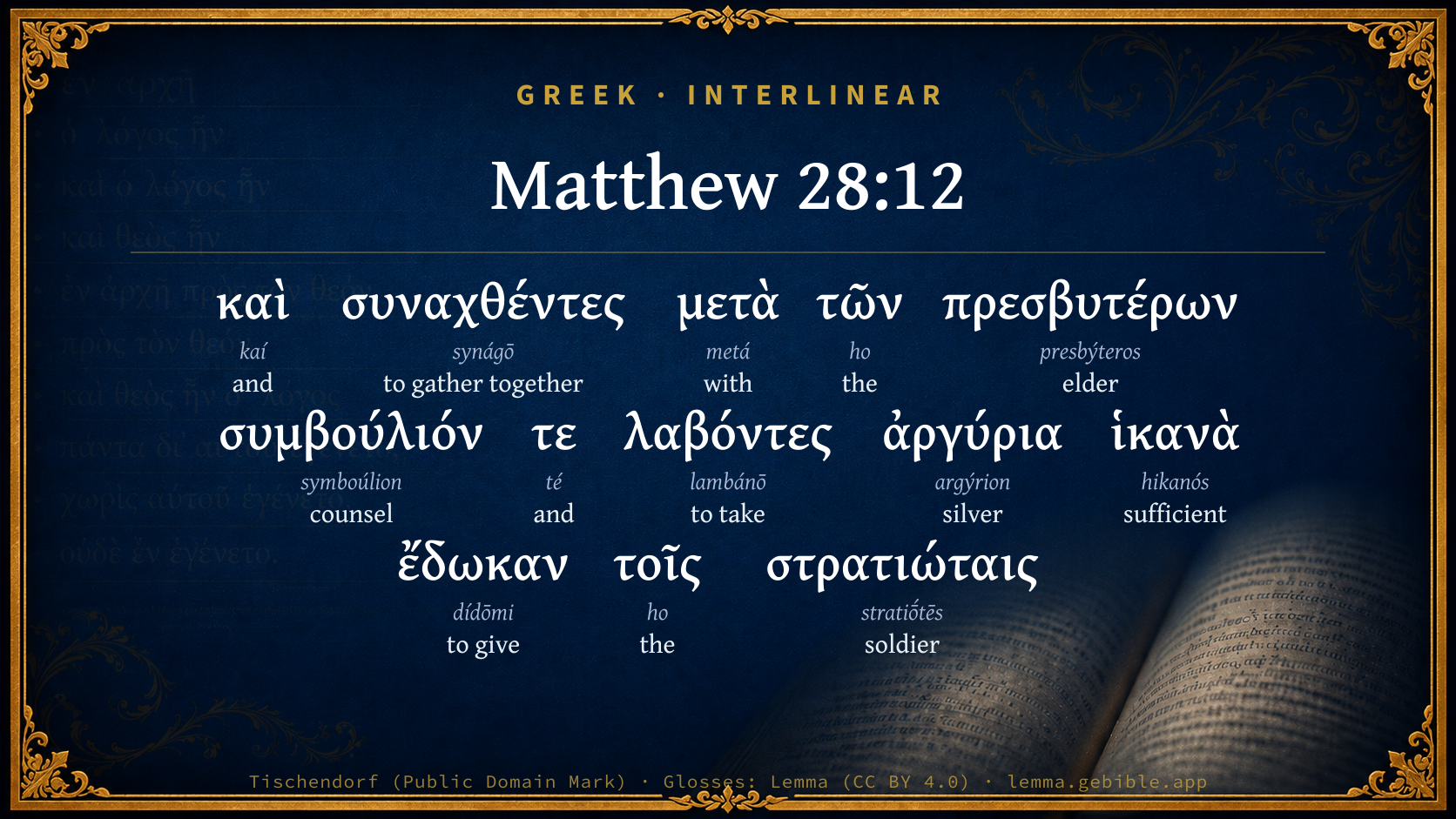
  1. καὶ kaí G2532 “and” Conjunction
  2. συναχθέντες synágō G4863 “to gather together” Verb, Aorist, Passive, Participle, Nominative, Plural, Masculine
  3. μετὰ metá G3326 “with” Preposition
  4. τῶν ho G3588 “the” Article, Genitive, Plural, Masculine
  5. πρεσβυτέρων presbýteros G4245 “elder” Adjective, Genitive, Plural, Masculine, Comparative
  6. τε té G5037 “and” Particle
  7. λαβόντες lambánō G2983 “to take” Verb, Aorist, Active, Participle, Nominative, Plural, Masculine
  8. ἀργύρια argýrion G694 “silver” Noun, Accusative, Plural, Neuter
  9. ἱκανὰ hikanós G2425 “sufficient” Adjective, Accusative, Plural, Neuter
  10. ἔδωκαν dídōmi G1325 “to give” Verb, Aorist, Active, Indicative, 3rd person, Plural
  11. τοῖς ho G3588 “the” Article, Dative, Plural, Masculine
  12. στρατιώταις stratiṓtēs G4757 “soldier” Noun, Dative, Plural, Masculine

About this verse

These counts appear in no published source. They are computed here, from the morphology-tagged text and Lemma’s own curated glosses. What Lemma adds →

13
words
12
distinct lemmas
Gospels
section

Notable vocabulary

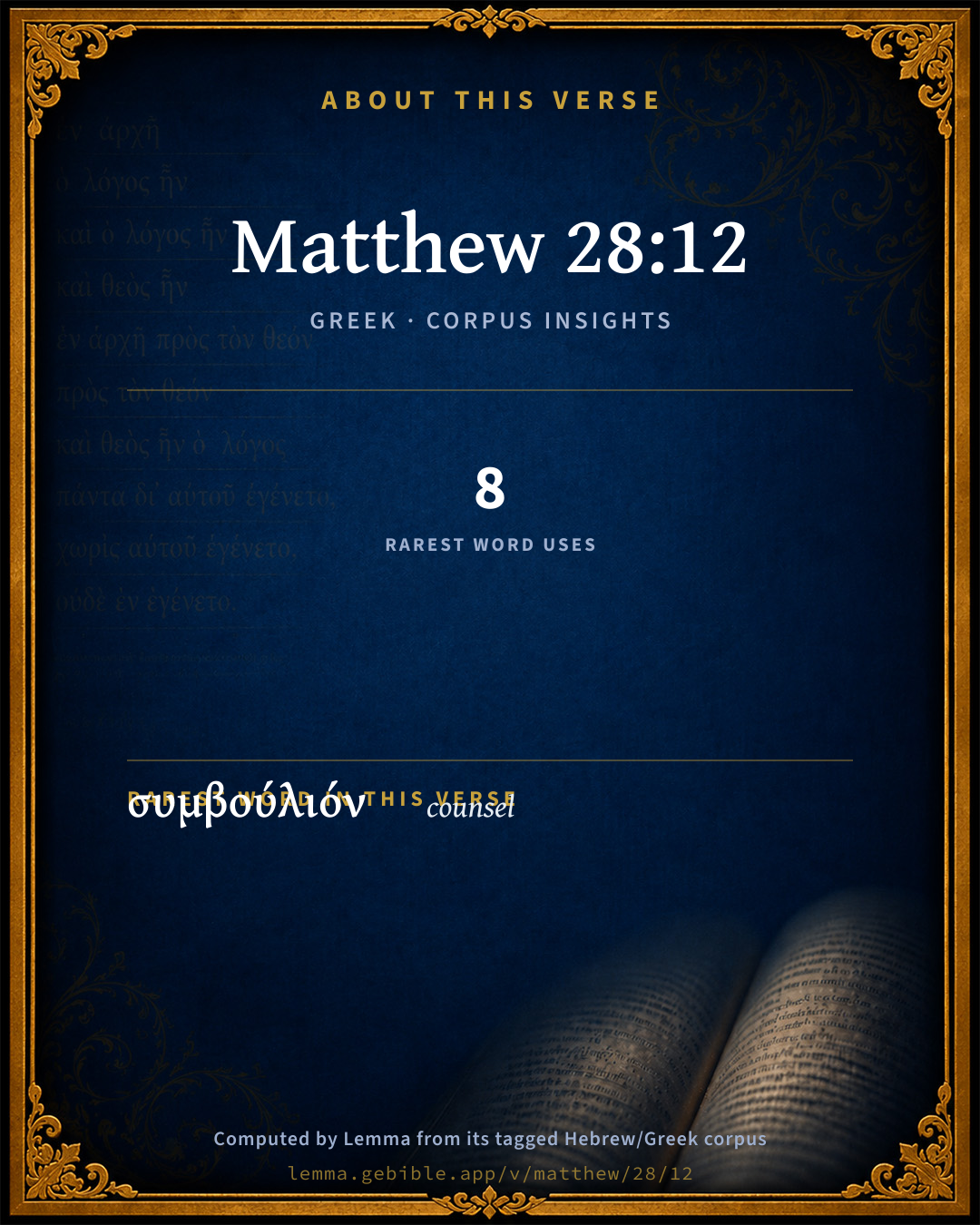
The rarest word here is συμβούλιόν counsel G4824 — appearing just 8 times in the whole Greek New Testament.

Shared distinctive vocabulary

συμβούλιόν counsel G4824 occurs in 8 verses of the Greek New Testament. Also found in:

Repetition

A word recurs within this verse:

Cross-references

9

Topical passages linked to Matthew 28:12 in the Treasury of Scripture Knowledge — connected by theme and wording, ordered by reader-vote popularity; previews shown in the World English Bible.

  • Matthew 26:3–4 Then the chief priests, the scribes, and the elders of the people were gathered together in the court of the high priest, who was called Caiaphas.
  • Matthew 27:1–2 Now when morning had come, all the chief priests and the elders of the people took counsel against Jesus to put him to death:
  • Matthew 27:62–64 Now on the next day, which was the day after the Preparation Day, the chief priests and the Pharisees were gathered together to Pilate,
  • Acts 4:5–22 It happened in the morning, that their rulers, elders, and scribes were gathered together in Jerusalem.
  • Psalms 2:1–7 Why do the nations rage, And the peoples plot a vain thing?
  • John 11:47 The chief priests therefore and the Pharisees gathered a council, and said, "What are we doing? For this man does many signs.
  • John 12:10–11 But the chief priests conspired to put Lazarus to death also,
  • Acts 5:33–34 But they, when they heard this, were cut to the heart, and determined to kill them.
  • Acts 5:40 They agreed with him. Summoning the apostles, they beat them and charged them not to speak in the name of Jesus, and let them go.

Cross-references courtesy of OpenBible.info (CC BY 4.0).

Commentary

Notes on Matthew 28:12 from classic Christian and Jewish commentators (each source and its license shown beneath its notes). The classic Christian expositions comment on the surrounding passage and are grouped to its opening verse, so a note may address several verses; the Jewish commentaries on the Tanakh (Rashi and others) are per-verse, so they appear only where the commentator wrote on this verse.

Lemma curates 59 commentaries, every one of them public domain or Creative Commons licensed, each selected and text-cleaned for this edition rather than reprinted as found. About our sources →

Joseph Benson's Commentary

Mat 28:12-14. And when they were assembled, &c. — The chief priests, having received this report, called the whole senate together, and they consulted among themselves what they should do in this perplexing emergency: and in particular, as may be reasonably supposed, whether they should dismiss the guards with a charge to conceal the story they had told them, or should accuse them to the governor, and attempt to get them punished for neglect of duty. But, considering the manner in which the governor had appeared to be affected toward Jesus, and the many prodigies which had attended his death, and also knowing they had no positive proof of any negligence or treachery in the soldiers; they resolved to decline commencing a prosecution against them, and even to pass the affair over without any complaint; but, apprehending that the most effectual method they could take would be to endeavour to pervert the evidence of these soldiers, they gave them large money, saying, Say ye, His disciples came by night and stole him away while we slept — To prevail with them to propagate this lie, they would doubtless urge, that in whatever way this strange occurrence which they reported might be accounted for, whether by supposing some diabolical operation in the case, or an illusion of their senses, it was necessary for the public safety that it should be concealed, because that otherwise the whole nation would be deluded and undone. The priests certainly could not but foresee what judgment any reasonable persons would form of such a report. At best, it could only be considered as the conjecture of the soldiers, who, by their own confession, being asleep when the supposed fact was said to take place, could tell no more of it than other people; or, if they pretended to say more, it was absurd, for how could they know what was doing, and by whom, while they were asleep? or, knowing it, why did they not prevent it? But this lie implies divers other absurdities: 1st, It was not probable that a Roman guard should be off their watch at all, much less that they should be asleep, since for such a neglect of duty, according to the Roman military laws, if discovered, they would have been liable to be punished with death. 2d, If even some of them had slept, it was not credible that they all should, especially in the open air, and at one time. 3d, If so improbable a thing as that had happened, it was still more incredible that they should all fall into such a sound sleep that not one of them should be awaked by the noise which must necessarily have been made by removing so large a stone, and carrying away the body; neither of which things could possibly have been done silently, or by men walking on tiptoes, to prevent discovery. 4th, It was equally incredible that our Lord’s disciples, or any persons, should have had time to come to the sepulchre to do all this, and return, carrying away the body, without being perceived by any one, and that during the time of the passover, when it was full moon, and when Jerusalem was very full of people, great numbers of whom would doubtless be walking in the suburbs and environs of the city, at all hours of the night.

The absurdity of the tale, that the disciples took away the body, will still further and more clearly appear if we attend to their temper, and some other circumstances of the case. “Far from entertaining any expectation of their Master’s rising again from the dead, they understood none of the predictions which he uttered concerning it. And when they were informed of it by the women, their words appeared to them as idle tales, and they believed them not. Nay, when Jesus himself came and stood in the midst of them, they were terrified, and supposed that they had seen a spirit. In this temper, is it probable that they would form the design of imposing upon the world the belief of their Master’s resurrection; an event which they had not the least expectation of themselves? Further, when Jesus was apprehended, his disciples were so full of fears for their own safety, that they all forsook him and fled. One of the most courageous of them, who followed him into the high-priest’s house, being asked if he was one of his disciples, was so terrified, that he denied three times, and with oaths, his having any knowledge of him. The rest, during his punishment, skulked among the crowd, except John, who ventured to appear among the women at his cross. In the whole, they were only eleven; a handful of men who had not been trained to arms. To suppose that a company of this sort either formed or executed the project of stealing away their Master’s body, from a sepulchre hewn out of a rock, to which there was only one entry, and that guarded by a numerous band of armed soldiers, is altogether improbable. Again, the stealing away of the body by the disciples is absurd for this reason likewise, that though they had, contrary to all probability, been successful in their design, it would have answered no purpose in the world. The disciples had all along considered the Messiah as a great temporal prince; and they had followed their Master in hopes that he would become this great prince, and raise them to the first posts in his kingdom. Accordingly, when they saw him expire on the cross, their hopes were all blasted at once. This they themselves honestly confessed; We trusted that it had been he which should have redeemed Israel. Wherefore, to have stolen away the dead body of their Master, could have served none of the views by which they were now actuated, even though thereby they could have imposed the belief of his resurrection upon the world. It did not raise him to universal dominion; it did not put them in possession of riches or power. And with respect to the use which they made afterward of their Master’s resurrection, in converting the world, they had not the most distant conception of it at the time they fixed for his resurrection. Upon the whole, the stealing away of the body by the disciples while the guards slept, is, in all the lights wherein it can be viewed, the most idle, inconsistent, and improbable story imaginable.” — Macknight.

Joseph Benson's Commentary on the Old and New Testaments (1811–1818) — public domain. Text from a community e-Sword module.

Tyndale Open Study Notes

Tyndale Open Resources

28:12 Such a bribe was contrary to the law (see Exod 20:16; 23:8). • elders: See study note on Matt 21:23.

Tyndale Open Study Notes — © Tyndale Open Resources, licensed CC BY-SA 4.0. Text via the HelloAO Bible API.

Bengel's Gnomon

Johann Albrecht Bengel

Mat 28:12. Ἀργύρια ἱκανὰ, money sufficient) i.e., to corrupt the Roman soldiers, and induce them to lie contrary to the truth, at their own great peril.[1229]

[1229] The greed of gold has more power with them than their fear spoken of in Mat 28:4.—V. g.

Bengel's Gnomon of the New Testament — English translation (T&T Clark, Edinburgh, 1860) — public domain. Text from a community e-Sword module.

Meyer's Critical & Exegetical Commentary

Heinrich August Wilhelm Meyer

Mat_28:12 ff. Συναχθέντες] Change of subject. Winer, p. 586 [E. T. 787].

συμβούλ. τε λαβόντες] after consulting together, as in Mat_12:14, Mat_22:15, Mat_27:1; Mat_27:7. The conjunctive particle τε has the same force as in Mat_27:48, and occurs nowhere else in Matthew; found so much the more frequently in Lukes writings, especially in the Acts.

ἀργύρια] as in Mat_26:15, Mat_27:3; Mat_27:5; Mat_27:9. Silver pieces, a sufficient number of shekels.

εἴπατε, κ.τ.λ.] an infelix astutia (Augustine), seeing that they could not possibly know what had taken place while they were sleeping.

Mat_28:14. ἐπὶ τοῦ ἡγεμόνος] coram procuratore. ἀκούειν is not to be understood, with the majority of expositors, merely in the sense of: to come to the ears of, which is inadmissible on account of ἐπί (for in that case Matthew would have simply written: καὶ ἐὰν ἀκούσῃ τοῦτο ὁ ἡγ, or used the passive with the dative), but in the judicial sense (Joh_7:51; Xen. Cyrop. i. 2. 14, and frequently): if this comes to be inquired into, if an investigation into this matter should take place before the procurator. Erasmus: si res apud illum judicem agatur. Comp. Vatablus and Bleek.

ἡμεῖς] with a self-important emphasis. Comp. ὑμᾶς in the next clause.

πείσομεν αὐτόν] we will persuade him, i.e. satisfy, appease him (see on Gal_1:10), in order, that is, that he may not punish you; see what follows.

ἀμερίμνους] free from all concern (1Co_7:32), and, in the present instance, in the objective sense: free from danger and all unpleasant consequences (Herodian, ii. 4. 3).

Mat_28:15. ὡς ἐδιδάχθ.] as they had been instructed, Herod. iii. 134.

ὁ λόγος οὗτος] not: the whole narrative (Paulus), but, as the context requires (Mat_28:13), this story of the alleged stealing of the body. The industrious circulation of this falsehood is also mentioned by Justin, c. Tr. xvii. 108. For an abominable expansion of it, as quoted from the Toledoth Jeschu, see Eisenmengers entdeckt. Judenth. I. p. 190 ff. For ἡ σήμερον ἡμέρα, see Lobeck, Paral. p. 534.

Meyer — Critical and Exegetical Commentary on the New Testament — English translation by Peter Christie, edited by Frederick Crombie (T&T Clark, 1880) — public domain. Text from a community e-Sword module.

Expositor's Greek Testament

ed. W. Robertson Nicoll

Mat 28:12 . ἀργύρια ; the holy men thoroughly understand the power of money; silver pieces, shekels are meant. ἱκανὰ probably means here a considerable number, not a number sufficient to bribe the soldiers (Meyer and Weiss). They gave with a free hand. This sense of ἱκανός is frequent in the N. T. Vide , e.g. , Mar 10:46 , of the crowd following Jesus at Jericho, and Act 27:9 (of time).

The Expositor's Greek Testament, edited by W. Robertson Nicoll (1897–1910) — public domain. Text from a community e-Sword module.

Jamieson, Fausset & Brown

Robert Jamieson, A. R. Fausset & David Brown

And when they were assembled with the elders--But Joseph at least was absent: Gamaliel probably also; and perhaps others.

and had taken counsel, they gave large money unto the soldiers--It would need a good deal; but the whole case of the Jewish authorities was now at stake. With what contempt must these soldiers have regarded the Jewish ecclesiastics!

Jamieson, Fausset & Brown — Commentary Critical and Explanatory on the Whole Bible (1871) — public domain (CC PDM 1.0). Text via the HelloAO Bible API.

Adam Clarke's Commentary

Verse 12. With the elders] That is, the senators of the great Sanhedrin or Jewish council of state, elsewhere called the elders of the people; they could now meet, as the Sabbath was over.

Adam Clarke's Commentary on the Bible (1810–1826) — public domain. Text from a community e-Sword/MySword module.

Ellicott's Commentary for English Readers

(12) When they were assembled.—Obviously the chief priests to whom the soldiers had told their tale.

And had taken counsel.—Better, as before in Mat_27:1; Mat_27:7, having held a council. It was a formal, though probably, as before, a packed, meeting of the Sanhedrin. They decided on the ready expedients of bribery and falsehood. The fact that the chief priests were Sadducees, and therefore specially interested in guarding against what would appear as a contradiction of their main dogma, must not be forgotten, as in part determining their action. (Comp. Acts 4:42.)

A Bible Commentary for English Readers, edited by Charles John Ellicott (1878–1897) — public domain. Text from a community e-Sword module.

John Gill's Exposition

And when they were assembled with the elders,.... Upon this the grand sanhedrim was convened together, which consisted of the chief priests, Scribes, and elders;

and had taken counsel among themselves what steps to take to stifle this matter, that it might not spread and be believed by the people; they agreed upon this, as the best expedient, to bribe the soldiers to give a false account of it, as they did:

they gave large money unto the soldiers, or "sufficient money"; they gave large sums of money, as were enough to satisfy the soldiers; they gave them whatever they would have; for though these men were very covetous, yet upon this occasion gave liberally; and that perhaps which were for the sacrifices, or for the repair of the temple, or for the supply of the poor.

John Gill's Exposition of the Whole Bible (1746–1763) — public domain (CC PDM 1.0). Text via the HelloAO Bible API.

Trapp's Complete Commentary

John Trapp

12 And when they were assembled with the elders, and had taken counsel, they gave large money unto the soldiers,

Ver. 12. They gave large money] q.d. We know that you soldiers are good fellows, and both love and lack money. Now if you will but say thus and thus, you shall have a round sum paid you down in ready cash, &c. And what will not such men say or do for money? Pecunia avidos fecit forma mendacii industrios, iam illa promissio temerarios, saith Aretius.

John Trapp, A Commentary or Exposition upon All the Books of the Old and New Testament (1647–1656) — public domain. Text from a community e-Sword module.

Albert Barnes' Notes on the Bible

And when they were assembled ... - They deemed the matter of so much importance as to justify the calling together of the great council of the nation. Notwithstanding all their caution, it was plain that the body of Jesus was gone. It was further plain that the disciples would affirm that he was restored to life again. It was not improbable that Jesus would himself appear, and convince multitudes that he was the Messiah, and that the guilt of putting him to death would, after all their caution and cunning, be charged on them. They had been at great pains to procure his death. They had convinced Pilate that he was dead. They had placed a guard for the express purpose of preventing his being taken away. It would be in vain, after this, to pretend that he was not dead; that he was in a swoon; that he died in appearance only. They had shut themselves out from this, which would have been the most plausible plea, and, whatever course they might now adopt, they were obliged to proceed on the admission that he had been really dead, and that all proper measures had been taken to prevent his being stolen. They concluded, after consultation, that but one way was left - to bribe the soldiers - to induce them to tell a falsehood - and to attempt to convince the world that Jesus, in spite of themselves, and in the face of all probability, had been really stolen.

Large money - Much money. This was given to bribe them; to induce them to conceal the truth, and to affirm what they knew was false.

Albert Barnes' Notes on the Bible (1834–1885) — public domain. Text from a community e-Sword/MySword module.

Haydock's Catholic Bible Commentary

Gave a great sum of money. These princes of the Jewish nation still persisting in their malice, refused to turn to their Creator by hearty repentance, and wished to persuade the world that Jesus was not risen, sacrificing that money to falsehood, which was given for the use of the temple. For as they offered Judas 30 pieces of silver to betray his Master, so now they offer a great sum of money to suppress a truth so useful and so necessary for man. (St. Jerome)

George Leo Haydock (1774–1849), Haydock's Catholic Family Bible and Commentary, 1859 edition — public domain. Excludes Psalms (Douay-Rheims chapter numbering differs from Protestant) and Deuterocanonical books (Catholic canon only).

Whedon's Commentary on the Bible

Daniel D. Whedon

12. Assembled with the elders — This was no doubt an informal meeting, not of the full Sanhedrim, but of the special enemies of Jesus. Gave large money — That is, amply sufficient to secure their fidelity. This might not require so very much, for it is plain that their security from punishment for remissness depended on the success of the Jews in keeping Pilate uninformed or propitiated.

Daniel D. Whedon (gen. ed.), Commentary on the Old and New Testaments (1874–1909) — public domain. Text from a community e-Sword module.

The Pulpit Commentary

When they (i.e. the chief priests) were assembled with the elders. On hearing the report of the soldiers, the Sanhedrists held a hurried and informal meeting, to consult about this alarming matter. It would be fatal to their policy to let the real truth get wind. Such testimony from unprejudiced heathens would infallibly convince the people of the validity of Christ"s claims, and produce the very effect which their unusual precautions had been intended to obviate. One course alone remained, and that was to prepare a circumstantial lie concerning one part of the story, and to deny or ignore utterly the supernatural details. The plainest evidence will not persuade against wilful blindness. These rulers acted according to Christ"s sad foreboding on another occasion, "If they hear not Moses and the prophets, neither will they be persuaded, though one rose from the dead". (Luk_16:31) They gave large money (money enough) unto the soldiers. They bribed the soldiers with a sum of money sufficient to satisfy their cupidity. This they did personally, or more probably through some trusty agent. They never doubted the facts to which the guards bore witness; they never attempted to discredit their story by suggestion of error or superstitious invention. They accepted the tale, and took most dishonourable means to make it innocuous. They had bought the aid of the traitor Judas; they now buy the silence of these soldiers. It. is suggested by St. Jerome that in both cases they made use of the temple funds, thus employing against the cause of God that which was devoted to his service.

The Pulpit Commentary (1880–1919), ed. H.D.M. Spence-Jones & Joseph S. Exell — public domain. Text from a community e-Sword module.

The People's New Testament

B. W. Johnson

12. When they were assembled with the elders. The chief priests and the elders, probably a secret meeting of the leading members of the Sanhedrim. They had gone too far into crime to stop.

B. W. Johnson's The People's New Testament with Notes (1889–1891) — public domain. Electronic text from the Christian Classics Ethereal Library (CCEL) ThML edition.

Cambridge Greek Testament for Schools and Colleges

12. ἀργύρια ἱκανά. Many pieces of silver, a largesse.

Cambridge Greek Testament for Schools and Colleges (Cambridge University Press, 1896; 21 vols, various authors incl. Carr, Maclear, Plummer, Farrar, Lumby, Moule, M. R. James, Simcox) — public domain. Text from a community e-Sword module.

Alford’s Greek Testament

Henry Alford

12.] συναχθέντες, i.e. οἱ ἀρχιερεῖς, a change of the subject of the sentence as in Luk 19:4 . This was a meeting of the Sanhedrim, but surely hardly an official and open one; does not the form of the narrative rather imply that it was a secret compact between those (the majority) who were bitterly hostile to Jesus? The circumstance that Joseph had taken no part in their counsel before, leads us to think that others may have withdrawn themselves from the meeting, e.g. Gamaliel, who could hardly have consented to such a measure as this.

Henry Alford, The Greek Testament (1849–1861) — public domain. Text from a community e-Sword module.

International Critical Commentary

12. And being gathered together with the elders, and having taken counsel.]—συμβούλιόν τε λαβόντες] See on 12:14.

(P)

International Critical Commentary — older volumes (1896–1929), various authors — public domain. Text from a community e-Sword module.

Vincent's Word Studies in the New Testament

Marvin R. Vincent

Large money [αργυρια ικανα] . Lit., sufficient money. Enough to bribe them to invent a lie.

Marvin R. Vincent, Word Studies in the New Testament (1887–1900) — public domain. Text from a community e-Sword/MySword module.

Lesson kit

Teaching starters — assembled from the data on this page, not authored interpretation. Every prompt links to the verse data it draws on. Edit before teaching.

Matthew, in the Gospels, opens this verse with 13 words (12 distinct Greek lemmas). Its most distinctive word is symboúlion (“counsel”). A historical commentator’s framing appears above. Read the whole chapter for the surrounding context.

Discussion questions

  1. The word symboúlion carries the sense “counsel.” How does it shape the verse?
  2. How does Matthew 12:14, which shares the word «counsel», read alongside this verse?
  3. What does the repetition of “the” (2× in this one verse) do in this verse?
  4. These translations render this verse differently. What is at stake in choosing one wording over another?
  5. Compare how Joseph Benson's Commentary and Tyndale Open Study Notes read this verse. Where do they agree or differ?

Things to notice

Reading settings

Reading text

Shown beneath each verse's original-language words.

Old Testament
Old Testament edition

Read the OT as the Masoretic Hebrew (MT) or the Greek Septuagint (LXX).

English shown for the Greek Septuagint (in the Hebrew ↔ Greek comparison).

Comparing translations? Open the Compare panel on any verse page to stack up to four side by side.