
Matthew 27:20

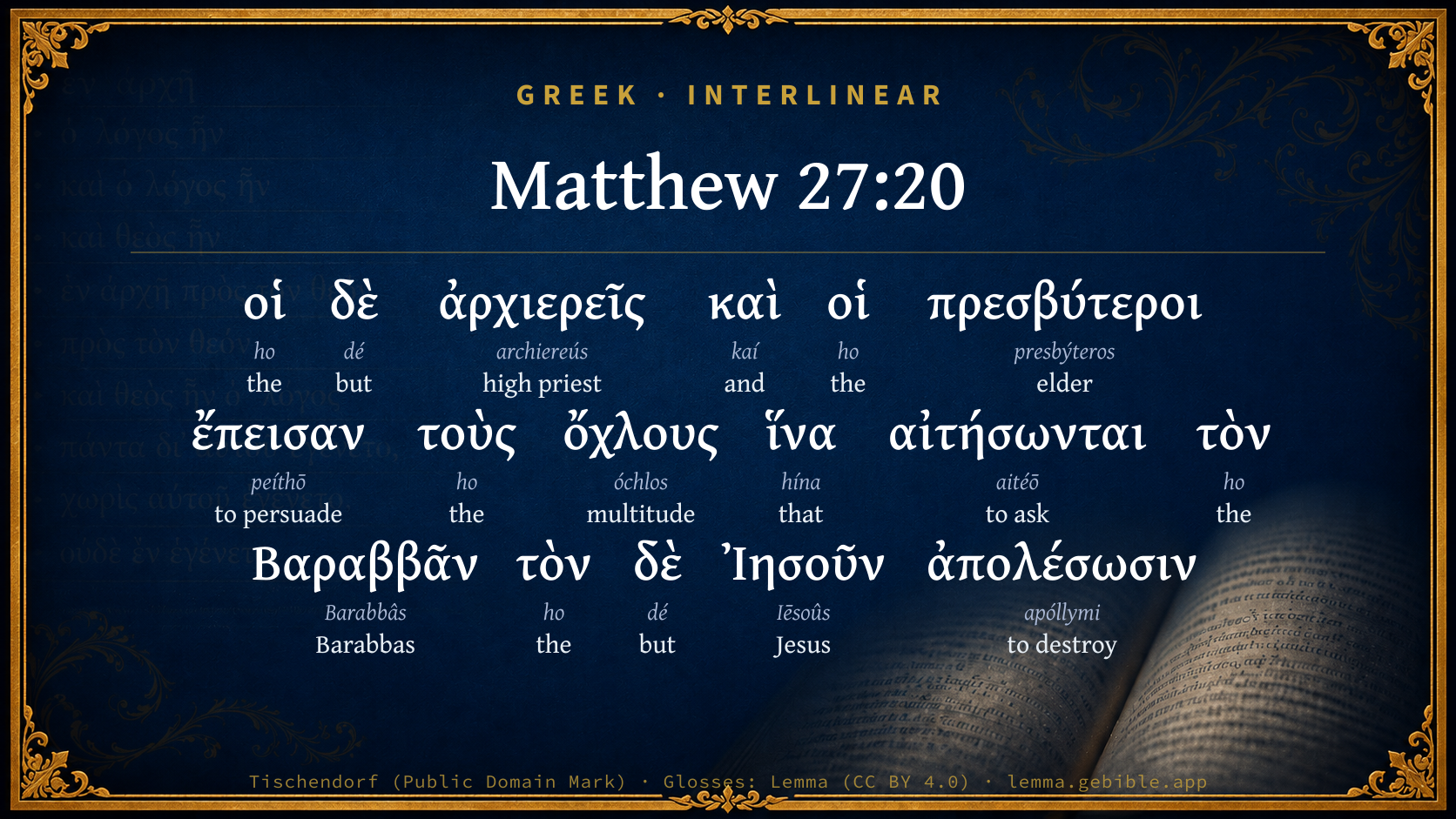
Greek (Tischendorf 8th ed.) Matthew 27:20 appears in the Greek New Testament. The text above is from the Tischendorf 8th edition. Each word links to its Strong’s number and a concise gloss. Click any word for its full Thayer’s Greek Lexicon entry.
Download image
Cite this verse

Matthew 27:20 (World English Bible). Public Domain. Lemma interlinear Bible study tool, https://lemma.gebible.app/v/matthew/27/20.

Show BibTeX & RIS
BibTeX
RIS
English Translation
Now the chief priests and the elders persuaded the multitudes to ask for Barabbas, and destroy Jesus.
World English Bible · Public Domain
Highlights
  • 1 first appearance in the Greek New Testament
Full analysis ↓
Download a study sheet

One document with this verse’s original text, its word-by-word gloss line, the meaning frame, cross-references with their text, attributed commentary, and full source and license credits — printable, and it pastes into notes with its structure intact.

This verse Autodidact and up

Study sheet (.html) Plain text (.txt)

A passage Seminary Student

Up to 50 verses in one chapter. A passage sheet keeps up to 6 commentary sources and 12 cross-references per verse, in the order this page ranks them, and says so on the sheet whenever that leaves anything out. Ask for a single verse and you get the Autodidact verse sheet above.

Everything on this page stays free to read, with no account — the sheet is a download of what is already on screen, not access to it.

Want to remove ads? Support Godless Engineer
Compare translations 3

The same verse in 3 English versions, stacked beneath the original-language interlinear above. Click any original word for its lexicon entry.

Each is an independent rendering of the whole verse — the interlinear is not word-aligned to these translations.

Highlighted words mark where these versions differ — a whole-verse word diff, not a word-by-word alignment.

  • World English Bible Public Domain
    Now the chief priests and the elders persuaded the multitudes to ask for Barabbas, and destroy Jesus.
  • King James Version Public Domain
    But the chief priests and elders persuaded the multitude that they should ask Barabbas, and destroy Jesus.
  • unfoldingWord Literal Text CC BY-SA 4.0
    But the chief priests and the elders persuaded the crowds so that they would ask for Barabbas but would destroy Jesus.

unfoldingWord Literal Text — © unfoldingWord, licensed CC BY-SA 4.0. Word-aligned USFM3 via Door43 (git.door43.org/unfoldingWord/en_ult).

Versions to compare (up to 4)

3 of 4 selected

Show all 19 translations

Every available English version of this verse, each an independent rendering of the whole verse.

  • World English Bible Public Domain
    Now the chief priests and the elders persuaded the multitudes to ask for Barabbas, and destroy Jesus.
  • Berean Standard Bible Public Domain
    But the chief priests and elders persuaded the crowds to ask for Barabbas and to have Jesus put to death.
  • Majority Standard Bible Public Domain
    But the chief priests and elders persuaded the crowds to ask for Barabbas and to have Jesus put to death.
  • King James Version Public Domain
    But the chief priests and elders persuaded the multitude that they should ask Barabbas, and destroy Jesus.
  • American Standard Version (1901) Public Domain
    Now the chief priests and the elders persuaded the multitudes that they should ask for Barabbas, and destroy Jesus.
  • Revised Version (1885) Public Domain
    Now the chief priests and the elders persuaded the multitudes that they should ask for Barabbas, and destroy Jesus.
  • Geneva Bible (1599) Public Domain
    But the chiefe Priestes and the Elders had persuaded the people that they shoulde aske Barabbas, and should destroy Iesus.
  • Douay-Rheims (1899) Public Domain
    But the chief priests and ancients persuaded the people, that they should ask Barabbas, and make Jesus away.
  • Young's Literal Translation Public Domain
    And the chief priests and the elders did persuade the multitudes that they might ask for themselves Barabbas, and might destroy Jesus;
  • Literal Standard Version CC BY-SA 4.0
    And the chief priests and the elders persuaded the multitudes that they might ask for themselves Barabbas, and might destroy Jesus;
  • Unlocked Literal Bible CC BY-SA 4.0
    Now the chief priests and the elders persuaded the crowd to ask for Barabbas, and have Jesus killed.
  • unfoldingWord Literal Text CC BY-SA 4.0
    But the chief priests and the elders persuaded the crowds so that they would ask for Barabbas but would destroy Jesus.
  • Darby Bible Public Domain
    But the chief priests and the elders persuaded the crowds that they should beg for Barabbas, and destroy Jesus.
  • World Messianic Bible Public Domain
    Now the chief priests and the elders persuaded the multitudes to ask for Barabbas and destroy Yeshua.
  • Webster's Bible Public Domain
    But the chief priests and elders persuaded the multitude that they should ask Barabbas, and destroy Jesus.
  • Free Bible Version CC BY-SA 4.0
    But the chief priests and the elders convinced the crowds to ask for Barabbas, and to have Jesus put to death.
  • Bible in Basic English Public Domain
    Now the chief priests and those in authority got the people to make request for Barabbas, and for Jesus to be put to death.
  • Text-Critical English NT CC BY 4.0
    But the chief priests and the elders persuaded the crowds to ask for Barabbas to be released and for Jesus to be executed.
  • Tyndale New Testament (1534) Public Domain
    But the chefe preestes and the elders had parswaded the people that they shulde axe Barrabas and shulde destroye Iesus.

Literal Standard Version (2020), Covenant Press — licensed CC BY-SA 4.0. Text via the HelloAO Bible API (eBible.org). Unlocked Literal Bible (unfoldingWord) — licensed CC BY-SA 4.0. Text via the HelloAO Bible API (eBible.org). unfoldingWord Literal Text — © unfoldingWord, licensed CC BY-SA 4.0. Word-aligned USFM3 via Door43 (git.door43.org/unfoldingWord/en_ult). Free Bible Version, Dr. Jonathan Gallagher — licensed CC BY-SA 4.0. Text via the HelloAO Bible API (eBible.org).

Word by word

More ways to search: Search by grammar → Find every occurrence → Compare this word →

Practice this passage: Drill this verse → Learn its vocabulary →

Βαραββᾶν
Barabbâs
G912
“Barabbas”
Noun, Accusative, Singular, Masculine
Part of Speech
Noun
Case
Accusative
Number
Singular
Gender
Masculine
Full Thayer's Definition

Origin: of Aramaic origin H1247 and H5

TDNT: None

Barabbas = "son of a father or master" 1. the captive robber whom the Jews begged Pilate to release instead of Christ
  1. οἱ ho G3588 “the” Article, Nominative, Plural, Masculine
  2. δὲ dé G1161 “but” Conjunction
  3. ἀρχιερεῖς archiereús G749 “high priest” Noun, Nominative, Plural, Masculine
  4. καὶ kaí G2532 “and” Conjunction
  5. οἱ ho G3588 “the” Article, Nominative, Plural, Masculine
  6. πρεσβύτεροι presbýteros G4245 “elder” Adjective, Nominative, Plural, Masculine, Comparative
  7. ἔπεισαν peíthō G3982 “to persuade” Verb, Aorist, Active, Indicative, 3rd person, Plural
  8. τοὺς ho G3588 “the” Article, Accusative, Plural, Masculine
  9. ὄχλους óchlos G3793 “multitude” Noun, Accusative, Plural, Masculine
  10. ἵνα hína G2443 “that” Conjunction
  11. αἰτήσωνται aitéō G154 “to ask” Verb, Aorist, Middle, Subjunctive, 3rd person, Plural
  12. τὸν ho G3588 “the” Article, Accusative, Singular, Masculine
  13. τὸν ho G3588 “the” Article, Accusative, Singular, Masculine
  14. δὲ dé G1161 “but” Conjunction
  15. Ἰησοῦν Iēsoûs G2424 “Jesus” Noun, Accusative, Singular, Masculine
  16. ἀπολέσωσιν apóllymi G622 “to destroy” Verb, Aorist, Active, Subjunctive, 3rd person, Plural

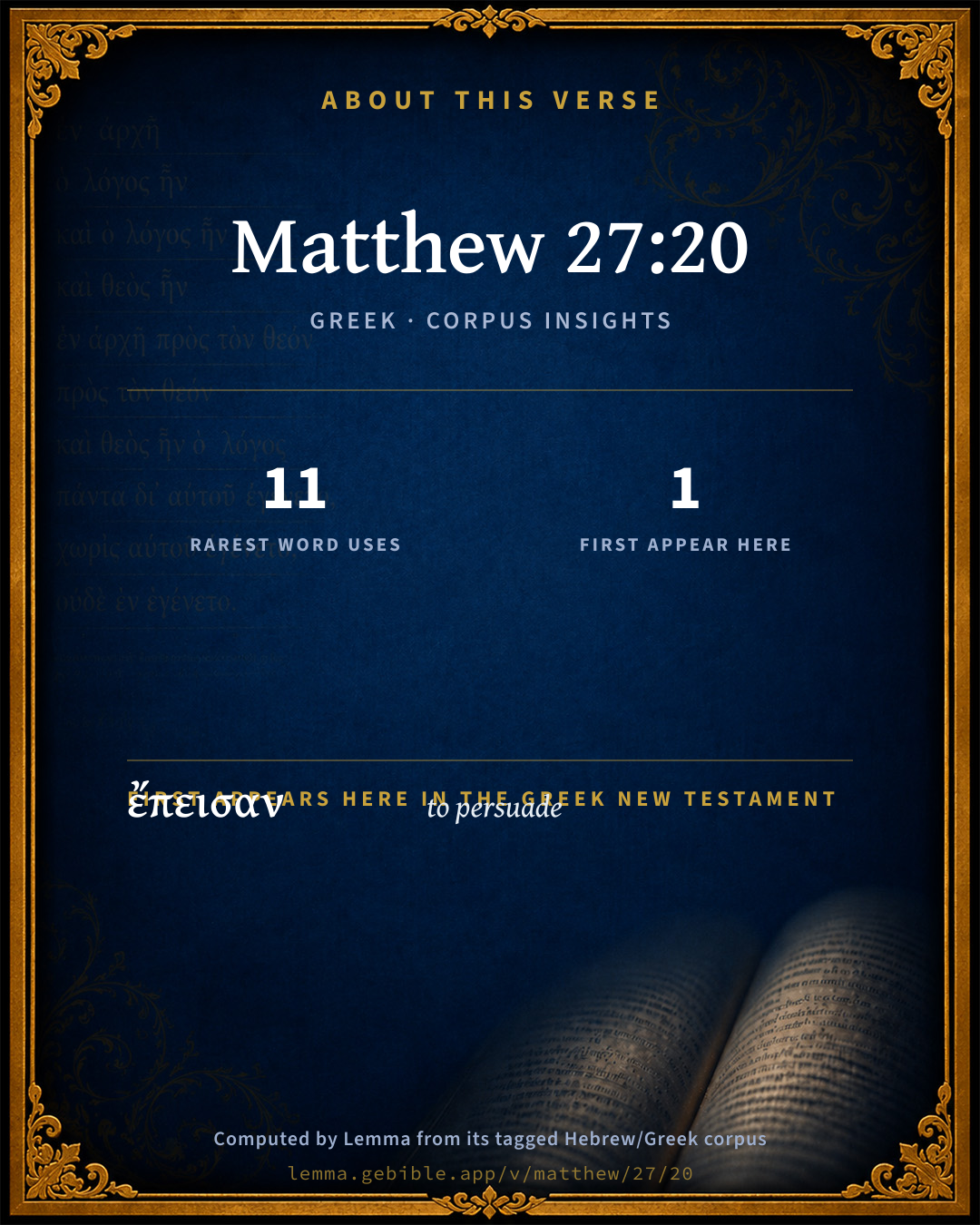
About this verse

These counts appear in no published source. They are computed here, from the morphology-tagged text and Lemma’s own curated glosses. What Lemma adds →

17
words
12
distinct lemmas
Gospels
section

Notable vocabulary

The rarest word here is Βαραββᾶν Barabbas G912 — appearing just 11 times in the whole Greek New Testament.

First appearance in Scripture

This word makes its first canonical appearance in the Greek New Testament here:

  • ἔπεισαν to persuade G3982

Shared distinctive vocabulary

Βαραββᾶν Barabbas G912 occurs in 10 verses of the Greek New Testament. Also found in:
Repetition

Words recur within this verse:

Cross-references

7

Topical passages linked to Matthew 27:20 in the Treasury of Scripture Knowledge — connected by theme and wording, ordered by reader-vote popularity; previews shown in the World English Bible.

  • John 19:15–16 They cried out, "Away with him! Away with him! Crucify him!" Pilate said to them, "Shall I crucify your King?" The chief priests answered, "We have no king but Caesar!"
  • Acts 3:14–15 But you denied the Holy and Righteous One, and asked for a murderer to be granted to you,
  • Mark 15:11 But the chief priests stirred up the multitude, that he should release Barabbas to them instead.
  • John 18:40 Then they all shouted again, saying, "Not this man, but Barabbas!" Now Barabbas was a robber.
  • Luke 23:18–20 But they all cried out together, saying, "Away with this man! Release to us Barabbas!" --
  • Acts 14:18–19 Even saying these things, they hardly stopped the multitudes from making a sacrifice to them.
  • Acts 19:23–29 About that time there arose no small stir concerning the Way.

Cross-references courtesy of OpenBible.info (CC BY 4.0).

Commentary

Notes on Matthew 27:20 from classic Christian and Jewish commentators (each source and its license shown beneath its notes). The classic Christian expositions comment on the surrounding passage and are grouped to its opening verse, so a note may address several verses; the Jewish commentaries on the Tanakh (Rashi and others) are per-verse, so they appear only where the commentator wrote on this verse.

Lemma curates 59 commentaries, every one of them public domain or Creative Commons licensed, each selected and text-cleaned for this edition rather than reprinted as found. About our sources →

The Biblical Illustrator

Joseph S. Exell

Mat_27:20

And destroy Jesus.

The cruel purpose

Moral beauty generally admired, etc. None more lovely than Jesus, and yet He was envied, hated, persecuted, and crucified.

I. The efforts to destroy Jesus (Mat_2:1-17; Luk_4:28). In the final conspiracy hired Judas, etc. (ch. 28). Though put to death, He rose, etc. Since then, Jews, etc., have laboured to destroy Him.

II. Why have they sought to destroy Jesus?

1. Not on account of the viciousness of His life.

2. Nor His opposition to law and order.

3. Nor the evil tendency of His doctrines.

4. Nor the injury He did by His influence (Mat_27:4; Luk_23:14; Mat_27:19).

It was-

1. Enmity to the truth.

2. Envy of His goodness.

3. Hatred of His person.

4. Love of wickedness.

III. How they have failed to destroy Jesus. Herod, Jews, Pilate, though they killed Him. He rose, etc. He lived on in His body, the Church. Trace the history of those destructive attempts down to Strauss and Renan, etc. Jesus is Divine, and cannot be destroyed. He shall live, etc. (Psa_72:15-18). His titles. The enemies of Jesus shall be destroyed. The nations that will not serve Him shall perish. So individuals. Learn:-

1. The baseness of the human heart to try to destroy Jesus.

2. Our obvious duty and interest to accept and honour Christ.

3. He should have our hearts and lives. (J. Burns, D. D.)

Satanic policy defeated

I. The destructible Jesus. To what extent could the purpose of the foes of Jesus succeed? They might succeed in disparaging His character and station before men. Maliciously assaulting the person of Jesus-to this Jesus had long been subjected. Restraining His personal freedom. Silencing His tongue. The torture they applied to His feelings. His crucifixion. Suggestions: In that it was possible for Jesus to die, lies the very basis of our redemption. In the death of Jesus, promises of the deepest import to our race were accomplished. In the death of Jesus lay His most sublime victory for men.

II. The indestructible Jesus. The purpose of Jesuss assailants was an entire and egregious failure. The very body of Jesus recovers its vitality. The Deity that was within the destructible temple they could not touch. They could not frustrate or retard His designs. The violent death of Jesus did not secure the permanence of the old Jewish establishment. Nor did it lead to the destruction of the New Kingdom, or to the dethronement of Jesus. Conclusion: Show who are in sympathy with this unholy purpose, and who are in living sympathy with the Indestructible Jesus. (Anon.)

The Biblical Illustrator, edited by Joseph S. Exell (c. 1880s–1900s) — public domain. Text from a community e-Sword module.

Bengel's Gnomon

Johann Albrecht Bengel

Mat 27:20. Ἔπεισαν, persuaded) by words fair in appearance.—Ἰησοῦν ἀπολέσωσιν, they should destroy Jesus) i.e. they should demand Jesus to be killed.

Bengel's Gnomon of the New Testament — English translation (T&T Clark, Edinburgh, 1860) — public domain. Text from a community e-Sword module.

Meyer's Critical & Exegetical Commentary

Heinrich August Wilhelm Meyer

Mat_27:20 The question of Mat_27:17 is still under the consideration of the assembled crowd; and while Pilate, who had mounted the tribunal for the purpose of hearing their decision, is occupied with the messengers from his wife, the members of the Sanhedrim take advantage of this interruption to persuade the people, etc.

ἵνα] purpose of ἔπεισαν. Ὅπως is likewise used with πείθειν by Greek authors. See Schoem. ad Plut. Cleom. p. 192.

Meyer — Critical and Exegetical Commentary on the New Testament — English translation by Peter Christie, edited by Frederick Crombie (T&T Clark, 1880) — public domain. Text from a community e-Sword module.

Expositor's Greek Testament

ed. W. Robertson Nicoll

Mat 27:20-26 . Result of the appeal to the people .

Mat 27:20 . οἱ δὲ ἀρχ ., etc.: the Sanhedrists saw the danger, and set themselves to bias the popular judgment, not sure what might otherwise happen with success, ἔπεισαν . So when, after due interval, the governor put the question, the reply was (Mat 27:21 ) τὸν Βαραββᾶν , and to the further question what then was to be done with Jesus: the unanimous ( πάντες ) reply was Σταυρωθήτω . Where were the men who had a few days ago shouted Hosanna? If there, how fickle; if absent, why? Or were they silent, cowed by the prevailing mood?

The Expositor's Greek Testament, edited by W. Robertson Nicoll (1897–1910) — public domain. Text from a community e-Sword module.

Adam Clarke's Commentary

Verse 20. Ask Barabbas] Who had raised an insurrection and committed murder - and to destroy Jesus, whose voice was never heard in their streets, and who had, during the space of three years and a half, gone about unweariedly, from village to village, instructing the ignorant, healing the diseased, and raising the dead.

Adam Clarke's Commentary on the Bible (1810–1826) — public domain. Text from a community e-Sword/MySword module.

Ellicott's Commentary for English Readers

(20) The chief priests and elders.—Brief as the statement is it implies much; the members of the Sanhedrin standing before Pilate’s palace, mingling with the crowd, whispering—now to this man, now to that—praises of the robber, scoffs and slander against the Christ. As the next verse shows, they did their work effectively.

A Bible Commentary for English Readers, edited by Charles John Ellicott (1878–1897) — public domain. Text from a community e-Sword module.

The Cambridge Bible for Schools and Colleges

gen. ed. J. J. S. Perowne

20. ask Barabbas, and destroy Jesus] St Peter brings out the full meaning of this choice: “ye denied the Holy One and the Just, and desired a murderer to be granted unto you; and killed the Prince of life” (Act_3:14-15). They saved the murderer, and slew the Saviour.

The Cambridge Bible for Schools and Colleges (gen. ed. J. J. S. Perowne; Cambridge University Press, 1878–1918) — public domain. Text from a community e-Sword module.

John Gill's Exposition

The governor answered and said unto them,.... A second time, after some time had been allowed and taken up to consider of the matter, and which the chief priests and elders improved among the people against Jesus.

Whether of the twain will ye that I release unto you? for as these two were proposed, one of them must be released; and it lay in the breast of the people to choose which they would:

they said, Barabbas; so that Christ was not only numbered among, and reckoned with transgressors, but he was accounted worse than the worst of them; a seditious person, a robber, and a murderer was preferred before him: see Act 3:14.

John Gill's Exposition of the Whole Bible (1746–1763) — public domain (CC PDM 1.0). Text via the HelloAO Bible API.

Trapp's Complete Commentary

John Trapp

20 But the chief priests and elders persuaded the multitude that they should ask Barabbas, and destroy Jesus.

Ver. 20. The chief priests and elders persuaded] And prevailed. See then how needful it is that we pray for good governors; Jeroboam made Israel to sin; Peter compelled the Gentiles to Judaize, Gal 2:14. As the corruption of a fish begins at the head, and as in a beast the whole body follows the head, so are the people overruled by their rulers.

John Trapp, A Commentary or Exposition upon All the Books of the Old and New Testament (1647–1656) — public domain. Text from a community e-Sword module.

Haydock's Catholic Bible Commentary

That they should ask Barabbas. All, therefore, that resemble the Jews in either theory or practice, desire to have Barabbas loosed to them; all therefore, that seek after iniquity, ask for Barabbas, and put Jesus away. But all who walk in the paths of virtue, ask for Jesus, and destroy Barabbas. Pilate wishing on this occasion to shew the Jews the enormity of their crime, again puts the question, which will you have of the two? And again, What shall I do with Jesus, who is called Christ? But, they being enraged that Pilate should declare Jesus to be the Christ, all in the frantic fury exclaimed, Let him be crucified. (Origen)

George Leo Haydock (1774–1849), Haydock's Catholic Family Bible and Commentary, 1859 edition — public domain. Excludes Psalms (Douay-Rheims chapter numbering differs from Protestant) and Deuterocanonical books (Catholic canon only).

Whedon's Commentary on the Bible

Daniel D. Whedon

20. Chief priests and elders persuaded — The people had been upon his side. They had brought him into Jerusalem with triumph, while the rulers were compelled to hide their heads in low murmurs. They dared not openly apprehend him, for fear of the people; but taking him secretly, and surrendering him with all the appendages of a culprit guilty of something, the people are induced to consider him as a deceiver and blasphemer and traitor. The very fact that he is there in fetters seems to prove that he is not divine, and so make out that he was a deceiver, who had claimed to be the Son of God. Nevertheless, when it comes to the point that he shall not be demanded for release, but the outlaw shall be preferred before him, it takes a fresh onset of persuasion to induce the people to take that step.

Doubtless the friends of Jesus were mostly absent, frightened away by this fearful revolution.

Daniel D. Whedon (gen. ed.), Commentary on the Old and New Testaments (1874–1909) — public domain. Text from a community e-Sword module.

The Pulpit Commentary

But the chief priests and elders persuaded the multitude. For a short time the people appear to have wavered in their choice, and Pilate had hopes that his stratagem worked well. But the Sanhedrists were at hand with their insidious suggestions; not a voice was raised for Christ; all his friends were scattered or silenced; and his enemies easily swayed the fickle crowd. That they should ask (ask for) Barabbas, and destroy Jesus. By directing popular favour to Barabbas, they could make the condemnation of Jesus more certain. The expression in the Greek implies that they used their persuasive powers in order that (ina) the people should demand the release of Barabbas, and compass the death of Jesus.

The Pulpit Commentary (1880–1919), ed. H.D.M. Spence-Jones & Joseph S. Exell — public domain. Text from a community e-Sword module.

Kretzmann's Popular Commentary

Paul E. Kretzmann

The progress of the trial:

v. 20. But the chief priests and elders persuaded the multitude that they should ask Barabbas, and destroy Jesus.

v. 21. The governor answered and said unto them, Whether of the twain will ye that I release unto you? They said, Barabbas.

v. 22. Pilate saith unto them, What shall I do, then, with Jesus which is called Christ? They all say unto him, Let Him be crucified.

v. 23. And the governor said, Why, what evil hath He done? But they cried out the more, saying, Let Him be crucified.

The fact that Pilate had placed Jesus on a level with Barabbas had been a concession to the Jews, for it placed an innocent man in the same class with a criminal, while in reality there was no comparison. The Jews felt the weakness of Pilate’s position and were not slow about taking advantage of it. The chief priests sent their messengers through the crowd to incite the passions ever more strongly. There was not much persuasion needed; a mob is easily swayed, especially when deeds of violence are contemplated. When Pilate therefore put the question to them as to their choice between the two men, they called loudly for the release of the guilty one. Many of the members of this crowd may have been more than half convinced a few short days before that Jesus was a great prophet, if nothing more, but under the skillful prodding of the Sanhedrin’s agents they take the part of the enemies of Christ. They have an answer even for Pilate’s somewhat perplexed inquiry as to how he was to dispose of Jesus. With increasing volume their hoarse cry rolled down through the narrow streets: Let Him be crucified! And upon Pilate’s inane and futile inquiry: What evil has He done, anyway? they realized more strongly than ever that they had the governor in their power. It was no longer a question of Christ’s guilt or innocence, but of yielding to the demand of the rabble and the threats of the elders and chief priests. The uproar increased from one minute to the next, and the governor was unable to cope with the situation.

Paul E. Kretzmann, Popular Commentary of the Bible (1921–1924) — public domain. Text from a community e-Sword module.

Burkitt's Expository Notes on the New Testament

William Burkitt

Observe here, 1. How exceedingly unwilling and averse Pilate was to be the instrument of our Saviour’s death; one while he bids the Jews take him themselves, and judge him according to their law; another while he offers to save Christ in honour of their feast, when by custom he was to release a prisoner, and this prisoner he desired might be Jesus. When this would not satisfy, he expostulates with them about our Saviour’s innocency, What evil has he done? Nay says, Luk 23:22 That Pilate came forth three times, and professed that he found no fault in him. Yet though Pilate was satisfied, the Jews would not be denied.

Thence learn, That wicked men and hypocrites within the visible church, may be guilty of such tremendous acts of wickedness, as the conscience of infidels and pagans without the church may boggle at, and protest against. Pilate, a pagan absolves Christ, whilst hypocritical Jews which had heard his doctrine, and seen his miracles, condemn him.

But observe, 2. Who influenced the main body of the Jew to desire Barabbas, and to destroy Jesus? It was the chief priests and elders, they persuaded the multitude. Woe unto the people, when their guides and leaders are corrupt for then they shall be tempted by wicked counsel; and woe unto them, much more, if they follow their wicked and pernicious counsels. Thus did the Jews follow their guides, the chief priests, till they had preserved Barabbas, and destroyed Jesus.

William Burkitt's Expository Notes on the New Testament (1700–1703) — public domain. Text from a community e-Sword module.

The People's New Testament

B. W. Johnson

20. Persuaded the multitudes. To call for the release of Barabbas, instead of Christ. It is likely that few of the Galileans, so favorable to him, yet knew of his arrest. “The multitudes” were such as the authorities would summon at this early hour.

B. W. Johnson's The People's New Testament with Notes (1889–1891) — public domain. Electronic text from the Christian Classics Ethereal Library (CCEL) ThML edition.

unfoldingWord translationNotes

Door43 World Missions Community

Now ... Jesus killed

Here "now" is used to mark a break in the main story line. Matthew tells background information about why the crowd chose Barabbas. (See: Background Information)

have Jesus killed

This can be stated in active form. AT: "have the Roman soldiers kill Jesus" (See: Active or Passive)

asked them

"asked the crowd"

who is called Christ

This can be stated in active form. AT: "whom some people call the Christ" (See: Active or Passive)

translationWords

chief priests

Barabbas

crucify

unfoldingWord translationNotes — © Distant Shores Media and the Door43 World Missions Community, licensed CC BY-SA 4.0. Source: git.door43.org/Door43/en_tn.

Cambridge Greek Testament for Schools and Colleges

20. ἵνα αἰτήσωνται κ.τ.λ. St Peter brings out the full meaning of this choice: ‘ye denied the Holy One and the Just, and desired a murderer to be granted unto you; and killed the Prince of life’ (Act 3:14-15). They saved the murderer, and slew the Saviour.

Cambridge Greek Testament for Schools and Colleges (Cambridge University Press, 1896; 21 vols, various authors incl. Carr, Maclear, Plummer, Farrar, Lumby, Moule, M. R. James, Simcox) — public domain. Text from a community e-Sword module.

Alford’s Greek Testament

Henry Alford

20.] So Mark also. Luke and John merely give, that they all cried out, &c. The exciting of the crowd seems to have taken place while Pilate was receiving the message from his wife.

ἵνα conveys a mixture of the purport with the purpose of the ἔπεισαν. See note on 1Co 14:13.

Henry Alford, The Greek Testament (1849–1861) — public domain. Text from a community e-Sword module.

International Critical Commentary

(M) 20. And the chief priests and the elders persuaded the multitudes that they should ask for Barabbas, and destroy Jesus.] Mk. has: “And the chief priests moved the people that he should rather release Barabbas to them.” For the insertion of καὶ οἱ πρεσβύτεροι, cf. v. 12.—τοὺς ὄχλους plur. for Mk.’s sing., as often. See Introduction, p. lxxxvi.—ἔπεισαν] for Mk.’s ἀνέσεισαν, which is late and uncommon in the sense to “incite.” Add to references in lexx. ἀνασίομενοι = being “incited,” Teb. Pap. 28, 20 (b.c. 114).

International Critical Commentary — older volumes (1896–1929), various authors — public domain. Text from a community e-Sword module.

Lesson kit

Teaching starters — assembled from the data on this page, not authored interpretation. Every prompt links to the verse data it draws on. Edit before teaching.

Matthew, in the Gospels, opens this verse with 17 words (12 distinct Greek lemmas). Its most distinctive word is Barabbâs (“Barabbas”). A historical commentator’s framing appears above. Read the whole chapter for the surrounding context.

Discussion questions

  1. The word Barabbâs carries the sense “Barabbas.” How does it shape the verse?
  2. This is the first place “to persuade” appears in Scripture (first appears here). What does its debut here establish?
  3. How does Matthew 27:16, which shares the word «Barabbas», read alongside this verse?
  4. What does the repetition of “the” (5× in this one verse) do in this verse?
  5. The translations on this page render this verse differently — a whole-verse word diff, not a word-by-word alignment. What might account for the different wordings?
  6. Compare how The Biblical Illustrator and Bengel's Gnomon read this verse. Where do they agree or differ?

Things to notice

  • 1 word makes its first canonical appearance in Scripture here.
  • These translations choose different wording for 6 words in this verse.
  • “the” occurs 5× in this single verse.
  • 12 distinct Greek lemmas span 17 words in this verse.

Reading settings

Reading text

Shown beneath each verse's original-language words.

Old Testament
Old Testament edition

Read the OT as the Masoretic Hebrew (MT) or the Greek Septuagint (LXX).

English shown for the Greek Septuagint (in the Hebrew ↔ Greek comparison).

Comparing translations? Open the Compare panel on any verse page to stack up to four side by side.