Mark 3:2

Greek (Tischendorf 8th ed.) Mark 3:2 appears in the Greek New Testament. The text above is from the Tischendorf 8th edition. Each word links to its Strong’s number and a concise gloss. Click any word for its full Thayer’s Greek Lexicon entry.
Download image
Cite this verse

Mark 3:2 (World English Bible). Public Domain. Lemma interlinear Bible study tool, https://lemma.gebible.app/v/mark/3/2.

Show BibTeX & RIS
BibTeX
RIS
English Translation
They watched him, whether he would heal him on the Sabbath day, that they might accuse him.
World English Bible · Public Domain
Highlights
  • 1 first appearance in the Greek New Testament
Full analysis ↓
Download a study sheet

One document with this verse’s original text, its word-by-word gloss line, the meaning frame, cross-references with their text, attributed commentary, and full source and license credits — printable, and it pastes into notes with its structure intact.

This verse Autodidact and up

Study sheet (.html) Plain text (.txt)

A passage Seminary Student

Up to 50 verses in one chapter. A passage sheet keeps up to 6 commentary sources and 12 cross-references per verse, in the order this page ranks them, and says so on the sheet whenever that leaves anything out. Ask for a single verse and you get the Autodidact verse sheet above.

Everything on this page stays free to read, with no account — the sheet is a download of what is already on screen, not access to it.

Want to remove ads? Support Godless Engineer
Compare translations 3

The same verse in 3 English versions, stacked beneath the original-language interlinear above. Click any original word for its lexicon entry.

Each is an independent rendering of the whole verse — the interlinear is not word-aligned to these translations.

Highlighted words mark where these versions differ — a whole-verse word diff, not a word-by-word alignment.

  • World English Bible Public Domain
    They watched him, whether he would heal him on the Sabbath day, that they might accuse him.
  • King James Version Public Domain
    And they watched him, whether he would heal him on the sabbath day; that they might accuse him.
  • unfoldingWord Literal Text CC BY-SA 4.0
    And they were watching him closely, if he will heal him on the Sabbaths, so that they might accuse him.

unfoldingWord Literal Text — © unfoldingWord, licensed CC BY-SA 4.0. Word-aligned USFM3 via Door43 (git.door43.org/unfoldingWord/en_ult).

Versions to compare (up to 4)

3 of 4 selected

Show all 19 translations

Every available English version of this verse, each an independent rendering of the whole verse.

  • World English Bible Public Domain
    They watched him, whether he would heal him on the Sabbath day, that they might accuse him.
  • Berean Standard Bible Public Domain
    In order to accuse Jesus, they were watching to see if He would heal on the Sabbath.
  • Majority Standard Bible Public Domain
    In order to accuse Jesus, they were watching to see if He would heal on the Sabbath.
  • King James Version Public Domain
    And they watched him, whether he would heal him on the sabbath day; that they might accuse him.
  • American Standard Version (1901) Public Domain
    And they watched him, whether he would heal him on the sabbath day; that they might accuse him.
  • Revised Version (1885) Public Domain
    And they watched him, whether he would heal him on the sabbath day; that they might accuse him.
  • Geneva Bible (1599) Public Domain
    And they watched him, whether he would heale him on the Sabbath day, that they might accuse him.
  • Douay-Rheims (1899) Public Domain
    And they watched him whether he would heal on the sabbath days; that they might accuse him.
  • Young's Literal Translation Public Domain
    and they were watching him, whether on the sabbaths he will heal him, that they might accuse him.
  • Literal Standard Version CC BY-SA 4.0
    and they were watching Him, whether on the Sabbaths He will heal him, that they might accuse Him.
  • Unlocked Literal Bible CC BY-SA 4.0
    Some people watched him closely to see if he would heal him on the Sabbath so that they could accuse him.
  • unfoldingWord Literal Text CC BY-SA 4.0
    And they were watching him closely, if he will heal him on the Sabbaths, so that they might accuse him.
  • Darby Bible Public Domain
    And they watched him if he would heal him on the sabbath, that they might accuse him.
  • World Messianic Bible Public Domain
    They watched him, whether he would heal him on the Sabbath day, that they might accuse him.
  • Webster's Bible Public Domain
    And they watched him, to see whether he would heal him on the sabbath; that they might accuse him.
  • Free Bible Version CC BY-SA 4.0
    Some of those there were watching Jesus to see if he would heal the man on the Sabbath, because they were looking for a reason to accuse him of breaking the law.
  • Bible in Basic English Public Domain
    And they were watching him to see if he would make him well on the Sabbath day, so that they might have something against him.
  • Text-Critical English NT CC BY 4.0
    Now the Pharisees were watching Jesus closely to see if he would heal the man on the Sabbath, so that they could accuse him.
  • Tyndale New Testament (1534) Public Domain
    And they watched him to se whether he wolde heale him on the Saboth daye that they might accuse him.

Literal Standard Version (2020), Covenant Press — licensed CC BY-SA 4.0. Text via the HelloAO Bible API (eBible.org). Unlocked Literal Bible (unfoldingWord) — licensed CC BY-SA 4.0. Text via the HelloAO Bible API (eBible.org). unfoldingWord Literal Text — © unfoldingWord, licensed CC BY-SA 4.0. Word-aligned USFM3 via Door43 (git.door43.org/unfoldingWord/en_ult). Free Bible Version, Dr. Jonathan Gallagher — licensed CC BY-SA 4.0. Text via the HelloAO Bible API (eBible.org).

Word by word

More ways to search: Search by grammar → Find every occurrence → Compare this word →

Practice this passage: Drill this verse → Learn its vocabulary →

παρετήρουν
paratēréō
G3906
“to watch carefully”
Verb, Imperfect, Active, Indicative, 3rd person, Plural
Part of Speech
Verb
Tense
Imperfect
Voice
Active
Mood
Indicative
Person
3rd person
Number
Plural
Full Thayer's Definition

Origin: from G3844 and G5083

TDNT: 10:26,1

1. to stand beside and watch, to watch assiduously, observe carefully a. to watch, attend to with the eyes b. of auguries, to see what he is going to do c. in a bad sense, to watch insidiously d. to watch one's self e. to observe, keep scrupulously 1. to neglect nothing requisite to the religious observance of
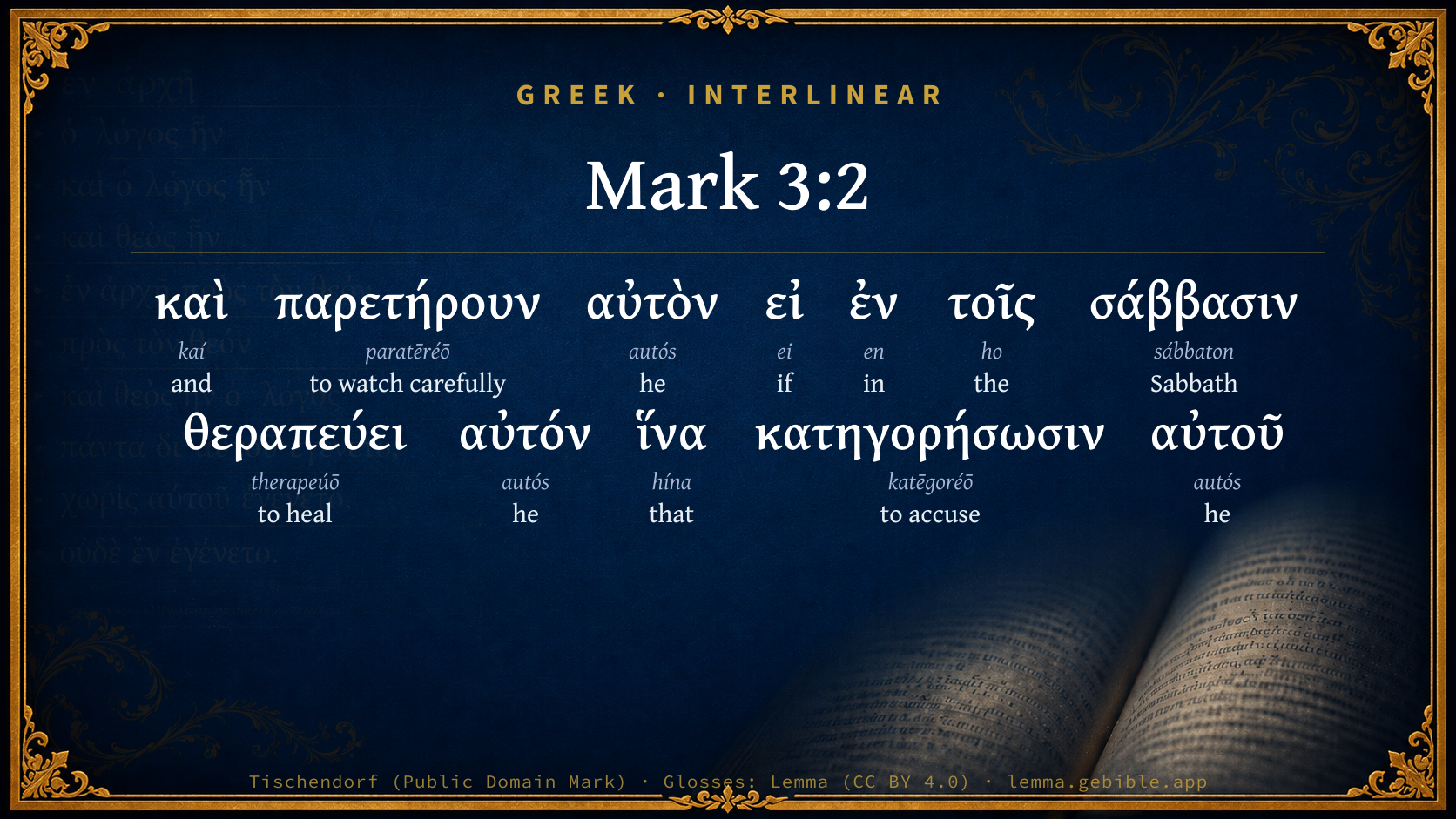
  1. καὶ kaí G2532 “and” Conjunction
  2. αὐτὸν autós G846 “he” Personal pronoun, Accusative, Singular, Masculine
  3. εἰ ei G1487 “if” Conditional
  4. ἐν en G1722 “in” Preposition
  5. τοῖς ho G3588 “the” Article, Dative, Plural, Neuter
  6. σάββασιν sábbaton G4521 “Sabbath” Noun, Dative, Plural, Neuter
  7. θεραπεύει therapeúō G2323 “to heal” Verb, Present, Active, Indicative, 3rd person, Singular
  8. αὐτόν autós G846 “he” Personal pronoun, Accusative, Singular, Masculine
  9. ἵνα hína G2443 “that” Conjunction
  10. κατηγορήσωσιν katēgoréō G2723 “to accuse” Verb, Aorist, Active, Subjunctive, 3rd person, Plural
  11. αὐτοῦ autós G846 “he” Personal pronoun, Genitive, Singular, Masculine

About this verse

These counts appear in no published source. They are computed here, from the morphology-tagged text and Lemma’s own curated glosses. What Lemma adds →

12
words
10
distinct lemmas
Gospels
section

Notable vocabulary

The rarest word here is παρετήρουν to watch carefully G3906 — appearing just 6 times in the whole Greek New Testament.

First appearance in Scripture

This word makes its first canonical appearance in the Greek New Testament here:

  • παρετήρουν to watch carefully G3906

Shared distinctive vocabulary

παρετήρουν to watch carefully G3906 occurs in 6 verses of the Greek New Testament. Also found in:

Repetition

A word recurs within this verse:

  • αὐτὸν he G846 ×3

Cross-references

10

Topical passages linked to Mark 3:2 in the Treasury of Scripture Knowledge — connected by theme and wording, ordered by reader-vote popularity; previews shown in the World English Bible.

  • Psalms 37:32 The wicked watches the righteous, And seeks to kill him.
  • Luke 6:7 The scribes and the Pharisees watched him, to see whether he would heal on the Sabbath, that they might find an accusation against him.
  • Luke 14:1 It happened, when he went into the house of one of the rulers of the Pharisees on a Sabbath to eat bread, that they were watching him.
  • Luke 20:20 They watched him, and sent out spies, who pretended to be righteous, that they might trap him in something he said, so as to deliver him up to the power and authority of the governor.
  • Daniel 6:4 Then the presidents and the satraps sought to find occasion against Daniel as touching the kingdom; but they could find no occasion nor fault, because he was faithful, neither was there any error or fault found in him.
  • Luke 11:53–54 As he said these things to them, the scribes and the Pharisees began to be terribly angry, and to draw many things out of him;
  • Isaiah 29:20–21 For the terrible one is brought to nothing, and the scoffer ceases, and all those who watch for iniquity are cut off;
  • Jeremiah 20:10 For I have heard the defaming of many, terror on every side. Denounce, and we will denounce him, [say] all my familiar friends, those who watch for my fall; peradventure he will be persuaded, and we shall prevail against him, and we shall take our revenge on him.
  • Matthew 12:10 And behold there was a man with a withered hand. They asked him, "Is it lawful to heal on the Sabbath day?" that they might accuse him.
  • John 9:16 Some therefore of the Pharisees said, "This man is not from God, because he doesn't keep the Sabbath." Others said, "How can a man who is a sinner do such signs?" There was division among them.

Cross-references courtesy of OpenBible.info (CC BY 4.0).

Commentary

Notes on Mark 3:2 from classic Christian and Jewish commentators (each source and its license shown beneath its notes). The classic Christian expositions comment on the surrounding passage and are grouped to its opening verse, so a note may address several verses; the Jewish commentaries on the Tanakh (Rashi and others) are per-verse, so they appear only where the commentator wrote on this verse.

Lemma curates 59 commentaries, every one of them public domain or Creative Commons licensed, each selected and text-cleaned for this edition rather than reprinted as found. About our sources →

Trapp's Complete Commentary

John Trapp

2 And they watched him, whether he would heal him on the sabbath day; that they might accuse him.

Ver. 2. And they watched him] So carnal men do still watch and pry into professors and their conversation, εποπτευοντες, 1Pe 3:2, curiously observing what they may catch and carp at. But it is a brave thing to throttle envy, to stop an evil mouth, to deny them occasion to blaspheme, as Christ did; to lead convincing lives, as Bradford and Bucer did, whom neither their friends could sufficiently praise, nor their foes find anything to fasten on. (Acts and Mon.)

John Trapp, A Commentary or Exposition upon All the Books of the Old and New Testament (1647–1656) — public domain. Text from a community e-Sword module.

Bengel's Gnomon

Johann Albrecht Bengel

Mar 3:2. Παρετήρουν, they were watching) Obliquely and secretly. On the immediately preceding Sabbath they had heard His doctrine concerning the Sabbath.

Bengel's Gnomon of the New Testament — English translation (T&T Clark, Edinburgh, 1860) — public domain. Text from a community e-Sword module.

Expositor's Greek Testament

ed. W. Robertson Nicoll

Mar 3:2 . παρετήρουν , they were watching Him; who, goes without saying: the same parties, i.e. , men of the same class, as those who figure in the last section. This time bent on finding Jesus Himself at fault in re the Sabbath, instinctively perceiving that His thoughts on the subject must be wholly diverse from theirs.

The Expositor's Greek Testament, edited by W. Robertson Nicoll (1897–1910) — public domain. Text from a community e-Sword module.

Adam Clarke's Commentary

Verse 2. They watched him] παρετηρουν αυτον, they maliciously watched him. See Clarke on Lu 14:1.

Adam Clarke's Commentary on the Bible (1810–1826) — public domain. Text from a community e-Sword/MySword module.

The Cambridge Bible for Schools and Colleges

gen. ed. J. J. S. Perowne

2. they watched him] The same company of Scribes and Pharisees had gathered together from Judæa, Jerusalem, and Galilee itself (Luk_5:17), to find matter of accusation against Him. They watched Him with no friendly purpose. The word itself signifies stratagem and hostility: comp. Luk_20:20, “And they watched Him and sent forth spies:” Act_9:24, “And they watched the gates day and night to kill him.”

The Cambridge Bible for Schools and Colleges (gen. ed. J. J. S. Perowne; Cambridge University Press, 1878–1918) — public domain. Text from a community e-Sword module.

John Gill's Exposition

And they watched him,.... The ruler of the synagogue, and the principal men in it; particularly the Scribes and Pharisees, who followed him wherever he went; they observed him diligently, and kept their eyes upon him; this lame man being in the synagogue, to see

whether he would heal him on the sabbath day; which, knowing his readiness to do good, they might expect he would:

that they might accuse him; as they had accused his disciples before, of the violation of the sabbath: according to the Evangelist Matthew, they put a question to him, whether it was lawful to heal on the sabbath day? with this view, that they might, one way or another, have something to accuse him of, either to the people, or to the sanhedrim; See Gill on Mat 12:10.

John Gill's Exposition of the Whole Bible (1746–1763) — public domain (CC PDM 1.0). Text via the HelloAO Bible API.

Whedon's Commentary on the Bible

Daniel D. Whedon

2. Watched him — Kept their eye fixed upon him to detect something which they might construe to an evil meaning. It is thus that some minds place themselves when they come to view religion. They scan it, not to know the true will of God, and their duty in his sight, but to see if some ground of perversion cannot be found.

Daniel D. Whedon (gen. ed.), Commentary on the Old and New Testaments (1874–1909) — public domain. Text from a community e-Sword module.

The Pulpit Commentary

The scribes had already the evidence that our Lord had permitted his disciples to rub the ears of corn on the sabbath day. But this was the act of the disciple, not his. What he was now preparing to do was an act of miraculous power. And here the ease was stronger, because work, which was prohibited under pain of death by the Law, (Exo_31:14) was understood to include every act not absolutely necessary.

HOMILIES BY A. ROWLAND Ver. 2. A miracle of healing.

The cure of the man with a withered hand was more obviously a supernatural work than sudden recovery from a fever, so that we need not wonder at the excitement it aroused. But it was only an example of many similar works, and as such we propose to consider it.

I THE MIRACLE WHICH JESUS DID.

1. It was a removal of bodily infirmity. Although the Son of God came from heaven to do a spiritual work, much of the time of his earthly ministry was spent in curing physical disorders. We might have supposed that, coming from a painless and sorrowless world he would have had sparse sympathy with such suffering; that he would have exhorted to fortitude and self-control, and expectation of a time when pain would be no more. It was not so, however. He sympathized with all sufferers, and, although he had before him a stupendous spiritual work, he by no means confined himself to it. Though sometimes he had "no leisure so much as to eat," he found time to heal many bodily diseases; and he did this without hurrying over it as if it were an inferior work, or as if it were necessitated by the hardness of the human heart; but he did it lovingly and constantly, as being an essential part of his mission. In some respects, no doubt, this was a lower work than preaching. The body is inferior to the soul, as the tent is to its inhabitant. The effects of cure were only transient, for none were promised exemption in the future from disease or death. Yet these lower and temporary blessings were generously bestowed by One who habitually stood in the light of eternity. Point out the ministry of mercy which the Church has yet to do, in Christ"s name, for suffering humanity.

2. It was a miracle with a moral purpose. The supernatural works of Christ were not mainly intended to excite attention. When he was asked "for a sign" with that object, he resolutely refused it. Had this been his purpose, he would have flung snowy Herman into the depths of the sea, instead of doing the kind of work which is more slowly done by human physicians. He had a better purpose than this. He healed disease because, as the Conqueror of sin, he would point out and abolish some of its effects. He rescued a man, if only for a time, from the evil that harassed him, to show that he was his Redeemer. And besides this, he appeared as the Representative of God, and therefore did what he is ever doing in more gradual methods. A modern writer has wisely said, "This, I think, is the true nature of miracles; they are an epitome of God"s processes in nature, beheld in connection with their source." We are apt to forget God in the processes through which he ordinarily works, and this forgetfulness could not be better checked than by the miracles in which Christ did directly what is usually done indirectly. For example, when we eat our daily bread, we know all that man has done with the corn since the harvest, and seldom think of God who gave life to the seed, strength to the husbandman, and nutriment to the ground. But if we saw the processes condensed into one Divine act, as the multitude did on the hillside, when Jesus created bread, there would be a recognition of God which would afterwards find expression in the more ordinary events we saw. So with the healing of the diseased. Every such miracle revealed God as the Dispenser of health and the Giver of all blessings.

3. It was a miracle having special significance for the spectators. By means of it Christ taught more clearly the nature and design of the sabbath day. His foes had followed him from Jerusalem, with the resolute determination to destroy his influence and, if possible, to compass his death. Already they had detected his disciples in the violation of a rabbinical rule by rubbing corn in their hands on the sacred day. And the Lord had at once thrown over his followers the shield of his authority, as an Achilles would have done over the wounded Greeks, and had roundly declared that the "Son of man was Lord even of the sabbath day." They hoped now that he would publicly commit himself by some action in harmony with this declaration, and that so prejudice might be raised against his heresy. Show how bravely, wisely, and victoriously he met this, and taught for all generations that "it is lawful to do well on the sabbath day.

II THE LESSONS JESUS TAUGHT.

1. Neglecting opportunities for doing good is really doing evil. Jesus Christ meant, by the alternative he put in the fourth verse, that if he did not do the good he was able to do for this poor sufferer, he did him a wrong. This is universally true. If at the judgment seat any appear who have done nothing for others and for their Lord, they will not be able to say, "We have done no harm!" for they have injured themselves and others by neglect. The "wicked and slothful servant" was not condemned because he had done harm with his wealth and talent, but because he had done no good with them, having digged in the earth and hid his lord"s money.

2. Loving help is better than outward ritual. The religious leaders of our Lord"s day thought it of vital importance that the law of the Jewish sabbath shalt do no manner of work should be observed with scrupulous exactness. But on that holy day Christ freely cured disease, and so taught the people the meaning of Jehovah"s words, "I will have mercy, and not sacrifice." We are bound so to use our sacred day, associating acts of love and mercy with the services which sanctify its hours.

3. Fear of personal consequences should never hinder the true servant of God. What our Lord did on this occasion so aroused anger that we read in St. Luke"s Gospel, "They were filled with madness;" and "straightway they took counsel with the Herodians against him, how they might destroy him." Foreseeing this, he did not hesitate for a moment. May the fear of God in us also cast out all fear of man! A.R.

The Pulpit Commentary (1880–1919), ed. H.D.M. Spence-Jones & Joseph S. Exell — public domain. Text from a community e-Sword module.

John Wesley's Explanatory Notes

And they - The scribes and Pharisees, watched him, that they might accuse him - Pride, anger, and shame, after being so often put to silence, began now to ripen into malice.

John Wesley, Explanatory Notes Upon the Whole Bible (1754–1765) — public domain. Text via the GEBible commentary corpus.

McGarvey & Pendleton's Commentaries

J. W. McGarvey

J. W. McGarvey's The Fourfold Gospel [XXXIX. Healing a Withered Hand].

XXXIX. JESUS DEFENDS HEALING A WITHERED HAND ON THE SABBATH. (Probably Galilee.) aMATT. XII. 9-14; bMARK III. 1-6; cLUKE VI. 6-11.

a9 And he departed thence. [The word here points to a journey as in Mat_11:1, Mat_15:29, which are the only places where Matthew uses this expression. Greswell may be right in thinking that it indicates the return back to Galilee from the Passover, since a cognate expression used by John expresses such a journey from Galilee to Judæa. See Joh_7:3], c6 And it came to pass on another sabbath [another sabbath than that on which the disciples plucked the grain], that he entered bagain aand went into their cthe synagogue and taught [The use of the pronoun "their" indicates that the synagogue in question was under the control of the same Pharisee who had caviled about plucking grain on the Sabbath. Where the synagogue was is not known. Some argue that from the presence of Herodians it was at Sepphoris, which was then capital of Herod Antipas. But Herodians were likely to be found everywhere.]: a10 and behold, bthere was a man who had a having a bhis hand withered. cand his right hand was withered. [The hand had dried up from insufficient absorption of nutriment, until its power was gone, and there was no remedy known by which it could be restored.] b2 And they cthe scribes and the Pharisees watched him, bwhether he would heal him on the sabbath day; cthat they might find how to accuse him. [They sought to accuse him before the local judges or officers of the synagogue; i. e., before a body of which they themselves were members. Jesus gave them abundant opportunity for such accusation, for we have seven recorded [214] instances of cures on the sabbath day; viz.: Mar_1:21, Mar_1:29, Joh_5:9, Joh_9:14, Luk_13:14, Luk_14:2, and this case.] aAnd they asked him, saying, Is it lawful to heal on the sabbath day? [They were afraid that Jesus might not notice the man, so they spoke about him. But, taught by their experience in the grainfield, they changed their bold assertion, "It is not lawful," and approached the subject with a guarded question, hoping to get an answer that could be used as a ground for accusation.] c8 But he knew their thoughts [omnisciently]; and he said to { bsaith unto the man that had his hand withered, cRise up, and stand forth in the midst. And he arose and stood forth. [Jesus thus placed the man openly before all the people, as though he stood on trial as to his right to be healed on the sabbath day.] a11 And he said unto them, What man shall there be of you, that shall have one sheep, and if it fall into a pit on the sabbath day, will he not lay hold on it, and lift it out? 12 How much then is a man of more value than a sheep! [A man who had but one sheep would set a high value upon it. But the most valuable sheep is not to be weighed in the balance against a man. The fact that Jesus used this illustration shows clearly that such an action was allowed at that time, though the rabbins forbade it afterward.] Wherefore it is lawful to do good on the sabbath day. c9 And Jesus aid bsaith unto them, cI ask you, Is it lawful on the sabbath bday to do good, or to do harm? to save life, or to kill? cdestroy it? [The rules of the Pharisees made the Sabbath question wholly a matter of doing or of not doing. But Jesus made it a question of doing good, and his question implies that a failure to do good, when one is able, is harmful and sinful. "The ability," says Cotton Mather, "to do good imposes an obligation to do it." To refrain from healing in such an instance would have been to abstain from using a power given him for that very purpose. The Jews held it lawful to defend themselves on the Sabbath, and considered themselves justified in killing their enemies if they [215] attacked on that day (I Macc. ii. 41; Josephus Ant. XII. vi. 2]. bBut they held their peace. [afraid to say that Jesus was wrong and stubbornly unwilling to admit that he was right.] 5 And when he had looked round about on them call, bwith anger, being grieved at the hardening of their heart [The anger of Jesus was not a spiteful, revengeful passion, but a just indignation ( Eph_4:26). God may love the sinner, but he is angry at sin. Anger is not sin, but it is apt to run into it: hence it is a dangerous passion. Righteous anger rises from the love of God and man, but that which rises from self-love is sinful], he saith { csaid a13 Then cunto him, bthe man, Stretch forth thy hand. cAnd he did so: ahe stretched it forth; and it bhis hand was restored. awhole, as the other. [As Jesus here healed without any word or action of healing, merely ordering the man to stretch forth his hand, the Pharisees could find no legal ground for accusation. God can not be tried by man, because his ways are hidden from the senses of man save as he chooses to reveal them.] c11 But they were filled with madness; and communed one with another what they might do to Jesus. b6 And the Pharisees went out, and straightway with the Herodians took counsel against him, how they might destroy him. [Here the three Synoptists first tell of the counsel to put Jesus to death, and we should note that, like John, they described the anger of the Jewish rulers as arising because of this Sabbath question. Their real motive was envious hatred, but their pretext was a zeal for the law. That it was not genuine zeal for the law is shown by the fact that they consulted with the Herodians or the adherents of Herod Antipas, as they also did afterwards ( Mat_22:16, Mar_12:13). They needed the secular power of the Herodians to secure the death of Jesus. Its efficiency for such ends had just been shown in the imprisonment of John the Baptist. But the Herodians were no friends of the Jewish law; in fact, they were real perverters of that law which Jesus merely correctly interpreted. This party and its predecessors had [216] flatteringly tried to make a Messiah of Herod the Great, and had been friends of Rome and patrons of Gentile influence. They favored the erection of temples for idolatrous ends, and pagan theaters and games, and Gentile customs generally. Unlike Jesus, the Pharisees grew angry and sinned, for it was against their conscience to consort with the Herodians.]

[FFG 214-217]

J. W. McGarvey (with Philip Y. Pendleton), Commentaries on the New Testament (The Fourfold Gospel, 1914; Acts; and the epistles) — public domain. Text from a community e-Sword/MySword module.

The People's New Testament

B. W. Johnson

2. They watched him. The same critics who had found fault in the preceding chapter. There was present a man whose right hand was withered, and they watched to see whether the Lord would heal him on the Sabbath.

B. W. Johnson's The People's New Testament with Notes (1889–1891) — public domain. Electronic text from the Christian Classics Ethereal Library (CCEL) ThML edition.

Cambridge Greek Testament for Schools and Colleges

2. παρετήρουν. They kept watching Him closely. That they did so with a sinister purpose (Luk 20:20; Dan 6:11) comes from the context. The middle is more common, and some texts ([578][579][580][581]) have it here; it is used of observing ordinances scrupulously (Gal 4:10). From Mar 3:6 we learn that it was the Pharisees who watched Christ.

[578] Codex Alexandrinus. 5th cent. Brought by Cyril Lucar, Patriarch of Constantinople, from Alexandria, and afterwards presented by him to King Charles I. in 1628. In the British Museum. The whole Gospel. Photographic facsimile, 1879.

[579] Codex Ephraemi. 5th cent. A palimpsest: the original writing has been partially rubbed out, and the works of Ephraem the Syrian have been written over it; but a great deal of the original writing has been recovered; of Mark we have Mar 1:17 to Mar 6:31, Mar 8:5 to Mar 12:29, Mar 13:19 to Mar 16:20. In the National Library at Paris.

[580] Codex Bezae. 6th cent. Has a Latin translation (d) side by side with the Greek text, and the two do not quite always agree. Presented by Beza to the University Library of Cambridge in 1581. Remarkable for its frequent divergences from other texts. Contains Mark, except Mar 16:15-20, which has been added by a later hand. Photographic facsimile, 1899.

[581] Codex Sangallensis. 9th or 10th cent. Contains the Gospels nearly complete, with an interlinear Latin translation. The text of Mark is specially good, agreeing often with CL. At St Gall.

εἰ τοῖς σάββασιν θ. αὐτόν. To see if He will heal him on the Sabbath; cf. τί οἶδας εἰ τὸν ἄνδρα σώσεις; (1Co 7:16). In the Acta Pilati i. (ed. Tisch. 215), the Jews say that they have a law not to heal on the Sabbath, and yet Jesus healed all kinds of people on the Sabbath. When this accusation is made before Pilate, he asks “Is it for a good deed that they wish to put Him to death?” They say to Him, “Yea.” To formalists a breach of external propriety is more shocking than a breach of principle. As in Mar 2:8, Jesus reads their thoughts and replies to them both by word and action.

Cambridge Greek Testament for Schools and Colleges (Cambridge University Press, 1896; 21 vols, various authors incl. Carr, Maclear, Plummer, Farrar, Lumby, Moule, M. R. James, Simcox) — public domain. Text from a community e-Sword module.

Alford’s Greek Testament

Henry Alford

2.] Luke only adds that it was the Scribes and Pharisees who watched Him.

Henry Alford, The Greek Testament (1849–1861) — public domain. Text from a community e-Sword module.

International Critical Commentary

2. παρετήρουν—they were watching. The imperfect denotes the act in its progress. There is no subject expressed here, but it is easily supplied from our knowledge of the class who insisted on these rigors of Sabbath observance. And v. 6 tells us that it was the Pharisees who went out and conspired with the Herodians against him.

International Critical Commentary — older volumes (1896–1929), various authors — public domain. Text from a community e-Sword module.

Vincent's Word Studies in the New Testament

Marvin R. Vincent

They watched [παρετηρουν] . Imperfect tense. They kept watching. The compound verb, with para, by the side of, means to watch carefully or closely, as one who dogs another's steps, keeping beside or near him. Wyc., They aspieden him : i e., played the spy. On threw, to watch, see on Joh 17:12.

He would heal [θεραπευσει] . Future tense : whether he will heal, the reader being placed at the time of the watching, and looking forward to the future.

Marvin R. Vincent, Word Studies in the New Testament (1887–1900) — public domain. Text from a community e-Sword/MySword module.

Lesson kit

Teaching starters — assembled from the data on this page, not authored interpretation. Every prompt links to the verse data it draws on. Edit before teaching.

Mark, in the Gospels, opens this verse with 12 words (10 distinct Greek lemmas). Its most distinctive word is paratēréō (“to watch carefully”). A historical commentator’s framing appears above. Read the whole chapter for the surrounding context.

Discussion questions

  1. What does “to watch carefully” (paratēréō) contribute to the verse as a whole?
  2. The word “to watch carefully” first appears here in Scripture. What is being introduced at this debut?
  3. Luke 6:7 shares the word «to watch carefully» with this verse. How do the two illuminate each other?
  4. “he” occurs 3× in this one verse. What is the effect of the repetition?
  5. The translations on this page render this verse differently — a whole-verse word diff, not a word-by-word alignment. What might account for the different wordings?
  6. Reading how Trapp's Complete Commentary and Bengel's Gnomon read this verse, where do the two commentators agree and where do they part?

Things to notice

  • 1 word makes its first canonical appearance in Scripture here.
  • These translations choose different wording for 9 words in this verse.
  • “he” occurs 3× in this single verse.
  • 10 distinct Greek lemmas span 12 words in this verse.

Reading settings

Reading text

Shown beneath each verse's original-language words.

Old Testament
Old Testament edition

Read the OT as the Masoretic Hebrew (MT) or the Greek Septuagint (LXX).

English shown for the Greek Septuagint (in the Hebrew ↔ Greek comparison).

Comparing translations? Open the Compare panel on any verse page to stack up to four side by side.