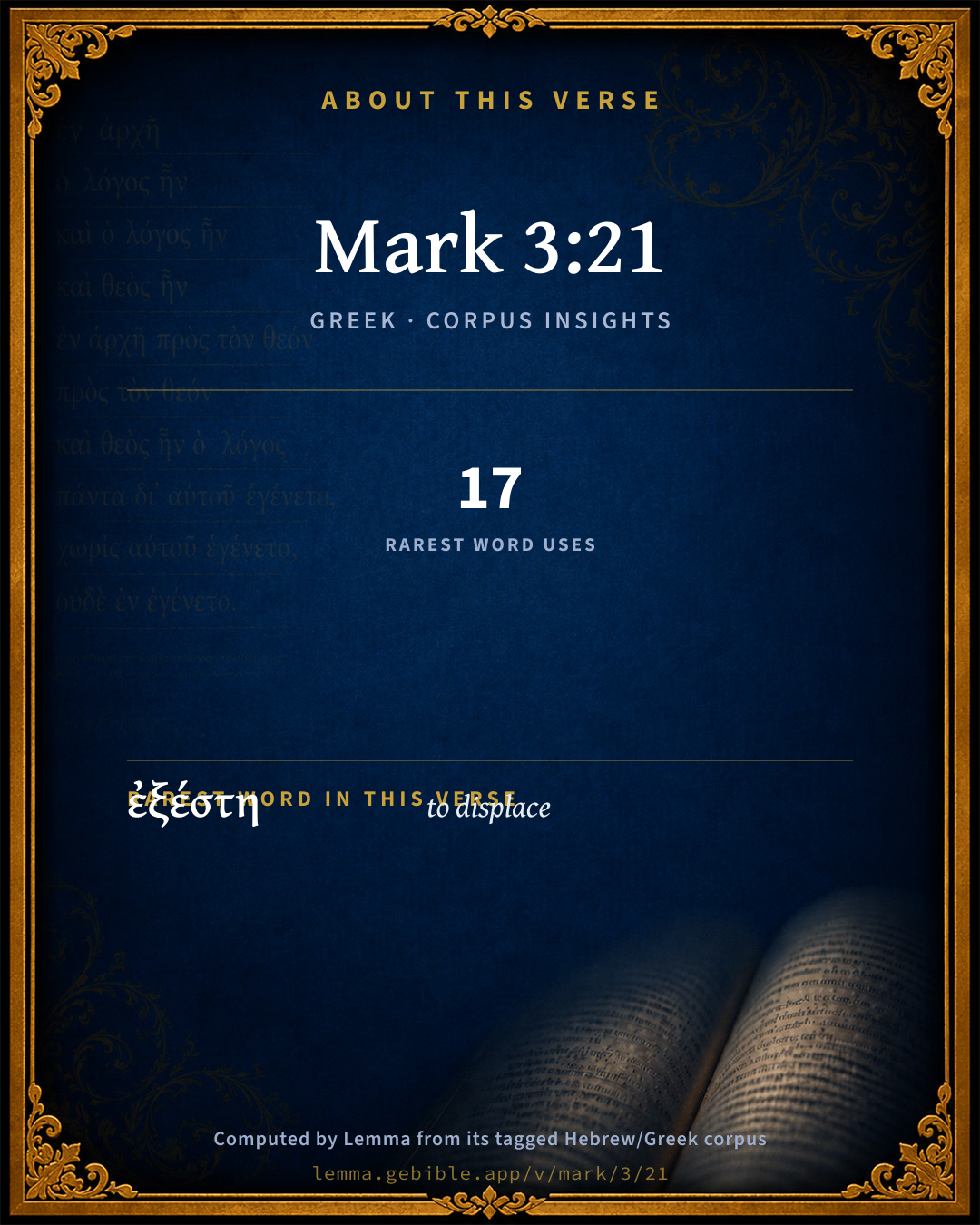
Mark 3:21

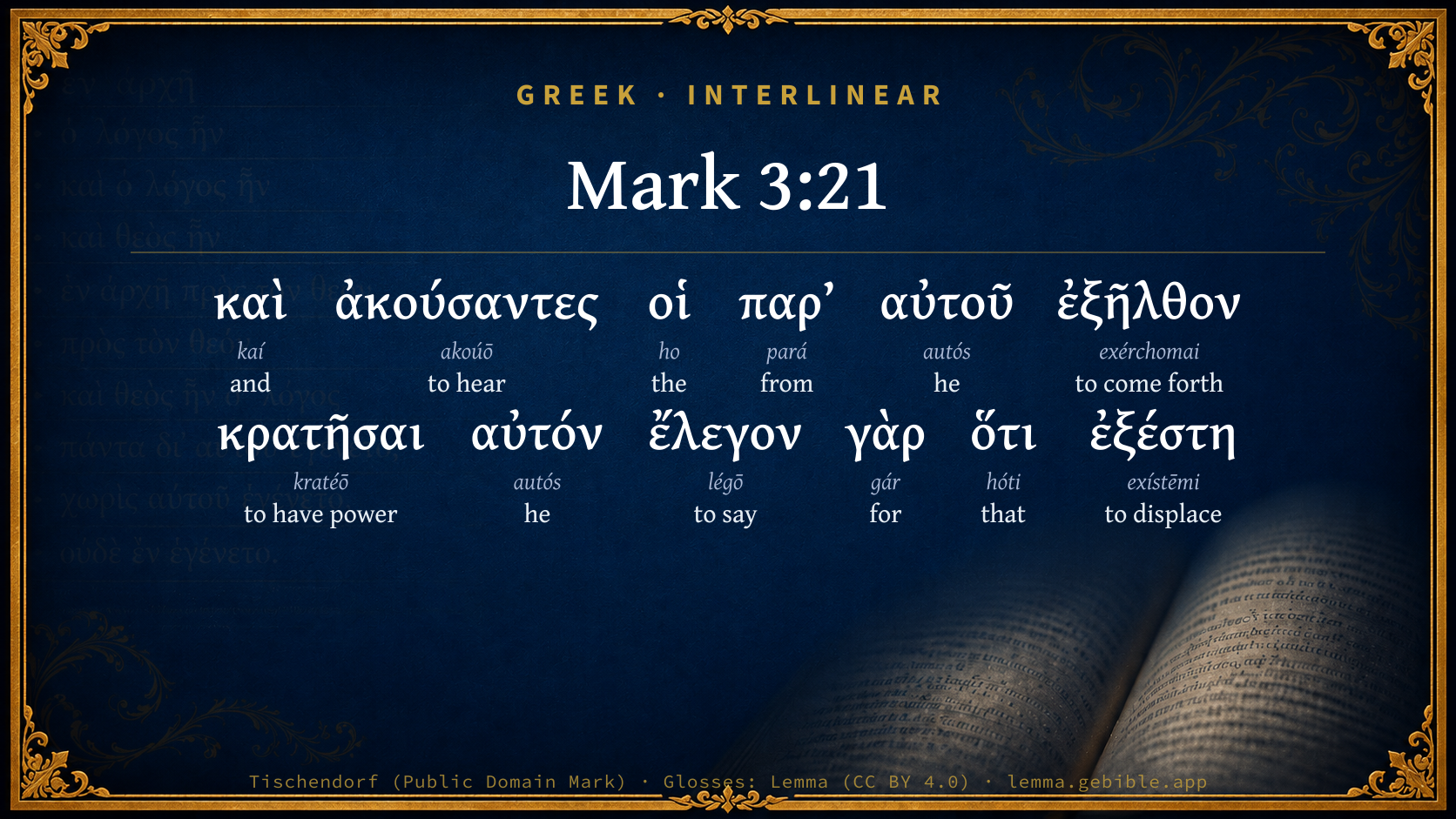
Greek (Tischendorf 8th ed.) Mark 3:21 appears in the Greek New Testament. The text above is from the Tischendorf 8th edition. Each word links to its Strong’s number and a concise gloss. Click any word for its full Thayer’s Greek Lexicon entry.
Download image
Cite this verse

Mark 3:21 (World English Bible). Public Domain. Lemma interlinear Bible study tool, https://lemma.gebible.app/v/mark/3/21.

Show BibTeX & RIS
BibTeX
RIS
English Translation
When his friends heard it, they went out to seize him: for they said, "He is insane."
World English Bible · Public Domain
Download a study sheet

One document with this verse’s original text, its word-by-word gloss line, the meaning frame, cross-references with their text, attributed commentary, and full source and license credits — printable, and it pastes into notes with its structure intact.

This verse Autodidact and up

Study sheet (.html) Plain text (.txt)

A passage Seminary Student

Up to 50 verses in one chapter. A passage sheet keeps up to 6 commentary sources and 12 cross-references per verse, in the order this page ranks them, and says so on the sheet whenever that leaves anything out. Ask for a single verse and you get the Autodidact verse sheet above.

Everything on this page stays free to read, with no account — the sheet is a download of what is already on screen, not access to it.

Want to remove ads? Support Godless Engineer
Compare translations 3

The same verse in 3 English versions, stacked beneath the original-language interlinear above. Click any original word for its lexicon entry.

Each is an independent rendering of the whole verse — the interlinear is not word-aligned to these translations.

Highlighted words mark where these versions differ — a whole-verse word diff, not a word-by-word alignment.

  • World English Bible Public Domain
    When his friends heard it, they went out to seize him: for they said, "He is insane."
  • King James Version Public Domain
    And when his friends heard of it, they went out to lay hold on him: for they said, He is beside himself.
  • unfoldingWord Literal Text CC BY-SA 4.0
    And the ones from him, having heard, went out to seize him, for they were saying, “He is out of his mind.”

unfoldingWord Literal Text — © unfoldingWord, licensed CC BY-SA 4.0. Word-aligned USFM3 via Door43 (git.door43.org/unfoldingWord/en_ult).

Versions to compare (up to 4)

3 of 4 selected

Show all 19 translations

Every available English version of this verse, each an independent rendering of the whole verse.

  • World English Bible Public Domain
    When his friends heard it, they went out to seize him: for they said, "He is insane."
  • Berean Standard Bible Public Domain
    When His family heard about this, they went out to take custody of Him, saying, “He is out of His mind.”
  • Majority Standard Bible Public Domain
    When His family heard about this, they went out to take custody of Him, saying, “He is out of His mind.”
  • King James Version Public Domain
    And when his friends heard of it, they went out to lay hold on him: for they said, He is beside himself.
  • American Standard Version (1901) Public Domain
    And when his friends heard it, they went out to lay hold on him: for they said, He is beside himself.
  • Revised Version (1885) Public Domain
    And when his friends heard it, they went out to lay hold on him: for they said, He is beside himself.
  • Geneva Bible (1599) Public Domain
    And when his kinsfolkes heard of it, they went out to laie hold on him: for they sayde that he was beside himselfe.
  • Douay-Rheims (1899) Public Domain
    And when his friends had heard of it, they went out to lay hold on him. For they said: He is become mad.
  • Young's Literal Translation Public Domain
    and his friends having heard, went forth to lay hold on him, for they said that he was beside himself,
  • Literal Standard Version CC BY-SA 4.0
    and those alongside Him having heard, went forth to lay hold on Him, for they said that He was beside Himself,
  • Unlocked Literal Bible CC BY-SA 4.0
    When his family heard about it, they went out to seize him, for they said, “He is out of his mind.”
  • unfoldingWord Literal Text CC BY-SA 4.0
    And the ones from him, having heard, went out to seize him, for they were saying, “He is out of his mind.”
  • Darby Bible Public Domain
    And his relatives having heard [of it] went out to lay hold on him, for they said, He is out of his mind.
  • World Messianic Bible Public Domain
    When his friends heard it, they went out to seize him; for they said, “He is insane.”
  • Webster's Bible Public Domain
    And when his friends heard of it, they went out to lay hold on him: for they said, He is beside himself.
  • Free Bible Version CC BY-SA 4.0
    When Jesus' family heard about it, they came to take him away, saying, “He's lost his senses!”
  • Bible in Basic English Public Domain
    And when his friends had news of it, they went out to get him, saying, He is off his head.
  • Text-Critical English NT CC BY 4.0
    When his family heard about it, they went out to restrain him, for they said, “He is out of his mind.”
  • Tyndale New Testament (1534) Public Domain
    And when they that longed vnto him hearde of it they went out to holde him. For they thought he had bene beside him selfe.

Literal Standard Version (2020), Covenant Press — licensed CC BY-SA 4.0. Text via the HelloAO Bible API (eBible.org). Unlocked Literal Bible (unfoldingWord) — licensed CC BY-SA 4.0. Text via the HelloAO Bible API (eBible.org). unfoldingWord Literal Text — © unfoldingWord, licensed CC BY-SA 4.0. Word-aligned USFM3 via Door43 (git.door43.org/unfoldingWord/en_ult). Free Bible Version, Dr. Jonathan Gallagher — licensed CC BY-SA 4.0. Text via the HelloAO Bible API (eBible.org).

Word by word

More ways to search: Search by grammar → Find every occurrence → Compare this word →

Practice this passage: Drill this verse → Learn its vocabulary →

ἐξέστη
exístēmi
G1839
“to displace”
Verb, Aorist, Active, Indicative, 3rd person, Singular
Part of Speech
Verb
Tense
Aorist
Voice
Active
Mood
Indicative
Person
3rd person
Number
Singular
Full Thayer's Definition

Origin: from G1537 and G2476

TDNT: 09:39,2

1. to throw out of position, displace a. to amaze, to astonish, throw into wonderment b. to be amazed, astounded c. to be out of one's mind, besides one's self, insane
  1. καὶ kaí G2532 “and” Conjunction
  2. ἀκούσαντες akoúō G191 “to hear” Verb, Aorist, Active, Participle, Nominative, Plural, Masculine
  3. οἱ ho G3588 “the” Article, Nominative, Plural, Masculine
  4. παρ’ pará G3844 “from” Preposition
  5. αὐτοῦ autós G846 “he” Personal pronoun, Genitive, Singular, Masculine
  6. ἐξῆλθον exérchomai G1831 “to come forth” Verb, Aorist, Active, Indicative, 3rd person, Plural
  7. κρατῆσαι kratéō G2902 “to have power” Verb, Aorist, Active, Infinitive
  8. αὐτόν autós G846 “he” Personal pronoun, Accusative, Singular, Masculine
  9. ἔλεγον légō G3004 “to say” Verb, Imperfect, Active, Indicative, 3rd person, Plural
  10. γὰρ gár G1063 “for” Conjunction
  11. ὅτι hóti G3754 “that” Conjunction

About this verse

These counts appear in no published source. They are computed here, from the morphology-tagged text and Lemma’s own curated glosses. What Lemma adds →

12
words
11
distinct lemmas
Gospels
section

Notable vocabulary

The rarest word here is ἐξέστη to displace G1839 — appearing just 17 times in the whole Greek New Testament.

Shared distinctive vocabulary

ἐξέστη to displace G1839 occurs in 17 verses of the Greek New Testament. Also found in:

Repetition

A word recurs within this verse:

  • αὐτοῦ he G846 ×2

Cross-references

8

Topical passages linked to Mark 3:21 in the Treasury of Scripture Knowledge — connected by theme and wording, ordered by reader-vote popularity; previews shown in the World English Bible.

  • Acts 26:24 As he thus made his defense, Festus said with a loud voice, "Paul, you are crazy! Your great learning is driving you insane!"
  • John 10:20 Many of them said, "He has a demon, and is insane! Why do you listen to him?"
  • Mark 3:31 His mother and his brothers came, and standing outside, they sent to him, calling him.
  • John 7:3–10 His brothers therefore said to him, "Depart from here, and go into Judea, that your disciples also may see your works which you do.
  • 2 Corinthians 5:13 For if we are beside ourselves, it is for God. Or if we are of sober mind, it is for you.
  • 2 Kings 9:11 Then Jehu came forth to the servants of his lord: and one said to him, Is all well? why came this mad fellow to you? He said to them, You know the man and what his talk was.
  • Hosea 9:7 The days of visitation have come. The days of reckoning have come. Israel will consider the prophet to be a fool, And the man who is inspired to be insane, Because of the abundance of your sins, And because your hostility is great.
  • Jeremiah 29:26 Yahweh has made you priest in the place of Jehoiada the priest, that there may be officers in the house of Yahweh, for every man who is mad, and makes himself a prophet, that you should put him in the stocks and in shackles.

Cross-references courtesy of OpenBible.info (CC BY 4.0).

Commentary

Notes on Mark 3:21 from classic Christian and Jewish commentators (each source and its license shown beneath its notes). The classic Christian expositions comment on the surrounding passage and are grouped to its opening verse, so a note may address several verses; the Jewish commentaries on the Tanakh (Rashi and others) are per-verse, so they appear only where the commentator wrote on this verse.

Lemma curates 59 commentaries, every one of them public domain or Creative Commons licensed, each selected and text-cleaned for this edition rather than reprinted as found. About our sources →

The Biblical Illustrator

Joseph S. Exell

Mar_3:21

He Is beside Himself.

The sinner mad, not the saint

I find St. Paul in the same chapter confesses and denies madness in himself. Whilst he was mad indeed, then none did suspect or accuse him to be distracted; but when converted, and in his right mind, then Festus taxeth him of madness. (See Act_26:11.) (Thomas Fuller, D. D.)

Mad because exceptional.

There is a country in Africa wherein all the natives have pendulous lips, hanging down like a dogs ears, always raw and sore. Here only such as are handsome are pointed at for monsters. (Thomas Fuller, D. D.)

Troubled with a good son

When the son of Dr. Innes became a missionary, the good old man, who sorely grudged parting with his boy, said, Some people are troubled with a bad son, but I am troubled with a good one.

The Biblical Illustrator, edited by Joseph S. Exell (c. 1880s–1900s) — public domain. Text from a community e-Sword module.

MacLaren's Expositions of Holy Scripture

Alexander MacLaren

Mark

‘HE IS BESIDE HIMSELF’

Mar 3:21.

There had been great excitement in the little town of Capernaum in consequence of Christ’s teachings and miracles. It had been intensified by His infractions of the Rabbinical Sabbath law, and by His appointment of the twelve Apostles. The sacerdotal party in Capernaum apparently communicated with Jerusalem, with the result of bringing a deputation from the Sanhedrim to look into things, and see what this new rabbi was about. A plot for His assassination was secretly on foot. And at this juncture the incident of my text, which we owe to Mark alone of the Evangelists, occurs. Christ’s friends, apparently the members of His own family-sad to say, as would appear from the context, including His mother-came with a kindly design to rescue their misguided kinsman from danger, and laying hands upon Him, to carry Him off to some safe restraint in Nazareth, where He might indulge His delusions without doing any harm to Himself. They wish to excuse His eccentricities on the ground that He is not quite responsible-scarcely Himself; and so to blunt the point of the more hostile explanation of the Pharisees that He is in league with Beelzebub.

Conceive of that! The Incarnate Wisdom shielded by friends from the accusation that He is a demoniac by the apology that He is a lunatic! What do you think of popular judgment? But this half-pitying, half-contemptuous, and wholly benevolent excuse for Jesus, though it be the words of friends, is like the words of His enemies, in that it contains a distorted reflection of His true character. And if we will think about it, I fancy that we may gather from it some lessons not altogether unprofitable.

I. The first point, then, that I make, is just this-there was something in the character of Jesus Christ which could be plausibly explained to commonplace people as madness.

A well-known modern author has talked a great deal about ‘the sweet reasonableness of Jesus Christ.’ His contemporaries called it simple insanity; if they did not say ‘He hath a devil,’ as well as ‘He is mad.’

Now, if we try to throw ourselves back to the life of Jesus Christ, as it was unfolded day by day, and think nothing about either what preceded in the revelation of the Old Covenant, or what followed in the history of Christianity, we shall not be so much at a loss to account for such explanations of it as these of my text. Remember that charges like these, in all various keys of contempt or of pity, or of fierce hostility, have been cast against all innovators, against every man that has broken a new path; against all teachers that have cut themselves apart from tradition and encrusted formulas; against every man that has waged war with the conventionalisms of society; against all idealists who have dreamed dreams and seen visions; against every man that has been touched with a lofty enthusiasm of any sort; and, most of all, against all to whom God and their relations to Him, the spiritual world and their relations to it, the future life and their relations to that, have become dominant forces and motives in their lives.

The short and easy way with which the world excuses itself from the poignant lessons and rebukes which come from such lives is something like that of my text, ‘He is beside himself.’ And the proof that he is beside himself is that he does not act in the same fashion as these incomparably wise people that make up the majority in every age. There is nothing that commonplace men hate like anything fresh and original. There is nothing that men of low aims are so utterly bewildered to understand, and which so completely passes all the calculus of which they are masters, as lofty self-abnegation. And wherever you get men smitten with such, or with anything like it, you will find all the low-aimed people gathering round them like bats round a torch in a cavern, flapping their obscene wings and uttering their harsh croaks, and only desiring to quench the light.

One of our cynical authors says that it is the mark of a genius that all the dullards are against him. It is the mark of the man who dwells with God that all the people whose portion is in this life with one consent say, ‘He is beside himself.’

And so the Leader of them all was served in His day; and that purest, perfectest, noblest, loftiest, most utterly self-oblivious, and God-and-man-devoted life that ever was lived upon earth, was disposed of in this extremely simple method, so comforting to the complacency of the critics-either ‘He is beside Himself,’ or ‘He hath a devil.’

And yet, is not the saying a witness to the presence in that wondrous and gentle career of an element entirely unlike what exists in the most of mankind? Here was a new star in the heavens, and the law of its orbit was manifestly different from that of all the rest. That is what ‘eccentric’ means-that the life to which it applies does not move round the same centre as do the other satellites, but has a path of its own. Away out yonder somewhere, in the infinite depths, lay the hidden point which drew it to itself and determined its magnificent and overwhelmingly vast orbit. These men witness to Jesus Christ, even by their half excuse, half reproach, that His was a life unique and inexplicable by the ordinary motives which shape the little lives of the masses of mankind. They witness to His entire neglect of ordinary and low aims; to His complete absorption in lofty purposes, which to His purblind would-be critics seem to be delusions and fond imaginations that could never be realised. They witness to what His disciples remembered had been written of Him, ‘The zeal of Thy house hath eaten Me up’; to His perfect devotion to man and to God. They witness to His consciousness of a mission; and there is nothing that men are so ready to resent as that. To tell a world, engrossed in self and low aims, that one is sent from God to do His will, and to spread it among men, is the sure way to have all the heavy artillery and the lighter weapons of the world turned against one.

These characteristics of Jesus seem then to be plainly implied in that allegation of insanity-lofty aims, absolute originality, utter self-abnegation, the continual consciousness of communion with God, devotion to the service of man, and the sense of being sent by God for the salvation of the world. It was because of these that His friends said, ‘He is beside Himself.’

These men judged themselves by judging Jesus Christ. And all men do. There are as many different estimates of a great man as there are people to estimate, and hence the diversity of opinion about all the characters that fill history and the galleries of the past. The eye sees what it brings and no more. To discern the greatness of a great man, or the goodness of a good one, is to possess, in lower measure, some portion of that which we discern. Sympathy is the condition of insight into character. And so our Lord said once, ‘He that receiveth a prophet in the name of a prophet shall receive a prophet’s reward,’ because he is a dumb prophet himself, and has a lower power of the same gift in him, which is eloquent on the prophet’s lips.

In like manner, to discern what is in Christ is the test of whether there is any of it in myself. And thus it is no mere arbitrary appointment which suspends your salvation and mine on our answer to this question, ‘What think ye of Christ?’ The answer will be-I was going to say-the elixir of our whole moral and spiritual nature. It will be the outcome of our inmost selves. This ploughshare turns up the depths of the soil. That is eternally true which the grey-bearded Simeon, the representative of the Old, said when he took the Infant in his arms and looked down upon the unconscious, placid, smooth face. ‘This Child is set for the rise and fall of many in Israel, that the thoughts of many hearts may be revealed.’ Your answer to that question discloses your whole spiritual condition and capacities. And so to judge Christ is to be judged by Him; and what we think Him to be, that we make Him to ourselves. The question which tests us is not merely, ‘Whom do men say that I am?’ It is easy to answer that; but this is the all-important interrogation, ‘Whom do ye say that I am?’ I pray that we may each answer as he to whom it was first put answered it, ‘Rabbi, Thou art the Son of God, Thou art the King of Israel!’

II. Secondly, mark the similarity of the estimate which will be passed by the world on all Christ’s true followers.

The same elements exist to-day, the same intolerance of anything higher than the low level, the same incapacity to comprehend simple devotion and lofty aims, the same dislike of a man who comes and rebukes by his silent presence the vices in which he takes no part. And it is a great deal easier to say, ‘Poor fool! enthusiastic fanatic!’ than it is to lay to heart the lesson that lies in such a life.

The one thing, or at least the principal thing, which the Christianity of this generation wants is a little more of this madness. It would be a great deal better for us who call ourselves Christians if we had earned and deserved the world’s sneer, ‘He is beside himself.’ But our modern Christianity, like an epicure’s rare wines, is preferred iced. And the last thing that anybody would think of suggesting in connection with the demeanour-either the conduct or the words-of the average Christian man of this day is that his religion had touched his brain a little.

But, dear friends, go in Christ’s footsteps and you will have the same missiles flung at you. If a church or an individual has earned the praise of the outside ring of godless people because its or his religion is ‘reasonable and moderate; and kept in its proper place; and not allowed to interfere with social enjoyments, and political and municipal corruptions,’ and the like, then there is much reason to ask whether that church or man is Christian after Christ’s pattern. Oh, I pray that there may come down on the professing Church of this generation a baptism of the Spirit; and I am quite sure that when that comes, the people that admire moderation and approve of religion, but like it to be ‘kept in its own place,’ will be all ready to say, when they hear the ‘sons and the daughters prophesying, and the old men seeing visions, and the young men dreaming dreams,’ and the fiery tongues uttering their praises of God, ‘These men are full of new wine!’ Would we were full of the new wine of the Spirit! Do you think any one would say of your religion that you were ‘beside yourself,’ because you made so much of it? They said it about your Master, and if you were like Him it would be said, in one tone or another, about you. We are all desperately afraid of enthusiasm to-day. It seems to me that it is the want of the Christian Church, and that we are not enthusiastic because we don’t half believe the truths that we say are our creed.

One more word. Christian men and women have to make up their minds to go on in the path of devotion, conformity to Christ’s pattern, self-sacrificing surrender, without minding one bit what is said about them. Brethren, I do not think Christian people are in half as much danger of dropping the standard of the Christian life by reason of the sarcasms of the world, as they are by reason of the low tone of the Church. Don’t you take your ideas of what a reasonable Christian life is from the men round you, howsoever they may profess to be Christ’s followers. And let us keep so near the Master that we may be able to say, ‘With me it is a very small matter to be judged of you, or of man’s judgment. He that judgeth me is the Lord.’ Never mind, though they say, ‘Beside himself!’ Never mind, though they say, ‘Oh! utterly extravagant and impracticable.’ Better that than to be patted on the back by a world that likes nothing so well as a Church with its teeth drawn, and its claws cut; which may be made a plaything and an ornament by the world. And that is what much of our modern Christianity has come to be.

III. Lastly, notice the sanity of the insane.

I have only space to put before you three little pictures, and ask you what you think of them. I dare say the originals might be found among us without much search.

Here is one. Suppose a man who, like the most of us, believes that there is a God, believes that he has something to do with Him, believes that he is going to die, believes that the future state is, in some way or other, and in some degree, one of retribution; and from Monday morning to Saturday night he ignores all these facts, and never allows them to influence one of his actions. May I venture to speak direct to this hypothetical person, whose originals are dotted about in my audience? It would be the very same to you if you said ‘No’ instead of ‘Yes’ to all these affirmations. The fact that there is a God does not make a bit of difference to what you do, or what you think, or what you feel. The fact that there is a future life makes just as little difference. You are going on a voyage next week, and you never dream of getting your outfit. You believe all these things, you are an intelligent man-you are very likely, in a great many ways, a very amiable and pleasant one; you do many things very well; you cultivate congenial virtues, and you abhor uncongenial vices; but you never think about God; and you have made absolutely no preparation whatever for stepping into the scene in which you know that you are to live.

Well, you may be a very wise man, a student with high aims, cultivated understanding, and all the rest of it. I want to know whether, taking into account all that you are, and your inevitable connection with God, and your certain death and certain life in a state of retribution-I want to know whether we should call your conduct sanity or insanity? Which? Take another picture. Here is a man that believes-really believes-the articles of the Christian creed, and in some measure has received them into his heart and life. He believes that Jesus Christ, the Son of God, died for him upon the Cross, and yet his heart has but the feeblest tick of pulsating love in answer. He believes that prayer will help a man in all circumstances, and yet he hardly ever prays. He believes that self-denial is the law of the Christian life, and yet he lives for himself. He believes that he is here as a ‘pilgrim’ and as a ‘sojourner,’ and yet his heart clings to the world, and his hand would fain cling to it, like that of a drowning man swept over Niagara, and catching at anything on the banks. He believes that he is sent into the world to be a ‘light’ of the world, and yet from out of his self-absorbed life there has hardly ever come one sparkle of light into any dark heart. And that is a picture, not exaggerated, of the enormous majority of professing Christians in so-called Christian lands. And I want to know whether we shall call that sanity or insanity? The last of my little miniatures is that of a man who keeps in close touch with Jesus Christ, and so, like Him, can say, ‘Lo! I come; I delight to do Thy will, O Lord. Thy law is within my heart.’ He yields to the strong motives and principles that flow from the Cross of Jesus Christ, and, drawn by the ‘mercies of God,’ gives himself a ‘living sacrifice’ to be used as God will. Aims as lofty as the Throne which Christ His Brother fills; sacrifice as entire as that on which his trembling hope relies; realisation of the unseen future as vivid and clear as His who could say that He was ‘in Heaven’ whilst He walked the earth; subjugation of self as complete as that of the Lord’s, who pleased not Himself, and came not to do His own will-these are some of the characteristics which mark the true disciple of Jesus Christ. And I want to know whether the conduct of the man who believes in the love that God hath to him, as manifested in the Cross, and surrenders his whole self thereto, despising the world and living for God, for Christ, for man, for eternity-whether his conduct is insanity or sanity? ‘The fear of the Lord is the beginning of wisdom.’

Alexander MacLaren, Expositions of Holy Scripture (1904–1910) — public domain. Text from a community e-Sword module.

Tyndale Open Study Notes

Tyndale Open Resources

3:21 He’s out of his mind: Mark does not explain whether the attempt by Jesus’ family to seize him was motivated by sincere but misguided concern, or by hostility. Jesus’ brothers and sisters were not among his followers until after his resurrection (3:31-35; John 7:3-5; 1 Cor 15:7 mentions James, the brother of Jesus, who became a leader of the Jerusalem church, Acts 15:13-21).

Tyndale Open Study Notes — © Tyndale Open Resources, licensed CC BY-SA 4.0. Text via the HelloAO Bible API.

Bengel's Gnomon

Johann Albrecht Bengel

Mar 3:21. Οἱ παρʼ αὐτοῦ, those belonging to Him) See App. Crit. Ed. ii., p. 150. The Gothic Version fram answers to περὶ and παρὰ.[25] Who these were, who belonged to Him, is clear from Mar 3:31, where the particle οὖν,[26] therefore, refers to this 21st verse, after the intervening parenthesis 22–30 has been as it were cleared out of they.—ἐξῆλθον, they went out) Their coming in Mar 3:31 followed their going out here. A table seems to have been laid at the house; see end of Mar 3:20.—Κρατῆσαι, to lay hold) to put a restraint on him.—ἔλεγον, they were saying) the messengers [not the relatives] from whom his relatives heard of His earnestness.—ὅτι ἐξέστη, He is beside Himself) By this word they were attributing to Him excess of ardour, overwhelming His intellect, but it was falsely that they attributed this to Him, as Festus did to Paul; Act 26:24, Thou art mad. Comp. by all means 2Co 5:13; comp. ιἑρεὺς καὶ προφήτης ἐξέστησαν διὰ τὸ σίκερα, Heb. שגו. Isa 28:7; so ὁ προφήτης παρεξεστηκὼς, Heb. משגע; Hos 9:7. The singular number does not admit of this being understood of the people; for although ὄχλος, a multitude, Mar 3:20 is singular, yet after an interval [between ΟΧΛΟς and the verb, if the latter were to be understood of the former], there always follow the pronoun and the verb in the plural.

[25] AB Vulg. Rec. Text read καὶ ἀκούσαντες οἱ παρʼ ἀυτοῦ; but Dabc read καὶ ὅτε ἤκουσαν περὶ αὐτοῦ οἱ γραμματεῖς καὶ οἱ λοίποί (c has Pharisæi.)—ED.

[26] But the oldest authorities BCDG vulg. abc omit οὐν. A, however, supports it.—ED.

Bengel's Gnomon of the New Testament — English translation (T&T Clark, Edinburgh, 1860) — public domain. Text from a community e-Sword module.

Expositor's Greek Testament

ed. W. Robertson Nicoll

Mar 3:21 . And the multitude cometh together again, etc.

συνέρχεται : the crowd, partially dispersed, reassembles (implying lapse of an appreciable interval). Jesus had hoped they would go away to their homes in various parts of the country during His absence on the hill, but He was disappointed. They lingered on. ὥστε , etc.: the crowding about the house and the demand for sight and succour of the Benefactor were so great that they (Jesus and His companions) could not find leisure, not even ( μηδὲ ) to take food , not to speak of rest, or giving instruction to disciples. Erasmus ( Adnot. ) thinks the reference is to the multitude, and the meaning that it was so large that there was not bread for all, not to speak of kitchen ( obsonia ).

Mar 3:21 introduces a new scene into the lively drama. The statement is obscure partly owing to its brevity (Fritzsche), and it is made obscurer by a piety which is not willing to accept the surface meaning (so Maldonatus “hunc locum difficiliorem pietas facit”), which is that the friends of Jesus, having heard of what was going on wonderful cures, great crowds, incessant activity set out from where they were ( ἐξῆλθον ) with the purpose of taking Him under their care ( κρατῆσαι αὐτόν ), their impression, not concealed ( ἔλεγον γὰρ , they had begun to say), being that He was in an unhealthy state of excitement bordering on insanity ( ἐξέστη ). Recent commentators, German and English, are in the main agreed that this is the true sense. οἱ παρʼ αὐτοῦ means either specifically His relatives (“sui” Vulg [21] , οἱ οἰκεῖοι α . Theophy.), so Raphel, Wetstein, Kypke, Loesner, with citations from Greek authors, Meyer and Weiss, identifying the parties here spoken of with those referred to in Mar 3:31 ; or, more generally, persons well disposed towards Jesus, an outer circle of disciples (Schanz and Keil). ἀκούσαντες : not to be restricted to what is mentioned in Mar 3:20 ; refers to the whole Galilean ministry with its cures and crowds, and constant strain. Therefore the friends might have come from a distance, Nazareth, e.g. , starting before Jesus descended from the hill. That their arrival happened just then was a coincidence. ἔλεγον γὰρ : for they were saying, might refer to others than those who came to lay hold of Jesus to messengers who brought them news of what was going on (Bengel), or it might refer quite impersonally to a report that had gone abroad (“rumor exierat,” Grotius), or it might even refer to the Pharisees. But the reference is almost certainly to the friends. Observe the parallelism between οἱ παρʼ αὐτοῦ , ἔλεγον γὰρ , ὅτι ἐξέστη and οἱ γραμματεῖς , οἱ … ἔλεγον , ὅτι Βεελ . ἔχει in Mar 3:22 (Fritzsche points this out in a long and thorough discussion of the whole passage). ἐξέστη : various ways of evading the idea suggested by this word have been resorted to. It has been referred to the crowd = the crowd is mad, and won’t let Him alone. Viewed as referring to Jesus it has been taken = He is exhausted, or He has left the place = they came to detain Him, for they heard that He was going or had gone. Both these are suggested by Euthy. Zig. Doubtless the reference is to Jesus, and the meaning that in the opinion of His friends He was in a state of excitement bordering on insanity ( cf. Mar 2:12 , Mar 5:42 , Mar 6:51 ). δαίμονα ἔχει (Theophy.) is too strong, though the Jews apparently identified insanity with possession. Festus said of St. Paul: “Much learning doth make thee mad”. The friends of Jesus thought that much benevolence had put Him into a state of enthusiasm dangerous to the health both of body and mind. Note: Christ’s healing ministry created a need for theories about it. Herod had his theory (Mat 14 ), the friends of Jesus had theirs, and the Pharisees theirs: John redivivus , disordered mind, Satanic possession. That which called forth so many theories must have been a great fact .

[21] Vulgate (Jerome’s revision of old Latin version).

The Expositor's Greek Testament, edited by W. Robertson Nicoll (1897–1910) — public domain. Text from a community e-Sword module.

Geneva Bible (1599)

Geneva Bible translators

None are worse enemies of the Gospel, than they that least ought.

Word for word, they that were of him, that is, his kinfolks: for they that were mad, were brought to their kinsmen.

Geneva Bible (1599) marginal notes — public domain. Text via Bolls.life.

Adam Clarke's Commentary

Verse 21. His friends] Or, relations. On this verse several MSS. differ considerably. I have followed the reading of the Syriac, because I think it the best: οιπαραυτου signify merely his relatives, his brethren, c., see Mr 3:31 and the phrase is used by the best writers to signify relatives, companions, and domestics. See Kypke in loc.

They said, He is beside himself.] It was the enemies of Christ that raised this report; and his relatives, probably thinking that it was true, went to confine him. Let a Christian but neglect the care of his body for a time, in striving to enter in at the strait gate; let a minister of Christ but impair his health by his pastoral labours; presently "he is distracted;" he has "not the least conduct nor discretion." But let a man forget his soul, let him destroy his health by debaucheries, let him expose his life through ambition, and he may, notwithstanding, pass for a very prudent and sensible man!

Schoettgen contends that the multitude, and not Christ, is here intended. Christ was in the house: the multitude, οχλος, Mr 3:20, pressed upon him so that he could not eat bread. His disciples, or friends, went out, κρατησαι αυτον (scil. οχλον,) to restrain it, viz. the multitude, to prevent them from rushing into the house and disturbing their Master, who was now taking some refreshment. This conjecture should not be lightly regarded.

Adam Clarke's Commentary on the Bible (1810–1826) — public domain. Text from a community e-Sword/MySword module.

Ellicott's Commentary for English Readers

(21) And when his friends . . .—Literally, those from Him—i.e., from His home. As the “mother and the brethren” are mentioned later on in the chapter as coming to check His teaching, we must see in these some whom they had sent with the same object. To them the new course of action on which our Lord had entered seemed a sign of over-excitement, recklessly rushing into danger. We may, perhaps, see in the random word thus uttered that which gave occasion to the more malignant taunt of the scribes in the next verse. They were saying now, as they said afterwards (Joh_10:20), “He hath a devil, and is mad.”

A Bible Commentary for English Readers, edited by Charles John Ellicott (1878–1897) — public domain. Text from a community e-Sword module.

The Cambridge Bible for Schools and Colleges

gen. ed. J. J. S. Perowne

21. when his friends] not the Apostles, but His relatives, including “His brethren and His mother,” who are noticed here as going forth, and a few verses later on as having arrived at the house where our Lord was (Mar_3:31), or the place where the crowds were thronging Him.

He is beside himself] They deemed the zeal and daily devotion to His labour of love a sort of ecstasy or religious enthusiasm, which made Him no longer master of Himself. St Paul uses the word in this sense in 2Co_5:13, “For whether we be beside ourselves, it is to God.” Comp. the words of Festus to St Paul (Act_26:24).

The Cambridge Bible for Schools and Colleges (gen. ed. J. J. S. Perowne; Cambridge University Press, 1878–1918) — public domain. Text from a community e-Sword module.

John Gill's Exposition

And the Scribes which came down from Jerusalem,.... Or, "but the Scribes", &c. who had an aversion to Christ, and a different opinion of him: these were they, who having heard much of the doctrine and miracles of Christ, came down from Jerusalem, which lay in the upper, and higher part of the land of Israel, into Galilee, a low country, to make their observations upon him; and take every advantage they could against him, being men, in their way, letter learned, and artful, and cunning: these

said, he hath Beelzebub: or, as the Syriac and Persic versions render it, "Beelzebub is in him": sometimes they call him Beelzebub; sometimes say that he cast out devils by him; and here, that he had him, or was in him; Beelzebub possessed him, and assisted him, and there was a confederacy and familiarity between them:

and by the prince of devils casteth he out devils; for so they reckoned Beelzebub to be; See Gill on Mat 10:25, Mat 12:24.

John Gill's Exposition of the Whole Bible (1746–1763) — public domain (CC PDM 1.0). Text via the HelloAO Bible API.

Trapp's Complete Commentary

John Trapp

21 And when his friends heard of it, they went out to lay hold on him: for they said, He is beside himself.

Ver. 21. They went out to lay hold on him] Some read, to lay hold on the multitude, as mad, because so eager and earnest, that they left not our Lord liberty for his necessary repose and repast. But if it be meant of Christ, his mother also may seem to have been in the common error, Mar 3:31. She was not then without original sin (as the Franciscans would have it, and do therefore name Joachim and Anna kissing, by which kiss Anna conceived, say they, with the Virgin Mary), neither yet without actual sin, as here, Joh 2:4. Sed si peccatrix, non deprecatrix: quae egebat, non agebat advocatum, saith an ancient.

John Trapp, A Commentary or Exposition upon All the Books of the Old and New Testament (1647–1656) — public domain. Text from a community e-Sword module.

Albert Barnes' Notes on the Bible

When his friends - Greek, “they who were of him.” Not the apostles, but his relatives, his friends, who were in the place of his nativity.

Heard of it - Heard of his conduct: his preaching; his appointing the apostles; his drawing such a multitude to his preaching. This shows that by “his friends” were not meant the apostles, but his neighbors and others who “heard” of his conduct.

They went out to lay hold on him - To take him away from the multitude, and to remove him to his home, that he might be treated as a maniac, so that, by absence from the “causes” of excitement, he might be restored to his right mind.

They said - That is, common report said; or his friends and relatives said, for they did not believe on him, Joh 7:5. Probably the enemies of Jesus raised the report, and his relatives were persuaded to believe it to be true.

He is beside himself - He is delirious or deranged. The reason why this report gained any belief was, probably, that he had lived among them as a carpenter; that he was poor and unknown; and that now, at 30 years of age, he broke off from his occupations, abandoned his common employment, spent much time in the deserts, denied himself the common comforts of life, and set up his claims to be the Messiah who was expected by all the people to come with great pomp and splendor. The charge of “derangement” on account of attention to religion has not been confined to the Saviour. Let a man be made deeply sensible of his sins, and spend much of his time in prayer, and have no relish for the ordinary amusements or business of life; or let a Christian be much impressed with his obligation to devote himself to God, and “act” as if he believed there was an “eternity,” and warn his neighbors of their danger; or let a minister show uncommon zeal and spend his strength in the service of his Master, and the world is not slow to call it derangement. And none will be more ready to originate or believe the charge than an ungodly and infidel parent or brother, a self-righteous Pharisee or professor in the church. At the same time, men may endanger themselves on the bosom of the deep or in the bowels of the earth for wealth; or may plunge into the vortex of fashion, folly, and vice, and break in upon the hours of repose, and neglect their duties to their family and the demands of business, and in the view of the world it is wisdom and proof of a sane mind! Such is the consistency of boasted reason; such the wisdom and prudence of worldly men!

Albert Barnes' Notes on the Bible (1834–1885) — public domain. Text from a community e-Sword/MySword module.

Haydock's Catholic Bible Commentary

And when his friends had heard of it;[1] literally, his own. We cannot here understand his apostles, for they were in the house with him; but either some of his kindred and friends, or some that were of the same country and town of Nazareth, though perhaps enemies to him. --- For they said. It is not certain who said this, whether his friends or his adversaries. --- He is become mad.[2] By the Greek, he is not himself. Christ might be called a madman by the Scribes and Pharisees, when he blamed their vices and when he preached with such extraordinary zeal. Or, as the Greek implies, he was thought to be transported out of his wits, and , as the Protestant translation hath it, was beside himself. If there were his friends that said this of him, they did not think so, but only pretended it, that they might get him safe out of the hands of his adversaries. (Witham)

===============================

[BIBLIOGRAPHY]

Sui, Greek: oi par autou.

===============================

[BIBLIOGRAPHY]

In furorem versus est, Greek: exeste; the word Greek: existasthai, is extra se esse, from which cometh the word ecstacy. See 2 Corinthians v. 13, where St. Paul useth the same Greek word.

====================

George Leo Haydock (1774–1849), Haydock's Catholic Family Bible and Commentary, 1859 edition — public domain. Excludes Psalms (Douay-Rheims chapter numbering differs from Protestant) and Deuterocanonical books (Catholic canon only).

Whedon's Commentary on the Bible

Daniel D. Whedon

21. When his friends — At Nazareth, where the reports of these miracles were in keeping with the depraved character of the place and the subject. Probably they had heard of the charge of his being a demoniac. Heard of it — Heard that immense crowds were following his preaching the wonders he did. They went out — From their homes, to rescue him from the danger that might result from the excitement he was producing. Beside himself — They doubtless meant this as an excuse for what they held to be the dangerous course of our Lord. He does not know what he is about in thus exposing himself to the danger of being held the author of public commotion. For the people were, as we learn by Mat_12:23, beginning to call to mind that he was the Son of David, and there was just fear of an insurrection. Mar_3:22-30. Compare notes on Mat_12:24-32. Whitby, however, prefers to render the words, “He is fainty,” or exhausted; that is, by the presence of the multitudes.

Daniel D. Whedon (gen. ed.), Commentary on the Old and New Testaments (1874–1909) — public domain. Text from a community e-Sword module.

John Wesley's Explanatory Notes

His relations - His mother and his brethren, ver. 31. But it was some time before they could come near him.

John Wesley, Explanatory Notes Upon the Whole Bible (1754–1765) — public domain. Text via the GEBible commentary corpus.

The People's New Testament

B. W. Johnson

21. His friends. Probably his relatives. See verse 31. His brethren were not yet counted among his disciples. He is beside himself. Carried away by an unwise enthusiasm.

B. W. Johnson's The People's New Testament with Notes (1889–1891) — public domain. Electronic text from the Christian Classics Ethereal Library (CCEL) ThML edition.

Cambridge Greek Testament for Schools and Colleges

21. οἱ παρʼ αὐτοῦ. An expression as vague as our “His people.” It might include relations, acquaintances, domestics, and all who had a special interest in Him. “Her household are clothed in scarlet” (Pro 31:21) is οἱ παρʼ αὐτῆς ἐνδιδύσκονται (LXX., Pro 29:3-9). Cf. Josephus (Ant. I. x. 5) Ἄβαμος περιτέμνεται καὶ πάντες οἱ παρʼ αὐτοῦ. In papyri, οἱ παρʼ αὐτοῦ often means “his agents” or “his representatives,” but also “his family.” J. H. Moulton, p. 106. Vulg. has sui, which is as vague as the Greek; Coverdale, “they that were aboute him.” Syr-Sin. is more definite, “His brethren,” perhaps from a feeling that the strong measure intended and the strong word used were against His Mother being included. Cf. Susann. 33; 1Ma 13:52.

ἐξῆλθον. Not from the house in which He was, but from their own house, which may have been at a distance.

κρατῆσαι αὐτόν. To get possession of His person; see on Mar 1:31. It is arbitrary to supply a fresh nom. for ἔλεγον, “for people were saying.” His brethren did not believe on Him (Joh 7:5).

Ἐξέστη. “He has gone out of His mind,” He is beside Himself (A.V., R.V.). This use of the aor. comes close to that of the perf., expressing present result of past action; but the aor. may imply that the past action was recent; ἀπέθανεν (Mar 5:35), ἠγέρθη (Mar 16:6; Luk 7:16), ἠγόρασα (Luk 14:18-19). Burton, § 47; J. H. Moulton, p. 134. Euthymius says that οἱ παρʼ αὐτοῦ were envious, τὴν φιλανθρωπίαν νομίζοντες μανίαν, καὶ ὄντως αὐτοὶ μαινόμενοι. This is unlikely; more probably they regarded His open defiance of Scribes and Pharisees from Jerusalem as fanatical folly. They may have known that there were projects for His destruction. But it is possible that He is beside Himself is more than ἐξέστη means; excepting 2Co 5:13, the verb nowhere has this meaning in N.T. Cf. Mar 2:12, Mar 5:42, Mar 6:51; Luk 2:47; Luk 8:56; Luk 24:22; Mat 12:23; and often in Acts. Nevertheless, this meaning fits the context; but in furorem versus est (Vulg.) is too strong.

Cambridge Greek Testament for Schools and Colleges (Cambridge University Press, 1896; 21 vols, various authors incl. Carr, Maclear, Plummer, Farrar, Lumby, Moule, M. R. James, Simcox) — public domain. Text from a community e-Sword module.

Alford’s Greek Testament

Henry Alford

21.] Peculiar to Mark.

οἱ παρʼ αὐτοῦ = his relations, beyond a doubt—for the sense is resumed in ver. 31: see reff.

ἐξῆλθ. (perhaps from Nazareth,—or, answering to Joh 2:12, from Capernaum), set out: see ch. 5:14. They heard of his being so beset by crowds: see vv. 7-11.

ἔλεγον] i.e. His relations—not τινἐς.

ἐξέστη] He is mad: thus E. V.; and the sense requires it. They had doubtless heard of the accusation of his having a dæmon: which we must suppose not to have first begun after this, but to have been going on throughout this course of miracles.

The understanding this that his disciples went out to repress the crowd, for they said, ‘It is mad,’ is as contrary to Greek as to sense. It would require at least αὐτούς and ἐξέστησαν, or τὸν ὄχλον for αὐτόν, and would even then give no intelligible meaning.

Henry Alford, The Greek Testament (1849–1861) — public domain. Text from a community e-Sword module.

International Critical Commentary

21. οἱ παρʼ αὐτοῦ—his family. v. 31, which is evidently a resumption of this part of the narrative, says his mother and his brothers. Literally, this phrase would denote those descended from him, but it has come to have this modification of its strict meaning. Κρατῆσαι—to lay hold of him, to get possession of him. They wanted to protect Jesus against his own madness. For they said that he is beside himself, ἐξέστη.2 ἀκούσαντες has for its object the preceding statement. Jesus’ permitting the multitude to gather about him in this tumultuous way and to engross him so entirely, seemed to them an unwarranted absorption in an entirely visionary work. This absence of prudence and of care of himself seemed to them misplaced.

Weiss, with some show of reason, makes the subject of ἔλεγον the persons from whom the family received their account. But the more natural subject is the same as that of ἐξῆλθον, unless a different one is pointed out. And it is just as probable that the family inferred the ἐξέστη from what they heard, as that it made a part of the report.

Καὶ οἱ γραμματεῖς οἱ ἀπὸ Ἱεροσολύμων καταβάντες—And the Scribes who came down from Jerusalem.

This delegation is introduced here with the article, as if it had been mentioned before. But the article may be taken as meaning the Scribes who were present, and οἱ καταβάντες as an incidental statement of the reason of their presence. This slight change of meaning would be indicated by a comma,—and the Scribes, who came down from Jerusalem.

International Critical Commentary — older volumes (1896–1929), various authors — public domain. Text from a community e-Sword module.

Vincent's Word Studies in the New Testament

Marvin R. Vincent

His friends [οι παρ αυτου] . Lit., they who were from beside him : i e., by origin or birth. His mother and brethren. Compare verses 31, 32. Wyc., kinsmen. Tynd., they that belonged unto him. Not his disciples, since they were in the house with him.

They said [ελεγον] . Imperfect tense. Very graphic, they kept saying.

Marvin R. Vincent, Word Studies in the New Testament (1887–1900) — public domain. Text from a community e-Sword/MySword module.

Lesson kit

Teaching starters — assembled from the data on this page, not authored interpretation. Every prompt links to the verse data it draws on. Edit before teaching.

Mark, in the Gospels, opens this verse with 12 words (11 distinct Greek lemmas). Its most distinctive word is exístēmi (“to displace”). A historical commentator’s framing appears above. Read the whole chapter for the surrounding context.

Discussion questions

  1. What does “to displace” (exístēmi) contribute to the verse as a whole?
  2. How does Matthew 12:23, which shares the word «to displace», read alongside this verse?
  3. What does the repetition of “he” (2× in this one verse) do in this verse?
  4. These translations render this verse differently; the difference is in the English rendering, not the original. What questions does that raise?
  5. Compare how The Biblical Illustrator and MacLaren's Expositions of Holy Scripture read this verse. Where do they agree or differ?

Things to notice

Reading settings

Reading text

Shown beneath each verse's original-language words.

Old Testament
Old Testament edition

Read the OT as the Masoretic Hebrew (MT) or the Greek Septuagint (LXX).

English shown for the Greek Septuagint (in the Hebrew ↔ Greek comparison).

Comparing translations? Open the Compare panel on any verse page to stack up to four side by side.