
Mark 1:23

Greek (Tischendorf 8th ed.) Mark 1:23 appears in the Greek New Testament. The text above is from the Tischendorf 8th edition. Each word links to its Strong’s number and a concise gloss. Click any word for its full Thayer’s Greek Lexicon entry.
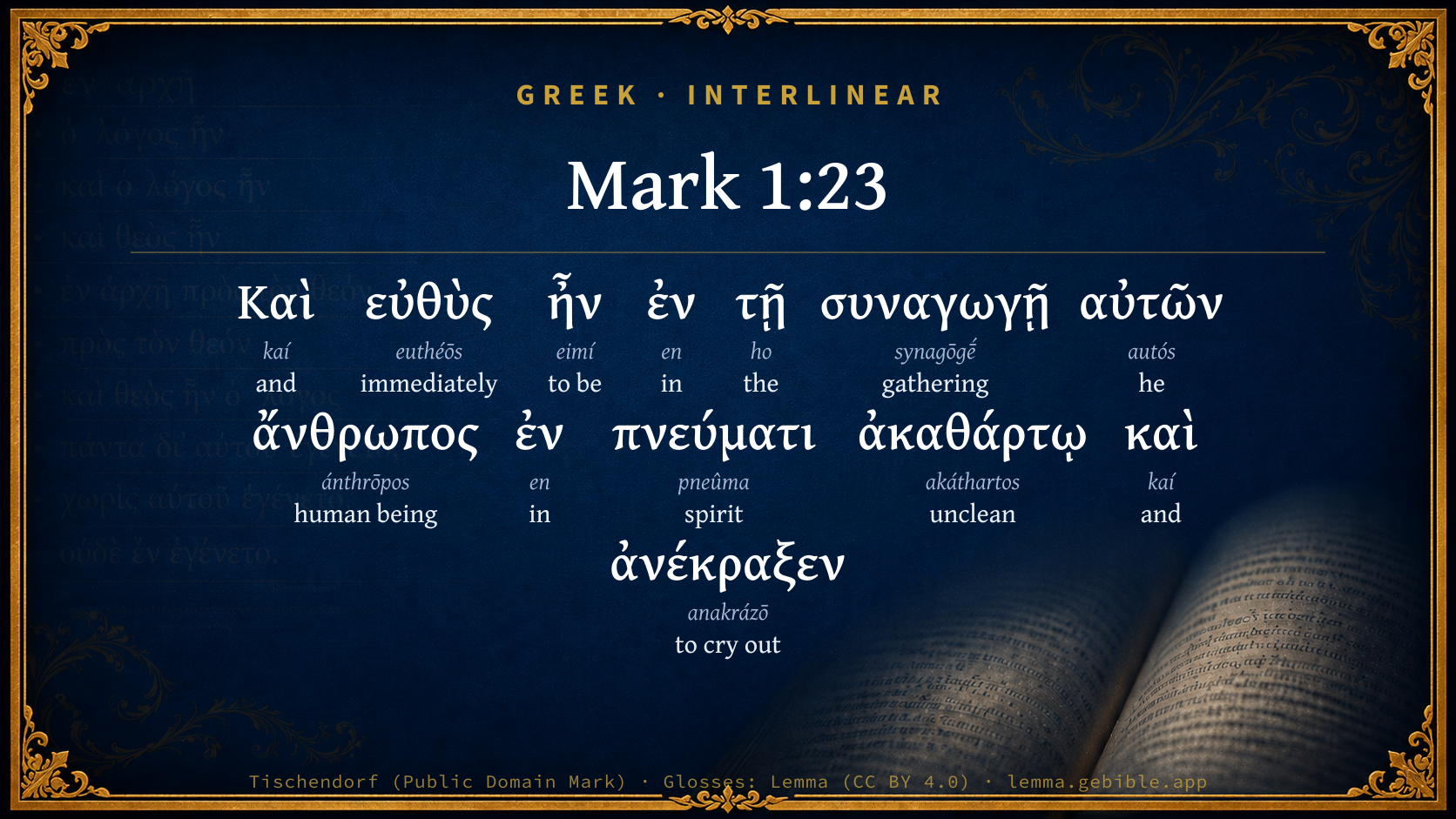
Download image
Cite this verse

Mark 1:23 (World English Bible). Public Domain. Lemma interlinear Bible study tool, https://lemma.gebible.app/v/mark/1/23.

Show BibTeX & RIS
BibTeX
RIS
English Translation
Immediately there was in their synagogue a man with an unclean spirit, and he cried out,
World English Bible · Public Domain
Highlights
  • 1 first appearance in the Greek New Testament
Full analysis ↓
Download a study sheet

One document with this verse’s original text, its word-by-word gloss line, the meaning frame, cross-references with their text, attributed commentary, and full source and license credits — printable, and it pastes into notes with its structure intact.

This verse Autodidact and up

Study sheet (.html) Plain text (.txt)

A passage Seminary Student

Up to 50 verses in one chapter. A passage sheet keeps up to 6 commentary sources and 12 cross-references per verse, in the order this page ranks them, and says so on the sheet whenever that leaves anything out. Ask for a single verse and you get the Autodidact verse sheet above.

Everything on this page stays free to read, with no account — the sheet is a download of what is already on screen, not access to it.

Want to remove ads? Support Godless Engineer
Compare translations 3

The same verse in 3 English versions, stacked beneath the original-language interlinear above. Click any original word for its lexicon entry.

Each is an independent rendering of the whole verse — the interlinear is not word-aligned to these translations.

Highlighted words mark where these versions differ — a whole-verse word diff, not a word-by-word alignment.

  • World English Bible Public Domain
    Immediately there was in their synagogue a man with an unclean spirit, and he cried out,
  • King James Version Public Domain
    And there was in their synagogue a man with an unclean spirit; and he cried out,
  • unfoldingWord Literal Text CC BY-SA 4.0
    And immediately there was in their synagogue a man with an unclean spirit, and he cried out,

unfoldingWord Literal Text — © unfoldingWord, licensed CC BY-SA 4.0. Word-aligned USFM3 via Door43 (git.door43.org/unfoldingWord/en_ult).

Versions to compare (up to 4)

3 of 4 selected

Show all 19 translations

Every available English version of this verse, each an independent rendering of the whole verse.

  • World English Bible Public Domain
    Immediately there was in their synagogue a man with an unclean spirit, and he cried out,
  • Berean Standard Bible Public Domain
    Suddenly a man with an unclean spirit cried out in the synagogue:
  • Majority Standard Bible Public Domain
    Now a man with an unclean spirit cried out in the synagogue:
  • King James Version Public Domain
    And there was in their synagogue a man with an unclean spirit; and he cried out,
  • American Standard Version (1901) Public Domain
    And straightway there was in their synagogue a man with an unclean spirit; and he cried out,
  • Revised Version (1885) Public Domain
    And straightway there was in their synagogue a man with an unclean spirit; and he cried out,
  • Geneva Bible (1599) Public Domain
    And there was in their Synagogue a man in whome was an vncleane spirite, and hee cried out,
  • Douay-Rheims (1899) Public Domain
    And there was in their synagogue a man with an unclean spirit; and he cried out,
  • Young's Literal Translation Public Domain
    And there was in their synagogue a man with an unclean spirit, and he cried out,
  • Literal Standard Version CC BY-SA 4.0
    And there was in their synagogue a man with an unclean spirit, and he cried out,
  • Unlocked Literal Bible CC BY-SA 4.0
    Just then a man in their synagogue who had an unclean spirit cried out,
  • unfoldingWord Literal Text CC BY-SA 4.0
    And immediately there was in their synagogue a man with an unclean spirit, and he cried out,
  • Darby Bible Public Domain
    And there was in their synagogue a man [possessed] by an unclean spirit, and he cried out
  • World Messianic Bible Public Domain
    Immediately there was in their synagogue a man with an unclean spirit, and he cried out,
  • Webster's Bible Public Domain
    And there was in their synagogue a man with an unclean spirit; and he cried out,
  • Free Bible Version CC BY-SA 4.0
    Suddenly, right there in the synagogue, a man with an evil spirit started shouting out,
  • Bible in Basic English Public Domain
    And there was in their Synagogue a man with an unclean spirit; and he gave a cry,
  • Text-Critical English NT CC BY 4.0
    Now in their synagogue there was a man possessed by an unclean spirit. He cried out,
  • Tyndale New Testament (1534) Public Domain
    And there was in their synagoge a man vexed with an vnclene spirite that cried

Literal Standard Version (2020), Covenant Press — licensed CC BY-SA 4.0. Text via the HelloAO Bible API (eBible.org). Unlocked Literal Bible (unfoldingWord) — licensed CC BY-SA 4.0. Text via the HelloAO Bible API (eBible.org). unfoldingWord Literal Text — © unfoldingWord, licensed CC BY-SA 4.0. Word-aligned USFM3 via Door43 (git.door43.org/unfoldingWord/en_ult). Free Bible Version, Dr. Jonathan Gallagher — licensed CC BY-SA 4.0. Text via the HelloAO Bible API (eBible.org).

Word by word

More ways to search: Search by grammar → Find every occurrence → Compare this word →

Practice this passage: Drill this verse → Learn its vocabulary →

About this verse

These counts appear in no published source. They are computed here, from the morphology-tagged text and Lemma’s own curated glosses. What Lemma adds →

13
words
11
distinct lemmas
Gospels
section

Notable vocabulary

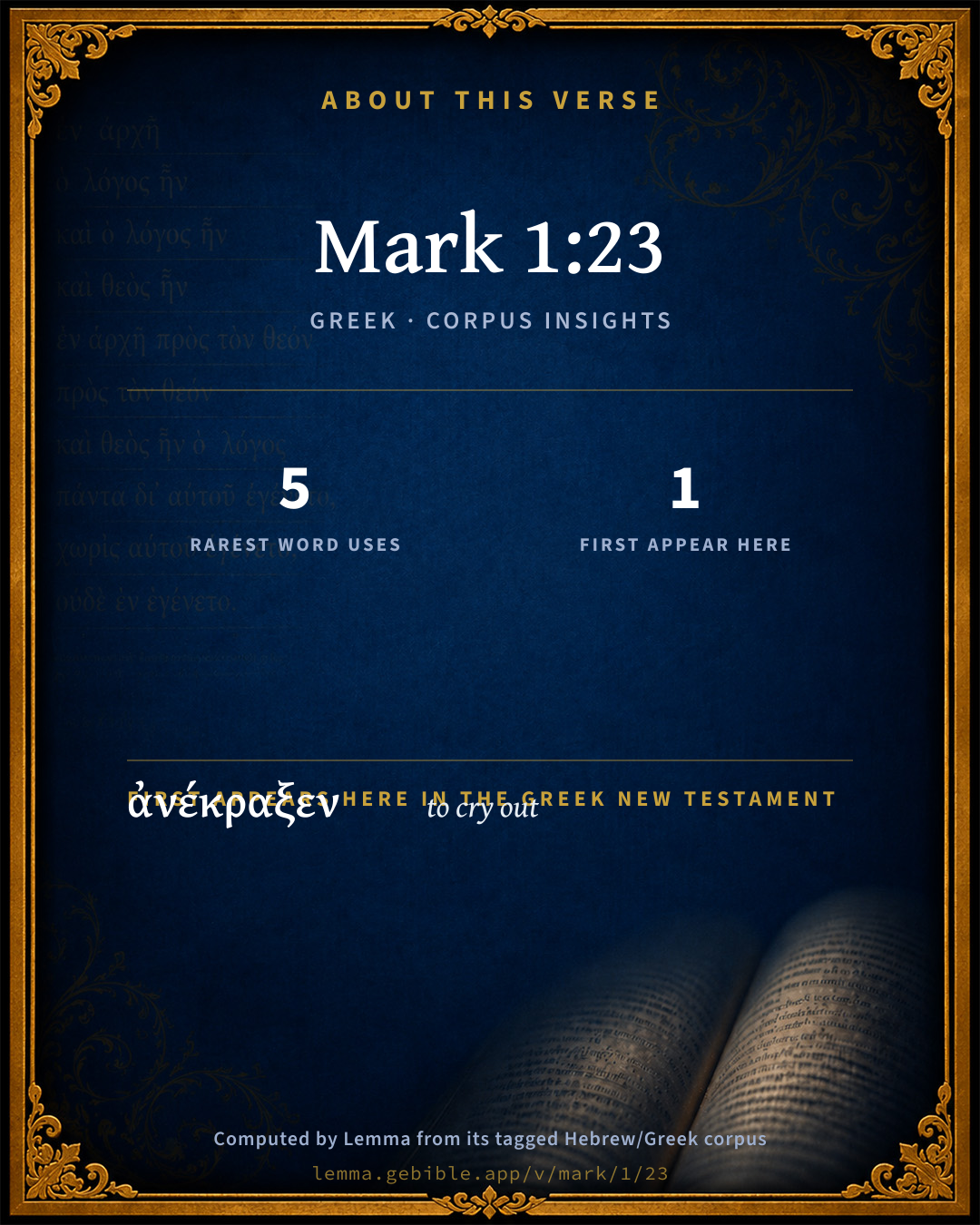
The rarest word here is ἀνέκραξεν to cry out G349 — appearing just 5 times in the whole Greek New Testament.

First appearance in Scripture

This word makes its first canonical appearance in the Greek New Testament here:

  • ἀνέκραξεν to cry out G349

Shared distinctive vocabulary

ἀνέκραξεν to cry out G349 occurs in 5 verses of the Greek New Testament. Also found in:
Repetition

Words recur within this verse:

Cross-references

6

Topical passages linked to Mark 1:23 in the Treasury of Scripture Knowledge — connected by theme and wording, ordered by reader-vote popularity; previews shown in the World English Bible.

  • Mark 9:25 When Jesus saw that a multitude came running together, he rebuked the unclean spirit, saying to him, "You mute and deaf spirit, I command you, come out of him, and never enter him again!"
  • Matthew 12:43 But the unclean spirit, when he is gone out of the man, passes through waterless places, seeking rest, and doesn't find it.
  • Mark 1:34 He healed many who were sick with various diseases, and cast out many demons. He didn't allow the demons to speak, because they knew him.
  • Mark 5:2 When he had come out of the boat, immediately there met him out of the tombs a man with an unclean spirit,
  • Mark 7:25 For a woman, whose little daughter had an unclean spirit, having heard of him, came and fell down at his feet.
  • Luke 4:33–37 In the synagogue there was a man who had a spirit of an unclean demon, and he cried out with a loud voice,

Cross-references courtesy of OpenBible.info (CC BY 4.0).

Where the printed editions differ

1 variant

Places in this verse where the major printed Greek editions disagree on the wording in a way that affects the translation — a comparison of editions, not a manuscript-by-manuscript collation. The editions are the modern critical texts (Nestlé-Aland 28/27, SBL, Westcott-Hort, Tregelles, Tyndale House) and the traditional texts behind the KJV (the Textus Receptus and the Byzantine/Majority text). It is not a claim about which reading is original.

  1. Extra text
    εὐθὺς

    “immediately”

    In NA28NA27TynSBLWH Not in TregTRByz

    εὐθὺς (euthus) 'immediately' is only in older manuscripts (NA28+NA27+Tyn+SBL+WH)

Textual data: Translators Amalgamated Greek New Testament (STEPBible TAGNT) · CC BY 4.0.

Commentary

Notes on Mark 1:23 from classic Christian and Jewish commentators (each source and its license shown beneath its notes). The classic Christian expositions comment on the surrounding passage and are grouped to its opening verse, so a note may address several verses; the Jewish commentaries on the Tanakh (Rashi and others) are per-verse, so they appear only where the commentator wrote on this verse.

Lemma curates 59 commentaries, every one of them public domain or Creative Commons licensed, each selected and text-cleaned for this edition rather than reprinted as found. About our sources →

The Biblical Illustrator

Joseph S. Exell

Mar_1:23

A man with an unclean spirit.

Possessed with a devil

The devil is always endeavouring to work on us, and seizes every advantage offered, and works through

(1) a darkened mind, or

(2) disordered nerves, or

(3) a depraved heart.

In all ages you find him oppressing with his torture all that are so conditioned, especially those with disordered nerves or depraved heart. The time of Christ was an age of wildness and despair. Oppression drove men mad. The man in the synagogue may have merely had disordered nerves, and have been simply a good man plunged into insane melancholy; or he may have had a depraved heart, sinking at last through remorse into despair. For, all badness tends to grow into madness. Some sin lies at the root of five-sixths of all our English madness. Falsehood and selfishness make men madly suspicious; vice softens the brain; drunkenness especially sinks men into madness. Whomsoever we obey, his servants we are, and if we obey the devil we soon give him the upper hand over us. (R. Glover.)

The man with an unclean spirit

I. The place to which the Saviour came. And they went into Capernaum, etc.

1. The occasion which led Him hither was strange and very distressing. In Nazareth He was in danger of losing His life, they led Him unto the brow of the hill whereon their city was built, that they might cast Him down headlong, He. So He left them, and directed His steps towards Capernaum, where He now appears.

2. The object which brought Him here was one of great interest and importance. He came to Capernaum to make it His future home. As His headquarters, during His public ministry, it was peculiarly adapted, affording facility of communication, as well by land and lake, with many flourishing towns, and of escape into more secure regions in case of threatened persecution.

3. The character which He assumed here was not that of a private citizen, but of a public Teacher.

II. The individual with whom our Lord came in contact.

1. His miserable condition.

2. The language which this evil spirit employed.

(1) His request. He insisted to be let alone, but that could not be.

(2) His inquiries-What have we to do with Thee? As a Saviour they had nothing to do with Him; they are amenable to Him as their Judge.

(3) His confession-I know Thee who Thou art. This unclean spirit makes a most accurate, explicit, and full confession; it was also full of alarm.

III. The wonderful power which Jesus displayed. We have here to consider-

1. His authoritative command-Hold thy peace, go. He would not accept the commendation of devils. He silenced them.

2. The spirits reluctant submission-And when the unclean spirit had torn him, etc. In vain he struggled to retain his hold of the poor victim.

IV. The effects which the memorable act produced.

1. It excited the greatest astonishment.

2. It caused His fame to be widely extended. (Expository Outlines.)

The devil in church

I. A devil in church. Synagogue means church. For the time being it was a Christian church, because Christ taught in it. In it was a devil. Devils are found in strange places. In Paradise. Among the sons of God (Job_1:1-22). Notice their infinite impudence. Hard to say whether the man took the devil, or the devil took him. Whichever it was, illustrates his accommodating character. So now a self-righteous devil accompanies men to puff them up with pride; a critical devil to quarrel with the doctrine or the preacher.

II. The devils creed. The demon was orthodox. No heresy in hell. What he believed he publicly professed. Many have a better faith who are silent. His confession was rejected. Profession worthless without submission. Impiety of creed without conduct.

III. The devils prayer. It was earnest and social, like that of Dives. Possible to pray earnestly and benevolently but in vain. It was prompted by fear and by wickedness. Leave us alone to sin and to torment.

IV. The devils excommunicating. In coming out he tore him, etc., just as an evil-disposed out-going tenant does as much harm as possible in his last opportunity. What an expulsion 1 Public; by a word; in vain, the devil did not repent. This came of his orthodoxy, for it was without fruit; and of his prayer, for it was without faith. (A. J. Morris.)

Holiness is eminently characteristic of Christ

1. As He is God.

2. As through a spotless incarnation He was the grand sacrifice for sin.

3. As His own pure nature was the model to which all that believe in Him are to be renewed by the transforming power of His grace.

4. As He was manifested to destroy the works of the devil. (R. Watson.)

Amazed at the miracles of Christ

Dont be startled or driven into unbelief by miracles. God is greater than these. They are not the wonders, but the minor incidents, an index of what is in God, and not the full power of God put forth. I have seen a teacher of physics make experiments in the lecture room on the electric battery. He makes the miniature flashes crack off its surface. Very interesting, very beautiful, for every tiny spark is the same as the lightning flash which cleaves the clouds like the sword of an archangel. The same? Yes, but a very small part of the terrific force which awakens the echoes of heaven, and makes the pillars of the earth tremble. You cannot believe in miracles? They are nothing-experiments in the lecture room. Lo! these are parts of His ways: but the thunder of His power who can understand. (T. Morlais Jones.)

Christ casts out a devil

I. Christs teaching was enforced by a miracle.

1. Proved His commission and His benevolence to man.

2. Illustrated the objects of His kingdom to destroy, etc. Our benevolence should aim at this object.

3. The manner of the miracle showed that He would not receive the testimony of devils, even to the truth. The devil is a liar-his testimony not needed, etc. Let us be as careful as to the means employed as to the end.

4. The manner of the miracle shows that a speculative truth may be in a devilish mind.

5. The people were amazed, but did not acknowledge His Messiahship. We wonder-we need not. Let us be convinced of the need of Divine power to enable us to call Jesus the Christ.

II. Christs fame spread abroad.

1. This resulted from His teaching, and still more from His miracles-wonderful, beneficent.

2. The gospel has always united temporal good with spiritual good. Man has sought to separate them-to take one and reject the other.

3. The fame of Christ left the Jewish nation without excuse. (Expository Discourses.)

The two antagonistic powers of the sanctuary

I. There is the satanic power in the sanctuary.

1. Satan is there to interrupt the service conducted by an earnest preacher.

2. To occasion distress to human souls.

3. He is entirely subject to the power of Christ.

II. There is the Christly power in the sanctuary.

1. To instruct souls.

2. To free souls from the tyranny of the devil. (Joseph S. Exell, M. A.)

The Biblical Illustrator, edited by Joseph S. Exell (c. 1880s–1900s) — public domain. Text from a community e-Sword module.

Joseph Benson's Commentary

Mar 1:23-28. And there was in their synagogue a man with an unclean spirit — Luke, which had a spirit of an unclean devil. And he cried out — Luke, with a loud voice. As soon as the devil saw Jesus, dreading his power, and expecting to be dispossessed, he cried out in great terror: saying, in the name of all the rest, Let us alone, &c. Art thou come to destroy us — By driving us out of our abodes on earth to the regions of darkness? I know thee — Under all the disadvantages of thy present appearance, I can sufficiently discern who thou art, the Holy One of God — Whom he hath sanctified and sent into the world for the destruction of my kingdom, and therefore I dread thee. It seems plain, from what is said afterward, Mar 1:27, that the other persons then present did not know Jesus to be the Son of God; how then should the demoniac know this if he had been only mad, as some vainly suppose, and not really possessed by an evil spirit? This case was so remarkable, that, as the evangelist adds, immediately our Lord’s fame spread abroad throughout all the region round about Galilee. However, though madmen might not know Christ, the devils could not be ignorant of him, from the time of his baptism, when the voice from heaven said, This is my beloved Son, &c, and therefore Satan soon after, in one of his temptations, says, If thou be the Son of God, &c., Mat 4:6. And Jesus rebuked him — Not being willing to receive any testimony from Satan. When the unclean spirit had torn him — Or convulsed him, as σπαραξαν seems here to mean. Accordingly, σπαραγμον, as Grotius has observed, is sometimes used to signify a convulsion. It is certainly much more natural, as Doddridge observes, to understand the expression thus, than to suppose the devil to have torn him, according to the common meaning of the word torn, which leaves the reader to imagine that he grievously wounded him, when Luke expressly says, he hurt him not. And cried with a loud voice — Or, noise, rather, for he was forbidden to speak. Christ would neither suffer those evil spirits to speak in opposition, nor yet in favour of him. He needed not their testimony, nor would encourage it, lest any should infer that he acted in concert with them. Luke says, When the devil had thrown him in the midst, he came out of him — It is remarkable, that in all the cures of this sort which our Lord performed, the person to be cured was seized with the disorder in its violence at the time of the cure, and raised from the stupor of the fit to perfect health in an instant. The reason was, that thus the reality and greatness both of the disorder and the cure were fully proved, to the conviction of every beholder. And they were all amazed — At so miraculous a cure; insomuch that they questioned among themselves — Inquired of each other, and reasoned together, saying, What new doctrine is this? — Luke, τις ο λογος ουτος, what a word is this! How powerful is this man’s word, or command! for with authority commandeth he even the unclean spirits — An indubitable proof that his doctrine was attended with an extraordinary power: and immediately his fame — Raised by this signal miracle, spread abroad throughout all the region — And made way for his reception in the progress which he afterward took into every place of the neighbouring country.

Joseph Benson's Commentary on the Old and New Testaments (1811–1818) — public domain. Text from a community e-Sword module.

The Expositor's Bible

CHAPTER 1:23 (Mar_1:23)

MIRACLES

"And straightway there was in their synagogue a man with an unclean spirit." Mar_1:23 (R.V.)

WE have just read that Christ's teaching astonished the hearers. He was about to astonish them yet more, for we have now reached the first miracle which St. Mark records. With what sentiments should such a narrative be approached? The evangelist connects it emphatically with Christ's assertion of authority. Immediately upon the impression which His manner of teaching produced, straightway, there was in the synagogue a man with an unclean spirit. And upon its expulsion, what most impressed the people was, that as He taught with authority, so "with authority He commandeth even the unclean spirits, and they obey Him."

Let us try whether this may not be a providential clue, to guide us amid the embarrassments which beset, in our day, the whole subject of miracles.

A miracle, we are told, is an interference with the laws of nature; and it is impossible, because they are fixed and their operation is uniform. But these bold words need not disconcert any one who has learned to ask, In what sense are the operations of nature uniform? Is the operation of the laws which govern the wind uniform, whether my helm is to port or starboard? Can I not modify the operation of sanitary laws by deodorization, by drainage, by a thousand resources of civilization? The truth is, that while natural laws remain fixed, human intelligence profoundly modifies their operation. How then will the objector prove that no higher Being can as naturally do the same? He answers, Because the sum total of the forces of nature is a fixed quantity: nothing can be added to that sum, nothing taken from it: the energy of all our machinery existed ages ago in the heat of tropical suns, then in vegetation, and ever since, though latent, in our coal beds; and the claim to add anything to that total is subversive of modern science. But again we ask, If the physician adds nothing to the sum of forces when he banishes one disease by inoculation, and another by draining a marsh, why must Jesus have added to the sum of forces in order to expel a demon or to cool a fever? It will not suffice to answer, because His methods are contrary to experience. Beyond experience they are. But so were the marvels of electricity to our parents and of steam to theirs. The chemistry which analyses the stars is not incredible, although thirty years ago its methods were "contrary" to the universal experience of humanity. Man is now doing what he never did before, because he is a more skillful and better informed agent than he ever was. Perhaps at this moment, in the laboratory of some unknown student, some new force is preparing to amaze the world. But the sum of the forces of nature will remain unchanged. Why is it assumed that a miracle must change them? Simply because men have already denied God, or at least denied that He is present within His world, as truly as the chemist is within it. If we think of Him as interrupting its processes from without, laying upon the vast machine so powerful a grasp as to arrest its working, then indeed the sum of forces is disturbed, and the complaints of science are justified. This may, or it may not, have been the case in creative epochs, of which science knows no more than of the beginning of life and of consciousness. But it has nothing to say against the doctrine of the miracles of Jesus. For this doctrine assumes that God is ever present in His universe; that by Him all things consist; that He is not far from any one of us, for in Him we live and move and have our being, although men may be as unconscious of Him as of gravitation and electricity. When these became known to man, the stability of law was unaffected. And it is a wild assumption that if a supreme and vital force exist, a living God, He cannot make His energies visible without affecting the stability of law.

Now Christ Himself appeals expressly and repeatedly to this immanent presence of God as the explanation of His "works."

"My Father worketh hitherto, and I work." "The Father loveth the Son, and showeth Him all things that Himself doeth." "I, by the finger of God, cast out devils."

Thus a miracle, even in the Old Testament, is not an interruption of law by God, but a manifestation of God who is within nature always; to common events it is as the lightning to the cloud, a revelation of the electricity which was already there. God was made known, when invoked by His agents, in signs from heaven, in fire and tempest, in drought and pestilence, a God who judgeth. These are the miracles of God interposing for His people against their foes. But the miracles of Christ are those of God carrying forward to the uttermost His presence in the world, God manifest in the flesh. They are the works of Him in Whom dwelleth all the fullness of the Godhead bodily.

And this explains what would otherwise be so perplexing, the essentially different nature of His miracles from those of the Old Testament. Infidelity pretends that those are the models on which myth or legend formed the miracles of Jesus, but the plain answer is that they are built on no model of the kind. The difference is so great as to be startling.

Tremendous convulsions and visitations of wrath are now unknown, because God is now reconciling the world unto Himself, and exhibiting in miracles the presence of Him Who is not far from every one of us, His presence in love to redeem the common life of man, and to bless, by sharing it. Therefore his gifts are homely, they deal with average life and its necessities, bread and wine and fish are more to the purpose than that man should eat angels' food, the rescue of storm-tossed fishermen than the engulfment of pursuing armies, the healing of prevalent disease than the plaguing of Egypt or the destruction of Sennacherib.

Such a Presence thus manifested is the consistent doctrine of the Church. It is a theory which men may reject at their own peril if they please. But they must not pretend to refute it by any appeal to either the uniformity of law or the stability of force.

Men tell us that the divinity of Jesus was an afterthought; what shall we say then to this fact, that men observed from the very first a difference between the manner of His miracles and all that was recorded in their Scriptures, or that they could have deemed fit? It is exactly the same peculiarity, carried to the highest pitch, as they already felt in His discourses. They are wrought without any reference whatever to a superior will. Moses cried unto the Lord, saying, What shall I do? Elijah said, Hear me, O Lord, hear me. But Jesus said, I will . . . I charge thee come out . . . I am able to do this. And so marked is the change, that even His followers cast out devils in His name, and say not, Where is the Lord God of Israel? but, In the Name of Jesus Christ of Nazareth. His power is inherent, it is self-possessed, and His acts in the synoptics are only explained by His words in St. John, "What things soever the father doeth, these the Son also doeth in like manner." No wonder that St. Mark adds to His very first record of a miracle, that the people were amazed, and asked, What is this? a new teaching! with authority He commandeth even the unclean spirits and they do obey Him! It was divinity which, without recognizing, they felt, implicit in His bearing. No wonder also that His enemies strove hard to make Him say, Who gave Thee this authority? Nor could they succeed in drawing from Him any sign from heaven. The center and source of the supernatural, for human apprehension, has shifted itself, and the vision of Jesus is the vision of the Father also.

CHAPTER 1:23-28 (Mar_1:23-28)

THE DEMONIAC

"And straightway there was in their synagogue a man with an unclean spirit; and he cried out, saying, What have we to do with Thee, Thou Jesus of Nazareth? art Thou come to destroy us? I know Thee Who Thou art, the Holy One of God. And Jesus rebuked him, saying, Hold thy peace, and come out of him. And the unclean spirit, tearing him and crying with a loud voice, came out of him. And they were all amazed, insomuch that they questioned among themselves, saying, What is this? a new teaching! with authority He commandeth even the unclean spirits, and they obey Him. And the report of Him went out straightway everywhere into all the region of Galilee round about." Mar_1:23-28 (R.V.)

WE have seen that belief in the stability of natural law does not forbid us to believe in miracles.

Special objections are urged, however, against the belief in demoniacal possession. The very existence of demons is declared to be inconsistent with the omnipotence of God, or else with His goodness.

And it may be granted that abstract reasoning in an ideal world, thought moving in a vacuum, would scarcely evolve a state of things so far removed from the ideal. This, however, is an argument against the existence, not of demons, but of evil in any shape. It is the familiar insoluble problem of all religions, How can evil exist in the universe of God? And it is balance by the insoluble problem of all irreligious systems: In a universe without God, how can either good or evil exist, as distinguished from the advantageous and the unprofitable? Whence comes the unquestionable difference between a lie and a bad bargain?

But the argument against evil spirits professes to be something more than a disguised reproduction of this abstract problem. What more is it? What is gained by denying the fiends, as long as we cannot deny the fiends incarnate -- the men who take pleasure in unrighteousness, in the seduction and ruin of their fellows, in the infliction of torture and outrage, in the ravage and desolation of nations? Such freedom has been granted to the human will, for even these ghastly issues have not been judged so deadly as coercion and moral fatalism. What presumption can possibly remain against the existence of other beings than men, who have fallen yet farther? If, indeed, it be certainly so much farther. For we know that men have lived, not outcasts from society, but boastful sons of Abraham, who willed to perform the lusts (Greek word) of their father the devil. Now since we are not told that the wickedness of demons is infinite,* but only that it is abysmal, and since we know that abysses of wickedness do actually exist, what sort of vindication of Deity is this which will believe that such gulfs are yawning only in the bosom of man? [*The opposite is asserted by the fact that one demon may ally himself with seven others worse.]

It alarms and shocks us to think that evil spirits have power over the human mind, and still more that such power should extend, as in cases of possession, even to the body. Evil men, however, manifestly wield such power. "They got rid of the wicked one," said Goethe, "but they could not get rid of the wicked ones." Social and intellectual charm, high rank, the mysterious attraction of a strong individuality, all are employed at times to mislead and debase the shuddering, reluctant, mesmerized wills of weaker men and women. And then the mind acts upon the body, as perhaps it always does. Drunkenness and debauchery shake the nerves. Paralysis and lunacy tread hard on the footsteps of excess. Experience knows no reason for denying that when wickedness conquers the soul it will also deal hardly with the body.

But we must not stop here. For the Gospels do not countenance the popular notion that special wickedness was the cause of the fearful wretchedness of the possessed. Young children suffered. Jesus often cautioned a sufferer to sin no more lest worse results should follow than those He had removed; but He is never known to have addressed this warning to demoniacs. They suffered from the tyranny of Satan, rather than from his seduction; and the analogies which make credible so frightful an outrage upon human nature, are the wrongs done by despots and mobs, by invading armies and persecuting religionists. Yet people who cannot believe that a demon could throw a child upon the fire, are not incredulous of Attila, Napoleon, and the Inquisition.

Thus it appears that such a narrative need startle no believer in God, and in moral good and evil, who considers the unquestionable facts of life. And how often will the observant Christian be startled at the wild insurrection and surging up of evil thought and dark suggestions, which he cannot believe to be his own, which will not be gainsaid nor repulsed. How easily do such experiences fall in with the plain words of Scripture, by which the veil is drawn aside, and the mystery of the spiritual world laid bare. Then we learn that man is not only fallen but assaulted, not only feeble but enslaved, not only a wandering sheep but under the "power of Satan," at his will.

We turn to the narrative before us. They are still wondering at our Lord's authoritative manner, when "straightway," for opportunities were countless until unbelief arose, a man with an unclean spirit attracts attention. We can only conjecture the special meaning of this description. A recent commentator assumes that "like the rest, he had his dwelling among the tombs: an overpowering influence had driven him away from the haunts of men." (Canon Luckock, in loco). To others this feature in the wretchedness of the Gadarene may perhaps seem rather to be exceptional, the last touch in the appalling picture of his misery. It may be that nothing more outrageous than morbid gloom or sullen mutterings had hitherto made it necessary to exclude this sufferer from the synagogue. Or the language may suggest that he rushed abruptly in, driven by the frantic hostility of the fiend, or impelled by some mysterious and lingering hope, as the demoniac of Gadara ran to Christ.

What we know is that the sacred Presence provoked a crisis. There is an unbelief which never canbe silent, never wearies railing at the faith, and there is a corruption which resents goodness and hates it as a personal wrong. So the demons who possessed men were never able to confront Jesus calmly. They resent His interference; they cry out; they disclaim having anything to do with Him; they seem indignant that He should come to destroy them who have destroyed so many. There is something weird and unearthly in the complaint. But men also are wont to forget their wrong doing when they come to suffer, and it is recorded that even Nero had abundance of compassion for himself. Weird also and terrible is it, that this unclean spirit should choose for his confession that pure and exquisite epithet, the Holy One of God. The phrase only recurs in the words of St. Peter, "We have believed and know that Thou art the Holy One of God" (Joh_6:69, R.V.). Was it not a mournful association of ideas which then led Jesus to reply, "Have I not chosen you the Twelve, and one of you is a devil?"* (*The connection would be almost certain if the word "devil" were alike in both. But in all these narratives it is "demon," there being in Scripture but one devil.)

But although the phrase is beautiful, and possibly "wild with all regret," there is no relenting, no better desire than to be "let alone." And so Jesus, so gentle with sinful men, yet sometime to be their judge also, is stern and cold. "Hold thy peace -- be muzzled," He answers, as to a wild beast, "and come out of him." Whereupon the evil spirit exhibits at once his ferocity and his defeat. Tearing and screaming, he came out, but we read in St. Luke that he did the man no harm.

And the spectators drew the proper inference. A new power implied a new revelation. Something far-reaching and profound might be expected from him who commanded even the unclean spirits with authority, and was obeyed.

It is the custom of unbelievers to speak as if the air of Palestine were then surcharged with belief in the supernatural. Miracles were everywhere. Thus they would explain away the significance of the popular belief that our Lord wrought signs and wonders. But in so doing they set themselves a worse problem than they evade. If miracles were so very common, it would be as easy to believe that Jesus wrought them as that He worked at His father's bench. But also it would be as inconclusive. And how then are we to explain the astonishment which all the evangelists so constantly record? On any conceivable theory, these writers shared the beliefs of that age. And so did the readers who accepted their assurance that all were amazed, and that His report "went out straightway everywhere into all the region of Galilee." These are emphatic words, and both the author and his readers must have considered a miracle to be more surprising than modern critics believe they did.

Yet we do not read that any one was converted by this miracle. All were amazed, but wonder is not self-surrender. They were content to let their excitement die out, as every violent emotion must, without any change of life, any permanent devotion to the new Teacher and His doctrine.

William Robertson Nicoll, ed., The Expositor's Bible (London: Hodder & Stoughton, 1887–1910) — public domain. 65 of 66 books (1 Corinthians is not separately keyed, as that volume carries no machine-parseable verse references); section-level commentary keyed to the opening verse. Introductory and overview sections not keyed to a specific passage are excluded.

Tyndale Open Study Notes

Tyndale Open Resources

1:23-24 The demon spoke through the man who was possessed by an evil spirit (1:24). Demons frequently cause disease (9:17, 27; Matt 17:15) and self-destructive behavior (Mark 1:26; 5:2-5; 9:17-18, 20-22). Demons know who Jesus is (1:34); they consistently testify that he is the Holy One of God (see 3:11; 5:7). • In saying us, the evil spirit spoke on behalf of all demons. It recognized Jesus’ complete authority and understood that he had come to interfere with and destroy evil.

Tyndale Open Study Notes — © Tyndale Open Resources, licensed CC BY-SA 4.0. Text via the HelloAO Bible API.

Bengel's Gnomon

Johann Albrecht Bengel

Mar 1:23. Καὶ, and) Mark, in the beginning of his history, records in what point of view both men and demons regarded Jesus. [It may be taken for granted that neither Mark nor Luke (ch. Mar 4:33) in this narrative insist on the historic order of events.—Harm., p. 256].—ἀνεκράξε, cried out) Most persons seem not to have previously known that the man was possessed. The power of possession must have been great, inasmuch as the same predicate is often assigned both to the man possessed and to the demon possessing him: ch. Mar 3:11, Mar 9:20; Act 8:7.

Bengel's Gnomon of the New Testament — English translation (T&T Clark, Edinburgh, 1860) — public domain. Text from a community e-Sword module.

Meyer's Critical & Exegetical Commentary

Heinrich August Wilhelm Meyer

Mar_1:23 f. Ἐν πνεύμ. ἀκαθάρτῳ] to be connected closely with ἄνθρωπος: a man in the power of an unclean spirit. See on ἐν Matthiae, p. 1141. Comp. Mar_5:2; 2Co_12:2; Buttmann, neut. Gr. p. 84 [E. T. 96]. As to the demoniacs, see on Mat_4:24; and as to the miracles of Jesus in general, see on Mat_8:4.

ἀνέκραξε] he cried aloud (see Winer, de verbor. cum praepos. compos. usu, III. p. 7), namely, the man, who, however, speaks in the person of the demon. Comp. Mat_8:29, where also, as here, the demon immediately discerns the Messiah.

ἡμᾶς] me and those like to me. Communem inter se causam habent daemonia, Bengel.

ἀπολέσαι] by relegation to Hades, like βασανίσαι in Matt. l.c.

ὁ ἅγιος τοῦ θεοῦ] the hallowed One of God (Joh_10:36) κατʼ ἐξοχήν (see Origen and Victor Antiochenus in Possini Catena), a characteristic designation of the Messiah, which here proceeds from the consciousness of the unholy demoniac nature (Luk_4:34; Act_4:27; Rev_3:7; Joh_6:69). In a lower sense priests and prophets were ἅγιοι τοῦ θεοῦ. See Knapp, Opusc. I. p. 33 f. The demon does not name Him thus as κολακεύων αὐτόν (Euthymius Zigabenus, and before him Tertullian), but rather by way of giving to His ἦλθες ἀπολέσαι ἡμᾶς the impress of hopeless certainty.

Meyer — Critical and Exegetical Commentary on the New Testament — English translation by Peter Christie, edited by Frederick Crombie (T&T Clark, 1880) — public domain. Text from a community e-Sword module.

Expositor's Greek Testament

ed. W. Robertson Nicoll

Mar 1:23-28 . The demoniac .

Mar 1:23 . εὐθὺς : almost = ἰδοὺ , Matthew’s word for introducing something important. αὐτῶν , in their synagogue, i.e. , the synagogue of the same men who had been surprised at Christ’s preaching. They are to get a new surprise, though one would have been enough for one day. We also get a surprise, for nothing in Mark’s narrative thus far has prepared us to expect such an event as is reported. In his general sketch of the Galilean ministry (Mar 4:23-25 ) Matthew combines the three features: preaching, teaching, and healing . ἐν π . ἀ . = with an unclean spirit (Maldonatus, Holtz., H. C.), in the power of, possessed by, Meyer, Weiss, Keil, etc. An unclean spirit is Mark’s standing name for what Matthew commonly calls δαίμων or δαιμόνιον .

The Expositor's Greek Testament, edited by W. Robertson Nicoll (1897–1910) — public domain. Text from a community e-Sword module.

Geneva Bible (1599)

Geneva Bible translators

Word for word, a man in an unclean spirit, that is to say, possessed with an evil spirit.

He preacheth that doctrine, by which alone Satan is driven out of the world, which also he confirmeth by a miracle.

Geneva Bible (1599) marginal notes — public domain. Text via Bolls.life.

Matthew Henry's Commentary

As soon as Christ began to preach, he began to work miracles for the confirmation of his doctrine; and they were such as intimated the design and tendency of his doctrine, which were to conquer Satan, and cure sick souls.

In these verses, we have,

I. Christ's casting the devil out of a man that was possessed, in the synagogue at Capernaum. This passage was not related in Matthew, but is afterward in Luk 4:33. There was in the synagogue a man with an unclean spirit, en pneumati akathartō - in an unclean spirit; for the spirit had the man in his possession, and led him captive at his will. So the whole world is said to lie en tō ponerō - in the wicked one. And some have thought it more proper to say, The body is in the soul, because it is governed by it, than the soul in the body. He was in the unclean spirit, as a man is said to be in a fever, or in a frenzy, quite overcome by it. Observe, The devil is here called an unclean spirit, because he has lost all the purity of his nature, because he acts in direct opposition to the Holy Spirit of God, and because with his suggestions he pollutes the spirits of men. This man was in the synagogue; he did not come either to be taught or to be healed, but, as some think, to confront Christ and oppose him, and hinder people from believing on him. Now here we have,

1. The rage which the unclean spirit expressed at Christ; He cried out, as one in an agony, at the presence of Christ, and afraid of being dislodged; thus the devils believe and tremble, have a horror of Christ, but no hope in him, nor reverence for him. We are told what he said, Mar 1:24, where he doth not go about to capitulate with him, or make terms (so far was he from being in league or compact with him), but speaks as one that knew his doom. (1.) He calls him Jesus of Nazareth; for aught that appears, he was the first that called him so, and he did it with design to possess the minds of the people with low thoughts of him, because no good thing was expected out of Nazareth; and with prejudices against him as a Deceiver, because every body knew the Messiah must be of Bethlehem. (2.) Yet a confession is extorted from him - that he is the holy One of God, as was from the damsel that had the spirit of divination concerning the apostles - that they were the servants of the most high God, Act 16:16, Act 16:17. Those who have only a notion of Christ - that he is the holy One of God, and have no faith in him, or love to him, go no further than the devil doth. (3.) He in effect acknowledgeth that Christ was too hard for him, and that he could not stand before the power of Christ; "Let us alone; for if thou take us to task, we are undone, thou canst destroy us." This is the misery of those wicked spirits, that they persist in their rebellion, and yet know it will end in their destruction. (4.) He desires to have nothing to do with Jesus Christ; for he despairs of being saved by him, and dreads being destroyed by him. "What have we to do with thee? If thou wilt let us alone, we will let thee alone." See whose language they speak, that say to the Almighty, Depart from us. This, being an unclean spirit, therefore hated and dreaded Christ, because he knew him to be a holy One; for the carnal mind is enmity against God, especially against his holiness.

2. The victory which Jesus Christ obtained over the unclean spirit; for this purpose was the Son of God manifested, that he might destroy the works of the devil, and so he makes it to appear; nor will he be turned back from prosecuting this war, either by his flatteries or by his menaces. It is in vain for Satan to beg and pray, Let us alone; his power must be broken, and the poor man must be relieved; and therefore, (1.) Jesus commands. As he taught, so he healed, with authority. Jesus rebuked him; he chid him and threatened him, imposed silence upon him; Hold thy peace; phimōthēti - be muzzled. Christ has a muzzle for that unclean spirit when he fawns as well as when he barks; such acknowledgments of him as this was, Christ disdains, so far is he from accepting them. Some confess Christ to be the holy One of God, that under the cloak of that profession they may carry on malicious mischievous designs; but their confession is doubly an abomination to the Lord Jesus, as it sues in his name for a license to sin, and shall therefore be put to silence and shame. But this is not all, he must not only hold his peace, but he must come out of the man; this was it he dreaded - his being restrained from doing further mischief. But, (2.) The unclean spirit yields, for there is no remedy (Mar 1:26); He tore him, put him into a strong convulsion; that one could have thought he had been pulled in pieces; when he would not touch Christ, in fury at him he grievously disturbed this poor creature. Thus, when Christ by his grace delivers poor souls out of the hands of Satan, it is not without a grievous toss and tumult in the soul; for that spiteful enemy will disquiet those whom he cannot destroy. He cried with a loud voice, to frighten the spectators, and make himself seem terrible, as if he would have it thought that though he was conquered, he was but just conquered, and that he hopes to rally again, and recover his ground.

II. The impression which this miracle made upon the minds of the people, Mar 1:27, Mar 1:28.

1. It astonished them that saw it; They were all amazed. It was evident, beyond contradiction, that the man was possessed - witness the tearing of him, and the loud voice with which the spirit cried; it was evident that he was forced out by the authority of Christ; this was surprising to them, and put them upon considering with themselves, and enquiring of one another, "What is this new doctrine? For it must certainly be of God, which is thus confirmed. He hath certainly an authority to command us, who hath ability to command even the unclean spirits, and they cannot resist him, but are forced to obey him." The Jewish exorcists pretended by charm or invocation to drive away evil spirits; but this was quite another thing, with authority he commands them. Surely it is our interest to make him our Friend, who has the control of infernal spirits.

2. It raised his reputation among all that heard it; Immediately his fame spread abroad into the whole adjacent region of Galilee, which was a third part of the land of Canaan. The story was presently got into every one's mouth, and people wrote it to their friends all the country over, together with the remark made upon it, What new doctrine is this? So that it was universally concluded, that he was a Teacher come from God, and under that character he shone more bright than if he had appeared in all the external pomp and power which the Jews expected their Messiah to appear in; and thus he prepared his own way, now that John, who was his harbinger, was clapped up; and the fame of this miracle spread the further, because as yet the Pharisees, who envied his fame, and laboured to eclipse it, had not advanced their blasphemous suggestion, that he cast out devils by compact with the prince of the devils.

Matthew Henry's Commentary on the Whole Bible (1708–1710) — public domain (CC PDM 1.0). Text via the HelloAO Bible API.

Jamieson, Fausset & Brown

Robert Jamieson, A. R. Fausset & David Brown

And there was in their synagogue a man with an unclean spirit--literally, "in an unclean spirit"--that is, so entirely under demoniacal power that his personality was sunk for the time in that of the spirit. The frequency with which this character of "impurity" is ascribed to evil spirits--some twenty times in the Gospels--is not to be overlooked.

and he cried out--as follows:

Jamieson, Fausset & Brown — Commentary Critical and Explanatory on the Whole Bible (1871) — public domain (CC PDM 1.0). Text via the HelloAO Bible API.

Adam Clarke's Commentary

Verse 23. A man with an unclean spirit] This demoniac is only mentioned by Mark and Luke, Lu 4:33. It seems the man had lucid intervals; else he could not have been admitted into the synagogue. Unclean or impure spirit - a common epithet for those fallen spirits: but here it may mean, one who filled the heart of him he possessed with LASCIVIOUS thoughts, images, desires, and propensities. By giving way to the first attacks of such a spirit, he may soon get in, and take full possession of the whole soul.

Adam Clarke's Commentary on the Bible (1810–1826) — public domain. Text from a community e-Sword/MySword module.

Ellicott's Commentary for English Readers

(23) An unclean spirit.—The phrase occurs in all the first three Gospels (not in St. John’s), but with special frequency in this. As in most Eastern cities, in both ancient and modern times, madness had an immunity from restraint, and the demoniacs seem to have mingled, if they chose, with the crowd of worshippers in the synagogue.

A Bible Commentary for English Readers, edited by Charles John Ellicott (1878–1897) — public domain. Text from a community e-Sword module.

The Cambridge Bible for Schools and Colleges

gen. ed. J. J. S. Perowne

23. with an unclean spirit] lit. in an unclean spirit, i. e. in his power, under his influence. St Luke describes him as having a “spirit of an unclean demon” (Luk_4:33). He seems to have entered unobserved amongst the throng, but could not resist the spell of that Pure Presence.

The Cambridge Bible for Schools and Colleges (gen. ed. J. J. S. Perowne; Cambridge University Press, 1878–1918) — public domain. Text from a community e-Sword module.

John Gill's Exposition

And there was in their synagogue,.... In the synagogue of the Capernaites, at the same time that Jesus was teaching there,

a man with an unclean spirit: not with an unclean heart, for there were doubtless many such there, but that had a devil; for in Luk 4:33, it is said, "he had a spirit of an unclean devil": so called, because he is impure in himself, and the cause of uncleanness in men, in which he delights: and such spirits sometimes are where religious persons meet, but with no good design; either to disturb the preacher, or to divert the hearer, that the word may be unfruitful and unprofitable:

and he cried out: either the man, or rather the unclean spirit in him, who had possessed his body, and made use of the organs of it: he cried out through dread of the majesty of Christ, whose presence he could not bear; and through grief and envy at the success of his ministration, and the influence it had upon the minds of men; and through fear of being dispossessed of the man, in whom he was.

John Gill's Exposition of the Whole Bible (1746–1763) — public domain (CC PDM 1.0). Text via the HelloAO Bible API.

Trapp's Complete Commentary

John Trapp

23 And there was in their synagogue a man with an unclean spirit; and he cried out,

Ver. 23. With an unclean spirit] Gr. εν πρευματι ακαθαρτω. In an unclean spirit. An unregenerate man is in maligno positus, as St John saith of the world, 1Jn 5:19. He is inversus decalogus; whole evil is in man, and whole man in evil, till at last (without grace) he be satanized and transformed into a breathing devil. By reason of the inhabitation of unclean spirits, our spirits have in them trenches, cages, forts, and strongholds of Satan, 2Co 10:4.

John Trapp, A Commentary or Exposition upon All the Books of the Old and New Testament (1647–1656) — public domain. Text from a community e-Sword module.

Matthew Poole's English Annotations

Luke reports the same passage, Luk 4:33,34; he saith, There was a man which had a spirit of an unclean devil. The devil is called an unclean spirit in opposition to the Spirit of God, which is the Holy Spirit. The man that had this unclean spirit, or rather the unclean spirit in the man, cries out, Let us alone; what have we to do with thee. He doubtless feared what followed, viz. that he should be cast out. He counts himself destroyed when he cannot do mischief; like wicked men, who are the seed of this old serpent, who sleep not, except they have done mischief; and their sleep is taken away, unless they cause some to fall, Pro 4:16. The devil here owneth Christ to be the Holy One of God.

Matthew Poole's English Annotations on the Holy Bible (1683–1685) — public domain. Text from a community e-Sword/MySword module.

The Pulpit Commentary

And straightway there was in their synagogue a man with an unclean spirit. According to the best authorities, the sentence in the Greek runs thus, Kai euyqu . And straightway there was in their synagogue, etc. This word "straightway" adds much force to the sentence. It marks the immediate effect of our Lord"s preaching. A man with an unclean spirit. The words are literally, "a man in an unclean spirit" (en pneumati akayartw); in his grasp, so to speak; possessed by him. There can be no reasonable doubt as to the personality of this unclean spirit. (see Mar_4:24 12:41) The man was so absolutely in the power of this evil spirit that he seemed to dwell in him; just as the world is said by St. John (1Jn_5:19) to lie "in the evil one" (en tw ponhrw). And he cried out. Who cried out? Surely the unclean spirit, using the possessed man as his instrument. In the case of a true prophet, inspired by the Holy Spirit, he is permitted to use his own gifts, his reason, and even his own particular manner of speech; whereas here a false and lying spirit usurps the organs of speech, and makes them his own.

Vers. 23-28. Christ"s authority over spirits.

After a condensed narrative of the events introductory to our Lord"s ministry, Mark proceeds to relate, in circumstantial detail, miracles performed in Capernaum and the neighborhood, forming a cycle of the greatest importance; for by these miracles the interest of the population of Galilee was excited, whilst the hostility of the scribes and Pharisees was gradually aroused. Mark"s is the Gospel of Power his emblem is the lion. He tells the story of Christ"s miraculous ministry with marvellous vigor and minuteness. The first miracle he records is the dispossession of a demon, impure and violent, yet unable to resist the authority of the Lord of the universe. This is well put in the forefront of the battle.

I CHRIST"S AUTHORITY IS ACKNOWLEDGED BY THE SPIRIT. 1, Not willingly, but of constraint. The demon recognizes, in the great Healer and Master, the "Holy One of God," i.e. the Messiah. Shrinking from his presence anxious to avoid the encounter the evil spirit nevertheless cowers before the Lord. When multitudes of the race which Jesus came to save knew him not, neither confessed his rightful claim, this demon was compelled to cry, "I know thee who thou art!" Happy omen for humanity the foe of God and man recognizes the irresistible Warrior and Conqueror!

There is an anticipation of the issue of the conflict, "Art thou come to destroy us?" What prescience is here! Scribes and Pharisees, Sadducees and Herodians, Jews and Romans, persuade themselves that they can destroy the Son of man. The demons know that the Son of man is their Destroyer! It is a just description of the Saviour"s work he comes to "destroy the works of the devil," to vanquish the foe, to cancel the sin, to release the sinner, to restore the captive of Satan to the liberty of the servant of the Lord.

II CHRIST"S AUTHORITY IS ASSERTED AND EXERCISED BY HIMSELF. Salvation involves antagonism: the bondman can only be released by the defeat of the tyrant; the strong man must be bound that the spoil may be recovered. The Lord Jesus had met with and vanquished the prince of evil; he was now to contend with his servants. Accordingly, Christ, who rebuked the winds and the waves elements producing discord in nature rebukes also the evil and unclean spirit. It is a witness that the soul of man is not the fit and divinely ordered home and dwelling of the agents of the power of evil. Silence! Hence! Begone! such is the bidding of Heaven to the emissaries of hell found encroaching upon the domain which is not theirs.

III CHRIST"S AUTHORITY IS PRACTICALLY SHOWN AND PROVED, The unclean spirit is reluctant to quit his hold upon his prey. Satan cannot see his subjects liberated and his empire wane without resistance and resentment. But there is no withstanding the power of Emmanuel. The struggle is apparent in the convulsions with which the frame of the possessed is torn, and in the cry of anguish which is forced from his lips. But there is only one issue possible. The demon quails beneath the Master"s eye, shudders at the Master"s voice, and yields. Oh, happy omen of a great salvation! How often is this illustration of Christ"s delivering power to be repeated in the Divine ministry, and through the dispensation of redemption and of grace!

IV CHRIST"S AUTHORITY IS ADMITTED WITH AMAZEMENT. The rendering of the revisers is full of meaning and vivacity: "What is this? a new teaching!" or, as others read, "A new doctrine with authority!" The point is that miracle and doctrine are justly regarded as one and the same. The listeners to his discourses felt the authority of his words; the spectators of his miracles felt the authority of his works. We distinguish between the two, but Christ"s contemporaries evidently saw, the identity more clearly than the diversity. From his teaching they learned that the authority of his miracles was that of a wise and holy Being; from his beneficent miracles they inferred that all his Divine lessons were fraught with a heavenly energy, and proceeded from the mind of God. Their minds were evidently incited to inquiry, to consideration, to reflection. Who will not bow before an authority so just and so Divine as this?

V CHRIST"S AUTHORITY BECAME THE THEME OF WIDESPREAD INTEREST AND FAME. Mark puts this dispossession of the demoniac forward as the first great miracle of this cycle, and represents it as the means of diffusing throughout Galilee an interest in the ministry of our Lord. Jesus thus became known as a Teacher, as a Saviour, as a Being of compassion and grace. Tidings of such a Prophet, of such a Benefactor, could not be other than a gospel to Israel and to mankind. What sacred and grateful and tender associations would mingle with the people"s memories and thoughts and expectations regarding Jesus of Nazareth!

APPLICATION.

1. Behold a picture of the power of Satan and of sin over the nature of man.

2. Behold a proof of the authority of Christ, when he enters upon a struggle with the power of darkness dwelling in human spirits.

3. Learn a lesson of encouragement as to the personal and universal results of the great moral conflict of the world.

The Pulpit Commentary (1880–1919), ed. H.D.M. Spence-Jones & Joseph S. Exell — public domain. Text from a community e-Sword module.

Kretzmann's Popular Commentary

Paul E. Kretzmann

The man with the unclean spirit:

v. 23. And there was in their synagogue a man with an unclean spirit; and he cried out,

v. 24. saying, Let us alone; what have we to do with Thee, Thou Jesus of Nazareth? Art Thou come to destroy us? I know Thee who Thou art, the Holy One of God.

v. 25. And Jesus rebuked him, saying, Hold thy peace, and come out of him.

v. 26. And when the unclean spirit had torn him, and cried with a loud voice, he came out of him.

v. 27. And they were all amazed, insomuch that they questioned among themselves, saying, What thing is this? What new doctrine is this? For with authority commandeth He the unclean spirits, and they do obey Him.

v. 28. And immediately His fame spread abroad throughout all the region round about Galilee.

By chance, as the average person would say, but as we say, by God’s dispensation, there was present in the synagogue, on that Sabbath morning, a man with an unclean spirit, possessed with a demon. Spiritually unclean the devil is, and the contact with him or his angels makes filthy before God. He had taken possession of the body of this man, using his members to do his bidding. It was the evil spirit that cried out at the sight of Jesus, affirming that he and Jesus of Nazareth had nothing in common, that he and all the demons belonged to a company which are and always will be at variance with the Son of God. His cry is a cry of fear, lest Christ should see meet to condemn them, to destroy them by chaining them forever in hell. He was conscious of his own spiritual uncleanness as compared with the holiness of Jesus, the Holy One of God. "In the emphatic sense, and thus, according to Joh 6:69; Rev 3:7, the concealed designation of the Messiah. As the typical Old Testament anointed ones represented the Messiah, so the typical saints, priests, prophets, and kings, Psa 16:1-11, represent the Holy One, in the most exclusive sense. " But Jesus soon made His business known by rebuking the demon and bidding him hold his peace and come out of the man. Jesus has absolute authority over all things, over all creatures, not only in heaven and on earth, but also under the earth. He is the Master and Lord also of the evil spirits. And so this demon, forced against his evil will to obey, tried to vent his spite in one last effort to harm the body of his victim. He convulsed him, he threw him into a spasm, into a severe epileptic fit. Then, with a last great, screaming cry, he goes forth from the man. The effect of this miracle, coming immediately after the address which had made such a deep impression, was overwhelming. The people were almost stupefied with astonishment. A questioning-together, a hubbub arose in the school, which shows how deeply they were moved: Who can explain this? Has He a new revelation that enables Him to deliver men from the power of demons? Does He do this by His own authority, in His own power? For we see that He orders the unclean spirits about, and they obey Him without question. The news spread like wildfire, at once, everywhere, in the whole region of Galilee round about. Jesus had here given indisputable evidence that He was indeed the Holy One of God, who had come into the world to destroy the works of the devil and to deliver all men from the bondage of Satan.

Paul E. Kretzmann, Popular Commentary of the Bible (1921–1924) — public domain. Text from a community e-Sword module.

Burkitt's Expository Notes on the New Testament

William Burkitt

St. Mark having given an account of our Saviour’s doctrine which he preached, verse 15, namely, the doctrine of faith and repentance, he now acquaints us in the remaining part of this chapter with the miracles which he wrought for the confirming of his doctrine, and they are three.

First, The casting of a devil out of one possessed, verse 23.

Secondly, The curing of Peter’s wife’s mother of a fever, verse 29.

Thirdly, The cleansing of the leper, from verse 40, to the end of the chapter.

His first miracle was the casting of a devil out of one possessed. There was a man with an unclean spirit; That is, an unclean spirit did enter into him, and bodily possess him. Amongst the many calamities which sin has brought upon our bodies, this is one, that we are liable to be bodily possessed by Satan. The devil has an inveterate malice against mankind, seeking to ruin our souls by his suggestions and temptations, and to destroy our bodies by some means or other: but, blessed be God, though his malice be infinite, yet his power is limited and bounded; as he cannot do all he can.

O how much is it our interest, as well as our duty, by prayer to put ourselves morning and evening under the divine protection, that we may be preserved from the power and malice of evil spirits!

Observe, 2. The attribute or title given to the devil, he is called an unclean spirit. The devils, those wicked spirits of hell, are most impure and filthy creatures; impure by means of their original apostasy; impure by means of their actual and daily sins, such as murder, malice, lying, and the like, by which they continually pollute themselves; impure by means of their continual desire and endeavour to pollute mankind with the contagion of their own sin. Lord, how foul is the nature of sin, which makes the devil such a foul and unclean creature!

Observe, 3. This unclean spirit no sooner saw Christ, but he cried out.

Whence note, That the greatness of Christ’s power (being the Son of God) over devils and wicked spirits is such, that it is very terrible and tormenting to them; it was terrible to them in his state of humiliation on earth, and made them cry out. But oh, how terrible will his power be to them at the great day, when Christ shall come in flaming fire, to render vengenance both to men and devils!

Observe, 4. The substance of the devil’s outcry; Let us alone, what have we to do with thee? Art thou come to destroy us?

Where note, that though the devils are now as full of sin and discontent as they can be, yet are they not so full of misery and torment as they shall be. Art thou come to torment us before the time? says St. Matthew. Mat 8:29 and Art thou come to destroy us? says St. Mark: that is to bring upon us our full and final destruction.

Implying, that the devil has not yet his full judgment and complete damnation. Therefore there is certainly a day of judgment to come, and the devils are in chains of darkness, reserved to the judgment of that great day. But some by these words, Art thou come to destroy us? understand as much as, "Art thou come to restrain us from the exercise of our power?"

Learn we thence, That the devil thinks himself destroyed when he is restrained from doing mischief.

Observe, 5. The title which the devil put upon our Saviour; Jesus of Nazareth, the Holy One of God. Although there was ground for the common people’s calling Christ, Jesus of Nazareth, because he was bred and brought up there, and lived there during his private life, till about thirty years of age; though he was not born there, but at Bethlehem; yet it is conceived that the devil gave this title to our Saviour in policy, to disguise the place of Christ’s nativity, that so the Jews might not believe him to be the true Messiah, because he was of Nazareth, whereas the Messiah was to come out of Bethlehem, but Jesus of Nazareth. But how comes the next title out of the devil’s mouth; The Holy One of God? Could an apostle, could Peter himself, make a profession beyond this? But how comes the devil to make it? For no good end or purpose, we may be sure; for he never speaks truth for truth’s sake, but for advantage.

Probably, (1.) He made this profession, that so he might bring the truth professes into suspicion, hoping that a truth which received testimony from the father of lies would be suspected.

(2.) It might perhaps be done that the people might believe that our Saviour had some familiarity with Satan, and did work miracles by his help, because he did confess him, and seem so much to honour him.

From this instance and example learn, That it is possible for a person to own and acknowledge Christ to be the true and only Saviour, and yet to miss of salvation by him. If a speculative knowledge, and a verbal profession, of Christ, were sufficient to salvation, the devil himself would not miss of happiness.

Observe, 6. How our Saviour rebukes the devil for his confession, and commands him silence; And Jesus rebuked him, saying, Hold thy peace. But why was this rebuke given the devil when he spake the truth?

Ans. 1. Because Christ knew that the devil confessed this truth on purpose to disgrace the truth.

2. Because the devil was not fit person to make this profession. A testimony of truth from the father of lies is enough to render truth itself suspected. Yet the devil’s evidence, that Christ was the holy One of God, will rise up in judgment against the wicked Pharisees, who shut their eyes against the miracles, and stop their ears against the doctrine, of the Holy One of God.

Observe lastly, How the unclean spirit obeys the voice of Christ, though with great reluctance and regret. When the unclean spirit had torn him, and cried with a loud voice, he came out. Christ is Lord over the wicked angels, and has an absolute power and authority to overrule them, and command them at his pleasure; if Christ says to the evil spirit, Come out, out he must come.

Yet observe the devil’s spite at parting, he tears the man, tortures his body, throws him violently from place to place, showing how loth he was to be dispossessed. Where Satan has once gotten an hold, and settled himself for a time, how unwilling is he to be cast out of possession! yea, it is a torture and vexation to him to be cast out: it is much easier to keep him out than to cast him out. Satan may possess the body by God’s permission, but he cannot possess our hearts without our own consent and approgbation: it will be our wisdom to deny him entrance into our souls at first, by rejecting his wicked motions and suggestions; for when once entered, he will, like the strong man armed, keep the house till a stronger than he casts him out.

William Burkitt's Expository Notes on the New Testament (1700–1703) — public domain. Text from a community e-Sword module.

The People's New Testament

B. W. Johnson

23. A man with an unclean spirit. See note on Matt. 8:28. Compare Luke 4:31–37. The New Testament plainly teaches that demoniac possession was a real and actual possession of the soul by a fallen spirit.

B. W. Johnson's The People's New Testament with Notes (1889–1891) — public domain. Electronic text from the Christian Classics Ethereal Library (CCEL) ThML edition.

unfoldingWord translationNotes

Door43 World Missions Community

What do we have to do with you, Jesus of Nazareth?

The demons ask this rhetorical question meaning there is no reason for Jesus to interfere with them and that they desire him to leave them. AT: "Jesus of Nazareth, leave us alone! There is no reason for you to interfere with us." (See: Rhetorical Question)

Have you come to destroy us?

The demons ask this rhetorical question to urge Jesus not to harm them. AT: "Do not destroy us!" (See: Rhetorical Question)

threw him down

Here the word "him" refers to the demon-possessed man.

while crying out with a loud voice

The demon is the one who is crying out, not the man.

translationWords

synagogue

demon

cry

Jesus

Nazareth

Holy One

God

rebuke

unfoldingWord translationNotes — © Distant Shores Media and the Door43 World Missions Community, licensed CC BY-SA 4.0. Source: git.door43.org/Door43/en_tn.

Cambridge Greek Testament for Schools and Colleges

23. εὐθύς ([142][143][144] 33, Memph., Orig.) may be retained, although [145][146][147] Syr-Sin., and many other authorities omit.

[142] Codex Sinaiticus. 4th cent. Discovered by Tischendorf in 1859 at the Monastery of St Katharine on Mount Sinai. Now at St Petersburg. The whole Gospel, ending at Mar 16:8. Photographic facsimile, 1911.

[143] Codex Vaticanus. 4th cent., but perhaps a little later than א. In the Vatican Library almost since its foundation by Pope Nicolas V., and one of its greatest treasures. The whole Gospel, ending at Mar 16:8. Photographic facsimile, 1889.

[144] Codex Regius. 8th cent. An important witness. At Paris. Contains Mar 1:1 to Mar 10:15; Mar 10:30 to Mar 15:1; Mar 15:20 to Mar 16:20, but the shorter ending is inserted between Mar 16:8 and Mar 16:9, showing that the scribe preferred it to the longer one.

[145] Codex Alexandrinus. 5th cent. Brought by Cyril Lucar, Patriarch of Constantinople, from Alexandria, and afterwards presented by him to King Charles I. in 1628. In the British Museum. The whole Gospel. Photographic facsimile, 1879.

[146] Codex Ephraemi. 5th cent. A palimpsest: the original writing has been partially rubbed out, and the works of Ephraem the Syrian have been written over it; but a great deal of the original writing has been recovered; of Mark we have Mar 1:17 to Mar 6:31, Mar 8:5 to Mar 12:29, Mar 13:19 to Mar 16:20. In the National Library at Paris.

[147] Codex Bezae. 6th cent. Has a Latin translation (d) side by side with the Greek text, and the two do not quite always agree. Presented by Beza to the University Library of Cambridge in 1581. Remarkable for its frequent divergences from other texts. Contains Mark, except Mar 16:15-20, which has been added by a later hand. Photographic facsimile, 1899.

23. εὐθὺς … αὐτῶν. See crit. note. Lk. omits both words as unnecessary, but they are part of Mk’s fulness; “On that very occasion, just as He was thus teaching in the local synagogue, etc.”

ἐν πνεύματι ἀκαθάρτῳ. “In the control of, in the power of, an unclean spirit” (Mar 5:2); we have the same use of ἐν when the spiritual influence is a good one (Mar 12:36; Mat 12:28; Mat 12:43; Luk 2:27; Luk 4:1). In Mar 3:30, Mar 7:25, Mar 9:17 the afflicted person “has” the evil spirit. Mk and Lk., who wrote for Gentiles, to whom spirits or demons were indifferent, add a distinctive epithet much more often than Mt., who wrote for Jews, for Jews distinguished evil spirits from good. Mk has ἀκάθαρτον eleven times, Lk. six times and πονηρόν twice, while Mt. has ἀκάθαρτον only twice. Mk and Lk. add this epithet the first time they mention these beings (here and Luk 4:33), whereas Mt. mentions them several times before he adds it (Mar 10:1). Nowhere in the Epistles is it used of spirits.

On the difficult subject of demoniacal possession see Hastings’ D.C.G. art. “Demon”; W. M. Alexander, Demonic Possession in the N.T. pp. 12, 200–212, 249; Plummer, S. Matthew, pp. 134 f. The other instances in Mk should be compared; Mar 1:34, Mar 3:11-12, Mar 5:6-7, Mar 9:20.

ἀνέκραξεν. “Lifted up his voice,” “cried loudly”; in N.T., the verb is peculiar to Mk and Lk. The crying out of demons is mentioned Mar 3:11, Mar 5:5; Mar 5:7, Mar 9:26.

Cambridge Greek Testament for Schools and Colleges (Cambridge University Press, 1896; 21 vols, various authors incl. Carr, Maclear, Plummer, Farrar, Lumby, Moule, M. R. James, Simcox) — public domain. Text from a community e-Sword module.

Alford’s Greek Testament

Henry Alford

23-28.] This account occurs in Luk 4:33-37, nearly verbatim: for the variations, see there. It is very important for our Lord’s official life, as shewing that He rejected and forbade all testimony to his Person, except that which He came on earth to give. The dæmons knew Him, but were silenced. (See Mat 8:29: ch. 5:7.) It is of course utterly impossible to understand such a testimony as that of the sick person, still less of the fever or disease.

23. ἄνθ. ἐν πν.] The use of the prep. in this connexion is unusual: see reff. I think the best account of it is, that it falls under a large class of usages of ἐν, expressing the element in which the man lived and moved, as possessed and interpenetrated by the evil spirit,—as in the common expressions ἐν κυρίῳ, ἐν χριστῷ, cf. 2Co 12:2, and Act 17:28.

Henry Alford, The Greek Testament (1849–1861) — public domain. Text from a community e-Sword module.

International Critical Commentary

23. Καὶ εὐθὺς—And immediately.

Insert εὐθὺς between Καὶ and ἦν Tisch. (Treg.) WH. RV. א BL 1, 33, 131, 209, Memph. etc.

εὐθὺς—immediately, here and in v. 21, shows the rapid sequence of events after he entered Capernaum. He was no sooner in the city than he entered the synagogue, and no sooner in the synagogue than this demoniac appeared.

ἐν πνεύματι ἀκαθάρτῳ—in an unclean spirit. The prep. is used to denote possession by the evil spirit, in the same way as ἐν Χριστῷ, in Christ, ἐν Πνεύματι Ἁγίῳ, in the Holy Spirit, denote the intimate connection between the Christian and Christ, or the Holy Spirit. The two beings are conceived as somehow ensphering each other, and sometimes one, sometimes the other, is said to enclose the being identified with it. The demon, e.g., is said to be in the man, or the man in the demon. In this case, the man is said to be in the unclean spirit, and v. 27, the unclean spirit is said to come out of him. πνεῦμα ἀκάθαρτον is used interchangeably with δαιμόνιον, demon (AV. devil), to designate these spirits.1 Beelzebul is their chief, or Satan. See 3:22, 23.

The reality of demoniacal possession is a matter of doubt. The serious argument against it is, that the phenomena are mostly natural, not supernatural. It was the unscientific habit of the ancient mind to account for abnormal and uncanny things, such as lunacy and epilepsy, supernaturally. And in such cases, outside of the Bible, we accept the facts, but ascribe them to natural causes. Another serious difficulty is that lunacy and epilepsy are common in the East, as elsewhere, and yet, unless these are cases, we do not find Jesus healing these disorders as such, but only cases of demoniacal possession in which these were symptoms. The dilemma is very curious. Outside the N.T., no demoniacal possession, but only lunacy and epilepsy; in the N.T., no cases of lunacy and epilepsy proper, but only demoniacal possession. See, however, Weiss, Life of Jesus, III. 6.

International Critical Commentary — older volumes (1896–1929), various authors — public domain. Text from a community e-Sword module.

Vincent's Word Studies in the New Testament

Marvin R. Vincent

Straightway

At the conclusion of his teaching.

With an unclean spirit (ἐν πνεύματι ἀκαθάρτῳ)

Lit., “in an unclean spirit.” Ἐν (in) has the force of in the power of. Dr. Morison compares the phrases in drink, in love.

Marvin R. Vincent, Word Studies in the New Testament (1887–1900) — public domain. Text from a community e-Sword/MySword module.

Lesson kit

Teaching starters — assembled from the data on this page, not authored interpretation. Every prompt links to the verse data it draws on. Edit before teaching.

Mark, in the Gospels, opens this verse with 13 words (11 distinct Greek lemmas). Its most distinctive word is anakrázō (“to cry out”). A historical commentator’s framing appears above. Read the whole chapter for the surrounding context.

Discussion questions

  1. How does “to cry out” (anakrázō) shape what this verse is saying?
  2. This is the first place “to cry out” appears in Scripture (first appears here). What does its debut here establish?
  3. How does Mark 6:49, which shares the word «to cry out», read alongside this verse?
  4. What does the repetition of “and” (2× in this one verse) do in this verse?
  5. The translations on this page render this verse differently — a whole-verse word diff, not a word-by-word alignment. What might account for the different wordings?
  6. Compare how The Biblical Illustrator and Joseph Benson's Commentary read this verse. Where do they agree or differ?

Things to notice

  • 1 word makes its first canonical appearance in Scripture here.
  • These translations choose different wording for 1 word in this verse.
  • “and” occurs 2× in this single verse.
  • 11 distinct Greek lemmas span 13 words in this verse.

Reading settings

Reading text

Shown beneath each verse's original-language words.

Old Testament
Old Testament edition

Read the OT as the Masoretic Hebrew (MT) or the Greek Septuagint (LXX).

English shown for the Greek Septuagint (in the Hebrew ↔ Greek comparison).

Comparing translations? Open the Compare panel on any verse page to stack up to four side by side.