Mark 1:6

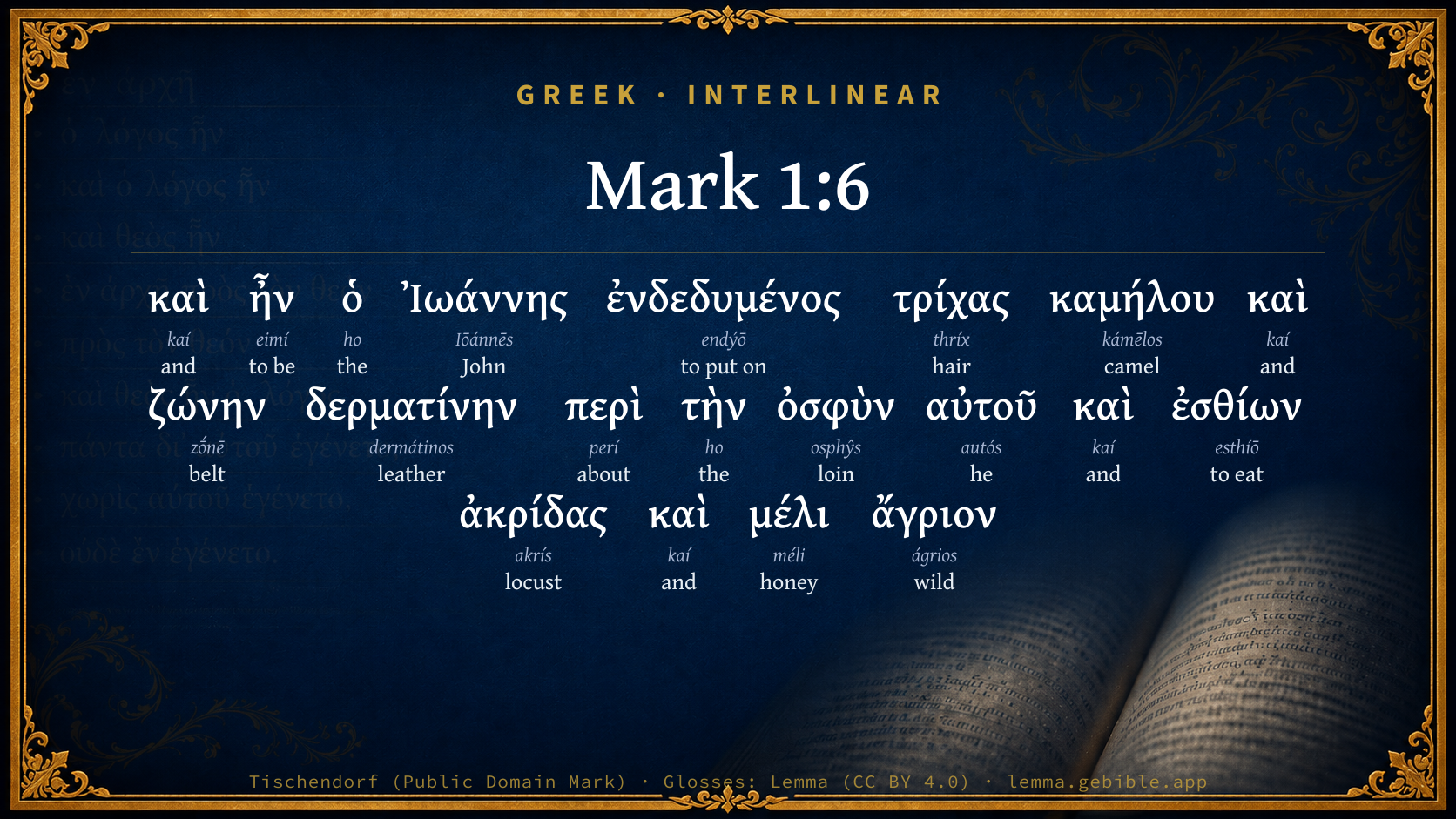
Greek (Tischendorf 8th ed.) Mark 1:6 appears in the Greek New Testament. The text above is from the Tischendorf 8th edition. Each word links to its Strong’s number and a concise gloss. Click any word for its full Thayer’s Greek Lexicon entry.
Download image
Cite this verse

Mark 1:6 (World English Bible). Public Domain. Lemma interlinear Bible study tool, https://lemma.gebible.app/v/mark/1/6.

Show BibTeX & RIS
BibTeX
RIS
English Translation
John was clothed with camel's hair and a leather belt around his loins. He ate locusts and wild honey.
World English Bible · Public Domain
Download a study sheet

One document with this verse’s original text, its word-by-word gloss line, the meaning frame, cross-references with their text, attributed commentary, and full source and license credits — printable, and it pastes into notes with its structure intact.

This verse Autodidact and up

Study sheet (.html) Plain text (.txt)

A passage Seminary Student

Up to 50 verses in one chapter. A passage sheet keeps up to 6 commentary sources and 12 cross-references per verse, in the order this page ranks them, and says so on the sheet whenever that leaves anything out. Ask for a single verse and you get the Autodidact verse sheet above.

Everything on this page stays free to read, with no account — the sheet is a download of what is already on screen, not access to it.

Want to remove ads? Support Godless Engineer
Compare translations 3

The same verse in 3 English versions, stacked beneath the original-language interlinear above. Click any original word for its lexicon entry.

Each is an independent rendering of the whole verse — the interlinear is not word-aligned to these translations.

Highlighted words mark where these versions differ — a whole-verse word diff, not a word-by-word alignment.

  • World English Bible Public Domain
    John was clothed with camel's hair and a leather belt around his loins. He ate locusts and wild honey.
  • King James Version Public Domain
    And John was clothed with camel's hair, and with a girdle of a skin about his loins; and he did eat locusts and wild honey;
  • unfoldingWord Literal Text CC BY-SA 4.0
    And John was clothed with camel hair and a leather belt around his waist, and eating locusts and wild honey.

unfoldingWord Literal Text — © unfoldingWord, licensed CC BY-SA 4.0. Word-aligned USFM3 via Door43 (git.door43.org/unfoldingWord/en_ult).

Versions to compare (up to 4)

3 of 4 selected

Show all 19 translations

Every available English version of this verse, each an independent rendering of the whole verse.

  • World English Bible Public Domain
    John was clothed with camel's hair and a leather belt around his loins. He ate locusts and wild honey.
  • Berean Standard Bible Public Domain
    John was clothed in camel’s hair, with a leather belt around his waist. His food was locusts and wild honey.
  • Majority Standard Bible Public Domain
    John was clothed in camel’s hair, with a leather belt around his waist. His food was locusts and wild honey.
  • King James Version Public Domain
    And John was clothed with camel's hair, and with a girdle of a skin about his loins; and he did eat locusts and wild honey;
  • American Standard Version (1901) Public Domain
    And John was clothed with camel's hair, and `had' a leathern girdle about his loins, and did eat locusts and wild honey.
  • Revised Version (1885) Public Domain
    And John was clothed with camel’s hair, and had a leathern girdle about his loins, and did eat locusts and wild honey.
  • Geneva Bible (1599) Public Domain
    Nowe Iohn was clothed with camels heare, and with a girdle of a skinne about his loynes: and he did eate Locusts and wilde hony,
  • Douay-Rheims (1899) Public Domain
    And John was clothed with camel's hair, and a leathern girdle about his loins; and he ate locusts and wild honey.
  • Young's Literal Translation Public Domain
    And John was clothed with camel's hair, and a girdle of skin around his loins, and eating locusts and honey of the field,
  • Literal Standard Version CC BY-SA 4.0
    And John was clothed with camel’s hair, and a girdle of skin around his loins, and eating locusts and honey of the field,
  • Unlocked Literal Bible CC BY-SA 4.0
    John was wearing a coat of camel's hair and a leather belt around his waist, and he was eating locusts and wild honey.
  • unfoldingWord Literal Text CC BY-SA 4.0
    And John was clothed with camel hair and a leather belt around his waist, and eating locusts and wild honey.
  • Darby Bible Public Domain
    And John was clothed in camel's hair, and a leathern girdle about his loins, and ate locusts and wild honey.
  • World Messianic Bible Public Domain
    Yochanan was clothed with camel’s hair and a leather belt around his waist. He ate locusts and wild honey.
  • Webster's Bible Public Domain
    And John was clothed with camels hair, and with a girdle of a skin about his loins; and he ate locusts and wild honey;
  • Free Bible Version CC BY-SA 4.0
    John wore clothes made of camel hair, with a leather belt around his waist. He ate locusts and wild honey.
  • Bible in Basic English Public Domain
    And John was clothed in camel's hair, with a leather band about him; and his food was locusts and honey.
  • Text-Critical English NT CC BY 4.0
    Now John was clothed with camel's hair and wore a leather belt around his waist; he ate locusts and wild honey.
  • Tyndale New Testament (1534) Public Domain
    Iohn was clothed with cammylles heer and with a gerdyll of a skyn a bout hys loynes. And he dyd eate locustes and wylde hony

Literal Standard Version (2020), Covenant Press — licensed CC BY-SA 4.0. Text via the HelloAO Bible API (eBible.org). Unlocked Literal Bible (unfoldingWord) — licensed CC BY-SA 4.0. Text via the HelloAO Bible API (eBible.org). unfoldingWord Literal Text — © unfoldingWord, licensed CC BY-SA 4.0. Word-aligned USFM3 via Door43 (git.door43.org/unfoldingWord/en_ult). Free Bible Version, Dr. Jonathan Gallagher — licensed CC BY-SA 4.0. Text via the HelloAO Bible API (eBible.org).

Word by word

More ways to search: Search by grammar → Find every occurrence → Compare this word →

Practice this passage: Drill this verse → Learn its vocabulary →

δερματίνην
dermátinos
G1193
“leather”
Adjective, Accusative, Singular, Feminine
Part of Speech
Adjective
Case
Accusative
Number
Singular
Gender
Feminine
Full Thayer's Definition

Origin: from G1192

TDNT: None

1. made of skin, leathern
  1. καὶ kaí G2532 “and” Conjunction
  2. ἦν eimí G1510 “to be” Verb, Imperfect, Active, Indicative, 3rd person, Singular
  3. ὁ ho G3588 “the” Article, Nominative, Singular, Masculine
  4. Ἰωάννης Iōánnēs G2491 “John” Noun, Nominative, Singular, Masculine
  5. ἐνδεδυμένος endýō G1746 “to put on” Verb, Perfect, Middle, Participle, Nominative, Singular, Masculine
  6. τρίχας thríx G2359 “hair” Noun, Accusative, Plural, Feminine
  7. καμήλου kámēlos G2574 “camel” Noun, Genitive, Singular, Masculine
  8. καὶ kaí G2532 “and” Conjunction
  9. ζώνην zṓnē G2223 “belt” Noun, Accusative, Singular, Feminine
  10. περὶ perí G4012 “about” Preposition
  11. τὴν ho G3588 “the” Article, Accusative, Singular, Feminine
  12. ὀσφὺν osphŷs G3751 “loin” Noun, Accusative, Singular, Feminine
  13. αὐτοῦ autós G846 “he” Personal pronoun, Genitive, Singular, Masculine
  14. καὶ kaí G2532 “and” Conjunction
  15. ἐσθίων esthíō G2068 “to eat” Verb, Present, Active, Participle, Nominative, Singular, Masculine
  16. ἀκρίδας akrís G200 “locust” Noun, Accusative, Plural, Feminine
  17. καὶ kaí G2532 “and” Conjunction
  18. μέλι méli G3192 “honey” Noun, Accusative, Singular, Neuter
  19. ἄγριον ágrios G66 “wild” Adjective, Accusative, Singular, Neuter

About this verse

These counts appear in no published source. They are computed here, from the morphology-tagged text and Lemma’s own curated glosses. What Lemma adds →

20
words
16
distinct lemmas
Gospels
section

Notable vocabulary

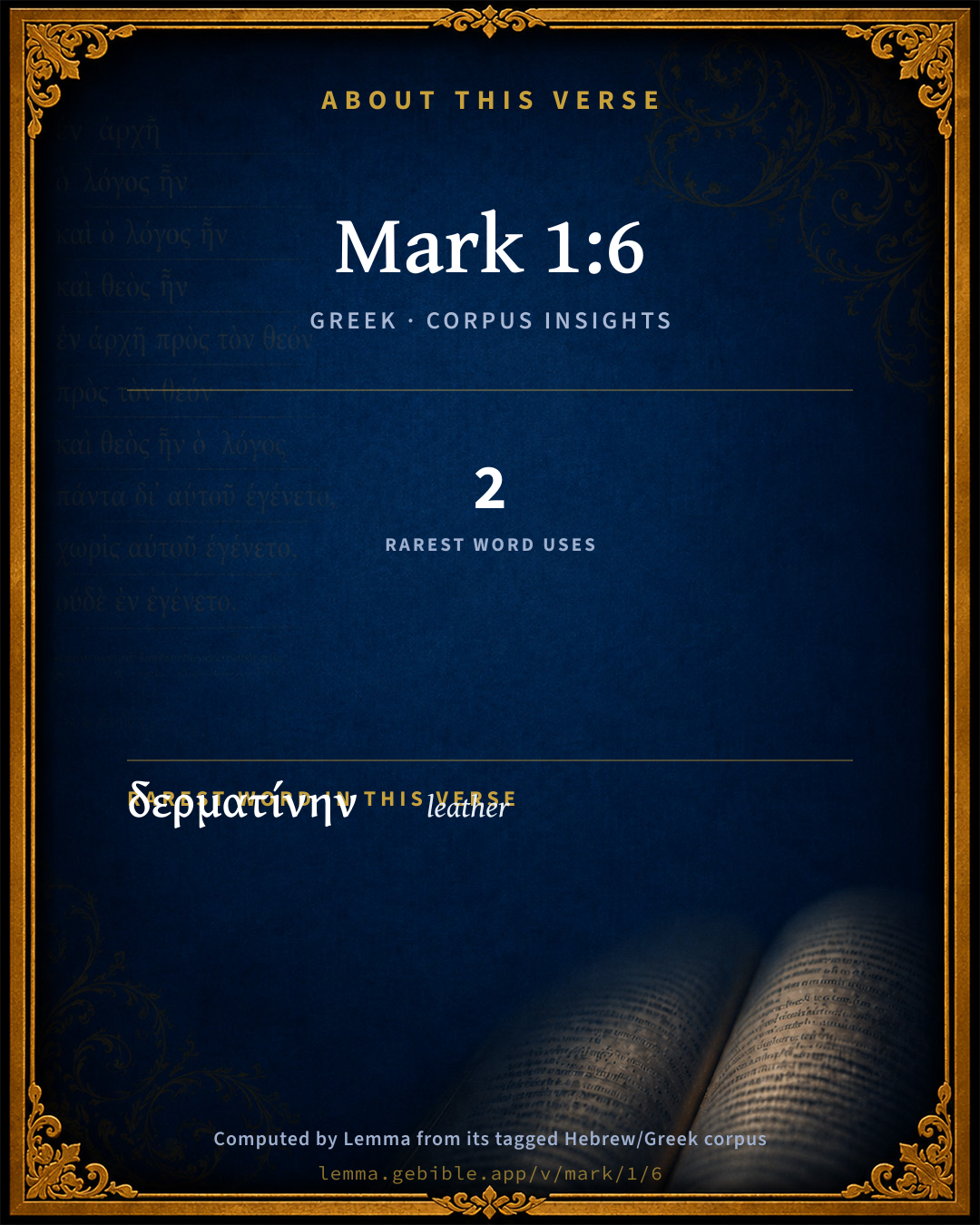
The rarest word here is δερματίνην leather G1193 — appearing just 2 times in the whole Greek New Testament.

Shared distinctive vocabulary

δερματίνην leather G1193 occurs in 2 verses of the Greek New Testament. Also found in:

Repetition

Words recur within this verse:

Cross-references

4

Topical passages linked to Mark 1:6 in the Treasury of Scripture Knowledge — connected by theme and wording, ordered by reader-vote popularity; previews shown in the World English Bible.

  • 2 Kings 1:8 They answered him, He was a hairy man, and girt with a belt of leather about his loins. He said, It is Elijah the Tishbite.
  • Leviticus 11:22 Even of these you may eat: any kind of locust, any kind of katydid, any kind of cricket, and any kind of grasshopper.
  • Zechariah 13:4 It will happen in that day, that the prophets will each be ashamed of his vision, when he prophesies; neither will they wear a hairy mantle to deceive:
  • Matthew 3:4 Now John himself wore clothing made of camel's hair, with a leather belt around his waist. His food was locusts and wild honey.

Cross-references courtesy of OpenBible.info (CC BY 4.0).

Commentary

Notes on Mark 1:6 from classic Christian and Jewish commentators (each source and its license shown beneath its notes). The classic Christian expositions comment on the surrounding passage and are grouped to its opening verse, so a note may address several verses; the Jewish commentaries on the Tanakh (Rashi and others) are per-verse, so they appear only where the commentator wrote on this verse.

Lemma curates 59 commentaries, every one of them public domain or Creative Commons licensed, each selected and text-cleaned for this edition rather than reprinted as found. About our sources →

The Biblical Illustrator

Joseph S. Exell

Mar_1:6

And John was clothed with camels hair.

Rules for sobriety in diet

1. It must not exceed our means.

2. It must not exceed our station.

3. It is to be taken at fit times-when hunger dictates (Psa_145:15; Ecc_10:16-17).

4. We must use such food as may serve to maintain strength and health of body, not such as tends to the hurt and overthrow of our health.

5. Our food should be such as may make us more fit for performance of the duties of our calling and of Gods service. (G. Petter.)

The Baptists plain fare

Coarse meat they were (locusts), but nature is content with little, grace with less. Bread and water with the gospel are good cheer. Our Saviour hath taught us to pray for bread, not for manchet or junkets, but downright household bread; and Himself gave thanks for barley bread and broiled fishes. A little of the creature will serve turn to carry thee through thy pilgrimage. One told a philosopher, If you will be content to please Dionysius, you need not feed upon green herbs. He replied, And if you can feed upon green herbs, you need not please Dionysius; you need not flatter, comply, be base, etc. (John Trapp.)

Why did John Baptist use such mean apparel and diet

1. It was agreeable to the custom of the place were he lived, and easy to be had there.

2. That he might resemble Elias, in whose spirit he was to go before Christ.

3. Because he was a Nazarite from his mothers womb.

4. Preaching the doctrine of repentance, he practised mortification in his own person.

5. That he might procure reverence to his person, and authority to his ministry.

6. To leave us a pattern and example of sobriety and temperance. (G. Petter.)

Rules to be used in the use of apparel, that it may be sober and moderate

1. According to our ability and maintenance in goods or lands.

2. Answerable to our station and dignity, in that place and calling wherein we live.

3. According to the laudable custom of that country where we live.

4. Such as may serve to express the inward graces and virtues of the mind, such as modesty, humility, etc. Therefore it must be comely and decent, not gaudy or garish.

5. Following the example of the most grave and sober men and women that live in the Church and are of our own rank; not after that of the lightest and vainest sort of the people.

6. Our apparel must be worn and used to the right ends for which it is appointed by God. (G. Petter.)

Wild honey

A good old French bishop, in paying his annual visit to his clergy, was very much afflicted by the representations they made of their extreme poverty, which indeed the appearance of their houses and families corroborated. While he was deploring the state of things which had reduced them to this sad condition, he arrived at the house of a curate, who, living amongst a poor set of parishioners, would, he feared, be in a still more awful plight than the others. Contrary, however, to his expectations, he found appearances very much improved. Everything about the house wore the aspect of comfort and plenty. The good bishop was amazed. How is this, my friend? said he; you are the first man I have met with a cheerful face and a plentiful board. Have you any income in addition to the stipend of your cure?…Yes, sir, said the clergyman, I have; my family would starve on the pittance I receive from the poor people I instruct. Come with me into the garden, and I will show you the stock that yields me an excellent interest. On going to the garden, he showed the bishop a large range of beehives. There is the bank from which I draw an annual dividend. It never stops payment.

The Biblical Illustrator, edited by Joseph S. Exell (c. 1880s–1900s) — public domain. Text from a community e-Sword module.

Tyndale Open Study Notes

Tyndale Open Resources

1:6 camel hair . . . leather belt: Cp. Elijah (2 Kgs 1:8). • For food John ate what was available in the wilderness; locusts were allowed as food (cp. Lev 11:20-24).

Tyndale Open Study Notes — © Tyndale Open Resources, licensed CC BY-SA 4.0. Text via the HelloAO Bible API.

Expositor's Greek Testament

ed. W. Robertson Nicoll

Mar 1:6 describes John’s way of life as in Mt., ἐνδεδυμένος standing for εἶχεν τὸ ἔνδυμα , and ἔσθων for ἡ τροφὴ ἦν .

The Expositor's Greek Testament, edited by W. Robertson Nicoll (1897–1910) — public domain. Text from a community e-Sword module.

Adam Clarke's Commentary

Verse 6. John was clothed, &c.] See Clarke on Mt 3:4.

Adam Clarke's Commentary on the Bible (1810–1826) — public domain. Text from a community e-Sword/MySword module.

Ellicott's Commentary for English Readers

(6) And John was clothed. . . .—See Note on Mat_3:4.

A Bible Commentary for English Readers, edited by Charles John Ellicott (1878–1897) — public domain. Text from a community e-Sword module.

The Cambridge Bible for Schools and Colleges

gen. ed. J. J. S. Perowne

6. was clothed] The Evangelist draws our attention to three points in reference to the Baptist:

(a) His appearance. He recalled the asceticism of the Essene. His raiment was of the coarsest texture, such as was worn by Elijah (2Ki_1:8) and the prophets generally (Zec_13:4). His girdle, an ornament often of the greatest richness in Oriental costume and of the finest linen (Jer_13:1; Eze_16:10) or cotton or embroidered with silver and gold (Dan_10:5; Rev_1:13; Rev_15:6), was of untanned leather (2Ki_1:8), like that worn by the Bedouin of the present day.

(b) His diet was the plainest and simplest. Locusts were permitted as an article of food (Lev_11:21-22). Sometimes they were ground and pounded, and then mixed with flour and water and made into cakes; sometimes they were salted and then eaten. For wild honey comp. the story of Jonathan, 1Sa_14:25-27.

(c) His message. (1) That the members of the Elect Nation were all morally unclean, and all needed moral and spiritual regeneration; (2) that One mightier than he was coming; (3) that He would baptize with the Holy Ghost.

The Cambridge Bible for Schools and Colleges (gen. ed. J. J. S. Perowne; Cambridge University Press, 1878–1918) — public domain. Text from a community e-Sword module.

John Gill's Exposition

And John was clothed with camel's hair,.... This is a description of John by his clothes; See Gill on Mat 3:4, to which may be added, that it was usual for penitents, and men of austere lives, and of the first class for holiness and religion, to live in deserts, to fare hard, and wear coarse apparel. Mention is made of one man, who is called, (f), because he had on a garment of goat's hair, which cut his flesh, that so it might atone for him, for he was a penitent:

and with a girdle or skin about his loins; a leathern one, as in Mat 3:4, not a golden one, such as the high priest wore, though the (g) Jews call John an high priest: he was indeed of the priestly race: his father was a priest, but he did not wear a priestly girdle, nor any of the priest's garments;

and he ate locusts and wild honey. The Ethiopic version renders it, "honey of earth bees": in Ethiopia was a sort of bees, little bigger than flies, and without a sting, which had their hives in the earth, where they produced honey of a white colour, very pleasant and wholesome; and this is thought, by the Ethiopians, to be the honey which John ate (h); but then there must have been the same in Judea, which does not appear. Moreover, in the land of Judea, there was , "the honey of palm trees"; and it is said (i), that it is the best honey; and therefore the Scripture calls, honey of the palm trees, honey; and the palm trees which grow in the plains and valleys, abound most with it; wherefore there was much of this about Jericho, the city of palm trees: there was also , "honey of figs"; which in some places was in great plenty:

"R. Jacob ben Dosthai says (k), it is three miles from Lud to Ono (see Ezr 2:33) one time I walked before break of day, and I went up to my ankles in honey of figs.''

Dr. Lightfoot thinks, this was the honey the evangelist speaks of, and John ate of. I have observed on Mat 3:4 that with the Jews, the honey of bees was lawful to eat (l) though the bees themselves were not. So Jonathan ben Uzziel paraphrases, Lev 11:20,

"Let the species of bees be an abomination to you, but the honey of bees may be eaten;''

they being reckoned among reptiles that fly: and it may be further observed, that according to them, the honey of wasps and hornets was lawful to be eaten, as well as the honey of bees (m) and this may be truly called, as here, wild honey; for which they give these reasons (n), because it is not of the substance of their bodies, but they gather it from herbs; and because in the same manner as bees, they take it into their bodies, but do not produce it from them; though some of the doctors dissent, and think it not lawful (o).

(f) T. Bab. Sabbat, fol. 56. 2. Vid. Buxtorf. not. in Sepher Cosri, p. 156, 157. (g) Gauz. Tzemach David, par. 1. fol. 25. 2. (h) Ludolph. Lex. Ethiop. p. 447. (i) Maimon. & Bartenora in Misn. Biccurim, c. 1. sect. 10. (k) T. Bab. Cetubot, fol. 111. 2. (l) Vid. Piske Tosephot Becorot, art. 13. (m) Misn. Macshirin, c. 6. sect. 4. T. Bab. Becorot, fol. 7. 2. (n) Maimon. Hilch. Maacalot Asurot, c. 3. sect. 3. Ib. & Bartenora in Misn. Macshirin, ibid. (o) In Piske Tosephot Becorot, art. 13. Maggid Misna in Maimon. Hilch. Maacolot ib.

John Gill's Exposition of the Whole Bible (1746–1763) — public domain (CC PDM 1.0). Text via the HelloAO Bible API.

Trapp's Complete Commentary

John Trapp

6 And John was clothed with camel’s hair, and with a girdle of a skin about his loins; and he did eat locusts and wild honey;

Ver. 6. And John was clothed, &c.] Elias also was a rough hairy man. Those worthies, of "whom the world was not worthy, wandered about in sheep’s skins and goat’s skins," Heb 11:37; but they were like the ark, goat’s hair without, but pure gold within; or like Brutus’ staff, Cuius intus solidum aurum corneo velabatur eortiee. (Plutarch.) Buchanan seldom cared for a better outside than a rug gown girt close about him, yet his inside was most rich.

He did eat locusts] Good meat (to those there at least) though coarse, and easily come by. Tartarians eat the carrion carcases of horses, camels, asses, cats, dogs, yea, when they stink, and are full of magots, and hold them as dainty as we do venison.

John Trapp, A Commentary or Exposition upon All the Books of the Old and New Testament (1647–1656) — public domain. Text from a community e-Sword module.

Haydock's Catholic Bible Commentary

See Matthew iii. 4. --- Wild honey. Rabbanus thinks it was a kind of white and tender leaf, which, when rubbed in the hand, emitted a juice like honey. Suidas thinks it was a kind of dew, collected from leaves of trees, and was called manna. But St. John Chrysostom, Theophylactus, Euthymius, and St. Isidore, with greatest probability, think it was honey collected by wild bees, in the fissures of rocks or in the holes of decayed trees, which was insipid and unpleasant to the taste. (Tirinus)

George Leo Haydock (1774–1849), Haydock's Catholic Family Bible and Commentary, 1859 edition — public domain. Excludes Psalms (Douay-Rheims chapter numbering differs from Protestant) and Deuterocanonical books (Catholic canon only).

Matthew Poole's English Annotations

See Poole on "Mat 3:4".

Matthew Poole's English Annotations on the Holy Bible (1683–1685) — public domain. Text from a community e-Sword/MySword module.

The Pulpit Commentary

Clothed with camel"s hair. This was a rough, coarse garment, characteristic of the doctrine which John taught, namely, penitence and contempt of the world. Camels abounded in Syria. And a leathern girdle about his loins. Not only the prophets, but the Jews and the inhabitants of Syria generally, used a girdle to keep the long flowing garment more closely about them, so as to leave them more free for journeying or for labour. Thus our Lord says, (Luk_12:35) "Let your loins be girded about, and your lamps burning." And he did eat locusts and wild honey. The insect called the locust (akriv) was permitted to be eaten. (see Lev_11:22) It was used as food by the common people in Judaea. The Arabs eat them to this day; but they are considered as a common and inferior kind of food. They are a sign of temperance, poverty, and penitence. The wild honey (meli agrion) was simply honey made by wild bees, either in the trees or in the hollows of the rocks. Isidorus says that it was of an inferior flavour. Both these kinds of food were consistent with the austere life and the solemn preaching of the Baptist.

The Pulpit Commentary (1880–1919), ed. H.D.M. Spence-Jones & Joseph S. Exell — public domain. Text from a community e-Sword module.

Kretzmann's Popular Commentary

Paul E. Kretzmann

John’s appearance and message of Christ:

v. 6. And John was clothed with camel’s hair and with a girdle of skins about his loins; and he did eat locusts and wild honey;

v. 7. and preached, saying, There cometh One mightier than I after me, the latchet of whose shoes I am not worthy to stoop down and unloose.

v. 8. I indeed have baptized you with water; but He shall baptize you with the Holy Ghost.

The appearance of John did much to call attention to his message, especially as the people of Judea were familiar with the description which the Old Testament gives of the great prophet Elijah, 2Ki 1:8. His one garment was woven of camel’s hair, by no means a stylish and comfortable garment, since he was seeking neither luxury nor easy living. A rough girdle of leather held the garment in place about the loins. His food was in full harmony with his clothing: an edible form of locust, Lev 11:22, and the wild honey found in the clefts of rocks or sweated out of certain trees growing in the wilderness. This mode of life he did not merely affect for the sake of making an impression. This was the clothing which he always wore; it was the food which he had always eaten, the customary meal. And now it appears that the message of the prophet, followed by baptism unto forgiveness, was all preparatory to the most characteristic’ preaching, that concerning Jesus. He, that one man, that is stronger, that has more power than I, is coming after me, is even now ready to be revealed before you. So great is the difference and contrast between them that John does not even feel himself worthy to perform a service for Him which a slave might covet. He is not worthy to stoop down before this greater Man unloosened the straps of His sandals. That was true, unaffected humility, such as is found in all those that really are serving the Lord. See 1Ti 1:15. The work of this Man that was thus expected could be summarized in a short sentence: He will baptize you with the Holy Ghost. And this in contrast to the mere baptism with water, which John was sent to do. That is a feature, the most significant part of Christ’s ministry and work for mankind, the baptism with, the communication of, the Holy Ghost, Joh 20:20. There may not always be evidence of His presence in extraordinary manifestations, as in the early days of the Church, but the Holy Spirit lives, by the gift of Christ, in the hearts of all that have come to faith. And the evidence of His presence is never entirely wanting, if the Christian but make diligent use of the means of grace, through which alone the Spirit is communicated to them at the present time, especially the Word of the Gospel and the Lord’s Supper. There will be a growth in grace and knowledge of Jesus Christ, the Savior; there will be cheerfulness in the midst of the various distresses and tribulations of these latter days; there will be, above all, the greater willingness to serve Him in His kingdom, in everlasting righteousness, innocence, and blessedness.

Paul E. Kretzmann, Popular Commentary of the Bible (1921–1924) — public domain. Text from a community e-Sword module.

Burkitt's Expository Notes on the New Testament

William Burkitt

This verse acquaints us with the strictness and austerity of St. John’s life in the wilderness; which is laid down in two things; in his mean and frugal apparel, and in his sober and temperate diet.

His apparel was rough and hairy, and his girdle of leather; as Elijah his forerunner was clad before him, 2Ki 1:8.

His diet was coarse and ordinary, locusts and wild honey; that is, such plain and ordinary food as the wilderness afforded.

His example teaches us, That the ministers of the gospel are not to effect either bravery in apparel, or delicacy in diet; but both by their habit and diet set an example of gravity and sobriety before their people; being in these, as well as in other things, an example unto their flocks.

William Burkitt's Expository Notes on the New Testament (1700–1703) — public domain. Text from a community e-Sword module.

The People's New Testament

B. W. Johnson

6. John was clothed with camel's hair. See note on Matt. 3:4.

B. W. Johnson's The People's New Testament with Notes (1889–1891) — public domain. Electronic text from the Christian Classics Ethereal Library (CCEL) ThML edition.

Cambridge Greek Testament for Schools and Colleges

6. The form ἔσθων ([63][64][65][66] 33) is freq. in the [67] text of LXX.

[63] Codex Sinaiticus. 4th cent. Discovered by Tischendorf in 1859 at the Monastery of St Katharine on Mount Sinai. Now at St Petersburg. The whole Gospel, ending at Mar 16:8. Photographic facsimile, 1911.

[64] Codex Vaticanus. 4th cent., but perhaps a little later than א. In the Vatican Library almost since its foundation by Pope Nicolas V., and one of its greatest treasures. The whole Gospel, ending at Mar 16:8. Photographic facsimile, 1889.

[65] Codex Regius. 8th cent. An important witness. At Paris. Contains Mar 1:1 to Mar 10:15; Mar 10:30 to Mar 15:1; Mar 15:20 to Mar 16:20, but the shorter ending is inserted between Mar 16:8 and Mar 16:9, showing that the scribe preferred it to the longer one.

[66] An asterisk denotes that the word is not found elsewhere in N.T., and such words are included in the index, even if there is no note on them in the commentary.

[67] Codex Vaticanus. 4th cent., but perhaps a little later than א. In the Vatican Library almost since its foundation by Pope Nicolas V., and one of its greatest treasures. The whole Gospel, ending at Mar 16:8. Photographic facsimile, 1889.

6. ἦν ἐνδεδυμένος. The periphrastic tense, freq. in Lk., is not rare in Mk (Mar 1:33, Mar 2:6, Mar 5:5, Mar 9:4, Mar 10:32, Mar 13:13; Mar 13:23, Mar 15:43). Cloth was made of camel’s hair, and either this or a camel’s skin may be meant. It is probable that actual locusts (Lev 11:22) and honey made by wild bees (Deu 32:13) are meant. The wilderness food was in harmony with the rough dress. This picture of the Baptist is the more remarkable because there is no corresponding picture of the Christ. But it is an exaggeration to say that we have a clear picture of John, but not of Jesus. There is uncertainty about the unusual dress and unusual food of John. Jesus wore the usual dress and ate the usual food. We know the details of neither. John perhaps deliberately imitated Elijah, in order to teach the people that he was a Prophet (2Ki 1:8; cf. Zec 13:4); but the suddenness with which he appears in Mk, Mt. and Jn, like Elijah in 1Ki 17:1, cannot be his doing. It is neither said nor implied that it was his asceticism which attracted such crowds; the belief that he was a Prophet did that.

Cambridge Greek Testament for Schools and Colleges (Cambridge University Press, 1896; 21 vols, various authors incl. Carr, Maclear, Plummer, Farrar, Lumby, Moule, M. R. James, Simcox) — public domain. Text from a community e-Sword module.

International Critical Commentary

6. τρίχας καμήλου—camel’s hair. Since it says camel’s hair, and not skin or fur, we are to understand probably a coarse cloth made of the hair. There are examples moreover of the cloth, but not of the skin, being used in this way. ζώνην δερματίνην—a leather girdle. This is selected to describe Elijah’s general appearance in 2 K. 1:8. And it is a distinguishing mark of coarse dress, the girdle gathering in the loose robe about the waist being generally a place for luxury and display in dress. There is some reason to suppose, too, that the description, hairy man, may refer to Elijah’s dress, which would be another correspondence. So RV.marg. καὶ ἔσθων ἀκρίδας καὶ μέλι ἄγριον—and was eating locusts and wild honey.1

ἔσθων Tisch. Treg. WH. א BL* Δ 33.

This food was wilderness food, and corresponds to the coarse dress. Together, they represent the spirit of the man, his contempt of ease and luxury, his revolt against a sinful generation, everything which caused him to dwell apart from men, and to contemn their manners. Locusts were an article of food especially allowed by the Levitical Law, and they are still eaten, prepared in various ways, by Eastern peoples. By wild honey may be meant that made by wild bees, and deposited in hollow trees, and other places in the woods; but as a matter of fact, the term μέλι ἄγριον seems to be applied generally to the sweet sap of certain trees.2

International Critical Commentary — older volumes (1896–1929), various authors — public domain. Text from a community e-Sword module.

Vincent's Word Studies in the New Testament

Marvin R. Vincent

With camels' hair (τρίχας καμήλου)

Lit., hairs. Not with a camel's skin, but with a vesture woven of camels' hair. Compare 2 Kings 1, 8.

Wild honey

“The innumerable fissures and clefts of the limestone rocks, which everywhere flank the valleys, afford in their recesses secure shelter for any number of swarms of wild bees; and many of the Bedouin, particularly about the wilderness of Judaea, obtain their subsistence by bee-hunting, bringing into Jerusalem jars of that wild honey on which John the Baptist fed in the wilderness” (Tristram, “Land of Israel”). Wyc., honey of the wood.

Marvin R. Vincent, Word Studies in the New Testament (1887–1900) — public domain. Text from a community e-Sword/MySword module.

Lesson kit

Teaching starters — assembled from the data on this page, not authored interpretation. Every prompt links to the verse data it draws on. Edit before teaching.

Mark, in the Gospels, opens this verse with 20 words (16 distinct Greek lemmas). Its most distinctive word is dermátinos (“leather”). A historical commentator’s framing appears above. Read the whole chapter for the surrounding context.

Discussion questions

  1. What does “leather” (dermátinos) contribute to the verse as a whole?
  2. Matthew 3:4 shares the word «leather» with this verse. How do the two illuminate each other?
  3. “and” occurs 4× in this one verse. What is the effect of the repetition?
  4. These translations render this verse differently; the difference is in the English rendering, not the original. What questions does that raise?
  5. Reading how The Biblical Illustrator and Tyndale Open Study Notes read this verse, where do the two commentators agree and where do they part?

Things to notice

Reading settings

Reading text

Shown beneath each verse's original-language words.

Old Testament
Old Testament edition

Read the OT as the Masoretic Hebrew (MT) or the Greek Septuagint (LXX).

English shown for the Greek Septuagint (in the Hebrew ↔ Greek comparison).

Comparing translations? Open the Compare panel on any verse page to stack up to four side by side.