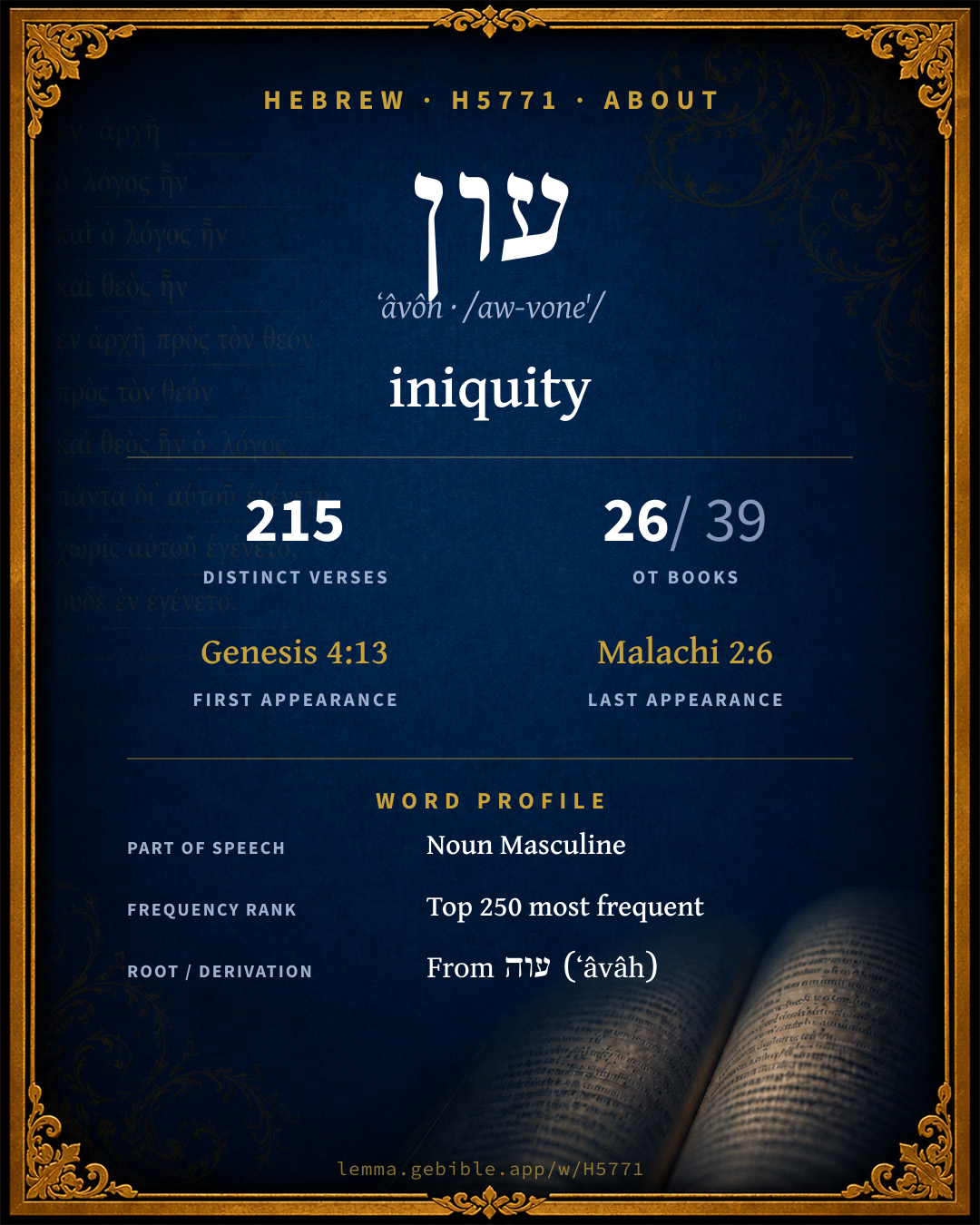
עָוֺן
iniquity
also: perversity, depravity fuller range ↓
Full lexicon entry — Brown-Driver-Briggs (BDB)
From Brown-Driver-Briggs (BDB)
Where this word appears
See every Construct-state word in the Hebrew Bible →
Grammar key — what these labels mean
Part of speech
- Noun
- A naming word — a person, place, thing, or idea.
Noun type
- Common
- A common noun — a general class of person, place, or thing (“king,” “city,” “water”), not a specific name.
State
- Construct
- A noun bound to a following noun in a possessive / “of” relationship (the construct chain).
- Absolute
- The independent form of a noun, not bound to a following word.
Gender
- Both
- Attested as both masculine and feminine.
Number
- Singular
- One.
- Plural
- More than one (in Hebrew, generally three or more).
Grammatical forms
- Noun, Common, Both, Singular, Construct 147 times (63%)
- Noun, Common, Both, Plural, Construct 41 times (18%)
- Noun, Common, Both, Singular, Absolute 40 times (17%)
- Noun, Common, Both, Plural, Absolute 4 times (2%)
Parsed forms decoded from the imported morphology (morphhb / Westminster Leningrad Codex — WLC text public domain, morphhb tagging CC BY 4.0), counted across 232 parsed occurrences — not distinct verses.
Page 1 of 2 — showing verses 1–200 of 215 distinct verses where H5771 appears, across 26 books. Click any verse to open its interlinear word-by-word view. Verse text shown in the World English Bible for context — . Each verse’s Hebrew form is shown with its reference; the English is not keyword-highlighted, since the data carries no word-level English alignment. Use “Compare translations” on any verse to read it across multiple English versions. This concordance covers the Hebrew Bible; Septuagint (Greek Old Testament) occurrences are not indexed here.
Genesis 4 verses
- Genesis 4:13 עֲוֺנִ֖/י n c bs cs + sfx pers 1cs Cain said to Yahweh, "My punishment is greater than I can bear.
- Genesis 15:16 עֲוֺ֥ן n c bs cs In the fourth generation they will come here again, for the iniquity of the Amorite is not yet full."
- Genesis 19:15 בַּ/עֲוֺ֥ן prep + n c bs cs When the morning arose, then the angels hurried Lot, saying, "Arise, take your wife, and your two daughters who are here, lest you be consumed in the iniquity of the city."
- Genesis 44:16 עֲוֺ֣ן n c bs cs Judah said, "What will we tell my lord? What will we speak? Or how will we clear ourselves? God has found out the iniquity of your servants. Behold, we are my lord's bondservants, both we, and he also in whose hand the cup is found."
Exodus 5 verses
- Exodus 20:5 עֲוֺ֨ן n c bs cs you shall not bow yourself down to them, nor serve them, for I, Yahweh your God, am a jealous God, visiting the iniquity of the fathers on the children, on the third and on the fourth generation of those who hate me,
- Exodus 28:38 עֲוֺ֣ן n c bs cs It shall be on Aaron's forehead, and Aaron shall bear the iniquity of the holy things, which the children of Israel shall make holy in all their holy gifts; and it shall be always on his forehead, that they may be accepted before Yahweh.
- Exodus 28:43 עָוֺ֖ן n c bs They shall be on Aaron, and on his sons, when they go in to the tent of meeting, or when they come near to the altar to minister in the holy place; that they don't bear iniquity, and die: it shall be a statute forever to him and to his descendants after him.
- Exodus 34:7 עָוֺ֛ן עֲוֺ֣ן n c bs n c bs cs keeping loving kindness for thousands, forgiving iniquity and disobedience and sin; and that will by no means clear the guilty, visiting the iniquity of the fathers on the children, and on the children's children, on the third and on the fourth generation."
- Exodus 34:9 לַ/עֲוֺנֵ֥/נוּ prep + n c bs cs + sfx pers 1cp He said, "If now I have found favor in your sight, Lord, please let the Lord go in the midst of us; although this is a stiff-necked people; pardon our iniquity and our sin, and take us for your inheritance."
Leviticus 16 verses
- Leviticus 5:1 עֲוֺנֽ/וֹ n c bs cs + sfx pers 3ms "'If anyone sins, in that he hears the voice of adjuration, he being a witness, whether he has seen or known, if he doesn't report it, then he shall bear his iniquity.
- Leviticus 5:17 עֲוֺנֽ/וֹ n c bs cs + sfx pers 3ms "If anyone sins, and does any of the things which Yahweh has commanded not to be done; though he didn't know it, yet he is guilty, and shall bear his iniquity.
- Leviticus 7:18 עֲוֺנָ֥/הּ n c bs cs + sfx pers 3fs If any of the flesh of the sacrifice of his peace offerings is eaten on the third day, it will not be accepted, neither shall it be imputed to him who offers it. It will be an abomination, and the soul who eats any of it will bear his iniquity.
- Leviticus 10:17 עֲוֺ֣ן n c bs cs "Why haven't you eaten the sin offering in the place of the sanctuary, seeing it is most holy, and he has given it you to bear the iniquity of the congregation, to make atonement for them before Yahweh?
- Leviticus 16:21 עֲוֺנֹת֙ n c bp cs Aaron shall lay both his hands on the head of the live goat, and confess over him all the iniquities of the children of Israel, and all their transgressions, even all their sins; and he shall put them on the head of the goat, and shall send him away into the wilderness by the hand of a man who is in readiness.
- Leviticus 16:22 עֲוֺנֹתָ֖/ם n c bp cs + sfx pers 3mp The goat shall carry all their iniquities on himself to a solitary land, and he shall let the goat go in the wilderness.
- Leviticus 17:16 עֲוֺנֽ/וֹ n c bs cs + sfx pers 3ms But if he doesn't wash them, or bathe his flesh, then he shall bear his iniquity.'"
- Leviticus 18:25 עֲוֺנָ֖/הּ n c bs cs + sfx pers 3fs The land was defiled: therefore I punished its iniquity, and the land vomitted out her inhabitants.
- Leviticus 19:8 עֲוֺנ֣/וֹ n c bs cs + sfx pers 3ms but everyone who eats it shall bear his iniquity, because he has profaned the holy thing of Yahweh, and that soul shall be cut off from his people.
- Leviticus 20:17 עֲוֺנ֥/וֹ n c bs cs + sfx pers 3ms "'If a man takes his sister, his father's daughter, or his mother's daughter, and sees her nakedness, and she sees his nakedness; it is a shameful thing; and they shall be cut off in the sight of the children of their people: he has uncovered his sister's nakedness; he shall bear his iniquity.
- Leviticus 20:19 עֲוֺנָ֥/ם n c bs cs + sfx pers 3mp "'You shall not uncover the nakedness of your mother's sister, nor of your father's sister; for he has made naked his close relative: they shall bear their iniquity.
- Leviticus 22:16 עֲוֺ֣ן n c bs cs and so cause them to bear the iniquity that brings guilt, when they eat their holy things: for I am Yahweh who sanctifies them.'"
- Leviticus 26:39 בַּֽ/עֲוֺנָ֔/ם בַּ/עֲוֺנֹ֥ת prep + n c bs cs + sfx pers 3mp prep det + n c bp cs Those of you who are left will pine away in their iniquity in your enemies' lands; and also in the iniquities of their fathers shall they pine away with them.
- Leviticus 26:40 עֲוֺנָ/ם֙ עֲוֺ֣ן n c bs cs + sfx pers 3mp n c bs cs "'If they confess their iniquity, and the iniquity of their fathers, in their trespass which they trespassed against me, and also that, because they walked contrary to me,
- Leviticus 26:41 עֲוֺנָֽ/ם n c bs cs + sfx pers 3mp I also walked contrary to them, and brought them into the land of their enemies: if then their uncircumcised heart is humbled, and they then accept the punishment of their iniquity;
- Leviticus 26:43 עֲוֺנָ֑/ם n c bs cs + sfx pers 3mp The land also will be left by them, and will enjoy its sabbaths while it lies desolate without them: and they will accept the punishment of their iniquity; because, even because they rejected my ordinances, and their soul abhorred my statutes.
Numbers 9 verses
- Numbers 5:15 עָוֺֽן n c bs then the man shall bring his wife to the priest, and shall bring her offering for her: the tenth part of an ephah of barley meal. He shall pour no oil on it, nor put frankincense on it, for it is a meal offering of jealousy, a meal offering of memorial, bringing iniquity to memory.
- Numbers 5:31 מֵ/עָוֺ֑ן עֲוֺנָֽ/הּ prep + n c bs n c bs cs + sfx pers 3fs The man shall be free from iniquity, and that woman shall bear her iniquity."
- Numbers 14:18 עָוֺ֖ן עֲוֺ֤ן n c bs n c bs cs Yahweh is slow to anger, and abundant in loving kindness, forgiving iniquity and disobedience; and that will by no means clear [the guilty], visiting the iniquity of the fathers on the children, on the third and on the fourth generation.
- Numbers 14:19 לַ/עֲוֺ֛ן prep + n c bs cs Pardon, Please, the iniquity of this people according to the greatness of your loving kindness, and according as you have forgiven this people, from Egypt even until now.
- Numbers 14:34 עֲוֺנֹ֣תֵי/כֶ֔ם n c bp cs + sfx pers 2mp After the number of the days in which you spied out the land, even forty days, for every day a year, shall you bear your iniquities, even forty years, and you shall know my alienation.
- Numbers 15:31 עֲוֺנָ֥/ה n c bs cs + sfx pers 3fs Because he has despised the word of Yahweh, and has broken his commandment, that soul shall utterly be cut off; his iniquity shall be on him.
- Numbers 18:1 עֲוֺ֣ן עֲוֺ֥ן n c bs cs n c bs cs Yahweh said to Aaron, You and your sons and your fathers' house with you shall bear the iniquity of the sanctuary; and you and your sons with you shall bear the iniquity of your priesthood.
- Numbers 18:23 עֲוֺנָ֑/ם n c bs cs + sfx pers 3mp But the Levites shall do the service of the tent of meeting, and they shall bear their iniquity: it shall be a statute forever throughout your generations; and among the children of Israel they shall have no inheritance.
- Numbers 30:15 עֲוֺנָֽ/הּ n c bs cs + sfx pers 3fs But if he shall make them null and void after that he has heard them, then he shall bear her iniquity.
Deuteronomy 2 verses
- Deuteronomy 5:9 עֲוֺ֨ן n c bs cs you shall not bow down yourself to them, nor serve them; for I, Yahweh, your God, am a jealous God, visiting the iniquity of the fathers on the children, and on the third and on the fourth generation of those who hate me;
- Deuteronomy 19:15 עָוֺן֙ n c bs One witness shall not rise up against a man for any iniquity, or for any sin, in any sin that he sins: at the mouth of two witnesses, or at the mouth of three witnesses, shall a matter be established.
Joshua 2 verses
- Joshua 22:17 עֲוֺ֣ן n c bs cs Is the iniquity of Peor too little for us, from which we have not cleansed ourselves to this day, although there came a plague on the congregation of Yahweh,
- Joshua 22:20 בַּ/עֲוֺנֽ/וֹ prep + n c bs cs + sfx pers 3ms Didn't Achan the son of Zerah commit a trespass in the devoted thing, and wrath fell on all the congregation of Israel? and that man didn't perish alone in his iniquity.
1 Samuel 7 verses
- 1 Samuel 3:13 בַּ/עֲוֺ֣ן prep + n c bs cs For I have told him that I will judge his house forever, for the iniquity which he knew, because his sons did bring a curse on themselves, and he didn't restrain them.
- 1 Samuel 3:14 עֲוֺ֧ן n c bs cs Therefore I have sworn to the house of Eli, that the iniquity of Eli's house shall not be expiated with sacrifice nor offering forever.
- 1 Samuel 18:9 עון n c bs Saul eyed David from that day and forward.
- 1 Samuel 20:1 עֲוֺנִ֤/י n c bs cs + sfx pers 1cs David fled from Naioth in Ramah, and came and said before Jonathan, "What have I done? What is my iniquity?" and "What is my sin before your father, that he seeks my life?"
- 1 Samuel 20:8 עָוֺן֙ n c bs Therefore deal kindly with your servant; for you have brought your servant into a covenant of Yahweh with you: but if there be in me iniquity, kill me yourself; for why should you bring me to your father?
- 1 Samuel 25:24 הֶֽ/עָוֺ֑ן ptcl def.art + n c bs She fell at his feet, and said, On me, my lord, on me be the iniquity; and please let your handmaid speak in your ears. Hear the words of your handmaid.
- 1 Samuel 28:10 עָוֺ֖ן n c bs Saul swore to her by Yahweh, saying, As Yahweh lives, there shall no punishment happen to you for this thing.
2 Samuel 7 verses
- 2 Samuel 3:8 עֲוֺ֥ן n c bs cs Then was Abner very angry for the words of Ish-bosheth, and said, Am I a dog's head that belongs to Judah? This day do I show kindness to the house of Saul your father, to his brothers, and to his friends, and have not delivered you into the hand of David; and yet you charge me this day with a fault concerning this woman.
- 2 Samuel 14:9 הֶ/עָוֺ֖ן ptcl def.art + n c bs The woman of Tekoa said to the king, My lord, O king, the iniquity be on me, and on my father's house; and the king and his throne be guiltless.
- 2 Samuel 14:32 עָוֺ֖ן n c bs Absalom answered Joab, Behold, I sent to you, saying, Come here, that I may send you to the king, to say, Why am I come from Geshur? it were better for me to be there still. Now therefore let me see the king's face; and if there be iniquity in me, let him kill me.
- 2 Samuel 16:12 ב/עונ/י prep + n c bs cs + sfx pers 1cs It may be that Yahweh will look on the wrong done to me, and that Yahweh will requite me good for [his] cursing of me this day.
- 2 Samuel 19:19 עָוֺן֒ n c bs He said to the king, Don't let my lord impute iniquity to me, neither do you remember that which your servant did perversely the day that my lord the king went out of Jerusalem, that the king should take it to his heart.
- 2 Samuel 22:24 מֵ/עֲוֺנִֽ/י prep + n c bs cs + sfx pers 1cs I was also perfect toward him; I kept myself from my iniquity.
- 2 Samuel 24:10 עֲוֺ֣ן n c bs cs David's heart struck him after that he had numbered the people. David said to Yahweh, I have sinned greatly in that which I have done: but now, Yahweh, put away, I beg you, the iniquity of your servant; for I have done very foolishly.
1 Kings 1 verse
2 Kings 1 verse
1 Chronicles 1 verse
Ezra 3 verses
- Ezra 9:6 עֲוֺנֹתֵ֤י/נוּ n c bp cs + sfx pers 1cp and I said, my God, I am ashamed and blush to lift up my face to you, my God; for our iniquities are increased over our head, and our guiltiness is grown up to the heavens.
- Ezra 9:7 וּ/בַ/עֲוֺנֹתֵ֡י/נוּ conj + prep + n c bp cs + sfx pers 1cp Since the days of our fathers we have been exceeding guilty to this day; and for our iniquities have we, our kings, and our priests, been delivered into the hand of the kings of the lands, to the sword, to captivity, and to plunder, and to confusion of face, as it is this day.
- Ezra 9:13 מֵֽ/עֲוֺנֵ֔/נוּ prep + n c bs cs + sfx pers 1cp After all that is come on us for our evil deeds, and for our great guilt, seeing that you our God have punished us less than our iniquities deserve, and have given us such a remnant,
Nehemiah 2 verses
- Nehemiah 4:5 עֲוֺנָ֔/ם n c bs cs + sfx pers 3mp and don't cover their iniquity, and don't let their sin be blotted out from before you; for they have provoked [you] to anger before the builders.
- Nehemiah 9:2 וַ/עֲוֺנ֖וֹת conj + n c bp cs The seed of Israel separated themselves from all foreigners, and stood and confessed their sins, and the iniquities of their fathers.
Job 15 verses
- Job 7:21 עֲוֺ֫נִ֥/י n c bs cs + sfx pers 1cs Why do you not pardon my disobedience, and take away my iniquity? For now shall I lie down in the dust. You will seek me diligently, but I shall not be."
- Job 10:6 לַ/עֲוֺנִ֑/י prep + n c bs cs + sfx pers 1cs That you inquire after my iniquity, And search after my sin?
- Job 10:14 וּ֝/מֵ/עֲוֺנִ֗/י conj + prep + n c bs cs + sfx pers 1cs If I sin, then you mark me. You will not acquit me from my iniquity.
- Job 11:6 מֵ/עֲוֺנֶֽ/ךָ prep + n c bs cs + sfx pers 2ms That he would show you the secrets of wisdom! For true wisdom has two sides. Know therefore that God exacts of you less than your iniquity deserves.
- Job 13:23 עֲוֺנ֣וֹת n c bp How many are my iniquities and sins? Make me know my disobedience and my sin.
- Job 13:26 עֲוֺנ֥וֹת n c bp cs For you write bitter things against me, And make me inherit the iniquities of my youth:
- Job 14:17 עֲוֺנִֽ/י n c bs cs + sfx pers 1cs My disobedience is sealed up in a bag. You fasten up my iniquity.
- Job 15:5 עֲוֺנְ/ךָ֣ n c bs cs + sfx pers 2ms For your iniquity teaches your mouth, And you choose the language of the crafty.
- Job 19:29 עֲוֺנ֣וֹת n c bp cs Be afraid of the sword, For wrath brings the punishments of the sword, That you may know there is a judgment."
- Job 20:27 עֲוֺנ֑/וֹ n c bs cs + sfx pers 3ms The heavens shall reveal his iniquity, The earth shall rise up against him.
- Job 22:5 לַ/עֲוֺנֹתֶֽי/ךָ prep + n c bp cs + sfx pers 2ms Isn't your wickedness great? Neither is there any end to your iniquities.
- Job 31:11 עָוֺ֥ן n c bs For that would be a heinous crime; Yes, it would be an iniquity to be punished by the judges:
- Job 31:28 עָוֺ֣ן n c bs This also would be an iniquity to be punished by the judges; For I should have denied the God who is above.
- Job 31:33 עֲוֺֽנִ/י n c bs cs + sfx pers 1cs If like Adam I have covered my transgressions, By hiding my iniquity in my heart,
- Job 33:9 עָוֺ֣ן n c bs 'I am clean, without disobedience. I am innocent, neither is there iniquity in me:
Psalms 29 verses
- Psalms 18:23 מֵ/עֲוֺנִֽ/י prep + n c bs cs + sfx pers 1cs I was also blameless with him. I kept myself from my iniquity.
- Psalms 25:11 לַ֝/עֲוֺנִ֗/י prep + n c bs cs + sfx pers 1cs For your name's sake, Yahweh, Pardon my iniquity, for it is great.
- Psalms 31:10 בַּ/עֲוֺנִ֣/י prep + n c bs cs + sfx pers 1cs For my life is spent with sorrow, My years with sighing. My strength fails because of my iniquity. My bones are wasted away.
- Psalms 32:2 עָוֺ֑ן n c bs Blessed is the man to whom Yahweh doesn't impute iniquity, In whose spirit there is no deceit.
- Psalms 32:5 וַ/עֲוֺ֘נִ֤/י עֲוֺ֖ן conj + n c bs cs + sfx pers 1cs n c bs cs I acknowledged my sin to you. I didn't hide my iniquity. I said, I will confess my transgressions to Yahweh, And you forgave the iniquity of my sin. Selah.
- Psalms 36:2 עֲוֺנ֣/וֹ n c bs cs + sfx pers 3ms For he flatters himself in his own eyes, Too much to detect and hate his sin.
- Psalms 38:4 עֲ֭וֺנֹתַ/י n c bp cs + sfx pers 1cs For my iniquities have gone over my head. As a heavy burden, they are too heavy for me.
- Psalms 38:18 עֲוֺנִ֥/י n c bs cs + sfx pers 1cs For I will declare my iniquity. I will be sorry for my sin.
- Psalms 39:11 עָוֺ֨ן n c bs When you rebuke and correct man for iniquity, You consume his wealth like a moth. Surely every man is but a breath." Selah.
- Psalms 40:12 עֲ֭וֺנֹתַ/י n c bp cs + sfx pers 1cs For innumerable evils have surrounded me. My iniquities have overtaken me, so that I am not able to look up. They are more than the hairs of my head. My heart has failed me.
- Psalms 49:5 עֲוֺ֖ן n c bs cs Why should I fear in the days of evil, When iniquity at my heels surrounds me?
- Psalms 51:2 מֵ/עֲוֺנִ֑/י prep + n c bs cs + sfx pers 1cs Wash me thoroughly from my iniquity. Cleanse me from my sin.
- Psalms 51:5 בְּ/עָו֥וֹן prep + n c bs Behold, I was brought forth in iniquity. In sin my mother conceived me.
- Psalms 51:9 עֲוֺ֖נֹתַ֣/י n c bp cs + sfx pers 1cs Hide your face from my sins, And blot out all of my iniquities.
- Psalms 59:4 עָ֭וֺן n c bs I have done no wrong, yet they are ready to attack me. Rise up, behold, and help me!
- Psalms 65:3 עֲ֭וֺנֹת n c bp Sins overwhelmed me, But you atoned for our transgressions.
- Psalms 69:27 עָ֭וֺן עֲוֺנָ֑/ם n c bs n c bs cs + sfx pers 3mp Charge them with crime upon crime. Don't let them come into your righteousness.
- Psalms 78:38 עָוֺן֮ n c bs But he, being merciful, forgave iniquity, and didn't destroy them. Yes, many times he turned his anger away, And didn't stir up all his wrath.
- Psalms 79:8 עֲוֺנֹ֪ת n c bp Don't hold the iniquities of our forefathers against us. Let your tender mercies speedily meet us, For we are in desperate need.
- Psalms 85:2 עֲוֺ֣ן n c bs cs You have forgiven the iniquity of your people. You have covered all their sin. Selah.
- Psalms 89:32 עֲוֺנָֽ/ם n c bs cs + sfx pers 3mp Then I will punish their sin with the rod, And their iniquity with stripes.
- Psalms 90:8 עֲוֺנֹתֵ֣י/נוּ n c bp cs + sfx pers 1cp You have set our iniquities before you, Our secret sins in the light of your presence.
- Psalms 103:3 עֲוֺנֵ֑/כִי n c bs cs + sfx pers 2fs Who forgives all your sins; Who heals all your diseases;
- Psalms 103:10 כַ֝/עֲוֺנֹתֵ֗י/נוּ prep + n c bp cs + sfx pers 1cp He has not dealt with us according to our sins, Nor repaid us for our iniquities.
- Psalms 106:43 בַּ/עֲוֺנָֽ/ם prep + n c bs cs + sfx pers 3mp Many times he delivered them, But they were rebellious in their counsel, And were brought low in their iniquity.
- Psalms 107:17 וּֽ֝/מֵ/עֲוֺֽנֹתֵי/הֶ֗ם conj + prep + n c bp cs + sfx pers 3mp Fools are afflicted because of their disobedience, And because of their iniquities.
- Psalms 109:14 עֲוֺ֣ן n c bs cs Let the iniquity of his fathers be remembered by Yahweh. Don't let the sin of his mother be blotted out.
- Psalms 130:3 עֲוֺנ֥וֹת n c bp If you, Yah, kept a record of sins, Lord, who could stand?
- Psalms 130:8 עֲוֺנֹתָֽי/ו n c bp cs + sfx pers 3ms He will redeem Israel from all their sins.
Proverbs 2 verses
Isaiah 24 verses
- Isaiah 1:4 עָוֺ֔ן n c bs Ah sinful nation, A people loaded with iniquity, A seed of evil-doers, Children who deal corruptly! They have forsaken Yahweh. They have despised the Holy One of Israel. They are estranged and backward.
- Isaiah 5:18 הֶֽ/עָוֺ֖ן ptcl def.art + n c bs Woe to those who draw iniquity with cords of falsehood, And wickedness as with cart rope;
- Isaiah 6:7 עֲוֺנֶ֔/ךָ n c bs cs + sfx pers 2ms He touched my mouth with it, and said, "Behold, this has touched your lips; and your iniquity is taken away, and your sin forgiven."
- Isaiah 13:11 עֲוֺנָ֑/ם n c bs cs + sfx pers 3mp I will punish the world for [their] evil, and the wicked for their iniquity: and I will cause the arrogance of the proud to cease, and will lay low the haughtiness of the terrible.
- Isaiah 14:21 בַּ/עֲוֺ֣ן prep + n c bs cs Prepare slaughter for his children for the iniquity of their fathers, that they not rise up, and possess the earth, and fill the surface of the world with cities.
- Isaiah 22:14 הֶ/עָוֺ֨ן ptcl def.art + n c bs Yahweh of Hosts revealed himself in my ears, Surely this iniquity shall not be forgiven you until you die, says the Lord, Yahweh of Hosts.
- Isaiah 26:21 עֲוֺ֥ן n c bs cs For, behold, Yahweh comes forth out of his place to punish the inhabitants of the earth for their iniquity: the earth also shall disclose her blood, and shall no more cover her slain.
- Isaiah 27:9 עֲוֺֽן n c bs cs Therefore by this shall the iniquity of Jacob be forgiven, and this is all the fruit of taking away his sin: that he makes all the stones of the altar as chalk stones that are beaten in sunder, [so that] the Asherim and the sun-images shall rise no more.
- Isaiah 30:13 הֶ/עָוֺ֣ן ptcl def.art + n c bs therefore this iniquity shall be to you as a breach ready to fall, swelling out in a high wall, whose breaking comes suddenly in an instant.
- Isaiah 33:24 עָוֺֽן n c bs The inhabitant shall not say, I am sick: the people who dwell therein shall be forgiven their iniquity.
- Isaiah 40:2 עֲוֺנָ֑/הּ n c bs cs + sfx pers 3fs Speak comfortably to Jerusalem; and cry to her, that her warfare is accomplished, that her iniquity is pardoned, that she has received of Yahweh's hand double for all her sins.
- Isaiah 43:24 בַּ/עֲוֺנֹתֶֽי/ךָ prep + n c bp cs + sfx pers 2ms You have bought me no sweet cane with money, neither have you filled me with the fat of your sacrifices; but you have burdened me with your sins, you have wearied me with your iniquities.
- Isaiah 50:1 בַּ/עֲוֺנֹֽתֵי/כֶם֙ prep + n c bp cs + sfx pers 2mp Thus says Yahweh, Where is the bill of your mother's divorce, with which I have put her away? or which of my creditors is it to whom I have sold you? Behold, for your iniquities were you sold, and for your transgressions was your mother put away.
- Isaiah 53:5 מֵ/עֲוֺנֹתֵ֑י/נוּ prep + n c bp cs + sfx pers 1cp But he was pierced for our transgressions, he was crushed for our iniquities; the punishment that brought our peace was on him; and by his wounds we are healed.
- Isaiah 53:6 עֲוֺ֥ן n c bs cs All we like sheep have gone astray; everyone has turned to his own way; and Yahweh has laid on him the iniquity of us all.
- Isaiah 53:11 וַ/עֲוֺנֹתָ֖/ם conj + n c bp cs + sfx pers 3mp He shall see of the travail of his soul, [and] shall be satisfied: by the knowledge of himself shall my righteous servant justify many; and he shall bear their iniquities.
- Isaiah 57:17 בַּ/עֲוֺ֥ן prep + n c bs cs For the iniquity of his covetousness was I angry, and struck him; I hid [my face] and was angry; and he went on backsliding in the way of his heart.
- Isaiah 59:2 עֲוֺנֹֽתֵי/כֶם֙ n c bp cs + sfx pers 2mp but your iniquities have separated between you and your God, and your sins have hidden his face from you, so that he will not hear.
- Isaiah 59:3 בֶּֽ/עָוֺ֑ן prep det + n c bs For your hands are defiled with blood, and your fingers with iniquity; your lips have spoken lies, your tongue mutters wickedness.
- Isaiah 59:12 וַ/עֲוֺנֹתֵ֖י/נוּ conj + n c bp cs + sfx pers 1cp For our transgressions are multiplied before you, and our sins testify against us; for our transgressions are with us, and as for our iniquities, we know them:
- Isaiah 64:6 וַ/עֲוֺנֵ֖/נוּ conj + n c bs cs + sfx pers 1cp For we are all become as one who is unclean, and all our righteousness are as a polluted garment: and we all do fade as a leaf; and our iniquities, like the wind, take us away.
- Isaiah 64:7 עֲוֺנֵֽ/נוּ n c bs cs + sfx pers 1cp There is none who calls on your name, who stirs up himself to take hold of you; for you have hid your face from us, and have consumed us by means of our iniquities.
- Isaiah 64:9 עָוֺ֑ן n c bs Don't be angry very sore, Yahweh, neither remember iniquity forever: see, look, we beg you, we are all your people.
- Isaiah 65:7 עֲ֠וֺנֹתֵי/כֶם וַ/עֲוֺנֹ֨ת n c bp cs + sfx pers 2mp conj + n c bp cs your own iniquities, and the iniquities of your fathers together, says Yahweh, who have burned incense on the mountains, and blasphemed me on the hills; therefore will I first measure their work into their bosom.
Jeremiah 23 verses
- Jeremiah 2:22 עֲוֺנֵ/ךְ֙ n c bs cs + sfx pers 2fs For though you wash yourself with lye, and use much soap, yet your iniquity is marked before me, says the Lord Yahweh.
- Jeremiah 3:13 עֲוֺנֵ֔/ךְ n c bs cs + sfx pers 2fs Only acknowledge your iniquity, that you have transgressed against Yahweh your God, and have scattered your ways to the strangers under every green tree, and you have not obeyed my voice, says Yahweh.
- Jeremiah 5:25 עֲוֺנוֹתֵי/כֶ֖ם n c bp cs + sfx pers 2mp Your iniquities have turned away these things, and your sins have withheld good from you.
- Jeremiah 11:10 עֲוֺנֹ֨ת n c bp cs They are turned back to the iniquities of their forefathers, who refused to hear my words; and they are gone after other gods to serve them: the house of Israel and the house of Judah have broken my covenant which I made with their fathers.
- Jeremiah 13:22 עֲוֺנֵ֛/ךְ n c bs cs + sfx pers 2fs If you say in your heart, Why are these things come on me? for the greatness of your iniquity are your skirts uncovered, and your heels suffer violence.
- Jeremiah 14:7 עֲוֺנֵ֨י/נוּ֙ n c bp cs + sfx pers 1cp Though our iniquities testify against us, work you for your name's sake, Yahweh; for our backslidings are many; we have sinned against you.
- Jeremiah 14:10 עֲוֺנָ֔/ם n c bs cs + sfx pers 3mp Thus says Yahweh to this people, Even so have they loved to wander; they have not refrained their feet: therefore Yahweh does not accept them; now will he remember their iniquity, and visit their sins.
- Jeremiah 14:20 עֲוֺ֣ן n c bs cs We acknowledge, Yahweh, our wickedness, and the iniquity of our fathers; for we have sinned against you.
- Jeremiah 16:10 עֲוֺנֵ֨/נוּ֙ n c bs cs + sfx pers 1cp It shall happen, when you shall show this people all these words, and they shall tell you, Why has Yahweh pronounced all this great evil against us? or what is our iniquity? or what is our sin that we have committed against Yahweh our God?
- Jeremiah 16:17 עֲוֺנָ֖/ם n c bs cs + sfx pers 3mp For my eyes are on all their ways; they are not hidden from my face, neither is their iniquity concealed from my eyes.
- Jeremiah 16:18 עֲוֺנָ/ם֙ n c bs cs + sfx pers 3mp First I will recompense their iniquity and their sin double, because they have polluted my land with the carcasses of their detestable things, and have filled my inheritance with their abominations.
- Jeremiah 18:23 עֲוֺנָ֔/ם n c bs cs + sfx pers 3mp Yet, Yahweh, you know all their counsel against me to kill me; don't forgive their iniquity, neither blot out their sin from your sight; but let them be overthrown before you; deal you with them in the time of your anger.
- Jeremiah 25:12 עֲוֺנָ֖/ם n c bs cs + sfx pers 3mp It shall happen, when seventy years are accomplished, that I will punish the king of Babylon, and that nation, says Yahweh, for their iniquity, and the land of the Chaldeans; and I will make it desolate forever.
- Jeremiah 30:14 עֲוֺנֵ֔/ךְ n c bs cs + sfx pers 2fs All your lovers have forgotten you; they don't seek you: for I have wounded you with the wound of an enemy, with the chastisement of a cruel one, for the greatness of your iniquity, because your sins were increased.
- Jeremiah 30:15 עֲוֺנֵ֗/ךְ n c bs cs + sfx pers 2fs Why cry you for your hurt? your pain is incurable: for the greatness of your iniquity, because your sins were increased, I have done these things to you.
- Jeremiah 31:30 בַּ/עֲוֺנ֖/וֹ prep + n c bs cs + sfx pers 3ms But everyone shall die for his own iniquity: every man who eats the sour grapes, his teeth shall be set on edge.
- Jeremiah 31:34 לַֽ/עֲוֺנָ֔/ם prep + n c bs cs + sfx pers 3mp and they shall teach no more every man his neighbor, and every man his brother, saying, Know Yahweh; for they shall all know me, from the least of them to the greatest of them, says Yahweh: for I will forgive their iniquity, and their sin will I remember no more.
- Jeremiah 32:18 עֲוֺ֣ן n c bs cs who show loving kindness to thousands, and recompense the iniquity of the fathers into the bosom of their children after them; the great, the mighty God, Yahweh of Hosts is his name;
- Jeremiah 33:8 עֲוֺנָ֖/ם עֲוֺנֽוֹתֵי/הֶם֙ n c bs cs + sfx pers 3mp n c bp cs + sfx pers 3mp I will cleanse them from all their iniquity, by which they have sinned against me; and I will pardon all their iniquities, by which they have sinned against me, and by which they have transgressed against me.
- Jeremiah 36:3 לַ/עֲוֺנָ֖/ם prep + n c bs cs + sfx pers 3mp It may be that the house of Judah will hear all the evil which I purpose to do to them; that they may return every man from his evil way; that I may forgive their iniquity and their sin.
- Jeremiah 36:31 עֲוֺנָ֑/ם n c bs cs + sfx pers 3mp I will punish him and his seed and his servants for their iniquity; and I will bring on them, and on the inhabitants of Jerusalem, and on the men of Judah, all the evil that I have pronounced against them, but they didn't listen.
- Jeremiah 50:20 עֲוֺ֤ן n c bs cs In those days, and in that time, says Yahweh, the iniquity of Israel shall be sought for, and there shall be none; and the sins of Judah, and they shall not be found: for I will pardon them whom I leave as a remnant.
- Jeremiah 51:6 בַּ/עֲוֺנָ֑/הּ prep + n c bs cs + sfx pers 3fs Flee out of the midst of Babylon, and save every man his life; don't be cut off in her iniquity: for it is the time of Yahweh's vengeance; he will render to her a recompense.
Lamentations 5 verses
- Lamentations 2:14 עֲוֺנֵ֖/ךְ n c bs cs + sfx pers 2fs Your prophets have seen for you false and foolish visions; They have not uncovered your iniquity, to bring back your captivity, But have seen for you false oracles and causes of banishment.
- Lamentations 4:6 עֲוֺ֣ן n c bs cs For the iniquity of the daughter of my people is greater than the sin of Sodom, That was overthrown as in a moment, and no hands were laid on her.
- Lamentations 4:13 עֲוֺנ֖וֹת n c bp cs [It is] because of the sins of her prophets, [and] the iniquities of her priests, That have shed the blood of the just in the midst of her.
- Lamentations 4:22 עֲוֺנֵ/ךְ֙ עֲוֺנֵ/ךְ֙ n c bs cs + sfx pers 2fs n c bs cs + sfx pers 2fs The punishment of your iniquity is accomplished, daughter of Zion; he will no more carry you away into captivity: He will visit your iniquity, daughter of Edom; he will uncover your sins.
- Lamentations 5:7 עֲוֺנֹתֵי/הֶ֥ם n c bp cs + sfx pers 3mp Our fathers sinned, and are no more; We have borne their iniquities.
Ezekiel 38 verses
- Ezekiel 3:18 בַּ/עֲוֺנ֣/וֹ prep + n c bs cs + sfx pers 3ms When I tell the wicked, You shall surely die; and you give him no warning, nor speak to warn the wicked from his wicked way, to save his life; the same wicked man shall die in his iniquity; but his blood will I require at your hand.
- Ezekiel 3:19 בַּ/עֲוֺנ֣/וֹ prep + n c bs cs + sfx pers 3ms Yet if you warn the wicked, and he doesn't turn from his wickedness, nor from his wicked way, he shall die in his iniquity; but you have delivered your soul.
- Ezekiel 4:4 עֲוֺ֥ן עֲוֺנָֽ/ם n c bs cs n c bs cs + sfx pers 3mp Moreover lie you on your left side, and lay the iniquity of the house of Israel on it; [according to] the number of the days that you shall lie on it, you shall bear their iniquity.
- Ezekiel 4:5 עֲוֺנָ֔/ם עֲוֺ֥ן n c bs cs + sfx pers 3mp n c bs cs For I have appointed the years of their iniquity to be to you a number of days, even three hundred ninety days: so shall you bear the iniquity of the house of Israel.
- Ezekiel 4:6 עֲוֺ֣ן n c bs cs Again, when you have accomplished these, you shall lie on your right side, and shall bear the iniquity of the house of Judah: forty days, each day for a year, have I appointed it to you.
- Ezekiel 4:17 בַּ/עֲוֺנָֽ/ם prep + n c bs cs + sfx pers 3mp that they may want bread and water, and be dismayed one with another, and pine away in their iniquity.
- Ezekiel 7:13 בַּ/עֲוֺנ֛/וֹ prep + n c bs cs + sfx pers 3ms For the seller shall not return to that which is sold, although they be yet alive: for the vision is touching the whole multitude of it, none shall return; neither shall any strengthen himself in the iniquity of his life.
- Ezekiel 7:16 בַּ/עֲוֺנֽ/וֹ prep + n c bs cs + sfx pers 3ms But those of those who escape shall escape, and shall be on the mountains like doves of the valleys, all of them moaning, every one in his iniquity.
- Ezekiel 7:19 עֲוֺנָ֖/ם n c bs cs + sfx pers 3mp They shall cast their silver in the streets, and their gold shall be as an unclean thing; their silver and their gold shall not be able to deliver them in the day of the wrath of Yahweh: they shall not satisfy their souls, neither fill their bowels; because it has been the stumbling block of their iniquity.
- Ezekiel 9:9 עֲוֺ֨ן n c bs cs Then said he to me, The iniquity of the house of Israel and Judah is exceeding great, and the land is full of blood, and the city full of wrestling [of judgment]: for they say, Yahweh has forsaken the land, and Yahweh doesn't see.
- Ezekiel 14:3 עֲוֺנָ֔/ם n c bs cs + sfx pers 3mp Son of man, these men have taken their idols into their heart, and put the stumbling block of their iniquity before their face: should I be inquired of at all by them?
- Ezekiel 14:4 עֲוֺנ/וֹ֙ n c bs cs + sfx pers 3ms Therefore speak to them, and tell them, Thus says the Lord Yahweh: Every man of the house of Israel who takes his idols into his heart, and puts the stumbling block of his iniquity before his face, and comes to the prophet; I Yahweh will answer him therein according to the multitude of his idols;
- Ezekiel 14:7 עֲוֺנ֔/וֹ n c bs cs + sfx pers 3ms For everyone of the house of Israel, or of the strangers who sojourn in Israel, who separates himself from me, and takes his idols into his heart, and puts the stumbling block of his iniquity before his face, and comes to the prophet to inquire for himself of me; I Yahweh will answer him by myself:
- Ezekiel 14:10 עֲוֺנָ֑/ם כַּֽ/עֲוֺן֙ כַּ/עֲוֺ֥ן n c bs cs + sfx pers 3mp prep + n c bs cs prep + n c bs cs They shall bear their iniquity: the iniquity of the prophet shall be even as the iniquity of him who seeks [to him];
- Ezekiel 16:49 עֲוֺ֖ן n c bs cs Behold, this was the iniquity of your sister Sodom: pride, fullness of bread, and prosperous ease was in her and in her daughters; neither did she strengthen the hand of the poor and needy.
- Ezekiel 18:17 בַּ/עֲוֺ֥ן prep + n c bs cs who has withdrawn his hand from the poor, who has not received interest nor increase, has executed my ordinances, has walked in my statutes; he shall not die for the iniquity of his father, he shall surely live.
- Ezekiel 18:18 בַּ/עֲוֺנֽ/וֹ prep + n c bs cs + sfx pers 3ms As for his father, because he cruelly oppressed, robbed his brother, and did that which is not good among his people, behold, he shall die in his iniquity.
- Ezekiel 18:19 בַּ/עֲוֺ֣ן prep + n c bs cs Yet say you, Why does not the son bear the iniquity of the father? when the son has done that which is lawful and right, and has kept all my statutes, and has done them, he shall surely live.
- Ezekiel 18:20 בַּ/עֲוֺ֣ן בַּ/עֲוֺ֣ן prep + n c bs cs prep + n c bs cs The soul who sins, he shall die: the son shall not bear the iniquity of the father, neither shall the father bear the iniquity of the son; the righteousness of the righteous shall be on him, and the wickedness of the wicked shall be on him.
- Ezekiel 18:30 עָוֺֽן n c bs Therefore I will judge you, house of Israel, everyone according to his ways, says the Lord Yahweh. Return you, and turn yourselves from all your transgressions; so iniquity shall not be your ruin.
- Ezekiel 21:23 עָוֺ֖ן n c bs It shall be to them as a false divination in their sight, who have sworn oaths to them; but he brings iniquity to memory, that they may be taken.
- Ezekiel 21:24 עֲוֺ֣נְ/כֶ֔ם n c bs cs + sfx pers 2mp Therefore thus says the Lord Yahweh: Because you have made your iniquity to be remembered, in that your transgressions are uncovered, so that in all your doings your sins do appear; because you have come to memory, you shall be taken with the hand.
- Ezekiel 21:25 עֲוֺ֥ן n c bs cs You, deadly wounded wicked one, the prince of Israel, whose day is come, in the time of the iniquity of the end,
- Ezekiel 21:29 עֲוֺ֥ן n c bs cs while they see for you false visions, while they divine lies to you, to lay you on the necks of the wicked who are deadly wounded, whose day is come in the time of the iniquity of the end.
- Ezekiel 24:23 בַּ/עֲוֺנֹ֣תֵי/כֶ֔ם prep + n c bp cs + sfx pers 2mp Your tires shall be on your heads, and your shoes on your feet: you shall not mourn nor weep; but you shall pine away in your iniquities, and moan one toward another.
- Ezekiel 28:18 עֲוֺנֶ֗י/ךָ n c bp cs + sfx pers 2ms By the multitude of your iniquities, in the unrighteousness of your traffic, you have profaned your sanctuaries; therefore have I brought forth a fire from the midst of you; it has devoured you, and I have turned you to ashes on the earth in the sight of all those who see you.
- Ezekiel 29:16 עָוֺ֔ן n c bs It shall be no more the confidence of the house of Israel, bringing iniquity to memory, when they turn to look after them: and they shall know that I am the Lord Yahweh.
- Ezekiel 32:27 עֲוֺֽנֹתָ/ם֙ n c bp cs + sfx pers 3mp They shall not lie with the mighty who are fallen of the uncircumcised, who are gone down to Sheol with their weapons of war, and have laid their swords under their heads, and their iniquities are on their bones; for [they were] the terror of the mighty in the land of the living.
- Ezekiel 33:6 בַּ/עֲוֺנ֣/וֹ prep + n c bs cs + sfx pers 3ms But if the watchman sees the sword come, and doesn't blow the trumpet, and the people aren't warned, and the sword comes, and take any person from among them; he is taken away in his iniquity, but his blood will I require at the watchman's hand.
- Ezekiel 33:8 בַּ/עֲוֺנ֣/וֹ prep + n c bs cs + sfx pers 3ms When I tell the wicked, O wicked man, you shall surely die, and you don't speak to warn the wicked from his way; that wicked man shall die in his iniquity, but his blood will I require at your hand.
- Ezekiel 33:9 בַּ/עֲוֺנ֣/וֹ prep + n c bs cs + sfx pers 3ms Nevertheless, if you warn the wicked of his way to turn from it, and he doesn't turn from his way; he shall die in his iniquity, but you have delivered your soul.
- Ezekiel 35:5 עֲוֺ֥ן n c bs cs Because you have had a perpetual enmity, and have given over the children of Israel to the power of the sword in the time of their calamity, in the time of the iniquity of the end;
- Ezekiel 36:31 עֲוֺנֹ֣תֵי/כֶ֔ם n c bp cs + sfx pers 2mp Then shall you remember your evil ways, and your doings that were not good; and you shall loathe yourselves in your own sight for your iniquities and for your abominations.
- Ezekiel 36:33 עֲוֺנֽוֹתֵי/כֶ֑ם n c bp cs + sfx pers 2mp Thus says the Lord Yahweh: In the day that I cleanse you from all your iniquities, I will cause the cities to be inhabited, and the waste places shall be built.
- Ezekiel 39:23 בַ/עֲוֺנָ֞/ם prep + n c bs cs + sfx pers 3mp The nations shall know that the house of Israel went into captivity for their iniquity; because they trespassed against me, and I hid my face from them: so I gave them into the hand of their adversaries, and they fell all of them by the sword.
- Ezekiel 43:10 מֵ/עֲוֺנֽוֹתֵי/הֶ֑ם prep + n c bp cs + sfx pers 3mp You, son of man, show the house to the house of Israel, that they may be ashamed of their iniquities; and let them measure the pattern.
- Ezekiel 44:10 עֲוֺנָֽ/ם n c bs cs + sfx pers 3mp But the Levites who went far from me, when Israel went astray, who went astray from me after their idols, they shall bear their iniquity.
- Ezekiel 44:12 עָוֺ֑ן עֲוֺנָֽ/ם n c bs n c bs cs + sfx pers 3mp Because they ministered to them before their idols, and became a stumbling block of iniquity to the house of Israel; therefore have I lifted up my hand against them, says the Lord Yahweh, and they shall bear their iniquity.
Daniel 3 verses
- Daniel 9:13 מֵֽ/עֲוֺנֵ֔/נוּ prep + n c bs cs + sfx pers 1cp As it is written in the law of Moses, all this evil is come on us: yet have we not entreated the favor of Yahweh our God, that we should turn from our iniquities, and have discernment in your truth.
- Daniel 9:16 וּ/בַ/עֲוֺנ֣וֹת conj + prep + n c bp cs Lord, according to all your righteousness, let your anger and please let your wrath be turned away from your city Jerusalem, your holy mountain; because for our sins, and for the iniquities of our fathers, Jerusalem and your people are become a reproach to all who are round about us.
- Daniel 9:24 עָוֺ֔ן n c bs Seventy weeks are decreed on your people and on your holy city, to finish disobedience, and to make an end of sins, and to make reconciliation for iniquity, and to bring in everlasting righteousness, and to seal up vision and prophecy, and to anoint the most holy.
Hosea 10 verses
About this entry
At a glance — auto-summarized from this page’s data, not written by a person. Every figure links to its source below. This summary describes the numbers; it doesn’t interpret them.
At its core, עון (ʻâvôn) means “iniquity.” Beyond its headline sense, its full sense range takes in “perversity” and “depravity”. It turns up in 215 verses across 26 books, a common footprint. It first appears in Genesis 4:13. It clusters with עוה, מעי and עוה under a shared root. Dig into 215-verse concordance and the renderings breakdown below.
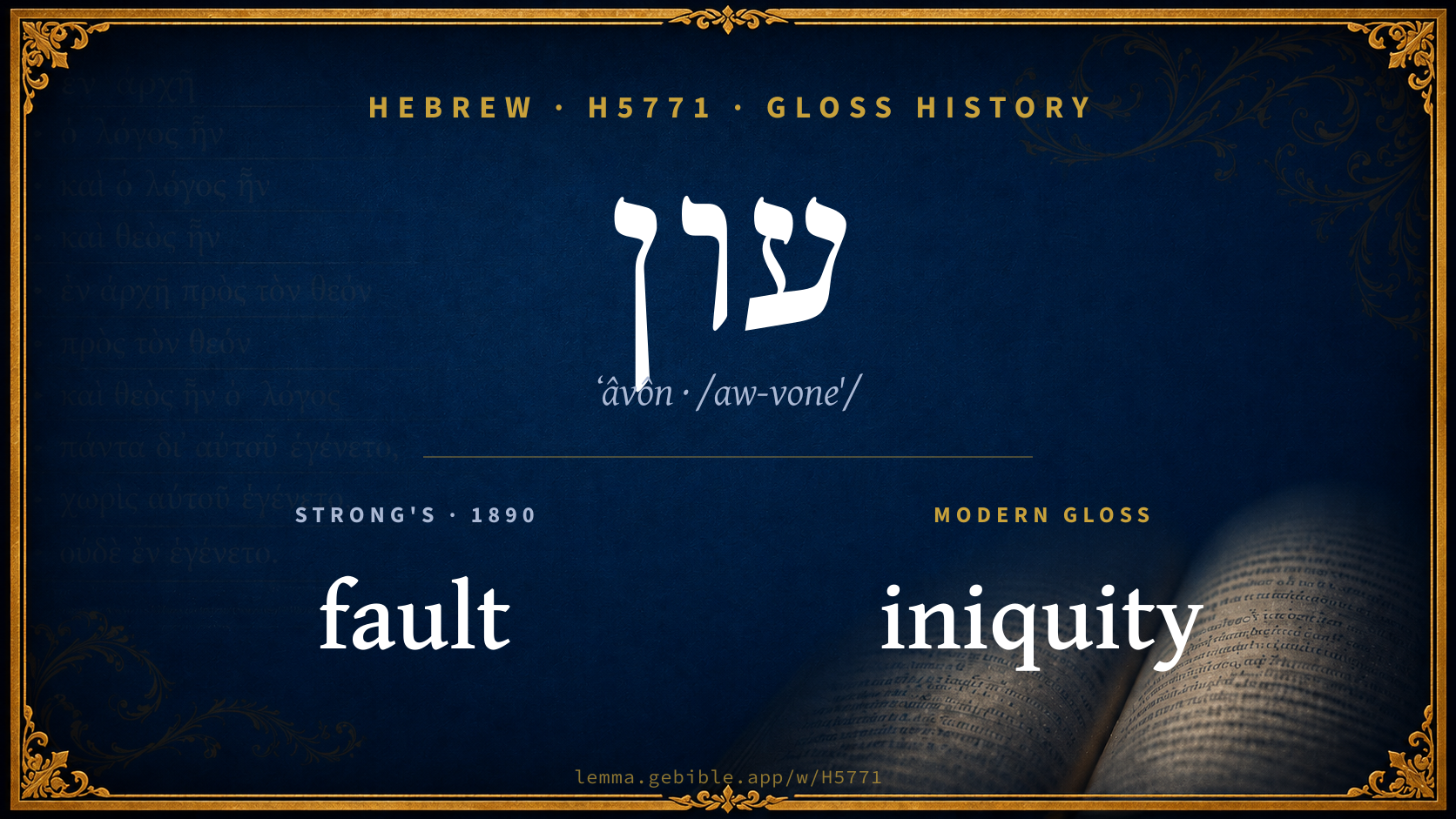
Gloss history
Strong's 1890 vs modern scholarship
About this word
Strong's H5771 catalogs a Hebrew word from the Hebrew Old Testament.
These counts are not copied from any lexicon or concordance. They are computed here, from the morphology-tagged Hebrew Old Testament. What Lemma adds →
- 215
- distinct verses
- The word appears in 215 distinct verses.
- 26 / 39
- OT books
- The word appears in 26 of 39 Old Testament books.
- #205
- by frequency
- Top 250 most frequent Hebrew words (rank 205 of 8,640 Hebrew words by occurrence).
View all 215 occurrences in the concordance →
By section of the Old Testament
By traditional corpus
Conventional, traditional groupings — biblical authorship is debated, so this is a traditional corpus grouping, not an authorship claim. Each share is this word’s portion of its verses in that division of the Hebrew canon. Each figure is a share of the word’s 215 distinct verses.
- Prophets (Nevi'im) 119 verses · 55%
- Writings (Ketuvim) 60 verses · 28%
- Torah (Pentateuch) 36 verses · 17%
How translations render this word
Counts come from each version’s own published word-to-Strong’s tagging or interlinear alignment — an approximate guide to how each version renders this word, not a word-level alignment the data otherwise carries. Because each total is that version’s own tagged count, the per-version totals vary from one another and need not match the appearance or distinct-verse counts above. These counts may also differ from a printed concordance because Lemma counts each distinctly tagged rendering and does not collapse phrase taggings into a single head-word total. This is a fixed set of word-tagged versions (KJV, ASV, BSB, ULT) and does not change with the reading translation you choose elsewhere. Each version’s license is shown beside its name below (and on Sources).
BDB lists this Strong’s number as 2 distinct words (homographs). Each count above pools all of them and is not split by sense — see the Senses section below. A low-frequency rendering may belong to a different one of those words, not the primary meaning.
- King James Version†: Iniquity 137×, Iniquities 33×, Punishment 3×
- American Standard Version†: Iniquity 121×, Iniquities 28×, Punishment 3×
- Berean Standard Bible†: Iniquity 123×, Iniquities 34×, Guilt 20×
- unfoldingWord Literal Text†: Iniquity 102×, Iniquities 28×, Iniquity of 28×
King James Version Public Domain
Renders H5771 across 229† tagged occurrences — most commonly:
Plus 47 renderings that appear only once — usually multi-word phrases or single function words the recovered tagging swept in, not distinct renderings. Not rendered by a distinct English word in 1 further occurrence.
American Standard Version Public Domain
Renders H5771 across 229† tagged occurrences — most commonly:
Plus 67 renderings that appear only once — usually multi-word phrases or single function words the recovered tagging swept in, not distinct renderings.
Berean Standard Bible Public Domain
Renders H5771 across 230† tagged occurrences — most commonly:
Plus 19 renderings that appear only once — usually multi-word phrases or single function words the recovered tagging swept in, not distinct renderings. Not rendered by a distinct English word in 2 further occurrences.
unfoldingWord Literal Text CC BY-SA 4.0
Renders H5771 across 225† tagged occurrences — most commonly:
Plus 24 renderings that appear only once — usually multi-word phrases or single function words the recovered tagging swept in, not distinct renderings.
11 senses and sub-senses in the full BDB
What do BDB’s symbols mean?
BDB uses these scholarly abbreviations:
| Symbol | Meaning |
|---|---|
| 𝔊 | the Septuagint (the ancient Greek translation, LXX) |
| 𝔙 | the Vulgate (the Latin translation) |
| 𝔖 | the Syriac version (the Peshitta) |
| 𝔗 | the Targum (the Aramaic translation) |
| ψ | the Psalms |
| √ | root (the underlying root or stem) |
| ‖ | parallel passage (a synonymous or contrasted parallel) |
| † | the dagger: every passage where the word occurs is cited |
The 11 senses and sub-senses the full Brown-Driver-Briggs lexicon distinguishes for this word, in lexicon order (not ranked by frequency), with BDB’s own verbatim wording and sub-sense lettering. Shown in Hebrew script with BDB’s own scholarly abbreviations. The condensed entry is in the Lexicon Entry tab. See also the Forms in the corpus table below.
- 1. iniquity, Jb 15:5; 20:27 Je 11:10; 14:7; 16:17 La 2:14 Ez 4:5; 7:13; ‖ חטאת 1 S 20:1 Jb 13:23 Is 5:18; 43:24; 59:2 Je 5:25; 16:10 La 4:6, 13 Dn 9:16 Ho 4:8; 13:12; ‖ פשׁע Jb 14:17; 31:33 ψ 107:17 Is 50:1; 53:5; ‖ אשׁמה Ezr 9:6, 7, 13; רעה Jb 22:5 Ho 7:1. e.g. Job 15:5
- a. ע׳ נְעוּרַי Jb 13:26 iniquities of my youth; ע׳ חֶרֶב 19:29 iniquities calling for the sword; ע׳ פְּלִילִי(ם) 31:11, 28 iniquity for (to be punished by) judges; שְׁתֵּי עֲוֹנֹתָם Ho 10:10 (so read Vrss Hi al.); כשׁל בע׳ stumble by iniquity Ho 5:5; 14:2; cf. מִבְשׁוֹל ע׳ Ez 7:19; 14:3, 4, 7; 18:30; 44:12; לכל־עון Dt 19:15; אשׁתמרה מע׳ 2 S 22:24 = ψ 18:24; עָוֹן אֲשֶׁר־חֵטְא Ho 12:9. e.g. Job 13:26
- b. iniquity as recognized, ידע ע׳ 1 S 3:13; Is 59:12; Je 3:13; 14:20; confessed, התודה ע׳ Lv 16:21; 26:40(×2) (P), Ne 9:2; הגיד ע׳ ψ 38:19; לא כסה ע׳ 32:5; brought to remembrance, הזכיר ע׳ Nu 5:15 (P) 1 K 17:18; Ez 21:28, 29; 29:16; causing shame, יִכָּֽלְמוּ מע׳ Ez 43:10; turned from, שׁוּב מע׳ Dn 9:13, cf. השׁיב מע׳ Mal 2:6. e.g. 1 Samuel 3:13
- c. (i) phrases of punishment: פקד ע׳ על Ex 20:5 = Dt 5:9; Ex 34:7; Nu 14:18; (J), Lv 18:25 (H) 2 S 3:8; Is 13:11; 26:21; Je 25:12; 36:31; Am 3:2; without על, La 4:22, פקד ע׳ ב ψ 89:33; Jb 11:6 v. II. [נשׁא]; יסּר על ע׳ ψ 39:12 chastise for iniquity; שַׁתָּ֯ ע׳לנגדךָ 90:8 set our iniquities before thee; גמל כע׳ 103:10; שׁמר ע׳ 130:3; שׁלּם ע׳ Is 65:7(×2); Je 16:18; 32:18; מַטְבֵּחַ בע׳ Is 14:21; (2) of forgiveness or removal: העביר ע׳ 2 S 24:10 = 1 Ch 21:8; Jb 7:21 Zc 3:4; משׁתי ע׳ 3:9; סלח לע׳ Ex 34:9 Nu 14:19 (J), ψ 25:11; 103:3; Je 31:34; 33:8; 36:3; נשׂא ע׳ Ex 34:7; Nu 14:18 (J), ψ 32:5; 85:3; Is 33:24; Ho 14:3; Mi 7:18; סר ע׳ Is 6:7; יכבושׁ ע׳ Mi 7:19; (3) of covering over, כסה על ע׳ Ne 3:37; כפּר ע׳ ψ 78:38; Pr 16:6; Is 22:14; 27:9; Dn 9:24; כפּר על ע׳ Je 18:23; יתכפּר ע׳ 1 S 3:14; (4) of cleansing from: כבּס מע׳ ψ 51:4; מחה ע׳ v 11; טהר מע׳ Je 33:8; Ez 36:33; (5) of imputing, reckoning to one: חשׁב ע׳ ל 2 S 19:20 ψ 32:2; (ל) זכר ע׳ 79:8; Is 64:8; Je 14:10; Ho 8:13; 9:9; יִזָּכֵר ע׳ ψ 109:14; בקשׁ (ל)ע׳ Jb 10:6; Je 50:20; (6) פדה מע׳ ψ 130:8 ransom from iniquity. e.g. Exodus 20:5
- 2. Guilt of iniquity (not always easy to disting. from 1; SS give more, Buhl fewer, sub 2);—‖ תועבות Ez 36:31; ‖ דם Is 59:3; ‖ חמם Ez 9:9; ע׳ פעור Jos 22:17 (P); ע׳ סדם Ez 16:49; ע׳ בצעוֹ Is 57:17; שְׁנֵי עונם Ez 4:4; נִכְתָּם עֲוֹנֵךְ לְפָנַי Je 2:22 the guilt of thine iniquity is marked before me; מצא ע׳ Gn 44:16 (E) ψ 36:3. e.g. Ezekiel 36:31
- a. ע׳ בְ: guilt of iniquity upon one Nu 15:31 (P) 1 S 20:8; 2 S 14:32; לא ע׳ לִי Jb 33:9 (‖ זַךְ); בלי־עון ψ 59:5 without my guilt. e.g. Numbers 15:31
- b. guilt, as great, increased: רֹב עָוֹן Je 13:22; 30:14, 15; Ez 28:18; Ho 9:7; לֹא־שָׁלֵם ע׳ Gn 15:16 (J); ע׳ עָֽבְרוּ רֹאשִׁי ψ 38:5; ע׳ עֲקֵבַי יְסוּבֵּנִי 49:6; ע׳ הִשִּׂיגוּנִי 40:13; ע׳ גברו מני 65:4; עַם כֶּבֶד ע׳ Is 1:4; בע׳ נלקח Ez 33:6. e.g. Jeremiah 13:22
- c. as a condition, בע׳:
- d. חוללתי was I brought forth ψ 51:7; e.g. Psalms 51:7
- e. גָּוַע expire Jos 22:20 (P); c. מות die Je 31:30; Ez 3:18, 19; 18:17, 18; 33:8, 9. e.g. Joshua 22:20
- 3. Consequence of, or punishment for, iniquity (SS include most of these under 2, and do not recognize 3; Buhl thinks this meaning rare, giving only Gn 4:13; Is 5:18);—אִם יִקְּ֯רֵךְ ע׳ בדבר הזה 1 S 28:10 no punishment shall happen unto thee for, etc.; נשׂא ע׳ bear the punishment for iniquity of others Ex 28:38; Lv 10:17 (take away ע׳ Di Nowii. 233 n.) 16:22; Nu 30:16 (P), Ez 4:4, 5, 6; בע׳ 18:19, 20(×2); one’s own, Ex 28:43 Lv 5:1, 17; 7:18; 17:16; 19:8; 20:17, 19; 22:16; Nu 5:31; 14:34; 18:1(×2), 23 (P), Ez 14:10; 44:10, 12; גדול ע׳מנשׂוא Gn 4:13 (J) my punishment is greater than I can bear; נִרְצָה עֲוֹנָהּ Is 40:2 her punishment is accepted, cf. רצה ע׳ Lv 26:41, 43 (H); ומצאנוּ ע׳ 2 K 7:9 punishment will overtake us; תנה ע׳ על ע׳ ψ 69:28 add punishment to their punishment; ע׳ הוא יסבל Is 53:11 the consequences of their iniquities he shall bear, cf. ע׳ סָבָ֑לְנוּ La 5:7; הפגיע בו ע׳ Is 53:6; נִקָּה מע׳ freed from punishment Nu 5:31 (P) Jb 10:14; בי אני העון 1 S 25:24 on me the punishment; עלי הע׳ 2 S 14:9; בע׳ c. various vbs.: Gn 19:15 (J) Lv 26:39(×2) (H) ψ 31:11; 106:43; Je 51:6; Ez 4:17; 7:16; 24:23; 39:23; עת ע׳ קץ 21:30, 34; 35:5; see also: Pr 5:22 (‖ חַבְלֵי חטאת), Is 30:13; 64:5, 6; La 4:22; Ez 4:4; 14:10(×2); 32:27. e.g. Genesis 4:13
Senses from the full Brown-Driver-Briggs lexicon (Brown, Driver, Briggs; Oxford 1906 — public domain), digitized via Sefaria, supplemented by the OpenScriptures HebrewLexicon (CC BY 4.0). Full attribution on Sources.
Word origin
n.m. Is 22:14 iniquity, guilt or punishment of iniquity;—ע׳ abs. Ex 28:43 +; עָווֹן 2 K 7:9 ψ 51:7; cstr. עֲוֹן Gn 15:16 +; עֲווֹן 1 Ch 21:8; sf. עֲוֹנִי Gn 4:13 + (2 S 16:12 read בְּעָנְיִי), עֲוֹנְךָ Ho 9:7 +; עֲוֹנֵ֑כִי ψ 103:3; עֲוֹ֔נָהֿ Nu 15:31 (Ges§ 91 e), etc.; pl. עֲוֹנוֹת abs. ψ 130:3 +, cstr. Jb 13:26 +; עְוֹנֹת abs. ψ 65:4, cstr. Lv 16:21 +; sf. עֲוֹנֹתֶיךָ Is 43:24, עֲוֹנֹתֵיכֶם Nu 14:34 +, etc.; also עֲוֹנֶיךָ Ez 28:18; עֲוֹנֵינוּ Is 64:6 +, etc. (SS doubt all these);—
— Brown-Driver-Briggs (Oxford 1906, public domain), digitized via Sefaria, supplemented by the OpenScriptures HebrewLexicon (CC BY 4.0). See Sources.
Derived from עוה (ʻâvâh) (H5753) — to twist.
Jastrow Dictionary
A second Hebrew/Aramaic lexicon for comparison, covering Aramaic and post-biblical (Talmudic, Targumic, Midrashic) usage that the biblical-Hebrew BDB does not. Matched by lemma rather than by Strong’s number, so a lemma may carry more than one Jastrow headword (shown separately below), and the entries cover usage well beyond the Bible.
עָוֹן
- 1. perversion, wrong. Deut. R. s. 3 לא חטא ולא ע׳ no sin or wrong. Sabb. 30ᵃ אותו ע׳ that sin (of David’s, against Uriah and Bathsheba); Snh. 107ᵃ מחול לי על אותו ע׳ כולו pardon me for that sin entirely. Sabb. 88ᵇ עֲוֹן גדי, v. כָּרַם. Snh. 44ᵇ אם יש בי ע׳ זה if I am guilty of that crime (for which I am to be put to death); a. fr.—ע׳ גליון, v. אָוֶן.—Pl. עֲוֹנוֹת, עֲווֹנוֹת. Ib. תהא … עֲווֹנוֹתַיי may my death be an atonement for all my wrong-doings. Ber. 5ᵇ מוחלין לו כל עֲוֹנוֹתָיו is forgiven all his sins. Yoma III, 8. Ib. 39ᵇ עְווֹנוֹתֵיהֶן של ישראל the sins of Israel; a. v. fr.
- 2. (sub. עוֹנֶשׁ) penalty. Yeb. 47ᵃ מודיעין אותו עֲוֹן לקט וכ׳ we acquaint him (the proselyte) with the consequences of a neglect of the laws concerning the share of the poor &c., v. עוֹנֶשׁ.—בַּעֲ׳ as a punishment for, in consequence of. Sabb. 32ᵇ בע׳ נדרים (sub. ביטול) as a punishment for the neglect of vows; בע׳ מזוזה for neglecting the law concerning the door-post inscription; בע׳ ביטול תורה for neglecting the study of the Law; בע׳ גילוי עריות for unchastity; a. fr.
עוּן
- to be round, curved; denom. עַיִן.
- (denom. of עַיִן)
- 1. to look in, read. Tanḥ. Ki Thissa 34 אסור … לעַיֵּין בתורה וכ׳ the interpreter must not look into the Torah (Hebrew text) and translate; (Pesik. R. s. 5 ליתן עיניו).
- 2. to look carefully; to search, investigate (cmp. דּוּק a. דִּקְדֵּק). B. Bath. 115ᵃ (ref. ובן אין לו, Num. XXVII, 8) עַיֵּין עליו (Ar. אַיֵּין) investigate his case (whether he has really no male issue); Yeb. 22ᵇ. Kidd. 4ᵃ (ref. to Lev. XXII, 13 וזרע אין לה) עיין לה; Yeb. 70ᵃ עיין עלה (Chald.). e.g. Numbers 27:8
- 3. to speculate, contemplate. Ber. 55ᵃ המאריך בתפלתו ומְעַיֵּין בה he who stays long in prayer and speculates on it (expecting its fulfillment as a reward for his lengthy prayer); Yalk. Prov. 950; Ber. 32ᵇ; a. e.
- 4. [to measure with the eye] to balance exactly, opp. הכריע (v. כָּרַע). B. Bath. 89ᵃ אין מְעַיְּינִין … במקום שמעיינין where it is customary to give overweight, you dare not sell by exact weight, and vice versa; a. e.—Part. pass. מְעוּיָּין a) (adv.) weighed exactly, even-balanced. Num. R. s. 16, end (ref. to עין בעין, Num. XIV, 14) הרי מאזנים מע׳ אתה וכ׳ behold the scales are evenly balanced, thou sayest …, and I say &c.; Deut. R. s. 5 הרי מדת הדין בכף מאזנים מע׳ judgment lies on evenly balanced scales. Tanḥ. Ki Thissa 34; Pesik. R. s. 5, beg. המאזניים מע׳ the claims on both sides are equal. Y. Snh. X, beg. 27ᶜ היה מע׳ if it (his sins and his merits) be even; Y. Peah I, 16ᵇ bot.; Y. Kidd. I, end, 61ᵈ מחציין (corr. acc.); Yalk. Ps. 784 כף מאזניים מע׳ [היה]; a. e.—b) having eyes (rings) or colors. Y. Kil. I, 27ᵃ, v. לְעוּנִים. e.g. Numbers 14:14
- (b. h.) [to contemplate; to augur;] to produce apparitions, to conjure. Snh. 65ᵇ, a. e. (interpret. מעונן, Deut. XVIII, 10) המעביר … על העין, v. זְכוּרוּ. Ib. (oth. interpret.) האוהז את העינים, v. אָחַז. Ib. (oth. interpret.; cmp. Pi.) המחשב עתים ושעות וכ׳ who calculates what times and hours are auspicious &c.; [Comment. on המחשב עתים explain עונן as denomin. of עוֹנָה I]; Tosef. Sabb. VII (VIII), 14 נותני עתים וכ׳. e.g. Deuteronomy 18:10
עוּן ²
- Pa. עֵיֵּין, עַיֵּן same,
- 1. to watch, guard. Targ. Y. II, Deut. XXXII, 10 עַיְּינֵי (Paeli).—B. Kam. 32ᵇ איבעי ליה עַיּוּנֵי (עַיּוּנֵיה) he ought to have been on his guard; Macc. 8ᵃ לעַיּיוּנֵיה.
- 2. to look out for, select. Targ. Job VIII, 17 יְעַיֵּין ed. Lag. (oth. ed. יְעוֹיִן).
- 3. to look into, meditate, study, speculate. M. Kat. 14ᵇ לעיוני בדיניה to study his case (not to decide it). Ib. אתו מצפרא ומְעַיְּינֵי בדיניה וכ׳ they meet in the morning and consider his case …, and then they come again at sunset &c. Ber. 25ᵃ עַיֵּין אי וכ׳ examine and see whether &c. Ib. 58ᵃ עד דמעייני ביה בדינא while they were arguing about him in court. Snh. 18ᵇ ומְעַיְּינִינָא וכ׳ and we argue on his case. Meg. 30ᵇ מְעַיְּינִינָן במילי דמתא we look into the affairs (the moral condition) of the town. Gitt. 60ᵃ; Tem. 14ᵇ מְעַיְּינֵי בספרא וכ׳ used to study the book of &c. R. Hash. 16ᵃ בחינה עיוני בעלמא היא ‘to probe’ (בחן) means merely to investigate (without decreeing). Ber. 55ᵃ דמְעַיּין בה when he thinks of his prayer (expecting its fulfilment), v. preced; a. fr.—[Pol. עוֹנֵן, v. עֲנַן.]
A Dictionary of the Targumim, the Talmud Babli and Yerushalmi, and the Midrashic Literature (Marcus Jastrow; London, Luzac, 1903) — Public Domain. Digitized via Sefaria. Digitized via Sefaria. Full attribution on Sources.
Forms in the corpus
The 136 distinct written forms H5771 takes in the Hebrew Bible, most frequent first — each parse links to that state’s occurrences in the concordance. Hebrew forms include their vowel points and cantillation, so a single lemma takes many written forms.
The 60 most common forms are shown; 76 rarer forms follow in the full concordance.
Same root — word family
Other BDB entries built from the same root as H5771, grouped by Strong’s listed origin. These share a root / origin per the lexicon — not necessarily a shared meaning. Each links to that word’s own entry.
Derives from
Shares the same root
- מעי mᵉʻîy H4596 ruin
- עוה ʻavvâh H5754 distortion
- עויא ʻivyâʼ H5758 perversity
- עועה ʻavʻeh H5773 distorting
- עי ʻîy H5856 ruin
Proper names from this root
People and places named from this root — a name, not an additional meaning of the word.
Compare all same-root words → Showing 4 of 8 — not the complete family. 1 of the same-root words is a proper name (a person or place). They share a root, not necessarily a meaning.
Septuagint verse parallels
This word appears in 203 verses that also exist in the Greek Old Testament (Septuagint), out of the 215 Hebrew verses it occurs in. You can read those verses in Greek by switching the Old Testament edition to the Septuagint.
Read these verses in the Septuagint
- Genesis 4:13
- Exodus 20:5
- Leviticus 5:1
- Numbers 5:15
- Deuteronomy 5:9
- Joshua 22:17
- 1 Samuel 3:13
- 2 Samuel 3:8
- 1 Kings 17:18
- 2 Kings 7:9
- 1 Chronicles 21:8
- Ezra 9:6
This is a verse-level parallel only — the same verses exist in both the Hebrew and Greek Old Testaments. No word-level Hebrew↔Greek correspondence is claimed: the data carries no such alignment, so no Greek word is shown as this Hebrew word’s translation. Coverage is not total — the Septuagint omits the deuterocanon and renumbers the Psalms, so some Hebrew verses have no direct Greek parallel.