
Ezekiel 33:6

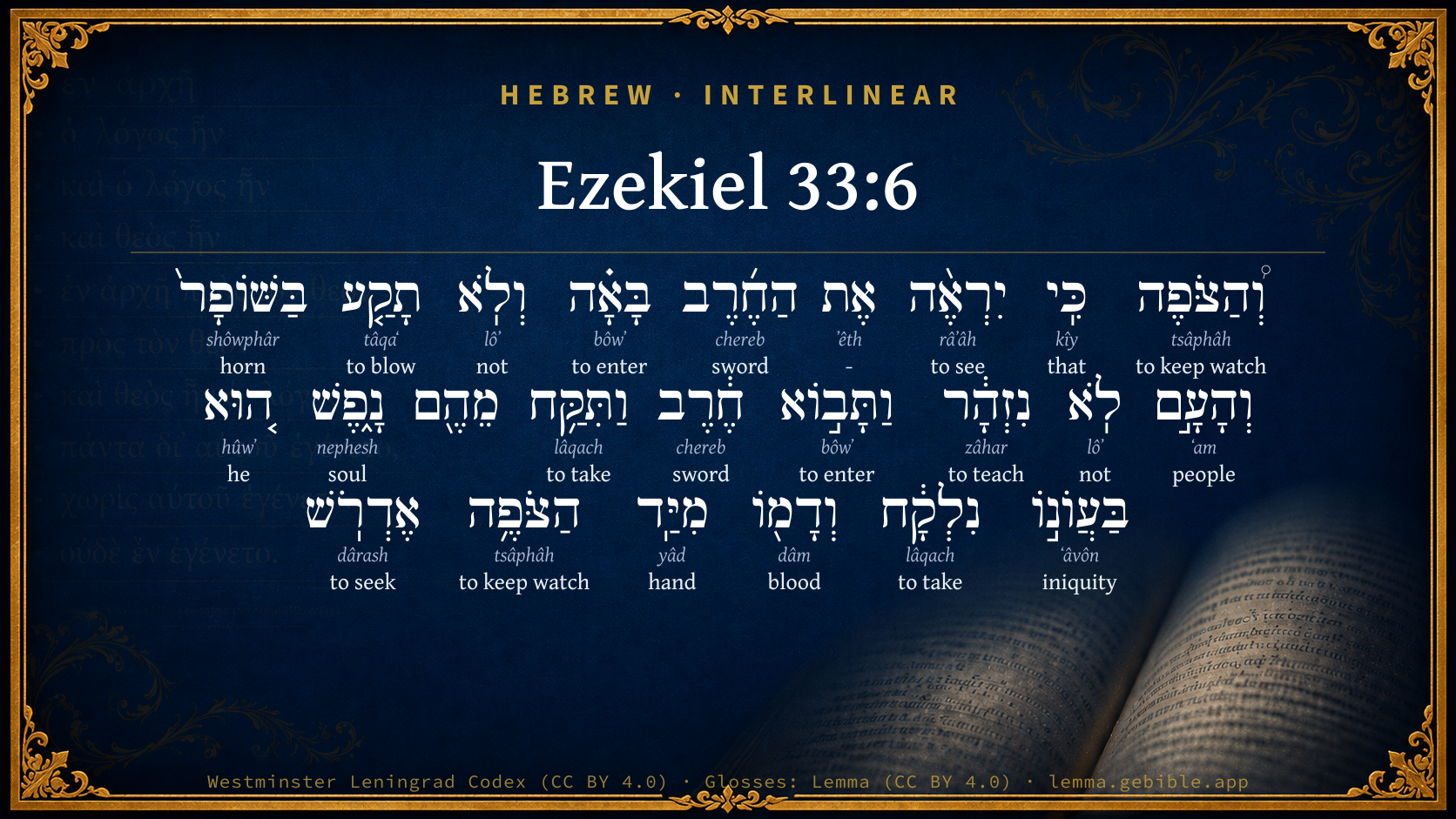
Hebrew (Westminster Leningrad Codex) Ezekiel 33:6 appears in the Hebrew Old Testament. The text above is from the Westminster Leningrad Codex. Each word links to its Strong’s number, a concise gloss, and parsing drawn from the Open Scriptures Hebrew Bible morphology. Click any word for its full Brown-Driver-Briggs (BDB) entry.
Download image
Cite this verse

Ezekiel 33:6 (World English Bible). Public Domain. Lemma interlinear Bible study tool, https://lemma.gebible.app/v/ezekiel/33/6.

Show BibTeX & RIS
BibTeX
RIS
English Translation
But if the watchman sees the sword come, and doesn't blow the trumpet, and the people aren't warned, and the sword comes, and take any person from among them; he is taken away in his iniquity, but his blood will I require at the watchman's hand.
World English Bible · Public Domain
Download a study sheet

One document with this verse’s original text, its word-by-word gloss line, the meaning frame, cross-references with their text, attributed commentary, and full source and license credits — printable, and it pastes into notes with its structure intact.

This verse Autodidact and up

Study sheet (.html) Plain text (.txt)

A passage Seminary Student

Up to 50 verses in one chapter. A passage sheet keeps up to 6 commentary sources and 12 cross-references per verse, in the order this page ranks them, and says so on the sheet whenever that leaves anything out. Ask for a single verse and you get the Autodidact verse sheet above.

Everything on this page stays free to read, with no account — the sheet is a download of what is already on screen, not access to it.

Want to remove ads? Support Godless Engineer
Compare translations 3

The same verse in 3 English versions, stacked beneath the original-language interlinear above. Click any original word for its lexicon entry.

Each is an independent rendering of the whole verse — the interlinear is not word-aligned to these translations.

Highlighted words mark where these versions differ — a whole-verse word diff, not a word-by-word alignment.

  • World English Bible Public Domain
    But if the watchman sees the sword come, and doesn't blow the trumpet, and the people aren't warned, and the sword comes, and take any person from among them; he is taken away in his iniquity, but his blood will I require at the watchman's hand.
  • King James Version Public Domain
    But if the watchman see the sword come, and blow not the trumpet, and the people be not warned; if the sword come, and take any person from among them, he is taken away in his iniquity; but his blood will I require at the watchman's hand.
  • unfoldingWord Literal Text CC BY-SA 4.0
    However, if the watchman sees the sword as it is coming, but if he does not blow the horn, with the result that the people are not warned, and if the sword comes and takes anyone’s life, then that person dies in his own sin, but I will require his blood from the watchman.’

unfoldingWord Literal Text — © unfoldingWord, licensed CC BY-SA 4.0. Word-aligned USFM3 via Door43 (git.door43.org/unfoldingWord/en_ult).

Versions to compare (up to 4)

3 of 4 selected

Show all 18 translations

Every available English version of this verse, each an independent rendering of the whole verse.

  • World English Bible Public Domain
    But if the watchman sees the sword come, and doesn't blow the trumpet, and the people aren't warned, and the sword comes, and take any person from among them; he is taken away in his iniquity, but his blood will I require at the watchman's hand.
  • Berean Standard Bible Public Domain
    But if the watchman sees the sword coming and fails to blow the horn to warn the people, and the sword comes and takes away a life, then that one will be taken away in his iniquity, but I will hold the watchman accountable for his blood.’
  • Majority Standard Bible Public Domain
    But if the watchman sees the sword coming and fails to blow the horn to warn the people, and the sword comes and takes away a life, then that one will be taken away in his iniquity, but I will hold the watchman accountable for his blood.’
  • King James Version Public Domain
    But if the watchman see the sword come, and blow not the trumpet, and the people be not warned; if the sword come, and take any person from among them, he is taken away in his iniquity; but his blood will I require at the watchman's hand.
  • American Standard Version (1901) Public Domain
    But if the watchman see the sword come, and blow not the trumpet, and the people be not warned, and the sword come, and take any person from among them; he is taken away in his iniquity, but his blood will I require at the watchman's hand.
  • Revised Version (1885) Public Domain
    But if the watchman see the sword come, and blow not the trumpet, and the people be not warned, and the sword come, and take any person from among them; he is taken away in his iniquity, but his blood will I require at the watchman’s hand.
  • Geneva Bible (1599) Public Domain
    But if the watchman see the sworde come, and blowe not the trumpet, and the people be not warned: if the sworde come, and take any person from among them, he is taken away for his iniquitie, but his blood will I require at the watchmans hande.
  • Douay-Rheims (1899) Public Domain
    And if the watchman see the sword coming, and sound not the trumpet: and the people look not to themselves, and the sword come, and cut off a soul from among them: he indeed is taken away in his iniquity, but I will require his blood at the hand of the watchman.
  • Young's Literal Translation Public Domain
    And the watchman, when he seeth the sword coming in, And he hath not blown with a trumpet, And the people hath not been warned, And come in doth a sword, And taketh away of them -- a soul, He in his iniquity is taken away, And his blood from the hand of the watchman I require.
  • Literal Standard Version CC BY-SA 4.0
    And the watchman, when he sees the sword coming in, || And he has not blown with a horn, || And the people have not been warned, || And a sword comes in, || And takes away a soul from them, || He is taken away in his iniquity, || And I require his blood from the hand of the watchman.
  • Unlocked Literal Bible CC BY-SA 4.0
    However, if the watchman sees the sword as it is coming, but if he does not blow the horn, with the result that the people are not warned, and if the sword comes and takes anyone's life, then that person dies in his own sin, but I will require his blood from the watchman.'
  • unfoldingWord Literal Text CC BY-SA 4.0
    However, if the watchman sees the sword as it is coming, but if he does not blow the horn, with the result that the people are not warned, and if the sword comes and takes anyone’s life, then that person dies in his own sin, but I will require his blood from the watchman.’
  • Darby Bible Public Domain
    But if the watchman see the sword coming, and blow not the trumpet, and the people be not warned, if the sword come and take a person from among them, he is taken away in his iniquity; but his blood will I require at the watchman's hand.
  • World Messianic Bible Public Domain
    But if the watchman sees the sword come and doesn’t blow the shofar, and the people aren’t warned, and the sword comes and takes any person from among them, he is taken away in his iniquity, but his blood I will require at the watchman’s hand.’
  • Webster's Bible Public Domain
    But if the watchman shall see the sword come, and blow not the trumpet, and the people be not warned; if the sword shall come, and take any person from among them, he is taken away in his iniquity; but his blood will I require at the watchman's hand.
  • Free Bible Version CC BY-SA 4.0
    But if the watchman saw the attack coming and didn't blow the trumpet to warn everyone, and someone is killed, then that person will die in their sins, but I will hold the watchman responsible for their death.
  • Bible in Basic English Public Domain
    But if the watchman sees the sword coming, and does not give a note on the horn, and the people have no word of the danger, and the sword comes and takes any person from among them; he will be taken away in his sin, but I will make the watchman responsible for his blood.
  • JPS Tanakh (1917) Public Domain
    But if the watchman see the sword come, and blow not the horn, and the people be not warned, and the sword do come, and take any person from among them, he is taken away in his iniquity, but his blood will I require at the watchman's hand.

Literal Standard Version (2020), Covenant Press — licensed CC BY-SA 4.0. Text via the HelloAO Bible API (eBible.org). Unlocked Literal Bible (unfoldingWord) — licensed CC BY-SA 4.0. Text via the HelloAO Bible API (eBible.org). unfoldingWord Literal Text — © unfoldingWord, licensed CC BY-SA 4.0. Word-aligned USFM3 via Door43 (git.door43.org/unfoldingWord/en_ult). Free Bible Version, Dr. Jonathan Gallagher — licensed CC BY-SA 4.0. Text via the HelloAO Bible API (eBible.org).

Word by word

More ways to search: Search by grammar → Find every occurrence → Compare this word →

Practice this passage: Drill this verse → Learn its vocabulary →

נִזְהָ֔ר
zâhar
H2094
“to teach”
Verb, Niphal, Perfect, 3rd Person, Masculine, Singular
Part of Speech
Verb
Stem
Niphal
Form
Perfect
Person
3rd Person
Gender
Masculine
Number
Singular
Full BDB Definition

Origin: a primitive root

TWOT: 531 , 532

to admonish, warn, teach, shine, send out light, be light, be shining - (Niphal) to be taught, be admonished - (Hiphil) - to teach, warn - to shine, send out light (figuratively)
  1. וְ֠הַצֹּפֶה tsâphâh H6822 “and · the · keeping watch” Conjunction + Particle, Definite Article + Verb, Qal, Participle Active, Masculine, Singular, Absolute
  2. כִּֽי kîy H3588 “that” Conjunction
  3. יִרְאֶ֨ה râʼâh H7200 “to see” Verb, Qal, Imperfect, 3rd Person, Masculine, Singular
  4. אֶת ʼêth H853 “-” Particle, Direct Object
  5. הַחֶ֜רֶב chereb H2719 “the · sword” Particle, Definite Article + Noun, Common, Feminine, Singular, Absolute
  6. בָּאָ֗ה bôwʼ H935 “entering” Verb, Qal, Participle Active, Feminine, Singular, Absolute
  7. וְלֹֽא lôʼ H3808 “and · not” Conjunction + Particle, Negative
  8. תָקַ֤ע tâqaʻ H8628 “to blow” Verb, Qal, Perfect, 3rd Person, Masculine, Singular
  9. בַּשּׁוֹפָר֙ shôwphâr H7782 “in/at the · horn” Preposition, Determined + Noun, Common, Masculine, Singular, Absolute
  10. וְהָעָ֣ם ʻam H5971 “and · the · people” Conjunction + Particle, Definite Article + Noun, Common, Masculine, Singular, Absolute
  11. לֹֽא lôʼ H3808 “not” Particle, Negative
  12. וַתָּב֣וֹא bôwʼ H935 “and · to enter” Conjunction + Verb, Qal, Sequential Imperfect, 3rd Person, Feminine, Singular
  13. חֶ֔רֶב chereb H2719 “sword” Noun, Common, Feminine, Singular, Absolute
  14. וַתִּקַּ֥ח lâqach H3947 “and · to take” Conjunction + Verb, Qal, Sequential Imperfect, 3rd Person, Feminine, Singular
  15. נָ֑פֶשׁ nephesh H5315 “soul” Noun, Common, Both, Singular, Absolute
  16. ה֚וּא hûwʼ H1931 “he” Pronoun, Personal, 3rd Person, Masculine, Singular
  17. בַּעֲוֺנ֣וֹ ʻâvôn H5771 “in/at · iniquity · his” Preposition + Noun, Common, Both, Singular, Construct + Suffix, Personal, 3rd Person, Masculine, Singular
  18. נִלְקָ֔ח lâqach H3947 “to take” Verb, Niphal, Perfect, 3rd Person, Masculine, Singular
  19. וְדָמ֖וֹ dâm H1818 “and · blood · his” Conjunction + Noun, Common, Masculine, Singular, Construct + Suffix, Personal, 3rd Person, Masculine, Singular
  20. מִיַּֽד yâd H3027 “from · hand of” Preposition + Noun, Common, Both, Singular, Construct
  21. הַצֹּפֶ֥ה tsâphâh H6822 “the · keeping watch” Particle, Definite Article + Verb, Qal, Participle Active, Masculine, Singular, Absolute
  22. אֶדְרֹֽשׁ dârash H1875 “to seek” Verb, Qal, Imperfect, 1st Person, Common, Singular

About this verse

These counts appear in no published source. They are computed here, from the morphology-tagged text and Lemma’s own curated glosses. What Lemma adds →

24
words
18
distinct lemmas
Prophets
section

Notable vocabulary

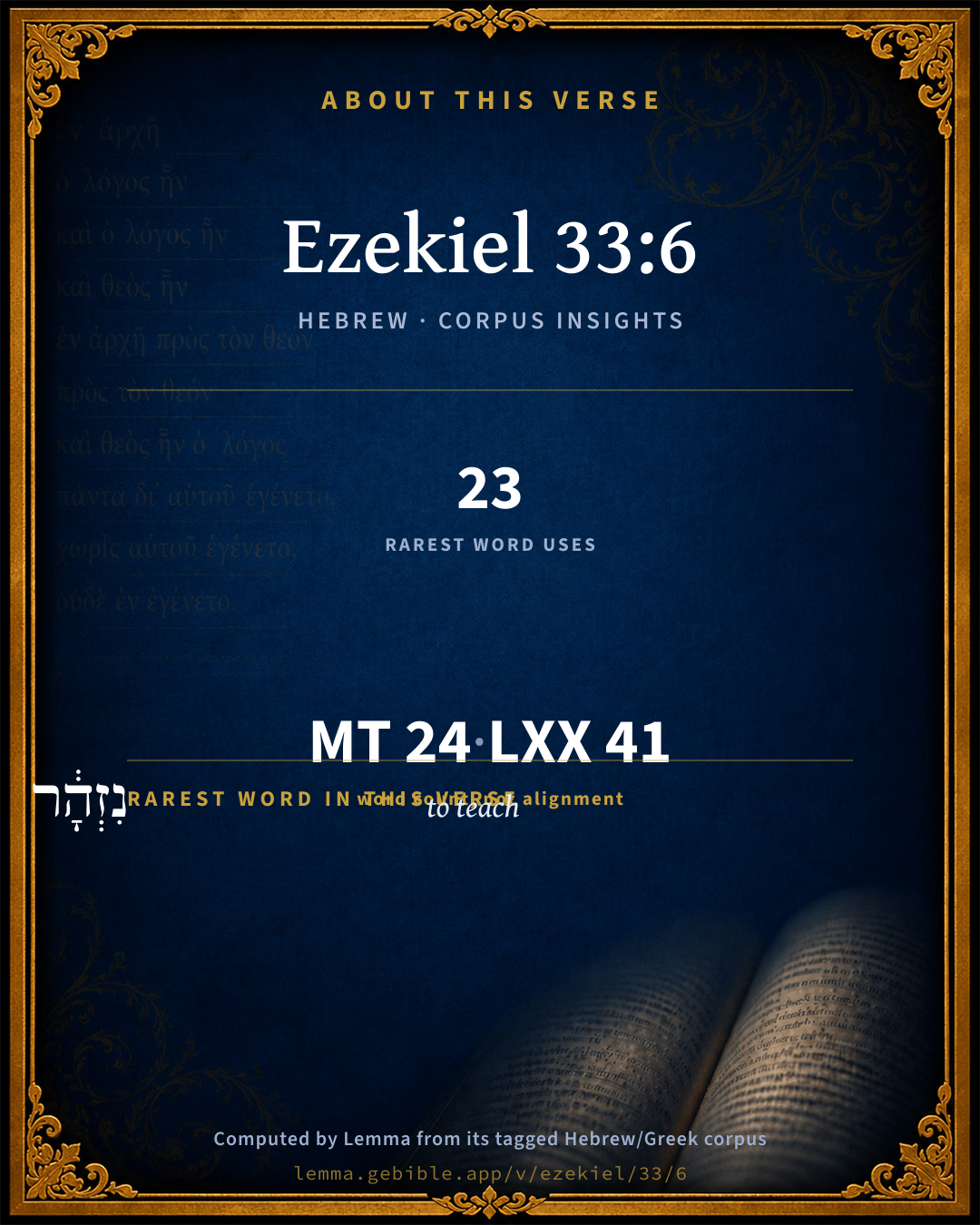
The rarest word here is נִזְהָ֔ר to teach H2094 — appearing just 23 times in the whole Hebrew Bible.

Shared distinctive vocabulary

נִזְהָ֔ר to teach H2094 occurs in 19 verses of the Hebrew Bible. Also found in:

Grammatical profile

  • 10 verbs
  • 8 nouns
  • 1 pronoun
  • 1 preposition
  • 1 conjunction
  • 3 particles

Verb forms

  • וְ֠הַצֹּפֶה Qal · Participle Active
  • יִרְאֶ֨ה Qal · Imperfect
  • בָּאָ֗ה Qal · Participle Active
  • תָקַ֤ע Qal · Perfect
  • נִזְהָ֔ר Niphal · Perfect
  • וַתָּב֣וֹא Qal · Sequential Imperfect
  • וַתִּקַּ֥ח Qal · Sequential Imperfect
  • נִלְקָ֔ח Niphal · Perfect
  • הַצֹּפֶ֥ה Qal · Participle Active
  • אֶדְרֹֽשׁ Qal · Imperfect

Repetition

Words recur within this verse — often emphatic in Hebrew:

  • וְ֠הַצֹּפֶה to keep watch H6822 ×2
  • הַחֶ֜רֶב sword H2719 ×2
  • בָּאָ֗ה to enter H935 ×2
  • וַתִּקַּ֥ח to take H3947 ×2
  • וְלֹֽא not H3808 ×2

Hebrew & Septuagint length

In English translation the verse runs 46 words from the Hebrew and 50 from the Septuagint (LXX English) — closely comparable.

A rough comparison of the two English renderings, which tokenize alike — not a word-level alignment.

Word counts can differ between the Hebrew and the Greek without any difference in meaning — e.g. the Hebrew direct-object marker אֵת has no separate Greek word, and Greek often adds the article ὁ.

In the original languages it is 24 Hebrew tokens and 41 Greek tokens — but the two are counted differently (Hebrew bundles its prefixes and suffixes into one token; the Greek is in lemma form), so that isn’t a like-for-like length.

Cross-references

11

Topical passages linked to Ezekiel 33:6 in the Treasury of Scripture Knowledge — connected by theme and wording, ordered by reader-vote popularity; previews shown in the World English Bible.

  • Ezekiel 3:18–20 When I tell the wicked, You shall surely die; and you give him no warning, nor speak to warn the wicked from his wicked way, to save his life; the same wicked man shall die in his iniquity; but his blood will I require at your hand.
  • Genesis 42:22 Reuben answered them, saying, "Didn't I tell you, saying, 'Don't sin against the child,' and you wouldn't listen? Therefore also, behold, his blood is required."
  • 2 Samuel 4:11 How much more, when wicked men have slain a righteous person in his own house on his bed, shall I not now require his blood of your hand, and take you away from the earth?
  • Ezekiel 33:8–9 When I tell the wicked, O wicked man, you shall surely die, and you don't speak to warn the wicked from his way; that wicked man shall die in his iniquity, but his blood will I require at your hand.
  • Ezekiel 18:20 The soul who sins, he shall die: the son shall not bear the iniquity of the father, neither shall the father bear the iniquity of the son; the righteousness of the righteous shall be on him, and the wickedness of the wicked shall be on him.
  • Genesis 9:5 I will surely require your blood of your lives. At the hand of every animal I will require it. At the hand of man, even at the hand of every man's brother, I will require the life of man.
  • Ezekiel 18:24 But when the righteous turns away from his righteousness, and commits iniquity, and does according to all the abominations that the wicked man does, shall he live? None of his righteous deeds that he has done shall be remembered: in his trespass that he has trespassed, and in his sin that he has sinned, in them shall he die.
  • Ezekiel 34:10 Thus says the Lord Yahweh: Behold, I am against the shepherds; and I will require my sheep at their hand, and cause them to cease from feeding the sheep; neither shall the shepherds feed themselves any more; and I will deliver my sheep from their mouth, that they may not be food for them.
  • John 8:21–24 Jesus said therefore again to them, "I am going away, and you will seek me, and you will die in your sins. Where I go, you can't come."
  • Proverbs 14:32 The wicked is brought down in his calamity, But in death, the righteous has a refuge.
  • Isaiah 56:10–11 His watchmen are blind, they are all without knowledge; they are all mute dogs, they can't bark; dreaming, lying down, loving to slumber.

Cross-references courtesy of OpenBible.info (CC BY 4.0).

Hebrew and Greek witnesses Masoretic Hebrew ↔ Greek Septuagint

The same verse in the two great witnesses to the Old Testament, shown verse-for-verse.

These are two independent witnesses, not word-aligned to each other, and the Septuagint is shown in lemma (dictionary) form.

Hebrew Ezekiel 33:6 Masoretic · Westminster Leningrad Codex

וְ֠הַצֹּפֶה כִּֽי יִרְאֶ֨ה אֶת הַחֶ֜רֶב בָּאָ֗ה וְלֹֽא תָקַ֤ע בַּשּׁוֹפָר֙ וְהָעָ֣ם לֹֽא נִזְהָ֔ר וַתָּב֣וֹא חֶ֔רֶב וַתִּקַּ֥ח מֵהֶ֖ם נָ֑פֶשׁ ה֚וּא בַּעֲוֺנ֣וֹ נִלְקָ֔ח וְדָמ֖וֹ מִיַּֽד הַצֹּפֶ֥ה אֶדְרֹֽשׁ

But if the watchman sees the sword come, and doesn't blow the trumpet, and the people aren't warned, and the sword comes, and take any person from among them; he is taken away in his iniquity, but his blood will I require at the watchman's hand.

World English Bible · Public Domain

Greek LXX Ezekiel 33:6 Septuagint · lemma form

καί ὁ σκοπός ἐάν ὁράω ὁ ῥομφαία ἔρχομαι καί μή σημαίνω ὁ σάλπιγξ καί ὁ λαός μή φυλάσσω καί ἔρχομαι ὁ ῥομφαία λαμβάνω ἐκ αὐτός ψυχή οὗτος διά ὁ ἑαυτοῦ ἀνομία λαμβάνω καί ὁ αἷμα ἐκ ὁ χείρ ὁ σκοπός ἐκζητέω

But if the watchman see the sword coming, and do not sound the trumpet, and the people do not watch; and the sword come, and take a soul from among them, that soul is taken because of its iniquity; but the blood thereof will I require at the watchman's hand.

LXX2012 (modern English Septuagint) · Public Domain

Hebrew: Westminster Leningrad Codex (CC BY 4.0). Greek: Septuagint (public domain); English from LXX2012 (modern English Septuagint) (Public Domain). How the Septuagint differs from the Hebrew →

Targum (Aramaic paraphrase)

1

The Targum is the ancient Jewish Aramaic paraphrase of the Hebrew Scriptures — an interpretive translation, not the Hebrew text itself. Onkelos (literal) and Pseudo-Jonathan (expansive) render the Torah, and Jonathan the Prophets. Coverage is partial: where no permissively-licensed English translation exists for a verse, only the Aramaic is shown. This is verse-level text, not a word-by-word alignment to the Hebrew.

  1. Targum Jonathan Prophets (Joshua–Malachi)
    וּמַזְהֲרָנָא אֲרֵי יֶחֱזֵי יַת דְקַטְלִין בְּחַרְבָּא אָתָן וְלָא תְקַע בְּשׁוֹפָרָא וְעַמָא לָא אִזְדְהַר וַאֲתוֹ קָטוֹלֵי חַרְבָּא וְדַבָּרוּ מִנְהוֹן נַפְשָׁא הוּא בְּחוֹבֵיהּ אִידְכַּר וּדְמֵהּ מִיַד אַזְהֲרָנָא אֶתְבַּע:

    (no public-domain English translation for this verse)

    Targum Jonathan — Aramaic: “Mikraot Gedolot” (public domain). English: “Sefaria Community Translation” (CC0 1.0 (public-domain dedication)); “London "Chaldee Paraphrase," 1871” (public domain). Text via Sefaria.

Commentary

Notes on Ezekiel 33:6 from classic Christian and Jewish commentators (each source and its license shown beneath its notes). The classic Christian expositions comment on the surrounding passage and are grouped to its opening verse, so a note may address several verses; the Jewish commentaries on the Tanakh (Rashi and others) are per-verse, so they appear only where the commentator wrote on this verse.

Lemma curates 59 commentaries, every one of them public domain or Creative Commons licensed, each selected and text-cleaned for this edition rather than reprinted as found. About our sources →

Trapp's Complete Commentary

John Trapp

Eze 33:6 But if the watchman see the sword come, and blow not the trumpet, and the people be not warned; if the sword come, and take [any] person from among them, he is taken away in his iniquity; but his blood will I require at the watchman’s hand.

Ver. 6. He is taken away in his iniquity.] This is a dismal kind of death, far worse than that of dying in prison, or of dying in a ditch.

As the watchman’s hand.] By whose treachery, or indiligence at least, he miscarried.

John Trapp, A Commentary or Exposition upon All the Books of the Old and New Testament (1647–1656) — public domain. Text from a community e-Sword module.

Geneva Bible (1599)

Geneva Bible translators

Signifying, that the wicked shall not escape punishment though the watchman be negligent: but if the watchman blow the trumpet, and then he will not obey, he shall deserve double punishment.

Geneva Bible (1599) marginal notes — public domain. Text via Bolls.life.

Jamieson, Fausset & Brown

Robert Jamieson, A. R. Fausset & David Brown

his iniquity--his negligence in not maintaining constant watchfulness, as they who are in warfare ought to do. The thing signified here appears from under the image.

Jamieson, Fausset & Brown — Commentary Critical and Explanatory on the Whole Bible (1871) — public domain (CC PDM 1.0). Text via the HelloAO Bible API.

The Cambridge Bible for Schools and Colleges

gen. ed. J. J. S. Perowne

6. Although in Eze_33:2 Jehovah is said to bring the sword upon the people (Eze_14:17), and presumably for their sin, the language of the present verse leads over from the illustration to the thing meant to be illustrated.

The Cambridge Bible for Schools and Colleges (gen. ed. J. J. S. Perowne; Cambridge University Press, 1878–1918) — public domain. Text from a community e-Sword module.

John Gill's Exposition

But if the watchman see the sword come,.... Or those that kill with the sword, as the Targum is; so far doing the duty of his office as to be in the watchtower, and not asleep:

and yet blow not the trumpet: to give the people notice of the enemy, and of their danger:

and the people be not warned; but in the utmost security, not apprehending themselves to be in any danger at all:

if the sword come and take any person from among them; even though but a single person:

he is taken away in his iniquity: having had no time to have it set before him, and to be convinced, and to repent of it, and seek for pardoning mercy for it; it is a dreadful thing thus to be taken out of the world, and snatched into hell at once:

but his blood will I require at the watchman's hands; he shall be punished for not doing his duty, for not giving the due warning of danger, on which account the man was surprised with the enemy, and taken away unawares; and therefore his death shall be laid to the watchman, and he must be answerable for it.

John Gill's Exposition of the Whole Bible (1746–1763) — public domain (CC PDM 1.0). Text via the HelloAO Bible API.

Haydock's Catholic Bible Commentary

Iniquity, not regarding the admonitions of his pastor; (chap. iii. 18.; Calmet) or rather of conscience, when the guide proves faithless and silent, as in this instance. (Haydock) --- The people were persuaded that none suffered except for some fault, ver. 10.; Jeremias xxxi. 30., Daniel xiii. 52., and Genesis xliv. 16. The author of the Book of Job takes great pains to remove this mistake. God sometimes sends crosses for a trial, (Calmet) and to increase the merit of his servants; though it be very true, (Haydock) "no one is miserable except he deserve it." (St. Augustine)

George Leo Haydock (1774–1849), Haydock's Catholic Family Bible and Commentary, 1859 edition — public domain. Excludes Psalms (Douay-Rheims chapter numbering differs from Protestant) and Deuterocanonical books (Catholic canon only).

Matthew Poole's English Annotations

Blow not the trumpet; neglect his charge, which is to give the alarm.

Be not warned; but, unwarned, are surprised by the enemy.

Taken away in his iniquity; punished by the Lord for his sins and trespasses formerly done, and he is destroyed under the present fault of not watching, which is a fault in every one that is so secure in time of war.

His blood; the guilt of that blood.

Require at the watchman’s hand; charge upon and for it punish the watchman, who sinned in not giving warning.

Matthew Poole's English Annotations on the Holy Bible (1683–1685) — public domain. Text from a community e-Sword/MySword module.

The Pulpit Commentary

Vers. 6-9. But if the watchman: etc. The words imply what we might almost call the agony of self-accusation. The prophet asks himself whether he has acted on the warning which was borne in on his mind at the very beginning of his mission. Has he sounded the trumpet? Has he warned the people of the destruction that is coming on them? The outward imagery vanishes in Ver. 7. It is of no Chaldean invader that the prophet had to give personal and direct warning, but of each man"s own special sin which was Bringing ruin on himself and on his country.

The Pulpit Commentary (1880–1919), ed. H.D.M. Spence-Jones & Joseph S. Exell — public domain. Text from a community e-Sword module.

John Wesley's Explanatory Notes

Is taken away - Punished by the Lord for his sin.

John Wesley, Explanatory Notes Upon the Whole Bible (1754–1765) — public domain. Text via the GEBible commentary corpus.

Lesson kit

Teaching starters — assembled from the data on this page, not authored interpretation. Every prompt links to the verse data it draws on. Edit before teaching.

Ezekiel, in the Prophets, opens this verse with 24 words (18 distinct Hebrew lemmas). Its most distinctive word is zâhar (“to teach”). A historical commentator’s framing appears above. Read the whole chapter for the surrounding context.

Discussion questions

  1. What does “to teach” (zâhar) contribute to the verse as a whole?
  2. How does Exodus 18:20, which shares the word «to teach», read alongside this verse?
  3. What does the repetition of “to keep watch” (2× in this one verse) do in this verse?
  4. These translations render this verse differently. What is at stake in choosing one wording over another?
  5. «וְ֠הַצֹּפֶה» is a Qal Participle Active verb. How does that grammatical form shape the action described?
  6. Compare how Trapp's Complete Commentary and Geneva Bible (1599) read this verse. Where do they agree or differ?

Things to notice

Reading settings

Reading text

Shown beneath each verse's original-language words.

Old Testament
Old Testament edition

Read the OT as the Masoretic Hebrew (MT) or the Greek Septuagint (LXX).

English shown for the Greek Septuagint (in the Hebrew ↔ Greek comparison).

Comparing translations? Open the Compare panel on any verse page to stack up to four side by side.