
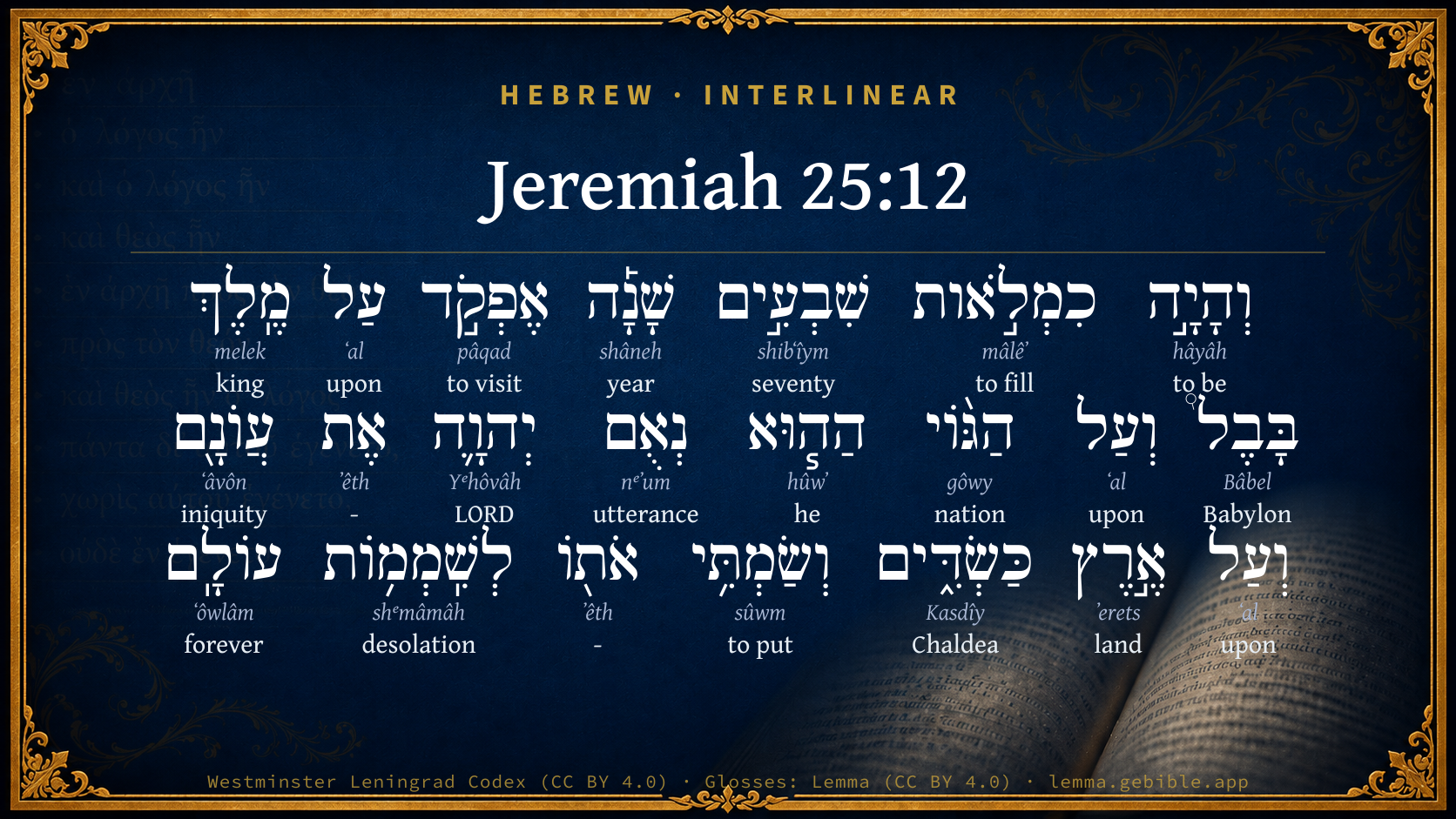
Jeremiah 25:12

Hebrew (Westminster Leningrad Codex) Jeremiah 25:12 appears in the Hebrew Old Testament. The text above is from the Westminster Leningrad Codex. Each word links to its Strong’s number, a concise gloss, and parsing drawn from the Open Scriptures Hebrew Bible morphology. Click any word for its full Brown-Driver-Briggs (BDB) entry.
Download image
Cite this verse

Jeremiah 25:12 (World English Bible). Public Domain. Lemma interlinear Bible study tool, https://lemma.gebible.app/v/jeremiah/25/12.

Show BibTeX & RIS
BibTeX
RIS
English Translation
It shall happen, when seventy years are accomplished, that I will punish the king of Babylon, and that nation, says Yahweh, for their iniquity, and the land of the Chaldeans; and I will make it desolate forever.
World English Bible · Public Domain
Download a study sheet

One document with this verse’s original text, its word-by-word gloss line, the meaning frame, cross-references with their text, attributed commentary, and full source and license credits — printable, and it pastes into notes with its structure intact.

This verse Autodidact and up

Study sheet (.html) Plain text (.txt)

A passage Seminary Student

Up to 50 verses in one chapter. A passage sheet keeps up to 6 commentary sources and 12 cross-references per verse, in the order this page ranks them, and says so on the sheet whenever that leaves anything out. Ask for a single verse and you get the Autodidact verse sheet above.

Everything on this page stays free to read, with no account — the sheet is a download of what is already on screen, not access to it.

Want to remove ads? Support Godless Engineer
Compare translations 3

The same verse in 3 English versions, stacked beneath the original-language interlinear above. Click any original word for its lexicon entry.

Each is an independent rendering of the whole verse — the interlinear is not word-aligned to these translations.

Highlighted words mark where these versions differ — a whole-verse word diff, not a word-by-word alignment.

  • World English Bible Public Domain
    It shall happen, when seventy years are accomplished, that I will punish the king of Babylon, and that nation, says Yahweh, for their iniquity, and the land of the Chaldeans; and I will make it desolate forever.
  • King James Version Public Domain
    And it shall come to pass, when seventy years are accomplished, that I will punish the king of Babylon, and that nation, saith the LORD, for their iniquity, and the land of the Chaldeans, and will make it perpetual desolations.
  • unfoldingWord Literal Text CC BY-SA 4.0
    And it will happen, when seventy years are fulfilled, I will punish the king of Babylon and that nation”—the declaration of Yahweh—“for their iniquity, and the land of the Chaldeans, and I will make it a perpetual desolation.

unfoldingWord Literal Text — © unfoldingWord, licensed CC BY-SA 4.0. Word-aligned USFM3 via Door43 (git.door43.org/unfoldingWord/en_ult).

Versions to compare (up to 4)

3 of 4 selected

Show all 18 translations

Every available English version of this verse, each an independent rendering of the whole verse.

  • World English Bible Public Domain
    It shall happen, when seventy years are accomplished, that I will punish the king of Babylon, and that nation, says Yahweh, for their iniquity, and the land of the Chaldeans; and I will make it desolate forever.
  • Berean Standard Bible Public Domain
    But when seventy years are complete, I will punish the king of Babylon and that nation, the land of the Chaldeans, for their guilt, declares the LORD, and I will make it an everlasting desolation.
  • Majority Standard Bible Public Domain
    But when seventy years are complete, I will punish the king of Babylon and that nation, the land of the Chaldeans, for their guilt, declares the LORD, and I will make it an everlasting desolation.
  • King James Version Public Domain
    And it shall come to pass, when seventy years are accomplished, that I will punish the king of Babylon, and that nation, saith the LORD, for their iniquity, and the land of the Chaldeans, and will make it perpetual desolations.
  • American Standard Version (1901) Public Domain
    And it shall come to pass, when seventy years are accomplished, that I will punish the king of Babylon, and that nation, saith Jehovah, for their iniquity, and the land of the Chaldeans; and I will make it desolate for ever.
  • Revised Version (1885) Public Domain
    And it shall come to pass, when seventy years are accomplished, that I will punish the king of Babylon, and that nation, saith the LORD, for their iniquity, and the land of the Chaldeans; and I will make it desolate for ever.
  • Geneva Bible (1599) Public Domain
    And when the seuentie yeres are accomplished, I will visite the King of Babel and that nation, saith the Lord, for their iniquities, euen the land of the Caldeans, and will make it a perpetuall desolation,
  • Douay-Rheims (1899) Public Domain
    And when the seventy years shall be expired, I will punish the king of Babylon, and that nation, saith the Lord, for their iniquity, and the land of the Chaldeans: and I will make it perpetual desolations.
  • Young's Literal Translation Public Domain
    `And it hath come to pass, at the fulness of seventy years, I charge against the king of Babylon, and against that nation -- an affirmation of Jehovah -- their iniquity, and against the land of the Chaldeans, and have appointed it for desolations age-during.
  • Literal Standard Version CC BY-SA 4.0
    And it has come to pass, at the fullness of seventy years, I charge against the king of Babylon, and against that nation,” a declaration of YHWH, “their iniquity, and against the land of the Chaldeans, and have appointed it for continuous desolations.
  • Unlocked Literal Bible CC BY-SA 4.0
    Then it will happen when seventy years have been completed, that I will punish the king of Babylon and that nation, the land of the Chaldeans—this is Yahweh's declaration—for their iniquity and make it an unending desolation.
  • unfoldingWord Literal Text CC BY-SA 4.0
    And it will happen, when seventy years are fulfilled, I will punish the king of Babylon and that nation”—the declaration of Yahweh—“for their iniquity, and the land of the Chaldeans, and I will make it a perpetual desolation.
  • Darby Bible Public Domain
    And it shall come to pass, when seventy years are accomplished, [that] I will visit on the king of Babylon and on that nation, saith Jehovah, their iniquity, and on the land of the Chaldeans, and I will make it perpetual desolations.
  • World Messianic Bible Public Domain
    “It will happen, when seventy years are accomplished, that I will punish the king of Babylon and that nation,” says the LORD, “for their iniquity. I will make the land of the Kasdim desolate forever.
  • Webster's Bible Public Domain
    And it shall come to pass, when seventy years are accomplished, that I will punish the king of Babylon, and that nation, saith the LORD, for their iniquity, and the land of the Chaldeans, and will make it perpetual desolations.
  • Free Bible Version CC BY-SA 4.0
    However, when these seventy years are over, I'm going to punish the king of Babylon and that nation, the country of Babylonia, for their sin, declares the Lord. I will completely destroy them.
  • Bible in Basic English Public Domain
    And it will come about, after seventy years are ended, that I will send punishment on the king of Babylon, and on that nation, says the Lord, for their evil-doing, and on the land of the Chaldaeans; and I will make it a waste for ever.
  • JPS Tanakh (1917) Public Domain
    And it shall come to pass, when seventy years are accomplished, that I will punish the king of Babylon, and that nation, saith the LORD, for their iniquity, and the land of the Chaldeans; and I will make it perpetual desolations.

Literal Standard Version (2020), Covenant Press — licensed CC BY-SA 4.0. Text via the HelloAO Bible API (eBible.org). Unlocked Literal Bible (unfoldingWord) — licensed CC BY-SA 4.0. Text via the HelloAO Bible API (eBible.org). unfoldingWord Literal Text — © unfoldingWord, licensed CC BY-SA 4.0. Word-aligned USFM3 via Door43 (git.door43.org/unfoldingWord/en_ult). Free Bible Version, Dr. Jonathan Gallagher — licensed CC BY-SA 4.0. Text via the HelloAO Bible API (eBible.org).

Word by word

More ways to search: Search by grammar → Find every occurrence → Compare this word →

Practice this passage: Drill this verse → Learn its vocabulary →

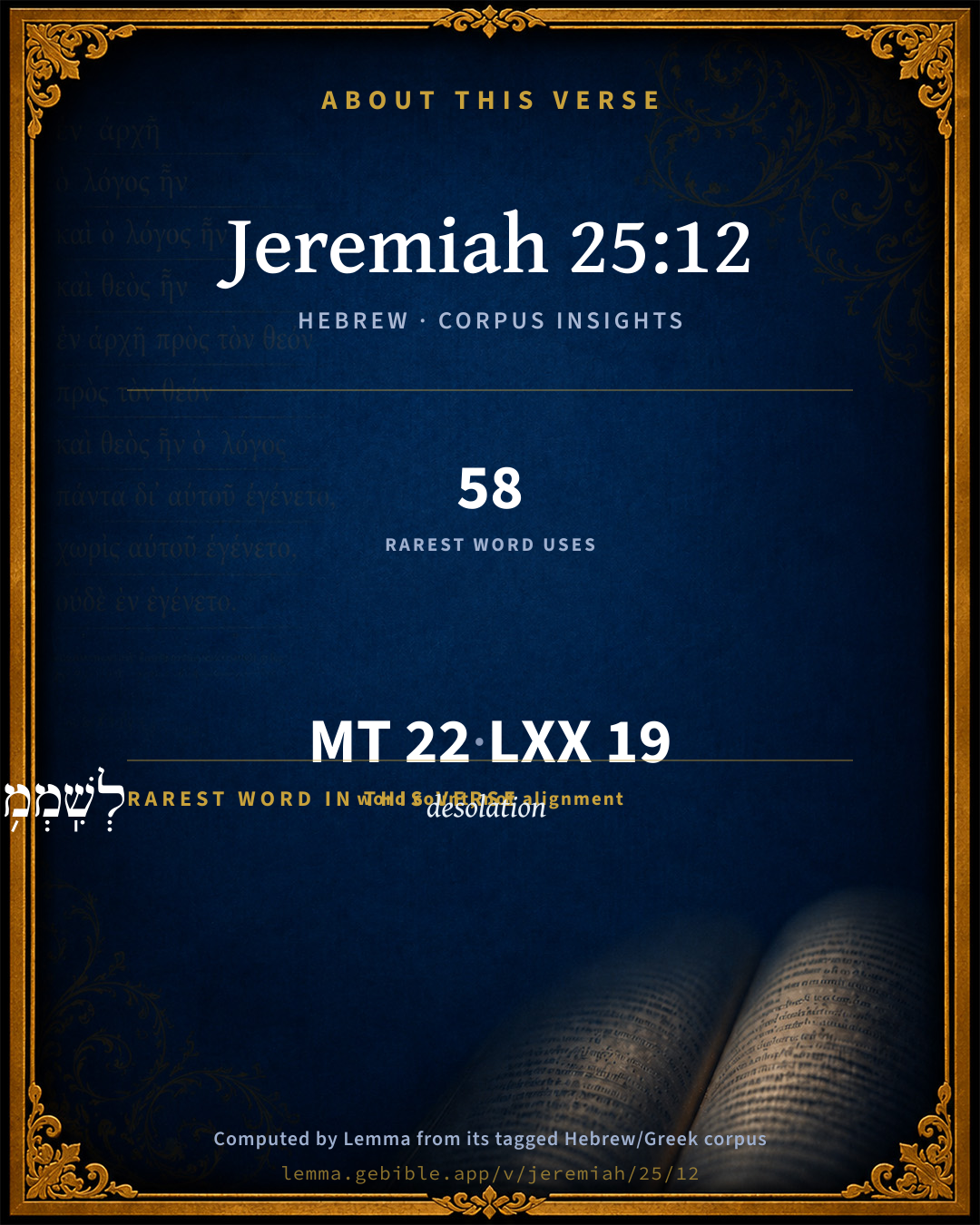
לְשִֽׁמְמ֥וֹת
shᵉmâmâh
H8077
“to/for · desolations of”
Preposition + Noun, Common, Feminine, Plural, Construct
Part of Speech
Preposition + Noun
Type
Common
Gender
Feminine
Number
Plural
State
Construct
Full BDB Definition

Origin: from H8076

TWOT: 2409b , 2409c

devastation, waste, desolation
  1. וְהָיָ֣ה hâyâh H1961 “and · to be” Conjunction + Verb, Qal, Sequential Perfect, 3rd Person, Masculine, Singular
  2. כִמְלֹ֣אות mâlêʼ H4390 “like/as · to fill” Preposition + Verb, Qal, Infinitive Construct
  3. שִׁבְעִ֣ים shibʻîym H7657 “seventy” Adjective, Cardinal number, Both, Plural, Absolute
  4. שָׁנָ֡ה shâneh H8141 “year” Noun, Common, Feminine, Singular, Absolute
  5. אֶפְקֹ֣ד pâqad H6485 “to visit” Verb, Qal, Imperfect, 1st Person, Common, Singular
  6. עַל ʻal H5921 “upon” Preposition
  7. מֶֽלֶךְ melek H4428 “king of” Noun, Common, Masculine, Singular, Construct
  8. בָּבֶל֩ Bâbel H894 “Babylon” Noun, Proper
  9. וְעַל ʻal H5921 “and · upon” Conjunction + Preposition
  10. הַגּ֨וֹי gôwy H1471 “the · nation” Particle, Definite Article + Noun, Common, Masculine, Singular, Absolute
  11. הַה֧וּא hûwʼ H1931 “the · he” Particle, Definite Article + Pronoun, Personal, 3rd Person, Masculine, Singular
  12. נְאֻם nᵉʼum H5002 “utterance of” Noun, Common, Masculine, Singular, Construct
  13. יְהוָ֛ה Yᵉhôvâh H3068 “LORD” Noun, Proper
  14. אֶת ʼêth H853 “-” Particle, Direct Object
  15. עֲוֺנָ֖ם ʻâvôn H5771 “iniquity · their” Noun, Common, Both, Singular, Construct + Suffix, Personal, 3rd Person, Masculine, Plural
  16. וְעַל ʻal H5921 “and · upon” Conjunction + Preposition
  17. אֶ֣רֶץ ʼerets H776 “land of” Noun, Common, Both, Singular, Construct
  18. כַּשְׂדִּ֑ים Kasdîy H3778 “Chaldea” Noun, Proper
  19. וְשַׂמְתִּ֥י sûwm H7760 “and · to put” Conjunction + Verb, Qal, Sequential Perfect, 1st Person, Common, Singular
  20. אֹת֖וֹ ʼêth H853 “- · him” Particle, Direct Object + Suffix, Personal, 3rd Person, Masculine, Singular
  21. עוֹלָֽם ʻôwlâm H5769 “forever” Noun, Common, Masculine, Singular, Absolute

About this verse

These counts appear in no published source. They are computed here, from the morphology-tagged text and Lemma’s own curated glosses. What Lemma adds →

22
words
19
distinct lemmas
Prophets
section

Shared distinctive vocabulary

לְשִֽׁמְמ֥וֹת desolation H8077 occurs in 54 verses of the Hebrew Bible. Also found in:

Grammatical profile

  • 4 verbs
  • 11 nouns
  • 1 adjective
  • 1 pronoun
  • 3 prepositions
  • 2 particles

Verb forms

  • וְהָיָ֣ה Qal · Sequential Perfect
  • כִמְלֹ֣אות Qal · Infinitive Construct
  • אֶפְקֹ֣ד Qal · Imperfect
  • וְשַׂמְתִּ֥י Qal · Sequential Perfect

Repetition

A word recurs within this verse — often emphatic in Hebrew:

Hebrew & Septuagint length

In the original languages it is 22 Hebrew tokens and 19 Greek tokens — but the two are counted differently (Hebrew bundles its prefixes and suffixes into one token; the Greek is in lemma form), so that isn’t a like-for-like length.

Cross-references

20

Topical passages linked to Jeremiah 25:12 in the Treasury of Scripture Knowledge — connected by theme and wording, ordered by reader-vote popularity; previews shown in the World English Bible.

  • Isaiah 13:19 Babylon, the glory of kingdoms, the beauty of the Chaldeans' pride, shall be as when God overthrew Sodom and Gomorrah.
  • Daniel 9:2 in the first year of his reign I, Daniel, understood by the books the number of the years about which the word of Yahweh came to Jeremiah the prophet, for the accomplishing of the desolations of Jerusalem, even seventy years.
  • Jeremiah 29:10 For thus says Yahweh, After seventy years are accomplished for Babylon, I will visit you, and perform my good word toward you, in causing you to return to this place.
  • Isaiah 14:23 I will also make it a possession for the porcupine, and pools of water: and I will sweep it with the broom of destruction, says Yahweh of Hosts.
  • Jeremiah 50:1–46 The word that Yahweh spoke concerning Babylon, concerning the land of the Chaldeans, by Jeremiah the prophet.
  • Jeremiah 51:62–64 and say, Yahweh, you have spoken concerning this place, to cut it off, that none shall dwell therein, neither man nor animal, but that it shall be desolate forever.
  • Deuteronomy 32:35–42 Vengeance is mine, and recompense, At the time when their foot shall slide: For the day of their calamity is at hand, The things that are to come on them shall make haste.
  • 2 Kings 24:1 In his days Nebuchadnezzar king of Babylon came up, and Jehoiakim became his servant three years: then he turned and rebelled against him.
  • Ezra 1:1–2 Now in the first year of Cyrus king of Persia, that the word of Yahweh by the mouth of Jeremiah might be accomplished, Yahweh stirred up the spirit of Cyrus king of Persia, so that he made a proclamation throughout all his kingdom, and [put it] also in writing, saying,
  • Isaiah 13:1–14 The burden of Babylon, which Isaiah the son of Amoz did see.
  • Isaiah 15:6 For the waters of Nimrim shall be desolate; for the grass is withered away, the tender grass fails, there is no green thing.
  • Isaiah 20:1–21:17 In the year that Tartan came to Ashdod, when Sargon the king of Assyria sent him, and he fought against Ashdod and took it;
  • Isaiah 46:1–47:1 Bel bows down, Nebo stoops; their idols are on the animals, and on the cattle: the things that you carried about are made a load, a burden to the weary [animal].
  • Jeremiah 23:2 Therefore thus says Yahweh, the God of Israel, against the shepherds who feed my people: You have scattered my flock, and driven them away, and have not visited them; behold, I will visit on you the evil of your doings, says Yahweh.
  • Jeremiah 25:14 For many nations and great kings shall make bondservants of them, even of them; and I will recompense them according to their deeds, and according to the work of their hands.
  • Jeremiah 51:24–26 I will render to Babylon and to all the inhabitants of Chaldea all their evil that they have done in Zion in your sight, says Yahweh.
  • Ezekiel 35:9 I will make you a perpetual desolation, and your cities shall not be inhabited; and you shall know that I am Yahweh.
  • Daniel 5:1–31 Belshazzar the king made a great feast to a thousand of his lords, and drank wine before the thousand.
  • Habakkuk 2:1–20 I will stand at my watch, and set myself on the ramparts, and will look out to see what he will say to me, and what I will answer concerning my complaint.
  • Revelation 18:1–24 After these things, I saw another angel coming down out of the sky, having great authority. The earth was illuminated with his glory.

Cross-references courtesy of OpenBible.info (CC BY 4.0).

Hebrew and Greek witnesses Masoretic Hebrew ↔ Greek Septuagint

The same verse in the two great witnesses to the Old Testament, shown verse-for-verse.

These are two independent witnesses, not word-aligned to each other, and the Septuagint is shown in lemma (dictionary) form.

Hebrew Jeremiah 25:12 Masoretic · Westminster Leningrad Codex

וְהָיָ֣ה כִמְלֹ֣אות שִׁבְעִ֣ים שָׁנָ֡ה אֶפְקֹ֣ד עַל מֶֽלֶךְ בָּבֶל֩ וְעַל הַגּ֨וֹי הַה֧וּא נְאֻם יְהוָ֛ה אֶת עֲוֺנָ֖ם וְעַל אֶ֣רֶץ כַּשְׂדִּ֑ים וְשַׂמְתִּ֥י אֹת֖וֹ לְשִֽׁמְמ֥וֹת עוֹלָֽם

It shall happen, when seventy years are accomplished, that I will punish the king of Babylon, and that nation, says Yahweh, for their iniquity, and the land of the Chaldeans; and I will make it desolate forever.

World English Bible · Public Domain

Greek LXX Structure differs

In the Septuagint, Jeremiah is about an eighth shorter than the Hebrew and arranges its material differently — the Oracles Against the Nations (Hebrew chapters 46–51) appear in the middle of the Greek book, after 25:13. Because the chapter and verse boundaries do not line up, a verse-for-verse comparison with the Hebrew is not shown.

A verse-for-verse comparison isn’t shown here because the chapters and verses don’t line up. Switch to the LXX edition with the MT / LXX toggle above to read the Greek directly.

On this verse, The Cambridge Bible for Schools and Colleges discusses the Septuagint’s reading. Read the note in Commentary ↓

Hebrew: Westminster Leningrad Codex (CC BY 4.0). Greek: Septuagint (public domain); English from a public-domain English Septuagint. How the Septuagint differs from the Hebrew →

Targum (Aramaic paraphrase)

1

The Targum is the ancient Jewish Aramaic paraphrase of the Hebrew Scriptures — an interpretive translation, not the Hebrew text itself. Onkelos (literal) and Pseudo-Jonathan (expansive) render the Torah, and Jonathan the Prophets. Coverage is partial: where no permissively-licensed English translation exists for a verse, only the Aramaic is shown. This is verse-level text, not a word-by-word alignment to the Hebrew.

  1. Targum Jonathan Prophets (Joshua–Malachi)
    וִיהֵי כְמִשְׁלַם שַׁבְעִין שְׁנִין אַסְעַר עַל מַלְכָּא דְבָבֶל וְעַל עַמָא הַהוּא אֲמַר יְיָ יַת חוֹבֵיהוֹן וְעַל אֲרַע כַּסְדָאֵי וַאֲשַׁוֵי יָתֵיהּ לְצָדוּת עֲלָם:

    (no public-domain English translation for this verse)

    Targum Jonathan — Aramaic: “Mikraot Gedolot” (public domain). English: “Sefaria Community Translation” (CC0 1.0 (public-domain dedication)); “London "Chaldee Paraphrase," 1871” (public domain). Text via Sefaria.

Commentary

Notes on Jeremiah 25:12 from classic Christian and Jewish commentators (each source and its license shown beneath its notes). The classic Christian expositions comment on the surrounding passage and are grouped to its opening verse, so a note may address several verses; the Jewish commentaries on the Tanakh (Rashi and others) are per-verse, so they appear only where the commentator wrote on this verse.

Lemma curates 59 commentaries, every one of them public domain or Creative Commons licensed, each selected and text-cleaned for this edition rather than reprinted as found. About our sources →

The Cambridge Bible for Schools and Colleges

gen. ed. J. J. S. Perowne

12–14. See end of introductory note to this section. Of these vv., 12 and 14, as well as the latter part of 13, cannot be a genuine part of Jeremiah’s prophecies, to be dated, like the earlier part of the passage, in “the 4th year of Jehoiakim,” but are subsequent insertions when the Book was virtually completed as at present. Jer_25:12 seems constructed out of Jer_29:10 (the assignment of the definite “seventy years” is shewn to be authentic there by the whole tenor of that ch.), where the Heb. “everlasting desolations” (as mg. here) is identical with that in this v. together with Jer_51:26; Jer_51:62. Moreover, (i) all three vv. form a break in the subject-matter, while Jer_25:15 f. give the reason for the punishment not of Babylon (Jer_25:12-14) but of Judah and the other nations (Jer_25:11), and (ii) Jer_25:13 implies that the prophecies against foreign nations (chs. 46–51) and in particular against Babylon (chs. 50, 51) were already included in the Book, whereas this last prophecy, if by Jeremiah at all, which may well be doubted (see introd. note there), was not placed in the collection till long after this date (see also on Jer_51:59-64 for date of that portion). Jer_25:14 (absent from LXX) appears to be made up from Jer_27:7 and Jer_50:29, Jer_51:24. Thus from the word “astonishment” in Jer_25:11 we should proceed at once (Jer_25:13) “and I will bring … this book,” continuing direct with Jer_25:15 “For, etc.”

The Cambridge Bible for Schools and Colleges (gen. ed. J. J. S. Perowne; Cambridge University Press, 1878–1918) — public domain. Text from a community e-Sword module.

Trapp's Complete Commentary

John Trapp

Jer 25:12 And it shall come to pass, when seventy years are accomplished, [that] I will punish the king of Babylon, and that nation, saith the LORD, for their iniquity, and the land of the Chaldeans, and will make it perpetual desolations.

Ver. 12. I will punish the King of Babylon.] As had been previoulsy threatened, {Isa 13:19-22; Isa 14:21-23; Isa 21:2-10; Isa 47:5; Isa 47:8-9} and was accomplished. {Dan 5:25-28; Dan 5:30}

John Trapp, A Commentary or Exposition upon All the Books of the Old and New Testament (1647–1656) — public domain. Text from a community e-Sword module.

Joseph Benson's Commentary

Jer 25:12-14. When seventy years are accomplished, I will punish the king of Babylon — “God often punishes the persons whom he makes instruments of his vengeance upon others for those very things which they did by his appointment, because their intention was merely to carry on their own ambitious and cruel purposes, and not at all to fulfil God’s will, or advance his glory. So that the evil they did was altogether their own, and the good that was brought out of it was to be ascribed solely to God.” — Lowth. See notes on Isa 10:5-7. And that nation for their iniquity — For their pride, ambition, luxury, tyranny, and cruelty, as well as for their various idolatries, which, after Daniel’s interpretation of Nebuchadnezzar’s dreams, and the miracles wrought by the God of Israel, in favour of Shadrach and his companions, not to mention the testimony borne to the true religion by many other pious Jews, were greatly aggravated, and without all excuse. And the land of the Chaldeans, and make it perpetual desolations — Chaldee was not reduced to desolation immediately upon the taking of Babylon, and the conquest of the country by the Medes and Persians, but its power was then broken, and the sources of its prosperity greatly diminished, and by degrees the country was turned into a solitude. Of the steps whereby this was effected, see notes on Isa 13:19-22, and Jer 50:40. All that is written in this book, which Jeremiah hath prophesied against all nations — Those prophecies are meant which are to be found all together from chap. 46. to chap. 51. inclusively; and which the LXX. have introduced in this place. For many nations, &c., shall serve themselves of them also — Namely, the nations and kings who were confederates with Cyrus. Houbigant renders the clause, For powerful people, and mighty kings, shall reduce even those nations to servitude, and so, &c. And Blaney to nearly the same sense, thus: For of them, even of these, shall many nations and great kings exact service; and I will render, &c.

Joseph Benson's Commentary on the Old and New Testaments (1811–1818) — public domain. Text from a community e-Sword module.

Whedon's Commentary on the Bible

Daniel D. Whedon

JUDGMENT ON BABYLON AND OTHER NATIONS, Jer_25:12-29.

12. When seventy years are accomplished — Babylon was captured 538 B.C., just sixty-eight years after the capture of Jerusalem.

Perpetual desolations — To none other of the great powers of the ancient world do these words apply so impressively and absolutely. The utter nothingness to which this vast empire has returned is not relieved even by interesting and valuable monumental remains, as in the case of Nineveh, and especially of Egypt.

Daniel D. Whedon (gen. ed.), Commentary on the Old and New Testaments (1874–1909) — public domain. Text from a community e-Sword module.

Keil & Delitzsch

C. F. Keil & F. Delitzsch

The overthrow of the king of Babylon's sovereignty. - Jer 25:12. "But when seventy years are accomplished, I will visit their iniquity upon the king of Babylon and upon that people, saith Jahveh, and upon the land of the Chaldeans, and will make it everlasting desolations. Jer 25:13. And I bring upon that land all my words which I have spoken concerning it, all that is written in this book, that Jeremiah hath prophesied concerning all peoples. Jer 25:14. For of them also shall many nations and great kings serve themselves, and I will requite them according to their doing and according to the work of their hands."

The punishment or visitation of its iniquity upon Babylon was executed when the city was taken, after a long and difficult siege, by the allied Medes and Persians under Cyrus' command. This was in b.c. 538, just 68 years after Jerusalem was taken by Nebuchadnezzar for the first time. From the time of the fall of Babylon the sovereignty passed to the Medes and Persians; so that the dominion of Babylon over Judah and the surrounding nations, taken exactly, last 68 years, for which the symbolically significant number 70 is used. The Masoretes have changed the Chet. הבאתי into הבאתי (Keri), because the latter is the usual form and is that which alone elsewhere occurs in Jeremiah, cf. Jer 3:14; Jer 36:31; Jer 49:36.; whereas in Jer 25:9 they have pointed הבאתים, because this form is found in Isa 56:7; Eze 34:13, and Neh 1:9. - The second half of the Jer 25:13, from "all that is written" onwards, was not, of course, spoken by Jeremiah to the people, but was first added to explain "all my words," etc., when his prophecies were written down and published.

Keil & Delitzsch — Biblical Commentary on the Old Testament (1861–1891) — public domain (CC PDM 1.0). Text via the HelloAO Bible API. (Old Testament only.)

Tyndale Open Study Notes

Tyndale Open Resources

25:12-14 Although the Lord used them to carry out judgment on Judah, the Babylonians would be held accountable for their sins, for their brutality, and for their abuse of those they defeated. In 539 BC, Babylon was conquered by Cyrus the Persian, and the people were taken into captivity. For centuries, many nations and great kings reduced the Babylonians to slavery, and the territory did not become independent again until 1932, as modern Iraq.

Tyndale Open Study Notes — © Tyndale Open Resources, licensed CC BY-SA 4.0. Text via the HelloAO Bible API.

Geneva Bible (1599)

Geneva Bible translators

For seeing the judgment began at his own house, the enemies must needs be punished most grievously, Ezek. 9:6, 1 Pet. 4:17.

This revelation was for the confirmation of his prophecy, because he told them of the time that they should enter and remain in captivity, 2 Chron. 36:22; Ezra 1:1; Jer. 29:10; Dan. 9:2.

Geneva Bible (1599) marginal notes — public domain. Text via Bolls.life.

Adam Clarke's Commentary

Verse 12. And that nation] הגוי ההוא haggoi hahu. Dr. Blayney contends that this should be translated his nation, and that ההוא hahu is the substantive pronoun used in the genitive case. It is certainly more clear and definite to read, "I will punish the king of Babylon, and HIS nation."

Will make it perpetual desolations] See Clarke on Isa 13:19, where the fulfilment of this prophecy is distinctly marked.

Adam Clarke's Commentary on the Bible (1810–1826) — public domain. Text from a community e-Sword/MySword module.

John Calvin's Commentaries

The Prophet now, as I have said, shews more clearly why the time of the captivity and exile had been defined, even that the faithful might know that God would not forget his covenant, though he deprived the people of the inheritance of the land. These words were not addressed indiscriminately to the whole body of the people, as we have observed before in other places; but the Prophet intended to consult the benefit of God’s elect, who always retained a concern for true religion; for they must have a hundred times despaired had not this promise been added. This, then, was a special doctrine intended as food for God’s children; for he addressed, as it was apart, the elect and faithful only.

God says also, that at the end of seventy years he would visit the iniquity of the king of Babylon, and of his whole people. We hence learn that Nebuchadnezzar was not called God’s servant because he deserved anything for his service, but because God led him while he was himself unconscious, or not thinking of any such thing, to do a service which neither he nor his subjects understood to be for God. Though, then, the Lord employs the ungodly in executing his judgments, yet their guilt is not on this account lessened; they are still exposed to God’s judgment. And these two things well agree together, — that the devil and all the ungodly serve God, though not of their own accord, but whenever he draws them by his hidden power, and that they are still justly punished, even when they have served God; for though they perform his work, yet not because they are commanded to do so. They are therefore justly liable to punishment, according to what the Prophet teaches us here.

John Calvin's Commentaries (1540-1563) — public domain. Text from the Calvin Translation Society English edition (1840s-50s) via the Christian Classics Ethereal Library (ccel.org). Calvin's coverage is partial (roughly two-thirds of the Bible); uncommented books and verses are honest gaps, never fabricated. The 19th-century editor's footnotes and remarks are omitted so the notes are faithfully Calvin's own voice.

Ellicott's Commentary for English Readers

(12) I will punish the king of Babylon . . .—The words are omitted in the LXX. version of the chapter, which differs materially from the Hebrew text, and there are some internal grounds for suspecting it to be a later addition, possibly from the hand of the prophet himself, or, more probably, from that of Baruch as collecting and editing his writings, or of some later transcriber. In Jer_25:26, as commonly interpreted, there is a prediction of the destruction of the king of Babylon veiled in enigmatic language. That we can understand well enough, if it was meant only for the initiated, but it is not easy to see why the same prophetic discourse should contain both the veiled and the open prediction. On the relation of the LXX. version to the Hebrew, see Introduction.

A Bible Commentary for English Readers, edited by Charles John Ellicott (1878–1897) — public domain. Text from a community e-Sword module.

John Gill's Exposition

And it shall come to pass, when seventy years are accomplished,.... Which were accomplished in the first year of Cyrus: they began with the first year of Nebuchadnezzar, who reigned two years and two months with his father Nabopolassar; after that forty three years by himself; Evilmerodach two years: Neriglissar four years; Belshazzar or Nabonadius seventeen years; and Darius the Median two years; which all make sixty nine years and two months; and if ten months more be added to complete the said seventy years, it will carry the end of them to the first year of Cyrus (g). These years are differently reckoned by others; by Spanhemius, from the first of Nebuchadnezzar, or fourth of Jehoiakim, to the destruction of the city under Zedekiah, nineteen years; thence to the death of Nebuchadnezzar, twenty four; then Evilmerodach, two; then the reign of Neriglissar, including some months of Laborosoarchod, five; then the years of Nabonadius, or Belshazzar, seventeen; and from his death, or the taking of Babylon, to the death of Darius the Mede, two years; which make sixty nine, exclusive of the first of Cyrus; and comes to much the same as the former. By James Alting thus; from the eighteenth year of Nebuchadnezzar, complete, to his death, twenty six years; Evilmerodach, twenty three; Belshazzar, three; Darius the Mede, eighteen, after the destruction of the Babylonish empire; which seems very wrong; better, by Dr. Lightfoot, thus; Nebuchadnezzar, forty five current; Evilmerodach, twenty three; and Belshazzar, three (h). So the Jewish chronicle (i):

that I will punish the king of Babylon, and that nation, saith the Lord, for their iniquity; the king for his tyranny, and the nation for their idolatry; and both for these and other sins they were guilty of; for, though they did the will of God in carrying the Jews captive, they no doubt in their usage of them exceeded their commission, and were justly punishable for their iniquities. This is not to be understood of the present king of Babylon, Nebuchadnezzar; but of Nabonadius, or Belshazzar, whom the Lord punished by Cyrus; who appears to have been a very wicked man, and in the excess of not, profaning the vessels of the temple the night he was slain, Dan 5:1;

and the land of the Chaldeans; and will make it perpetual desolations; even as other nations had been made by them, Jer 25:9.

(g) See Prideaux's Connexion, par. 1. B. 2. p. 130. (h) Vid. Witsii Exercitat. 11. in Miscel. Sacr. tom. 2. p. 282, 283. (i) Seder Olam Rabba, c. 28. p. 81.

John Gill's Exposition of the Whole Bible (1746–1763) — public domain (CC PDM 1.0). Text via the HelloAO Bible API.

Albert Barnes' Notes on the Bible

Perpetual desolations - The ruins of Babylon form its only lasting memorial.

Albert Barnes' Notes on the Bible (1834–1885) — public domain. Text from a community e-Sword/MySword module.

Haydock's Catholic Bible Commentary

Punish. Literally, visit upon. (Challoner) --- Cyrus overturned the monarchy, and the city was ruined by degrees, Isaias xiii., and xiv., and xxi. 1., and Ezechiel i. 5. (Calmet)

George Leo Haydock (1774–1849), Haydock's Catholic Family Bible and Commentary, 1859 edition — public domain. Excludes Psalms (Douay-Rheims chapter numbering differs from Protestant) and Deuterocanonical books (Catholic canon only).

Matthew Poole's English Annotations

When seventy years are accomplished; seventy years accounted from the time that the Jews were carried away in the time of Jeconiah or Jehoiachin, 2Ki 24:15,16. This was fulfilled by Darius the king of Persia, Dan 4:31. Of these seventy Nebuchadnezzar reigned thirty-six, 2Ki 25:27, Evil-merodach thirty-two, and Belshazzar at least two, Dan 8:1. Though God, whose all the creation is, and who is the Lord of all the hosts of his creatures, doth often make use of heathens and other wicked men to punish his own people, yet he will at last punish them too; and ordinarily when he doth punish them, it is with a more severe and grievous destruction than that by which he punisheth his people, Isa 27:7; thus he threatens to make the Chaldeans a perpetual desolation.

Matthew Poole's English Annotations on the Holy Bible (1683–1685) — public domain. Text from a community e-Sword/MySword module.

The Pulpit Commentary

Vers. 12-29. The judgment upon Judah and the nations.

Perpetual desolations. Thus, too, we read in Isa_13:20, that Babylon "shall never be inhabited." There is a dispute between Dr. Keith and Dr. Kay on the one side, and rationalistic commentators (e.g. Kuenen) on the other, whether these prophecies have received a circumstantial fulfillment. The truth is that authorities are not entirely agreed on the area covered by the site of Babylon. General Chesney remarks that, so far from being uninhabited, "A town of considerable population, villages, date groves, and gardens, are found still on the very site of ancient Babylon" (extracts from a private letter in B. W. Newton"s "Babylon: its Revival and Final Desolation," pp. 38-42). Similarly M. Menant, a veteran French Assyriologist, remarks that "Hillah, according to M. Oppert, was a quarter of Babylon, probably that which was inhabited by the working population, without the precincts of the royal palaces. Numberless traces of ancient habitations indicate this origin of the modern town" ("Babylone," p. 177). Mr. George Smith, however, in his "Assyrian Discoveries," simply states that, "A little to the south rose the town of Hillah," apparently assuming (what is impossible to prove, as the walls of Babylon have not yet been discovered) that Hillah lay just outside the city enclosure. But even he adds that it was "built with the bricks found in the old capital," which is, strictly speaking, inconsistent with the absolute abandonment of the site of Babylon implied in Isa_13:20-22. The dispute is an unfortunate one, as it tacitly implies that circumstantial fulfillments are necessary to the veracity of prophecy. The truth seems to lie in the mean between two opposing views. As a rule, the details of a prophetic description cannot be pressed; they are mainly imaginative elaborations of a great central truth or fact. Occasionally, however, regarding the prophecies in the light of gospel times, it is almost impossible not to observe that "the Spirit of Christ which was in" the prophets (1Pe_1:11) has overruled their expressions, so that they correspond more closely to facts than could have been reasonably anticipated. Such superabundant favors to believers in inspiration occur repeatedly in the prophecies respecting Christ. They may, of course, occur elsewhere for a sufficient reason, but we have no right to be surprised if we do not meet with them. The general truth of the prophecy is that the empire of Babylon shall fall forever. As Dr. Payne Smith remarks, it was practically the work of one man (Nebuchadnezzar), and after his death it only lasted for a few years, during which its history is a series of murders and usurpations.

The Pulpit Commentary (1880–1919), ed. H.D.M. Spence-Jones & Joseph S. Exell — public domain. Text from a community e-Sword module.

John Wesley's Explanatory Notes

Accomplished - Counted from the time that the Jews were carried away in the time of Jeconiah or Jehoiakim, 2 Kings xxiv, 15, 16. Desolations - This was fulfilled by Darius, the king of Persia, Dan. iv, 31, of these seventy Nebuchadnezzar reigned thirty six, 2 Kings xxv, 27. Evil-merodach thirty two, and Belshazzar at least two, Dan. viii, 1.

John Wesley, Explanatory Notes Upon the Whole Bible (1754–1765) — public domain. Text via the GEBible commentary corpus.

Kretzmann's Popular Commentary

Paul E. Kretzmann

The Judgment on the Kingdoms

v. 12. And it shall come to pass, when seventy years are accomplished, namely, from the time of the first deportation to Babylon, that I will punish the king of Babylon and that nation, saith the Lord, for their iniquity, visiting their guilt upon them and the land of the Chaldeans, and will make it perpetual desolations, the enemies thus being punished in turn, even as it happened when the Medes and Persians under the command of Cyrus overthrew the Babylonian empire.

v. 13. And I will bring upon that land all My words which I have pronounced against it, carrying out His threats upon the entire country, even all that is written in this book, which Jeremiah hath prophesied against all the nations, for it was in this year that Jeremiah was, for the first time, told to write all his prophecies against the various foreign nations in a book, so that this remark was inserted when the collection was made.

v. 14. For many nations and great kings shall serve themselves of them also, that is, the Chaldeans themselves would, in turn, become servants to others, so that their masters would exact the service of vassals from them; and I will recompense them according to their deeds and according to the works of their own hands. This is further emphasized by the picture of the Lord’s cup of fury.

v. 15. For thus saith the Lord God of Israel unto me, Take the wine-cup of this fury at My hand, a symbol of stupefying judgments, and cause all the nations to whom I send thee to drink it, a symbolical action which could be used to illustrate an important truth.

v. 16. And they shall drink and be moved, so that they would stagger and reel, and be mad, stunned and stupefied with the intoxicating effects of the liquid consumed, because of the sword that I will send among them, that is, the war which the Lord intended to bring upon these nations would be so severe, so horrible, that people would be stupefied by its terrors and perish in helpless confusion.

v. 17. Then took I the cup at the Lord’s hand, all this in the vision which was vouchsafed him, and made all the nations to drink unto whom the Lord had sent me, namely, by making an open announcement of this intention on the part of Jehovah:

v. 18. to wit, Jerusalem and the cities of Judah, these two heading the list as the chief offenders against the Lord of the covenant, and the kings thereof and the princes thereof, to make them a desolation, an astonishment, an hissing, and a curse, objects of mockery and imprecations, as it is this day;

v. 19. Pharaoh, king of Egypt, upon whom the Jews had chiefly relied, and his servants and his princes and all his people,

v. 20. and all the mingled people, small tribes of a mixed population near the borders of Egypt and elsewhere, and all the kings of the land of Uz, in Northwestern Arabia, near the borders of Idumea and Egypt, and all the kings of the land of the Philistines, of the various Philistine city-states, and Ashkelon, and Azzah, or Gazah, and Ekron, and the remnant of Ash-dod, this city being very much reduced in size and influence on account of the Egyptian oppression, Gath, the fifth of the ancient city-states, not being mentioned, probably because it no longer was a separate capital,

v. 21. Edom, south of the Dead Sea, and Moab, east of the Dead Sea, and the children of Anunon, tribes to the northeast of Moab,

v. 22. and all the kings of Tyrus, and all the kings of Zidon, the representative cities of Phenicia on the Mediterranean Sea, and the kings of the isles which are beyond the sea, all the distant countries along the shores of the Mediterranean and the nations on its islands,

v. 23. Dedan, north of Arabia, and Tema, an Arabian city not far from Damascus, and Buz, another city and tribe in this neighborhood, and all that are in the utmost corners, the entire section of Arabia bordering on Palestine,

v. 24. and all the kings of Arabia, and all the kings of the mingled people that dwell in the desert, where tribes no longer were of pure blood,

v. 25. and all the kings of Zimri, probably a country toward the Euphrates, and all the kings of Elam, to the east of the Tigris, used for Persia in general, and all the kings of the Medes,

v. 26. and all the kings of the North, far and near, a general expression referring to all the empires in the valleys of the Euphrates and the Tigris and beyond, one with another, and all the kingdoms of the world, which are upon the face of the earth, and the king of Sheshach, shall drink after them, Babylon itself being designated by this term and included in the list of those who were to be stunned by the wine of God’s avenging fury.

v. 27. Therefore thou shall say unto them, Thus salth the Lord of hosts, whose majesty and power would here find expression, the God of Israel, Drink ye, namely, the cup of the Lord’s fierce anger, and be drunken, and spue, vomiting as a result of their excessive drinking, and fall, and rise no more, being completely overcome by the powerful potion, because of the sword which I will send among you.

v. 28. And it shall be, if they refuse to take the cup at thine hand to drink, unwilling to let His punishment strike them, then shalt thou say unto them. Thus saith the Lord of hosts, Ye shall certainly drink, compelled to endure the destruction which had been resolved upon in their case.

v. 29. For, lo, I begin to bring evil on the city which is called by My name, revealed in the Word which had been proclaimed by His prophets from the early days, Jerusalem being the center of the true worship, and should ye be utterly unpunished? Should the Lord treat the others as innocent and forbear wreaking His vengeance upon them, if He did not spare the city which He had chosen as the place of His Sanctuary? Ye shall not be unpunished; for I will call for a sword upon all the inhabitants of the earth, saith the Lord of hosts. His patience was now exhausted, and He intended to include all His enemies in the punishment which was about to go forth.

Paul E. Kretzmann, Popular Commentary of the Bible (1921–1924) — public domain. Text from a community e-Sword module.

unfoldingWord translationNotes

Door43 World Missions Community

when seventy years have been completed

"after seventy years" or "after seventy years have passed"

this is Yahweh's declaration

Yahweh speaks of himself by name to express the certainty of what he is declaring. See how you translated this in Jeremiah 1:8. AT: "this is what Yahweh has declared" or "this is what I, Yahweh, have declared" (See: First, Second, or Third Person)

an unending desolation

The noun "desolation" can be translated as an adjective. AT: "desolate forever" (See: Abstract Nouns)

everything written in this book

This can be translated in active form. AT: "everything that Jeremiah has written in this book" or "everything that one has written in this book" (See: Active or Passive)

I will repay them for their deeds and the works of their hands

Yahweh speaks of punishing the people of the nations for what they have done as if he were paying them back. (See: Metaphor)

their deeds and the works of their hands

These two phrases mean basically the same thing. The idiom "the works of their hands" refers to the actions of a person, with the word "hands" being a synecdoche that represents the person who does those actions. AT: "everything that they have done" (See: Doublet and Idiom and Synecdoche)

translationWords

punish

Chaldea

declare

iniquity

written

prophet

works

hand

unfoldingWord translationNotes — © Distant Shores Media and the Door43 World Missions Community, licensed CC BY-SA 4.0. Source: git.door43.org/Door43/en_tn.

Lesson kit

Teaching starters — assembled from the data on this page, not authored interpretation. Every prompt links to the verse data it draws on. Edit before teaching.

Jeremiah, in the Prophets, opens this verse with 22 words (19 distinct Hebrew lemmas). Its most distinctive word is shᵉmâmâh (“desolation”). A historical commentator’s framing appears above. Read the whole chapter for the surrounding context.

Discussion questions

  1. The word shᵉmâmâh carries the sense “desolation.” How does it shape the verse?
  2. How does Exodus 23:29, which shares the word «desolation», read alongside this verse?
  3. What does the repetition of “upon” (3× in this one verse) do in this verse?
  4. These translations render this verse differently; the difference is in the English rendering, not the original. What questions does that raise?
  5. «וְהָיָ֣ה» is a Qal Sequential Perfect verb. How does that grammatical form shape the action described?
  6. Compare how The Cambridge Bible for Schools and Colleges and Trapp's Complete Commentary read this verse. Where do they agree or differ?

Things to notice

Reading settings

Reading text

Shown beneath each verse's original-language words.

Old Testament
Old Testament edition

Read the OT as the Masoretic Hebrew (MT) or the Greek Septuagint (LXX).

English shown for the Greek Septuagint (in the Hebrew ↔ Greek comparison).

Comparing translations? Open the Compare panel on any verse page to stack up to four side by side.